DOI 10.1007/s00453-016-0252-6
Matchings with Lower Quotas: Algorithms
and Complexity
Ashwin Arulselvan1 · Ágnes Cseh2 · Martin Groß3 · David F. Manlove4 · Jannik Matuschke5
Received: 27 March 2016 / Accepted: 11 November 2016
© The Author(s) 2016. This article is published with open access at Springerlink.com
Abstract We study a natural generalization of the maximum weight many-to-one matching problem. We are given an undirected bipartite graphG=(A ˙∪P,E)with weights on the edges in E, and with lower and upper quotas on the vertices in P.
A preliminary version of this paper appeared at the 26th International Symposium on Algorithms and Computation (ISAAC 2015). The authors were supported by the Hungarian Academy of Sciences under its Momentum Programme (LP2016-3), COST Action IC1205 on Computational Social Choice, DFG within Project A07 of CRC TRR 154, EPSRC Grant EP/K010042/1, DAAD with funds of BMBF and the EU Marie Curie Actions. Part of this work was carried out whilst Á. Cseh was visiting the University of Glasgow.
B
Ágnes Cseh[email protected] Ashwin Arulselvan
[email protected] Martin Groß
[email protected] David F. Manlove
[email protected] Jannik Matuschke
1 Department of Management Science, University of Strathclyde, Sir William Duncan Building,
Glasgow G4 0GE, UK
2 Institute of Economics, Hungarian Academy of Sciences, Budaörsi út 45., Budapest 1112,
Hungary
3 Institute for Mathematics, TU Berlin, Straße des 17. Juni 136, 10623 Berlin, Germany 4 School of Computing Science, University of Glasgow, Sir Alwyn Williams Building,
Glasgow G12 8QQ, UK
5 TUM School of Management, Technische Universität München, Arcisstraße 21, 80333 Munich,
We seek a maximum weight many-to-one matching satisfying two sets of constraints: vertices in A are incident to at most one matching edge, while vertices in P are either unmatched or they are incident to a number of matching edges between their lower and upper quota. This problem, which we call maximum weight many-to-one matching with lower and upper quotas (WMLQ), has applications to the assignment of students to projects within university courses, where there are constraints on the minimum and maximum numbers of students that must be assigned to each project. In this paper, we provide a comprehensive analysis of the complexity of WMLQ from the viewpoints of classical polynomial time algorithms, fixed-parameter tractability, as well as approximability. We draw the line betweenNP-hard and polynomially tractable instances in terms of degree and quota constraints and provide efficient algorithms to solve the tractable ones. We further show that the problem can be solved in polynomial time for instances with bounded treewidth; however, the corresponding runtime is exponential in the treewidth with the maximum upper quotaumaxas basis, and we prove that this dependence is necessary unlessFPT=W[1]. The approximability of WMLQ is also discussed: we present an approximation algorithm for the general case with performance guaranteeumax+1, which is asymptotically best possible unless P = NP. Finally, we elaborate on how most of our positive results carry over to matchings in arbitrary graphs with lower quotas.
Keywords Maximum matching· Many-to-one matching·Project allocation· Inapproximability·Bounded treewidth
1 Introduction
Many university courses involve some element of team-based project work. A set of projects is available for a course and each student submits a subset of projects as acceptable. For each acceptable student–project pair(s,p), there is a weightw(s,p)
denoting theutilityof assigningstop. The question of whether a given project can run is often contingent on the number of students assigned to it. Such quota constraints also arise in various other contexts involving the centralized formation of groups, including organizing team-based activities at a leisure center, opening facilities to serve a community and coordinating rides within car-sharing systems. In these and similar applications, the goal is to maximize the utility of the assigned agents under the assumption that the number of participants for each open activity is within the activity’s prescribed limits.
We model this problem using a weighted bipartite graphG=(A˙∪P,E), where the
The objective is to find a maximum weight many-to-one matching satisfying all lower and upper quotas. We denote this problem by WMLQ.
In this paper, we study the computational complexity of WMLQ from various perspectives. We begin by defining the problem formally in Sect.2. Then in Sect.3, we show that WMLQ can be solved efficiently if the degree of every post is at most 2, whereas the problem becomes hard as soon as posts with degree 3 are permitted, even when lower and upper quotas are all equal to the degree, and every applicant has a degree of 2. Furthermore, we show the tractability of the case of pair projects, i.e., when all upper quotas are at most 2. In Sect.4, we study the fixed parameter tractability of WMLQ. To this end, we generalize the known dynamic program for maximum independent set with bounded treewidth to WMLQ. The running time of our algorithm is exponential in the treewidth of the graph, withumax, the maximum upper quota of any vertex, as the basis. This yields a fixed-parameter algorithm when parameterized by both the treewidth and umax. We show that this exponential dependence on the treewidth cannot be completely separated from the remaining input by establishing a
W[1]-hardness result for WMLQ parameterized by treewidth. Finally, in Sect.5, we discuss the approximability of the problem. We show that a simple greedy algorithm yields an approximation guarantee ofumax+1 for WMLQ and√|A|+1 in the case of
unit edge weights. We complement these results by showing that these approximation factors are asymptotically best possible, unlessP=NP. We briefly comment on the generalizability our aforementioned results in Sect.6for matchings in arbitrary graphs with lower quotas.
1.1 Related Work
Among various applications of centralized group formation, perhaps the assignment of medical students to hospitals has received the most attention. In this context, as well as others, the underlying model is a bipartite matching problem involving lower and upper quotas. The Hospitals/Residents problem with Lower Quotas (HRLQ) [4,14] is a variant of WMLQ where applicants and posts have ordinal preferences over one another, and we seek astable matchingof residents to hospitals. Hamada et al. [14] considered a version of HRLQ where hospitals cannot be closed, whereas the model of Biró et al. [4] permitted hospital closures. Strategyproof mechanisms have also been studied in instances with ordinal preferences and no hospital closures [9,12,13].
quotas and project closures, but our focus is on cardinal utilities rather than ordinal preferences. Cardinal utilities can facilitate a more flexible representation of prefer-ences and they occur naturally in various matching problems, such as the solution of symmetric indefinite systems [31], the organization of Chess tournaments [28] or car sharing [15]. Moreover, various methods for converting ordinal preferences into cardinal utilities are known, such as the normalized Borda score [30].
The unit-weight version of WMLQ is also closely related to theD-matching prob-lem[8,23,33], a variant of graph factor problems [29]. In an instance of theD-matching problem, we are given a graphG, and a domain of integers is assigned to each vertex. The goal is to find a subgraphGofGsuch that every vertex has a degree inGthat is contained in its domain. Lovász [22] showed that the problem of deciding whether such a subgraph exists isNP-complete, even if each domain is either{1}or{0,3}. On the other hand, some cases are tractable. For example, if for each domain D, the complement ofDcontains no consecutive integers, the problem is polynomially solv-able [33]. As observed in [32], D-matchings are closely related toextended global cardinality constraints and the authors provided an analysis of the fixed-parameter tractability of a special case of theD-matching problem; see Sect.4for details.
The problem that we study in this paper corresponds to an optimization version of the D-matching problem. We consider the special case whereGis bipartite and the domain of each applicant vertex is{0,1}, whilst the domain of each post vertexpis
{0} ∪ {(p), . . . ,u(p)}, where(p)andu(p)denote the lower and upper quotas of
prespectively. Since the empty matching is always feasible in our case, our aim is to find a domain-compatible subgraphGsuch that the total weight of the edges inGis maximum.
2 Problem Definition
In this section we provide a formal definition of the maximum weight many-to-one matching problem with lower quotas (WMLQ).
Basic Notation LetG=(V,E)be a graph. For a subset of verticesU ⊆Vwe denote byδ(U)= {{v, w} ∈E :v∈U, w∈V \U}the set of edges incident to exactly one vertex inU. For a vertexv ∈ V, we writeδ(v) =δ({v}), and for a subset of edges
F ⊆Ewe write degF(v)= |δ(v)∩F|. ByΓ (v)= {w∈V : {v, w} ∈E}we denote theneighborhoodofv, i.e., the set of vertices that are adjacent tov.
In our problem, a set of applicants A and a set of posts P are given. Aand P
constitute the two vertex sets of an undirected bipartite graphG=(V,E)withV = A˙∪P andE represents the set of acceptable applicant-post pairs. Each edge carries aweightw : E → R≥0, representing the utility of the corresponding assignment.
The set of posts is equipped with functions : P → Z≥0 andu : P → Z≥0
such that (p) ≤ u(p) for every p ∈ P. Here (p) is called thelower quota of
p andu(p)is called theupper quota of p. These functions bound the number of admissible applicants for the post (independent of the weight of the corresponding edges). Furthermore, every applicant can be assigned to at most one post. Thus, an
applicanta ∈ Aand|δ(p)∩M| ∈ {0, (p), (p)+1, . . . ,u(p)}for every p ∈ P. With respect to an assignmentM, a post is said to beopenif the number of applicants assigned to it is greater than 0, andclosedotherwise. Thesizeof an assignmentM, denoted|M|, is the number of assigned applicants, while theweightof M, denoted w(M), is the total weight of the edges in M, i.e.,w(M)=e∈Mw(e). The goal is to find an assignment of maximum weight. Formally, we define the WMLQ problem as follows.
Problem 1 WMLQ
Input:I = (G, w, ,u); a bipartite graph G = (A˙∪P,E)with edge weightsw, lower quotasand upper quotas u.
Task: Find an assignment of maximum weight.
Ifw(e)=1for all e∈ E, we refer to the problem asmlq.
Remark 1 Note that when lower quotas are present but posts cannot be closed, we obtain the Degree Constrained Subgraph Problem (DCS); a maximum weight match-ing in an instance of DCS can be found in polynomial time [10]. In the special case that lower quotas are absent, DCS is referred to as the Upper Degree Constrained Subgraph Problem (UDCS) [10].
Some trivial simplification of the instance can be executed right at the start. If
u(p) >|Γ (p)|for a postp, thenu(p)can be replaced by|Γ (p)|. On the other hand, if(p) >|Γ (p)|, then post pcan immediately be deleted, since no feasible solution can satisfy the lower quota condition. Moreover, a post p with(p) = 1 behaves identically to the case that(p)=0, so we assume that no postphas(p)=1. From now on we assume that the instances have already been simplified this way.
3 Degree- and Quota-Restricted Cases
In this section we characterize the complexity of WMLQ in the presence of upper bounds placed on vertex degrees or the posts’ upper quotas. Section3.1deals with degree-restricted cases, whilst Sect.3.2studies cases involving bounded upper quotas.
3.1 Degree-Restricted Cases
Theorem 1 mlq(2,3)isAPX-complete.
Proof First of all,mlq(2,3)is inAPXbecause the problem has a 4-approximation that can be found in polynomial time (see Theorem7).
To each instanceIof mison cubic graphs we create an instanceIof mlqsuch that there is an independent vertex set of size at leastK inIif and only ifIadmits an assignment of size at least 3K, yielding an approximation-preserving reduction. The construction is as follows. To each of the n vertices of graph G inI, a post with upper and lower quota of 3 is created. Themedges ofG are represented asm
applicants inI. For each applicanta ∈ A,|Γ (a)| =2 andΓ (a)comprises the two posts representing the two end vertices of the corresponding edge. Since we work on cubic graphs,|Γ (p)| =3 for every postp∈ P.
First we show that an independent vertex set of sizeK can be transformed into an assignment of at least 3Kapplicants. All we need to do is to open a post with its entire neighborhood assigned to it if and only if the vertex representing that post is in the independent set. Since no two posts stand for adjacent vertices inG, their neighbor-hoods do not intersect. Moreover, the assignment assigns exactly three applicants to each of theK open posts.
To establish the opposite direction, let us assume that an assignment of cardinality at least 3K is given. The posts’ upper and lower quota are both set to 3, therefore, the assignment involves at leastK open posts. No two of them can represent adjacent vertices inG, because then the applicant standing for the edge connecting them would be assigned to both posts at the same time.
Note that every solution of the constructed instance ofmlqserves an integer multi-ple of 3 applicants. In particular, themlqinstance has a solution serving 3Kapplicants if and only if there is an independent set of sizeK in themisinstance. Hence, this reduction preserves the approximation factors. Sincemlq(2,3)belongs toAPXand misisAPX-complete in cubic graphs, it follows thatmlq(2,3)isAPX-complete.
So far we have established that if |Γ (a)| ≤ 2 for every applicanta ∈ A and
|Γ (p)| ≤3 for every postp∈ P, thenmlqisNP-hard. In the following, we also show that these restrictions are the tightest possible. If|Γ (p)| ≤2 for every post p ∈ P, then a maximum weight matching can be found efficiently, regardless of|Γ (a)|. Note that the case WMLQ(1,∞) is trivially solvable.
Theorem 2 WMLQ(∞,2) is solvable in O(n2logn)time, where n= |A| + |P|.
Proof After executing the simplification steps described at the end of Sect.2, we apply two more changes to derive our helper graphH. Firstly, if(p)=0,u(p)=2 and
|Γ (p)| =2, we separatep’s two edges, splittingpinto two posts with upper quota 1. After this step, all posts withu(p)=2 also have(p)=2. All remaining vertices are of upper quota 1. Then, we substitute all edge pairs of posts with(p)=u(p)=2 with a single edge connecting the two applicants. This edge will carry the weight equal to the sum of the weights of the two deleted edges.
Clearly, any matching inHtranslates into an assignment of the same weight inG
and vice versa. Finding a maximum weight matching in a general graphG=(V,E)
can be done inO(|V|(|E|+|V|log|V|))time [11], which reduces toO(|V|2log|V|)
3.2 Quota-Restricted Cases
In this section, we consider restrictions of WMLQ with bounded upper quotas. Note that Theorem1already tells us that the case ofu(p)≤3 for all posts p∈ Pis NP-hard to solve. We will now settle the complexity of the only remaining case, where we have instances with every post p ∈ Phaving an arbitrary degree andu(p)≤ 2. This setting models posts that need to be assigned to none, one or pairs of applicants. Here we present a solution for WMLQ withu(p)≤2. Our algorithm is based on
f-factors of graphs. In thef -factor problem, a graphGand a functionf :V →Z≥0is
given. A set of edgesF ⊆Eis called an f -factorif degF(v)= f(v)for everyv∈V,
where degF(v), as per our earlier definition, is the degree ofv in the graph(V,F).
Constructing an f-factor of maximum weight in a graph withnvertices andmedges or proving that none exists can be done in O(φ(m+nlogn))time, whereφis the sum of all f-values in the graph [10,11].
Theorem 3 WMLQ with u(p)≤2for every p∈P can be solved in O(nm+n2logn) time, where n= |V|and m= |E|.
Proof We partition P into P1 and P \ P1, where P1 denotes the set of posts with
u(p) = 1. For posts in P \ P1 we can assume that (p) = u(p) = 2 for every postp. For, a postpwith(p)=0 andu(p)=2 can be transformed into a post with (p)=u(p)=2 by giving it two dummy edges with zero weight, allowing us to pick the dummy edges in order to make up for the raised lower quota.
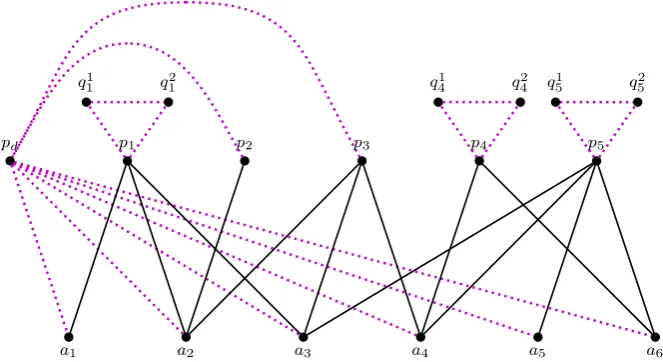
The graphG =(V,E)of the constructed f-factor instance contains the graph
G=(V,E)of our WMLQ instance, as shown in Fig.1. We add a dummy postpdto
Vand connect it to every applicant inA. We connect every post pi ∈ P1topd. For
every post pi ∈ P\P1we add two dummy verticesqi1andqi2and a triangle on the
vertices pi,qi1andqi2. All new edges inE\Ecarry zero weight.
We set f(pd)=K, f(p)=u(p)for every p∈ Pand f(v)=1 for the rest of the
vertices. In the initial version of our algorithm, we solve a weighted f-factor problem for everyK ∈ {0,1, . . . ,|A|+|P1|}, and later we will show a slightly modified version of the f-factor instance so that it is sufficient to construct only two instances.
First we show that if there is a feasible assignmentM inGso that the number of unmatched applicants and the number of closed posts inP1add up toK, then it can be extended to an f-factorMof the same weight inG. We constructMstarting with
M and then adding the following edges to it:
– {pd,ai}for every applicantai that is unmatched inM;
– qi1,pi
andqi2,pi
for every post pi ∈ P\P1that is closed inM;
– qi1,qi2for every post pi ∈ P\P1that is open inM;
– {pd,pi}for every post pi ∈ P1that is closed inM;
For all vertices v = pd, it immediately follows from the construction that
degM(v) = f(v). The same holds for pd as well, because an edge is assigned to
it either because an applicant is unmatched or because a post in P1is closed and we assumed that these add up toK.
It is easy to see that if there is an f-factor M in G, then its restriction toG
pd p1 p2 p3 p4 p5
a1 a2 a3 a4 a5 a6
q1
1 q21 q41 q24 q51 q25
Fig. 1 The transformation from WMLQ to anf-factor problem. Thesolidedges formG, while thedotted
edges are the added ones, carrying weight 0. Here,P1= {p2,p3}andP\P1= {p1,p4,p5}
applicants and the number of closed posts inP1add up toK. Since every postpi ∈ P1
is connected to pd and f(pi) = 1, it is either the case that pi is open in M or
{pd,pi} ∈ M. Regarding posts outside ofP1, we need to show that the two edges
incident to them are either both in Gor neither of them are inG. Assume without loss of generality that{pi,qi1} ∈ M and{pi,qi2} ∈/ Mfor some pi ∈/ P1. Since
f(qi2)=1 and degM(qi2)=0,Mcannot be an f-factor.
So far we have shown that it is sufficient to test|A|+|P1|+1 values for f(pd), and
collect the optimal assignments given by the maximum weight f-factors. Comparing the weight of these locally optimal solutions delivers a global optimum. A slight modification on the the graph corresponding to the f-factor instance will allow us to solve the problem by constructing just two instances, as against|A| + |P1| +1 instances. Similar to the triangles attached to posts inP\ P1, triangles are added to
pd as well. The added vertices have f-value 1 and the added edges carry weight 0.
The number of such triangles hanging on pd is
|A|+|P1|
2
. These triangles can take up all the f-value ofpdif necessary, but by choosing the edge not incident topdthey
can also allow pdto fill up its f-value with other edges. Since a triangle either takes
up 0 or 2 ofpd’s f-value, we need to separate the two different parity cases. Thus, to
cover all the|A| + |P1| +1 cases for possible values for f(pd), in one instance we
set f(pd)to|A| + |P1| +1 and in the other instance f(pd)= |A| + |P1|.
4 Bounded Treewidth Graphs
[image:8.439.53.385.56.237.2]language processing [5]. More specifically, WMLQ could be used as a potential mod-eling approach to handle load balancing in telecommunication networks that requires throughput maximization. In WLAN and P2P networks, servers have limited capacities and in addition the loads need to be reasonably balanced among the active servers [3]. This could be quite efficiently modeled using the upper and lower quotas. Moreover, certain P2P and WLAN networks have bounded treewidth [19].
Fixed-Parameter Tractability This field of complexity theory is motivated by the fact that in many applications of optimization problems certain input parameters stay small even for large instances. A problem, parameterized by a parameterk, is fixed-parameter tractable (FPT) if there is an algorithm solving it in time f(k)·φ(n), wheref :R→R
is a function,φis a polynomial function, andnis the input size of the instance. Note that this definition not only requires that the problem can be solved in polynomial time for instances wherekis bounded by a constant, but also that the dependence of the running time onkis separable from the part depending on the input size. On the other hand, if a problem is shown to beW[1]-hard, then the latter property can only be fulfilled ifFPT=W[1], which would implyNP⊆DTIME(2o(n)). For more details
on fixed-parameter algorithms see, e.g., [27].
Treewidth In case of WMLQ we focus on the parameter treewidth, which, on an intuitive level, describes the likeness of a graph to a tree. Atree decomposition of graph G consists of a tree whose nodes—also called bags—are subsets of V(G).
These must satisfy the following three requirements.
1. Every vertex ofGbelongs to at least one bag of the tree.
2. For every edge{a,p} ∈E(G), there is a bag containing bothaandp.
3. If a vertex inV(G)occurs in two bags of the tree, then it also occurs in all bags on the unique tree-path connecting them.
The width of a tree decomposition with a set of bags B is maxB∈B|B| −1. The
treewidthof a graphG, tw(G), is the smallest width among all tree decompositions
ofG. It is well known that a tree decomposition of smallest width can be found by a fixed-parameter algorithm when parameterized by tw(G)[6].
Nice Tree Decomposition Anice tree decompositionis a tree decomposition with the following additional properties: The decomposition tree has a root bagR, and every bag in the tree (includingR) is of one of the four types below.
– Leaf bag:|B| =1 andBhas no child;
– Introduce bag:Bhas exactly one childB1, so thatB1⊂Band|B\B1| =1; – Forget bag:Bhas exactly one childB1, so thatB⊂B1and|B1\B| =1; – Join bag:Bhas exactly two childrenB1andB2, so thatB=B1=B2.
For every tree decomposition with a specific treewidth, a nice tree decomposition of the same treewidth can be found in linear time [20]. We will henceforth assume we are given such a nice tree decomposition.
only parameterized by the treewidth. A similar study of the fixed-parameter tractability of the related extended global cardinality constraint problem (EGCC) was conducted in Ref. [32]. EGCC corresponds to the special case of theD-matching problem where the graph is bipartite and on one side of the bipartition all vertices have the domain
{1}. In contrast with WMLQ, EGCC is a feasibility problem (note that the feasibility version of WMLQ is trivial, as the empty assignment is always feasible). The authors of [32] provided a fixed-parameter algorithm for EGCC when parameterized simulta-neously by the treewidth of the graph and the maximum domain size, and they showed that the problem isW[1]-hard when only parameterized by the treewidth. These results mirror our results for WMLQ, and indeed both our FPT-algorithm for WMLQ and the one in Ref. [32] are extensions of the same classic dynamic program for the underlying maximum independent set problem. However, our hardness result uses a completely different reduction than the one in Ref. [32]. The latter makes heavy use of the fact that the domains can be arbitrary sets, whereas in WMLQ, we are confined to intervals.
4.1 Algorithm for Bounded Treewidth Graphs
We will now describe an algorithm for solving WMLQ in polynomial time for graphs with constant treewidth. The algorithm is a dynamic program that inductively computes a set of partial solutions for each bag of the nice tree decomposition and each possible degree profile within that bag. It starts at the leaf bags and then generates partial solutions for each inner node bag by combining or extending partial solutions of its children. The final solution can then be obtained from the root bag. We now formalize the concepts of a partial solution and its corresponding degree profile.
Partial Assignments For any bag B, letVB ⊆V denote the set of vertices contained
in the union of bags present in the subtree rooted at B. We define the graphGB =
(VB,EB)withEB :=E[VB] \E[B], whereE[U]denotes the set of edges with both
endpoints inU ⊆V. Apartial assignmentfor the subtree rooted at a bagB(orpartial assignmentfor Bin short) is an assignmentM ⊆EBofGB such that degM(v)=0
or (v) ≤ degM(v) ≤ u(v) for allv ∈ VB \ B.1 Note that this definition allows
applicants and posts inB to have an arbitrary assignment, which is not restricted by their corresponding quota and that by definition ofGB, no vertex inBis assigned to
another vertex inB.
Degree Profiles Adegree profilefor bagB is a vectorα ∈ XB := {0, . . . ,umax}B.
We say a partial assignmentM forB agreeswith a degree profileα∈XB, ifα(v)=
degM(v)for allv∈ B. For every bag Band everyα∈ XB, letMB(α)be the set of
partial assignments forBthat agree withαand let
WB(α):=max{w(M): M ∈MB(α)} ∪ {−∞}
1 For ease of exposition, we define(a):=u(a):=1 for alla∈A. Also recall that deg
denote the optimal value of any assignment that agrees withαfor the graphGB(note
that a value of−∞implies that no partial assignmentM agrees withα). We further denote the set of optimal partial assignments agreeing withαby
M∗B(α):= {M ∈MB(α):w(M)=WB(α)}.
In the following, we will provide a series of lemmas that reveals how to efficiently obtain an element ofM∗B(α)for everyα∈XBfor a bagB(or showingM∗B(α)= ∅),
assuming such representatives for each setM∗B(α)have already been computed for
every childBofBand eachα∈ XB.
Notation Before we proceed with the formal statement of the lemmas, we introduce some useful notation. ForU⊆Uandα∈ZU defineα|U as therestrictionofαto
U, i.e.,α|U ∈ZU
andα|U(v)=α(v)for allv∈U. Forv∈V \Uandi ∈Zlet
further[α,i]vbe theextensionofαtoU∪ {v}defined by[α,i]v(v):=α(v)for all v ∈Uand[α,i]v(v):=i. For a set of edgesSwe define the vectorαS,U ∈ZU by
αS,U(v):=degS(v)for allv∈U.
We first observe that for leaf bags, the only partial assignment possible is the empty assignment.
Lemma 1 Let B= {v}be a leaf bag and letα∈ XB. Ifα(v)=0, thenM∗B(α)=
{M∅}, where M∅is the empty assignment. Ifα(v)=0, thenM∗B(α)= ∅.
Proof This follows directly from the fact thatEB = ∅for all leaf bags and thus the
only assignment inGBis the empty assignment.
For introduce bags, the set of partial assignments is identical to that of its child, extending the degree profiles by a 0-entry for the new vertex.
Lemma 2 Let B be an introduce bag such that B is the only child of B and B\B= {v}. Letα∈XB. Then
M∗B(α)=
M∗
B(α|B) ifα(v)=0,
∅ otherwise.
Proof Note thatΓ (v)∩VB⊆Bby Properties 2 and 3 of a tree decomposition. This
impliesδ(v)∩EB = ∅and hence the lemma follows.
For a forget bag, every partial assignment corresponds to the union of a partial assignment for its child bag and a subset of edges incident to the removed vertex (connecting it to the vertices in forget bag).
[forget] max w(S)+WB([α−αS,B,i− |S|]v)
s.t. |S| ≤i,
αS,B(v)≤α(v) ∀v∈ B,
S ⊆δ(v)∩δ(B), i∈ {0, (v), . . . ,u(v)}.
Then M∪S∗ ∈ M∗B(α)for all M ∈ M∗B([α−αS∗,B,i∗− |S∗|]v). If the optimal
solution to [forget] has value−∞, thenM∗B(α)= ∅.
Proof AssumeMB(α) = ∅and let M ∈ M∗B(α). Let S := M∩δ(v)∩δ(B)
and leti:=degM(v). Observe that(S,i)is a feasible solution to [forget] and that
M\S∈MB([α−αS,B,i− |S|]v). We conclude that
w(M)≤w(S)+WB
[α−αS,B,i− |S|]v
≤w(S∗)+WB
[α−αS∗,B,i∗− |S∗|]v .
In particular, this implies that the optimal solution value of [forget] is finite and thus there is someM ∈M∗B([α−αS∗,B,i∗− |S∗|]v).
Thus let M∗ := M ∪ S∗. Observe that indeed degM∗(v) = degM(v)
+degS∗(v) = α(v)−αS∗,B(v)+αS∗,B(v) = α(v) for all v ∈ B. Furthermore
degM∗(v) = degM(v) ∈ {0, (v), . . . ,u(v)}for allv ∈ VB \ B by feasibility of
M. Finally, degM∗(v) = i∗ ∈ {0, (v), . . . ,u(v)}, implying M∗ ∈ MB(α). As
w(M∗)=w(S∗)+WB([α−αS∗,i∗− |S∗|]v)≥w(M), we conclude that indeed
M∗∈M∗B(α).
For join bags, every partial assignment is a union of partial assignments for the two child bags.
Lemma 4 Let B be a join bag such that B=B1=B2for the two children B1,B2of B. Letα∈ XB. Let(α1∗, α∗2)be an optimal solution to
[join] max WB1(α1)+WB2(α2)
s.t. α1(v)+α2(v)=α(v) ∀v∈ B,
α1∈ XB1, α2∈ XB2.
Then M1∪M2∈ M∗B(α)for all M1 ∈ M∗B
1(α ∗
1), M2∈ M∗B2(α ∗
2). If the optimal solution to [join] has value−∞, thenM∗B(α)= ∅.
Proof Let M∗ := M1∪M2for some M1 ∈ M∗B
1(α ∗
1), M2 ∈ M∗B2(α ∗
2). We first
observe thatVB1∩VB2 =Bby Properties 2 and 3 of the tree decomposition and hence
M1∩M2= ∅. This implies that
degM∗(v)=
⎧ ⎪ ⎨ ⎪ ⎩
HenceM∗∈MB(α).
Now letM ∈MB(α). LetM1 := M∩EB1 andM2 := M∩EB2. We observe that(αM1,B1, αM2,B2)is a feasible solution to [join] and hencew(M)= w(M1)+
w(M2)≤w(M1)+w(M2)=w(M∗).
Finally, we observe that after computingWR(α)and the corresponding elements
ofM∗R(α)for eachαfor the root bagR, an optimal assignment forGcan be easily obtained.
Lemma 5 Let(S∗, α∗)be an optimal solution to
[root] max WR(α)+w(S)
s.t. α(v)+degS(v)∈ {0, (v), . . . ,u(v)} ∀v∈ R,
α∈ XR, S⊆E[R].
Then S∗∪M is an optimal solution to WMLQ for any M ∈M∗R(α∗).
Proof Let M∗ := S∗∪M for some M ∈ M∗R(α∗). Note that forv ∈ V \ R, we haveS∗∩δ(v) = ∅and hence degM∗(v) = degM(v) ∈ {0, (v), . . . ,u(v)}by the
feasibility of M. Furthermore, forv ∈ R, we have degM∗(v)=α∗(v)+degS∗(v)∈
{0, (v), . . . ,u(v)}by the feasibility ofS∗for [root]. We conclude thatM∗is indeed a feasible solution to WMLQ.
Now letM ⊆E be any solution to WMLQ. DefineS :=M∩E[R]andα:= αM,R−αS,R. Observe that(S, α)is a feasible solution to [root] and that further
M\S∈MR(α). We conclude that
w(M)≤WR(α)+w(S)≤WR(α∗)+w(S∗)=w(M∗),
and thusM∗is indeed an optimal solution to WMLQ.
Theorem 4 WMLQ can be solved in time O(T + (umax)3 tw(G)+3|E|), where T is the time needed for computing a tree decomposition of G of width tw(G). In particular, WMLQ can be solved in polynomial time when restricted to instances of bounded treewidth, and WMLQ parameterized by max{tw(G),umax} is fixed-parameter tractable.
Proof In order to solve a given WMLQ instance, the algorithm starts by computing a nice tree decomposition of G of width tw(G). Note that T is of the same order for tree decompositions and nice tree decompositions. Using Lemmas1–5, we can inductively compute a representativeM ∈M∗B(α)for every bagBand everyα∈Xb,
or deduce thatM∗B(α) = ∅. We first observe that|XB| = (umax+1)|B|, thus only
(umax+1)tw(G)+1representatives have to be computed per bag. Furthermore, for each of the above lemmas, the necessary computations to derive an M ∈ M∗B(α)from representatives ofM∗B(α)of childrenBofBcan be done in timeO((umax)2 tw(G)+2).
This is obvious for Lemmas 1 and 2. For Lemmas 3–5 we observe that the sets of feasible solutions for the corresponding optimization problems [forget], [join], and [root] have size at most 2|B|·(umax+1),(umax+1)2|B|, and 2|R|
2
respectively (note that without loss of generality we can assume|R|to be of constant size by introducing at most tw(G)additional forget bags). The theorem then follows
from the fact that the number of bags is linear.
4.2W[1]-Hardness for Parameterizing by Treewidth Only
While our algorithm runs in polynomial time for bounded treewidth, the degree of the polynomial depends on the treewidth and the algorithm only becomes a fixed-parameter algorithm when fixed-parameterizing by treewidth andumaxsimultaneously. We
will now show by a reduction fromMinimum Maximum Outdegreethat this depen-dence is necessary under the assumption thatFPT=W[1].
Problem 2 Minimum Maximum Outdegree
Input: A graph G = (V,E), edge weightsw : E → Z+ encoded in unary and a degree-bound r ∈Z+.
Task: Find an orientation D of G such thate∈δ+
D(v)w(e)≤r for allv ∈V , where δ+D(v)stands for the set of edges oriented so that their tail isv.
Theorem 5 (Theorem 5 from [34])Minimum Maximum Outdegreeis W[1]-hard
when parameterized by treewidth.
Theorem 6 mlqisW[1]-hard when parameterized by treewidth, even when restricted
to instances where(p)∈ {0,u(p)}for every p∈ P.
Proof Given an instance(G=(V,E), w,r)ofMinimum Maximum Outdegree, we construct an instance(G=(A˙∪P,E), ,u)of mlqas follows:
– For every vertexv∈V we introduce a post pv ∈ Pwith lower quota(pv)=0 and upper quotau(pv)=r.
– For every edge e = {v, v} ∈ E, we introduce two posts pe,v and pe,v with
identical lower and upper quotas ofw(e)+1, i. e. ,
(pe,v)=(pe,v)=u(pe,v)=u(pe,v)=w(e)+1.
We also add 2w(e)+1 applicantsae1,v, . . . ,aew(,ve),ae1,v, . . . ,aew(,ve),ze, which are
connected to the posts by the edges
pv,aie,v
,aei,v,pe,v
,pv,aei,v
,aei,v,pe,v
fori ∈ {1, . . . , w(e)}
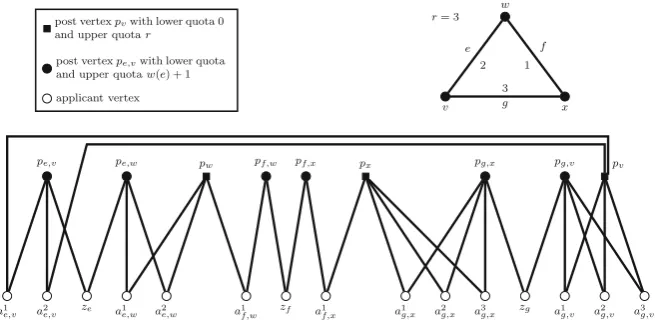
as well as{pe,v,ze}and{ze,pe,v}. This construction is shown in Fig.2.
We show that the constructed instance has a solution serving all applicants if and only if theMinimum Maximum Outdegreeinstance has an orientation respecting the bound on the weighted outdegree.
First assume there is an orientation DofGwith maximum weighted outdegree at mostr. Then consider the assignment that assigns for every oriented edge(v, v)∈ D
v w
x e
2
f
1
g
3
r= 3 post vertexpvwith lower quota 0
and upper quotar
post vertexpe,vwith lower quota and upper quotaw(e) + 1
applicant vertex
pv
pw px
pe,v pe,w
a1
e,v a2e,v ze a1e,w a2e,w
pf,w pf,x
a1 f,w
zf a1 f,x
pg,x pg,v
a1
g,x a2g,x a3g,x zg a1g,v a2g,v a3g,v
Fig. 2 The transformation of theMinimum Maximum Outdegreeinstance in theupper right cornerto amlqinstance. Thenumberson the edges of theMinimum Maximum Outdegreeinstance are the edge weights
the weighted outdegree of vertexvis at mostr, every post pvgets assigned at most
r=u(pv)applicants.
Now assumeMis a feasible assignment of applicants to posts serving every appli-cant. In particular, for every edgee= {v, v} ∈ E, applicantzeis assigned to either
pe,vor pe,v and exactly one of these two posts is open because the lower bound of
w(e)+1 can only be met ifzeis assigned to the respective post. If pe,v is open then
allw(e)applicantsaei,vare assigned topvand none of the applicantsaie,vis assigned
to pv, and vice versa if pe,v is open. Consider the orientation obtained by orienting
every edgeefromvtovif and only if pe,v is open. By the above observations, the
weighted outdegree of vertexvcorresponds to the number of applicants assigned to postpv, which is at mostr.
Finally, note thatG can be constructed in time polynomial in the input size of theMinimum Maximum Outdegreeinstance as the weights are encoded in unary there. Furthermore, the treewidth ofGis at most max{tw(G),3}. To see this, start with a tree decomposition ofGand identify each vertexv∈Vwith the corresponding post pv. For every edgee= {v, v} ∈ E, there is a bagBwith pv,pv∈ B. We add the new bag Be = {pv,pv,pe,v,pe,v}as a child to B. We further add the bags
Bze = {pe,v,pe,v,ze}, Bai
e,v = {pv,pe,v,a
i
e,v}and Bai
e,v = {pv,pe,v,a
i e,v}for
i ∈ {1, . . . , w(e)}as children toBe. Observe that the tree of bags generated by this
construction is a tree decomposition. Furthermore, since we did not increase the size of any of the existing bags and added only bags of size at most 4, the treewidth ofG
is at most max{tw(G),3}.
5 Approximation
[image:15.439.56.384.57.218.2]approximation algorithm and corresponding inapproximability bounds expressed in terms of|A|,|P|and upper quotas in the graph.
The method, which is described formally in Algorithm1, is a simple greedy algo-rithm. We say a post p isadmissibleif it is not yet open and|Γ (p)| ≥ (p). The algorithm iteratively opens an admissible post maximizing the assignable weight, i.e., it finds a post p ∈ P and a set A of applicants in its neighborhoodΓ (p) with (p)≤ |A| ≤u(p)such thata∈Aw(a,p)is maximized among all such(p,A)
pairs. It then removes the assigned applicants from the graph (potentially rendering some posts inadmissible) and re-iterates until no admissible post is left.
Algorithm 1Greedy algorithm for WMLQ
InitializeP0= {p∈P : |Γ (p)| ≥(p)}.
InitializeA0=A.
whileP0= ∅do
Find a pairp∈P0andA⊆Γ (p)∩A0with|A| ≤u(p)such thata∈Aw(a,p)is maximized
among all such pairs.
Openpand assign all applicants inAto it.
RemovepfromP0and remove the elements ofAfromA0.
forp∈P0with(p) >|Γ (p)∩A0|do
RemovepfromP0.
end for end while
Remark 2 As an alternative to Algorithm1, one could use a reduction from WMLQ to the set packing problem. The elements in the universe of the set packing problem would beA∪P. For each postpand for each subsetS⊂Γ (p), such thatl(p)≤ |S| ≤u(p), we create a set S ∪ {p} for the set packing instance. A feasible set packing then corresponds to a feasible assignment of the same weight. However, if the difference between p’s upper and lower quota is not bounded by a constant, this would create an exponential-sized input for the set packing problem and we could only employ an oracle-based algorithm known for the set packing problem to solve WMLQ. The greedy algorithm known for the set packing problem [7] can be made to work in a fashion similar to the algorithm presented above.
In the following we give a tight analysis of the algorithm, establishing approxima-tion guarantees in terms of the number of posts|P|, the number of applicants|A|, and the maximum upper quotaumax:=maxp∈Pu(p)over all posts. We also provide two
examples that show that our analysis of the greedy algorithm is tight for each of the described approximation factors. We further show that the approximation ratios given above for WMLQ are almost tight from the point of view of complexity theory.
Theorem 7 Algorithm 1 is an α-approximation algorithm for WMLQ with
α = min{|P|,|A|,umax+1}. Furthermore, for mlq, Algorithm 1is a √|A| +1
-approximation algorithm. It can be implemented to run in time O(|E|log|E|).
solution of weight OPT, consisting of open posts p1, . . . ,pk and the corresponding
sets of applicantsA1, . . . ,Akassigned to those posts.
We first observe that the first two approximation ratios of|P|and|A|are already achieved by the initial selection ofp1andA1chosen in the first round of the algorithm. For every i ∈ {1, . . . ,k}, post pi is an admissible post in the first iteration of the
algorithm. The first iteration’s choice of the pair(p1,A1)impliesa∈A 1w(a,p
1)≥
a∈Ai w(a,pi) ≥ w(a
,pi)for everya ∈ Ai. As the optimal solution opens at most |P| posts and serves at most |A| applicants, we deduce that min{|P|,|A|} ·
a∈A1w(a,p1)≥OPT.
We now turn our attention to the remaining approximation guarantees, which are
umax +1 for WMLQ and √|A| +1 for mlq. For every i ∈ {1, . . . ,k}, let π(i) denote the first iteration of the algorithm such that Aπ(i) ∩Ai = ∅or pπ( i) = pi.
This is the first iteration in which post pi is opened or an applicant assigned to it
in the optimal solution becomes assigned. Note that such an iteration exists, because
pi is not admissible after the termination of the algorithm. Furthermore, observe that
a∈Aπ(i)w(a,pπ( i))≥
a∈Ai w(a,pi), because the pair(pi,Ai)was a valid choice for the algorithm in iterationπ(i). Now for iteration j define Pj := {i : π(i)= j}
and observe that|Pj| ≤ |Aj| +1, because Pj can only contain one indexi with
pi = pj, and all otheri ∈ Pj\ {i}must haveAi∩Aj = ∅(where the setsAi are
disjoint). We conclude that
OPT =
k
i=1
a∈Ai
w(a,pi) ≤ k
i=1
a∈Aπ(i)
wa,pπ( i)
≤
n
j=1 |Pj|
a∈Aj
wa,pj
≤
n
j=1
|Aj| +1
a∈Aj
wa,pj
.
Note that|Aj| ≤umaxand therefore
OPT≤(umax+1)
n
j=1
a∈Aj
wa,pj
,
proving the third approximation guarantee. Now consider the unit-weightmlqcase and define A =nj=1Aj. If|A| ≥√|A|, then√|A||A| ≥ |A| ≥OPT. Therefore assume|A| < √|A|. Note that in this case, the above inequalities imply OPT ≤ (|A| +1)|A| ≤(√|A| +1)|A|, proving the improved approximation guarantee for mlq.
introduce a heap containing all admissible posts, and associate with each post pthe total weight of the firstu(p)edges in its neighborhood list. Note that these entries can be easily kept up to date whenever the algorithm opens a post and assigns applicants to it: In the list of every other post pwe simply replace the assigned applicants with the first not-yet-assigned entry in the list (or we remove the post if less than(p)applicants are available). As every edge in the graph can only trigger one such replacement, only
O(|E|)updates can occur and each of these requiresO(log|P|)time for reinserting the post at the proper place in the heap. Now, in each iteration of the algorithm, the optimal pair(p,A)can be found by retrieving the maximum element from the heap. This happens at most|P|times and requiresO(log|P|)time in each step.
Example 8 The following two examples show that our analysis of the greedy algorithm is (asymptotically) tight for each of the described approximation factors.
(a) The bounds|P|andumax+1 are tight, and√|A| +1 is asymptotically tight: Consider an instance ofmlqwithk+1 posts p0, . . . ,pkandk(k+1)applicants
a0,1, . . . ,a0,k,a1,1, . . . ,ak,k. Let(pi) = u(pi) = k fori ∈ {0, . . . ,k}. Each
applicantai,j applies to posti, and ifi >0, additionally to post 0. For the greedy
algorithm, opening postp0and assigning applicantsa1,1, . . . ,ak,kto it is a valid
choice in its first iteration, after which no further posts are admissible. Thus, it only assignskapplicants in total. The optimal solution, however, can assign allk(k+1)
applicants by assigning applicantsai,1, . . . ,ai,k to pi for eachi. Therefore, the
greedy algorithm cannot achieve an approximation factor better thank+1 on this family of instances, for which|P| =k+1,√|A|<k+1, andumax=k. (b) The bound|A|is tight:
To see that the approximation ratio of|A|is tight for WMLQ consider the following instance withkposts p1, . . . ,pk andkapplicantsa1, . . . ,ak. Let(pi)=0 and
u(pi)=kfor everyi. Every applicant applies for every post, andw(ai,pi)=1
for everyibutw(ai,pj)=εfor every j =ifor some arbitrarily smallε >0. In
its first iteration, the greedy algorithm might choose to open post p1and assign all applicants to it. This solution accumulates a weight of 1+(k−1)ε, while the
weight of the optimal solution isk= |A|.
Theorem 9 mlqis not approximable within a factor of|P|1−εor√|A|1−ε or u1−ε
max for anyε >0, unlessP=NP, even when restricting to instances where(p)=u(p) for every p∈ P and|Γ (a)| ≤2for every a∈ A.
Proof Once again we use the maximum independent vertex set problem. Given an instance ofmison a graphG=(V,E)with|V| =nand|E| =m, we create anmlq instance withnpostsp1, . . . ,pn, postpicorresponding to vertexvi. We also introduce
n2−mapplicants as follows. Initially, we introducen applicantsai,1,ai,2, . . . ,ai,n
applying for each postpi. Then, for every edge{vi, vj} ∈ E, we merge the applicants
ai,j andaj,i, obtaining a single applicant applying for both pi andpj. Furthermore,
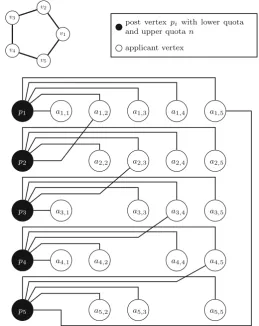
we set(pj)=u(pj)=nfor every post. This construction is shown in Fig.3.
v1
v2
v3
v4
v5
post vertex pi with lower quota and upper quotan
applicant vertex
p1 a1,1 a1,2 a1,3 a1,4 a1,5
p2 a2,2 a2,3 a2,4 a2,5
p3 a3,1 a3,3 a3,4 a3,5
p4 a4,1 a4,2 a4,4 a4,5
p5 a5,2 a5,3 a5,5
Fig. 3 The transformation of themisinstance in theupper left cornerto amlqinstance
which is equivalent toviandvjnot being adjacent inGby construction of the instance.
Therefore, themlqinstance has a feasible solution openingkposts (and thus serving
knapplicants) if and only if there is an independent set of sizekinG. We conclude that OPTmlq =n·OPTmisfor the two instances under consideration.
Note that in the constructedmlqinstance,n= |P| =umax≥√|A|. Therefore any approximation algorithm with a factor better than|P|1−εor√|A|1−εoru1max−εforε >0
yields a solution of the instance that serves at least(1/n1−ε)OPTmlq applicants and
therefore opens at least(1/n2−ε)OPTmlq=(1/n1−ε)OPTmisposts, corresponding to
an independent set of the same size. By Ref. [35], this impliesP=NP.
6 Matchings with Lower Quotas in General Graphs
[image:19.439.87.347.56.383.2]arbitrary (not necessarily bipartite) graphG allowsallvertices of the graph to have lower and upper quotas.
Problem 3 gwmlq
Input:I = (G, w, ,u); a not necessarily bipartite graph G = (V,E)with edge weightsw, lower quotasand upper quotas u.
Task: Find an assignment of maximum weight.
Ifw(e)=1for all e∈ E, we refer to the problem asgmlq.
One can see this generalization as a variant of the D-matching problem (see Sect.1.1), where each vertex has a domain consisting of 0 and an interval. Clearly, the hardness results derived in the previous sections are valid forgwmlqas well. We now briefly argue that the positive results from Sects.3and4carry over to this generalized setting. However, our approximation results do not hold even ifGis bipartite and only a single applicant is equipped with lower and upper quotas. In fact,gwmlqdoes not allow for any approximation even in this very restricted case unlessP=NP.
The two positive results in Sect. 3, namely Theorems 2and3, are applicable to gwmlq. Note that Theorem2 (bounded degree for all posts) is a special case of Theorem3(bounded upper quota for all posts).
Theorem 10 gwmlqcan be solved in polynomial time when restricted to instances
with u(v)≤2for allv∈V .
Proof We will work with the proof of Theorem3, which requires some simple mod-ifications to fit the case of arbitrary graphs. All we need to do is to add a dummy vertexvdtoG—this resembles dummy postpdin the proof of Theorem3. The steps
corresponding to a post vertex should now be executed for all vertices of the graph. We can assume there are no vertices with lower quota 0 and upper quota 2 by a similar reasoning given in Theorem2. For every vertexviwith(vi)=2, we add two dummy
verticesqi1andqi2and connect them to each other andvi. For all of these vertices, we
set(qi1)=u(qi1)=(qi2)=u(qi2)=1. Then, the dummy vertexvdis connected
to vertices with upper quota 1. We finish the construction by adding triangles tovdto
ensure that only two f-factors need to be computed. The arguments in the proof of
Theorem3can now be applied to this f-factor instance.
As for Theorem4, the algorithm for bounded treewidth and upper quota carries over togwmlqwithout any modification. Note that in the proof we never used the bipartiteness ofGor thatu(a)=1 for the applicants.
Theorem 11 gwmlq can be solved in time O(T +(umax)3 tw(G)+3|E|), where T
is the time needed for computing a tree decomposition of G of width tw(G). In particular, gwmlq can be solved in polynomial time when restricted to instances
of bounded treewidth, and WMLQ parameterized by max{tw(G),umax} is fixed-parameter tractable.
v1 v2
v3
v4
v5
post vertex pi with lower quota
and upper quotan+ 1
applicant vertex
dummy applicant vertex with lower quota and upper quotaK
p1 a1,1 a1,2 a1,3 a1,4 a1,5
p2 a2,2 a2,3 a2,4 a2,5
p3 a3,1 a3,3 a3,4 a3,5
p4 a4,1 a4,2 a4,4 a4,5
p5 a5,2 a5,3 a5,5
ad
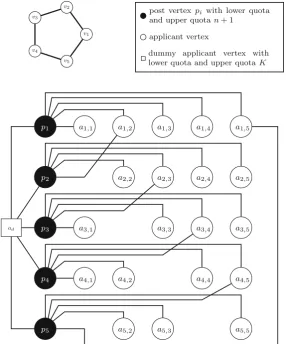
Fig. 4 The transformation of themisinstance in theupper left cornerto a generalizedmlqinstance
Theorem 12 It isNP-hard to decide whetherOPT>0for an instance ofgmlq, even
if the graph is bipartite and on one side of the bipartition all vertices except for one have unitary upper and lower quota.
Proof To every instance ofmis we construct an instance ofgmlqso that the mis instance admits an independent set of sizeK if and only if OPT >0 for thegmlq instance. We start with the same mlqinstance that was constructed from an mis instance in the proof of Theorem9. The changes are depicted in Fig.4. A dummy applicantadis added to the graph and connected to all posts. We set(ad)=u(ad)=
K and change(p)=u(p)ton+1 for every postp∈ P.
Since every post is adjacent to exactlyn+1 applicants, opening a post requires allocating all its applicants to it, includingadas well. Thus, opening any post implies
[image:21.439.76.363.56.401.2]ad, which is equivalent to the K vertices corresponding to them in themisinstance
forming an independent set.
7 Conclusion
We discussed the complexity, approximability and fixed-parameter tractability of WMLQ from various viewpoints such as bounded degree, quota and treewidth.
Further work on the topic might include imposing common quotas on some groups of posts. That is, we may have subsets P1, . . . ,Pk, where for eachi (1 ≤ i ≤ k),
Pi ⊆ P, Pi has acommon quota u(Pi)≥ 1, whereu(Pi) ≤
p∈Piu(p), and any assignment M must now satisfy the additional property thatp∈P
i|δ(p)∩M| ≤
u(Pi). Common quotas are similar to regional caps studied in Economics [17] and
they can model constraints such as the limited availability of resources required for certain projects—for exampleP1might correspond to those projects that require access to high-performance computing facilities.
We have seen that WMLQ as defined in Problem1 has a natural application in the context of student–project allocation, where the weight on a given edge(s,p)
corresponds to the utility of studentsbeing assigned to project p. However in many applications students have ordinal preferences over projects. Cardinal utilities can of course follow from these via the use of Borda scores, so we can obtain WMLQ as before. But ordinal preferences themselves allow alternative optimality criteria to be formulated. For example we may optimize on theprofileof a matching M, which is a vector whose ith position indicates the number of students who obtain theiri th-choice project inM [24]. Agreedy maximum matchingis a matching whose profile is lexicographically maximum, taken over all maximum cardinality matchings, whilst agenerous maximum matchingis a matching whose reverse profile is lexicograph-ically minimum, taken over all maximum cardinality matchings. There are efficient algorithms to find greedy and generous maximum matchings in the absence of lower quotas [21], but it remains open to extend the positive results in this paper to the setting involving both lower quotas and preferences.
Acknowledgements We would like to thank András Frank and Kristóf Bérczi for their observations that led us to Theorem3. We would also like to thank the anonymous reviewers for their valuable comments, which have helped to improve the presentation of this paper.
Open Access This article is distributed under the terms of the Creative Commons Attribution 4.0 Interna-tional License (http://creativecommons.org/licenses/by/4.0/), which permits unrestricted use, distribution, and reproduction in any medium, provided you give appropriate credit to the original author(s) and the source, provide a link to the Creative Commons license, and indicate if changes were made.
References
1. Abraham, D.J., Irving, R.W., Manlove, D.F.: Two algorithms for the student–project allocation problem. J. Discrete Algorithms5(1), 79–91 (2007)
3. Bejerano, Y., Han, S.J.: Cell breathing techniques for load balancing in wireless lans. IEEE Trans. Mob. Comput.8(6), 735–749 (2009)
4. Biró, P., Fleiner, T., Irving, R.W., Manlove, D.F.: The College Admissions problem with lower and common quotas. Theor. Comput. Sci.411, 3136–3153 (2010)
5. Bodlaender, H.L.: A tourist guide through treewidth. Acta Cybern.11(1–2), 1 (1994)
6. Bodlaender, H.L.: A linear-time algorithm for finding tree-decompositions of small treewidth. SIAM J. Comput.25(6), 1305–1317 (1996)
7. Chandra, B., Halldórsson, M.M.: Greedy local improvement and weighted set packing approximation. J. Algorithms39(2), 223–240 (2001)
8. Cornuéjols, G.: General factors of graphs. J. Comb. Theory Ser. B45(2), 185–198 (1988)
9. Fragiadakis, D., Iwasaki, A., Troyan, P., Ueda, S., Yokoo, M.: Strategyproof matching with minimum quotas. ACM Trans. Econ. Comput.4(1), 6:1–40 (2016)
10. Gabow, H.N.: An efficient reduction technique for degree-constrained subgraph and bidirected network flow problems. In: Proceedings of STOC ’83: The 15th Annual ACM Symposium on Theory of Computing, pp. 448–456. ACM (1983)
11. Gabow, H.N.: Data structures for weighted matching and nearest common ancestors with linking. In: Proceedings of SODA ’90: The 1st ACM-SIAM Symposium on Discrete Algorithms, pp. 434–443. ACM-SIAM (1990)
12. Goto, M., Hashimoto, N., Iwasaki, A., Kawasaki, Y., Ueda, S., Yasuda, Y., Yokoo, M.: Strategy-proof matching with regional minimum quotas. In: Proceedings of the AAMAS ’14: The 13th International Conference on Autonomous Agents and Multi-agent Systems, pp. 1225–1232. IFAAMAS (2014) 13. Goto, M., Kurata, R., Hamada, N., Iwasaki, A., Yokoo, M.: Improving fairness in nonwasteful matching
with hierarchical regional minimum quotas. In: Proceedings of AAMAS ’15: The 14th International Conference on Autonomous Agents and Multiagent Systems, pp. 1887–1888. IFAAMAS (2015) 14. Hamada, K., Iwama, K., Miyazaki, S.: The hospitals/residents problem with lower quotas. Algorithmica
74(1), 440–465 (2014)
15. Hanna, J.P., Albert, M., Chen, D., Stone, P.: Minimum cost matching for autonomous carsharing. IFAC PapersOnLine49(15), 254–259 (2016)
16. Iwama, K., Miyazaki, S., Yanagisawa, H.: Improved approximation bounds for the student–project allocation problem with preferences over projects. J. Discrete Algorithms13, 59–66 (2012) 17. Kamada, Y., Kojima, F.: Stability and strategy-proofness for matching with constraints: a problem in
the Japanese medical match and its solution. Am. Econ. Rev.102(3), 366–370 (2012)
18. Kamiyama, N.: A note on the serial dictatorship with project closures. Oper. Res. Lett.41, 559–561 (2013)
19. Klasing, R., Kosowski, A., Navarra, A.: Cost minimization in wireless networks with a bounded and unbounded number of interfaces. Networks53(3), 266–275 (2009)
20. Kloks, T.: Treewidth, Computations and Approximations, volume 842 of Lecture Notes in Computer Science. Springer, Berlin (1994)
21. Kwanashie, A., Irving, R.W., Manlove, D.F., Sng, C.T.S.: Profile-based optimal matchings in the Student/Project Allocation problem. In: Proceedings of IWOCA ’14: The 25th International Workshop on Combinatorial Algorithms, volume 8986 of Lecture Notes in Computer Science, pp. 213–225. Springer (2015)
22. Lovász, L.: On the structure of factorizable graphs. Acta Math. Acad. Sci. Hung.23(1–2), 179–195 (1972)
23. Lovász, L.: Antifactors of graphs. Period. Math. Hung.4(2–3), 121–123 (1973)
24. Manlove, D.F.: Algorithmics of Matching Under Preferences. World Scientific, Singapore (2013) 25. Manlove, D.F., O’Malley, G.: Student project allocation with preferences over projects. J. Discrete
Algorithms6, 553–560 (2008)
26. Monte, D., Tumennasan, N.: Matching with quorums. Econ. Lett.120, 14–17 (2013)
27. Niedermeier, R.: Invitation to Fixed-Parameter Algorithms. Oxford University Press, Oxford (2006) 28. Ólafsson, S.: Weighted matching in chess tournaments. J. Oper. Res. Soc.41(1), 17–24 (1990) 29. Plummer, M.D.: Graph factors and factorization: 1985–2003: a survey. Discrete Math.307(7–8), 791–
821 (2007)
31. Röllin, S., Schenk, O.: Maximum-weighted matching strategies and the application to symmetric indefinite systems. In: Dongarra, J., Madson, K., Wasniewski, J. (eds.) Applied Parallel Computing, State of the Art in Scientific Computing, 7th International Workshop, PARA 2004, Lyngby, Denmark, June 20–23, 2004, pp. 808–817. Springer, Berlin Heidelberg (2006)
32. Samer, M., Szeider, S.: Tractable cases of the extended global cardinality constraint. Constraints16, 1–24 (2011)
33. Seb˝o, A.: General antifactors of graphs. J. Comb. Theory Ser. B58(2), 174–184 (1993) 34. Szeider, S.: Not so easy problems for tree decomposable graphs. CoRR.arXiv:1107.1177(2011) 35. Zuckerman, D.: Linear degree extractors and the inapproximability of max clique and chromatic