City, University of London Institutional Repository
Citation
:
Francis, J., Duncan, E. M., Prior, M. E., MacLennan, G., Marshall, A. P., Wells, E. C., Todd, L., Rose, L., Campbell, M. K., Webster, F., Eccles, M. P., Bellingan, G., Sepplet, I. M., Grimshaw, J. M. and Cuthbertson, B. H. (2014). Comparison of four methods for assessing the importance of attitudinal beliefs: An international Delphi study in intensive care settings. British Journal of Health Psychology, 19(2), doi: 10.1111/bjhp.12066This is the accepted version of the paper.
This version of the publication may differ from the final published
version.
Permanent repository link: http://openaccess.city.ac.uk/3292/
Link to published version
:
http://dx.doi.org/10.1111/bjhp.12066Copyright and reuse:
City Research Online aims to make research
outputs of City, University of London available to a wider audience.
Copyright and Moral Rights remain with the author(s) and/or copyright
holders. URLs from City Research Online may be freely distributed and
linked to.
1
Title
Comparison of four methods for assessing the importance of attitudinal beliefs: An
international Delphi study in intensive care settings
Running Head
Methods for assessing importance of beliefs
Authors
Francis JJ1,2, Duncan EM1,2, Prior ME2, MacLennan G2, Marshall AP3, Wells EC4,
Todd L5, Rose L6, Campbell MK2, Webster F5, Eccles MP7, Bellingan G8, Seppelt IM9,
Grimshaw JM10,11, Cuthbertson BH12, for the SuDDICU study groups.
1 Health Psychology Group, University of Aberdeen, UK
2 Health Services Research Unit, University of Aberdeen, UK
3 Research Centre for Clinical and Community Practice Innovation, Griffith
University, Southport, Australia and Gold Coast Hospital, Southport,
Australia
4 Centre for the Study of Social and Legal Responses to Violence,
University of Guelph, Canada
5 Department of Family and Community Medicine, University of Toronto,
Canada
6 Lawrence S. Bloomberg Faculty of Nursing, University of Toronto, Canada
7 Institute of Health and Society, University of Newcastle upon Tyne, UK
8 Intensive Care Unit, University of College London Hospital, UK
9 George Institute for Global Health, University of Sydney, Australia
10 Clinical Epidemiology Program, Ottawa Hospital Research Institute,
Canada
11 Department of Medicine, University of Ottawa, Canada
12 Department of Critical Care Medicine, Sunnybrook Health Sciences
Centre and Department of Anesthesia, University of Toronto, Canada
*Requests for reprints should be addressed to Jill Francis, City University London,
Northampton Square, London EC1V 0HB, United Kingdom (e-mail:
2
Word count: 4,471
Statement of Competing Interests
Jill Francis is an Associate Editor of the British Journal of Health Psychology. It is
understood that the anonymity of the peer review process safeguards against any
influence that might follow from this.
Acknowledgements
This project was funded by the UK NIHR Health Technology Assessment programme
and will be published in full in the Health Technology Assessment journal series.
Visit the HTA programme website for more details www.hta.ac.uk/2299. The views
and opinions expressed therein are those of the authors and do not necessarily
reflect those of the Department of Health.
The Health Services Research Unit is core funded by the Chief Scientist Office of the
Scottish Government Health Directorates. Views expressed are those of the authors
and do not necessarily reflect the view of the Chief Scientist Office. JMG holds a
Canada Research Chair in Health Knowledge Transfer and Uptake.
We acknowledge the support of the Canadian Institutes of Health Research
operating grant support, the Australian Intensive Care Foundation (ICF) and the
Australian and New Zealand College of Anaesthetists. The SuDDICU collaboration is
a collaboration that includes the Canadian Critical Care trials group (CCTG) and the
Australian and New Zealand Intensive Care Society Clinical Trials Group (ANZICS
3
Statement of contribution
What is already known on this subject?
Attitudinal beliefs (specific beliefs about the consequences of performing an
action) are key to designing interventions to change intentions and behaviour.
The literature reports four methods for assessing the importance of attitudinal
beliefs: frequency of elicitation in interviews; importance ratings in
questionnaires; and strength of prediction (bivariate and multivariate) of global
attitude scores.
The congruence between these measures of importance is not known.
What does this study add?
Four indices of importance were examined in a multi-professional,
international study about the use of Selective Digestive Decontamination to
prevent infection in intensive care settings
Three indices were correlated with one another.
Each method used to assess importance produced a different subset of the
most important beliefs. Selection of the most important beliefs should use
multiple assessment methods.
This evidence suggests that multiple regression approaches may not be
4
Abstract
Objectives
Behaviour change interventions often target ‘important’ beliefs. The literature
proposes four methods for assessing importance of attitudinal beliefs: elicitation
frequency, importance ratings and strength of prediction (bivariate and multivariate).
We tested congruence between these methods in a Delphi study about Selective
Decontamination of the Digestive tract (SDD). SDD improves infection rates among
critically ill patients, yet uptake in intensive care units is low internationally.
Methods
A Delphi study involved three iterations (‘rounds’). Participants were 105 intensive
care clinicians in the UK, Canada and Australia/New Zealand. In Round 1,
semi-structured interviews were conducted to elicit beliefs about delivering SDD. In
Rounds 2 and 3, participants completed questionnaires, rating agreement and
importance for each belief-statement (9-point Likert scales). Belief importance was
assessed using: elicitation frequency; mean importance ratings; and prediction of
global attitude (Pearson’s correlations; beta-weights). Correlations between indices
were computed.
Results
Participants generated 14 attitudinal beliefs. Indices had adequate variation
(frequencies: 4-94); mean importance ratings: 4.93-8.00; Pearson’s correlations:
+0.09 to +0.54; beta-weights: +0.01 to +0.30). SDD increases antibiotic resistance
was the most important belief according to three methods and was ranked second by
beta-weights (behind Overall, SDD benefits patients to whom it is delivered).
Spearman’s correlations were significant for importance ratings with frequencies and
correlations. However, other indices were unrelated. The top four beliefs differed
according to the measure used.
5
Results provided evidence of congruence across three methods for assessing belief
importance. Beta-weights were unrelated to other indices, suggesting that they may
6
Comparison of four methods for assessing the importance of attitudinal
beliefs: An international Delphi study in intensive care settings.
Background
Beliefs about the positive and negative consequences of performing a specified
behaviour (i.e., attitudinal beliefs) are widely thought to influence the likelihood that
the behaviour will be performed (Michie, Johnston, Abraham, Lawton, & Parker,
Walker, 2005). In social cognition models, such beliefs are proposed to be the
precursors of attitude, which is one of the important predictors of intention and
behaviour (Fazio, 1989; Fishbein & Ajzen, 1975) . Introducing strategies to change
attitude is one of the most frequent approaches used when trying to change
behaviour (Michie, Johnston, Francis, Hardeman, & Eccles, 2008; Zimbardo &
Leippe, 1991; Abraham & Michie, 2008). The literature proposes several methods for
identifying the key beliefs to take forward for further investigation or for intervention
development. However, there is a lack of evidence about which methods are best for
identifying attitudinal beliefs that are most important and thus most likely to be key to
behaviour change.
Several working assumptions about this question are evident in research about
health-related behaviour, including the behaviour of healthy people (to maintain
health), those with a diagnosis (to manage their condition) and health professionals
(as they deliver health care). In social cognitive approaches, the cognitive
accessibility of a concept (i.e., how readily it comes to mind) (Higgins, King, & Mavin,
1982) is proposed to indicate its importance for processing relevant information (e.g.,
combining concepts when forming attitudes) and to moderate the attitude-behaviour
relation (Fazio, 1989; Fazio, Powell, & Williams, 1989). For example, some people
who think about the consequences of increasing their physical activity may
immediately (and frequently) think of losing weight; others may think about increasing
7
change scientists would be justified in assuming that an individual’s most quickly and
frequently activated beliefs (i.e., those with greatest cognitive accessibility) are the
most likely to drive that person’s motivation and, thus, behaviour. This assumption
has obvious and important implications for selecting the informational content of
behaviour change interventions. The ‘cognitive accessibility’ assumption underlies
theory-based elicitation studies: participants are interviewed to elicit their salient
beliefs; some of these beliefs are then identified as ‘modally-salient’ (i.e. most
frequently mentioned across a sample of interview participants). The modally salient
beliefs are then included in questionnaires to identify the strongest predictors of
intention, motivation or behaviour (Ajzen, 1991; Sutton et al., 2003).
Modal salience is not the only approach to identifying belief importance. Two
contrasting approaches to assessing the importance of attitudinal beliefs do not rely
on the cognitive accessibility assumption. First, ‘expectancy-value’ approaches to
designing questionnaires include two kinds of questionnaire items: (1) items to
assess the ‘expectancy’ associated with each belief (i.e., strength of belief, or the
individual’s estimate of the probability of the consequence occurring); and (2) ‘value’
of that consequence to the individual (i.e., its subjective importance) (Fishbein &
Ajzen, 1975) .
Second, a ‘judgement analysis approach’ has been applied to clinical reasoning
(Cooksey, 1996). This approach contrasts subjective and objective importance by
considering both questionnaire-based importance ratings (e.g., How important is it to
you to build muscle mass? Scale: 1 [not at all important] to 7 [extremely important])
and the relative power of each belief to predict attitude or behaviour. For example, in
a multiple linear regression to predict global attitude from a number of
strength-of-belief ratings, the relative sizes of the standardised regression coefficients would
8
Dean, 1995). Evans et al. (1995) used this multiple regression approach to identify
the “tacit policies” of General Medical Practitioners and compared them with their
stated policies (subjective ratings of the influence of each factor in a clinical
scenario). The multiple regression method is used to identify the ‘objectively
important’ beliefs (or ‘tacit policies’) that are appropriate targets in behaviour change
interventions. A variation on this method is the Pearson’s correlation coefficient which
represents the linear relationship between a belief and global attitude, regardless of
any other beliefs that might explain variation in the attitude score.
In summary, in the social cognition literature, there appear to be four methods for
determining belief importance, each based on different assumptions: (1) the
elicitation method (based on the cognitive accessibility assumption); (2) the
self-report method (based on the assumption that individuals can accurately report the
importance of their beliefs for influencing their attitudes or behaviour); (3) the
bivariate prediction method (based on the assumption that prediction, while different
from causation, is nonetheless an indicator of the beliefs that are most likely to have
a causal influence on attitude and behaviour); and (4) the multivariate prediction
method (based on the assumption that the relative importance of beliefs is best
judged by considering them together in one analysis). These four approaches, and
their underlying assumptions, are presented in Table 1.
TABLE 1 HERE
To identify the extent of usage of these four methods of assessing importance, we
conducted a brief but systematic scoping search, in the PsycINFO database to May
2013, of the following terms when combined with terms relating to attitude and belief
importance: (“elicit*” or “modal salien*”); (“rating” or “self-report”); “correlat*”;
9
3758, 3476 and 1966 results. When these four searches were combined with “AND”,
no papers were identified. This confirmed that, first, the four methods have been
extensively reported in the literature and, second, no investigations have been
reported that compare all these methods.
In the field of behaviour change, intervention design crucially relies on the validity of
whichever of these four methods is used for identifying important beliefs. For
example, intervention mapping approaches propose that a key step in intervention
design is the use of empirical evidence (literature reviews, qualitative and quantitative
studies) to identify the important determinants of the health problem to be addressed
(Bartholomew, Parcel, & Kok, 1998) . In addition, recent reports of the development
of behaviour change interventions to enhance the uptake of clinical guidelines have
been based on evidence about the importance of beliefs, where evidence about
importance is generated from the elicitation method (McKenzie et al., 2008; French et
al., 2012) or the prediction method (Foy et al., 2007).
As the elicitation method is frequently used to select the most important beliefs to
include in questionnaires, questionnaires usually contain only a subset of beliefs
elicited in interview studies. Hence, there is little research directly comparing these
measures of importance. Steadman and Rutter (Steadman & Rutter, 2004)
compared attitude scores based on salient (frequently elicited) beliefs with attitude
scores based on a subset of those beliefs that were rated as ‘important’ but did not
directly compare the importance indices. More direct evidence can be found in the
social judgment analysis literature, which indicates that the relative importance of
subjective (importance ratings) and objective beliefs (predictive power) does not
always converge (Evans St., Harries, Dennis, & Dean, 1995; Hunter, McKee,
10
between all four approaches. How, then, can we identify the best methods for
selecting the beliefs that should drive the design of behaviour change interventions?
A recent international Delphi study of beliefs of healthcare professionals about a
clinical procedure, Selective Decontamination of the Digestive tract (SDD), in
Intensive Care Units (ICUs) study (the SuDDICU study), provided the opportunity to
test, for the first time, the congruence of four indices of importance. SDD involves the
application of non-absorbable antibiotic paste to the mouth and stomach and a short
course of intravenous antibiotics, for prevention of infection (Cuthbertson et al.,
2010). The evidence base relating to SDD is strong, with 11 published meta-analyses
of 36 randomised controlled trials (RCTs). These meta-analyses show that SDD
reduces rates of ventilator-associated pneumonia and hospital acquired infections. It
also reduces mortality in critically ill patients in more recent meta-analyses. However,
uptake of SDD, internationally is low. The Delphi study investigating clinicians’ views
about SDD was part of a larger multi-phase, mixed-methods study (the SuDDICU
study) reported elsewhere, that investigated the reasons for such low uptake in the
United Kingdom, Canada, Australia and New Zealand (Cuthbertson et al., 2010).
Delphi approaches have been used in health research for over four decades (Dalkey,
1969; Fink, Kosecoff, Chassin, & Brook, 1984) to establish expert consensus (e.g.,
to decide appropriateness of clinical actions, where there was a lack of evidence), or
to identify levels of agreement (or disagreement) within an expert group. Delphi
studies use a structured, iterative process including anonymised feedback in a series
of sequential questionnaires or ‘rounds’. There are two advantages of using this
technique, compared with face-to-face group discussion. First, it operationalises the
principle that good decision making first involves the generation of multiple
alternatives, leaving a critique of those alternatives to a later stage (D'Zurilla & Nezu,
11
group discussions, e.g. ‘groupthink’ (in which individuals reach premature consensus
through ‘normative’ influence (Janis, 1972) arising from the early or strong views of
influential individuals such as senior colleagues) or ‘group polarisation’ (in which
individuals express opposing views because of competition within the group) (Myers
& Lamm, 1975) . It is designed to use ‘informational’ influence (Asch, 1955), in which
novel ideas may be introduced and considered by individuals in the group without
being contaminated by the effects of group dynamics. The appropriate number of
Delphi rounds will vary according to the complexity of the issues discussed and the
diversity of the sample, but evidence suggests that three or four rounds are
appropriate (Erffmeyer & Erffmeyer, 1986; Murphy et al., 1998) .
Reflecting the four methods for assessing the importance of beliefs, the SUDDICU
Delphi study involved: (1) an interview round to elicit participants’ beliefs about the
consequences of delivering SDD; (2) two questionnaire rounds in which the same
participants were asked to rate their strength of agreement with, and the importance
of, each belief; (3) computation of bivariate correlations; and (4) building of a
regression model to predict global attitude from strength-of-agreement scores for
each belief. The aim of the current paper was to assess the congruence of the
findings based on these four methods for assessing the importance of attitudinal
beliefs.
Methods
Sample
Participants were clinicians working in intensive care in three geographical zones
(UK, Canada and Australia/New Zealand). They included four groups of
12
ICUs: intensive care physicians, clinical microbiologists, hospital pharmacists and
ICU clinical leads. In each geographical zone, clinicians in each of the four
professional groups were purposively sampled to achieve diversity on a range of
potentially relevant characteristics (teaching hospital versus general hospital, size of
ICU, experience of using SDD or not, years of experience in ICU).
There is a range of opinions on the appropriate sample size for Delphi studies, but
smaller sizes (10) have been deemed appropriate where participants have similar
training (Akins, Tolson, & Cole, 2005). Thus, the target sample size was 10
participants per stakeholder group in each geographical zone (40 per zone and 120
in total). The analysed sample included all clinicians who provided complete data
across all three Delphi rounds.
Of the 141 clinicians interviewed, 105 (74%) provided complete data (i.e., no missing
items) across the three data collection rounds. There was good representation of all
geographical zones (32, 35 and 38 in Australia / New Zealand, Canada and UK,
respectively) and all clinician groups (34, 20, 24 and 27 for intensivists,
microbiologists, pharmacists and ICU leads, respectively). Participants reported an
average of 16.5 (SD = 7.8) years’ experience working in the intensive care context. It
was not possible (or appropriate) to recruit equal numbers of participants with and
without experience of the target behaviour (delivering SDD) as it is not used in
Australia / New Zealand or Canada. Of the 38 participants in the UK, seven reported
current or past experience of using this procedure.
Materials
A topic guide was designed (presented in Appendix), based on the Theoretical
Domains Framework (TDF) of behaviour change (Michie et al., 2005). The TDF was
developed by experts in behaviour change and health services research using a
13
theories to make theory more useful in applied research and is frequently used to
investigate clinical behaviours (Francis, O'Connor, & Curran, 2012) . The topic guide
included at least one prompt for eliciting beliefs from each of the 12 theoretical
domains in the framework and a range of potential follow-up prompts. The topic
guide was piloted with three clinicians and minor adjustments were made to increase
usability and clinical sensibility.
Based on the interview (Round 1) findings, a questionnaire was developed for Round
2. Items incorporated all elicited beliefs (i.e., not only the frequently mentioned beliefs
but also minority beliefs, as long as they were mentioned in each geographical zone
and were thus relevant to each healthcare context) and included the global attitude
item, I am opposed to SDD. For each belief, participants were asked to report the
strength of their agreement or disagreement (where 1 = strongly disagree and 9 =
strongly agree) and their rating of the personal importance of this issue to their
overall opinion about the delivery of SDD to critically ill patients (where 1 = not at all
important and 9 = very important). Nine-point Likert items were used, as is
recommended for Delphi studies involving expert samples (Fitch et al., 2000). For
Round 3 an identical questionnaire was used, with the addition of feedback of the
Round 2 results for each item, in the form of a frequency histogram of the sample’s
responses, together with an individually customised reminder of the participant’s
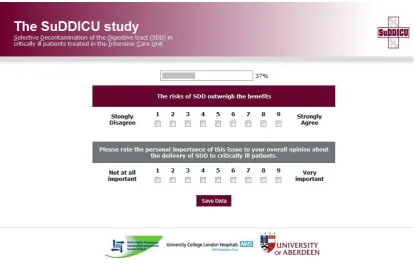
Round 2 response. Example screen shots from the Round 2 and Round 3 materials
are presented in Figures 1 and 2.
FIGURE 1 HERE
FIGURE 2 HERE
14
Clinicians were initially contacted by clinical members of the research team and
invited to participate. Those who agreed to participate were contacted by a
researcher in each zone (ED, AM, EW) to arrange a telephone interview. In Round 1,
semi-structured one-to-one, audio-recorded telephone interviews of 30 to 40 minutes
duration were conducted. Recordings were transcribed verbatim, checked for
accuracy and anonymised. One week after the completion of Round 1 interviews
(four months after the first interview), the same participants were invited by email to
complete Round 2. Ten weeks after the initial circulation of the Round 2 materials,
participants were invited by email to complete Round 3. Computer programming of
the Round 2 and 3 materials enabled direct downloading of data as participants
submitted their responses, thereby eliminating the possibility of data entry error.
The study was given ethics approval in each jurisdiction: in the UK (NHS REC;
Reference 10/S0801/69); in Canada (Research Ethics Board of Sunnybrook Health
Sciences Centre, reference 306-2010) and in Australia/New Zealand (Nepean Blue
Mountains Local Health Network Health Research Ethics Committee; No. 11/08).
Analysis
For Round 1, interview transcripts were classified into theoretical domains by one
researcher in each zone. These classifications were checked and discussed by other
members of the team in each nation and by the study’s international working group.
Content analysis was performed on data within each domain by other members of
the team, using an inductive process, to identify specific beliefs. Beliefs with similar
content (e.g., relating to cost-effectiveness) but opposite valence (i.e., implying being
for or against SDD) were classified together as one belief. The analysis was
conducted in parallel in the three geographical zones, and the international research
team met by telephone conference once each month during the four-month duration
15
The iterative approach of the Delphi approach enables the assessment of the extent
to which participants change their opinions during the process of viewing group-level
feedback. Round 2 and 3 responses were thus assessed for stability at the level of
both individuals (change scores) and the whole sample (group means). Round 3 data
in the Beliefs about Consequences domain (i.e., attitudinal beliefs) are reported in the
current paper, as a greater number of specific beliefs were generated in this domain
than in any other domain. Mean importance ratings were computed. Pearson’s
bivariate correlations were computed between agreement scores for each attitudinal
belief and global attitude scores (assessed using the item I am opposed to SDD). A
multiple linear regression was performed to predict global attitude scores from
agreement scores for the individual beliefs.
The relative importance of beliefs was thus measured using four methods: (1)
elicitation (frequency of coding in interview data); (2) self-report (importance ratings);
(3) bivariate prediction (correlation) and (4) multivariate prediction (standardised
regression coefficients in a multiple regression using agreement ratings to predict
global attitude). These four indices were tabulated and the congruence between
them was assessed using Spearman’s correlation coefficients.
Results
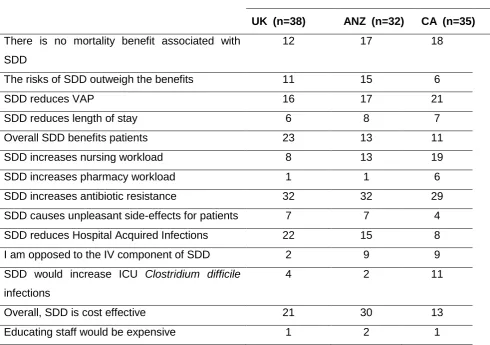
Beliefs elicited in Round 1 interviews are presented in Table 2, together with coding
frequencies for each geographical zone. Participants generated a total of 16
attitudinal beliefs. Of these, one was classified as a ‘global’ attitude item (I am
opposed to SDD) and was used as the dependent variable. Fourteen beliefs were
elicited across all three zones. Patterns of frequencies were similar across the zones
(Table 2).
16
Responses were highly stable, at the individual level, between Round 2 and Round
3. The Inter Quartile Range (IQR) of individual change scores for agreement ratings
was zero (i.e. no change) for every item and the IQR of change scores for
importance ratings was zero for all items except SDD increases antibiotic resistance,
for which the IQR (change score) was 1. Group-level stability was evident from the
small changes in mean scores for each item between Round 2 and Round 3;
absolute mean differences ranged from 0 to 0.52. Hence, a further Delphi round was
deemed not required and the decision was made to stop at Round 3 and to use the
Round 3 data for analysis.
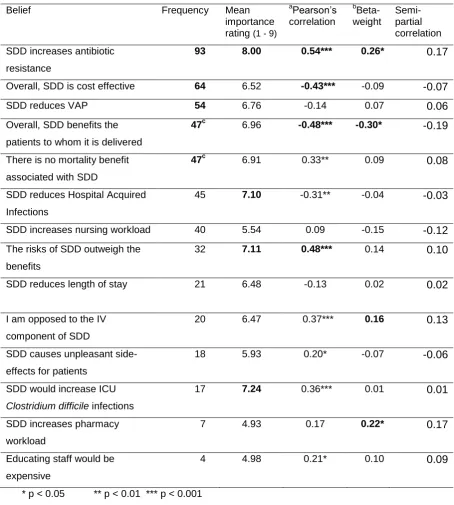
Table 3 presents beliefs from highest to lowest frequency in interviews, together with
the other three indices of importance. Mean importance ratings at Round 3 ranged
from 4.93-8.00 (on the scale of 1 to 9). Correlations between individual belief scores
and global attitude scores ranged from +0.09 to +0.54. Beta-weights (standardised
regression coefficients) ranged from +0.01 to +0.30. The regression model
accounted for 43.5% of the variance (adjusted R2) in scores on the global attitude
item, F(14,90) = 6.72, p < 0.001. The semi-partial correlations, presented in Table 2
to show the unique variance accounted for by each belief, were substantially lower
than the beta-weights for two beliefs (SDD increases antibiotic resistance and
Overall, SDD benefits the patients to whom it is delivered), indicating substantial
shared variance with other predictors. However, the rank order of beliefs based on
beta weights and semi-partial correlations was the same.
TABLE 3 HERE
Three of the four indices of importance identified SDD increases antibiotic resistance
as the most important belief. This belief was elicited in 93/105 (89%) interviews; had
a mean importance rating of 8.00 (on the scale of 1 to 9) and was significantly
17
had the second highest beta weight ( = 0.26, p < 0.001). Similar congruence among
importance indices was not demonstrated for the other beliefs; for example,
identification of the next three most important beliefs (bolded in Table 3) differed
according to the measure used as follows (listed in order):
From frequencies: SDD is cost effective; SDD reduces ventilator associated
pneumonia; SDD benefits the patients to whom it is delivered; There is no
mortality benefit associated with SDD (four beliefs listed here as the third and
fourth beliefs had equal frequency);
From importance ratings: SDD would increase Clostridium difficile infections;
The risks of SDD outweigh the benefits; SDD reduces hospital acquired
infections
From correlations: The risks of SDD outweigh the benefits; SDD benefits the
patients to whom it is delivered;SDD is cost effective;
From beta-weights: SDD benefits the patients to whom it is delivered; SDD
increases pharmacy workload; I am opposed to the IV component of SDD.
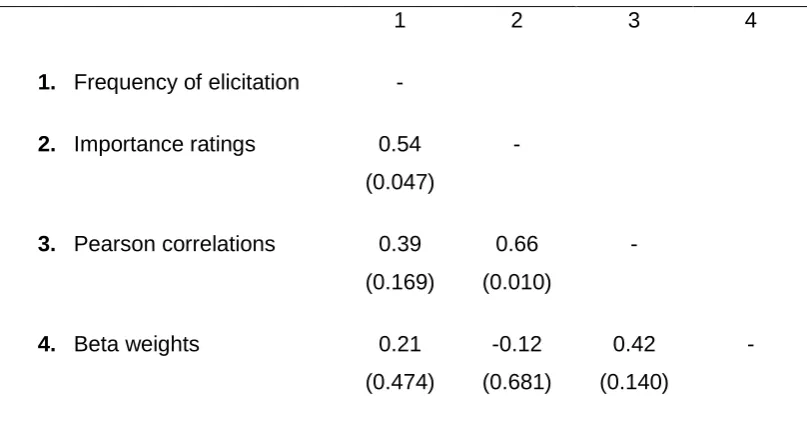
Spearman’s correlations, for assessing the congruence (in ranking of beliefs)
between the four indices, are presented in Table 4. Although the sample size was
small (n = 14 items), correlations were high, and significant at the 0.05 level, for the
relationship between importance ratings and frequencies, and between importance
ratings and bivariate correlations rho = 0.54 and 0.66, respectively). Spearman’s rho
for the relationship between the beta weights and bivariate correlations was 0.42 (p >
0.05). Spearman’s correlations between the other measures were in the range -0.12
< rho < 0.39, all non-significant.
18
Discussion
This international study is the first to assess the congruence between the four most
commonly used methods for identifying the importance of attitudinal beliefs. It
showed that importance indices based on self-report (importance ratings) were
correlated with those based on elicitation and bivariate prediction. The multivariate
prediction method, using beta weights, was congruent with bivariate prediction (these
two indices not being independent of each other) but not with the other two methods.
These findings in general support the theoretical assumptions that underlie three of
these measures (namely, the cognitive accessibility assumption, the assumption that
individuals can accurately report the importance of their beliefs; and the assumption
that bivariate linear relationship is an indicator of importance). However, the
statistical complexities underlying multivariate regression (specifically, when
predictors are inter-correlated as in this case) appear to make this an inferior
indicator of belief importance. Using multiple regression analysis (as proposed by the
social judgement approach), therefore, may not be a robust method to use routinely
for identifying important beliefs. It could be argued that a reason for using multiple
regression is to get rid of shared variance between predictors. However, we would
argue that shared variance, while an important consideration for prediction, should
not rule out a variable as an appropriate, or potentially important, intervention target.
It is perhaps not surprising that there was no reliable relationship between the
frequency method and the Pearson’s correlation method: we do not regard this as a
fault of the interview method as such. Rather, it reflects the different objectives of
each method. The frequency method does not seek to assess how strongly a belief is
held, but assesses the prevalence of a belief across a sample.
Despite some evidence of congruence, these results suggest that methods for
selecting a few of the most important beliefs (e.g., for designing interventions) may
19
elicited beliefs either for further investigation in a predictive questionnaire study (Foy
et al., 2007) or for intervention design (French et al., 2012). Although three methods
for assessing importance identified the same ‘most important’ belief about SDD, the
next three most important beliefs differed according to the method used. Hence,
selecting a small number of important beliefs to target in an intervention would lead
to interventions with different informational content depending on which measure of
importance was used.
If researchers wish to select beliefs as the focus of interventions, we would
recommend the use of multiple methods. This would, for example, require that a
belief be assessed as important according to at least two indices before being taken
forward for further consideration. As an example, from Table 3 above, using the three
related indices, the following beliefs were identified in the top four for importance at
least twice:
SDD increases antibiotic resistance
The risks of SDD outweigh the benefits
Overall, SDD benefits the patients to whom it is delivered
Overall, SDD is cost effective
In any intervention that aimed to alter clinicians’ attitudes to SDD, it would thus be
appropriate to target these specific beliefs. It is worthy of note that, while it could
appear that the second and third beliefs in the above list are essentially the same,
they were actually different for the clinicians in this sample, who distinguished
between individual patients and patients collectively. Many reported that, although
SDD could benefit the individual patient, they felt that there was an unacceptable risk
of the development of antibiotic resistance among patient populations as a whole if
20
This study had a number of strengths. First, in a diverse multinational,
multi-professional panel of clinicians responsible for the care of patients in ICUs, there was
a relatively high level of participant retention. The parallel use of the same methods
for data collection and analysis across three continents and different health systems
yielded similar patterns of data, suggesting that the findings are robust across
different healthcare contexts. However, the specific topic investigated (the use of
SDD in intensive care) may have particular features that could limit the
generalisability of the specific findings (e.g., with respect to one belief consistently
emerging as most important). Nonetheless, the findings relating to methods for
assessing the importance of attitudinal beliefs appear robust.
Since the introduction of evidence-based health care, clinical guidelines, frequently
developed using Delphi methods to obtain expert consensus, have become a major
approach to trying to influence healthcare practice. For example, the National
Institute for Health and Clinical Excellence (NICE) in England, the Scottish
Intercollegiate Guidelines network (SIGN), and Australia’s National Health and
Medical Research Council all produce evidence-based guidelines that aim to
prioritise and direct changes in healthcare practice. Hence, the identification of
important beliefs may influence the practice of evidence-based health care as well as
being central to behavioural research. Assessment of the validity of importance
ratings is thus necessary to judge the validity of this methodology to develop clinical
guidelines as well as the likely success of behaviour change interventions.
Thus, the question of which methods are valid for identifying belief importance has
significant implications. Further research could take this approach a step further by
assessing the extent to which guidelines or interventions that are based on
‘important’ beliefs (identified using these different methods) are effective in changing
21
Conclusion
To our knowledge this is the first study to test congruence of four methods for
assessing the importance of beliefs in determining attitude: frequency of elicitation or
modal salience; importance ratings; bivariate prediction and multivariate prediction.
Importance ratings were strongly related to both frequency of elicitation and bivariate
correlation. However, studies usually select a few ‘most important’ beliefs for further
investigation or for intervention design. In this study, each of the four measures of
importance gave a different set of the four most important beliefs. Based on these
findings, identification of important attitudinal beliefs for intervention design should
not use a singular approach and should not rely solely on the multiple regression
22
References
Abraham, C., & Michie, S. (2008). A taxonomy of behavior change techniques used
in interventions. health psychology. Health Psychology, 27, 379-387. doi:
10.1037/0278-6133.27.3.379
Ajzen, I. (1991). The theory of planned behavior. Organizational Behavior and
Human Decision Processes, 50, 179-211.
Akins, R. B., Tolson, H., & Cole, B. R. (2005). Stability of response characteristics of
a delphi panel: Application of bootstrap data expansion. BMC Medical Research
Methodology, 5, 37. doi:10.1186/1471-2288-5-37
Asch, S. (1955). Opinions and social pressure. Scientific American, 193, 31-35.
Bartholomew, L. K., Parcel, G. S., & Kok, G. (1998). Intervention mapping: A process
for developing theory- and evidence-based health education programs. Health
Education and Behavior, 25, 545-563. doi:10.1177/109019819802500502
Cooksey, R. W. (1996). Judgement analysis: Theory, methods and applications.
London: Academic Press.
Cuthbertson, B. H., Francis, J., Campbell, M. K., MacIntyre, L., Seppelt, I., &
Grimshaw, J. (2010). A study of the perceived risks, benefits and barriers to the
use of SDD in adult critical care units (the SuDDICU study). Trials, 11, 117.
Dalkey, N. C. (1969). The delphi method: An experimental study of group opinion.
Santa Monica, California: RAND.
D'Zurilla, T. J., & Nezu, A. (1998). A study of the generation-of-alternatives process in
social problem solving. Cognitive Therapy and Research, 4, 67-72.
23
Erffmeyer, R. C., & Erffmeyer, E. S. (1986). The delphi technique: An empirical
evaluation of the optimal number of rounds. Group & Organization Management,
11, 120-128. doi: 10.1177/105960118601100110
Evans St., J. B. T., Harries, C., Dennis, I., & Dean, J. (1995). General practitioners'
tacit and stated policies in the prescription of lipid lowering agents. British
Journal of General Practice, 45, 15-18. PMCID: PMC1239107
Fazio, R. H. (1989). On the power and functionality of attitudes: The role of attitude
accessibility. Attitude, structure and function. Hillsdale, NJ: Erlbaum.
Fazio, R. H., Powell, M. C., & Williams, C. J. (1989). The role of attitude accessibility
in the attitude-to-behaviour process. J Consumer Research, 16, 280-288. doi:
10.1086/209214
Fink, A., Kosecoff, J., Chassin, M., & Brook, R. H. (1984). Consensus methods:
Characteristics and guidelines for use. Am J Public Health, 74. 979-983. doi:
10.2105/AJPH.74.9.979
Fishbein, M., & Ajzen, I. (1975). Belief, attitude, intention, and behavior : An
introduction to theory and research. Reading, Mass: Addison-Wesley.
Fitch, K., Bernstein, S. J., Aguilar, M. D., Burnand, B., LaCalle, J. R., Lázaro, P., . . .
Kahan, J. P. (2000). The RAND/UCLA appropriateness method user's manual
RAND Europe, RAND Health.
Foy, R., Francis, J. J., Johnston, M., Eccles, M., Lecouturier, J., Bamford, C., &
Grimshaw, J. (2007). The development of a theory-based intervention to
promote appropriate disclosure of a diagnosis of dementia. BMC Health
24
Francis, J. J., O'Connor, D., & Curran, J. (2012). Theories of behaviour change
synthesised into a set of theoretical groupings: Introducing a thematic series on
the theoretical domains framework. Implementation Science,7, 35. PMID:
22531601
French, S. D., Green, S. E., O'Connor, D. A., McKenzie, J. E., Francis, J. J., Michie,
S., . . . Grimshaw, J. M. (2012). Developing theory-informed behaviour change
interventions to implement evidence into practice: A systematic approach using
the theoretical domains framework. Implementation Science,7, 38.
doi:10.1186/1748-5908-7-38
Higgins, E. T., King, G. A., & Mavin, G. H. (1982). Individual construct accessibility
and subjective impressions and recall. Journal of Personality and Social
Psychology, 43, 35-47. doi: 10.1037/0022-3514.43.1.35
Hunter, D. J. W., McKee, C. M., Sanderson, C. F., & Black, N. A. (1994). Appropriate
indications for prostatectomy in the UK – results of a consensus panel. Journal
of Epidemiology & Community Health, 4, 58-64. PMCID: PMC1059896
Janis, I. (1972). Victims of groupthink: A psychological study of foreign-policy
decisions and fiascos. Boston: Houghton-Mifflin.
McKenzie, J. E., French, S. D., O'Connor, D. A., Grimshaw, J. M., Mortimer, D.,
Michie, S., . . . Green, S. E. (2008). IMPLEmenting a clinical practice guideline
for acute low back pain evidence-based manageMENT in general practice
(IMPLEMENT): Cluster randomised controlled trial study protocol.
Implementation Science., 3, 11. doi:10.1186/1748-5908-3-11
Michie S. Johnston M. Abraham C. Lawton R. Parker D. Walker A. (2005). Making
25
consensus approach. Quality & Safety in Health Care, 14, 26-33.
doi:10.1136/qshc.2004.011155
Michie, S., Johnston, M., Francis, J. J., Hardeman, W., & Eccles, M. P. (2008). From
theory to intervention: Mapping theoretically derived behavioural determinants to
behaviour change techniques. Applied Psychology: An International Review, 57,
660-680. DOI: 10.1111/j.1464-0597.2008.00341.x
Murphy, M. K., Black, N. A., Lamping, D. L., McKee, C. M., Sanderson, C. F.,
Askham, J., & Marteau, T. (1998). Consensus development methods, and their
use in clinical guideline development. Health Technology Assessment
(Winchester, England), 2, 1-88. DOI: 10.4135/9781848608344
Myers, D. G., & Lamm, H. (1975). The polarizing effect of group discussion.
American Scientist, 63, 297-303. doi.org/10.1016/0022-1031(78)90049-5
Steadman, L., & Rutter, D. R. (2004). Belief importance and the theory of planned
behaviour: Comparing modal and ranked modal beliefs in predicting attendance
at breast screening. British Journal of Health Psychology, 9, 447-463. DOI:
10.1348/1359107042304579
Sutton, S., French, D. P., Hennings, S. J., Mitchell, J. O., Wareham, N. J., Griffin, S.,
. . . Kinmonth, A. L. (2003). Eliciting salient beliefs in research on the theory of
planned behaviour: The effect of question wording. Current Psychology, 22,
234-251. doi: 10.1007/s12144-003-1019-1
Zimbardo, P. G., & Leippe, M. R. (1991). The psychology of attitude change and
social influence. McGraw-hill series in social psychology. New York, NY:
26
Table 1: Four methods for assessing belief importance
Method Approach Underlying assumption Measure
Elicitation Modal
Salience
Cognitive accessibility – how
readily an issue comes to mind
reflects its importance for
influencing attitudes and
behaviour
Frequency of
interviews in which the
belief is mentioned
Self-report
Expectancy-value
Individuals can accurately rate
the importance of their own
beliefs for influencing attitudes
and behaviour
Means of importance
ratings for each belief,
generated from participants’ questionnaire responses Bivariate prediction Judgement analysis
Prediction is an indicator of the
beliefs most likely to exert causal
influence on attitudes and
behaviour
Pearson’s correlation
coefficients between
agreement ratings for
each specific belief
and measure of global
attitude
Multivariate
prediction
Judgement
analysis
Prediction is an indicator of the
beliefs most likely to exert causal
influence on attitudes and
behaviour. The relative
importance of beliefs is best
judged by considering all beliefs
together in one analysis
Beta-weights in a
multiple linear
regression to predict
measure of global
27
Table 2. Frequencies of coding of 14 beliefs in 105 interview transcripts.
Item Wording Number of interviews where belief coded
UK (n=38) ANZ (n=32) CA (n=35) There is no mortality benefit associated with
SDD
12 17 18
The risks of SDD outweigh the benefits 11 15 6
SDD reduces VAP 16 17 21
SDD reduces length of stay 6 8 7
Overall SDD benefits patients 23 13 11
SDD increases nursing workload 8 13 19
SDD increases pharmacy workload 1 1 6
SDD increases antibiotic resistance 32 32 29
SDD causes unpleasant side-effects for patients 7 7 4
SDD reduces Hospital Acquired Infections 22 15 8
I am opposed to the IV component of SDD 2 9 9
SDD would increase ICU Clostridium difficile
infections
4 2 11
Overall, SDD is cost effective 21 30 13
Educating staff would be expensive 1 2 1
Note. The beliefs listed here present the content elicited in Round 1 interviews but in
many cases there was variation in the direction of the belief (for or against SDD).
SDD = Selective Decontamination of the Digestive Tract; VAP = Ventilator
Associated Pneumonia; IV = Intravenous; ICU = Intensive Care Unit, UK = United
28
Table 3. Importance of attitudinal beliefs: four methods presented in rank order from
most to least frequently coded in interviews (n = 105) together with semi-partial
correlations to assist with interpreting beta-weights.
Belief Frequency Mean
importance rating (1 - 9)
aPearson’s correlation b Beta-weight Semi-partial correlation
SDD increases antibiotic
resistance
93 8.00 0.54*** 0.26* 0.17
Overall, SDD is cost effective 64 6.52 -0.43*** -0.09 -0.07
SDD reduces VAP 54 6.76 -0.14 0.07 0.06
Overall, SDD benefits the
patients to whom it is delivered
47c 6.96 -0.48*** -0.30* -0.19
There is no mortality benefit
associated with SDD
47c 6.91 0.33** 0.09 0.08
SDD reduces Hospital Acquired
Infections
45 7.10 -0.31** -0.04 -0.03
SDD increases nursing workload 40 5.54 0.09 -0.15 -0.12
The risks of SDD outweigh the
benefits
32 7.11 0.48*** 0.14 0.10
SDD reduces length of stay 21 6.48 -0.13 0.02 0.02
I am opposed to the IV
component of SDD
20 6.47 0.37*** 0.16 0.13
SDD causes unpleasant
side-effects for patients
18 5.93 0.20* -0.07 -0.06
SDD would increase ICU
Clostridium difficile infections
17 7.24 0.36*** 0.01 0.01
SDD increases pharmacy
workload
7 4.93 0.17 0.22* 0.17
Educating staff would be
expensive
4 4.98 0.21* 0.10 0.09
* p < 0.05 ** p < 0.01 *** p < 0.001
Note. In each column, the four most important beliefs are presented in bolded font. SDD =
Selective Decontamination of the Digestive Tract; VAP = Ventilator Associated Pneumonia; IV
= Intravenous; ICU = Intensive Care Unit
a
Correlation between item and score on the global attitude item, I am opposed to SDD.
b
From a multiple regression to predictscore on the global attitude item, I am opposed to
SDD.
c
29
Table 4. Correlations on ranks of four indices of belief importance (p values in
brackets).
1 2 3 4
1. Frequency of elicitation -
2. Importance ratings 0.54
(0.047)
-
3. Pearson correlations 0.39 (0.169)
0.66
(0.010)
-
4. Beta weights 0.21
(0.474)
-0.12
(0.681)
0.42
(0.140)
-
Note. 1. Frequency of elicitation in interviews; 2. Participant-rated importance (on
9-point Likert scales); 3. Pearson correlation with global attitude score; 4. Beta weights
in multiple regression to predict global attitude score.
30
Figure 1. Example screen shot from the Round 2 materials (items to measure
31
Figure 2. . Example screen shot from the Round 3 materials (anonymised
32
APPENDIX:Delphi study interview topic guide exploring delivery of SDD to patients in the Intensive Care Unit
Shaded cells present alternative questions for participants whose ICU delivers SDD.
Domain Core Question Possible Prompts
Knowledge In your view, what are the components
of SDD? What variations are the in possible these components?
What are the components of SDD as they are delivered in your unit? Do you know about the unit SDD protocol?
What does the protocol say?
Have I understood you correctly that SDD involves the application of antibiotic pastes to the mouth, throat and stomach and a short course of intravenous antibiotics for the purpose of prophylaxis?
[If no: There is variation in what people consider to be SDD. For the purpose of this interview, would it be possible to think about SDD as the application of antibiotics in three ways; orally, to the mouth and throat, gastric application to the stomach and a short course of IV antibiotics]
General Is SDD delivered in your ICU? What would you say is the main reason?
Motivation and
goals How important is the issue of SDD for you? How does it fit with other priorities in the ICU? Is its priority for you related to your assessment of the evidence?
Professional role and identity
Do you sense whether there is general consensus in your profession about SDD?
What is the range of views? How does SDD fit with your own professional standards?
Emotion Does anyone you work with
have strong feelings about SDD? (If Yes) Have you got a sense why they feel strongly about SDD?
Social
influences Would you say that your opinion on providing SDD has been influenced by your colleagues?
(If Yes) In what way? (If No) Why not?
Behavioural
regulation What else are you doing to prevent new infections in your unit?
What would need to happen in order to adopt SDD in your Unit?
How would implementation of the protocol be monitored?
If the decision was not to adopt SDD, what alternative procedures might you use instead?
How is implementation of the
SDD protocol monitored? Are there procedures or ways of working that make it easier or more efficient to deliver SDD?
Beliefs about
consequences What would be and downsides, of delivering (are) the benefits SDD over and above what you are doing now? (I’m thinking of clinical outcomes but also financial costs, time, staff
What about the bigger picture. What might be the short/medium-term benefits and downsides compared to longer term consequences?
33 resources and so on.) SDD in ICU that may affect other
patients in the ICU or hospital?
Skills Are there any specific skills
needed for delivering SDD? Do you think members of your profession have these skills? (Would training be needed to deliver SDD?)
Nature of the
Behaviour How difficult would SDD be in comparison to what you are doing already?
Do you think the complexity is an important barrier to adoption? Are the behaviours that make
up SDD performed often enough to become routine?
Is SDD well embedded within the daily routines of the unit?
Environmental context and resources
What additional resources would (does) your Unit need in order to deliver SDD?
Any other resources?
To what extent is the delivery of SDD influenced by physical or resource factors?
Beliefs about
capabilities How much influence do you personally have over whether or not your Unit adopts SDD?
Do you have responsibility for instigating changes?
How difficult or easy is it for you to do the things that you are required to do as part of SDD delivery?
What problems have you encountered?
What would help them?
Decision
processes How would you go about seeking agreement among your colleagues about whether or not to adopt SDD in your Unit?
How about individual clinical decisions - What would you consider when making the clinical decision whether or not to administer SDD to an individual? In which patient groups would you not administer SDD?
What would you consider when making the clinical decision to administer SDD to an individual?
In which patient groups would you not administer SDD?
Further research
Do you think that further research would settle some of the issues surrounding SDD?
What type of research study do you think would be most informative for the future of SDD practice?
Is further research ethical? Why? Or why not?
Secondary focus 1: Participation
in an
effectiveness trial
The purpose of this study is not to recruit you to a trial but if there was a study which randomised patients to a SDD group against a no-SDD control group would you be willing to recruit patients?
34 Secondary focus
2: Participation in
implementation trial
If there was a study whose aim was to increase adoption of SDD in ICUs nationwide would you be willing to participate?
Why? Or why not?
Other Is there anything else that you want to say that you haven’t mentioned yet?
What do you think is the current state of the evidence about SDD? Any other ethical matters?
Questions for describing sample
What ICU do you work in?
How many beds are there in the ICU?