Rochester Institute of Technology
RIT Scholar Works
Theses Thesis/Dissertation Collections
8-1-2013
Math expression retrieval using symbol pairs in
layout trees
David Stalnaker
Follow this and additional works at:http://scholarworks.rit.edu/theses
Recommended Citation
Math Expression Retrieval Using
Symbol Pairs in Layout Trees
by
David Stalnaker, B.S.
THESIS
Presented to the Department of Computer Science
Golisano College of Computer and Information Sciences
in Partial Fulfillment
of the Requirements
for the Degree of
Master of Science
Math Expression Retrieval Using
Symbol Pairs in Layout Trees
APPROVED BY
SUPERVISING COMMITTEE:
Dr. Richard Zanibbi, Chair
Dr. Bo Yuan, Reader
Math Expression Retrieval Using
Symbol Pairs in Layout Trees
David Stalnaker, M.S.
Rochester Institute of Technology, 2013
Advisor: Dr. Richard Zanibbi
We have developed a layout-based math retrieval system by indexing on
pairs of symbols in mathematical expressions. Existing approaches to
layout-based retrieval include tree edit distance-layout-based matching on MathML trees
(Kamali and Tompa, 2013) and longest common subsequence matching in
LATEX strings (Kumar et al., 2012). In our work, we compare our new
layout-based retrieval method with a math retrieval system built using the
conven-tional text-based retrieval system Lucene (Zanibbi and Yuan, 2011), as such
systems are commonly used for math search. We show that the search results
returned by our system are scored by participants in a study as significantly
more similar than those of the comparison system and that our system is fast
Table of Contents
Abstract iii
List of Tables vi
List of Figures vii
Chapter 1. Introduction 1
Chapter 2. Background 4
2.1 Information Retrieval . . . 4
2.2 Index Compression . . . 5
2.3 Math Retrieval . . . 7
2.4 Ranking Math Query Results . . . 11
2.5 MathML . . . 12
2.6 Summary . . . 14
Chapter 3. Methodology 15 3.1 Corpora . . . 15
3.1.1 MREC . . . 15
3.1.2 Wikipedia . . . 16
3.2 Input Formats . . . 16
3.3 Symbol Layout Trees . . . 17
3.4 Symbol Pairs . . . 18
3.5 Symbol Pair Index . . . 19
3.6 Ranking Functions . . . 21
3.7 Implementation . . . 26
Chapter 4. Results and Discussion 29
4.1 Experimental Design . . . 29
4.1.1 Query Result Relevance . . . 29
4.1.2 System Performance . . . 32
4.2 Results . . . 33
4.2.1 Demographics and Survey Responses . . . 33
4.2.2 Search Result Scores . . . 33
4.2.3 Response Times . . . 37
4.3 Performance Metrics . . . 38
4.4 Discussion . . . 39
4.5 Summary . . . 41
Chapter 5. Future Work and Conclusion 42 5.1 Future Work . . . 42
5.1.1 Performance Optimizations . . . 42
5.1.2 Retrieval Improvements . . . 43
5.1.3 Additional Comparisons . . . 45
5.2 Conclusion . . . 46
Appendices 47
List of Tables
3.1 Definitions for the ranking functions . . . 22 3.2 Important Redis keys and their values. . . 27
List of Figures
1.1 Screenshots of min and Tangent . . . 2
2.1 Size of encoded values . . . 7
3.1 Example expression, Symbol Layout Tree, and Symbol Pairs . 18 3.2 Pseudocode for indexing and searching. . . 20 3.3 Example query and result for Prefix ranker . . . 25 3.4 Pseudocode for the Prefix ranking function. . . 26
Chapter 1
Introduction
While search for text is a well-studied problem, math search is less
ma-ture. Search for mathematical expressions is difficult for a number of reasons.
There are numerous representations for expressions, including: LATEX,
(con-tent and presentation) MathML, Mathematica, and various forms of rendered
output (PDF, images). Mathematical expressions are generally expressed as
a tree structure (whereas text is linear), which necessitates more complex
al-gorithms for matching. Partially matched expressions are difficult to rank
because small syntactic changes can have large semantic meaning and vice
versa.
The main motivation for a math search engine is to facilitate learning.
Upon coming upon an unfamiliar mathematical expression, a student could
search for it and learn what it means. Similarly, a researcher could find
pa-pers by searching the math contained within them [17]. Math search could
also be used when mathematical queries are detected in an existing search
en-gine [2]. One problem with a math search enen-gine is that the representations of
mathematics are complex and students are unlikely to be familiar with them.
hand-written mathematics and can be used as an input for our search engine.
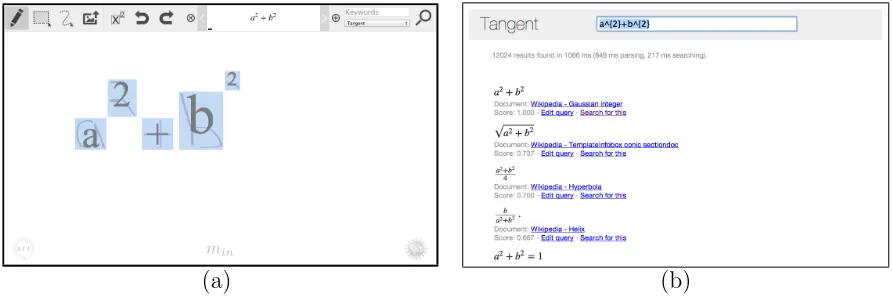
Figure 1.1 shows the interaction between these two systems.
(a) (b)
Figure 1.1: Screenshots of the min handwritten math recognition tool
(a), and the results page of our Tangent search engine (b).
An inverted index is the tool used most commonly in text search. It is
a lookup table from words to the documents that contain them. This idea has
been modified to allow for word locality, phrase searching, index compression,
and distributed indexing. With these and other improvements, systems can
be built to quickly search massive corpora (notably the Internet) [20].
In our system, Tangent, we apply the concept of the inverted index to
math search, indexing directly on the structure of the equation instead of a
linear string representation thereof. The idea is that encoding the structure of
the expression directly in the index will yield more partial matches, providing
text search, overall system speed should be comparable to those systems. This
leads us to this hypothesis:
Implementing a math expression search system using an
inverted index on symbol pairs from layout trees will: 1)
yield more relevant results than text-based retrieval, and
2) be fast enough for real time use.
We conducted two experiments to test our hypothesis: a human study
wherein we asked participants to score results from our system and a text
search-based comparison system, and a performance analysis of our system.
The results of these experiments support both parts of the hypothesis. The
search results for our system scored significantly higher than those of the
com-parison system and a performance analysis showed the system to be usable
Chapter 2
Background
Information retrieval is a well-established field in computer science, but
the majority of the research has been focused on text retrieval with significantly
less work in math retrieval. In this chapter, we will describe the basic concepts
used in text retrieval, and methods to compress the indexes used therein.
We will then describe several existing math search systems and discuss the
general goals of math retrieval. Finally, we will describe MathML, a common
representation for mathematical expressions.
2.1
Information Retrieval
As computers appeared, one of the important tasks that emerged was
storing and searching large sets of documents. The inverted index was an
early and natural development in this field. It can be thought of like an index
in a book: it is a structure that maps each term to a list of documents that
contains it. In its most simple form, an inverted index only allows us to find
the documents that contain a given term [7, 10].
The inverted index is still the basis of almost every document retrieval
powerful. By looking up multiple terms and taking the union or intersection of
the returned set of documents, we can handle multi-term queries. By storing
the frequencies of terms in each document, we can order the documents by
this frequency. By storing the location(s) of each term in each document, we
can search for exact and inexact phrases.
There are numerous ways in which to rank the relevance of matched
documents. The simplest is the frequency of a matched term in the
docu-ment, or term frequency. A common metric, TF-IDF, makes use of this and
the Inverse Document Frequency. The IDF is the inverse of the number of
documents that contain the term. Including this in a ranking metric allows
us to bias results towards infrequently used words, which works well because
common words are usually less discriminative. Other measures that might be
used as part of a ranking metric are the number of documents and terms in
the index, and the term frequency.
2.2
Index Compression
While storing document references and counts in the index as 32- or
64-bit integers is convenient, it is wasteful of space. There are numerous
ways to compress the inverted lists. In addition to the decreased storage
need, this also usually brings a performance improvement, as the added cost
of decompression is negligible compared to the decreased cost of disk reads.
Most of the compression methods discussed will remain applicable with the
is a summary of Zobel and Moffat’s discussion of the same topic in [20].
One way to compress an index is to change the representation of an
integer. The appropriate representation depends on the probability
distribu-tion of the values. If the values are very low, a unary representadistribu-tion is viable,
wherein the numbernis is represented by n−1 “1” bits followed by a “0” bit.
This has the property that “1” is encoded with just 1 bit, but quickly becomes
inefficient for larger values. Unary encoding is most efficient when P[n]≈ 1 2n,
where n is the number being encoded and P is the probability distribution of
the numbers to be encoded. In practice this means n must be very small.
Elias’ gamma code allows for more efficient encoding of larger numbers.
The value n is factored into 2e+d, where e=blog
2nc. The encoding is then
e+ 1 encoded in unary followed by d encoded in binary (using e bits). It is
most efficient when P[n]≈ 1 2n2.
While bitwise encoding schemes can lead to a great reduction in index
size, they ignore the fact that computers can generally only address memory
at the byte level. It is thus often a better idea to encode our index in whole
bytes, for reason of both performance and ease of programming. An effective
method is to break the value into 7-bit chunks. If the value fits in 7 bits,
encode it in one byte with the high bit set to “0”. Otherwise, encode the
first 7 bits with a leading “1”, and iterate with the next byte. This is more
wasteful than the bitwise methods for small values, but in practice provides a
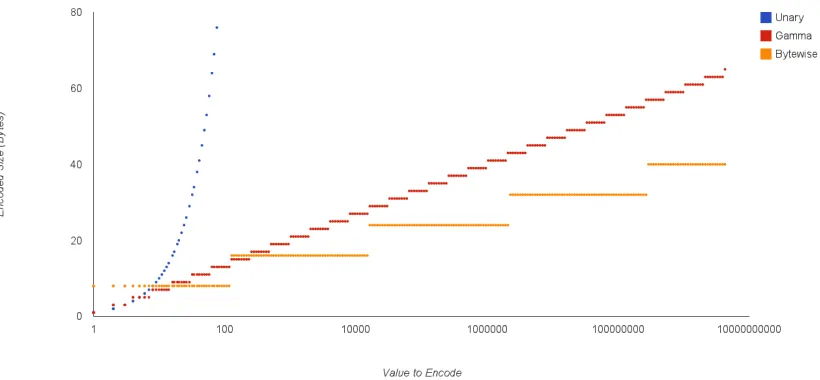
Figure 2.1: Size of encoded values. Input values are on a log scale, and the unary encoding is far off the scale for large values.
These encoding schemes work well for frequency counts because they
are generally very small. Document IDs, however, are distributed uniformly
and thus do not compress well. An effective way to solve this is to sort the
document identifiers in each inverted list and store instead the differences
between each element and its predecessor. In a list for a common word (which
will make up a sizable portion of the index), these differences will be very
small and compress easily.
2.3
Math Retrieval
There are several systems for math search that encode expressions as
key effort here is the process of “linearizing” the math expression for input
into the text search system, both for documents to index and queries to the
system. Zanibbi and Yuan’s system [19] indexes individual LATEX expressions
by tokenizing the expression and mapping each symbol to a text
represen-tation. In this example from Miller [8], the LATEX expression x^{t-2} = 1
is represented as x BeginExponent t minus 2 EndExponent Equal 1. Ex-pressions are then inserted into the Lucene search engine and queried with
LATEX expressions processed in the same manner.
Sojka and L´ıˇska’s MIaS system [14, 15] operates on similar principles
but differs in several areas. It is a full-text search system that indexes both
math expressions and the surrounding text. Instead of single LATEX
expres-sions, MIaS indexes XHTML documents containing MathML expressions. The
overall architecture of the system is similar, with linearized expressions being
inserted into a text search system (it too uses Lucene). Munavalli and Miner’s
MathFind [9] is another text-search based system, indexing text and MathML
expressions together by converting the expressions to text strings.
The key problem with this approach is that the text search has limited
information on the structure of the expression. It is thus difficult to align
the qualities of a good textual match with the qualities of a good match of
the expression. The advantages are that it works reasonably well in practice,
is easy to implement, and benefits directly from the decades of research in
document retrieval. Our approach will use the same concept of the inverted
expressions.
There have been several approaches which look at the problem more
directly. Kamali and Tompa describe a system based on efficient exact
match-ing of MathML trees [3]. They use an index in which identical subtrees are
shared between all expressions, which allows for much better performance.
In-exact matching is enabled through the use of wildcards, where each wildcard
can be a number, variable, operator, or expression (which can itself contain
wildcards). More recently, they describe a system that uses a similar index
but uses a tree-edit distance for searching and ranking, which allows for
in-exact matching without user-specified wildcards [4]. Calculating the tree-edit
distance for each expression in the index would be too expensive, but through
a combination of early termination for poor matches and caching for
subex-pressions, it achieves competitive performance (∼800ms query time on a large
corpus compared to ∼300ms for MIaS).
Kumar et al. [6] use a Least Common Subsequence (LCS) algorithm for
matching LATEX strings. The input LATEX strings are preprocessed as a
canon-icalization step where each function, variable, and number is mapped to an
atomic term. Variables and numbers are generalized. A dynamic-programming
LCS algorithm on these terms is then used to find the matches. This approach
is fairly robust against small changes in the structure (i.e. it allows for inexact
matching) as missing or modified parts of the expression will be gaps in the
LCS. However the LCS algorithm is O(n2) in the expression size and requires
for large indexes.
Another approach to the problem uses substitution trees. Substitution
trees come from the field of automatic theorem proving. The leaf nodes contain
the expressions that have been inserted into the tree. The internal nodes
contain expressions with at least one generic term. Each child represents a
substitution of one or more of the generic terms of its parent with more specific
terms (which can introduce new generic terms).
Kohlhase and Sucan’s Math WebSearch [5] uses substitution trees to
match expressions on their semantic meaning, rather than layout. This
ap-proach can match expressions that match the query term exactly up to α
-equivalence, which means the structure must match exactly but individual
terms may be substituted (to terms of the same type). In addition,
subex-pression matching was enabled by inserting all subexsubex-pressions of an
expres-sion when inserting it into the index. Input to Math WebSearch is Content
MathML (see Section 2.5).
Schellenberg’s work [12, 13] instead uses substitution trees to match
ex-pressions by their layout. Rather than performing an exact expression match
(as Math WebSearch does), this system exhaustively searches the tree for
matches. This has the benefit of allowing for partial matches that have
struc-tural similarity, but the drawback of greatly increased query times. The system
introduces a ranking method for partial matches which will be discussed in the
2.4
Ranking Math Query Results
While very effective metrics have been developed for ranking text queries,
ranking math expressions remains an open question. There are some analogs
between the two problems (for example, the concept of term frequency can
be roughly applied in the same way to symbols in an expression), but a new
strategy is needed.
Mathematical expressions can generally be considered to have a tree
structure, unlike text which is linear. As such, the structure of the expression
is important to capture in the ranking metric. Symbols in an expression can
easily be broken into categories: operators, variables, constants, and functions.
These categories should have different weights in the ranking function (e.g.
operators have more meaning than variables, which can be renamed without
much change to the expression) [16]. Relatedly, a useful quality for a ranking
function to have would be to match expressions with the identical structure
but variables renamed, with a penalty.
Another positive quality for a ranking function would be to favor results
in which the matched symbols are more connected to each other than not. A
common type of query would be one that matches a small part of a larger
expression. For example, take the queryx+y. The result (x+y)∗zwould be a
better match than (x+z)∗y, because the query term is an exact subexpression.
According to this quality, the more relevant result would thus be the one that
While most systems rely on their underlying text search systems for
ranking partial matches, there have been some attempts made at ranking
math expressions directly. Schellenberg [12, 13] defines a ranking function that
combines two metrics: a bag-of-words comparison of the individual symbols
in the expressions and a bipartite comparison that looks at pairs of symbols
(including the structure between them: the relationship between the symbols
and position along the baseline). For each of these metrics, the number of
matching symbols / pairs is counted, and the average of these two scores is
taken. Additionally, symbols that match the correct type but not the exact
symbol are counted at 25% of a full match. While our index will be built using
a different method than that of this system, our ranking function will build
directly on its ideas.
2.5
MathML
MathML is an XML-based language for describing mathematical
ex-pressions. There are two forms: Content MathML describes semantic
mean-ing and Presentation MathML describes layout. While some systems (Math
WebSearch [5]) build indexes on semantics, we will be focusing on layout and
thus Presentation MathML.
A MathML expression is contained in a root <math> tag. There are
four token elements (elements that do not contain other elements): identifiers
(<mi> ), operators ( <mo> ), numbers ( <mn> ), and text ( <mtext> ).
of adjacent elements. Each of the child elements are placed in a row. The
<mfrac> tag describes a fraction. The first child is the numerator and the
second is the denominator. The <msup> tag describes a superscript, with the
first child being the base and the second being the exponent. <msub> and
<msubsup> tags describe subscripts and combination subscript-superscripts,
respectively. Similarly, <mover> , <munder> , and <munderover> describe
elements that are directly under and/or over an element (e.g. an integral
sign). The <msqrt> tag describes the square root of its only child and the
<mroot> tag describes the n-th root of its first child, where n is its second
child. Tables are contained in <mtable> elements and contain rows ( <mtr>
) which contain cells ( <mtd> ). The <mfenced> tag describes a group where
its children are surrounded by some fence symbol (e.g. parentheses).
As Presentation MathML can represent the same expression in multiple
ways, a canonicalization procedure is needed to prevent a valid match from
being ignored because it was represented differently. Archambault and Mo¸co
define Canonical MathML [1], an extension of Presentation MathML that
does exactly this. Canonicalization is important because we are encoding the
structure obtained from the MathML in our index. If an expression can take
multiple forms in our index, a matching query and result could appear to
not match if they are expressed differently in MathML, even when they are
describing the same expression.
In Canonical MathML, all tags like <msub> , <mfrac> , and <mroot>
enforcing the use of the <mrow> tag where it is not strictly necessary in
standard MathML. Summation, product, and integrals must be contained in a
two-element row. The first element is the symbol, which might also be wrapped
in a <msub> or <msubsup> tag. The second element is the subexpression
being (for example) summed, which must be wrapped in a second <mrow> if
it contains multiple symbols. Similarly, a parenthesis group is contained in a
<mrow>, with all fence symbols and commas as <mo> elements in it.
A common and more human-readable representation of mathematical
expressions than MathML is LATEX. LATEX expressions are presentational and
can be converted to Presentation MathML (see Section 3.1).
2.6
Summary
Existing methods of math information retrieval can be generally broken
up into two groups: adaptations of existing text search tools or some form of
tree-matching. The approach we describe in the next section takes a different
tack: we apply the idea of an inverted index more directly on the structure of
Chapter 3
Methodology
Tangent uses an inverted index of pairs of symbols from expressions.
In this chapter, we will describe the corpora and formats used for math
repre-sentation. We will define the Symbol Layout Trees and the Symbol Pairs used
in the index, and then the index itself. Then, we will define 5 different ranking
functions for ordering matches. Finally, we will describe the implementation
of our system.
3.1
Corpora
3.1.1 MREC
MREC (Math REtrieval Collection) is a collection of approximately
324,000 academic publications. The arXiv1 contains preprint papers in
sci-ence and mathematics. These documents have been converted to XHTML
and MathML by the LaTeXML2 project. MREC takes the documents that
have been converted successfully and modifies them, most importantly by
con-verting the MathML expressions to Canonical MathML.
1http://arxiv.org
3.1.2 Wikipedia
The Wikipedia corpus contains every mathematical expression from
the English-language Wikipedia project. It contains mathematical expressions
from virtually every field and more importantly, definitions and explanations
thereof. It is a desirable corpus because the information it contains is helpful
in learning mathematics, which is one of the major use cases of a math search
system. Additionally, we feel it is ideal for a comparison between search engines
because the breadth rather than depth of the mathematics represented. Each
concept might only have a few expressions, but with so many articles covering
so much material, it is likely that a given query will have a wide variety of
relevant results.
The corpus was assembled from a full XML archive of English Wikipedia
created on May 4, 2013. The LaTeX expressions were extracted from the
doc-ument along with the associated articles. The extracted LaTeX expressions
were then converted into MathML documents using the same LaTeXML tool
as used by MREC. There are 482,364 expressions contained in 32,780 articles.
3.2
Input Formats
Our system can parse both LATEX expressions and the XHTML +
Canonical MathML files from the MREC and Wikipedia datasets. For
sim-plicity, we use LaTeXML (the same tool used to create the datasets) to convert
any LATEX expressions to MathML, which we then parse into Symbol Layout
ex-pressions are also necessary as MathML is too unwieldy for user input (for the
query expression). In practice, the index will likely be built from MathML and
search queries will be input with LATEX (either written by the user or generated
by our handwritten math recognition tool, min [11]). Every commonly-used
MathML tag (all of those found in both corpora) is supported with the
excep-tion of those related to tables. The Symbol Pair representaexcep-tion used for the
index is not well-defined for tables, so MathML expressions containing tables
are ignored.
3.3
Symbol Layout Trees
Internally, Tangent uses a Symbol Layout Tree (SLT) to represent
ex-pressions. The vertices in this tree are the symbols in the expression and the
edges are the spacial relationships between them. The tree is rooted at the
leftmost symbol on the main baseline. Each symbol can have a relationship
to those ABOVE, BELOW, ADJACENT to, and WITHIN it. Examples of
ABOVE relationships include superscripts and upper limits on integrals (in
some SLT representations these would be separate relationships, but we have
combined them). Similarly, BELOW relationships include subscripts and lower
limits. Fractions are encoded as a FRAC symbol with the numerator ABOVE
and the denominator BELOW. A square root can have an expression WITHIN
it, and most other symbols will be ADJACENT (always to the right).
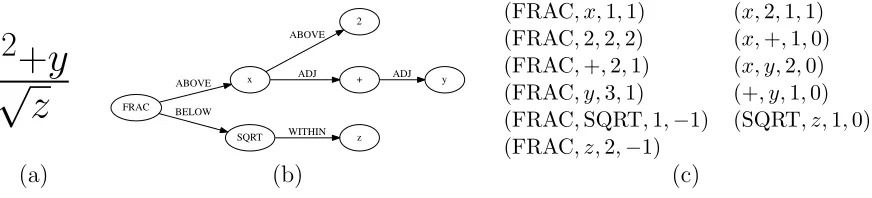
Fig-ure 3.1 shows an example expression, its Symbol Layout Tree, and its Symbol
x
√
2
+
y
z
FRACx ABOVE
SQRT BELOW
2 ABOVE
+ ADJ
z WITHIN
y ADJ
(FRAC, x,1,1) (x,2,1,1) (FRAC,2,2,2) (x,+,1,0) (FRAC,+,2,1) (x, y,2,0) (FRAC, y,3,1) (+, y,1,0) (FRAC,SQRT,1,−1) (SQRT, z,1,0) (FRAC, z,2,−1)
[image:26.612.101.537.139.238.2](a) (b) (c)
Figure 3.1: Example expression (a), Symbol Layout Tree (b), and Sym-bol Pairs(c)
3.4
Symbol Pairs
In text information retrieval, the documents are split into words to be
inserted into an index. To (naively) apply this idea directly to mathematics,
we could insert each symbol from an expression into the index, but this would
lose all information about the structure of the expression.
Our approach is to instead add pairs of symbols to the index. The
pairs are encoded with a representation of the structure between them. This
Symbol Pair representation is a tuple (s1, s2, dh, dv) where s1 and s2 are the
two symbols in the pair. The horizontal distance, dh, is the length of the
path between s1 and s2 when traversing the SLT. It can also be thought of
the number of symbols between s1 and s2 when moving rightward along the
baseline (though not strictly true as, for example, the ABOVE relationship
between a FRAC and a numerator counts towardsdh but does not move
right-ward). The vertical distance, dv, is the height of s2 aboves1’s baseline, which
is not affected by ADJACENT or WITHIN relationships. For example, in
the expression xy +z, we would add (x, y,1,1), (x,+,1,0), (x, z,2,0), and
(+, z,1,0) to the index. This representation is chosen to maintain the relative
relationship between the pair of symbols but be general enough to be used for
partial matches.
The Symbol Pairs are generated between every symbol (s1) in the SLT
and every symbol in the subtrees (children) of s1. This means that s1 is
always a parent element of s2 in the SLT. Not all pairs of symbols from the
SLT will be included; specifically, two symbols that in separate child subtrees
of a parent will not be included when generating the Symbol Pairs for an
expression. There are a worst-case n2 pairs inserted for an expression with n
symbols, which would occur for any linear expression (i.e. when there are no
branches in the SLT).
3.5
Symbol Pair Index
The index we have developed is similar to that of a text search engine,
with Symbol Pairs instead of words. The index is a hash table mapping Symbol
Pairs to the list of expressions that contain them. To create the index, we look
up each symbol pair in the index (creating an empty list if none was found)
and append the expression to the list that was found.
Querying the index is more complex. We construct a hash table,
re-sult pairs, that maps each matching expression to a list of the Symbol Pairs
the query expression in the index, getting a list of expressions that contain
that pair. Then, for each expression in that list, we add the pair to the
re-sult pairs entry for that expression. The full list of rere-sult expressions are then
ordered by a ranking function, which is given the search expression, the result
expressions, and the list of matching Symbol Pairs for each result expression.
It is possible for an expression to contain the same Symbol Pair more
than once. When this happens, we count the pair n times, where n is the
minimum of number of times the pair occurs in the query and the result. For
example, if a Symbol Pair occurs 5 times in a result but only twice in the
query, we will count it twice.
Index(expression, index):
for pair in symbol pairs of expression: append expression to index[pair] Search(query, index, k):
for pair in symbol pairs of query: for expression in index[pair]:
append pair to result_pairs[expression]
sort expressions by the ranking function (using result_pairs) return the top k expressions
Figure 3.2: Pseudocode for indexing and searching.
In text search, the index often includes in the lists the position in the
document where each word was found. Analogously, we include an identifier
that defines the absolute position of s2. This identifier is a d-element list,
a 0, 1, 2, or 3 depending on whether the ith relationship in the path to s2 is
BELOW, ABOVE, ADJACENT, or WITHIN, respectively. Because dh tells
us the path length betweens1ands2, we can later calculate the identifier fors1
by removing the last dh elements of s2’s identifier. As only one of the ranking
functions uses this information, we have not included it in the pseudocode for
clarity.
3.6
Ranking Functions
It is necessary to apply a ranking function to rank the matched
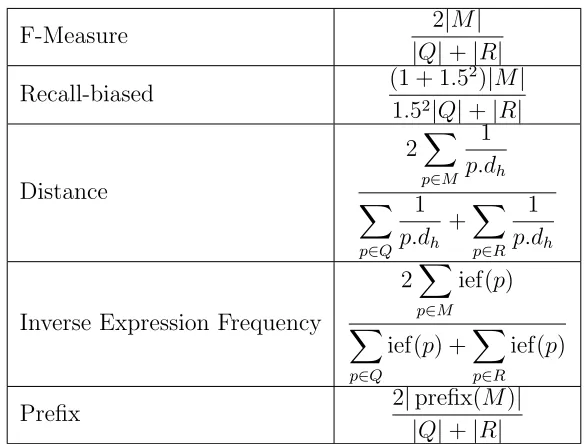
expres-sions by some metric of relevance. We have developed several such functions:
F-Measure, Recall-Biased, Distance, Prefix, and Inverse Expression Frequency.
F-Measure is the baseline, which balances between recall and precision of the
match. The rest of the the ranking functions are each a modification to the
F-Measure, usually by weighting each pair somehow. Recall-Biased uses a
weighted F-Measure to prefer matches that contain most of the Symbol Pairs
in the query. Distance gives higher weight to the Symbol Pairs that are closer.
Inverse Expression Frequency gives higher weight to the Symbol Pairs that are
less common in the index. Prefix removes Symbol Pairs that are from different
parts of the query.
F-Measure Ranker. Our baseline metric is the F-Measure ranker.
The recall-of-match is the percentage of Symbol Pairs in the query that are in
the match, and the precision-of-match is likewise the percentage matched in
F-Measure 2|M|
|Q|+|R|
Recall-biased (1 + 1.5
2)|M|
1.52|Q|+|R|
Distance
2X
p∈M
1 p.dh
X
p∈Q
1 p.dh
+X
p∈R
1 p.dh
Inverse Expression Frequency
2X
p∈M
ief(p)
X
p∈Q
ief(p) +X
p∈R
ief(p)
Prefix 2|prefix(M)|
[image:30.612.168.461.113.335.2]|Q|+|R|
Table 3.1: Definitions for the ranking functions. Q, R, and M are the sets of Symbol Pairs in the query, result candidate, and match (in-tersection) of the query and result, respectively. Note that each is an F-Measure that has been modified in some way.
the match: |Q2||+M|R||, where Q, R, and M are the sets of pairs in the query, result candidate, and match (between the query and result) respectively. Ranking
just by recall would bias results towards those that have the most pairs in
common with the query, but it is not effective. It would not consider the
length of the result and thus can rank highly results that are very long and
thus have a low percentage (but high number) of matched pairs. In a similar
way, ranking just by precision allows matches that are very short, which is
also undesirable. Using the harmonic mean of these values allows us to strike
an appropriate balance between these two extremes.
modifi-cation to the F-Measure ranker which biases the results slightly towards those
with high recall rather than precision. The reasoning behind this is that that
a user might prefer partial matches that contain the query to those that are
contained in the query. This would bias the system to including results that
contain the query as a subexpression than vice versa. It is more likely that the
user neglected to input part of the expression than he or she input too much.
The formula for the Recall-Biased ranker is the F1.5 score, where the general
Fβ score is (1 +β2)· precision
·recall (β2·precision)+recall.
Distance Ranker. The Distance ranker gives higher weights to the
pairs whose symbols are closer. Each pair is weighted by 1/dh, which has the
effect of giving more importance to the pairs that are closer together. The
ranker modifies the F-Measure thusly: instead of counting the set of pairs in
each of M, Q, and R, we sum this 1/dh weight for each Symbol Pair in the
set. The formula for the ranker is then
2X
p∈M
1 p.dh
X
p∈Q
1 p.dh
+X
p∈R
1 p.dh
, where p.dh is the
dh value for p.
Inverse Expression Frequency Ranker. The Inverse Expression
Frequency (IEF) ranker adapts the common text search metric of TF-IDF
(term frequency - inverse document frequency) to the math domain. The
formula ends up being quite different (to that of text search), but the basic
idea is the same: apply more weight to uncommon pairs (terms). We use
match, we sum the inverse expression frequency (IEF) of each matched pair.
The final score is
2X
p∈M
ief(p)
X
p∈Q
ief(p) +X
p∈R
ief(p) .
Prefix Ranker. The Prefix ranker looks at a way to find an alignment
between the query and result expressions and only include pairs in the match if
they occur on that alignment. To provide this alignment we use the additional
path information associated with each pair in the index (See Section 3.5).
Specifically, for each pair in the match, we get the path to s1 in both the
query and the result. These paths are then used to find which pairs share a
common prefix in the match using the algorithm described in Figure 3.4. The
idea is to find the first place (from the symbol moving up the SLT) where the
paths from the query and result diverge. We can then say that the Symbol
Pair is rooted at this this prefix of the two paths. The Symbol Pairs for a
large subexpression match will all be rooted at the same prefix, but Symbol
Pairs that are in different places between the query and result will not - the
idea is to prefer the more connected match.
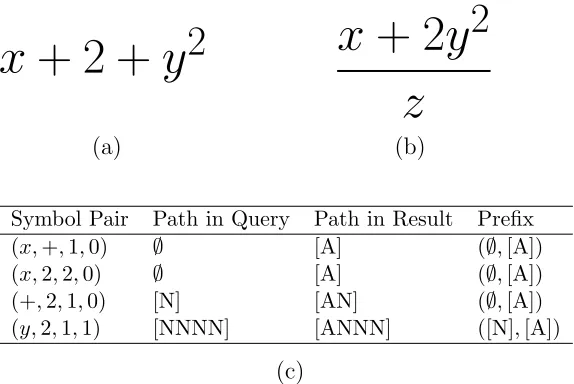
Consider the example query and result in Figure 3.3. Between the
two expressions, there are four matching Symbol Pairs: (x,+,1,0), (x,2,2,0),
(+,2,1,0), and (y,2,1,1). The path to x is ∅ in the query (it is the first
symbol on the main baseline) and [A] in the result (above the FRAC symbol).
The path to + is [N] in the query (one symbol along the baseline) and [AN] in
the result. The path to y is [NNNN] in the query and [ANNN] in the result.
x
+ 2 +
y
2
x
+ 2
y
2
z
(a) (b)
Symbol Pair Path in Query Path in Result Prefix (x,+,1,0) ∅ [A] (∅,[A]) (x,2,2,0) ∅ [A] (∅,[A]) (+,2,1,0) [N] [AN] (∅,[A]) (y,2,1,1) [NNNN] [ANNN] ([N],[A])
[image:33.612.168.455.136.328.2](c)
Figure 3.3: Example query (a), result (b), and matched Symbol Pairs and the paths to s1 (c). “A” stands for ABOVE and “N” stands for ADJACENT (next to).
element of the paths differs. For (+,2,1,0), we remove the common N from
the end of the two paths, and get the same prefix of (∅,[A]). For (y,2,1,1),
we can remove three N relationships, but this leaves us with a different prefix
([N],[A]). As 3 matched pairs have the same prefix, this gives us a score of
2∗3
15+16 ≈0.194, whereas the F-Measure would have been
2∗4
15+16 ≈0.258.
The Prefix ranker handles the case of the same pair matching multiple
times differently than the other rankers. We calculate the prefix for all
com-binations of the matches. For example, if a pair was in the query twice and
a result candidate three times, we would calculate the prefix for all 6
PrefixRank(pairs, query_size, result_size): prefixes := dictionary()
for each pair p, with path l_q in the query and l_r in the result: n := max(len(l_q), len(l_r))
pad l_q and l_r with null elements at beginning to length n while last(l_q) == last(l_r):
popright(l_q) popright(l_r)
prefixes[(l_q, l_r)] += 1 largest := max(prefixes)
return f-measure(largest, query_size, result_size)
Figure 3.4: Pseudocode for the Prefix ranking function.
result) of the prefixes can be the same, so this property is maintained from
the other rankers while allowing the prefixes that are in the largest group to
contribute to the result.
3.7
Implementation
The implementation of our system is designed around the Redis3
key-value store. Redis is a robust, scalable, in-memory database that maps string
keys to strings, lists, sets, sorted sets, and hash tables (all of strings). It was
chosen to ease development (as the Tangent server can be restarted
indepen-dently of Redis) and for its high performance. The index and all supporting
information is stored in Redis. As Redis is a simple key-value store, each type
of information is given a key; Table 3.2 lists the most important keys and the
values they store.
Key Value
expr count total # of expressions; next expression id pair:[sp]:exprs list of expressions containing symbol pair [sp] expr:[e]:docs set of documents containing expression [e] expr:[e]:mathml MathML text for expression [e] (for display) expr:[e]:[r]score maximum score for expression [e] and ranker[r]
Table 3.2: Important Redis keys and their values.
The Tangent system itself is implemented in Python. There is a core
library (approximately 1000 lines of code), which defines the data structures
(SLT and Symbol Pairs), a MathML parser, and a RedisIndex class with
func-tionality to add and search for expressions. Each Ranker is defined as a static
class which contains a ranking function and various properties that tell the
index what information to fetch from Redis. This allows the ranking function
to be chosen on the fly, with all of them able to use the same index.
Building on this, there is a command-line tool for both indexing and
searching. The primary interface for searching is however through a web
in-terface built using the Flask4 web framework. This simple web server receives
a request containing the query expression and uses the RedisIndex from the
core library to perform a search using the algorithm described in Section 3.5.
The index then returns 10 result expressions and a link to the article for each,
which are then displayed to the user. A screenshot of this interface can be
seen in Figure 1.1b.
3.8
Summary
We have described our Symbol Layout Tree and Symbol Pair data
struc-tures and the index we have created using them. We also defined 5 different
ranking functions for that index that each have a different goal for improving
the quality of the results. In the next section, we will describe an experiment
Chapter 4
Results and Discussion
To test our hypothesis, we needed to run two experiments. The first
was to compare the search results between our system and another and the
second was to evaluate the performance characteristics of our system. In this
section, we will first describe the design of our experiments. We will then
display the results from the various parts of the experiments. Following that
will be a discussion of the results.
4.1
Experimental Design
4.1.1 Query Result Relevance
It is difficult to evaluate relevance for query results automatically. Not
only is the relevance of a result a subjective judgment of the user, relevance
can vary widely between users and depending on the task of the user. For
this reason, we conducted a human study to compare our search results with
those of an existing, text-search-based system (Yuan and Zanibbi [19]). The
experiment asked participants to score the top 10 unique results from each
system for 10 queries. The participants were shown one query and result
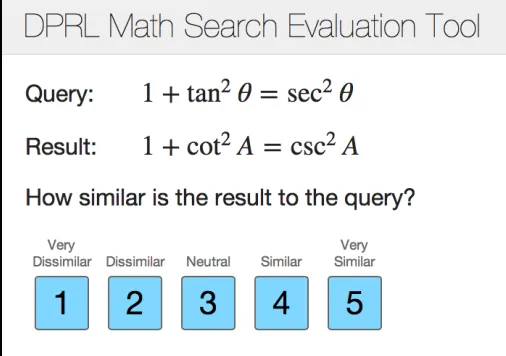
answer on a 5-point Likert scale (See Figure 4.1). We asked the participants
to score by similarity rather than relevance because relevance is dependent on
[image:38.612.188.441.194.372.2]the search task, which is beyond the scope of this experiment.
Figure 4.1: Screenshot of the evaluation tool used in the experiment.
The corpus used for the experiment was the Wikipedia corpus. The
queries were chosen by randomly sampling a larger set of queries from the
corpus, and picking from this 10 that represented diversity in size, type of
structure, and field (see Table 4.1). Due to time constraints in the
experi-ment, we were unable to compare all of the ranking functions we developed.
We conducted an informal experiment beforehand and determined that the
best-performing ranking functions were F-Measure, Distance, and Prefix. The
experiment was thus a comparison between Tangent with these three ranking
functions and Yuan and Zanibbi’s Lucene-based system (henceforth referred
# Query 1 ρe
2 u¯= (x, y, z) 3 1 + tan2θ = sec2θ
4 cos(θE) = e−T R/T1
5 a =gm1−m2
m1+m2
6 Rabf(x)dx=F(b)−F(a).
7 1/6, p1/28, −p12/7, 0, 0, 0, 0, 0
8 Pn
i=mai =am+am+1+am+2+· · ·+an−1+an.
9 f(x;µ, c) =p c
2π e−
c
2(x−µ) (x−µ)3/2
10 D4σ = 4σ = 4
rR∞
−∞
R∞
−∞I(x,y)(x−¯x)2dx dy
R∞
−∞
R∞
−∞I(x,y)dx dy
Table 4.1: List of queries used in the experiment.
The experiment was run in person, one participant at a time, through a
web-based evaluation tool (see Figure 4.1). Before the experiment, participants
were asked to fill out a short demographics survey. Then, they completed a
short familiarization exercise, wherein they scored 5 results from each of 2
queries. These responses were excluded from analysis. After this task was
complete and any questions were answered, they began the main experiment.
In addition to the scores, we also recorded the time it took the participant for
each query. Finally, they were asked to rate the difficulty of the task and to
describe their process of scoring. The task took approximately 30 minutes and
participants were paid $10 for their time.
To save time, any results found by both systems were only scored once.
This allowed us to include results from three of our ranking functions without
different rankers. After deduplication, the participants were asked to score
214 results, 10 of which were for the familiarization exercise. To ensure a fair
comparison, both the order of the queries and the order of the results were
randomized for each participant.
4.1.2 System Performance
Indexing and retrieval speed is simpler to evaluate, as it can be directly
measured. Indexing time was tested using the full Wikipedia corpus
(approx-imately 482,000 expressions). Retrieval time was tested using the 10 queries
from the experiment and the same corpus. We analyzed system clock time as
opposed to operation counts because we are just interested in if the system is
fast enough, and for that we need actual clock times. Operation counts would
be more appropriate for a formal performance comparison. Using clock time
has the drawback of introducing noise into our timings and being dependent
on specific hardware. The former can be mitigated with multiple trials and
the latter is reasonable considering our goal.
As indexing speed is only important for the initialization of the system,
it is the less important of the two quantities being measured. It is still an
interesting and important quantity. It would be difficult to experiment with
the system if it takes days to index the corpus. Retrieval speed is much more
important to the success of the system. It is mostly binary: either the system
is fast enough to be used in real time (queries running in under approximately
4.2
Results
4.2.1 Demographics and Survey Responses
20 students and professors participated in the experiment. 15 (75%) of
the participants were male. 15 (75%) were between the age of 18 and 24, three
(15%) were 25-34, and one (5%) was 35-44. All participants were from fields
in science and technology, with 13 (65%) in computing, 5 (25%)in science, and
2 (10%) in mathematics. Students and faculty in these fields were targeted
because they represent a group that might find a math search engine useful in
their work. 1 participant (5%) found the task very difficult, 11 (55%) found
it difficult, 7 (35%) were neutral, and 1 (5%) found it easy. When asked to
describe how they evaluated the results, 17 (85%) mentioned using visual
sim-ilarity and 10 (50%) mentioned semantic meaning. The additional comments
mostly described how difficult the users found the task, which aligned with
their ratings.
4.2.2 Search Result Scores
Our result scores are from a Likert scale, which is ordinal data with
no inherent numeric value. Whether it is valid to use Likert data as numeric
values for statistical analysis remains an open question. We will avoid doing
this, as we can test our hypothesis with the more conservative approach of
treating it only as ordinal data. We can thus not directly apply an analysis of
variance (ANOVA) test to our results. In order to get around this, we binarize
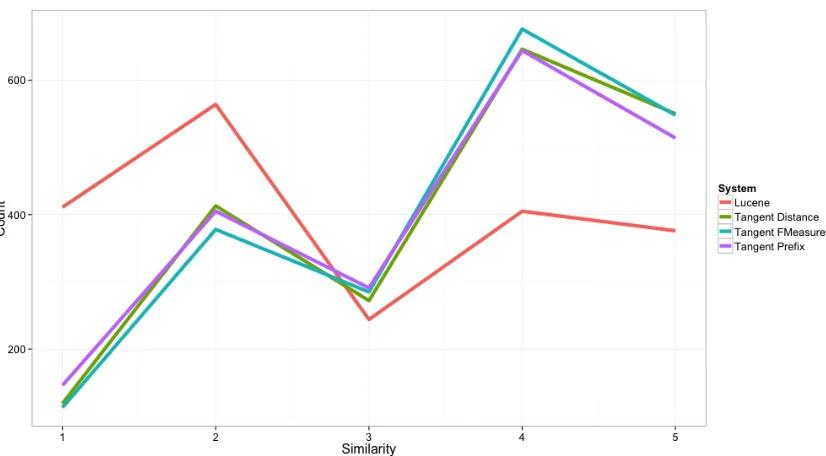
Figure 4.2: Score counts by system for 10 results each for 10 queries.
relevant (scored neutral or worse). With this, we can then calculate the
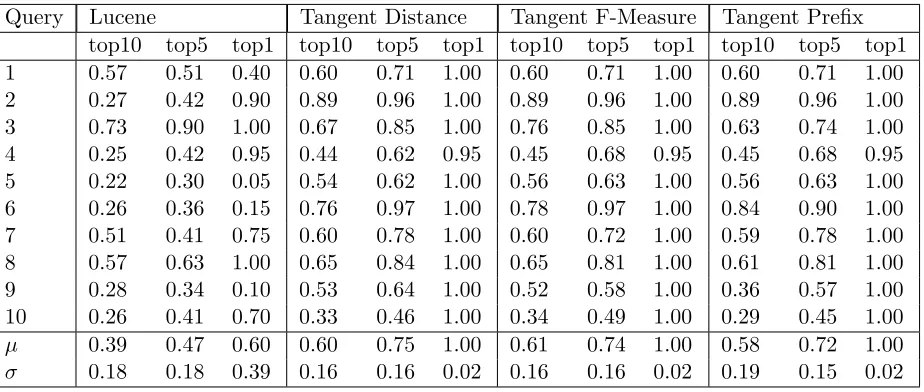
top-10, top-5, and top-1 precision for each query. Table 4.2 shows these values for
each system.
A two-way ANOVA test looking at the effects of the system and query
on average top-10 precision shows a very strong effect of the system (p <
2.2∗10−16) as well as of the query (p <8.9∗10−16). There was no interaction
effect found between the system and query (p < 0.205). Running pairwise
t-tests (using the Bonferroni correction for multiple comparisons), we see that
there is a significant difference is between Lucene and each of the three Tangent
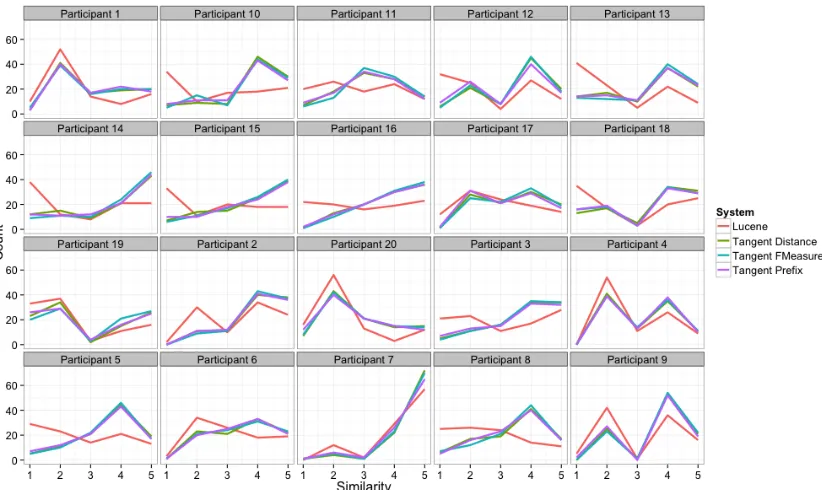
Figure 4.3: Score counts by participant and system.
Figure 4.4: Score counts by query and system.
The ANOVA test is unnecessarily conservative for two reasons: firstly
[image:43.612.123.521.412.552.2]sec-Query Lucene Tangent Distance Tangent F-Measure Tangent Prefix top10 top5 top1 top10 top5 top1 top10 top5 top1 top10 top5 top1 1 0.57 0.51 0.40 0.60 0.71 1.00 0.60 0.71 1.00 0.60 0.71 1.00 2 0.27 0.42 0.90 0.89 0.96 1.00 0.89 0.96 1.00 0.89 0.96 1.00 3 0.73 0.90 1.00 0.67 0.85 1.00 0.76 0.85 1.00 0.63 0.74 1.00 4 0.25 0.42 0.95 0.44 0.62 0.95 0.45 0.68 0.95 0.45 0.68 0.95 5 0.22 0.30 0.05 0.54 0.62 1.00 0.56 0.63 1.00 0.56 0.63 1.00 6 0.26 0.36 0.15 0.76 0.97 1.00 0.78 0.97 1.00 0.84 0.90 1.00 7 0.51 0.41 0.75 0.60 0.78 1.00 0.60 0.72 1.00 0.59 0.78 1.00 8 0.57 0.63 1.00 0.65 0.84 1.00 0.65 0.81 1.00 0.61 0.81 1.00 9 0.28 0.34 0.10 0.53 0.64 1.00 0.52 0.58 1.00 0.36 0.57 1.00 10 0.26 0.41 0.70 0.33 0.46 1.00 0.34 0.49 1.00 0.29 0.45 1.00
µ 0.39 0.47 0.60 0.60 0.75 1.00 0.61 0.74 1.00 0.58 0.72 1.00
[image:44.612.87.549.115.311.2]σ 0.18 0.18 0.39 0.16 0.16 0.02 0.16 0.16 0.02 0.19 0.15 0.02
Table 4.2: Top 10, Top 5, and Top 1 precision by query and system.
ondly because the binarization process loses information. Because the
differ-ence between Lucene and Tangent is so great, the test is perfectly valid and
able to detect the difference. A Friedman test addresses both of these
con-cerns. As a non-parametric test based on ranking the given scores, it is able
to operate on the ordinal Likert scores directly. Additionally, the test allows
blocks, where there is a source of variability between the blocks that is not
important in the experiment. The blocks are ranked individually and thus
the unwanted variability does not affect the result of the test. In our case,
the blocking factors will be the query and the participant, the two sources of
variability that we identified earlier. The p-value for the Friedman test is even
stronger than the ANOVA result - it is a smaller value than our statistical
4.2.3 Response Times
In addition to the scores directly given by the participants, we also
collected the time it took each participant to score each result. As some
results were shared between systems and only displayed to each user once, the
timings were likewise counted for each system with that result. An ANOVA
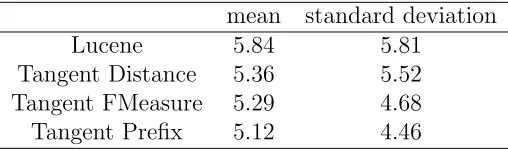
test on the timings by system showed that with high confidence (p <0.00007)
there is a significant difference between the systems. Specifically, from a t-test
(Bonferroni correction) post-hoc, there is a difference between Lucene and each
of the three Tangent systems, with p-values of 0.018, 0.0037, .000053 between
Lucene and Distance, F-Measure, and Prefix respectively.
mean standard deviation
Lucene 5.84 5.81
Tangent Distance 5.36 5.52
Tangent FMeasure 5.29 4.68
[image:45.612.188.442.361.436.2]Tangent Prefix 5.12 4.46
Table 4.3: Response times by system (in seconds).
There is also a strong correlation between the scores given to and time
taken to score each result. As can be seen in Figure 4.5, participants took
longest to score the expressions that were not obviously similar or dissimilar.
This intuitively makes sense, as less thought is required if the expressions are
Figure 4.5: Response times by score.
4.3
Performance Metrics
As Lucene is a robust, mature, and heavily-optimized search engine,
the Lucene-based system is much more performant than Tangent. It is faster
for both indexing and searching, and the index is far smaller. But while
Tangent is clearly slower than Lucene, it is not unusably slow. Indexing the
Wikipedia dataset took 53 minutes - much slower than Lucene’s 7 minutes 44
seconds, but perfectly workable for a one-time task. The average query time
for the 10 queries used in the experiment is ∼1.5 s with a standard deviation
of ∼1 s. This is well within our stated goal of being fast enough to be used
in real time. Query time is dependent on the size of the query and number
of matches, but the even the largest (slowest) queries we tested took under 3
seconds. Tangent’s index for the Wikipedia dataset used 6.19 GB of memory
while Lucene’s on-disk index was a much smaller 107 MB (Tangent does not
4.4
Discussion
The results confirm both parts of our hypothesis. The ANOVA test (on
computed precision) and Friedman test (on raw scores) both reject the null
hypothesis and the associated post-hoc tests show that all three Tangent
varia-tions produce better precision-at-k values than the Lucene-based system. Our
performance comparison shows that while slower, performance in all categories
is sufficient for real-world use.
Both by looking at the graphs and the statistical tests, we can see that
our result is clear: Tangent’s results are better than Lucene’s (Appendix A
contains results for each query). While our scores are for the similarity between
the query and result, there is intuitively a very strong correlation between
similarity and relevance. If a resultlooks similar the query, we propose that it
is more likely tobe similar to the query.
The comparison between the various ranking functions was surprising
and less conclusive. We only tested three (F-Measure, Distance, and Prefix),
but IEF and Recall both performed worse than the others in a prior, informal
comparison. None of the three we did test were shown to be significantly
different. Considering this, we recommend the F-Measure ranker as it is the
simplest and (one of) the best performing.
Several trends are apparent in the scores obtained from the experiment.
By looking at the scores by participant (Figure 4.3) and by query (Figure 4.4),
par-ticipants scored expressions much higher on average than others, and several
avoided the “neutral” score. The scores vary between queries even more: in 5
of the queries (queries 2, 4, 5, 6, and 9), Tangent performs much better than
Lucene, but the scores in the other 5 queries are much closer. Additionally,
both systems perform poorly in query 10.
But while there was a lot of variation between participant and between
queries, Tangent’s scores were almost always higher. There are no individual
participants or queries for which you could argue that Lucene performs better.
Looking at the scores by query, we can put the queries in two categories: 5
where Tangent and Lucene score roughly as well as each other, and 5 where
Tangent does much better. What we can draw from this is that while Lucene
sometimes can find good matches, Tangent’s results are much more consistent.
This is important for a search engine, as a system that only returns good results
for half of the queries would be frustrating to use.
The performance analysis shows that while slower, Tangent is not
un-tenable for real-world use. The high memory usage necessitates a modern
computer that can address more than 4 GB of memory, but most current
computers are capable of running Tangent well. Both indexing and query
speed are good enough for the system to be used as an actual search engine.
Additionally, there is a few decades’ research in index compression and
opti-mization for text search that can largely applied to Tangent (see future work).
It is likely that a much more optimized system could be comparable to Lucene
compare our query speed with Kamali and Tompa’s results [4]. In an index
that is roughly twice the size as ours, their system is roughly twice as fast
as Tangent (∼800ms vs ∼1500ms per query). In the same comparison, Sojka
and L´ıˇska’s MIaS [14] is even faster, at∼300ms, and other various text-search
and exact match systems take between 200 and 400ms. This speed difference
could be a problem for larger indexes, but we can probably narrow the gap
significantly with some optimization.
4.5
Summary
The experiments described in this section confirmed both parts of our
hypothesis. The system provides high-quality search results and does so
rela-tively efficiently. There is, however, much room for improvement in both areas
Chapter 5
Future Work and Conclusion
5.1
Future Work
5.1.1 Performance Optimizations
While the performance of Tangent is acceptable, there are many
op-portunities for improvement. The most obvious is to reimplement the system
in a higher-performance language than Python. This is actually not as
im-portant as it might appear, because most of the query time is spent reading
data from Redis (which calls C libraries). Another possibility would be
stor-ing the index directly in memory, rather than indirectly through Redis. We
briefly experimented with both approaches (using the Go language), but very
surprisingly, query times were similar between the current Python-Redis and
the in-memory Go implementations. This was however not an exhaustive test,
and implementation-specific speedups could be possible.
More interestingly, however, are the decades of research in
optimiza-tions for (text) information retrieval. Index compression in particular could
be a great boon to performance because the majority of the query time is
spent transferring the inverted lists from the Redis server. Storing the
docu-ment references in a compressed form (either Elias’ gamma code or a bytewise
of these lists, as would storing the differences between document identifiers
rather than the identifiers themselves. Additionally, we could define a more
compact representation for the Symbol Pairs, but most of the time is spent
moving the document identifiers.
Another technique that could be applied from text information retrieval
is parallelization. For an index the size of Wikipedia, a load-balanced set of
servers running the entire index would allow the system to scale to more users,
albeit without improving query time. For larger indexes, performance (query
time) starts to become unacceptable. For these, more work would be needed
to allow servers to only contain parts of the full index and communicate with
each other to present a final result.
5.1.2 Retrieval Improvements
There are several ways worth exploring to improve the quality of the
search results. A major limitation of Tangent is that it does not allow for
substitution of symbols. For example, a2 should be a partial match for b3, as
they are both a variable raised to an integer power. While we showed that the
structure surrounding the symbols needing substitution is generally enough for
Tangent to return good matches (see Query 2 in Appendix A), substitution
would likely improve the result quality further. This could be accomplished
by creating a separate substitution index where one or both of the symbols
is replaced by a more general symbol (e.g. VARIABLE, OPERATOR,
expressions would share the general symbols than the specific ones. This could
make the performance of the system much worse without a clever approach to
avoid this repetition.
Using our definition ofdh, Symbol Pairs must match this distance
ex-actly. This is not as reasonable for large values of dh (there is not much
difference between a pair being 8 or 9 symbols apart. It could be possible to
find more general matches if we binned the values for dh. Another approach
would be to search for pairs not only with exactly dh but also dh+ 1, dh−1,
and so on.
Our definition for dv in the Symbol Pair is lossy. If, for example, an
ABOVE relationship is followed by a BELOW relationship, dv will be 0, the
same as if there were two ADJACENT relationships. This would occur with
the (x, z) pair in the expressionxyz. A possible solution to this problem would
be to define dv as a list of the baseline changes - for this example, dv would
be [ABOVE, BELOW]. It is not clear if this would greatly affect the results,
or even if the effect would be positive.
There are two possible problems with the way we generate the Symbol
Pairs. The first is that we do not generate Symbol Pairs between pairs that
are on separate branches of the SLT. For example, there is no pair between
the 2 and yinx2+y. Fixing this would require major changes to the Symbol
Pair representation, and as these pairs tend to represent weak semantic
rela-tionships, might not be helpful. The second issue is that the number of pairs
unintentional effect of preferring well-connected matches seems to be positive,
it is not apparent why this particular weighting is ideal. It would be possible
to counter this effect (possibly to introduce another) by weighting each
Sym-bol Pair inversely proportional to the number of other SymSym-bol Pairs that use
either of the symbols in it.
Currently, Tangent does not support tables or matrices because they
cannot be represented well using a Symbol Layout Tree. One simple solution
would be to simply index each table cell separately, as its own expression.
Another approach would be to modify the SLT and Symbol Pair definitions
to allow for this structure.
Finally, it might be interesting to use geometric distances for dh and
dv instead of distances within the layout tree. We could render the expression
to find these distances. Doing this would change the general type of matching
that is being done, moving towards a directly visual match from a (somewhat)
semantic one. It is unknown if this would produce better or worse results, but
it would introduce to major problems. The first is that the distances would be
dependent on the font and font size. The second is that these distances would
then be real-valued and thus not able to be inserted into a table. Without a
solution to these problems, indexing would likely be unfeasible.
5.1.3 Additional Comparisons
Our system performed well in the comparison with the Lucene-based
It would be interesting to compare our search results with those of some of
the other systems mentioned in Chapter 2; Kamali and Tompa’s SimSearch [4]
and Sojka and L´ıˇska’s MIaS [14] would be good candidates.
5.2
Conclusion
Hypothesis: Implementing a math expression search
sys-tem using an inverted index on symbol pairs from layout
trees will: 1) yield more relevant results than text-based
retrieval, and 2) be fast enough for real time use.
We have shown evidence to strongly support both claims in the
hy-pothesis. Our novel approach to math expression retrieval yields high quality
search results and does so efficiently. Not only have we created a search system
that performs competitively today, we have introduced several new
opportuni-ties for future work (discussed below). Additionally, we introduced a rigorous
method for evaluating results in math expression retrieval using human
Query 1: ˜
ρ
Rank Lucene Tangent F-Measure Tangent Distance Tangent Prefix
1 ρ→eρe ρ˜ ρ˜ ρ˜
2 ρ˜ ρρ˜ ρρ˜ ρρ˜
3 (ρ,eVe) ρ→ρee ρ→eρe ρ→eρe
4 ρφψf ρe=ρ∗ ρe=ρ∗ ρe=ρ∗
5 Xe ρ˜(k) ρ˜(k) ρ˜(k)
6 Be ρ˜(r) ρ˜(r) ρ˜(r)
7 Mf ρ˜uc(k) ρ˜uc(k) ρ˜uc(k)
8 te (ρ,eVe) (ρ,eVe) (ρ,eVe)
9 (ρ, V)7→(ρ,eVe) dρ˜(ρ) = 0 dρ˜(ρ) = 0 dρ˜(ρ) = 0
10 ρe=ρ∗ trRχ˜= ˜ρ ρ˜(1)·v=v trRχ˜= ˜ρ
Query 2: ¯
u
= (
x, y, z
)
Rank Lucene Tangent F-Measure Tangent Distance Tangent Prefix 1 f(¯u) =f(x, y, z) u¯= (x, y, z) u¯= (x, y, z) u¯= (x, y, z) 2 = R(z, dt)|x, y, zi u= (x, y, z) u= (x, y, z) u= (x, y, z) 3 (x∨y)(¯x∨z)(y∨z) = (x∨y)(¯x∨z) v= (x, y, z) v= (x, y, z) v= (x, y, z) 4 u¯= (x, y, z) r= (x, y, z) r= (x, y, z) r= (x, y, z) 5 z(x) = dxdy(x) x= (x, y, z) x= (x, y, z) x= (x, y, z) 6 f(t,u¯) =f(t, x, y, z) F = (x, y, z) F = (x, y, z) F = (x, y, z) 7 P(X=x|Y =y, Z =z) = P(X =x|Z =z) r0 = (x, y, z) r0 = (x, y, z) r0= (x, y, z)
8 =H(p, q)·G(p, q)|p=x λz,q=
y
λz ~x= (x, y, z) ~x= (x, y, z) ~x= (x, y, z)
9 P ={(x, y, z)|3x+y−2z= 10} x= (x, y, z)T (x, y, z) x= (x, y, z)T 10 z(x) =Q(y(x),dxdy(x)) (x, y, z) x= (x, y, z)T (x, y, z)
Query 3: 1 + tan
2
θ
= sec
2
θ
Rank Lucene Tangent F-Measure Tangent Distance Tangent Prefix 1 1 + tan2θ= sec2θ 1 + tan2θ= sec2θ 1 + tan2θ= sec2θ 1 + tan2θ= sec2θ
2 tan2θ+ 1 = sec2θ 1 + tan2y= sec2y 1 + tan2y= sec2y 1 + tan2y= sec2y
3 sec2θ= 1 + tan2θ dθd tanθ= sec2θ dθd tanθ= sec2θ dθd tanθ= sec2θ
4 1 + tan2θ= sec2θ and 1 + cot2θ= csc2θ. 1 + cot2θ= csc2θ sec2θ= 1 + tan2θ 1 + cot2θ= csc2θ
5 cos2θ+ sin2θ= 1 , sec2θ= 1 + tan2θ 1 + cot2θ= csc2θ p1 + tan2θo
6 sin2θ+ cos2θ= 1 p1 + tan2θ
o tan2θ+ 1 = sec2θ ±
√
1 + tan2θ
7 cos2θ+ sin2θ= 1 ±√1 + tan2θ p1 + tan2θo 1 + cot2A= csc2A
8 1 + cot2θ= csc2θ 1 + cot2A= csc2A ±√1 + tan2θ 1 + cot2y= csc2y
9 cot2θ+ 1 = csc2θ 1 + cot2y= csc2y dtanθ= sec2θ dθ = dx3 . ±√ 1 1+tan2θ
10 x=rcosθ= 2asin2θ= 2atan2θ = 2at2 tan2θ+ 1 = sec2θ ±√tanθ dtanθ= sec2θ dθ= dx.
Query 4:
cos
(
θ
E
) =
e
−
T R/T
1
Rank Lucene
1 cos(θE) =e−T R/T1
2 cos(θE) =e−(d1+at)/T1
3 AFHAST =AFH∗AFT =e(Constant∗(RH n
s−RHon)∗e(Ea/k)∗(1/To−1/Ts)
4 AFT =e(Ea/k)∗(1/To−1/Ts)
5 P(Ei) =g(Ei)/(e(E−µ)/kT + 1)
6 sinθc= [−K2±(K22−3K1K3)1/2]/3K3 1/2
7 GT
2 =GT1 + (Cp −ST1)(T2−T1)−T2ln (T2/T1)Cp
8 1 = cos(3π/8)Axc T ,L+B
xc
T,L+ cos(π/4)E xc T ,L
9 IC =ISO(eVBE/VT−1)≈ISOeVBE/VT
10 Eθ[(θi−Xi)h(X)|Xj =xj(j6=i)] =
R
(θi−xi)h(x) 21π
n/2
e−(1/2)(x−θ)T(x−θ)m(dxi)
Rank Tangent F-Measure Tangent Distance Tangent Prefix 1 cos(θE) =e−T R/T1 cos(θE) =e−T R/T1 cos(θE) =e−T R/T1
2 cos(θ) = 1 cos(θE) =e−(d1+at)/T1 cos(θ) = 1
3 cos(θE) =e−(d1+at)/T1 cos(θ) = 1 cos(θE) =e−(d1+at)/T1
4 cos(α) = 1 r·cos(θ) cos(α) = 1 5 r·cos(θ) µ=|cos(θ)| r·cos(θ) 6 x1=a1cos(θ) g=< cos(θ)> x1=a1cos(θ)
7 x2=a2cos(θ) x1 =a1cos(θ) x2=a2cos(θ)
8 P3
r=1cos( 2rπ
7 ) =
−1
2 x2 =a2cos(θ)
P3
r=1cos( 2rπ
7 ) =
−1 2
9 cos(α) = 1k cos(α) = 1 cos(α) = 1k 10 TL= cosTN(θ) TL= cosTN(θ) TL= cosTN(θ)
Query 5:
a
=
g
m
m
1
−
m
2
1
+
m
2
Rank Lucene Tangent F-Measure Tangent Distance Tangent Prefix