City, University of London Institutional Repository
Citation:
Kalyvianaki, E., Fiscato, M., Salonidis, T. and Pietzuch, P. (2016). THEMIS:
Fairness in Federated Stream Processing under Overload. Paper presented at the 2016
ACM International Conference on Management of Data (SIGMOD), 26 Jun - 01 Jul 2016,
San Francisco, USA.
This is the accepted version of the paper.
This version of the publication may differ from the final published
version.
Permanent repository link:
http://openaccess.city.ac.uk/13546/
Link to published version:
Copyright and reuse: City Research Online aims to make research
outputs of City, University of London available to a wider audience.
Copyright and Moral Rights remain with the author(s) and/or copyright
holders. URLs from City Research Online may be freely distributed and
linked to.
City Research Online:
http://openaccess.city.ac.uk/
[email protected]
THEMIS: Fairness in Federated Stream Processing
under Overload
Evangelia Kalyvianaki
City University LondonMarco Fiscato
Imperial College LondonTheodoros Salonidis
IBM TJ Watson Research CenterPeter Pietzuch
Imperial College LondonABSTRACT
Federated stream processing systems, which utilise nodes from mul-tiple independent domains, can be found increasingly in multi-pro-vider cloud deployments, internet-of-things systems, collaborative sensing applications and large-scale grid systems. To pool resources from several sites and take advantage of local processing, submitted queries are split intoquery fragments, which are executed collabo-ratively by different sites. When supporting many concurrent users, however, queries may exhaust available processing resources, thus requiring constant load shedding. Given that individual sites have autonomy over how they allocate query fragments on their nodes, it is an open challenge how to ensure global fairness on processing quality experienced by queries in a federated scenario.
We describe THEMIS, a federated stream processing system for resource-starved, multi-site deployments. It executes queries in a globally fair fashion and provides users with constant feedback on the experienced processing quality for their queries. THEMIS associates stream data with itssource information content(SIC), a metric that quantifies the contribution of that data towards the query result, based on the amount of source data used to gener-ate it. We provide the BALANCE-SIC distributed load shedding algorithm that balances the SIC values of result data. Our evalua-tion shows that the BALANCE-SIC algorithm yields balanced SIC values across queries, as measured by Jain’s Fairness Index. Our approach also incurs a low execution time overhead.
1.
INTRODUCTION
Federated stream processing systems (FSPSs) [14, 13] contin-uously process data streams using computation and network re-sources from several autonomous sites [9]. Submitted queries are split intoquery fragments, which can be deployed across multiple sites. For example, a cloud-based stream processing system may span more than one cloud provider to benefit from lower costs, higher resilience or closer proximity to data sources. In collabo-rative e-science applications, FSPSs such as OGSA-DAI [3] and Astro-WISE [1] pool resources from multiple organisations to pro-vide a shared processing service for high stream rates and computa-tionally expensive queries. Participatory sensing and smart city
in-.
frastructures [5, 31] require deployments of systems that combine independent domains with distinct data or processing capabilities for a large user base.
A challenge is that FSPSs are likely to suffer from long-term overload conditions. As a shared processing platform with many users, they can experience a “tragedy of the commons” [19] when users submit more queries than what can be sustained given the available resources. Instead of adopting a rigid admission policy, which rejects user queries when available resources are low, it is more desirable for an FSPS to use load-shedding techniques [33, 27]. Under load-shedding, the FSPS provides a best-effort service by reducing the resource requirements of queries through dropping a fraction of tuples from the input data streams.
Appropriate load shedding in an FSPS, however, is complicated by the fact that individual sites are autonomous and may imple-ment their own resource allocation policies. For example, a site may prioritise queries belonging to local users at the expense of external query fragments. Without coordination of load-shedding decisions across sites, multi-site queries may experience significant variations in processing quality, depending on the load distribution across sites. It is therefore an open challenge how to ensure that queries spanning multiple autonomous sites in an FSPS experience globally fair processing quality under overload conditions.
Many stream processing systems support load shedding mecha-nisms to handle overload conditions. Load shedding mechamecha-nisms that operate at the granularity of individual nodes [33, 10, 35], how-ever, cannot achieve fair shedding decisions for queries spanning multiple nodes. Proposals for distributed load shedding [34, 44] associate a utility function with query output rates and aim to max-imise the sum of utilities, which is not a representative measure of fairness. In addition, they assume special structure and a-priori knowledge of utility functions. Load shedding decisions are con-trolled by a centralised entity or are based on pre-computed shed-ding plans—both of which are not practical in an FSPS in which domains retain control. Operator-specific semantic shedding ap-proaches for, e.g. joins [21, 26, 17], aggregates [10, 35] or XML streams [38] cannot be applied in a federated context when users employ diverse sets of operators or customised, user-defined ones.
We describe a new approach for distributed load shedding in an FSPS that treats queries in a globally fair fashion. The key idea is to define a query-independent metric to measure the quality of processing that query fragments have experienced, and then to use this information for load shedding:
result data item. Intuitively, data that was aggregated over many stream sources is considered to be more important to the final query result. The SIC metric thus decouples processing quality from the semantics of the operators and provides a query-independent way to capture the quality of query processing with respect to tu-ple shedding. This is particularly suited to accommodate a diverse set of user queries that executes operators of various semantics and even with user-defined operators.
(2) Overloaded nodes in the FSPS invoke a distributed semantic fair load-shedding algorithmthat aims to balance the SIC values of query results across all queries, referred to as the BALANCE-SIC fairness policy. This policy balances the SIC values of query re-sults (i.e. maximises the Jain’s Fairness Index, a normalised scalar metric that quantifies balance). It effectively utilises the process-ing capacity of FSPS nodes, given the practical constraints of the placement of queries on sites and their autonomy.
When queries are assigned across FSPS sites, it becomes chal-lenging to control per-node tuple shedding and yet provide global BALANCE-SIC fair processing. This stems from the fact that shed-ding tuples at a node affects its resource availability and also the processing quality of other queries. Since queries span across sites and share resources, such effects are spread across sites, affecting shedding decisions on the rest of the nodes. It is therefore non-trivial to control tuple shedding globally in a federated setting.
In our approach, each node takes independent yet informed shed-ding decisions about the overall processing quality of locally-hosted queries. Queries provide continuous feedback on their processing quality through the SIC metric. The shedding of tuples eventually converges to global fairness as each node continuously adjusts its shedding behaviour in response to that of other FSPS nodes.
To demonstrate the practicality of our fair load-shedding approach, we describe THEMIS, an FSPS for overloaded deployments.1 Our evaluation of THEMISshows that: (a) the SIC metric captures the result degradation across a variety of query types; (b) in contrast to the baseline of random shedding, THEMISachieves 33% fairer query processing, according to Jain Fairness Index, even with skewed workload distributions; and (c) our approach has low overhead and scales well to the number of nodes and queries.
In summary, the contributions and the paper outline are: 1. a query-independent model and a metric called SIC for
quan-tifying the quality of stream processing based on the amount of information contributed by data sources (§4) and a practi-cal approximation for computing it (§6);
2. the definition of the BALANCE-SIC fairness in an overloaded FSPS based on the processing quality of queries; and a dis-tributed algorithm for globally BALANCE-SIC-fair semantic load-shedding in an FSPS, which takes the loss of informa-tion suffered by queries into account (§5);
3. the design and implementation of THEMIS, an FSPS that im-plements efficiently the BALANCE-SIC fair load-shedding policy (§6); and
4. results from an experimental evaluation that demonstrate that the approach achieves fair query processing under various workloads in a federated setting (§7).
1According to the Greek mythology, T
HEMISis the Titan goddess of law and order.
Paris
cloud-based data center
Rome
governmental institute data center
Mexico research institute
data center sensors
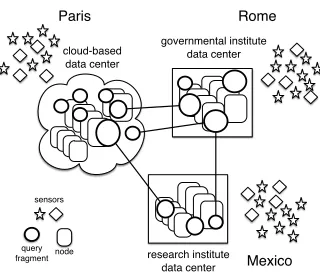
[image:3.612.356.516.53.189.2]query fragmentnode
Figure 1: Example of a multi-site FSPS deployment for urban micro-climate monitoring
2.
OVERLOAD IN FEDERATED STREAM
PROCESSING
In this section, we describe the problem of fairness in query pro-cessing, which arises in an overloaded FSPS. We identify the key characteristics of an FSPS using an example application for query data processing over micro-climate sensor-generated data (§2.1). We then introduce the BALANCE-SIC fairness goal for an over-loaded FSPS (§2.2) and discuss related work (§2.3).
2.1
Federated Stream Processing
Consider a use case of a globally-distributed FSPS for urban micro-climate monitoring. Figure 1 shows a deployment of such a system across three sites (i.e. Rome, Paris and Mexico), with en-vironmental sensors as data sources. The FSPS collects data from a range of sensors, such as air temperature, humidity and carbon monoxide, and processes the data in real-time for analysis. Queries are issued, e.g. by government agencies for urban planning, trans-port authorities, citizens with respiratory problems and meteorolog-ical researchers. A sample high-level data streaming queries may continuously report: “the 10 highest values of carbon monoxide concentration measurements on highways in Mexico every minute” and “the covariance matrix between measurements of (temperature, airflow) and (carbon dioxide, nitrogen) in Paris every 10 minutes”. Each site consists of a data centre with physical nodes running a local distributed stream processing system, and we assume seam-less integration across all these systems at the federated sites [12]. Below, we provide a high-level overview of data stream process-ing in an FSPS. Sources generatetuplesfor processing byqueries. Queries are subdivided intoquery fragmentsand deployed at one or more sites. A query fragment consists of one or moreoperators, and each fragment of the same query is deployed on a different FSPS node. Query fragments use resources, i.e. CPU, memory, disk space and network bandwidth, to process incoming tuples and generate output tuples. Output tuples may be further processed by fragments of the same query, until result tuples are sent to the user issuing the query. Nodes share their resources among fragments belonging to different queries.
Below, we identify three main characteristics regarding user be-haviour and resource utilisation in such an FSPS:
running at a given site due to licensing constraints, which may limit the number of authorised users or remote sites using the system. C2. Permanent resource overload. Due to the shared nature of an FSPS, we assume that the system is constantly overloaded, i.e. its resources are lower than required for perfect execution of all queries. In the above example, queries are issued by a large user population, leading to high demand. A common strategy for an FSPS to handle overload is to usetuple shedding[27, 33]. C3. Site autonomy. The collaborative nature of an FSPS means that a site should accept incoming queries, even under high load. However, sites belonging to different administrative domains are managed autonomously. It is therefore infeasible to assume cen-tralised control over all tuple shedding decisions, enforced across all sites. Instead, sites elect to cooperate, having only a partial view of all resource allocation decisions across the whole FSPS.
2.2
Fairness in FSPS
The problem of how to implementfair query processingarises naturally in an overloaded FSPS. There exist many different ap-proaches to address overload conditions. For example, admission control rejects incoming queries under overload [41, 40]. Such methods are not applicable in a federated context because the col-laborative nature means that submitted queries must be accepted. Other approaches redistribute operators for load balancing [43, 40, 42, 11]. However, query placement in an FSPS is typically con-trolled by users, e.g. to leverage characteristics such as proximity.
We employdistributed load sheddingto address overload con-ditions in an FSPS. By using load shedding, we assume that users agree to use the FSPS and receivedegraded query processingfor their queries. We assume that users submit queries whose results remain useful, even when their processing is degraded due to load shedding, such as aggregates [10], including averages, counts as well as top-k queries. Finally, we usedistributedload shedding to comply with site autonomy (see C3 in §2.1).
There are two challenges to implement distributed load shed-ding. First, there is a need for a query-independent processing metric to capture the impact of shedding on the quality of query processing. Ideally, we require a measure for processing quality that quantifies the processing degradation under shedding but is query-independent, i.e. it does not have to be adapted manually to the semantics of specific queries. With such a measure, it becomes possible to compare the impact of tuple shedding across queries and hence guide shedding decisions according to a fairness policy. In §4, we introduce the SIC query-independent metric that captures the quality of processing by measuring the contribution of source tuples actually used for generating query results.
Second, depending on the deployment of query fragments to sites, some queries may get more penalised due to overload than others. We therefore want to achieve global fairnessacross all queries by enforcing load shedding at all sites so that all queries are equally penalised by the shedding. We achieve this by aiming to equalise a fairness measure of all queries after shedding. It is a challenge how to implement fairness across queries executing on overloaded, distributed and autonomous sites, regardless of their deployment. In §5, we present a new distributed load shedding al-gorithm that maintains BALANCE-SIC fairness of queries.
2.3
Related Work
The research community recognises the need for FSPSs, explor-ing relevant research challenges. Tatbul [32] argues for the inte-gration of multiple stream processing engines for a variety of ap-plications and pinpoints the challenges when dealing with hetero-geneous query semantics. Botan et al. [12] presentMaxStream, an
FSPS for business intelligence applications. Our focus instead is on fairness in an overloaded FSPS using load shedding.
Centralised load shedding.Early proposals for load shedding fo-cus on single-node systems [4, 33, 28]. A simple way to address overload is throughrandom shedding[33] that discards arbitrary tuples. This baseline approach is easy to implement and has low overhead, however, it cannot be used to control the shed tuples.
In contrast,semantic sheddingdiscards tuples using a function that correlates them with their contribution to the quality of the query output [33]. Tuples are discarded in a way that maximises result quality. Carney et al. [15] describe genericdrop-and value-basedfunctions to quantify the contribution of tuples on the result. A drop-based function specifies how the result quality of a query decreases with the number of discarded tuples. Many systems dis-card tuples as to maximise the output tuple rate [17, 34]. In some cases, a value-based function correlates the query output quality with the values of the output tuples [23]. In contrast, our goal is to maximise the contribution of the source tuples used for processing. There exist semantic load shedding approaches for specific oper-ator types, such as joins [21, 26, 17], aggregates [10, 35] and XML operators [38]. These approaches require domain knowledge of the operator semantics, while we treat operators as black-boxes. Distributed load shedding. The problem of distributed load al-location has been studied for stream processing systems. Zhao et al. [44] consider the allocation problem for applications with tasks modelled as synchronous and asynchronous forks and joins, com-menting that this approach can be applied to distributed stream pro-cessing. Their work emphasises a theoretical framework for con-vergence to an optimal solution and presents simulations over two queries and three output streams. In contrast, we provide a fair stream processing system based on the contributions of source tu-ples and evaluate a prototype implementation.
Tatbul et al. [34] employ distributed shedding to maximise the total weighted throughput of queries by computing the drop se-lectivity of random or window drop operators inserted at the in-put streams of a stream processing system. Shedding decisions are made sequentially by each node along a query, starting from the leaves and propagating through metadata up to the input nodes. They assume identical queries layouts to nodes (e.g. all root com-ponents are deployed on the same node), which is not applicable in a federated system. Finally, the scalability of the approach remains unclear, as the simulation-based evaluation only includes a hand-ful of applications. In our prototype evaluation, we execute several hundreds of queries across tens of nodes.
Both approaches [34, 44] perform load shedding to maximise the sum of utility functions but sum maximisation does not achieve fairness. In addition, they require utility functions of special struc-ture (either linear weighted functions [34] or concave functions [44] of rate), which does not capture query utility in practice. Finally, they require a-priori knowledge of the utility functions, which is challenging to estimate offline. In contrast, our approach targets fairness without assuming specific, a-priori utility functions. The only assumption is that the “utility” (as captured by the SIC metric) decreases with shedding and is implicitly modelled during system operation through the propagation and updating of the SIC metric in the data tuples.
Metrics for query processing quality. The building block for a fairness mechanism is a metric that quantifies the processing degra-dation under shedding. A typical metric is the rate of query output tuples [17, 34, 44]. This metric intuitively increases when the rate of tuple shedding decreases. It remains unclear, however, how to compare performance degradation across queries with different se-mantics, which fundamentally may exhibit different output rates.
Our metric associates query performance with the contribution of source tuples required for perfect processing, which is related to the network imprecision metric (NI) [24] used in large-scale mon-itoring systems. The NI metric estimates the percentage of nodes available when calculating an aggregate value over a set of data sources. In contrast, our metric operates at the granularity of indi-vidual tuples and uses a time interval to reason about the impact of source tuples on the result.
Approximate query execution[22, 28, 15, 10, 7, 6] has the goal to reduce the resource footprint of queries by producing different, ap-proximate answers compared to execution with abundant resources. Existing techniques in this area change operator semantics [28, 26, 17, 16, 30, 39]—instead, we approach queries as black-boxes and address overload by tuple shedding for fair processing.
Fairness. The notion of fairness in an FSPS remains largely un-explored. In early work, Babcock et al. [10] study the problem of load shedding across aggregation queries running over a single-node streaming engine. Although they do not discuss fairness di-rectly, the goal of their work is to minimise, and hence equalise, the relative error caused by shedding for all queries. They employ a performance metric that is tailored for sliding window aggregation queries only. In a special case of their work, Zhao et al. [44] im-plement a weighted proportional fairness scheme on output stream rates. In contrast, we explore the concept of BALANCE-SIC fair-ness in the context of an overloaded FSPS.
3.
FEDERATED PROCESSING MODEL
In this section, we describe our system model for an FSPS. Data model.A tupletis a set of three elements(τ,SIC,V)where
τis the tuple’s logical timestamp; SIC∈R+is the source informa-tion content meta-data, which we formally define in §4; andVis the set of payload values according to the tuple’s schema. We use the notationstτ,tSIC andtV to refer to the timestamp, meta-data and payload values, respectively, of a tuplet. Astreamof tuples is an infinite, time-ordered sequence of tuples.
Query graph.A queryqis a directed acyclic graphq= (O,M) whereOis the set of operators andMis the set of streams. An operator takes one or moreinput streamsand produces anoutput streamofderivedtuples. Derived tuples are denoted bytout. We assume that, for each operatoro∈ O, there exists a time or count window that atomically emits tuples for processing byo.
In the query graph, the direction of edges indicates the direction of tuples flowing between operators. Certain operators in the query graph are connected to a finite set ofsources, which are denoted byS and producesource tuplesin time-variant rates. We assume sources of different rates per query. Every source is connected to a single operator in the query graph. We usetsto denote that tuplet
comes from sources ∈ S. The domain of source tuples across sourcesSover time is given byTS. The timestamptτ indicates
the time of tuple’stgeneration either by a source or by an operator in the case of a source or a derived tuple, respectively. There exists oneroot operatorin the query graph to emit thequery result stream containing result tuples for the user. Result tuples are denoted by
trand the domain of result tuples is given byTR.
Query deployment. An FSPS consists of a set of nodesDwith heterogeneous resources. Each noded∈ Dcorresponds to a differ-ent autonomous site; without loss of generality, we focus on single-node sites as typically single-nodes within a site have similar capacities.
Upon deployment, the query graph is partitioned intoquery frag-mentsthat are disjoint sets of at least a single query operator. Each query fragment is deployed on a different FSPS node, and a query can span a subset or all of the FSPS nodes. We assume that query division to fragments and mapping of fragments to FSPS nodes are performed by the query user and remain the same throughout a query’s execution. Finally, an FSPS node can host multiple frag-ments of different queries.
4.
SOURCE INFORMATION CONTENT
We introduce the source information content (SIC) metric to quan-tify the quality of processing by accounting for the contributions of source tuples towards result tuples.
Query processing. We consider queries as black-boxes. For each queryq, we use an abstractquery functionfqto describe the
collec-tive processing by all operators inOover source tuples to produce result tuples, i.e.fq:TS→TR. A query function takes as input a set of source tuplesTSand outputs a set of result tuplesTR
gen-erated from operators processingTS
, i.e.fq(TS) = TR where
TS ∈
TSandTR ∈TR. Our goal is to enumerate the tuples of TS
and so to measure any loss of these tuples due to shedding. Source information content.We now formally introduce thesource information content(SIC) metric to quantify the information con-tribution from sources to query results.
The SIC value of a source tupletsSIC measures its contribution
to the result tuples in relation to the rest of tuples∈ TS
. We assign the SIC value of a source tuple as:
tsSIC =
1 |TS
s ||S|
. (1)
Equation (1) captures our consideration that all source tuples from a given source s, denoted byTS
s , are equally important for the
result. The more tuples a source generates, the less important each individual tuple becomes because it can be regarded as anupdate, e.g. multiple sensor readings at a higher sampling rate. Thus, the SIC value of an individual source tupletsis inversely proportional to|TS
s |and is also normalised by the number of sources|S|in a
query for a query-independent metric.
For a queryq, the SIC value of its result tuples,qSIC, is given by the sum of the SIC values of all source tuples used for the genera-tion of the result tuples, i.e. tuples that are not dropped:
qSIC:= X
ts∈TgS
tsSIC, (2)
whereTfS⊆ TSis the set of source tuplesactuallyprocessed for the result tuples. A source tuple is not used towards a result because it (or a tuple derived from it) was discarded due to load shedding.
The SIC value of the query result,qSIC, lies in the range of[0,1]. WhenqSIC= 1, the result isperfect, and all source tuples are pro-cessed,TfS=TS. WhenqSIC∈(0,1), the result isdegraded, and a subset of source tuples are missing. The shed tuples are given by TS
/TfSandfq(TfS) =gTR, wheregTR⊆ TRis the set of result tuples derived from processingTfS. Finally, whenqSIC = 0, all source tuples were discarded, i.e.TfS=∅.
de-source tuples
result tuples
processed tuple
SIC
STW
operator
derived tuples derived tuple
not being generated due to downstream shedding
SIC
a
b c
0.125 0.125
0.25
0.25 0.5 0.5
0.25 0.25
0.125 0.125 0.25
0.25
shed tuple SIC
a
b c
0.125 0.125
0.25
0.25 0.5 0.5
0.25 0.25
0.125 0.125 0.25
0.25
[image:6.612.62.286.63.227.2]without shedding with shedding
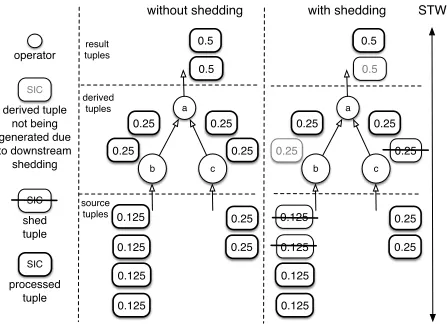
Figure 2: Example of SIC tuple values
rived tuples are “lost”, e.g. due to filters and joins, which only se-lect a subset of their input tuples. In other cases, tuples contribute to multiple derived tuples, e.g. sliding windows. Next, we intro-duce a practical way to (i) identify the source and result tuples in the corresponding sets ofTS
andTR
such thatfq(TS) =TRfor
perfect processing; and (ii) to measure the contribution of source tuples inTfSfor degraded processing.
Source time window. We introduce the concept of asource time window(STW), i.e. a period of time during which we account for all generated source tuples to contribute to certain result tuples. More formally, given a source tuplets and a result tupletr,ts ∈ TS
andtr ∈ TR
andfq(TS) =TRif and only if there exists a time
indexρsuch thatρ≤tsτ, t r
τ ≤ρ+STW. The duration of aSTW
should cover theend-to-end processing latency to allow enough time for source tuples to be processed by operators and produce result tuples. We always select aSTW with significantly higher duration than the end-to-end latency, and it includes any network latencies for multi-fragmented queries.
SIC propagation from source to result tuples.Using theSTW, we can calculate the query SIC value as in Equation (2). Rather than adding up the contributions of source tuples, we follow a bottom-up approach in which we propagate the SIC values of source tbottom-uples fromTS
using derived tuples as they are processed by operators during the period of aSTW. We then add the contributions of result tuples that contain the contributions of those source tuplesactually processed towards the result tuples.
First, we calculate the SIC contribution of every derived tupletout:
toutSIC =
X
t∈To in
tSIC
|To out|
, (3)
whereTo
inis the set of all input tuples processed atomically by oper-atoro, producing a set of output tuples given byTouto during aSTW. Recall that in our model, we always consider a time or count win-dow that atomically emits input tuples for an operator to process. In this way, the SIC values of source tuples are gradually passed from source tuples through derived tuples to result tuples. As de-rived tuples are discarded, their SIC values are not accounted for because they are not part of the set of input tuplesTo
infor operator
processing. Finally, the query SIC value of result tuples is:
qSIC:= X
tr∈TgR
trSIC, (4)
where we only consider result tuplestr ∈ g
TR ⊆ TR
that are derived from source tuples∈ TfS. The use of STWcaptures the relationship between source and result tuples, i.e.fq(TfS) =gTR. SIC example.Figure 2 provides a numerical example of the use of SIC values on source, derived and result tuples, the use of a STW and how result SIC values are calculated in the case of perfect pro-cessing and shedding. It shows a query with three operators,a,
band c. During aSTW, operatorbreceives 4 source tuples and outputs 2 derived tuples; operatorcreceives 2 source tuples and outputs 2 derived tuples; and operatorareceives 4 derived tuples and outputs 2 result tuples. All SIC values for source tuples are nor-malised to the 2 sources. Without shedding,qSIC= 1,TScontains 6 tuples in total andP
ts∈TStsSIC = 4∗0.125 + 2∗0.25 = 1;
and, TR
has 2 tuples andP tr∈TRt
r
SIC = 2∗0.5 = 1.
As-suming that operatorb sheds two of its input tuples and opera-torasheds one of its input tuples (non-shed tuples are shown with bold), then: qSIC = Ptr∈TgRt
r
SIC = 0.5and
P ts∈TgSt
s
SIC =
0.125 + 0.125 + 0.25 = 0.5because some of the source tuples do not contribute to the result tuplesgTR. Although not discarded, one of the input source tuples ofcdoes not contribute to the result tuple since a derived output tuple ofcis shed.
The SIC metric enables direct comparisons among queries us-ing only their source tuples and without considerus-ing their seman-tics. Such a query-independent metric is key to compare shedding amongst queries and to define BALANCE-SIC fairness.
5.
BALANCE-SIC FAIRNESS
Given a deployment of streaming queries in an overloaded FSPS, the problem arises how to perform load shedding in a fair manner. Shedding the same amount of data from all queries is not desirable because different queries derive different utilities from the same amount of data. In practice, such utilities may not be known a-priori before actual system deployment. In addition, FSPS sites are distributed and autonomous, and they must achieve global fairness across queries in a fully decentralised manner.
We address the fairness problem by introducing the BALANCE -SIC fairness objective. This objective seeks to equalise the queries’ SIC values while fully utilising all node resources. The SIC metric represents the contribution ofprocessedsource tuples of a query to produce its result. It also represents the degradation of query result as opposed to the “perfect” result achieved with no load shedding. Equalising SIC values of different queries leads to utility fairness— each of the queries will generate degraded results to the same de-gree with respect to no shedding of its data.
Algorithm 1:BALANCE-SIC Stream Processing Fairness
1 /* all variables refer to a single node */
2 c:=number of tuples a node can process 3 Q:=set of running queries
4 T :=set of tuples for aSTW
5 foreachSTWdo
6 X =selectTuplesToKeep(c,Q); 7 shedTuples(T/X);
8 ProcedureupdateSIC(Q)
9 ∀q∈ QupdateqSIC
10 ProcedureselectTuplesToKeep(c,Q)
11 whilec >0do
12 q0= arg minq∈Q(qSIC)
13 Q0=Q/q0
14 q00= arg minq∈Q0(qSIC, qSIC00 6=q0SIC)
15 select set of tuplesxfromq0with aggregate SIC value
xSIC:=Pt∈xtsic, such that:
16 min
(q00SIC−(q
0
SIC+xSIC)),max(xSIC)
17 subject to (|x|< c)
18 c=c− |x|
19 X=X∪x
20 updateSIC(Q);
21 returnX
22 ProcedureshedTuples(T/X)
23 shed all tuples∈ T/X
We first describe the algorithm operation on a single FSPS node. We then describe how it achieves BALANCE-SIC fairness across multi-fragment queries running on a multi-site FSPS.
5.1
Single node Balance-SIC fairness
Consider a node running a set of single-fragment queries, de-noted byQ. Assume that the node’s capacitycis known and is defined by the number of tuples that the node can process before overloading during aSTW(Assumption 1), i.e. a node is overloaded when the total number of input tuples of all queries combined ex-ceeds the node’s capacity as defined by the number of tuples to process. In §6, we describe a cost model that estimatescin an online fashion. Assume that, for each queryq ∈ Q, the set of its source tuplesTS is known at the start of its
STW (Assump-tion 2), which means that the set of allTS
from allq ∈ Qcan be defined asT. Note that these assumptions are made primarily for the description of the Algorithm 1. In §6, we discuss practi-cal ways to satisfy these assumptions. Extensive evaluation results in §7 show that the implementation of our algorithm efficiently en-forces the BALANCE-SIC fairness policy in an overloaded FSPS despite these assumptions.
The BALANCE-SIC Algorithm 1 is executed eachSTW(lines 5– 7) and defines the set of tuples to shed so that all running queries
q∈ Qconverge to equal result SIC values for the currentSTW. For simplicity, we consider all queries to have the sameSTW. The algo-rithm first executes the procedureselectTuplesToKeep()(line 6) to select the set of source tuplesX to retain for processing so that allqSICvalues for all queriesq∈ Qconverge to the same value.
Then, the algorithm sheds all remaining tuples i.e.T/X (line 7) that cannot be processed due to limited capacity.
The procedureselectTuplesToKeep(c,Q)(lines 10–21) iter-atively selects tuples to process from each query until the total
q1
20 t/s
q2
q3 q4
1/30
10 t/s 10 t/s 20 t/s
tSIC 1/20
30 t/s
1/10 1/20 1/40
iteration source rate
0 0 0.1
0 0.1 0.1 0 -, 3, -, -
0 -, -, 1, -
0.1 0.1 0.1 0 2, , ,
-0.1 0.1 0.1 0.1 -, -, -, 3
0.1 0.133 0.1 0.1 , 1, ,
-1 2 3 4 5
qSIC
node
q1q2q3q4
accepted tuples
cumu-lative
0 0 0 +1 0 -, -, -, -
+3
+2
+1
+3
1
4
6
9
10 0
[image:7.612.333.537.58.193.2]per query/iteration
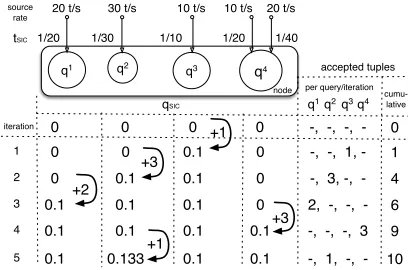
Figure 3:selectTuplesToKeep()on a single node withc= 10 number of tuples to keep reaches the node’s capacityc. In each iteration, the algorithm selects the two queries with the leastqSIC
values, i.e.q0 andq00(lines 12–14). Given the lowest result SIC queryq0(line 12), it selects as many tuples as required fromq0so thatq0SICreaches the result SIC value of the second lowest query
q00(lines 15–16). If there is more that one query with the same minimum SIC values, the algorithm selects one randomly. In case the aggregate number of tuples to accept is higher than the node’s capacity, the algorithm only accepts as many as possible without exceeding the node’s capacity (line 17).
For each query, the algorithm keeps the tuples with the highest SIC values, as shown in line 16 bymax(xSIC). This maximises
the aggregate SIC value of a query with the least possible number of tuples and so utilises nodes’ resources efficiently. The accepted tuples are passed for processing and soq0SICis updated (line 20 and
lines 8–9). We further explain in §5.2 the use of theQargument inupdateSIC()(line 20). The loop terminates when the number of accepted tuples reaches the node’s capacity as measured byc. The remaining tuplesT/X are discarded (line 7) as shown by the functionshedTuples()(lines 22–23).
The algorithm follows a gradient ascent approach to increase gradually the result SIC values of all queries while minimising the pairwise SIC differences of the two queries with the lowest SIC values. Iteratively, the algorithm minimises the pairwise SIC differ-ences of the lowest two queries—eventually all queries’ SIC values will converge as long as there are enough tuples from all queries to select (see Assumption 3).
Example of single node Balance-SIC fairness. Figure 3 shows an example of a single node with capacityc=10with 4 single-fragment queries. Three of the queries have one source and query
q4has two sources. Source rates and thus the normalised tuplet
SIC
values are given. At the beginning, all queries haveqSIC= 0.
At iteration 1, the algorithm selectsq3randomly to accept one tu-ple and soq3
SIC= 0.1At iteration 2, the lowest query is randomly
selected to beq2and the next highest isq3. The algorithm accepts 3tuples fromq2so thatq2SIC =qSIC3 = 0.1. At iteration 3,2
tu-ples fromq1are accepted to matchq1
SIC=qSIC2 =qSIC3 = 0.1. At
iteration 4, the algorithm accepts1tuple from one of theq4sources and2tuples from the other source, i.e.qSIC4 =201 + 2∗
1 40= 0.1. After iteration 4, all queries’ SIC values converge to the same value as they are all equal to0.1. However, the node has remaining capacity (9<10) to process one more tuple, and so the algorithm accepts one more tuple (i.e. randomly fromq2
) to fully utilise the node. The algorithm terminates after iteration 5 at which point the number of accepted tuples reaches 10 and equals the node’s ca-pacity. Eventually, three of the queries have exactly the same SIC values i.e.q1
q1 10 t/s
q2
q2 q3
1/10
10 t/s 10 t/s
tSIC 1/10
5 t/s
1/20 1/10 source
rate
0.1 0 0.05
0.1 0.1 0.05 0.1
0
0.1 0.2 0.1 0.1
0.2 0.2 0.1 0.2
0.2 0.3 0.15 0.2
1
2
3
4
5
qSIC per query fragment
accepted tuples cumulative a +1 1 2 3 4 5 node b, cb=5
+1 node a, ca=5
q1 q2 q3 b
0.1 0 0.05 0
1
0.1 0.1 0.05 0.1
2
0.2 0.1 0.05 0.2
3
0.2 0.2 0.1 0.2
4 iteration with updateSIC(Q) +1 +1 +1 +1 +1 without updateSIC(Q)
0.3 0.2 0.1 0.3
5 iteration 0 0.1 0.1 0.2 0.2 0.05 0.15 0.3 0.3 0.45 0.1 0.1 0.1 0.2 0.2 1 2 3 4 5 1 2 3 4 5 0 0.1 0.2 0.2 0.3 0.05 0.15 0.15 0.3 0.3 0.1 0.1 0.2 0.2 0.3 1 2 3 4 5 +1 +1 +1 +1 +1 +1
qSIC per query
q1 q2 q3
[image:8.612.56.287.52.295.2]q2 +1 +1 +1 +1 +1 +1 +1
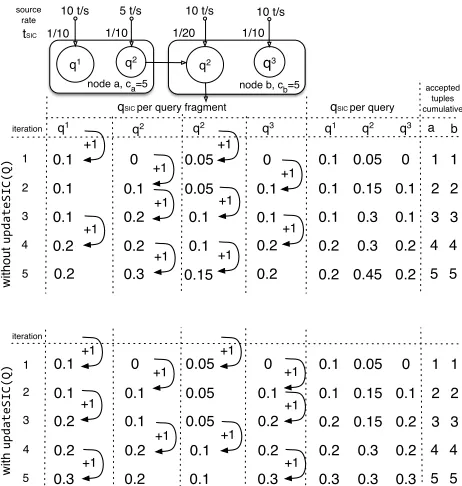
Figure 4: selectTuplesToKeep() on two nodes withca=5and
cb=5tuples
This example highlights that, in practice, the algorithm may not make all queries achieve exactly the same SIC values because of the involved node capacities and tuple rates, but it opportunistically tries to converge to equal SIC values.
5.2
FSPS Balance-SIC fairness
In the case of a multi-site FSPS, each node executes the same Algorithm 1 (lines 5–7). There are two main differences in the case of fragment queries. First, the SIC value of a multi-fragment query is affected by the tuple shedding performed on other nodes. If such a query has the minimum SIC value among all co-located queries on the same node, the following problem emerges: all nodes running other fragments of these co-located queries attempt to maximise the SIC values of the same minimum SIC query, potentially overshooting and causing oscillations. To address this problem, the algorithm explicitly updates the result SIC value of the queries at each iteration so that all nodes eventually become aware of each other’s shedding decisions (updateSIC(Q)
in line 20).
To better illustrate the use ofupdateSIC(Q)for global conver-gence, we use the example in Figure 4 in which two nodes host three queries in total and queryq2
spans both nodes. The source rates of all queries and the nodes’ capacities are shown in the figure. The top part of the figure illustrates the execution of the BALANCE -SIC without the use of theupdateSIC(Q)function. In each iter-ation, a node attempts to converge the SIC values of its running queries in isolation. In case of ties, the algorithm selects a query randomly. After iteration 5, the multi-fragmentq2
query has the highest result SIC value of all the single-fragment queries, and they all have different result SIC values (qSIC2 = 0.45> q
1
SIC= 0.2 =
q3SIC = 0.2). This is because each node compares only the SIC
values of the fragments of its hosted queries.2
2
We consider that fragments of a query graph have the same struc-ture. The SIC value of a fragment corresponds to the SIC value of the downstream operator, which outputs the tuples for the next downstream fragment in the case of multi-fragment queries, or the end-user in the case of a single-fragment query.
The bottom part of Figure 4 shows how the use ofupdateSIC(Q)
makes both nodes take informed shedding decisions for global con-vergence. At the end of each iteration, both nodes are updated with the result SIC values of their hosted queries and so become aware of each others’ shedding decisions. In this case, the BALANCE -SIC algorithm converges and all result -SIC values become equal (q1
SIC=qSIC2 =qSIC3 = 0.3). The dissemination of the query SIC
result values to the FSPS nodes hosting the query fragments for the use ofupdateSIC(Q)is performed by the query coordinator described in §6.
In the description of the algorithm, we assumed no delays when updating the result SIC value of a query to the nodes hosting its query fragments: once a tuple is accepted by a query, its contri-bution to the result SIC value is assumed to be instantaneous (As-sumption 3). This as(As-sumption is for the purposes of the explanation only—we provide a practical implementation in §6 to address de-lays, and our evaluation results that show that the algorithm works well with delayed updates in practice.
The second issue with multi-fragment queries is that an accepted tuple on a node from a multi-fragment query may be discarded by another node downstream, thus wasting processing resources at an upstream node. Rather than using back-pressure [44], our al-gorithm uses the actual SIC values of tuples to select the highest available value. Since, in our model, the SIC metric captures the importance of tuples, i.e. the higher the SIC value, the more impor-tant is the tuple, the algorithm thus always keeps the most valuable tuples (max(xSIC)in line 16).
The BALANCE-SIC algorithm aims to converge the SIC values of all queries by exploiting the overlap of queries fragments across nodes and by allowing each node to take informed shedding deci-sions based on the result SIC values of its hosted queries. In this way, nodes become aware of each others shedding decisions and converge to global fairness across the set of FSPS queries with-out centralised coordination. Our work considers FSPS in which all nodes are implicitly connected through the fragmentation of queries. This means that any accepted tuple on a node eventually affects the shedding on any other node transitively.
6.
BALANCE-SIC FAIRNESS
IMPLEMEN-TATION
Next we describe the integration of the BALANCE-SIC fairness approach with our FSPS system called THEMIS. THEMIS imple-ments the performance model from §4 and associates stream tuples with meta-data about their SIC value. It uses this information for shedding decisions according to the BALANCE-SIC fairness. This section focusses on the practical aspects of the BALANCE-SIC fair-ness approach. In particular, we explain how to weaken our previ-ous assumptions and, in §7, we will give experimental evidence on the convergence of the BALANCE-SIC algorithm. Figure 5 pro-vides an overview of the architecture of a typical THEMISnode. STW approximation. §4 introduced theSTW concept as an in-terval, which captures the relationship between source and result tuples. The duration of theSTWshould exceed the end-to-end pro-cessing latency of the system in order to allow source tuples to be processed by all downstream operators. To model the continu-ous nature of stream processing and the generation of tuples from sources, THEMISuses the concept of asliding windowto imple-ment aSTW, i.e. theSTWlogically slides continuously over time. This approximation allows us to handle the continuous generation of source tuples, relating them to result tuples.
tuple shedder
input buffer
threads executing operators
output tuples input
tuples
[image:9.612.323.550.51.285.2]overload detector
Figure 5: Architecture of a typical single THEMISnode
given result tuple. We find empirically that aSTWthat is an order-of-magnitude larger than the end-to-end processing delay and has a small slide, leads to an acceptable SIC precision. Furthermore, a largeSTWallows more tuples and therefore more queries to be selected by the BALANCE-SIC algorithm for global convergence. SIC maintenance.In THEMIS, tuples are associated with SIC val-ues. Based on a relational streaming model [8], each tuple hasfields of a given schema. When an operator atomically outputs multiple tuples, they are grouped together into abatch. A batch contains a sequence of tuples preceded by a single header with the following fields: (a) the SIC value; (b) a unique identifier of the query that these tuples belong to; and (c) a timestamp of the tuple creation, in case of source tuples, or, of their generation, for derived tuples.
The assignment of SIC values to source tuples is performed as per Equation (1), which requires the number of source tuples per source per STW TsS and the number of sources. Although the
number of sources S per query is known a-priori—we consider queries with fixed sources—calculating the number of tuples in TS
s poses a challenge when source rates are unknown and
time-varying. THEMISuses theSTWapproximation of sliding windows to update the SIC values of all source tuples per slide online, before passing these for processing to downstream operators. By using a largeSTWand small slides, THEMIScan accurately capture time-changing source rates, thus providing a practical solution to relax Assumption 2 (see §5.1).
The assignment of SIC values to derived tuples is performed as per Equation (3), which requires the sets of input and output tuples. These groups are identified easily for tumbling windows before an operator emits tuples atomically for processing. In the case of slid-ing windows, we also provide a practical way to divide the SIC value of an input tuple across all its derived tuples per slide.
The dissemination of query result SIC values to nodes that host query fragments (i.e.updateSIC()in Algorithm 1) is performed by a logically-centralisedquery coordinatorcomponent. It is in-stantiated when a new query is deployed, and it is responsible for the query management during its lifecycle.
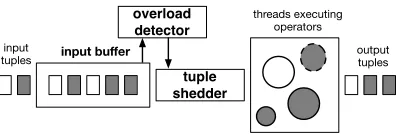
Overload detection. Each THEMISnode has aninput buffer(IB) queue (Figure 5) in which all incoming tuples await processing. When the tuple arrival rate exceeds the node’s capacity, the size of the IB grows, and the node overloads. To address overload, a node has anoverload detectorand atuple sheddercomponent.
The overload detector periodically checks the size of the IB. When its size exceeds a thresholdc, the overload invokes the tu-ple shedder to discard excess tutu-ples from the IB. The IB threshold represents the number of tuples that the node can process during a shedding interval. Its value changes and is estimated online based on acost model. The tuple shedder discards batches until the size of the remaining tuples in the IB reachesc, as in Algorithm 1.
In case a node is momentarily not overloaded, THEMISprocesses all tuples for all hosted queries. In this case, the BALANCE-SIC algorithm is independently invoked on all other overloaded nodes to balance SIC values across all FSPS nodes.
Cost model.The IB threshold depends on the properties of the op-erators. We adopt a cost model to calculate the average processing
Aggregate workload AVG: average value of tuples every sec:
Select Avg(t.v) from Src[Range 1 sec] MAX: maximum value of tuples every sec:
Select Max(t.v) from Src[Range 1 sec] COUNT: no of tuples with values≥50 every sec.
Select Count(t.v) from Src[Range 1 sec]
Having t.v≥ 50 Complex workload
AVG-all: average CPU usage of nodes every sec.
Select Avg(t.v) from AllSrc[Range 1 sec], (13 ops) TOP-5: top 5 nodes with largest available CPU and free memory≥100 MB every sec.
Select Top5(AllSrcCPU.id) From AllSrcCPU[Range 1 sec],
AllSrcMem[Range 1 sec]
Where AllSrcMem.free>= 100,000and AllSrcCPU.id = AllSrcMem.id, (29 ops) COV: covariance of CPU usage of two nodes every sec.
Select Cov(SrcCPU1.value, SrcCPU2.value) SrcCPU1[Range 1 sec],SrcCPU2[Range 1 sec], (5 ops) Table 1: Queries in CQL-like [8] syntax. Srcrepresents a single source stream. AllSrcshows the union of multiple streams. For thecomplexqueries, the number of operators/fragment is shown.
time spent on a tuple (see Assumption 1 in §5.1). This is calculated based on the number of processed tuples between successive invo-cations of the overload detector. We use a moving average over past estimations to calculate the average time required to process a tu-ple. Based on the time until the next invocation of the shedder, we estimatec. Our cost model works independently from the node’s hardware capacity. It estimates online the processing capacity of any node as the average processing time per tuple. More complex cost models [37, 26] have been proposed, but they only apply to specific operator semantics.
Tuple shedder. The tuple shedder executes Algorithm 1 in each shedding interval. The interval is a fixed configuration parameter and sets a bound on the maximum waiting time of tuples in the IB. For low latency processing, it should be set to a short interval, e.g. a few hundred milliseconds. Setting a very low threshold, however, incurs a higher overhead. In §7.2, we evaluate the impact of the shedding interval on BALANCE-SIC fairness.
To reduce the impact of delays when disseminating the result SIC values by the query coordinator to nodes hosting query frag-ments, the load shedder estimates the result SIC values of queries based on its local shedding. The shedder assumes that all batches in the IB are discarded and then estimates the effect of discarding them on the result SIC values. It subtracts the sum of the SIC val-ues of batches from the current updated query result SIC. In this way, it projects the effect that its shedding will have on the result SIC value. Furthermore, the periodic invocation of the shedder en-ables it to make informed decisions across aSTWin a step-by-step fashion. In this way, THEMIScaptures the real-time nature of tuple processing and any further downstream shedding that must con-sider the query result SIC value. The above heuristics enables us to address Assumption 3 (see §5.2) on zero delays between shedding and updating the result SIC values. Evaluation results show that FSPS queries converge to BALANCE-SIC fairness.
7.
EVALUATION
[image:9.612.75.273.55.122.2]Local test-bed
Server spec.
3 servers with 1.8 Ghz CPU, 4 GB mem, Linux 2.6.27-17-server, 1 Gbps LAN THEMIS
deployment
1 source node, 1 query submission node, 1 processing node
source rate
400 tuples/sec in 5 batches/sec of 80 tu-ples/batch per source
Emulab test-bed
Server spec.
25 servers with 3 Ghz CPU, 2 GB mem, Linux RedHat 9, 1 Gbps LAN
THEMIS
deployment
3 source nodes, 3 query submission nodes, up to 18 processing nodes
source rate
[image:10.612.65.283.54.214.2]150 tuples/sec in 3 batches/sec of 50 tu-ples/batch per source
Table 2: Set-up of experimental test-beds
1. the correlation of the SIC metric with result correctness when query processing is degraded due to load shedding (§7.1). The results show that the SIC metric captures result correctness across different types of queries and data distributions; 2. theeffectiveness of the BALANCE-SIC fairness algorithmin
reducing the spread of SIC values across queries (§7.2). The re-sults show that our approach is fairer than random shedding: for a mixture of multi-fragment queries deployed across 18 nodes, it has a 33% higher Jain’s Fairness Index metric. We also demon-strate convergence for different shedding intervals;
3. thescalability of the fairness algorithm(§7.3). We show that the algorithm maintains fair query shedding with an increasing number of nodes and queries;
4. theimpact on burstiness and wide-area networks(§7.4) in applying BALANCE-SIC fairness is minimal;
5. thecomparison against related work(§7.5). We show that our approach outperforms [34] and works agnostically in terms of the output utility function as opposed to [44], which leads to fairer allocations in complex deployments; and
6. theoverhead of our fair shedder implementation(§7.6). We provide evidence that the load shedder increases the execution time of a base random shedder by only 11%.
Experimental set-up.We use queries from two workloads, an ag-gregateand acomplexworkload as described in Table 1. Aggre-gate queries operate on a single source and perform basic aggreAggre-gate functions; the complex workload implements a set of queries for monitoring the health of data center servers. It consists of monitor-ing queries over multiple sources, composed of various operators including average, max, top-k, group-by, filter, join and covariance. The queries from the complex workload are split into fragments for multi-site deployment, as follows. Each fragment connects to sources and contains the same operators, performing equivalent processing as a single-fragment query in an incremental fashion. An AVG-all fragment connects to 10 sources; a TOP-5 fragment connects to 20 sources; and a COV fragment connects to 2 sources. The number of operators per fragment are shown in Table 1. For ex-ample, the most complex TOP-5 fragment consists of 29 operators, i.e. 10 CPU source data receivers, 10 memory receivers, 1 filter, 3 time windows, 2 averages, 1 join, 1 top-k and 1 output operator.
The query graphs, when running, are organised in two different ways: (1) in the case of the AVG-all query, a root fragment is con-nected to all other fragments and centrally aggregates partial results towards the final result forming a tree; and (2) for TOP-5 and COV queries, fragments form a chain, and the last fragment in the chain outputs the query result. Such graphs enable us to evaluate the
ef-fect of downstream shedding and the estimation of the result SIC values by the tuple shedder across two different query graphs.
Queries process eithersyntheticorreal-worlddatasets. The data in thesyntheticdataset follows either a gaussian,uniformor ex-ponentialdistribution, with a mean of 50. We also use amixed synthetic dataset, with values randomly chosen from any of the previous distributions. Thereal-worlddataset are measurements of CPU and memory-related utilisation from PlanetLab nodes, as recorded by the CoTop project [36].
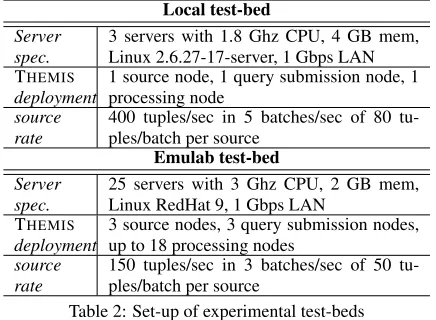
Table 2 describes our twolocalandEmulab[2] test-beds. We use the local test-bed for the SIC correlation to result correctness. We use the Emulab test-bed for the fairness and scalability experiments where all nodes are located within the same 100-Mbps LAN with a star topology and 5 ms of delay between nodes.
In all experiments, we set theSTWduration to 10 secs and the shedding interval to 250 ms. The size of theSTW should be set to an order of magnitude larger than the end-to-end processing de-lay across all queries, which emit new result tuples every 1 sec. We determined empirically that largerSTWvalues do not effect the cor-rect query SIC calculation. We deploy 10 TOP-5 queries with two fragments, and we measure their SIC values overSTWset to 10 and 100 secs. In these underloaded cases, results show that the aver-age SIC values across queries correctly measure perfect processing: 0.9700±0.0064 and 1.0086±0.0034, respectively. Therefore, we set the duration of theSTWto 10 sec. In the rest of the paper, we report results over 5 minutes of execution after query deployment.
7.1
SIC Correlation
When using the SIC metric to provide feedback on processing quality, it is important that its value is correlated with the result error: a higher SIC value should indicate that the query result is closerto the perfect result.
We evaluate this correlation for different types of queries and source data. We use the local test-bed to deploy queries from the aggregate workload and the TOP-5 and COV queries from the com-plex workload. For each query type, we increase the number of queries on a single node to emulate different degrees of overload. For the aggregate workload and the COV queries, the source rate is 400 tuples/sec and, for the TOP-5 query, it is 20 tuples/sec. The node uses a shedder that discards tuples randomly every 250 ms.
Figure 6 shows the correlation between the result correctness and the SIC values for the aggregate workload. We quantify correctness by comparing to perfect processing. We report themean absolute error, which quantifies the relative distance of the degraded result values,˜trVfrom the perfect values,trVfor all result tuplesn:
X
∀tr ˜
trV−trV
tr
V !
/n
The results show that, when the SIC values increase, the error decreases, which indicates that the degraded results approach the perfect results. Depending on the query type, this correlation is stronger (e.g. for COUNT) or weaker (e.g. for AVG).
0 0.1 0.2 0.3 0.4 0.5
0 0.2 0.4 0.6 0.8 1
mean absolute error
SIC values gaussian uniform exponential mixed planetlab
(a) AVG queries
0 0.2 0.4 0.6 0.8 1
0 0.2 0.4 0.6 0.8 1
mean absolute error
SIC values gaussian uniform exponential mixed planetlab
(b) COUNT queries
0 0.2 0.4 0.6 0.8 1
0 0.2 0.4 0.6 0.8 1
mean absolute error
SIC values gaussian uniform exponential mixed planetlab
[image:11.612.64.542.56.181.2](c) MAX queries
Figure 6: Correlation of SIC metric with result correctness for the aggregate query workload
0 0.2 0.4 0.6 0.8 1
0 0.2 0.4 0.6 0.8 1
Kendall's distance
SIC values gaussian uniform exponential mixed planetlab
(a) TOP-5 queries
0 100 200 300 400
0 0.2 0.4 0.6 0.8 1
std
SIC values gaussian uniform exponential mixed planetlab
(b) COV queries
Figure 7: SIC correlation with results for the complex workload
Next, we consider the SIC correlation for the complex workload. For the TOP-5 query, we calculate the error between perfect and degraded results using the Kendall’s distance metric [18]. It counts the differences—i.e. permutations and elements in only one list—of pairs of distinct elements between two lists. We plot the normalised Kendall’s distance with a maximum error of 1.
For the COV query, we discard source data at random, which produces a series of sample covariance values. Since these values are random, their expected value should match the real covariance, obtained through perfect processing. We can estimate the deviation of the values from the perfect value through the standard deviation. The results in Figure 7 show that there is a significant correla-tion. As the result SIC value increases, the distance/error to the per-fect result decreases. For example, the TOP-5 query shows similar behaviour across synthetic and real-world datasets. For the COV query, the error is more prominent in the real-world than the syn-thetic dataset because discarding values from the synsyn-thetic distribu-tion does not significantly change the covariance of the distribudistribu-tion.
0 0.2 0.4 0.6 0.8 1
30 60 90 120 150 180 210 240 270 300 330 0
0.2 0.4 0.6 0.8 1
mean SIC Jain's index
[image:11.612.82.257.174.483.2]number of quries mean Jain's index
Figure 8: Single-node fairness
7.2
Balance-SIC Fairness
Next we evaluate the effectiveness of the BALANCE-SIC fair-ness approach to converge the result SIC values of queries. We start by validating that our approximation of the STWallows the algorithm to converge to BALANCE-SIC fairness on a single node. We also explore the behaviour of the algorithm for different shed-ding intervals. We continue to evaluate our approach in the case of a multi-node deployment, comparing to the baseline of random shed-ding. Finally, we study the effect of the ratio of multi-fragmented queries on the level of achieved fairness.
To measure the effectiveness of the BALANCE-SIC fairness ap-proach, we use theJain’s Fairness Index metric[25]:
Jain’s index:=
P
[image:11.612.332.529.211.329.2]∀q∈QqSIC 2
|Q| ∗P
∀q∈Q(qSIC)2
,
whereQis the set of queries executed by the FSPS. Intuitively, the metric captures the proportion of queries whose differences in SIC values are small. The Jain’s index values range from1/|Q|to 1; the higher the value, the fairer the system. When its value is1, all queries have the same result SIC value.
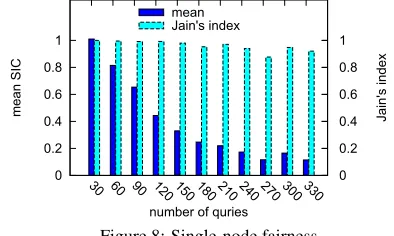
Source time window approximation. We first explore the con-vergence of our algorithm to BALANCE-SIC fairness, validating the use of sliding windowSTW(see §6). We deploy queries of the complex workload on a local test-bed node. Over the course of this experiment, we did not observe any oscillation of SIC values and the standard deviation of values remained low.
0 0.2 0.4 0.6 0.8 1
25 50 100 150 200 250 0 0.2 0.4 0.6 0.8 1
mean SIC Jain's index
[image:12.612.72.267.55.307.2]interval in msecs mean Jain's index
Figure 9: Shedding interval
0 0.2 0.4 0.6 0.8 1
0.1 0.2 0.4 0.6 0.8 1.0 0 0.2 0.4 0.6 0.8 1
mean SIC Jain's index
ratio of queries with 3 fragments mean
[image:12.612.337.528.58.170.2]Jain's index
Figure 11: Fairness for multi-fragmented queries
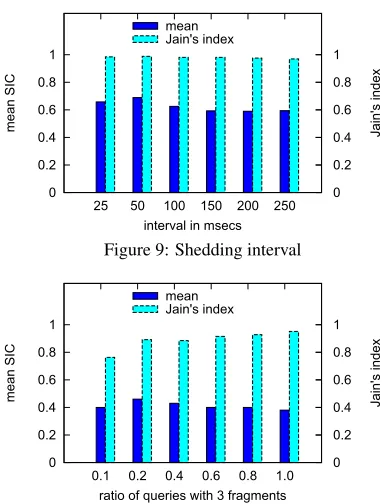
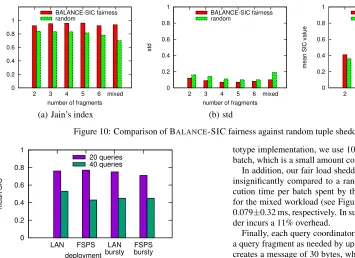
Shedding interval. We study the effect of different shedding in-tervals, as shown in Figure 9. The shedding interval corresponds to the slide of theSTW. In each case, we deploy 200 queries from the complex workload on 6 nodes, and each query has between 1 and 3 fragments. The results show that our algorithm achieves fair shedding regardless of the shedding interval, as shown by the close values for the mean and high values Jain’s index metric. BALANCE-SIC fairness across multiple nodes.Next, we deploy our fair shedding approach across 18 nodes. As we do not know the optimal fairness solution, we compare against random shedding as a practical baseline. We deploy multi-fragment, complex queries. We report results as we vary the number of fragments per query from 1 to 6 and when queries have a random number of fragments between 1 and 6 (mixed case). In all cases, the total number of fragments is the same, approximately 2,000.
Figure 10 shows that the BALANCE-SIC fair shedder provides a fairer solution in all cases compared to the random shedder. For the most realistic mixed workload, BALANCE-SIC is 33% bet-ter than the random approach, according to the Jain’s index. In addition, BALANCE-SIC reduces the spread of SIC values across queries, as shown by the standard deviation (std) in Figure 10(b). The BALANCE-SIC shedder accepts tuples from the most degraded queries while it sheds tuples from the least degraded ones. In do-ing so, it better utilises resources towards processdo-ing more valuable source tuples, as supported by the increased mean SIC values in Figure 10(c). In contrast, the random shedder blindly sheds tuples regardless of their upstream processing.
Multi-fragmentation.We rely on query fragmentation to achieve our fairness. We study the effect that different ratios of multi-fragmented queries have. We vary the ratio of three-fragment over single-fragment queries from the complex workload across 10 nodes. The total number of fragments is about 2,000, and each node has roughly the same load. Figure 11 shows that, when more queries are multi-fragmented, the BALANCE-SIC fairness algorithm con-verges to a fairer system, as more queries span nodes.
0 0.2 0.4 0.6 0.8 1
9 12 18 24
0 0.2 0.4 0.6 0.8 1
mean SIC Jain's index
number of nodes mean Jain's index
Figure 12: Fairness for increasing number of nodes
0 0.2 0.4 0.6 0.8 1
180 240 300 360 420 480 540 600 660 720 780 840 900 0
0.2 0.4 0.6 0.8 1
mean SIC Jain's index
number of queries mean Jain's index
Figure 13: Fairness for increasing number of queries
7.3
Scalability
Next we evaluate the scalability of the BALANCE-SIC fairness algorithm. First we increase the number of nodes while hosting a constant number of 500 queries. We deploy queries from the complex workload and vary their fragments randomly from 1 to 6. Fragments are deployed according to a Zipf distribution.
As shown in Figure 12, BALANCE-SIC manages to utilise the increasing number of nodes as the mean SIC values increase. In all cases, our approach sheds tuples fairly, as the Jain’s index metric approaches to 1. In Figure 13, we increase the number of queries for a fixed deployment on 18 nodes. The results show that, with more queries, tuples are discarded fairly. This is even the case when the large number of queries strain the resources of the sys-tem, decreasing the mean SIC value.
7.4
Burstiness and wide-area networks
We evaluate BALANCE-SIC fairness with bursty sources over a wide-area network, referred to as FSPS. We deploy THEMISover a network with 4 nodes, and we emulate wide-area latencies be-tween nodes of 50 ms. To introduce bursty source rates, we modify sources so that 10% of the time they generate tuples at 10×their normal rate. We also deploy queries on a LAN without burstiness as a baseline. We deploy queries from the complex workload with two query fragments, which are randomly assigned to nodes.
Figure 14 shows the average SIC values of queries after carrying out BALANCE-SIC shedding. The results show that, regardless of the deployment set-up, the average SIC values remain similar. This indicates that THEMIScan achieve BALANCE-SIC fairness in the presence of bursty sources and variation in nodes’ latency.
7.5
Comparison against related work
[image:12.612.337.528.193.306.2]0 0.2 0.4 0.6 0.8 1
2 3 4 5 6 mixed
Jain’s index
number of fragments BALANCE-SIC fairness random
(a) Jain’s index
0 0.2 0.4 0.6 0.8 1
2 3 4 5 6 mixed
std
number of fragments BALANCE-SIC fairness random
(b) std
0 0.2 0.4 0.6 0.8 1
2 3 4 5 6 mixed
mean SIC value
number of fragments BALANCE-SIC fairness random
[image:13.612.84.439.54.312.2](c) mean
Figure 10: Comparison of BALANCE-SIC fairness against random tuple shedding
0 0.2 0.4 0.6 0.8 1
LAN FSPS LAN bursty
FSPS bursty
mean SIC
deployment 20 queries 40 queries
Figure 14: Fairness with source burstiness and wide-area latencies
parameter values. To address this limitation, we use the THEMIS cost model to calculate any unknown values.
We formulate the centralised problem of a fixed query deploy-ment that closely matches the simple set-up used in the evaluation of [34]. It consists of two nodes and multiple two-operator queries in which all operators connecting to sources are collocated on the same node. We use 60 AVG-all queries of two fragments running on 2 nodes. As in [34], we use the GLPK tool to solve the optimi-sation problem. The optimal solution allows 3 out of the 60 queries to process all of their input tuples: one query discards a fraction of its input tuples; and all the other queries discard all of their tuples, which is clearly not a fair solution. This optimisation problem is not formulated to balance the throughput across queries (although all queries weights are set to 1).
To compare with [44], we first solve the problem for the same simple set-up of [34] as above, using the formulation of [44] and logarithmic output utility functions. For this simple set-up, [44] yields a fair solution as our approach. We further compare using a complex deployment of 20 AVG-all queries (3 fragments each), 20 COV and 20 TOP-5 queries (2 fragments each), and randomly de-ploying their fragments on 4 nodes. The solution of [44] is obtained using Matlab and the Jain’s fairness index for the resulting utilities’ distribution (normalised log-output rates) equals 0.87. This solu-tion is less fair than our BALANCE-SIC solution where the Jain’s fairness index for the resulting SIC values equals to 0.97, which is close to perfect fairness. Note that the solutions based on [34] are only applicable to concave utility functions.
Both approaches [34, 44] aim to solve the distributed shedding problem for specific deployments, and they rely on a-priori knowl-edge of values. Although [44] gives a fair allocation in simple deployments, with complex deployments and varying workloads, BALANCE-SIC provides a fairer allocation.
7.6
Overhead
We finally consider the overhead of BALANCE-SIC in terms of additional meta-data bytes and shedder execution time. In our
pro-totype implementation, we use 10 bytes to store the SIC value per batch, which is a small amount compared to actual stream data.
In addition, our fair load shedder increases execution time only insignificantly compared to a random shedder. The average exe-cution time per batch spent by the fair and the random shedders for the mixed workload (see Figure 10) are 0.088±0.26 msec and 0.079±0.32 ms, respectively. In summary, the BALANCE-SIC shed-der incurs a 11% overhead.
Finally, each query coordinator submits the result SIC values to a query fragment as needed byupdateSIC()in Algorithm 1. This creates a message of 30 bytes, which is sent at regular intervals to all query fragments. In the evaluation, we used intervals of 250 ms to match the shedding interval for update shedding. The additional data sent between nodes because of this operation is negligible when compared to high tuple rates in data stream processing.
8.
CONCLUSIONS
It will be increasingly important to handle long-lasting overload in federated stream processing systems (FSPSs). This requires new decentralised designs to provide fairness in queries processing.
We describe a new fairness model for FSPSs under overload. We associate tuples with theirsource information content(SIC), i.e. the amount of information from data sources that they contain. This approach quantifies the perceived contribution of a tuple, without being dependent on processing semantics. We provide evidence that the contribution of source tuples is correlated with the quality of query results. We provide a new definition of BALANCE-SIC processing fairness in the context of FSPSs according to SIC values and describe a distributed algorithm that enables individual sites in an FSPS to perform BALANCE-SIC fair tuple shedding, reducing the skew in experienced processing quality.
Acknowledgments.This research work was partially supported by the EPSRC DISSP grant (EP/F035217/1), and the U.S. Army Re-search Laboratory and the U.K. Ministry of Defence under Agree-ment Number W911NF-06-3-0001.
9.
REFERENCES
[1] Astronomical Wide-field Imaging System for Europe. http://www.astro-wise.org/.
[2] Network Emulation Testbed. http://www.emulab.net. [3] OGSA-DAI: Open Grid Services Architecture.
http://ogsadai.org.uk/.
[4] D. J. Abadi, D. Carney, et al. Aurora: A New Model and Architecture for Data Stream Management.VLDB, 12(2), 2003.
[image:13.612.76.530.56.186.2]