Pattern-avoiding alternating words
Alice L.L. Gao1, Sergey Kitaev2, and Philip B. Zhang31Center for Combinatorics, LPMC-TJKLC Nankai University, Tianjin 300071, P. R. China 2 Department of Computer and Information Sciences
University of Strathclyde, 26 Richmond Street, Glasgow G1 1XH, UK 3 College of Mathematical Science
Tianjin Normal University, Tianjin 300387, P. R. China
Email: 1[email protected],2[email protected],
Abstract. A word w = w1w2· · ·wn is alternating if either w1 < w2 > w3 < w4 > · · · (when the word is up-down) orw1 > w2 < w3 > w4 <· · · (when the word is down-up). In this paper, we initiate the study of (pattern-avoiding) alternating words. We enumerate up-down (equivalently, down-up) words via finding a bijection with order ideals of a certain poset. Further, we show that the number of 123-avoiding up-down words of even length is given by the Narayana numbers, which is also the case, shown by us bijectively, with 132-avoiding up-down words of even length. We also give formulas for enumerating all other cases of avoidance of a permutation pattern of length 3 on alternating words.
Keywords: alternating words, up-down words, down-up words, pattern-avoidance, Narayana numbers, Fibonacci numbers, order ideals, bijection
AMS Subject Classifications: 05A05, 05A15
1
Introduction
A permutation π = π1π2· · ·πn is called up-down if π1 < π2 > π3 < π4 > π5 < · · ·. A permutationπ =π1π2· · ·πn is calleddown-up ifπ1 > π2 < π3 > π4 < π5 >· · ·. A famous result of Andr´e is saying that if En is the number of up-down (equivalently, down-up)
permutations of 1,2, . . . , n, then
X
n≥0 En
xn
n! = secx+ tanx.
Some aspects of up-down and down-up permutations, also calledreverse alternating and
alternating, respectively, are surveyed in [16]. Slightly abusing these definitions, we refer to alternating permutations as the union of up-down and down-up permutations. This union is known as the set of zigzag permutations.
compositions [2, 5]. In this paper, we study alternating words. These words, also called
zigzag words, are the union of up-down and down-up words, which are defined in a similar way to the definition of up-down and down-up permutations, respectively. For example, 1214, 2413, 2424 and 3434 are examples of up-down words of length 4 over the alphabet {1,2,3,4}.
Section 2 is dedicated to the enumeration of up-down words, which is equivalent to enumerating down-up words by applying the operation of complement. For a word w = w1w2· · ·wnover the alphabet{1,2, . . . , k}its complementwcis the wordc1c2· · ·cn, where
for each i= 1,2, . . . , n,ci =k+ 1−wi. For example, the complement of the word 24265
over the alphabet {1,2, . . . ,6} is 53512. Our enumeration in Section2 is done by linking bijectively up-down words to order ideals of certain posets and using known results. We note that an alternative enumeration of these words (in terms of generating functions) is done in [3] (see formula (1.11) there). However, as far as we can see, our recursive formula (1) allowing quick computation of numbers in question cannot be easily derived from the generating functions in [3].
A (permutation) pattern is a permutation τ =τ1τ2· · ·τk. We say that a permutation
π = π1π2· · ·πn contains an occurrence of τ if there are 1≤ i1 < i2 <· · · < ik ≤ n such
thatπi1πi2· · ·πik is order-isomorphic toτ. Ifπdoes not contain an occurrence ofτ, we say thatπavoidsτ. For example, the permutation 315267 contains several occurrences of the pattern 123, for example, the subsequences 356 and 157, while this permutation avoids the pattern 321. Occurrences of a pattern in words are defined similarly as subsequences order-isomorphic to a given word called pattern (the only difference with permutation patterns is that word patterns can contain repetitive letters, which is not in the scope of this paper).
Comprehensive introductions to the theory of patterns in permutations, words and compositions can be found in [7, 8]. In particular, Section 6.1.8 in [8] discusses known results on pattern-avoiding alternating permutations (also, see [4, 9]), and Section 7.1.6 discusses results on permutations avoiding patterns in a more general sense. An example of relevant studies is that of longest alternating subsequences in pattern-avoiding words conducted in [11].
In what follows, [k] ={1,2, . . . , k}.
2
Enumeration of up-down words
In this section, we consider the enumeration of up-down words. We shall show that this problem is the same as that of enumerating order ideals of a certain poset. Since up-down words are in one-to-one-correspondence with down-up words by using the complement operation, we consider only down-up words throughout this section.
Table 1 provides the number Nk,` of down-up words of length ` over the alphabet [k]
for small values of k and ` indicating connections to the Online Encyclopedia of Integer Sequences(OEIS) [14].
k `
0 1 2 3 4 5 6 7 8 9 10 OEIS
2 1 2 1 1 1 1 1 1 1 1 1 trivial
3 1 3 3 5 8 13 21 34 55 89 144 A000045
4 1 4 6 14 31 70 157 353 793 1782 4004 A006356
5 1 5 10 30 85 246 707 2037 5864 16886 48620 A006357
6 1 6 15 55 190 671 2353 8272 29056 102091 358671 A006358
7 1 7 21 91 371 1547 6405 26585 110254 457379 1897214 A006359
Table 1: The numberNk,` of down-up words on [k] of length `for small values of k and `.
We assume the reader is familiar with the notion of a partially ordered set (poset) and some basic properties of posets; e.g. see [15]. A partially ordered set P is a set together with a binary relation denoted by≤P that satisfies the properties of reflexivity,
antisymmetry and transitivity. An order ideal of P is a subset I of P such that if x∈ I and y≤x then y∈I. We denoteJ(P) the set of all order ideals of P.
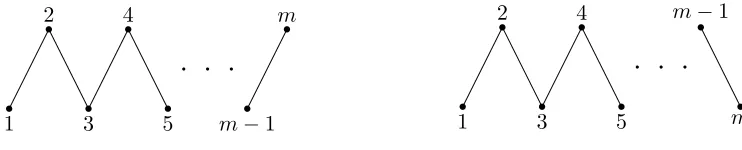
Let n be the poset on [n] with its usual order (n is a linearly ordered set). The m-element zigzag poset, denoted Zm, is shown schematically in Figure 1. Note that the
order <Zm in Zm is 1 < 2 > 3 < 4 > 5 < · · · . The definition of the order ≤Zm is self-explanatory.
1 2
3 4
5 m−1
m
m even
1 2
3 4
5
m−1
m
[image:3.612.84.527.314.426.2]m odd
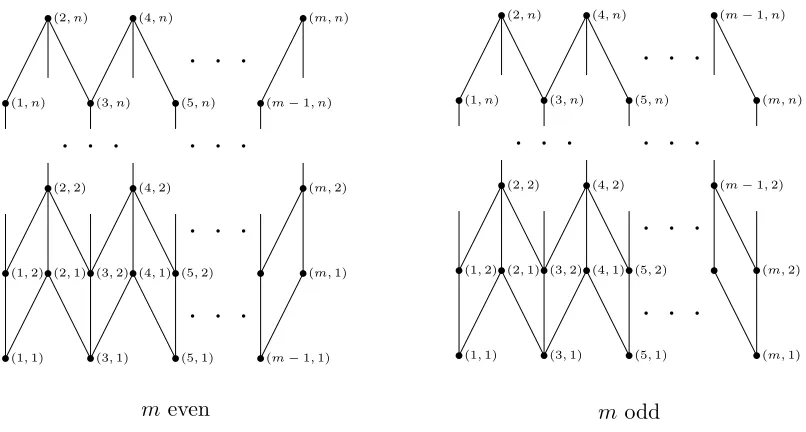
[image:3.612.116.487.627.702.2]The posetZm×n is as shown in Figure 2. Elements of Zm×n are pairs (i, j), where
i∈Zm and j ∈[n], and the order is defined as follows:
(i, j)≤(k, `) if and only ifi≤Zm k and j ≤`.
(1, n) (2, n)
(3, n) (4, n)
(5, n)
(1,2) (2,2)
(3,2) (4,2)
(5,2)
(1,1) (2,1)
(3,1) (4,1)
(5,1)
(m−1, n) (m, n)
(m,2)
(m−1,1) (m,1)
m even
(1, n) (2, n)
(3, n) (4, n)
(5, n)
(1,2) (2,2)
(3,2) (4,2)
(5,2)
(1,1) (2,1)
(3,1) (4,1)
(5,1)
(m−1, n)
(m, n)
(m−1,2)
(m,2)
(m,1)
[image:4.612.102.505.193.409.2]modd
Figure 2: The poset Zm×n.
It is known that, for m ≥2, the size of J(Zm) equals to the Fibonacci number Fm+2, which is defined recursively as F1 = F2 = 1 and Fn+1 = Fn+Fn−1 for any n ≥ 2; see Stanley [15, Ch. 3, Ex. 23.a]. The enumeration of J(Zm ×n) was studied by Berman
and K¨ohler [1]. The following theorem reveals their connection with the enumeration of alternating words. We shall give two proofs of it here, a bijective proof and an enumerative proof.
Theorem 2.1. For any k ≥2 and ` ≥ 2, the number Nk,` of down-up words over [k] of
length ` is equal to the number of order ideals of Z`×(k−2).
Bijective Proof. Let Wk,` denote the set of down-up words over [k] of length `. We
shall build a bijection between Wk,` and J(Z`×(k−2)).
We first define a map Φ : Wk,` → J(Z` × (k−2)). Given a down-up word w =
w1w2· · ·w`, we define the word α=α1α2· · ·α` as follows:
αi =
(
wi−2, if i is odd,
wi−1, if i is even,
where 1≤i≤`. Then let
For example, letk= 4 and`= 7, and consider the wordw= 3241423. Then,α = 1120211 and thus Φ(w) = {(1,1),(2,1),(3,1),(3,2),(5,1),(5,2),(6,1),(7,1)}, which is an order ideal ofZ7 ×2.
We need to show that this map is well defined. It suffices to prove that Φ(w) is an order ideal of Z`×(k−2), that is to say that, if (i0, j0) ≤ (i, j) and (i, j) ∈ Φ(w) then
(i0, j0) ∈ Φ(w). From the definition of the order of Z` ×(k−2), we have that i0 ≤Z` i and j0 ≤j. Now, we divide the situation into two cases: i0 =i and i0 <Z` i. For the case i0 = i, the argument is obviously true from the construction of Φ(w). We just need to consider the casei0 <Z` i. At this time, imust be even, and i
0 can only bei−1 or i+ 1.
Since (i, j)∈Φ(w), we have that αi ≥j and thus wi ≥j + 1. From the fact that w is a
down-up word, it follows that wi0 > wi. Hence, wi0 ≥ j + 2 and thus αi0 ≥ j. From the construction of Φ(w), we obtain that (i0, j0)∈Φ(w) for all j0 ≤j, as desired.
Next, we define a map Ψ : J(Z` × (k−2)) → Wk,`. Given an order ideal I of
Z`×(k−2), we define a word γ = γ1γ2· · ·γ` as follows. For each 1 ≤ i ≤ `, if there
exists at least one j such that (i, j) ∈ I, then let γi be the maximum j. Otherwise, we
letγi=0. The corresponding word Ψ(I) is defined as (2 +γ1)(1 +γ2)(2 +γ3)(1 +γ4)· · ·. For exmaple, ifI ={(1,1),(2,1),(3,1),(3,2),(5,1),(5,2),(6,1),(7,1)}, thenγ = 1120211 and thusw= 3241423.
It is easy to see that, for any even integer i, we have γi ≤γi+1 and γi ≤γi−1, since I is an order ideal. From the construction of Ψ(I), we see that it is a down-up word.
Finally, it is not difficult to prove that Ψ◦Φ = id and Φ◦Ψ = id. Hence Φ is a bijection. This completes our bijective proof.
Enumerative Proof. We first prove that the numbers in question satisfy the following recurrence relation, fork ≥3 and `≥2,
Nk,`=Nk−1,`+
b`−21c X
i=0
Nk−1,2iNk,`−2i−1−δ`is evenNk−1,`−2, (1)
with the initial conditions Nk,0 = 1, Nk,1 = k for k ≥ 2, and N2,` = 1 for ` ≥2. To this
end, we note that any down-up wordwover [k] of length `belongs to one of the following two cases.
Case 1: w does not contain the letter k. Then the number we count is that of down-up words over the alphabet [k−1] of length `, which is Nk−1,`. This corresponds to the first
term on the righthand side of (1).
right hand side of (1). The only exception occurs when the subword after the leftmost letter k is of length one. It can be any letter in [k−1], but Nk,1 = k. So, an additional term occurs, which fixes this. In these cases, `−2i−1 equals 1, which means that ` is even. This completes the proof of (1).
Now, let us denote the number of order ideals ofZ`×kbyMk,`. We note that Berman
and K¨ohler [1, Example 2.3] studied a similar recurrence forMk,`, which is, for k≥1 and
`≥1,
Mk,` =Mk−1,`+
b`−1 2 c
X
i=0
Mk−1,2iMk,`−2i−1,
with the initial conditionsMk,0 = 1 for k ≥0 and M0,`= 1 for ` ≥1.
Owing to their akin recurrence relations, we made a minor change to the numberNk,`
to complete the proof. We let Nek,` be Nk,` except Nek,1 = k−1. One can easily check
that, fork ≥3 and `≥1,
e
Nk,`=Nek−1,`+
b`−1 2 c
X
i=0
e
Nk−1,2iNek,`−2i−1,
with the initial conditionsNek,0 = 1 fork ≥2 andNe2,`= 1 for` ≥1. It follows immediately
that, fork ≥2 and `≥0,
e
Nk,` =Mk−2,`,
since they have the same initial conditions and recurrence relations. Together with the factNk,` =Nek,` except `= 1, we obtain that
Nk,`=Mk−2,`
fork ≥2 and `≥2. This completes our enumerative proof.
As an immediate corollary of Theorem 2.1, we have the following statement.
Theorem 2.2. For k ≥ 3 and ` ≥ 2, the numbers Nk,` of down-up (equivalently,
up-down) words of length ` over [k] satisfy (1) with the initial conditions Nk,0 = 1, Nk,1 =k
for k≥2, and N2,` = 1 for ` ≥2.
Note that the Fibonacci numbers have the following recurrence relations [17, pp. 5–6]:
F2n = n−1
X
i=0
F2i+1, F2n+1 = 1 +
n
X
i=1 F2i.
Using (1) and the fact that N2,` = 1 for ` ≥ 2, one can prove the following statement,
which can also be derived from the results in [3].
3
Enumeration of 123-avoiding up-down words
In this section, we consider the enumeration of 123-avoiding up-down words. DenoteAk,`
the number of 123-avoiding up-down words of length` over the alphabet [k], and Ajk,`the number of those words counted byAk,` that end with j.
3.1
Explicit enumeration
It is easy to see thatAk,2i = k
X
j=2
Ajk,2i. (2)
Next, we deal with the enumeration of Ajk,2i. In what follows, for a word w, we have {w}∗ ={, w, ww, www, . . .}, where is the empty word, and{w}+ ={w, ww, www, . . .}.
Lemma 3.1. For k ≥3and 2≤j ≤k, the numbers Ajk,2i satisfy the following recurrence relation,
Ajk,2i =
i
X
i0=1
Ajk−−11,2i0 −A
j
k−1,2i0+A
j+1
k,2i0
, (3)
with the boundary conditionAk k,2i =
i+k−2
i
. Furthermore, an explicit formula forAjk,2i is
Ajk,2i = j−1 k−1
i+k−2 i
i+k−j−1 i−1
. (4)
Proof. We first check the boundary condition. When j = k, the words must be of the form
{(k−1)k}∗{(k−2)k}∗. . .{2k}∗{1k}∗.
The structure is dictated by the presence of the rightmost k; violating the structure, we will be forced to have an occurrence of the pattern 123. Therefore, Ak
k,2i =
i+k−2
i
, where we applied the well known formula for the number of solutions of the equation x1 +· · ·+xk−1 =i with xi ≥0 for 1≤i≤k−1.
Now we proceed to deduce the recurrence relation (3). All the legal words of length 2i ending with j can be divided into the following cases according to the occurrence of the letter 1:
Case 1: For the legal words that contain the letter 1, the letter 1 must appear in the second last position, since otherwise it would lead to a 123 pattern. We now divide all the legal words ending with 1j into the following subcases:
Case 1.2: We deal with the words of the formw{j0j}+{1j}+, wherewis a legal word and 2≤j0 ≤j−1. Note that w cannot contain 1 because of an occurrence of j0j. Thus, we consider a legal word over the alphabet set [2, k] of even length which ends with j0j. By subtracting 1 from each letter of this word, we obtain a legal word over [k−1] ending with (j0 −1)(j −1). Thus, the number of all words in this case is equal to that of all words over [k−1] ending with j−1, which is Pi−1
i0=1A
j−1
k−1,2i0.
Case 1.3: The others are the words of the form wj0+{1j}+, where w is a legal word and j0 ≥j+ 1. Clearly, the number of such words in this case is Pi−1
i0=1
Pk
j0=j+1A
j0 k,2i0.
Case 2: We next deal with the legal words ending with j over the alphabet [k]\ {1}= {2,3, . . . , k}. In this case, it has the same enumeration as that of the legal words over [k−1] ending with j−1. The number of such words is Akj−−11,2i.
Thus, we have the following recurrence relation
Ajk,2i = 1 +
i
X
i0=1
Ajk−−11,2i0 +
i−1
X
i0=1
k
X
j0=j+1
Ajk,02i0. (5)
From (5), we have that
Ajk,2i−Ajk,+12i =
i
X
i0=1
Ajk−−11,2i0 −A
j k−1,2i0
+
i−1
X
i0=1 Ajk,+12i0,
and therefore the recurrence (3) follows.
Now we deduce the formula (4) for Ajk,2i. Let
A0(k, i, j) = j −1 k−1
i+k−2 i
i+k−j−1 i−1
.
We next prove thatAjk,2i =A0(k, i, j) by induction onk−jandk. We shall show that these numbers have the same base case and satisfy the same recursion. Indeed, for k =j ≥2, this fact is obviously true, since A0(k, i, k) = Akk,2i. We will now check that A0(k, i, j) satisfy the following recurrence relation:
A0(k, i, j) =
i
X
i0=1
(A0(k−1, i0, j−1)−A0(k−1, i0, j) +A0(k, i0, j + 1)). (6)
Indeed, (6) is true if and only if
Further, the number of 123-avoiding up-down words of length 2i over [k] is
Ak,2i = k
X
j=2 j−1 k−1
i+k−2 i
i+k−j−1 i−1
= 1
i+ 1
i+k−2 i
i+k−1 i
.
The last equality can be deduced from the Gosper algorithm [12].
Now we consider legal words of odd length. For any legal word of length 2i (i ≥ 1) ending with j (2 ≤ j ≤ k), we can adjoin any letter in [j −1] at the end to form an up-down word of length 2i+ 1 over [k]. In fact, such words are necessarily 123-avoiding. So, we obtain that
Ak,2i+1 =
k
X
j=2
(j−1)Ajk,2i
=
k
X
j=2
(j−1)2 k−1
i+k−2 i
i+k−j−1 i−1
= i+ 2k−2 (i+ 1)(i+ 2)
i+k−2 i
i+k−1 i
.
Also, the last equality can be deduced from the Gosper algorithm [12]. Hence, we have proved the following theorem.
Theorem 3.2. For Ak,`, the number of 123-avoiding up-down words of length ` over [k],
Ak,0 = 1, Ak,1 =k, and for `≥2,
Ak,`=
1
i+1
i+k−2
i
i+k−1
i
, if `= 2i,
i+2k−2 (i+1)(i+2)
i+k−2
i
i+k−1
i
, if `= 2i+ 1.
(7)
3.2
Generating functions
In this subsection, an expression for the generating function for Ak,`, which enumerates
123-avoiding up-down words of length` over [k], is given. Here, we adopt the notation of
Narayana polynomials, which are defined as N0(x) = 1 and, for n≥1,
Nn(x) = n−1
X
i=0 1 i+ 1
n i
n−1 i
xi.
A remarkable generating function for Ak,2i can be expressed as follows.
Lemma 3.3. For k≥3, we have that
X
i≥0
Ak,2ixi =
Nk−2(x)
Proof. By equating coefficients of powers of xon both sides of (8), it suffices to show that
Ak,2i = k−3
X
j=0 1 j+ 1
k−2 j
k−3 j
2k−4 +i−j 2k−4
,
where Ak,2i is given by (7). The last binomial identity can be checked, e.g. by
Mathe-matica, which completes the proof.
We next consider the generating function for Ak,2i−1. By Theorem 3.2, a routine computation yields the following identity:
Ak,2i−1 =Ak,2i−Ak−1,2i, (9)
for alli≥2. (Note that we shall also give a combinatorial interpretation of (9) in Section 7.) Thus, together with Ak,1 =k, it follows that
X
i≥1
Ak,2i−1xi =x+ X
i≥1
Ak,2ixi−
X
i≥1
Ak−1,2ixi
=x+ Nk−2(x) (1−x)2k−3 −
Nk−3(x) (1−x)2k−5 =x+Nk−2(x)−(1−x)
2N
k−3(x) (1−x)2k−3 . Then, we obtain that
X
i≥0
Ak,ixi =
X
i≥0
Ak,2ix2i+
X
i≥1
Ak,2i−1x2i−1
= Nk−2(x 2)
(1−x2)2k−3 +x+
Nk−2(x2)−(1−x2)2Nk−3(x2) x(1−x2)2k−3 . Hence, we are ready to get the main result of this subsection.
Theorem 3.4. For k≥3, we have that
X
i≥0
Ak,ixi =x+
(1 +x)Nk−2(x2)−(1−x2)2Nk−3(x2) x(1−x2)2k−3 .
4
A bijection between
S
k,2i132and
S
k,2i123Letp be a pattern and Sk,`p be the set of p-avoiding up-down words of length ` over [k]. In this section, we will build a bijection betweenS132
k,2i and Sk,1232i.
The idea here is to introduce the notion of irreducible words and show that irreducible words inS132
k,2ican be mapped in a 1-to-1 way into irreducible words inSk,1232i, while reducible
Definition 1. A word w is reducible, if w = w1w2 for some non-empty words w1 and w2, and each letter in w1 is greater than or equal to every letter in w2. The place between w1 and w2 in w is called a cut-place.
For example, the word 242313 is irreducible, while the word 341312 is reducible (it can be cut into 34 and 1312).
Note that in a reducible up-down word, if we have a cut-place, and there are equal elements on both sides of it, then to the left such elements must be bottom elements, and to the right they must be top elements.
Lemma 4.1. A wordw inS132
k,2i is irreducible if and only ifw=w1xy, where w1 is a word
in S132
k,2i−2, x is the minimum letter in w (possibly, there are other copies of x in w) and y is the maximum letter in w (possibly, there are other copies of y in w).
Proof. If x is not the minimum element in w, then the element right before it, and the minimum element inwwill form the pattern 132. Since w is irreducible,y is forced to be no less than the minimum element in w1. On the other hand, if y is not the maximum element in w, then the maximum one in w1 and the element just preceding it will form the pattern 132. This completes the proof.
Now, given a word w in Sk,1322i, we can count in how many ways it can be extended to an irreducible word inS132
k,2i+2. Suppose that a and b are the minimum and the maximum elements inw, respectively. Then the number of extensions ofwinS132
k,2i+2 isa·(k−b+ 1), since there are a choices of the next to last element and k −b+ 1 choices of the last element.
Next, we discuss a procedure of turning any wordwinS123
k,2i into an irreducible word in
Sk,1232i+2. From this procedure, it would be clear that the number of choices isa·(k−b+ 1), wherea and b are the minimum and the maximum elements inw, respectively.
Suppose that w = b1t1b2t2· · ·biti, where bj’s and tj’s stand for bottom and top
ele-ments, respectively. To obtain the desired word, we inserting a new top element x, shift the bottom elements one position to the left, and then insert one more bottom element y. Then, the extension is of the form
w0 =b1xb2t1b3t2· · ·biti−1yti,
wherex≥b and y≤a, and again, a and b are the minimum and the maximum elements inw, respectively. For example, if w = 242313 ∈ S5123,6, a = 1 and b = 4, then w0 can be 24241313 or 25241313.
w0 belongs to S123
k,2i+2. An equivalent condition an up-down w is 123 avoiding is that w satisfy b1 ≥b2 ≥ · · · ≥bi and t1 ≥t2 ≥ · · · ≥ti. From the construction of w0, we obtain
that w0 is also 123 avoiding. Besides, w0 is irreducible, sincebj < tj for 1≤j ≤i.
Now, a bijection between S132
k,2i and Sk,1232i is straightforward to set recursively, with a
trivial base case of words of length 2 mapped to themselves. Indeed, if we assume that we can map all words inSk,1322i to all words inSk,1232i, then applying the same choice ofx and y, we can map all irreducible words in S132
k,2i+2 to all irreducible words inSk,1232i+2. Finally, each reducible wordw is of the form w1w2, where w1 is irreducible word with maximum possible even length. But thenw1 and w2 are of smaller lengths thanw, and we can map them recursively.
S132
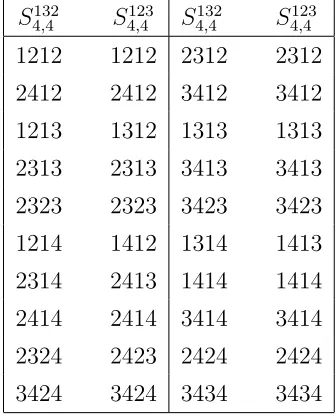
[image:12.612.220.388.280.488.2]4,4 S4123,4 S4132,4 S4123,4 1212 1212 2312 2312 2412 2412 3412 3412 1213 1312 1313 1313 2313 2313 3413 3413 2323 2323 3423 3423 1214 1412 1314 1413 2314 2413 1414 1414 2414 2414 3414 3414 2324 2423 2424 2424 3424 3424 3434 3434
Table 2: The bijection φ:S132
4,4 →S4123,4. For example, w = 3435121213 ∈ S132
5,10 is reducible, since it can be cut into 3435 and 121213. We calculate that φ(3435) by two steps: first φ(34) = 34 and the sec-ond φ(3435) = 3534. Similarly, φ(121213) = 131212. It follows that φ(3435121213) = 3534131212, i.e. the word 3435121213 in S132
5,10 is mapped to 3534131212 in S5123,10. Also, see Table2 showing images of all words in S132
4,4.
5
Enumeration of 132-avoiding up-down words
In this section, we consider the enumeration of 132-avoiding up-down words. DenoteBk,`
From the bijection, it follows that Bk,2i =Ak,2i =
1 i+ 1
i+k−2 i
i+k−1 i
. (10)
For any legal word of length 2i (i ≥ 1) whose letter in the second last position is j (1≤ j ≤k−1), the minimum letter in this word is alsoj, since it is 132-avoiding. By subtracting j −1 from each letter of this word, we obtain a legal word over [k −j + 1] whose letter in the second last position is 1. Thus, we have that
Bjk,2i =Bk1−j+1,2i. Similarly, we obtain that
Bk,12i =Bk,2i− k−1
X
j=2
Bk,j2i =Bk,2i−Bk−1,2i =
i+ 2k−3 (i+ 1)(k−1)
i+k−3 i−1
i+k−2 i
.
Now, we consider legal words of odd length. For any legal word of length 2i (i ≥ 1) whose letter in the second last position is j (1 ≤ j ≤ k−1), the minimum letter in the word is also j and hence, we can adjoin any letter in [j] at the end to form an up-down word on [k] of length 2i+ 1. In fact, such words are necessarily 132-avoiding. So, we obtain that fori≥1
Bk,2i+1 =
k−1
X
j=1 jBk,j2i
=
k−1
X
j=1
jBk1−j+1,2i
=
k−1
X
j=1
j i+ 2(k−j)−1 (i+ 1)(k−j)
i+k−j−2 i−1
i+k−j−1 i
=
k−1
X
j=1
(k−j)(i+ 2j−1) j(i+ 1)
i+j −2 i−1
i+j −1 i
.
Unfortunately, we were not able to find a closed form formula forBk,2i+1. We conclude this section with listing expressions forBk,2i+1 for k= 3,4,5,6 and i≥1:
B3,2i+1 = 1 2(i
2+ 3i+ 4),
B4,2i+1 = 1 12(i
4+ 8i3 + 29i2+ 46i+ 36),
B5,2i+1 = 1 144(i
6+ 15i5+ 103i4+ 381i3+ 832i2+ 972i+ 576),
B6,2i+1 = 1 2880(i
8
6
Enumeration of 312-avoiding up-down words
In this section, we consider the enumeration of 312-avoiding up-down words. DenoteCk,`
the number of 312-avoiding up-down words of length`over the alphabet [k], andCk,`j the number of those words counted byCk,` that end with j.
Recall the definition of the complement wcof a word w given in Section1. Also, for a wordw=w1w2· · ·wn, its reverse word wr is given by wr =w`w`−1· · ·w1. It is clear that the operations of reverse and complement are both bijections on alternating words.
Letpbe a pattern and letSb
p
k,`denote the set of allp-avoiding down-up words of length
` over an alphabet [k].
We first consider the words of odd length.
Proposition 6.1. For all k ≥ 1 and i ≥ 0, we have that the number of 312-avoiding up-down words of length2i+ 1 on [k] is the same as that of 123-avoiding up-down words on [k] of the same length. Namely,
Ck,2i+1 =Ak,2i+1.
Proof. We shall prove this theorem by establishing a bijection betweenSk,3122i+1 andSk,1232i+1. Applying the complement operation to the former of these sets, and reverse and comple-ment to the latter set, it suffices to show that there exists a bijection betweenSbk,1322i+1 and
b
S123
k,2i+1.
The map ψ(w) : Sbk,1322i+1 →Sbk,1232i+1 is defined as follows. For any w=w1w2· · ·w2i+1 ∈ b
Sk,1322i+1, let w0 bew2· · ·w2i+1. It is clear that w0 ∈Sk,1322i. Thus let
ψ(w) = w1φ(w0), where the mapφ :S132
k,2i →Sk,1232i is described in Section 4.
We need to show that ψ is well-defined. From the construction of φ, we see that φ preserves the first letter, i.e. φ(w0)1 =w10 =w2. Therefore, it follows thatψ(w)∈Sbk,1232i+1.
Hence, the map ψ is well-defined.
It is not difficult to see by construction thatψ is a bijection. Hence, we get a bijection betweenSbk,1322i+1 and Sbk,1232i+1. This completes the proof.
Now let us consider the words of even length. Note that
Ck,2i = k
X
j=2 Ck,j2i.
For any wordw∈S312
k,2i whose last letter isj, the maximum letter of wis also j, since
lettersj0w2i−1j forming the pattern 312. Thus, we have that Ck,j2i =Cj,j2i,
where 2≤j ≤k .
Moreover, for any word in S312
j,2i ending with j, we can remove j to form a word of
length 2i−1, which is also 312-avoiding. On the other hand, for any word Sj,3122i−1, we can adjoin a letterj at the end to form a 312-avoiding word of length 2i. Thus,
Cj,j2i =Cj,2i−1. So, we obtain that
Ck,2i = k
X
j=2
Cj,2i−1
=
k
X
j=2
i−3 + 2j i(i+ 1)
i+j −3 i−1
i+j −2 i−1
= 1
i+ 1
i+k−2 i
i+k−1 i
=Ak,2i,
where the second last equality can be deduced from the Gosper algorithm [12]. We have just obtained the main result in this section.
Theorem 6.2. The sets of 312-avoiding up-down words and123-avoiding up-down words are equinumerous, that is,
Ck,` =Ak,`
for all k≥1 and ` ≥0.
7
Enumeration of other pattern-avoiding up-down words
In this section, we consider the enumeration of other pattern-avoiding up-down words. In order to avoid confusion, let Nk,`(p) denote the number of p-avoiding up-down words of
length` over the alphabet [k].
We first focus on all six length 3 permutation patterns to be avoided on up-down words of odd length.
Theorem 7.1. For all k≥1 and i≥0, we have
Nk,2i+1(123) =Nk,2i+1(312) =Nk,2i+1(213) =Nk,2i+1(321)
and
Proof. Through the reverse operation, the following equations hold: Nk,2i+1(132) =Nk,2i+1(231),
Nk,2i+1(123) =Nk,2i+1(321), and
Nk,2i+1(312) =Nk,2i+1(213).
Combing with Theorem6.2, the proof is complete.
Next, we obtain the following result for the case of the even length.
Theorem 7.2. For all k≥1 and i≥1, there is
Nk,2i(123) =Nk,2i(132) =Nk,2i(312) =Nk,2i(213) =Nk,2i(231).
Proof. Through the complement and reverse operations, it follows that Nk,2i(132) =Nk,2i(213),
and
Nk,2i(231) =Nk,2i(312).
From Section4, we have that
Nk,2i(132) =Nk,2i(123).
Together with Theorem6.2, we complete the proof.
In the rest of this section, we deal with the only remaining case, 321-avoiding up-down words of even length. Our approach is based on deriving the desired enumeration from an alternative enumeration of 123-avoiding up-down words.
All 123-avoiding up-down words of length `over [k], for`≥4, can be divided into the following two cases:
• Legal words containing no k in them. These words are counted by Ak−1,`.
• Legal words that contain at least one k. Such wordsw=w1w2· · ·w` are necessarily
It follows that for`≥4,
Ak,`=Ak−1,`+Nk,`−1(321), and thus
Nk,`−1(321) =Ak,`−Ak−1,`.
Hence, by Theorem3.2, we are ready to obtain an expression for Nk,`(321).
Theorem 7.3. For the number of 321-avoiding up-down words of length ` over [k],
Nk,0(321) = 1, Nk,1(321) =k, Nk,2(321) = k2
, and for ` ≥3,
Nk,`(321) =
i(i+2k−3)(i+2k−2)+2(k−2)(k−1) (i+1)(i+2)(k−2)(k−1)
i+k−2
i
i+k−3
i
, if `= 2i,
i+2k−2 (i+1)(i+2)
i+k−2
i
i+k−1
i
, if `= 2i+ 1.
Since Nk,2i+1(123) = Nk,2i+1(321), we actually give another approach to deal with 321-avoiding up-down words of odd length.
8
Concluding remarks
In this paper we initiated the study of (pattern-avoiding) alternating words. In particular, we have shown that 123-avoiding up-down words of even length are given by the Narayana numbers. Thus, alternating words can be used, for example, for encoding Dyck paths with a specified number of peaks [6]. To our surprise, the enumeration of 123-avoiding up-down words turned out to be easier than that of 132-avoiding up-down words, as opposed to similar studies for permutations, when the structure of 132-avoiding permutations is easier than that of 123-avoiding permutations.
Above, we gave a complete classification of avoidance of permutation patterns of length 3 on alternating words. We state it as an open direction of research to study avoidance of longer patterns and/or patterns of different types (see [8]) on alternating (up-down or down-up) words.
Acknowledgments. The authors are grateful to the anonymous referees for bringing to our attention related papers. The work of the first and the third authors was supported by the 973 Project, the PCSIRT Project of the Ministry of Education and the National Science Foundation of China. The second author is thankful to Bill Chen and Arthur Yang for their hospitality during the author’s visit of the Center for Combinatorics at Nankai University in November 2014.
References
[2] L. Carlitz. Enumeration of up-down sequences, Discrete Math. 4 (1973) 3, 273–286. [3] L. Carlitz and R. Scoville. Up-down sequences, Duke Math. J.39 (1972), 583–598. [4] G. Firro, T. Mansour and M. Wilson. Longest alternating subsequences in
pattern-restricted permutations,Electr. J. Combin. 14 (2007), #R34.
[5] E. Fuller and J.B. Remmel. Quasi-Symmetric functions and up-down compositions,
Discrete Math. 311 (2011) 16, 1754–1767.
[6] A. L.L. Gao, S. Kitaev and P. B. Zhang. Avoiding vincular patterns on alternating words. arXiv:1507.06154.
[7] S. Heubach and T. Mansour. Combinatorics of compositions and words, Chapman & Hall/CRC an imprint of Taylor & Francis LLC, Discrete Mathematics and Its Applications Series, 2009.
[8] S. Kitaev.Patterns in permutations and words. Monographs in Theoretical Computer Science. An EATCS Series. Springer, Heidelberg, 2011.
[9] T. Mansour. Restricted 132-alternating permutations and Chebyshev polynomials,
Annals of Combin. 7:2(2003) 201–227.
[10] T. Mansour. Longest alternating subsequences of k-ary words,Discrete Appl. Math. 156:1(2008) 119–124.
[11] T. Mansour. Longest alternating subsequences in pattern-restricted k-ary words, On-line Journal of Analytic Combinatorics 3 (2008) #5.
[12] M. Petkovˇsek, H. S. Wilf, and D. Zeilberger. A = B. A K Peters, Ltd., Wellesley, MA, 1996.
[13] D. Rawlings. Restricted words by adjacencies, Discrete Math. 220 (2000), 183–200. [14] N. J. A. Sloane. The On-Line Encyclopedia of Integer Sequences.
http://www.oeis.org.
[15] R. P. Stanley. Enumerative combinatorics. Vol. 1, volume 49 of Cambridge Studies in Advanced Mathematics. Cambridge University Press, Cambridge, 1997.
[16] R. P. Stanley. A survey of alternating permutations. In Combinatorics and graphs, volume 531 of Contemp. Math., pages 165–196. Amer. Math. Soc., Providence, RI, 2010.