Rochester Institute of Technology
RIT Scholar Works
Theses Thesis/Dissertation Collections
1-31-2012
Multi-mission radar waveform design via a
distributed SPEA2 genetic algorithm
Brent Josefiak
Follow this and additional works at:http://scholarworks.rit.edu/theses
This Thesis is brought to you for free and open access by the Thesis/Dissertation Collections at RIT Scholar Works. It has been accepted for inclusion in Theses by an authorized administrator of RIT Scholar Works. For more information, please [email protected].
Recommended Citation
I
Multi-Mission Radar Waveform Design via a Distributed SPEA2 Genetic
Algorithm
by
Brent Josefiak
A Graduate Thesis Submitted
in
Partial Fulfillment
of the
Requirements for the Degree of
MASTER OF SCIENCE
in
Electrical Engineering
Approved by:
(Dr. Vincent Amuso, Graduate Advisor)
(Dr. Sohail Dianat, Committee Member)
(Dr. Ferat Sahin, Committee Member)
(Dr. Sohail Dianat, Department Head)
January 31, 2012
DEPARTMENT OF ELECTRICAL AND MICROELECTRONIC ENGINEERING
II
Contents
Acknowledgements ... III
Abstract ... IV
Previous Work ... IV
1. Introduction ... 1
2. C++ Class Implementation and Functionality ... 2
3. Scenario and Algorithm Configuration ... 6
4. Fitness Mapping ... 8
4.1. Genetic Representation ... 9
4.2. Uniform Crossover Operator ... 9
4.3. Binary Mutation Operator ... 10
4.4. Radar Genome Mapping ... 10
5. Radar Scenario Calculation. ... 10
6. MPI Performance Validation ... 14
7. MPI Grid FFT Performance ... 14
8. SAR C++ Validation ... 15
9. MTI C++ Validation ... 18
10. SAR MPI C++ Validation ... 20
11. MTI MPI C++ Validation ... 22
12. SAR MPI Increased Resolution ... 24
13. SAR MPI Increased ROI Size 45m by 60m ... 25
14. SAR MPI Scenario 45m by 120m ... 29
15. SAR 45m by 60m with 4 Apertures ... 32
16. SAR 45m by 1000m ... 35
17. SAR & MTI 45m by 1000m ... 38
18. SAR & MTI 45m by 1000m 4 Apertures... 41
19. Conclusion ... 46
III
Acknowledgements
My loving wife Tara who has kindly dealt with and encouraged me along the path to
completing my Master's work. Without your amazing support I would not have been able to
finish, thank you!
I have to give immense thanks to my family for their over the years. Mom and Dad thank
you for all you've sacrificed to provide me with the best possible opportunities, I appreciate them
every day and must credit it with so much of my success.
So many of my coworkers at Harris RF who have answered questions and help reinforce
the value of the education I was pursuing. The supervisors, especially Glen and Jeff who helped
work with me when classes fell at inopportune times and helped me balance success at work with
completing my education.
Dr. Amuso, for the tremendous opportunity to continue work on the this project and
guiding me forward. Your insights and tutelage made this whole endeavor possible and very
IV
Abstract
This thesis furthers the development of Genetic Algorithms (GAs) and their application to the
design of multi-mission radar waveforms. An application was developed with the goal of
developing a waveform suite that finds the Pareto optimal solutions to a multi-objective
optimization radar problem. Utilizing the Strength Pareto Evolutionary Algorithm 2 (SPEA2) a
series of radar parameters are optimized along the fitness metrics of interest. This implementation
builds upon the previous work to develop an application that is capable of analyzing longer more
realistic scenarios by using a distributed grid computer to spread the computational load across
multiple CPUs. It also advances the previous research by solving for the Pareto optimal front of a
simultaneous Synthetic Aperture Radar (SAR) and Moving Target Indication (MTI) mission.
These results are presented to validate the performance of the new distributed application against
previous work and introduce results of larger more realistic scenarios for a multi-mission radar
suite.
Previous Work
This initial work of this thesis was presented at the 2012 International Waveform Diversity &
Design Conference. “A Distributed Object-Oriented Multi-Mission Radar Waveform Design
Implementation” written by Dr. Vincent Amuso and Brent Josefiak and was presented by Dr.
1
1. Introduction
Waveform diversity seeks to optimize the performance of a radar system by tailoring the
operating parameters to suit a particular mission and spectral allocation. Many radar systems
have been shown capable of performing multiple missions, such as SAR and MTI, but they
cannot do them simultaneously [2]. Designing a waveform capable of adequately performing
multiple missions simultaneously would offer significant advantages in cost and risk. However,
this design problem is non-trivial as it requires a solution that balances complementary and
competing design parameters.
There are various techniques available to solve the multiple objective problem proposed by a
multi-mission radar waveform, but evolutionary computing has proven an effective tool [2].
Genetic algorithms, with their ability to correlate waveform mission parameters to generic fitness
metrics, offer a way to effectively search a radar waveform’s multi-dimensional solution space.
Previous work in this area created a waveform design suite capable of proving that the Strength
Pareto Evolutionary Algorithm 2 (SPEA2) could effectively optimize both SAR and MTI
missions [1]. The suite encoded radar parameters, such as center frequency, azimuth angle and
number of pulses per coherent pulse interval, as genetic information, would be used to run
through a scenario and measure its fitness. Mission performance was measured across different
objective functions for the SAR and MTI scenarios, but these were then mapped to the generic
fitness values used by SPEA2.
The initial work done in this area proved its feasibility, but the implementation was limited in
scalability and could not complete larger scenarios. Bringing more computational capacity to
bear on this problem would allow for multi-second scenarios that would be directly applicable to
real-world applications. To this end, the SPEA2 multi-mission radar suite was rewritten as a C++
application that could be run on a Linux based multi-core grid computer. The significant number
of two dimensional Inverse Fast Fourier Transforms required to measure the performance of a
SAR waveform can gain significant speed boosts when run in the parallel grid environment.
This paper proposes the continued application of SPEA2 to the multi-mission radar problem,
but by utilizing a more computationally efficient and extensible framework. This new
implementation will be examined in detail to explain how some of the design trade-offs were
2 the new C++ radar suite will be validated by reconstructing the SAR and MTI scenarios described
in “SPEA2 applied to simultaneous multi-mission waveform design” [1]. Optimizations to the algorithm’s implementation will allow for scenarios that simulate a larger SAR mission with
higher resolution PSL and ISL.
The performance gained by utilizing the Message Passing Interface (MPI) to parallelize the
processing of population members will also be examined. This was the primary speed-up that
allowed for a combined large scale MTI and SAR mission to be examined.
2. C++ Class Implementation and Functionality
+Evaluate() +CalculateObjectiveVectors() +BinaryMutate() -mChromosomes -mObjectiveVectors Genome +TransmitGeneData() +ReceiveGeneData() +TransmitFitnessData() +ReceiveFitnessData() +SlaveIo()
-mRank : int MPIGenome +Evaluate() +CalculateObjectiveVectors() -MapGenesToVariables() -IlluminateRoI() -CalculateAverageRevistTime() -CalculatePulseIntegrationFitness() -CalculatePulseTiming() -CalculatePeakPosition() -NormalizeComplex() -CalculatePeakPower() -mPulseTiming -mNumCpi -mVideoPhaseHistory RadarGenome +SetConfiguration() +SetFactory() #InitializePopulation() #ExecuteAlgorithm() #SaveGeneration() -GaConfiguration -GenomeFactory BaseGa #ExecuteAlgorithm() #CalculateObjectiveVectors() #SortMembersByRawFitness() #CalculateDominated() #CalculatePopulationStrength() #CalculatePopulationRawFitness() #CalculatePopulationFinalFitness() #CalculateEnvironmentalPerformance() #CalculateKFactor() #PopulateMatingPool() #PerformMating() #PerformMutation() #EvaluateEndCondition() -mArchive -mPopulation -mLoopCnt SPEA2_ST +SetNumSlaves() #ExecuteAlgorithm() #CalculateObjectiveVectors() -mNumSlaves SPEA2_MPI «datatype» VectorGenomePointers 1 * «uses» +AllocateGenomeCopy() GenomeFactory +AllocateGenomeCopy() RadarGenomeFactory «uses» +SortMembersByObjective() +CalculateDensity() +UniformCrossover() +SortDistances() +SetRank() «interface» GenomeHelpers «uses» +GetFitnessFromMap() +LoadScenario() +SaveScenario() +InitializeRadarFitnessMaps() «interface» Scenario «uses» +GetParameter() +IsParameterDynamic() +GenerateRandomParameter() +GetCRLimits() +GetDRLimits() «interface» RadarParameters «uses»
Figure 1 C++ Radar Waveform Design Suite Class Diagram
Figure 1is a UML diagram laying out the relationship between the Genetic Algorithm, its
population members (Genomes) and the helper functionality supporting them. At the lowest
level, there are the Genome and BaseGa classes[14]. The specific algorithm implementations,
3 upon. The Genome class contains the genetic information required for a given problem, but not
the ability to interpret the encoded information; that task is left to a derived class.
New population members are constructed through a GenomeFactory class, which isolates
the algorithm from the problem specific genome implementation.[14] This factory is provided to
the algorithm as part of the initialization. Radar data and functions are contained in the
RadarGenome class that is derived from the base Genome. The radar members contain the ability
to translate their generic genetic information into radar specific parameters (azimuth angle,
center frequency, etc).
The GenomeHelper interface provides a layer of abstraction that manipulates the inner
workings of multiple genomes. This prevents the genetic algorithm from needing to understand
the inner workings of its genomes when it desires operations involving two or more genomes. An
excellent example of this is uniform crossover, where the algorithm provides the helper with two
genomes and, based on the scenario's crossover probability (provided as part of the scenario
initialization), the helper function handles the swap of genetic information. The other helper
functions in this class fall into this category of acting upon two or more genomes.
SPEA2_ST is the single threaded SPEA2 implementation derived from the BaseGa,
which implements and validates the original waveform design suite algorithm in C++. The
SPEA2 implementation acts upon two genome sets, the new member population and archive
pools. It contains the functionality required to calculate the raw fitness, strength and final
ranking of the populations.
SPEA2_MPI is the MPI compatible implementation of SPEA2, which re-implements the
algorithm to distribute genetic information from the master algorithm to a set of slave genomes.
These slaves are distributed across multiple cores so that the computationally intensive 2D IFFTs
required to calculate PSL and ISL can be run in parallel. When the current set of slave genomes
have yielded their fitness data, 0.0 to 1.0 values representing the success of that particular
member, it is transmitted back to the master. The master process then continues to calculate the
4
This functionality was overridden by the MPI implementation. It is here that data
is distributed to Slave processes.
Archive size correct
Fill in VPH
End condition
met Exit
Mating pair remaining Populate mating
pool
Uniform Crossover
Binary Mutate
Add to population
Truncate Add Dominated
Populate Archive Calculate Enviromental Performance CalculateObjective
Vectors (Archive ) CalculateObjective
Vectors (Population )
Yes No
Yes Exact
Small Large
No
Figure 2 SPEA2 ExecuteAlgorithm
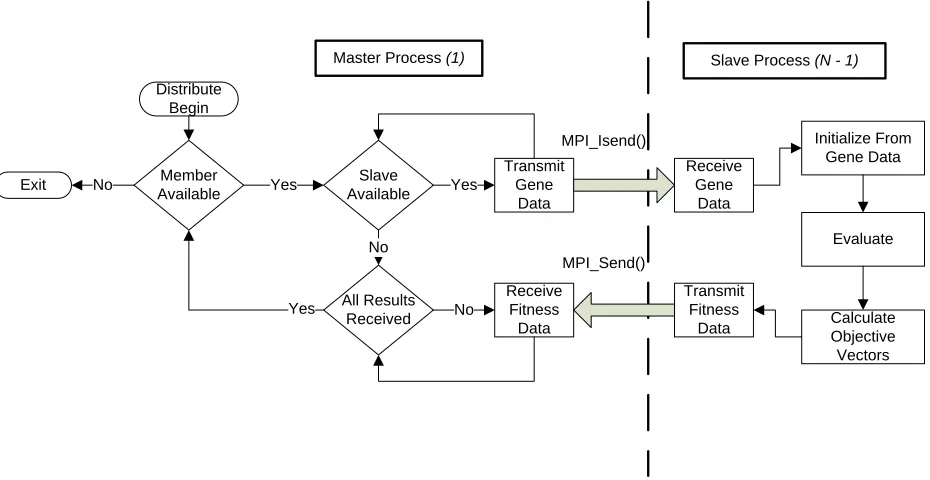
Figure 2 and 3 highlight the changes to the Execute Algorithm and Calculate Objective
Vectors functions that were overridden from the original single threaded implementation.
5 pools off to the genome slaves. The total number of slaves is configurable at run-time and can
utilize as many cores as are available on a given grid implementation.
Member Available
Slave Available
All Results Received
Transmit Gene
Data
Receive Fitness
Data Yes
No
No Yes
Yes Exit No
Distribute Begin
Receive Gene
Data
Transmit Fitness
Data
Initialize From Gene Data
Calculate Objective Vectors Evaluate MPI_Isend()
MPI_Send()
[image:10.612.76.541.117.357.2]Master Process (1) Slave Process (N - 1)
Figure 3 MPI Calculate Objective Vectors - Parallel Computation Distribution and Result Recovery
For a population of size Np and archive of size Na, an optimal number of processors
would be Np + Na + 1 = Copt. This allocates a core for every population member and one for
the master algorithm. The current software suite will not yield any benefit when there are more
cores available than combined population and archive members. See sections 6 and 7 for a
detailed analysis of the MPI performance improvement.
It should be noted that two different MPI transmission mechanisms are used when
transmitting gene data verses the returning slave generated fitness data. When the master is
distributing information to the various tasks it utilizes MPI_Isend, which is the non-blocking
send. As each slave process is known to be waiting at this point, the master can send the
information to each immediately without waiting for an acknowledgement back. This readiness
can be assured because synchronization occurs when the slave process calls MPI_Send (the
blocking call) to return the fitness data. As soon as the slave has returned its fitness data, it is
6
3. Scenario and Algorithm Configuration
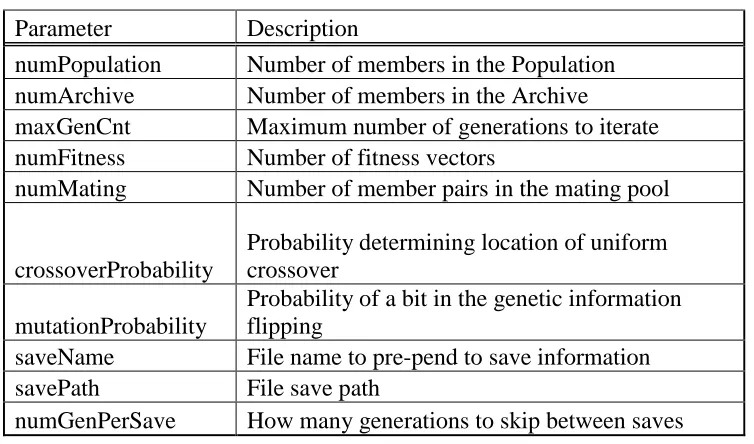
A run of the test suite requires two files for configuration parameters, one that sets the
general genetic algorithm parameters and one to configure the scenario specific radar parameters.
These parameters are stored in human readable text files that are provided as arguments when the
[image:11.612.119.496.244.466.2]program is launched. General configuration information required by the BaseGa is listed in
Table 1, along with the description of each parameter.
Table 1 Base GA Configuration Format
Parameter Description
numPopulation Number of members in the Population
numArchive Number of members in the Archive
maxGenCnt Maximum number of generations to iterate
numFitness Number of fitness vectors
numMating Number of member pairs in the mating pool
crossoverProbability
Probability determining location of uniform crossover
mutationProbability
Probability of a bit in the genetic information flipping
saveName File name to pre-pend to save information
savePath File save path
numGenPerSave How many generations to skip between saves
Radar scenario parameterization is defined in a second file and loaded into a dynamic parameter
map during runtime initialization. This map allows each RadarGenome access to the scenario
configuration by indexing based on the requested parameter. If a parameter is dynamic for a
given scenario, it will contain all the potential values index-able by the genetic information of a
population member.
The first parameter in the scenario file is the random number seed. Saving the seed allows
a scenario to be reproduced again in the future. Given the same random seed value, arun of the
algorithm will produce identical results, asall of the randomness in the algorithm is based on the
pseudorandom “randn” functionality. Changing this value is necessary to examine how different
populations would respond to the same scenario.
7 determines the length in seconds the scenario will model. Taken with Pulse Repetition
Frequency (PRF) and pulses per interval, this value determines the number of Coherent Pulse
Intervals (CPI) a waveform will transmit.
The next line in the configuration file currently contains 4 bits, which toggle the various
fitness metrics on and off. In order, these bits enable (1) or disable (0) the use of the Peak Side
Lobe (PSL), Integrated Side Lobe (ISL), Average Revisit Time and Integrated Pulses fitness
functions. Any combination of these can be can be used, but the total number of enabled fitness
functions must match the number provided to the base genetic algorithm. Failure to match these
parameters will cause the GA to use the first n fitness vectors, where n is the number specified
within the GA’s configuration file.
The lines after this are the 22 configuration parameters that describe a radar scenario.
Each line is a comma delimited string and contains a digit stating which parameter it is (0 -21),
next a digit stating whether it’s an integer (0) or double (1) parameter, then the number of values
that parameter can assume, and finally the values themselves. Each parameter can assume
between 1 and 232 possible values in steps of powers of 2. If only one value is provided, the
parameter is considered static and not included in the genetic information of population
members.
Parameters for the CPI (enumeration 0), Number of Apertures (enumeration 1), PRF
(enumeration 6) and the total simulation time are used to determine the length of the genetic
information of a given member. When any of these parameters are dynamic, and thus contained
in the genetic information, the number of alleles used by population members will vary. When a
population member is initially generated, all the dynamic parameters of a given CPI are
randomized and it is pushed onto a vector. After each CPI is generated, the time elapsed is
checked, the number of pulses divided by the selected PRF, to ensure it does not exceed the total
simulation time. If the number of apertures is dynamic, the other dynamic parameters are
repeated A times for a given CPI, where A is the number of active independently steerable
apertures. Despite the repetition of all dynamic parameters, each CPI in a multiple aperture
scenario can only select one PRF and number of CPIs (if these parameters are dynamic). This
limits the multiple apertures to mainly altering the steering parameters.
The remainder of the parameters laid out in the scenario configuration file focus on
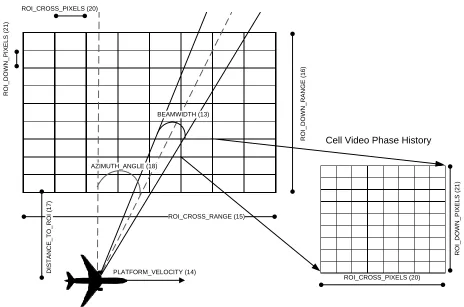
8 platform is the plane carrying the radar waveform, and its movement is defined as a line along
the ROI cross range at a speed specified by parameter 14 in meters per second. The
perpendicular distance from the ROI is defined in meters by parameter 17.
ROI_CROSS_RANGE (15) R O I_ D O W N _ R A N G E ( 1 6 )
Region of Interest
D IS T A N C E _ T O _ R O I (1 7 ) ROI_CROSS_PIXELS (20) R O I_ D O W N _ P IX E L S ( 2 1 ) PLATFORM_VELOCITY (14) ROI_CROSS_PIXELS (20) R O I_ D O W N _ P IX E L S ( 2 1 )
Cell Video Phase History
AZIMUTH_ANGLE (18)
[image:13.612.74.538.163.470.2]BEAMWIDTH (13)
Figure 4 Scenario Parameter Representation
The other scenario parameters highlighted in Figure 4 are the ROI region parameters,
which define the total cross and down range (15/16) in meters, as well as the size of a pixel
within that region (20/21). Each one of these cells is made up of a VPH array of size defined by
parameters 20 and 21, typically 128 x 128. The final parameter required for the computation of
PSL and ISL are the IFFT cross and down-range dimensions, which define the resolution and
complexity of the 2D - IFFT calculation.
4. Fitness Mapping
Other than the two configuration files defining algorithm and scenario parameters, there
9 mapping between a scenario specific parameter and the 0.0-1.0 fitness metric used by the SPEA2
algorithm. Currently there are two formats for these files, which is stated in the first line of the
file; 0 for an integer based mapping and 1 for a floating point implementation. After the type is
determined, the next line tells how many data points the file contains and the maximum value
possible for the objective value. Each of the subsequent lines then listsan objective value (in
either integer or double format) and its corresponding fitness value. When the radar member
maps an objective to fitness value, if it does not match one of the points provided in the map, it
takes the linear interpolation between the two closest objective values to determine the correct
fitness value.
4.1.Genetic Representation
Each base genome contains all the genetic information required for a given scenario and,
once the member has been evaluated, its performance data. Base genetic information is stored in
an array of 32-bit values. Each 32-bit allele will be used by the problem specific
(RadarGenome) class to map to a scenario relevant value. These alleles are capable of mapping
up to 232 different parameters, should the functionality be desired, but most parameters are kept
to around 5-bits or 32 values. The one restriction on parameter mapping in the current
implementation is that the scenario must use 2N mappings exactly (where N is 0-32); non power
of 2 mappings results in an invalid configuration. This constraint was placed to prevent
mutation from generating an allele without a valid parameter mapping.
4.2.Uniform Crossover Operator
Uniform crossover is applied to each mating pair selected for the new population pool.
The crossover point is selected based on the smaller parent genome and the crossover
probability, which is typically 0.5, so that any location is equally likely to be the crossover
location[2]. A check for the smaller parent is required for situations when pulse per CPI or PRF
are dynamic and can alter the total number of genes present in a given population member.
Valid crossover points must be on allele boundaries, but are not constrained by where a CPI or
10 4.3.Binary Mutation Operator
The binary mutation operator works based on a probability of flipping provided by the
configuration file and the number of bits per allele defined in the scenario configuration. After
the members of the mating pool have undergone uniform crossover, each is subjected to
mutation. This mutation operator iterates over each bit in the population member's genetic
information; then a random number is generated and checked against the range defined by the
GA's mutation probability. If the value is in the specified percentage of the random range, then
the bit is flipped by XORing the current allele with a 1 shifted to location of the current target
bit.
4.4.Radar Genome Mapping
The Radar Genome takes each allele to be an index into the scenario’s dynamic
parameter map. The total number of alleles in a given member must be a multiple of the number
of dynamic parameters in a given radar scenario.
The radar member class uses the static scenario parameters as well as the dynamic values
mapped to its genetic information to construct a coherent pulse interval timing sequence. This
sequence defines at what position the target platform initiates a given CPI, where it is aimed, and
how many pulses are triggered at a given PRF, which defines at what platform location and times
a waveform burst will be triggered.
5. Radar Scenario Calculation.
Once this burst information is constructed, the platform location and antenna steering
parameters are used to determine which cells of the region of interest (ROI) are illuminated in a
given coherent pulse interval (CPI). This information is stored in a 2 dimensional Pixel
Illumination Vector where each ROI cell has a vector that is pushed back with new pulse timing
each time it is illuminated. After it is known which bursts illuminate a given ROI cell, the Video
Phase History (VPH) can be filled in, and the MTI revisit time parameter can be calculated [1].
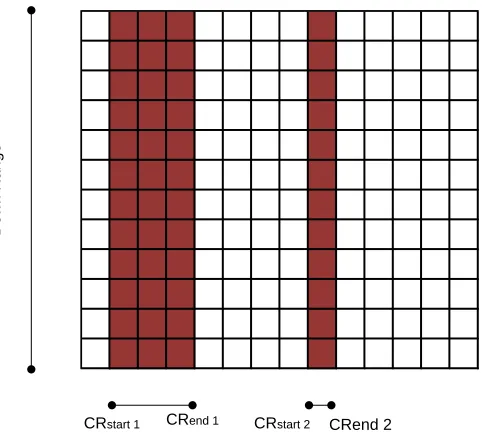
To illuminate the VPH, two factors come into play. The cross range VPH cells are
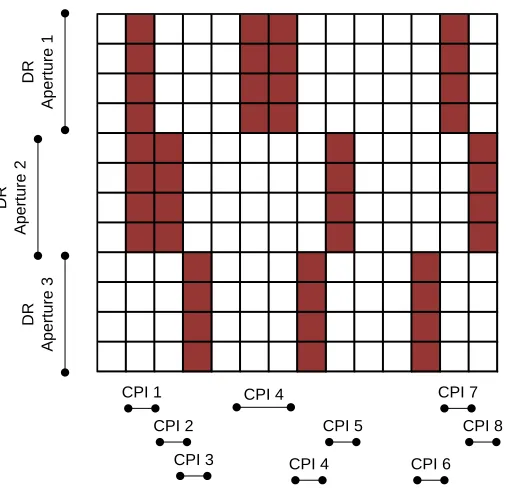
11 on the bandwidth and number of apertures. As highlighted in Figure 4, the VPH dimensions are
defined by the down and cross pixel count. When a single aperture is used, the down range, or
column as seen in Figure 5, is fully illuminated. Multiple apertures cause the down range
dimension (rows) to be divided up so that the bandwidth is allocated evenly amongst
sub-apertures as seen in Figure 6. The cross range illumination is determined by the following
equations:
Where is the total simulation time and is the time a given CPI begins to illuminate the
ROI. The and variables are used to index into the VPH and determine which
cross range (columns) are illuminated by the current CPI, as can be seen in Figure (x, y).
D
o
w
n
R
a
n
g
e
[image:16.612.191.432.434.651.2]CRstart 1 CRend 1 CRstart 2 CRend 2
12
D
R
A
p
e
rt
u
re
1
CPI 1 CPI 4
D
R
A
p
e
rt
u
re
2
D
R
A
p
e
rt
u
re
3
CPI 2
CPI 3 CPI 4 CPI 5
[image:17.612.177.430.121.366.2]CPI 6 CPI 8 CPI 7
Figure 6. Multiple Sub-Aperture Illumination.
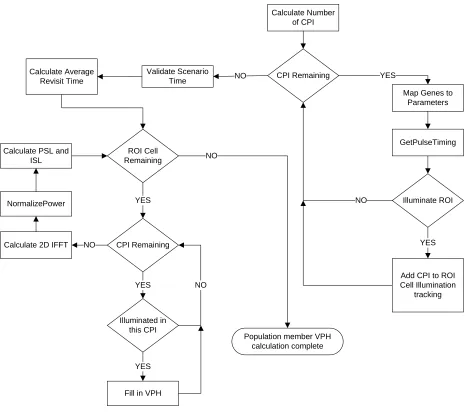
One may notice that we are iterating across all the CPI's twice in the algorithm shown in
Figure 7, unfortunately memory limitations on the size of the VPH limited the number that could
be allocated. The smaller scenario, where a 256x256 2D-IFFT is computed, necessitated
256(DR) * 256(CR) * 8(Bytes per double) * 2 (complex) = 1 MB of contiguous memory per
VPH buffer, two of which are required per ROI cell (one for input and one for output).
Although several could be allocated, not enough were available to provide one for every ROI
cell, so we are forced to iterate over the CPI two times.
Once all the CPIs that illuminate a given ROI cell have illuminated it, the 2-dimensional
IFFT can be run across the VPH. The 2-dimensional Inverse FFT is calculated using the FFTW
library developed by Matteo Frigo and Steven Johnson of MIT. This library is upheld by
benchmarks as the fastest available FFT implementation and is licensed for use in Matlab. The
IFFT dimension is typically twice that of the VPH pixel count so that there is sufficient
resolution to calculate PSL and ISL. Were further computing power available, increasing this
13 The complex information generated by this operation is normalized to a power mapping,
which is then used to find the PSL and ISL performance. In order to calculate PSL and ISL, the
main power lobe is located and the total power contained within it is summed. The remainder of
the power mapping is then summed in order to calculate the ISL. While iterating across the
remaining pixels, the maximum value found is saved and used to calculate the PSL.
Map Genes to Parameters CPI Remaining
Calculate Number of CPI
YES
GetPulseTiming
Illuminate ROI
Add CPI to ROI Cell Illumination
tracking YES NO
Calculate Average
Revisit Time NO
ROI Cell Remaining
CPI Remaining YES
Calculate 2D IFFT NormalizePower
NO Calculate PSL and
ISL
Illuminated in this CPI
YES
Fill in VPH YES
NO NO
Population member VPH calculation complete Validate Scenario
[image:18.612.73.539.214.629.2]Time
Figure 7. Radar Genome Evaluation
Once the radar calculations have been completed the performance data is gathered.
These values are then used to index a fitness map, which normalizes performance into a fitness
14 performance of population members. In the case of the MPI implementation it is this normalized
fitness value that is returned to the master. Further detail on how SPEA2 uses this fitness
information to select the fittest members for addition to the archive can be found in [3].
6. MPI Performance Validation
Just as the initial C++ implementation was validated against the original Matlab
implementation, so too was the grid implementation validated against previous results. The
resulting genetic algorithm performance, once differences in CPU performance were normalized,
were in line with the expected parallelization gains. The MPI grid used for the simulations
presented later in this paper had only had 30 cores available, while most test runs contained a
population size of 100 and archive size of 20. This is well below the Copt found previously, so it
becomes important to understand the distribution scheme and its affect on parallelization.
When testing began on the grid one immediate revelation was that running a single
threaded implementation was slower than an identical run to generate the single threaded results
of previous C++ simulations. This was caused by a CPU difference and the difference was
baselined by running a series of 256 by 256 2D-IFFT. A single grid core was capable of
executing this in 10ms, which is 3x slower than the previous implementation. Despite this
silicon setback the "embarrassingly parallel" nature of the genetic algorithm scenario allowed the
other 27 cores to prove the value in a distributed algorithm.
As noted previously, information is distributed to the slaves in batches based on how
many slaves have been constructed. This batch scheduling approach means that a speed-up only
occurs as slaves increase by least common multiples of the total population size.
Thus the total speed up versus the single threaded implementation is given by:
7. MPI Grid FFT Performance
In order to understand the time required to compute the 2D-IFFTs of a generation, a
15 to compute its IFFT averaged over a hundred runs. The results from these runs can be seen in
the following Table 2.
Table 2. IFFT Time
VPH CR
IFFT2 CR
Time Per Transform (sec)
Time Per Member - 45m x 1000m (sec)
Time Per Member - 45m x 1000m (min)
128 256 0.0198682 66.161106 1.1026851
256 512 0.04555384 151.6942872 2.52823812
512 1024 0.11810853 393.3014049 6.555023415
1024 2048 0.26291108 875.4938964 14.59156494
2048 4096 0.56116136 1868.667329 31.14445548
These test runs were all computed with a VPH down range dimension of 128 and IFFT
down range 256. The cross range dimension was repeatedly doubled from an initial IFFT of 256
up to 4096. One can see that the 128 x 256 transform required 0.0198 seconds to complete,
while the 2048 x 4096 required 0.5611 seconds per calculation.
The large 45m by 1000m ROI scenario requires each member to calculate 3330
2D-IFFTs, yielding the time required per member found in columns 4 and 5. Using the equation
generated in the previous section, one can determine that running a population size of 120 (20
archive plus 100 mating population), at the 256 by 512 size would require 51 minutes per
generation in pure FFT calculations.
When running the later SAR scenarios, this theoretical number was proven to be correct
with each generation requiring 55-56 minutes to complete. A full real-life SAR mission would
require the 45m by 1000m scenario to run with a VPH cross range of at least 2048 to provide a
column to each CPI pulse. Calculating this scenario with the current grid would require 622.88
minutes per member, or over 10 hours per generation.
8. SAR C++ Validation
The C++ SPEA2 waveform suite was first validated against the original SAR mission. In
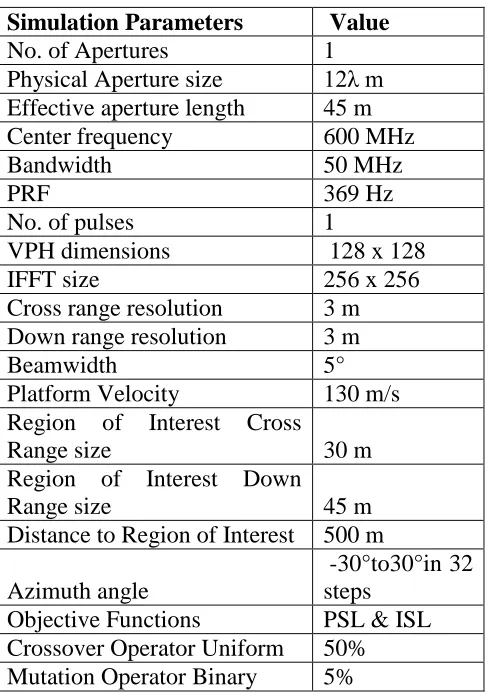
this scenario, a platform illuminates a 45m by 30m region of interest in a 0.346 second run. The
original fitness mappings for PSL and ISL to the 0.0 to 1.0 fitness value were reused by the C++
implementation. Table 2 lists all the relevant parameters including the dynamic azimuth angle,
which is encoded in the genetic material of each population member. Running this scenario has
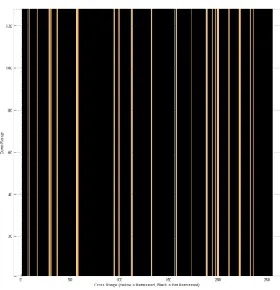
16 Figure 8 is the Illuminated VPH for the center cell of an archive member of the randomly
generated initial population. Note its relatively sparse illumination – only a small number of the
waveform’s CPIs were landing within the ROI. Contrast this with Figure 9 and one can see how
the 350 generations have found genetic material, which better illuminates the ROI cell. This
yields a significant improvement in PSL and ISL.
The improvement in fitness performance is illustrated in Figure 10. Over the course of
350 generations, the PSL and ISL have both improved by 6-7dB, which results in a fitness
improvement of 0.3-0.4. The fitness improvement of SPEA2 in this mission is not linear as most
of the growth occurs within the first 50 generations, while the remaining 300 offer a fraction of
growth. Understanding when fitness improvement tapers off allows for testing scenarios to an
optimal generation count and once this has been reached a new scenario can be tested more
[image:21.612.186.430.353.701.2]quickly.
Table 3. SAR Parameters
Simulation Parameters Value
No. of Apertures 1
Physical Aperture size 12λ m
Effective aperture length 45 m
Center frequency 600 MHz
Bandwidth 50 MHz
PRF 369 Hz
No. of pulses 1
VPH dimensions 128 x 128
IFFT size 256 x 256
Cross range resolution 3 m
Down range resolution 3 m
Beamwidth 5°
Platform Velocity 130 m/s
Region of Interest Cross
Range size 30 m
Region of Interest Down
Range size 45 m
Distance to Region of Interest 500 m
Azimuth angle
-30°to30°in 32 steps
Objective Functions PSL & ISL
Crossover Operator Uniform 50%
17 Figure 8. Initial VPH for the center cell of the ROI. Figure 9. Final VPH for the center cell of the ROI.
Figure 10. Initial and Final Archive Population Fitness
Figure 11. SAR Maximum Member Fitness Improvement
20 40 60 80 100 120
20 40 60 80 100 120 Cross Range
(Yellow = Illuminated, Black = Not Illuminated)
D ow n R a nge
20 40 60 80 100 120
20 40 60 80 100 120 Cross Range
(Yellow = Illuminated, Black = Not Illuminated)
D ow n R a nge
0 0.2 0.4 0.6 0.8 1
0 0.2 0.4 0.6 0.8 1
Integrated Side Lobe Fitness
P e a k S ide L obe F it ne ss Initial Population Final Archive
0 50 100 150 200 250 300 350
18 Figure 11 illustrates the rate of change for the ISL and PSL fitness, where ISL continues to
improve throughout the generations, while PSL plateaus after 50 generations and sees only
marginal (1.5%) improvement.
The performance generated in the simple SAR scenario reproduces the previous [2] work
and shows the viability of the new C++ model for improving PSL and ISL.
9. MTI C++ Validation
The purpose of reconstructing the MTI mission in [1] is to baseline the functionality of the
new implementation against known results. The scenario parameters in Table 3 are used to run a
MTI mission where revisit time and number of pulses are used as the fitness functions in a 3
second run-time scenario.
Table 4. MTI Scenario Parameters
Simulation Parameters Value
No. of Apertures 1
Physical Aperture size 12λ m
Effective aperture length 45 m
Center frequency 600 MHz
Bandwidth 50 MHz
PRF 369 Hz
No. of pulses 1, 8, 16, 32
VPH dimensions 128 x 128
IFFT size 256 x 256
Cross range resolution 3 m
Down range resolution 3 m
Beamwidth 5°
Platform Velocity 130 m/s
Region of Interest Cross
Range size 1000 m
Region of Interest Down
Range size 45 m
Distance to Region of
Interest 500 m
Azimuth angle
-60° to 60° in 32 steps
Objective Functions
Revisit & Pulse
Timing
Crossover Operator
Uniform 50%
19 The C++ implementation was able to quickly complete the MTI mission and rapidly
improved the performance of the archive population members. Comparing against [1] does
highlight a discrepancy in the fitness values achieved by the final archive population. Initial
random populations for both the original Matlab and new implementation have an average fitness
of ~0.5 for both Pulse and Revisit time. After one hundred generations, the Pareto optimal front
achieved by the original implementation is at around 0.6 to 0.8. While the new waveform design
suite has measured its final archive members to have 0.98 Revisit fitness and 0.9 Pulse fitness.
This performance is shown in Figure 12.
This growth is also achieved rapidly; in Figure 6 one can see that the revisit fitness has
approached its maximum within 10 generations. When implementing the PSL and ISL
calculations for the SAR mission, the original Matlab implementation was directly ported to C++.
Pulse fitness however was calculated with a new algorithm and this may explain some of the
fitness discrepancy. Originally the pulse fitness was found by calculating the average number of
pulses in each ROI cell, then averaging over the total number of ROI cells. The C++ algorithm
assigns a fitness value (between 0.0 and 1.0) to each pulses count per CPI type, and then
determines how many of each pulse count type occur in a given member. Averaged over the total
number of CPI, the summation of the fitness value by the pulse count is used to determine each
member’s Pulse fitness.
The results of the MTI mission are evolved successfully by the new suite and achieve an even
20 Figure 12. MTI Initial versus Final Archive Fitness (100 Generations)
Figure . MTI Maximum Member Fitness Improvement.
10.SAR MPI C++ Validation
Once the MPI extension was completed, the initial small scale SAR scenario was
re-executed to validate the distributed algorithm. The parameters were kept identical to the initial
SAR scenario, but re-run on the grid system to ensure that similar fitness improvement was
observed. The resulting fitness improvement and rate of fitness improvement can be observed in
the following figures.
0 0.2 0.4 0.6 0.8 1
0 0.2 0.4 0.6 0.8 1
P
ul
se
F
it
ne
ss
Revisit Time Fitness Initial Population
Evolved Archive Population
0 20 40 60 80 100
0 0.2 0.4 0.6 0.8 1
F
it
ne
ss
P
e
rf
or
m
a
nc
e
Generation
21 Figure 13. SAR Fitness Improvement per Generation
Figure 14. SAR Maximum Member Fitness Improvement
Figure 15. Initial VPH for the center cell of the ROI. Figure 16. Final VPH for the center cell of the ROI.
0 50 100 150 200 250 300 350 400 450 500 0 0.2 0.4 0.6 0.8 1 F it n e s s P e rf o rm a n c e Generation PSL Fitness ISL Fitness
0 0.1 0.2 0.3 0.4 0.5 0.6 0.7 0.8 0.9 1 0 0.1 0.2 0.3 0.4 0.5 0.6 0.7 0.8 0.9 1 In te g ra te d S id e L o b e
Peak Side Lobe Initial Population
Evolved Archive Population
20 40 60 80 100 120
20 40 60 80 100 120 D o w n R a n g e
Cross Range (Yellow = Illuminated, Black = Not Illuminated)
20 40 60 80 100 120
20 40 60 80 100 120
Cross Range (Yellow = Illuminated, Black = Not Illuminated)
[image:26.612.129.286.532.686.2]22 Figure 17. Initial 2D IFFT Normalized Magnitude Figure 18. Final 2D IFFT Normalized Magnitude
Performance of the MPI implementation was nearly identical to the gains observed in the
single threaded implementation. Figure 8 is the Illuminated VPH for the center cell of an archive
member of the randomly generated initial population, while Figure 9 shows the VPH of an
archive member from generation 500. There has been a significant improvement (but comparable
to the single threaded implementation) in the illumination of the center cell. This yields a
significant improvement in PSL and ISL, as can be observed in Figures 10 and 11. The plots
show the 2D IFFT magnitudes of generation 0 and generation 500 and one can observe a
significantly higher resolution point source in Figure 11.
The improvements in PSL and ISL evident in Figures 17 and 18 correspond to the fitness
improvement observed in Figure 7. The PSL and ISL have both improved by 6-7dB, which
results in a fitness improvement of .4 for the ISL and .5-.6 for the RSL. This is a comparable
level of growth to the initial single threaded implementation, with a small amount of additional
improvement achieved in the additional 150 generations the MPI variant was able to run. The
growth rate remains front loaded with the greatest improvement in the first 75 generations, but
PSL continued to make modest gains for the remainder of the simulation.
11.MTI MPI C++ Validation
This scenario recreates the large MTI scenario, but distributing it with MPI. A 1000m by
45m region of interest was examined over a 3 second simulation evaluating with the revisit time
23 be run for 500 generations instead of the 100 used in the Matlab and initial C++
implementations.
Figure 19. MPI MTI Inivital versus Final Archive Fitness
Figure 20. MPI MTI Maximum Member Fitness Improvement
Examining the two figures above one can see a similar level of performance
improvement from the initial implementation, when comparing the first 100 generations. The
advantage of running for 500 generations appears to be twofold. First, the Pareto Optimal front
created by the final archive population covers a wider range of potential solutions, with most of
this spread across the Revisit time fitness, but also increased distribution in the Pulse fitness as
well. Second, the final improvement of the Pulse fitness has reached the maximum over the
course of the run. This simulation validated the ability of the MPI solution to run the MTI
scenario accurately and reproduce the previous results.
0 0.1 0.2 0.3 0.4 0.5 0.6 0.7 0.8 0.9 1 0 0.1 0.2 0.3 0.4 0.5 0.6 0.7 0.8 0.9 1 P u ls e F it n e s s
Revisit Time Fitness
Pulse Fitness versus Revisit Time Fitness Performance MTI Mission
Initial Population Evolved Archive Population
0 50 100 150 200 250 300 350 400 450 500 0 0.2 0.4 0.6 0.8 1 F it n e s s P e rf o rm a n c e Generation
Maximum Fitness Performance Improvement versus Generation MTI Mission
24
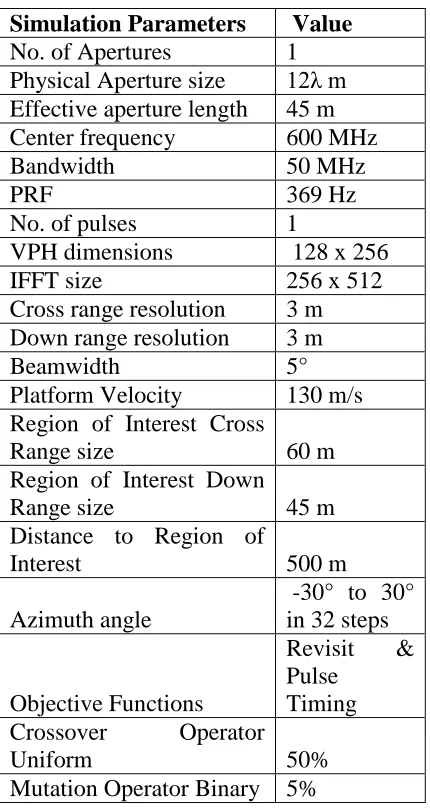
12.SAR MPI Increased Resolution
In this scenario the same parameters are maintained from the original SAR scenario,
except the VPH dimensions and IFFT size are increased. With a VPH dimension of 128 x 256,
and scenario time remaining at 0.346 seconds, each CPI illuminates two cross range columns.
The IFFT size was increased to 256x512 to retain resolution.
Table 5. SAR Increased Resolution Parameters
Simulation Parameters Value
No. of Apertures 1
Physical Aperture size 12λ m
Effective aperture length 45 m
Center frequency 600 MHz
Bandwidth 50 MHz
PRF 369 Hz
No. of pulses 2
VPH dimensions 128 x 256
IFFT size 256 x512
Cross range resolution 3 m
Down range resolution 3 m
Beamwidth 5°
Platform Velocity 130 m/s
Region of Interest Cross
Range size 30 m
Region of Interest Down
Range size 45 m
Distance to Region of
Interest 500 m
Azimuth angle
-30° to 30° in 32 steps
Objective Functions
Revisit & Pulse
Timing
Crossover Operator
Uniform 50%
Mutation Operator Binary 5%
The results of this run can be observed in the following Figures where the final
improvement of generation 500 is comparable to that of the initial SAR run. PSL fitness has
improved from an initial average of 0.47 to 0.90, while ISL has gone from 0.61 to 0.81. The
largest discrepancy between the two runs comes from the initial fitness values, while the final are
25 conclusion that upping the size of the VPH while maintaining the same scenario time yields little
benefit to final performance.
Figure 21. SAR Fitness Improvement per Generation
Figure 22. SAR Maximum Member Fitness Improvement
13.SAR MPI Increased ROI Size 45m by 60m
This scenario keeps the increased VPH resolution of the previous solution, but pairs it
with an increased scenario ROI and flight time. Increasing the length of the scenario time to
0.692 seconds with the 369 Hz PRF caused each CPI to illuminate one complete cross range
column. Doubling the scenario time also allows the target platform to traverse twice the ROI
distance during the scenario, increasing the complexity of each population member's genome to
twice the number of chromosomes.
0 50 100 150 200 250 300 350 400 450 500 0 0.2 0.4 0.6 0.8 1 F it n e s s P e rf o rm a n c e Generation PSL Fitness ISL Fitness
0 0.1 0.2 0.3 0.4 0.5 0.6 0.7 0.8 0.9 1 0 0.1 0.2 0.3 0.4 0.5 0.6 0.7 0.8 0.9 1 In te g ra te d S id e L o b e
Peak Side Lobe Initial Population
26 Table 6. SAR 45m by 60m Parameters
Simulation Parameters Value
No. of Apertures 1
Physical Aperture size 12λ m
Effective aperture length 45 m
Center frequency 600 MHz
Bandwidth 50 MHz
PRF 369 Hz
No. of pulses 1
VPH dimensions 128 x 256
IFFT size 256 x 512
Cross range resolution 3 m
Down range resolution 3 m
Beamwidth 5°
Platform Velocity 130 m/s
Region of Interest Cross
Range size 60 m
Region of Interest Down
Range size 45 m
Distance to Region of
Interest 500 m
Azimuth angle
-30° to 30° in 32 steps
Objective Functions
Revisit & Pulse
Timing
Crossover Operator
Uniform 50%
Mutation Operator Binary 5%
Results from this scenario show that configuring the scenario time and PRF such that one
CPI illuminates a single cross range column (Figure 25, 26) will produce consistent performance
independent of the increase in ROI. Although this required doubling the amount of genetic
information, the run-time of this scenario was close to the higher resolution SAR 45m x 30m run.
This is due to the fact that most of the processing time is spent in the 2D – IFFT and not
determining which VPH bins are illuminated by a particular CPI.
Figures 23 and 24 show the rate of fitness improvement for PSL and ISL and the initial
versus final Archive member performance after 500 generations. PSL continues to be the fitness
metric most improved by the genetic algorithm, as it starts with a lower fitness and ends higher
27 final archive fitness was similar but more tightly grouped. The 500th generation’s archive
performance also yielded a tight bend with a dense but defined pareto-optimal front emerging.
In Figures 27 and 28, one can see the 2 dimensional surface created by the IFFT of the
illuminated VPH. Figure 27, from the center ROI cell of an initial population member, has a
well defined main lobe, but Figure 28 clearly illustrates the effect of the genetic algorithm. It has
improved the performance by roughly 6dB of peak side lobe suppression.
Another way to examine the improvement is to determine whether or not each CPI
successfully illuminates at least one pixel of the ROI as defined by the cross and down range
resolutions. Figure 29 shows the rate of illumination for a member of the initial and final archive
populations. The x-axis is the CPI index and the y-axis is the total number of CPIs whose
illumination fell within the ROI. Ideally this would have a slope of 1 and the total number of
CPIs would equal the number of hits. Generation zero only yielded 33 ROI hits out of its 256
potential intervals for a success rate of 12.9%. After completion of the algorithm, this has
increased to 98 hits or 38.3% hit rate.
This plot allows one to identify, by regions with decreased slope, where the GA could
still use improvements. These low increase regions are common in the initial member, but the
final archive pushes most of these lower performing regions to the beginning and end of the CPI
indices. Given a moving platform that begins and ends at the edge of the ROI, this result is
expected as these points in the flight provide the greatest number of Azimuth angles, which can
miss the ROI. This information could also yield a more targeted mutation operator in the future.
It is also interesting to note that with only 38.3% of the CPIs falling within the region of interest,
the population is able to achieve a fitness of 0.88-0.91 in PSL and 0.82 -0.86 ISL, so perhaps the
28 Figure 23. SAR Fitness Improvement per Generation
Figure 24. SAR Maximum Member Fitness Improvement
Figure 25.Initial VPH for the center cell of the ROI Figure 26. Final VPH for the center cell of the ROI
0 50 100 150 200 250 300 350 400 450 500 0
0.2 0.4 0.6 0.8 1
F
it
n
e
s
s
P
e
rf
o
rm
a
n
c
e
Generation
PSL Fitness ISL Fitness
0 0.1 0.2 0.3 0.4 0.5 0.6 0.7 0.8 0.9 1 0
0.1 0.2 0.3 0.4 0.5 0.6 0.7 0.8 0.9 1
In
te
g
ra
te
d
S
id
e
L
o
b
e
Peak Side Lobe Initial Population
29
Figure 27. Initial 2D IFFT Normalized Magnitude Figure 28. Final 2D IFFT Normalized Magnitude
Figure 29. ROI Illumination per CPI
14.SAR MPI Scenario 45m by 120m
Maintaining a similar computational burden to the previous simulations, a larger ROI of
120m in the cross range dimension was examined. A simulation time of 1.384 and a PRF of 369
achieved a single cross range column illumination by upping the pulses per CPI to two from the
single pulse used in all preceding scenarios.
0 50 100 150 200 250 300
0 10 20 30 40 50 60 70 80 90 100
Coherent Pulse Interval (CPI)
T
o
ta
l
Il
lu
m
in
a
ti
n
g
P
u
ls
e
s
30 Table 7. SAR 45m by 120m Parameters
Simulation Parameters Value
No. of Apertures 1
Physical Aperture size 12λ m
Effective aperture length 45 m
Center frequency 600 MHz
Bandwidth 50 MHz
PRF 369 Hz
No. of pulses 2
VPH dimensions 128 x 256
IFFT size 256 x 512
Cross range resolution 3 m
Down range resolution 3 m
Beamwidth 5°
Platform Velocity 130 m/s
Region of Interest Cross
Range size 120 m
Region of Interest Down
Range size 45 m
Distance to Region of
Interest 500 m
Azimuth angle
-31° to 31° in 32 steps
Objective Functions
Revisit & Pulse
Timing
Crossover Operator
Uniform 50%
Mutation Operator Binary 5%
Figure 30. SAR Fitness Improvement per Generation
0 0.1 0.2 0.3 0.4 0.5 0.6 0.7 0.8 0.9 1 0
0.1 0.2 0.3 0.4 0.5 0.6 0.7 0.8 0.9 1
In
te
g
ra
te
d
S
id
e
L
o
b
e
Peak Side Lobe Initial Population
31 Figure 31. SAR Maximum Member Fitness Improvement
Figures 30 and 31 show that this scenario configuration experienced results consistent
with the previous experiments. PSL initially starting with a lower performance was rapidly
improved to an average fitness of 0.9 and ISL improved to 0.88. Examining the VPH and IFFT's
for the center cell also reinforced that when constrained to the same illumination per CPI, the
results are similar despite changes to the scenario time and ROI length.
Figure 32. Initial VPH for the center cell of the ROI 33. Final VPH for the center cell of the ROI.
0 50 100 150 200 250 20 40 60 80 100 120
D
o
w
n
R
a
n
g
e
Cross Range (Yellow = Illuminated, Black = Not Illuminated) 0 50 100 150 200 250
20 40 60 80 100 120
D
o
w
n
R
a
n
g
e
32
Figure 34. Initial 2D IFFT Normalized Magnitude Figure 35. Final 2D IFFT Normalized Magnitude
15.SAR 45m by 60m with 4 Apertures
This scenario is the first to utilize multiple sub-apertures and apply them to a ROI of 45m
by 60m. With the exception of the sub-apertures, the scenario is identical to section 14, running
for 0.692 seconds with a VPH size of 128 by 256. This run time allows the target platform to
traverse the length of the 60m ROI. Each CPI sub-aperture is allocated 12.5 MHz, or one quarter
of the down range resolution (32 cells), and one column in the cross range dimension. This
allocation of bandwidth yields VPH illumination patterns that are no longer symmetrical about
33 Table 8. SAR 45m by 60m with 4 Aperutres Parameters
Simulation Parameters Value
No. of Apertures 4
Physical Aperture size 12λ m
Effective aperture length 45 m
Center frequency 600 MHz
Bandwidth 50 MHz
PRF 369 Hz
No. of pulses 1
VPH dimensions 128 x 256
IFFT size 256 x 512
Cross range resolution 3 m
Down range resolution 3 m
Beamwidth 5°
Platform Velocity 130 m/s
Region of Interest Cross
Range size 60 m
Region of Interest Down
Range size 45 m
Distance to Region of
Interest 500 m
Azimuth angle
-30° to 30° in 32 steps
Objective Functions
Revisit & Pulse
Timing
Crossover Operator
Uniform 50%
Mutation Operator Binary 5%
Figure 36. SAR Fitness Improvement per Generation
0 0.1 0.2 0.3 0.4 0.5 0.6 0.7 0.8 0.9 1 0
0.1 0.2 0.3 0.4 0.5 0.6 0.7 0.8 0.9 1
In
te
g
ra
te
d
S
id
e
L
o
b
e
Peak Side Lobe Initial Population
34 Figure 37. SAR Maximum Member Fitness Improvement
Figure 38. Initial VPH for the center cell of the ROI Figure 39. Final VPH for the center cell of the ROI
Figure 40. Initial 2D IFFT Normalized Magnitude Figure 41. Final 2D IFFT Normalized Magnitude
0 50 100 150 200 250 300 350 400 450 500 0 0.2 0.4 0.6 0.8 1 F it n e s s P e rf o rm a n c e Generation PSL Fitness ISL Fitness
Cross Range (Yellow = Illuminated, Black = Not Illuminated)
D o w n R a n g e
50 100 150 200 250
20 40 60 80 100 120
Cross Range (Yellow = Illuminated, Black = Not Illuminated)
D o w n R a n g e
50 100 150 200 250
[image:39.612.90.285.300.457.2] [image:39.612.88.293.507.660.2] [image:39.612.318.527.508.661.2]35 The results from this scenario offered a significant departure from the previous
simulations. Initial ISL performance shown in Figure 36, was comparable to the results in
section 14, starting with a fitness value of 0.6. PSL, which previously began lower then ISL,
found an initial value of 0.8, which was well above the expected ~0.48 fitness. One can see in
Figure 37 that PSL performance rocketed to saturation by the 50th generation, while the ISL only
managed to gain ~0.1 for a final archive fitness 0.7.
Comparing against previous sub-aperture work [1], one can see that this PSL and ISL
tradeoff is the anticipated result of introducing multiple sub-apertures. This simulation
reinforces the rapid improvement in PSL that can be achieved at the cost of ISL performance.
Further investigation should target whether the saturation of PSL fitness prevents further growth
in the ISL dimension. A new fitness map for the PSL function would also allow for one to
determine the maximum achievable PSL dB value, as the members in this simulation were not
rewarded for performance beyond the 14dB value seen in Figure 41.
16.SAR 45m by 1000m
This scenario is an attempt at running the SAR optimization on a ROI with the
dimensions used for the MTI mission. The cross range ROI size was increased to 1000 meters
and the scenario run time was set to 7.6293 seconds to allow the platform to fully traverse the
ROI. Instead of a -30° to 30° Azimuth angle, the genetic algorithm was set to optimize for
values between -60° and 60°. PRF was increased to 530 Hz, but the number of pulses per CPI
36 Table 9. SAR 45m by 1000m Parameters
Simulation Parameters Value
No. of Apertures 1
Physical Aperture size 12λ m
Effective aperture length 45 m
Center frequency 600 MHz
Bandwidth 50 MHz
PRF 530 Hz
No. of pulses 16
VPH dimensions 128 x 256
IFFT size 256 x 512
Cross range resolution 3 m
Down range resolution 3 m
Beamwidth 5°
Platform Velocity 130 m/s
Region of Interest Cross
Range size 1000 m
Region of Interest Down
Range size 45 m
Distance to Region of
Interest 500 m
Azimuth angle
-60° to 60° in 32 steps
Objective Functions
Revisit & Pulse
Timing
Crossover Operator
Uniform 50%
Mutation Operator Binary 5%
Based on the results of the previous experiments, one would have expected similar
performance of the PSL and ISL as each CPI is again illuminating a single cross-range column.
Although this scenario was only run for 300 generations versus the 500 of the pervious
simulations, both the initial and final fitness proved to be lower than expected.
One can see in Figure 43, initial PSL performance fell from a fitness of 0.6 to 0.36,
almost a 50% falloff compared to the 45m by 120m scenario. ISL also dropped to 0.59 from a
typical start of ~0.63. This starting deficiency was compounded by reduced performance
improvement across all generations of the scenario. Figure 42 shows that while PSL improved
by ~0.3 in the smaller scenarios, here it only experienced 0.1 fitness growth over the course of its
37 scenarios, was even slow to improve. ISL only gains 0.05 fitness in this 1000m scenario, which
[image:42.612.196.410.248.417.2]is half the performance of the 120m scenario. One can see the small improvement between
Figure 44 and Figure 45; this cell has only gained a small amount of illumination after the 300
generations have run their course.
This scenario baselines the SAR performance in a large scale scenario so that it can be
compared against the large combined SAR/MTI mission, as well as combined with multiple
sub-aperture missions. Performance would likely be improved by tweaking the pulse per CPI, PRF
[image:42.612.197.411.464.633.2]and CR VPH resolution parameters.
Figure 42. SAR Fitness Improvement per Generation
Figure 43. SAR Maximum Member Fitness Improvement
0 50 100 150 200 250 300
0 0.2 0.4 0.6 0.8 1 F it n e s s P e rf o rm a n c e Generation PSL Fitness ISL Fitness
0 0.1 0.2 0.3 0.4 0.5 0.6 0.7 0.8 0.9 1 0 0.1 0.2 0.3 0.4 0.5 0.6 0.7 0.8 0.9 1 In te g ra te d S id e L o b e
Peak Side Lobe Initial Population
38
Figure 44. Initial VPH for the center cell of the ROI Figure 45. Final VPH for the center cell of the ROI
Figure 46. Initial 2D IFFT Normalized Magnitude Figure 47. Final 2D IFFT Normalized Magnitude
17.SAR & MTI 45m by 1000m
This scenario combines the SAR and MTI missions for a 4-dimensional SPEA2
optimization run. It uses 2 dynamic parameters encoded into each CPI, the number of pulses and
the angle from -60° to 60°. The combination of a simultaneous SAR and MTI mission, as well
as running a SAR mission with a SPEA2 driven number of pulses were both novel to this
scenario. The dynamic pulse number was required as it is a crucial part of the fitness metrics
used for the MTI mission.
Cross Range (Yellow = Illuminated, Black = Not Illuminated)
D
o
w
n
R
a
n
g
e
50 100 150 200 250
20 40 60 80 100 120
Cross Range (Yellow = Illuminated, Black = Not Illuminated)
D
o
w
n
R
a
n
g
e
50 100 150 200 250
[image:43.612.87.287.82.238.2] [image:43.612.87.294.290.443.2]39 Table 10. SAR and MTI Parameters
Simulation Parameters Value
No. of Apertures 1
Physical Aperture size 12λ m
Effective aperture length 45 m
Center frequency 600 MHz
Bandwidth 50 MHz
PRF 369 Hz
No. of pulses 1, 8, 16, 32
VPH dimensions 128 x 256
IFFT size 256 x 512
Cross range resolution 3 m
Down range resolution 3 m
Beamwidth 5°
Platform Velocity 130 m/s
Region of Interest Cross
Range size 1000 m
Region of Interest Down
Range size 30 m
Distance to Region of
Interest 500 m
Azimuth angle
-60° to 60° in 32 steps
Objective Functions
Revisit & Pulse
Timing
Crossover Operator
Uniform 50%
Mutation Operator Binary 5%
Unfortunately, the addition of the MTI mission did not provide any benefit to the SAR
mission when comparing against the pervious scenario. Initial ISL and PSL performance was
equivalent with 0.59 and 0.37, respectively. Fitness growth across the 500 generations was weak
even when compared to the results of the previous 1000m SAR scenario. PSL and ISL both
grew by ~0.04; a very marginal improvement.
The MTI fitness metrics performed differently from the expectations set by the previous
stand-alone run. Revisit time increased its initial starting value from 0.7 to ~0.9, while Pulse
fitness fell from 0.6 to 0.5. The revisit time fitness was able to reach saturation, as it did in the
40 one can see that the pareto-optimal front was not the clean band previously observed in the MTI
mission. The diffusion is likely a result of now optimizing across the 4 fitness function.
[image:45.612.197.409.124.293.2]Figure 48. SAR Fitness Improvement per Generation
Figure 49. MTI Fitness Improvement per Generation
0 50 100 150 200 250 300 350 400 450 500 0
0.2 0.4 0.6 0.8 1
F
it
n
e
s
s
P
e
rf
o
rm
a
n
c
e
Generation
PSL Fitness ISL Fitness
0 50 100 150 200 250 300 350 400 450 500 0
0.2 0.4 0.6 0.8 1
F
it
n
e
s
s
P
e
rf
o
rm
a
n
c
e
Generation
41 Figure 50. SAR Maximum Member Fitness Improvement
Figure 51. MTI Maximum Member Fitness Improvement
18.SAR & MTI 45m by 1000m 4 Apertures
This scenario combines all the previous investigations to produce a waveform controlling
4 sub-apertures across a 7.6293 second scenario. The algorithm is run with both the SAR and
MTI fitness functions for 500 generations.
0 0.1 0.2 0.3 0.4 0.5 0.6 0.7 0.8 0.9 1 0
0.1 0.2 0.3 0.4 0.5 0.6 0.7 0.8 0.9 1
P
S
L
F
it
n
e
s
s
ISL Time Fitness Initial Population
Evolved Archive Population
0 0.1 0.2 0.3 0.4 0.5 0.6 0.7 0.8 0.9 1 0
0.1 0.2 0.3 0.4 0.5 0.6 0.7 0.8 0.9 1
P
u
ls
e
F
it
n
e
s
s
Revisit Time Fitness Initial Population
42 Figure 52. SAR Fitness Improvement per Generation
Figure 53. MTI Fitness Improvement per Generation
0 50 100 150 200 250 300 350 400 450 500 0
0.2 0.4 0.6 0.8 1
F
it
n
e
s
s
P
e
rf
o
rm
a
n
c
e
Generation
Maximum Revisit Time Fitness Maximum Pulse Fitness
0 50 100 150 200 250 300 350 400 450 500 0
0.2 0.4 0.6 0.8 1
F
it
n
e
s
s
P
e
rf
o
rm
a
n
c
e
Generation