City, University of London Institutional Repository
Citation:
Bacon, N. & Hoque, K. (2015). The influence of trade union Disability Champions on employer disability policy and practice. Human Resource Management Journal, 25(2), pp. 233-249. doi: 10.1111/1748-8583.12060This is the accepted version of the paper.
This version of the publication may differ from the final published
version.
Permanent repository link:
http://openaccess.city.ac.uk/6198/Link to published version:
http://dx.doi.org/10.1111/1748-8583.12060Copyright and reuse: City Research Online aims to make research
outputs of City, University of London available to a wider audience.
Copyright and Moral Rights remain with the author(s) and/or copyright
holders. URLs from City Research Online may be freely distributed and
linked to.
City Research Online: http://openaccess.city.ac.uk/ [email protected]
1
The influence of trade union Disability Champions on employer disability policy and practice
Abstract
Disability Champions are a new type of lay workplace trade union activist, whose role is to encourage employers to audit and improve disability policies and offer independent advice and guidance on disability issues to employees. Drawing on a survey of the population of Disability Champions, this paper assesses Disability Champion influence on employer disability policy and practice. While the majority of Disability Champions report having had a positive impact, they report greater influence on employer willingness to conduct disability audits and to amend and improve employer equal opportunities practices with regard to disability than employer willingness to make reasonable adjustments. The analysis also identifies several factors that are likely to be important in improving Disability Champion effectiveness. Overall, the results suggest Disability Champions have the potential to enhance the ability of unions to represent disabled people and help manage disability issues within the workplace. The article makes a theoretical contribution to disability champion roles that develops further the ‘activity-support-characteristic’ framework which seeks to understand the impact of unions and can inform policy, practice and outcomes.
Keywords
Disability, Disability Champions, equal opportunities, trade unions
Introduction
There is significant evidence pointing to the labour market disadvantage experienced by
disabled people. The 2012 Labour Force Survey estimated the UK employment rate for the
working-age disabled to be 46% compared with 76% for the working-age non-disabled
(Office for Disability Issues, 2013). Disabled people are over-represented in low-skilled and
low-status jobs (Riddell et al, 2010), are paid almost a pound an hour less than the
non-disabled (ibid.), have poorer access to career progression and training opportunities, and are
more likely to work in jobs for which they are overqualified (Meager and Higgins, 2011).
At the same time, however, there remains a continued paucity of employer HR
practices aimed at managing disability, despite initial hopes that the 1995 Disability
Discrimination Act (DDA) would engender positive change (Bruyère and James, 1997: 5). As
demonstrated by the 2004 Workplace Employment Relations Survey, almost a decade after
2
promotions by disability, while only 19% reviewed recruitment and selection procedures,
10% reviewed promotion procedures and 4% reviewed relative pay rates by disability
(Kersley et al, 2006: 241-2, 248). In addition, Williams et al. (2008) argue that employers
often fail to make inexpensive adjustments to keep disabled people in work, and disabled
people often remain reluctant to disclose their disability and request adjustments for fear of
discrimination.
In light of these apparent shortcomings in disability practice, it should perhaps be
viewed as positive that trade unions have recently demonstrated greater willingness to
support disabled people within the workplace. Although union approaches to disability have
been typified historically by what Humphrey (1998: 588) describes as ‘a political and cultural
forgetfulness’, in recent years unions have placed greater emphasis on representing disabled
people, having identified and initiated claims under the DDA (TUC, 2011), represented
workers with mental health problems (TUC, 2008), tackled disability discrimination in
sickness absence procedures (TUC, 2013a) and campaigned to protect the Public Sector
Equality Duty (TUC, 2013b). This might be deemed important in light of Dickens’ (1999)
three-pronged approach, within which the joint regulation of employer equality policy via
union representation is viewed as one of three prongs for promoting equality, alongside
unilateral employer action and legal regulation.
A further important recent union initiative regarding disability has been the
establishment of the union Disability Champion role. Disability Champions are a new type of
lay workplace union activist, whose role, after undertaking a five-day Trades Union
Congress-sponsored training course, is to offer independent advice and guidance on disability
issues to employees and encourage employers to audit and improve disability policies.
Department of Trade and Industry funding in 2003 helped recruit and train the first Disability
3
(2012: 47) claims they provide an important vehicle by which unions can develop specialist
disability expertise to support disabled people and their employers. They may well, therefore,
provide an important mechanism by which the joint regulation element of Dickens’ (1999)
three-pronged approach can be given substance for disabled people.
No research has been conducted to date, however, into the impact of Disability
Champions in terms of engendering workplace-level improvements. As such, this paper has
two aims. The first is to assess how effective Disability Champions have been in encouraging
employers to amend and improve disability policy and practice. The second is to assess the
factors associated with Disability Champion reports of their effectiveness. The findings have
the potential to inform both theoretical and practical understanding of the potential for
Disability Champions (and the joint regulation element of Dickens’ (1999) three-pronged
approach more broadly) to promote greater disability equality.
Unions, Disability Champions and employer disability policy and practice
With regard to the paper’s first aim (to assess the effectiveness of Disability Champions in
encouraging employers to amend and improve disability policy and practice), a useful
theoretical starting point is Freeman and Medoff’s (1984) collective voice/institutional
response model. According to this model, positive union effects may result where unions
provide a direct voice channel. This might, as suggested by Dickens (1999), involve formal
negotiation and equality bargaining. Beyond this, however, it might also involve informal
dialogue with managers in which disabled members’ concerns are brought to the attention of
management, who may then respond by improving disability policies (ILO, 2009;
Labropoulou and Soumeli, 2001; Schurman et al, 1998). One might expect Disability
Champions to amplify such voice effects given their specific focus and expertise in
4
formalised via Disability Champion participation on equality or disability committees. Such
committees typically oversee initiatives and monitor progress on equality issues (Kalev et al,
2006: 593) and scrutinise managers’ compliance with requests for reasonable adjustments,
often suggesting a broader range of adjustments than may otherwise be considered (Bruyère,
2001). Hence, they may provide Disability Champions with a formal voice channel by which
they can influence employer disability policy.
In addition to voice effects, theoretical understanding of the impact of joint regulation
on equality outcomes might also be informed by what Budd and Mumford (2004) refer to as
‘facilitation effects’. This involves unions operating with ‘government mandate’ (Schurman
et al, 1998: 123) to help implement equality legislation (by disseminating information to
disabled people about their legal rights and enforcing statutory regulations, for example). It
might also involve providing advice, guidance and representation within grievance
procedures. This may increase the likelihood of disabled people who believe they have faced
discrimination initiating formal grievance proceedings, thereby bringing disability-related
problems to the employer’s attention and thus encouraging them to improve disability policy
(Bruyère, 2000). Such facilitation effects may be dampened, however, should disabled
employees who feel discriminated against be reluctant to seek union advice for fear of
escalating problems (Foster and Fosh, 2010: 568). Despite this, there is evidence that unions
in Britain have influenced employer disability policy recently via this route, having (as
mentioned earlier) identified and initiated claims under the DDA, with employers often
responding by reviewing their disability policies (Meager et al, 1999). Such facilitation
effects will arguably be stronger where a Disability Champion is present, given the specific
role they might play in providing information, advice and guidance to disabled members.
In addition to such ‘hard’ facilitation effects, unions (and Disability Champions) may
multi-5
disciplinary teams including managers and occupational health practitioners to facilitate
reasonable adjustments or an effective return to work. In such cases, unions may help reduce
workers’ anxieties concerning placement into inappropriate jobs and provide reassurance
concerning terms and conditions (Bruyère and James, 1997: 12). One might expect such
‘soft’ facilitation effects to be more prevalent where a Disability Champion is present.
There are theoretical grounds, therefore, to argue that Disability Champions have the
potential to augment the ‘joint regulation’ element of Dickens’ (1999) three-pronged
approach to equality via the enhancement of both voice effects (Freeman and Medoff, 1984)
and hard/soft facilitation effects (Budd and Mumford, 2004), thereby exerting a significant
positive impact on employer disability policy and practice. The paper’s first aim is to
evaluate how far this is the case.
Factors associated with Disability Champion effectiveness – the
‘Activity-Support-Characteristics’ framework
The paper’s second aim is to assess the factors associated with Disability Champion
effectiveness. As suggested elsewhere, one might argue that the key determinants of union
representative effectiveness (Disability Champion or otherwise) are: the activities they
engage in; the support they receive; and their characteristics. This
‘Activity-Support-Characteristics’ (ASC) theoretical framework – previously applied to the study of Union
Learning Representatives (Bacon and Hoque, 2011) and Union Equality Representatives
(Bacon and Hoque, 2012) – is developed further below and applied to the area of disability
equality to explore the potential correlates of Disability Champion effectiveness.
6
Arguably, the impact of Disability Champions on employer disability policy and practice will
be particularly evident in instances where they engage in activities that enhance the voice and
facilitation effects outlined above. Where voice effects are concerned, this might involve the
establishment of regular dialogue with managers on disability matters and Disability
Champion involvement in equality committee activities. With regard to facilitation effects,
Disability Champions may report greater influence where they provide information, advice
and guidance to disabled people and represent them within grievance procedures (Bruyère,
2000; Budd and Mumford, 2004). As outlined above, this might bring disability-related
problems to the employer’s attention, thereby encouraging them to make improvements. The
paper will therefore seek to identify the extent to which Disability Champion effectiveness is
associated with these types of activity.
It is unlikely, however, that Disability Champions will have an impact via either the
voice or facilitation routes unless they spend sufficient time performing their duties. This is a
crucial factor for union representative effectiveness in general (ACAS, 2008), and may be of
particular concern to Disability Champions given they lack statutory rights to time off. This
paper will therefore assess the association between Disability Champion effectiveness and the
number of hours they are able to spend on the role.
Support given to Disability Champions
A further factor that might influence Disability Champion effectiveness concerns the support
they receive from their union, from employers and from the broader bargaining environment.
Where union support is concerned, support for new types of representatives such as Disability
Champions might involve negotiating formal agreements for time off and facilities
(Hollinrake et al, 2008). However, given the somewhat patchy history of unions in relation to
7
employer support is concerned, several elements might prove important (Jodoin and Harder,
2004; Shrey et al, 2006; Williams-Whitt, 2007). For example, given that Disability
Champions do not have statutory rights to office facilities they may depend on employer
willingness to make such facilities available. They also depend on employers to provide the
information they need to play the role effectively. Previous research, however, has cast doubt
on whether HR managers value input from union representatives in dealing with statutory
disability legislation (Bruyère et al, 2004: 36). Given this, it is perhaps debatable whether
management support for Disability Champions will be forthcoming.
A further element of support is whether the Disability Champion is operating in an
environment that offers scope for joint regulation of disability policy via either consultation
or negotiation (Dickens, 2007; Hoque and Bacon, 2014). Where consultation is concerned,
good practice guidance encourages employers to consult with union representatives on
equality and disability issues (EHRC, 2011: para. 17.3), and Woodhams and Corby (2007:
568) suggest employers have become more willing to do so recently. With regard to
negotiation, this may give Disability Champions the scope to influence employer disability
policy indirectly by encouraging union negotiating officers to prioritise bargaining on
disability matters or by working with them to develop a bargaining position on disability.
Whether this happens, however, is dependent in part on union willingness to include
disability on the bargaining agenda. This might not necessarily happen should, for example,
claims for reasonable adjustments potentially affect non-disabled employees adversely
through the re-organisation of job roles or by cutting across existing job classifications and
seniority provisions in negotiated agreements (Balser, 2002: 142).
8
A number of individual characteristics might influence Disability Champion effectiveness.
First, prior experience of union representative roles may be important, given that new
activists may lack the skills and experience necessary to persuade employers to amend
disability policy and make reasonable adjustments (Foster and Fosh, 2010: 570). That said,
new activists may be attracted to the Disability Champion role because of a specific interest
in disability, and may therefore play the role with particular vigour.
Second, longevity in the Disability Champion role itself may be important, given that
over time they may accumulate the skills and experience necessary to understand the needs of
people with a wide range of impairments. As the role is relatively new, many incumbents
may not have sufficient longevity for this to have happened.
A third potentially important characteristic is whether the Disability Champion also
holds another union role (shop steward for example). Arguably, such ‘hybrid’ representatives
will focus less than ‘dedicated’ Disability Champions on disability matters as their other
representative roles may crowd out their Disability Champion duties. Against this, however,
the additional union role(s) played by ‘hybrid’ representatives may provide them with access
to broader union networks and support in performing the Disability Champion role (Moore
and Wright, 2010). Hybrid reps may also be better placed to prevent disability issues from
becoming marginalised into separatist organising and representation in union governance and
internal structures. Additionally, given that Disability Champions lack statutory rights to time
off, it may be difficult to play the role meaningfully unless they also have another union role
that accords such rights, and they use a proportion of this time in which to conduct their
Disability Champion duties.
A final characteristic that relates to the notion of self-organisation and activism by
disadvantaged groups is whether the Disability Champion has a long-term illness, health
9
themselves disabled (Dryden and Garner, 2004: 64). As Dickens (2007: 484) argues, female
and ethnic minority union representatives may be more likely than their male/white
counterparts to seek to promote gender/ race equality. Similarly, Disability Champions with
personal experience of a long-term illness, health problem or disability may play the role with
particular vigour.
In relation to the paper’s second aim, therefore, the analysis draws on the ASC
theoretical framework outlined above to explore the extent to which Disability Champion
effectiveness is associated with a range of factors relating to the activities they engage in, the
support they receive and their characteristics.
Data and method
The data are drawn from an independent survey distributed between June and November
2010 to all Disability Champions who attended the Trades Union Congress-sponsored
Disability Champion training course. Representatives must undergo this training before
becoming Disability Champions, hence the whole population was surveyed. The survey was
conducted online with a link to the survey being emailed to participants. Hard copies or
alternative formats were offered to respondents on request. The link was distributed to 497
Disability Champions, of whom 159 replied (a response rate of 32%). 116 responses were
used once respondents who undertook the training but did not subsequently adopt the role and
observations with missing data were excluded. Respondents were informed that their
responses would be analysed confidentially, with the authors being solely responsible for the
survey design, analysis and interpretation of the findings.
The paper’s aims were tested as follows. The first aim (to estimate Disability
Champion effectiveness in encouraging employers to amend and improve disability policy
10
employer’s: willingness to conduct disability audits of documents, buildings or procedures;
willingness to make reasonable adjustments for disabled employees; and equal opportunities
practices with regard to disability (on a four-point scale where 1=none and 4=a lot). Analyses
using self-report measures are common in both surveys and interviews for assessing the
impact of new types of union representatives, and have produced similar results to analyses
using non-self-report measures (Bacon and Hoque, 2011; Hollinrake et al, 2008; Hoque and
Bacon, 2008), suggesting that self-report measures provide reliable estimates of impact.
The paper’s second aim (to assess the factors associated with Disability Champion
reports of their effectiveness) was tested in three equations that treated the self-report
measures of Disability Champion effectiveness described above as the dependent variables
and a series of variables relating to the Activity-Support-Characteristics factors as the
independent variables (listed in the Appendix table). Observable characteristics relating to
both demographic and workplace characteristics were controlled for (see Appendix table).
Given the categorical nature of the dependent variables, ordered probit maximum likelihood
was used. To indicate the magnitude of the significant effects, post-estimation average
predicted probabilities were calculated.
Some of the independent variable means reported in the Appendix table are notable in
their own right, given how little is known about Disability Champions. First, where Disability
Champion activities are concerned, only 22% report spending 5 hours or more a week
performing the role, while nearly a quarter report spending less than one hour a week
performing the role. This in itself might suggest that statutory rights to time off for Disability
Champions are needed to help increase the time they can spend on their duties. That said,
most Disability Champions are playing the role actively, with only 13% neither having
provided information to/assisted disabled employees to help them overcome problems at
11
and harassment. This is notable given the high inactivity levels identified among other types
of new union representatives (Bacon and Hoque, 2009; Hollinrake et al, 2008).
Where union support for Disability Champions is concerned, it is positive that more
than 70% believe the union to be supportive/strongly supportive of their role (though not
reported in the table, only 6% believe the union to be unsupportive). There are no grounds to
believe, therefore, that a lack of union support will undermine their effectiveness. By
contrast, employer support for Disability Champions is less forthcoming, with 34% of
Disability Champions reporting managers at their workplace do not value their activities, and
fewer than 3 in 10 believing managers support their role. Also noteworthy, however, is that a
majority of Disability Champions operate in an environment with some scope for joint
regulation, with 40% reporting managers normally consult union representatives when
deciding disability policies and practices, and 20% reporting managers normally negotiate.
Turning to Disability Champion characteristics, 93% of Disability Champions
previously held another union post, suggesting the position is being used to expand the roles
of existing union representatives with specific disability interests rather than to bring new
activists into lay union representation. Also reflecting this, 88% of Disability Champions are
‘hybrid’ representatives with another union role. This might also be seen as unsurprising
given that Disability Champions do not have statutory rights to time off – as argued earlier it
may only be possible for representatives to adopt the Disability Champion role if they have
another role that accords them such rights, and they use a proportion of this time to conduct
their Disability Champion duties. Finally, the majority (72%) of Disability Champions
themselves have a long-term illness, health problem or disability. Personal experience in this
regard may be a key motivating factor in the decision to become a Disability Champion.
Finally, it is notable that Disability Champions are located predominantly in large
12
suggests a paucity of Disability Champions in small and medium-sized enterprises, it also
suggests their influence may extend across large numbers of employees, given the size of
organisations they are located in.
Results
Disability Champions’ perceptions of their effectiveness
The paper’s first aim is to estimate how effective Disability Champions have been in terms of
encouraging employers to amend and improve disability policy and practice. The results in
Table 1 show that Disability Champions report greater success in influencing some elements
of employer disability policy and practice than others. In particular, 71% report ‘a lot’ or
‘some’ influence on employer willingness to conduct disability audits of documents,
buildings or procedures, while only 14% report no influence on this outcome. Concerning
their impact on employer equal opportunities practices with regard to disability, 57% report
‘a lot’ or ‘some’ influence, with 21% reporting no influence. However, only 47% report ‘a
lot’ or ‘some’ influence on employer willingness to make reasonable adjustments, while 29%
report no influence.
INSERT TABLE 1 HERE
Further analysis was also undertaken to identify the proportion of Disability
Champions reporting a positive effect on at least one of the three measures. This analysis
demonstrates that 11% report no impact on any of the measures, while a further 14% report
only ‘a little’ impact on the measures they have influenced. While this suggests that
approximately a quarter of Disability Champions perceive their impact to have been
13
three-quarters) report a positive effect (defined as ‘some’ or ‘a lot’ of impact) on at least one
measure.
Factors associated with Disability Champion perceived effectiveness
The paper’s second aim is to identify the ‘Activity-Support-Characteristics’ (ASC) factors
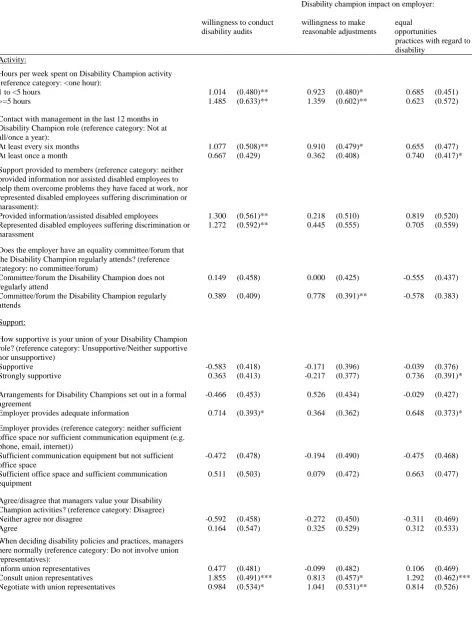
associated with Disability Champion effectiveness. The results are presented in table 2.
INSERT TABLE 2 HERE
Activity. Where activities likely to enhance voice effects (Freeman and Medoff, 1984) are
concerned, there is only weak evidence pointing to the importance of informal dialogue with
management. Disability champions who had contact at least monthly with any level of
management in the last 12 months reported slightly greater influence (at the 10% level) on
the employer’s equal opportunities practices with regard to disability than those that have not
been in contact or have been in contact just once. There is, however, stronger evidence that
Disability Champions report greater influence on employer willingness to make reasonable
adjustments in instances where they regularly attend an equality/disability committee. The
predicted probability1 that they report ‘a lot’ of influence on employer willingness to make
reasonable adjustments is 0.123 in such instances, but only 0.050 where a committee exists
but they do not regularly attend, and 0.049 where no committee exists.
There is also some evidence pointing to the importance of activity that enhances
facilitation effects, with the predicted probability that Disability Champions report ‘a lot’ of
influence on employer willingness to conduct disability audits being 0.318 where they have
represented disabled employees suffering discrimination and harassment, 0.323 where they
14
disabled employees, but only 0.117 where they have neither provided information/assistance,
nor represented disabled employees.
The final issue concerning Disability Champion activity relates to the hours-per-week
spent on the role, this being associated with their impact on employer willingness to conduct
disability audits and willingness to make reasonable adjustments. The effect sizes are notable,
with the predicted probability of Disability Champions reporting ‘a lot’ of influence on
employer willingness to conduct disability audits being 0.416 where they spend 5 hours or
more a week on the role but only 0.146 where they spend less than one hour on the role.
Similarly, the predicted probability that Disability Champions report ‘a lot’ of influence on
employer willingness to make reasonable adjustments is 0.131 where they spend 5 hours or
more a week on the role, but only 0.020 where they spend less than one hour on the role.
Support. Turning to support for Disability Champions, there is only weak evidence for the
importance of union support, with those stating the union is ‘very supportive’ reporting only
slightly greater impact (at the 10% level) on the employer’s equal opportunities practices
with regard to disability.
Where employer support is concerned, there is no evidence that Disability Champion
effectiveness is influenced by whether the employer provides sufficient office space or
communication equipment, or whether managers value the role. Only a slightly greater
impact (at the 10% level) is reported on employer willingness to conduct disability audits and
on equal opportunities practices with regard to disability where Disability Champions believe
the employer provides adequate information.
There is, however, greater evidence pointing to the importance of a bargaining
environment that is supportive of joint regulation. In instances where disability policy is
15
influence on employer willingness to make reasonable adjustments is 0.122 where
negotiation occurs, but only 0.030 where management do not involve union representatives.
Disability Champions also report slightly greater impact (at the 10% level) on employer
willingness to conduct disability audits where negotiation occurs. Where consultation with
unions over disability policies and practices occurs, Disability Champions report greater
influence on employer willingness to conduct disability audits (the predicted probability that
Disability Champions report ‘a lot’ of influence is 0.475 where consultation occurs but only
0.201 where managers do not involve union representatives), and employer equality practices
with regard to disability (the predicted probability that they report ‘a lot’ of influence is 0.283
where consultation occurs but only 0.098 where management do not involve union
representatives). They also report slightly greater impact (at the 10% level) on employer
willingness to make reasonable adjustments.
Characteristics. Turning to characteristics, there is some evidence pointing to the importance
of Disability Champions’ longevity in the role, with the predicted probability that they report
‘a lot’ of influence on employer willingness to make reasonable adjustments being 0.253
where they have been in role for 5 or more years, but only 0.061 where in role for less than
one year. Also, those in role for 5 or more years report slightly greater influence (at the 10%
level) on employer willingness to conduct disability audits and equal opportunities practices
with regard to disability.
Controls. Some of the control variable coefficients are noteworthy. First, Disability
Champions in large organisations report greater influence on employer willingness to conduct
disability audits, and a slightly more positive influence on employer equal opportunities
16
encouraging that those reporting the greatest influence are located in workplaces where they
will potentially affect large numbers of disabled employees. Second, Disability Champions in
health and social work report less influence on employer disability policy and practice than
do those in other industrial sectors. This may reflect over-cautious approaches to health and
safety in this sector which often ‘debar(s) disabled people unfairly from particular …
professions’ (DWP, 2011: 47). Third, Disability Champion influence is no greater in the
public sector than in the private or not-for-profit sectors, suggesting that public sector
preparations for the introduction of the Equality Duty (which came into force in April 2011)
did not provide them with additional leverage.
Discussion and Conclusions
This paper sought to address two main aims. The first was to assess how effective Disability
Champions have been in encouraging employers to amend and improve disability policy and
practice. The second was to identify the factors associated with Disability Champion
effectiveness. In the event, the analysis revealed some notable results.
With regard to the paper’s first aim, the majority (approximately three-quarters) of
Disability Champions report a positive impact on at least one of the three elements of
employer disability policy and practice assessed. This suggests support for the EHRC’s
(2012: 47) view that the Disability Champion initiative has the potential to help unions
develop specialist expertise to support disabled people and their employers, and that the role
complements the greater emphasis unions have placed in recent years on representing
disabled people (TUC, 2008, 2011, 2013a,b). It would appear, therefore, that Disability
Champions have significant potential to enhance the ‘joint regulation’ element of Dickens’
(1999) three-pronged approach concerning the impact of unions on employer disability
17
Notable, however, is that although Disability Champions report considerable success
in encouraging employers to audit and improve disability policy and practice, they report
more limited impact on employer willingness to make reasonable adjustments. The likelihood
of reasonable adjustments being made is partly dependent on whether managers and other
employees support and understand the need for them (EHRC, 2012). The difficulties
Disability Champions report concerning adjustments may reflect a continued absence of such
support and understanding in many workplaces (Williams et al., 2008), despite initial hopes
the DDA would engender this (Bruyère and James, 1997: 5).
With regard to the paper’s second aim (identifying the factors associated with
Disability Champions’ reports of their effectiveness), a number of
‘Activity-Support-Characteristics’ (ASC) factors were found to be important. Turning first to the ‘activity’
element of the framework, there was some evidence for the importance of activities that
enhance voice effects (Freeman and Medoff, 1984), with there being a positive association
between Disability Champion attendance at workplace equality/disability committees and
employer willingness to make reasonable adjustments. Only 33% of Disability Champions
attend workplace equality/disability committees (see Appendix table), and they do not exist at
all in 47% of the workplaces in which Disability Champions are located. This suggests the
more widespread establishment of such committees in which Disability Champions
participate may help increase employer responsiveness and understanding of the requirements
of disabled people. Future research may usefully explore whether such findings concerning
the impact of equality committees hold for other disadvantaged groups, and if so whether this
impact is dependent on a joint-problem solving approach being taken, and/or the authority
such committees command (Bruyère, 2001; Kalev et al, 2006: 593).
The results also highlight the importance of activities that enhance facilitation effects.
18
representing disabled employees within grievance procedures report a greater impact on
employer willingness to conduct disability audits. Notable, however, is that they do not report
greater impact on employer willingness to make reasonable adjustments. One potential
explanation for this is that union intervention of this nature may come at too late a stage after
disadvantage has occurred, and may therefore risk escalating problems (Foster and Fosh,
2010: 568) and entrenching management views rather than encouraging a positive response.
Set alongside the results highlighting the positive impact of Disability Champion
participation in equality/disability committees, this suggests that for unions to increase the
likelihood of reasonable adjustments being made, joint-working between managers and union
reps that facilitates early intervention is necessary.
Also concerning activity, the findings support previous work suggesting that the
impact of new specialised union representatives depends on the number of hours per week
they spend on the role (Bacon and Hoque, 2011, 2012). Only 22% of Disability Champions
report spending five or more hours a week on the role, suggesting their effectiveness might be
enhanced considerably by statutory rights to time off. Indeed, it is arguably only with
statutory backing of this nature that joint regulation approaches to equality (Dickens 1999)
are likely to fulfil their potential in the current context of general union weakness.
Turning to the ‘support’ element of the ASC framework, the results further highlight
the importance of union voice effects (Freeman and Medoff 1984). Concurring with prior
research (Dickens, 2007; Hoque and Bacon, 2014), the analysis finds Disability Champion
reports of their effectiveness to be more positive in environments that are supportive of
consultation or negotiation over equality. However, consultation and negotiation may
influence different types of equality action in different ways, the findings suggesting that
formal consultation with unions may encourage employers to conduct disability audits and
19
increase employer willingness to make reasonable adjustments. Future research may usefully
seek to identify the equality practices best advanced by consultation and those which require
negotiation/equality bargaining.
With regard to the ‘characteristics’ element of the ASC framework, the results suggest
that Disability Champions with greater longevity in the role report greater success in
encouraging employers to make reasonable adjustments. This suggests it takes time to learn
about and understand the needs of people with a wide range of impairments and persuade
employers to make appropriate adjustments (Foster and Fosh, 2010). This in turn suggests the
impact of Disability Champions may increase in future as the current Disability Champion
cohort develops greater expertise. It also suggests that the retention of union reps with
equality expertise is an important issue. In reaching this conclusion, however, one must keep
in mind the possibility of reverse causation, given that longevity in the role might also be a
consequence of, as well as a cause of, influence. Nevertheless, future research may usefully
explore further the relationship between union rep longevity and their effectiveness in
achieving equality outcomes.
The results presented here have some potentially important implications for unions,
employers and government. Where unions are concerned, some of the ASC factors associated
with Disability Champions’ reports of their effectiveness (ensuring Disability Champion
retention, for example) might be best viewed as their responsibility. However, other factors
(advocating joint regulation with regard to disability decision-making, the adoption of
workplace disability or equality committees and rights to time off, for example) require
employer and state action. It is debatable, however, whether state intervention will be
forthcoming in the immediate future given statutory rights to time off were not accorded to
Equality Representatives in the Equality Act 2010. This might be viewed with a certain irony
20
benefits into employment (National Audit Office, 2010). Were the state and employers
willing to provide such support, thereby enhancing the ability of Disability Champions to
influence employer receptiveness to disabled people, this might have the potential to make an
important contribution to the achievement of this policy goal.
Finally, it is necessary to highlight several caveats concerning the results reported
here. First, it is not possible to draw clear causal inferences between the ASC factors and
Disability Champion reports of their effectiveness given the potential for reverse causality
and common method bias. Second, the paper relies on Disability Champions’ self-reports of
their impact. This may lead them to over-estimate their impact (to maintain self-esteem), or
under-estimate their impact (should they have high expectations concerning their level of
influence). To address these caveats, further research exploring Disability Champions might
adopt longitudinal designs and/or collect matched data from Disability Champions and
employers or disabled employees to enable the dependent and independent variables to be
derived from different data sources. In addition, qualitative research might usefully explore in
greater detail the precise nature of Disability Champion impact, and also provide a nuanced
explanation of the manner in which the ASC factors influence Disability Champion
effectiveness. Finally, future research might also account for the fact that disability
discrimination is often closely related to age, gender and ethnicity discrimination, hence it
might usefully seek to look beyond a single-strand focus and seek to explore issues of
intersectionality. Should future research that takes these issues into consideration replicate the
results achieved here, this will bolster further the argument that Disability Champions have
the potential to play an important role in enhancing the joint regulation element of Dickens’
(1999) three-pronged approach, and also in assisting HR managers in managing disability
21 Notes
1. The predicted probabilities reported throughout the results section are not reported in the tables for the sake of brevity.
References
ACAS (2008). Time Off for Trade Union Duties and Activities. London: HMSO.
Bacon, N. and Hoque, K. (2009). The Impact of the Union Learning Representative. London: Unionlearn.
Bacon, N. and Hoque, K. (2011). ‘Union representation and training: the impact of Union Learning Representatives and the factors influencing their effectiveness’. Human Relations, 64: 3, 387-413.
Bacon, N. and Hoque, K. (2012). ‘The role and impact of trade union equality representatives in Britain’. British Journal of Industrial Relations,50: 2, 239-262.
Balser, D.B. (2002). ‘Agency in organizational inequality: organizational behavior and individual perceptions of discrimination’. Work & Occupations, 29: 2, 137-165.
Bruyère, S.M. (2000). Disability Employment Policies and Practices in Private and Federal Sector Organizations. Ithaca, NY: ILR Cornell University.
Bruyère, S.M. (2001). The ADA and Collective Bargaining Issues. Ithaca, NY: ILR Cornell University.
Bruyère, S.M., Erickson, W.A. and VanLooy, S. (2004). ‘Comparative study of workplace policy and practices contributing to disability nondiscrimination’. Rehabilitation Psychology, 49: 1, 28–38.
Bruyère, S. and James, P. (1997). ‘Disability management and the Disability Discrimination Act’. Human Resource Management Journal, 7: 2, 5-17.
Budd, J.W. and Mumford, K. (2004). ‘Trade unions and family-friendly policies in Britain’. Industrial and Labor Relations Review,57: 2, 204–22.
Dickens, L. (1999). ‘Beyond the business case: a three-pronged approach to equality action’. Human Resource Management Journal, 9: 1, 9-19.
Dickens, L. (2007). ‘The road is long: thirty years of equality legislation in Britain’. British Journal of Industrial Relations,45: 3, 463-494.
22
DWP (2011). Getting in, Staying in and Getting on. London: HMSO Cm8081.
EHRC (2011). Equality Act 2010 Statutory Code of Practice Employment. London: Equality and Human Rights Commission.
EHRC (2012). Working Better: The Perfect Partnership- Workplace Solutions for Disabled Persons and Business. London: Equality and Human Rights Commission.
Foster, D. and Fosh, P. (2010). ‘Negotiating difference: representing disabled employees in the British Workplace’. British Journal of Industrial Relations,48: 3, 560–582.
Freeman, R. and Medoff, J. (1984). What do unions do? New York: Basic Books.
Hollinrake, A., Antcliff, V. and Saundry, R. (2008). ‘Explaining activity and exploring experience-findings from a survey of union learning representatives’. Industrial Relations Journal, 39: 5, 392–410.
Hoque, K. and Bacon, N. (2008). ‘Trade unions, union learning representatives and employer-provided training in Britain’. British Journal of Industrial Relations, 46: 4, 702-731.
Hoque, K. and Bacon, N. (2014). ‘Unions, joint regulation and workplace equality policy and practice in Britain: evidence from the 2004 Workplace Employment Relations Survey’. Work, Employment & Society, 28: 2, 1-20.
Humphrey, J.C. (1998). ‘Self-organise and survive: disabled people in the British trade union movement’. Disability and Society, 13: 4, 587–602.
ILO (2009). Trade Unions and Decent Work for People with Disabilities: Information Sheet. Geneva: International Labour Organisation.
Jodoin, S. and Harder, H. (2004). ‘Strategies to enhance labour-management cooperation in the development of disability management programs’. International Journal of Disability, Community, and Rehabilitation, 3: 4.
Kalev, A., Dobbin, F. and Kelly, E. (2006). ‘Best practices or best guesses? Assessing the efficacy of corporate affirmative action and diversity policies’. American Sociological Review,71: 4, 589–617.
Kersley, B., Alpin, C., Forth, J., Bryson, A., Bewley, H., Dix, G. and Oxenbridge, S. (2006). Inside the Workplace: Findings from the 2004 Workplace Employment Relations Survey. London: Routledge.
Labropoulou, K. and Soumeli, E. (2001). ‘Workers with disabilities: law, bargaining and the social partners’. European Industrial Relations Observatory On-line.
23
Meager, N., Doyle, B., Evans, C., Kersley, B., Williams, M., O’Regan, S. and Tackey, N. (1999). Monitoring the Disability Discrimination Act DDA. London: Department for Education and Employment. Research Brief No. 119.
Moore, S. and Wright, T. (2010). PCS Equality Representatives’ Training, Development & Support Programme: Final Evaluation Report. London: London Metropolitan University.
National Audit Office (2010). Support to Incapacity Benefits Claimants Through Pathways to Work. http://www.nao.org.uk/wp-content/uploads/2010/05/101121es.pdf. Page last reviewed: 7 February 2014.
Office for Disability Issues (2013). Disability Facts and Figures.
http://odi.dwp.gov.uk/disability-statistics-and-research/disability-facts-and-figures.php#imp Page last reviewed: 13 June 2013.
Riddell, S., Edward, S., Weedon, E. and Ahlgren, L. (2010). Disability, Skills and Employment. Manchester: Equality and Human Rights Commission.
Schurman, S.J., Weil, D., Landsbergis, P. and Israel, B.A. (1998). ‘The role of unions and collective bargaining in preventing work-related disability’, in T. Thomason, J.F. Burton Jr, and D.E. Hyatt (eds) New Approaches to Disability in the Workplace, University of
Wisconsin-Madison: IRRA.
Shrey, D., Hursh, N., Gallina, P., Slinn, S. and White A. (2006). ‘Disability management best practices and joint labour-management collaboration’. International Journal of Disability Management Research,1: 1, 52-63.
TUC (2008). Representing and Supporting Members with Mental Health Problems at Work. London: Trades Union Congress.
TUC (2011). Disability and Work. London: Trades Union Congress.
TUC (2013a). Sickness Absence and Disability Discrimination. London: Trades Union Congress.
TUC (2013b). Public Sector Equality Duty Review: TUC response for GEO Call for Evidence. London: Trades Union Congress.
Williams, B., Copestake, P., Eversley, J. and Stafford, B. (2008). Experiences and Expectations of Disabled People. London: Office for Disability Issues.
Williams-Whitt, K. (2007). ‘Impediments to disability accommodation’. Relations Industrielles,62: 3, 405-432.
24
Table 1: Impact of Disability Champion activity on employer disability policy (percentages)
Since becoming a Disability Champion, what impact have you had on the following areas?
A lot Some A little None
Your employer’s willingness to conduct 30 41 16 14
disability audits of documents, buildings or procedures
Your employer’s willingness to make 8 39 24 29
reasonable adjustments for disabled employees
Your employer’s equal opportunities 17 40 22 21
practices with regard to disability
25
Table 2: Factors associated with Disability Champion effectiveness
Disability champion impact on employer: willingness to conduct willingness to make equal disability audits reasonable adjustments opportunities practices with regard to disability
Activity:
Hours per week spent on Disability Champion activity (reference category: <one hour):
1 to <5 hours 1.014 (0.480)** 0.923 (0.480)* 0.685 (0.451) >=5 hours 1.485 (0.633)** 1.359 (0.602)** 0.623 (0.572) Contact with management in the last 12 months in
Disability Champion role (reference category: Not at all/once a year):
At least every six months 1.077 (0.508)** 0.910 (0.479)* 0.655 (0.477) At least once a month 0.667 (0.429) 0.362 (0.408) 0.740 (0.417)* Support provided to members (reference category: neither
provided information nor assisted disabled employees to help them overcome problems they have faced at work, nor represented disabled employees suffering discrimination or harassment):
Provided information/assisted disabled employees 1.300 (0.561)** 0.218 (0.510) 0.819 (0.520) Represented disabled employees suffering discrimination or
harassment
1.272 (0.592)** 0.445 (0.555) 0.705 (0.559)
Does the employer have an equality committee/forum that the Disability Champion regularly attends? (reference category: no committee/forum)
Committee/forum the Disability Champion does not regularly attend
0.149 (0.458) 0.000 (0.425) -0.555 (0.437) Committee/forum the Disability Champion regularly
attends
0.389 (0.409) 0.778 (0.391)** -0.578 (0.383)
Support:
How supportive is your union of your Disability Champion role? (reference category: Unsupportive/Neither supportive nor unsupportive)
Supportive -0.583 (0.418) -0.171 (0.396) -0.039 (0.376) Strongly supportive 0.363 (0.413) -0.217 (0.377) 0.736 (0.391)* Arrangements for Disability Champions set out in a formal
agreement
-0.466 (0.453) 0.526 (0.434) -0.029 (0.427) Employer provides adequate information 0.714 (0.393)* 0.364 (0.362) 0.648 (0.373)* Employer provides (reference category: neither sufficient
office space nor sufficient communication equipment (e.g. phone, email, internet))
Sufficient communication equipment but not sufficient office space
-0.472 (0.478) -0.194 (0.490) -0.475 (0.468) Sufficient office space and sufficient communication
equipment
0.511 (0.503) 0.079 (0.472) 0.663 (0.477)
Agree/disagree that managers value your Disability Champion activities? (reference category: Disagree)
Neither agree nor disagree -0.592 (0.458) -0.272 (0.450) -0.311 (0.469) Agree 0.164 (0.547) 0.325 (0.529) 0.312 (0.533) When deciding disability policies and practices, managers
here normally (reference category: Do not involve union representatives):
26
Characteristics:
Time spent as Disability Champion (reference category: <1 year):
1 to <2 years 0.086 (0.461) -0.566 (0.472) -0.272 (0.454) 2 to <5 years 0.732 (0.436)* -0.165 (0.430) 0.606 (0.430) >=5 years 1.027 (0.560)* 1.320 (0.553)** 0.950 (0.546)* Previously held another union post -0.144 (0.713) -0.904 (0.691) 0.464 (0.724) Other union post currently held -0.234 (0.568) 0.209 (0.524) -0.607 (0.540) Long-term illness, health problem or disability 0.055 (0.379) -0.440 (0.372) 0.204 (0.362) Controls:
Sector (reference category: public sector)
Private sector -0.182 (0.585) -0.254 (0.519) -0.163 (0.565) Not-for-profit sector 0.148 (0.686) -0.309 (0.618) 0.696 (0.641) Organisation size (reference category: <=999 employees)
1000-4999 1.024 (0.582)* 0.565 (0.551) 0.776 (0.551) 5000-9999 0.117 (0.571) -0.447 (0.564) 0.401 (0.548) >=10000 1.464 (0.553)*** 0.283 (0.531) 0.901 (0.538)* Workplace size (reference category: <=50 employees)
51-100 0.554 (0.634) 1.167 (0.620)* -0.225 (0.600) 101-250 -0.462 (0.599) -0.137 (0.559) -0.408 (0.562) 251-500 -1.128 (0.610)* -0.814 (0.597) -0.216 (0.573) 501-1000 -1.290 (0.655)** -0.485 (0.614) -2.168 (0.684)*** >=1000 -0.935 (0.546)* -0.206 (0.483) -0.561 (0.489) Standard Industrial Classification (SIC) major group
(reference category: Public administration and defence)
Education 0.588 (0.646) -0.420 (0.604) 0.349 (0.580) Health and social work -1.434 (0.594)** -1.191 (0.610)* -1.093 (0.575)* Transport, storage and communications -0.279 (0.516) -0.547 (0.483) 0.012 (0.468) Other community, social and personal services -0.488 (0.538) -0.293 (0.508) 0.091 (0.498) Other industry group -0.072 (0.586) 0.119 (0.503) 0.194 (0.528) Occupational group represented (reference category:
managers/professionals)
Non-management 0.682 (0.652) -0.211 (0.645) 0.346 (0.620) Mixed 0.628 (0.631) -0.220 (0.622) 0.056 (0.589) Representative age (<=29 years old)
30-39 -0.820 (0.447)* 0.229 (0.417) -0.521 (0.420) 40-49 -1.588 (0.529)*** -0.757 (0.475) -1.391 (0.487)*** 50-59 -2.033 (0.557)*** -0.794 (0.530) -1.739 (0.545)*** >=60 years old -1.571 (0.608)*** -1.087 (0.563)* -1.032 (0.569)* Female -0.541 (0.332) 0.084 (0.313) -0.166 (0.313) Ethnic minority 0.249 (0.472) 0.315 (0.443) 0.662 (0.474)
Pseudo R2 0.353 0.290 0.289
N 116 116 116
Notes:
Coefficients given, standard errors in brackets
27
Appendix Table: independent and control variables (percent)
Percent Disability Champion Activity
Hours a week spent on the Disability Champion role, including both time spent at work or elsewhere
<one hour 22.4
1 to <5 hours 56.0
>=5 hours 21.6
Contact with any level of management in the last 12 months in disability champion role
Not at all/once a year 25.9 At least every six months 27.6 At least once a month 46.6 Neither provided information to/assisted disabled employees to help them 12.9 overcome problems they have faced at work in the past year, nor
represented disabled employees suffering discrimination or harassment (either in informal proceedings or in formal disciplinary or grievance procedures)
Provided information to/assisted disabled employees to help them 38.8 overcome problems they have faced at work in the past year
Represented disabled employees suffering discrimination or 48.3 harassment in the past year
Does the employer have an equality committee/forum that the Disability Champion regularly attends?
No committee/forum 47.4
Committee/forum that the Disability Champion does not regularly attend 19.8 Committee/forum that the Disability Champion regularly attends 32.8 Support for Disability Champions
Overall, how supportive is your union of your Disability Champion role?
Unsupportive/neither supportive nor unsupportive 29.3
Supportive 37.9
Strongly supportive 32.8
Arrangements for Disability Champions in your workplace set out in a formal agreement 13.8 Employer provides adequate information to conduct the Disability Champion role 50.9 To help youconduct your Disability Champion role, the employer provides:
Neither sufficient office space nor sufficient communication equipment (e.g. phone, email, internet) 29.3 Sufficient communication equipment only 15.5 Sufficient office space and sufficient communication equipment 55.2 Do you agree or disagree that managers at this workplace value
your Disability Champion activities?:
Disagree 33.6
Neither agree nor disagree 37.1
Agree 29.3
When deciding disability policies and practices managers normally:
Do not involve union representatives 23.3 Inform union representatives 17.2 Consult union representatives 39.7 Negotiate with union representatives 19.8 Disability Champion Characteristics
How long have you been a Disability Champion?
<one year 16.4
1 to <2 years 18.1
2 to <5 years 49.1
>=5 years 16.4
28
Control variables
Public sector 73.3
Private sector 17.2
Not-for-profit/voluntary sector 9.5 Organisation size (employees):
<=999 12.1
1000-4999 25.0
5000-9999 20.7
>=10000 42.2
Workplace size (employees):
>=50 15.5
51-100 8.6
101-250 11.2
251-500 15.5
501-1000 12.9
>1000 36.2
SIC major group:
Public administration and defence 30.2
Education 10.3
Health and Social Work 12.1 Transport, storage and communications 17.2 Other community, social and personal services 12.9
Other industry group 17.2
Occupational group represented:
Managers/professionals 10.3
Non-management 30.2
Mixed 59.5
Rep age:
<=29 years old 19.8
30-39 years old 29.3
40-49 years old 20.7
50-59 years old 15.5
>=60 years old 14.7
Female 37.1
Ethnic minority 10.3