City, University of London Institutional Repository
Citation
:
Aversa, P., Haefliger, S., Rossi, A. & Baden-Fuller, C. (2015). From Business Model to Business Modelling: Modularity and Manipulation. Business Models and Modelling, 33, pp. 151-185. doi: 10.1108/S0742-332220150000033022This is the draft version of the paper.
This version of the publication may differ from the final published
version.
Permanent repository link:
http://openaccess.city.ac.uk/13976/Link to published version
:
http://dx.doi.org/10.1108/S0742-332220150000033022Copyright and reuse:
City Research Online aims to make research
outputs of City, University of London available to a wider audience.
Copyright and Moral Rights remain with the author(s) and/or copyright
holders. URLs from City Research Online may be freely distributed and
linked to.
From Business Model to Business Modeling:
Modularity and Manipulation
Paolo Aversa
Cass Business School, City University London
Stefan Haefliger
Cass Business School, City University London
Alessandro Rossi
DEM, Università degli Studi di Trento
Charles Baden-Fuller
Cass Business School, City University London
Abstract
The concept of modularity has gained considerable traction in technology studies as a way to conceive, describe and innovate complex systems, such as product design or organizational structures. In the recent literature, technological modularity has often been intertwined with business model innovation, and scholarship has started investigating how modularity in technology affects changes in business models, both at the cognitive and activity system levels. Yet we still lack a theoretical definition of what modularity is in the business model domain. Business model innovation also encompasses different possibilities of modeling businesses, which are not clearly understood nor classified. We ask when, how and if modularity theory can be extended to business models in order to enable effective and efficient modeling. We distinguish theoretically between modularity for technology and for business models, and investigate the key processes of modularization and manipulation. We introduce the basic operations of business modeling via modular operators adapted from the technological modularity domain, using iconic examples to develop an analogical reasoning between modularity in technology and in business models. Finally, we discuss opportunities for using modularity theory to foster the understanding of business models and modeling, and develop a challenging research agenda for future investigations.
From Business Model to Business Modeling:
Modularity and Manipulation
Introduction
A business model represents a business enterprise’s essential value creation and capture activities in reduced and abstract form (Teece, 2010). Such models are, first of all, cognitive devices that mediate between managerial thinking and engagement in economic activities (Baden-Fuller & Morgan, 2010; Chesbrough & Rosenbloom, 2002; Martins, Rindova & Greenbaum, 2015), and so represent complex economic environments in simplified forms, facilitating reasoning and communication to third parties. While economists work with sophisticated mathematical representations, simpler tools - such as lists or maps - are often employed as models in the management field (for a taxonomy see French, Maule & Papamichail, 2009; or see Osterwalder & Pigneur, 2010 for a business model 'canvas'). The business model, specifically, has recently gained widespread interest and application among scholars and managers as a helpful tool for both thinking about and creating systems of value creation, delivery and capture (for a review see Zott, Amit & Massa, 2011).
innovated to fit changing technological or market conditions (Baden-Fuller & Haefliger, 2013).
In this paper, we refer to business modeling as the set of cognitive actions aimed at representing (complex) business activities in a parsimonious, simplified form (i.e., a business model), as well as to the set of activities that cognitively manipulate the business model to evaluate alternative ways in which it could be designed. These activities are the antecedents of business model innovation, which - however radical or incremental - often constitute a change in a business model that is commonly perceived as useful in its representation, and which scholars often connect to an opportunity for performance enhancement (Zott & Amit, 2007, 2008). Once implemented, business model innovation may lead on to sustainable business operations, or it may fail: but we leave it to past and future research as well as management practice to engage with the perils of execution. Beyond this, what is noteworthy here is that scholars seem to share a growing interest in the underlying idea of modeling a business model, which is tightly connected to other popular concepts such as business model
innovation (Baden-Fuller & Haefliger, 2013; Chesbrough, 2010; Gambardella & McGahan,
2010), renewal (Chesbrough, 2010), evolution (Doz & Kosonen, 2010), and design (Demil & Lecocq, 2010; Zott & Amit, 2010). This growing stream of research reflects the importance of understanding the underlying dynamics related to business model experimentation and manipulation, which often represent the most common option for firms needing to respond to changing environments or fierce competition.
strategic decisions. Also, despite the increasing interest in phenomena related to business model innovation, as well as their paramount importance, we still lack a clear understanding of the basic options for change in existing business models. In this study we tackle this important aspect by investigating the following research question: How can we systematically understand and classify the manipulations of a business model?
To respond to this question, we borrow from the theory of complex systems, and in particular from Simon (1962), who viewed modular systems as the result of deliberate human activity: i.e., that artifacts and social systems are conceived of as being composed of other subsystems. Attempts at modeling a new instantiation of an existing business model necessarily encounter the difficulties of modularization and manipulation as well as the opportunities and limitations of decomposability and information hiding. To follow this theoretical perspective, we consider the business model as a system of interconnected parts, which stand for sub-categories populated by constituent elements, such as a business’ monetization mechanisms. Our approach resonates with previous themes in the business model literature. As Massa and Tucci (2013) highlight, the level of abstraction of business model representations among scholars and practitioners varies between being more or less granular (i.e., including more or less elements, depending on the level of analysis), but the different classifications still tend to remain consistently represented in terms of the inter-relatedness of their elements. We suggest that this system approach offers a basis to understand how business models might change and, particularly, how firms might conceive such innovations as, for instance, the move from ‘product’ to ‘multi-sided platform’ business models, or from vertically integrated towards networked arrangements.
modular designs show high degrees of manipulability, which enable efficient and effective experimentation in terms of novel, innovative configurations. If we can conceive of business models in terms of the principles of modularity, the notion of manipulability can facilitate changes in their design, which may lead to significant innovation for firms.
Since its very early days, the business model debate has been tightly intertwined with technology and innovation (Amit & Zott, 2001; Baden-Fuller & Haefliger, 2013; Chesbrough, 2010; Gambardella & McGahan, 2010), particularly, the discussion of how the diffusion of the Internet allowed firms to introduce new business models or innovate their existing ones (Amit & Zott, 2001; Baden-Fuller & Haefliger, 2013). For instance, the degree of modularity embedded in many information-intensive artifacts - such as ICT-based products and services (Yoo, Boland Jr, Lyytinen & Majchrzak, 2012) - has promoted the emergence of platform business models, also referred to as multi-sided business models (Rochet & Tirole, 2003; 2006). These allow different sides of a market to be connected via multiple technological platforms and technological domains (consider for example how Amazon, Google, or Airbnb platforms engage with different categories of users in exchanging goods, services, or other scarce resources, e.g., customer attention). Thus technological modularity has remained at the very core of the business model debate, and scholars have paid increasing attention to the benefits of modular technologies for business model innovation, to the point of starting to question whether business models themselves can actually be modular, and how their modularity might be related to the modularity of their enabling technologies (Bonina & Liebenau, 2015; Kodama, 2004; Parmatier, 2015).
theory can be applied to business models and modeling. Finally, we suggest that modularity is a viable theory to inquire into business models due to its own constituting logics that have also allowed its previous application to organizational contexts (see for example Brusoni, Marengo, Prencipe & Valente, 2007; Brusoni & Prencipe, 2001a).
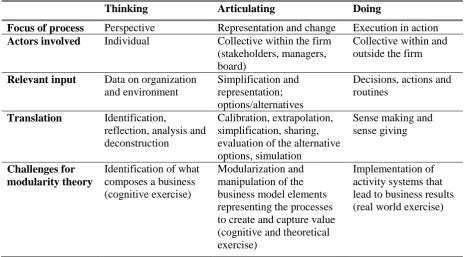
[image:7.595.65.531.488.745.2]We characterize our approach to business models as one that focuses on cognitive modeling, rather than real world execution. Business modeling can be divided into three phases (see Table 1). Thinking is the cognitive effort to inquire into the business, and usually corresponds to the individual effort of cognitively understanding a business. Articulating is the individual cognitive effort to represent the business in a parsimonious and simplified model, so that it may be conveniently shared with other stakeholders, whose interactions may affect the model representation itself. The articulation phase may involve considering possible modifications to the original business model, achieved via cognitive manipulation - a phase in which individuals and groups cognitively ‘tinker’ with possible alternatives to optimize their business model. Finally, the doing phase implies a series of decisions and routines to translate the cognitive model into a set of activities in the real world of business, which involves grappling with the messy details of technology. Table 1 refers to the complex challenges managers face when designing a business model.
Table 1: Business model thinking, articulating, doing: challenges for a modularity perspective
Thinking Articulating Doing
Focus of process Perspective Representation and change Execution in action Actors involved Individual Collective within the firm
(stakeholders, managers, board)
Collective within and outside the firm
Relevant input Data on organization and environment
Simplification and representation; options/alternatives
Decisions, actions and routines
Translation Identification,
reflection, analysis and deconstruction
Calibration, extrapolation, simplification, sharing, evaluation of the alternative options, simulation
Sense making and sense giving
Challenges for modularity theory
Identification of what composes a business (cognitive exercise)
Modularization and manipulation of the business model elements representing the processes to create and capture value (cognitive and theoretical exercise)
Our paper proceeds by considering the concept of elements (i.e., components of a system/mode) as well as the constituting principles of modularity theory. Specifically, we consider two key notions of the business model construct: first, the modularization of the business model - which includes the possibility of representing a model via a set of interconnected elements. And second, we consider the manipulation of those interconnected elements – and so ‘inquiring into’ the challenges of modeling a business model. We also consider the benefits and risks of two basic properties of modular models, namely
decomposability (Simon, 1962), and information hiding (Parnas, 1972).
Once the necessary principles are identified, we then tackle the thorny problem of understanding and classifying business model changes (i.e., manipulations) through modularity operators. To substantiate this abstract reasoning more fully, we first define these operators according to modularity theory (Baldwin & Clark, 2000; Parnas, 1972), and show how they have been originally applied to examples within the technology domain. Second, following analogical reasoning (Gavetti, Levinthal & Rivkin, 2005; Martins et al., 2015), we identify iconic examples of innovation in the business model domain and, by appreciating the salient changes, identify the types of changes that are analogous to change cases in technology. In particular, we follow three general constituting elements of the business model (i.e., value creation, delivery, and capture) and the changes they undergo that are comparable to our technology architecture examples, and make reference to current practical issues. We generalize our arguments with a series of propositions that extract cognitive operators explaining business model change. By applying modularity operators to business model change, we are thus able to advance a precise classification of business model changes, which can help both scholars and practitioners inquiring into different types of manipulations. Finally, we ask how modularity may further help scholars respond to questions from the contemporary business model research domain. We conclude with a set of suggestions for future contributions, which represent a challenging research agenda whose trajectory points to the intersection of business models, modeling, and modularity.
Modularity Theory and the Business Model
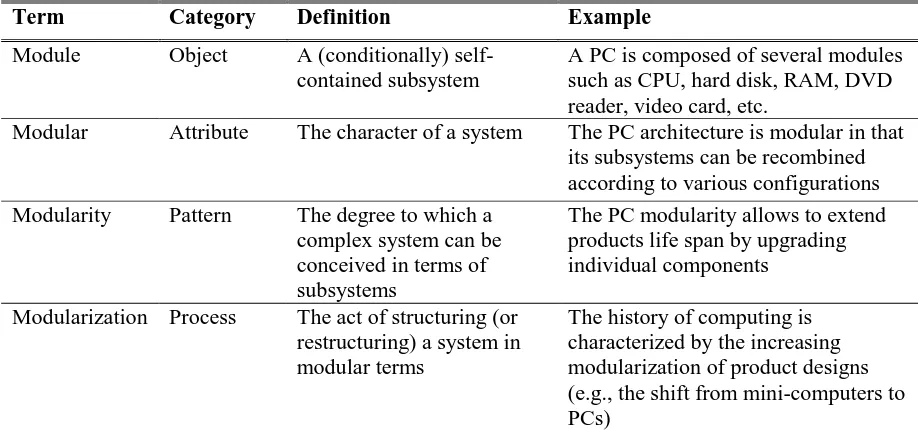
depending on the possibility that it could be decomposed into loosely coupled components, and modularization can be seen as the process by which a system is structured according to a modular design, or could be redesigned to achieve a higher degree of modularity (see Table 2 for a summary of the relevant definitions).
Table 2: Modularity in technology
Term Category Definition Example
Module Object A (conditionally)
self-contained subsystem
A PC is composed of several modules such as CPU, hard disk, RAM, DVD reader, video card, etc.
Modular Attribute The character of a system The PC architecture is modular in that its subsystems can be recombined according to various configurations
Modularity Pattern The degree to which a
complex system can be conceived in terms of subsystems
The PC modularity allows to extend products life span by upgrading individual components
Modularization Process The act of structuring (or restructuring) a system in modular terms
The history of computing is characterized by the increasing modularization of product designs (e.g., the shift from mini-computers to PCs)
It is important to acknowledge that our understanding of systems and modularity borrows heavily from the original work of Simon (e.g., Simon, 1962) on modeling complex systems and their decomposability. Simon’s contribution suggested that modeling is most fruitful if the model of the system can be simplified and decomposed into parts. This allows components that are less crucial to be put into ‘black boxes’ to focus more clearly on core elements and thus facilitate their manipulation (for an appreciation of how and why Simon influenced our thinking, see Boumans, 2009; Morgan, 1991). Following this line of reasoning, we stress the cognitive nature of modeling activities, which implies that the actual possibility of manipulating a model lies, above all, in the actors’ understanding of its components and their interdependencies, rather than in the actual properties of the elements and the model.
managing complexity in a variety of different fields, such as industrial manufacturing, neuroscience, problem solving, software engineering, architectural design, and product development (to name a few). Within the management research domain, modularity principles have been widely applied to strategic management (see among others Brusoni & Prencipe, 2001a; Garud, Kumaraswamy & Langlois, 2009; Schilling, 2000), organizational design (Baldwin, Hienerth & Von Hippel, 2006; Baldwin, 2008; Garud & Kumaraswamy, 1995), and other fields. Thus we are confident that, given evidence of similar exercises in nearby theoretical domains, by extending modularity principles to business models scholars will be able to apply a large set of modularity tools and operators that have been successfully developed to inquire into technological and organizational issues, some of which we consider in this paper.
If we have to take on board the notion of ‘model’ in full in considering business models, we need to ask how such models work, how they can be changed by their users, and how analogical reasoning may support both their modularization and manipulation. However, it is first necessary to recognize a set of compelling challenges and boundary conditions that relate to this objective. We acknowledge that it is not obvious that modularity theory can always be applied to organization and management science (Brusoni & Prencipe, 2001a), because modular technologies may not lend themselves easily to analogies beyond technology, such as organizational design efforts (Baldwin & Clark, 2000), and that activities that appear modular may require integrated thinking and knowledge sharing (Sosa, Eppinger & Rowles, 2007). Modularity represents models and systems in arbitrary, abstract, and simplified forms, but the models and the actual activity systems they represent may ultimately not match. Still, if we allow for the possibility that modularity describes models that can usefully represent systems such as businesses, then two key processes - and thus two major challenges - stand out: the (1) modularization and (2) manipulation of the business model.
Modularization and manipulation
to the optimization of the model. These processes are part of the modeling phase in preparation for a new business model’s actual implementation in the real world. Still, it is pivotal to keep in mind that what applies at the cognitive level might not be easy to enact in the real world due to constraints at both levels. At a cognitive level (Baden-Fuller & Haefliger, 2013; Baden-Fuller & Mangematin, 2013; Baden-Fuller & Morgan, 2010; Martins et al., 2015), the possibility of modularizing and manipulating a business model depends on the individual’s ability to think and represent a business as a system of interconnected elements, sharing it with other stakeholders, and to be able to interact to manipulate a shared representation jointly. In contrast, the translation of a cognitive model into the real world - and thus within an activity system perspective (Zott & Amit, 2007, 2008, 2010) - depends heavily on the actual decomposability of the resources and functions in that activity system, as well as on more general organizational constraints (e.g., governance, routines, inertia, etc.). This distinction of perspectives is critical, and requires a closer inspection of the connection between a modular cognitive representation of reality and a modular set of processes or activities, as what seems feasible in cognitive terms might not be as possible in the real world.
The activity system perspective (Amit & Zott, 2001; Casadesus-Masanell & Ricart, 2010; Zott & Amit, 2010) argues that a business model can be thought of as a set of interdependent organizational activities structured by a focal firm (directly or through its partners) in order to create and capture value. According to Zott and Amit (2010), an activity system has three major design parameters: content, which activities are involved, structure, how they are linked, and governance, who is in charge of them. If one considers the first two elements, the overlap between the concepts of elements and their interdependencies is straightforward, especially in the case where activities can be reified in an artifact design by embedding them as functionalities assigned to specific components. As far as the third design parameter is concerned, the arguments on governance are closely related to those contributions in the literature on modularity that highlight how modularity at the artifact level fosters the emergence of modular industries (see for example Brusoni, Prencipe & Pavitt, 2001).
the essence of their business, and to make meaningful inferences in terms of cause-effect relationships between their various constituent parts. Following this line of reasoning, we need to distinguish between the organizational domain and its modularity and the business model representations in the managers’ minds - that is, the distinction between real world and cognitive representations.
Our argument heeds the complexity involved in understanding the nature of the relations between the elements that allows for their manipulation. In order to be seen and understood as a modular design, and thus be manipulated, considering a business as a system of interconnected components also needs a higher level of abstraction that entails a series of cognitive steps, such as: (1) understanding which functionalities are involved in the business model as a whole; (2) assigning these functionalities to the various business model elements; (3) discerning which of those elements are the focus of attention, and appreciating the interactions between them; and (4) decoupling their interdependencies, as much as possible. None of this can be taken for granted: the cognitive part of this process - which is bounded by the individual’s rationality - might not be aligned with the actual configuration of resources and activities in the real world. Modularization is a useful practice that prepares the ground for, but does not necessarily guarantee, manipulation. The actor might not be able to manipulate the system in its current state, either because of cognitive limitations on their logical skills or because of actual real world constraints.
Undertaking modeling is not trivial. We know that many managers find manipulating models difficult. Although they recognize the importance of the value creation, value capture, and value delivery elements as a narrative of their businesses, they typically try to model everything at once, and are not able to fully articulate how those individual parts interact and how they contribute to their firm’s performance. Not being able to focus on what is core to their business, and then to conceptualize a business model in terms of a limited number of sub-elements (and embrace the principles of modularity) appears to inhibit understanding, and thus manipulation. As in the case of the design of complex artifacts, it is therefore important to note that embracing modularity is the result of a deliberate problem-solving approach, where a complex phenomenon is tackled by decomposing it into quasi-independent sub-components or sub-problems.
Choosing the locus of attention
of granularity are two very important dimensions in specifying the appropriate elements, which can be regarded as exercises in business model conceptualization that must necessarily precede its manipulation. Making the business model explicit, modularizing its elements, and then manipulating them are knowledge-intense processes, and are often carried out within social interactions. Modularization, in particular, can be addressed as a multi-level process whose granularity is contingent on individuals’ perceptions of optimum effectiveness and efficiency for their final objectives. To undertake this exercise in cognitive terms, theory-driven business model classifications offer valuable templates to modularize the often rich and complex narrative of a business model into a parsimonious system of constituting elements.
The literature offers different schemas to categorize business models, which means this exercise can be performed at different levels of granularity and selectivity or - in Massa and Tucci’s (2013) words - at “different levels of abstraction”. For example, Demil and Lecocq (2010) provide a three-element framing based on (1) resources and competences, (2) organization, and (3) value proposition, while Baden-Fuller and Mangematin (2013) and Baden-Fuller and Haefliger (2013) offer a four-element classification based on (1) customer sensing, (2) customer engagement, (3) monetization, (4) value chain and linkages, which has a special focus on the customer-firm interface that resonates with Rochet and Tirole’s (2003, 2006) theory work on multi-sided platforms. In contrast, Osterwalder and Pigneur’s (2010) business model ‘canvas’ offers a nine-element classification including (1) key partners, (2) key activities, (3) key resources, (4) value proposition, (5) customer relationships, (6) channels, (7) customer segments, (8) cost structure, and (9) revenue streams, but with no particular focus. We value the contribution of each of these (and other) classifications in identifying key business model aspects, and leave it to the readers to engage with the one that best suits their needs. As our analogical arguments aim to be equally applicable to any of these classifications, so as to maximize their generalizability and applicability to future classifications, this paper uses a very parsimonious model of three elements that modularize the business model in processes of value (1) creation, (2) delivery and (3) capture – and we compare and contrast two particular approaches.
service system, or sometimes a project based system) – and considers that business model manipulation involves value chain considerations, such as outsourcing, partnering, knowledge management, etc. An alternative perspective is represented by contributions (such as by Baden-Fuller & Mangematin, 2013; Eisenmann, Parker & Van Alstyne, 2011; Füller, Jawecki & Mühlbacher, 2007; Hienerth, Keinz & Lettl, 2011; Rochet & Tirole, 2003; 2006) which - building on evidence gathered by observing the evolution of information intensive industries - focus on the boundary space between the firm and its customers and users, and treat the firm’s internal structures and organizations as fixed, at least in the first place. From this perspective, manipulations typically consider different kinds of customer arrangements (product/service vs. multi-sided platform) as key. In both cases, while there is still modularization and manipulation, what is modularized and what is manipulated differ, even though both designs can be grouped under the broad ‘business model’ label. In both cases, the system is decomposed, and is made modular, as we explain below - but what is decomposed and what is made modular are a matter of choice that depends on the scholar’s or manager’s perspective.
Information hiding
To guarantee greater degrees of manipulability, and efficient and effective experimentation with the model, another key principle of modularity needs to be introduced. According to another fundamental principle of modularity - known as information hiding (Baldwin & Clark, 2000; Parnas, 1972; Schilling, 2000) - one only needs to understand what an individual element does, and how it interacts with the other elements, to be able to adjust the overall system performance via that element. This means that information on the inner workings of all the other elements can be safely and efficiently ignored or hidden when a given element is being manipulated. Information hiding allows business model designers to postpone many decisions about the actual design of the overall system - which may just involve single elements - and can be made at later stages in the model’s development. In short, modular designs create options, in the sense that elements can incorporate option values because they allow design decisions to be postponed into the future, so allowing the system to evolve over time, by introducing local changes at the single component level, without the need to revise the whole modular architecture (Parnas, 1972). To the extent that the system is actually modular, information hiding can be a tremendous advantage.
specific elements will perform in the future. This means not being able to grasp a holistic view of the model, and thus not being able to inquire into it in its entirety. For this reason, we argue that inquiring into a business model in a modular fashion should involve a back-and-forth reasoning at the system and subsystems levels. In fact, by applying a modular representation, should involve combining the benefits of retaining an overall view of the system with the efficiencies of fostering local changes. In practical terms this translates into assessing - via an iterative process - how a change in or of a single element might influence the system as a whole, and eventually going back to modify that element in order to change the entire business model in a way that retains its ability to fulfil its ultimate purpose.
The interplay between elements and the system as a whole provides for efficient experimentation because it operates at the cognitive level, but holds the potential for influencing collective decisions and implementations at the activity level. Business models draw boundaries between their elements, so that the model itself appears to be compartmentalized. These boundaries are not always obvious organizational structures - such as functional or divisional sub-organizations - and hence require new thinking about the links that connect them. It is paramount, then, to identify the appropriate level of granularity different business model classifications can offer, as well as the level of modularity by which they represent business processes (Massa & Tucci, 2013). This is a complex task, because the model designer needs to avoid over-simplifications that come at the cost of lack of precision, but also avoid over-specification that could lead to information overload. In this fashion, information hiding allows for inquiring into single elements efficiently, but then also needs to be combined with a holistic overview at the system level to understand how the part(s) influence the whole. Assessing the appropriate level at which modularity should be applied takes into account the current business processes as well as potential new processes that could be innovated or acquired. Doz and Kosonen (2010) speak of “resource fluidity” that allows managers to consider business model renewal, and use modularity as one approach by which business models can take into account more malleable resources that can be decoupled and modularized. However, once this and the aforementioned conditions (i.e., granularity of the representation; modularization, information hiding etc.) have been assessed, one can move to the actual manipulation of the model. Thus, our next step turns to specific modularity operators that can be utilized for experimenting with and changing business models.
From Technology Design to Business Model Change
As described earlier, a key property and benefit of modular systems is the opportunity to introduce innovation into the system via element-based change. In the modularity perspective, a consolidated view is that of modular operators - a taxonomy of generic design actions inherited from the field of complex adaptive systems (Simon, 1962) - that allows for the manipulation of the architecture at the level of its elements. Baldwin and Clark (2000) identified six modular operators: splitting, substituting, augmenting, inverting, excluding and
porting. Table 3 defines these operators and offers relevant examples of technological artifact
[image:16.595.68.530.290.498.2]designs.
Table 3: Definitions of modular operators and examples from technology
Technological domain
Operator Definition Example
Splitting Separating a module into two or more
new modules
Moving from integrated to swappable batteries in electronic devices
Substituting Replacing a module with another module
performing the same task
Swapping processors in PC, upgrading a software application
Augmenting Adding a module to increase the
functions of the artifact
Adding the option of saving data on a cloud service
Inverting Promoting and embedded function to
stand alone module
From DEC’s embedded system to UNIX as a stand along operating system
Excluding Removing a module to reduce the
functions of the artifact
Stripped down products/services, portable computers without DVD reader
Porting Moving a module from one architecture
to another
Using an Apple printer in a PC network
Source: adapted and revised from Baldwin & Clark (2000).
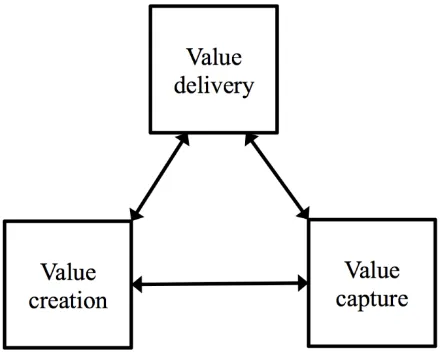
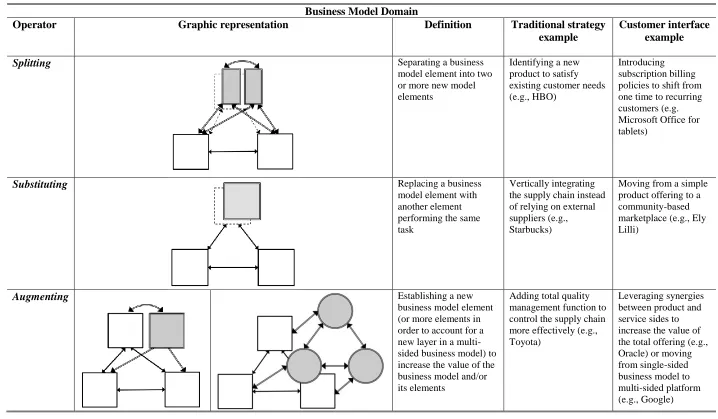
Mangematin, 2013; Demil & Lecocq, 2010; Osterwalder & Pigneur, 2010) but rather to identify a set of activities which represents a general system of value (1) creation, (2) delivery, and (3) capture that could be relevant to all businesses. In doing so, we note in Table 4 two possible types of examples following our discussion of the locus of attention in strategic management – one that focuses on manipulating elements that are internal to the firm and one that focuses on manipulations of the customer interface. We use this parsimonious representation to identify the basic modular system of the business model, and use it in our vignettes to provide examples of business model modeling. The links connecting the three inter-connected elements (as represented by the square boxes in Figure 1) indicate that these activities are not fully independent, but rather there is some degree of residual dependence (i.e., quasi-decomposability) between them, and, from a cognitive perspective, they can be perceived as part of an overall system - the overarching business model. In Table 4, business model elements (and related arrows) are represented differently according to how the application of the modular operator affects them: single solid lines correspond to pre-existing elements which are not influenced by the modular operator; double lined, grey filled, elements are new elements that are introduced in the business model by the operator; and elements which are eliminated from the business model appear in dotted lines (note also that squares and circles are used to distinguish between elements belonging to different business models, or different sides of a multi-sided business model).
Table 4: Definitions of modular operators and examples for business modeling
Business Model Domain
Operator Graphic representation Definition Traditional strategy
example
Customer interface example
Splitting Separating a business
model element into two or more new model elements
Identifying a new product to satisfy existing customer needs (e.g., HBO)
Introducing subscription billing policies to shift from one time to recurring customers (e.g. Microsoft Office for tablets)
Substituting Replacing a business
model element with another element performing the same task
Vertically integrating the supply chain instead of relying on external suppliers (e.g., Starbucks)
Moving from a simple product offering to a community-based marketplace (e.g., Ely Lilli)
Augmenting Establishing a new
business model element (or more elements in order to account for a new layer in a multi-sided business model) to increase the value of the business model and/or its elements
Adding total quality management function to control the supply chain more effectively (e.g., Toyota)
Inverting Leveraging a specific part of a business model, to stand alone element or stand-alone business model
Creating new stand-alone departments from a firm’s existing departments (e.g., Xerox Centralized Print Services)
Elevating a part of the business model from peripheral to core status (e.g., Gillette razor-blade)
Excluding Removing a component
to narrow down the business model’s function
No frills offering at lower cost (e.g., Ryanair)
Stripping down additional services and sides of a business model (e.g., US National Public Radio)
Porting Moving a business
model component (or an entire model) from one domain to another
Adapting the razor-blade model from shaving to printers (e.g., Epson Printers)
Importing social-network interaction into video gaming (e.g., Sony Playstation)
Legend:
Splitting
The first fundamental operator in modularity is splitting, which consists in separating a module by dividing it into two or more (independent) sub-elements. This is consistent with the idea that conceptualizing the design of an artifact at a finer grain gives the opportunity to experiment with many more design specifications, thus speeding up the quest for performance-enhancing solutions. In the technological domain, a typical example of this operator is represented by reworking activities within a product architecture aimed at isolating some features or tasks belonging to a relatively large component, as, for instance, in the case of the transition from integrated to swappable batteries in electronic devices.
Cognitively applying this operator to business modeling generally entails focusing on aspects of a business model at a finer level of detail, again by dividing one or more elements into smaller sub-elements. While business model changes might derive directly from splitting at the technological level (e.g., the advent of the centralized computing paradigm in favor of client-server solutions, which resulted in novel business models for the software industry), in other instances such splitting might occur at a more abstract - business model - level. In this case, splitting can be interpreted as the action of dividing one business model element into two or more subcomponents which perform more specialized tasks. For instance, one could distinguish, within the general ‘value capture’ module, between revenue model and cost model components. Such splitting allowed Microsoft to focus on their revenue model and come up with a subscription offering for Office in the tablet market, allowing the recurring billing of customers who had formerly been one-time purchasers, leaving the cost model untouched. Likewise, in value creation, one could focus separately on customer engagement and customer sensing. In other words, generally speaking, splitting a module might require the reworking of some activities in the remaining model elements to preserve the business model’s overall consistency. Thus, we can argue that:
Proposition 1: In the business model domain, ‘splitting’ is the operator that enables
cognitive inquiries into the separation of an individual element into two or more
sub-elements.
Substituting
in terms of producers experimenting with their technology product architectures, such as swapping a type of processor or software in a personal computer as a way of introducing variety and higher performance in a product line, or improving a mobile phone’s wi-fi connectivity by substituting a GPRS-based data service with a component that can support faster connectivity (e.g., 2G, 3G, 4G, etc.).
In general terms, a business model undergoes an element substitution process every time one or more value creation, delivery or capture elements are replaced by another which, despite being internally arranged with a different set of activities, performs the same task in the business model architecture. Scholars or managers may use such archetypal ‘swapping’ operations to evaluate the effectiveness of incremental business model innovation (e.g., ‘Leaving everything else untouched, what if we change this?’). This can take the form of high-level abstraction - e.g., at the value creation level: (‘Could we engage the customer through a taxi, rather than a bus, mode?’) - or a more practical evaluation of alternative ways to implement activities pertaining to a specific business model element (e.g., substituting the standard ‘paid’ mode by introducing ‘free-to-play’ or ‘freemium’ modes in an app’s value capture mechanism). However, this type of change might force managers to reconsider their product types, as free-to play games (e.g., Angry Birds) might need to be designed to fit with the requirements of in-game advertisers. To be effective, substitution needs to also consider the overall business model and re-design some of its elements within the interplay between the system and its elements. Consider crowdsourcing as the poster child of substituting, e.g., Amazon’s Mechanical Turk micro-task platform or Eli Lilly’s InnoCentive marketplace for innovative ideas. In both these cases, the business model innovation lies in conceptualizing alternative ways to organize and execute production or design/ideation tasks by engaging large external crowds of contributors in the firm’s business operations. So we can posit that:
Proposition 2: In the business model domain, ‘substituting’ is an operator that allows
cognitive inquiries into replacing one original business model element with a different
one that performs the same task but in a different way.
Augmenting
Augmenting in business modeling can mean developing additional value creation mechanisms to satisfy existing customer needs, as in the case of HBO exploiting value creation via reselling third-party content and producing its own original series. Or one could enhance and exploit synergies by augmenting existing elements with additional benefits. For example, SAP or Oracle might benefit from connecting their software sales (which respond to a typical product business model) to an after-sale business model such as customization and consulting for product implementation. This might provide an efficient product-service bundle, which extends their monetization options thanks to effective servitization. However, when this happens, SAP or Oracle might not only need to reshape their products (to make sure they favor customization), but also their pricing schemes and organizational structures in order to move value creation resources from their pre-sale to post-sale activities
In cognitive terms, scholars or practitioners might apply augmenting to their business model whenever they introduce a new element to exploit synergies with different value creation, delivery, or capture mechanisms. Another, even more radical way, to apply augmenting would be by introducing many elements in parallel in order to account for a new layer in a multi-sided business model. For example, Google’s initial business model was single-mindedly focused on creating value for its search engine’s final users, with a clear emphasis on reaching a critical mass of such users. But it was later developed into a fully-fledged multi-sided platform where monetization was via channeling users’ attention towards clicks paid for by advertisers, a different side of the market that was augmented into the original business model. However, in order to maximize the value of this operation, Google had to undergo a major redefinition of its platform design, to allow (for example) sponsored links, and reference systems for various products. In general terms, augmenting starts by introducing a different category of user/customer who will both contribute to value creation for the original user/customer and can be the subject of a new value creation module. The shift from a single to a multi-sided business model also very often requires thinking about different value delivery and capture mechanisms for the new side. Thus:
Proposition 3: In the business model domain, ‘augmenting’ is the operator that allows
cognitive inquiries into establishing or leveraging complementarities across different
sides of a business model, to increase the value of the business model and/or of its
constituent elements.
Inverting
within a module and promoting it as a stand-alone module or architecture. An example of such an action in the technology design domain is the case of the development of UNIX as a stand-alone operating system, starting from its predecessor’s (DEC’s) embedded operating system.
In terms of conceptualizing business models, inverting can be achieved by selecting an element which is merely instrumental to value creation, delivery, or capture in a given business model and elevating it to the status of the focal point in a new business model configuration. Take, as an example, the iconic razor and blades business model popularized by Gillette: innovating the traditional business model, where value capture is the direct consequence of selling a product as a whole, towards a loss leadership/freebie business model which leverages complementary assets, is a straightforward interpretation of the notion of ‘inverting’ in business modeling. Another example is represented by the recent rise of TV formats (e.g., game, quiz and reality shows) within the television industry: once internally developed as part of a particular TV network’s overall offer, today they have increasingly become autonomous products produced and marketed by external production companies (such as the entertainment production company Endemol) across different media and targeting audiences in various worldwide markets. Similar to the other operators, inverting can only be maximized by considering the possibility that other business model elements might need to undergo adjustments in order to guarantee the new business model’s effectiveness. Thus, in moving from a traditional business model to its ‘razor-blade’ one, Gillette had to undergo a redefinition of both its product architecture and its pricing mechanisms, which led to significant increases in the prices of the blades and the razor itself being sold at a discount. Thus, we advance the following:
Proposition 4: In the business model domain, ‘inverting’ is the operator that enables
cognitive inquiries into the promotion of a distinct, peripheral business model element
into a core, stand-alone status.
Excluding
The excludingoperator is applied by scholars or managers inquiring into eliminating parts of a business model, for example by removing a specific customer segment or even a whole side of a multi-sided business model. Excluding can be a powerful cognitive pattern to evaluate more parsimonious business model configurations by leveraging on a firm’s core competences. On a more practical level, excluding can be observed every time a business refocuses its value creation and capture efforts for particular customers. Public radio broadcasting (e.g., US National Public Radio) represents an alternative to commercial radio broadcasting, where advertising is excluded and radio stations seek voluntary contributions from listeners as a simpler value capture device. Another iconic example is low-cost airlines such as Easyjet or Ryanair, which strip the flying experience of its complementary service elements (e.g., free food, pre-assigned seats, included checked-in baggage, etc.) down to the minimum to achieve more competitive pricing. Thus our fifth proposition is:
Proposition 5: In the business model domain, ‘excluding’ is the operator that enables
cognitive inquiries into eliminating parts of a business model, for example, turning a
double-sided business model into a single-sided one.
Porting
Finally porting involves moving a module from one architecture to another, as in the case of using a Linux server within a Windows or an Apple based PC network, by exploiting increased compatibility in the interfaces that allow the various modules to communicate with each other.
In terms of business modeling, porting is implemented by moving whole business models (or some of their elements) from one domain to another. Firms tend to engage with a specific set of business models, but porting elements or entire models in from another industry might create the opportunity for a ‘new-to-the-industry’ business model, which could improve value creation and capture. Take, as an example, the case of Zynga, the largest developer of social games, which has increased its users’ experience by allowing them to play with peers via mobile apps enhanced with several social networking features. This type of value delivery has also been implemented by Sony’s Playstation and Microsoft’s X-Box, which now offer web-based multiplayer functionalities with social networking features. These video-games examples seem to focus on porting a specific element (the social-network or the peer-to-peer customer engagement) from the social networking (e.g., Facebook) domain to that of video gaming.
increasing introduction of sharing economy models, such as collaborative consumption, into traditional business models such as car rental (e.g., the Zipcar business model). Generally speaking, every time scholars or practitioners speculate on ‘how to become the Airbnb of industry X’ or ‘the Ikea of industry Y’, they are making a thought exercise based on the idea of porting. Still, porting a whole business model is an operation that needs not only consideration of the new business model in its entirety, but also its complementarities with other existing business models in the portfolio (when relevant). For example, major airlines wanting to embrace a complementary low-cost service based on a ‘Ryanair-like business model’ may need to adjust the pricing and services of their prime operation to avoid cannibalization between their own business models. A holistic view of these factors must also consider business model configurations at the portfolio level. Thus we propose:
Proposition 6: In the business model domain, ‘porting’ is the operator that enables
cognitive inquiries by adopting a business model (or some business model elements)
from different domains and industries, and which are which ‘new to the field’.
So far, we have sketched a first overview of the possible opportunities derived by extending some key principles of modularity into business model thinking and manipulation. We have generalized the modularity operators in terms of cognitive patterns that scholars or practitioners might find useful to think about when renewing their business models. We have also considered how those who want to manipulate model elements need to consider the parallel effects on the business model as a whole, or in some cases even at the business model portfolio level. The examples above suggest practical ways in which applying modular operators might help them delve more systematically into thinking and classifying business model change. Moreover, we have considered how scholars and managers might gather deeper insights by looking at existing iconic patterns of business model innovation from their direct competitors, or from other industries.
allowing final users to buy from both their and their complementors’ catalogues can be seen as an example of augmentation, which led to Amazon refashioning its e-commerce platform into a fully double-sided market. Finally, the more recent introduction of Amazon Simple Storage Service (S3) can be seen as the result of inversion, where Amazon’s internal assets, traditionally used instrumentally to connect with traditional customers, become the subject of its new Internet-based services and infrastructures offering. All these changes need to fit within an overall portfolio strategy where Amazon adjusts multiple business model elements to make sure that the individual business models first work holistically in themselves, and ultimately within the configurations of its whole business model portfolio.
Business Models and Modularity:
Contributions and Research Agenda
Our paper provides insights into the debate on business modeling and innovation by looking at the business model through a modularity perspective. We speculate about a grammar for describing business model changes in terms of a series of basic operations that can be performed at the cognitive level, and eventually at the activity system level, on a given business model. The (challenging) processes of modularizing and manipulating a model depend strongly on a specific property called decomposability - namely the extent to which a system can be subdivided into loosely coupled sub-elements - which is a key characteristic of all complex systems. This conceptualization has been strongly influenced by Simon’s (Simon, 1962) idea of nearly decomposable hierarchic systems, architectures where interactions within the various subsystems occur at a higher scale and frequency than those that take place across different subsystems. In such instances, even if the decomposability is only imperfect, and some residual interdependencies between subsystems might eventually remain to be dealt with, modularity can act as a first useful approximation to orient cognitive problem-solving activities: effectively breaking down the complexity of the whole system to make problems manageable (Baldwin & Clark, 2000). Thus, higher levels of performance of the whole system could be reached by optimizing its component subsystems. Our classifications provide a basic set of operators to understand such modular-based optimization patterns. However, our contribution can only scratch the surface of such a complex and profound issue, and leaves several possibilities for future investigation.
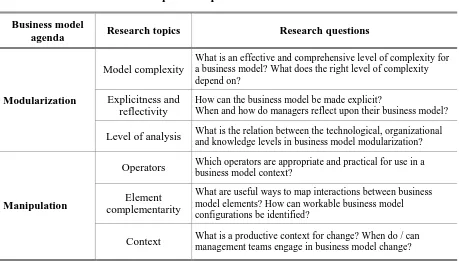
Table 5: Research topics and questions for business model research
Business model
agenda Research topics Research questions
Modularization
Model complexity
What is an effective and comprehensive level of complexity for a business model? What does the right level of complexity depend on?
Explicitness and reflectivity
How can the business model be made explicit?
When and how do managers reflect upon their business model?
Level of analysis What is the relation between the technological, organizational and knowledge levels in business model modularization?
Manipulation
Operators Which operators are appropriate and practical for use in a
business model context?
Element complementarity
What are useful ways to map interactions between business model elements? How can workable business model configurations be identified?
Context What is a productive context for change? When do / can management teams engage in business model change?
Among those research opportunities, we isolate a set of compelling questions. For example, what are the conditions under which managers can tackle the challenge of effectively specifying a business model in modular terms? If quasi-decomposability in the underlying architecture allows modular upgradability in complex systems, which principles allow similar innovation patterns in the case of business model manipulation? While the idea that highly independent business model elements allow for simpler experimentation paths towards configurations that yield higher performance seems both straightforward and intriguing, spelling out the recipe for modularization remains challenging. How to reach a quasi-decomposable model should be a key topic for future research.
business model’s entire architecture (i.e., identifying its elements and how their interfaces specify how they are supposed to interact), the design rules that are effective in business modeling are those that make the elements and their interactions explicit in terms of the fundamental value generation, delivery, and capture issues.
In addition to this cognitive perspective on business model modularization, there are two other major enabling factors which can help the modular reconfiguration of a business model. First, there is growing evidence that technological improvements in Information and Communication Technologies (ICT) are enabling the emergence of new business opportunities (Baldwin & Clark, 2000; Brusoni & Prencipe, 2006). Digitalization has allowed shifts in monetization schemes in some content industries from flat fees to pay per use modes, which would previously have been technologically impossible. Thus ICT enables business model changes via the upgrading of their elements, as well as possibly in other ways. Second - beyond purely technological enablers such as ICT - the material and architectural traits of artifacts can create opportunities for new divisions of labor and innovation which promise to have implications for business units or for whole value chains (Amit & Zott, 2001; Zott & Amit, 2008). Moving from interconnected artifact designs towards modularized architectures allows greater opportunity for outsourcing, subcontracting, functional changes, and innovation. Overall, this trend allows for the introduction of changes at the value delivery level by introducing alternative value chain schemes that leave existing value creation and capture mechanisms virtually untouched. It might be interesting to understand how these might influence the architectures of the whole ecosystems on which business models are based (Brusoni et al., 2001; Henderson & Clark, 1990; Kallinikos, 2012). Again, this might be seen as an instance of business model innovation through element upgrading.
of teams should be aligned with the modularity of the technologies on which they are working. When referring to the modularity of business models, we also talk about a third level - the knowledge domain (Brusoni & Prencipe, 2006: 185) - which precedes and accompanies both the organizational and the technology domains, in that managers need to understand what they are modularizing and why - in terms of both business activities and technologies.
The second set of questions, which relate to the issue of manipulability and its boundary conditions, also deserves particular attention. First, some of the lessons learned from modularity can be applied fruitfully regardless of the extent to which a business model is truly modular. Applying modularity principles and operators can also be helpful as a first cognitive approximation in settings where the business model is not made explicit, or is best described as non-modular or as deeply intertwined. In many instances, it may seem that business models are delicate, tightly interconnected systems of parts where changing even a single element could trigger a series of adjustments that would influence the model’s overall integration and performance. In this regard, different levels of integration between elements - e.g., tightly vs. loosely coupled relationships (Brusoni & Prencipe, 2001b) - might moderate the relationship between a change in an element and the system’s overall performance, thus leading to different outcomes. For instance, simply introducing a premium service on top of a previously free offering will not work out effectively in a business model without also retouching the value creation domain that is being adjusted (the premium user might be not the same as the free user, and engaging such consumers might require different skills). In terms of modularity theory, such a change would trigger a sequence of testing and integration activities between the elements (given their interdependencies, and due to the model’s non-decomposability), which might entail adjustments or revisions in various elements before a satisfactory outcome can be reached. This also connects to the idea of product or service bundling (Stremersch & Tellis, 2002), in the sense that bundling different elements together (e.g., different value offers, such as the premium and the free) will lead to the configuration of the business model (e.g., into a freemium model) whose effects might differ from those of just the sum of the two configurations in isolation.
an ideal guide - but we can identify three research topics that may help shed light on the application of the operators: the complementarity of elements within business model configurations; the context of manipulation in collective thinking; and engagement among the management team.
Many large companies engage in running more than one business model simultaneously (Casadesus-Masanell & Tarzijan, 2012; Markides & Charitou, 2004), and the manipulation of a business model may lead to complementarities between those different models. Random manipulation cannot be a goal, but rather an informed play that may result in new business model configurations that promise to be viable innovations when implemented. In order to understand complementarities among business model elements (and between entire models) it may first of all be helpful to map and follow the interactions that exist in the current configuration. Value delivery involves upstream and downstream partners, whose behaviors may be beyond the control of the focal firm, and such partners may limit information flows about their critical strategic moves. Future research in strategy should consider multiple business models explicitly, and which sorts of configurations prove viable for firms. Literature on this topic is scarce, despite the insights that complementarities between business models matter both for performance and for competitive dynamics and innovation.
Finally, our analogical reasoning compares technology and business model operators, suggesting that modularity theory might inform both technologies and business models. However, a well-known trade-off applies in both fields: the modularization of a system should not be thought of as being independent of its environment, lest it suffers from being locked in to inferior designs or inefficient search patterns (Baden-Fuller & Haefliger, 2013). Thus, the modularization of a business model as a cognitive task should take into account the intensity of environmental change: this is a prerequisite for effective business model change, and so may be a limitation on the usefulness of the operators we outline above.
watch, learn, and agree on what the new production will look like: only then can implementation start and the new strategy hit the ground running. We are confident that future research leveraging modularity theory can inform scholars and practitioners about the challenging process of understanding the interplay between cognition and action in business model innovation.
Acknowledgements
We would like to thank Mary Morgan for many insightful discussions on the role of cognition and modularity in business models. We gratefully acknowledge the AiSM Special Issue Senior Editor Vincent Mangematin and the two anonymous reviewers for their expert and constructive comments. We also thank Santi Furnari, Alessandro Giudici, Alessandro Narduzzo, Simone Santoni, Valerie Sabatier, Enrico Zaninotto and all the participants at the internal ‘brown-bag’ seminar series and the Business Model Mini Conference at Cass Business School for their precious suggestions. This work was supported by the European Commission’s Marie-Curie Actions (Project nr. 301688 - Project Acronym AJ86RH5GYM - FP7-PEOPLE-2011-IEF) and the EPSRC UK Research Council (EP/K039695/1 Building Better Business Models).
References
Amit R. & Zott C. (2001). Value creation in e-business. Strategic management journal, 22(6-7): 493-520.
Austin R.D. & Devin L. (2003). Artful making: What managers need to know about how artists work: FT Press.
Baden-Fuller C. & Morgan M.S. (2010). Business models as models. Long Range Planning, 43(2-3): 156-171.
Baden-Fuller C. & Haefliger S. (2013). Business Models and Technological Innovation. Long Range Planning, 46(6): 419-426.
Baden-Fuller C. & Mangematin V. (2013). Business models: A challenging agenda. Strategic Organization, 11(4): 418-427.
Baldwin C., Hienerth C. & Von Hippel E. (2006). How user innovations become commercial products: A theoretical investigation and case study. Research policy, 35(9): 1291-1313. Baldwin C.Y. & Clark K.B. (2000). Design rules: The power of modularity: The MIT Press. Baldwin C.Y. & Clark K.B. (2003). Managing in an age of modularity, Managing in the Modular
Age: Architectures, Networks, and Organizations: 149-171. Oxford: Blackwell Publishers.
of firms. Industrial and corporate change, 17(1): 155-195.
Barney J.B. (1991). Firm Resources and Sustained Competitive Advantage. Journal of Management, 17(1): 99-120.
Bonina C. & Liebenau J. (2015). Modularity, technology and business model innovation. Working Paper.
Boumans M.J. (2009). Grey-Box Understanding in Economics. In H. W. De Regt & S. Leonelli & K.-O. Eigner (Eds.), Scientific Standing: Philosophical Perspectives: 210-229. Pittsburgh, PA: University of Pittsburgh Press.
Brusoni S. & Prencipe A. (2001a). Unpacking the black box of modularity: technologies, products and organizations. Industrial and Corporate Change, 10(1): 179-205.
Brusoni S. & Prencipe A. (2001b). Managing knowledge in loosely coupled networks: exploring the links between product and knowledge dynamics. Journal of Management Studies, 38(7): 1019-1035.
Brusoni S., Prencipe A. & Pavitt K. (2001). Knowledge Specialization, Organizational Coupling, and the Boundaries of the Firm: Why Do Firms Know More Than They Make? Administrative Science Quarterly, 46(4): 597-621.
Brusoni S. & Prencipe A. (2006). Making design rules: A multidomain perspective. Organization science, 17(2): 179-189.
Brusoni S., Marengo L., Prencipe A. & Valente M. (2007). The value and costs of modularity: a problem-solving perspective. European Management Review, 4(2): 121-132.
Casadesus-Masanell R. & Ricart J.E. (2010). From strategy to business models and onto tactics. Long Range Planning, 43(2-3): 195-215.
Casadesus-Masanell R. & Tarzijan J. (2012). When One Business Model Isn't Enough. Harvard Business Review, 90(1-2): 132-137.
Chesbrough H. & Rosenbloom R.S. (2002). The role of the business model in capturing value from innovation: evidence from Xerox Corporation's technology spin‐ off companies. Industrial and corporate change, 11(3): 529-555.
Chesbrough H. (2010). Business model innovation: opportunities and barriers. Long range planning, 43(2-3): 354-363.
Demil B. & Lecocq X. (2010). Business model evolution: in search of dynamic consistency. Long Range Planning, 43(2-3): 227-246.
Devetag G. & Zaninotto E. (2001). The imperfect hiding: Some introductory concepts and preliminary issues on modularity. ROCK Working Papers.
Doz Y.L. & Kosonen M. (2010). Embedding strategic agility: A leadership agenda for accelerating business model renewal. Long Range Planning, 43(2-3): 370-382.
Eisenmann T., Parker G. & Van Alstyne M. (2011). Platform envelopment. Strategic Management Journal, 32(12): 1270-1285.
French S., Maule J. & Papamichail N. (2009). Decision behaviour, analysis and support: Cambridge University Press.
Füller J., Jawecki G. & Mühlbacher H. (2007). Innovation creation by online basketball communities.
Journal of Business Research, 60(1): 60-71.
Gambardella A. & McGahan A.M. (2010). Business-model innovation: General purpose technologies and their implications for industry structure. Long Range Planning, 43(2-3): 262-271.
Garud R. & Kumaraswamy A. (1993). Changing competitive dynamics in network industries: An exploration of Sun Microsystems' open systems strategy. Strategic Management Journal, 14(5): 351-369.