City, University of London Institutional Repository
Citation:
Lavelle, M., Healey, P. G. T. and McCabe, R. ORCID: 0000-0003-2041-7383 (2014). Nonverbal Behavior During Face-to-face Social Interaction in Schizophrenia. The Journal of Nervous and Mental Disease, 202(1), pp. 47-54. doi:10.1097/nmd.0000000000000031
This is the accepted version of the paper.
This version of the publication may differ from the final published
version.
Permanent repository link:
http://openaccess.city.ac.uk/21763/Link to published version:
http://dx.doi.org/10.1097/nmd.0000000000000031Copyright and reuse: City Research Online aims to make research
outputs of City, University of London available to a wider audience.
Copyright and Moral Rights remain with the author(s) and/or copyright
holders. URLs from City Research Online may be freely distributed and
linked to.
City Research Online: http://openaccess.city.ac.uk/ [email protected]
Running title: Nonverbal behaviour: Schizophrenia
Title: Nonverbal behaviour during face-to-face social interaction in schizophrenia: A review.
1,2
Mary Lavelle PhD., 2Patrick G.T. Healey PhD., 1Rosemarie McCabe PhD.
1
Unit for Social and Community Psychiatry, Barts and the London School of Medicine and Dentistry, Queen Mary, University of London.
2
Interaction, Media and Communication Research Group, School of Electronic Engineering & Computer Science, Queen Mary, University of London.
Corresponding Author: Mary Lavelle. Unit for Social and Community Psychiatry, Newham Centre for Mental Health,
London, E13 8SP.
email: [email protected] Telephone: +44(0) 207 882 7559 Fax: +44 (0)20 8980 6533
Funding body: This work was funded by the Engineering and Physical Sciences
Patients with a diagnosis of schizophrenia display nonverbal deficits in social cognitive assessments. However, little is known about patients’ nonverbal communication during social
encounters. This review identified seventeen studies investigating nonverbal communication in patients’ unscripted face-to-face interactions addressing: (i) nonverbal differences between patients and others; (ii) nonverbal behaviour of patients’ partners; associations between
nonverbal behaviour and (iii) symptoms and (iv) social outcomes. Patients displayed fewer nonverbal behaviours inviting interaction, with negative symptoms exacerbating this pattern. Positive symptoms were associated with heightened nonverbal behaviour. Patients’ partners
changed their own nonverbal behaviour in response to the patient. Reduced pro-social behaviours, inviting interaction, were associated with poorer social outcomes. Patients’
increased gestures, signaling communication difficulty, were associated with poorer rapport. The evidence suggests that patients’ nonverbal behaviour during face-to-face interaction is influenced in different ways depending on their symptom profile, in particular negative symptoms, and this impacts the success of their social interactions.
Key words: Nonverbal communication; schizophrenia; social interaction; conversation.
Introduction
One of the most debilitating features of schizophrenia is social dysfunction. Patients with schizophrenia have very low rates of employment (Marwaha et al, 2004) and are one of the most socially excluded groups (Social Exclusion Unit, 2004). Compared to matched healthy controls, or patients with other psychotic disorders, patients have fewer social networks and fewer people to turn to in a crisis (Erickson et al, 1989; Macdonald et al, 2000). Social deficits are present prior to the onset of positive symptoms, such as hallucinations and delusions (Addington et al, 2008), remain stable over time and predict poorer patient prognosis (Monte et al, 2008). However, the precise nature of patients’ social deficits remains unknown.
During face-to-face interaction the majority of communication is conveyed nonverbally through cues such as; facial expressions, posture, head and body movement, and hand and arm gestures (Burgoon et al, 1989). Nonverbal cues have specific communicative meanings, which can be identified and classified. They convey critical information about the dynamics of the interaction, including; when a speaker will start and end their turn, the role of each partner in the conversation (e.g. as speaker or listener) and the level of engagement, shared understanding and affiliation between partners (Bavelas et al, 2007; Kendon, 1970). The ability to coordinate and communicate nonverbally is critical to successful interaction and associated with better interpersonal relationships such as better rapport (Lakin et al, 2003; Miles et al, 2009).
Nonverbal communication is thought to be problematic in schizophrenia. The phrase ‘Praecox feeling’ was part of the working language of early psychiatrists describing the intuitive feeling of a
patients’ task performance reflects the social deficit present in their daily lives. Although much
research has been conducted on verbal communication in schizophrenia (DeLisi, 2001), comparatively little is known about patients’ nonverbal communication during face-to-face social interactions with others. Identifying the pattern of nonverbal behaviours manifest in patients’ social encounters is a crucial first step in specifying the nature of patients’ social deficits and their
potential impact on patients’ wider social functioning.
Hence, the aim of this paper was to identify studies investigating nonverbal communication during actual social interactions between patients with a diagnosis of schizophrenia and others in order to identify the methods employed to assess social interaction and review and synthesize the findings.
Methods
This was a nonsystematic review. The bibliographic databases PubMed (Medline) and Ovid (PsycINFO) were searched to identify studies published over the last three decades between January 1979 and July 2012. The following two groups of search terms were used: (1) Schizophrenia/ schizoaffective disorder/ schizo*, psychosis/psychotic and (2) nonverbal/non-verbal, communicat*, social interaction, interpersonal, motion. Terms in group 2 were searched in combination with the terms in group 1. Searches were adapted for each database and performed independently. Titles and abstracts were identified that potentially fulfilled the inclusion criteria of:
1. Unscripted face-to-face social interactions involving patients with a diagnosis of schizophrenia, schizoaffective disorder or schizophreniform disorder.
2. Nonverbal behaviour of the schizophrenia patient, their partner(s) or both was audio-visually recorded or motion captured.
3. Nonverbal assessment was a main focus of the study
As the focus of this review was to assess nonverbal communication in patients’ free, unscripted,
face-to-face interaction, studies involving scripted role-play tasks (e.g. (Kupper et al, 2010) or interactions that were not conducted face-to-face (e.g. (Gaebel et al, 2004) were excluded.
Results
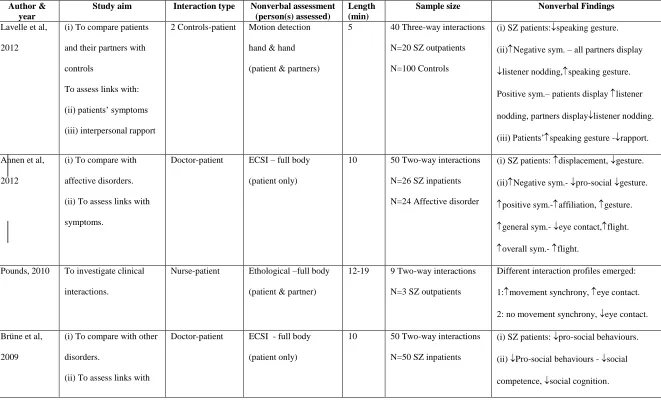
Seventeen articles were identified that met the inclusion criteria (table 1). Studies were geographically diverse spanning Europe, America and Australia. Sample sizes ranged from 3-78 (M=41.50, SD=22.35). The studies investigated nonverbal communication in schizophrenia inpatients and outpatients. Interactions were recorded in clinical settings with health care professionals, or in non-clinical settings, with familiar or unfamiliar others. The studies assessed nonverbal communication on one of three levels: (1) nonverbal behaviour of the patient only, (2) nonverbal behaviour of the patient and their interacting partner(s) and (3) nonverbal communication of the patient and their partner as a single unit.
Measuring nonverbal communication
The methods used to measure nonverbal behaviour fall into two broad categories: (1) Ethological methods, which interpret nonverbal behaviours in terms of their function and meaning in social communication (Geerts et al, 2009; Troisi, 1999) and (2) Motion-based methods, which measure precise movements of interacting partners.
Ethological methods
(Troisi, 1999) to dyadic clinical interactions (Annen et al, 2012; Brüne et al, 2009; Brüne et al, 2008; Dimic et al, 2010; Troisi et al, 2007; Troisi et al, 1998). The ECSI consists of 37 behaviours (such as eye blink, gaze direction, facial movements, body posture and hand and arm gesture during speech), which vary in their complexity. These behaviours are grouped into nine behavioural categories: eye contact (looking at the interviewer); gesture (hand and arm movements using during speech signaling communicative effort); affiliation behaviours (expressions of friendliness); submission behaviours (signals of appeasement of the other, preventing hostile contact); flight behaviours (signaling avoidance of social stimuli); assertion behaviours (expressions of aggression); displacement behaviours (signaling tension, conflict or emotive arousal); relaxation (signaling low level of emotional arousal); and pro-social behaviours (made up of a combination of affiliation behaviours [expressing friendliness] and submission behaviours [expressing the appeasement of others to prevent hostile contact]).
One study investigated patients’ eye contact during clinical interactions (Troisi et al, 1991). Three studies employed individually designed ethograms to assess patients’ head and facial nonverbal
behaviour during dyadic clinical interactions (Davison et al, 1996; Jones et al, 1979; Pitman et al, 1987). Jones & Pansa (1979) also assessed patients’ displacement behaviours, such as patients touching their face or body with their hands. Studies conducted by Pitman et al (1987) and Davison et al. (1996) also rated patients’ nonverbal behaviour in the context of whether the patient was
speaking or silent when the behaviour was produced.
full body nonverbal behaviours, grouped into five ethological categories: engagement, inclusiveness, defensiveness, congruence and rhythmicity. In this study nonverbal behaviours were rated if they occurred during the interaction but not attributed to either partner.
Three ethological studies were conducted outside of a clinical setting. Meilijson et al. (2004) employed the pragmatics protocol, developed by Prutting & Kirchner (1987), to assess the appropriateness of patients’ behaviour, including nonverbal behaviour such as facial expressions,
gestures, body posture and eye gaze, during interactions with familiar and unfamiliar others. Two experimental studies employed variants of the Facial Action Coding (FAC) system, developed by Ekman & Friesen (1978), to assess the facial expressivity of patients and their interacting partners (Ellgring, 1986; Steimer-Krause et al, 1990). Ellgring et al. (1986) experimentally assessed the degree of coordination between speech and facial expressivity in patients’ interactions with relatives. Patients and their partners’ facial expressions were coded in the context of whether they
were speaking or silent when the behaviour was produced. Steimer-Krause et al. (1990) objectively examined transference and counter-transference in patients’ interactions, with unfamiliar others who were unaware of their diagnosis, through assessment of facial affect in patients and their interacting partners.
Motion-based methods
Two studies investigated head and body motion during patients’ non-clinical, three-way interaction
(Altorfer et al, 1992; Lavelle et al, 2012). Altorfer and colleagues (1992) assessed patients’ interactions with two parents. Observers rated the frequency, degree and duration of patients’ head,
Lavelle et al. (2012) employed simultaneous 3-dimension motion-capture technology and audio-visual cameras to record patients’ three-way interactions with two unfamiliar healthy controls. The
head and hand movements of patients and their partners were automatically detected in 3D. They investigated nonverbal behaviour of patients and their partners in the role of listener and speaker.
Patients’ communication
Studies employing ethograms to investigate patients’ facial behaviours found that, compared to
control participants, patients displayed less variability and complexity in their facial expressions and less upper facial movements, including those used to convey positive affect such as smiling (Jones et al, 1979; Steimer-Krause et al, 1990; Troisi et al, 2007). Patients displayed facial expressions conveying negative emotions, including those to promote distance such as anger (Steimer-Krause et al, 1990). Patients’ nonverbal facial expressivity was also found to be less coordinated with speech (Ellgring, 1986): controls displayed more than 70% of their facial expressivity as speaker, compared to 50% for patients.
Studies investigating patients’ head and body behaviours found that, compared to controls, patients
displacement and flight behaviours (Brüne et al, 2008; Troisi et al, 1998), comparisons with other patient groups reported an increase in displacement and flight behaviours in schizophrenia (Annen et al, 2012; Dimic et al, 2010).
A limiting feature reported by all studies reviewed was large variation in patients’ nonverbal
behaviour, with some patients displaying behaviours within the region displayed by controls. Reflecting this variation, Meilijson et al. (2004) identified three nonverbal behaviour clusters in schizophrenia patients: (1) appropriate nonverbal behaviour, (2) minimally impaired nonverbal behaviour and (3) high degree of inappropriate nonverbal behaviour and turn taking. Clusters 2 and 3 displayed particular impairment in body posture, facial expression and gesture use. The patient sample included both inpatients and outpatients, differences were not investigated (Meilijson et al, 2004).
Interpersonal communication
Six studies assessed nonverbal aspects of interpersonal communication between patients and their interacting partners. Three studies investigated the impact of the presence of the patient on the nonverbal behaviour of non-clinical partners (Ellgring, 1986; Lavelle et al, 2012; Steimer-Krause et al, 1990). Pounds (2010) assessed the impact of the patient on their clinical partner, Hardin (1980) provided a nonverbal assessment patients and their partners in an interactional unit and Altorfer (1992) assessed patients’ behaviour in response to specific verbal comments from their interacting partners. These studies will be discussed in turn.
Steimer-Krause et al. (1990) assessed the behaviour of patients and unfamiliar partners who were unaware of the patient’s diagnosis. Partners of schizophrenia inpatients displayed facial behaviours
partners are due to the discrepancy between how they expect the patient to behave and how the patient actually behaves. If the discrepancy is small (i.e. patients are less symptomatic, thus display fewer nonverbal manifestations of their symptoms e.g. outpatients) patients’ partners’
overcompensate to reduce the difference and normalize the interaction. However, when the discrepancy is larger (i.e. patients are more symptomatic, thus display more pronounced nonverbal manifestations of their symptoms e.g. inpatients) patients’ partners adopt the pattern of behaviour
displayed by the patient (Steimer-Krause et al, 1990).
Ellgring (1986) investigated the coordination between an individuals’ verbal (speech) and their
facial expressions. Schizophrenia inpatients showed reduced coordination between their own speech and facial expressivity. Their partners (relatives) also displayed less coordination between their own speech and facial expressivity when interacting with the patient, which was not present during their interactions with others (Ellgring, 1986). Thus, patients’ interacting partners appeared to adopt patients’ reduced coordination pattern.
In a study of patients’ three-way interactions, Lavelle et al. (2012) found that schizophrenia
outpatients, with more negative symptoms, displayed less nodding as a listener and more gesture as a speaker. Their unfamiliar partners, who were unaware of their diagnosis, displayed the same behavioural pattern in response to the patient. The authors suggest that patients’ partners’ increased
speaking gesture use may reflect the greater communicative effort needed in response to the patients’ reduced feedback (i.e. listener nodding) and the more demanding interaction conditions
(Lavelle et al, 2012).
Pounds (2010) investigation of three patients’ dyadic interactions with their nurse revealed different
gaze, the nurse employed exaggerated verbal and nonverbal behaviours, including hand gestures, to gain the patients’ attention and engagement.
Hardin (1980) recorded patients’ interactions with (i) other schizophrenia patients and (ii) trainee
nurses. Patient-nurse interactions displayed more frequent and durable periods of engagement, congruent body position and synchronous body and leg movements. Nonverbal communication in the patient-patient interactions were unique in that they displayed very little engagement and no synchronization of leg or body movement (Hardin, 1980). As nonverbal behaviours were coded as a unit it is impossible to say if the highly engaging and congruent pattern in the patient-nurse interaction is due to the behaviour of both participants or just one. However, based on the findings of Steimer-Krause et al. (1990), Lavelle et al. (2012) and Pounds (2010), one hypothesis is that patients’ partners are displaying more engaging and congruent behaviours to compensate for, and
attempt to engage with, the patient.
Altorfer and colleagues (1992) analysed patients’ nonverbal responses to positive and negative comments that were directed towards them by others during interaction. Overall patients displayed more movement when receiving a positive comment and less when receiving a negative comment.
Clinical Symptoms
Seven ethological studies investigated the association between patients’ clinical symptoms and their
nonverbal behaviour during clinical interactions. The findings across theses studies are mixed. Patients’ increased negative symptoms were associated with: reduced pro-social behaviours,
stimuli (e.g. looking away), and reduced assertive behaviours, signaling an expression of anger (e.g. frowning or head shaking) (Brüne et al, 2008; Troisi et al, 1991).
Inpatients’ increased positive symptoms were associated with: increased affiliative behaviours,
expressing friendliness (Annen et al, 2012); increased eye contact with the interviewer, signaling engagement (Troisi et al, 1998); increased use of hand gesture when speaking, signaling communicative effort (Brüne et al, 2008; Troisi et al, 1998); increased flight behaviours, signaling an avoidance of social stimuli and a reduction in submissive behaviours designed to appease their interacting partner and prevent hostile contact (Brüne et al, 2008). Patients’ increased overall symptom severity has been associated with an increase in patients’ flight behaviours (Annen et al, 2012; Dimic et al, 2010) and a reduction in their pro-social behaviours, assertive behaviours and speaking hand gesture (Brüne et al, 2008).
Pitman et al. (1987) assessed nonverbal patterns in schizophrenia patients classed as ‘paranoid’ and ‘non-paranoid’ subtypes. Paranoid sub-type patients display more positive symptoms such as
hallucinations and delusions and minimal negative symptoms. Compared to non-paranoid patients, paranoid patients spoke more and, when speaking, displayed more eye contact with the clinician and less facial expressions. This finding agrees with the increased eye contact in patients with positive symptoms found by Troisi et al. (1998). Non-paranoid patients spoke less, displayed less eye contact with the interviewer and displayed facial behaviours that appeared to be unusual in their timing and unrelated to the interaction context (Pitman et al, 1987). Linking these behaviours to their ethological meaning, the authors suggest that patients with paranoid subtype displayed more assertive behaviours, signaling hostility, whereas non-paranoid patients displayed more flight behaviour, signaling social avoidance (Pitman et al, 1987).
Lavelle et al., (2012) assessed the relationship between patients’ symptoms and the nonverbal
nodding, thought to signal increased nonverbal feedback to the speaker, and their partners displaying less. Patients’ increased negative symptoms were associated with patients and their partners gesturing more when speaking, signaling increased communicative effort, and less nonverbal feedback to the speaker. (i.e. reduced listener nodding). Thus, all partners appeared to display more communicative effort when speaking and less when listening. The association between patients’ negative symptoms and hand gesture differs from the findings of ethological
studies discussed previously (Annen et al, 2012; Troisi et al, 1998). The different methodologies used in these studies may explain the discrepancy. Firstly, Lavelle et al. (2012) assessed patients’
three-way interactions rather than dyadic. Three-way interaction is more communicatively demanding as two interacting partners must be monitored instead of just one. Increased gesture use may reflect the increased communicative effort needed by interacting partners, particularly in these circumstances where the nonverbal feedback from listeners is reduced. Secondly, this study assessed patients’ interactions with unfamiliar others rather than clinical professionals. Thus,
removing the elements of shared history, knowledge of diagnosis and therapeutic relationship, which may influence the behaviour of both interacting partners. Thirdly, this study measured nonverbal behaviour using motion detection rather than observational methods. As such, some behaviours identified as gestures through motion detection may not be identified through observational analysis.
Three studies investigated the relationship between nonverbal behaviour and clinical improvement without specifying symptom type. In an observational case study Pounds (2010) reported that patients displayed less eye contact with their nurse when they were more symptomatic. Jones & Pansa (1979) found patients’ frequency of displacement behaviours, conveying discomfort, tension
schizophrenia outpatients, schizophrenia inpatients (i.e. more symptomatic) displayed more intense expressions of facial affect with a greater reduction in their pro-social facial expressions (e.g. smiling), and an increase in their negative expressions of affect (e.g. anger). Patients’ partners’
expression of facial affect was also dependent on patients’ symptom severity. Specifically, outpatient partners displayed more pro-social expressions of facial affect such as smiling, whereas inpatient partners displayed reduced pro-social facial affect, similar to that of the patient. As discussed previously (section: Interpersonal processes), authors suggest that patients’ partners nonverbal responses are predicted by the discrepancy in patients’ expected and actual behaviour.
Social outcomes
Three studies investigated relationships between patients’ nonverbal behaviour and social outcomes including: functional outcome (Troisi et al, 2007), social cognition, social competence (Brüne et al, 2009) and interpersonal rapport (Lavelle et al, 2012)
Troisi et al. (2007) assessed patients’ functional outcome using the Sheehan Disability Scale
(Sheehan et al, 1996). This is a self-report measure where patients’ rate the degree of disruption their symptoms have on their work, social life/leisure activities or family life/home responsibilities. Patients’ reduced pro-social facial expression was associated with patients rating their symptoms as
having a greater disruption on their work and social life. Furthermore, patients’ pro-social nonverbal behaviour explained a greater variance in patients’ social and occupational disability than
negative symptoms (Troisi et al, 2007).
Based on the assumption that nonverbal expressivity is associated with social functioning (Troisi, 2007) and the evidence for a robust deficit in social cognition in patients with schizophrenia (Penn, 2007), Brüne et al. (2009) investigated the relationship between patients’ nonverbal expressivity, their social competence and social and neurocognition. Patients’ social competence was rated by
patients’ communicative skills, affective symptoms, socially inappropriate behaviours, skills and
movement disorders. Nonverbal expressivity did not correlate with any social or neurocognitive measures. The authors suggested that this was due to patient heterogeneity. To account for this, patients in the highest and lowest quartile of pro-social nonverbal expressivity were compared on the social measures. Compared to high pro-social patients, low pro-social patients had poorer social competence and social cognition. Neurocognition was not associated with any measure of patients’ nonverbal expressivity. A limitation of this study was that the method used to assess patients’ social
competence and their nonverbal behaviour share many similarities, which may lead to inflated associations.
Lavelle et al. (2012) conducted an experimental study to assess the links between patients’ nonverbal communication, social cognition and others’ experience of interpersonal rapport with the patient. Similar to the findings of Brüne et al. (2009) patients’ social cognition was not associated with patients’ nonverbal behaviour. However, patients’ increased use of hand gestures when speaking was associated with others experiencing less rapport with the patient. Indeed, patients’
Discussion
Seventeen studies investigating nonverbal behaviour in face-to-face social interaction were identified. The majority of these studies employed ethological methods, based on the evolutionary study of behaviour, to assess inpatients’ nonverbal behaviour during clinical interactions.
A number of studies found that, during both clinical and non-clinical interactions, inpatients with schizophrenia displayed a reduction in nonverbal behaviours designed to invite social interaction, particularly pro-social facial expressions (Brüne et al, 2009; Brüne et al, 2008; Jones et al, 1979; Steimer-Krause et al, 1990; Troisi et al, 1991; Troisi et al, 2007; Troisi et al, 1998). Studies investigating the nonverbal behaviour of patients’ interacting partners found that they change their
nonverbal behaviour in response to a patient, both when aware (Ellgring, 1986; Pounds, 2010) and unaware of their diagnosis (Lavelle et al, 2012; Steimer-Krause et al, 1990). Patients’ symptoms appear to influence the behaviour of both the patient and their interacting partners. Specifically, patients’ increased negative symptoms were associated with patients’ reduced nonverbal behaviour,
particularly pro-social displays (Annen et al, 2012; Brüne et al, 2009; Brüne et al, 2008; Dimic et al, 2010; Lavelle et al, 2012; Steimer-Krause et al, 1990; Troisi et al, 1991; Troisi et al, 2007; Troisi et al, 1998) whereas, increased positive symptoms were associated with patients’ heightened displays of nonverbal behaviour (Annen et al, 2012; Brüne et al, 2008). This trend differed under the more demanding three-way interaction conditions, where patients with more negative symptoms gestured more when speaking (Lavelle et al, 2012). Partners of schizophrenia patients appear to display a compensatory increase in pro-social expressions, designed to engage the patient, when patients are less symptomatic (Steimer-Krause et al, 1990) and a reduced nonverbal profile, similar to that of the patient, when patients symptoms are more severe (Ellgring, 1986; Steimer-Krause et al, 1990). However, the evidence is insufficient to determine a conclusive pattern. Studies investigating the relationship between patients’ nonverbal behaviour and their social outcomes revealed that patients’
patients’ reporting greater difficulty in their work and social lives (Troisi et al, 2007) and poorer
clinician rated social competence (Brüne et al, 2009). In three-way interactions, patients gesturing more when speaking, signaling increased communicative effort, were rated by others as having poorer interpersonal rapport (Lavelle et al, 2012), suggesting that, in three interactions, patients’ increased hand movement when speaking may be an indicator of an interactional difficulty (Lavelle et al, 2012).
The review identified some conflicting findings between studies. Employing similar ethological methods, some studies reported an increase in patients’ flight behaviours (Dimic et al, 2010; Pitman
et al, 1987), which intensified with increased symptoms (Annen et al, 2012; Dimic et al, 2010). Others reported a reduction in flight behaviour, which was further reduced with increased symptoms (Brüne et al, 2008) and others reported no difference (Troisi et al, 1998). Findings on displacement behaviours, such as self-touching and grooming, which signal emotional arousal or tension, were also contradictory. Compared to controls, Troisi et al. (1998) found schizophrenia patients to display less displacement behaviours, whereas Brüne et al. (2008) reported no difference. Compared to patients with affective disorders, such as depression, schizophrenia patients displayed more displacement behaviours (Annen et al, 2012; Jones et al, 1979).
Meilijson et al (2004), could potentially be more advantageous and beneficial in specifying clinical and biological subgroups of schizophrenia.
Overlapping clinical and nonverbal characteristics between diagnostic groups may also impair the ability to identify patterns of behaviours that are specific to schizophrenia. For example, the pattern of reduced pro-social expression, which has been identified as a marker of schizophrenia in this review, has also been identified in patients with depression (Geerts et al, 2009). Furthermore increased displacement behaviours seen in schizophrenia also act as a marker of anxiety (Troisi, 2002). Studying patients in terms of the nonverbal classifications, as an alternative to diagnostic group, could increase the specificity with which we can study a range of psychiatric disorders.
The ethological studies reviewed focused predominantly on the behaviour of the patient and, as such, provide rich information on patients’ behavioural repertoires. Ethological measures assign
nonverbal behaviours to pre-defined categories that convey communicative meaning, e.g., a laugh is assigned to the category ‘relaxed’. However, the same nonverbal behaviour has different functions
clinical settings, in order to develop a clearer picture of patients’ nonverbal deficits, which are
important both for understanding the nature of the illness and designing targeted interventions. An overarching aim of research within this field is to develop a better understanding of patients’ social difficulties. The majority of research investigating patients’ social deficits do so using social
cognitive assessments (Penn et al, 2007). However, the relationship between patients’ social cognitive performance and the deficits they experience in their social encounters is unclear. The reviewed studies provide some evidence of a link between patients’ nonverbal behaviour during
interaction and their occupational and social disabilities (Troisi et al, 2007), social competence (Brüne et al, 2009) and interpersonal rapport (Lavelle et al, 2012). However, the relationship with social cognition requires further exploration (Brüne et al, 2009; Lavelle et al, 2012). Thus, an important direction for future research is to bridge the gap between patients’ social cognition, nonverbal behaviour and real world social functioning.
The origin of patients’ nonverbal deficits is unclear. It has been hypothesized that nonverbal deficits
may represent a core cognitive deficit, although the evidence for this is insufficient (Brüne et al, 2007; Lavelle et al, 2012). The studies in this review suggest an association between patients’ nonverbal behaviour and symptoms. However, patients’ nonverbal deficits are present as early as
childhood (Schiffman et al, 2004), prior to the onset of any positive or negative symptoms, and show limited improvement with drug treatments that improve patients’ symptoms (Goldberg et al,
2007). Thus, the relationship between patients’ nonverbal behaviour, cognition and symptoms is likely to be complex. Recent findings suggest that, mirror neuron activity, which is activated in the understanding, action and observation of behaviour, is anomalous in patients with schizophrenia and associated with patients’ clinical symptoms (Enticott et al, 2008; McCormick et al, 2012).
Conclusion
In face-to-face interaction, patients with schizophrenia display fewer nonverbal behaviours inviting social interaction. Negative symptoms appear to further reduce these behaviours while positive symptoms may heighten nonverbal behaviours. Others, interacting with patients, change their own nonverbal behaviour, even when unaware of a patient’s presence. Finally, patients’ nonverbal behaviour is associated with their wider social functioning and others’ experience of rapport with
them. Targeting specific nonverbal behavioural deficits in actual social encounters may need to be considered in interventions, such as social skills training, aimed at improving patients’ social functioning.
References
Addington J, Penn D, Woods SW, Addington D & Perkins DO (2008) Social functioning in individuals at clinical high risk for psychosis. Schizophrenia Research, 99, 119-124.
Altorfer A, Goldstein MJ, Miklowitz DJ & Nuechterlein KH (1992) Stress-Indicative Patterns of Non-Verbal Behaviour: Their Role in Family Interaction. British Journal of Psychiatry, 161, 103-113.
Annen S, Roser P & Brüne M (2012) Nonverbal behavior during clinical interviews: similarities and dissimilarities among schizophrenia, mania, and depression. J Nerv Ment Dis, 200, 26-32.
Bavelas JB & Gerwing J (2007) Conversational hand gestures and facial displays in face-to-face dialogue. In Social Communication (ed. K. Fiedler). New York: Psychology Press.
Brüne M, Abdel-Hamid M, Sonntag C, Lehmkämper C & Langdon R (2009) Linking social cognition with social interaction: Non-verbal expressivity, social competence and "mentalising" in patients with schizophrenia spectrum disorders. Behavioral and Brain Functions, 5, 6.
Brüne M, Sonntag C, Adbel-Hamid M, Lehmkämper C, Juckel G & Troisi A (2008) Nonverbal behaviour during standardized interviews in patients with schizophrenia spectrum disorders. Journal of Nervous and Mental Disease, 196, 282-288.
Burgoon JK, Buller DB & Woodall WG (1989) Nonverbal Communication: The Unspoken Dialogue. New York: Harper & Row Publishers Inc.
Davison PS, Frith CD, Harrison-Read PE & Johnstone EC (1996) Facial and other non-verbal communicative behaviour in chronic schizophrenia. Psychological Medicine, 26, 707-713.
DeLisi LE (2001) Speech disorder in schizophrenia: Review of the literature and exploration of its relation to the uniquely human capacity for language. Schizophrenia Bulletin, 27, 481-496.
Dimic S, Wildgrube C, McCabe R, Hassan I, Barnes TRE & Priebe S (2010) Non-Verbal Behaviour of Patients with Schizophrenia in Medical Consultations: A Comparison with Depressed Patients and Association with Symptom Levels. Psychopathology, 43, 216-222.
Ekman P & Friesen WV (1978) Facial Action Coding System (FACS): A Technique for Measurement of Facial Action. Palo Alto: CA: Consulting Psychologists Press.
Ellgring H (1986) Nonverbal Expression of Psychological States in Psychiatric Patients. European Archives of Psychiatry and Clinical Neuroscience, 236, 31-34.
Enticott P, Hoy K, Herring S, Johnston P, Daskalakis Z & Fitzgerald P (2008) Reduced motor facilitation during action observation in schizophrenia: A mirror neuron deficit? Schizophrenia Research, 102, 116-121.
Erickson DH, Beiser M, Iacono WG, Fleming JA & Lin TY (1989) The role of social relationships in the course of first episode schizophrenia and affective psychosis. American Journal of Psychiatry, 146, 1456-1461.
Gaebel W & Wolwer W (2004) Facial expressivity in the course of schizophrenia and depression. European Archives of Psychiatry and Clinical Neurosciences, 254, 335-342.
Goldberg TE, Goldman RS, Burdick KE, Malhotra AK, Lencz T, Patel RC, Woerner MG, Schooler NR, Kane JM & Robinson DG (2007) Cognitive improvement after treatment with second-generation antipsychotic medications in first-episode schizophrenia: is it a practice effect? Archives of General Psychiatry, 64, 1115-1122.
Haakana M (2002) Laughter in medical interaction: From quantification to analysis, and back. Journal of Sociolinguistics, 6, 207-235.
Hardin SB (1980) Comparative analysis of nonverbal interpersonal communication of schizophrenics and normals. Res Nurs Health, 3, 57-68.
Jones IH & Pansa M (1979) Some nonverbal aspects of depression and schizophrenia occurring during the interview. Journal of Nervous and Mental Disease, 167, 402-9.
Kendon A (1970) Movement coordination in social interaction: Some examples described. Acta Psychologica, 32, 101-125.
Kupper Z, Ramseyer F, Hoffmann H, Kalbermatten S & Tschacher W (2010) Video-based quantification of body movement during social interaction indicates the severity of negative symptoms in patients with schizophrenia. Schizophrenia Research, 121, 90-100.
Lakin JL & Chartrand TL (2003) Using Nonconscious Behavioral Mimicry to Create Affiliation and Rapport. Psychological Science, 14, 334-339.
Lavelle M, Healey PGT & McCabe R (2012) Is nonverbal communication disrupted in interactions involving patients with schizophrenia? Schizophrenia Bulletin. doi:10.1093/sbs091
Macdonald EM, Hayes RL & Baglioni AJ (2000) The quantity and quality of the social networks of young people with early psychosis compared with closely matched controls. Schizophrenia Research, 46, 25-30.
Marwaha S & Johnson S (2004) Schizophrenia and Employment. Social Psychiatry and Psychiatric Epidemiology, 39, 337-349.
McCormick LM, Brumm MC, Beadle JN, Paradiso S, Yamada T & Andreasen N (2012) Mirror neuron function, psychosis, and empathy in schizophrenia. Psychiatry Res, 201, 233-9.
Meilijson SR, Kasher A & Elizur A (2004) Language Performance in Chronic Schizophrenia: A Pragmatic Approach. J Speech Lang Hear Res, 47, 695-713.
Miles LK, Nind LK & Macrae CN (2009) The rhythm of rapport: Interpersonal synchrony and social perception. Journal of Experimental Social Psychology, 45, 585-589.
Monte RC, Goulding SM & Compton MT (2008) Premorbid functioning of patients with first-episode nonaffective psychosis: A comparison of deterioration in academic and social performance, and clinical correlates of Premorbid Adjustment Scale scores. Schizophrenia Research, 104, 206-213.
Osvaldsson K (2004) On laughter and disagreement in multiparty assessment talk. Interdisciplinary Journal for the Study of Discourse, 24, 517.
Penn DL, Sanna LJ & Roberts DL (2007) Social Cognition in Schizophrenia: An Overview. Schizophrenia Bulletin, 34, 408-411.
Pitman RK, Kolb B, Orr SP & Singh MM (1987) Ethological study of facial behavior in nonparanoid and paranoid schizophrenic patients. American Journal of Psychiatry, 144, 99-102.
Pounds KG (2010) Client-nurse interaction with individuals with schizophrenia: a descriptive pilot study. Issues Ment Health Nurs, 31, 770-4.
Prutting CA & Kirchner DM (1987) A clinical appraisal of the pragmatic aspects of language. Journal of Speech & Hearing Disorders, 52, 105-119.
Rümke HC (1941) Das Kernsyndrom der Schizophrenie und das 'Praecox-Gefühl'. Zentralblatt gesamte Neurologie und Psychiatrie, 102, 168-169.
Sheehan DV, Harnett-Sheehan K & Raj BA (1996) The measurement of disability. Int Clin Psychopharmacol, 3, 89-95.
Social Exclusion Unit (2004) Mental Health and Social Exclusion (ed. O. o. t. D. P. Minister). London.
Steimer-Krause E, Krause R & Wagner G (1990) Interaction regulations used by schizophrenic and psychosomatic patients: studies on facial behavior in dyadic interactions. Psychiatry, 53, 209-28.
Troisi A (2002) Displacement activities as a behavioral measure of stress in nonhuman primates and human subjects. Stress, 5, 47-54.
Troisi A (1999) Ethological research in clinical psychiatry: the study of nonverbal behavior during interviews. Neuroscience & Biobehavioral Reviews, 23, 905-913.
Troisi A, Pasini A, Bersani M, Di Mauro M & Clani N (1991) Negative symptoms and visual behavior in DSM-III-R prognostic subtypes of schizophreniform disorder. Acta Psychiatrica Scandinavica, 83, 391–394.
Troisi A, Pompili E, Binello L & Sterpone A (2007) Facial expressivity during the clinical interview as a predictor functional disability in schizophrenia. A pilot study. Progress in Neuro-Psychopharmacology and Biological Psychiatry, 31, 475-481.
Troisi A, Spalletta A & Pasini A (1998) Non-verbal behaviour deficits in schizophrenia: an ethological study of drug-free patients. Acta Psychiatrica Scandinavica, 97, 109-115.
Table 1. Studies investigating nonverbal communication in patients’ social interactions
Author & year
Study aim Interaction type Nonverbal assessment (person(s) assessed)
Length (min)
Sample size Nonverbal Findings
Lavelle et al,
2012
(i) To compare patients
and their partners with
controls
To assess links with:
(ii) patients’ symptoms
(iii) interpersonal rapport
2 Controls-patient Motion detection
hand & hand
(patient & partners)
5 40 Three-way interactions
N=20 SZ outpatients
N=100 Controls
(i) SZ patients:speaking gesture.
(ii)Negative sym. – all partners display
listener nodding,speaking gesture. Positive sym.– patients display listener
nodding, partners displaylistener nodding. (iii) Patients’speaking gesture -rapport.
Annen et al,
2012
(i) To compare with
affective disorders.
(ii) To assess links with
symptoms.
Doctor-patient ECSI – full body
(patient only)
10 50 Two-way interactions
N=26 SZ inpatients
N=24 Affective disorder
(i) SZ patients: displacement, gesture. (ii)Negative sym.- pro-social gesture.
positive sym.-affiliation, gesture.
general sym.- eye contact,flight.
overall sym.- flight. Pounds, 2010 To investigate clinical
interactions.
Nurse-patient Ethological –full body
(patient & partner)
12-19 9 Two-way interactions
N=3 SZ outpatients
Different interaction profiles emerged:
1:movement synchrony, eye contact. 2: no movement synchrony, eye contact. Brüne et al,
2009
(i) To compare with other
disorders.
(ii) To assess links with
Doctor-patient ECSI - full body
(patient only)
10 50 Two-way interactions
N=50 SZ inpatients
(i) SZ patients: pro-social behaviours. (ii) Pro-social behaviours - social
competence, social cognition.
social competence and
social cognition.
Dimic et al,
2010
(i) To compare with
depression.
(ii) To assess links with
symptoms.
Doctor-Patient ECSI – reduced version
(patient only)
2 78 Two-way interactions
N=39 SZ outpatients
N=39 Depression
(i) SZ patients: flight. (ii)positive, negative and general sym.:
flight.
Brüne et al,
2008
(i) To compare with controls
(ii) To assess links with
negative symptoms
Doctor-patient ECSI - full body
(patient only)
10 73 Two-way interactions
N=44 SZ inpatients
N=29 Controls
(i) SZ patients: affiliation, pro-social,
flight, relaxation. (ii) Negative sym.- gesture, affiliation,
flight, assertion.
Positive sym. -submission.
Excitement sym. –flight.
Troisi et al,
2007
To assess links with functional
outcome
Doctor-patient ECSI – face
(patient only)
30 28 Two-way interactions
N=28 SZ inpatients
pro-social facial expression -work and
social disability.
Meilijson et
al, 2004
To identify patient clusters Control-patient Pragmatic protocol –
full body
(patient only)
15 73 Two-way interactions
N=43 SZ in/outpatients
N=15 Depression
N=15 Controls
3 patient clusters: 1- minimal impairment;
2-lexical impairment; 3-interactional
impairment of body posture, facial
Troisi et al,
1998
(i) To compare with controls
(ii) To assess links with
symptoms
Doctor-patient ECSI – full body
(patient only)
20 53 Two-way interactions
N=28 SZ inpatients
N=25 Controls
(i) SZ patients: pro-social, gesture,
displacement. (ii) anxiety/depression sym.-eye contact.
Davison et al,
1996
To compare with other
disorders
Doctor-patient Head & face
(patient only)
4 51 Two-way interactions
N=21SZ in/outpatients
N=30 Parkinsons
SZ patients: head movement, frowning,
eye contact when speaking.
Altorfer et al,
1992
To assess links with stressful
events
2 Parents–patient Head & arm movement
(patient only)
- 18 Three-way interactions
N=7 SZ outpatients
N=11 Bipolar
N=36 Controls
Positive comments – patient movement. Negative comments –patient movement.
Troisi et al,
1991
(i) To compare patients with
good and poor prognosis
(ii) To assess links with
negative symptoms
Doctor-patient Eye contact/eyes shut
(patient only)
30 18 Two-way interactions
N=18 SZ inpatients
SZ patients poor prognosis:
(i) :eye contact, eye closures. (ii) negative symptoms.
Steimer-Krause et al,
1990
(i) To compare with controls
and other disorders
(ii) To compare schizophrenia
inpatients and outpatients.
Control-patient EMFACS - face
(patient & partner)
20 50 Two-way interactions
N=10 SZ inpatients
N=10 SZ outpatients
N=10 Psyhosomatic
N=50 Controls
(i) SZ patients: variable and complex
expressions, upper face movements. SZ inpatient partners:pro-social.
SZ outpatient partners:smiling. (ii) SZ inpatients:upper face movements,
Pitman et al,
1987
To compare:
(i) between SZ types.
(ii) patients with others.
Doctor-patient Head & face behaviour
(Patient only)
5 27 Two-way interactions
N=15 SZ inpatients
N=12 Controls
SZ paranoid patients: eye contact, facial
expressions when speaking. [Aggression]
SZ non-paranoid patients:eye contact when speaking. [Flight]
Ellgring, 1986 (i) To compare patients and
their partners with others.
Control-patient FACS –Face & speech
coordination
(Patient & partner)
- 20 Two-way interactions
N=10 SZ inpatients
N=20 Controls
SZ patients:speech and face coordination. Partners:face and speech coordination
when interacting with a patient,
coordination interacting with others. Hardin, 1980 To compare patients’
interactions with controls.
Patient-patient
/Control-patient
Ethological coding –full
body
(interaction unit)
30 6 Two-way interactions
N=6 SZ inpatients
N=6 Nurse trainees
SZ patient-SZ patient: engagement,
congruency, no movement synchrony. Control-SZ patient:engagement,
congruency, movement synchrony. Jones et al,
1979
To compare with:
(i) controls,
(ii) depression
(iii) To assess links with
symptom severity
Doctor-patient Head, face &
displacement
(Patient only)
2 38 Two-way interactions
N=12 SZ inpatients
N=13 Depression
N=13 Controls
(i) SZ patients:smiling. (ii) SZ patients:head movement,
displacement. (iii) Clinical improvement-displacement.
LWW Copyright Transfer and Disclosure Form
LWW Copyright Transfer and Disclosure Form
LWW Copyright Transfer and Disclosure Form