City, University of London Institutional Repository
Citation
:
Corsi, F., Audrino, F. and Reno, R. (2012). HAR Modeling for Realized Volatility
Forecasting. In: Handbook of Volatility Models and Their Applications. (pp. 363-382). New
Jersey, USA: John Wiley & Sons, Inc. ISBN 9780470872512
This is the accepted version of the paper.
This version of the publication may differ from the final published
version.
Permanent repository link:
http://openaccess.city.ac.uk/4438/
Link to published version
:
http://dx.doi.org/10.1002/9781118272039.ch15
Copyright and reuse:
City Research Online aims to make research
outputs of City, University of London available to a wider audience.
Copyright and Moral Rights remain with the author(s) and/or copyright
holders. URLs from City Research Online may be freely distributed and
linked to.
City Research Online:
http://openaccess.city.ac.uk/
[email protected]
CHAPTER 1
HAR MODELING FOR REALIZED
VOLATILITY FORECASTING
Fulvio Corsi (University of St. Gallen), Francesco Audrino (University of St. Gallen),
1
Roberto Ren `o (University of Siena)
2
3
1.1 INTRODUCTION
4
The importance of financial market volatility has generated a very large literature
5
in which volatility dynamics has been modelled in order to take into account its
6
most salient features: clustering, slowly decaying auto-correlation, and non-linear
7
responses to previous market information of a different type.
8
In the literature, these phenomena have typically given rise to models in which
9
volatility is generated by a long memory process, characterized by fractional
inte-10
gration and an hyperbolic decay of the autocorrelation function. However, in this
11
chapter we follow an alternative direction which generates very similar stylized facts
12
for volatility series using the superposition of short memory frequencies. This
frame-13
work turns out to be easier to handle, with a straightforward economic interpretation
14
and an excellent fit to the data.
15
Volatility Models and Their Applications. By Bauwens, Hafner, Laurent
Copyright c2011 John Wiley & Sons, Inc.
Originally, this framework was inspired by the work of [66] and [41]. We view
1
volatility persistence as the result of the aggregation of the heterogeneous components
2
present in the financial market (the so called Heterogeneous Market Hypothesis).
Het-3
erogeneity among participants in the financial market may be of a different nature:
4
differences in the endowments, institutional constraints, risk profiles, information,
5
geographical locations, and so on. The proposed model concentrates on the
het-6
erogeneity that originates from (or materializes in) the difference in time horizons.
7
Typically, a financial market is composed of participants having a large spectrum
8
of trading frequencies. At one end of the spectrum are dealers, market makers,
9
and intraday speculators with an intraday trading horizon. At the other end, there
10
are institutional investors, such as insurance companies and pension funds trading
11
much less frequently and possibly for larger amounts. The key idea is that agents
12
with different time horizons perceive, react to, and cause different types of volatility
13
components.
14
In addition, it has been recently observed that volatility over longer time intervals
15
has stronger influence on volatility over shorter time intervals than conversely.1This
16
can be economically explained by noticing that for short-term traders the level of
17
long-term volatility matters because it determines the expected future size of trends
18
and risk. The overall pattern that emerges can be statistically described by a cascade of
19
heterogeneous volatility components (generated by the action of market participants
20
of different natures) from low frequencies to high frequencies.
21
This idea has been pursued in [34], who proposed an additive cascade model
22
of realized volatility aggregated at different time horizons. This cascade of
het-23
erogeneous volatility components leads to a simple AR-type model in the realized
24
volatility that considers volatilities realized over different time horizons and is thus
25
called Heterogeneous Auto-Regressive (HAR). In spite of its simplicity and the fact
26
that it does not formally belong to the class of long-memory models, the HAR model
27
for realized volatility is able to reproduce the volatility persistence revealed by the
28
empirical analysis on financial markets. The combination of ease of implementation
29
with a very accurate fit of financial volatility time series has made the HAR models
30
very popular in the financial econometrics community.
31
In this chapter we survey the HAR model for realized volatility forecasting and
32
its extensions. After reviewing some stylized facts of realized volatility we present
33
the derivation and possible interpretations of the heterogeneous structure of the HAR
34
model. We then discuss different extensions of the univariate HAR model aiming at
35
modeling the forecasting power of jumps, leverage effect and structural breaks.
36
In particular, we provide evidence for the contention that jumps have
signifi-37
cant impact on future realized volatility and that the impact of negative returns (the
38
so-called leverage effect) is highly persistent and also presents a HAR structure,
39
confirming the view of the existence of an heterogeneous structure in the financial
40
market. Moreover, we also provide empirical evidence of the existence of other
non-41
linear effects of past market information on volatility on the top of the leverage effect
42
STYLIZED FACTS 3
by introducing a flexible HAR-type model able to explicitly take into account
struc-1
tural breaks and regime-switches. Finally, we provide a brief review of multivariate
2
models for realized variance-covariance matrix dynamics.
3
1.2 STYLIZED FACTS ON REALIZED VOLATILITY
4
Summarized from the vast literature on the empirical analysis of financial markets,
5
the main characteristics of financial markets volatility are:
6
1. Long range dependence: (hourly, daily, weekly and monthly) realized volatility
7
displays significant autocorrelations even at very long lags. This property is
8
often ascribed to a long memory data generating process. In this chapter, we
9
take another approach by using a superposition of autoregressive processes
10
with different time scales.
11
2. Leverage effect: it is empirically observed that returns are negatively
corre-12
lated with (realized) volatility. In particular, volatility bursts are more likely
13
associated with negative past returns.
14
3. Jumps: financial prices are subject to abrupt variations. Jumps are not very
15
frequent and practically unpredictable, but they have a strong positive impact
16
on future volatility.
17
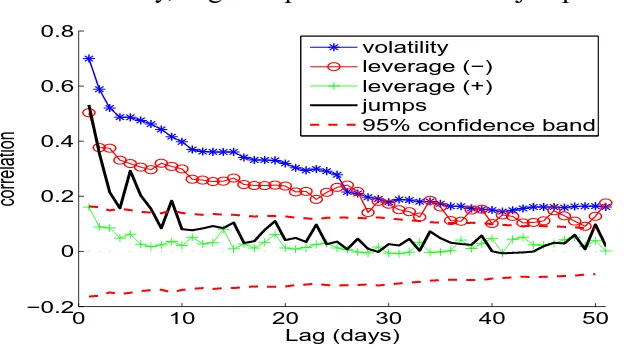
To illustrate these stylized facts of realized volatility (RVt), let us now consider
18
historical data on the S&P 500 stock index over the period 1982-2009. Figure 1.1 plots
19
Corr(RVt, Zt−h), i.e. the correlation betweenRVtandZt−h, forh= 1, . . . ,50.Zt
20
corresponds either toRVt, negative daily returns (r−t =min(rt,0), wherertis the
21
return on dayt), positive returns (r+t =max(rt,0)) or jumps (Jt). More details on the
22
data and the estimation ofRVtandJtare given in Section 1.3. Corr(RVt, RVt−h)
23
is the AutoCorrelation Function (ACF) of RVt. Figure 1.1 clearly suggests the
24
presence of long-memory in the realized volatility. This figure also suggests that
25
while past positive daily returns (rt+−h) are not significantly correlated withRVt, past
26
negative returns (rt−−h) have a significant impact on futures volatilities, and negative
27
shocks take a long time to die out (which might also be viewed as long-memory).
28
Interestingly, jumps seem also to have a positive impact on future values ofRVt,
29
although their effect decays at a faster rate thanRVtandr−t−h. This motivates the
30
analysis in the following sections.
31
1.3 HETEROGENEITY AND VOLATILITY PERSISTENCE
32
The appearance of long range dependence might be due to a genuine long-memory
33
data generating process or, alternatively, it can be explained as a combination of
34
different short memory processes (as discussed further below). Although a true long
35
memory process requires the aggregation of an infinite number of short memory
36
processes (as shown by [52]), an approximated long memory process (practically
Correlation between realized volatility and past realized
volatility, negative/positive returns and jumps.
0 10 20 30 40 50
−0.2 0 0.2 0.4 0.6 0.8
Lag (days)
correlation
volatility leverage (−) leverage (+) jumps
[image:5.612.116.428.71.249.2]95% confidence band
Figure 1.1 Corr(RVt, Zt−h) (h = 1, . . . ,50) for the S&P 500 series for the period January 1990 to February 2009. Ztcorresponds either toRVt, negative daily returns (r−t =
min(rt,0), wherertis the return on dayt), positive returns (r+t =max(rt,0)) or jumps (Jt). The displayed95%confidence bands (dashed lines) are computed with the generalized Bartlett’s formula of [46].
indistinguishable from a true one) can be obtained by aggregating only few
hetero-1
geneous time scales ([58]).
2
The need for multiple components in the volatility process has been advocated
3
by (among others) [66], [43], [21], [14], and [26] and has been reconsidered by
4
making use of the concept of an additive cascade of realized volatility aggregated
5
over different time horizons in [34]. In what follows, we briefly review this latter
6
approach.
7
We assume that the state variableX (typically the log price) is driven by the stochastic process:
dXt=µtdt+σtdWt+ctdNt, (1.1)
whereµtis predictable,σtis c´adl´ag andNtis a doubly stochastic Poisson process2 whose intensity is an adapted stochastic processλt, the random times of the corre-sponding jumps are(τj)j=1,...,NT andcjare iid adapted random variables measuring
the size of the jump at timeτj. In practice, e.g. for risk management purposes, we
HETEROGENEITY AND VOLATILITY PERSISTENCE 5
are interested in forecasting the quadratic variation defined as:
e
σ2t = Z t+1
t
σs2ds+ X
t≤τj≤t+1
c2τj,
where the time unit is one day.
1
This quantity is not directly observable and therefore has to be estimated. Let us denote byVˆta consistent estimator ofσe2t, that is:
logeσt2= log ˆVt+ωt,
whereωtis iid noise.3 In the ideal case of no microstructure noise,RVtis the most
2
natural choice forVˆt. In the presence of microstructure noise, other estimators are
3
preferable such as the two-scale estimator proposed by [74], the realized kernels
4
method of [13], the pre-average approach of [55], or the multi-scales Discrete Sine
5
Transform estimator (DST) of [40]. In our empirical analysis in Section 1.6, we use
6
theDSTestimator.
7
Consider the aggregated values oflogVbt, defined as:
logVb(tn)=
1
n
n X
j=1
logVbt−j+1 (1.2)
and assume two different time scales, of lengthn1andn2, withn1> n2(e.g. weekly
and daily). For the largest time scale, assume thatσe2
t, once aggregated as in (1.2), is determined by:
logσe2,(n1)
t+n1 =c
(n1)+β(n1)logVb(n1)
t +ε
(n1)
t+n1 (1.3)
whereε(n1)
t is an iid random variable with mean zero and unit variance which is
8
independent on the estimation errorωt, andc(n1)andβ(n1)are unknown parameters.
9
This can be explained by assuming that the level of short-term volatility does not affect the trading strategies of long-term traders.4 On the other hand, for short-term traders the level of long-term volatility matters because it determines the expected future size of trends and risk. Hence, the shorter time scale(n2)is assumed to be
influenced by the expected future value of the largest time scale(n1), so that:
logσe2,(n2)
t+n2 =c
(n2)+β(n2)logVb(n2)
t +δ( n2)E
t h
logeσ2,(n1)
t+n1
i
+ε(n2)
t+n2, (1.4)
whereε(n2)
t is an iid random variable with mean zero and unit variance, independent onε(n1)
t andωtandδ(n2)is a constant. The economic interpretation of this mech-anism is that each volatility component corresponds to a market component whose
3The model can also be specified in terms ofbV tand for
q b
Vt, as in [34] [3] and [38]. However, the log specification has the double advantage of avoiding imposing positivity constraints and making the distribution closer to normality, see e.g. [51].
expectation on next period volatility is formed looking at, beyond the current realized volatility value, the forecast on the longer time horizon. The basic idea is that agents with different time horizons perceive, react to, and cause different types of volatility components. By substitution, this gives:
logVb(tn+2n)2 =c+β
(n2)logVb(n2)
t +β(n1)logVb
(n1)
t +εt; (1.5)
whereεtis iid noise depending onε
(n1)
t , ε
(n2)
t , ωt. The model (1.5) can be easily
1
extended todhorizons of lengthn1> n2> . . . > nd. Typically, three components
2
are used with lengthn1= 22(monthly),n2= 5(weekly),n3= 1(daily).
3
The HAR model is then a parsimonious AR model reparameterized by imposing
4
different sets of restrictions (one for each volatility component) on the autoregressive
5
coefficients of the AR model. Each set of restrictions takes the form of equality
6
constraints among the autoregressive coefficients constituting a given time horizon,
7
so that once combined they lead to a step function for the autoregressive weights.
8
In this sense, the HAR can be related to the MIDAS regression of [47], [48], and
9
[45], although the standard MIDAS with the estimated Beta function lag polynomial
10
cannot reproduce the HAR step function weights.
11
In practice, the HAR model provides a simple and flexible method to fit the
12
partial autocorrelation function of the empirical data with a step function which has
13
predefined tread depth and estimated (by simple OLS) rise height. More generally,
14
however, nothing prevents the use of different types of kernel in the aggregation of
15
b
Vtinstead of the rectangular one used in the simple moving average; in this case we
16
would no longer have a step function for the coefficients but a more general function
17
given by a mixture of kernels (e.g. mixture of exponentials for exponentially weighted
18
moving averages) which can still be easily estimated by simple OLS.
19
Even if the HAR model does not formally belong to the class of long memory
20
processes, it fits the persistence properties of financial data as well as (and potentially
21
better than) true long memory models, such as the fractionally integrated one, which,
22
however, are much more complicated to estimate and to deal with (see the review of
23
[10]). For these reasons, the HAR model has been employed in several applications
24
in the literature, of which an incomplete list is: [47] and [45] compare this model
25
with the MIDAS model; [3] use an extension of this model to forecast the volatility
26
of stock prices, foreign exchange rates and bond prices; [31] implement it for risk
27
management with VaR measures; [20] use it to analyze the risk-return tradeoff; [18]
28
use it to study the relation between intraday serial correlation and volatility.
29
HETEROGENEITY AND VOLATILITY PERSISTENCE 7
model which, with the three commonly used frequencies, reads:
logbV(1)t+1=c+β(1)logVb (1)
t +β(5)logVb
(5)
t +β(22)logVb
(22)
t +
p
htεt (1.6)
ht=ω+ q X
j=1
aju2t−j+ p X
j=1
bjht−j (1.7)
εt|Ωt−1∼iid(0,1), (1.8)
whereΩt−1denotes theσ-field generated by all the information available up to time
1
t−1andut=√htεt.
2
1.3.1 Genuine long memory or superposition of factors?
3
Assessing whether volatility persistence is generated by a data-generating process
4
with genuine long memory or from a superposition of factors as illustrated above may
5
appear an impossible task. Clearly, the two possibilities might generate very similar
6
empirical features which would make them indistinguishable. In this case, analytical
7
tractability becomes the most important feature to take into account. However, as we
8
discuss here, some specific data generating processes can be ruled out on the basis of
9
the statistical features of the realized volatility time series.
10
Such an investigation is carried out in [39]. They propose two competing continuous-time models for the volatility dynamics which belong to the class (1.1). The first one is a genuine long-memory model with constant volatility-of-volatility:
dlogσt=k(ω−logσt)dt+ηdWt(d), (1.9)
wheredWt(d)is a fractional Brownian motion with memory parameterd∈[0,0.5],
11
see [33]. The valued = 0 corresponds to the standard Brownian motion, while
12
higherdcorrespond to higher memory in the time series. Model (1.9) (or its discrete
13
counterpart) is usually advocated as the source of long memory in volatility, even
14
if it is very difficult to deal with mathematically and econometrically. It is
impor-15
tant to note that in this model persistence comes both from the mean-reverting term
16
k(ω−logσt)and from the fractional Brownian motiondW( d)
t . [39] estimate model
17
(1.9) via indirect inference, using the HAR model as auxiliary model. The advantage
18
of indirect inference is that, beyond providing an estimate of the parametersk, ω, η,
19
andd, it provides overall statistics of the goodness-of-fit of the model. They find
un-20
ambiguously that the model (1.9) is unable to reproduce the time series of volatilities
21
in the S&P500 index.
22
The second model they test is an affine two-factor model:
σ2t =Vt1+Vt2
dV1
t =κ1(ω1−Vt1) +η1
p
V1
tdWt1
dVt2=κ2(ω2−Vt2) +η2
p
V2
tdWt2,
where W1 and W2 are two independent Brownian motions. In this case, even
1
imposing the restrictionω1 = ω2 to identify the model5, the two-factor model is
2
perfectly able to reproduce the statistical features of the volatility of the S&P500
3
index. The obtained estimates ofˆκ1 = 2.138andκˆ2 = 0.006imply the presence
4
of a fast mean-reverting factor and a slowly mean-reverting factor with a half-life of
5
nearly166days, which is usually suggested in the empirical literature on stochastic
6
volatility and option pricing.
7
Clearly, a more complicated long-memory model (e.g. with two factors) might
8
also reproduce the volatility time series, so it would be wrong to conclude that these
9
results rule out the presence of genuine long memory in the volatility series. However,
10
these results show that the superposition of volatility factors is able to reproduce the
11
long range dependence displayed by realized volatility, for which a genuine long
12
memory data generating process is unnecessary (and certainly not mathematically
13
convenient).
14
These results can also help explaining the good performance of multi-factor model
15
in the option pricing, see e.g. [16]. They also suggest that two factors might be
16
unnecessary if the volatility dynamics is specified directly with a model similar to
17
HAR: an attempt in this direction is the study proposed by [36] where a realized
18
volatility option-pricing model is developed based on the HAR structure. Such a
19
model is found to provide good pricing performances.
20
1.4 HAR EXTENSIONS
21
1.4.1 Jumps measures and their volatility impact
22
The importance of jumps in financial econometrics is rapidly growing. Recent research focusing on jump detection and volatility measuring in presence of jumps includes [12], [62], [59], [56], [2], [1], [29], [63] and [24]. [3] suggested that the continuous volatility and jump component have different dynamics and should thus be modelled separately. In this section, we closely follow [38] using theC-Tztest6 for jumps detection, andTBPVt, i.e. the threshold bipower variation, to estimate the
5The structural model (1.10) has6free parameters while, the auxiliary three components HAR model has
5(including the parameter of the variance of the innovations). 6TheC-Tzstatistics is defined as:
C-Tzt=δ−
1
2 (RVt−C-TBPVt)·RV
−1
t
r
π2 4 +π−5
maxn1,C-TTriPVt
(TBPVt)2
o, (1.11)
whereδis the time between high-frequency observations,C-TBPVtis a correction of (1.12) devised to be unbiased under the null andC-TTriPVis a similar estimator of integrated quarticityRtt+1σ4
HAR EXTENSIONS 9
continuous part of integrated volatility, defined as:
TBPVt=
π
2
nX−2
j=0
|∆t,jX| · |∆t,j+1X|I{|∆t,jX|2≤ϑj−1}I{|∆t,j+1X|2≤ϑj}, (1.12)
whereI{·}is the indicator function andϑtis a threshold function which we estimate as in [38]. It can be proved that, under model (1.1),TBPVt →
Rt+1
t σ
2
sdsas the interval between observations goes to zero. This continuous volatility estimator has much better finite sample properties than standard bipower variation and provides more accurate jump tests, which allows for a corrected separation of continuous and jump components. For this purpose, we set a confidence levelαand estimate the jump component as:
Jt=I{C-Tz>Φα}·
b
Vt−TBPVt +
, (1.13)
where Φα is the value of the standard Normal distribution corresponding to the confidence levelα, andx+= max(x,0). The corresponding continuous component is defined as:
Ct=Vbt−Jt, (1.14)
which is equal toVbtif there are no jumps in the trajectory, while it is equal toTBPVt
1
if a jump is detected by theC-Tzstatistics.
2
As forlogVbtwe define aggregated values oflogCtas
logC(tn)=
1
n
n X
j=1
logCt−j+1.
For the aggregation of jumps, given the presence of a large number of zeros in the series, we prefer to simply take the sum of the jumps over the windowhinstead of the average, i.e.:
J(tn)= n X
j=1
Jt−j+1.
Consistent with the above section, in the volatility cascade we assume thatCtand
3
Jtenter separately at each level of the cascade, that is:
4
logeσ2,(n1)
t+n1 =c
(n1) + α(n1)log(1 +J(n1)
t ) +β(
n1)logC(n1)
t +ε
(n1)
t+n1
logeσ2,(n2)
t+n2 =c
(n2) + α(n2)log(1 +J(n2)
t ) +β(
n2)logC(n2)
t
+ δ(n2)
Et
h
logσe2,(n1)
t+1
i
+ε(n2)
t+n2
originating the model:
5
logVb(t+n2n)2 = c + α
(n1)log(1 +J(n1)
t ) +α(
n2)log(1 +J(n2)
t ) (1.15)
+ β(n2)logC(n2)
t +β
(n1)logC(n1)
t +εt.
Note that we uselog(1 +Jt)instead oflogJtsinceJtcan be zero. This model has
6
been introduced as the HAR-CJ model by [3].
1.4.2 Leverage effects
1
It is well known that volatility tends to increase more after a negative shock than
2
after a positive shock of the same magnitude: this is the so-called leverage effect (see
3
[30, 27, 50] and more recently [19]).
4
Given the stylized facts presented in Section 1.2, it is then natural to extend the
5
Heterogeneous Market Hypothesis approach to leverage effects. We assume that
6
realized volatility reacts asymmetrically not only to previous daily returns but also
7
to past weekly and monthly returns. We model such heterogeneous leverage effects
8
by introducing asymmetric return-volatility dependence at each level of the cascade
9
considered in the above section. Define daily returnsrt=Xt−Xt−1and aggregated
10
returns as:
11
r(tn)=
1
n
n X
j=1
rt−j+1.
To model the leverage effect at different frequencies, we definer(tn)−= min(r
(n)
t ,0).
12
We assume that integrated volatility is determined by the following cascade:
13
logeσ2,(n1)
t+n1 = c
(n1)+β(n1)logVb(n1)
t +γ(
n1)r(n1)−
t +ε
(n1)
t+n1
logeσ2,(n2)
t+n2 = c
(n2)+β(n2)logVb(n1)
t +γ(n2)r
(n2)−
t +δ(n2)Et h
logeσ2,(n1)
t+n1
i
+ε(n2)
t+n2,
whereγ(n1,2)are constants. This now gives:
logVb(tn+2n)2 = c+β
(n2)logVb(n2)
t +β(
n1)logVb(n1)
t +γ(
n2)r(n2)−
t +γ(
n1)r(n1)−
t + ˜εt. (1.16) We then postulate that leverage effects influence each market component
sepa-14
rately, and that they appear aggregated at different horizons in the volatility dynamics.
15
Combining heterogeneity in realized volatility, leverage, and jumps, we construct
16
the Leverage Heterogeneous Auto-Regressive with Continuous volatility and Jumps
17
(LHAR-CJ) model. As is common in practice, we use three components for the
18
volatility cascade: daily, weekly and monthly. Hence, the proposed model reads:
19
logVb(th+)h=c + β( d)logC
t+β(w)logC
(5)
t +β(
m)logC(22)
t
+ α(d)log(1 +Jt) +α(w)log(1 +J(5)t ) +α
(m)log(1 +J(22)
t )
+ γ(d)rt−+γ( w)r(5)−
t +γ(
m)r(22)−
t +ε
(h)
t . (1.17)
Model (1.17) nests the other models introduced in the chapter. Whenα(d,w,m) =
20
γ(d,w,m) = 0 andC
t = Vbt, the model reduces to the HAR model (1.5). When
21
γ(d,w,m)= 0, we get the HAR-CJ model (1.15).
22
Model (1.17) can be estimated by OLS with the Newey-West covariance correction
23
for serial correlation. In order to make multiperiod predictions, we will estimate the
24
model considering the aggregated dependent variablelogVb(t+h)hwithhranging from
25
1 to 22, i.e. from one day to one month.
HAR EXTENSIONS 11
1.4.3 General non-linear effects in volatility
1
Another question of interest is to investigate whether the leverage effects introduced
2
in the previous section are the only relevant non-linear (in that case asymmetric)
3
behaviors present in the realized volatility dynamics in response to past shocks in the
4
market and, more in general, in the whole (macro)economy. In fact, in the last five
5
years several empirical studies published in the literature applied different (parametric
6
and non-parametric) methodologies to the problem of estimating and forecasting
7
realized volatilities, covariances, and correlations dynamics. These showed that they
8
are subject to structural breaks and regime-switches driven by shocks of a different
9
nature: see, among others, [65], [69], and [7].
10
To investigate this, we generalize the LHAR-CJ model introduced in (1.17) to estimate leverage effects. We propose a tree-structured local HAR-CJ model (Tree HAR-CJ) which is able to take into account both long-memory and possible general non-linear effects in the (log-) realized volatility dynamics. Tree-structured models belong to the class of threshold regime models, where regimes are characterized by some threshold for the relevant predictor variables. The class of tree-structured GARCH models was introduced by [5] in the financial volatility literature, and was generalized recently to capture simultaneous regime shifts in the first and second conditional moment dynamics of returns series (see, for example, [8]). The proposed model reads:
logVb(th+)h=Et[logVb
(h)
t+h] +ε
(h)
t , (1.18)
whereEt[·]denotes (as usual) the conditional expectation given the information up
11
to timet. The conditional dynamics of the realized (log-) volatilities are given by:
12
Et[logVb
(h)
t+h] = Pk
j=1
cj +β
(d)
j logCt+β
(w)
j logC
(5)
t +β
(m)
j logC
(22)
t
+α(jd)log(1 +Jt) +α
(w)
j log(1 +J
(5)
t ) +α
(m)
j log(1 +J
(22)
t )
+γj(d)rt+γ
(w)
j r
(5)
t +γ
(m)
j r
(22)
t
I[Xpred
t ∈Rj], (1.19)
whereθ = (cj, α
(d,w,m)
j , β
(d,w,m)
j , γ
(d,w,m)
j , j = 1, . . . , k) is a parameter vector
13
which parameterizes the local HAR-CJ dynamics in the different regimes,kis the
14
number of regimes (endogenously estimated from the data), andI[·] is the identity
15
function that defines regime-shifts.7
16
The regimes are characterized by partition cellsRjof the relevant predictor space
GofXpredt :
G=
k [
j=1
Rj, Ri∩ Rj=∅(i6=j).
For modeling (log-)realized volatilities, the relevant predictor variables in Xpredt
1
are past-lagged realized volatilities (considering the estimated ones, as well as the
2
continuous and the jump parts alone), and past-lagged returns of the underlying
3
instrument under investigation to allow explicitly for leverage effects. In taking
4
volatility cascades into account, all such predictor variables are considered at three
5
different time horizons: daily, weekly, and monthly. We also consider time as an
6
additional predictor variable to investigate the relevance of structural breaks in time.8
7
To completely specify the conditional dynamics given in (1.19) of the realized
8
volatilities, we determine the shape of the partition cellsRj, which are admissible in
9
the Tree HAR-CJ model. Similar to the standard classification and regression trees
10
(CART) procedure (see [25]), the only restriction we impose is that regimes must be
11
characterized by (possibly high-dimensional) rectangular cells of the predictor space,
12
with edges determined by thresholds on the predictor variables. Such partition cells
13
are practically constructed using the idea of binary trees. Introducing this restriction
14
has two major advantages: it allows a clear interpretation of the regimes in terms
15
of relevant predictor variables, and it also allows an estimation of the model using
16
large-dimensional predictor spacesG.
17
The Tree HAR-CJ model introduced above can be estimated for any fixed sequence
18
of partition cells using quasi-maximum likelihood (QML). The choice of the best
19
partition cells (that is, splitting variables and threshold values) involves a model
20
choice procedure for non-nested hypotheses. Similar to CART, the model selection
21
of the splitting variables and threshold values can be performed using the idea of
22
binary trees (for all details, see [8], Section 2.3 and Appendix A). Within any
data-23
determined tree structure, the best model is selected using information criteria or a
24
more formal sequence of statistical tests to circumvent identification problems (see
25
[65]).
26
1.5 MULTIVARIATE MODELS
27
We now turn to a multivariate setting, in which aRN-valued stochastic processXt evolves over time according to the dynamics:
dXt=µtdt+ ΣtdWt+dJt
whereµtis anRN-valued predictable process,ΣtanRN×N-valued c´adl´ag process,
28
W1, . . . , WN is anN−dimensional Brownian motion anddJtis aRN valued jump
29
process. Modeling and forecasting asset returns (conditional) covariance matrix
30
Σtis pivotal to many prominent financial problems such as asset allocation, risk
31
management and option pricing. However, the multivariate extensions of the realized
32
volatility approach pose a series of difficult challenges that are still the subject of
33
active research.
34
MULTIVARIATE MODELS 13
First, in addition to the common microstructure effect biasing realized volatility
1
measures (i.e. bid-ask spread, price discreteness, etc.), the so called non-synchronous
2
trading effect ([60]) strongly affects the estimation of the realized covariance and
3
correlation measures. In fact, since the sampling from the underlying stochastic
4
process is different for different assets, assuming that two time series are sampled
5
simultaneously when, indeed, the sampling is non-synchronous gives rise to the
6
non-synchronous trading effect. As a result, standard covariance and correlation
7
measures constructed by imposing an artificially regularly spaced time series of
8
high frequency data will possess a bias toward zero which increases as the
sam-9
pling frequency increases.9 This effect of a consistent drop of the absolute value of
10
correlations when increasing the sampling frequency was first reported by [44] and
11
hence called the Epps effect. To solve this problem, various approaches have been
12
proposed in the literature: incorporate lead and lag cross returns in the estimator
13
([70], [32],[22], [9]), avoid any synchronization by directly using tick-by-tick data
14
([42],[54],[53],[67],[71],[72],[35]), multivariate realized kernel ([11]), and the
mul-15
tivariate Fourier method ([68, 64]). Given the high level of persistence presents in
16
both realized covariances and correlations, the HAR model has also been employed
17
to model the univariate time series dynamics of realized correlations as in [7].
18
Second, when realized volatility and covariance measures apply any kind of
cor-19
rection for microstructure effects, the resulting variance-covariance matrix is not
20
guaranteed to be positive semi-definite (psd). Exceptions are the multivariate
real-21
ized kernel with refresh time of [11] and the multivariate Fourier method of [64].
22
In both cases, however, the frequency at which all the realized variance-covariance
23
estimates are computed are dictated by the asset having the lowest liquidity, hence
24
discarding, in practice, a considerable amount of information especially for the most
25
liquid assets.
26
Third, in order to have a valid multivariate forecasting model, it is necessary to
27
construct a dynamic specification for the stochastic process of the realized covariance
28
matrix which produces symmetric and psd covariance matrix predictions. In the
29
still relatively scarce but growing literature on multivariate modeling of realized
30
volatilities, three types of approaches have been proposed thus far: modeling the
31
Cholesky factorization ofΣ([28]), its matrix log transformation ([17]), and directly
32
modeling the dynamics ofΣas a Wishart Autoregressive model (WAR) ([23] and
33
[57]).
34
Fourth, as with all other types of multivariate models, the multivariate modeling of
35
realized volatilities is prone to the curse of dimensionality in the number of parameters
36
of the model. This problem is made particularly severe by the high persistence of
37
the variance-covariance processes, which requires consideration of a large number
38
of variance-covariance elements in the conditioning set. To precisely deal with this
39
problem, the HAR modelling approach has been also adopted in the multivariate
1
framework and, because of its simplicity, is often preferred to multivariate long
2
memory models.
3
For instance, after decomposing the realized covariance matrix into Cholesky factorsPt, where
Pt0Pt= Σt,
[28] apply both a vector fractionally integrated model (where the same fractional
4
difference parameter is imposed) and an HAR specification with scalar coefficients to
5
the vector of the lower triangular elements of the Cholesky factorization (i.e. toUt=
6
vech(Pt)). In their HAR specification, they also include the biweekly frequency, in
7
addition to the commonly used daily, weekly, and monthly frequencies. The authors
8
find that, in comparison with the more involved vector fractionally integrated model,
9
“the HAR specification shows very good forecasting ability".10
10
ForΣt, [17] chose the bi-power covariance of [15], but the same principle can be
11
applied to any other covariance estimators. Then they apply a multivariate extension
12
of the HAR-RV model to the principal components oflogm(Σt).11 They also include
13
negative past returns to model asymmetric responses and other prediction variables
14
that have been shown to forecast stock returns (such as interest rates, dividend yields,
15
and credit spreads). In their empirical application they find that “lagged principal
16
components of realized weekly and monthly bi-power covariation have a strong
17
predictive power" on the covariance matrix dynamics of size-sorted stock returns.
18
[23] propose capturing the persistence properties in the realized variances and
co-19
variances with a Wishart-based generalization of the HAR model. The HAR structure
20
is then obtained by direct temporal aggregation of the daily covariance matrices over
21
different window lengths. The authors propose a restricted parametrization of their
22
Wishart HAR-type model that is able to deal with large asset cross-section
dimen-23
sions. In a four dimensional application using two US treasury bills and two exchange
24
rates they show that the restricted specification of the model provides results similar
25
to the fully parameterized model for variance forecasting and risk evaluation.
26
In the same direction, [57] propose a Wishart specification having HAR type
com-27
ponents (i.e. defined as sample averages of past realized covariance matrices). Two
28
types of time-varying Wishart models are considered by the authors: one in which
29
the components affect the scale matrix of the Wishart distribution in a multiplicative
30
way and the second with the components entering in an additive way. Both models
31
are estimated using standard Bayesian techniques with Markov Chain Monte Carlo
32
(MCMC) methods for posterior simulation given that the posterior distribution is
33
unknown. In their empirical analysis on five assets stock prices, the additive
spec-34
10The authors find a slightly superior performance of the fractionally integrated model at a longer horizon. However, this result could be due to the authors’ choice to neglect, in the long horizon direct forecast, the forecasting contribution coming from the higher frequency volatility components.
11IfΣ
APPLICATIONS 15
ification showed better performance in terms of density forecasts of returns up to 3
1
months ahead.
2
1.6 APPLICATIONS
3
The purpose of this section is first to empirically analyze the performance of the
4
LHAR-CJ model (1.17) and then investigate the presence of other non-linear effects
5
in the dynamics of the S&P500 futures volatilities in addition to the leverage effects.
6
Our data set covers a long time span of almost 20 years of high frequency data for
7
the S&P 500 futures from January 1990 to February 2009, for a total of 4,766 daily
8
observations. In order to reduce the impact of microstructure effects, the estimator for
9
the daily volatilityVbtis computed with the multi-scales DST estimator of [40]. The
10
multi-scales DST estimator combines the DST orthogonalization of the volatility
11
signal from the microstructure noise with a multi-scales estimator similar to that
12
proposed by [73]12but constructed with a simple regression based approach.
13
The (significant) jump componentJtin (1.13) and the continuous volatilityCtin
14
(1.14) are computed at the 5-minute sampling frequency (corresponding to84returns
15
per day). The confidence levelαin (1.13) is set to 99.9%. All the quantities of
16
interest are computed on an annualized base.
17
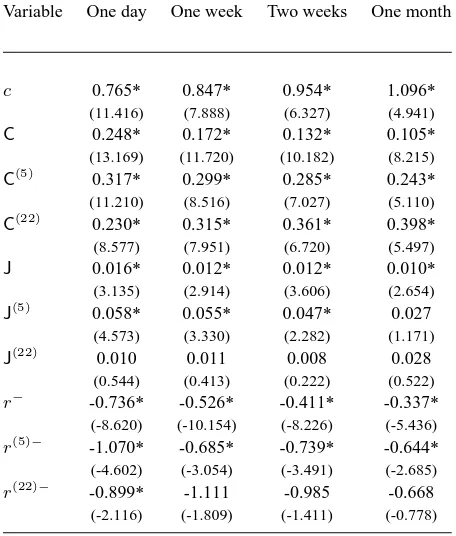
The results of the estimation of the LHAR-CJ on the S&P500 sample from January
18
1990 to February 2009, withh= 1,5,10,22are reported in Table 1.1, together with
19
their statistical significance, evaluated with the Newey-West robust t-statistic with44
20
lags.
21
As usual, all the coefficients of the three continuous volatility components are
22
positive and highly significant. We observe that the coefficient measuring the impact
23
of monthly volatility on future daily volatility (i.e. 0.203) is more than twice as big
24
as the one of daily volatility on future monthly volatility (i.e. 0.105). This finding
25
is consistent with the hierarchical asymmetric propagation of the volatility cascade
26
formalized in Section 1.3.
27
A similar hierarchical structure, although less pronounced, is present in the
im-28
pact of jumps on future volatility. The daily and weekly jump components remain
29
highly significant and positive especially when modelling realized volatility at short
30
horizons. In addition, their impact declines when the frequency at which RV is
31
modelled declines. The jumps aggregated at the monthly level, however, turn out to
32
be insignificant on the considered data set.
33
Interestingly, estimation results for model (1.17) reveal the strong significance
34
(with the economically expected negative sign) of the negative returns at (almost) all
35
frequencies, which unveils the presence of a heterogeneous structure in the leverage
36
effect as well. In fact, the daily volatility is significantly affected, not only by the
37
daily negative return of the day before (the well know leverage effect) but also of
38
the week and of the month before. This result suggests that the market aggregates
39
S&P500 LHAR in-sample regression
Variable One day One week Two weeks One month
c 0.765* 0.847* 0.954* 1.096* (11.416) (7.888) (6.327) (4.941)
C 0.248* 0.172* 0.132* 0.105*
(13.169) (11.720) (10.182) (8.215)
C(5) 0.317* 0.299* 0.285* 0.243* (11.210) (8.516) (7.027) (5.110)
C(22) 0.230* 0.315* 0.361* 0.398* (8.577) (7.951) (6.720) (5.497)
J 0.016* 0.012* 0.012* 0.010*
(3.135) (2.914) (3.606) (2.654)
J(5) 0.058* 0.055* 0.047* 0.027
(4.573) (3.330) (2.282) (1.171)
J(22) 0.010 0.011 0.008 0.028
(0.544) (0.413) (0.222) (0.522)
r− -0.736* -0.526* -0.411* -0.337* (-8.620) (-10.154) (-8.226) (-5.436)
r(5)− -1.070* -0.685* -0.739* -0.644* (-4.602) (-3.054) (-3.491) (-2.685)
[image:17.612.164.392.137.405.2]r(22)− -0.899* -1.111 -0.985 -0.668 (-2.116) (-1.809) (-1.411) (-0.778)
Table 1.1 OLS estimates of the LHAR-CJ model (1.17), for S&P500 futures from January 1990 to February 2009, (4,766observations). The LHAR-CJ model is estimated withh= 1(one day),h= 5(one week),h= 10(two weeks) andh= 22
APPLICATIONS 17
information at the daily, weekly and monthly levels and reacts to shocks happening
1
at these three levels/frequencies. These findings thus further confirm the views of the
2
Heterogeneous Market Hypothesis.
3
To evaluate the performance of the LHAR-CJ model, we compare it with the
4
standard HAR (with only heterogeneous volatility) and the HAR-CJ model (with
5
heterogeneous jumps) on the basis of a genuine out-of-sample analysis. For the
6
out-of-sample forecast ofVbton the[t, t+h]interval we keep the same forecasting
7
horizons (one day, one week, two weeks and one month) and re-estimate the model
8
at each day t on a moving window of length 2500 days. Table 1.2 reports the
9
out-of-sample forecasts of the different models evaluated on the basis of the R2
10
of Mincer-Zarnowitz forecasting regressions and the Diebold-Mariano test for the
11
out-of-sample Root Mean Square Error (RMSE).13
12
The superiority of the HAR-CJ model over the HAR model is mild, since it has
13
to be ascribed preeminently to days which follow a jump, and thus on a very small
14
sample; conditioning on days following the occurrence of a jump would show a
15
sharper improvement (as shown in [38]). However, the superiority of the LHAR-CJ
16
model at all horizons, with respect to the HAR (and the HAR-CJ model) is much
17
stronger, validating the importance of including both the heterogeneous leverage
18
effects and jumps in the forecasting model.
19
In the second part of our empirical analysis, we estimate the Tree HAR-CJ model
20
introduced in (1.19) to investigate whether additional non-linear effects are present
21
in the dynamics of the S&P500 futures volatilities on the top of the leverage effect
22
and whether the explicit modeling of structural breaks and regime-shifts is able to
23
improve the accuracy of the estimates and forecasts. To simplify the interpretations
24
and reduce the number of parameters in the model, we assume that the cascade is
25
present only in the volatility continuous componentCt(i.e. we set the parameters
26
α(jw,m) andγ
(w,m)
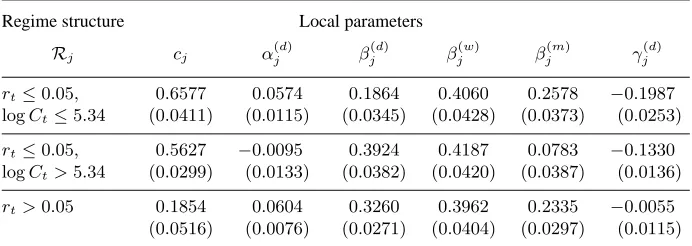
j , j = 1, . . . , k, to zero). Estimated coefficients, as well as the
27
estimated regimes, are reported in Table 1.3 forh = 1. Classical model-based
28
bootstrapped standard errors are given in parentheses.
29
Table 1.3 shows that almost all coefficients in the local dynamics of realized
30
volatilities are highly significant, with a couple of interesting exceptions. As
dis-31
cussed previously, the leverage effect is found to be the most important asymmetry
32
and yields the first binary split in the procedure. The optimal threshold is found
33
to be around zero, highlighting the different reaction of realized volatilities to past
34
positive and negative S&P 500 returns. A second relevant non-linear behavior of
35
realized volatility dynamics is found in response to past low and moderate vs. high
36
(continuous part) volatilities when past S&P 500 returns are negative. In fact, the
37
threshold valued2 = 5.34corresponds to the70%quantile of the estimatedlogCt
38
series.
39
In these three regimes, local volatility dynamics show significant differences. In
40
particular, it is worth mentioning the following two results: First, past lagged S&P
41
S&P500 out-of-sample performances
Variable One day One week Two weeks One month
HAR 0.8073 0.8351 0.8162 0.7573
HAR-CJ 0.8107 0.8397 0.8188 0.7597 (1.994) (1.808) (0.835) (0.115)
[image:19.612.162.394.62.196.2]LHAR-CJ 0.8238 0.8487 0.8279 0.7651 (4.663) (2.854) (2.023) (1.169)
Table 1.2 R2of Mincer-Zarnowitz regressions for out-of-sample forecasts for horizonsh= 1(one day),h= 5(one week),h= 10(two weeks) andh= 22(one month) of the S&P500 from January 1990 to February 2009 (4,766 observations, the first 2500 observations are used to initialize the models). The forecasting models are the standard HAR, the HAR-CJ and the LHAR-CJ model. In parentheses is reported the Diebold-Mariano test for the out-of-sample RMSE with respect to the standard HAR model.
Tree HAR-CJ estimates and regimes
Regime structure Local parameters
Rj cj α(
d)
j β
(d)
j β
(w)
j β
(m)
j γ
(d)
j
rt≤0.05, 0.6577 0.0574 0.1864 0.4060 0.2578 −0.1987 logCt≤5.34 (0.0411) (0.0115) (0.0345) (0.0428) (0.0373) (0.0253)
rt≤0.05, 0.5627 −0.0095 0.3924 0.4187 0.0783 −0.1330 logCt>5.34 (0.0299) (0.0133) (0.0382) (0.0420) (0.0387) (0.0136)
rt>0.05 0.1854 0.0604 0.3260 0.3962 0.2335 −0.0055 (0.0516) (0.0076) (0.0271) (0.0404) (0.0297) (0.0115)
[image:19.612.113.459.356.479.2]CONCLUDING REMARKS AND AREAS FOR FUTURE RESEARCH 19
500 returns are significant only in the regimes where they are negative, yielding to
1
an increase in the realized volatilities. When past lagged S&P 500 returns are
posi-2
tive (last regime) their impact in estimating future volatility dynamics is negligible.
3
Second, the impact of jumps highly changes depending on the regime in which they
4
occur: it is positive and significant in regimes characterized by (somehow) stable
5
financial markets (regimes 1 and 3), yielding to an increase of realized volatility.
6
By contrast, in times of market turbulence (measured by past negative returns and
7
high past volatilities), jumps are found to have no particular impact in driving future
8
realized volatility dynamics. These interesting results confirm and extend previous
9
empirical findings shown in this section.
10
Similarly to what has been shown above for the LHAR-CJ model, in a preliminary
11
series of forecasting experiments forhequal to one, the Tree HAR-CJ model has
12
been found to be able to significantly improve the out-of-sample performance of the
13
classical HAR and HAR-CJ models. A more detailed and complete investigation
14
of how the introduction of regimes (threshold-based or of a Markovian type) may
15
improve predictions in a general HAR setting is left for the future.
16
1.7 CONCLUDING REMARKS AND AREAS FOR FUTURE RESEARCH
17
By projecting a dynamic process on its own past values aggregated over different time
18
horizons, the HAR model is a general and flexible approach to fit the autocorrelation
19
function of any persistent process in a very simple and tractable way. In this chapter
20
we have briefly surveyed the nature, construction, and properties of the HAR class
21
of models for realized volatility estimation and prediction. We discussed some
22
of the extensions of the standard HAR model that have been recently proposed to
23
explicitly take into account the predictive power of jumps, leverage effects, and other
24
non-linearities (i.e. structural breaks and regime switches driven by the different
25
sources acting on the financial market) for the time-varying dynamics of realized
26
volatilities. We also reviewed some recent studies generalizing the HAR model
27
for predicting univariate realized volatilities to the multivariate setting of realized
28
covariance matrices. This is a fast-growing field and the list of references will no
29
doubt need updating in the near future.
30
In our review of the extant literature on HAR models a number of topics stand
31
out as possible avenues for future research. The most obvious, and perhaps difficult,
32
is to generalize the univariate flexible HAR model with jumps, leverage effects,
33
and other non-linear behaviors due to regime changes to the multivariate context.
34
Existing models do not take these effects into account and are not well-designed
35
to deal with (possibly) high-dimensional realized covariance matrices. What is
36
needed are flexible yet parsimonious multivariate HAR-type extensions that remain
37
computationally feasible in large dimensions. This task may be accomplished using
38
recent techniques coming from the computational statistics community, similar to
39
what was done ten years ago in [6] for the estimation of a flexible volatility matrix in
40
a multivariate GARCH setting.
REFERENCES
1
1. Y. A¨ıt-Sahalia and J. Jacod. Testing for jumps in a discretely observed process. Annals
2
of Statistics, 37:184–222, 2009.
3
2. Y. A¨ıt-Sahalia and L. Mancini. Out of sample forecasts of quadratic variation. Journal of
4
Econometrics, 147(1):17–33, 2008.
5
3. T. Andersen, T. Bollerslev, and F. X. Diebold. Roughing it up: Including jump components
6
in the measurement, modeling and forecasting of return volatility. Review of Economics
7
and Statistics, 89:701–720, 2007.
8
4. A. Arneodo, J.F. Muzy, and D. Sornette. Casual cascade in stock market from the
9
"infrared" to the "ultraviolet". European Physical Journal B, 2:277, 1998.
10
5. F. Audrino and P. B¨uhlmann. Tree-structured garch models. Journal of the Royal
11
Statistical Society, Series B, 63:727–744, 2001.
12
6. F. Audrino and P. B¨uhlmann. Volatility estimation with functional gradient descent for
13
very high-dimensional financial time series. Journal of Computational Finance, 6(3):1–
14
26, 2003.
15
7. F. Audrino and F. Corsi. Modeling tick-by-tick realized correlations. Computational
16
Statistics & Data Analysis, 54:2373–2383, 2010.
17
8. F. Audrino and F. Trojani. Estimating and predicting multivariate volatility regimes in
18
global stock markets. Journal of Applied Econometrics, 21:345–369, 2006.
19
9. F.M. Bandi and J.R. Russell. Realized covariation, realized beta and microstructure noise.
20
Unpublished paper, Graduate School of Business, University of Chicago, 2005.
21
10. A. Banerjee and G. Urga. Modelling structural breaks, long memory and stock market
22
volatility: An overview. Journal of Econometrics, 129(1-2):1–34, 2005.
23
11. O. E. Barndorff-Nielsen, P. R. Hansen, A. Lunde, and N. Shephard. Multivariate realised
24
kernels: Consistent positive semi-definite estimators of the covariation of equity prices
25
with noise and non-synchronous trading. Working Paper Series, 2010.
26
12. O. E. Barndorff-Nielsen and N. Shephard. Power and bipower variation with stochastic
27
volatility and jumps. Journal of Financial Econometrics, 2:1–48, 2004.
28
13. O.E. Barndorff-Nielsen, P.R. Hansen, A. Lunde, and N. Shephard. Designing realized
29
kernels to measure the ex post variation of equity prices in the presence of noise.
Econo-30
metrica, 76(6):1481–1536, 2008.
31
14. O.E. Barndorff-Nielsen and N. Shephard. Non-Gaussian Ornstein–Uhlenbeck-based
32
models and some of their uses in financial economics. Journal of the Royal
Statisti-33
cal Society: Series B (Statistical Methodology), 63(2):167–241, 2001.
34
15. O.E. Barndorff-Nielsen and N. Shephard. Measuring the impact of jumps in multivariate
35
price processes using bipower covariation. 2005.
36
16. D. Bates. Post-’87 crash fears in the S&P 500 futures option market. Journal of
Econo-37
metrics, 94:181–238, 2000.
38
17. G.H. Bauer and K. Vorkink. Forecasting multivariate realized stock market volatility.
39
Journal of Econometrics, 2010.
40
18. S. Bianco, F. Corsi, and R. Ren`o. Intraday LeBaron effects. Proceedings of the National
41
Academy of Science of the USA, 106:11439–11443, 2009.
REFERENCES 21
19. T. Bollerslev, J. Litvinova, and G. Tauchen. Leverage and volatility feedback effects in
1
high-frequency data. Journal of Financial Econometrics, 4(3):353, 2006.
2
20. T Bollerslev, G Tauchen, and H Zhou. Expected stock returns and variance risk premia.
3
Review of Financial Studies, 22(11):4463–4492, 2008.
4
21. T. Bollerslev and J.H. Wright. Volatility forecasting, high-frequency data, and frequency
5
domain inference. Review of Economics and Statistics, 83:596–602, 2001.
6
22. T. Bollerslev and B. Y. B. Zhang. Measuring and modeling systematic risk in factor
7
pricing models using high-frequency data. Journal of Empirical Finance, 10(5):533–558,
8
2003.
9
23. M. Bonato, M. Caporin, and A. Ranaldo. Forecasting realized (co)variances with a block
10
structure Wishart autoregressive model. Working Papers, 2009.
11
24. K. Boudt, C. Croux, and S. Laurent. Outlyingness weighted quadratic covariation.
Work-12
ing Paper, 2008.
13
25. L. Breiman, J. Friedman, C. J. Stone, and Richard A. Olshen. Classification and regression
14
trees. Chapman & Hall/CRC, 1984.
15
26. L.E. Calvet and A.J. Fisher. How to forecast long-run volatility: Regime switching and
16
the estimation of multifractal processes. Journal of Financial Econometrics, 2(1):49–83,
17
2004.
18
27. J. Y. Campbell and L. Hentschel. No news is good news: a asymmetric model of changing
19
volatility in stock returns. Journal of Financial Economics, 31:281–318, 1992.
20
28. R. Chiriac and V. Voev. Modelling and forecasting multivariate realized volatility. Journal
21
of Applied Econometrics, 2010.
22
29. K. Christensen, R. Oomen, and M. Podolskij. Realised quantile-based estimation of the
23
integrated variance. Journal of Econometrics, 159(1):74–98, 2010.
24
30. A. Christie. The stochastic behavior of common stock variances: value, leverage and
25
interest rate effects. Journal of Financial Economics, 10:407–432, 1982.
26
31. M.P. Clements, A.B. Galv˜ao, and J.H. Kim. Quantile forecasts of daily exchange rate
27
returns from forecasts of realized volatility. Journal of Empirical Finance, 15(4):729–750,
28
2008.
29
32. K. Cohen, G. A. Hawawini, S. F. Maier, R. Schwartz R., and D. Whitcomb D. Friction in
30
the trading process and the estimation of systematic risk. Journal of Financial Economics,
31
12:263–278, 1983.
32
33. F. Comte and E. Renault. Long memory in continuous-time stochastic volatility models.
33
Mathematical Finance, 8(4):291–323, 1998.
34
34. F. Corsi. A simple approximate long-memory model of realized volatility. Journal of
35
Financial Econometrics, 7:174–196, 2009.
36
35. F. Corsi and F. Audrino. Realized covariance tick-by-tick in presence of rounded time
37
stamps and general microstructure effects. Unpublished manuscript, University of St.
38
Gallen, 2008.
39
36. F. Corsi, D. La Vecchia, and N. Fusari. Realizing smiles: Pricing options with realized
40
volatility. Working Paper, 2010.
41
37. F. Corsi, S. Mittnik, C. Pigorsch, and U. Pigorsch. The volatility of realized volatility.
42
Econometric Reviews, 27(1-3):1–33, 2008.
38. F. Corsi, D. Pirino, and R. Ren`o. Threshold bipower variation and the impact of jumps
1
on volatility forecasting. Journal of Econometrics, 159:276–288, 2010.
2
39. F. Corsi and R. Renò. Discrete-time volatility forecasting with persistent leverage effect
3
and the link with continuous-time volatility modeling. Working Paper, 2010.
4
40. G. Curci and F. Corsi. Discrete sine transform for multi-scales realized volatility measures.
5
Quantitative Finance, 2010. Forthcoming.
6
41. M.M. Dacorogna, U.A. M¨uller, R.D. Davé, R.B. Olsen, and O.V. Pictet. Modelling
short-7
term volatility with garch and harch models. In "Nonlinear Modelling of High Frequency
8
Financial Time Series", pages 161–76, 1998. edited by C. Dunis and B. Zhou, John Wiley,
9
Chichester.
10
42. F. De Jong and T. Nijman. High frequency analysis of lead-lag relationships between
11
financial markets. Journal of Empirical Finance, 4(2-3):259–277, 1997.
12
43. R.F. Engle and G.G.J. Lee. A permanent and transitory component model of stock return
13
volatility. In R.F. Engle and H. White, editors, Cointegration, Causality, and Forecasting:
14
A Festschrift in Honor of Clive WJ Granger, pages 475–497. Oxford University Press,
15
Oxford, 1999.
16
44. T. Epps. Comovements in stock prices in the very short run. Journal of the American
17
Statistical Association, 74:291–298, 1979.
18
45. L. Forsberg and E. Ghysels. Why do absolute returns predict volatility so well? Journal
19
of Financial Econometrics, 5:31–67, 2007.
20
46. C. Francq and J.M. Zakoian. Bartlett’s formula for a general class of nonlinear processes.
21
Journal of Time Series Analysis, 30(4):449–465, 2009.
22
47. E. Ghysels, P. Santa-Clara, and R. Valkanov. Predicting volatility: getting the most out of
23
return data sampled at different frequencies. Journal of Econometrics, 131(1-2):59–95,
24
2006.
25
48. E. Ghysels, A. Sinko, and R. Valkanov. Midas regressions: Further results and new
26
directions. Econometric Reviews, 26:53–90, 2006.
27
49. R. Giacomini and H. White. Tests of conditional predictive ability. Econometrica,
28
74(6):1545–1578, 2006.
29
50. L. Glosten, R. Jagannathan, and D. Runkle. On the relation between the expected value of
30
the volatility of the nominal excess return on stocks. Journal of Finance, 48:1779–1801,
31
1989.
32
51. S. Gonc¸alves and N. Meddahi. Box-Cox transforms for realized volatility. Journal of
33
Econometrics, 160(1):129–144, 2011.
34
52. C. Granger. Long memory relationships and the aggregation of dynamic models. Journal
35
of Econometrics, 14:227–238, 1980.
36
53. J.E. Griffin and R.C.A. Oomen. Covariance measurement in the presence of
non-37
synchronous trading and market microstructure noise. Journal of Econometrics, 160(1):58–
38
68, 2011.
39
54. T. Hayashi and N. Yoshida. On covariance estimation of non-synchronously observed
40
diffusion processes. Bernoulli, 11(2):359, 2005.
41
55. J. Jacod, Y. Li, P.A. Mykland, M. Podolskij, and M. Vetter. Microstructure noise in the
42
continuous case: The pre-averaging approach. Stochastic Processes and their
Applica-43
tions, 119(7):2249–2276, 2009.
REFERENCES 23
56. G.J. Jiang and R.C.A. Oomen. Testing for jumps when asset prices are observed with
1
noise–a "swap variance" approach. Journal of Econometrics, 144(2):352–370, 2008.
2
57. X. Jin and J. Maheu. Modelling realized covariances and returns. Working Papers, 2010.
3
58. B. LeBaron. Stochastic volatility as a simple generator of financial power-laws and long
4
memory. Quantitative Finance, 1:62131, 2001.
5
59. S.S. Lee and P.A. Mykland. Jumps in financial markets: A new nonparametric test and
6
jump dynamics. Review of Financial studies, 21(6):2535, 2008.
7
60. A. Lo and W. Andrew. An econometric analysis of nonsynchronous trading. Journal of
8
Econometrics, 45(1-2):181–211, 1990.
9
61. P. Lynch and G. Zumbach. Market heterogeneities and the causal structure of volatility.
10
Quantitative Finance, 3(4):320–331, 2003.
11
62. C. Mancini. Non-parametric threshold estimation for models with stochastic diffusion
12
coefficient and jumps. Scandinavian Journal of Statistics, 36(2):270–296, 2009.
13
63. C. Mancini and R. Ren`o. Threshold estimation of Markov models with jumps and interest
14
rate modeling. Journal of Econometrics, 160(1):77–92, 2011.
15
64. M.E. Mancino and S. Sanfelici. Estimating covariance via Fourier method in the presence
16
of asynchronous trading and microstructure noise. Journal of Financial Econometrics,
17
2010. Forthcoming.
18
65. A. McAleer and M.C. Medeiros. A multiple regime smooth transition heterogeneous
19
autoregressive model for long memory and asymmetries. Journal of Econometrics,
20
147:104–119, 2008.
21
66. U. Muller, M. Dacorogna, R. Dav´e, R. Olsen, O. Pictet, and J. von Weizsacker. Volatilities
22
of different time resolutions - analyzing the dynamics of market components. Journal of
23
Empirical Finance, 4:213–239, 1997.
24
67. A. Palandri. Consistent realized covariance for asynchronous observations contaminated
25
by market microstructure noise. Unpublished Manuscript, 2006.
26
68. R. Ren`o. A closer look at the Epps effect. International Journal of Theoretical and
27
Applied Finance, 6(1):87–102, 2003.
28
69. M. Scharth and M.C. Medeiros. Asymmetric effects and long memory in the volatility of
29
dow jones stocks. International Journal of Forecasting, 25:304–327, 2009.
30
70. M. Scholes and J. Williams. Estimating betas from nonsynchronous data. Journal of
31
Financial Economics, 5:181–212, 1977.
32
71. K. Sheppard. Realized covariance and scrambling. Unpublished Manuscript, 2006.
33
72. V. Voev and A. Lunde. Integrated covariance estimation using high-frequency data in the
34
presence of noise. Journal of Financial Econometrics, 5:68–104, 2007.
35
73. L. Zhang. Efficient estimation of stochastic volatility using noisy observations: a
multi-36
scale approach. Bernoulli, 12(6):1019–1043, 2006.
37
74. L. Zhang, P. A. Mykland, and Y. A¨ıt-Sahalia. A tale of two time scales: Determining
38
integrated volatility with noisy high-frequency data. Journal of the American Statistical
39
Association, 100:1394–1411, 2005.