City, University of London Institutional Repository
Citation
:
de Jong, J., Douglas, S., Sicilia, M., Radnor, Z., Noordegraaf, M. and Debus, P. (2016). Instruments of value: using the analytic tools of public value theory in teaching and practice. Public Management Review, 19, pp. 605-620. doi:10.1080/14719037.2016.1192162
This is the accepted version of the paper.
This version of the publication may differ from the final published
version.
Permanent repository link: http://openaccess.city.ac.uk/20633/
Link to published version
:
http://dx.doi.org/10.1080/14719037.2016.1192162Copyright and reuse:
City Research Online aims to make research
outputs of City, University of London available to a wider audience.
Copyright and Moral Rights remain with the author(s) and/or copyright
holders. URLs from City Research Online may be freely distributed and
linked to.
1 Submitted to Public Management Review
Instruments of Value: Using the Analytic Tools of Public
Value Theory in Teaching and Practice
Jorrit de Jong, Scott Douglas, Mariafrancesca Sicilia, Zoe Radnor, Mirko Noordegraaf, Peter Debus
Version: March 11th 2015
Word count abstract: 100 (max. 100 words)
Word count essay (including references): 7.517 (max. 8.000 words)
Abstract
2
Introduction
How do analytical tools work in practice? The tools of carpenters help them to hammer and saw raw materials into their desired shape; the tools of accountants help them to measure and structure financial data into understandable figures; and the tools of surgeons help them to perform diagnostic and curative operations on patients. But how exactly do the analytical tools of public value theory help public managers to understand and improve their practice? In our experience in classrooms and boardrooms, this question is often asked implicitly or explicitly with regards to the tools of public value management: What are the strategic triangle, the public value chain, and the public value account supposed to do? What makes them special? What makes them valuable? After being introduced to the basic tools, some practitioners leave the room inspired and enlightened (‘Finally it all makes sense!’ ‘We are going to change everything!’), others discouraged and disappointed (‘Everything seems more complex and confusing now than before’), while others are left underwhelmed (‘A triangle? What’s the big deal?’).
Similarly, scholars wonder how exactly the analytical tools reshape the way public managers think and act, questioning whether public value management fundamentally changes the mechanisms of the public sector or that they simply provide new cover for old habits (Stoker, 2006; Rhodes and Wanna, 2007; Moore, 2014; Dahl & Soss, 2014). Based on the rapidly expanding body of public value literature as well as on our own engagement with the key concepts in classrooms and boardrooms from Europe to Australia and North America to China, we seek to explore how the analytical tools of public value work in action. As such this essay is a reflection on our own practice as academics using the tools of public value theory and a contribution to theory development in the form of a set of propositions that may be tested and refined through empirical research and further theorizing.
3
public value theory out of the classrooms and apply it to real world problems and address the challenges of their organizations such as implementing policy, delivering of the appropriate service to the citizen and managing constrained budgets (Kruiter and De Jong, 2008). Researchers are fine-tuning and testing public value theory through theoretical and, increasingly, empirical work (see the essay by Hartley et al in this issue). Central to these activities is the use of the tools of public value management. The strategic triangle is at the core of the toolbox. It has become a key conceptual model for a school of thought in academia and a hallmark analytic device for a practitioners, especially in the UK, Australia and the Netherlands. Further tools, such as the public value account and public value process mapping are also gaining ground (see essay by Alford et al, same issue for a more detailed explanation).
As the use of public value theory spreads, proponents and opponents debate the utility and validity of these tools. Proponents work on extending and refining the toolset. They want to make public value tools applicable to the new challenges emerging in public value management and develop more concrete guidance for management activities in network management (Page et al, 2015), IT-planning (Cook & Harrison, 2015), or process optimization (Alford & Yates, 2014). Page et al (2015), for example, expand the framework with new criteria to show how it applies to collaborative networks, while Wang & Christensen (2015) developed a so-called open value account to measure the performance of the Chinese government.
At the same time, critics of public value theory point to the shortcomings of the existing tools. Some have argued that the tenets of public value theory provide non-elected officials with and unduly political role, asking them to play as guardians of what they may feel is best for the public, while others take issue with “recycling private sector thought” and being too vague to really move the discipline and practice of public management on from New Public Management (Rhodes & Wanna, 2007; Dahl & Soss, 2014). Rhodes and Wanna (2007: 408) accuse the theory of being unclear about either its empirical validity or normative agenda. Yet, as Alford and O’Flynn (2009: 174) observe, the tools of public value can be used to service multiple purposes: diagnose an existing situation, structure thinking about what is to be done, and offer a set of categories for analyzing how managers behave.
4
public value approaches do have significant empirical value, and therefore in this essay we propose to focus on an essentially practical question: how do the analytic tools of public value theory work? We therefore have to return to and examine carefully the intended and practical purposes of the tools. It is our view that the tools were developed first and foremost to help make sense of strategic challenges in public policy and management. They are not intended to be recipes for success in a utilitarian sense (“If you do this or follow these steps, you will accomplish that”), nor are they normative admonishments in a deontological sense (“As a public manager, you really should do this or leave that”). That is not to say that there are no utilitarian or deontological dimensions to the tools in use. On the contrary: the tools are designed to help people think about the utilitarian and deontological dimensions of the creation and evaluation of public value – multiplicity of normative perspectives in any given public environment is a key idea.
However, as tools, they are neither purely instrumental nor entirely normative: they intend to enable scholars and practitioners to describe and diagnose empirical situations in such a way that thoughtful deliberation among reasonable people who hold different beliefs becomes possible. The tools do not intend to provide answers, but raise questions and help those who are willing to engage with fundamental issues in public management to identify action alternatives. While some analytic tools, for example quantitative tools with embedded algorithms or decision-making tools with fixed weighted criteria may produce specific answers or clear action alternatives, the strategic triangle, the public value chain, the public value account and the public value score-card should be considered heuristic devices, which help identify challenges and structure discussion about them.
5
It is important to realize at this point that practitioners and readers of Creating Public Value
or Recognizing Public Value typically are exposed to public value through the case study method. Both in the classroom and the book, they are first presented with a problem and then invited to intuit the core tools first before having the conceptual framework laid out for them. Understanding the use of these tools is therefore best reflected by noting the learning effects
they offer practitioners: the tool aims to help not just practitioners, but indeed also scholars, to explore the challenges of public management. The tools therefore do not provide clear-cut answers or detailed marching orders, but they do generate a series of questions about what is happening or what could be done in the face of a public sector challenge (Alford & O’Flynn, 2009).
In order to assess the merits and identify possible improvements or additions to the public value toolbox, we will first properly discuss the function and impact of the existing tools as heuristic concepts in action. Below, we will review a significant part of the repertoire of tools currently available and describe what typically happens when they are applied to understand particular public management challenges that executive students or clients bring to a discussion. We draw here from our own experience and fully acknowledge our own bias and the limitations of this analysis. We do, however, believe that our combined 40+ years of working with and writing about public value theory allow us to suggest some propositions. These propositions, to be discussed by peers and tested in practice, are about the principles of application of the tools of public value theory. How can they be used effectively to facilitate the diagnosis and deliberation described above? Finally, we chart some next steps for further scientific examinations of these tools in action and further innovative intertwining of these tools with other public management instruments.
Tools in public value management
For a more detailed overview of the different tools within public value management, see the introductory essay by Alford et al (same issue). For the purposes of our discussion here, we will briefly outline the main characteristics of the different tools. There are two generations of tools within the work on public value management as developed by Moore, with a further set of tools developed by adopters of the public value paradigm.
6
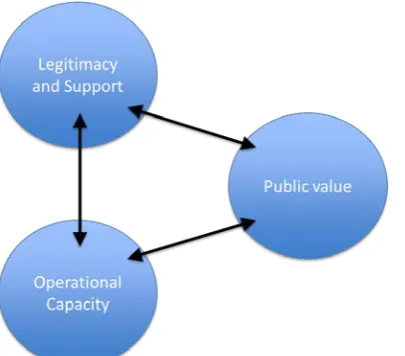
[image:7.595.200.403.307.485.2]network hopes to make; 2) the authorizing environment, the set of different stakeholders which need to provide the activities of the agency or network with legitimacy and support; and 3) the operational capacity, which refers to the processes required to work with the stakeholders of the organization or network to materially deliver the public value desired. The strategic triangle brings these three elements together and became the foremost analytical tool of public value management (Figure 1), reminding students and scholars that the “definition of public value is conditional on the support of the political authorizing environment (…) and on the existence of some organizational and operational capacity that must be animated and guided to produce public value” (Moore, 2013: 104).
Figure 1. The strategic triangle of public value management
7
value creation, and describes the value chain from organizational inputs activities, to outputs for clients and social outcomes for the public at large.
Finally, there are tools developed by other scholars and teachers of public value theory. Some explore the nature of aligning the three elements of the strategic triangle in more detail (Leonard, 2005), others zoom in and expand upon the public value chain by mapping value chain processes (Alford & Yates, 2014), while yet others connect public value to transparency practices (Douglas & Meijer, 2016). Because all of these tools show fidelity to the basic conceptual framework, we speak of them belonging to the “public value toolbox”.
The tools of public value management in action
Let us now consider the function of these heuristic devices at work. How do the frameworks generate new insights and raise new questions about value ambition, strategic space, conflicts and constraints and personal roles of individuals? As said, heuristic devices should help us to explore and structure social phenomena. In this case, the tools of public value help people to explore and structure the different dimensions of their policy, public management or governance challenges. The tools help people to identify the questions, puzzles, and resources at hand and generate new perspectives for addressing them. Reflecting on our respective experiences with applying the tools and seeing others apply the tools, we suggest that the following four dimensions are most salient – these are the different ways in which the tools are useful to the scholar or practitioner using them:
• Ambition: what is at stake for clients, stakeholders, the public at large? How is value defined, and by whom? What more can be done to satisfy clients or improve social conditions? Are we underperforming and missing out on creating more value?
• Strategic Space: what are the external circumstances that put pressure to retain or move from the status quo? What room to maneuver exists for the organization as a whole or the individual public manager to adapt to these circumstances?
• Conflicts and constraints: what value trade-offs, conflicting interests, political power struggles or disputes over budgetary control and governance manifest themselves as a source or result of the situation that requires strategic adjustment?
8
optimal equilibrium. Referring back to the first three points above: how can you shape the value ambition, explore the strategic space and mediate and resolve conflicts and constraints in service of the creation of public value.
The tools are useful in helping people to identify and diagnose public management challenges on these dimensions (but, of course, not all users use the tools in the same way and to the same extent). If we think of the functionality of the tools in terms of a continuum, we can imagine a hypothetical optimum as well as two extremes. The optimum, a functional usage of the tools, would lead to the intended effects, as described above: it would help practitioners and scholars to broaden and structure their thinking about the challenges of public management. On the two extremes of the continuum, however, we can imagine less functional usage of the tools when manager apply them respectively with too much or too little fidelity to the actual ideas and conceptual frameworks of public value theory. Fidelity here does not refer to exactly reproducing the exact same decisions across time and contexts, but in staying true to the original purpose of public value theory and its tools, which may very well necessitate context-based variation in decisions.
This fidelity requires a balanced appreciation of the key tools, steering clear of both an all-round rejection of their ideas and an overzealous uncritical embrace. In the case of overuse, public servants may get carried away, become unrestrained and inflate their own importance as architects of value or overextend their strategic space for public value maximization from their perspective, with the risk of putting firs their own interest to those of the public. This overuse could be driven by self-interest, but also by uncritical acceptance of the tools without proper reflection. In the case of under-usage, people stop themselves from exploring their potential to create value and retreat to conventional conservative administrator behavior. Again this behavior could stem from a personal interest in ‘not rocking the boat’, but could also be caused by a misunderstanding of underestimation of the utility of these tools.
9
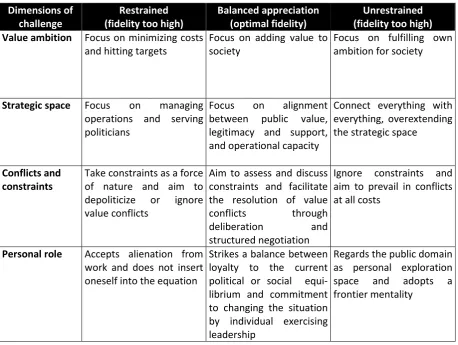
[image:10.595.70.529.315.660.2]We are agnostic with regards to both issues. We do argue that, given the stated objectives of public value theory in the cited works, the tools can be used in more or less functional way - that is in a way that is more or less helpful in making sense of strategic challenges in such a way that viable action alternatives can be identified and evaluated. Drawing on our own experience and deliberation among ourselves as a diverse group of scholars and teachers we bring together the main insights in what happens when these tools are used. Table 1 shows how different applications of the tools of public value theory have an impact on these four dimensions of a public management challenge, while the next paragraphs explore these effects in more detail.
Table 1.Understanding the dimensions of a public management challenge through public value tools
Dimensions of
challenge (fidelity too high) Restrained Balanced appreciation (optimal fidelity) (fidelity too high) Unrestrained
Value ambition Focus on minimizing costs
and hitting targets Focus on adding value to society Focus on fulfilling own ambition for society
Strategic space Focus on managing operations and serving politicians
Focus on alignment between public value, legitimacy and support, and operational capacity
Connect everything with everything, overextending the strategic space
Conflicts and
constraints Take constraints as a force of nature and aim to depoliticize or ignore value conflicts
Aim to assess and discuss constraints and facilitate the resolution of value
conflicts through
deliberation and structured negotiation
Ignore constraints and aim to prevail in conflicts at all costs
Personal role Accepts alienation from work and does not insert oneself into the equation
Strikes a balance between loyalty to the current political or social equi-librium and commitment to changing the situation by individual exercising leadership
Regards the public domain as personal exploration space and adopts a frontier mentality
Value ambition
10
organization producing? Who decides or has decided that this is the value to be produced? How do you know you are actually producing any value? Is it conceivable that more value could be produced if things would change? What would that look like? Questions like these guide the process of mapping, diagnosing and potentially reshaping the ambitions of public managers and public organizations. Many public organizations have been battered by years of re-organization, budget cuts, political turmoil, and so on. The technical interventions of business process redesign, performance management and change management have become stale. Public managers are often either absorbed by operational issues and organizational conflict or by political issues and public opinion.
The notion of examining what public managers think might be of value to society based on their knowledge, data, expertise and proximity to the task, , is as refreshing as it is radical. They sometimes think about their work as a set of performance targets to be achieved or a set of problems to be dealt with, but beneath and above that, there is typically a motivation to contribute to public value. Conversely, entrepreneurial public managers who have always been focused on innovation and change find the strategic triangle helpful in articulating their value proposition in ways that are more easily translatable into operational and accountability terms.
Some public managers feel they do not have the information or right to determine what is valuable. They argue that it is up to the politicians to decide what is valuable and that civil servants should merely execute their wishes. Other civil servants get a little carried away in the value statements. They feel that the concept of public value allows them to state their own goals and serve as the banner for their own crusade for a public cause. They tend to forget their relationship to the authorizing environment or the constraints of operational capacity. In this sense, talking about public value gets to the fundamental doubts and aspirations of public managers, but it also highlights that the value proposition cannot be understood without including the legitimacy and operational perspectives.
Strategic space
11
whereby traditionally they tend to understand their relationship with political masters in relatively narrow principal-agent terms or perceive strategic issues through the crowded lens of day-to-day operations.
The relationships between the different parts of the triangle allows the discussion to be broad, yet structured. Additionally, the analysis helps make sense of ambiguity caused by competing demands for attention, conflicting loyalties, colliding values, and contradictory messages from stakeholders in the authorizing environment.
The notions that an authorizing environment may have to be nudged into consensus, that a public value proposition can be multifaceted or under-articulated on purpose, or that operational capacity may have to be found outside the boundaries of one’s own organization help managers make sense of an otherwise frustrating situation. The descriptive power of the concepts (even visually, on blackboard or whiteboards) lies in their ability to acknowledge ambiguity, fragmentation, and tension). That appeals to managers who experience this reality daily and often have trouble relating to neatly organized concepts of academic theories. The strategic triangle does not impose an overtly neat framework onto messy realities; it opens up the strategic space by seeing new patterns and possibilities in what previously looked like an impossible chaos. In other words, the strategic triangle does not impose strict normative means and ends, but rather provides conceptual tools for thinking about both means and ends. In some cases, opening up the strategic space through the triangle leads to endless digressions and ponderings on what legitimacy really is or what stakeholders or business processes are important. There is indeed a near endless list of potential constituencies for a given policy, just as there are an endless number of operational processes involved, but that is no excuse for analysis-paralysis. In our experience, the strategic triangle is best used to drill downwards to the core issues and task at hand and separate essential from protean circumstances. The triangle is built to ask questions, and follow-up questions, as long as needed to arrive at an answer that combines the current or desired value ambition, the nature and source of legitimacy and support for the vision of public value, and the elements that make up the operational capacity in a concrete way.
Conflicts and constraints
12
three corners of the triangle never align neatly, a further exploration of the authorizing environment often reveals contradictory demands and preferences. Here public value management reveals its understanding of the public domain as inherently political with a small ‘p’ (see discussion in Introduction, same issue). Public value does draw on objective measurements of value or processes where possible, but ultimately recognizes that the appreciation of public achievements is a subjective process, as visualized in the value chain. Ideally, the tools of public value management help practitioners to structure these value conflicts. These conflicts and choices cannot be depoliticized or ignored; pretending that all questions are decided by the technicalities of legal mandates, procedure mandates or operational constraints will not get the agency very far. However, public value management does not aim to over politicize all issues. Where possible, public value management does aim to use qualitative and quantitative data, if not only to identify operational bottlenecks or facilitate the subjective evaluation of the stakeholders. Rather emphasizing that everything is ‘politics’ in the view of public value management, it may be more apt to say that everything is ‘public’ in public value management. Finally, when discussing conflict and conflict resolution, links are typically made to negotiation analysis (mutual gains approach) and (adaptive) leadership theory (Heifetz et al, 2009; Hartley & Fletcher, 2008). Both sets of ideas are focused on maximizing value in a multi-actor environment and helping organizations and social systems arrive at a better equilibrium, both in terms of substance and in terms of relationships. The authorizing environment corner of the triangle is therefore a good segue into politics, negotiation and leadership theory.
Personal role
13
This approach aims to break through the sense of alienation that a lot of participants in public life may feel. The systems of government and the language of management often inspire detachment and depersonalization. Structures and processes are emphasized and human agency is de-emphasized. Ideally, the tools of public value reconnect practitioners with the values driving their own actions, but also show how they are personally reliant upon others for legitimacy and support. This element is the bridge to leadership theory, in particular
adaptive leadership (Heifetz, et al 2009): to what extent do your current job description and your formal authority allow you to play the role that is needed to better align value, capacity and support and to what extent do you need to re-interpret your role and transgress the boundaries of formal authority?
This need not imply that managers take on a grandiose role and feel emboldened to pursue their private public value agenda, as has been cautioned by Rhodes & Wanda (2007) with specific reference to Westminster-type politico-administrative systems. That is of course a risk, but spending just a couple of minutes discussing the question “Where does legitimacy and support come from?” will be a sobering experience for those prone to overzealousness. What the element of one’s personal role in the larger picture of strategic analysis means, is that public value theory is not removed from practice, but derives its meaning and utility from application in practice. You can’t apply the tools unless you apply yourself.
Principles for the application of public value theory tools
Based on the different dynamics created by the tools-in-use described above, we would like to suggest a number of propositions about principles for successfully applying the instruments of public value theory. These principles can help us to optimize the impact of the current set of public value theory tools, by staying true to their original intent and practical utility. These principles can help teachers to transmit the different tools of public value management, practitioners in the application of the instruments, and scholars towards formulating hypotheses which can be operationalized and examined through further research (see Alford et al, this issue). The first four principles are derived from impact on the value ambition, strategic space, conflicts and the personal role as detailed above.
14
2. Strategic space: Tools should encourage a reframing of the domain of the challenge at hand, involving players as they are relevant to the situation and prioritizing operational issues if they turn out to be relevant for the solution of the problem.
3. Conflicts & constraints: The tools should help actors to engage with the ever-present ambiguity of public management by helping them to structure conflicts, not to eradicate uncertainty by reducing challenges to merely technical issues.
4. Personal role: The tools should keep public value management personal. Although the value ambition may extend to the entire community (or beyond), the first and final question is always to the individuals involved: What will you do?
We would like to add a fifth principle on the pedagogics of teaching and transmitting public value tools, arguing that this is core to the function of public value tools as heuristic devices. The essence of public value management cannot be captured through passive observation, just as they cannot be explored solely through theoretical expositions or simplified hands-on guides. It takes a combination of reflection and action (Kolb et al, 2014) to explore and structure the dimensions of the public management challenge, whether they concern the value ambition, strategic space, constraints, or personal roles. This call for constant learning and interaction applies to teaching (exploring, not explaining), practice (co-creating, not dictating), and research (submerging, not merely observing).
5. Learning and interaction: An effective use of the tools rlies on a continuous interplay between the abstract and concrete, people and phenomena, examples and principles
15
value are more widely used around the world, teachers and practitioners of different capability will apply them in different ways and with varying levels of fidelity and utility.
Strengthening, Connecting and Expanding the Toolbox
After our examination of the tools-in-use and discussing the principles of application, let us now look ahead and identify opportunities for further development of the toolkit. Although we believe much can still be gained through applying the tools appropriately, we do also see opportunities to strengthen the toolkit in order to augment its ability to explore and structure the value ambition, strategic space, constraints, and personal roles within government. So how might the existing toolset be strengthened, connected to other tools and potentially extended?
Strengthening the toolbox
Some authors are still skeptical of the ability of the tools of public value to move the field beyond New Public Management obsessions with technocratic performance management and award sufficient respect to the importance of necessary democratic conflicts and constraints. Dahl & Soss (2014) voice concerns when examining the tools and mechanisms of public value management. They question “the extent to which public value governance challenges the economistic logic of neoliberalism” and argue that the tools take too “little account of power, conflict, and inequality.” As Rhodes and Wanda (2007) before them, they fear that the tools of public value management are simply a continuation of the New Public Management project, albeit with a new language and further excuses for by-passing democratic principles. Dahl & Soss argue that the tools of public value management therefore require fundamental strengthening.
16
To argue that the strategic triangle does not pay enough attention to politics would be unfair to a theory that has explicitly attempted to do just that. To say that it would be helpful to have more refined tools to map stakeholders, analyze sources, distribution and exercise of power is a valid statement. It would be interesting to develop a more detailed generic template for examining the authorizing environment. What John Alford has done for Public Value Process mapping is bringing the authorizing environment into the analysis of the value chain. Moore lists the stakeholders in the Public Value Account and Score Card as a means of demonstrating how different actors care about different things. Another approach might be to take the authorizing environment as a point of departure and somehow bring the operational capacity and public value proposition into that. This might build on existing tools for stakeholder or network analysis, or it might be a new tool altogether.
The tools of public value theory do not claim to be granular, exhaustive, or advanced, but holistic, integrative and foundational. Therefore, ‘strengthening the tools’ would appear to apply to their capacity to stimulate and shape discussion and careful consideration of relevant dimensions. The tools are at their strongest when they instill curiosity in the public manager. This curiosity, directed at the strategic challenge, the manager’s assumptions and beliefs, and insights offered by the literature, is guided by the tools and the teacher. The tools help the teacher switch between the concrete situation (a teaching case, or a personal real world challenge) and abstract ideas or general theories. The tools of public value, when properly applied, do not reduce complex questions to easy answers, but do help managers with structuring the hard work of navigating ambiguity. As such the tools are a necessary condition to orchestrate a conversation that is as integrative as public value theory intends to be, but not a sufficient condition. It will always be up to the teacher or facilitator to ensure that all dimensions of the public challenge are carefully explored, in appropriate detail, and in a balanced conversation.
Connecting the toolbox
17
dimensions of strategic management. Many tools can be deployed to navigate ambiguity, identify action alternatives, and make general ideas more concrete. To give the example of lean management, or business process reengineering more generally, it may seem that public value proponents would be distrustful of lean management because New Public Management proponents love to use it. However, when lean management is used to streamline the creation of value, rather than simply the fulfillment of efficiency targets, it is actually a very powerful tool to maximize the capabilities of the operational processes. Lean management can help managers to reveal false constraints in their value process chain. In the case of lean management, embedding it within a proper understanding of the value ambition could actually be said to restore the underlying ambition of lean management, which attached paramount importance to customer value, not rigid processing rules (Seddon et al, 2011). Similarly, benchmarking, another tool favored in New Public Management, could be applied within the principles of public value management. It may be very instructive to compare the performance of one agency to another. This additional data may serve to showcase what amount of value creation is possible and where the agency is lagging behind, again furthering the understanding of operational constraints. Importantly, however, in line with the focus on cases and customization inherent in the tools of public value management, it is not then the intention to mindlessly emulate the top-performers in a benchmark. Instead, public managers could work with their own authorizing environment and operational capacity, to determine what priorities are prominent for the stakeholders of this agency and what operational issues can be addressed in their context.
18
provide public managers with the practical utility of management tools without dangerously simplifying their challenges.
Extending the toolbox
The toolbox could also be expanded by creating new tools. While, as mentioned, skillful teachers and advisors can manage perfectly well with the existing basic instruments, it might be helpful to those who are new to the theory to have some ancillary tools at their disposal or to equip expert users with more refined instruments. A good place to start would be a tool to help map and analyze authorizing environments beyond principal-agent accountability relationships and incorporating new conceptual ideas, such as those of Talbot (2010) on performance regimes and Page et al (2015) on network management. For the operational capacity, we need a better understanding of optimizing operations which involve stakeholders and citizens outside the immediate scope of the organization, linking to the work on collaborative governance (Ansell & Gash, 2008) and innovation (Torfing et al, this issue). For the value proposition, we need additional tools to capture societal impact, linking to the work on health care outcomes (Porter & Teisberg, 2006) and Big Data initiatives.
Conclusion
The tools of public value management are heuristic devices that help students, practitioners and scholars to explore the dimensions of strategic challenges in public management and identify and evaluate courses of action. More specifically, the tools invite and encourage managers to reflect on their public value ambition, strategic space, constraints, and personal role and responsibility to act. If the tools are used with too little or too much emphasis on fidelity, they may actually lead to flawed thinking and ill-conceived practice. Instead, the tools of public value theory require a balanced appreciation and continuous in their application by teachers and practitioners. Principles for successful application include encouraging value-seeking behavior, engaging with conflict, constraints and ambiguity, stimulating personal engagement, and explicitly connecting abstract ideas with concrete situations. However, the tools may be necessary instruments to convey public value theory, but are not sufficient on their own to guarantee high quality discussion or action. Skillful, informed and principled facilitation is required to bring out the strength of the tools.
19
facilitation of enquiry. Similarly, there is theoretical and practical work to be done to further refine and expand the current toolkit of public value theory, both as a set of interrelated tools and in connection to other tools of business administration, public policy and management and democratic theory. This will require more integrative conceptual work in combination with a design oriented approach to applying the tools in practice. Let us therefore use the whiteboards in board rooms and the blackboards in classrooms not just to advise and teach, but also to learn, experiment and further develop public value theory.
References
Alford, J., & Yates, S. (2014). Mapping public value processes. International Journal of Public Sector Management, 27(4), 334-352.
Alford, J., & O'Flynn, J. (2009). Making sense of public value: Concepts, critiques and
emergent meanings. International Journal of Public Administration, 32(3-4), 171-191.
Ansell, C., & Gash, A. (2008). Collaborative governance in theory and practice. Journal of
Public Administration Research and Theory, 18(4), 543-571.
Bryson, J.M,, Crosby, B.C. & Bloomberg, L. (2014). Public Value Governance: Moving
Beyond Traditional Public Administration and the New Public Management. Public
Administration Review, 74 (4), 445-456.
Cook, M., & Harrison, T. M. (2015). Using public value thinking for government IT planning and decision making: A case study. Information Polity, 20(2, 3), 183-197.
Dahl, A., & Soss, J. (2014). Neoliberalism for the common good? Public value governance and the downsizing of democracy. Public Administration Review, 74(4), 496-504.
Douglas, S. & Meijer A. (2016), Transparency and PublicValue - Analyzing the
Transparency Practices and Value Creation of Public Utilities, International Journal of
Public Administration, DOI:10.1080/01900692.2015.1064133.
Hartley, J., & Fletcher, C. (2008). Leading with political awareness: Leadership across
diverse interests inside and outside the organisation. In Leadership Perspectives (pp.
163-176). Palgrave Macmillan UK.
Heifetz, R., Linsky, M., & Grasshow, A., (2009) The Theory and Practice of Adaptive
20
Kruiter, A.J., & De Jong, J., (2008) “Providing Services to the Marginalized: Anatomy of an Access Paradox” in: De Jong., J and Rizvi, G., The State of Access. Success and Failure of Democracies to Create Equal Opportunity”, Washington D.C.: Brookings Institution Press
Kolb, A. Y., Kolb, D. A., Passarelli, A., & Sharma, G. (2014). On Becoming an Experiential
Educator The Educator Role Profile. Simulation & Gaming, 45(2), 204-234.
Marshall, G. 1998. "heuristic device." A Dictionary of Sociology.
Mathiasen, D. G. (1999). The new public management and its critics. International Public Management Journal, 2(1), 90-111.
Moore, M. H. (2014). Public Value Accounting: Establishing the Philosophical Basis. Public Administration Review, 74(4), 465-477.
Moore, M. H. (1995). Creating Public Value: Strategic Management in Government. Cambridge, MA: Harvard University Press.
Moore, M. H. (2013). Recognizing Public Value. Cambridge, MA: Harvard University Press.
Noordegraaf, M., & Abma, T. (2003). Management by measurement? Public management
practices amidst ambiguity. Public Administration, 81(4), 853-871.
Page, S. B., Stone, M. M., Bryson, J. M., & Crosby, B. C. (2015). Public value creation by
cross-sector collaborations: a framework and challenges of assessment. Public
Administration, Vol 93(3), 715-732.
Porter, M. E., & Teisberg, E. O. (2006). Redefining Health Care: Creating Value-based
Competition on Results. Harvard Business Press.
Rhodes, R. A., & Wanna, J. (2007). The limits to public value, or rescuing responsible
government from the platonic guardians. Australian Journal of Public Administration, 66(4),
406-421.
Seddon, J., O’Donovan, B., & Zokaei, K. (2011). Rethinking lean service. InService Design
and Delivery (pp. 41-60). Springer US.
21
Talbot, C. (2010). Theories of Performance: Organizational and Service Improvement in the
Public Domain. Oxford University Press.
Wang, B., & Christensen, T. (2015). The Open Public Value Account and Comprehensive Social Development An Assessment of China and the United States. Administration & Society, first on line.