Development of industrial process characterisation
through data analysis
Aleksandar Josifovic
Design, Manufacture and Engineering Management University of Strathclyde 75 Montrose street, Glasgow, G1 1XJ Email: [email protected]
Jonathan Corney
Design, Manufacture and Engineering Management University of Strathclyde 75 Montrose street, Glasgow, G1 1XJ
Email: [email protected]
Abstract—Recently the world has seen an explosion of available data, gathered from sensors, experiments and direct measure-ments. The engineering world is shifting from model-centred simulations to the exploitation of large datasets for insights into machine behaviour. In the case of optimisation, where usually a simulation model is provided for the exploration of the parameter space, the new data-driven approach translates into the use of data for quantifying problems and delivering an optimal solution. This paper presents a methodology developed for interpreta-tion of condiinterpreta-tion monitoring data in the design process and site characterisation of hydraulic fracturing. Field data samples were processed to construct a nominal operating regime in a process pumping system.
After describing the generic process a case study implementa-tion of field data from a North American hydraulic fracturing site is presented for illustration. The paper summarises sensor installation, data acquisition and cloud-based pre-processing. Consequent analysis demonstrates expected operational output in normal operating conditions for a specified geological terrain. The paper concludes with a base-case scenario for PD pump’s process output.
I. INTRODUCTION
In recent years modern engineering systems have witnessed the start of a shift in the process of product development from in-depth physical modelling to increasing exploitation of real-time monitoring of on-site operation. Machine learning, de-veloped from Artificial Intelligence, aims to provide solutions for problems based on developed algorithms and analysis of historical data.
The concept of machine learning has been previously used in many different industries and scientific studies such as agriculture [1], mineral extraction [2], optical recognition [3], robotics [4] and others. In industrial environment, two approaches prevail; data collection on site and processing in cloud or, both data collection and processing is done directly on site.
Hydraulic fracturing process was established in 1950s [5] and involves using large number of positive displacement (PD) pumps to pressurise and deliver slurry-water mix into a well [6]. This method for stimulation and increase of hydrocarbon recovery has had global economic impact in energy sector, as demonstrated in North America [7], [8], [9].
In this well stimulation techniques all the central processes are controlled manually with limited amount of feedback information related to equipment life and failure prediction. Data processing of site metrics is currently being recorded on site and evaluated at central locations. Initial assessment stage needs to consider present on-site practices to develop benchmark criteria for future exploration wells. Proposed ini-tiative considers using characterized process metrics to develop performance envelops for satisfactory equipment operation. With the expansion of gathered data potential for predictive maintenance will be feasible. This paper evaluates mechanisms for extending equipment’s operational availability by introduc-ing a methodology for a PD pump monitorintroduc-ing system.
Aim of this work is to establish methodology for develop-ment of data processing system for hydraulic fracturing.
Systematic approach for implementing machine learning system involves using previously recorded field metrics to char-acterise, evaluate amplitudes and assign operational envelopes with specific phases of the process. Specific milestones in this work include following:
• Sensor identification and installation on equipment at
process location
• Data acquisition using specialised industrial hardware
• Upload to cloud-based system and access through
be-spoke data software
• Data evaluation using MatLab for identified process
phases
• Establishing performance envelops based on previously
examined data
II. METHODOLOGY
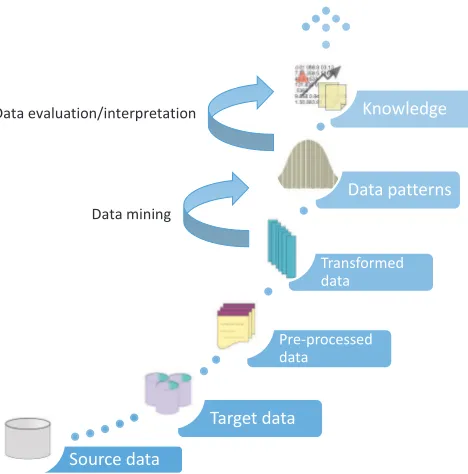
In Figure 1 knowledge discovery diagram is presented.
Source data - For data processing and analysis of hydraulic
fracturing processes a case study was required. Selected data was recorded in Texas, U.S. in 2015, the upcoming sections will present additional well properties.
Target data - Pumping stages in hydraulic fracturing
Data mining Data evaluation/interpretation
Source data
Target data
Pre-processed data
Transformed data
[image:2.595.310.564.99.259.2]Data patterns Knowledge
Figure 1. Data mining and knowledge discovery diagram
Pre-processed data - Processing site information requires
selection of relevant operational metrics to be recorded for analysis. In this case, PD pump’s inlet/outlet pressure, speed and vibration are measured.
Transformed data - Acquired pump metrics are transformed
for display into SI units, pressure in MPa, speed in RPM and vibration in g.
Data patterns - Physical measurements are aligned and
displayed in the same phases of pumping process. Data char-acterisation in form of mean, extreme and frequency values are presented for all sensor measurements.
Knowledge - Cumulative sensor output provides necessary
knowledge for site characterisation in hydraulic fracturing by defining surface pump pressure and associated vibration for a given pump speed.
III. CASESTUDYDESCRIPTION
Hydraulic fracturing involves using multiple high pressure PD pumps to propel fluid downhole. A typical site consists of multiple frac-truck assemblies each of which carries a single PD pump.
Photograph of a hydraulic fracturing process site, with equipment annotation, is shown in Figure 2.
A. Sensor data
[image:2.595.57.291.101.338.2]One of the pump units was instrumented with a slurry pressure sensors, a speed sensor, accelerometers on both power-end and fluid-end together with a number of pressure and temperature sensors for power-end lubrication, shown in Figure 3. In addition to PD pump instrumentation, engine and transmission operation metrics were recorded to monitor drivetrain performance.
2 1
3 5
4
6
7
1 - PD pump 2 - Frac-truck assembly 3 - Blender - slurry mixer 4 - Water container
5 - Sand container 6 - Manifold trailer 7 - Wellhead 8 - Data collection van
8
Figure 2. Equipment identification on site
PTD VTF ST
VTP
PTS
PT - Pressure transducer - discharge PT - Pressure transducer - suction VT - Vibration transducer - fluid-end VT - Vibration transducer - power-end ST - Speed transducer
D S F P
Figure 3. Sensor allocation on the field unit
All the reciprocating equipment on a frac-site can be related to the pumping frequency, therefore running the PD pump at higher speed will demand a higher acquisition rate from the sensors. For example, a higher acquisition rate is required for accelerometers to identify spectral energy at higher frequen-cies.
B. IMS gateway
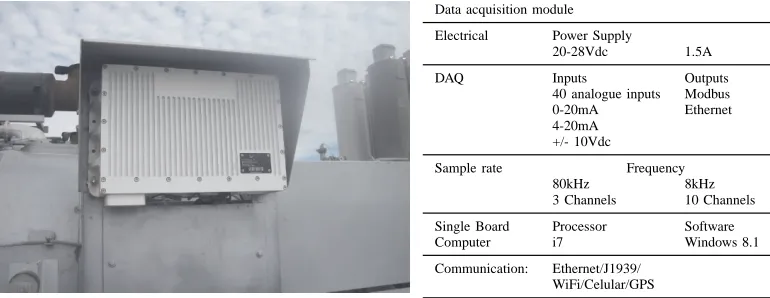
A key component of the system described is the IMS gateway, shown in Figure 4. This unit is used to acquire sensor data, perform signal processing and algorithmic calculations on the data and utilise its communication interfaces to send collected information to a cloud server.
Data flow path, illustrated in Figure 5, progresses as follows: 1) Signal conditioning changes transducer output into a readable value, which is followed by noise attenuation. For example a 4-20 mA value, obtained from the sensor, is converted into 0-5 VDC.
[image:2.595.315.555.106.476.2]Data acquisition module Electrical Power Supply
20-28Vdc 1.5A DAQ Inputs Outputs
40 analogue inputs Modbus 0-20mA Ethernet 4-20mA
+/- 10Vdc
Sample rate Frequency 80kHz 8kHz 3 Channels 10 Channels Single Board Processor Software Computer i7 Windows 8.1 Communication: Ethernet/J1939/
WiFi/Celular/GPS
Figure 4. Data acquisition unit is installed in the field. Main characteristics are listed in the table.
[image:3.595.112.497.103.252.2]Field unit Sensor IMS DAQ 'Enterprise' Cloud Workspace''SI MATLAB
Figure 5. Methodology for data acquisition from the PD pump unit on site.
that can be read by the Single board computer (SBC). Accelerometers are recorded at 4 kHz in DAQ card B and the remaining sensors are recorded at 1 kHz in DAQ card A.
3) The DAQ data is then sent to the SBC via USB interface. All the sensor data is stored in a database with time stamps and associated sensor information (e.g. sensor type and units of measure)
4) Data is then saved to the solid state drive (SSD). All the data firstly goes through a buffer and all the data can be approached almost instantaneously (no need to be pre-programmed). It can also be automated to acquire specific data at any available frequency.
5) Data is finally uploaded to the cloud server or physically transferred by one of the field engineers. The main challenge with current DAQ system is the volume of data storage space required to record high speed time series information. This can quickly run to terabytes of data and consequently the system is programmed always to erase the oldest data.
C. Rate of acquisition and data storage
Stage data is stored using three different sampling rates. Low speed was used to capture the whole stage. Due to the length of the stage, which could be up to three hours in length, it was sufficient to have 1 Hz sampling frequency to capture accurately well-head metrics (e.g. sampling frequency of 1 kHz is used for all pressure sensors, temperature sensors and rotational encoders installed on the field unit). In contrast, the accelerometers on the PD pump’s power-end and fluid-end
acquire data at 4 kHz owing to the speed of the reciprocating drives and the induced equipment vibration on site.
D. Data transfer method
Physical data was downloaded using a specialised software, ‘SiWorkspace’, from the cloud to a local workstation where
data was processed using MatLab. Although SiWorkspace is a configurable tool it currently only has limited data processing capabilities and is in principle only used to download the data from the cloud.
IV. DATA ANALYSIS
The system aims to allow all significant events, seen in the operation, to be detected and recorded. By evaluating their magnitude and impact the opportunity arises to predict and control events or foresee their development. The system would also be able to send information to the operator and signal any operational irregularity. For example, excessive vibration is common on site and to date it’s been difficult to get data to investigate the cause. In addition, the handlers on site needs to walk between units during operation and report any leaks or extreme vibration. There are potential safety benefits which a control system can provide.
In addition to the speed encoder (measuring PD pump’s rpm) and discharge pressure sensor, location of which can be seen in Figure 3, pump is also instrumented with two accelerometers. In Figure 6 precise orientation and placement on two main subsections of the pump, power-end and the fluid-end, can be seen.
To illustrate the system data PD pump pressure and speed are displayed in Figure 7. It is clear that changes occur
in 44th, 53rd, 94th and 126th minute. All of the changes
can be correlated to variations seen in hydraulic fracturing stage, thereby, highlighted areas will be analysed further by using high frequency data. However, there hasn’t been enough information to justify in-depth discussion of each of these states as they show great similarities between one another.
x y
z PowerEnd Orientation
FluidEnd Orientation
x y
z
[image:4.595.100.512.100.231.2]Fluid End - accelerometer Power End - accelerometer
Figure 6. Orientation of accelerometers on the PD pump
30 40 50 60 70 80 90 100 110 120 130 140
0 10 20 30 40 50 60 70
Pressure (MPa)
30 40 50 60 70 80 90 100 110 120 130 1400
20 40 60 80 100 120 140
Time (min)
Speed (RPM)
Pump discharge pressure Pump speed
Formation Breakdown Increasing speed
Change of gear
[image:4.595.55.291.282.474.2]Well shutdown
Figure 7. Identifying transitional parts of the stage
Table I
DATA FROM TRI-AXIAL ACCELEROMETER LOCATED ON THEPDPUMP’S
POWEREND
Sensor Peak (g) Mean (g) RMS (g)
Positive Negative
x-accelerometer 5.09 -5.00 -0.03 0.83
y-accelerometer 0.39 -0.36 -0.02 0.08
z-accelerometer 0.62 -0.69 -0.03 0.11
shown in three coordinate axes (X,Y and Z) at acquisition frequency of 4 kHz. The remaining sensors are all acquiring at 1 kHz.
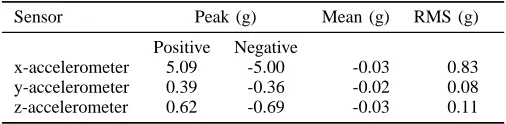
1) Power-End (PE) Tri-axial accelerometer: Time domain
analysis of the crankshaft accelerometer in state one is shown in Table I.
Analysis in time domain demonstrates significantly higher energy in x-axis of the crankshaft assembly. Calculating RMS values shows approximately 10 times more energy in x-axis compared to y-axis and 7 times more energy than in the z-axis.
50 51 52 53 54 55 56 57 58 59 60
−10 0 10
Time (sec)
Acceleration (m/s
2
50 51 52 53 54 55 56 57 58 59 60
−5 0 5x 10
−3
Time (sec)
V
elocity (m/s)
50 51 52 53 54 55 56 57 58 59 60
−1 0 1x 10
−6
Time (sec)
Displacement (m)
Crankshaft accleration in x−axis
Crankshaft velocity in x−axis
Crankshaft displacement in x−axis
(a)
(b)
(c)
Figure 8. Crankshaft accelerometer and data metrics displaying velocity and displacement
Peak values are mostly symmetrical in positive and nega-tive magnitude. Mean values are relanega-tively low in all three orientations.
To date the evidence suggests there is only limited inter-action between the vibration in the three axes, so each of the axis is considered as an independent function. Because of the comparatively high energy in one direction further PE accelerometer analysis and discussion focuses solely on the x-axis.
Time series data obtained from the PE accelerometer can be further developed by double integration to evaluate the crankshaft displacement. Pump’s PE displacement along the x-axis is quantified in Figure 8 (c). The noisy signal was processed with 50 Hz filter.
Analysis in the frequency domain of accelerometer in x-axis is displayed in Figure 9.
Accelerometer reading in the x-axis of the PE are shown in Figure 9. Given that the pump is operating at 106 rpm (i.e. 1.76 Hz) it can be seen that the dominant amplitude spikes are at 455 Hz, 15 Hz and 135 Hz which are listed according to their power amplitude.
2) Fluid-End (FE) Tri-axial accelerometer: Time domain
[image:4.595.315.560.284.438.2] [image:4.595.48.301.553.615.2]0 0.1 0.2 0.3 0.4 0.5 0.6 −4
−2 0 2 4
Time(sec)
Acceleration (g)
Vibration and Crank angle position
0 0.1 0.2 0.3 0.4 0.5 0.60
60 120 180 240 300 360
Crank Angle (
°
)
PEx at 106rpm(1.76Hz)
0 200 400 600 800 1000 1200 1400 1600 1800 2000
0 200 400 600 800 1000
X: 15 Y: 364.2
Frequency plot
Frequency(Hz) X: 135
Y: 303.5 X: 455 Y: 806.4
X: 618.3 Y: 224.1
Amplitude
X: 910 Y: 266.7X: 1038
Y: 196.9X: 1200Y: 157.4 X: 1337 Y: 195.7
X: 1500 Y: 197.7
[image:5.595.53.294.103.236.2]PEx at 106rpm(1.76Hz)
[image:5.595.319.560.107.239.2] [image:5.595.314.560.294.428.2]Figure 9. Frequency plot of accelerometer placed on the PD pump’s Power End in the direction of the x-axis
Table II
DATA FROM TRI-AXIAL ACCELEROMETER LOCATED ON THEPDPUMP’S
FLUIDEND
Sensor Peak (g) Mean (g) RMS (g)
Positive Negative
x-accelerometer 0.27 -0.28 -0.03 0.04
y-accelerometer 4.65 -5.49 -0.03 0.17
z-accelerometer 0.28 -0.29 -0.02 0.06
in state one is shown in Table II.
Once again energy in the direction of one of the axes is visibly higher compared to the other two. Again, displacement can be evaluated using double integration of the recorded acceleration. Figure 10 shows fluid-end displacement over the course of ten seconds.
Because of the nature of the signal it was decided that no filtering was needed as it will affect the final output. Because of this it is clear that pulses are equally spaced. This means that pump running at a constant speed will produce synchronized pulses that correspond well with plunger movement inside the pump. This effect is naturally more prominent on the fluid-end side of the pump because of the closeness to the reciprocating source (plunger) and the operating medium (slurry).
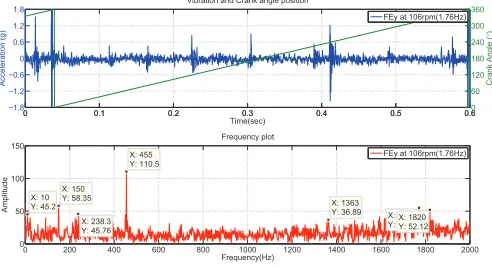
Analysis of the fluid-end accelerometer in frequency domain can be seen in Figure 11. Presented data is extracted from the same time segment as in the analysis of the crankshaft metrics. From the data displayed in Figure 11 it can be seen that there are certain similarities to the data presented in the crankshaft section, which is to be expected. Primarily, the occurrence of the peak at 455 Hz matches earlier results. The remaining two peaks at 150 Hz and 10 Hz are close to the ones exhibited in the PE section. Power amplitudes are lower in the FE section, vibration peak in time series is lower by 70% compared to the PE.
3) Suction pressure analysis: PD pump’s inlet pressure is a
good indicator of the overall performance and can be used very efficiently for predicting cavitation [11]. Data is processed and presented in form of time series and frequency domain.
50 51 52 53 54 55 56 57 58 59 60
−50 0 50
Time (sec)
Acceleration (m/s
2)
Fluid End accleration in y−axis
50 51 52 53 54 55 56 57 58 59 60
−0.01 0 0.01
Time (sec)
Velocity (m/s)
Fluid End velocity in y−axis
50 51 52 53 54 55 56 57 58 59 60
−2 0 2x 10
−6
Time (sec)
Displacement (m)
Fluid End displacement in y−axis
Figure 10. Acceleration, velocity and displacement plot from accelerometer located on the Fluid End in the direction of the y-axis
0 0.1 0.2 0.3 0.4 0.5 0.6
−1.8 −1.2 −0.6 0 0.6 1.2 1.8
Time(sec)
Acceleration (g)
Vibration and Crank angle position
0 0.1 0.2 0.3 0.4 0.5 0.60
60 120 180 240 300 360
Crank Angle (
°
)
FEy at 106rpm(1.76Hz)
0 200 400 600 800 1000 1200 1400 1600 1800 2000
0 50 100 150
X: 10 Y: 45.2
Frequency plot
Frequency(Hz)
Amplitude
X: 150 Y: 58.35
X: 455 Y: 110.5
X: 238.3 Y: 45.76
X: 1772 Y: 55.12X: 1820Y: 52.12 X: 1363
Y: 36.89
[image:5.595.48.300.321.383.2]FEy at 106rpm(1.76Hz)
Figure 11. Frequency analysis plot from accelerometer located on the Fluid End of a PD pump in the direction of the y-axis
Table III shows peak pressure and mean values during one second.
An entire pumping cycle is displayed in Figure 12 where pressure is shown in blue and plunger displacement, traveling
from 0 to 360◦, is shown in green on the right axis.
Unsurpris-ingly, the three cylinder pump has three distinct pressure spikes
at 0◦, 120◦ and 240◦ of crank rotation. Pressure fluctuations,
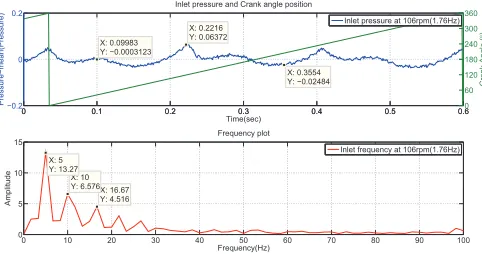
shown in Figure 12, are influenced by opening and closing of the inlet valves which gives rise to the transient behaviour inside the inlet manifold of the PD pump. Instrumented PD pump was operating in the fleet of PD pump units thereby the possibility of suction pressure fluctuation due to system interaction must not be ignored.
[image:5.595.311.564.707.757.2]Peak to peak variation is illustrated in Table III. Positive
Table III
SUCTION PRESSURE OPERATIONAL METRICS
Sensor Peak (MPa) Mean
(MPa) RMS (MPa)
Positive Negative
40 40.1 40.2 40.3 40.4 40.5 40.6 40.7 40.8 40.9 41 0.25
0.3 0.35 0.4 0.45 0.5 0.55
X: 40.6 Y: 0.4045 Inlet Pressure
Pressure (MPa)
X: 40.54 Y: 0.3241 X: 40.28
Y: 0.3854
X: 40.33 Y: 0.3309 X: 40.1
Y: 0.369
X: 40.41 Y: 0.4086 X: 40.22
Y: 0.4222 X: 40.03
Y: 0.4113
40 40.1 40.2 40.3 40.4 40.5 40.6 40.7 40.8 40.9 410
60 120 180 240 300 360
Crank Angle (
°
)
Cylinder no.1 Cylinder no.3
[image:6.595.311.561.129.345.2]Cylinder no.2
Figure 12. Suction pressure on the inlet side of the pump during one pumping stroke
0 0.1 0.2 0.3 0.4 0.5 0.6
−0.2 0 0.2
X: 0.3554 Y: −0.02484
Time(sec)
Pressure−mean(Pressure)
Inlet pressure and Crank angle position
X: 0.09983 Y: −0.0003123
X: 0.2216 Y: 0.06372
0 0.1 0.2 0.3 0.4 0.5 0.60
60 120 180 240 300 360
Crank Angle (
°
)
Inlet pressure at 106rpm(1.76Hz)
0 10 20 30 40 50 60 70 80 90 100
0 5 10 15
X: 16.67 Y: 4.516
Frequency plot
Frequency(Hz)
Amplitude
X: 10 Y: 6.576 X: 5 Y: 13.27
Inlet frequency at 106rpm(1.76Hz)
Figure 13. Frequency spectrum of the suction pressure on the inlet side of the pump during one pumping stroke
pressure peak is approximately 46% higher than the mean value. Pressure variation in the negative pressure peak is 60%.
It can be seen that peaks accurately align with the crank angle position and the annotations in Figure 12 indicate precise timing of the individual cylinders during one pumping cycle. In Figure 13 a single pumping cycle is analysed in frequency domain. The regular pressure pattern is visible in the frequency plot. Results show regular energy spikes at 5 Hz, 10 Hz and 16.7 Hz.
4) Discharge pressure analysis: Time domain analysis of
the discharge pressure has significance due of its influence on pump performance. Pressure was recorded at the discharge plenum located inside the PD pump. In the field the possibility that other PD pumps in the system are influencing operation of the test unit must also be considered.
Mean pressure during the recording time of two minutes, along with details on peak values, are shown in Table IV.
Figure 14 displays operation during one pumping cycle. The slow modulation of the outlet pressure can be the result of the load and the flow rate. Overall complexity of the signal is shown in the Figure 14.
Peak to peak oscillation varies in the sampled period. Section from the later part of the recording, shown in Figure 15, exhibit higher amplitudes.
Analysis in the frequency domain for the discharge pressure was done on the same time range of one second. Figure 16
Table IV
DISCHARGE PRESSURE
Sensor Peak (MPa) Mean
(MPa) RMS (MPa)
Positive Negative
Discharge Pressure 43.80 70.18 57.18 57.34
80 80.1 80.2 80.3 80.4 80.5 80.6 80.7 80.8 80.9 81
45 50 55 60 65 70 75
X: 80.26 Y: 54.11
Outlet Pressure
Pressure (MPa)
Time (s) X: 80.29
Y: 66.53
80 80.1 80.2 80.3 80.4 80.5 80.6 80.7 80.8 80.9 810
60 120 180 240 300 360
Figure 14. Discharge pressure inside outlet plenum of the pump during one pumping stroke
displays results from this analysis.
Frequency spectrum, shown in Figure 16, depicts impulsive nature in the low frequency part of the pressure signal. It is clear that there is a strong frequency concentration at 18 Hz forming 10:1 ratio with plunger frequency of 1.76 Hz.
V. RESULTS
Synchronization in the time domain and alignment against crankshaft position provides useful insight towards understand-ing pump operation in the field environment. Clear correlations between different sensor measurement can be seen and some of their relationship have been presented in this paper. In Figure 17 these observations are highlighted.
For example the accelerometer on the fluid-end, in the direction of the y-axis, shows equally spaced pulses that
110 110.1 110.2 110.3 110.4 110.5 110.6 110.7 110.8 110.9 111
45 50 55 60 65 70 75
X: 110.5 Y: 51.82 Outlet Pressure
Pressure (MPa)
Time (s) X: 110.5 Y: 68.66
X: 110.7 Y: 52.2
X: 110.7 Y: 69.31
110 110.1 110.2 110.3 110.4 110.5 110.6 110.7 110.8 110.9 1110
[image:6.595.54.295.277.404.2]60 120 180 240 300 360
[image:6.595.316.559.601.728.2]0 0.05 0.1 0.15 0.2 0.25 0.3 0.35 0.4 0.45 0.5
−10 −5 0 5 10
X: 0.1327 Y: 6.934
Time(sec)
Pressure−mean(Pressure)
Outlet pressure and Crank angle position
X: 0.3273 Y: −7.344
0 0.05 0.1 0.15 0.2 0.25 0.3 0.35 0.4 0.45 0.50
60 120 180 240 300 360
Crank Angle (
°
)
Outlet pressure at 106rpm(1.76Hz)
0 10 20 30 40 50 60 70 80 90 100
0 500 1000 1500 2000 2500
X: 18 Y: 2310
Frequency plot
Frequency(Hz) Amplitude X: 12Y: 642.1
[image:7.595.52.295.102.229.2]Outlet frequency at 106rpm(1.76Hz)
Figure 16. Frequency spectrum of the discharge pressure on the outlet side of the PD pump during one pumping stroke
0 30 60 90 120 150 180 210 240 270 300 330 360
-1 -0.5 0 0.5
1 FluidEnd acceleration
Crank Angle (°)
Y-direction
0 30 60 90 120 150 180 210 240 270 300 330 360
0.35 0.4 0.45
0.5 Inlet Pressure
Pressure (MPa)
0 30 60 90 120 150 180 210 240 270 300 330 360
55 60 65
70 Outlet Pressure
Pressure (MPa)
Crank Angle (°)
Crank Angle (°)
Acceleration (g)
Figure 17. Important pump metric and their relationship during one full pumping cycle
correlate well with angle of the crankshaft. Similarly, inlet and outlet pressure show strong association with the type of a PD pump (i.e. triplex) in the output signal. Pressure variation is also presented and +/- 10% fluctuation is seen around the mean value.
VI. CONCLUSION
In conclusion, the information provided in this paper illus-trates the complexity of data being collected from industrial operation to monitor site behaviour. This analysis highlights the field operation and the challenges that have to be overcome before the goal of a comprehensive mechatronic site control system can be realized.
The analysis of the accelerometers has shown that the vibration along the length of the pump is dominate. This presents valuable information that needs to be further devel-oped to support structural analysis. For example, similar field data analysis has previously been reported for wind turbines where the fatigue cycle was measured and implemented in computational model to assess possible improvements and design modification [12], [13].
In pressure pulsation studies, scenarios showing steady state and transitional operation were displayed and discussed which have possibility to be used as system training data sets.
Future implementation of this approach in industrial systems could provide live monitoring and feedback to equipment op-erator. Lastly, the condition monitoring system could provide information about any outstanding trends or predict failure based on this method for developing training data sets.
REFERENCES
[1] R. J. McQueen, S. R. Garner, C. G. Nevill-Manning, and I. H. Witten, “Applying machine learning to agricultural data,” Computers and electronics in agriculture, vol. 12, no. 4, pp. 275–293, 1995, URL.
[2] J. Tessier, C. Duchesne, and G. Bartolacci, “A machine vision approach to on-line estimation of run-of-mine ore composition on conveyor belts,” Minerals Engineering, vol. 20, no. 12, pp. 1129–1144, 2007, URL.
[3] A. Fathi and G. Mori, “Action recognition by learning mid-level motion features,” in Computer Vision and
Pat-tern Recognition, 2008. CVPR 2008. IEEE Conference
on. IEEE, 2008, pp. 1–8, URL.
[4] J. R. Peters, “Machine learning of motor skills for robotics,” Ph.D. dissertation, University of Southern Cal-ifornia, 2007, URL.
[5] G. E. King and Apache, “Hydraulic fracturing 101: What every representative environmentalist regulator reporter investor university researcher neighbor and engineer should know about estimating frac risk and improving frac performance in unconventional gas and oil wells,” in SPE Hydraulic Fracturing Technology Conference. Society of Petroleum Engineers, 2012, URL.
[6] Daneshy Consultants International, “Hydraulic fracturing to improve production,” Tech101, 2010, URL.
[7] Rohan North, “Hydraulic fracturing market (online),” Accessed: 16 April 2016, 2016, URL.
[8] API, “Hydraulic fracturing unlocking americas natural gas resources,” Accessed: 16 April 2016, 2014, URL. [9] Oil and Gas - Financial journal, “Hydraulic fracturing
market projected to continue growth,” Accessed: 16 April 2016, 2015, URL.
[10] M. J. Economides, K. G. Nolte, U. Ahmed, and
D. Schlumberger, Reservoir stimulation. Wiley
Chich-ester, 2000, vol. 18, ISBN: 978-0471491927.
[11] P. J. Singh and S. D. Able, “Determination of npshr for reciprocating positive displacement pumps-a new ap-proach,” in PROCEEDINGS OF THE INTERNATIONAL
PUMP USERS SYMPOSIUM. TEXAS A&M
UNIVER-SITY SYSTEM, 1996, pp. 131–142, URL.
[12] B. Jouan, S. Bergholz, and J. Rudolph, “Fatigue mon-itoring approaches for power plants,” in ASME 2014
Pressure Vessels and Piping Conference. American
Soci-ety of Mechanical Engineers, 2014, pp. V001T01A035– V001T01A035, URL.
[image:7.595.52.296.279.430.2]