
JOURNAL OF VIROLOGY, July 1977,p.177-187
CopyrightC 1977 American Society for Microbiology
Vol. 23, No. 1
Printed in U.S.A.
Polypeptide Synthesis in Simian Virus 5-Infected Cells
RICHARD W. PELUSO,* ROBERT A. LAMB, AND PURNELL W. CHOPPIN
TheRockefellerUniversity, New York, New York 10021
Received for publication18February 1977
Polypeptide synthesis in threedifferent cell types infected with simian virus 5 has beenexamined using high-resolution polyacrylamide slab gel
electrophore-sis, and all of the known viral polypeptideshave been identified above the host
cellbackground.The polypeptides were synthesized in infected cells in unequal
proportions, which are approximately the same as they are found in virions, suggestingthat their relativeratesofsynthesisarecontrolled.Thenucleocapsid
polypeptide (NP) was thefirst to bedetectedininfected cells, and by 12 to 14 h
the other virion structural polypeptides were identified, except for the
polypep-tides comprising the smaller glycoprotein (F). However, aglycosylated
precur-sor
(FO)
withamolecularweightof66,000 wasfoundineach cell type, andpulse-chase experimentssuggestedthat this precursor was cleaved to yield
polypep-tides F1 and F2. No other proteolytic processing was found. In addition to the
structural polypeptides, the synthesis of five other polypeptides, designated I
through V, has beenobservedinsimian virus5-infected cells. One of these(V),
withamolecular weight of 24,000, was found in all cells examined and may be a nonstructural viralpolypeptide. In contrast, there are polypeptides present in
uninfected cellsthatcorrespondin size topolypeptidesIthroughIV, and similar
polypeptides have also been detectedinincreasedamounts incellsinfectedwith
Sendaivirus. These findings, and the fact that the synthesis of allfour of these
polypeptidesis notincreasedineverycelltype,suggestthattheyrepresenthost
polypeptides whose synthesismaybeenhanceduponinfection. Whena
high
saltconcentrationwasused todecrease host cellproteinsynthesisininfectedcells,
polypeptidesIVand (to alesserextent) I weresynthesizedinrelatively greater
amounts than other cellularpolypeptides, as were theviral polypeptides. The
possibility that these polypeptides may play some role in virusreplication is
discussed.
Theparamyxovirussimian virus 5(SV5)has
been shown to contain five major structural
proteins, designated HN, NP, F, 5, and M (5,
23, 25). Two of theviral proteins, HNandF,are
glycosylated (15), and the larger of these (HN)
has been showntopossess both
hemagglutinat-ingandneuraminidase activities, whereas the
smaller (F)isthoughttobe involvedin
hemoly-sis and cell fusion (34-36, 38). The F
glycopro-teinof Sendai virusand Newcastle disease
vi-rus (NDV), two other paramyxoviruses, has
beenshowntobederived byspecificproteolytic
cleavage of a precursor glycoprotein,
desig-nated
FO,
whichisaccompanied by activation ofthecell-fusing and hemolyzing activities of the virion and its ability to initiate infection (12, 14, 27, 32, 35, 37). Although biologically inac-tivevirionscontaining theuncleaved
Fo
glyco-protein have beenfoundwithSendaivirusand NDV, such virions have never beenfoundwithSV5. However, evidence for the existence of
such aprecursor has beenobtainedinthat the
SV5Fprotein, aswellasthoseof Sendaivirus
and NDV, has been found to consist of two
subunits, F1 and F2, linked by disulfide bonds
(33, 38).
Themostabundantvirionprotein, NP,
com-plexes with viral RNAtoformthenucleocapsid
(24),andthe smallestprotein, M, isthoughtto
beassociatedwiththeinnersurface of the viral
envelope (23). The remaining major structural
protein, 5, is thought to be involved in the virion RNA polymerase activity (E. Buetti and P. W. Choppin, submitted for publication),
along with NP and possibly a viral protein
present insmall amount, L. The host cell pro-tein actin (A)hasrecentlybeenfoundinsome paramyxovirions (39), but the significance of thisis notyet clear.
Although much is known about the
struc-ture, composition, andfunctions of the compo-nents of SV5 and its interactions with cellsin
cytocidal and
noncytocidal
infections (6, 9, 11,16-18), relatively little isknown aboutthe
de-177
on November 10, 2019 by guest
http://jvi.asm.org/
178 PELUSO, LAMB, AND CHOPPIN
tailsof the synthesis of its proteins. This is due largelyto the difficulties inherent in studying viral protein synthesis in a system in which host cell synthesis is not rapidly turned off (10, 13), a situation commonwith paramyxoviruses. Recently, it has been possible to study the syn-thesis of Sendai and influenza virus-induced proteins in infected cells by the use of [35S]methionine labeling, high-resolution slab gel electrophoresis, and autoradiography (20, 21). This report describes SV5-induced protein synthesis in three different cell types. The time courseofviral protein synthesis has been stud-ied by pulse-labeling, and the processing of one of theviral glycoproteins (F) has been demon-strated in pulse-chase experiments with [3H]-glucosamine.
MATERIALS AND METHODS
Cells. Monolayer cultures of a variant of the MDBK line of bovine kidney cellsand the TC7 clone of CV-1 cells obtained from James Robb were grown in reinforced Eagle medium (REM) (1) with 10% fetal calf serum, as described previously (7). Pri-mary cultures of chicken embryo fibroblasts (CEF) were grown in lactalbumin hydrolysate medium with 2% calf serum (21). Baby hamster kidney (BHK-21-F) cells for plaque assays were grown in REM with 10%calf serum and 10% tryptose phos-phate broth as described previously (13). All cells were grown onplastic petri dishes.
Virus. Stock virus was grown in MDBK cells infected with the W3 strain of SV5 (6) at a multiplic-ity of-1 PFU/cell. After a2-h adsorption period at
370C, the monolayerswerewashed with
phosphate-buffered saline (PBS), and REM withoutserum was added. After3 to 4days at 370C, the medium was collected andclarified at 3,000 rpm for 30 min in a Sorvall GSA rotor. Bovine serum albumin was added to aconcentration of 1%, and the viruswas frozen at -70'C. Plaque assayswere performed as describedpreviously (8).
Chemicals andisotopes. 3H-labeled reconstituted protein hydrolysate was purchased from Schwarz Bio-Research, Orangeburg, N.Y.; [3H]leucine and [3H]glucosamine, from New England Nuclear Corp., Boston, Mass.; [35S]methionine, from Amersham/ Searle, Arlington Heights, Ill.; sodium dodecyl sul-fate, from Gallard-Schlesinger, Carle Place, N.Y.; dithiothreitol and ammonia-free glycine, from Cal-biochem, La Jolla,Calif.;and acrylamide and bisac-rylamide, from Ames Co., Elkhart, Ind.
Growth and purification ofisotopically labeled virus. MDBK cells were infected as describedabove; afteradsorption, the monolayers were washed with PBS, and REM containing 5 ,uCi of[3H]leucine per ml was added. After 3 to 4 days, the medium was harvested and clarified, and the virus was pelleted by centrifugation at 10,000 rpm for 2 h in a GSA rotor. The pellet was suspended in 10% potassium tartrate, homogenized in a Dounce homogenizer, andlayered on a linear 15 to 35% (wt/wt) potassium tartrate gradient. After centrifugation at 22,000 rpm
J. VIROL.
in a SpincoSW27 rotor for2h, the virusband was collectedanddialyzed against 0.0625M Tris, pH 6.8. Purified virus waskept at -20°C.
Infection and labeling of cells. Confluent mono-layers on 60-mm dishes were washedthree times withPBSand inoculated with-50PFU/cell; after a 1-hadsorption, the monolayers were againwashed three times, and2mlof Eagle medium wasadded. At various times after infection, the medium was removed andreplacedwith 1mlofoneof the follow-ing: (i)REM deficientinmethionineandcontaining [35S]methionine (10 ,Ci/ml); (ii) REM deficient in aminoacidsand containinga3H-labeled aminoacid mixture (10
A.tCi/ml);
(iii) REM deficient inglucose and containing [3H]glucosamine (25 uCi/ml). After incubation at 37°C for periods as indicated in Re-sults, the mediumwasremoved, and the cellswere washed twice with PBS andlysedinasolution con-sisting of4%sodiumdodecyl sulfate,3% dithiothrei-tol, 40% glycerol,and62.5mM Tris, pH6.8. Lysates werescraped from the dish and frozenat-20°C until processed for electrophoresis. Forpulse-chase exper-iments, the radioactive medium wasremoved, the cells werewashed threetimeswithPBS, and REM wasaddedtothedishes. At the appropriate times, the cells were harvestedasdescribed above.Polyacrylamide gel electrophoresis. Polyacryl-amide gel electrophoresis was done using a slight
modification of the procedure described previously (21);instead of anacrylamide-bisacrylamide ratio of 37.5:1, a ratio of 77:1 was used to obtain better resolution ofinfected cell lysates. Molecular weights ofpolypeptides wereestimated by their migration relativetothe following markers of known molecu-larweight: myosin, 18-galactosidase, phosphorylase a, bovine serum albumin,catalase, ovalbumin, al-coholdehydrogenase, DNase I, carbonicanhydrase,
a-chymotrypsinogen, and trypsin.
Autoradiography and fluorography. For detec-tionof 3H ingels,afluorographic procedure(2)was employed using Kodak RP-Royal X-Omat film. For [35S]methionine detection, dried gels were exposed
to Dupont Cronex 2DC X-ray film. Fluorograms wereprocessed byhand, and autoradiogramswere processed using aKodak3.5-minX-Omat.
RESULTS
StructuralproteinsofSV5virions.Figure1
shows an autoradiograph of3H-labeled, puri-fied virionsgrownin MDBKcells andsubjected to slabgelelectrophoresis. The five major
poly-peptides HN, NP, F1, 5, and M have estimated
molecularweights basedonmigration relative
to markers in this gel system of -70,000, 61,000, 52,000, 46,000, and38,000, respectively. Two minor polypeptides, L and a protein that comigrates with cellular actin, with approxi-mate molecular weights of 200,000 and43,000,
respectively, are also present. F2, the smaller
fragmentderived byproteolytic cleavageof
FO,
migrates with the buffer front in this gel and therefore is not resolved (38).
Polypeptide synthesis in SV5-infected MDBK
on November 10, 2019 by guest
http://jvi.asm.org/
POLYPEPTIDES IN SV5-INFECTED CELLS 179
L
HN
NP
F
-FIG. 1. Autoradiograph of the polypeptides of SV5 virions separated byelectrophoresis on a 10% polyacrylamide-sodium dodecyl sulfate (SDS) slab gel. Virionswerelabeledwith[3H]leucinein MDBK cells,purified,disrupted withSDSand dithiothrei-tol, andsubjectedto electrophoresisas described in thetext.Migration is fromtopto bottom.
cells. In MDBK cells, infective virions begin
toappearbetween8and9hpostinfection (p.i.),
and there is an exponential increase until 15
to 24 h p.i., followed by continuous virus
pro-duction for several days with only slight
cyto-pathic effects. Virus yields at 36 to 72 h are
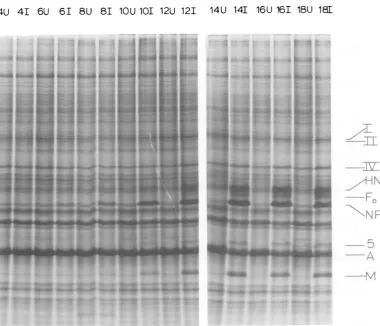
[image:3.501.90.198.85.544.2]usually in the range of 2 x 10⁸ to 4 x 10⁸ PFU/ mland256to 1,024hemagglutination units/ml. Figure 2 shows anautoradiograph of a lysate of infected MDBK cells labeled at various times after infection with [35S]methionine and
sub-jected to electrophoresis. By 6 h p.i., the
most prominent viral protein, NP, was
distin-guishedagainst the host cellbackground, and
by 12to 14 h all themajor virionpolypeptides, withtheexceptionof F1 and F2,weredetected. In addition to these structural proteins, three
polypeptides that are not found in virions
ap-peared to be present in increased amounts in
infected cells by 14 h. They are labeled I, II, and IV and have apparent molecular weights of -99,000, 97,000, and 78,000, respectively. As
discussed below, the available evidence
sug-geststhat thesearecellular polypeptides whose
synthesisisenhancedininfected cells.In
addi-tion tothesepolypeptides, infectedMDBKcells contain apolypeptide withamolecular weight of-24,000,designatedV(seeFig.5). This
poly-peptide ran off the gel shown in Fig. 2. The
polypeptide migrating withamolecular weight
of-66,000, labeled
FO,
willbe shown belowtobe theprecursorofpolypeptides F1 andF2. The
L protein was not detected inthese cells,
pre-sumably because it is present in a very small
amountand masked by comigrationwithhost proteins. Although the amount of each viral protein has not been quantitated precisely,
theseand similar autoradiographssuggestthat
the virion polypeptides are synthesized in
in-fected cellsinunequalamountsandarepresent
incellsinproportions similartothose foundin
virions.
Protein synthesisin primary CEF cells. In
primary CEF cells, few SV5 virions are
pro-duced,i.e., <105PFU/ml, thereis nodetectable
hemagglutinin (<2 hemagglutination units),
andnonon-hemagglutinatingparticles are
re-leased. Therefore, thepossibility ofadefectin
viralproteinsynthesisinCEFcellswas
investi-gated.Eventhoughlittleor novirus isreleased
fromthecells,all the known viralproteins are
synthesized
(Fig. 3). The most abundant viralprotein,NP,wasdetected before the other viral
proteins, as early as4hp.i., and by14 hall the known virion polypeptides except
F1
and F2 were seen, includinga small amount ofthe L protein which wasjust detectableat 14 to 18h. Inaddition to the virion proteins, the glycopro-tein precursor,FO,
was clearly seen in theseautoradiographs. As shown above in MDBK
cells, therewerealso large
polypeptides
whosesynthesis was increased in these cells and
which were not present in purified virions.
VOL. 23, 1977
on November 10, 2019 by guest
http://jvi.asm.org/
180 PELUSO, LAMB, AND CHOPPIN
4U
4I 6U 6I 8U 8I1OU
10I 12U 12IA*. 4.si, I_ ato 66._11- _m*
*-Wk.
LI-.tAh i 4 i; ; X 4 ;
;iB| \ F j; rmeI.- *I
Si'
.*sea*
.w
r.-.u.Alw'J. VIROL.
14U 14I 16U 16I 18U
1E8
4~~~~~~~~~~~~~~~~~~~~~~~~~4
4 ^ J. X
FIG. 2. Time courseofsynthesis of SV5polypeptidesinMDBK cells. Cellswereinfectedandlabeled with
[35S]methionine for60min at varioustimesafterinfectionasindicated.Inthis andsubsequentfiguresthe numbersrefertothe timeafterinfectionatwhich thelabelwasadded.I,Infectedcelllysates;U,
uninfected
celllysates.Whole-celllysateswereprepared forelectrophoresisandautoradiographyasdescribedinthetext.
Thepolypeptidesofunlabeled virions wereincludedoneachgelas markers.
Thesearedesignated I,II, IV,andV,and their
apparentmolecularweightsweresimilar in the two cell types. However, there was one
poly-peptide, III (molecular weight, -86,000), that
wasdetectedin CEF but not in MDBK cells.
Protein synthesisin theCV-1 line of
mon-key kidneycells.Virus-specific protein
synthe-siswasexaminedinthe TC7clone ofCV-1cells,
whichexhibitcontact inhibition ofgrowth (30),
todetermine ifsynthesisof minor viralproteins would be more easily detected in these cells.
Figure4showstheresultsobtained with CV-1 cells pulse-labeledatvarious times after infec-tion. Inaddition to themajorvirionstructural
polypeptides and Fo, polypeptides IV and V
wereclearlyseeninthesecells, and theL pro-tein, though still present in a small amount,
was detected at 12 to 18 h in these cells. No otherprecursorsorminorproteinswereseen.
Attempts to diminish host protein
synthe-sis. Toobviate furtherthe inherentdifficulties
in studying viral protein synthesis in cells in
which thereis no inhibitionof hostcell protein
synthesis, attempts were made to
selectively
reduce therateofsynthesis of cellular
proteins.
Neither growing cells at
330C
nor the use ofactinomycinD (0.05to5
Ag/ml)
wassuccessful
inthisregard;however,the exposure of MDBK
cellstohypertonic conditions priorto and
dur-ingthelabelingperiod,aprocedure thatcauses
adecrease in the initiation ofcellular
protein
synthesis (28, 31), resultedin some
degree
ofaselectiveinhibition of host
synthesis.
Theviralpolypeptides HN,
FO,
NP, 5, and M, althoughsynthesized
at decreasedrates ascompared
tocells notexposed tohigh salt, were
prominent
againstthe inhibited host cell
background (Fig.
5, cf. Fig. 2). Figure 5 also shows that the
synthesisof
polypeptides
I andIVappeared
tobe lessinhibitedininfectedcells thanin
on November 10, 2019 by guest
http://jvi.asm.org/
[image:4.501.70.451.70.396.2]POLYPEPTIDES IN SV5-INFECTED CELLS 181
46
ma66
6I 86
8I1Ju
l1126 121
146 14I 166 16i 18U 18I
I i *i ;
i .-LA
X
n~~~
i iI
E i~~~~~~~~~~~~~~~~~~~~~~~~~~~~~~~~~~
W ~~~~~~~~~~~~
km 1
l".
r
1I
IT
* 4
i
U
i:
I
#W W
FA-
mI
I.
Ft {sr
=a
-,-~-a;
*v
_
|6i
r
* 4
VW-_ o suW
* _S *ASr an
FIG. 3. Timecourseof SV5polypeptide synthesisin primaryCEFcells. Cellswerelabeled for 60 min with
[35S]methionineatthe times indicatedandprocessed for electrophoresis and autoradiographyasdescribedfor
Fig.2.
fectedcells. This becomesapparentifone
com-paresthe synthesis of thesepolypeptides,
par-ticularly IV, with those of other cellular pro-teinswhoseratesofsynthesis appeared similar
ininfectedand uninfected cells. Thus, high salt appeared to cause less inhibition not only of
viral polypeptides, but also oftwo presumed cellular polypeptides whose synthesis was
en-hanced in infectedcells. This finding raises the possibility that these proteins mayplay arole
in virusreplication.
Figure5alsoemphasizes the value of methio-nineasalabelinstudies of SV5 proteins, since
the labeling patterns ofviral polypeptides ob-tained with thetritiated amino acidmixture in
theseexperimentswassimilartothat obtained
withmethionine (cf. Fig. 2).
Comparisonofpolypeptide synthesisinSV5 andSendaivirus-infected cells. Toinvestigate
furtherthe originofpolypeptides Ithrough V, whose rates ofsynthesis in infected cells ap-peared to be greater than that in uninfected cells, thepatternsobtaineduponinfection with
SV5andSendaiviruswerecompared.
Polypep-tides thatcorrespondtopolypeptidesIthrough
IVinSV5-infected cellswerealso foundin Sen-daivirus-infected cells (Fig. 6).Thisfinding,in addition to the factthat proteins with similar
electrophoretic mobilitieswere found in
unin-fected cells, providessuggestive evidence that these are host polypeptides whose synthesis
is enhanced after viral infection rather than
virus-coded polypeptides. However,
polypep-tide V (molecular weight, -24,000) of SV5-in-fected cells does notcorrespond to a proteinin
Sendai virus-infected cells, nor does poly-peptide C (molecular weight, -22,000) in
Sen-dai virus-infected cells have a counterpart in
II
I
L
I'
i
p I
4
4
,-d*
L
I
zHN
---
Fo
-NP
5
A
M
6
VOL. 23, 1977
i i
. . 0
L ..
i
A 4...
,4w
4094
'w'..:,...,
;,_
on November 10, 2019 by guest
http://jvi.asm.org/
[image:5.501.52.440.68.421.2]182 PELUSO, LAMB, AND CHOPPIN
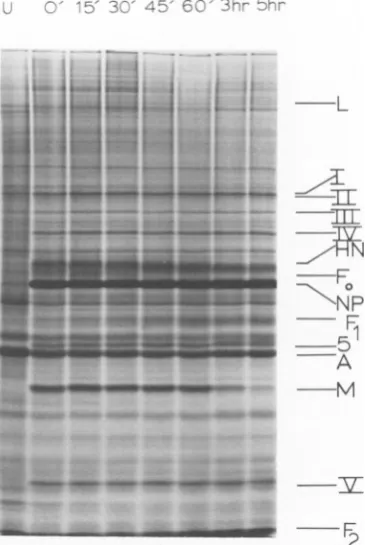
shows a representative experiment in which CEFcells werepulsed for 60 min at 17 h p.i. and then chased. By 30 min into the chase period, the amount of
Fo
wasgreatly decreased, andby 45 min it was not detectable, but F. had ap-peared, suggesting a precursor-product rela-tionship. The other cleavage product, F2, waspresent in the dye front on this gel but is re-solved in gels shown below (Fig. 8 and 9). In contrast to the rapid chasing of
Fo
into F1 and F2, the M protein did not decrease until 3 h, andnootherproteins werechasedout in up to 5 h.
The decrease in M is consistent with the
hy-pothesis that thesynthesis of this polypeptide
represents arate-limiting step in the
matura-FIG. 4. SV5 polypeptide synthesis in CV-1 cells. Atthe times indicated, the cells were labeled with
[P5S]methionine for60min andprocessed for electro-phoresisandautoradiography.
SV5-infected cells. This suggests that poly-peptide V may be a virus-specific,
nonstruc-turalpolypeptide, as waspreviously suggested
forpolypeptide CinSendai virus-infected cells (21).
Pulse-chase experiments in SV5-infected cells. Inthe aboveexperimentsinthree differ-ent cell types, aglycoprotein corresponding to
F1 was not detected. However, another poly-peptide that migrated slightly faster than HN
was consistently found. By analogy to Sendai
virus (21, 35, 37, 38), thiswasthoughttobe
FO.
This precursor has never been found on SV5
virions;therefore, it is presumably processed by proteolyticcleavage before release of the virus inall cells thusexamined, anassumption
sup-ported by therecentfindings that the F protein ofSV5, as well as those of Sendai virus and
NDV, consists oftwodisulfide-linked polypep-tides, F1 andF2(38).To investigate whether the polypeptide observed in SV5-infected cells is
suchaprecursor,pulse-chaseexperimentswere
performed in all three cell types. Figure 7
an
mmA*
-11 b
!r--\4
--lt
p:
FIG. 5. Effect ofhighsalt concentration on
poly-peptide synthesis in SV5-infected MDBK cells. (A)
Polypeptides ofSV5 virions grown in MDBK cells and labeled with [PH~leucine. (B) Polypeptides of infectedcells labeledfor60minat14hp.i. with 3H-amino acids in the presence of0.1 M NaCl. (C)
Polypeptides of infected cells labeledfor 60 min at
14 hp.i. with 3H-amino acids in isotonic medium. All samplesweresubjectedtoelectrophoresisonthe
same slabgel. Fluorography wasperformedas de-scribed in thetext.
H
of,-momm
J. VIROL.
on November 10, 2019 by guest
http://jvi.asm.org/
[image:6.501.71.252.70.371.2] [image:6.501.271.456.239.548.2]POLYPEPTIDES IN SV5-INFECTED CELLS 183
L
HHN
ILI
HN-NP
5
A
M
20% gel, it is evident that F. and F2 are both appearing in the chase. Thus, the experiments shown in Fig. 8 and 9 strongly suggest that
F0
isprocessed to yieldF1 andF2. These results, together with the previous findings thatF. and F2 are disulfide linked on SV5 virions (38), es-tablish that SV5-infected cells contain anF0
protein that isproteolytically cleaved to yield twopolypeptide chains in a manner analogous to Sendai virus and NDV.
DISCUSSION
_____F
The use ofhigh-resolution polyacrylamide
____N
gel electrophoresis, autoradiography, and fluo-rography (20, 21) hasmade it possible to study SV5protein synthesis in the presence of ongo-ingcellular synthesis. The use of several differ-entcelltypes hasmade it possible to identify all the known viral proteins and has also revealedseveralproteins that are notfoundin the virion
--B but whose
synthesis
is enhanced in infected--M cells.
By
4 to6 hp.i.
the most abundant viralpolypeptide, NP, was seen, and by 12 to 14 h all
FIG. 6. Comparison ofpolypeptidessynthesizedin SV5- and Sendai virus-infected primary CEF. At 18hp.i. thecells were labeled with[35S]methionine for 30 min, andcell lysates were then prepared for electrophoresis and autoradiograhy. Left lane, Unin-fected cells; middle lane, SV5-inUnin-fected cells; right lane, Sendai virus-infected cells.
tion ofenveloped viruses (21, 22). There is a
slight alteration in the mobility ofHN as
Fo
disappears, which could represent processing,
suchas changesinthe
carbohydrate
portionoftheglycoprotein. Although proteolytic cleavage
involvinga significantportion ofHN doesnot
appear to occur, removal of a small peptide cannotbeexcluded.
Glycoprotein
synthesis.
To obtain furtherevidence that the transient
polypeptide,
FO,
isthe precursor to F1 and F2, infected cellswere
labeledwith
[3H]glucosamine.
ProteinsHN, F1,
and F2 were
labeled,
aswell asFo
(Fig.
8). To establish the precursor-product relationship,pulse-chaseexperimentswere
performed
using[3H]glucosamine. When
Fo
diminished, F. andF2 appeared (Fig. 9, left). This is shown more
clearlyintheright panelofFig. 9,inwhich the
samples were subjectedto electrophoresis in a
20% gel; both F1 and F2 are clearly resolved.
Although it was not possible to detect a
de-crease in
FO
since it migratedwith HN in this _fls^.
s-w F1 w
e .J
^ it fl
A;;E
| |
| ;
-9
-*
W 4 *at4 to f
An..
49z;.^
*
to. 9,.< g '.4 } I
Air i I Et ^ ... * t i
|+wAa_at_
I C. .4._Ww
r-.-a-W_
e____a*.___...W
.- drage -a > or_
b_-_-*._1*_
And____a,,
5 3,7 Ad 6C 3rr Bhr
L
-IIIC
___NP
-FAN
Fo
-""NP
5
-
A
M
- -S|~_ _-Y--A
F
FIG. 7. Pulse-chase experiment in SV5-infected
primaryCEFcells.Cellswerepulsed for60 minwith
[f5S]methionineat17 hp.i. After the pulse, the radio-active medium was removed, thecellswerewashed three times withPBS, and REMwasadded. Atthe timesindicated, the cells wereprepared for electro-phoresis andautoradiography.
.. 26h dw
A"
a*
AMam
Joe&I
.-AV joinVWIM."s"O
m
-mmmmr-.. No
-VOL. 23, 1977
on November 10, 2019 by guest
http://jvi.asm.org/
[image:7.501.258.441.317.590.2]184 PELUSO, LAMB, AND CHOPPIN
t_
PR,
;"
W
FIG. 8. Synthesis ofglycoproteinsinSV5-infected MDBKcells.Cellswerelabeled for2h with [3H]glu-cosamine (25 ,uCi/ml) at 17 h p.i. and processed forelectrophoresis andfluorography asdescribedin
the text. Marker virions (right lane) were labeled with[3H]leucine.
ofthe viral structural polypeptides except F1 andF2werepresentin amountssufficienttobe
detected. Although the amount ofeach viral polypeptide synthesized ininfected cells could not be determined precisely by this method, examination of many autoradiographs
indi-cates that they are synthesized in
approxi-mately the same unequal proportions as they arefoundinvirions, whichsuggeststhat there
is control ofviral polypeptide synthesis.
Simi-lar findings have been reported for NDV (12)
andSendai virus (21, 29).
Inpulse-chase experiments a precursor
gly-coprotein, F0, has been identified in SV5-in-fectedcells; thisappearstobe convertedto two
smaller
polypeptides,
F1
andF2.
Unlike Sendai virus andNDV,
theFo
protein
ofSV5 hasnever beenseen onmaturevirions, indicating
that it issusceptible
tocleavage by
proteasespresent
inawide
variety
ofcells. Thismaybe duetoanextreme
sensitivity
tothesameprotease found in manycells,
or tosusceptibility
to a widevariety
of proteases, unlikewild-type
Sendaivirus,
orNDV,
which aresusceptible
totryp-sin,
or to the Sendaimutants,
whichrequire
other
specific proteases (27, 35,
37).The demon-stration ofcleavage
ofFo
in infected cells toyield F1
andF2
andthefinding
ofthelattertwodisulfide-linked
polypeptides
on SV5 virions(33,
38)
have established thegenerality
of theactivation of
paramyxovirus
virionsby
cleav-ageofthe
F0
glycoprotein,
eveninthecaseofa virus in which the uncleaved precursor is not foundonmaturevirions.The
finding
ofcleavage
of theFo
protein ofSV5 inthe nonpermissive CEF cells has ruled
out the
possibility
that lack ofcleavage
isre-sponsible
forthefailure of these cellstoproduce
virus.
Similarly,
thelack ofsynthesisof any oftheknown virion
proteins
has also beenshownnot to be the
explanation.
Although thepossi-bility
that there is ablock in theproductionof progeny genome strandsofviral RNA hasnotbeen
excluded,
thehigh
levels ofsynthesis of virionpolypeptides
in CEP cells suggest that thedefect lies atsomelaterstepintheassem-bly
process, e.g., in the proper sequence ofevents at the cell membrane. Further studies
are
required
toexplainthefailure ofproduction
of enveloped viruses from cells in which the
known viral proteinsare
synthesized.
Intwo avirulent strains ofNDV, but not in other
strains,
Nagai
andco-workers (27) dem-onstrated theexistence ofaprecursor(HNO)
tothe viral
hemagglutinin-neuraminidase
glyco-protein
(HN).
We have attempted to detect such aprecursor inSV5-infected cells, usingavariety
ofexperimental conditions,including
short pulses with [35S]methionine, high salt concentrations to reduce host cellprotein
syn-thesis,
and zincions,which have been shown in other systemsto inhibit cleavage ofviral pro-teins(3, 4,
19).However,
wehave been unabletodetect suchaprecursororto detect the syn-thesis of any other large unstable proteins in
infected cells. Similarly, attempts to find an
HNo
precursor in Sendai virus-infected cells have notbeen successful (21; LambandChop-pin, unpublished data). Thus, the question
re-mains open of whether synthesis of an
HNo
protein islimitedto afew strains, such as the
two avirulent strains ofNDV, or is a
general
feature of paramyxoviruses;however,if the
lat-teris the case, it hasescapeddetectionin exten-J. VIROL.
'.1
".K;p
4 -"
-, .4
on November 10, 2019 by guest
http://jvi.asm.org/
[image:8.501.105.219.72.430.2]POLYPEPTIDES IN SV5-INFECTED CELLS 185
0 .iI I
I * ii_I
.4~~~~~~~~~~~~~~~~~~~~~~~~~~~~~~~~~~~~~~~~~~~~~~~~~~~~..
a
MO
-HN.IF
0'* --F
2
2
FIG. 9. Pulse-chaseofglycoproteinsinSV5-infectedMDBK cells. Cellswerepulsed for60minat17 hp.i. with[3H]glucosamine (25 pXi/ml)and then washed threetimes withPBS,and REMwasadded. At thetimes
indicatedthecellswereprocessedasdescribedforelectrophoresison a10%gel (left) with[3H]leucine-labeled marker virus in theright lane,or on a20%gel (right)with[3H]glucosamine-labeledmarker virus in theright lane.
siveexperiments with SV5 and Sendai virus. Aninterestingaspectof thepresentstudies is the observations relating to the polypeptides whose synthesis is stimulated in infectedcells but which are not foundin the virion. One of these, V (molecular weight -24,000), doesnot
appeartocorrespond to apolypeptidefound in
uninfected cells, and thusmayrepresenta
non-structural protein analogous to the
22,000-dal-ton,presumed nonstructural polypeptide C
syn-thesizedinSendai virus-infected cells(21). The
function of these proteins is at present
un-known. In additiontoprotein V, thereareother
polypeptides in both SV5- and Sendai virus-infected cells (polypeptides I through IV) whose origins and functionsarenotcertain. However,
the available evidence suggests that these are
host polypeptides whose synthesis may be
en-hanceduponinfection. This conclusion is based onthefindingthat therearepolypeptideswith similarelectrophoretic mobilities in uninfected
cells, thatthe number detecteddependsonthe
cell type,e.g., three in MDBK cells and four in
CEFcells, and thatthesynthesisof four similar
polypeptides appears to be enhanced in cells infected with Sendai virus. When a high salt
concentration was used toselectively decrease thesynthesis of host cellproteins,the synthesis
of most cellular polypeptides was greatly
di-minished relative to SV5 proteins; however, synthesis of polypeptide IV, and, to a lesser
extent, I, was not inhibited as much as other
hostcell polypeptides. Thissuggeststhat these polypeptides are translated more efficientlyin
infectedcells than in uninfected cells and raises thepossibility that theymayplaysome rolein
the replication of paramyxoviruses, a concept
supported bythefindingofenhancedsynthesis
ofapparently host polypeptides in Sendai virus-infected cells (Fig. 6). Whether these proteins
are significant in virus infection, or,
alterna-tively, their apparentincreased synthesis is a
nonspecific effect following infection, remains
tobe determined. Therearepossibleroles that
could be envisaged for host proteins in para-myxovirusinfection, e.g., as acomponentofan
enzyme involved in the replication ofgenome
RNA, but there is no evidence at present on
E,
VOL. 23, 1977
on November 10, 2019 by guest
http://jvi.asm.org/
[image:9.501.54.443.69.354.2]186 PELUSO, LAMB, AND CHOPPIN
which to base any assignment of function to
these polypeptides. However, their detection
serves to stimulate investigation of possible roles for host proteins whose synthesis is en-hanced in infection by these nontransforming RNAviruses.
ACKNOWLEDGMENTS
We thank Ann Duncan for excellent technical assist-ance,E. Gershey for CV-1 cells, A. Scheid for helpful dis-cussions.
This research wassupported by Public Health Service research grantAI-05600 from theNational Institute of Al-lergyand Infectious Diseases and research grant PCM76-09993from theNational ScienceFoundation,andby Insti-tutional National Research Service Award TE-CA09256 from the NationalCancerInstitute, under which R.W.P. is apredoctoral trainee.
LITERATURE CITED
1. Bablanian, R., H. J. Eggers, and I.Tamm. 1965. Stud-ies on the mechanism ofpoliovirus-induced cell dam-age.I.Therelation betweenpoliovirus-induced meta-bolicandmorphological alterationsinculturedcells. Virology 26:100-113.
2. Bonner, W. M.,and R. A. Laskey. 1974. A film detec-tionmethod fortritium-labeled proteins andnucleic acidsinpolyacrylamidegels.Eur. J.Biochem. 46:83-88.
3. Bracha, M., and M. J. Schlesinger. 1976. Inhibition of Sindbis virus replication by zinc ions. Virology 72:272-277.
4. Butterworth, B. E., and B. D. Korant.1974. Character-ization ofthe large picornaviral polypeptides pro-duced in the presence ofzincion.J.Virol. 14:282-291. 5. Caliguiri,L.A., H.-D.Klenk,and P. W.Choppin.1969. The proteins of the parainfluenza virus SV5. I.
Sepa-ration of virion polypeptides by polyacrylamide gel electrophoresis. Virology 39:460-466.
6. Choppin, P. W. 1964. Multiplication ofa myxovirus (SV5) with minimalcytopathic effects and without interference. Virology 23:224-233.
7. Choppin,P. W.1969.Replicationofinfluenza virusin a continuouscell line:highyield of infective virus from cells inoculated at high multiplicity. Virology 39:130-134.
8. Choppin,P.W., and R. W.Compans.1970.Phenotypic mixing ofenvelope proteins of theparainfluenza vi-rus SV5 and vesicular stomatitis virus. J. Virol. 5:609-616.
9. Choppin,P.W., and R. W.Compans.1975.
Reproduc-tionofparamyxoviruses, p.95-178.In H. Fraenkel-Conrat and R. R. Wagner(ed.),Comprehensive virol-ogy, vol. 4.PlenumPress,NewYork.
10. Choppin, P. W., and K. V. Holmes. 1967.Replicationof SV5 RNAand the effects ofsuperinfectionwith polio-virus.Virology 33:442-451.
11. Compans, R. W., K. V. Holmes, S. Dales, and P. W. Choppin.1966.Anelectronmicroscopicstudyof mod-erateand virulent virus-cell interactions of the para-influenza virus SV5. Virology 30:411-426.
12. Hightower, L. E., and M. A. Bratt. 1974. Protein syn-thesis in Newcastle disease virus-infected chicken embryo cells.J. Virol. 13:788-800.
13. Holmes, K. V., and P. W. Choppin. 1966. On the role of theresponse ofthe cell membrane in determining virusvirulence. Contrasting effectsofthe parainflu-enza virus SV5 in two cell types. J. Exp. Med. 124:501-520.
14. Homma, M., and M. Ohuchi. 1973. Trypsin action on
J. VIROL.
thegrowth of Sendai virus in tissue culture cells. III. Structural difference of Sendai virusesgrownineggk
andtissue culture cells. J. Virol.12:1457-1265. 15. Klenk, H.-D.,L.A.Caliguri,and P. W.Choppin.1970.
Theproteinsof theparainfluenzavirusSV5. II. The
carbohydratecontentandglycoproteinsofthe virion.
Virology42:473-481.
16. Klenk,H.-D., and P. W. Choppin.1969.Chemical
com-position of the parainfluenza virus SV5. Virology 37:155-157.
17. Klenk, H.-D., and P. W. Choppin. 1969. Lipids of plasma membranes of monkey and hamsterkidney
cells and of parainfluenza virions grown in these cells.Virology 38:255-268.
18. Klenk,H.-D., and P. W.Choppin.1970. Plasma
mem-branelipidsandparainfluenza virus assembly. Virol-ogy40:939-947.
19. Korant,B. D., and B.E.Butterworth.1976.Inhibition
byzincofrhinovirus proteincleavage: interaction of zinc with capsidpolypeptides. J. Virol. 18:298-306. 20. Lamb, R. A., and P. W. Choppin. 1976. Synthesis of
influenzavirus proteins ininfectedcells: translation of viralpolypeptides,including three Ppolypeptides,
fromRNA produced by primarytranscription. Virol-ogy74:504-519.
21. Lamb, R.A., B.W. J. Mahy, andP.W.Choppin.1976. The synthesis of Sendai virus polypeptidesininfected cells.Virology 69:116-131.
22. Lazarowitz, S. G.,R. W. Compans, and P. W.Choppin. 1971. Influenza virus structural and nonstructural proteins in infected cells and their plasma mem-branes.Virology 46:830-843.
23. McSharry, J. J., R. W. Compans, H. Lackland, and P. W.Choppin. 1975. Isolation andcharacterization of thenonglycosylated membrane protein and a nucleo-capsidcomplex from theparamyxovirus SV5. Virol-ogy67:365-374.
24. Mountcastle, W. E., R. W. Compans, L. A. Caliguiri, andP. W.Choppin. 1970.Nucleocapsid protein sub-units of simian virus 5,Newcastle disease virus, and Sendai virus. J. Virol. 6:677-684.
25. Mountcastle, W. E., R. W. Compans, and P. W.Chop. pin.1971.Proteins and glycoproteins of paramyxovi-ruses: a comparison of simian virus 5, Newcastle diseasevirus, and Sendaivirus.J. Virol.7:47-52. 26. Nagai, Y., and H.-D. Klenk. 1977. Activation of
precur-sors tobothglycoproteins of Newcastle diseasevirus by proteolyticcleavage. Virology77:125-134. 27. Nagai, Y., H.-D. Klenk, and R. Rott. 1976. Proteolytic
cleavage of the viral glycoproteins and its signifi-cance for the virulence of Newcastle disease virus. Virology 72:494-508.
28. Nuss, D. L., H. Opperman, and G. Koch. 1975. Selec-tiveblockage of initiation of host protein synthesisin RNA-virus-infected cells. Proc. Natl. Acad. Sci. U.S.A.72:1258-1262.
29. Portner, A., and D. W. Kingsbury. 1976. Regulatory events in thesynthesisofSendai viruspolypeptides and theirassemblyintovirions.Virology 73:79-88. 30. Rovera, G., S. Mehta, and G. Maul.1974. Ghost
mono-layersin the study of themodulation of transcription incultures of CV1 fibroblasts. Exp. Cell. Res. 89:295-305.
31. Saborio, J. L., S.-S. Pong, and G. Koch. 1974. Selective and reversible inhibition of protein synthesis in mammalian cells. J. Mol. Biol. 85:195-211. 32. Samson, A. C. R., and C. F. Fox. 1974. Selective
inhibi-tionofNewcastle disease virus-induced glycoprotein synthesis by D-glucosamine hydrochloride. J. Virol. 13:775-779.
33. Scheid, A. 1976. Activation ofparainfluenza viruses through host-dependent cleavageofanenvelope
on November 10, 2019 by guest
http://jvi.asm.org/
POLYPEPTIDES IN SV5-INFECTED CELLS 187
coprotein,p.457-470.In D.Baltimore,A.S. Huang, and C. F. Fox (ed.), Animal virology, vol. IV. Aca-demic Press Inc., NewYork.
34. Scheid, A., L. A. Caliguiri, R.W.Compans,and P. W. Choppin. 1972.Isolation ofparamyxovirus glycopro-teins. Association of both hemagglutinating and neuraminidaseactivitieswith thelarger SV5 glyco-protein.Virology50:640-652.
35. Scheid, A., andP. W.Choppin.1974.Identification of biologicalactivitiesof paramyxovirusglycoproteins. Activation of cell fusion, hemolysis, andinfectivity by proteolytic cleavage ofaninactiveprecursor pro-teinof Sendaivirus.Virology57:475-490.
36. Scheid, A., and P. W. Choppin. 1974.The
hemaggluti-ninand neuraminidaseproteinofaparamyxovirus: interactionwith neuraminicacidinaffinity chroma-tography. Virology62:125-133.
37. Scheid, A., and P. W. Choppin. 1976. Protease activa-tionmutantsof Sendaivirus.Activationofbiological propertiesby specificproteases.Virology69:265-277. 38. Scheid, A., and P. W. Choppin. 1977. Two disulfide-linked polypeptide chainsconstitutetheactive F pro-teinofparamyxoviruses.Virology, inpress.
39. Wang, E., B. A. Wolf, R. A.Lamb, P. W. Choppin, and A. R. Goldberg.1976.Thepresenceof actin in enve-lopedviruses,p.589-599.InR.Goldman, T. Pollard, andJ. Rosenbaum(ed.), Cellmotility, book A. Cold Spring Harbor Laboratory, ColdSpring Harbor, N.Y.
VOL. 23, 1977
![Figure 2 shows an autoradiograph of a lysate ofinfected MDBK cells labeled at various timesafter infection with [35S]methionine and sub-](https://thumb-us.123doks.com/thumbv2/123dok_us/1543105.106849/3.501.90.198.85.544/figure-autoradiograph-ofinfected-labeled-various-timesafter-infection-methionine.webp)
![FIG.|6i[35S]methionineFig. 3. Time course ofSV5 polypeptide synthesis in primary CEF cells](https://thumb-us.123doks.com/thumbv2/123dok_us/1543105.106849/5.501.52.440.68.421/fig-methioninefig-time-course-polypeptide-synthesis-primary-cells.webp)
![FIG. 4.phoresis[P5S]methionineAt the SV5 polypeptide synthesis in CV-1 cells. times indicated, the cells were labeled with for 60 min and processed for electro- and autoradiography.](https://thumb-us.123doks.com/thumbv2/123dok_us/1543105.106849/6.501.271.456.239.548/phoresis-methionineat-polypeptide-synthesis-indicated-processed-electro-autoradiography.webp)
![FIG. 8.forcosaminetheMDBKwith Synthesis ofglycoproteins in SV5-infected cells. Cells were labeled for 2 h with [3H]glu- (25 ,uCi/ml) at 17 h p.i](https://thumb-us.123doks.com/thumbv2/123dok_us/1543105.106849/8.501.105.219.72.430/fig-forcosaminethemdbkwith-synthesis-ofglycoproteins-infected-cells-cells-labeled.webp)
