Theses
Thesis/Dissertation Collections
6-1-2012
Donor coordination in Kosovo 2010-2020 :
[presentation given on May 22, 2012]
Fatlinda Nitaj-Rexhaj
Follow this and additional works at:
http://scholarworks.rit.edu/theses
This Master's Project is brought to you for free and open access by the Thesis/Dissertation Collections at RIT Scholar Works. It has been accepted for inclusion in Theses by an authorized administrator of RIT Scholar Works. For more information, please [email protected].
Recommended Citation
1
American University of Kosovo
School of Public Services
&
Rochester Institute of Technology
Master of Science Degree in Professional Studies
Public Administration
“Donor Coordination in Kosovo 2010-2020”
By
Fatlinda NITAJ
“Submitted as a Capstone Project Report in partial fulfillment of the requirements for the
degree of Master of Science at the RIT - Center for Multidisciplinary Studies & American
University in Kosovo”
DRAFT - FINAL
2
TABLE OF CONTENTS
Acknowledgements……….……….……6
Acronyms ………....………..8
Executive Summary……….…...9
CHAPTER ONE: Donor Coordination in Kosovo…...………..………...11
1.1 The Department for Legislation …..………..…………..….13
1.2 Department for Economy and Trade ………...14
1.3 Governance Department...15
1.4 Human and Infrastructure Development Directorate…..………..15
1.5 Directorate for Strategy and Coordination…..………..16
1.6 The Department of Central Administration………..………16
CHAPTER TWO: Organizational structure of coordination established bodies by the Regulation on Donor Coordination………...18
2.1 Description of current situation of donor coordination…..………..18
2.2 Established Bodies by the Regulation on Donor Coordination…..………...19
2.3 The High Level Forum………..………..19
2.4 Structure and operations of the High Level Forum…….………19
2.5 Structure and Operations of Sector Working Groups…….………20
2.6 Structure and Operations of the Sub-Sector Working Groups…..……….20
2.7 Monitoring and Evaluation of Donor Coordination System…..………..20
2.8 Financial instruments ………..………..21
2.8.1 Instrument for Pre Accession Assistance (IPA)………..………21
2.8.2 TAIEX – Technical Assistance and Information Exchange………..22
2.8.3 TWINNING Instrument………..…...23
CHAPTER THREE: Donor Coordination at the regional and international level………..….25
3.1 Donor Coordination in Albania…………..………25
3.2 Donor Coordination in Macedonia………..………26
3
3.4 Donor Coordination in Serbia ………28
3.5 Coordination in Bosnia and Herzegovina………29
CHAPTER FOUR: Donor profiles and profiles on UN implementing agencies ………...30
4.1 Switzerland……….………30
4.2 Department for International Development – DFID……….31
4.3 Global Fund ………..………..32
4.4 Austria ……….……….33
4.5 Denmark ……….……….34
4.6 Finland……….………..36
4.7 USAID ……….………37
4.8 The Embassy of the Kingdom of the Netherlands ………...38
4.9 The Italian Cooperation (Cooperazione Italiana)……….……….….39
4.10 European Office in Kosovo………..………...40
4.11 The World Bank………..………...42
4.12 British Embassy in Prishtina………..………43
4.13 Japan International Cooperation Agency (JICA)……….44
4.14 Royal Norwegian Embassy / Norwegian Ministry of Foreign Affairs………45
4.15 Embassy of France……….46
4.16 Germany – KfW………..………...47
4.17 German Government Deutsche Gesellschaft für Internationale Zusammenarbeit (GIZ) ...48
4.18 Swedish International Development Cooperation Agency (SIDA)………...49
4.19 United Nations Implementing Agencies...50
4.20 Luxembourg...55
CHAPTER FIVE: Research methodology & survey respondents………..………63
5.1 Methodology of the survey work………..63
5.2 Survey results Facts & Figures ………..…64
5.3 Government questionnaire ………....….64
5.4 Age variable……….…………..65
5.6 Government questionnaire: Responsibilities, administrative support and staffing……….……65
4
5.8Coordination and communication ………..……..……...……67
5.9 Trained coordination personnel at the Ministries……….………68
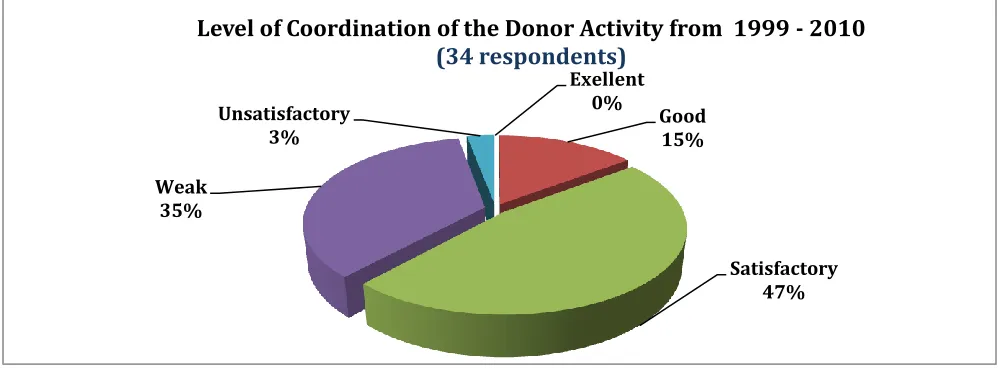
5.10. Level of Coordination of the Donor Activity from 1999 – 2010………..……….68
CHAPTER SIX: Communication and Coordination challenges……….69
6.1 Government monitoring policies ………69
6.2 Weakest Government policies……….…..70
6.3 Donor Future Support and Challenges……….….71
6.4 Government expectations for donor support in the future……….……72
6.5 Monitoring and Evaluation mechanisms ……….……..73
CHAPTER SEVEN: Training for Official working in the coordination of donations……….74
7.1 Donor questionnaire – poor coordination and aid effectiveness……….74
7.2 Satisfaction by donor community on management of financial assistance by Kosovo Institutions so far………..74
7.3 Aid effectiveness- actions that Kosovo Government should undertake ………75
7.4 Aid aligning on national priorities ………..76
7.5 Improvement of donor coordination……….76
CHAPTER EIGHT: Monitoring and Evaluation……….………..77
8.1 Improvement in the project evaluation process……….77
8.2 Areas prioritized by donor community for assistance in the next coming years………77
CHAPTER NINE: Final discussions & Recommendations……….………79
REFERENCES ………...81
ANNEX 1.GOVERNMENT QUESTIONNAIRE (ALBANIAN & ENGLISH LANGUAGE) ANNEX 2.DONOR COMMUNITY QUESTIONNAIRE
5 LIST OF TABLES AND FIGURES
CHART A. Organizational Structure of the Ministry of European Integration in osovo…….…....12
FIGURE 1. Aid Trends:Sectoral concentration between 1999 till 2007……….……...9
FIGURE 2.Actions for Government of Kosovo to undertake the coordination of donations…..….…..10
FIGURE 2.1.Bodies for Donor Coordination Assistance within the Ministry of European Integration……….………..18
FIGURE 3.1. Donor Coordination structure in Albania...25
FIGURE 3.2. Donor Coordination Structure in Macedonia………..………...26
FIGURE 3.3. Proposal for Donor Coordination in Montenegro………..……..27
FIGURE 3.4 Aid Coordination Mechanisms in Serbia……….….28
FIGURE 5.1 Government questionnaire-Gender Percentage (Female and Male) (34 respondents).63 FIGURE 5.2 Donor questionnaire: The Gender Percentage (Female and Male) (18 respondents)…64 FIGURE 5.4Government questionnaire: (34 respondents)Member’s age group (18 respondents)...64
FIGURE 5.5 Donor questionnaire: Age group the age percentage ……..………65
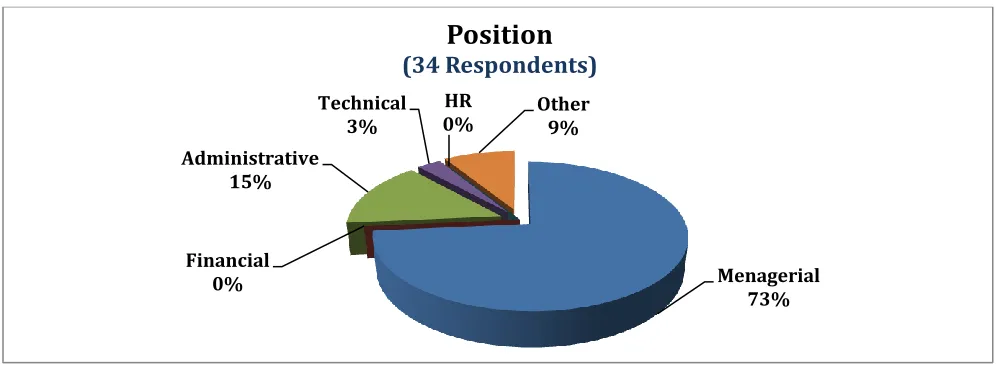
FIGURE 5.6 Positions of the Government representatives………. 65
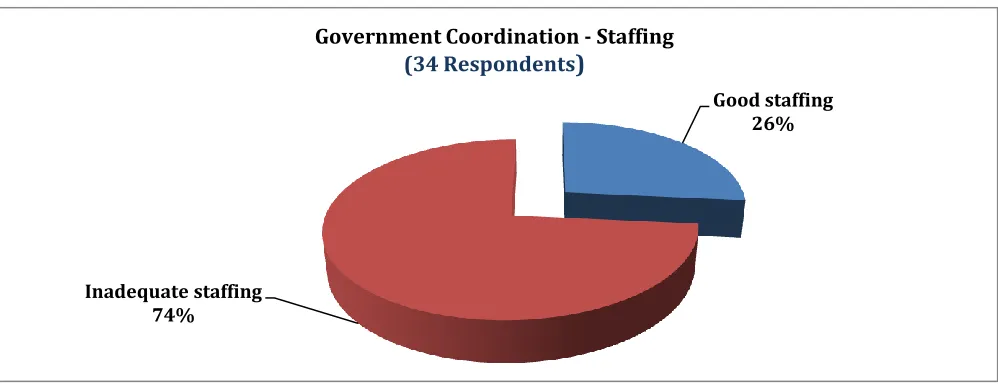
FIGURE 5.7 Government coordination – staffing ………..66
FIGURE 5.8 Coordination and communication among governmental staff and donor community..66
FIGURE 5.9. Trained coordination personnel at the Ministries……….67
FIGURE 5.10 Level of coordination of the donor activity from 1999-2010………...67
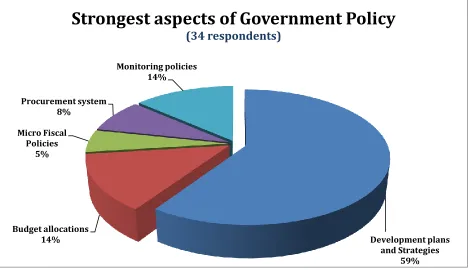
FIGURE 6.1 Strongest aspects of Government policies……….68
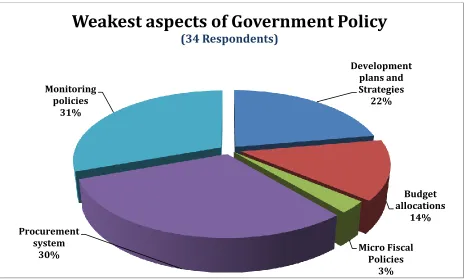
FIGURE 6.2 Weakest aspects of government policy …………..………69
FIGURE 6.3 Changes experienced in the Government Sectors in time period from 1999-2010….….70 FIGURE 6.4 Expectations for donor support in the future………..……….……71
FIGURE 6.5. Monitoring and evaluation mechanisms ………..………72
FIGURE 7.1 Government of Kosovo should undertake coordination of donations………73
FIGURE 7.2 Level of Satisfaction with managed donor assistance by Kosovo Institutions……….74
FIGURE 7.3 Aid effectiveness and what Government should make use of ……….………….….74
FIGURE 7.4 Aid aligning on national priorities……….………..74
FIGURE 7.5 Prioritization to improve the donor coordination………..75
FIGURE 8.1 Improvement in the project evaluation process……….……….……76
6 Tables:
TABLE 1. Switzerland - Disbursement 2008 – 2011 (in Million Euros)………33
TABLE 2. Department for International Development – DFI- Disbursements 2008 – 2011 (in Million Euros)………...34
TABLE 3. Global Fund - Disbursements 2008 – 2011 (in Million Euros)………36
TABLE 4. Austria - Disbursements 2008 – 2011 (in Million Euro)…….……….…37
TABLE 5. Denmark - Disbursements 2008 – 2011 (in Millions Euro)………..38
TABLE 6. Finland - Disbursements 2008 – 2011 (in Million Euros)………..39
TABLE 7. USAID - Disbursements 2008 – 2011 (in thousands Euro) ………41
TABLE 8. The Embassy of the Kingdom of the Netherlands - Disbursements 2008 – 2011 (in Million Euros)……….42
TABLE 9. The Italian Cooperation (Cooperazione Italiana) - Disbursements 2008 – 2011 (in Million Euros) ……….43
TABLE 10. European Office in Kosovo- Disbursements 2008 – 2011 (in Million Euros) ……..…...45
TABLE 11.The World Bank - Disbursements 2008 – 2011 (in Million Euros)………47
TABLE 12. British Embassy in Prishtina
-
Table: Disbursements 2008 – 2011 (in Million Euros).48 TABLE 13. Japan International Cooperation Agency (JICA) - Disbursements 2008 – 2011 (in Million Euros) ………..49TABLE 14. Royal Norwegian Embassy / Norwegian Ministry of Foreign Affairs - Disbursements 2008 – 2011 (in Million Euros)……….…50
TABLE 15. Embassy of France - Disbursements 2008 – 2011 (in Million Euros)……….51
TABLE 16. Germany – KfW - Disbursements 2008 – 2011 (in Million Euros)………....52
TABLE 17. German Government- Disbursements 2008 – 2011 (in Million Euros)………...…53
TABLE 18. Swedish International Development Cooperation Agency (SIDA) represented by Embassy of Sweden- Disbursements 2008 – 2011 (in Million Euros) ……….……54
TABLE 19. United Nations Development Program (UNDP) - Disbursements 2008 – 2011 (in thousands Euro)………....56
TABLE 20. UNICEF – United Nations Children’s Fund - Disbursements 2008 – 2011 (in Million Euros) ……….….58
TABLE 21. United Nations Population Fund- UNFPA- Disbursements 2008 – 2011 (in Million Euro)……….…….59
7
“Improved coordination among donors is an important step toward improving the impact of
development assistance globally” --- “Foreign Aid International Donor Coordination of
Development Assistance
“
Marian Leonardo Lawson
8
Acknowledgements
It is my pleasure to express my gratitude to all of those who helped me with the preparation of this thesis. I am deeply indebted to my supervisor and I would like to express my appreciation and special thanks to my capstone project advisor Professor Brian H. Bowen PhD for his continuous support, encouragement, guidance from the very first to the final stage enabled me to complete this thesis. He never accepted less than my best efforts.
In the mean time I would like to acknowledge and extend my deepest gratitude to professors Tom Hanney, Mary Boyd, Christopher G.Hall, William Wechsler, Vernon Hayes, David Keefe, Robert Wilton, Niccole Hyatt PhD, Francis Demoy and Gregory VanLaeken. Also, I would like to thank my first project consultant Mr.Demush Shasha, Secretary General of the Ministry of European
Integration, for his valuable help and contribution to gather information about the structure and donor mechanisms in Kosovo.
Moreover, I would like to express my gratitude to my second capstone project consultant to Dr.Niccole Hyatt who taught us a Human Resource Development course and who has been continuously willing to help me during the phase of writing the questionnaires.
I would also like to thank my third project consultant Ms.Lida Kita –Human Capital Development Specialist in the Operations Department at the European Training Foundation (ETF).
Furthermore, I extend my appreciation to my friends who made this capstone project possible and would like also to thank my colleagues in the Ministry of European Integration and in the Ministry of Labour and Social Welfare.
My special gratitude goes to my husband Astrit for his patience, understanding and support during the entire master program. Most importantly, I wish to extend my sincere appreciations to my parents, for their moral support and encouragement before and during this whole process.
9
Abbreviations & Acronyms
ADA Austrian Development Agency
BC British Council
CIMONLINE Center for international Migration and Development
DFID Department for International Development
ECLO European Commission Liaison Office in Kosovo
EUO European Union Office
FAO Food and Agriculture Organization of the United Nations
GIZ Deutsche Gesellschaft für Internationale Zusammenarbet
IMF International Monetary Fund
JICA Japan International Cooperation Agency
KWF KFW Bankengruppe
MAFRD Ministry of Agriculture, Forestry and Rural Development
MCR Ministry of Community and Returns
MCYS Ministry of Culture, Youth and Sports
MED Ministry of Economic Development
MEI Ministry of European Integration
MESP Ministry of Environment and Spatial Planning
MEST Ministry of Education, Science and Technology
MFA Ministry of Foreign Affairs
MFE Ministry of Finance and Economy
MI Ministry of Infrastructure
MIA Ministry of Internal Affairs
MLSW Ministry of Labour and Social Welfare
MoD Ministry of Diaspora
MoH Ministry of Health
MoJ Ministry of Justice
MPA Ministry of Public Administration
MTI Ministry of Trade and Industry
NGO Non-governmental Organization
OECD Organization for Economic Co-operation and Development
10 SDC Swiss Agency for Development and Cooperation
SIDA Swedish International Development Cooperation Agency
UNDP United Nations Development Program
UNFPA United Nations Population Fund
UNHABITAT United Nations Settlements Programme
UNHCR United Nations High Commissioner for Refugees
UNICEF United Nations International Children’s Emergency Fund
USAID United States Agency for international Development
WB World Bank
WHO World Health Organization
MTEF Medium Term Expenditure Framework
11
Executive Summary
This capstone project explored directions to be undertaken in improving the aid effectiveness in coordination of external assistance between the donor community and the
Government of Kosovo. It gives particular emphasis to aid needs by the donor community to move towards a more coordinated form of assistance leading to strengthening the economy. Since 1999, Kosovo has received a total of donor assistance €3.5 Billion. To date only € 2.7 Billion has been allocated for the period 1999-2007.
There are three main stages in this Capstone Project. (1) The first stage was a collection of all documents from the Government of Kosovo in donor activities from 1999 till 2010. (2) The second stage was the analysis of reports and an assessment on financing activities published by different international and national organizations and other available sources containing this kind of information and direction of aid in the last 10 years. 3) The third stage was the interview and questionnaire process.
The survey lasted for two months and included 40 government officials, (34 of them responded) and 20 donor organizations (18 of them responded) who gave feedback on donor coordination assistance and aid effectiveness. Also, case studies from regional countries were included in order to provide an improved analytical and comparative approach to this topic. The sectors which received the largest amount of external financing between 1999-2007 were the public and the private sector.
Figure 1: Donations to Kosovo: Percentage by ranging sector 1999 – 2007
Public Administration 2%
Solid Waste 1%
Water
4% Democratic Governance
/ Local Administration 21% Energy 17% Private Sector Development 11% Housing 7% Budget 7% Education and Science 5% Healthe and Social Welfare 5%
12
The findings identify that the most important action that the Government of Kosovo should undertake to coordinate donations as given in the Figure 2. below. The Government among other things has to show more commitment toward aid effectiveness. About 44% of respondents answered that, followed by the answer on showing more leadership on donor coordination. According to the responses, the third most important element that Government of Kosovo need to undertaken in the process of donor coordination is communication and leadership in this process. Figure2: Actions for Government of Kosovo should undertake to coordinate donations
As a result, two major recommendations step out from these findings when the Government of Kosovo should undertake in the donor coordination to improve the coordination and communication
between all the stakeholders. As illustrated in Figure 3 below, 50% of respondents answered that there is ineffective communication takes place. Therefore, improving the coordination and communication will help the Government to strengthen more the coordination mechanism itself and be an active party in whole this process.
Show more commitment
toward aid effectiveness
39%
Show leadership on donor coordination
38% Communication
and leadership in this
process 23%
No leadership is necessary
0% Non of the above 0%
Effective Communication
takes place 6%
13
Further recommendations include the following:
The government should increase the effectiveness of communication channels
Increase the level of monitoring and reporting system between Government and the Donor Community
The Government should show more effective leadership and commitment when coordinating the foreign assistance
The Government should have a satisfactory result oriented framework
The Government and Donors should set a framework on meeting specific goals
The Government should have a stronger and more balanced mechanism to support accountability
The Government should identify priorities to benefit from external assistance and promote donor coordination
14
Chapter 1
Donor Coordination in Kosovo
Kosovo is a low middle income country with a population of 1.815 million1. In 2010 Kosovo’s GDP
was 4.22 billion and GDP per capita 2.3832. Considering the fact that Kosovo is one of the poorest
countries in Europe, Kosovo also faces significant political challenge. Ethnic conflict in 1999 culminated in NATO intervention. After several years of being under UN control, the Republic of Kosovo declared its independence in 2008.
In 2008, a donor conference was held in Brussels to discuss the future of Republic of Kosovo and it’s relations with donors. The Government presented several major objectives with respect to aid. Broadly these objectives are to improve the standard of living, reduce poverty and to move towards full membership in the European Union3.
Based on consultations with all the stakeholders donor and Government Institutions, it has been agreed that there is a need for change in the approach to planning external assistance, i.e. moving from a project-based to a sector/or programme -based approach. In particular, the European Commission informed Kosovo authorities as well as EU member states and other donors present in Kosovo about the revision of its planning approach in April 2010 and invited other stakeholders' input to MIPD (Multi Indicative Planning Document). To streamline Kosovo's and donors' efforts and thus improve the effectiveness and impact in Kosovo, the government decided to embark on a sector-based approach to planning and implementing assistance.
As a responsible institution for coordinating external aid for the Republic of Kosovo the Ministry of European Integration (MIE), created some structures, including the High Level Forum which is responsible for organizing an annual meeting gathering the highest officials of the Kosovo Government, the donor community and other agencies to discuss relevant issues relating to promises made at the Donor Conference, held on 11th July 2008 in Brussels.
1 World Bank, World Development Indicators, 2012. Retrieved 1 May 2012 http://data.worldbank.org/ country/kosovo.
Preliminary results of the 2011 Census of Kosovo report a total population of 1.733.872; however, these figures do not include the population of several northern municipalities, so the World Bank figures are cited here.
2 2011 Gross Domestic Product, Kosovo Statistical Agency (1 May 2012) http://esk.rks-gov.net
15
The High Level Forum was established as a permanent mechanism with the purpose of analyzing and assessing progress in social and economic development and the efficacy of external aid. Furthermore, this forum is the highest decision-making body in the field of donation which takes political decisions. The aid effectiveness must increase significantly to strengthen governance and improve development performance in existing and new bilateral and multilateral initiatives leading to significant increase in aid. Kosovo should pay attention to such complex situation toward greater aid effectiveness.
The Ministry of European Integration4 is the main body to coordinate donor assistance in
Kosovo on behalf of the Government of Kosovo, so in the figure below is the organizational structure of the Ministry.
Chart A: Organizational Structure of the Ministry of European Integration in Kosovo
Source: Ministry of European Integration
4
16
According to the organizational chart within the Ministry of European Integration there are six departments: 1) Department of Legislation;2)Department for Economy and
Trade;3)Department of Governance;4)Human and Infrastructure Department;5)Department for Strategy and Coordination and 6)Central Administration Department.
1.1The Department of Legislation
The department of legislation (DoL) 5 operates within the Ministry of European and its main
functions are coordination and monitoring of the harmonization process of the draft laws with acquis communautaire. The Department of Legislation within its competence ensures that all the draft laws are prepared and proposed for adoption to be in compliance with all the principles and standards sourcing from Acquis Communitaire 6. Thus, the Department for Legislation issues two
main standard documents: 1) The Statement of Compliance and 2) Opinion Juris) for any ongoing procedure with regard to the evaluation of compliance of the draft law with the general principles of acquis communautaire. Documents contain the analysis on the draft law compliance with the principles sourcing from acquis communautaire and advisory opinion on possible adjustments of the proposed draft law in cases where it is considered necessary.
The statement of Compliance – contains the conclusions coming from analysis on the draft law compliance with general principles ofacquis communautaire, especially the probable braches of the general principles by the draft law.
Opinion Juris – contains all specific and concrete recommendations on the feasible changes on the draft law’s specific provisions, the aim to be in compliance with Acquis Communautaire In cases where the draft law is not in full compliance then the Department for Legislation overturns the draft law in the sponsoring Ministry to include the proposed remarks. The existing procedure guarantees that any draft law cannot be preceded in the Government Meeting or in the Kosovo Assembly, if it does not pass through the scrutiny of the harmonization procedure.
Taking into consideration the integration criteria’s’, the harmonization of the Kosovo legislation with the European Union’s is one of the key criteria, and the function of the Department for Legislation is in the duty of fulfilling the latter requirement.
5
http://www.mei-ks.net/?page=2,184
6Acquis communautaire is a French term referring to the cumulative body of European Community includes all the treaties, regulations and directives passed by the European institutions, as well as judgments laid down by
17
Therefore, Department of Legislation within its duties makes that the Annual Legislative program of the Government to be in compliance with the European Partnership Action Plan.
The Department assists the Ministries to identify the EU legislation from the relevant fields and facilitate all line Ministries in all the concerns that deal with the process of harmonization. Apart from focusing in harmonization, Department is also responsible for coordination of the translation process of the Acquis Communautaire.In each and every new accession of candidate and potential candidate countries, all European Community legislation shall be translated in the language of the country before its accession into EU, with the purpose to inform the citizens on their rights and obligations after the country accession into EU. In function of translation process of EU legislation of the normative acts in Kosovo’s official languages. Thus, the Department of Legislation is engaged to provide standardized procedure related to the process of translation of the EU normative acts into the official languages of Kosovo. As regards the monitoring data for translation process Department establish cooperation with the EU bodies, institutions and individuals included in the process of preparations of the national version of Acquis Communautaire.
1.2Department of Economy and Trade
The Department of Economy and Trade (DET)7 is one of the six departments of the Ministry of
European Integration, which mainly focuses on the issues of the economy and market. Within its competence, the department is responsible to coordinate and harmonize the work of the state administrative bodies and other bodies and institutions in European Integration in the area of acquis. Department of Economy and Trade is organized in four units: 1) Unit for internal market, trade and custom; 2) Unit for economic development and support to the SME;3)Unit for regional economic development and cross-border cooperation; and 4) Unit for employment, social policy, health and education. Main responsibilities of this department are: coordination and participation in the preparation of the Action Plan for Implementation of the European Partnership and other key documents of the Government of the Republic of Kosovo related to the process of development and integration. Participation, coordination and monitoring the institutional development for
implementation of the EU law in the area of acquis within its competence of the Department of Economy and Trade. Among other duties and responsibilities is also participation in the
cooperation with non-governmental sector and programming the use, scope and values of the EU programs, their monitoring and preparation of the reports for realization of the programs.
7
18
The Department among other responsibilities has also monitoring and utilization of EU community programs and instruments such TAIEX and Twinning instruments. This department supports ministries and other state administrative bodies in the preparation of the draft projects and programs for assistance and their implementation. This department coordinates bilateral foreign assistance related to the development and European Integration issues, and participation in negotiations with the EU Member States, other countries and with the international organizations for the use, scope and value of the programs.
1.3Governance Department
The Governance Department (GD)8 is mainly focused in the issues of governance, rule of law, public
administration, human and minority rights. This department is responsible to coordinate and harmonize the work of the state administrative bodies and other institutions in European Integration in the area of acquis. Organization of the Governance Department is within four units:1)Unit for Public Administration, Decentralization and Statistics;2)Unit for Public Finances, Financial Control and Procurement;3)unit for Rule of LAW;4)Unit for Minorities, Civil Society, Media and Cultural Heritage.
Main responsibilities of Governance Department are to coordinate and participate in the
preparation of the Action Plan for the implementation of the European Partnership and other key documents of the Government of the Republic of Kosovo related to the process of development and integration. Moreover this Department participates in the work of the working bodies of the Government for development and European Integration related issues, cooperation with the non-governmental sector and programming the use, scope and value of the EU programs , their monitoring and preparation of reports for realization of the programs.
1.4Human and Infrastructure Development Department
The Human & Infrastructure Development Department (HIDD)9 is focused in the issues of human
development and infrastructure. Within the competence this department is responsible to coordinate and harmonize the work of the state administrative bodies and other bodies and institutions in European integration in the area of acquis.
8
Ibid http://www.mei-ks.net/?page=2,184
19
The organizations of the Human and Infrastructure Department is within four units: 1) Unit for Agriculture, food safety and Rural Development;2) Unit for Energy, mining and environment;3)Unit for Transport;4)Unit for Health and Education.
The main responsibilities of this Department are: Coordination and participation in the preparation of the Action Plan for Implementation of the European Partnership and other key documents of the Government of the Republic of Kosovo related to the process of development and integration. Coordinating and monitoring the institutional development for implementation of the EU law in the area of aquis within its competence, participation in the work of the working bodies of the Government for development and European integration related issues. This department also cooperates with the non-governmental sector in programming the use, scope and values of EU programs, aiming to coordinate and monitor the utilization of EU programs and instruments within the competence of the department. It also supports ministries and other agencies in the preparation of the draft projects and programs for assistance and the implementation of projects.
Apart from this,Human and Infrastructure Development Department coordinate the bilateral foreign assistance from the EU Member States and of other bilateral and multilateral foreign assistance to the development and European Integration issues for the better use of EU programs and support coming from the foreign assistance.
1.5 Department for Strategy and Coordination
The department for strategy and coordination (DSC)10 deals with the issues of strategic and
general policy directions on the basis of analysis, policy coordination and methodologies. Within the competence, this department is responsible to coordinate and undertake measures for implementation of the European Partnership, including coordination and facilitation of the preparation of the European Partnership Action Plan (EPAP).Department for Strategy and Coordination is organized in four units;1)Unit for policy Coordination and Analysis;2) Secretariat to High Level Forum;3)Unit for Database and Management of Information Systems;4) Unit for Capacity Building.
The main responsibilities of this Department are to coordinate and prepare all meetings of different coordination structures, including coordination mechanism of EU-Kosovo bodies, for
10
20
the Stabilization and Association process Dialog Meeting (SAPD).Communication and coordination with all other institutions is also a task of this Department, which takes care to work with all the Department for European Integration and Policy Coordination in all line ministries and other bodies of the state administration. This department does overall
coordination and planning and programming of the priorities of Kosovo for the use of foreign technical foreign technical assistance from the EU Member States and other bilateral and multilateral foreign assistance related to reforms. Along with the programming, monitoring and evaluation of the EU assistance (IPA national, regional /horizontal and cross border allocations, TAIEX, Twinning Community Programs and Agencies for Bilateral and multilateral assistance form Member States and others this department makes a long-term planning of resources in support of the integration process in the EU including consistency with the MTEF, Public Investment Program, Annual Government Plan and Annual Kosovo Budget.
Last but not least, this department is responsible for preparation and coordination of the capacity building program including training program for civil servants in EU issues.
1.5The Department of Central Administration
The Department of Central Administration (DCA) 11is responsible for managing and taking care of
human and resources, internal organization and offering different trainings for the increase of the quality of personnel development, administrative and logistic support as well as offering of the services of Information Technology. Department for central Administration is organized in these divisions: 1) The Human Resources Division;2) Information Technology Division;3)Division for General Services. The role of this department is to conduct the procedures for the selection and employment of the qualified personnel for the Ministry of European Integration (MEI) in accordance with the applicable legislation.
This department monitors the implementation of all policies of the personnel, including the assessment and the classification of the works, recruitment, selection, filling the vacant positions based on the preparation and the specifications, experiences in agreements with the respective department and offices. Furthermore, this department leads the preparation and the
implementation of the qualification programs for the employees of the Ministry of European Integration, prepares the annual budget for the Central Administration and implement policies and instructions that come out from the regulation of civil service in accordance with the labour legal
11
21
22
Chapter 2
Organization structure of the coordination mechanisms
2.1 Description of current situation of donor coordination
The Government of Kosovo has recently approved the Regulation on Donor Coordination Nr.04/2011 12 which has entered into force on 03 June 2011 and aims to coordinate the
foreign aid, creating a system that ensures effectiveness and transparency between the activities of Government of Republic of Kosovo and the donor community.
[image:23.612.69.556.329.659.2]2.2. Established Bodies by the Regulation on Donor Coordination
Figure 2.1 .Bodies for Donor Coordination Assistance within the Ministry of European Integration.
-Decides main priorities for aid strategies
for development of the sectors and also
decides on key monitoring indicators.
-Coordinate donor activities at the
sectoral level, initiate drafting of
sectoral strategies and review
operational and technical issues
at the specific sub-sector.
- Instructing and monitoring of activities
in a particular sub-sector and ensure
that it is being done in accordance
with sectoral strategies and action plans.
12
Regulation Nr.04/2011 on Donor Coordination, establishing structures for donor coordination, signed by Prime Minister on 03 June 2011 (Annex 1 Division of Sector Working Groups)
High Level Forum
Sector Working Groups
23
2.3 The High Level Forum
The high level forum (HFL)13 is the highest body to approve the annual and multi annual priorities
for donor assistance in all sectors, which should be in full compliance with the key strategic documents of the Government of Kosovo. This forum approves defines the key indicators for monitoring progress and recommends improvement of donor coordination in all sectors.
2.4 Structure and operations of the High Level Forum
The High Level Forum is chaired by the Government of Kosovo, it is represented by the Prime Minister, member of which are ministries other Ministries, independent institutions, ambassadors or head of agencies representing bilateral and multilateral donor organizations. High Level Forum meet at least once a year under the coordination of the Ministry for European Integration and decisions are taken with the agreement of the majority of the members.
According to the regulation there are seven working groups on donor coordination which represent different Ministries in charge to coordinate the donor assistance at the specific sectors. These Sector Working Groups have certain responsibilities to initiate drafting of sectoral strategies in their absence and reviews the existing sectoral strategies.
The aim of these groups is to establish common performance indicators to measure the progress of development of the sector in general and reporting on the donor funds related to project planned in the Medium Term Expenditure Framework.14 Verification of database of the Aid Management
Platform (AMP)15 of donor projects related to specific sub-sectors is also a task of this department
which is responsible to ensure i regular updating by the ministries and donors, as well as provide regular reports of activities for all stakeholders. Furthermore, this department review the progress of sub-sectors and make the exchange of information on their best practices in providing and promoting inter-sectorial cooperation, promoting collaboration across Sub-Sector Working Groups.
This department also, takes the lead in preparing annual reports to the High Level Forum on the progress of the sector and reports on issues agreed during SWG’s quarterly and identify the potential donors to support priority needs and taking care to avoid multiple donations to the same matter by more than one donor so needless.
13
The High Level Forum http://www.mei-ks.net/?page=2,90
14 Medium Term Expenditure Framework
http://ec.europa.eu/enlargement/archives/seerecon/kdc/MTEF%20%202008-2011%20June%2012.pdf 15
24
2.5 Structure and Operations of Sector Working Groups
Members of the Sector Working Groups are representatives of the relevant sectors, representatives from the Ministry of European Integration, representatives of independent institutions and
representatives of the donor community aid portfolio which represents the sector. Secretariat of the Sector Working Groups is Ministry of European Integration who is responsible for modality of functioning of the Secretariat defined in the Rule of Procedure of the Ministry of European
Integration. Meetings of these groups take place quarterly. Moreover, each member of the Sector Working Groups has the right to initiate proposals for making decisions within the Sector Working Groups, on consensus basis. They include: Reviewing of activities in the sub-sector in order to verify the fulfillment of the target indicators of the sub-sector, identifying key priorities that need funding and donor support in the sub-sector level, active supporting in implementing strategies and action plans of existing sector.
This is to create synergy between donor-funded projects in sub-sectors and avoiding
duplication, reviewing and monitoring proposals for donor assistance in sub –sectors and to report it to the SWG about the progress of sub-sectors.
2.6 Structure and Operations of the Sub-Sector Working Groups
Relevant ministries are responsible for selecting the structure and functioning of the Sub-Sector Working Groups. These groups are made up by officials of the ministries who are heads of a particular sub-sector, level of directors of the departments, Ministry of European
Integration officials in charge of sector and donor community representatives.
The Sub-Sector Working Group is chaired by one of the Directors of the Department in charge of a particular sub-sector, and if necessary will be co-chaired by the Director of the
Department of other relevant Ministries. On the other hand, the Department of European Integration and Policy Coordination of that Ministry is the Secretariat where the Sub-Sector Working Group is represented. All the materials from these meetings are placed in the Aid Management Platform.
2.7 Monitoring and Evaluation of Donor Coordination System
25
and Sub-Sector Working Groups. Basic indicators to measure the results of the system for donor coordination are based on the Paris Declaration Survey. There are eight sectoral working groups:
Sector Working Groups: 1. Governance; 2. Rule of Law; 3. Agriculture and Rural Development; 4. Education and Employment; 5. Public Finance; 6. Economy Trade and Industry; 7. Transport and Infrastructure; 8. Environment.
2.8 Financial instruments
2.8.1 Instrument for Pre Accession Assistance (IPA)
IPA16 is a financial instrument used by the EU to help countries in the process of joining the EU,
which was created in 2007. There are 5 key objectives that Instrument for Pre Accession includes:1)Strengthening democratic institutions;2)Reforming the administration and
economy,3)Promoting and protecting human rights and freedoms;4)Improving and respecting the rights of minorities, and 5) Developing civil society.
Assistance offered in the context of documents regulating relations of a country with the European Commission, mainly European Partnerships for potential candidates and Accession Partnerships for candidate countries. Of the countries benefiting from the IPA, are included the five states of the former Yugoslavia (excluding Slovenia which is now an EU member), Albania and Turkey. However, IPA is a flexible instrument which can be used to help other countries outside the process of pre-accession always bearing in mind that measures financed by the IPA are part of a regional, cross-border, inter-state or international framework and do not supersede other EU programs for external assistance.
IPA assistance offers five components including:
1. Support during the transition and building of institutions; 2. Cross border cooperation;
3. Regional development;
4. Human resources development; 5. Rural development.
16
Instrument for Pre Accession Assistance (IPA)
26
This IPA assistance is based on multi-year strategic planning which includes the Multi-annual Financial Indicative Framework - a document which defines the amount the European Commission intends to spend in a country for a defined period and the priority fields to which IPA allocates funds. In addition, strategic planning is done through programs which can be annual or multi-year. IPA assistance, amongst others, can be divided into investment, subsidies, administrative
cooperation, participation in EU programs and budgetary assistance. The latter is divided in rare cases and is subject to oversight.
For the allocation of IPA funds, every year a cycle of IPA programs is developed during which projects are defined which will be financed through this instrument. The management of IPA programs is achieved depending on the capacities of a country to implement them. In Kosovo, the institution responsible for managing IPA programs was till 2012 Liaison Office of the European Commission., now European Union Office to Kosovo. For the years 2011-2013, IPA funds for Kosovo will focus on the field of rule of law, including in general law and order bodies, such as the police and courts, reform of public administration and economic development. These priority areas are specified in the Multi-annual Indicative Planning Document 2011-2013 which is also the key reference document for IPA projects.
2.8.2 TAIEX – Technical Assistance and Information Exchange
Technical Assistance and Information Exchange (TAIEX)17 is an instrument of the General
Directorate for Enlargement in the European Commission. TAIEX assists countries in the Balkans with harmonization of legislation, application and use of EU legislation. Its services are offered on the basis of need, which it coordinates and at the same time contributes with its expertise in solving problems as swiftly as possible.
TAIEX offers technical aid and advice on the transposure of EU legislation into domestic legislation for benefiting countries and for administration in general and implementing and putting into force that legislation. Besides this, TAIEX also offers:
Technical training and assistance for partners of benefiting countries, Information.
17
27 Database for making easier the monitoring of harmonization progress and identifying other
needs for technical assistance.
Those benefiting from TAIEX are: the public and private sector undertaking the transposure, implementation and putting into force of EU legislation.TAIEX is focused in supporting:
Civil servants employed in public administration at the national level and in local government associations;
Courts and authorities responsible for implementing the law;
Parliament members and civil servants employed in the Parliament and in Legislative Councils;
Professional and commercial associations which represent social partnerships and representatives of trading unions and employment associations;
Persons harmonizing and translating legislative texts.
TAIEX is mandated to offer assistance for the following beneficiary countries:- Croatia, the Former Yugoslav Republic of Macedonia and Turkey;- Albania, Bosnia and Herzegovina, Kosovo, Montenegro and Serbia;- Algeria, Armenia, Azerbaijan, Belarus, Egypt, Georgia, Israel, Jordan, Lebanon, Libya, Moldavia, Morocco, the Palestine Authority, Syria, Tunisia, Ukraine and Russia. New EU member states continue to benefit from TAIEX for one year after joining the EU.TAIEX does not offer services for ordinary citizens or private companies.
2.8.3 Twinning Instrument
Twinning 18aims to assist beneficiary countries in developing a modern and efficient
administration, with structures, human resources and managerial skills, necessary for achieving implementation of European standards and the Acquis Communautaire.
During the process of European integration, the administrations of potential candidates are offered mostly technical assistance, and twinning is considered the most successful instrument for this purpose. Consequently, twinning is offered as a form of assistance, especially in the more advanced stages of the European Integration process. Hence, with Kosovo’s progress towards European Integration, twinning is offered as a comprehensive form of assistance, affecting a large number of institutions. Besides this, twinning offers greater benefits, by bringing closer together public
18
28
administrations from different parts of Europe, offering possibilities to exchange experiences, solutions to problems and expanding perspectives about issues of shared interest.
29
Chapter 3
Donor Coordination at the International and Regional level
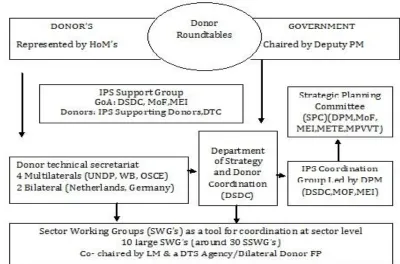
3.1 Donor Coordination in Albania
Is currently going through a rapid transition phase from a donor-led approach to country-owned coordination. If this process continues Albania will be elevated from a best practice case in Europe to one of the globally-interesting models for aid effectiveness.
[image:30.612.101.501.322.586.2]Coordination Structure
Figure 3.1Source: Donor Coordination structure in Albania
30
3.2 Donor Coordination in Macedonia
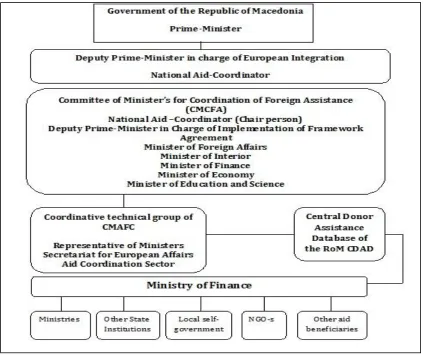
[image:31.612.95.519.241.596.2]Donor Coordination in Macedonia is facing difficulties while the Government designs the overall and sectoral strategies and policies, the main mandate of the National Aid Coordinator and the Committee of Ministers for Coordination of Foreign Assistance is to secure strategic directions of the foreign assistance in accordance with the Government priorities and to strengthen its effectiveness through inter-sectoral coordination.
Figure 3.2.Donor Coordination Structure in Macedonia
31
3.3 Donor Coordination in Montenegro
The Ministry for EU Integration, jointly with the Ministry of Foreign Affairs, is in charge of overall donor coordination. The inclusion of non-state-actors and municipalities in the development dialogue with the government, in coordination through line ministries (Tourism, Economic Development, Spatial Planning and Environment, Education and Science, Labour and Social Affairs), is a key aspect of this strategy. Firm commitment of development partners and the Government to the principles of aid effectiveness is needed to achieve sustainable long-term results under strong government leadership.
Figure 3.3. “Proposal for Donor Coordinationin Montenegro”
32
3.4 Donor coordination in Serbia
Serbian European Integration Office has established a consultative process which is based on sectoral civil society organizations, in order to ensure their participation in planning development assistance, especially programming and use of Instrument for Pre-accession. The section Cooperation with civil society organizations presents detailed information on the consultative mechanism, composition of seven SECOs, network members as well as their activities. With the aim of efficient and coordinated international assistance programming and monitoring process, in particular IPA, eight sector working groups have been established, comprising representatives of relevant national institutions and Sector for Planning, Programming, Monitoring and Reporting on EU Funds and Development Assistance.
Figure 3.4 Aid Coordination Mechanisms in Serbia
33
3.5 Donor coordination in Bosnia and Herzegovina
34
CHAPTER FOUR
4.1 Donor and UN implementing agencies profiles
4.1 Switzerland
Name of Organization Swiss Cooperation Office
Organization Type Bilateral
DAC Member Yes
Head of the Organization Marchus Baechler
Keypriority areas/sectors for the Switzerland to support Kosovo are: 1) Economy and Employment; 2) Rule of Law and Democracy; 3) Public Infrastructure; 4) Diaspora and Migration. Switzerland will continue its support to Kosovo’s transition processes towards socially inclusive, market economies and democratic political systems in view of the European Integration of the Western Balkans Region.
In the following table it is presented the disbursements Table: 1Disbursement 2008 – 2011 (in Million Euros)
Aid Modality 2008 2009 2010 2011
Capital Investment 0 0 102 0
General (or direct) Budget Support
(GBS) 0 174 923 129
In Kind / Supplies 0 238 306 0
Project 1.631 1.798 2.943 5.943
Targeted or Earmarked Sector Budget
Support (SBS) 600 397 1.230 88
Technical Cooperation
/Assistance 713 1.396 2.174 1.565
Total 2.945 4.002 7.679 7.724
The overall goal of the Swiss programmers is to support Kosovo in its transition and state building process, by contributing to improve:
- economic growth and sustainable employment;
- governance at central and local levels,
- rule of law and democratic processes;
35
Switzerland’s cooperation programme in Kosovo began with its participation in an OSCE
verification mission. During the armed conflict in 1998–1999, it set up an extensive humanitarian aid programme. Since the year 2000, humanitarian actions and programmes to assist the return of persons displaced by the war were soon complemented by reconstruction-assistance measures and by projects to foster livelihoods, to promote culture and to aid development.
4.2 Department for International Development – DFID
Name of Organization Department for International Development
Organization Type Bilateral
DAC Member Yes
Head of the Organization Richard Taylor
Keypriority areas/sectors for Department for International Development – DFID to support
Kosovo in the future are:1)Civil Service;2)Public Administration;3)Public Finance, 4)Private Sector Development;5)Statistical Systems Development;6)Social Protection;7)Health Sector Reform;8)Rule of Law
In the following table there are presented disbursement from 2008-2011. Table: Disbursements 2008 – 2011 (in Million Euros)
Aid Modality 2008 2009 2010 2011
Project 0 364 256 468
Targeted or Earmarked
Sector Budget Support (SBS) 0 0 0 1.169 Technical Cooperation
36
DFID has worked in Kosovo since 1999, initially providing immediate post-conflict humanitarian assistance. DFID programme has evolved over the last 12 years into one which currently focuses on supporting reforms in the areas of governance, rule of law, and improving economic growth. Since 1999 DFID has contributed over €240 million (£170 million) to bilateral development projects, and in UK financial year 2010/11 bilateral assistance to Kosovo totaled €8.8 million (£7.5 million).
Key achievements in supporting the Government of Kosovo have included: -Reform of the Kosovo health and social welfare system
-Laying the foundations for a professional civil service
-Supporting the Government in meeting international standards that were pre-conditions to Kosovo’s independence in February 2008
On 1 March 2011 the UK Secretary of State for International Development announced that DFID would close 16 country programmes by December 2012, including the Kosovo programme. Plans are in place to phase down activity over the transition period, culminating in the closure of the DFID office on 30 November 2012. DFID will fulfill all current UK bilateral programme
commitments and is fully committed to working closely with the Government of Kosovo (GoK) and other partners to do so. UK Government through the British Embassy will continue to play a crucial role in maintaining Political Stability and promoting economic growth for Kosovo.
4.3 Global Fund
Name of Organization The Global Fund to Fight AIDS, Tuberculosis and Malaria (The Global Fund)
Organization Type Multilateral
DAC Member No
Head of the Organization Gabriel Jaramillo, General Manager
Keypriority areas/sectors: Health sector, country-wide
Current Country Strategy / Short description on planned initiatives (long term)
Main strategies (HIV), until end of 2014:
1) Reduce HIV vulnerability among most at risk population groups, with a special focus on IDUs, sex workers, MSM, drug-using prison inmates and young people at higher HIV risk.
37
3) Create a supportive environment for a sustainable response to HIV and AIDS in Kosovo, and 4) Strengthen the evidence base for a targeted and effective response to HIV and AIDS in Kosovo.
Table: Disbursements 2008 – 2011 (in Million Euros)
Aid Modality 2008 2009 2010 2011
Project 1.052 929 1.469 1.004
Grand Total 1.052 929 1.469 1.004
Since 2005, the Global Fund has supported Tuberculosis diagnosis and treatment activities in Kosovo through a Round 4 TB grant. Further, there is a Round 7 HIV grant focusing on HIV
prevention among most at risk population groups and a Round 9 TB grant focusing on TB diagnosis and treatment, including Multi-Drug Resistant Tuberculosis (MDR-TB).
The Program activities will also focus on decreasing the burden of tuberculosis and HIV in
populations affected by both diseases.Health systems will be strengthened through implementation of the Practical Approach to Lung Health strategy and involvement of all relevant care providers (both private and public sector) in the National TB Program. The Program will create conditions to support the engagement of private and public health sectors in the Stop TB Strategy
implementation in Kosovo. Activities and consequential results are expected to have a large impact on health system strengthening in general.
38
4.4 Austria
Name of Organization Austrian Development Agency
Organization Type Bilateral
DAC Member Yes
Head of the Organization ADA: Ambassador Brigitte Öppinger-Walchshofer Kosovo Office: Christian Geosits
Keypriority areas/sectors (including municipalities) for Austria to support Kosovo in the
next coming years are: 1) Basic Infrastructure and Water; 2) Support to socially vulnerable groups,3) Education and Youth (focus on Higher Education);4)Private Business Support (direct and institutional through MTI / KCC);5)Rural Development (focus on agriculture);6)X-Cutting:
Interethnic Cooperation / Support to ethnic minorities - Good Governance / Rule of Law , Gender and Environment.
Table: Disbursements 2008 – 2011 (in Million Euro)
Aid Modality 2008 2009 2010 2011
Capital Investment 80 31 0 0
In Kind / Supplies 0 0 115 0
Project 1.969 1.396 1.636 1.117
Technical Cooperation / Assistance 695 849 140 1.570
Grand Total 2.744 2.277 1.891 2.687
Since 1999, Austria has been assisting Kosovo in developing basic infrastructure, such as roads and water supply, and in education, democratization and economic development.
Austrian Development Cooperation focuses its work on rural development, which affords particular scope for poverty reduction and economic growth. With a view to sustainable and socially equitable development, ADC also assists in promoting the private sector.
Framing education programmes and building capacity is another priority. Austria supports the development of an educational system to meet needs at the higher education and vocational training level. ADC also helps Kosovo to implement measures in good governance and rule of law and seeks to foster democratic values by promoting conflict prevention and human rights
39
4.5 Denmark
Name of Organization Danish Ministry of Foreign Affairs
Organization Type Bilateral
DAC Member Yes
Keypriority areas/sectors to support Kosovo are: Private sector and agriculture
Current Country Strategy / Short description on planned initiatives (long term)- is to promote open and democratic societies founded on the rule of law and based on a stable political and
economic development.
Thus, the programme supports Denmark’s foreign policy priority of promoting a peaceful and stable Europe in progress and prosperity. A total of DKK 742 mill was allocated to the programme during 2004-2007. The Neighborhood Programme is continuing in a second phase from 2008-2012 with a total of DKK 1 billion.
Table: Disbursements 2008 – 2011 (in Millions Euro)
Aid Modality 2008 2009 2010 2011
Project 308 1.256 2.546 1.249
Technical Cooperation
/Assistance 0 0 135 372
Grand Total 308 1.256 2.682 1.621
In early years the assistance of Denmark was focused on humanitarian assistance and
reconstruction, while later on, it was more focused on larger development assistance programmes within the private sector, education and agriculture. Through the Danish Neighbourhood
Programme, Kosovo is benefiting from assistance aimed at economic and business sector development.
In 2008, the implementation of a private sector development programme was initiated. The main goal of the programme is to create sustainable growth and employment through:
-support to the horticulture value chains,
40
-an improvement in access to credit in the rural areas provided through the European Fund for Southeast Europe (EFSE).
The overall aim of the assistance is to reduce the country’s massive unemployment. The total budget is 80 million DKK over a five-year period 2008-2012.
Furthermore, a number of smaller programmes are being carried out in Kosovo, including support for:
- Rule of law and access to justice in Kosovo (in collaboration with UNDP),
- A multi-ethnic educational institution in Northern Kosovo (Mitrovica),
- Support for the 2011 population and household census, and
- The Kosovo Sustainable Employment Development Policy
Program (in cooperation with the World Bank and other development partners).
New assistance covering the 2012-2015 periods within the area of the private/agriculture sector development is presently being programmed.
4.6 Finland
Name of Organization Finland
Organization Type Bilateral
DAC Member Yes
Head of the Organization Ms. Anne Meskanen, Chargée
d’Affaires Mr. Vesa Kotilainen, First Secretary
Keypriority areas/sectors to support Kosovo are: 1)Stability and security;2)Environment Aid for Trade;3)Social sustainability
Current Country Strategy / Short description on planned initiatives (long term)
The current framework for development cooperation will end after 2013. In 2012 and 2013 the current programme will be evaluated, and based on the results a new framework programme will be designed.
Table: Disbursements 2008 – 2011 (in Million Euros)
Aid Modality 2008 2009 2010 2011
General (or direct) Budget Support (GBS) 4.500 0 0 0
Project 1.436 1.423 6.193 979
Technical Cooperation / Assistance 0 171 715 1.109
41
Finland has carried out bilateral development cooperation in the Kosovo since 1999. Currently the implementation is based on the Framework Programme for the Western Balkans in 2009-2013. The amount of bilateral assistance to Kosovo is projected to be 16 million Euros between years 2009-2013.
Most of the support is channeled through projects implemented by international organizations (UNDP, FAO, IOM, WB). Currently there are projects in the fields of employment, forestry,
environment, trade, gender equality and rule of law. Also work of international NGOs is funded – with Finnish contribution European Center for Minority issues has worked the recent years to support communities during the decentralization process.
In addition, Finnish educational institutions and companies (Edu Cluster Finland, JAMK University of Applied Sciences and Savonia University of Applied Sciences) are working to develop among other things inclusive education system and vocational training. Embassy of Finland has also yearly allocation of Local Cooperation Fund of 300,000 Euro for Kosovar NGOs.
4.7 USAID
Name of Organization USAID
Organization Type Bilateral
DAC Member Yes
Head of the Organization Maureen A. Shauket, Mission Director
Keypriority areas/sectors are: 1) Rule of Law; 2) Local Government; 3) Economic Growth; Energy;
4) Agriculture; 5) Education.
Current Country Strategy / Short description on planned initiatives (long term)
The 2010-2014 USAID/Kosovo strategic plan is based on the implementation of three assistance objectives. Given the strong synergies among the objectives and intermediate results, USAID will continually assess the sequencing and prioritization of interventions.
42
Table: Disbursements 2008 – 2011 (in thousands Euro)
Aid Modality 2008 2009 2010 2011
Capital Investment 6 4.392 6.417 5.343
Project 573 83.895 1.986 173
Technical Cooperation / Assistance 16.992 27.273 42.577 43.863 Grand Total 17.571 115.560 50.979 49.378
After addressing immediate post-conflict humanitarian needs to house, feed and provide for the basic requirements of an enormous number of displaced persons following the conflict, USAID helped to establish basic government institutions, most significantly the Ministry of Economy and Finance. New government institutions and the foundations of a judicial system were developed with major assistance from USAID and other donors. While the major work to establish these key governance institutions has been successfully concluded. USAID continues to provide technical assistance in a few key areas including financial policy, judicial strengthening, and energy.
USAID activities have transitioned from starting up economic ministries and independent agencies to enhancing the ability of these public organizations to manage the overall economy. Currently, USAID implements activities that contribute to Kosovo’s economic growth, democracy and governance to help achieve lasting security, prosperity and stability. USAID’s community-based programs have rehabilitated and built community infrastructure, engaged young people and supported businesses in minority areas of Kosovo. Activities are supporting stability by increasing the confidence and ability of Kosovo Serbs to enable them have a viable future in Kosovo through programs focused on increasing education and economic opportunities, and an improved quality of life.
Overall economic growth activities are focused on developing Kosovo’s private sector with the aim of improving/modernizing the business enabling environment, increasing local production, and employment for the short and long-term growth of local enterprises and reducing imports
43
4.8 The Embassy of the Kingdom of the Netherlands
Name of Organization The Embassy of the Kingdom of the Netherlands
Organization Type Bilateral
DAC Member Yes
Head of the Organization Robert Bosch, Ambassador
Keypriority areas/sectors to support Kosovo in next years are:1)Human rights - Gender rights,2)Minority rights;3)The rule of law;4)Good governance and 5)Free and independent media.
Current Country Strategy / Short description on planned initiatives (long term)
The long term strategy consists of supporting civil society and the strengthening of the rule of law in Kosovo.
Table: Disbursements 2008 – 2011 (in Million Euros)
Aid Modality 2008 2009 2010 2011
General (or direct) Budget Support
(GBS) 0 0 0 131
Project 3.591 5.864 9.527 408
Technical Cooperation / Assistance 0 0 596 944
Grand Total 3.591 5.864 10.124 1.483
After the war in 1999 the Dutch Government supported Kosovo with emergency aid in the form of support for the balance of payment. The amounts spent were ca. 45 million in 1999, 27 million in 2000, 18 million in 2001 and 12 million in 2002. From 2003 onwards the Dutch government started supporting Kosovo in the form of projects which aimed to support infrastructure, the integration of returnees, social economic development and the environment. The average annual support in 2003 and 2004 was 8 to 10 million.
For a while, starting in 2005, the Dutch government supported regional development project, targeting Serbia, Montenegro, Kosovo, Macedonia, Bosnia and Herzegovina and Albania simultaneously. Projects were implemented supporting the environment, internal security
44
annual amount spent by the Dutch Government on development co-operation from 2005 to 2011 in Kosovo was 5 to 7 million.
From 2008 onwards the Dutch Embassy in Pristina was responsible for a fund that supported small projects in the areas of sports and development, culture and development, human rights, gender rights, minority rights, the rule of law, good governance and free and independent media.
At the same time the Dutch government aimed to support business by making available subsidies for foreign companies that form a joint venture with Kosovo companies and by providing support for Kosovar companies to find a Dutch business partner. The Dutch government also has a
programme through which Kosovar professionals can receive fellowships to study at Dutch universities. Finally the Dutch government can offer sector support on request of the Embassy. At the end of 2011 Koso