Rochester Institute of Technology
RIT Scholar Works
Theses
Thesis/Dissertation Collections
2008
The manufactured experience
Debra Ruzinsky
Follow this and additional works at:
http://scholarworks.rit.edu/theses
This Thesis is brought to you for free and open access by the Thesis/Dissertation Collections at RIT Scholar Works. It has been accepted for inclusion
in Theses by an authorized administrator of RIT Scholar Works. For more information, please contact
Recommended Citation
The
Manufactured
Experience
An
MFA
Thesis
By
Debra
Ruzinsky
Rochester Institute
ofTechnology
College
ofImaging
Arts
andSciences
School
ofAmerican
Craft
Glass Program
Submitted
June
2,
2008
Faculty Advisory
Committee
Chief Advisor:
Michael
Rogers
Associate
Advisor:
Robin
Cass
Final Approvals
Chief Advisor
:
Michael Rogers
Signature
Date
:
Associate Advisor
:
Robin Cass
Print name Signature
Date
:
Associate Advisor
:
C. B. Sheffield, Jr.
Signature
Date
:
Chairperson
:
Print name Signature
Date
:
I
,
_ _
D_e_b_r_a
__
R_u_z_i_n_s_k_y~_
hereby (grant
,
deny) permission to the Wallace Memorial
Library of RIT to reproduce my thesis in whole or in part
.
Any reproduct
i
on will not be for commercial use
or profit.
OR
I,
prefer to be contacted each time a request for
reproduction is made
.
I can be reached at the following address
:
/
~J.-{)6
Abstract for
"The Manufactured
Experience"An
MFA
Thesis
by
Debra
Ruzinsky
Repeatedly
whatI
see around me are placesand messagesthat
generate manufactured
experiences,
manipulatedby
someonewith anagenda
to
promote.My
thesis
work, entitled"Sweet
Reassurance,"is
apersonalapproach
to
re-invention;
aconceptually driven
body
ofworkthat
exploresmy
obsessionwithirony,
a needto
ventfrustration
withpublic policy,
complacency,
and misguided priorities.The
work springsfrom
a notionto
create proposalsfor
architecturalprojectsthat
are ratherabsurd and could never
really
be
realized.They
aremy
brand
ofvisionary
architecture,
existing
somewherebetween the Utopian
andthe
Dystopian.
I have
developed
avocabulary
ofelements-representations ofthe
tools
ofwar, of ways of "sugar-coating"
the
truth,
ofadvertising-style graphicelementswithwhich
to
sellthe
message.I
resistthe
notionthat
I
or anyoneelse should
be
soeasily
manipulatedby
pretty
picturesthat
coverhorrific
truths.
I
amdrawn to the
"how"and
the
"why"behind
the
creation ofplaces where
nothing
existedbefore. Layout,
hierarchy,
and placementof objects
in the
work addressthe
nature of power.My
interest has
been in
molding, combining, andtransforming
realobjectsWhen
I
was6 my
family
took
atrip
to
Expo 67
in
Montreal.
Here
wasaUtopian
vision ofthe
worldthat
left
anindelible
mark on me.Throughout
the fair
weredepictions
ofreality
and fantasyvisions ofthe
world asit
could/should
be. Buckminster
Fuller's
transparent,
acrylic-skinnedgeodesic
dome,
andMoshe
Safdie's "Habitat
67"were
two
structuresdisplayed
atExpo
designed
to
promotetechnological innovation
andinventive
thinking. Both
were physical manifestations ofthe
desire
andmotivation
to
improve
the
details
ofdaily
life.1Throughout my
life
I
have been
very
interested in
the
"material
culture" ofthe
world.The term
was coinedby
V.E.
Tatlin,
and refersto the processing
of materials
into
objectsfor
usein every
day
living.2In
retrospect,I
realizethat
my fascination
with material culturehas
driven the
course ofmy
interests
and choicesin
waysthat
nothing
elsehas.
I
amdrawn to the
"how"
and
the
"why"behind
the
creation of places wherenothing
existed
before.
Tatlin, Safdie,
andLe Corbusier
are allUtopian thinkers
whointend
that their
structureshave
aninfluence
on society.Le
Corbusier
believed in
architecture as a surrogatefor
social reform,exclaiming
"Architecture
orRevolution. Revolution
canbe
avoided"3.Sigfried
Giedion,
in his
"Space, Time,
andArchitecture,"
while
referring to Le
Corbusier,
discusses the
needfor
architectsto "have the
rare gift of aCanadian
architecturalwriterand culturaljournalist Adele Weder
offersan assessment of
Habitat '67 in the
January/February
2008 issue
ofthe
Walrus
Magazine. In her
article,"For
Everyone
aGarden: The Failed
dream
ofMontreal's Habitat
'67,"she states:
The
Modernists' most naive conceit wasthat
they
thought
they
could
design
socialequality into
existence.Le Corbusier's famous
Marseilles Unite d'Habitation
apartment complex wasbuilt in
the
hopeful
aftermath ofWorld
War
II,
but
by
the 1 960s
wasderided
asa
bleak,
monotonous warehouse.Habitat,
our own answerto the
Unite,
seemed asif it
wouldbe different. As futuristic
as adna
modelyet evocative of a
Mediterranean
villa,it looked like the
perfectspaceage
home. And it fit in perfectly
withExpo's faith in
technology
for creating
ajust,
endlessly
prosperous country.5The theme
ofExpo 67
was"Man
andhis
World,"inspired
by
the
philosophy
ofFrench
authorAntoine
de
Saint-Exupery
(1 900-1
944.)
According
to
Saint-Exupery,
"To
be
aMan
is
to
have the
convictionthat
when one
lays
abrick,
oneis
taking
ahand in
building
the
world."6As I
make work
it is
with adesire to
reinventwhatI
see around me,to
re-lay
authentic experience.
Repeatedly
whatI
seearound me are places andmessages
that
generate manufacturedexperiences,
manipulatedby
someone with an agenda
to
promote.My
thesis
work, entitled"Sweet
Reassurance,"is
my
approachto
reinvention.
It
is
aconceptually
driven
body
of workthat
explores apersonal obsession with
irony,
a needto
ventfrustration
with public policy,complacency, and misguided priorities.
These things
colorthe
nature ofmy
product.The
work springsfrom
a notionto
create proposalsfor
architectural projects
that
are rather absurd and could neverreally be
realized.
Instead,
they
function to
provoke andto
comment.They
aremy
brand
ofvisionary
architecture,existing
somewherebetween the Utopian
and
the Dystopian.
Research
and explorationhave
guided methrough the
production ofsculptural objects, presented as
if
they
are modelsfor human
scalemonuments.
I
have developed
avocabulary
of elementsto
include
in this
work-representations of
the tools
ofwar,of ways of "sugar-coating"the
truth,
of advertising-style graphic elements withwhichto
sellthe
message.I
resistthe
notionthat I
or anyone else shouldbe
soeasily
manipulatedby
I
first learned
about glassfrom Dick
Marquis,
whilehe
wasmy
professoratUCLA in the early 1
980's.
I
developed
a real appreciationfor the
California
funk
aestheticthat
he brought
withhim,
from his
Northern
California
pastin
the
1960's. An
unprecedentedmelding
ofideas
andtechniques,
high
andlow
art, popularculture and politicalcommentary
came out of
that time
and place.This
aestheticis
etchedinto
my
unconscious and
finds
waysinto
the
style andform
ofmy
work.My
useofthe
word "reassurance" comesfrom
a connection withDisney
and
my
previouslife (1
1
yearsspent)
as adesigner for
Disney
theme
parks.Disney
architects anddesigners
create environmentsthat
have
aparticular agenda
in
mindadesire
to
create a
kind
of nostalgicemotionalresponse,
replicating for
adults andinstilling
in
childrenthe
purejoy
ofbeing
a child.Some
criticizeDisney's
intentions
asbeing
much moreabout crass consumerculture,
purely
profitdriven.
The truth is
somewherein
between,
and people experiencethe theme
parksin individual
ways.Some
are obsessedfans;
some aredisgusted
by
the
sanitized nature ofit
all.
The
architecture ofDisneyland,
according to
arthistorian Erika
Doss,
"fused
post-war enthusiasmsfor
imagination,
horror,
hallucination,
andNeil
Harris,
in
"Designing
Disney's
Theme Parks: The Architecture
ofReassurance,"
explores expositions,
going back
asfar
asLondon's
Vauxhall Gardens
in 1 660. "The
greatfairs,"he
says,"are now worshipped
as
revelatory texts, keys
to
openthe
lock
box
of national values andprejudices."
Walt Disney's
ownfather, Elias,
helped build the
World's
Columbian
Exposition
held
in
Chicago
in 1
893.
The
Chicago
exposition"spawned
a revolutionin American
urbandesign
that
wouldinfluence the
appearance of
the Lincoln
Memorial
andNational
Mall,
and of citiesacross
the
country."8Pierre Charles L'Enfant's designs
for Washington
satmostly
untouched untilthe
year1900,
when agroup
ofleaders
from the
World's Columbian
Exposition,
sponsoredby
the American Institute
ofArchitects,
cameto the
City
ofWashington
andformed
the McMillan
Commission.
This group is
responsiblefor the
execution ofL'Enfant's
1791
designs
for the
National
Mall.
They
decided
aswellto
adapthis
workto
encompass
the
entireDistrict
ofColumbia.
The
designs
ofAndre
LeNotre
for
landscaping
atthe
Palace
ofVersailles
in
the 1
660's,
were animportant inspiration for
L'Enfant
ashe
designed
andplanned
the National
Mall
in Washington D.C. The
thread
canbe
sewnthat
connectsthe
designs
atVersailles,
producedfor
royalty,to
L'Enfant's
designs,
producedfor
government.The
works ofboth
mensuccessfully
alignmentof axis
between
monuments andbuildings.
They
carefully
control
the
waysthat
people movethrough
spaces,instilling
in
peoplewho experience
their
work a sense ofaweand grandeur.Karal Ann
Marling,
in
her
essay
"Imagineering
the
Disney
Theme
Parks"addresses someof
the
"how"behind
the
production ofillusion through
use of scale and
layout
of space.Main Street
was aslightly-larger-than-normal modeltrain layout. 'It's
not apparent at a casual glance
that
this
streetis
only
a scalemodel,'
confessed
Walt,
whotold the
pressthat
he had
worked outthe
dimensions
ofMain
Street
by
the
simple expedientof'blowing
up'
his
backyard
enginefive times in
sizefor
Disneyland
andscaling
the
buildings
aroundit
accordingly.So,
in
theory,
every brick
andshingle and gas
lamp
onstreetlevel
wasto
be
made atfive-eighths
true
size.'This
costsmore,but
madethe
street atoy,'Walt
said,'and the
imagination
canplay
morefreely
with atoy.
9This
kind
ofmanipulation ofthe familiar in
orderto
perpetuate aproscribed point ofview
is something
that
makes me uncomfortable on aperceptionswith commensurate
force.
I
believe contemporary
society
has
lost touch
with authentic experiences.All
the information
around ushas become
predigested.Spun
by
government,
media,and purveyors ofentertainment,
particular points of view areattractively
packaged andserved up.
The
work ofUtopian
visionaries,even when createdwiththe
noblest of
intentions,
repeatedly falls
short.Jean
Baudrillard,
in
"Simulations,"argues
that
"Disneyland
is
presented asimaginary
in
orderto
make usbelieve
the
restis
real, whenin fact
all ofLos Angeles
andthe America
surrounding
it
are nolonger
real,but
ofthe
order of
the hyperreal
and of simulation."10! spent much ofmy life in Los
Angeles,
andthere I
experienced and played afirst hand
rolein the
creation of artifice.
In
the time
line
ofmy
ownlife,
my
experience ofthe
worldhad been
shaped
by
large
events.I
wasborn
in
1961
.Nine
months and aday
before
I
wasborn,
Dwight D.
Eisenhower
gavehis farewell
addressto the
Nation, his
final
act as president.In
it
he
sounds awarning
ominous now,46
yearslater.
In
the
councils ofgovernment,we must guard againstthe
acquisitionmilitary-industrial
complex.The
potentialfor
the disastrous
rise of misplacedpower exists and will persist.
We
must neverlet the
weight ofthis
combination endanger ourliberties
ordemocratic
processes.We
shouldtake nothing for
granted.Only
an alert andknowledgeable
citizenry
can compelthe
propermeshing
ofthe
huge industrial
andmilitary
machinery
ofdefense
withour peaceful methodsand goals, so
that security
andliberty
may
prospertogether.11
Having
grownup in the
shadow ofthis
warning,I
have
come awake nowto
its implications.
My
outragehas
cometo the
surfaceduring
the
presentBush
administration,as civilliberties
are eroded, as soldiers and civiliansare
killed
in the
name of "freedom" and asAmerican society
atthis
pointin time is
alarmingly
complacent.I
wantto believe that
humankind is
basically
good,that
weare more creativethan
destructive
by
nature.I
have
a relentlessdesire to
remainoptimistic,but my faith
wavers.The
society
welive
in
today
is
fiercely
divided.
Achieving
clarity
andconsensus
is
adifficult
proposition.Conflicting
motivations collidein
political
discourse.
I
believe in seeking
peacefulsolutionsto
conflict.I
creating
even moreconflict.I
abhorthe
way
that
privatefirms like
Halliburton
benefit
from
such choices.Documentary
filmmaker Eugene
Jarecki in
his 2005
project"Why
We
Fight"
makes comparisons
between
ancientRome
and our presentday
imperialistic
agendaknown
asAmerican
foreign
policy.When
askedwhy
he
madethe
film,
Jarecki
said,Americans
[today]
have
a visceral sensethat
something
is
rotten,but
no-one can seem
to
connectthe dots....
I
wantedto
makethis
film
because
we need whatEisenhower
called an'alert
andknowledgeable
citizenry'to
compelchange,to
improve
the
public'sability to
monitorthose in
power.12I
ammaking
workthat
speaksto the
inconsistencies
between
appearance and reality,
delving
into the
nature ofmanipulation,using
elements
from
American
culturallife
asmy
building
blocks. As
a makerI
cannot separate myself
from the society in
whichI
live.
Instead
I
usemy
activity
ofmaking to
engagein that
relationship,in
orderto both
communicate with
those
around me andto
gain understanding.I
wantto
throughout history,
the
failures
ofsingular,
restrictive pointsof view whenimposed
onthe
massesofhumanity
in the
name of abetter
way
oflife.
The
processby
which monumentsarebuilt is
highly
politicized.I
have
chosen
to
create scaledpseudo-monuments
because
ofthe way
that
publicspaces and monuments are
designed
typically
to
"encapsulate
anofficial version ofevents."
My
intent is to
poke at such"official
versions" ofevents
in
orderto
uncoverthe
motivation andinfluence
hidden
beneath.
Judith
DuPre,
in
"Monuments: America's
History
in
Art
andMemory,"speaksof
the
process ofmaking
public monumentsin this
way:Whether
or not one agrees withthe
aesthetics ofthe
commemoration,
the
vastmajority
willacceptthe
monumentnarrative as
'the
way
things
were.'Over
time,
the
monumentfades
into
the
fabric
ofthe
landscape,
until oneday
it
disappears
and noone sees
it
anymore.You
mightsay
that
whatis
finally
built is only
amarker of
the
soul-searching
processthat brought it
into being.
What
is
selectedto
be
preservedtells
useverything
about whatis
valued
by
the majority
ofthe
population at a given momentin
history.
Achieving
such consensusis
becoming increasingly
difficult
as
the
prerequisitefor
public memorializationa shared set ofvaluesno
longer
exists. 13What
follows is
a piece-by-piece analysis ofthis thesis
exhibition.SPENT
The
mostintuitive
andimmediate
pieceI
have
producedfor this
exhibition,
"Spent"is my
gutlevel
reaction,
akind
of visualsummation,addressing
the
costs of war.It is
intended
as asymbolic representation ofexpenditures,
ready
to
be
quantified,
totaled,
anddocumented.
The
physicalnature of
the
receipt spikesuggests violence,whilethe
cost-accounting
it
representsis
completely dispassionate
andpurely
fact-driven.
Military
losses
pile up, representedby
the hats
of generals.I
feel
apower
in the
disconnect between
the
conflicting
emotional statesrepresented
in this
work.The
use of a real,functional
objectin
conjunction with aconsciously
molded, arranged
form (the
stack ofmilitary
hats)
pointsto how
intentions
and
reality do
not always match up,creating
unintended consequences.I
usethe look
andfeel
ofthe
vintage metal objectto
inform
the
look
ofthe
glass,giving it
akind
of patina sothat it
feels
worndown
by
time,
tying
it visually to the literal
wearandtear that
is
evident onthe
receipt spike.The
piecesfunction
metaphorically,representing
ofthe
ravages oftime
and experience combined with
military
action.I
frequent
antiqueshopsand
thrift
stores,digging
through
the archeology
of our cultureto find
objects
that
resonate with me.For this
pieceI
found
a smallbust
of a5
star general.
I
moldedhis hat in
rubber,then
replicatedit in
wax.The lost
waxprocess allows me
to
createfinal
forms for
casting.The
reduced scaleofthe
modeledhats
givesthem
atoy-like
quality.They
feel
almostlike
game-boardpieces,
removedfrom the
realities ofwarand
its
consequences.I think
aboutthe Bush
Administration
andhow
Bush's primary
advisors(Dick
Cheney,
Donald
Rumsfeld,
Karl
Rove)
alllack
first
hand
military
experience.I
picturethese
politicians at a giantgame-board,
moving
small pieces around,losing
touch
withthe
personal storiesof
the
soldiers whosefates
they
hold
in their hands.
Unintended
consequences
have
piledup
andup
and up.COLLATERAL
I
embrace multiple meaningsin the title
ofthis
work.
The
military
term,
"collateral
damage,"describes
unintentionaldamage
causedby
eventsduring
amilitary
operation,
parallelto
oralongsidethe
intended
action.
The
wordcollateralalso refersto
printedmarketing
materials producedfor
advertising
campaignsfor
the selling
ofgoods.This
pieceaddressesthe
nature ofselling
messagesfor
the
promotion ofparticularagendas.It
also speaksto
akind
of collision of intentionsmessages ofpaternalisticprotection can
reasonably
be
viewed assuspect.Motivations behind
messages should not,in my
view,be
blindly
accepted.I
valuemy
rightto
questionthe
sweetenedinformation
being
fed
to
me.I
chooseto
referencethe
work ofAmerican
graphicdesigner
Lester Beall
(1903
-1969)
in these
prints,adding
anironic
spinto the kind
of pieceshe
produced.Beall is
mostwidely known for his
workfor the
Department
ofAgriculture's
"Rural Electrification
Administration"in
the
late 1930's. He
created several series of posters
to
communicatethe
benefits
oftechnological
progressto
peoplein very
rural areas.His
postersborrowed
heavily
from
the Russian
Construct'rvists,
utilizing
a vernacular styleestablished
20
years earlierandalready
associated withcommunicating
Utopian
visions of abetter life.
Notable,
influential
figures
wereGustav
Klutsis,
Valentino
Kulagina,
Aleksandr
Rodchenko
andEl
Lissitzky. Klutsis
(1895-1938,)
wasborn in Latvia. He became
prominentin the Soviet
Avant
Garde
art anddesign
movement.He
admiredLenin
andconceived of a posterproject
to
introduce Lenin's
planto electrify the
entirecountry.
The American federal agency
that
hired
Beall
wastasked
to
convincethe
rural populacethat
their
lives
couldbe
improved
by
taking
advantage ofthe
spread ofelectricity,
running
water, radiowaves,home
heating,
etc.Current
governmentleaders
in the US
have
tasked
themselves
to
sellthe
populaceon
the idea
of"homeland
security"and
the
needto
instigate
aggressive
military
action acrossthe
globe.The
costs aredownplayed,
and our attention
is actively
steeredin
a particular, proscribeddirection.
For this
pieceI
photographed sweets,brought
them
into Adobe
Photoshop
and renderedthem
with ade-saturated,
high
contrastlook.
The
resulting image
wasthen
brought into Adobe Illustrator
andcombined with representations of stealth aircraft and
American
flag-style
stripes.
I
usebright, happy,
candy-like colorsin
combination with red,white, and
blue,
American
imagery,
in
orderto
attractthe
viewerto the
messages conveyed.
SWEET DISTRACTION
This is my
three-dimensional
take
onthe
redirection ofthe
attention ofthe
publicwith seductivevisuals.
Embracing
an excessive, sugar-ladensensibility,
this
pieceinfuses
somehumor
into the idea
of manipulation,pointing to the
absurdlengths
taken
to
keep
peoplefrom
really
exploring
deeper truths hidden behind information
as presented.There
is
a primary,central mass and
two
secondary,flanking
forms. The
symmetricallayout
and
hierarchy
of size and placement ofobjects speaksaboutpower andconveys analmost religious sense of awe.
The
scale ofthe
sweets aswell asthe
quantity
ofthem play
animportant
rolehere,
representing
extremes
to
which some will goin
their
questto distort the truth.
I
considerthe
lighting
and shadowsto
be
animportant
aspectofthis
piece as well.
The
translucent
"Jell-O" portions glowseductively
whilethe
mass of
the forms
cast shadowsthat threaten to
dominate
the
tiny
figures
looking
up
atthem.
The
use of molded processesfor the
production ofthe
parts addsto
the
conceptualcontent,
speaking to the
molding
ofopinion,the
proscribing
of a
very
particular point of view.The
elaborate urbanlandscape
lifts
up
the
monumentalglassforms,
elevating
them
for the
small peopleviewing
the
scene,punctuating the
fact that
they
are meantto
be
impressed,
diverted,
anddirected. The
large,
surrounding, square plazaforces
the
small
figures to
approachthe
monumentslowly,imposing
akind
ofreverent attitude upon
them.
The
pristine white colorofthe
plazais
marred
in
places.An
unnamedforce
threatens
the
perfection ofthe
scene.
I
referencethe
work ofLeNotre,
L'Enfant,
Le
Corbusier,
andSpeer
andtheir
approachesto the
design
ofspaces.The
manipulation and controlofpublic space pervades our
lives
morethan
most realize.Many
yearsago,I
was employedby
adeveloper
ofshopping
malls.Developers
ofthis type
use notonly
design
skillsbut psychology
aswellin
order
to
controlthe
way
people movethrough
the
environmentsthat
they
create.People
areforced
to take
long,
indirect
pathsin
orderto
getfrom
one end of a mallto the
other.The indirect
path offersthe
developer
(who doubles
often asthe
lease
holder
of retailspace)
more"face
time"with
the
consumer, more chancethat
they
willseesomething
that
they
"need"to
purchase.People
are manipulatedin the
name ofcommerce,
in
the
name ofpolitics,in the
name of "progress,"in the
nameof religion.
I
remain constantin
my
needto
be "an
alert andknowledgeable"
citizen,
tuned in to the
forces
atworkaround me.APPARITION
This
piecefollows
avery
similartheme
as"Sweet
Distraction."
The
length
of
lollipop
roadleading
up to
the
clearglass monumentis intended to
express
the impact
ofmonumentality
onthe
individual
in
a givenenvironment.
The
lollipops
readlike the flags
ofNations,
creating
aprocessional space.
Symmetry
is
animportant
aspectofthis
piece aswell,
emphasizing
animposition
of control, oforder.The
smallfigure
is
presented with an exaggerated
pathway
onwhichto
travel,
reminiscentof
the
fantasy
world ofWilly
Wonka
in his
chocolatefactory
(from the
book
writtenby
Roald
Dahl.)
In both
this
piece and"Sweet
Distraction,"
I
present an over-the
top
explosion ofsugary
sweets,then
add oneelement of
something just
abit
wrong.In this
caseI
usebarbed
wireto
surround
the
monument atthe
end ofthe
road,in the
otherthere is
murky,seeping
sludgecreeping
up
through
cracksin
the
pavement.The
clear glasstower
lacks
the
visual punch ofthe
bright
lollipops
andthe
astro-
turf. This is
due
to its
completelack
of color.It
has
aresulting
ghostlike
presencethat
looms
overthe
scene.Bright
colorleads the
smallfigure
in
aforward
motion,but lack
of color atthe
end ofthe
road callsinto
questionthe
nature ofthe
destination,
andthe
reasonsfor moving
toward it
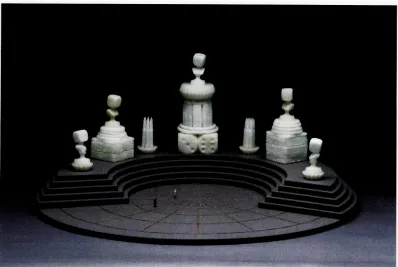
or not.PRIDE, POMP,
AND
CIRCUMSTANCE
[image:24.528.64.462.401.668.2]This
workis the
result ofmy
desire
to
representthe
arrogance of power.The
name comesfrom
aline
out ofShakespeare's
"Othello."The
wordsrefer
to
Othello's
reminiscence(in Act
3,
scene3)
aboutthe glory
and staturehe
achieved onthe
battlefield.
He
leaves
this
worldbehind
with regret.He
bids farewell
to
maritalbliss,
mistakenly
believing
that
his
wifehas
been
unfaithful.He
also says good-byeto his
occupation,
his
well-worn
identity
as a noble warrior.Here I
exploredeception
andthe
representation of power,and refer
to
something
ominous at work.In
this
pieceI
set out withthe
specificintention to
recreatethe look
offine
white marble.
Since
Antiquity,
marblehas
been,
sooften,the
material of choicefor
makers of public monuments.It
is
a materialthat
representsluxury,
delineates
classstratification, andimplies
a sense of respectability.Viewers
of public monuments are meantto be
wowedby
the
feeling
that
the
people who areimmortalized
and placed on viewin this way
arebetter than the
average person onthe
street,that their
actions mean morethan
those
of everyone else.There is
ahybrid
ofunlikely
parts-dice, bullets, licorice,
wafercookies,Grecian
busts
andtartlets
combinein the
piece, unifiedvisually
by
the
white "marble"look
producedby
the
use ofglass powder.These
whitepieces are also unified
by
their
arrangementin the
space, elevated on asemi-circle of
steps,
raisedsignificantly
abovethe
smallfigures,
representative of
the
public.The
smallfigures
aredwarfed
by
the
imposing
presence ofthe
monumentsin the
plaza.They
are meantto
feel the
power oftheir
owninsignificance.
In this
pieceI
referencethe
extreme
in the
making
of publicmonuments.The
monumentbuilt
by
Mussolini for Victor
Emmanuel
II
comesto
mindfor
its
extremesof scale and use of white marble.When Mussolini
cameto
power
in
Italy,
he tore down many
existing buildings
in
orderto
createthis
massive
display
of power.II
Duce lived here
untilthe
end ofWW
II
andmade
many
speechesfrom the
balcony
that
looks
out ontothe Piazza
Venezia.
REFLECTION
This
piece, morethan
the
others,is
akind
ofstudy
ofthe
physical nature ofpolitical
theater,
referencing
the
mallin
Washington
DC.
In 1901 the
McMillan Commission
wascreatedfor the
purposeoftransforming
the
design
and master plan ofWashington
DC
by
connecting
the Lincoln
Memorial
andthe
Washington Memorial
with a2,029 foot
long
reflecting
pool.
"With the
Reflecting
Pool,
the
plan articulated a perfected,symbolic universe with a
long
view ofthe
nation'saspirations."14While making this
piecemy
thoughts
werefocused
onthe kind
ofpolitical,theatrical
spectacle createdby
a wide range ofpoliticians, architects,&
designers. Sometimes
persuasivedisplay
and spectacleis
orchestratedby
someone who can
be
called all ofthese things. Someone like Albert
Speer,
architect anddesigner for
Adolph
Hitler,
comesto
mind.It
washis
vision
that
createdthe indelible images
ofpower, unity, and confidencethat
characterizedNazi
rallies atNuremberg
asthe
Nazi
party
roseto
prominence and captured
the imagination
ofthe German
people.In
Joachim Fest's
book,
"Speer: The
Final
Verdict,"he describes
particulardetails
ofSpeer's designs for
Nuremberg
asinstrumental in
creating
an atmosphere ofmagic, mystery, and exaltation.Many
guests at
Nuremburg
rallies,including
foreign
ones,were soimpressed
by
the
spectaclethat
they
were preparedto
overlooksome of
the
regime's more repulsivefeatures.15Guy
Debord
(1931-1994,)
French
writer,filmmaker,
andfounder
ofthe
magazine called
"Situationiste
Internationale,"writes
the
following
in "The
Society
ofthe
Spectacle":
What
hides
underthe
spectacular oppositionsis
a'unity
ofmisery.'Behind
the
masks oftotal
choice,
different
forms
ofthe
samealienation confront each other, all of
them built
on realcontradictionswhich are repressed.
The
spectacle existsin
aconcentrated or a
diffuse
form
depending
onthe
necessities ofthe
particular stage of
misery
whichit
denies
and supports.In
both
cases,
the
spectacleis nothing
morethan
animage
ofhappy
unification surrounded
by
desolation
andfear
atthe
tranquil
centerofmisery.16
It
is
acertainty
that
Hitler,
withthe
significant assistance ofSpeer,
capitalized on
the
economic miseries ofhis time.
Hitler
methodically
shaped a
story
aboutthe
state ofthings,
created scapegoats,creating
simplified solutions
to
complex problems.He
paradedthis story
outfor
public consumption quite
successfully
by
the
creation and use ofspectacle.
GENERAL
Here
I
amlooking
atthe
question ofhow
one person might attain powerabove others.
How
muchis up to
chance,how
muchis
circumstance,how
muchis
consciously
planned?Is there
a predetermined planto life
oris it
as cliche as aroll ofdice?
Maybe,
for
me,this is really
a question ofwhetherakind
of spiritualbelief
in
anexternally
imposed
orderholds up
againstthe
notionthat
wehave
the
powerto map
outour ownindividual destinies.
I
chafe atthe
idea
ofsubmitting
to
the
will of someform
ofhigher
power.I
questionthat
power
question who
defines
ithow
it
comes
into
beingandwhy it
should affect me.
On
anidealized,
bright
greenlawn,
the
clustered,
faceless figures
gatherlike
groupies aroundthe "rock
star"that is
the bust
of afaceless
five
stargeneral.
He
has been
sculpted, molded,
cast and elevatedup
overtheir
heads,
placedin
a classby
himself.
The
bronze
used representsthe
importance
ofthe
man, made withthe intent that
his image
shouldoutlive
them
all,remaining
when all ofthese
average peoplehave
passed on and a new generation
takes their
place.The
peoplelooking
on are all
in
white, almost ghost-like.They
have been
madeabstract,their
faces
replaced withdice,
randomly
rolledinto
position ontheir
necks.
They
willfade,
whilethe
generalwill continue, memorializedfor
alltime.
SINK OR SWIM
This
is the
only
workin
the
exhibition madeduring
my
first
yearas agraduate student
here
atRIT. In
it I
use"apple
pie"
ideals
againstLady
Liberty
herself,
questioning the
effectof so muchAmerican
consumerculture on
the
natureofliberty, freedom,
andself-determination.Her
patinaedbronze
facade fades
anddisappears,
swallowedup
by
the
golden
(actually
gold-leafed)
pies, meantto
represent allthe
promise ofcliched
American idealism.
"Baseball,
hot
dogs,
applepie, andChevrolet,
they
gotogether
in the
good oleUSA
"according to
a carcommercial
that
airedfrom 1974-1978, (music
composedby
Ed
Labunski,
lyrics
by
Jim
Hartzell.)
The
spotwascreatedfor
Chevrolet
by
the
Campbell-Ewald
advertising
agency.In
2006,
the
spot wasrecreated,
nostalgically
looking
back
to the
old ad.In
afact
sheet writtenby
Deutsch
Los
Angeles
(the
adagency producing
the
newspot) the
new adis
described
as"the
ideal
choiceto
cueChevy's Americana
heritage,
and atthe
sametime
reflecting
the
brand's
21st
century
outlook."^
I
couldhear this jingle
ringing
in my head
asI
putthe
piecetogether,
andI
think
aboutit
still as abackdrop
to the
warwe are engagedin
nowin
Iraq. Our country
camebursting
into
Iraq,
gunsblazing,
rearranging
definitions
oftorture
andliberty
atAbu Ghraib
prisonto
suitour ownprejudices,
driving
gas-guzzling
vehicles anddemanding
our rightsto
maintain a wasteful,consumer
driven lifestyle. Susan
Sontag,
in
an articleoriginally
writtenfor the New
York
Times (and
now much circulated onthe
internet,)
"Regarding
the Torture
ofOthers,"has this to
say:Shock
and awe werewhatourmilitary
promisedthe Iraqis. And
shock and
the
awful arewhatthese
photographs announceto the
world
that
the Americans
have delivered:
a pattern of criminalbehavior in
open contemptofinternational humanitarian
conventions.
Soldiers
nowpose,thumbs
up,before the
atrocitiesthey
commit, and send offthe
picturesto their buddies.
Secrets
ofprivate
life
that,
formerly,
you wouldhave
givennearly anything to
conceal,
you nowclamourto be
invited
on atelevision
showto
reveal.
What is
illustrated... is
as muchthe
culture of shamelessnessas
the
reigning
admirationfor
unapologetic brutality.18I
feel
atremendous
sense of shame aboutthe
choicesour president and
his
administrationhave
made.The true
meaning
ofliberty
has
gottenlost;
it
sinks as wespeak,as our nationimposes
one set of rulesonIraqi
citizens,and another onourselves.
As
I
researched source materialto flesh
outthis
entirebody
ofwork,I
found
much common groundin
the ideas
espousedby
Vladimir
Tatlin.
Nikolai Nikolaevich
Punin,
acontemporary
ofTatlin,
wroteextensively
andhad
muchto do
withthe
promotion ofV.E. Tatlin's
work.In
1921 he
wrotea paper on
the Monument to the Third
International,
Tatlins'most
famous
work.
In
it he
statesthat:
A
monument should sharethe
social and publiclife
ofthe city
andthe city
shouldlive in it.
It
mustbe indispensable
anddynamic
in
orderto
be
contemporary.The forms
ofcontemporary
propagandain
plastic art
lie
onthe
other side ofdepicting
man as a unit.These
forms
are
discovered
by
an artist whohas
notbeen
crippledby
the
bourgeois Renaissance tradition
but
alsohas been working
asalaborer
onthe
three
units ofcontemporary
plastic consciousness:material, construction,
and volume.When working
with materialconstruction and volume
Tatlin
produced a newform in the
world ofmonumentalart.
Such
is the form
ofthe Monument
to the
Third
International.19Tatlin,
through the
proposal ofthis
monument,
expressedhis
ratherromantic notion
that he
coulddesign
adynamic
placethat
wouldbecome
symbolic of a superiorway
oflife. The Russian
Constructivist
movement
has been
described
as"a
philosophy predominantly
concernedwith
the function
ofarchitecture as a socialcatalyst."20
Tatlin
envisioned
his
monumentduring
atime
of extreme economichardship
in
Soviet
society.He believed in the necessity
andachievability
ofhis
Utopian
goals.The
monumenthe
conceived was neveractually built.
Formal
Concerns
My
workconsistsprimarily
ofkiln-cast
glass and crystal.My
interest has
been
in
molding,combining,
andtransforming
real objectsinto something
other,
to
create anidiosyncratic
visuallanguage
for the
expressionofideas. Through
my labor these
ideas have taken
shape.For
quite some
time
I
have harbored
the
desire
to
learn
the
techniques
ofmold-making
and casting.
While I
have been here
as a graduate student,the
processof
developing
new skillshas lead
meto the
subject matter of
the
work.It
was not
pre-conceived,
instead
it
evolvedin
aprogressive way,
step
by
step.
My
subject matterhas
comeinto focus
asI
have been
more andmore able
to
harness
these
abilities.I
choselead
crystalfor the
"Jell-O
pieces"due
to its
visualclarity
andit's
ability to
sellthe
look
ofthe
pieces, asthough
made of realJell-O.
It
added
to my
appreciation ofthe
absurdto
use a material associatedwith
luxurious
consumptionfor the
purpose ofmaking
1950's
era,middle-American
comfortfood.
For
"Spent" and"Pride, Pomp,
andCircumstance,"
I
was ableto
approximatethe look
ofmarblewiththe
useof clear glass powder.
It is important to
methat
the
nature ofthe
materialsused adds
depth to the
conceptualbasis
ofthe
work.Artist
Sylvia Levinson describes the
glass medium as:not a neutral material,
but
avery
powerful medium ofcommunication.
I
seeit
as a metaphorfor
transparency,
for
feeling
and
revealing
emotions.21When
I
look to the
work of otherartistsfor
inspiration,
I
find
that many that
attract me are not glass artists.
Levinson is
one ofthe few
who usethe
medium of glass
in
away that
speaksto my
process of working.She
startswith a
strong
concept,
a powerfulidea
to be
expressed,
then develops
the
approachfor
making
withdeep
rootsin that
concept.Her
grandmother and
father
emigratedto
Argentina
from Russia.
Born in
Buenos Aires,
shefled
the military
dictatorship
ofGen. Jorge Rafael
Videla,
moving
to
Italy
in
1
981
.She
usesher
workto
addressissues
of power andvulnerability
as shehas
experiencedthem in her
ownlife.
Robert Arneson has been
a source of muchinspiration
as well."Arneson
relentlessly
pokedfun
atboth himself
and others whilepushing
modernsculpture
in
new stylisticdirections.
For
morethan
thirty
years,he
lampooned
the pomposity
and prejudices ofindividuals
andinstitutions
alike
through
boisterous,
punning,superbly
crafted,but
jarringly funky
sculptures
that personify the
no-holds-barredtradition
ofNorthern
California
ceramics."22
I
also admirethe
workofEd
andNancy
Reddin
Kienholz,
whosefull-scale
visions of raw
humanity
don't
hold
back
in their desire to
express powerfulideas
and emotions."In
anexcessively
fragmented
worldthe
greatKienholz
achievementmay
be the
way
he
(they)
absorbedthe
literature
of
the
American
Myth from Paul
Bunyan to Sam Clemens
and graftedthem to the
European Theater
ofthe
Absurd.... Kienholz
predictedtoday's
use of art as a
tool
of social and political expression and remains ahead ofthe
curvein
favoring
humanistic humor
andcompassion overdemagogic
cant."
23
In
"Sweet
Reassurance"I
have developed
anidiosyncratic
body
of workto
expressmy
ideas
aboutthe
world around me atthis
momentin time.
There is
an obsessivequality to the
production ofthe
work,to the
formation
ofthe
language
I
have
chosento
usein the
making.There is
also an eclectic
quality
indicative
ofmy desire to
minethe archeology
ofmy
country, culture, andtime
asthe
source materialfor
inspiration.
I look
everywhere,
to
high
andlow
art,to
architecture anddesign,
to
politicaldiscourse,
to
advertising,to the Utopian
andDystopian
visions ofthose
who
have
comebefore
me.I
have built
a personallanguage
out ofcombinations of parts
that
represent chance,determination,
sweetness,seriousness, power, and
vulnerability-All
ofthis
meldstogether,
tossed
withirony, technique,
material, andform,
and
is
made manifest assolid, physical,tangible
objects.The
workis
sculpted, molded, castand arranged
to function
as ametaphoricrepresentations ofconceptual material.
My
attentiontoward form
comesafter
I've
stirredup
asoup
filled
with content.I
strivefor
ahappy
marriageof
technique
andideas.
As in
all goodmarriages,
eachhalf
must supportthe
other,with alayering
and adepth
that
expands eachtime
it is
explored.
Notes:
1
)
Buckminster
Fuller's dome
was unusualin
the fact that
it
wasbuilt from
1
smalldrawing
ofthe
single modulethat
wasthe basis
ofits
form.
Habitat
was
innovative
in its development
ofmodular, mass productionhomes
atlowcost.
2)
Tatlin,
editedby
Larissa Alekseevna
Zhadova,
page345
3)
Le
Corbusier,
"Towards
aNew
Architecture,"page
289
4)
Sigfried
Giedion, "Space,
Time,
and Architecture,"pg 543
5)
Adele
Weder,
January/February
2008 issue
ofthe
Walrus
Magazine
6)
Expo
'67 Official
Guide,
page1
7)
Erika
Doss,
"Making
Imagination
Safe in the 1
950's,"an
essay
withinthe
book"
Designing
Disney's Theme
Parks: The
Architecture
ofReassurance,
page
1
80
8)
Neil
Harris,
"Expository
Expositions:
Preparing
for the Theme
Parks,"an
essay
withinthe book
"Designing
Disney's Theme Parks: The Architecture
ofReassurance," page
20
9)
Karal
Ann
Marling,
"Imagineering
the
Disney
Theme
Parks,"an
essay
within
the book
"Designing
Disney's Theme Parks: The Architecture
ofReassurance,"
page
81
10)
Jean
Baudrillard, Simulations,
pg 25
1 1
)
Eisenhower's
Farewell
addressto the
Nation,
January
1
7,
1 961
12)
from
aQ
& A
withEugene
Jarecki,
Sony
Pictures
Classics
websitefor
the film
"Why
We
Fight"13)
J.
DuPre,
"Monuments," page89
14)
J.
DuPre,
"Monuments,"page
89
15)
"Speer:
The Final
Verdict,"by
Joachim Fest,
page53
1
6) Guy
Debord,
"The
Society
ofthe
Spectacle,"paragraph
63
1
7)
from
an articledated
July
1 1
,2006
by
the Auto
advertising
andMarketing
editorat www.theautochannel.com18)
Susan
Sontag,
excerptfrom
"Regarding
the Torture
ofOthers"originally
publishedin
the
New York
Times,
May
23,
2004
19)
Tatlin,
editedby
Larissa Alekseevna
Zhadova,
page345
20)
Russian Avant Garde
Art
andArchitecture,
editedby
Catherine
Cooke,
pg.34
21
)
Sylvia Levinson's
artist statementfor the
1
9thRakow
Commission, 2004,
from
the
Corning
Museum
ofGlass
22)
Arneson
andPolitics,
A
Commemorative
ExhibitionJune
2
through
August
1
5 1
993,
showcatalogue,
M.H.
de
Young
Memorial Museum,
Steven A.
Nash,
Associate Director/Chief
Curator,
page9
23)
Edward
andNancy
Reddin
Kienholz:
The
Hoerengracht,
exhibitioncatalogue,
essay
by
William
Wilson,
pg
1
6
Bibliography
Arneson
andPolitics,
A
Commemorative Exhibition,
June
2
through
August
1 5 1
993,
showcatalogue,M.H. de
Young
Memorial
Museum,
Steven
A.
Nash,
Associate Director/Chief Curator
Cultural Materialism:
onRaymond Williams
Edited
by
Christopher
Prendergast
for the Social Text
Collective,
1
995,
University
ofMinnesota
Press, Minneapolis,
London
Designing
Disney's Theme Parks: The Architecture
ofReassurance
Edited
by
Karal Ann
Marling,
1
997,
Canadian Centre for
Architecture,
Flammarion
Etched
in
Stone
Enduring
Words
From
ourNations
Monuments
Ryan
Coonerty,
National
Geographic Society, Washington, DC,
USA
Expo '67 Official
Guide
1967,
Maclean-Hunter
Publishing
Company,
Ltd,
Canada
"For
Everyone
aGarden: The Failed Dream
ofMontreal's Habitat
'67"January/February
2008 issue
ofthe Walrus Magazine
Adele Weder
Gardens
ofRevelation: Environments
by Visionary
Artists
John
Beardsley,
1
995,
2003,
Abbeville
Press, NY,
London
Gustav Klutsis
andValentino Kulagina:
Photography
andMontage After
Constructivism
Margarita
Tupitsyn,
I 2004
International
Center
ofPhotography, NY, NY,
USA,
Steidl
Illuminations
Walter
Benjamin,
editedby
Hannah
Arendt,
English translation 1
968,
Harcourt Brace
Jovanovich,
USA
Lester Beall: Trailblazer
ofAmerican Graphic Design
R. Roger
Remington,
1996,
W.W.
Norton
andCo., NY,
London
L'Enfant
andWashington,
1
791-1 792
Elizabeth Sarah
Kite,
The Johns Hopkins
Press, Baltimore,
MD
The American Image: US Posters form the
19thto
the
21stCentury
Mark Resnick
andR. Roger
Remington,
2006,
RIT
Cary
Graphic Arts Press
Rochester,
NY
The Dymaxion World
ofBuckminster
Fuller
R.
Buckminster Fuller
andRobert
Marks
1960,1973 Southern
Illinois
University
Press
andAnchor
Press,
USA
Monuments:
America's
History
in Art
andMemory
Judith
Dupre,
2007,
Random House
Inc., NY,
USA
Oscar Neimeyer
andthe
Architecture
ofBrazil
David
Underwood,
1
994,
Rizzoli
International Publications, Inc., NY,
NY
Space, Time,
andArchitecture:
The
growth of a newtradition
Sigfried
Giedion,
1
967,
Cambridge,
Harvard
University
Press
Tatlin
Edited
by
Larissa Alekseevna
Zhadova,
1 984,1 988 Rizzoli International
Publications,
Inc., NY,
NY
They
Built the Capitol
Ihna Thayer
Frary,
1
940, 1969,
Books for Libraries
Press, Freeport,
NY
Tomorrow
Soars in
atExpo
'67,
Life
Magazine,
April
28,
1 967
Tom
Prideaux,
pgs33-39
"Regarding
the Torture
ofOthers"Originally
publishedin the
NY
Times,
May
23,
2004
Susan
Sontag
Simulations
Jean
Baudrillard,
Translated
by
Paul
Foss,
Paul
Patton,
andPhilip
Beitchman
1983,
Semiotext
(e)
Inc., NY, NY,
USA
Society
ofthe
Spectacle
Guy
Debord,
Black
andRed
Press, Detroit, Ml,
1
983
The Activist
Drawing
Retracing
Situationist Architectures from
Constant's
New Babylon
to
Beyond
Edited
by
Catherine de Zegher
andMark
Wigley,
2001
,The
Drawing
Center, NY,
The
MIT
Press,
Cambridge,
Massachusetts
Towards
aNew
Architecture
Le
Corbusier,
translated
by
Frederick
Etchells
1
986,
Dover
Publications,
USA