Rochester Institute of Technology
RIT Scholar Works
Theses Thesis/Dissertation Collections
3-1-2008
Human activity recognition using limb component
extraction
Jamie Boeheim
Follow this and additional works at:http://scholarworks.rit.edu/theses
This Thesis is brought to you for free and open access by the Thesis/Dissertation Collections at RIT Scholar Works. It has been accepted for inclusion in Theses by an authorized administrator of RIT Scholar Works. For more information, please [email protected].
Recommended Citation
Human Activity Recognition Using
Limb Component Extraction
by
Jamie Lynn Boeheim
A Thesis Submitted in Partial Fulfillment of the Requirements for the Degree of Master of Science in Computer Engineering
Supervised by
Dr. Andreas Savakis
Department of Computer Engineering Kate Gleason College of Engineering
Rochester Institute of Technology Rochester, NY
March 2008
Approved By:
______________________________________________________________________________________
Dr. Andreas Savakis, Professor and Department Head
Primary Advisor – R.I.T. Dept. of Computer Engineering
______________________________________________________________________________________
Dr. Juan Cockburn, Associate Professor
Secondary Advisor – R.I.T. Dept. of Computer Engineering
______________________________________________________________________________________
Dr. Muhammad Shaaban, Associate Professor
Thesis Release Permission Form
Rochester Institute of Technology
Kate Gleason College of Engineering
Title: Human Activity Recognition Using Limb Component Extraction
I, Jamie Lynn Boeheim, hereby grant permission to the Wallace Memorial Library to reproduce my thesis in whole or part.
_________________________________ Jamie Lynn Boeheim
Dedication
Acknowledgements
Abstract
Interest in the field of human activity recognition has existed for quite sometime,
but has gained popularity in recent years for use in many areas of application. In the
security industry, suspicious activities could be detected in high-profile areas. In the
medical industry, systems could be trained to detect patterns of motion indicating distress
or to detect a lack of motion if a person had fallen and was unable to move. However,
algorithms with reliable accuracy are difficult to implement in a real-time environment
due to computational complexity.
This thesis developed a new way of extracting and using data from a human
figure in a video frame to determine what type of activity the subject is performing.
Following background subtraction, a thinning algorithm operating on the silhouette
offered a more robust limb extraction method, while a six-segment representation of the
human figure offered more accuracy in deriving limb parameters, or components, such as
distance from torso, and angle of displacement from the vertical axis. Neural networks or
nearest neighbor classifiers used the limb components to identify a number of activities,
such as walking, running, waving and jumping. This entire human activity recognition
system was tested with both a MATLAB implementation (non real-time) and a C++
implementation in OpenCV (real-time). The algorithm achieved 96% classification
accuracy in video feeds, which is only slightly lower than that of intensive, non real-time
Table of Contents
Thesis Release Permission Form ... ii
Dedication ... iii
Acknowledgements... iv
Abstract ... v
Table of Contents ... vi
List of Figures ... vii
List of Tables ... viii
Glossary ... ix
Chapter 1 Introduction ... 1
Chapter 2 Background ... 4
2.1 Applications of Activity Recognition ... 4
2.2 Methodology ... 5
2.2.1 Human Figure Extraction... 7
2.2.2 Human Figure Representation ... 8
2.2.3 Activity Data Extraction and Representation ... 10
2.2.4 Activity Classification ... 12
Chapter 3 Limb Component Extraction... 15
3.1 Background Subtraction... 16
3.2 Skeletonization... 19
3.3 Feature Point Extraction ... 22
3.4 Six-Segment Model of the Human Figure ... 22
3.5 Evaluation of Limb Components for Characterization ... 26
Chapter 4 Activity Classification... 30
4.1 Classification Algorithms ... 31
4.1.1 Artificial Neural Network ... 31
4.1.2 Nearest Neighbor ... 33
4.2 Real-time Classification... 34
Chapter 5 Implementation and Integration ... 37
5.1 Background Capture ... 39
5.2 Video Frame Processing ... 39
Chapter 6 Results ... 44
6.1 Training and Performance Results... 44
6.1.1 MATLAB Testing... 45
6.1.2 Real-time Environment ... 50
6.2 Example Frames... 52
6.2.1 MATLAB Prototype ... 52
6.2.2 Real-time Environment ... 58
Chapter 7 Conclusions ... 63
7.1 Discussion of Results ... 63
7.2 Future Work ... 66
List of Figures
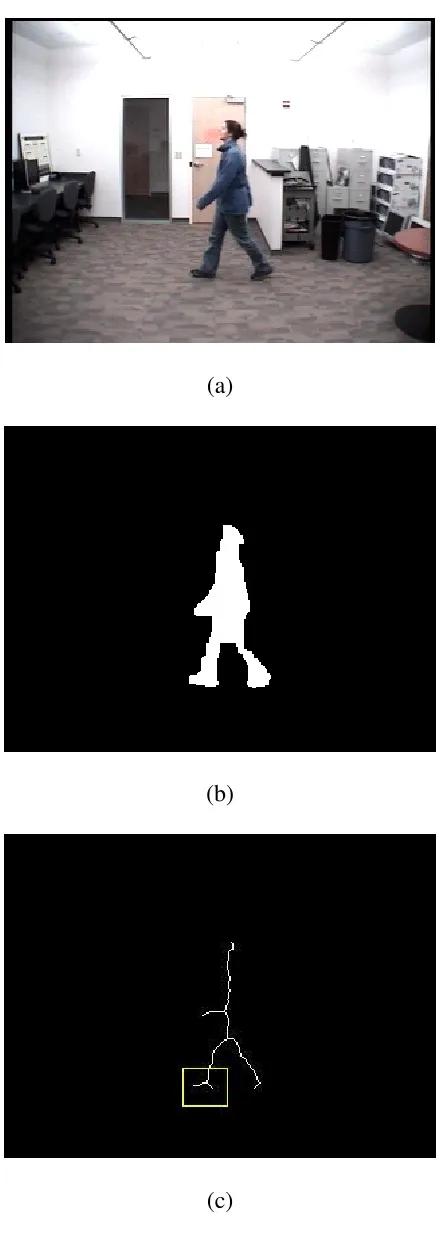
Figure 1: Activity Recognition Process ... 6
Figure 2: Human Figure Representation Schemes... 8
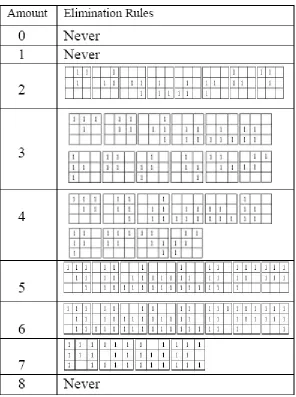
Figure 3: Skeletonization Elimination Rules (1 denotes a white pixel)... 21
Figure 4: Feature Point Rules (1 denotes a white pixel)... 22
Figure 5: Multiple Endpoints on a Limb... 23
Figure 6: Fujiyoshi’s Five-Segment Model ... 24
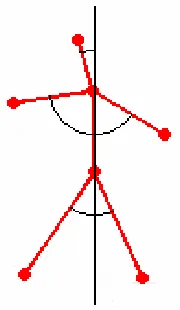
Figure 7: Six-Segment Model... 25
Figure 8: Limb Component Measurements ... 28
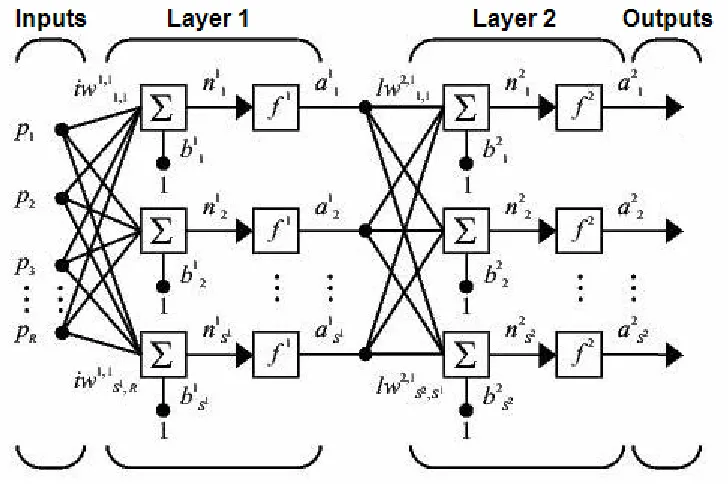
Figure 9: Artificial Neural Network Topology... 32
Figure 10: System Flow Diagram ... 38
Figure 11: Image Storage Structure ... 40
Figure 12: Neighborhood Transformation Example (1-white, 0-black) ... 42
Figure 13: Test Jump Activity ... 53
Figure 14: Test Run Activity ... 54
Figure 15: Test Walk Activity ... 55
Figure 16: Test Wave1 Activity... 56
Figure 17: Test Wave2 Activity... 57
Figure 18: Real-time Jump Activity ... 58
Figure 19: Real-time Run Activity ... 59
Figure 20: Real-time Walk Activity ... 60
Figure 21: Real-time Wave1 Activity... 61
List of Tables
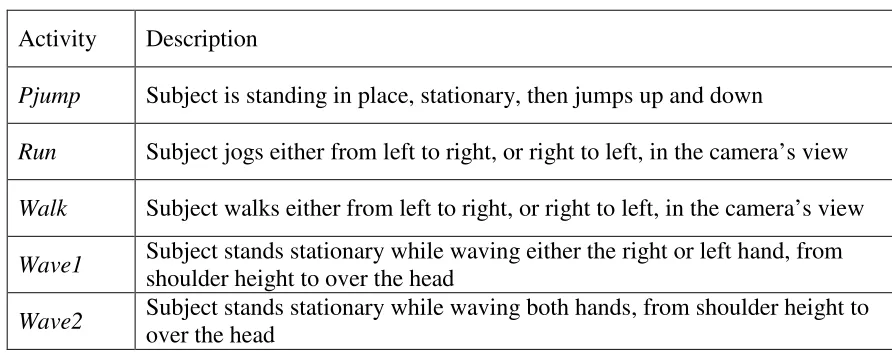
Table 1: Activity Descriptions ... 46
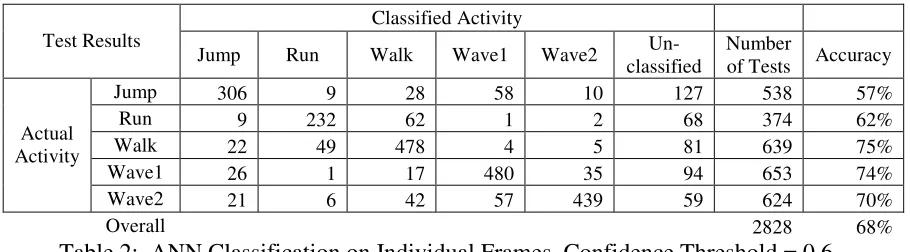
Table 2: ANN Classification on Individual Frames, Confidence Threshold = 0.6... 48
Table 3: ANN Classification on Activity Segments, Confidence Threshold = 0.6 ... 48
Table 4: NN Classification on Individual Frames, Confidence Threshold = 50 ... 48
Table 5: NN Classification on Activity Segments, Confidence Threshold = 50 ... 48
Table 6: NN Classification on Individual Frames, No Confidence Threshold... 49
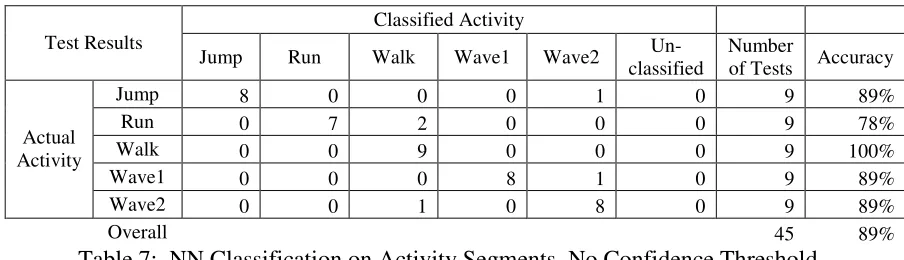
Table 7: NN Classification on Activity Segments, No Confidence Threshold ... 49
Table 8: NN Classification on Individual Frames, Confidence Threshold = 50, Motion Weight = 30... 49
Table 9: NN Classification on Activity Segments, Confidence Threshold = 50, Motion Weight = 30... 49
Table 10: NN Classification on Individual Frames, No Confidence Threshold, Motion Weight = 30... 50
Table 11: NN Classification on Activity Segments, No Confidence Threshold, Motion Weight = 30... 50
Table 12: NN Classification on Individual Frames, No Confidence Threshold, Motion Weight = 30... 51
Glossary
ANN: See Artificial Neural Network.
Artificial Neural Network: An interconnected group of artificial neurons that uses a model (e.g. mathematical or computational) for information processing. Generally it is an adaptive system that changes its structure based on information fed through the network during training.
Feature Extraction: The locating of certain characteristics within an image or signal. Features may be anything, but here they refer to the head, hands, and feet.
Feature Point: Any distinguishable point on a human figure. It is
generally tracked from frame to frame. Common choices of feature points include points on the head, hands, feet, elbows, and knees.
Feature-based: An approach which uses features.
k-NN: See Nearest Neighbor.
k-Nearest Neighbor: A general term for the classification algorithm which finds the k data vectors in a set which have the smallest
Euclidean distance to a test data vector.
NN: See Nearest Neighbor.
Occlusion: A hiding or partial covering of a feature or object.
Real-time: The results from the calculations are required without noticeable delay. Delays could be disastrous or cause the system to fail.
Chapter 1
Introduction
Research in the field of computer vision aims to replicate the extremely intricate
and complex pattern recognition capabilities of the human brain. Human activity
recognition uses image understanding techniques on video sequences to detect and
recognize what a human subject is doing in the surrounding environment. This type of
information is difficult to obtain both quickly and accurately, but it is of great value in
many applications, particularly in the security industry. Human activity recognition is
one of the complex tasks the human brain does effortlessly, but presents many difficulties
when a computer system attempts to automate the process. The vast amounts of data
available in video streams often make it difficult for a computer system to make
classification decisions in real-time environments due to the large processing
requirements.
Real-time human activity recognition systems are becoming increasingly
important in the security industry, where it is important to identify suspicious actions and
behaviors to avoid harm coming to others. People watching security videos may miss
important occurrences, and in such situations, it would be helpful for a computer system
to flag suspicious actions and behaviors and alert to possible dangerous or criminal
also for the medical industry. Motion patterns of humans could be examined to help
patients that seem to be experiencing a dangerous condition, such as a seizure, heart
attack, or serious fall. Proper medical personnel would be alerted to provide care to the
person. Applications of this type of system are varied, but in all situations, a human
activity recognition system would provide an extra layer of vigilance and security in
real-time to alert people for the possible need to respond to an important situation that may
otherwise be missed.
The solution to the real-time problem then becomes how to best represent the
human figure within the computer system such that the data extracted from the video is
minimal, but can still be used in a classification system to accurately differentiate among
activities. The data extracted from video streams should all provide independent and
unique information about the scene, and this information should characterize an activity
and allow for individual differences for how people perform activities differently.
Considerable research has been done on segmentation algorithms which extract
objects and people from the environment for example, and research into human activity
recognition has been gaining popularity by building on existing methods of image
understanding. This task of human activity recognition combines both the spatial
information of the target subjects within the video frames, as well as the temporal
information of the target subjects as they move over time. This allows human activity
recognition research to draw on a wide variety of approaches and algorithms to devise an
optimal recognition system for a given set of circumstances. Offline analysis of data
would allow the usage of more complex and computationally intensive algorithms than
human figure from the environment so as to indicate what part of each video frame is
significant. Then, the position and motion data of the figure can then be extracted.
Chapter 2 discusses popular approaches to these issues and how several approaches are
not suitable for implementation in real-time systems.
The framework proposed in this thesis implements a real-time human activity
recognition system by reducing the data required for processing and classification such
that only a few parameters of body positioning, orientation, and net motion in the XY
plane are required for a classification. This is accomplished by representing the human
figure as a streamlined skeleton and comparing relative position and orientation data of
the subject’s body and limbs and using this data in a classifier. Chapter 3 discusses how
these limb components were chosen, extracted, and used in the classification process, and
Chapter 4 discusses how the classification structure was developed and tested for the
system. Implementation details of the system are discussed in Chapter 5 with the human
activity recognition system results presented in Chapter 6. Discussion and analysis of the
Chapter 2
Background
Interest in the field of human activity recognition has existed for sometime, but
the research has gained popularity in recent years with the desire for advanced security
and surveillance systems. With growing knowledge in the field, the methods have begun
to be applied to various other fields. The thorough, computationally intensive algorithms
have begun to be adapted for real-time environments with somewhat less accuracy, but a
much faster processing speed. However, human activity recognition is only a single
stage of a multi-staged system, with each stage presenting unique difficulties in achieving
a system that operates in real-time. Many approaches to the subject have been researched
and tested, each having strengths and weaknesses.
2.1 Applications of Activity Recognition
Within the last several years, there has been a growing desire for increased
security measures in high-profile areas such as national monuments, airports, bridges and
tunnels, and office buildings in light of terrorist threats. In the past, much of surveillance
work often required a person to view many streams of video simultaneously. Studies on
human psychology and attention span indicate that remaining vigilant on a task of
been doing the task for an extended period of time [7, 15]. A psychological study on
signal detection by Mackworth showed that accuracy in this type of task has been shown
to dramatically fall after as little as thirty minutes, with subjects missing almost 25% of
the target signals. Thus, it is difficult for people to remain attentive to video streams and
detect questionable actions and behaviors for long periods of time. Airports have
attempted to address this issue by mandating shift changes at security checkpoints after
certain lengths of time have passed and training x-ray screeners with Threat Image
Projection tests (TIP). Still, a single detection miss can have a great price in life and
property. Automating the process of detecting questionable behaviors and actions would
reduce the probability that the behavior or action would go undetected by a human
observer.
Beyond the need in areas of security, other fields such as medicine benefit from
automated systems which detect and identify human activities. Such systems can be
trained to detect patterns of motion indicating distress, as would be the case if a person
was having a heart attack for example, or to detect a lack of motion if a person had fallen
and was unable to move. These types of system could be used in conjunction with
existing systems of alert bracelets and necklaces where subjects self-report medical
emergencies for aid. If the subject was unable to alert the staff independently, these
systems could alert medical staffs to potential emergencies.
2.2 Methodology
Automated human activity recognition by computers attempts to accomplish what
human figures and to assign the actions and behaviors to categories or classes.
Unfortunately, the complexity of pattern recognition performed by the brain is near
impossible to replicate on a scale suitable for current technology. Therefore, this
problem becomes a matter of finding the best way to represent an activity in a computer
system and determining what type of information from the scene is necessary to
accurately distinguish one activity from another [6, 16].
In general, representing the activity is accomplished with a multi-step process
illustrated in Figure 1. A very popular approach to representing an activity within a
computer system is to use data from the human figure performing the activity in the scene
[8, 12, 22, 23]. This involves the extraction of the figure from the background which is a
non-trivial task. Once the figure is extracted, the data can be used for any number of
human figure representation schemes with the ultimate goal of extracting the most useful
and complete information to characterize the activity. Once the activity data is extracted,
it can be used in a classifier for the decision-making process.
Figure 1: Activity Recognition Process
In each stage of processing, implementation choices are made, and some
implementations are not well suited for real-time environments for various reasons. The
following sections outline the most common approaches to each step and comparisons to
illustrate the strengths and weaknesses of each for this application. Human Figure
Extraction
Activity Classification Activity Data
Extraction Human Figure
2.2.1 Human Figure Extraction
There is broad need for robust algorithms capable of distinguishing among many
different activities with a high degree of accuracy. Optical flow analysis is one approach
used in activity recognition [1]. Used alone, the data captured with optical flow
algorithms provide insight into the areas of the scene that are moving, but optical flow
does not capture foreground objects that are stationary. This information can be just as
valuable for activity classification as the information about the motion in other parts of
the scene. Barron shows that more robust algorithms of optical flow can achieve very
low error rates in the calculated motion vectors, but the algorithms that could realistically
be used in a real-time environment show significant calculation error in non-synthetic
video sequences. Optical flow algorithms will also extract the motion of any part of the
scene, be it foreground or background. This creates difficulty in environments where
there is noticeable motion in the background from extraneous sources.
A second approach to human activity recognition involves the extraction of the
human figure from the background with a background subtraction algorithm. Such
algorithms can be classified as either adaptive – where background estimation changes
over time to account for variations in scenery – or non-adaptive – where the background
model remains constant throughout a video stream. Adaptive algorithms allow for robust
background subtraction particularly in outdoor scenes where extraneous motion from
things such as animals, tree leaves, moving cars, and other people, can affect the
subtraction [13, 17]. However, it becomes difficult to extract an entire human figure if
parts of the body remain motionless for long periods of time. Motionless parts of the
purposes. Non-adaptive algorithms do not perform as well in outdoor scenes, but do very
well in controlled environments. In addition, they are generally less computationally
intensive [18, 21, 23]. For a constrained environment for testing, the effect of the
sensitivity to background noise with non-adaptive background subtraction becomes
negligible.
2.2.2 Human Figure Representation
Several representations of the human figure have been presented in research.
These representations range from a holistic approach to a very piece-wise approach.
Each has strengths and weaknesses, but some are more suited to a real-time environment
than others. With the goal of reducing the amount of data obtained from extracting the
figure from the background, it becomes important to eliminate extraneous data which
adds no new information to speed up processing.
(a) (b) (c)
Figure 2: Human Figure Representation Schemes (a) Jin et al. [11], (b) Ozer et al. [19], (c) Mori et al. [16]
Several approaches in research have a holistic approach based on silhouettes.
Blank uses solutions to the Poisson equation to extract space-time features of the human
figure such as action dynamics, shape structure, and orientation for a “volumized”
characterization. Jin simply uses the human figure silhouettes extracted from the
background. However, these approaches can be sensitive to noise, and a great deal of
error can be introduced by clothing and body size.
In the middle of the spectrum, other research uses a combination of holistic and
piece-wise approaches. Chen and Ozer divide the extracted silhouettes into limb shapes,
or “limb blocks” for individual analysis. These processes are also sensitive to noise, and
have errors that are introduced from clothing and body size. In addition, there is the
added processing requirements of accurately and quickly dividing the silhouettes into the
limb blocks.
More piece-wise approaches are also explored in research. Feature points can be
extracted from the human figure and used in various configurations to represent the
human figure. A feature point can be any distinguishable point on the figure, and usually
corresponds to major joints, such as hands, feet, elbows, and knees for example. Once
feature points are extracted, they can be used in many ways. Fujiyoshi, Kim, Lu, Mori,
and others use feature points to represent the body in a skeleton-like manor. Algorithms
such as the skeleton [8, 12, 14, 16], lend themselves more to real-time applications due to
the relatively few levels of processing needed for the algorithm to work. They are less
sensitive to noise, clothing error, and body size differences. These algorithms can be
feature point configurations, the extra processing time can be more easily mitigated than
in other approaches.
2.2.3 Activity Data Extraction and Representation
The method of activity data extraction and activity representation is tied closely
with the method of representing the human figure. Obviously, approaches used with a
silhouette representation will be ill-suited for feature point representations. Therefore,
these two stages are closely linked when determining the processing for the activity
recognition system.
Once a human figure can be extracted from the background, a silhouette of that
figure is obtained. Many human activity recognition algorithms use silhouettes as a basis
for the activity classification [11, 18, 24]. For example, template libraries can be created
to represent activities. These libraries are composed of many single frames of silhouettes
that are marked as representative of particular activities. Frames are extracted from a
video stream and matched with library silhouette templates for a closest match. This
method and other model-based learning methods, however, rely on human annotation of
test video stream frames and expert knowledge of which frames would be most
representative of the activity, as well as how many template frames should be included
for an activity in the library [9, 14, 18]. Restricting computational intensity by limiting
the size of the template library often reduces the robustness of the algorithm. Matching
test frames to template frames of similar activities can be difficult and/or error-prone.
Using the entire silhouette of the human figure for classification presents
factors. Some approaches to activity recognition fit a skeleton-like structure to the
silhouette to extract data from the position and movement of the figure for classification
[8, 12, 14, 16]. In a derivative of template matching, the human figure extracted with the
silhouette is broken down into key sections, or regions [3, 19, 20]. Such approaches may
include key sections such as head, upper arm, lower arm, hand, thigh, calf, and foot
regions, as well as multiple torso regions. The positions and orientations of all these
regions and the “joints” which join them, relative to one another, are characteristic of the
activity being performed in the scene. Temporal data is still being taken into account, as
is the case with optical flow methods, but the temporal data is instead presented in the
context of a specific part of the human body, rather than as part of the entire visual field.
Since each single region moves as one entity, be it rotationally or along an axis, the
temporal data is reduced to a single measurement per region on the human figure.
Of course, as the region sizes increase, more generalization is introduced into the
measurements of the regions. This increased generalization can create temporal error. If
a non-moving region becomes generalized into a moving region, the motion will be
distributed over the entire generalized region. Taking into account individual differences
when performing an activity, many of the important motion parameters could be
averaged out. It essentially becomes an optical flow calculation with very low resolution.
The advantage, however, is that the generalization can be defined to group areas of the
visual field, with similar optical flow measurements, together and eliminate redundancy.
Another approach to activity recognition involves a combination of background
subtraction and feature point tracking [8, 12, 22, 23]. Feature points can be defined as
usually represented as a single point, such as on the boundary of the silhouette or any
distinctive point on a non-thresholded extracted human figure. A small neighborhood of
pixels may be used to perform neighborhood matching to determine the motion vector
from one frame to another [5]. Popular choices for feature points include head, hands,
feet, knees, and elbows [3, 8, 23]. These parts of the body are involved in most pose
differentiation methods, and their position and orientation relative to one another provide
data to be used in classification.
Techniques involving feature point extraction and representation vary greatly.
Some approaches assume known locations of manually extracted feature points in each
video frame and simply track them over time [16]. More robust algorithms use various
methods of automatic feature point extraction, such as with skeleton or extremal
point-extraction [3, 8]. From the positions and orientations of feature points in relation to the
centroid of the figure, assumptions can be made about the positions and orientations of
the rest of the limbs, thereby reducing the data involved in extraction, tracking, and
classification [8, 23].
2.2.4 Activity Classification
As processing is done on the human figures in the video sequences, the
information collected must be helpful in the classification process, that is, the data must
be sufficient for a classifier to differentiate among the activities in the system. Without
characteristic data from the video sequences, it would be impossible for correct
classification to be accomplished. To ensure the data collected is sufficient, multiple
Several classifiers have been used in human activity recognition research with
varying degrees of complexity. When differentiating among a few activities, simple
thresholds on extracted features can be used for a high accuracy rate [8]. However, as
activities become more numerous and complex, this approach does not work. Data will
not threshold easily, and thresholding techniques often fall short when individual
differences produce variances in activity parameters such as speed.
Artificial neural networks (ANNs) have been used as classifiers in many problems
involving detection and differentiation. While more complex to train than other methods,
they are very robust and can be customized to achieve the classification structure desired
for a particular application. A drawback, however, is the retraining of the classifier when
activities are added to the system, which can be extremely time consuming. Reducing the
training set with a limited number of representative frames of the activity would reduce
the training time, but the robustness of the classifier would suffer.
The nearest neighbor algorithm is more sensitive to outliers than ANNs, but
provides similar classification characteristics with the advantage of being easier to
reconfigure and adapt to the situation. The nearest neighbor algorithm can use distance
measurements ranging from simple Euclidean distances to more complex weighted
distance functions that emphasize specific extracted data from the human figure. The
drawback to this algorithm is the training set, or ‘neighbors’, used for the distance
measurements. As this set grows, the system doing computations on all samples to find
the nearest neighbor would slow down. This could be mitigated by incorporating
techniques such as K-means clustering to increase classification speed without a great
The implementation of a human activity recognition system requires the
integration of several processing steps that must be fined-tuned to the application. The
human figure must be extracted from the scene, the human figure and activity must be
represented in the system, and a classifier must be developed to differentiate among
activities. The next several chapters will discuss these steps in detail, and how individual
algorithms must be tuned to the specific application of real-time human activity
Chapter 3
Limb Component Extraction
One of the fundamental problems in activity recognition systems is how activities
are represented within the system, known as the feature extraction process. Most feature
extraction algorithms use combinations of human figure pose and change of position over
time to define activities in the system [8, 12, 14, 16, 21, 22]. How pose and change in
position over time is captured influences how successful the system will be in
differentiating among activities.
A common feature extraction approach is to extract the human figure from the
scene and identify positions of specific “feature points” on the figure. These points on
the human figure are generally taken to give indicative data on the activity being
performed. The data can be used in many ways. Fujiyoshi and Su use limb parameters,
or components, such as length, position, and angle of displacement which can be
determined from analysis of feature points located on figure limbs and joints. The cyclic
patterns of motion of the limb parameters are used to classify an activity as either
walking or running based on a simple threshold. To generalize Fujiyoshi’s approach, the
system should be able to differentiate among more activities which cannot be done with a
simple threshold. A new approach must be taken to use the feature point data in new
with limb parameters and under what conditions limb components provide sufficient data
to classify activities.
3.1 Background Subtraction
To record and track the feature points on the human figure, it is necessary to first
extract the figure from the background. This figure extraction can be done in several
ways. The simplest static approach requires knowledge of the background scene. This
generally requires obtaining a single frame of the background. The assumption is that the
background frame has static elements that will not change during the course of the
activity recognition processing. As such, outdoor scenes and crowded areas are not good
candidates for using static background subtraction due to the high level of dynamic
behavior of the background elements, such as trees blowing in the wind and cars
traveling down roads.
Extracting the human figure from the scene in this way generally involves the
subtraction of the known background frame from the video feed frames. In grayscale,
this can be as simple as the absolute value of a pixel-by-pixel subtraction. In color
images, it could be the subtraction process on each color plane, or a Euclidean distance
calculation. This method is extremely fast and ultimately lends itself very well to
parallelization, but again, it is not adaptive to changes and motion in the background
scene.
Often times, an adaptive background subtraction approach will use running
averages or infinite impulse response (IIR) filters. These processes require motion for the
only extract the outline around the upper torso and arm. The lower body and legs lack
motion and will not be extracted. Hence, the figure outline will be incomplete, and the
feet feature points cannot be extracted. While these points are not necessary for
classification, they would be helpful. In many situations, lack of motion of a certain part
of the body can be just as important as having motion present. Therefore, this approach
was not used in this thesis.
Variations of this adaptive model exist, where probability is taken into account as
to whether a given pixel is background or not. These approaches are somewhat more
effective in extracting a complete human figure outline and subsequently obtaining all the
feature points needed. Unfortunately, the processing speeds are a bit slow for use in a
real-time environment, and the algorithms still require the use of a known background
frame as an initial reference.
In an indoor testing environment, there is little need for an adaptive algorithm, as
the background remains constant for long periods of time. Therefore, a non-adaptive
background subtraction algorithm was used.
Results of prototyping in MATLAB yielded positive results for background
subtraction on grayscale images. The extracted silhouettes of the human figures were full
and well-defined. Using this approach in the real-time system did not yield robust
results, however. The human subjects and their clothes were not as reliably extracted
from the scene, leaving holes and ill-defined silhouettes. The same problem occurred
when using the absolute difference background subtraction on each color plane of the
image. If the difference was above a given threshold on any one of the color planes, the
data given in the captured frames without adding much computational complexity and
processing time. However, the silhouettes extracted were only slightly better than when
using grayscale images, and there were many more extraneous pixels marked from light
flicker and shadowing.
Instead of the absolute difference threshold on each plane, a Euclidean distance
calculation was used on each pixel of the frame using color information. The color
vectors of each pixel were used in the distance calculation between the background image
and the video feed frames. For each pixel in the test frame pt, the distance D from the
corresponding pixel in the background frame pb was computed.
[
b b b]
t[
t t t]
b r g b p r g b
p = , =
(
) (
2) (
2)
2t b t
b t
b r g g b b
r
D= − + − + −
After the distance was computed for a given pixel, a threshold t was applied. If the distance was greater than t, the pixel was set white. Otherwise, the pixel was set black. The result of this operation was a binary image which defined the areas of greatest
dissimilarity between the test image and the background image. Using the lowest
resolution possible for many image formats, 8-bit unsigned integers were used to store
pixel data. Setting a pixel white required a 255 value, while setting it black required a 0
value. > = otherwise t D P , 0 , 255
This background subtraction algorithm yielded clean, well-defined, whole silhouettes
To further clean the silhouette shapes, morphological processing was performed
on the resulting frames. Small extraneous groups of pixels not part of the silhouette were
removed by erosion, and breaks in the silhouettes were joined together using a closing
operation.
3.2 Skeletonization
Once a silhouette has been successfully extracted from the background, the
system can estimate the locations of the feature points needed to be extracted. Several
algorithms exist which accomplish this. More basic algorithms divide the silhouette into
three sections – a top, middle, and bottom – to define areas where feature points are
located [21]. Feet, for example, would be located in the lower part of the bottom section.
Feature points located in the middle section would probably be hands. Of course, these
divisions would be based on the locations of the section boundaries relative to the human
figure. This algorithm is effective at determining which feature is being analyzed, but
can not precisely locate the feature point. A general region can be determined, but limb
occlusions and partial occlusions make it difficult to identify whether a limb or feature
point is actually present in a particular silhouette division.
An algorithm that is more effective at determining precise locations of feature
points extracts local maxima from distance measurements from the centroid of a
silhouette to a silhouette boundary pixel [8]. Fujiyoshi found that local maxima would be
indicative of limb extremities, and those maxima could be labeled as the precise location
of the feature point needed for extraction. Unfortunately, depending on the silhouette,
points to be extracted would be the strongest local maxima on a graph of distances, they
may have to be greater than a certain threshold to be considered strong enough.
However, taking only the strongest local maxima does not account for partial occlusions
of the limbs. Even taking local maxima with moderate strengths would not account for
partial occlusions because the shape of the local region is not considered.
An alternative approach to extracting feature points is through a skeletonization
process. Skeletonization of a shape involves the gradual whittling away at the shape’s
boundary pixels until nothing is left but a one-pixel-wide “skeleton” of the previous
shape. This is generally accomplished with a set of masks that act as “elimination rules”
for determining which pixels should be left and which should be removed. Several such
rule sets exist [4, 10]. The skeletonization process has the advantage of being able to
extract small variations in shapes where partial limb occlusion is present. Feet, hands,
and head on the human figure are readily extractable as well. This algorithm can be
computationally intensive, depending on the implementation strategy, but this can be
mitigated by narrowing the search area of the figure and utilizing a lookup table for the
masks.
Huang’s skeletonization algorithm was used in this thesis [10]. The algorithm is
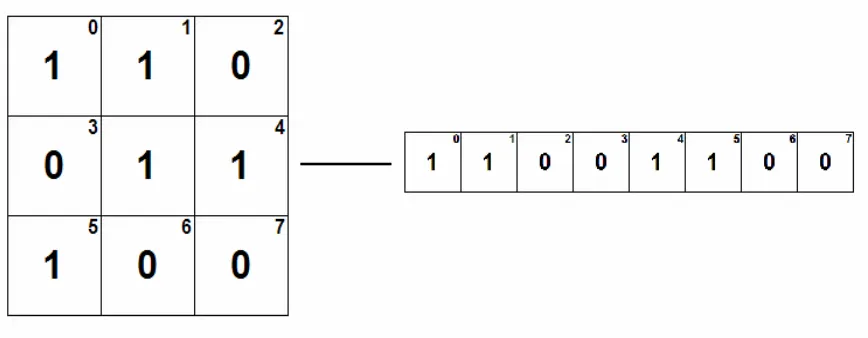
based on a set of elimination rules in the form of 3x3 pixel configurations seen in Figure
3. The pixel is ‘erased’ from the silhouette if the 3x3 neighborhood surrounding it
matches a configuration in the eliminate rule set. Each pixel can be examined in parallel
which allows for the possibility of greater processing speedup with additional computing
resources. Continuing elimination until no pixels can be removed, the remaining pixels
skeleton gives the form of the human figure with defined limb endpoints – essential for
[image:31.612.160.456.165.562.2]extraction of limb components.
3.3 Feature Point Extraction
Once the silhouette has been skeletonized, feature points on the limb extremities
can be extracted. While applying the elimination rules to the pixels of the silhouette, the
endpoint masks in Figure 4 developed for this thesis can also be applied to flag skeleton
endpoints – an endpoint being defined as a pixel with a single, eight-connected neighbor.
Figure 4: Feature Point Rules (1 denotes a white pixel)
The skeletonization process can leave behind multiple endpoints on the skeleton
for a single limb as shown in Figure 5. To determine the actual endpoint of the limb, a
clustering process is used to average feature points located within certain distances of
each other. If other feature points are found within a certain neighborhood of a feature
point being analyzed, those points are averaged to create a clustered limb endpoint.
3.4 Six-Segment Model of the Human Figure
Once feature points have been extracted and clustered, their correspondences to
parts of the human figure must be established. Also, the feature point data must be used
in a way that presents unique information for each different activity to the classifier. A
shortcoming of some feature point based algorithms is that the structural component of
(a)
(b)
[image:33.612.196.417.66.683.2](c)
reference. That is, there is information to be gained when the feature points are used in
conjunction with a structural model for the human figure. Fujiyoshi used a five-segment
model to represent the human figure, and data was extracted with head, hands, and feet
feature points [8]. Figure 6 shows an example of the five-segment model being applied
to a silhouette. A centroid is marked in the middle of the region of interest, and five
feature points, extracted by a local maxima algorithm, are connected to the centroid with
line segments. The length as well as the rotational angle of the line segments are
computed and used for classification. These line segments simulate the limbs and torso
of the human figure.
Figure 6: Fujiyoshi’s Five-Segment Model
This model has obvious error in identifying limbs, particularly apparent in the
arms. The resulting segments poorly correspond to the actual orientation of the arms of a
walking human figure. The body axis along the torso is nonexistent in this model by its
definition. To create a more realistic model of the human figure without adding much
complexity, a six-segment model was developed, seen in Figure 7. This model takes into
account the body axis, as well as hip and shoulder ‘centroids’ for better estimates of limb
After the skeleton of the human figure is created and the extracted feature points
are clustered, the centroid of the region of interest is computed. This centroid is moved
horizontally until it encounters a white pixel on the skeleton corresponding to the torso of
the body. Based on a ratio found from averaging body proportions of test subjects, the
torso centroid is moved vertically to create both a shoulder centroid and a hip centroid.
Feature points can then be joined to their corresponding centroid for more accurate
distance and angle measurements.
Figure 7: Six-Segment Model
The correspondence between feature points and the joints is found simply by
examining where the feature point is in relation to the shoulder and hip centroids. If the
feature point is blow the hip, that feature point is a foot. If the feature point is above the
shoulder, that feature point is a head. Any feature points in between the shoulder and hip
are hands. Exceptions to these rules are made for some postures, such as when one or
both hands are raised above the head, or if the hands hang low below the hip. In the first
case, the head is marked as the feature point closest to the shoulder, and others are
differ significantly distance-wise from the other feature points in their respective regions.
This ensures exceptions are not applied incorrectly, such as when a leg is bent at the knee
and appears shorter than the other leg which is fully extended.
3.5 Evaluation of Limb Components for Characterization
When the correspondence of feature points to human figure parts has been
established, the data must be used in a way that could identify the activity being
performed. The periodic motion patterns of limbs over time that is characteristic of many
activities have been examined in current research [8, 23]. It has been found that
frequencies and amplitude of the motion curves in the XY plane over time can be used to
classify activities in video sequences. However, algorithms utilizing this technique are
not able to classify a very wide range of activities, and some classification results are
reported only for separating two activities [8]. Upon investigating this approach, it was
found that the differences in frequency and amplitude among activities fall within the
range of individual differences of human subjects for certain single activities. For
example, the leg swing amplitude of walking for one person may be more characteristic
of the ‘norm’ running characterization for leg swing amplitude.
As with any algorithm, relying on a small number of data sequences – in this case
one feature point – does not provide enough data to reach a conclusion, or meaningful
classification. Therefore, several samples must be used, and this gives a rationale to the
selection of several feature points on the body for use in classification. Most commonly
used are the head, hands, and feet, but other joints such as elbows, knees, and shoulders
Analysis of each feature point’s motion history has been shown to provide correct
classification of activities [8, 23]. However, this method relies on continuous and
accurate tracking of each feature point in space-time. Due to occlusions of the limbs,
such as when the arms line up with the torso when walking is viewed from the side, some
feature points are temporarily lost during the video feeds. The success of this algorithm
depends on a robust system for predicting the location of feature points after they have
been occluded from the camera’s view, and this is a difficult problem.
This problem would have to be solved using characteristic motion patterns for
each activity to be used in the tracking calculations. This would place many constraints
on the scalability of the system by requiring human annotation of feature point
correspondence after occlusions. It would also require increased processing when trying
to find correspondence of feature points based on several motion profiles that would exist
for each activity. These would not be desirable features of a real-time robust algorithm
for activity recognition.
A robust algorithm should require minimal human annotation of data that would
not rely on activity profiles needed to be programmed into the algorithm. By simply
using a limited number of parameters extracted from each frame in whole video
sequences of an activity, the need for human annotation is eliminated without requiring
large amounts of processing time or memory. Feature points are used as a function of
where they are in relation to the central vertical axis of the body. For example,
processing a feature point does not determine what the human figure’s right hand is
doing, but simply that there is a hand located on the right side of the body, regardless of
This reduces the number of problems associated with occlusion and the
complexity of finding feature point correspondences. The resulting features extracted
from each frame can therefore be the limb distances to the corresponding centroids and
angles of displacement from the torso axis, of the head, hand found of the left side of the
body, hand found on the right side or the body, foot found on the left side of the body,
and foot found on the right side of the body. This gives ten parameters that provide
orientation data of key parts of the body that have been shown to be key factors in
differentiating among activities. Figure 8 illustrates the distance and angles
[image:38.612.261.351.325.480.2]measurements for the five feature points of the head, hands, and feet of the human figure.
Figure 8: Limb Component Measurements
Since all these measurements are relative to the central vertical axis of the body
and are not based on the video frame itself, there is no information provided about the
motion of the human figure as time progresses. To provide more data to the classifier
and incorporate the temporal characteristics of the human figure as a whole, delta motion
values in both X and Y directions are used in classification. These calculations are
current frame and the previous frame. This allows differentiation between activities such
as standing still and jumping in place.
Once data has been extracted from the human figure in the scene, the data must be
used in some way to classify the activity. Chapter 4 discusses methods for using the
feature data in classification, as well as two classifiers that were used in testing the
Chapter 4
Activity Classification
A classifier can only perform to its potential if the training data is accurate and
sufficiently representative for the classification process. Compounding error in the data –
due to blurring for example – can result in the classifier being unable to accurately
differentiate among classes. Hands and feet may be blurred if a camera cannot capture a
fast action with a sufficient number of frames, and this may cause feature points to be
erroneously marked. Errors may be present in both the training set data and the data
submitted for classification. The classifier may also fail if the training data is not
sufficiently broad for class differentiation. Some data points may be dependent on
others, and thus do not contribute enough unique information for the classification
process.
Addressing these problems was a two-fold process. The data extracted from the
video frames was examined for accuracy, and an error margin was determined.
Additionally, the classification process was performed using two different algorithms –
4.1 Classification Algorithms
The data collected from feature extraction consists of the distance and angle of
displacement measurements of the hands, feet, and head from their corresponding
shoulder or hip marker, as well as the X and Y axis delta values from the motion
calculations. To test whether this data is sufficient for the classification process, two
different classifiers were used in prototyping – artificial neural network (ANN) and
nearest neighbor (NN).
To test the capability of classification using the extracted data from the video
sequences, a MATLAB prototype of the system was implemented and used with the
Blank data set [2]. This data set contains color video sequences of ten activities
performed by nine individual subjects. This data set was chosen because the camera
moved very little during the taping of the sequence, making non-adaptive background
subtraction very easy. There were also a wide variety of taped activities performed by
each subject, which would help determine if the features extracted from the video
sequences have the capability of differentiating among a varied set of activities. Nine
subjects performing each activity allowed for the capture of individual differences in
classifier training.
4.1.1 Artificial Neural Network
The first classifier to be used was the ANN which has been used in prior activity
recognition research for classifying activities [22, 24]. This classifier has the advantage
of being less sensitive to outliers, and the network structure can be configured in a variety
For the prototyping of this method, a feed-forward backpropagation ANN
structure was created using the MATLAB neural networks toolbox. The network had
twelve inputs, one for each of the limb components extracted from the skeletons and two
for motion parameters, and a hidden layer of fifty neurons as shown in Figure 9. The
hidden layer had to be sufficiently large to accommodate the number of inputs to the
structure. The number of outputs of the classifier equaled the number of activities, or
classes, on which the classifier would be trained. Between network layers, the ‘tansig’
transfer function was used. This allowed for a -1 to 1 output, easily mapped to a binary
[image:42.612.125.489.352.596.2]mapping if needed. The network was trained with the ‘trainlm’ training function.
Figure 9: Artificial Neural Network Topology (12 input neurons, 50 layer_1 neurons, variable layer_2 neurons/outputs for activity testing)
eight of the nine subjects. The classifier was then tested with the activity video
sequences of the remaining subject. The test subject was rotated after each trial. This
method of training and testing allowed for a reasonable estimate of the performance of
the classifier with the full set of available data.
The maximum output among all outputs of the network was used as the
classification result. To provide a confidence measure to the classifier output, the
maximum response was considered as a valid classification result if it was above a certain
threshold. If the maximum response fell below the threshold, the frame would be marked
as ‘Unclassified’. The threshold was adjusted to determine the optimal value which
passed the largest number of correct classifications while not passing a large number of
incorrect classifications.
4.1.2 Nearest Neighbor
The second classifier considered was nearest neighbor. This classification
algorithm is very simple – the Euclidean distances from the test parameters to the training
set parameters were calculated, and the classification result is the activity corresponding
to the smallest distance measurement (k-NN is possible). Initial calculations were made
(
)
2dt dl
d hd hd
hd = − hda =
(
hdal −hdat)
2(
)
2_ _
_nd hn ndl hn ndt
hn = − hn_na =
(
hn_nal −hn_nat)
2(
)
2_ _
_ pd hn pdl hn pdt
hn = − hn_ pa =
(
hn_pal −hn_pat)
2(
)
2_ _
_nd ft ndl ft ndt
ft = − ft_na =
(
ft_nal − ft_nat)
2(
)
2_ _
_ pd ft pdl ft pdt
ft = − ft_ pa =
(
ft_pal − ft_pat)
2(
)
2_ _
_x mot xl mot xt
mot = − mot_y=
(
mot_yl −mot_ yt)
2y mot x mot p ft p ft n ft n ft p hn p hn n hn n hn hd hd
D= d+ a+ _ d+ _ a+ _ d+ _ a+ _ d+ _ a+ _ d+ _ a+ _ + _
The training data set was used for matching test video sequence frames. All
template data was accumulated in a single file. When test limb parameters were
extracted, the Euclidean distance was calculated between the test limb parameters and
each template data entry. The activity corresponding to the smallest distance would be
the result of the classification algorithm. As a confidence measure, a threshold was set
on the maximum distance allowable by the algorithm. If the smallest distance was not
below the threshold, the frame would be marked ‘Unclassified’.
The nearest neighbor classification algorithm was chosen for the real-time system
implementation due to the better classification performance based on prototypes as seen
in Chapter 6, and the ease of modifying the underlying dataset for testing strategies. The
template data, read in from a file during system initialization, was stored in a table in
memory. Once the camera has begun to capture video frames and the limb parameters
are extracted, the Euclidean distances are calculated from the extracted limb parameters
to each template in the table. Again, the shortest distance in classification needed to be
below a threshold for the classification decision to hold. Otherwise, the frame would be
marked ‘Unclassified’.
Extending the system implemented in MATLAB, it was desired to have the
ability to recognize more activities. Adding more activities required a modification to the
Euclidean distance formula. In the scale of the video frames being used, the delta motion
value ranges are very small – on the order of two to three pixels. The motion difference
calculations would be insignificant compared to the difference calculations of the
extracted limb parameters of the head, hands, and feet. Therefore, the range of values of
each parameter and delta value were converted to a 0 to 100 scale. This scaling
accentuated the small differences in delta motion values that were otherwise obscured in
the formula.
With this scaling, the delta motion values were still somewhat obscured.
Accumulating differences in the ten limb parameters would overshadow the two
differences of delta motion. In order to have more equal contributions of spatial error and
being added to the sum. The equations for the motion components were adjusted as seen
below, and used in the distance calculation as before.
(
mot x mot x)
W xmot w = l − t ⋅
2
_ _
_ mot yw =
(
mot yl −mot yt)
⋅W2 _ _ _ w w a d a d a d a d a
d hd hn n hn n hn p hn p ft n ft n ft p ft p mot x mot y
hd
D= + + _ + _ + _ + _ + _ + _ + _ + _ + _ + _
Once the decisions have been made on the best approach, for a specific
application, to each stage of the activity recognition process, the algorithms can be
implemented on the desired platform. The following chapter explains the steps taken to
Chapter 5
Implementation and Integration
For a real-time implementation of the human activity recognition system, both
hardware and software concerns must be addressed. The system requires a hardware
platform consisting of a computer console for the algorithm processing and a camera
capable of two-way communication with the computer console. OpenCV libraries and a
C++ compiler were needed for the algorithm development in C++.
The pan-tilt-zoom (PTZ) camera capturing the live video feed must be controlled
from the computer console to best specify the field of view of the system. During the
initialization phase, a clutter-free background frame is captured for use with the
background subtraction algorithm. Therefore, there must be two-way communication
between the computer and the camera. The modules first developed by Justin Hnatow
and later revised by Andrew Mullen, provide most of the functionality needed for these
requirements.
In a real-time environment, a MATLAB code base would not be sufficient for the
high processing speeds necessary for streaming video. Streamlining the system requires
conversion of the prototype system to a more effective programming environment. The
platform. Furthermore, C++ has the additional benefit of utilizing Intel’s OpenCV
[image:48.612.90.520.142.389.2]framework developed for computer vision and image processing systems.
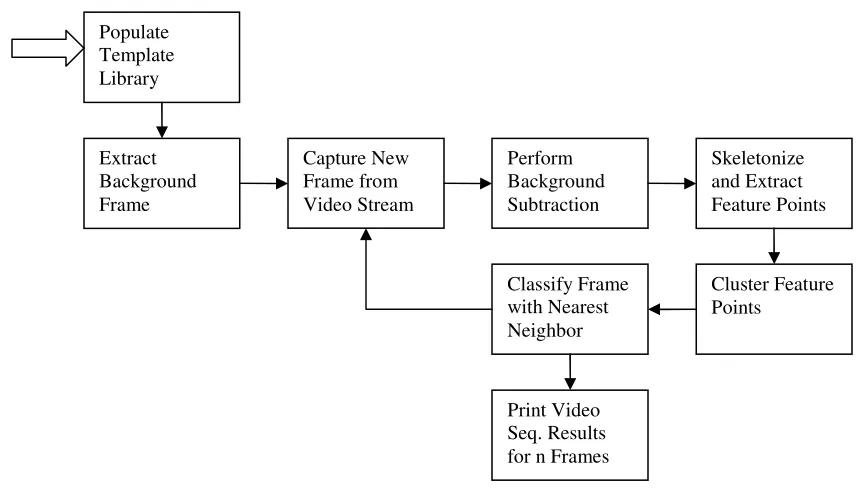
Figure 10: System Flow Diagram
Once the hardware and software platforms are selected, separate subsystems are
integrated to form the completed structure as a stand-alone, real-time human activity
recognition system. Error! Reference source not found. presents a diagram of the
system where each stage of the algorithm is defined. On startup, the template library is
read from file and stored in memory. A background frame is captured by controlling the
position of the camera to incorporate the desired field of view. After capturing the
background frame, the camera remains fixed and is not adjusted further. Each image
frame in the video stream is processed and clustered feature points representing limbs are
is analyzed, and the resultant activity classification is based on the activity with the
maximum number of classifications within the 30 frames.
5.1 Background Capture
In order to perform background subtraction, there must be a static, background
frame with which to perform the comparison. This background frame should be captured
while there is little – ideally no – motion present. The Camera module was incorporated
into the system to control the camera’s PTZ parameters for effective capture of the
background frame. In practice, the camera was adjusted to incorporate a field of view
that would allow subjects as much room as possible to move for the activities. Once the
camera has been adjusted for background capture, the user inputs a command from the
keyboard to store the frame into a background frame container. This frame is stored in
memory, and is accessed for every background subtraction calculation.
5.2 Video Frame Processing
Several OpenCV functions were used to optimize the processing performed on the
captured video frames stored in memory. Since available memory storage is not an issue
in this system, many image containers were created to store the images resulting from
intermediate processing steps throughout the algorithm. It is possible to perform in place
computations, so that a container could be used for multiple steps if memory did become
an issue. Separating each step of the algorithm has the additional benefit of facilitating
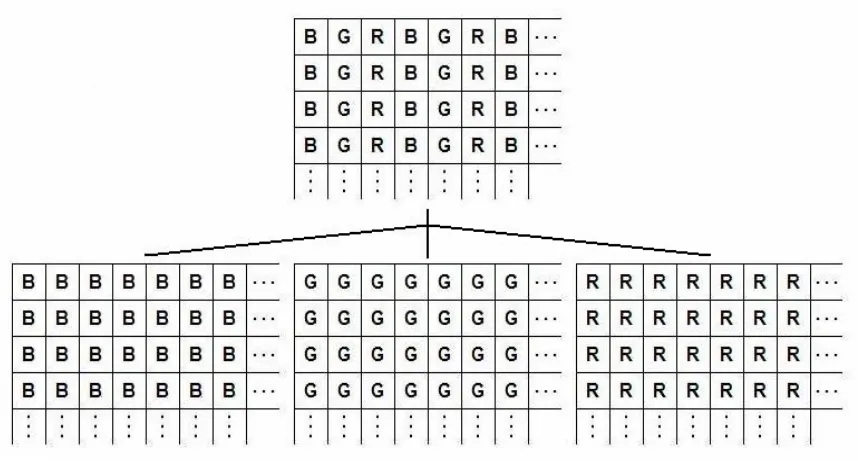
Figure 11: Image Storage Structure
The background subtraction algorithm is simply a thresholding of the Euclidean
distance between the RGB color vectors of the background frame and the video stream
frame for each pixel. OpenCV by default stores the images in an interleaved BGR
structure as seen in Error! Reference source not found.. Each pixel value is stored as
an 8-bit unsigned integer, which is the lowest possible resolution. First in the Euclidean
distance calculation, one vector is subtracted from the other. The result is then squared,
and then the individual squared vector entries are added, with a square root taken after the
addition. Once the difference is taken between the pixel RGB color vectors, the
interleaved BGR planes are split into three individual color planes and converted to
32-bit floating point values to complete the distance calculation. The result is stored in a
single channel grayscale image containing the Euclidean distance measurements from the
background frame to the video stream frame. Each pixel is then thresholded and
silhouette of the human figure extracted on a dark background. Values above the
threshold are set to 255, or white, and values below are set to 0, or black.
Once the image is thresholded, morphological processing is performed to remove
stray white clusters one or two pixels wide by erosion with two passes of a 3x3 square
structuring element. Then the silhouette is dilated to close holes in the silhouette and
rejoin sections that had not been extracted wholly from the background. An erosion
follows to remove the enlarging effects of the dilation. The final dilation and erosion
used 3x3 square structuring elements. The dilation was performed five times and the
erosion three times, to account for the initial erosion to remove small stray white clusters.
In practice the system becomes difficult to test due to changes in the background
when the entire camera field of view is considered for the skeletonization alg