Rochester Institute of Technology
RIT Scholar Works
Theses
Thesis/Dissertation Collections
1996
Deconstruction, existentialism, and art
Ryutaro Furuhashi
Follow this and additional works at:
http://scholarworks.rit.edu/theses
This Thesis is brought to you for free and open access by the Thesis/Dissertation Collections at RIT Scholar Works. It has been accepted for inclusion
in Theses by an authorized administrator of RIT Scholar Works. For more information, please contact
.
Recommended Citation
ROCHESTER
INSTITUTE OF
TECHNOLOGY
A Thesis Submitted
to the
Faculty
ofThe
College
ofImaging
Arts
andScienses
In
Candidacy
for
the
Degree
ofMASTER
OF
FINE
ARTS
DECONSTRUCTION,
EXISTENTIALISM,
AND ART
by
Ryutaro Furuhashi
Approvals
Adviser:/?1!tanitz
Date:
~
r(
Associate Adviser: Leonard Urso
Date:
Jf
-r··
96
Associate Adviser: Elaine Defibaugh
Date:
q
~}
<I -
J
f.,
Department Chairperson: Robert Schmitz
Date:
<£/
-II -
"7",
TABLE
OF
CONTENTS
LIST
OF
ILLUSTRATIONS
ii
Chapter
1. INTRODUCTION
1
2. DECONSTRUCTION
AND ART
2
3. EXISTENTIALISM AND
ART
6
4.
WORKS IN
DECONSTRUCTION
9
5. CONCLUSION
12
ILLUSTRATIONS
13
LIST
OF
ILLUSTRATIONS
Figure
1. Ryutaro
Furuhashi,
Existence. 1995
13
2. Ryutaro
Furuhashi,
Consciousness. 1995
14
3.
Ryutaro
Furuhashi,
Gaze. 1995
15
4.
Ryutaro
Furuhashi,
Purpose. 1995
16
5.
Ryutaro
Furuhashi,
Certainty.
1995
17
6.
Ryutaro
Furuhashi,
Freedom.
1995
18
CHAPTER
1
INTRODUCTION
My
thesis
is
aboutdeconstruction
of existentialismthroughvisualimages,
ormore
precisely,
deconstructive
visual representations of existential themes.The
question ofhuman
existencehas been
a primalinterest in my
work.What
is
the
meaning
ofexistence?How
canI
make sense of man's uniqueintellectual
capacity
toquestion one's ownexistence?
My
concernis
not so much aboutcoming
up
withthe
answer,
but
tohave
alanguage
todisclose
thecondition.In
thepast,
my
work wasmerely
theambiguous expression oftheexistentialfeeling
withoutany
particularconceptual
foundation.
My
workis
now amanifestationof confrontationwiththevery
awareness of existence.
In
this
thesisproject,
my
intention is
toexplore a more analytical approachto
therepresentationofthe
subject,
by
applying
thedeconstructionist
principleto
theconceptionof
my
work.The
objective ofincorporating
deconstructive
thinking
is
toexaminethenature ofthe
relationship between
theimages
andtheirmeanings,
andtoinvestigate how
theworks of art construct and representtheiroverallconcepts.In
doing
so,
I
intend
toprovidesufficientinformation
onthedeconstructonist
practice,
theCHAPTER
2
DECONSTRUCTION
AND ART
Deconstruction
was originatedby
theFrench
philosopherJacques Derrida
in
thelate 1960s.
Originally
it
waspracticedin
philosophical writings andliterary
criticisms.However,
sincethen,
thepracticehas
spreadto thefields
of socialsciences, architecture,
and
the
visual arts.Nowadays it is
abroadly
used(and
misused)
termand,
in
somecases,
it has little
todo
withtheoriginalphilosophicalidea.
Although
its influence
onthecurrent postmodern culture cannot
be
denied,
thereis
a certaindegree
of skepticismabout
its
real significance.Commonly,
deconstruction
seemstobe
misunderstoodby
thegeneral publicbecause
its
identity
is
ratherintangible
andobscured.Part
ofthe reasonfor
this
is
caused
by
Derrida
himself,
who refuses todefine
whatdeconstruction
is.
In
the
interview
withChristopher
Norris,
Derrida
states:Since it is
notasystem,
notamethod,
it
cannotbe
homogenised. Since it
takesthe
singularity
ofevery
contextinto
account,
Deconstruction
is different from
onecontexttoanother.
So
I
shouldcertainly
wanttorejecttheidea
that'Deconstruction'
denotes
any theory,
method or univocalconcept.1'Jacques
Derrida,
"Jacques Derrida: In Discussion
withChristopher
Norris,"interview
by
Christopher
Norris,
in Deconstruction:
Omnibus
Volume,
ed.Andreas
This does
not meanthatdeconstruction is
unknowable.Norris
summarizes thedeconstructionist
activity
asfollows:
Deconstruction
locates
certain crucial oppositions orbinary
structures ofmeaning
andvalue
that
constitutethe
discourse
of'Western
metaphysics'.These include
(among
many
others)
the
distinctions
between
form
andcontent,
nature andculture,
thought
andperception,
essence andaccident,
mind andbody,
theory
andpractice,
maleand
female,
concept andmetaphor,
speech andwriting
etc.A
Deconstructive
reading
thengoes ontoshowhow
thesetermsareinscribed
withina systematic structure ofhierarchical
privilege,
suchthat
one of each pairwill always appearto
occupy
the
sovereign orgoverning
position.The
aimis
thentodemonstrate
-by
way
of closereading
-how
this system
is
undone,
soto speak,
from
within;
how
thesecond or subordinateterm
in
each pairhas
an equal(maybe
aprior)
claimto
be
treatedas a condition
ofpossibility
for
theentire system.Thus writing
is
regularly
marginalised,
denounced
or putin
its
place-a
strictly
secondary,
'supplementary'
place
-by
along
line
ofthinkers
in
theWestern tradition,
from
Plato
andAristotle
to
Rousseau, Husserl, Saussure,
Levi-Strauss
andthelatter-day
structuralisthuman
sciences.2This
typeofthinking
certainly
seems tohave
anaffinity
withthepostmodernartworld.
However,
candeconstruction really
be
appliedto the
visualarts?Since
the
deconstructionist
practiceis
heavily
rootedin
thequestioning
oflinguistic
structure andreading
oftexts,
its
applicationtothe
visual arts seems absurd.Here
is
Derrida's
response:
[TJhe
most effectivedeconstruction,
andI
have
saidthis often,
is
onethatdeals
withthe nondiscursive, orwith
discursive
institutions
thatdon't have
theform
of a writtendiscourse.
. . .Now,
because
therecannotbe
anything,
andin
particularany
art,
thatisn't
textualizedin
the senseI
giveto theword"text"-which goes
beyond
the
purely discursive
- thereis
text
as soon asdeconstruction is
engagedin fields
saidto
be
artistic,visualor spatial.There
is
textbecause
thereis
always alittle
discourse
somewherein
the visualarts,
and alsobecause
evenif
thereis
noHDhristopher
Norris,
Introduction
to
"Jacques Derrida:
In
Discussion
withdiscourse,
the
effectofspacing already implies
atextualization. . . .Deconstruction
starts with
the
deconstruction
oflogocentrism,
andthus
towantto
confineit
to
linguistic
phenomenais
the
most suspectofoperations.3So
deconstruction
cansurely
take
placein
the
field
of visual arts.However,
how
can
deconstructive
artbe visually
recognized?The
worddeconstruction
has
been
usedby
criticstodescribe
theworks of such artists asMarcel
Duchamp,
Jasper
Johns,
andFrancis
Bacon.4Some
artists such asFrancis
Bacon,
Valerio
Adami,
andGerard
Titus-Carmel have
talked
ofDerrida's influence
ontheirworks.Yet
the
distinction
between deconstructive
art andmany
oftheother modern andpostmodernarts remainsunclear/
Andrew
Benjamin
explains thisdifficulty
in specifying
a particular work of art asan
instance
ofdeconstruction:
Part
ofthedifficulty
withthisis
trying
tolocate
Deconstruction
in
an object. . . .The
question oftheobject returnsin
anotherway
andit
goesback
to thepoint putto
Derrida
astowhetheror notDeconstruction
is
something
thatcomestobe
enacted within anobject or
is
away
ofreading
objects or away
ofreading
texts.
As
is
always thecase with thesethings,
it's
clearly
both;
thequestion of enactmentis
problematic.63Jacques
Derrida,
"The Spatial Arts: An Interview
withJacques
Derrida,"interview
by
Peter Brunette
andDavid
Wills,
trans.Laurie
Volpe,
in
Deconstruction
andthe
Visual
Arts,
ed.Peter
Brunette
andDavid
Wills
(Cambridge:
Cambridge
University
Press, 1994),
14-15.
4Norris,
71.
5David
Lodge,
"Deconstruction: A Review
oftheTate
Gallery
Symposium,"in
Deconstruction:
Omnibus
Volume.
89-90.
Andrew
Benjamin,
"Discussion
andComments,"
discussion
withStephen
Geoff Bennington
putsit
this way,
"Deconstruction
is
notin
objects[Ojbjects
arein
Deconstruction."7There is
another reasonwhy
it is difficult
toidentify
deconstruction
in
art.Deconstruction is certainly
rebellious against traditionalphilosophicalthinking.
Such
aframe
of mindis
very
similarto
the attitudesofmany contemporary
artists whocontinuously
questionthe
value of established styles and concepts.That
explainswhy,
in
art,
deconstruction does
not appeartobe
anything
distinctively
different
visually.Here is Bennington
again:[T]he
mosttraditionalphilosophical views of art asmimesis, andits
most academicpractice,
have
alwaysnecessarily left uneasily
open a sense of art as adangerous
event
in
whichsomething
happens
todisturb
theintegrity
of'nature
herself'(and
not
just
respondtoher),
somewhereresisting
the
grasp
of concept andcommentary,
andthroughtheinsufficiency
of attempted explanations ofthiseventin
termsoftalent,
inspiration
orgenius,
something
ofthisdeconstructive
edge or'point',
asDerrida
says,
has
alwaysbeen
at work.To
thisextent,
arthas
alwaysalready been
in
excess ofits
concepts,
already deconstructive
. . .[Deconstruction]
is in any
case a provisional and
necessarily improper
namefor
the
movement one of whosetraditionalnames
has
been
'art'.87Geoff
Bennington,
"Discussion
andComments,"discussion
withStephen
BannetaL,
in Deconstruction: Omnibus
Volume. 77.
"Geoff
Bennington,
"Deconstruction
andPostmodernism,"in
CHAPTER 3
EXISTENTIALISM
AND
ART
The
question ofhuman
existenceis
themainthemein
my
work.It
seemsinevitable for human beings
to
face
thisquestion.Why
do
weexist?The
question ofexistence
is
disturbing
and unsettling.We
cannothelp
but
feel
anguishedbecause
weare conscious
beings.
The philosophy
of existentialism offers avery
clear view of whatthe state ofhuman reality
is. The
principleof existentialismis
that, in
thecase ofhuman
beings,
existence precedes essence.
In
otherwords,
youhave
tostartwithsubjectivity.We
existfirst,
andthen,
webecome
something
afterward.There is
no predeterminedhuman
nature.9
In
thewords ofJean-Paul
Sartre,
"Man
is nothing
elsebut
whathe
makes ofhimself."10
Human
beings
arefree
to
chooseany
actions.Consequently,
eachindividual
is
totally
responsiblefor
his/her
own actions.11Some
ofmy
works aresimply
expressions of various existentialfeelings.
They
are more or
less
intuitively
conceivedimages
ratherthandeeply
analytical, yet,
a'Jean-Paul
Sartre,
"The
Humanism
ofExistentialism,"trans.
Bernard
Frechtman,
in Essays in Existentialism,
withaforeword
and editedby
Wade Baskin
(New York: A
Citadel
Press
Book, 1993),
35-36.
Ibid.,
36.
particularexistential
issue
underlieseach work.For
instance,
Existence
(fig.l)
is
aboutthe
contingency
ofhuman
existencein
this
world.It
represents a man's accidentalappearance and
disappearance
in
a certain space andtime.
What
lies in between his
birth
anddeath is only his freedom
ofchoicein
life.
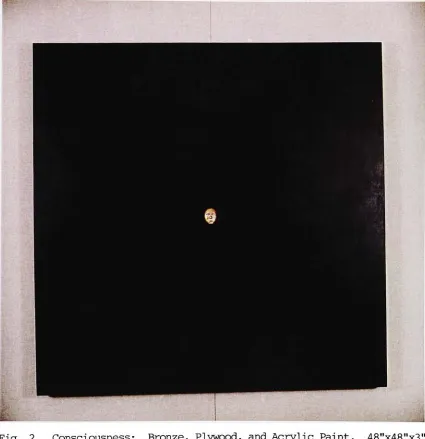
Consciousness
(fig.2)
is
aboutthe
nothingness ofbeing. The
face in
the
centersymbolizes a man'sreflectiveconsciousness and
his
realizationof self.At
the sametime,
it is
the
realizationofthe emptinessofbeing
as well.So
the
vastempty
spaceis
actually
the
reflection ofhimself.
In
Sartre's
thought,
theconcept ofnothingnessis
deeply
relatedto thatofbeing. To
understandthis,
first,
you needtounderstandthenature of consciousness.
Arthur
C.
Danto
explains:The
primary
structure ofconsciousness,
the absolutebeginning
point,
as muchfor
Sartre
asfor
the
entire phenomenologicalschool,
is
thatconsciousness alwaysis
of
something.
It
is
not,
sotospeak,
a purestate,
and no oneis
merely
consciouswithout
there
being
something
ofwhichhe is
conscious.12Therefore,
since consciousnessis
invariably
conscious ofsomething
external,
consciousness
itself
is
a sort ofnothingness.13In
otherwords,
asSartre
writes,
"Nothingness lies
coiledin
theheart
ofbeing
-like
aworm."14
Gaze
(fig.3)
is
about anontologicalconflictbetween
individuals. It depicts
thementaltormentcaused
by
thepresence of anotherconsciousness.Sartre
points outtwo"Arthur
C.
Danto,
"Nothingness:
or,
Consciousness
andOntology,"in
Jean-Paul
Sartre (New York: The
Viking
Press, 1975),
43.
13Ibid.,
57.
14Jean-Paul
Sartre,
"The
Problem
ofNothingness,"trans.
Hazel E.
Barnes,
basic
types
ofbeing. The
being-for-itself
is
thetype
ofbeing
which possessesits
ownconsciousness,
such as ahuman
being.
The
being-in-itself
is
the
onewhichexistswithoutconsciousness of
its
own,
such as an object.And
thebeing-for-itself
can turninto
anothertype
ofbeing,
whichis
called thebeing-for-others.15What
turnsabeing-for-itself
toabeing-for-others
is
thegaze of anotherhuman
being. The
look
ofanotherhuman
being
makes anindividual
perceivehim/herself
as"a
possible objectfor
thatlook".16
So,
in
theworkGaze,
theface
which appears onthe surface oftheeyeis
actually
thereflection ofthebeing
whois
reducedto the state of an objectby
thelook.
The
workportrays theloss
ofhis
sense offreedom,
andtheontologicalproblem ofothers.
All
threeofthese worksconsist ofthecombination of representational andabstract elements.
The
mostvisually
intelligible
elementthrough theseworksis
theimage
of aface.
Certainly
it is
accessible toviewersbecause
theimage is easily
recognizable and
it has
a certain undisguised symbolic quality.It clearly
symbolizes theawareness of existential problems.
Even
thoughthe
image
of aface
can evoke astrong
emotionalresponse towhich aviewercan
possibly
relate, the
conceptual under currentof eachwork
is
not so obvious.Therefore
it
becomes necessary for
theviewertointerpret
theabstractsymbolsandtheotherimplications in
theworkstofully
perceivetheir wholeconcepts.
15Danto,
41-42.
16Arthur
C.
Danto,
"Shame:
or, the
Problem
ofOther
Minds,"in
Jean-Paul
Sartre.
121.
CHAPTER 4
WORKS
IN DECONSTRUCTION
One
obviousbinary
relationship
which occursin
artis
thatofimage
andmeaning.
It is
a system of signs whichis
of asocial, cultural,
orindividual
creation.Since
artistsfreely
combine various visualimages
from
a socialicon
toa personalsymbol
in
theirworks,
how
aworkof art representsits
concept variesfrom
onetoanother.
The meaning
of a certainimage is
notfixed but
also changesaccording
to
its
context.
Therefore,
how
aworkof artis
perceiveddepends
heavily
uponeachindividual's knowledge
oftheworkandhow he/she interprets
the
visualimages.
This
does
not meanthataworkof artis
all visualimages
withhidden
meanings.The
issue
oftitle
brings
up
aninteresting
aspectin
art.The
title
of aworkoccupies an ambiguous positionin
art.It
is
not a part oftherepresented
image,
yetit is
notcompletely
outside oftheworkeither.What
it does is
tocreateacertain condition
for
theworktobe
seenin
a certain way.In
some ofmy
works,
the titlesplay
avery
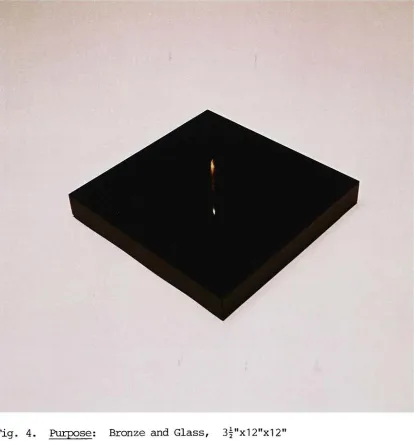
significantrole.Purpose
(fig.4)
canbe described
asthe
work whichquestionsthe
existentialconcept ofthepurpose of
being by
questioning
the
purpose ofthe
art objectitself.
In
otherwords, the
image has
nological
relationtoits title. So
theaim oftheworkis
toraisethequestion:
"Why
is
thisworkcalledPurpose?".
Even
thoughthe
relationship
between
theimage
andits title
ormeaning is completely
arbitrary,
thebullet
shapedbronze
piece andits
reflective glassbase
are meantto
be
perceivedassomething
meaningful.
Certainly,
this
image has
an undeniable serenequality
of a meditative or anabsolute state.
What
thewhole workultimately implies is
the
purposelessness ofhuman
existence
in its
very
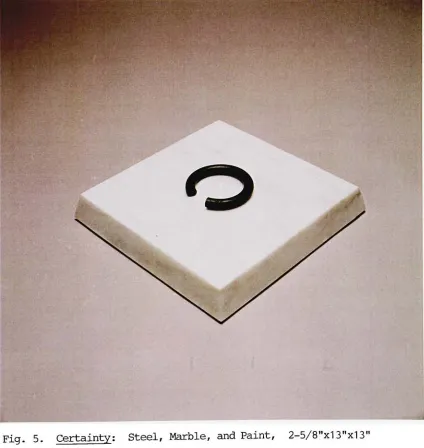
essence.Certainty
(fig.5)
uses aplay
of contradictiontooriginatethequestionabouttheconcept of certainty.
The
broken
circle acts as acontradictory image
to
its title
Certainty. There is nothing
certain aboutthebroken
circlebecause
ofits
incompleteness. So
whatis
certainty?How
can webe
certain aboutanything
afterall?The
concept ofcertainty is
a man made abstract concept which comes withtheproblemof
language.
The
workquestionshow
uncertaincertainty is
andthecertainty
of whatwethinkof
human
reality.Freedom
(fig.6)
is
about thefreedom
of man.The
existential concept ofhuman
freedom
revealstheparadoxical aspect ofhuman
condition.Sartre
writes:[M]an
is
condemnedtobe free.
Condemned,
because he did
not createhimself,
yet,
in
otherrespectis
free; because,
oncethrown
into
the
world,
he is
responsiblefor
everything
he
does.17In
otherwords,
human beings
cannotescapefrom
theirownfreedom. The
chainedsteel
rings
andtheircoldheavy
property
ofthematerialsymbolizethisheavy
human
conditionof
being
bound
toone's ownfreedom. The
image
oftheworkis certainly
a17Jean-Paul
Sartre,
"The
Humanism
ofExistentialism,"trans.
Bernard
Frechtman,
in Essays in Existentialism.
41.
contrastto the
ordinary
concept ofthe term
freedom.
Therefore,
theworkforces
aviewerto
face
thesetwo
seemingly contrary
viewsand,
as aresult,
toquestiontheconcept of
human freedom
atits very
core.All
three
ofthese
works explorethe
relationshipsbetween
theimages
andtheirmeanings
in
theirown unique ways.The
overall concept of each workonly
comesinto
existence withintheperceptible
difference
between
therepresented object andits
meaning implied
by
the
title.
However,
these works cannotescapefrom
thepolysemousnature of signs after
all,
no matterhow
clearly
they
aretitled
orhow obviously
they
arerepresented.
In
theend,
everything
seemstobe
same asit
was.The
works ofartremain silent and ambiguous.
CHAPTER 5
CONCLUSION
In
the
pastfew
years,
it
seemsthat, consciously
orunconsciously,
my
struggle asan artist was
to
attain a certainclarity in my
work.I
seemedto
believe
that
theidea
of aworkcould
be
manifestedclearly in
a visualimage
or an art objectAs
aresult,
I
couldnot
help facing
a sort ofdilemma between my
concept of what art canbe
andtheway
art
is.
Even
though thereseemstoexist anillusion
of art as anintelligible
substancebecause
ofits
visualstatus,
it is
not quiteso,
asPeter Brunette
andDavid
Wills
correctiy
point
out,
"Artistic
expressionis
nevertheunmediated manifestation of emotionthatit
wants topretend
it
is."18So it
goesback
to thevery
basic
questionof what artis. More
thananything,
what
I
discovered,
or ratherrediscovered,
through this thesisprojectis
that thenature ofart
is
aheuristic
medium.Since
artcannever escapefrom
the system ofsigns,
works ofart always come with some ambiguity.
This ambiguity
is
precisely
what gives a sense ofmystery
to
a work of art.And
themystery
is
probably
necessary
for
art,
in
orderto
transcend
its
makerandits
mere objectness."Peter Brunette
andDavid
Wills,
"Introduction,"
in
Deconstruction
andtheVisual
Arts. 4.
rH|OJ
b
roCD
N
c
o
(D
Cn
H
fa
Fig.
2.
Consciousness:Bronze, Plywood,
and AcrylicPaint,
48"x48"x3" [image:19.540.57.482.166.605.2]ro
oo
CO ro
CD 0) -P Ul
C td
U 0)
&
u
tn H fa
Fig.
4.
Purpose: Bronze andGlass,
35nx12"x12" [image:21.540.69.483.172.613.2]Fig.
5.
Certainty:Steel, Marble,
andPaint,
2-5/8"x13,,x13,, [image:22.540.60.484.173.621.2]CO
tn a
H
u
CD
$
en
JS
Si
c
CD CD
H
Q
tn
WORKS
CITED
Brunette,
Peter,
andDavid
Wills,
eds.Deconstruction
andthe
Visual
Arts.
Cambridge:
Cambridge
University
Press,
1994.
Danto,
Arthur
C.
Jean-Paul
Sartre.
New York: The
Viking
Press,
1975.
Papadakis, Andreas,
Catherine
Cooke,
andAndrew
Benjamin,
eds.Deconstruction:
Omnibus Volume. London:
Academy
Editions,
1989.
Sartre,
Jean-Paul. Essays in Existentialism. With
aforeword
and editedby
Wade Baskin.
Translated
by
Bernard Frechtman
and others.New
York: A Citadel
Press,
1993.