Int. J. Electrochem. Sci., 12 (2017) 10542 – 10552, doi: 10.20964/2017.11.60
International Journal of
ELECTROCHEMICAL
SCIENCE
www.electrochemsci.org
Short Communication
Adsorption Behavior of 3-phenylacrylaldehyde on a Tin Surface
during Electroplating
Chengqiang An1,2,*, Kai An1, Chunming Liu1, Xiaolin Qu3
1
School of Materials Science and Engineering, Northeastern University, Wenhua RD 3, Shenyang 110819, China
2
School of Environmental and Chemical Engineering, Shenyang Ligong University, Nanping RD 6, Shenyang 110159,China
3
Dalian University of technology, Linggong RD 2, Dalian 116024,China
*
E-mail: [email protected]
Received: 23 July 2017 / Accepted: 9 July 2017 / Published: 12 October 2017
The global and local activities of 3-phenylacrylaldehyde and 4-phenylbut-3-en-2-one, their adsorption behavior on a tin surface, and the electrodeposition mechanism of tin were studied using quantum chemistry calculations, molecular dynamics simulations, and electrochemical measurements. The results indicate that active sites bind to C, O, and H atoms resulting in the multi-center adsorption of molecules on tin surfaces via coordinate and feedback bonds. The adsorption activity of 3-phenylacrylaldehyde was superior to that of 4-phenylbut-3-en-2-one. Polarization curves and SEM observations indicated that the presence of 3-phenylacrylaldehyde not only enhanced the cathodic polarization of tin electrodeposition but also accelerated the nucleation rate of tin. The increased adsorption of 3-phenylacrylaldehyde on a tin surface in a methylsulphonate plating solution resulted in a bright electroplated coating.
Keywords: Quantum chemistry calculation; molecular dynamic simulation; 3-phenylacrylaldehyde; reactivity; absorption behavior
1. INTRODUCTION
However, the mechanism by which these additives improve the coatings remains unknown [5-8]. Some studies have investigated the adsorption behaviors of these additives and their effect on electrochemical mechanisms using electrochemical measurements and quantum chemistry calculations [9-13].
Sekar et al [14]. used Gelatin,b-naphthol, polyethylene glycol, peptone and histidine in the plating bath to improve the surface morphology, grain size, smoothness and corrosion resistance of the tin deposits. The effects of additives on surface morphology, grain refinement and corrosion resistance were studied. Meinshausen et al [15]. investigated the effect of Indium Addition on Whisker Mitigation in Electroplated Tin. Indium additions reduced whisker growth by at least two orders of magnitude, X-ray confirmed that In had indeed diffused into the Sn and was a likely reason for the mitigation of Sn whiskers. Kee et al [16]. studied the electrodeposition of tin from Tin (II) Methane Sulfonate (MSA) with varying concentration in air and water stable 1-Butyl-1-Methylpyrrolidinium Trifluoro-Methanesulfonate, (BMPOTF) ionic liquid at room temperature. The result shows that Methane Sulfonate salts has promising results with current efficiency as high as 99% and fine, polygonal grain structures were obtained. Sang et al [11]. investigated the adsorption behavior of four typical thiadiazole derivatives. Moreover, they also investigated the adsorption and inhibition behaviors of the corrosion inhibitors on copper foil in rolling oil using experimental and computational techniques. Based on the measured molecular orbitals and Fukui indices, the inhibitor’s active sites were mainly concentrated on the hydrocarbon rings, while the distribution of polar functional groups resulted in coordination and feedback bonding among molecules and led to stable adsorption on the metal surface. Sang’s work provides theoretical guidance for the selection of corrosion inhibitors for deposition on copper foil in rolling oil [17]. However, previous studies focused on the adsorption behavior of additives on metal surfaces without considering the adsorption of additives on metal surfaces during tin electroplating in acidic MSA electrolytes.
In this work, the global reactivity and local reactivity of 3-phenylacrylaldehyde and 4-phenylbut-3-en-2-one were studied using computational approaches based on quantum chemistry, and the effect of 3-phenylacrylaldehyde adsorption on tin plating is discussed. Electrochemical measurements and microscopy observations indicated the validity and reliability of the computational results, which might provide a framework for additive selection by correlating adsorption behavior with coating properties.
2. MATRIALS & METHODS
2.1. Composition of MSA plating solution
Table 1. Bath composition and coating parameters
Parameters Values range Optimum value
Tin MSA
Methanesulfonic acid Additives
Current density Temperature
12 g/L–18 g/L 40 mL/L–50 mL/L 20 mL/L–40 mL/L 0.2 A/dm2–1.5 A/dm2 35 °C–55 °C
14 g/L 45 mL/L 30 mL/L 1.5 A/dm2 45 °C
2.2. Microstructure observation and Electrochemical analysis
The surface morphology was imaged using scanning electron microscopy (SEM, JEOL JSM-5310, Japan) at an acceleration voltage of 20 kV. The electrochemical measurements were accomplished on a CHI650A electrochemical workstation (Shanghai chenhua Instruments, China). A three-electrode cell was used with tinplate as working electrode, a platinum counter electrode as the counter and a saturated calomel electrode (SCE) as the reference electrode,respectively. The test solution was a 3.5% NaCl aqueous solution at room temperature. Cyclic voltammetry and cathodic polarization experiments were performed at a scan rate of 10 mV/s.
2.3. Quantum chemistry calculations
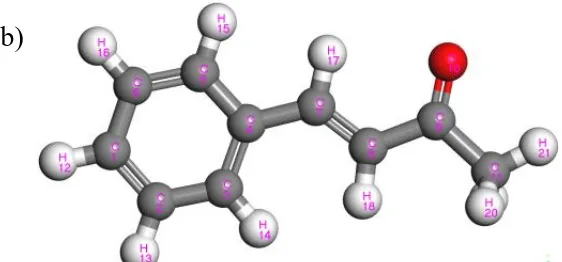
Possible geometrical structures of 3-phenylacrylaldehyde and 4-phenylbut-3-en-2-one were studied using density functional theory (DFT) [18-19], Gaussian in Materials Studio, and hybrid density functional theory (B3LYP). The structures’ energies were verified to be the minimum in their potential energy surfaces. Based on the GGA/PW91 basis set, the DMo13 method from Materials Studio [20-21] was used to optimize the structures. The distributions of the highest occupied molecular orbital (HOMO), chemical potential (μ), softness (S), hardness (η), and electrophilic index (ω) were used to determine the global reactivities of 3-phenylacrylaldehyde and 4-phenylbut-3-en-2-one. The local Fukui index was used as a measure of the local reactivities of 3-phenylacrylaldehyde and 4-phenylbut-3-en-2-one. The structures of the 3-phenylacrylaldehyde and 4-phenylbut-3-en-2-one molecular models are shown in Figure. 1.
Figure 1. Molecular structure of 3-phenylacrylaldehyde (a) and (b) 4-phenylbut-3-en-2-one.
2.4. Molecular dynamics simulation
Quantum chemistry was used to obtain microstructural information of the additives, and the additives’ reactivities were analyzed. Using a numerating simulation, interfacial information was accessed according to the equilibrium configuration of the interface of the additive molecule and metal. It is important to evaluate each additive’s performance. The adsorption energy of 3-phenylacrylaldehyde and 4-phenylbut-3-en-2-one on a tin surface is given by Eq. 1 [21],
Eadsorption=Etotal-(Emolecule+Esurface) (1)
where Eadsorption is the adsorption energy, Emolecule is the energy of an isolated molecule, Esurface is
the energy of the metal surface without an adsorbed molecule, and Etotal is the total energy of the
molecule and the metal surface.
Interactions between the additive and the tin surface were determined using molecular MD simulations. The (100) crystal plane of tin was selected as the crystal surface on which adsorption occurred. A three-layer system was built. The first layer was the tin surface, containing two layers of 148 total tin atoms. The surfaces volume was 1.3769 nm × 1.3769 nm × 2.7850 nm. The second layer included a one 3-phenylacrylaldehyde molecule or 4-phenylbut-3-en-2-one molecule (ρ = 1 g/cm3). In the calculations, all atoms in the first layer were ‘frozen’, while the molecules in the second layer were free to interact with the metal surface. Material was selected in the VCFF force field, and the smart minimizer was used to optimize the system. Dynamic simulations were performed using the Discover module [21]. The constant NVT canonical ensemble was used. The simulation temperature was 298 K. Van der Waals and coulombic interaction were modeled using the charge group method. The truncation radius was 15 Å. The total simulation time was 500 ps at a time step of 1 fs. Configurations were recorded every 1000 fs.
3. RESULTS & DISCUSSION
3.1. Global reactivity of the additives
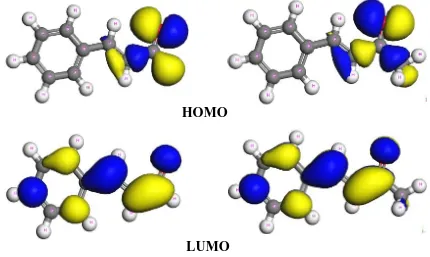
Since interactions only occur between the reactants and molecules at the forefront of the rail. The additive’s adsorption behavior was analyzed by studying the HOMO and lowest unoccupied molecular orbital (LUMO). The HOMOs and LUMOs of 3-phenylacrylaldehyde and
[image:4.596.167.448.72.203.2]
en-2-one in the level of 0.03 a.u. is shown in Figure. 2. Relevant chemical parameters, e.g., μ, S, η, and ω, which were calculated by DFT [22-23], are listed in Table 2.
=- = E
N
(2) 2
2
== E =
N N
(3) 1
= N
S
(4) 2
(5)
1 =
2 EHOMO ELUMO
(6)
1 =
2 ELUMO EHOMO
(7)
According to front orbital theory, EHOMO is a measure of a molecule’s electron-donating ability; a higher EHOMO indicates a stronger electron-donating ability. ELUMO represents a molecule’s electron-accepting ability, and a lower ELUMO corresponds to a greater ability to accept electrons. Conversely, it is not easy to accept electrons [21]. ΔE is an important parameter for molecular stability. A larger ΔE indicates a more stable molecule.
Figure 2. HOMO and LUMO isosurfaces with values of 0.03 a.u. for (a) 3-phenylacrylaldehyde and (b) 4-phenylbut-3-en-2-one
[image:5.596.83.513.431.688.2]
Table 2. Calculated quantum chemical parameters of the studied molecules
Molecules
EHOMO/eV ELUMO/eV ΔE/eV η/eV μ/eV ω/eV S/eV-1
3-Phenylacrylaldehyde -5.544 -3.004 2.540 1.270 -4.274 14.380 0.787 4-Phenylbut-3-en-2-one
-5.363 -2.740 2.623 1.312 -4.052 12.517 0.762 3-phenylacrylaldehyde had a lower hardness than 4-phenylbut-3-en-2-one, but the magnitude of its softness and chemical potential were larger than those of benzalacetone. Therefore, 3-phenylacrylaldehyde was a highly reactive molecule. According to the global activity parameters, the adsorption activities of the two additives followed 3-phenylacrylaldehyde > 4-phenylbut-3-en-2-one.
3.2. Local reactivity of the additive molecules
Fukui indices are an effective means of expressing the nucleophilic or electrophilic reactivities of organic compounds and of determining a molecule’s reactive sites. The Fukui function, fk
, is defined as a first-order partial derivative of the electron density, ( )r , in terms of the electron number, N [18].
( )
( )
( ) ( ) r
r f r
N
(8)
According to the characteristic line method, the Fukui functions can be expressed as
fk qk( 1) k( )Fukui N q N (9)
fk q Nk( ) qk( 1)Fukui N (10)
where qk is the static electricity of the first k atoms with static electricity in the molecule fk
is the nucleophilic attack index, and fk
is the index of electrophilic attack. These parameters indicate the donating and accepting ability of the molecules. Greater magnitude parameters indicate stronger donating and accepting abilities. The Fukui indices of 3-phenylacrylaldehyde and 4-phenylbut-3-en-2-one are show in Table 3.
Table 3. Calculated local reactivity descriptors of the molecules studied. PC = 3-phenylacrylaldehyde and PE = 4-phenylbut-3-en-2-one
PC Fukui (-)/au Fukui (+)/au PE Fukui (-)/au Fukui (+)/au
C(7) 0.048 0.093 C(7) 0.043 0.089
O(10) 0.334 0.125 O(10) 0.335 0.120
H(11) 0.205 0.090 H(19) 0.094 /
H(18) 0.080 0.074 H(20) 0.085 /
[image:6.596.52.543.621.694.2]
Based on the adsorption mechanism of these additives, an effective additive contains polar functional groups that adsorb on the metal surface. The non-polar portion of the molecule forms an adsorption layer on the metal surface. This adsorption lowers the activation energy of tin deposition and shifts the cathodic polarization curve to the right. The Fukui(-) indices of both molecules, 3-phenylacrylaldehyde and 4-phenylbut-3-en-2-one, is greater than their Fukui(+) indices, suggesting that the atoms have electrophilic characteristics and can easy lose an electron to participate in electrophilic reactions. The largest indices were 3-phenylacrylaldehyde O(10) Fukui(-), 4-phenylbut-3-en-2-one O(10) Fukui(-), and 4-phenylbut-3-en-2-one H(19) Fukui(-). All of these atoms had nucleophilic centers and formed a feedback bond by accepting electrons from the metal surface. C(7) and O(10) Fukui(+) in 3-phenylacrylaldehyde and 4-phenylbut-3-en-2-one were large, because these atoms are electrophilic reaction centers and form feedback bonds by accepting electrons from the metal surface. These results indicate that oxygen atoms not only provide electrons to form coordinate bonds but also accept electrons from the metal surface to form feedback bonds.
3.3. Molecular dynamics simulations
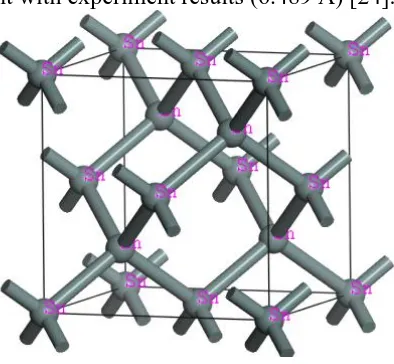
[image:7.596.201.398.422.604.2]Tin crystals have a face-centered cubic structure and are in space group Fd3m, as shown in Fig. 3. Structural optimization was carried out using MD methods using the DMo13 module of Materials Studio based on the GGA/PW91 basis set. Structural optimization revealed that the lattice parameter was 6.491 Å, which is consistent with experiment results (6.489 Å) [24].
Figure 3. Crystal cell of tin atoms
[image:8.596.148.445.178.395.2]
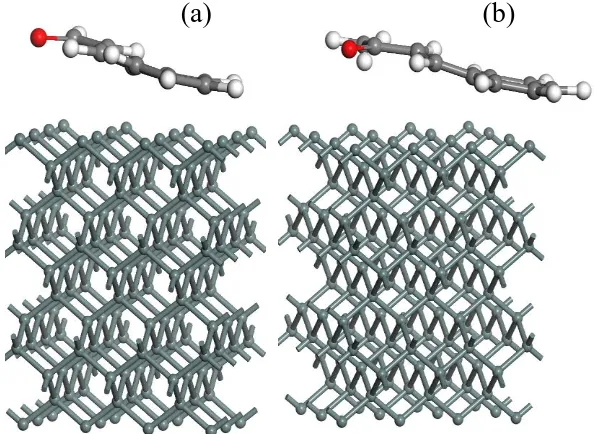
The bonding strength of the additive molecule on the metal surface is an important characteristic for measuring its ability to improve polarization performance [25]. Adsorption energy is the most direct embodiment of bonding strength. According to thermodynamic principles, the adsorption of particles at an interface in solution is caused by a reduction in the system’s free energy during adsorption.
Figure 4. Adsorption of inhibitor molecules on Sn (100)
Exothermic processes with negative adsorption energy and large adsorption energy magnitudes indicate that molecules became combined with the surface in a stable manner. The interaction energy between the molecules (3-phenylacrylaldehyde and 4-phenylbut-3-en-2-one) and the tin surface in solution was obtained from the MD simulation’s single molecule adsorption energies, as listed in Table 4.
Table 4. Average values of the molecules’ adsorption energies (Eadsorption) on the tin surface
Molecules Emolecule/KJ·mol-1 Esurface/KJ·mol-1 Etotal/KJ·mol-1 Eadsorption/KJ·mol-1
3-phenylacrylaldehyde 75972.369 440819.494 516771.109 -20.754 4-phenylbut-3-en-2-one 80348.068 440819.903 521149.396 -18.575
According to Table 4, the adsorption energy between the molecules (3-phenylacrylaldehyde and 4-phenylbut-3-en-2-one) and the tin surface in solution is negative, which indicates that the two molecules can both adsorb to the metal surface, and they both have the capacity to promote cathodic polarization. According to the simulation results, 3-phenylacrylaldehyde had larger adsorption energy. Theoretically, 3-phenylacrylaldehyde has the maximum adsorption activity. Both molecules undergo physical adsorption (Eadsorption < 40 KJ mol-1). From the perspective of single molecule adsorption,
[image:8.596.40.554.573.627.2]
phenylacrylaldehyde has a higher adsorption activity than 4-phenylbut-3-en-2-one, which is consistent with the results of quantum chemistry calculations[9,11].
3.4. Influence of 3-phenylacrylaldehyde on electrochemical plating and plating morphology
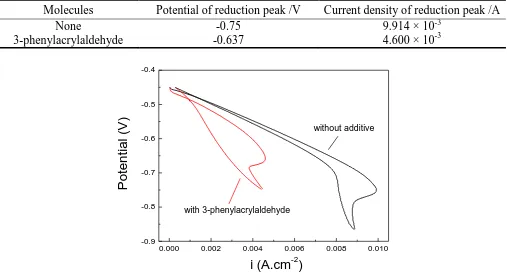
[image:9.596.46.553.299.574.2]The influence of 3-phenylacrylaldehyde on electroplating in the MSA plating solution was measured experimentally, as shown in Figure. 5 and Table 5. In the cyclic voltammetry curve without additive plating solution, the cathodic current rapidly increased and no tin was deposited on the electrode when the potential was scanned from -0.45 V to -0.65 V, indicating the occurrence of the hydrogen evolution reaction. At cathodic potentials in excess of -0.75 V, a reduction peak was observed in the cyclic voltammograms, suggesting that tin was deposited on the electrode[10,11,16]. Table 5. Reduction peak potential and current in the absence and presence of 3-phenylacrylaldehyde
Molecules Potential of reduction peak /V Current density of reduction peak /A None
3-phenylacrylaldehyde
-0.75 -0.637
9.914 × 10⁻³ 4.600 × 10⁻³
0.000 0.002 0.004 0.006 0.008 0.010 -0.9
-0.8 -0.7 -0.6 -0.5 -0.4
Poten
tial
(V)
i (A.cm-2)
without additive
with 3-phenylacrylaldehyde
Figure 5 Cyclic voltammograms recorded in the MSA plating solution with and without 3-phenylacrylaldehyde
0.000 0.002 0.004 0.006 0.008 0.010 -0.80
-0.72 -0.64 -0.56 -0.48 -0.40
with
3-phenylacrylaldehyde
Poten
tial
(V)
i (A.cm-2)
without additive
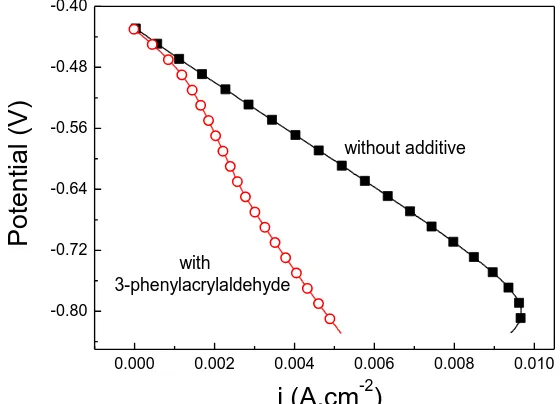
Figure 6. Cathodic polarization curves recorded in the MSA plating solution with and without 3-phenylacrylaldehyde
The morphologies of electroplated coatings after 15 s of plating are shown in Figure. 7. Without an additive, two sizes of electrocrystallized grains were observed on the coating. The larger grains were 1.5 μm to 2 μm in size, while the smaller grains were several hundreds of nanometers. Meanwhile, after the addition of 3-phenylacrylaldehyde, more refined grains and a more uniform plating was observed. Both the electrochemical measurements and these morphological observations indicate that the adsorption of 3-phenylacrylaldehyde influenced the cathodic electrodeposition process and improved grain refinement, resulting in a smoother and more uniform coating[11,16].
[image:10.596.160.440.72.274.2]
Figure 7. Morphologies of the electroplated coatings (a) with and (b) without 3-phenylacrylaldehyde
4. CONCLUSIONS
[image:10.596.123.475.461.600.2]
(2) The variation of single molecular adsorption gives a good index in determining the two molecule’s adsorption activities. 3-phenylacrylaldehyde outperformed 4-phenylbut-3-en-2-one. The results suggest that this conclusion is consistent with quantum chemistry calculations.
(3) The tin deposition potential was improved and the cathodic polarization was enhanced by adding phenylacrylaldehyde to the MSA solution for tin electroplating. The inhibitory effect of 3-phenylacrylaldehyde on tin was stronger than that without an additive. The additive increased the rate of the crystallization process. The higher cathodic over-potential strongly influenced the electrocrystallization of tin, improving the grain refinement and resulting in a smoother and more uniform electroplated coating.
References
1. Q. Feng, T. Li, J. Jin, D. Zeng, Rare. Metal.Mater. Eng., 36 (2007) 559-564. 2. G. Medvedev, N. Makrushin, Russ. J. Appl. Chem., 77 (2004) 1781-1785.
3. M. Illera, R. Lostado, R. Fernandez Martinez, B.J. Mac Donald, J. Strain. Anal. Eng., 49 (2014) 467-480.
4. M.I. Verissimo, R.P. Silva, M.T. Gomes, J. Sci. Food. Agric., 96 (2016) 3042-3046. 5. F. Yang, Y. Li, J. Appl. Phys., 104 (2008) 113512.
6. J. Hassoun, S. Panero, P. Reale and B. Scrosati, Int. J. Electrochem. Sci., 1(2006)110-121. 7. J. Jin, Coat. Tech., 14 (2017) 6247-6252.
8. K. Murakami, M. Hino, M. Takamizawa, K. Nakai, Mater. Trans., 49 (2008) 2829-2836. 9. W. Li, Q, W. He, C. Pei, Electrochim. Acta, 22 (2007) 6386-6394.
10. L. Feng, H. Yang, F. Wang, Electrochim. Acta, 58 (2011) 427-436. 11. X. Sang, J. Sun, X. Yang, Mater. Sci. Forum, 817 (2015) 204-211.
12. A. Survila, Z. Mockus, S. Kanapeckaitė, M. Samulevičienė, V. Jasulaitenė, Prot. Met. Phys. Chem., 45 (2009) 455-460.
13. S. Xiong, J. Sun, Y. Xu, X. Yan, J. Nonferr. Metal., 25 (2015) 1721-1730. 14. R. Sekar, C. Eagammai, S. Jayakrishnan, J. Appl. Electrochem., 40 (2009) 49-57.
15. L. Meinshausen, S. Bhassyvasantha, B.S. Majumdar, I. Dutta, J. Electron. Mater., 45 (2015) 791-801.
16. Y.K. Kee, W.J. Basirun, K.H. Lee, Adv. Mater. Res., 264-265 (2011) 1462-1467. 17. S. Xiong, J. Sun, W. Jiang, Y. Xu, China. Pet. Process. Pe.,17 (2015) 96-107. 18. K. Khaled, S. Fadl-Allah, B. Hammouti, Mater. Chem. Phys., 117 (2009) 148-155. 19. D. Roy, J. Phys. Chem. A. 110 (2006) 1084-1093.
20. R. Shinde, M. Sobhia, J. Molecular, J. Mol. Graphics Modell., 45 (2013) 98-110.
21. V. Pandarinathan, K. Lepková, S. Bailey, Indust. Eng. Chem. Res., 53 (2014) 5858-5865. 22. C. Öğretir, S. Çalış, G. Bereket, J Molecular Structure: THEOCHEM, 635 (2003) 229-237. 23. J.M. Harrison, D. Woodruff, J. Robinson, J. Density, Surf. Sci., 600 (2006) 1827-1836. 24. C. Li, L. Li, C. Wang, Electrochim. Acta, 115 (2014) 531-536.
25. B. Huang, C. Li, L. Shi Chinese Material Engineering Dictionary, Chemical Industry Press, Beijing. 2006.
26. F.I. Danilov, I.V. Sknar, Y.E. Sknar, Russ. J. Appl. Chem., 47 (2011) 1035-1042.