ISBN 978-94-6138-104-0
Available for free downloading from the CEPS website (http://www.ceps.eu) ©CEPS, 2011
Customs Cooperation in the Area of
Freedom, Security and Justice
The role of customs in the management
of the EU’s external border
Peter Hobbing
June 2011
Abstract
This study contrasts the current role of customs at the EU’s external borders with the role it was intended to perform according to international standards in border management. There is a considerable imbalance between the involvement of customs and border guards, which impedes the smooth operation of border control and poses security risks for the Union and its citizens, including terrorist attacks. This paper analyses the causes of this imbalance and proposes appropriate solutions that are in line with international standards.
The CEPS ‘Liberty and Security in Europe’ publication series offers the views and critical reflections of CEPS researchers and external collaborators on key policy discussions surrounding the construction of the EU’s Area of Freedom, Security and Justice. The series encompasses policy-oriented and interdisciplinary academic studies and commentary about the internal and external implications of Justice and Home Affairs policies inside Europe and elsewhere throughout the world.
Unless otherwise indicated, the views expressed are attributable only to the authors in a personal capacity and not to any institution with which they are associated. This publication may be reproduced or transmitted in any form for non-profit purposes only and on the condition that the source is fully acknowledged.
1. Introduction: A long-term companion in border matters, suddenly superfluous? ... 1
2. European integration: The Customs Union and beyond ... 2
2.1 Beyond the Customs Union: New horizons in the security sector ... 3
2.1.1 US models in cargo security ... 4
2.1.2 Approach of the World Customs Organisation in supply chain management . 5 2.1.3 The EU safety and security amendment of 2005 ... 5
2.2 Customs involvement in the ‘third pillar’: End of a sidetrack? ... 6
3. Customs and its current status: an assessment of capacities ... 9
3.1 The assets ... 9
3.1.1 Operational field ... 10
3.1.2 Political landscape ... 11
3.2 Possible deficits ... 12
3.2.1 EU customs territory – Diverging area, diverging borderlines ... 12
3.2.2 Uniform application of the law ... 15
3.2.3 The vexed question of penalties ... 15
3.2.4 Less funding for training and equipment ... 16
3.2.5 Political support ... 17
3.2.6 Customs coordination – A currently vacant function ... 17
4. Integrated vs. coordinated border management: finding the right concept/ place for customs ... 18
4.1 Existing IBM models – An evaluation ... 19
4.1.1 The ‘who’ element: Are all relevant services involved? ... 19
4.1.2 The ‘what’ element: Does the coordination/integration cover all relevant subjects, i.e. security and regulatory matters? ... 21
4.1.3 Merger or coordination: ‘How’ should the relationship be organised? ... 21
4.2 Guidelines and best practices – Motors of change? ... 24
4.2.1 CSD study on best practices in the cooperation between border guards and customs administrations of 2010 ... 24
4.2.2 Commission Guidelines for Integrated Border Management in EC External Cooperation of 2009 ... 25
4.3.2 Attribution of functions to the Customs Cooperation Working Party ... 27
4.3.3 Creation of a ‘Customs Department’ within FRONTEX ... 27
4.3.4 Europol ... 27
4.3.5 Joining forces with the European Anti-Fraud Office (OLAF) ... 28
5. Conclusions and policy recommendations ... 28
Policy recommendations ... 29
References ... 31
ACBPS Australian Customs and Border Protection Service AEO Authorised Economic Operator
BCP Border crossing point
BIA Border and Immigration Agency CATS Article 36 Committee (Council) CBM Coordinated border management
CBP US Bureau of Customs and Border Protection CCC Community Customs Code
CCWP Customs Cooperation Working Party (Council) CIS Customs Information System
COREPER Committee of Permanent Representatives
COSI Council Standing Committee on Internal Security CSD Center for the Study of Democracy, Sofia
CSI Container Security Initiative (US)
C-TPAT Customs-Trade Partnership Against Terrorism (US) DG Directorate-General
EBS System of European border guards
ECA European Customs Agency (project considered)
EP European Parliament
EUBAM European Union Border Assistance Mission to Moldova and Ukraine
FRONTEX European Agency for the Management of Operational Cooperation at the External Borders
HMRC Her Majesty’s Revenue & Customs (UK) IBM Integrated border management
IPR Intellectual property rights ISS Internal Security Strategy JHA Justice and home affairs
MAG Mutual Assistance Group (under the Naples Convention) MCC Modernised Customs Code (EU)
OLAF European Anti-Fraud Office TEU Treaty on European Union
TFEU Treaty of the Functioning of the European Union UKBA UK Border Agency
| 1
Security and Justice
The role of customs in the management of the
EU’s external border
Peter Hobbing
*CEPS Paper in Liberty and Security in Europe, June 2011
1. Introduction: A long-term companion in border matters, suddenly
superfluous?
Customs authorities have a longstanding though mostly low-key reputation in border matters: while border guards and police are normally in the limelight when it comes to channelling migratory flows and catching dangerous terrorists, customs officers are seen as inconspicuous tax collectors; at best spoilsports for tourists returning from holidays with cheap cigarettes and expensive Rolex watches.
But this unspectacular existence has been marked by bright intermissions, when from time to time trade flows and revenues have surfaced from oblivion and overshadowed the glory of police/border guard colleagues. One of these more glorious periods dates back more than two millennia and today still fills customs officers with pride that their profession was among the most frequently cited in the Christian Bible – notwithstanding the fact that ancient colleagues (such as the tax collector Matthew) were likened to extortionists and other sinners because of their materialistic attitude.
On a more political note, customs skills and strategies promoted progress at decisive moments in history, such as the transition from medieval to more productive mercantilist societies in the 17th century. They did so again in the 20th century for European integration, when the new customs union completed in 1968 represented the first flagship achievement of the young EU. Ever since customs have proved to be a loyal guardian of the Union’s trade and economic interests, first, by collecting a sizeable share of its revenues in the form of import duties; second by applying quotas, contingents and other quantitative restrictions; and third by enforcing a rapidly increasing number of protective measures directed against threats. Such threats range from intellectual property rights (IPR) piracy, to illegal drugs, weapons of mass destruction and terrorism, and have gained growing importance in the day-to-day operations of customs since 2001.
It took many observers by surprise, but following the most recent incident of terrorist threats – the Yemen air freight bomb plot1 of October 2010 – the tide seemed to be turning. Instead of calling for reinforced means to beef up customs and its counter-terrorist defences in the admittedly neglected air freight sector, politicians invoked a complete paradigm shift by
*
Peter Hobbing is a former official of the European Commission, (Justice & Home Affairs), and is an Associate Fellow of CEPS.
1
planning to transfer the relevant competences to police. These claims were not just individual statements but almost resembled a concerted action – all the more so when considering the programmatic background at EU level: the term ‘customs’ had literally disappeared from recent policy considerations in the areas of security and even integrated border management (IBM) as undertaken by the Stockholm Programme of 2009 and the Internal Security Strategy of 2010. What had gone wrong? This question appears all the more legitimate as ‘doing away with customs’ would not have corresponded with the mainstream approach in international security matters. On the contrary, highly security-conscious countries, such as the US, Australia, Canada and even the UK, had indeed streamlined their border services but by no means at the expense of customs. In all these cases, customs became an equitable partner (e.g. the US Bureau of Customs and Border Protection, CBP) or even the backbone of a new agency (e.g. Australia, where customs exercises immigration and other person-related functions on behalf of the relevant services).
If we assume at this stage that the current neglect of the customs aspect represents a specific EU phenomenon, we must still acknowledge that there are two diverse approaches in parallel: besides the above ‘internal’ Schengen mode, we find an entirely different EU concept being taught to external partners in the eastern neighbourhood, the Balkans and Central Asia. If in the end it turns out to be a problem unique to the EU, then there would be some probability that this is rooted in the peculiar development the EU has experienced in the context of the post-Maastricht schism between security and mainstream policy areas. To what extent this first-third pillar split-up2 continues to influence the discussion is still an open question.3
But whatever the origin, the problem as such is serious and should be tackled soon. Things have barely calmed down with the Yemen plot when another, possibly more serious affair looms with the ‘dirty bomb’, suspected since February 2011, in a cargo container on the docks of the Italian port of Naples.4
The study will thus undertake to illustrate the specific assets of the customs approach: always goods-related but extremely versatile in their policy approach, the customs services have been loyal servants to rulers throughout history in implementing strategies of economic expansion, free-trade or protectionist concepts as well as security/safety mechanisms of all kinds. The first 50 years of European integration, as covered in section 2, have witnessed such versatility in particularly short intervals – and yet customs sees itself expelled from the joint management responsibility at the end of this period. Section 3 thoroughly reconsiders/revalues the customs approach in light of current and future needs while section 4 identifies options for allocating customs their rightful place in the European border management architecture.
2. European
integration:
The Customs Union and beyond
Following a few unsuccessful attempts before WWII, notably Richard Coudenhove-Kalergi’s Pan-European Movement,5 European integration started in the 1950s as a peace project
2
Regarding the risk that third pillar structures will not only survive but also even ‘contaminate’ former first pillar areas such as border management, see Guild and Carrera (2011), p. 3.
3
A very valuable contribution shedding light upon the current state of customs–border guard cooperation is a Center for the Study of Democracy study commissioned by DG HOME. The text was finalised in November 2010, but has not yet been officially published. See CSD (2010) and section 5.2.1 of this report.
4
For details, see FLNS, 18 February 2011 (http://www.ifw-net.com/freightpubs/ifw/index/dirty-bomb-fears-over-radioactive-container-at-italian-port/20017850492.htm).
5
See “History of Europe: Ever closer Union”, in Encyclopaedia Britannica
conducted by means of economic integration. The merger of customs territories in the sense of i) abolishing customs duties among the members and ii) creating a common tariff and a joint external border to the outside represented the centrepiece of the operation. The customs union6 completed in 1968 has ever since been regarded as a vital ‘foundation’ of the EU.7 Further development phases (1969–75 and 1976–2000) saw the continuous growth of the customs union in size and depth, but also implied a definite shift from a mere revenue provider to a simultaneously security-conscious organisation – with this last element gaining further momentum in the aftermath of the terrorist events of 9/11.8
2.1 Beyond the Customs Union: New horizons in the security sector
In the 1970s, another important turn in customs history occurred. While in the past customs administrations generally derived their right to exist from the revenue contributions they rendered to the budget, this function gradually diminished. Not only did the worldwide tariff reductions agreed under the GATT lead to a generally reduced income from customs duties, but also the EU granted a ‘collection fee’ of 10% (later 25%) to member states as compensation for their collection costs and at the same time as an incentive to perform this task in a painstaking way.9 In line with international tendencies, the share of customs revenues within the overall EU budget thus fell from 22.8% to 9.8% during the period from 1988 to 2005.10
Yet this loss was largely compensated by a simultaneous trend towards higher security needs and awareness within modern society, which gave customs a new raison d’être. In addition to its traditional security functions, such as the fight against illicit drugs, illegal arms and explosives, a number of newly emerging risks have led to a whole set of import prohibitions and restrictions. Endangered Species of Wild Fauna and Flora on the basis of the CITES Convention of 1975, counterfeit/pirated goods in line with the GATT Uruguay Round, and chemical precursors destined for illicit drugs manufacture (1988 UN Anti-Drugs Convention) represent just a few examples of border-related measures operated by customs. Only on a few spectacular occasions has this new security role become visible to the wider public, e.g. when the UK’s customs managed to stop the delivery of Saddam Hussein’s Babylon supergun in 1990,11 just before the beginning of the first Gulf War.
This security trend was reinforced in the new millennium when the analysis of the 9/11 events showed that terrorist threats would not necessarily materialise in the form of travelling terrorists but could also emerge in the form of bombs hidden in a cargo container.
The new awareness triggered a series of security programmes (almost exclusively developed in the US) meant to tackle the cargo risks. Mechanisms such as the US Container Security Initiative (CSI), the Customs-Trade Partnership against Terrorism (C-TPAT) and the Secure Freight Initiative soon spread out all over the world, first as external antennas of US homeland security and later as part of global networks and specific European developments.
6
The legal basis is mainly the EEC Treaty concluded on 25 March 1957.
7
See, for example, the Council conclusions on the further development of the EU’s Customs Union of 14 May 2008 (http://www.consilium.europa.eu/uedocs/cms_Data/docs/pressdata/en/ecofin/100339.pdf).
8
With some similarities to the Schengen process between 1985 and the 1990s, see Bigo (1996).
9
Art. 2(3) of Council Decision of 29 September 2000 (2000/597/EC).
10
European Parliament (2007), p. 22.
11
Probably “the largest gun in the world” with a range of almost 1,000 km. See BBC.co.uk, “1990: Customs seize ‘supergun’” (http://news.bbc.co.uk/onthisday/hi/dates/stories/april/11/newsid_2477000/
2477023.stm). The seizure occurred in the context of responsibilities conferred to customs under the
2.1.1 US models in cargo security
As a first reaction in the freight sector, the Container Security Initiative (CSI) came into being in early 2002. Given that 90% of the world's trade is transported in cargo containers, the US Department of Homeland Security decided to “extend the zone of security outward so that American borders are the last line of defence, not the first”.12 By now, 58 major ports worldwide (25 of which are within the EU)13 allow US CBP officers to screen, by x-ray detectors, US-bound containers in concert with the host administration. The CSI mechanism also contains the requirement of an advanced cargo notification (the so-called ‘24-hour rule’). After initial hesitation, the EU formally approved14 the arrangements in view of various concessions made by the US concerning i) equal treatment of European ports to become part of the CSI programme and ii) the option for member states to equally deploy inspectors in US ports.15
In 2007, the US undertook to improve container security from yet another angle: in line with the Secure Freight Initiative, the US CBP was required to fulfil a 100% scanning mandate for nuclear and radioactive materials on certain sensitive trade routes (initially three ports, including Southampton (UK), with further ports to follow). But in view of the enormous investments necessary and the operational costs expected in the ports concerned, the EU vehemently protested against the project, pointing out that the burden on society would by no means be compensated by reasonable security gains.16 Similar objections came from other governments (e.g. Singapore) and even US authorities,17 such that the US has already stepped back from the overly ambitious 100% rule.18
Finally, the Customs-Trade Partnership Against Terrorism (C-TPAT)19 initiative is considered the mother of all supply chain security programmes. Launched in November 2001 with just seven companies, the C-TPAT mechanism and its now more than 10,000 members worldwide has not just left an imprint on all US-oriented trade, but also served as a general model for security standards in international commerce. Although based on voluntary participation, C-TPAT provides numerous incentives for traders to register in the programme, in particular the facilitation of otherwise lengthy import procedures in the US: C-TPAT members benefit from a reduced number of inspections and reduced waiting times at the border. These benefits, however, have a price in the form of thorough security checks that address potential risks at the company level (e.g. personnel, physical/procedural security and access controls) as well as an agreement to be signed with the CBP formally committing members to the programme’s security guidelines.20
12
DHS Secretary Tom Ridge, speech of 12 June 2003
(http://www.dhs.gov/xnews/speeches/speech_0118.shtm).
13
For a complete list of ports, see the CBP website
(http://www.cbp.gov/xp/cgov/trade/cargo_security/csi/ports_in_csi.xml).
14
See EU–US Agreement on cooperation on container security of 13 April 2004.
15
US CBP, “CSI in Brief”, 20 March 2008
(http://www.cbp.gov/xp/cgov/trade/cargo_security/csi/csi_in_brief.xml).
16
European Commission (2010a).
17
US CBP (2008).
18
BTS, “Post-9/11 Maritime Initiatives”
(http://www.bts.gov/publications/americas_container_ports/2011/html/spotlight_02.html).
19
US CBP (2004).
20
2.1.2 Approach of the World Customs Organisation in supply chain
management
Inspired by the above US concepts, the World Customs Organisation (WCO) undertook to adapt its basic features for use at the global level. Notably through its SAFE Framework of Standards to Secure and Facilitate Global Trade adopted in 2005, the WCO managed to engage 166 member administrations representing 99% of global trade to subscribe to the same set of rules, which would enhance supply chain security at reasonable costs and give due respect to facilitation interests. Based on a two-pillar approach (customs to customs and customs to business), the WCO stipulates four core elements for translating the principles into day-to-day reality. These are i) harmonising electronic cargo advance information requirements; ii) employing a consistent risk-management approach to addressing security threats; iii) performing, upon request, an outbound inspection of high-risk containers/cargo; and iv) granting benefits to businesses that meet the required security standards (Authorized Economic Operator (AEO) issue).21
It is the merit of the WCO initiative that it succeeded in promoting the worldwide dissemination of its security approach;22 only when there is a common understanding of the supply chain concept, will governments and the business community be willing to make the necessary investments.23 Remarkably enough WCO goes beyond the unilateral vision adopted by C-TPAT: while the latter exclusively focuses on trade flows to the US (just imports!), the WCO mechanism covers all security-relevant operations (import, export and transit).
2.1.3 The EU safety and security amendment of 2005
Beyond its initial support for the above US security initiatives, the EU soon reflected on its own system. It thereby opted for the WCO model, owing to its wider and more flexible approach, which was neither confined to import operations nor primarily focused on customs-business relations.
The security amendment to the Customs Code24 definitely mirrors the four core elements of the WCO SAFE Framework when it introduces the following “major changes to the Code”;25 i.e. i) information requirements for traders prior to import/export, ii) facilitation measures for reliable traders/AEOs, and iii) EU-wide uniformity of risk-selection criteria for controls, and iv) outbound border inspections upon request (Arts. 182a CCC, 87 and 186 MCC).
The EU arrangement also resorts to the WCO model as regards the two-fold customs-to- customs (risk management) and customs-to-business (pre-shipping notification, AEO) approaches.
The Modernised Customs Code (MCC)26 as adopted in 2008, together with the e-Customs Decision,27 further refines these concepts, eliminating remaining obstacles of a bureaucratic nature and shaping the EU supply chain mechanism as a handy tool which may be managed
21
WCO (2007), pp. 7ff.
22
By July 2009, 156 out of 174 WCO members had committed to implement the SAFE framework (Ireland, 2009, p. 7).
23
Lane (2004), p. 17.
24
Regulation (EC) No. 648/2005.
25
European Commission (2011a).
26
Regulation (EC) No. 450/2008.
27
with greater precision from the central level, especially as regards the supervision of national practices in security controls/risk management.
While all these changes may have been motivated by facilitation arguments in favour of EU business, the reform also serves the purpose of greater coherence of the customs union and its visibility at national level. In view of the benefits of greater competitiveness in the EU economic area, member states even renounced certain national procedures (e.g. simplifications) that had been dear to traders but hard to manage at the EU level given their many variations. This development illustrates an important change taking place in today’s EU: while it is out of the question to formally challenge national autonomy in the organisation of administrative structures and implementation of legislation, practical constraints such as the manageability of the trade system can bring about pragmatic solutions beyond all orthodox doctrines. EU customs have elevated this pragmatism to a sort of political creed, allowing them to tackle the challenges of the 21st century: the Customs 2013 programme thus promotes a “pan-European electronic customs environment” to ensure that “national customs administrations operate as efficiently and effectively…as would one single administration”.28
2.2 Customs involvement in the ‘third pillar’: End of a sidetrack?
European customs cooperation has actually a much longer history than that of the police; while the latter only started in 1972 within the TREVI framework, customs authorities already encountered the need for efficient administrative contacts during the preparatory phase of the customs union (1957–68). In line with longstanding traditions, this cooperation initially took place by intergovernmental means. To formalise relations in time for the actual start-up of the new customs border, member states concluded the Naples Convention of 1967,29 entering into force in 1970. For more than a decade, the Naples Convention with the Mutual Assistance Group (MAG) as its (informal) management committee took care not only of administrative assistance regarding the correct application of Community customs law, but also the prevention, investigation and repression of customs infringements.
As we know from internal records of the member state authorities involved, the workload of individual fraud and smuggling cases soon exceeded the national capacities available,30 so that the MAG presidency turned to the Commission for help. As an organisational curiosity, from 1983 to 1992 the MAG operated under a member state presidency with the secretariat provided by the Commission (DG XXI Customs), and the Commission bearing all the costs incurred by meetings of the MAG and its sub-groups (including travel for member state delegates). Later the new Regulation (EC) No. 1468/81 on mutual administrative assistance took over much of the MAG’s previous assignments, reducing the latter to cooperation on non-communitarised matters (national customs provisions and criminal justice aspects of infringements).
MAG proved to be quite productive, notably by drafting a series of policy documents and practical guidelines, organising operations against drug smuggling by air (‘airline transit exercises’ 1987 - 1992) and preparing the later Customs Information System (CIS). The positive record of the MAG undoubtedly had to do with the synergy developed through the dual role of DG XXI’s antifraud service ensuring the operation of both MAG and the Committee under Regulation 1468/81, including the development of the IT systems SCENT and CIS.
28
Art. 5(f), Rec (2) of Decision No. 624/2007/EC.
29
Convention on mutual assistance between customs administrations, concluded in Naples on 7 September 1967.
30
Nevertheless, a number of important inconveniences in the intergovernmental set-up soon became apparent. Besides the lack of permanent infrastructure and the changing dynamics of the various MAG presidencies, the Convention suffered from the fact that all obligations were subject to the condition of reciprocity: no measure of assistance could be requested unless the requesting party was in a position to provide the same measure in the opposite case (Art. 21). Customs cooperation underwent considerable change in the post-1992 era: on the one side, the general transfer of JHA matters from the intergovernmental sphere to the EU third pillar meant a general revaluation of all areas concerned. The wider umbrella of the Union offered several advantages plausible even to eurosceptic member states, notably the close link between certain free-movement/Single Market competences of the Community and key JHA areas, and the political weight Commission and Parliament had gained over the years.31 Customs took advantage of this situation, as well as the improved infrastructure that the Council General Secretariat could offer. The final adoption of the CIS Convention in July 1995, and that of the Naples II Convention in December 1997, were among the most tangible results, both offering decisive progress in facing the requirements of prosecuting/punishing customs fraud within the Single Market. On the other side, customs administrations remained excluded from major achievements of the third pillar such as the access to the European Police College (CEPOL), still today reserved to police staff.
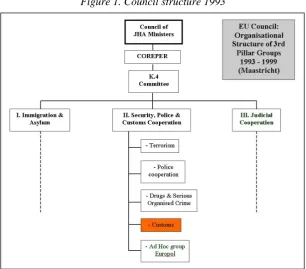
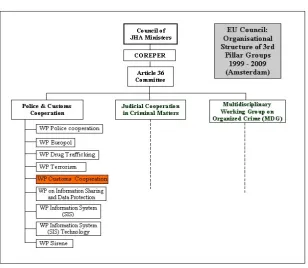
[image:11.595.144.451.447.716.2]Customs cooperation appeared generally isolated in the new Council structure: be it under the K.4 Coordinating Committee (Maastricht Treaty, 1993–99) or under the Article 36 Committee (CATS) (Amsterdam Treaty, 1999–2009), the customs forum represented an exotic element among all the police/counter-terrorism/organised crime groups in its immediate neighbourhood. As one can see from Figures 1 and 2, customs was one of five groups under the K.4 Steering Group II of the post-1993 situation and one of nine working parties within the Police and Customs Cooperation hierarchy under CATS after 1999.
Figure 1. Council structure 1993
Source:Author’s compilation based on contemporary Council organigrammes.
31
Figure 2. Council structure 1999
Source:Author’s compilation based on contemporary Council organigrammes.
Customs matters – despite the productivity of the Customs Cooperation Working Party (CCWP) – rarely made it to the Council of Ministers and if they did, ministers hardly took note of them.32 This is no surprise, given that home ministers rather look at police as their ‘constituency’ while ministers of finance are far away in other Council configurations.
This unfortunate situation was complemented by a no less peculiar structure at the Commission level. During the 1999 restructuring of Commission services, it was deemed appropriate to pool all third pillar competences under the new DG Justice & Home Affairs (DG JAI, later Justice, Liberty and Security).33 The transfer of Article 29 TEU functions and corresponding staff to DG JAI may have been facilitated by the fact that preventive/investigative functions under Regulation (EC) No. 1468/81 (later No. 515/97) had already been ceded from DG TAXUD to the predecessor of the European Anti-Fraud Office (OLAF).
Still, the scattering of customs functions among three services proved to be problematic. While the dividing line between TAXUD and OLAF (policy vs. operational matters) was easily comprehensible, the new ‘customs cell’ within DG JAI remained isolated within the law enforcement and security environment. This isolation was reinforced when the initial host of the customs cell (Police and Customs Cooperation Unit), became redeployed to ‘Organised Crime’, and later the ‘Fight against Terrorism’. From a substance point of view, it is noted that the third pillar customs cooperation – which intrinsically represents “police cooperation between customs authorities”34 – only has the infringement element in common with the JHA security environment, whereas all the other case specifics stem from a normal day-to-day customs
32
Interview with Council SG on 19 January 2011.
33
Decision taken in September 1999.
34
terrain.35 The split-up of customs tasks has thus been seen critically from the very beginning as an “artificial and outdated…dividing line”.36
Even the Commission recognised in its 2004 Communication on Enhancing Police and Customs Cooperation in the EU37 that “[u]nlike in the case of police co-operation, there is an important first-pillar element in customs co-operation”. But so far nothing has changed.
In early 2011, more than a year after the entry into force of the Lisbon Treaty, the Council CCWP quite demonstratively continued to work in traditional third pillar fashion, i.e. without taking note of the new involvement of the EP in security matters, and in strict seclusion from the regulatory customs for a.38 It operates with approximately 10-12 meetings per year, planning inter alia joint operations with FRONTEX.39 While the future of central JHA fora like CATS is still uncertain, CCWP is not on the list of Council bodies whose ‘necessity’ is to be re-evaluated by COREPER before 1 January 2012.40
Although member state representatives on the CCWP (mainly from national customs investigation services) seem to appreciate the independence of mainstream customs policy, they remain sceptical towards the wider context. Just as before with K.4 and CATS, they now feel marginalised in the new Standing Committee on Operational Cooperation on Internal Security (COSI),41 which has been set up to facilitate and monitor operational cooperation in EU internal security.
And when the question comes up of identifying a body that could assume the coordination of national customs services as a counterpart to FRONTEX, CCWP appears to be a serious choice for some.42 We return to this issue later.
3. Customs and its current status: an assessment of capacities
As we have seen, customs as trade control and facilitation specialists have gone through a number of challenges since the early days of the customs union, whereby they could prove their versatility and ability to adjust to new horizons repeatedly. Abolishing internal frontiers to build up a larger territory with a new common borderline, reconciling the objectives of fraud control with those of trade enhancement and switching from collecting revenues to enforcing complex prohibitions and restrictions appears an impressive list of achievements. These achievements offer some guarantees that such a versatile administration will also be a dynamic and valuable partner to those who look at the external border from a movement-of-persons point of view.
3.1 The
assets
Besides achievements already recognised, a number of lesser-known accomplishments might still be added to the record. For example, under the keyword ‘versatility’ one might end up with
35
This close link was emphasised even by CCWP in its “Draft strategy for customs cooperation in the Third Pillar”, adopted on 4 November 2009 – see Council of the European Union, Customs Cooperation Working Party (2009), p. 2.
36
Ravillard (1994), p. 221.
37
European Commission (2004a), p. 31.
38
As expressed by the programmatic title of its current strategic basis “Strategy for customs cooperation in the Third Pillar”, Council of the European Union (2009).
39
Interview with Council SG on 19 January 2011.
40
Council of the European Union (2010), p. 9.
41
Created on 27 November 2009 on the basis of Art. 71 TFEU.
42
an endless enumeration of situations in which trade control expertise helped to counter high-risk situations even under political or peacekeeping perspectives. Here we just refer to the UN embargo against Serbia and Montenegro in the 1990s, when the centrepiece of the operation, the Sanctions Assistance Missions Communications Centre (SAMCOMM) was provided by the customs DG of the European Commission.43
3.1.1 Operational
field
Occasionally some doubts emerge as to operational capacities that appear crucial for a successful exercise of border control and surveillance tasks.
However, the physical examination of goods is indeed a standard act that customs is by all means entitled to carry out: it is part of the customs controls in the sense of the current44 as well as the future Customs Code.45 Another question is to what extent the right to conduct such a search is actually exercised. Modern customs – in their concern to dispose of scarce resources in a responsible and targeted manner – strongly support risk management procedures; as a consequence, searches, examinations and so forth are applied according to the risk level attributed to the consignment in question. A 100% rate of controls as sometimes advocated by border guards with regard to persons is by no means a target for customs administrations.46 A further issue concerns the place and time of control: according to external observers, customs appears to conduct controls/examinations inland at the end of a transit movement rather than stopping it before the actual entry into the territory. Here again it appears to be a question of risk assessment, as expressed finally yet importantly by the distinction between safety and security concerns. In the case of security, i.e. an immediate threat against persons, customs will intervene directly at the border while in purely revenue or safety (e.g. IPR violation) cases, it may be acceptable to conduct the control (if any) solely at the destination.47
Some misunderstandings also exist regarding any further unexpected powers available to customs in at least certain member states: a tool highly appreciated by practitioners is that of stop and search without reasonable suspicion, as granted to customs in Germany, within a border zone of 30 km (land border) and 50 km (maritime border).48 This power turned out to be a very attractive reason for police forces to seek closer cooperation.49
Some customs authorities are experienced in carrying out border guard functions on the basis of a “mutual conferral of public authority” as established between German customs and Federal Police.50 The mutual conferral has practical importance in situations in which one of the two administrations is not represented, e.g. in small maritime harbours (ports, marinas and piers) that control police and customs on the basis of joint risk analysis.51
43
United Nations Security Council (1996), p. 7.
44
Regulation (EEC) No. 2913/92.
45
See Regulation (EC) No. 450/2008, to enter into force by 2013; see also WCO (2007), p. 6.
46
Interview of 11 February 2011 with Mark Fuchter of UKBA, formerly of UK Customs, on different control approaches applied/required in customs and border guard environments.
47
Interview of 18 January 2011 with Tomas Kucirek and colleagues of DG TAXUD.
48
See § 10 ZollVG.
49
Interview of 25 January 2011 with Rick Weijermans, deployed to FRONTEX from the Dutch Marechaussee, which exercises border police functions in the Netherlands.
50
Based on §66-68 Bundespolizeigesetz (Federal Police Act) and §1(3)(b) Zollverwaltungsgesetz (Customs Management Act).
51
Another less-known feature is the presence of customs on the blue52 and green borders,53 to exercise surveillance on the stretches of border between official border-crossing points (BCPs). In the old days of the customs union, the coverage of these sections of the borders (internal as well as external) was one of the key tasks for discouraging the smuggling of coffee, cigarettes and butter. Practically all member states entertained special surveillance forces that were uniformed and armed to patrol such borders day and night, i.e. surveillance units (such as the
Zollgrenzkommissariate in Germany) and a customs coast/river fleet. These services disappeared from the internal EU borders only in 1993 when customs controls among the member states were definitely abandoned.
At present, the role of customs seems to have greatly diminished even at the external borders: in most cases, it is now border guards/border police who ensure the patrolling and surveillance of the border outside BCPs,54 where they are entitled by special delegation to carry out customs controls. In other cases (e.g. Poland), customs participate in joint patrols, with border guards taking the lead and ensuring the security and support of customs.55 Only Finland and Germany still entertain fully independent customs patrol/mobile unit services56 that carry out border patrols on their own or as a joint/coordinated measure together with border guards.
Risk management mechanisms are nowadays considered to be the most valuable tool to target scarce staff and equipment resources at the highest security threats, no matter whether this concerns persons or goods. Customs, under the lead of the WCO57 and in the framework of the 2005 security amendment58 established a refined system to identify and address high-level security risks. It may be seen as a process cycle allowing the system to permanently adapt to a changing risk landscape.59 Embedded within the customs security approach and interlinked with other players at the international level (in particular the US),60 it certainly represents a state-of-the-art solution in freight-related security matters.
3.1.2 Political
landscape
Besides its renowned technical capacities, the call for customs to maintain its current involvement in EU border management or even extend it also relies on other qualifications. Customs was part of the ‘construction team’ that laid the foundations of the EU in its current shape. Beyond this recognition as a pioneer of European integration, customs has been able to gain valuable experience in enacting Community policies over more than 40 years after the completion of the customs union, and more than 50 years since the Treaty of Rome.
This close relationship with the economic development of the EU has paid off not just in terms of acquaintance with the Community way of developing/implementing law; it has also meant adapting to a more civilian way of dealing with the ‘customer’. Over time, the role has changed from a sovereign tax collector to that of a partner in trade and business. Starting from the 1980s, when for the first time a national customs administration saw its vocation as that of
52
‘Blue’ refers to water borders, at internal as well as maritime waters.
53
‘Green’ refers to inland borders between border-crossing points.
54
See CSD (2010), p. 67f.
55
Ibid., p. 373f.
56
Ibid., p. 67f, 223f, 266f.
57
See WCO, Risk Management Guide (2003); see also WCO (2008), p. 7.
58
See section 3.2.3 above.
59
See European Commission (2004b), Standardised Framework for Risk Management in the Customs Administrations of the EU, p. 4.
60
“enhancement of business”,61 the facilitation aspect has become a standard element of customs policy, as is formally recognised by the new EU Customs Code.62 And despite all the progress made in past years, border guards/border police have nothing equivalent to offer on their side. So it is not surprising that critics of the Schengen external border and the way it has been managed have turned their eyes to customs in the hope that a customs-influenced form of IBM could achieve a more “civilian” format, i.e. be clearly marked by the respect of civil liberties and etiquettes.
This approach partially coincided with the proposal for a new set-up of European border services consisting of a first-line inspection carried out by non-enforcement officials – e.g. “European civil servants (category – border controls)” whose main competences would be the full and uniform application of the Schengen rules on border checks – and secondary inspections carried out by enforcement specialists to which travellers would be referred in case of suspected irregularity.63
A second positive feature frequently attributed to customs is the achievement of genuinely European legislation, which is identical for the entire territory not merely on paper but in practice, due to a rigid system of compliance control. The absence of such uniformity is greatly regretted for the Schengen area, where the compliance target has not been met thanks to the lesser efficiency of Schengen evaluation and peer review, and where heterogeneity and patchwork structures remain the norm.
It is exactly this objective of achieving a higher coherence in border protection that motivated the Busuttil report64 in the framework of the current revision of the FRONTEX mandate to replace the Joint Support Teams and Rapid Border Intervention Teams as proposed by the Commission by an EU system of border guards (EBS) in the sense of a permanent pool. Besides practicalities, the advantage of this solution would be the clearer European identity it provides. A close relationship between customs and the proposed EBS in the framework of a European IBM system could certainly enhance this idea.65
With full respect to the well-deserved merits of the European customs administrations, one should remain sceptical towards too idealistic an image and alert to possible deficits.
3.2 Possible
deficits
With all the merits and achievements accumulated over the years, customs may appear as the model EU administration, with full regulatory command over its areas of competence – and an ideal partner for border guard organisations to enter into cooperation through integrated or coordinated border management. Doubts nonetheless arise in several areas, as discussed below.
3.2.1 EU customs territory – Diverging area, diverging borderlines
With EU accession member states automatically become part of the customs union, whilst there is no automatism regarding Schengen. Some members did not want to join (the UK and
61
See Hobbing (2005), p. 9.
62
See Recital (5) of MCC, Regulation (EC) No. 450/2008.
63
For details on this approach, see Carrera (2010), p. 28.
64
European Parliament (2010b), p. 53.
65
Ireland), others were not admitted (Bulgaria and Romania),66 while non-member states such as Norway, Iceland and Switzerland only became part of Schengen. As a consequence, there is considerable divergence between the two territories and their borderlines. One definitely needs to distinguish between a border that is relevant for customs purposes and another for passport controls.
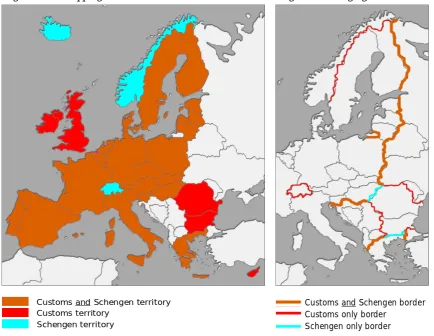
Figures 3 and 4 document the split geography for customs and border guards in terms of border location as well as actual border length.67 For reasons of transparency, the comparison is confined to land borders.
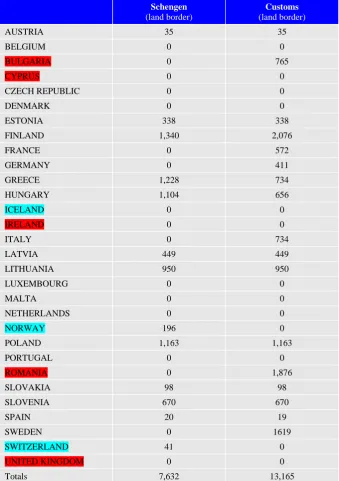
[image:17.595.82.517.320.656.2]At first sight, the much greater length of the customs border (13,165 kms vs. 7,632 kms, see Table 1) may appear striking. But it can be easily explained by the long borders of Bulgaria and Romania (which are EU external borders only in terms of customs) and by the fact that while Switzerland and Norway are Schengen members they remain outside the customs territory. Nevertheless, with respect to security/smuggling risks, the borders between Sweden and Norway and those between Switzerland and the neighbouring EU members are less important.
Figure 3. Overlapping territories Figure 4. Diverging borderlines
Source: Author’s compilation. Source: Author’s compilation.
66
Bulgaria’s and Romania’s full integration into the Schengen area, originally foreseen for March 2011 has been postponed indefinitely because of remaining problems regarding corruption and organised crime.
67
For a concise overview of the territory situation, see the articles on “Customs territory”
(http://ec.europa.eu/taxation_customs/common/faq/faq_1178_en.htm#2) and “Schengen”
(http://en.wikipedia.org/wiki/Schengen_Area).
Customs and Schengen territory Customs territory
Schengen territory
Customs and Schengen border Customs only border
This limited congruency of borderlines, in which not even 40% of their length is subject to both customs and border guard controls, might point to a limited added value of increased cooperation between the services. Given the reduced security importance of some of the customs-only borders, however, along with the probability that Bulgaria and Romania’s borders will soon represent the Schengen external border, one should see this situation as temporary. Most of the real hotspots on the eastern land border are already simultaneously covered by both administrations.
Table 1. The border contrast in kilometres (kms of border length)
Schengen
(land border)
Customs
(land border)
AUSTRIA 35 35
BELGIUM 0 0
BULGARIA 0 765
CYPRUS 0 0
CZECH REPUBLIC 0 0
DENMARK 0 0
ESTONIA 338 338
FINLAND 1,340 2,076
FRANCE 0 572
GERMANY 0 411
GREECE 1,228 734
HUNGARY 1,104 656
ICELAND 0 0
IRELAND 0 0
ITALY 0 734
LATVIA 449 449
LITHUANIA 950 950
LUXEMBOURG 0 0
MALTA 0 0
NETHERLANDS 0 0
NORWAY 196 0
POLAND 1,163 1,163
PORTUGAL 0 0
ROMANIA 0 1,876
SLOVAKIA 98 98
SLOVENIA 670 670
SPAIN 20 19
SWEDEN 0 1619
SWITZERLAND 41 0
UNITED KINGDOM 0 0
Totals 7,632 13,165
3.2.2 Uniform
application of the law
For a traditional Community/first-pillar administration, it would appear normal if the application of legislation was aligned to the greatest extent possible. Unfortunately such a consideration is not automatically valid for structures like the EU, where centralised legislative competences are paired with decentralised competences at the implementation level, as stipulated by the conferral principle (Art. 5(2) TEU) in conjunction with the obligation of member states to implement legally binding Union acts (Art. 291(5) TFEU).
The patchwork situation of 27 national infrastructures applying EU law in their own way, as we know from the Schengen context, thus also exists in the customs field – at least to a certain degree. Of course, there is the formal EU infringement procedure (Art. 258 TFEU, formerly Art. 226 TEC), but this artillery proves to be too heavy to address daily compliance issues.
As a consequence, the EU was confronted in 2004 with a US complaint before the World Trade Organisation, claiming that its customs union i) failed to administer the uniform application of EU customs law by the 25 national administrations, thus infringing Art. X.3(a) GATT 1994, and ii) did not promptly review and take corrective administrative action as required by Art X.3(b).68 From then on the ‘uniform application’ of customs legislation, in particular the Community Customs Code, has become a key phrase for any further development. Already the Modernised Customs Code of 2008 installed uniformity of application as a major principle of customs operation, as evidenced by its mention in very prominent places, i.e. Recital 5 as well as Art. 1(1) MCC. In addition, the Customs 2013 Programme requires coherence in the sense that “controls are implemented effectively at every point of the Community customs territory”.69 And finally the 2013 Action Programme sketched out the overarching aim that “national customs administrations should operate as efficiently and effectively and react to any requirement arising from a changing customs environment as would one single administration”.70
In terms of practical solutions, the customs union seems to rely on the e-border mechanisms of the new customs code (MCC), i.e. in that individual decisions by national customs may be monitored by the central level and thus a certain coherence can be achieved.71
3.2.3 The vexed question of penalties
So far, despite customs legislation being an exclusive EU competence,72 its enforcement represents an exclusive function of the member states.73 Considerable differences among the member states in terms of (administrative and criminal) penalties have been found to lead to regrettable distortions of competition in the internal market, which the European Court of Justice has consistently qualified as equivalent to illegal quantitative restrictions among the member states (Art. 28 TEC, now Art. 34 TFEU).74
68
Cf. Anaboli (2010), p. 391 and the Rapid Press Release IP/06/1557 of 14 November 2006 (http://europa.eu/rapid/pressReleasesAction.do?reference=IP/06/1557&format=HTML&aged=0&languag e=en&guiLanguage=en).
69
European Commission (2005), p. 6.
70
Decision No. 624/2007/EC, Recital 2.
71
Arts. 1, 2(1)(b) MCC.
72
Art. 3(1)(a) TFEU.
73
See Anaboli (2010), p. 389.
74
In light of the traditional importance member states attribute to their criminal law as an intrinsic part of their national sovereignty and identity, previous harmonisation attempts by the Commission in the 1980s and 1990s failed.75 But with the new approaches in terms of compliance and uniform application (see section 4.2.2 above), DG TAXUD is currently making another effort to resolve the issue.
At first sight, the situation appears favourable: under the Lisbon Treaty, the approximation of criminal laws is possible in the sense of establishing minimum rules in areas of harmonised legislation, such as the Customs Union (Art. 83(2) TFEU). A necessary precondition is that this approximation appears “essential to ensure the effective implementation” of the Union policy in question. To formally establish the “essential necessity” of the envisaged measure, the Commission has commissioned a study on the penalties situation in the member states for which the results are expected in 2011.
Given the uncertain outcome of the study and the disadvantages of approximation (lengthy implementation process by means of a directive), another option is being considered. If the objective could be reached by means of administrative penalties, the prospects would appear much brighter: this approach could envisage full harmonisation of such sanctions, and also take advantage of directly applicable legislation. However, some member states make no distinction between criminal and administrative penalties which might bring DG TAXUD back to the approximation of criminal law as the only applicable solution.
3.2.4 Less funding for training and equipment
In the heyday of the Single Market movement of the early 1990s, plenty of resources were available to support integration. A retrospective 1998 Commission report stressed that
it became apparent that administrative cooperation between the Member States needed to be strengthened in all the areas in which discrepancies in the implementation of Community law might give rise to malfunctions in the management of the internal market…[and that] customs was considered a priority sector from the outset.76
Following the first pilot project in 1989, the Matthaeus programme was officially launched in 1991 to provide “common training schemes to ensure that Community law … was applied uniformly and to encourage customs officers to become more aware of the Community dimension of their duties”77 (emphasis added). Over the years, a large number of events – seminars, staff exchanges and monitoring operations – were held, through which Matthaeus obtained practically the same popularity among customs officials as the later Erasmus initiative did among university students. Towards the end of the 1990s, Matthaeus was incorporated into the Customs 2000 programme, which in turn was absorbed by Customs 2003, Customs 2007 and now Customs 2013.
It seems that with this absorption into programmes with a wider remit, the Matthaeus idea had lost its raison d’être; the purpose of the common management of the external border seemed accomplished and no more specific effort was needed. This was also evidenced by the rather limited resources now allocated to customs for these purposes. For the entire period 2007–13, Customs 2013 foresees no more than €11.4 million,78 i.e. less than €2 million per year for common training purposes, whereas during Matthaeus times the training budget (apparently)
75
See Anaboli (2010), p. 390.
76
European Commission (1998), p. 2.
77
Ibid., p. 3.
78
amounted to 20 million ECU per year.79 One should also take into account that other items, for instance the “security aspects of customs policy” (€38.7 million), also serve to improve the coherence of external border management.
Nevertheless, these budgets by no means match those available for the external border for other Schengen aspects: FRONTEX alone spends between €5.8 and €7.2 million per year on border-related training.80 In addition, there is the extensive aid granted by the external borders fund as a “financial solidarity mechanism to support the states [that] endure, for the benefit of the Community, a lasting and heavy financial burden arising from the implementation of common standards on control and surveillance of external borders and visa policy”.81 The sum €1,533 million is distributed among the states in question on the basis of objective criteria expressing the burden of each state for external border control and visa policy.
3.2.5 Political
support
Attentive political observers are familiar with the sight: whenever security incidents such as the recent Yemen air freight bomb plot occur, it is the minister of the interior or home minister responsible for border guards and police who stands up first and informs the media even though freight control is primarily a customs matter.82 Ministers of finance, to whose portfolio customs normally belongs, are less eager to address the public in such matters, as they gain their reputation from policy fields other than security. It therefore turns out to be a tactical disadvantage for customs that ‘their’ minister usually prefers other policy issues, such as budget and taxes, through which s/he wants to shine and impress the public. Security is just a secondary field in this regard.
3.2.6 Customs coordination – A currently vacant function
In a way, the current state of customs and its role on the external border is like a ship without a captain. What we see is 27 national administrations present at the border and (loosely connected) various bodies at the central level, none of which has full control of what is going on on-site. Until the early 1990s, the Commission through its customs service (initially the Service de l’Union douanière/Customs Union Service, from 1986 DG XXI and now DG TAXUD) was in charge of everything: customs legislation, efforts to combat fraud and Commission assistance to customs cooperation in the intergovernmental field (Naples Convention). Obviously, it also represented one of the main actors in the completion of the Single Market.
Since then customs has split into three distinct segments, i.e. i) DG TAXUD in charge of general customs legislation; ii) the Anti-Fraud Office OLAF taking care of the administrative prevention/investigation of infringements of the customs regulation since 1995; and iii) the CCWP, responsible for cooperation regarding the prosecution and punishment of infringements. This situation has additionally been burdened by a new Council configuration in place since 2002, whereby customs legislation has partially been dealt with by trade and industry ministers within the Competitiveness Council rather than by finance ministers in ECOFIN.83 And it
79
See European Commission (1998), p. 15.
80
FRONTEX (2010), p. 11.
81
European Commission (2011b).
82
See e.g. the Reuters news article “Freight stopped from Yemen after bomb scare – Germany”, Reuters.com, 31 October 2010 (http://in.reuters.com/article/2010/10/31/idINIndia-52573720101031).
83
should not be forgotten that the former third pillar CCWP continues to report to ministers of justice and home affairs.84 This is certainly not a coherent solution!
As a consequence, customs interests have not been pursued in a systematic manner, as before, and have been unable to match the dynamic approach displayed by the Schengen side in its coherently structured coordination between DG HOME, FRONTEX and the Council hierarchy under the JHA ministers.
So for customs to resume its former role, some important structural changes need to take place to allow for a holistic approach, combining customs’ various assets under trade and security aspects. We look into this in section 4.
4. Integrated vs. coordinated border management: finding the right
concept/place for customs
Before 2001, ‘integration’ was an unknown term in inter-service relations on borders still widely dominated by jealousy and esprit de corps thinking. The change came with the events of 9/11 when unity and the ultimate pooling of resources were suddenly in demand to build up strong defences against terrorism. Quite naturally, the US was the first to take concrete action: by 19 September 2001 all border-related agencies including customs became part of the Terrorist Response Task Force85 before they were merged in March 2003 into the new US CBP within the Department of Homeland Security.
The EU reacted soon afterwards: in December 2001, the Laeken European Council in its famous border management conclusion prescribed similar treatment for the border agencies, for which the range of solutions considered (“a mechanism or common services to control external borders”)86 even included the option of a US-style merger. Subsequently, however, the ambitious beginnings were somewhat watered down when encountering the still unfavourable Union reality.
While the 2002 Commission Communication, Towards Integrated Management,87 still covered all options (e.g. the creation of a European Corps of Border Guards,88 full participation by regulatory administrations such as customs and even plant health and similar services),89 later concepts like the definition by JHA ministers of December 2006 diminished the initial optimism. A more modest approach emerged, unilaterally focusing on the movement of persons and the involvement of police authorities.90 Most recent statements, including the Stockholm
84
Ibid. p. 9.
85
US CBP, “History Time Line” (http://nemo.customs.gov/opa/TimeLine_062409.swf).
86
European Council (2001), No. 42: “… The European Council asks the Council and the Commission to work out arrangements for cooperation between services responsible for external border control and to examine the conditions in which a mechanism or common services to control external borders could be created.”
87
See European Commission (2002) and, as regards customs, (2003, p. 39ff).
88
European Commission (2002), p. 12.
89
Ibid., pp. 9, 16.
90
Council of the European Union (2006), p. 26. “Integrated border management is a concept consisting of the following dimensions:
• Border control (checks and surveillance) as defined in the Schengen Borders Code, including relevant risk analysis and crime intelligence
• Detection and investigation of cross border crime in coordination with all competent law enforcement authorities
Programme of 200991 and the Internal Security Strategy of 2010,92 further strengthen the impression that integrated border management mainly deals with law enforcement and combating crime.
Although the downsized EU approach may be disappointing and divergent from international standards, the self-imposed limitation appears understandable in the EU context with its patchwork of 27 members and innumerable services involved in border matters. Even where limited to the police/border-guard side, such action may be considered an enormous integrative effort and accomplishment.
And yet, for the purposes of clarity it is indispensable to look closely at the intrinsic elements of integrated border management in order to determine which of the various approaches operating under this denomination really deserve the label. From an etymological point of view (where integrate means “combine or be combined to form a whole”)93 we do not gain absolute clarity, as this definition would apply to mergers as well as firmly structured networks; it would also not exclude partial solutions entailing just some of the services competent in border matters. Another clue could come, however, from the initial statement that IBM serves the ultimate objective of pooling resources in terms of staff, expertise and equipment to make the operation of borders more efficient in achieving their intended purposes.
4.1 Existing IBM models – An evaluation
In view of the ultimate pooling criterion, a satisfactory evaluation of the various IBM models at hand could take place along the lines of who participates, which border activities are affected and how the interaction between the services is structured (network or merger).
4.1.1 The ‘who’ element: Are all relevant services involved?
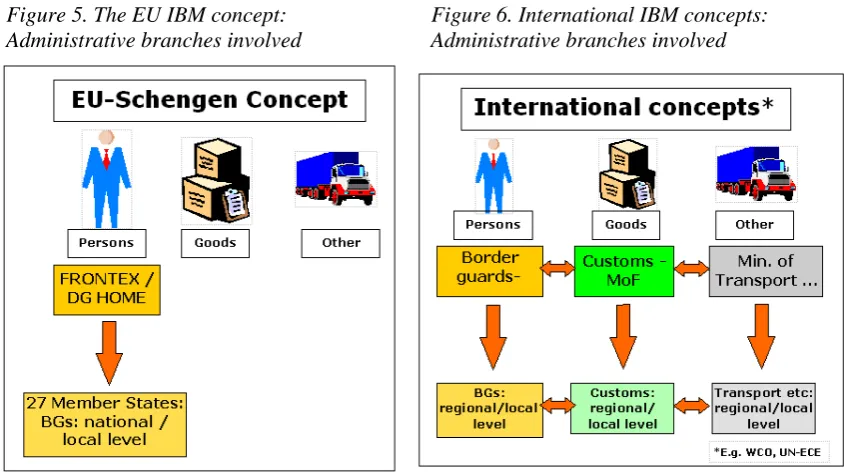
As a comparison of Figures 5 and 6 clearly indicates, the international concepts see their border purposes met through the most comprehensive inclusion of all services involved in border control, no matter whether their involvement is motivated by security or regulatory control. It is for this reason that the third column in the figures is just indicative: “other” could equally refer to agricultural, veterinary or traffic control authorities, which are actually quite frequently implied in one way or another in border controls.94
91
European Council (2009).
92
Council of the European Union (2010).
93
See the Concise Oxford English Dictionary, Oxford: Oxford University Press, 2008 (http://www.wordreference.com/definition/integrate).
94
Figure 5. The EU IBM concept: Figure 6. International IBM concepts: Administrative branches involved Administrative branches involved
Source: Author’s compilation. Source: Author’s compilation.
Another important element is to be found in the bi-dimensional orientation of coordination links. Unlike the purely vertical approach of the EU Schengen model (coordination only between FRONTEX/DG HOME and the member state authorities at the national/local levels, but not between the Schengen hierarchy and its respective counterparts within customs), the international approach incorporates links between the hierarchies at all levels. It should be stressed that except for the EU Schengen zone, the wider international approach is preferred everywhere else in the world. Even international EU missions, such as EUBAM95 in Moldova and Ukraine, follow the international model, inter alia manifested by the fact that the head of the mission is a border guard officer and his deputy a customs official.96
Typically such links would be established – as long as there is no formal merger as in the case of the US CBP or the UK Border Agency (UKBA) – in the form of interagency working groups at the central EU and national levels (e.g. inter-ministerial working groups) with regular coordination meetings.97 At the local level, where the offices of border guards and customs are often side-by-side if not in the same building, the appropriate approach could be a jour-fixe
arrangement, by which the partner services exchange briefings at weekly meetings.98
If the EU Schengen model is characterised as a ‘no customs’ approach, it should nevertheless be noted that in practice certain horizontal links may exist at the national/local levels, but this is not part of the official strategy, at least to the extent that it goes beyond purely security matters.99 Horizontal links between border guards and customs can take multiple forms, such as i) cooperation procedures at border-crossing points and inland, including joint operations and controls; ii) joint training; and iii) the sharing of equipment and joint procurement.100
95
EUBAM refers to the European Union Border Assistance Mission to Moldova and Ukraine.
96
See the EUBAM website (http://www.eubam.org/en/about/structure).
97
Ibid., p. 64.
98
Ibid., p. 53.
99
4.1.2 The ‘what’ element: Does the coordination/integration cover all
relevant subjects, i.e. security and regulatory matters?
The one-dimensional approach favoured by the EU/Schengen is focused not only on one administrative branch (police and border guards) but also to a certain extent on a limited subject, i.e. security while neglecting facilitation.
This situation results from a combination of factors. On the one side, the legal instruments in question, i.e. the FRONTEX Regulation of 2004 and the 2006 Council definition of IBM, both use a neutral formula in which the scope of action is confined to regulatory action101 or comprises “border control…as defined by the Schengen Borders Code” and the “detection and investigation of cross-border crime”.102 On the other side, the more recent programme papers (the Stockholm Programme and the Internal Security Strategy) place IBM under the heading of “[a] Europe that protects” in the direct neighbourhood of the Internal Security Strategy, law enforcement, criminal justice and the new Council committee on internal security (COSI).103 It is no surprise that on the basis of such ambiguous texts, far-reaching misunderstandings arise that affect not just on the authorities concerned but also outside bodies engaged in evaluating the current state of border cooperation, as can be seen in the study on customs/border guard cooperation by the Center for the Study of Democracy (CSD). Such misconceptions may easily develop a momentum of their own, e.g. when they are used to explain the inefficiency of cooperation by the fact that FRONTEX lacks a partner agency at the EU level representing the “law enforcement aspects of MS’ customs”, as if FRONTEX’s vocation as well as that of border guard/customs cooperation was primarily seen in this field.104
4.1.3 Merger or coordination: ‘How’ should the relationship be
organised?
Although practised in just a handful of countries around the world,105 the option of merging border authorities into just one agency has heated up the debate for years and eventually led to a change of label for all those solutions that did not include such a merger. Especially in the terminology of WCO,106 such approaches were subsequently called ‘coordinated border management’ (CBM) in order to provide for a clear distinction.107 At the EU level, the term ‘integrated border management’, introduced for customs purposes by the 2003 Communication on the Role of Customs,108 has been retained up to the present day. Only some member state customs administrations seem to prefer the CBM terminology.109
100
The EU IBM Guidelines contain many additional examples, cf. European Commission (2009).
101
Regulation (EC) No. 2007/2004.
102
Council of the European Union (2006).
103
Regarding the Stockholm Programme, see European Council (2009), pp. 36f; regarding the Internal Security Strategy, see Council of the European Union (2010), p. 2 and many other places throughout the document.
104
CSD (2010), p. 86. Similar passages are found in other places of the study.
105
Statement by WCO representative M. Polner at the Workshop “The Future of the EU’s Integrated Border Management Strategy”, held at CEPS, Brussels, 29 November 2010.
106
Interview meeting with WCO panel on 19 January 2011.
107
WCO (2009), p. 3.
108
European Commission (2003).
109