White Rose Research Online URL for this paper:
http://eprints.whiterose.ac.uk/150353/
Version: Published Version
Article:
Brini, A. orcid.org/0000-0002-3758-827X, Cavalieri, R. and Ross, D. (2019) Crepant
resolutions and open strings. Journal für die reine und angewandte Mathematik (Crelles
Journal), 2019 (755). pp. 191-245. ISSN 0075-4102
https://doi.org/10.1515/crelle-2017-0011
© 2017 de Gruyter. Reproduced in accordance with the publisher's self-archiving policy.
[email protected] https://eprints.whiterose.ac.uk/
Reuse
Items deposited in White Rose Research Online are protected by copyright, with all rights reserved unless indicated otherwise. They may be downloaded and/or printed for private study, or other acts as permitted by national copyright laws. The publisher or other rights holders may allow further reproduction and re-use of the full text version. This is indicated by the licence information on the White Rose Research Online record for the item.
Takedown
If you consider content in White Rose Research Online to be in breach of UK law, please notify us by
Crepant resolutions and open strings
ByAndrea Briniat Montpellier,Renzo Cavalieriat Fort Collins andDustin Rossat Ann Arbor
Abstract. In the present paper, we formulate a Crepant Resolution Correspondence for
open Gromov–Witten invariants (OCRC) of toric Lagrangian branes inside Calabi–Yau3 -orbi-folds by encoding the open theories into sections of Givental’s symplectic vector space. The correspondence can be phrased as the identification of these sections via a linear morphism of Givental spaces. We deduce from this a Bryan–Graber-type statement for disk invariants, which we extend to arbitrary topologies in the Hard Lefschetz case. Motivated by ideas of Iritani, Coates–Corti–Iritani–Tseng and Ruan, we furthermore propose (1) a general form of the morphism entering the OCRC, which arises from a geometric correspondence between equivariantK-groups, and (2) an all-genus version of the OCRC for Hard Lefschetz targets. We provide a complete proof of both statements in the case of minimal resolutions of threefold An-singularities; as a necessary step of the proof we establish the all-genus closed Crepant Resolution Conjecture with descendents in its strongest form for this class of examples. Our methods rely on a new description of the quantum D-modules underlying the equivariant Gromov–Witten theory of this family of targets.
Contents
1. Introduction
2. Gromov–Witten theory and crepant resolutions: Setup and conjectures 3. The open crepant resolution conjecture
4. OCRC forAn-resolutions
5. One-dimensional mirror symmetry 6. Quantization
A. Gromov–Witten theory background B. An-resolutions
C. Analytic continuation of LauricellaFD.N / References
1. Introduction
1.1. Summary of results. This paper proposes an approach to the Crepant Resolution
Conjecture for open Gromov–Witten invariants, and supports it with a series of results and verifications about threefoldAn-singularities and their resolutions.
LetZ be a smooth toric Calabi–Yau Deligne–Mumford stack of dimension three with generically trivial stabilizers and semi-projective coarse moduli space, and let L be an Aganagic–Vafa brane (Section 3.1.1). Fix a Calabi–Yau torus actionT on Z and denote by Z the free module overH.BT /spanned by theT-equivariant lifts of orbifold cohomology
classes of Chen–Ruan degree at most two. We define (Section 3.1) a family of elements of Givental space,
FL;diskZWHT.Z/!HZDHT.Z/..z 1//;
which we call thewinding neutral disk potential. Upon appropriate specializations of the
vari-ablez,FL;diskZencodes disk invariants of.Z; L/at any windingd.
Consider a crepant resolution diagram X!X Y, where X is the coarse moduli space ofX andY is a crepant resolution of the singularities of X. A Lagrangian boundary conditionLis chosen onXand we denote byL0its transform inY. Our version of the open crepant resolution conjecture is a comparison of the (restricted) winding neutral disk potentials.
Proposal 1 (The OCRC). There exists a C..z 1//-linear map of Givental spaces
OWHX !HY and analytic functionshXWX !C,hY WY !Csuch that
h 1 z YFL;Ydisk
ˇ
ˇY Dh 1 z
XOıF
disk L;X
ˇ ˇ
X
upon analytic continuation of quantum cohomology parameters.
Further, we conjecture (Conjecture 3.5) that both O andh are completely determined
by the classical toric geometry ofX andY. In particular, we give a prediction for the transfor-mationOdepending on a choice of identification of theK-theory lattices ofXandY.
When X is a Hard Lefschetz Calabi–Yau orbifold, the OCRC comparison extends to all ofHT.Z/. This, together with ideas of Coates–Iritani–Tseng and Ruan (Conjecture 2.4), motivates a comparison for potentials encoding invariants of maps with arbitrary topology.
Proposal 2(The quantum OCRC). LetX!X Y be a Hard Lefschetz diagram for which the OCRC holds. DefiningO˝` DO.z1/˝ ˝O.z`/, we have
FLg;`0;Y DO
˝`
ıFL;g;`X;
where the winding neutral open potentialFg;` is the genus-g,`-boundary components analog ofFdiskdefined in Section 3.3.
Consider now the family of threefold An singularities, where X D ŒC2=ZnC1C andY is its canonical minimal resolution.
Our verification of the OCRC and Conjecture 3.5 in this family of examples follow from Proposition 3.6 and Theorem 4.1. The quantum OCRC is a consequence of the closed string quantum CRC in its strongest version (Conjecture 2.4, Theorem 6.1), which we establish in Section 6. From this, we deduce a series of comparisons of more classical generating functions for open invariants, in the spirit of Bryan–Graber’s formulation of the CRC.
In Section 3.2 we define thecohomological disk potentialFdisk
L – a cohomology-valued generating function for disk invariants that “remembers” the twisting and the attaching fixed point of an orbimap. We also consider the coarserscalar potential(see Section 3.1.1), which
keeps track of the winding of the orbimaps but forgets the twisting and attaching point. There are essentially two different choices for the Lagrangian boundary condition onX; the simpler case occurs whenLintersects one of the effective legs of the orbifold. In this case we have the following result.
Theorem 4.4(Effective leg). Identifying the winding parameters and setting
OZ.1k/DPnC1
for everyk, we have
FLdisk0;Y.t; y;w/E DOZıFL;diskX.t; y;w/:E
It is immediate to observe that the scalar potentials coincide (Corollary 4.5). The case whenLintersects the ineffective leg of the orbifold is more subtle.
Theorem 4.2(Ineffective leg). We exhibit a matrixOZof roots of unity and a special-ization of the winding parameters depending on the equivariant weights such that
Fdisk
L0;Y.t; y;w/E DOZıFL;diskX.t; y;w/:E
The comparison of scalar potentials in this case does not hold anymore. Because of the special form of the matrixOZ we deduce in Corollary 4.3 that the scalar disk potential for Y corresponds to the contribution to the potential for X by the untwisted disk maps. Our proof of the quantum CRC makes it an exercise in book-keeping to extend the statements of Theorems 4.2 and 4.4 to compare generating functions for open invariants with arbitrary genus and number of boundary components, even treating all boundary Lagrangian conditions at the same time. The main tool used in the proof of our main theorem is a new global description of the gravitational quantum cohomology of theAn geometries, which enjoys a number of remarkable features, and may have an independent interest per se.
Theorem 5.4. By identifying the A-model moduli space with a genus-zero double Hurwitz space, we construct a global quantum D-module .F;; TF;;r.g;z/; H .;/g/ which is locally isomorphic toQDM.X/ andQDM.Y /in appropriate neighborhoods of the
orbifold and large complex structure points.
1.2. Context, motivation and further discussion. Open Gromov–Witten (GW) theory
additional structure. In [19, 21] Lagrangian Floer theory is employed to study the case when the boundary condition is a fiber of the moment map. In the toric context, a mathematical approach [13, 32, 54, 69] to construct operatively a virtual counting theory of open maps is via the use of localization.1)A variety of striking relations have been verified connecting open GW theory and several other types of invariants, including open B-model invariants and matrix models [3, 4, 8, 40, 60], quantum knot invariants [47, 63], and ordinary Gromov–Witten and Donaldson–Thomas theory via “gluing along the boundary” [2, 61, 64].
Since Ruan’s influential conjecture [70], an intensely studied problem in Gromov–Witten theory has been to determine the relation between GW invariants of target spaces related by a crepant birational transformation (CRC). The most general formulation of the CRC is framed in terms of Givental formalism ([28]; see also [29] for an expository account); the conjecture has been proved in a number of examples [23, 24, 28] and has by now gained folklore status, with a general proof in the toric setting announced for some time [25, 27]. A natural question one can ask is whether similar relations exist in the context of open Gromov–Witten theory. Within the toric realm, physics arguments based on open mirror symmetry [8,9,15] have given strong indications that some version of the Bryan–Graber [17] statement of the crepant res-olution conjecture should hold at the level of open invariants. This was proven explicitly for the crepant resolution of the Calabi–Yau orbifoldŒC3=Z2in [18]. Around the same time, it was suggested [10, 11] that a general statement of a Crepant Resolution Conjecture for open invariants should have a natural formulation within Givental’s formalism, as in [24, 28]. Some implications of this philosophy were verified in [11] for the crepant resolutionOP2. 3/of the orbifoldŒC3=Z3.
The OCRC we propose here is a natural extension to open Gromov–Witten theory of the Coates–Iritani–Tseng approach [28] to Ruan’s conjecture. The observation that the disk function of [13,69] can be interpreted as an endomorphism of Givental space makes the OCRC statement follow almost tautologically from the Coates–Iritani–Tseng/Ruan picture of the ordi-nary CRC via toric mirror symmetry [28]. The more striking aspect of our conjecture is then that the linear functionOcomparing the winding neutral disk potentials is considerably simpler
than the symplectomorphismUX;Y in the closed CRC and it is characterized in terms ofpurely
classical data: essentially, the equivariant Chern characters of X and Y. This is intimately related to Iritani’s equation (2.4) that the analytic continuation for the flat sections of the global quantumD-module is realized via the composition ofK-theoretic central charges. While Iritani works non-equivariantly on proper targets, his constructions carry through to the equivariant setting, and inspire us to make Conjecture 3.5. We point out that our results do not rely on the validity of Iritani’s proposal, but rather support the fact that an equivariant version of his proposal should hold.
Iritani’s theory is inspired and consistent with the idea of global mirror symmetry, i.e. that there exists a global quantumD-module on the A-model moduli space which locally agrees with the Frobenius structure given by quantum cohomology. In order to verify his proposal in the equivariant setting relevant for this paper, we give a new construction of this global structure: motivated by the connection of the Gromov–Witten theory ofAn-surface singular-ities to certain integrable systems of Toda type [12], we realize the globalA-model quantum D-module as a system of one-dimensional Euler–Pochhammer hypergeometric periods. This
1) Alternatively, open string invariants in the manifold case can be defined using relative stable
mirror picture possesses several remarkable properties which enable us to verify in detail our proposals for the open CRC, as well as proving along the way various results of indepen-dent interest on Ruan’s conjecture as well as its refinements (Iritani, Coates–Iritani–Tseng) and extensions (the higher genus CRC). First off, the computation of the analytic continuation of flat sections is significantly simplified with respect to the standard toric mirror symmetry meth-ods based on the Mellin–Barnes integral: in particular, the Hurwitz space picture gives closed-form expressions for the analytic continuation of flat sections upon crossing a parametrically large number of walls. A useful consequence for us is Theorem 4.1, which furnishes an explicit form for the morphismUX;Y of Givental’s spaces of [24], as well as a verification of Iritani’s
proposal [50] in the fully equivariant setting. Furthermore, the monodromy action on branes (and therefore equivariantK-theory) gets identified with the Deligne–Mostow monodromy of hypergeometric integrals, thereby giving a natural action of the pure braid group withnC2 strands on the equivariantK-groups ofAn-resolutions. Finally, proving the strong version of the quantized Crepant Resolution Conjecture (Conjecture 2.4) is reduced by Theorem 5.4 to a calculation in Laplace-type asymptotics. To our knowledge, this provides the first example where a full-descendent version of Ruan’s conjecture is established to all genera.2)
1.3. Relation to ongoing and other work. A proof of the all-genus Ruan’s conjecture
and of the quantum OCRC for the other case of a Hard Lefschetz Crepant Resolution of toric Calabi–Yau 3-folds – theG-Hilb resolution ofŒC3=GwithG DZ2Z2 – will be offered in the companion paper [14], where the OCRC will also be proven for a family of non-Hard Lefschetz targets.
In the current form, thewinding neutral disk potential, which encodes information about
disk invariants, depends on the choice of an Aganagic-Vafa brane incident to one of the torus invariant lines. In other words, we have a different object corresponding to each phase of the open moduli. It would be desirable to have a construction of the winding neutral disk potential that is independent of the choice of Lagrangian, and to obtain the various boundary conditions as specializations, so as to witness more explicitly the phase transitions in the open moduli. We are currently investigating this proposal and have some positive results in the case of targetC3.
We have also been made aware of the existence of a number of projects related in various ways to the subject of this paper. In a forthcoming paper, Coates–Iritani–Jiang will establish Iritani’s proposal on the relation between theK-group McKay correspondence and the CRC in the fully equivariant setting for general semi-projective toric varieties. Ke–Zhou [55] have announced a proof of the quantum McKay correspondence for disk invariants on effective outer legs for semi-projective toric Calabi–Yau3-orbifolds using results of [40]; this is the case where the comparison of cohomological disk potentials of the OCRC is simplified to an identification of the scalar disk potentials. Very recently, a similar statement for scalar potentials was obtained by Chan–Cho–Lau–Tseng in [20] as an application of their construction of a class of non-toric Lagrangian branes inside toric Calabi–Yau3-orbifolds. This opens up the suggestive hypothesis that our setup for the OCRC may be generalized beyond the toric setting considered here.
1.4. Organization of the paper. This paper is organized as follows. Section 2 is a
pre-sentation of various versions of the ordinary (closed string) Crepant Resolution Conjecture
2) For non-descendent invariants, an all-genus Bryan–Graber-type statement forA
n-surface resolutions was
that are addressed in this paper. In Section 3 we present our proposal for the Open Crepant Resolution Conjecture, whose consequences we analyze in detail in Section 4 for the case of An-resolutions. Proofs of the statements contained here are offered in Sections 5– 6: Section 5 is devoted to the construction of the Hurwitz-space mirror, which is used to verify our pre-diction on the form of the morphismO, while in Section 6 the quantum CRC and OCRC are
established by combining the tools of Section 5 with Givental’s quantization formalism. Rel-evant background material on Gromov–Witten theory and quantumD-modules is reviewed in Section A, while Section B collects mostly notational material on the toric geometry concern-ing our examples. A technical result on the analytic continuation of hypergeometric integrals required in the proof of Theorem 4.1 is discussed in Section C.
Acknowledgement. We would like to thank Hiroshi Iritani, Yunfeng Jiang, Étienne
Mann, Stefano Romano, Ed Segal, Mark Shoemaker, and in particular Tom Coates for useful discussions, correspondence and/or explanation of their work. We are also grateful to Bohan Fang, Melissa Liu and Zhenyu Zong for correspondence after the appearance of their work [41, 81], which led to an improved version of our manuscript in the discussion of Remark 6.2. This project originated from discussions at the Banff Workshop on “New recursion formulae and integrability for Calabi–Yau manifolds”, October 2011; we are grateful to the organizers for the kind invitation and the great scientific atmosphere at BIRS.
2. Gromov–Witten theory and crepant resolutions: Setup and conjectures
This section collects and ties together various incarnations of the CRC that we wish to focus on. We assume here familiarity with Gromov–Witten theory and Givental’s formalism; relevant background material is collected in Section A.
Consider a toric Gorenstein orbifoldX, and let X Y be a crepant resolution of its coarse moduli space. ForZDX; Y, fix an algebraicT 'C action with zero-dimensional fixed loci such that the resolution morphism is T-equivariant. The equivariant Chen–Ruan cohomology ring H.Z/,Horb
T .Z/ of Z is a rank-NZ,rankCŒH.Z/ free module over H.BT /'CŒ, where Dc1.OBT.1//is the equivariant parameter. Note that the genus-zero Gromov–Witten theory ofZdefines a deformation of the ring structure onH.Z/, and equiva-lently, the existence of a distinguished family of flat structures on its tangent bundle. We shall fix notation as follows:
the flat pairing on the space of vector fieldsX.H.Z//induced by the Poincaré pairing onZ
(A.1)
ı the quantum product at 2H.Z/ (A.4), (A.6)
r.;z/ the Dubrovin connection onX.H.Z// (A.7) QDM.Z/ the quantumD-module structure onX.Z/induced by.;ı/ (A.8) SZ the vector space of horizontal sections ofr.;z/
H .;/Z the canonical pairing onSZinduced by (A.9)
JZ the bigJ-function ofZ (A.11) SZ the fundamental solution (S-calibration) of QDM.Z/ (A.10)
LZ the Lagrangian cone associated toQH.Z/ (A.20) Sp˙.HZ/ the positive/negative symplectic loop group ofHZ Section A.2.1
Z the free module overCΠspanned byT-equivariant lifts of
orbifold cohomology classes with degCR 2.
2.1. QuantumD-modules and the CRC. Ruan’s Crepant Resolution Conjecture can
be phrased as the existence of aglobal quantumD-moduleunderlying the quantumD-modules ofX andY. This is a 4-tuple .MA; F;r; H .;/F/ given by a connected complex analytic spaceMAand a holomorphic vector bundleF !MA, endowed with a flatOM
A-connection
rand a non-degenerater-flat inner productH .;/F 2End.F /.
Conjecture 2.1 (The Crepant Resolution Conjecture). There exist a global quantum
D-module.MA; F;r; H .;/F/such that for open subsetsVX,VY MAwe locally have
.MA; F;r; H .;/F/ˇˇ
VX 'QDM.
X/; (2.1)
.MA; F;r; H .;/F/ˇˇ
VY 'QDM.Y /:
In particular, any 1-chaininMAwith ends inVXandVY gives an analytic continuation map ofr-flat sectionsUSX;;Y WSX !SY, which is an isometry ofH .;/F and identifies the quantumD-modules ofX andY.
Even when equation (2.1) holds, there may be an obstruction to extend the isomorphism of small quantum products to big quantum cohomology which is relevant in our formulation of the OCRC. Locally around the large radius limit point ofX and Y, canonical trivializa-tions of the global flat connectionr are given by a system of flat coordinates for the small Dubrovin connection. Generically they are not mutually flat: on the overlap VX\VY, the relation between the two coordinate systems is typically not affine overC./, and as a result the induced Frobenius structures onH.X/ andH.Y /may be inequivalent. In favorable sit-uations, for example when the coarse moduli spaceZ is semi-projective, the two charts are related by a conformal factorhYhX1 for local functionshX2OVX;hY 2OVY which are in
turn completely determined by the toric combinatorics defining X and Y as GIT quotients (equation (A.16)). A sufficient condition [28] for the two Frobenius structures to coincide (i.e. hXDhY) is given by the Hard Lefschetz criterion forX,
age. / age.inv /D0;
for any class 2H.X/.
2.2. Integral structures and the CRC. In [50], Iritani usesK-groups to define an inte-gral structure in the quantum D-module associated to the Gromov–Witten theory of a smooth and proper Deligne–Mumford stackZ; we recall the discussion in [50,51]. WriteK.Z/for the Grothendieck group of topological vector bundlesV !Zand consider the map
F WK.Z/!H.Z/˝C..z 1//
given by
F.V /,.2/ dim2Zz Z[.2i/ deg
where ch.V /is the orbifold Chern character,[is the topological cup product onIZ, and
Z ,
M
v
Y
f
Y
ı
.1 f Cı/; (2.2)
,
1
2deg./ 3 2
I
the sum in equation (2.2) is over all connected components of the inertia stack, the left product is over the eigenbundles in a decomposition of the tangent bundle TZ with respect to the stabilizer action (withf the rational weight of the action on the eigenspace; note that1 f is always strictly positive and hence Z is an invertible function in a neighborhood of 0),
and the right product is over all of the Chern rootsıof the eigenbundle. Via the fundamental solution (A.10) this induces a map to the space of flat sections of QDM.Z/; its image is a lattice [50] inSZ, which Iritani dubs theK-theory integral structureofQH.Z/.
Iritani’s theory has important implications for the Crepant Resolution Conjecture. At the level of integral structures, the analytic continuation map USX;;Y of flat sections should
be induced by an isomorphism UK;X;Y WK.Y /!K.X/ at the K-group level. The Crepant Resolution Conjecture can then be phrased in terms of the existence of an identification of the integral local systems underlying quantum cohomology, which, according to [50], should take the shape of a natural geometric correspondence betweenK-groups.
2.3. The symplectic formalism and the CRC. The symplectic geometry of Frobenius
manifolds gives the Crepant Resolution Conjecture a natural formulation in terms of mor-phisms of Givental spaces, as pointed out by Coates–Corti–Iritani–Tseng [24, 28] (see also [29] for a review).
Conjecture 2.2 ([28]). There exists a C..z 1//-linear symplectic isomorphism of Givental spacesUX;Y WHX!HY;matching the Lagrangian cones ofX andY upon a suit-able analytic continuation of small quantum cohomology parameters:
(2.3) UX;Y.LX/DLY:
This version of the CRC is equivalent to the quantumD-module approach via the funda-mental solutions, which give a canonicalz-linear identification
SZ.; z/WHZ Š !SZ;
translating the analytic continuation map USX;;Y to a symplectic isomorphism of Givental
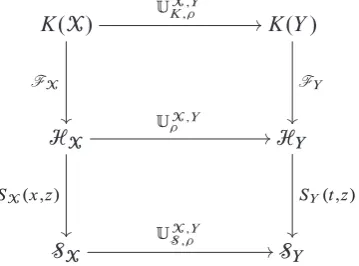
spacesUX;Y. Iritani’s theory of integral structures proposes that the symplectic isomorphism UX;Y should be induced from a natural equivalence at the level ofKlattices ofX andY, as illustrated in Figure 1:
Proposal 3([50]). Inverting the central chargeFX, one obtains
(2.4) UX;Y DFY ıUX;Y
K; ıF 1
X :
K.X/ K.Y /
HX HY
SX SY
UX;Y K;
/
/
UX;Y / / FX FY
SX.x;z/
SY.t;z/
UX;Y
S;
/
/
Figure 1. Analytic continuation of flat sections, symplectomorphism of Givental spaces and com-parison of integral structures.
non-equivariant limits,
Jn-eqZ .; z/, lim !0J
Z
.; z/; U;0X;Y , lim
!0U
X;Y :
By the string equation and dimensional constraints, e 0=z
Jn-eqZ .; z/is a Laurent polynomial of the form [30, Section 10.3.2]
Jn-eqZ .; z/De 0=z zC NXZ 1
iD1
i Cfi
Z
. / z
iC gZ. /
z2 1Z
!
;
wherefZ. /andgZ. /are analytic functions around the large radius limit point ofZ. Restric-ting Jn-eqZ .; z/ to Z and picking up a branch of analytic continuation of the quantum
parameters, the vector-valued analytic functionIX;Y defined by
X Y
HX HY
IX;Y
/
/
JX
n-eqjX
O
O
JY n-eqjY
O O h 1 z XU X;Y ;0 h 1 z Y / / (2.5)
gives an analytic isomorphism3)between neighborhoodsV
X,VY of the projections of the large radius points ofXandY toXandY. WhenXsatisfies the Hard–Lefschetz condition, the coefficients ofUX;Y contain only non-positive powers ofz[28] and the non-equivariant limit coincides with thez! 1limit; then the isomorphismIX ;Y extends to the full cohomology rings of X and Y, and induces an affine linear change of variablesbIX ;Y, which gives an isomorphism of Frobenius manifolds.
3) Explicitly, matrix entries.UX;Y
;0 /ij ofU;0X;Y are monomials inz; calluij the coefficient of such
mono-mial. Then (2.5) boils down to the statement that quantum cohomology parametersiinforiD1; : : : ; lY
are identified as
(2.6) iY D.IX;YX/i,ui 0C lY
X
jD1
uij.X/jC NXY 1
kDlYC1
ui kfkX.X/:
Since deg.U;0X;Y/ij > 0forj > lY, in the Hard Lefschetz case the condition that the coefficients ofUX;Y are
Taylor series in1
[image:10.595.191.371.82.215.2]2.4. Quantization and the higher genus CRC. Conjecture 2.2 shapes the genus-zero
CRC as the existence of a classical canonical transformation identifying the Givental phase spaces of X andY. As the higher genus theory is obtained from the genus-zero picture by quantization, it is expected that the full Gromov–Witten partition functions should be identi-fied, upon analytic continuation, via aquantumcanonical transformation identifying the Fock
spaces, and that such quantum transformation is related to the quantization of the symplecto-morphismUX;Y in equation (2.3).
Conjecture 2.3 ([28, 29]). LetUX;Y DU U0UC denote the Birkhoff factorization
ofUX;Y. Then
(2.7) ZY D
b
U Uc0b
UCZX:A much stronger statement stems from equation (2.7) in the Hard Lefschetz case, when
UCD1HX (cf. [28, Theorem 5.10]).
Conjecture 2.4 (The Hard Lefschetz quantized CRC). Let X!X Y be a Hard Lefschetz crepant resolution diagram. Then
(2.8) ZY DU
1
X;YZXBy [44, Proposition 5.3], equation (2.8) gives, up to quadratic genus-zero terms,
(2.9) ZY DZXjtXDŒUX1 ;YtYC;
whereŒf .z/Cdenotes the projectionŒCWC..z//!CŒŒz. In other words, Conjecture 2.4
states that the full descendent partition function ofZandY coincide to all genera, upon analytic continuation and the identification of the Fock space variables dictated by the classical sym-plectomorphism (2.3).
3. The open crepant resolution conjecture
3.1. Open string maps and Givental’s formalism.
3.1.1. Open Gromov–Witten theory of toric 3-orbifolds. For a three-dimensional
toric Calabi–Yau variety, open Gromov–Witten invariants are defined “via localization” in [32, 54]. This theory has been first introduced for orbifold targets in [13] and developed in full generality in [69] (see also [40] for recent results in this context).
Boundary conditions are given by choosing special type of Lagrangian submanifolds introduced by Aganagic–Vafa in [4]. These Lagrangians are defined locally in a formal neigh-borhood of each torus invariant line: in particular ifpis a torus fixed point adjacent to the torus fixed linel, and the local coordinates atpare.z; u; v/, thenLis defined to be the fixed points of the anti-holomorphic involution
.z; u; v/7! 1z; zu; zv
Loci of fixed maps are described in terms of closed curves mapping to the compact edges of the web diagram in the usual way and disks mapping rigidly to the torus invariant lines with Lagrangian conditions. Beside Hodge integrals coming from the contracting curves, the con-tribution of each fixed locus to the invariants has a factor for each disk, which is constructed as follows. The map from the disk to a neighborhood of its image is viewed as the quotient via an involution of a map of a rational curve to a canonical target. The obstruction theory in ordinary Gromov–Witten theory admits a naturalZ2action, and the equivariant Euler class of the invo-lution invariant part of the obstruction theory is chosen as the localization contribution from the disk [13, Section 2.2], [69, Section 2.4]. This construction is encoded via the introduction of a “disk function”, which we now review in the context of cyclic isotropy (see [69, Section 3.3] for the general case of finite abelian isotropy groups).
LetZbe a three-dimensional CY toric orbifold,pa fixed point such that a neighborhood is isomorphic toŒC3=ZnC1, with representation weights.m1; m2; m3/and CY torus weights .w1; w2; w3/. Fix a Lagrangian boundary condition L which we assume to be on the first coordinate axis in this local chart. Definene D.nC1/=gcd.m1; nC1/to be the size of the effective part of the action along the first coordinate axis. There exist a map from an orbi-disk mapping to the first coordinate axis with windingd and twisting4)kif the compatibility condition
(3.1) d
ne
km1 nC1 2Z is satisfied. In this case the positively oriented disk function is
DkC.dI Ew/D
n
ew1 d
age.k/ 1 n e
d.nC1/nd e
˘
Š
nedw2w1 C˝km3nC1˛Cned
nedw2w1 ˝km2nC1˛C1 :
The negatively oriented disk function is obtained by switching the indices2and3. By renaming the coordinate axes this definition applies to the general boundary condition.
In [69] the disk function is used to construct the GW orbifold topological vertex, a build-ing block for open and closed GW invariants ofZ. Thescalar disk potentialis expressed in terms of the disk and of theJ function of Z. The fixed point basis for the equivariant Chen Ruan cohomology ofZhasnC1classes supported at the fixed pointp, corresponding to all irreducible representations of ZnC1. ForkD1; : : : ; n, denote by1p;k the fundamental class
of the twisted sector corresponding to the characterk; we denote1p;nC1the untwisted class of
the fixed pointp. Raising indices using the orbifold Poincaré pairing, and extending the disk function to be a cohomology-valued function
DC.dI Ew/D nXC1
kD1
DkC.dI Ew/1pk;
the (genus-zero)scalar disk potentialis obtained by contraction with theJ function:
FLdisk.; y;w/E ,X d
yd d Š
X
n 1
nŠh; : : : ; i L;d 0;n
DX
d yd
d Š
DC.dI Ew/; JZ
;new1 d
Z
;
where we denoted byh; : : : ; iL;d0;n the disk invariants with boundary conditionL, windingd andngeneral cohomological insertions.
Remark 3.1. We may consider the disk potential relative to multiple Lagrangian
bound-ary conditions. In that case, we define the disk function by adding the disk functions for each Lagrangian, and we introduce a winding variable for each boundary condition. Furthermore, it is not conceptually difficult (but book-keeping intensive) to express the general open potential in terms of appropriate contractions of arbitrary copies of these disk functions with the full descendent Gromov–Witten potential ofZ.
3.1.2. The disk function, revisited. We reinterpret the disk function as a symmetric
tensor of Givental space. First we homogenize Iritani’s Gamma class (2.2) and make it of degree zero:
Z.z/,z
1
2degZ,XkZ1p;k;
where the second equality defineskZ as the 1p;k-coefficient of Z.z/. With notation as in
Section 3.1.1, we define
(3.2) DCZ.zI Ew/.1p;k/, w1.nC1/sin
˝km3 nC1
˛ w3 z
1
kZ
1pk:
The dual basis of inertia components diagonalizes the tensorDCZ.
Lemma 3.2. Thekth coefficient ofDCZ coincides withDkC.dI Ew/whenzD new1d and the winding/twisting compatibility condition is met:
ı1;exp
2 i ned km1nC1
DCZ
n
ew1 d I Ew
.1p;k/;1p;k
Z D
DCk.dI Ew/
Proof. This formula follows from the explicit expression of Z in the localization/
inertia basis, manipulated via the identity
.?/.1 ?/D
sin.?/:
The Calabi–Yau conditionw1Cw2Cw3 D0is also used. Theıfactor encodes the degree/ twisting condition.
3.1.3. Open crepant resolutions. LetX !X Y be a diagram of toric Calabi–Yau threefolds for which the Coates–Iritani–Tseng/Ruan version of the closed crepant resolution conjecture holds. Choose a Lagrangian boundary conditionLX inX and denote by LY the transform of such condition inY; notice that in general this can consist of several Lagrangian boundary conditions.
Proposition 3.3. There exists aC..z 1//-linear transformation
OWHX !HY
of Givental spaces such that
This proposition is trivial, asO can be constructed as DCY ıUX;Y ı.DCX/ 1, where .DCX/ 1 denotes the inverse of DCX after restricting to the basis of eigenvectors with non-trivial eigenvalues andO is defined to be0 away from these vectors. However, we observe that interesting open crepant resolution statements follow from this simple fact, and thatO
is a simpler object thanUX;Y. For a good reason: the disk function almost completely
can-cels the transcendental part in Iritani’s central charge. We make this precise in the following observation.
Lemma 3.4. Referring to equations(2.2)and(3.2)for the relevant definitions, we have
‚Z.1p;k/,
w1.nC1/
z32
DCZ.1p;k˝z Z/1pk
(3.3)
D 1
sin ˝km3nC1˛ w3z 1
k p:
Combining Lemma 3.4 with Iritani’s equation (2.4), we obtain the following prediction.
Conjecture 3.5. Choose bases for the equivariant CR cohomologies ofX andY. Con-sider a set5) W of equivariant bundles onZthat descend bijectively to bases for K.X/˝C andK.Y /˝C. For DX; Y, let CHdenote the matrix of Chern characters in the chosen bases. Denote
CHD
2i z
1 2deg
invCH :
With‚be as in equation (3.3), we have
OD‚Y ıCHY ıCH 1
X ı‚X 1:
We verify Conjecture 3.5 for the resolution ofAnsingularities in Sections 4 and 5. We also note that while we are formulating the statement in the case of cyclic isotropy to keep notation lighter, it is not hard to write an analogous prediction in a completely general toric setting.
3.2. The OCRC. Having modified our perspective on the disk functions, we also
update our take on open disk invariants to remember the twisting of the map at the origin of the disk. In correlator notation, denoteh; : : : ; iL;d;k0;n the disk invariants with Lagrangian boundary conditionL, windingd, twistingkandncohomology insertions. We then define the cohomological disk potentialas a cohomology-valued function, which is expressed as a
com-position of theJ function with the disk function (3.2):
FLdisk.; y;w/E ,X d
yd d Š
X
n 1
nŠh; : : : ; i L;d;k 0;n 1pk;
(3.4)
DX
d
ı1;exp 2i d ne km1nC1
yd
d ŠD C ZıJ
Z
;new1 d ;wE
:
5) In [72] such a set is called agrade restriction window. In the hypotheses and notation of Proposition 3.3,
note thatX andY must be related by variation of GIT, and therefore they are quotients of a common space
ZDClYC3; the grade restriction window may be chosen from the coordinate axes ofZ, thought of as
HX O // HY
HX
UX;Y
/
/
DX
O
O
HY
DY
O
O
X
h 1 z
XJ X
f
f
h 1 z
XFL;diskX
H
H
IX;Y
/
/ Y h
1 z YeJ
Y
8
8
h 1 z YFL;Ydisk
V
V
Figure 2. Open potential comparison diagram. In the Hard Lefschetz case this same diagram holds with thehfactors omitted, andidentified with the full cohomologies of either target.
We define a section of Givental space that contains equivalent information to the disk potential:
FLdisk.t; z;w/E ,DCZ ıJZ.; zI Ew/:
We callFLdisk.t; z;w/E thewinding neutral disk potential. For any pair of integersk and d satisfying (3.1), the twistingk and windingd part of the disk potential is obtained by sub-stitutingzD nedw1. A general “disk crepant resolution statement” that follows from the closed CRC is a comparison of winding-neutral potentials, as illustrated in Figure 2.
Proposition 3.6. LetX!X Y be a diagram for which the Coates–Iritani–Tseng/ Ruan form of the closed crepant resolution conjecture holds and identify quantum parameters inXandY viaIX;Y as in equation(2.5). Then
h 1 z YF
disk L;Y
ˇ
ˇY Dh 1 z
XOıF
disk L;X
ˇ ˇ
X:
Assume further thatXsatisfies the Hard Lefschetz condition and identify cohomologies via the
affine linear change of variablesbIX ;Y. Then
FL;Ydisk DOıFL;diskX:
Here we also understand that the winding-neutral disk potential ofY is analytically con-tinued appropriately (we suppressed the tilde to avoid excessive proliferation of superscripts).
Remark 3.7. At the level of cohomological disk potentials, the normalization factors
hXandhY enter as a redefinition of the winding number variableyin (3.4) depending on small
quantum cohomology parameters; this is the manifestation of the so-calledopen mirror mapin
the physics literature on open string mirror symmetry [3, 8, 11, 60].
Remark 3.8. The statement of the proposition in principle hinges on the possibility
to identify quantum parameters as in (2.5)–(2.6). Restricting to the coordinate hyperplanes of the fundamental class insertions, the existence of the non-equivariant limits ofUX;Y and the
[image:15.595.147.490.82.252.2]3.3. The Hard Lefschetz OCRC. In the Hard Lefschetz case the comparison of disk
potentials naturally extends to the full open potential. We define thegenus-g,`-holes winding neutral potential, a function from the spaceH.Z/to the`th tensor power of Givental space H˝`
Z DH.Z/..z
1
1 //˝ ˝H.Z/..z`1//:
FZg;`;L.; z1; : : : ; z`;w/E ,D
C˝`
Z ıJ
Z
g;`.; z1; : : : ; z`I Ew/; whereJg;`Z encodes genus-g,`-point descendent invariants:
(3.5) Jg;`Z .;zI Ew/,
˛1
z1 1
; : : : ; ˛` z` `
g;`
˛1˝ ˝˛`:
In (3.5), we denotedzD.z1; : : : ; z`/and a sum over repeated Greek indices is intended. Just as in the disk case, one can now define a winding neutral open potential by summing over all generagand integers`and a cohomological open potential by introducing winding variables and summing over appropriate specializations of thezvariables. For a pair of spacesX andY in a Hard Lefschetz CRC diagram the respective potentials can be compared as in Section 3.1 – this all follows from the comparison of thel-hole winding neutral potential, which we now spell out with care.
Theorem 3.9. Let X !X Y be a Hard Lefschetz diagram for which the higher
genus closed Crepant Resolution Conjecture holds (Conjecture2.4). With all notation as in Proposition3.6, andO˝` DO.z1/˝ ˝O.z`/, we have
FLg;`0;Y DO
˝`
ıFL;g;`X:
Proof. The generating functionJg;`Z is obtained from the genus-gdescendent potential by first`applications of the total differentiald, and then restricting to the small phase space variables D ¹˛º D ¹t˛;0º. Under the natural identification of theith copy ofTHZCŠHZ
with the auxiliary variablezi, we have
(3.6) dt˛;k D
˛
zkC1:
Conjecture 2.4 gives us the equality of the Gromov–Witten partition functions (2.9) after a change of variable given by the linear identification
(3.7) CıUX;Y ıi WHXC!H C
Y :
If we decompose the symplectomorphismUX;Y as a series in 1z of linear maps, i.e. we have UX;Y ,
P
n0 1
znUn, then differentiating the change of variable given by (3.7) gives
(3.8) dtY˛;kD k
X
nD0
U˛;n dtX;kCn;
where we denoted byU˛;n the.˛; /entry of the matrix representingUnafter having chosen bases for the cohomologies ofXandY. Combining (3.6) and (3.8),
1
X
kD0 ˛ zkC1 D
1
X
kD0
dtY˛;k D 1
X
kD0 k
X
nD0
U˛;n dt ;kCn
X
(3.9)
D 1
X
kD0 k
X
nD0
U˛;n
zkCnC1 DU
X;Y
1
X
kD0
zkC1
!
Now we differentiate equation (2.9)`times, and restrict to primary variables that are identified via (3.7): such identification reduces tobIX;Y. Using (3.9), we obtain
Jg;`Y DUX;Y˝`ıJg;`X:
The statement of the theorem follows by composing byDC˝Y `and then using the commutativ-ity of the diagram in Figure 2.
4. OCRC forAn-resolutions
4.1. EquivariantUX;Y
and integral structures. For the pairs
.X; Y /D ŒC3=ZnC1; An;
Proposition 3.6 and Theorem 3.9 imply a Bryan–Graber-type CRC statement comparing the open GW potentials. Notice that sinceXis a Hard Lefschetz orbifold, we do not have to deal with the trivializing scalar factors h. In Sections 4.2 and 4.3 we study the two essentially
distinct types of Lagrangian boundary conditions.
The reader may find a detailed review of the toric geometry describing our targets in Section B.1, which is summarized by Figure 6. A generic Calabi–Yau torus action is taken on X andY, with weights as in Figure 6. We denote byj, j D1; : : : ; n, the duals of the torus invariant linesLj 2H2.Y / and by Pi, i D1; : : : ; nC1, the equivariant cohomology classes concentrated on the torus fixed points of the resolution. On the orbifold, we label by1k,
kD1; : : : ; nC1, the fundamental classes of the components of the inertia stackIXtwisted by e2ik=.nC1/. A generic pointt
2H.Y /is written astnC11Y CPjtjj; similarly, we write xDPnkCD11xk1k forx2H.X/.
Let nowYbe the ball of radiusaround the large radius limit point ofY with respect to the Euclidean metric.ds/2 DPi.deti/2in exponentiated flat coordinates etj. We define a path inY1,
(4.1) WŒ0; 1!Y1; s7!..s//j Ds! j:
as the straight line in the coordinates etj connecting the large radius point LR,¹etj D0ºof Y to the one ofX, which we denote as OP,¹etj D! jº.
Theorem 4.1. LeteJY.z/denote the analytic continuation ofJY along the path to the point.1/composed with the identification(B.16)of quantum parameters. Then the linear transformation
(4.2) UX;Y1k D
X
i Pi
1 .nC1/
iY
kX
i 1
X
jD0
! j ke2ij˛1z C n
X
jDi
! j ke2i.nC1zj /˛2
!
is an isomorphism of Givental spaces such that
e
JY DUX;Y ıJX:
This result is compatible with Iritani’s equation (2.4). We now describe the canonical identificationUK;X;Y. Denote byO.k/the geometrically trivial line bundle onCnC3where the torus.C/nacts via thekth factor with weight 1and the torusT acts trivially. We define our grade restriction windowW K.CnC3/to be the subgroup generated by theO.k/. Using the description of the local coordinates in Section B.1, we compute that the quotient (B.2) identifiesO.k/withO k (with trivialT-action) and the quotient (B.3) identifiesO.k/with O.k/(with canonical linearization (B.7)). Therefore, we defineUK;X;Y by identifying
OY $OX; O.k/$O k;
where theT-linearizations are trivial on the orbifold and canonical on the resolution.
On the orbifold, all of the bundlesOj are linearized trivially, so the higher Chern classes vanish. The orbifold Chern characters are
.2i/deg2 invch.Oj/D nXC1
kD1
! j k1k:
The class is
z 12degX D
1C ˛1C˛2 z
"Xn
kD1
1 k
nC1 ˛1
z
k
nC1 ˛2
z
1k
z
C
1 ˛1 z
1 ˛2 z
1nC1
#
:
On the resolution, the Chern roots at eachPi are the weights of the action on the fiber above that point:
.2i/deg2 ch.O.j//D j
X
iD1
e2i.nC1 j /˛2P i C
nXC1
iDjC1
e2ij˛1Pi
and
.2i/deg2 ch.O/D nXC1
iD1 Pi:
The class is
z 12degY D
1C˛1C˛2 z
"nXC1
iD1
1Cw C
i z
1Cwi z
Pi
#
:
With this information one can compute the symplectomorphism as in equation (2.4) and obtain the formula in Theorem 4.1.
We now derive explicit disk potential CRC statements for the two distinct types of Lagrangian boundary conditions.
4.2. Lintersects the ineffective axis. We impose a Lagrangian boundary condition on
Theorem 4.2. Consider the cohomological disk potentialsFdisk
L0;Y.t; yP1; : : : ; yPnC1;w/E
andFdisk
L;X.t; y;w/E . Choosing the dual bases 1k and P
i (where k andi both range from 1
tonC1), define a linear transformationOZ WH.X/!H.Y /by the matrix
OZik D
´
!.12 i /k; k6DnC1;
1; kDnC1:
After the identification of variables from Theorem B.2, and the specialization of winding parameters
yPi Dei
w
i C.2i 1/˛1 ˛1C˛2
y
we have
FLdisk0;Y.t; y;w/E DOZıFL;diskX.t; y;w/:E
Proof. From equation (3.2), we have
DL;CX.zI Ew/.1k/D nXC1
kD1
1k
.nC1/.˛1C˛2/sin ˝nCk1˛C˛2z k
X
and
DLC0;Y.zI Ew/.Pi/D nXC1
iD1
Pi
.˛1C˛2/sin wi
z
iY :
The transformationOis now obtained asDCY ıUX;Y ı.DC
X/
1:
O.1k/D nXC1
iD1
"
sin ˝nCk1˛C˛2z
sin wi z
i 1
X
jD0
! j ke2ij˛1z C n
X
jDi
! j ke2i
.nC1 j /˛2 z
!#
Pi:
We now specializezD ˛1Cd˛2, ford 2Z. Thei; kcoefficient fork¤nC1, after some gym-nastics with telescoping sums, becomes
Oki D. 1/ed i
n iC2C.2i n 2/ ˛1 ˛1C˛2
! 12 i
k :
ForkDnC1,
OniC1 D. 1/ed i
n iC2C.2i n 2/˛1˛1C˛2 :
It is now immediate to see that we can incorporate the part of the transformation that depends multiplicatively on d into a specialization of the winding variables, and that the remaining linear map is preciselyOZ.
From this formulation of the disk CRC one can deduce a statement about scalar disk potentials which essentially says that the scalar potential of the resolution compares with the untwisted disk potential on the orbifold.
Corollary 4.3. With all notation as in Theorem4.2:
FLdisk0;Y.t; y;w/;E
nXC1
iD1 Pi
!
Y
D n 1
C1 F disk
L;X.t; y;w/;E 1nC1
Proof. This statement amounts to the fact that the coefficients of all but the last column
of the matrixOZadd to zero.
4.3. Lintersects the effective axis. We impose our boundary conditionLon the first
coordinate axis, which is an effective quotient ofC with representation weightm1 D 1and torus weight ˛1. We can obtain results for the boundary condition on the second axis by switching˛1with ˛2,m1 withm2 andCwith in the orientation of the disks. In this case there is only one corresponding boundary conditionL0on the resolution, which intersects the (diagonal) non-compact leg incident toPnC1in Figure 6.
Theorem 4.4. Consider the two cohomological disk potentialsFdisk
L0;Y.t; yPnC1;w/E and Fdisk
L;X.t; y;w/E . Choosing the bases 1
k andPi (where k andi both range from 1 ton
C1), defineOZ.1k/DPnC1 for everyk. After the identification of variables from Theorem B.2, and the identification of winding parametersyDyPnC1 we have
Fdisk
L0;Y.t; y;w/E DOZıFL;diskX.t; y;w/:E
We obtain as an immediate corollary a comparison among scalar potentials.
Corollary 4.5. SettingyDyPnC1, we have
FLdisk0;Y.t; y;w/E DFL;diskX.t; y;w/:E
Proof. The orbifold disk endomorphism is
DCX.zI Ew/.1k/D
˛1.nC1/sin ˛1Cz˛2 k
X
1k;
The resolution disk endomorphism is
DCX.zI Ew/.Pi/D
.nC1/˛1sin ˛1Cz˛2 nC1 Y
ıi;nC1PnC1:
We can now computeO:
O.1k/D 1 nC1
n
X
jD0
! j ke2ij˛1z
!
PnCi:
SpecializingzD .nCd1/˛1 for any positive integerd, we obtain
OknC1 D 1
nC1 n
X
jD0
! j ke2ijnCd1 Dı
k; dmodnC1;
which implies the statement of the theorem.
5. One-dimensional mirror symmetry
5.1. Weak Frobenius structures on double Hurwitz spaces.
Definition 5.1. Let Ex2ZnC3 be a vector of integers adding to 0. The genus-zero double Hurwitz spaceHE
x ,M0.P
1
Ix/parameterizes isomorphism classes of coversof the projective line by a smooth genus-zero curveC, with marked ramification profile over 0and 1specified byEx. This means that the principal divisor ofis of the form
./DXxiqi:
We denote by andthe universal family and universal map, and by†i the sections marking theith point in./:
P1
// U
/
/ P1
Œ
pt
/
/
Pi
C
C
HE
x.
†i
D
D
A genus-zero double Hurwitz space is naturally isomorphic to C?M0;nC3, and is
therefore an open set in affine spaceAnC1. The genus-zero case is the only case we consider in
this paper and it may seem overly sophisticated to use the language of moduli spaces to work on such a simple object: we choose to do so in order to connect to the work of Dubrovin [35,36] and Romano [67] (after Saito [71]; see also [57]), who studied existence and construction of Frobenius structures on double Hurwitz spaces for arbitrary genus.
Write supp./D ¹qi 2Cºi for the set of points./is supported on; let21C.log.// be a meromorphic one-form having simple poles at supp./with constant residues. We call .; /respectively thesuperpotentialand the primitive differentialofHE
x. Borrowing the
ter-minology from [67, 68], we say that an analytic Frobenius manifold structure .F;ı; / on a complex manifoldF is weak if
(1) the ı-multiplication gives a commutative and associative unitalO-algebra structure on the space of holomorphic vector fields onF,
(2) the metricprovides a flat pairing which is Frobenius with respect toı, (3) the algebra structure admits a potential, meaning that the 3-tensor
R.X; Y; Z/,.X; Y ıZ/ satisfies the integrability condition
.r./R/Œ˛ˇ ı D0:
In particular, this encompasses non-quasihomogeneous solutions of WDVV, and solutions without a flat identity element.
By choosing the last three sections to be the constant sections 0; 1;1, we can realize HE
x 'C
?
M0;nC3 as an open subset ofAnC1and trivialize the universal family. In homo-geneous coordinatesŒu0 W WunforPn,
HE
x DC
?
PnndiscrHE
x;
(5.1)
discrHE
x ,Proj
CŒu0; : : : ; un
˝Qn
iD0uiQj <k.uj uk/
Theorem 5.1([38, 67]). For vector fieldsX,Y,Z2X.HE
x/, define the non-degenerate symmetric pairinggand quantum product?as
g.X; Y /, X P2supp./
Res P
X.log/Y .log/ dlog
2; (5.2)
g.X; Y ? Z/, X P2supp./
Res P
X.log/Y .log/Z.log/ dlog
2 ; (5.3)
whered denotes the relative differential with respect to the universal family (i.e. the differen-tial in the fiber direction). Then the tripleF; D.HE
x; ?; g/endowsHEx with a holomorphic weak Frobenius manifold structure. The embeddingHE
x,!C
?
Pninduces uniquely a mero-morphic weak Frobenius structure onP1Pn.
Equations (5.2)–(5.3) are the Dijkgraaf–Verlinde–Verlinde formulae [33] for a topologi-cal Landau–Ginzburg model on a sphere with log.q/as its superpotential. The case in which .q/itself is used as the superpotential gives rise to adifferentFrobenius manifold structure,
which is the case originally analyzed by Dubrovin in his study of Frobenius structures on Hurwitz spaces [36, Lecture 5]; the situation at hand is its dual in the sense of [38], whereg plays the role of the intersection form and?the dual product, whose poles coincide with the discriminant ideal in the Zariski closure (5.1) ofHE
x.
Remark 5.2. Sinceis a genus-zero covering map, in an affine chart parametrized by q2Cits logarithm takes the form
(5.4) logDX i
xilog.q qi/Cy;
where xi;y2Z. In fact, the existence of the weak Frobenius structure (5.2)–(5.3) carries through unscathed [68] to the case where dlogis a meromorphic differential onC upon identifying supp./D ¹qiº; this in particular encompasses the case wherexi;y2C in equa-tion (5.4). The locaequa-tionsqi of the punctures provide a special type of local coordinates onHEx:
by the general theory of double Hurwitz spaces [67], for suitable choices oftheir logarithms are flat coordinates for the pairinggin equation (5.2).
5.1.1. Twisted homology and the quantum differential equation. Let
C,C nsupp./
and denote by W QC!C its universal covering space. Fixz2C and pick the canonical principal branch for1z Dexp.z 1log/in equation (5.4), defined as
1z.q/DY iD1
jq qijieiiargi.q/;
wherei WD xzi and argi.q/2Œ0; 2/is the angle formed byq qi with the real axis. Then we have a monodromy representation
W1.C/!L'C
on the complex lineLparametrized by 1
z, a simple looplq
i aroundqi resulting in multipli-cation by
qi WD.lqi/De2i
We denote byH.C; L/(resp.H.C; L/) the homology (resp. cohomology) groups of Ctwisted by the set of local coefficients determined byqi. Integration over 2H1.C; L/ of1z2H1.C; L/defines thetwisted period mapping
(5.5) ; WH1.C; L/!O.HEx/; 7!
Z
1z:
Let nowr.g;z/
WX.HE
x/!X.HEx/˝
1.H
Ex/be the Dubrovin connection associated toF;
(5.6) rX.g;z/.Y; z/,rX.g/Y Cz 1X ? Y and write Sol; for itsC.1; : : : ; n/-vector space of parallel sections
Sol; D ¹s2X.HEx/W r
.g;z/s
D0º:
The following statement [38] is averbatimapplication of the arguments of [37] for the ordinary
Hurwitz case.
Proposition 5.3. The solution space of the quantum differential equations ofF; is
generated by gradients of the twisted periods(5.5)
Sol; DspanC.a1;:::;an/¹gradg;. /º2H1.C;L/:
In other words, twisted periods are a flat coordinate frame for the Dubrovin connection onTF;.
5.2. A one-dimensional Landau–Ginzburg mirror. We now fix the ramification
pro-file
E
xD..nC1/˛1; ˛1 ˛2; .nC1/˛2; ˛1 ˛2; : : : ; ˛1 ˛2
„ ƒ‚ …
n
/:
DefineMA,HE
x. We pick global coordinates on it as follows: we write0 for an
(exponen-tiated-linear) coordinate in the first factor of MA'C?M0;nC3, and we pick i D u0ui, i D1; : : : ; n, as a set of global coordinates onM0;nC3. As before, we write q to denote an
affine coordinate on the fibers of the universal family. We give MA the structure of a one-parameter family of double Hurwitz spaces as follows:
.0; : : : ; n; q/D n
Y
jD0
j˛1 q
.nC1/˛1
.1 q/˛1C˛2Qn
kD1.1 qk/˛1C˛2 ; (5.7)
.q/D 1
˛1C˛2 dq
q : (5.8)
The Frobenius structure on MA determined by equations (5.2), (5.3), (5.7), (5.8) is denoted by F;. By Remark 5.2, and since both the metric and the associative product in equa-tions (5.2), (5.3), (5.7), (5.8) depend rationally on.˛1; ˛2/, we will in the following consider them as complex parameters.
Theorem 5.4. The following statements hold.
(1) With notation as at the beginning of Section4.1, let
0De tnC1CıY
˛1 ; (5.9)
j D n
Y
iDj
eti; 1
j n; (5.10)
whereıY is an arbitrary constant. Then, in a neighborhoodVY ofLRD ¹eti D0º,
F; 'QH.Y /:
(2) Let
0De
xnC1CıX
˛1 ; (5.11)
j Dexp
"
2i
nC1 j C n
X
kD1
e ik.jnC11/sin
j k
nC1
xk
!#
; 1kn; (5.12)
whereıX is an arbitrary constant. Then, in a neighborhoodVXofOPD ¹xi D0º,
F; 'QH.X/:
Proof. The proof of the theorem is a direct computation from the Landau–Ginzburg
formulae (5.2)–(5.3).
(i) Consider the three-point correlatorR.i𝜕i; j𝜕j; k𝜕k/, where𝜕k , 𝜕𝜕k, and define
Ri;j;k.l/ , Res qD 1
l
i𝜕𝜕lnij𝜕𝜕ln j k
𝜕ln 𝜕k .˛1C˛2/2q𝜕𝜕lnq
dq q :
Inspection shows thatR.l/ij k D0unlessl Di Dj,l Di Dkorl Dj Dk. Assume without loss of generalityl Dj Di, and suppose thati; k > 0. We compute
R.i /i;i;k D i k i C
˛2 ˛1C˛2
; (5.13)
Ri;i;i.i / D .n 1/˛1C˛2 ˛1C˛2 C
nXC1
l¤i l i l
; R.i /0;i;i D 1 ˛1C˛2
: (5.14)
Moreover, for alli,j andkwe have
R.0/i;j;k,Res qD0
i𝜕𝜕ln i j
𝜕ln 𝜕j k
𝜕ln 𝜕k .˛1C˛2/2q𝜕𝜕lnq
dq
q D
˛2 ıi;nC1 ıj;nC1 ık;nC1 1
.nC1/.˛1C˛2/2 ; (5.15)
R.i;j;k1/ , Res qD1
i𝜕𝜕ln i j
𝜕ln 𝜕j k
𝜕ln 𝜕k .˛1C˛2/2q𝜕𝜕lnq
dq
q D
. ˛2/2 ıi;nC1 ıj;nC1 ık;nC1 .nC1/.˛1C˛2/2
: (5.16)
(ii) This part is obtained by composing the computation above with the Coates–Corti– Iritani–Tseng isomorphism of quantum cohomologies (Theorem B.2).
Remark 5.5. The freedom of shift byıXandıY respectively alongH0.X/andH0.Y / in equations (5.9) and (5.11) is a consequence of the restriction of the String Axiom to the small phase space. We setıX DıY D0throughout this section, but it will be useful to reinstate the shifts in the computations of Section 5.3.2.
5.3. The global quantumD-module. Theorems 5.4 and 5.3 together imply the
exis-tence of a global quantumD-module.MA; F;r; H .;/g/ interpolating between QDM.X/ and QDM.Y /. LetF ,TF; be endowed with the family of connectionsr.g;z/, as in equa-tion (5.6) and forr.g;z/-flat sectionss1,s
2define
H.s1; s2/g Dg.s1.; z/; s2.; z//:
With notation as in Section 4.1, letVX andVY be neighborhoods of OP and LR, respectively. Then Theorems 5.4 and 5.3 imply that
.F;; TF;;r.g;z/; H .;/g/jV
X 'QDM.X/;
.F;; TF;;r.g;z/; H .;/g/jVY 'QDM.Y /:
In particular, choosing a basis of integral twisted 1-cycles yields a global flat frame for the quantum differential equations ofXandY upon analytic continuation in the-variables, and
(5.17) Sol;jVX DSX; Sol;jVY DSY:
Representatives of one such integral basis can be constructed as follows. For generic monodromy weights, the monodromy representation.lqi/factors through a faithful repre-sentation Q WH1.C;Z/!V. Then in this case the twisted homology coincides with the integral homology of the Riemannian covering [78] ofC
H.C; L/'H.CQ=Œ1.C/; 1.C//;Z/:
In particular, compact loops in the kernel of the abelianization morphism
hW1.C/!H1.C;Z/
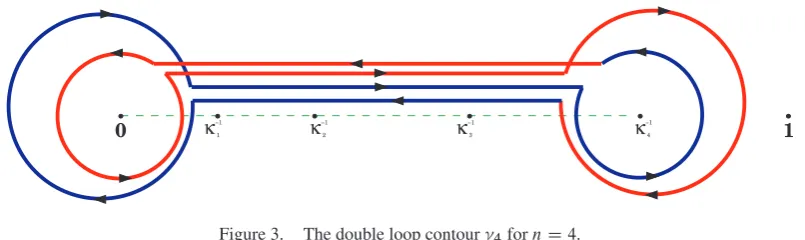
may have non-trivial lifts to H1.C; L/. One such basis is given explicitly [78, 79] by the Pochhammer double loop contours ¹iºniDC11: these are compact loops encircling the points qD0andqDi 1,i D1; : : : ; nC1, as in Figure 3 (that isi DŒl0; l 1
i , where thelqare simple oriented loops around each of the punctures). Then the twisted periods
…i ,
za;.i/ .1 e2ia/.1 e 2ib/; (5.18)
where we defined
a, .nC1/˛1
z ; qa ,e
2ia;
b , ˛1C˛2
z ; qb ,e
2ib;
κ−1
1 κ
−1
2 κ
−1
3 κ
−1 4
0 1
Figure 3. The double loop contour4fornD4.
Remark 5.6. We have a natural isomorphism with the homology of the complex line
relative to the punctures
PWH1.C; L/
!H1.P1;supp.//; i 7!.1 qa/.1 qb/Œ0; i 1
obtained by associating to any Pochhammer contour the path inCthat it encircles. The choice of coefficient reflects the existence [79], whenRe.a/ > 0,Re.b/ < 1, of an Euler-type integral representation: namely, a factorization of the period mapping
H1.C; L/
H1.P1; .// C.qa;qb/ P
;
'
'
R
1z
/
/
(5.19)
which reduces (5.18) to convergent line integrals ofza1zover the intervalP.i/.
By the above remark, the period integrals of equation (5.18) are a multi-variable general-ization of the classical Euler representation for the Gauss hypergeometric function. Explicitly, they take the form [39]
…i.; z/D
.a/.1 b/ .1Ca b/
a i
n
Y
jD0
˛1 z j (5.20)
ˆ.n/
a; b; 1Ca bI1 i
; : : : ;i 1 i
; 1 i
;iC1 i
; : : : ;n i
for1i nand
(5.21) …nC1.; z/D
.a/.1 b/ .1Ca b/
n
Y
jD0
˛1 z j
!
ˆ.n/.a; b; 1Ca bI1; : : : ; n/;
where we defined
(5.22) ˆ.m/.a; b; c; w1; : : : ; wm/,FD.m/.aIb; : : : ; bIcIw1; : : : ; wm/;
andFD.m/.aIb1; : : : ; bMIcIw1; : : : ; wm/in equation (5.22) is the Lauricella function of typeD (cf. [58]):
(5.23) FD.m/.aIb1; : : : ; bmIcIw1; : : : ; wm/,
X
i1;:::;im
.a/Pjij
.c/Pjij m
Y
jD1
.bj/ijw ij j ijŠ
[image:26.595.79.482.77.197.2]