Int. J. Electrochem. Sci., 14 (2019) 4532 – 4545, doi: 10.20964/2019.05.18
International Journal of
ELECTROCHEMICAL
SCIENCE
www.electrochemsci.orgEffect of Inhibitor based on Emulsion on Mild Steel Corrosion
in Acid Environment
Juan Du1, Yue Liu1, Pingli Liu1,*, Yigang Liu2, Shang Gao2, Liping Zhang2
1 State Key Laboratory of Oil & Gas Reservoir Geology and Exploitation Engineering, Southwest
Petroleum University, Chengdu, Sichuan, 610500, China
2 CNOOC China Co. Ltd. Tianjin branch, Tianjin, 300000, China *E-mail: [email protected]
Received: 19 November 2018 / Accepted: 24 February 2019 / Published: 10 April 2019
An inhibitor based on emulsion was prepared by anti-corrosion substances, crude oil and emulsifier in this paper. The inhibition behavior of this inhibitor based on emulsion on N80 steel in 10%HCl + 4%HBF4 solution was investigated by electrochemical measurements and soaking experiments. Results
of electrochemical impedance spectroscopy and surface analysis studies indicated that the inhibitor based on emulsion can effectively inhibit the corrosion reaction by forming an adsorption layer function as a barrier. Polarization curves indicated that it is mixed type inhibitor which can reduce anodic dissolution and cathodic hydrogen evolution reactions simultaneously. Experimental results indicated that the inhibitor based on emulsion has better anti-corrosion performance than that of composite inhibitor without crude oil and emulsifier even though with smaller application concentration.
Keywords: inhibitor based on emulsion, N80 steel, 10%HCl and 4%HBF4 solution, weight loss method,
electrochemical method
1. INTRODUCTION
In the past decades, many works have been focused on the development and evaluation of pickling inhibitor[1-5], and these works are mainly carried out in HCl solution[6]. The acid solution mixed by HF and HCl is usually used to dissolve siliceous minerals in sandstone reservoirs acidizing process. HCl + HBF4 is a very common acid solution for sandstone acidizing since the HBF4 can stabilize
clay and produce HF, usually the application concentration range is 3%~15%HCl + 4%~12%HBF4[7].
However, there are few studies on the corrosion and inhibition of mild steel in HCl + HBF4 solution, so
Most of the well-known acid inhibitors are organic compounds containing nitrogen, oxygen and/or sulfur atoms, heterocyclic compounds and π-electrons[8-10]. It is generally accepted that organic molecules inhibit corrosion via adsorption at the metal/solution interface[11-13], the adsorption layer function as a barrier and isolate the metal from the corrosion solution[14]. In the oil exploitation, it is recognized that oil plays an inhibition role on corrosion[15,16]. The mechanism has been attributed to the adsorption of oils and the improvement in protectiveness of the anti-corrosion layers[17]. Only the corrosion inhibitor can reduce the oil pipe corrosion while injecting fresh acid, and then crude oil discharged during residual acid reflux so as to improve the anti-corrosion effect of inhibitor. Therefore, oil can be added to fresh acid to keep oil-wet on steel surface, and reduce tube corrosion during the acid injection process.
In this paper, a kind of inhibitor based on emulsion was obtained by uniform mixing of anti-corrosion substances, crude oil and emulsifier based on a mass proportion. The anti-corrosion behavior and inhibition performance of this missed inhibitor for N80 mild steel in 10%HCl+4%HBF4 solution was
studied by weight loss method and electrochemical method. It is hoped that the inhibitor based on emulsion can reduce the oil pipe corrosion during the acidizing process.
2. EXPERIMENT DETAILS
2.1 Materials
All of the emulsifier, butylene glycol, imidazole, polyvinylpyrrolidone, 2-phosphonobutane-1,2,4-tricarboxylic acid, ethyl alcohol and acetone were obtained from Chengdu Kelon Chemical Reagent Company of China, and of analytical reagent grade. The N80 steel specimens (50mm×10mm×3mm) used in this work were investigated in the as-received condition. Its chemical composition is shown in Tab.1. The corrosion solution was prepared by diluting the HCl and HBF4 with
distilled water. The crude oil used to prepare inhibitor based on emulsion was obtained from Bohai oil field.
Table 1 Chemical composition of N80 steel
Alloy C Si Mn P S Cr V Al Fe
Wt% 0.34 0.22 1.55 0.18 0.013 0.14 0.13 0.02 Bal.
2.2 Instruments
2.3 Experimental method
2.3.1 Preparation of inhibitor without emulsifier
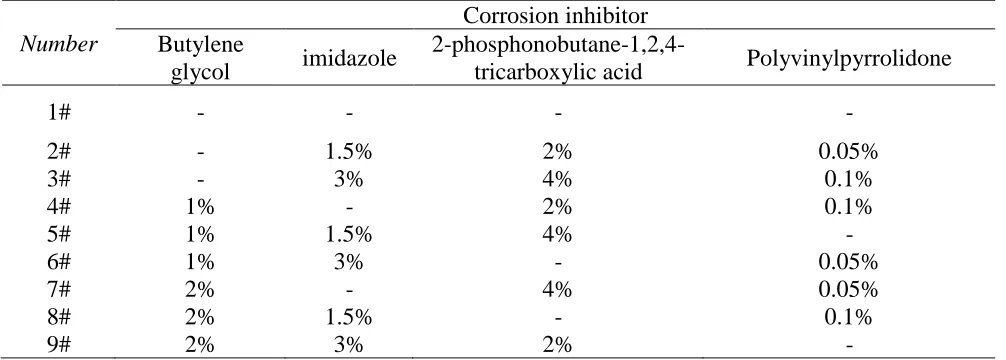
The composite inhibitor without emulsifier was prepared by uniform mixing of butylene glycol, imidazole, polyvinylpyrrolidone and 2-phosphonobutane-1,2,4-tricarboxylic acid in different weight proportion shown in Tab.2.
Table 2. Preparation of composite inhibitor without emulsifier by butylene glycol, imidazole, polyvinylpyrrolidone and 2-phosphonobutane-1,2-4-tricarboxylic acid in different weight proportion
Number
Corrosion inhibitor Butylene
glycol imidazole
2-phosphonobutane-1,2,4-tricarboxylic acid Polyvinylpyrrolidone
1# - - - -
2# - 1.5% 2% 0.05%
3# - 3% 4% 0.1%
4# 1% - 2% 0.1%
5# 1% 1.5% 4% -
6# 1% 3% - 0.05%
7# 2% - 4% 0.05%
8# 2% 1.5% - 0.1%
9# 2% 3% 2% -
2.3.2 Preparation of inhibitor based on emulsion
The inhibitor based on emulsion was obtained by uniform mixing of inhibitor (a mixture of butylene glycol, imidazole, polyvinylpyrrolidone and 2-phosphonobutane-1,2,4-tricarboxylic acid), crude oil and emulsifier based on a weight percentage as 3:1:1.
2.3.3 Corrosion experiment with the weight loss method
The fresh N80 steel was washed with acetone and ethyl alcohol, then dried in desiccators and accurately weighed. The weight loss experiments were performed by immersing N80 steel in 10%HCl + 4%HBF4 solution with and without different inhibitors at different temperatures. The steel was totally
immersed in acid solution and the temperature was controlled by HH-2K constant temperature water bath. Then, after four hours, the N80 steel was removed, rinsed with deionized water, acetone and ethanol, dried in desiccators, and reweighed. The corrosion rate (CR) was calculated using equation (1):
6
0 =1
R
m C
St
(1)
where CR (g·m-2·h-1) is the corrosion rate of each steel specimen, S (mm2) is the surface area of
[image:3.596.49.552.262.442.2]
specimen. The corrosion inhibition efficiency (IE) of the corrosion inhibitor was calculated using equation (2):
= R Ri 100%
R
I
C
E C −C (2)
where CR (g·m-2·h-1) and CRi (g·m-2·h-1) in equation (2) are the average corrosion rates in the
absence and presence of inhibitor, respectively[18].
2.3.4 Electrochemical measurements
Polarization and electrochemical impedance spectroscopy (EIS) were used to investigate the corrosion behavior of N80 mild steel in 10%HCl + 4%HBF4 solution with and without inhibitor in an
electrochemical station with a three-electrode system at 293K. The reference electrode, auxiliary electrode and working electrode used in this work are saturated calomel electrode, standard chlorinated silver platinum electrode and N80 mild steel of 1cm2 (10mm × 10mm), respectively. All electrochemical measurements were obtained after reaching a steady open circuit potential. Potentiodynamic polarization curves were obtained by changing the electrode potential automatically from -300 to + 300mV versus Eoc at a scan rate of 0.5mV·s-1.
The inhibition efficiency (IEp) on the corrosion of steel was calculated using equation (3):
'
100%
corr corr
p
corr
I I
IE
I
−
= (3)
where Icorr (mA·cm-2) and I’corr (mA·cm-2) are the corrosion current density of steel specimens
in the absence and presence of inhibitor, respectively[19].
EIS measurements were obtained in a frequency range from 105Hz to 10-2Hz under potentiostatic conditions with an amplitude of 5mV peak-to-peak using the AC signal at open circuit potential (Eoc).
The inhibition efficiency (IEE) on the corrosion of steel was calculated using equation (4):
'
' 100%
corr corr
E
corr
R R
IE
R
−
= (4)
where Rcorr (Ω) and R’corr (Ω) are the charge transfer resistance of steel specimens in the absence
and presence of inhibitor, respectively[20].
2.3.5 Surface analysis of N80 steel
The microstructure of the N80 steel surface immersed in 10%HCl + 4%HBF4 solution with and
without different inhibitors was assessed by SEM. The elemental composition and content of corrosion products on the N80 steel surface were obtained using EDS analysis. The phase composition of corrosion products on the N80 steel surface was evaluated by X-ray diffraction. The analysis of microstructure and corrosion product was used to study the corrosion mechanism of N80 steel in 10%HCl + 4%HBF4
3. RESULTS AND DISCUSSION
3.1 Inhibition efficiency of composite inhibitor without emulsifier
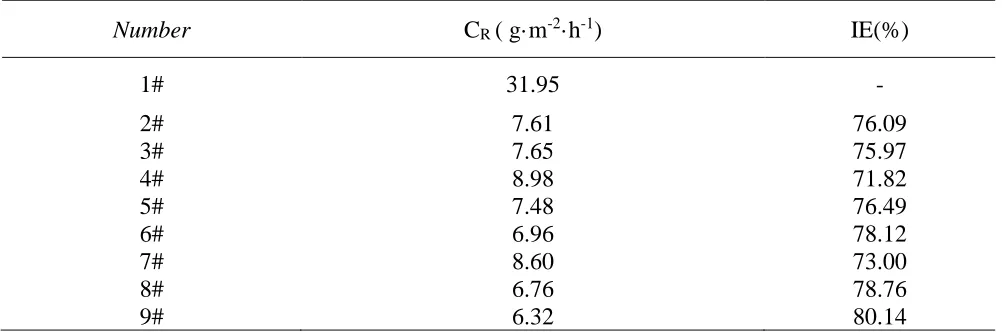
The corrosion rates of N80 steel in 10%HCl + 4%HBF4 solution with different composite
inhibitors without emulsifier at 353K are shown in Tab.3.
Table 3. Corrosion rate and inhibition efficiency for N80 steel in 10%HCl + 4%HBF4 solution with
different composite inhibitor without emulsifier obtained by weight loss method at 353K for 4h
Number CR ( g·m-2·h-1) IE(%)
1# 31.95 -
2# 7.61 76.09
3# 7.65 75.97
4# 8.98 71.82
5# 7.48 76.49
6# 6.96 78.12
7# 8.60 73.00
8# 6.76 78.76
9# 6.32 80.14
The results in Tab.3 indicate that the mixture of these four substances can effectively induce the corrosion rate of N80 steel in 10%HCl + 4%HBF4 solution, the inhibition efficiency of this mixture can
reach to 80.14% when the concentration of butylene glycol, imidazole, polyvinylpyrrolidone and 2-phosphonobutane-1,2,4-tricarboxylic acid is 2%, 3%, 0% and 2%, respectively. Therefore, the proportion of butylene glycol, imidazole and 2-phosphonobutane-1,2,4-tricarboxylic acid in the inhibitor based on emulsion is 2:3:2 in the following experiments in this study.
3.2 Evaluation of inhibitor based on emulsion
The inhibition behavior of inhibitor based on emulsion on N80 steel in acidizing solution were studied by weight-loss and electrochemical methods.
3.2.1 Effect of concentration on inhibition efficiency
In order to select the optimal concentration of inhibitor based on emulsion, weight loss measurements were performed in 10%HCl + 4%HBF4 solution for 4h at 353K. The corrosion rates and
[image:5.596.49.550.229.395.2]
Table 4 Corrosion rate and inhibition efficiency for N80 steel in 10%HCl + 4%HBF4 solution with
inhibitor based on emulsion with different concentrations obtained by weight loss method at 353K for 4h
Cinh(wt%) CR(g·m-2·h-1) IE(%)
0 31.95 0
1% 9.09 71.46
2% 6.75 78.79
4% 2.99 90.53
6% 0.06 99.71
From Tab.4, it can be found that the corrosion inhibition efficiency increased and the corrosion rate decreased considerately with the increasing concentration of inhibitor based on emulsion. This may be attributed to the increased adsorption and coverage of inhibitor based on emulsion molecular on N80 steel surface[21,22]. The inhibition behavior of this mixed inhibitor may be attributed to a compact and coherent film formed on N80 steel and reduced chemical attacks of corrosive ions. The corrosion rate of N80 steel is 0.06g·m-2·h-1 which has already reached the requirement of acidification when the concentration of this mixed inhibitor is 6% (wt%). Therefore, all of the concentration of inhibitor based on emulsion is 6% in the following experiments.
3.2 Effect of temperature on inhibition efficiency
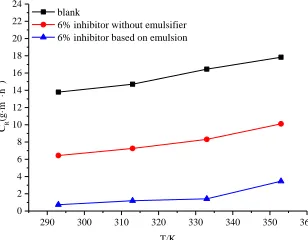
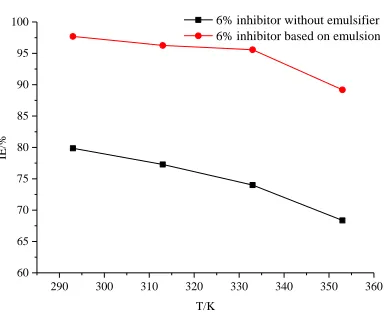
The effects of temperature on the corrosion behavior of N80 steel and the inhibitive behavior of inhibitor based on emulsion were investigated by weight loss measurements in the temperature range 293-353K in 10%HCl + 4%HBF4 solution. The results are shown in Fig.1 and Fig.2.
Figure 1 Corrosion rate of N80 steel in 10%HCl + 4%HBF4 solution with and without different inhibitor
at different temperatures from weight-loss method for 4h
As detected from Fig.1, corrosion rate of N80 steel in 10%HCl + 4%HBF4 solution with and
without different inhibitor increased with increasing of temperature in studied temperature range. The results may be attributed to that increasing point of corrosion on N80 steel surface with increasing temperature and thus the corrosion reactions were more likely to occur.
290 300 310 320 330 340 350 360
0 2 4 6 8 10 12 14 16 18 20 22 24
blank
6% inhibitor without emulsifier 6% inhibitor based on emulsion
CR
(g·m
-2·h -1)
[image:6.596.46.549.125.210.2] [image:6.596.199.353.475.595.2]
Figure 2 Inhibition efficiency different inhibitor on N80 steel in 10%HCl + 4%HBF4 solution at different
temperatures from weight loss method for 4h
As detected from Fig.2, inhibition efficiency of composite inhibitor decreased with increasing of temperature in studied temperature range. The results may be attributed to that the corrosion rate increased sharply at the initial immersing stage before the inhibitor molecules adsorbed on the steel surface to prevent attack of corrosive medium.
3.2.3 Thermodynamic activation parameters
The apparent activation energy and pre-exponential factors for corrosion reaction of N80 steel in different solution can be calculated by Arrhenius equation[23]:
= a
R
E C Aexp
RT
−
(5)
a =Ln
n R E
L C A
RT
−
( ) (6)
where Ea is apparent activation energy, A is the pre-exponential factor and R is the Avogadro
number (6.02×10²³), respectively.
The apparent activation energy and pre-exponential factors of different inhibitor for N80 steel can be calculated by linear regression between lnCR and 1/T, the results were shown in Tab.5. The plots
[image:7.596.185.379.102.259.2]obtained are straight lines and the slop of straight line gives its apparent activation energy and the intercept gives its pre-exponential factor.
Table 5 Thermodynamic activation parameters for N80 steel in 10%HCl + 4%HBF4 solution with and
without different inhibitor
system slop intercept Ea (kJ·mol-1) A(mg·cm-2·h-1)
blank -0.455 6.466 7.115 0.643×10³
6% inhibitor without emulsifier -0.764 6.749 8.990 0.853×10³ 6% inhibitor based on emulsion -1.491 7.141 12.396 1.26×10³
290 300 310 320 330 340 350 360 60
65 70 75 80 85 90 95 100
IE/
%
T/K
[image:7.596.56.547.702.762.2]
Tab.5 showed that in presence of inhibitor, activation energy increased compared to the free acid solution. The increase of apparent activation energy indicates that the energy required for corrosion reaction increases, that is to say the increase of apparent activation energy increases the resistance of corrosion reaction, and then decreases the corrosion rate of steel. It is clear from equation (4) that the higher Ea and lower A lead to the lower corrosion rate. In general, the effect of Ea on steel corrosion is
much higher than that of A on steel corrosion. So, it can come to a conclusion that the inhibitive effect of 6% inhibitor based on emulsion is much better than that of 6% inhibitor without emulsifier.
3.3 Electrochemical measurements
3.3.1 Open circuit potential measurements
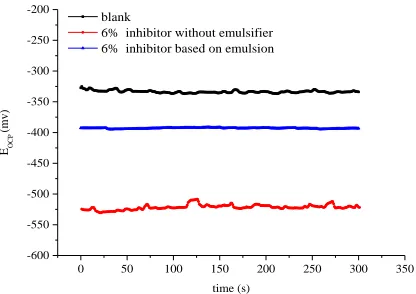
The variation of open potential of working electrode (N80 steel) with time in different solution at 293K is graphically represented in Fig.3.
As detected from Fig.3, the open circuit potential of N80 steel electrode moved to the negative direction after adding different inhibitors compared to that of free acid solution. It took about 300s to reach the steady state for the N80 steel in 10%HCl + 4%HBF4 solution with and without different
inhibitor, so the working electrode (N80 steel) was immersed into 10%HCl + 4%HBF4 solution with and
without inhibitor for at least 5min before each electrochemical measurement.
Figure 3. Open circuit potential of N80 steel electrode in 10%HCl + 4%HBF4 solution with and without
different inhibitor at 293K
3.3.2 Potentiodynamic polarization studies
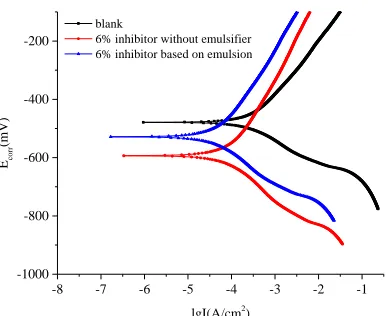
Polarization curves of N80 steel electrode in 10%HCl + 4%HBF4 solution with and without
different inhibitor are shown in Fig.4. The Polarization parameters of N80 steel specimens in 10%HCl + 4%HBF4 solution with and without different inhibitor at 293K are summarized in Tab.6.
0 50 100 150 200 250 300 350 -600
-550 -500 -450 -400 -350 -300 -250 -200
EO
CP
(mv)
time (s) blank
[image:8.596.173.381.427.574.2]
-8 -7 -6 -5 -4 -3 -2 -1 -1000
-800 -600 -400 -200
Ecor
r
(mV)
lgI(A/cm2)
blank
6% inhibitor without emulsifier 6% inhibitor based on emulsion
Figure 4. Polarization curves for N80 steel immersed in 10%HCl + 4%HBF4 solution with and without
[image:9.596.192.385.86.244.2]different inhibitor at 293K
Table 6. Electrochemical parameters for N80 steel immersed in 10%HCl + 4%HBF4 solution with and
without different inhibitor at 293K
System Ecorr (mV) icorr (mA/cm2) IE%
blank -482 405.7 -
inhibitor without emulsifier -614 118.54 70.78%
inhibitor based on emulsion -533 35.44 91.26%
It can be found that the corrosion current density of N80 steel in the system with inhibitor based on emulsion reduced significantly and the inhibition efficiency was 91.26% which was much higher than that of inhibitor without emulsifier. The corrosion potential of N80 steels shifted to more negative value after adding different inhibitor in 10%HCl + 4%HBF4 solution. According to the literatures[24,25], it
has been reported that if the displacement in Ecorr in the presence of inhibitor is more than 85mV, the
inhibitor can be classified as a cathode or anode type, on the contrary, if the displacement in Ecorr in the
presence of inhibitor is less than 85mV, the inhibitor can be classified as a mixed type. Based on this result, it can be speculated that the inhibitor without emulsifier is a cathode inhibitor which mainly inhibit the cathode reaction of corrosion, meanwhile, the inhibitor based on emulsion is a mixed type inhibitor which can inhibit both cathode and anode reaction of corrosion, so as to show better inhibitive effect.
3.3.3 AC impedance analysis
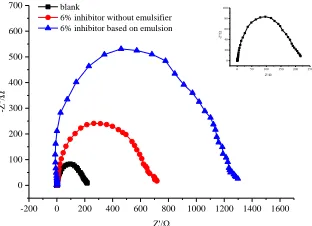
The corrosion resistance of the N80 steel was investigated via the electrochemical impedance technique under different acid conditions. The Nyquist curves of N80 steel in 10%HCl + 4%HBF4
Figure 6. Nyquist curves for N80 steel immersed in 10%HCl + 4%HBF4 solution with and without
different inhibitor at 293K
Table 7. EIS parameters for N80 steel immersed in 10%HCl + 4%HBF4 solution with and without
different inhibitor at 293K
System Rp( Ω·cm2) fmax(Hz) Cdl(µF·cm-2) IE%
blank 202 9.68 186.37 -
inhibitor without emulsifier 694 25.43 48.28 70.97% inhibitor based on emulsion 1333 42.36 21.45 88.35%
As shown in Fig.5, the arc radius of N80 steel increased after adding different inhibitors in 10%HCl + 4%HBF4 solution, it indicated that the inhibitors increased the resistance to the corrosion
reaction of steel. These results suggest that the inhibitor can be adsorbed on the surface of the steel to form a protective film, which improves the impedance value and prevents the acid solution from corroding the steel. Fig.5 also demonstrated that the inhibitor based on emulsion can inhibit the corrosion reaction of N80 steel more effectively compared to inhibitor without emulsifier. The results of electrochemical tests were highly compatible with that of weight-loss method. The Nyquist curves for N80 steel immersed in 10%HCl + 4%HBF4 solution with and without different inhibitor are in same
form which manifest that the inhibitor did not change the corrosion mechanism of steel while reduced the corrosion rate significantly.
3.4 Analysis of N80 steel surface and corrosion products 3.4.1 Corrosion morphologies
The microscopic morphologies and microstructure of the N80 steel after immersed in the 10%HCl + 4%HBF4 solution with and without different inhibitor were revealed using SEM and the
results are shown in Fig.6. As shown in Fig.6, the N80 steel surface appeared very rough due to the formation of uniform dot corrosion products after immersed in acid solution without inhibitor. The surface was severely damaged, and many pits were visible in the microphotograph after removing the corrosion products on the steel surface.
-200 0 200 400 600 800 1000 1200 1400 1600
0 100 200 300 400 500 600 700
0 50 100 150 200 250 0
20 40 60 80 100
-Z''/Ω
Z'/Ω
-Z''/
Ω
Z'/Ω blank
[image:10.596.221.377.86.199.2] [image:10.596.86.509.303.361.2]
[image:11.596.57.514.68.212.2]
(a) without inhibitor (b) inhibitor without emulsifier (c) inhibitor based on emulsion
Figure 6 Scanning electron micrographs of N80 steel surface after immersing in 10%HCl + 4%HBF4
solution with and without different inhibitor at 353K
There is no serious uniform corrosion damage on the surface of N80 steel after immersed in 10%HCl + 4%HBF4 solution with 6% inhibitor without emulsifier, but the corrosion pits are visible, the
result is attributed to that the inhibitor without emulsifier can just restrain uniform corrosion. There are neither serious uniform corrosion damage nor corrosion pits on the surface of N80 steel after immersed in 10%HCl + 4%HBF4 solution with 6% inhibitor based on emulsion, these results suggest that the
inhibitor based on emulsion generates a protective film, possibly due to adsorption of the inhibitor molecules on the steel surface. This film prevents attack of corrode ions on the steel metal surface.
3.4.2 Component of corrosion products
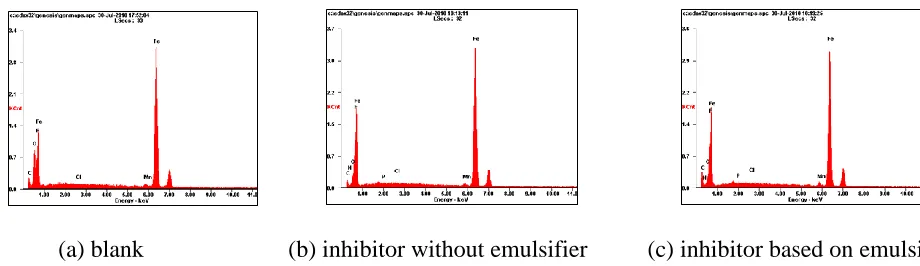
To further investigate the elements in the layer covering the steel surface, the element distribution of the steel immersed in fresh acid was determined by elemental mapping, as shown in Tab.8. Fe, Mn, and C were the main elements in the N80 steel, but a uniform distribution of O and Cl was also observed, indicating that the inhibitor molecules were absorbed on the steel surface to form the protective film.
(a) blank (b) inhibitor without emulsifier (c) inhibitor based on emulsion Figure 7. EDS Elemental Analysis of N80 Steel Surface after immersing in 10%HCl + 4%HBF4 solution
[image:11.596.63.523.528.661.2]
Table 8. Elemental content of N80 steel surface after immersing in10%HCl + 4%HBF4 solution with
and without different inhibitor for 4h at 353K
C Mn Fe O N F Cl P
a Wt% 9.90 1.35 73.51 10.05 - 5.05 0.14 -
At% 26.90 0.80 42.97 20.51 - 8.68 0.13 -
b Wt% 8.18 1.41 77.66 3.66 1.68 7.10 0.10 0.19
At% 24.06 0.91 49.15 8.10 4.25 13.21 0.10 0.22
c Wt% 14.46 1.24 72.01 3.64 1.89 6.53 0.13 0.11
At% 37.28 0.70 39.93 7.04 4.18 10.65 0.11 0.11
Notes: (a) after immersing 10%HCl + 4%HBF4 solution without inhibitor; (b) after immersing 10%HCl
+ 4%HBF4 solution with 6% inhibitor without emulsifier; (c) after immersing in 10%HCl + 4%HBF4
solution with 6% inhibitor based on emulsion; Wt%: the relative mass percentage of the elements; At%:the relative atomic number percentage of the elements.
3.4.3 Phase composition of corrosion products
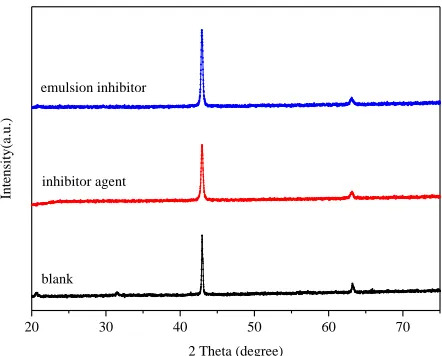
X-ray diffraction (XRD) measurements were performed to investigate the phase composition of N80 steel after immersed in 10%HCl + 4%HBF4 with and without different inhibitor. As shown in Fig.
8, the characteristic peaks of N80 steel are at 43.94 and 64.15, and the base line is relatively smooth. Compared with the characteristic peaks of N80 steel after immersed in acid solution without inhibitor, the peaks of N80 steels after immersed in acid solution with inhibitor did not obviously differ, but the intensities of the characteristic peaks were gradually enhanced. In addition, the baseline of the immersed N80 steel become smoother due to the presence of inhibitor which indicated that the corrosion would generate some fluctuating signal peaks.
Figure 8. X-ray diffraction pattern of N80 steel after after immersing in10%HCl + 4%HBF4 solution
with and without different inhibitor for 4h at 353K
20 30 40 50 60 70
emulsion inhibitor
inhibitor agent
blank
Int
ens
it
y
(a.u.)
[image:12.596.145.366.523.701.2]
The XRD curves revealed no obvious changes in the characteristic peaks, indicating that the inhibitor inhibited the corrosion of N80 steel through dynamic physical and chemical adsorption, similar to the results reported by Zou[26], Zhang[27] and Zhao[28].
4. CONCLUSION
(1) A kind of inhibitor based on emulsion was prepared by composite inhibitor, oil and emulsifier in a certain proportion of 3:1:1. The composite inhibitor was prepared by butylene glycol, imidazole and 2-phosphonobutane-1,2,4-tricarboxylic acid according to the mass ratio of 2:3:2.
(2) The inhibition efficiency of inhibitor based on emulsion increased with the increasing concentration and decreased with the increasing of temperature.
(3) The existence of oil and emulsifier improved the quality of anti-corrosion film on N80 steel surface, and then improved inhibition efficiency and decreased the production cost.
(4) The results of electrochemical indicated that the inhibitor based on emulsion was a mix inhibitor which can reduce the corrosion rate of anode and cathode reaction without changing the corrosion mechanism of N80 steel in 10%HCl + 4%HBF4 solution.
ACKNOWLEDGEMENTS
The work was supported by the Open Fund (PNL201824) of State Key Laboratory of Oil and Gas Reservoir Geology and Exploitation (Southwest Petroleum University).
References
1. U.C. Nwaogu, C. Blawert, N. Scharnagl, W. Dietzel and K.U. Kainer, Corros. Sci., 6(2010)2143. 2. M.A. Quraishi, N.K. Gupta, C. Verma, R. Salghi, H. Lgaz and A.K. Mukherjee, New J. Chem.,
21(2017)1.
3. S. Ashhari and A.A. Sarabi, Pigm. Resin. Technol., 5(2015) 322.
4. M.N. El-Haddad and K.M. Elattar, Res. Chem. Intermed., 7(2013)3135.
5. Z.L. Wang, J. Zhang, Z.M. Wang, L. Zhou, X. Han, Q..F Li and S. Gao, Corros. Sci., 86(2014)310. 6. F. Shi, X. Wang, J. Yu and B. Hou , Anti-Corros. Methods M. 3(2011)111.
7. N. Li, F. Zeng, J. Li, Q. Zhang, Y. Feng and P. Liu, J. Nat. Gas. Sci. Eng., 34(2016)792. 8. E.H.S.M. Abd, E.W.S. Abd, E.A.E.E. Abd and A. Farouk, Corros. Sci., 1(2013)1. 9. T.J. Harvey, F.C. Walsh and A.H. Nahlé, J. Mol. Liq., 266(2018).
10. W. Zhang, S. Li and R. Ma, Chem. Res. Chin. Univ., 5(2016)827. 11. S. Chen, L. Li, C. Wang, B. Yuan and W. Li, Sensors, 4(2012)4962.
12. O. Olivares-Xometl, N.V. Likhanova, M.A. Domı´nguezAguilar, E. Arce, H. Dorantes and P. Arellanes-Lozada, Mater. Chem. Phys., 110(2008)344.
13. G. Quartarone, M. Battilana, L. Bonaldo and T. Tortato, Corros. Sci., 50(2008)3467. 14. E.E. Ebenso, Bull. Electrochem., 19(2003)209.
15. G.A. Zhang and Y.F. Cheng, Corros. Sci., 51(2009)901.
16. H.Q. Becerra, C. Retamoso and D.D. Macdonald, Corros. Sci., 42(2000)561. 17. K.D. Efird and R.J. Jasinski, Corros., 45(1989)165.
19. Y.H. Zhu, L.Q. Zhao, P.L. Liu and M. Yang, Anti-Corros. Methods M., 65(2018)451. 20. J. Du, J.H. Guo, L.Q. Zhao, Y.X. Chen, C.L. Liu and X.H. Meng, Int. J. Electrochem. Sci.,
13(2018)5810
21. A.K. Singh and M.A. Quraishi, J. Appl. Electrochem., 40(2010)1293. 22. 18 J.O. Bockris and D. Drazic, Electrochim. Acta, 7(1962)293.
23. E.A. Noor and A.H. Al-Moubaraki, Mater. Chem. Phys., 110(2008)145. 24. A.A.F. Sabirneeza and S. Subhashini, Inter. J. Ind. Chem., 5(2014)111.
25. E.S. Ferreira, C. Giacomelli, F.C. Giacomelli and A. Spinelli, Mater. Chem. Phys., 83(2004)129. 26. Y. Zuo, L. Yang, Y. Tan, Y. Wang and J. Zhao, Corros. Sci., 120(2017)99.
27. J. Zhang, X. L. Gong, H. H. Yu and M. Du, Corros. Sci., 10(2011)3324. 28. J. Zhao and G. Chen, Electrochim. Acta, 5(2012)247.