Unless otherwise indicated, the views expressed are attributable only to the author in a personal capacity and not to any institution with which he is associated.
ISBN 92-9079-527-1
Available for free downloading from the CEPS website (http://www.ceps.be) © Copyright 2004, Alfred Steinherr
Thinking ahead for Europe
Russian Banking
since the Crisis of 1998
Alfred Steinherr
Abstract
This paper establishes that the banking sector in Russia is far less-developed than in the formerly socialist countries of Central Europe and that the underdevelopment of the financial sector is a drag on economic growth. It holds that the major cause of the financial crisis of 1998 was not losses on treasury-bill investments, as widely thought, but foreign exchange exposures, imprudent lending with limited risk diversification and bad management. The financial crisis, often regarded as not very damaging on account of the small size of the banking sector compared to GDP, caused substantial costs in terms of economic growth.
An amazing feature of crisis resolution was that the authorities abstained from substantially restructuring the banking sector. With regard to much-needed reforms, alternatives are proposed to privatising Russia’s dominating state bank, Sberbank. The paper also recommends the introduction of two types of licenses for banks, rather than closing an excessively large number of inefficient banks that have an important role in serving distant areas. The paper concludes that although some steps to make the financial system more robust have been taken, swift and substantial action is still needed.
Alfred Steinherr is the Chief Economist at the European Investment Bank.
The author wishes to thank Irena Petrounova and Irina Ryzhova for their detailed comments without implicating their responsibility for remaining shortcomings and Roberta Benini for very useful editorial suggestions.
European
Policy Studies
Introduction ...1
1. A bad start: 1988-98 ...1
2. The crisis of 1998 ...4
3. Does quick growth recovery justify the passive policy approach to restructuring? ...7
4. The present state of the banking sector...10
5. Unresolved issues ...11
Problem 1: Lack of an enabling environment...11
Problem 2: Which banking model? ...12
Problem 3: Establishing a level playing field ...13
Problem 4: How to increase trust in the banking system? ...13
Problem 5: Deepening financial intermediation ...15
Problem 6: The regulatory framework ...16
Problem 7: Corporate governance ...17
6. Conclusions ...18
| 1
CEPS
W
ORKING
D
OCUMENT
N
O
.
209/O
CTOBER
2004
A
LFRED
S
TEINHERR
Introduction
The evolution of the Russian banking sector since the crisis of 1998 is difficult to understand without first taking account of its origins after the demise of the socialist monobank system. Section 1 of this report reviews the period 1988-98 and sets out the salient features of the unfortunate naissance of a decentralised banking sector with private capital participation.
Section 2 analyses the crisis of 1998 in which the entire banking system became illiquid and insolvent. As opposed to received opinion, this section argues that the default on government debt was not a major cause of the insolvency of banks. The major and unique cause was poor or absent regulation. That allowed banks to accumulate foreign currency borrowings without matching foreign currency assets. Banks were also totally free to enter into forward contracts in the foreign exchange market, which implied major risks. In addition to the unbalanced foreign-exchange assets and liabilities, with weak regulation and supervision banks were able to make imprudent and improper loans that became non-performing in the crisis. The Central Bank of Russia (CBR) was able to find solutions that minimised the losses for depositors, which minimised the impact on the structure of the industry.
The crisis provided a historic opportunity to establish a framework closer to tested Western standards and to clean up the very peculiar Russian banking landscape. But not much happened. Section 3 attempts an evaluation of the costs of the crisis and of not dealing with bank restructuring in terms of growth lost. Section 4 assesses the current state of the banking sector and identifies significant improvements since 1998. Section 5 discusses the unresolved issues and makes various policy proposals. Among others, it elaborates alternatives to the two big issues, in particular privatisation of Sberbank and closing hundreds of inefficient banks. Section 6 concludes.
1.
A bad start: 1988-98
As in all socialist economies, the Soviet Union operated with a monobank system consisting of a state bank (Gosbank) that operated as both a central bank and a commercial bank. In 1988 the government created a two-tier banking system, comprising the CBR and five ‘spetz’ banks (Agroprombank, Promstroibank, Sberbank, Vnesheconombank and Zhilsotsbank), which were designed to fund specific state programmes. Through the 1988 Law on Cooperatives, the government allowed the creation of so-called ‘zero banks’, which were formed from private capital but often benefited from official financial sources. Additionally, many firms created ‘pocket banks’, which acted primarily as account agents for related companies. When Russia achieved statehood in 1992, the number of licensed banks exceeded 1,300.
Several factors caused this proliferation of banks. First, pro-sovereignty Russian politicians used lax entry conditions to break the financial power of the USSR state banking system. Second, high inflation made it easy to satisfy the minimum capital requirements for creating a bank. Third, former state bank officials used their connections in the CBR to speed up registrations.
Responsibility for overseeing, regulating and licensing these banks fell to the CBR. From the beginning this task was exposed to conflicts of interest as the CBR was closely intertwined with commercial banks.1 Many former branch banks of the Soviet-era Central Bank transformed themselves
1
into private commercial banks. The largest banks (Sberbank, Agroprombank, Promstroibank, VEB and VTB) remained in state hands, directly or through ownership by the CBR. Thus, the state/Central Bank of Russia owns a large part of the banking sector and the CBR is the regulator of all banks.
The difficult and highly volatile macroeconomic environment of the 1990s would have made banking very difficult even for a mature banking sector. Further, property rights and legal procedures were in constant evolution, making lending to private companies difficult and risky. As a consequence, banks only marginally engaged in standard financial intermediation between savers and investors. Rather banks spotted the opportunity to extract resources from the state. The means by which banks extracted rents varied over time, but none generated incentives for banks to develop financial intermediation or to invest in better governance.
Hyperinflation in 1992 and 1993 generated vast revenues for banks. Easterly and de Cunha (1993) estimate the transfer of wealth to banks through hyperinflation at 6 to 9% of GDP. For a sector with capital of less than 1% of GDP this is not bad. Banks paid negative real deposit rates and made loans at very large spreads. Some of the loans were disbursement of government credits granted to specific sectors or firms. On the external side, hyperinflation caused the dollar value of the rouble to fall sharply. Banks invested a large part of their rouble liabilities in dollar assets, making a pile of money. They also helped clients to transfer capital abroad against a sizeable cut. By the mid-1990s these fabulous gains cemented a powerful banking/industrial lobby (as most private banks are owned by industrial groups) that could start influencing policy to its advantage.
Having prospered from hyperinflation during 1992 and 1993, banks found a new source of exceptional revenues in 1994. At that time the government began financing its deficit by issuing treasury bills (GKOs).2 They were denominated in roubles and had maturities of up to 12 months. The banking industry lobbied successfully to exclude foreigners from the market. The CBR, acting as the issuing agency and the market-maker, sold GKOs only to a select group of banks. By the end of 1995 there were, however, over 130 primary dealers in the GKO market. Rates of return fluctuated between 20% and 250% in line with the market’s perception of inflation risk. Frye (2002) reported from Russian Economic Trends (5 March 1998) that during 1994-98 the Russian government obtained $15 billion from issuing GKOs, but the nominal value of GKOs held by lenders – mostly banks and the CBR through Sberbank (during 1997-98 they held an estimated two-thirds of outstanding GKOs) – was $70 billion.
Another source of rents extracted from the public sector was the management of local, regional and federal government funds. Johnson (2000) cites an estimate by the State Audit Chamber that banks earned more than $1.3 billion in 1995 and 1996 from these special relationships. In addition, the now infamous ‘loans-for-shares’ scheme, combined with the right to conduct the auctions in which they or related firms would participate, made some banks and their owners very rich.3
It is therefore not surprising that normal financial intermediation could not develop. Most firms outside the orbit of industrial groups owning the banks did not have access to credit. Those that obtained credit paid exorbitant mark-ups. In a situation of asymmetric information, the extremely high interest rates created a classic adverse-selection problem, as became clear during the crisis.
Long-term finance has been unavailable as is generally the case in developing financial markets. Most credits had maturities of less than a year with uncertain rollover prospects and, in times of liquidity crisis, faced the prospect of the shortening of maturities or arbitrary recalls. Nor were there any incentives for bankers to lobby for clearer and more transparent regulation. On the contrary, banks lobbied against moving more quickly towards Western standards, promising ‘normal’ rates of return.
2
GKOs are zero-coupon instruments, so that the difference between the issuing price (what the government receives) and the maturity price (what the government pays back) reflects the interest payment. Since the CBR is entitled to keep half of its profits and turns over the other half to the federal government, the costs of GKOs held by the CBR were not offset for the Russian government.
3
When Central Bank Chairman Viktor Gerashchenko, whom Jeffrey Sachs once called the “worst central banker in the world”, stepped down after a botched currency reform in October 1994, Tatyana Paramonova took his place and seemed serious about banking regulation and governance. The Association for Russian Banks resisted her efforts to raise capital requirements for banks and in November 1995 Sergei Dubinin, who was strongly supported by the banking community, replaced her.
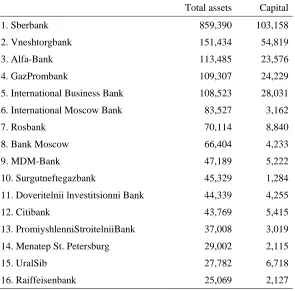
The proliferation of private banks in a regulatory void and the peculiar relationship between banks and the government, and banks and industrial groups owned by oligarchs, which generated a bonanza of rents, are one side of the sad initial years. The other side is that the public sector did not disengage from banking. The CBR is a majority owner of the country’s largest bank, Sberbank, and until October 2002 it also owned Vneshtorgbank (VTB), the country’s largest foreign trade bank. Sberbank is not only the largest bank but represents by itself a quarter or more of the banking sector (Table 1).
Table 1 lists the largest 16 banks in 2002, four years after the crisis. The two largest banks by far are state banks. They also have the highest capital in relation to assets. To take two extremes, VTB has more than one-third of its assets covered by capital whereas Surgutneftegazbank has only 3% of assets covered by capital. Of these 16 banks only two are foreign-controlled. Most banks are part of an industrial holding.
[image:5.595.153.448.448.739.2]In terms of total assets, Sberbank has 25% of the banking sector and the second largest bank, VTB, has 5%. In terms of deposits, Sberbank has 75% of total deposits and 90% of deposits by households. There are three reasons for this domination. First, Sberbank is government-owned (more precisely CBR-owned) and enjoys the privilege of a state guarantee of its deposits. Second, it is the successor of the socialist monobank and has agencies throughout Russia. Third, being state-owned and present in all of Russia it is in charge of payment of government pensions. Pensioners hold 60% of Sberbank deposits. The State Pension Fund only deals with Sberbank (for a very good reason – Sberbank is the only bank with a presence throughout Russia) and transfers $1.5 billion monthly to Sberbank accounts.
Table 1. Banks ranked according to total assets (in millions of roubles), 1 March 2002
Total assets Capital
1. Sberbank 859,390 103,158
2. Vneshtorgbank 151,434 54,819
3. Alfa-Bank 113,485 23,576
4. GazPrombank 109,307 24,229
5. International Business Bank 108,523 28,031
6. International Moscow Bank 83,527 3,162
7. Rosbank 70,114 8,840
8. Bank Moscow 66,404 4,233
9. MDM-Bank 47,189 5,222
10. Surgutneftegazbank 45,329 1,284
11. Doveritelnii lnvestitsionni Bank 44,339 4,255
12. Citibank 43,769 5,415
13. PromiyshlenniStroitelniiBank 37,008 3,019
14. Menatep St. Petersburg 29,002 2,115
15. UralSib 27,782 6,718
16. Raiffeisenbank 25,069 2,127
As a result there is not a level playing field. Sberbank can attract deposits at rates below those of its competitors, saving an estimated $100 million annually. But much more damaging is its dominance of the deposits market, depriving private banks of deposits as a source of funding. Banks can borrow from each other and the banking sector as a whole can borrow from the government, the central bank or the domestic or international capital markets. Borrowing from the government did occur but cannot be a regular source of funding. Even funding through the central bank, at times massive, cannot be a steady and growing source. What remains is the capital market. Yet the domestic capital market is not developed enough to provide substantial resources. Hence the need of Russian banks to borrow in foreign currency in external capital markets or from international banks. One could therefore argue that the crowding out of private banks from the deposit market through the privileges granted to Sberbank, combined with the lack of prudential rules for foreign currency exposures, created the vulnerability of the banking sector before 1998.
In the early 1990s some politicians had already proposed government guarantees for all retail deposits. The CBR and the government saw the advantage of bringing ‘mattress money’ into banks, but were not ready to remove Sberbank’s advantage in the deposits market. The CBR also was able to block attempts at privatising some of its bank holdings. Spurred by the failure of pyramid schemes in 1994, the State Duma again proposed deposit insurance, but was blocked by the bankers’ lobby.4 Following the crash of August 1998, both houses passed legislation backing deposit insurance, but President Boris Yeltsin vetoed it. Only 2004 saw the beginning of implementation of deposit insurance.
These arrangements benefited the government and the CBR: in 1997 and 1998, the CBR and Sberbank held roughly two-thirds of GKOs, an arrangement that allowed the federal government to cover its deficit. The benefit for the CBR consisted in being able to retain half of its profits and to turn the other half over to government. This arrangement also provided incentives to underreport profits, for which the CBR uses a variety of schemes (such as relying on foreign banks owned by the CBR to buy and trade in GKOs and placing unreported funds abroad). According to the Audit Chamber of the Russian Federation, more than $50 billion passed through an account of the CBR in an obscure bank in Jersey, unreported to the government or the International Monetary Fund (IMF).
2.
The crisis of 1998
Nevertheless, in early 1998 the CBR underlined the solidity of the Russian banking sector pointing to the high capital/assets ratios and valuing loan provisions as adequate. In the four years preceding the crisis, Russia had started to promote foreign capital inflows, which over the years could not compensate for the dramatic size of capital outflows. Remarkable is the fact that the government never seriously attempted to stop capital flight, which would have been easier than attracting foreigners to invest in Russia.
Russia took advantage of the worldwide attraction of investors to emerging markets. Stabilisation succeeded in a rouble-dollar peg in July 1995 and Russia received financial support from the IMF and the World Bank. Mr. Yeltsin was re-elected in 1996, so the political uncertainty seemed to be over. In February 1996 foreign investors were allowed to buy GKOs in primary markets (against the opposition of the banking lobby) and to repatriate the related income. With foreign capital responding positively to these changes, the Russian stock market rose by 142% in 1996 and 184% during the first eight months of 1997.
After the collapse of the stock market and the Asian crisis, concern surfaced over the possibility of Russia suffering the same fate as Thailand or Indonesia. Foreign institutional investors, attracted by the high GKO yields, purchased foreign-exchange coverage by entering into forward agreements with Russian bank counterparts. Investors worldwide reallocated their assets in favour of high quality.
4
Russia faced increasing difficulties in rolling over its debt and in supporting the exchange rate. In August 1998 it gave up on the exchange rate and froze GKO operations.
The crisis revealed the underlying deep structural flaws of the banking sector. As Sberbank’s quasi-monopoly in the retail sector had crowded out private banks they borrowed abroad. As of July 1998, 75% of the foreign currency liabilities were concentrated in the 20 largest banks, where they represented 20% of total liabilities. Foreign currency assets were much less. In addition to a currency imbalance, there was a maturity imbalance as banks borrowed foreign currency short term to be rolled-over (as long as that was possible) and lent longer term.
Inadequate risk and liquidity management at commercial banks, inefficient nationwide settlement and clearing systems, poor monitoring by the CBR and exaggerated confidence in the CBR’s ability to keep the rouble fixed were factors that exacerbated these excessive risks. Management of banks that were part of an industrial holding pursued maximisation of the results for the holding and not for the bank.
While all banks were affected by the crisis, the biggest impact was on the top 20 banks, excluding Sberbank and a few others. Large banks suffered losses from:
• positions on foreign-exchange forward contracts (only large banks could enter into such deals);
• the losses on the GKO portfolios;
• liquidity shortages owing to the outflow of client deposits (small banks had virtually no deposits); and
• defaults on margin calls.
Large banks lost between 14% and 45% of their retail deposits. An exception was Sberbank, which kept the large majority of its rouble-denominated accounts, but lost over 30% of its US-dollar denominated accounts. To protect savers, the CBR offered to transfer savings from insolvent banks to Sberbank, since deposits at Sberbank were insured. Further, dollar accounts were transferred to Sberbank at a rate of 9 roubles per dollar (much below the market rate) whereby it is estimated that customers lost half of the value of their dollar deposits.
Most analysts share the view that the effect of the banking crisis on the Russian economy was very limited. As bank lending to the private sector was underdeveloped and represented less than 10% of GDP, the temporary breakdown of financial intermediation could not be a big loss for corporations. In addition, large corporations were able to net deposits with loans granted to different parts of the industrial holding. They also were able to move their deposits before retail account holders as they had bargaining power over the banks. For example, Rossiisky Kredit, Inkombank and Menatep lost between 50% and 70% of their deposits between August and September. The major reasons for the financial crisis were the high concentration of assets among highly leveraged and badly managed banks, extraordinary exposure to foreign exchange risks and the loss of client confidence.
The loss on GKO investments was not, contrary to a widely held view, a major cause of insolvability. Indeed, banks had significantly decreased their GKO investments before the default and converted the proceeds into dollar securities. By the time the GKO default occurred, banks had less than 10% of their assets invested in GKOs. What looks like smart or lucky management has a more earthy Russian explanation. Vladimir Potanin, head of Oneximbank, stated in an interview that bankers knew by 14 August that the government would devalue on 17 August. Most large banks also took advantage of the debt-exchange programme of 15 July 1998, whereby the government offered to exchange short-term rouble treasury bills for 7-year or 20-year dollar Eurobonds to reduce the volume of short-term debt. This debt exchange was seen as a key part of a loan agreement with the IMF and the World Bank.
long positions may provide some offset, is extraordinary. Most banks were short on rouble forward contracts so that the offsets were not very large. For some banks their forward exposure represented a large multiple of total assets. The most-exposed banks in relation to assets were MDM-Bank, Unibest and Metkombank.
Table 2. Russian banks with largest forward contracts, 1 July 1998
Forward contract
(billions of roubles)
% of assets
Inkombank 169.2 469.9
National Reserve 99.4 944.4
MDM-Bank 84.6 4,656.8
Unibest 77.6 3,709.2
Tokobank 66.9 871.7
ONEKSIM-bank 47.3 197.9
Sberbank 39.5 19.7
SBS-Agro 31.2 115.8
Avtobank 26.8 303.2
GazPrombank 25.7 189.5
Menatep 24.2 131.5
Vneshtorgbank 24.1 132.9
Mezhkombank 23.6 690.5
Rossiski Kredit 22.0 113.8
Metkombank 19.2 2,000.0
Source: Gros & Steinherr (2004).
In addition, larger Russian banks not only acted as counterparts to foreigners covering their rouble risks, they also bought dollars with smaller Russian banks as counterparts. Thus they had a large counterparty risk on their winning contracts and were on the losing side with strong foreign counterparties. In the end, a number of tricks allowed banks to reduce the impact of their foreign exchange risk. One trick was to invoke force majeure and another was to corner the spot market when the maturities of large contract amounts were bunched on specific dates. In the end, losses from non-payment of government paper represented 18% of banks’ losses, whilst 82% were accounted for by foreign-exchange losses and losses from bad loans.
One of the weaknesses of Russian banks has been the low diversification of loan portfolio risks. Even after the crisis, this is still the case. According to 2001 data, the ten most important borrowers accounted for half of the credit portfolio and almost 30% of all assets of the average Russian bank (Ippolito, 2002). It is often the case that a few key corporate clients dominate the credit institutions from which they borrow. In the smaller banks the ten largest credits amounted to 80% of their loan portfolio in 2001; in medium-sized banks their share reduced to 55-65%; and in large banks it averaged 45%. As asset amounts increase, credits are typically replaced by investments in securities.
The view of a limited cost of the crisis, on account of the small size of the banking sector, is contrary to the experience in many countries with underdeveloped financial systems. Certainly the apparent cost was limited by luck: the increase in oil and other commodity prices started in 1999 and thereby helped the economy to resume growth again that year. Nevertheless, we show in section 4 that this view is unsustainable.
buy time, as needed in a liquidity crisis. But in fact it reduced the real cost of banks. Suppose that in June 1998 a Russian bank bought dollars forward for September at 9 roubles. On the date in September the spot price is 15 roubles per dollar. It therefore owes the counterpart 6 roubles per dollar. But it does not have to pay immediately because of the moratorium. When the moratorium elapses the rouble is at 24 per dollar. If the bank has some dollars it can sell dollars against roubles and pay $0.25 for the 6 roubles it owes. In September the cost would have been $0.40 or 60% more.
The second measure was to transfer deposits from banks with difficulties to Sberbank. This may have prevented a bank run but it seems that banks, although officially invited to transfer deposits, in fact had no choice. As the CBR is the owner of Sberbank, the policy appeared suspect.
The third measure was to inject liquidity (46 billion roubles) into the banking system at rates significantly below market rates. Of that amount, 35 billion represented the cost of the government guarantee for the repayment of all deposits frozen at insolvent banks. Around 11 billion roubles were provided as short-term ‘stabilisation loans’ to the largest banks. The CBR made long-term loans to 17 banks. The largest recipient (with 9 billion roubles) was Sberbank. Yet this strong support by the CBR was neither able to give clients confidence in their banks nor could it save all banks from insolvency.
But surprisingly, few banks were actually closed. The total number of bank licenses revoked in 1998 was 229 compared with 334 in 1997. Typically, when countries experience a banking crisis, a big restructuring follows to which a large number of banks – perhaps as much as 50% – fall prey.
Acknowledging the experience of other countries that have suffered a banking crisis and have found it useful to create an independent agency in charge of the restructuring process, ARCO – the Agency for the Restructuring of Credit Organisations – was created in early 1999. But from the beginning ARCO suffered from fatal flaws: first, with capital of 10 billion roubles it was undercapitalised to effectively restructure the banking sector. Second, it lacked independence and fell under the control of the CBR. The chairman of the CBR was appointed chairman of ARCO’s board of directors and former Deputy Chairman of the CBR, Alexander Turbanov, was appointed its Director General. Third, ARCO lacked the right to close down insolvent banks or impose a restructuring plan. An additional law in July 1999 gave ARCO the right to impose restructuring on insolvent banks. ARCO wasted most of its capital by buying up ‘off-market’ government bonds and by providing a loan of 1 billion roubles to the untroubled, but presumably well-connected Alfa Bank. This loan served to establish branches in regions facing problems with underdeveloped banking services. Alfa Bank opened 15 operational units in 14 regions.
Altogether, by 2003 ARCO had participated in 21 projects in 12 regions of Russia. It had completed the restructuring of 14 banks and liquidated three banks. The total funding of restructuring measures amounted to 16 billion roubles, a very modest amount in comparison to the usual cost of cleaning up the banking landscape after a deep banking crisis. For comparison, the clean-up of the banking sector in Turkey after the crisis of 2001 is estimated to have cost $40 billion (Steinherr, Tukel & Ucer, 2004).
In February 1999, the Law on the Bankruptcy of Credit Institutions was passed, providing a definition of a bankrupt bank and setting out bankruptcy procedures. Unfortunately, the Law protects incumbent shareholders and not creditors. It therefore did not stop asset-stripping and other manoeuvres. After the passage of the law, at least half of the top 10 banks moved their business to newly established bridge banks in violation of creditor rights.
3.
Does quick growth recovery justify the passive policy approach to
restructuring?
exceptional and different from the experience of other countries. Empirical research on banking crises identifies several conditions for successfully overcoming a deep financial crisis, as follows:5
• First, a comprehensive bank-restructuring programme is needed. This requires a solution for the stock of non-performing loans, initiatives to ensure that new loans are better performing and reforms of banks’ internal risk-management systems.
• Second, bank restructuring is best undertaken by the government and financed in a transparent way with tax revenues. This is preferable to central bank financing, which is less transparent, may lead to increased inflation and in the end to a higher fiscal cost.
• Third, these actions need to be carried out swiftly to minimise damage and fiscal cost.
It is remarkable that Russia did not take any of these three steps. It was the CBR that acted as lender of last resort, as if the crisis had been a liquidity crisis. (Of course, at the beginning of a crisis it is difficult to distinguish between insolvent and temporarily illiquid banks.) As argued in section 3, these interventions by the CBR were neither transparent nor following a clearly defined strategy.
The government neither implemented a bank restructuring programme nor a programme dealing with bank debtors, such as enforcement of overdue debt with pledged securities. The lenience of the CBR regarding the violation of prudential rules and its granting of uncollateralised stabilisation loans reinforced incentives for banks to ‘gamble for resurrection’. The consequence was taking high risks, distributing profits despite solvency problems and stripping assets.6
[image:10.595.76.527.429.527.2]As a result, most of the bankrupt banks were not liquidated. It is true that bank licenses were revoked, but amazingly in fewer numbers than before the crisis as shown in Table 3. And banks with revoked licenses were not liquidated, but instead became ‘phantom banks’.
Table 3. Number of credit institutions and revoked licenses in Russia, 1995-2002
1995 1996 1997 1998 1999 2000 2001 2002
Number of credit institutions registered by CBR n.a. 2589 2562 2481 2376 2124 2004 1826
Change n.a. n.a. -27 -81 -105 -252 -120 -178
Revoked licenses 216 275 329 227 127 33 12 10
Credit institutions liquidated n.a. n.a. 52 73 100 258 144 216
Sources: IMF (2003); Central Bank of Russia, Bulletin of Banking Statistics, various issues.
While there is a difficult trade-off between forbearance and action in dealing with a crisis, the literature on banking crises strongly suggests that delaying a comprehensive restructuring programme tends to raise the economic costs substantially. Given that after the crisis growth resumed very quickly in Russia, the question arises as to whether or not Russia did in fact (and contrary to the experience of other countries) adopt the right approach.
A convincing answer to this question is given by Beck (2004) and the answer is no. He estimates a model for Russia based on the literature of ‘modern’ growth theory from 1995 to 2002 with quarterly data. This is a very short time-span with limited degrees of freedom. Nevertheless, he checks with estimation parameters from the literature and the results point in the same direction.
Real growth is estimated with the following explanatory variables: a constant, the growth rates of the investment/GDP share, the dollar oil price, the real exchange rate, government expenditures/GDP, a dummy for the structural break in the third quarter of 1998 and indicators of financial development. The financial indicators used are those of the classic study by King & Levine (1993), namely financial
5
See among others, Gray & Holle (1996 and 1997), Dziobek & Pazarbasioglu (1997) and Tang et al. (2000).
6
depth as measured by broad money/GDP, the importance of banks measured with the ratio of banks’ domestic assets/banks’ plus central bank domestic assets, the share of credit to the non-financial private sector/GDP, the ratio of total bonds outstanding/GDP and other indicators. According to the results by King & Levine (1993), higher per capital growth is associated with higher levels of financial development. As they additionally find significant correlations between initial levels of financial development and subsequent economic growth, as well as capital accumulation and productivity growth, financial development can be an important cause of long-term growth.
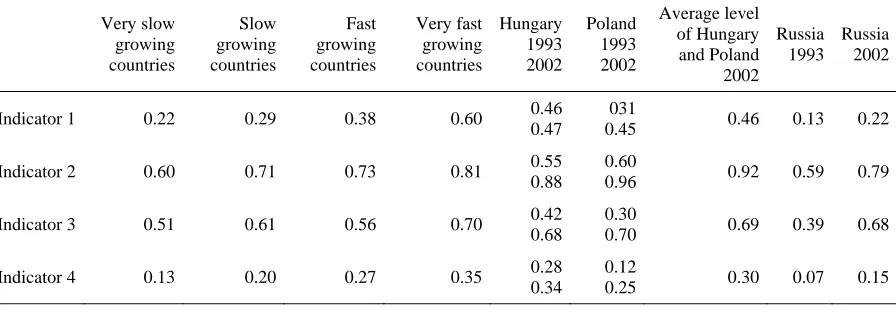
[image:11.595.78.526.310.466.2]As shown in the last two columns of Table 4, between 1993 and 2002 there was significant development of the financial sector in Russia. The starting point, however, was extremely low, much lower than in two comparator countries, Hungary and Poland. Particularly the ratio of credit to the non-financial sector over GDP was and is very underdeveloped: one-third of the Hungarian-Polish average in 1993 and still only half of it in 2002.
Table 4. Average levels of financial development of a large sample of developing and developed countries (excluding major oil exporters) during 1960-89, and for Poland, Hungary and Russia in 1993 and 2002
Very slow growing countries Slow growing countries Fast growing countries Very fast growing countries Hungary 1993 2002 Poland 1993 2002 Average level of Hungary and Poland 2002 Russia 1993 Russia 2002
Indicator 1 0.22 0.29 0.38 0.60 0.46 0.47
031
0.45 0.46 0.13 0.22 Indicator 2 0.60 0.71 0.73 0.81 0.55
0.88
0.60
0.96 0.92 0.59 0.79 Indicator 3 0.51 0.61 0.56 0.70 0.42
0.68
0.30
0.70 0.69 0.39 0.68 Indicator 4 0.13 0.20 0.27 0.35 0.28
0.34
0.12
0.25 0.30 0.07 0.15
Source: Beck (2004).
Note: Indicator 1 is broad money/GDP; indicator 2 is banks’ domestic assets/total of banks’ and central bank domestic assets; indicator 3 is the share of credit to the non-financial private sector in total credit; indicator 4 is the ratio of credit to the non-financial private sector to GDP.
In the growth regressions by Beck (2004) all the explanatory variables have the expected signs and are statistically significant. For example, the results suggest that a sustained increase in the price of oil by $10 would lead to an increase in real growth of 2.8%, while a sustained real depreciation by 10% would lead to an increase in growth of 2.5%. This confirms the notion that growth after 1998 was mainly because of the real devaluation and the increase in the world market price of oil. In fact, without the financial crisis growth would have been higher than the already healthy growth rate realised. The question then is what was the impact of the banking crisis on the growth rate?
Beck simulates various scenarios of which two are of particular interest. In the first scenario it is assumed that Russia’s financial indicators would have continued their trend of improvement before the crisis, until 2002. The result would have been an increase in long-term growth by 1%. The second scenario is more ambitious. It asks what would have happened to Russian growth if Russia had been able to linearly increase its financial indicators to reach the average level that Poland and Hungary had in the year 2002. In that case, Russia’s long-term growth would have increased by 6.9%. This is most likely an overestimate, but even if the impact on growth was only half or a third of that amount, the result suggests the importance of financial reforms for the growth process.
These results suggest that the cost of the financial crisis in terms of real growth foregone is very high. It also provides support for the view that financial reforms pay off very richly and that Russia would benefit enormously from implementing financial reforms immediately.
4.
The present state of the banking sector
An assessment report of the IMF-World Bank (2003) concludes that in 2002-03, at least according to official data, banks were in general well-capitalised, although the quality of capital was questionable and loan loss provisioning may not have fully reflect risks.
Stress tests imitating the events of the 1998 crisis indicated a continued vulnerability of the banking system. While overall liquidity is high, some banks have difficulty meeting temporary liquidity needs in a thin and fragmented interbank market.
For example, in June 2004 a number of banks had to sell securities and loans to boost their cash position. These actions followed a sharp rise in the interbank rates and the beginning of a clamp down by the CBR on problem banks. In May 2004 the CBR closed Sodbusinessbank for alleged money laundering, followed by a run of depositors on some banks. In early July the liquidity crisis spread and brought Guta Bank into difficulties. Guta Bank was solvent and in assets ranked 20th among Russian banks. In early July 2004, VTB, the state-owned bank, announced that it had refused a credit of $400 million to Guta Bank. Guta Bank then turned to the CBR, which also denied it help. The CBR was, however, willing to provide a loan to VTB to finance VTB’s acquisition of Guta Bank. It therefore seems that ownership matters for CBR support and that nationalisation rather than privatisation is on the agenda.
The way in which the CBR provided liquidity also demonstrates its unwillingness to modernise its regulatory approach and provide the framework for a market-based banking sector. For instance, it belatedly injected liquidity in a non-market conform way by halving the reserve requirements on the deposits of corporates from 7% to 3.5%. The liquidity crisis also induced depositors to transfer their money to Sberbank accounts for safety, reversing the recent trend of Sberbank’s declining market share.
These recent events underline the precarious state of the banking sector with many dubious institutions still in existence (including institutions that continue without a license) and a regulator slow to clean up and unwilling to cease the business of owning banks.
In line with the conclusions of section 4, the IMF-World Bank (2003) report stresses that banking-sector reform is a matter of the highest priority if Russia is to achieve its growth potential. This will require strengthening the supervisory framework, enhancing the transparency of ownership, governance and financial reporting, and facilitating the consolidation of the fragmented private banks. The report also stresses the need to level the playing field between private and state banks, which is made uneven by the large size of Sberbank and by the 100% guarantee of household deposits for state banks. The CBR needs to close those banks that are non-viable, overburdened with connected lending or in transgression of supervisory norms. The IMF-World Bank report is, however, unable to give practical advice about how to convince a government and a central bank that have different views to act upon these recommendations. Clearly, as long as Russia does not need the IMF’s financial support, Washington institutions lack leverage to ensure that their policy recommendations are implemented.
2004, which has contributed to a gain in trust and international acceptance and helped to reduce the risk premium in interest rates paid by Russian borrowers on international markets.7
In this environment, the assets of the banking sector increased from $50 billion in 1998 to $190 billion in 2003 and retail deposits grew from $10 billion to $47 billion. Overall deposits reached $90 billion at the end of 2003, of which $25 billion were in foreign currency. Expansion of money markets eased the liquidity management of banks and money market instruments held by banks at the end of 2003 amounted to close to $30 billion.8 On the lending side, the relative importance of lending to the public sector significantly declined in favour of private borrowers.
Profitability of the sector has strongly improved, also helped by the cut in corporate income tax from 43 to 24% in 2002. As a result, bank equity strongly increased to about $30 billion at the end of 2003. The banking sector has expanded its networks and moved more decisively into mid-market corporate and retail segments. Banks have gradually adopted international accounting standards (IAS), a process to be completed by 1 October 2004. Some banks have improved corporate governance standards and have adopted asset liability management (ALM) standards and procedures.
Nevertheless, despite recent advances, the bank asset/GDP ratio of 42.1% at the end of 2003 and the loans/GDP ratio of 19.3% are much lower than in the Western transition countries. High operating costs suggest unresolved shortcomings in efficiency. Many banks rely heavily on business with related parties, such as shareholders, and avoid market forces. Connected lending and group internal-asset transfers remain unresolved issues. Poor governance, opaque legal structures and inappropriate or non-existent risk-management systems continue to be major problems in the sector.
In 2003 the risk-weighted capital adequacy ratio (CAR) stood at 18.6%. This looks encouraging although the Russian definitions of risks and of capital are not identical to Basle standards. In the same year the CBR tightened the definition of capital, eliminating ‘improper assets’ (a concept beyond comprehension for Westerners!) with the result that CARs declined modestly. With the generalised introduction of the IAS in 2004, these problems should to some extent disappear. Effective 2005, banks with capital of less than €5 million will be subject to a minimum CAR of 10%. In 2007 all banks will be required to have a minimum capital of €5 million and a CAR of 10%.
The share of foreign assets and liabilities in Russian banks and their net balance has declined since 1998. In 2003 foreign assets stood at 32% of total assets and liabilities at 29% of total liabilities.9 Therefore decline in the rouble exchange rate would not noticeably hurt the aggregate Russian banking sector.
The highly fragmented structure of the banking sector relies heavily on state banks, with a modest contribution of 8% by foreign banks and a core private sector that accounts for only 22% of the total amount of banking assets. The fragmentation of the sector is further illustrated by the fact that in 2004 only 36% of credit institutions have capital of more than €5 million, about 38% have capital of €1-5 million and over 26% have capital of less than €1 million (CBR, 2004).
5.
Unresolved issues
Problem 1: Lack of an enabling environment
The development of the banking sector is a function of what could be called an ‘enabling environment’: the role of the state, the legal framework and the efficiency of the judiciary system,
7
In 2004 this gain in trust has been squandered again through the handling of the Yukos affair. Standard & Poor’s has delayed its upgrading and Russian international bonds have trailed other emerging-market debt instruments. Capital flight out of Russia has accelerated again.
8
The source of the data used in this section is CBR (2004).
9
socially-accepted ethical standards, generally applied rules of transparency and the quality of company reporting, the solidity of ownership rights, the independence and professionalism of the central bank, development of the non-bank financial sector, corporate governance of firms in general, access of firms and households to banking services, and, perhaps surprisingly, geography. On all these parameters, Russia has shortcomings or difficulties and therefore lacks an enabling environment.
As the Yukos affair has demonstrated, the Russian state’s vision of a market economy is different from Western concepts. This seriously weakens ownership rights and induces Russians to keep a substantial part of their savings abroad or under the mattress. Withdrawals of deposits can be arbitrarily taxed, which is a further deterrent.
The Russian state continues to hold participations in many banks. It owns the largest banks directly or indirectly through Sberbank. In addition, it holds participations of less than 25% of capital in some 400 banks (the government has stated its readiness to privatise these participations) and participations of more than 25% in more than 40 banks (considered as ‘strategic’ and therefore not for sale). The government’s seriousness in not privatising these participations was confirmed in 2003 when it took over VTB from the CBR instead of privatising it. It has the very valid fear of handing over even more control to oligarchs and has remained concerned about the role of foreign banks. In fact, the Putin administration mistrusts market forces and they cannot be blamed. The Russian economy has little in common with a ‘competitive equilibrium’ delivering socially optimal outcomes. Being unable to create the necessary institutions and controls, some of their ad hoc attempts include using the banks under government control for directing resources into allocations of political interest.
The Yukos affair has also demonstrated that the judiciary is a servant of the state and not of the law.10 While a variety of new laws concerning banking can be considered as very positive developments, applicability in the ‘spirit of the law’ remains doubtful. The rights of lenders (depositors) have been strengthened but in judiciary proceedings these continue to lack clear and full protection against owners. The seniority ranking of claims is in practice subject to power plays among stakeholders.
Geography is a major constraint for the development of an efficient banking sector. To most Westerners the number of banks in Russia seems excessive. Most banks, however, are very small and serve distant locations across the vast expanse of Russia. The operations of large private banks are concentrated in Moscow, St. Petersburg and other large industrial cities. There is no incentive to cover larger parts of Russia. Sberbank fills the gaps but only partially. As in the US, where more than 10,000 banks (most of which are very small) cover rural towns across the country, small banks in Russia also serve distant areas. Further, where the productivity and efficiency differences between money-centre banks and rural savings & loans (S&Ls) associations are huge in the US, the same is true for Russia.
Problem 2: Which banking model?
At the beginning of the transition process in the early 1990s there was a debate among European and American academics and bankers as to the appropriate approach to the creation of a market-based financial system (Gros & Steinherr, 1995). Americans favoured rapid development of capital markets and Europeans put the emphasis on quickly setting up an efficient banking system. As the institutional requirements for a deep and efficient capital market are much more demanding than for banking (Steinherr & Huveneers, 1994) the debate was a purely theoretical one. In practice efforts were made to create both but it was soon realised that the establishment of a well-functioning capital market takes considerable time, particularly in countries where institutions have remained weak. The banking sector therefore took the lead.
10
In the 1990s, the segmentation of banking – a hallmark of the US system since the Glass-Steagall Act – was already on the way out and in any case Europeans have always believed in the tradition of universal banking. Russia today has an underdeveloped capital market and universal banking. Ownership of most private banks is dominated by industrial groups, so that the Russian system most closely resembles the Japanese keiretsu system. Arguably, there was no alternative. But this does not mean that all banks have to be universal. A small bank serving the people in a distant provincial town should be limited to deposit collection, liquidity management and lending. It does not need to be universal. In the US, for example, S&Ls are severely restricted in their scope of banking activities.
As demonstrated in Steinherr & Huveneers (1991), problems of conflict of interest and insider information are particularly pronounced in universal banking. A strong regulatory environment is therefore needed to limit the possible pitfalls.
Transition countries in Central Europe have relied on foreign banks to modernise their banking sector. This model has no chance in Russia. A country as large as Russia cannot be expected to give foreign banks a large stake and the state is not ready to withdraw from banking given its central role in resource allocation. Foreign banks are allowed to establish subsidiaries upon approval by the CBR. A foreign subsidiary is required to have capital in excess of €10 million; also, 75% of employees and 50% of board members must be Russian. Foreign institutions are allowed to take minority participations in Russian banks but cannot acquire a majority holding.
Recently, BNP (France) was the first foreign bank to invest up to the allowed limits in a Russian retail bank, the Russian Standard Bank (RSB), a major player in consumer credits. BNP acquired 50% of a holding company that owns 90% of RSB.
Problem 3: Establishing a level playing field
With regard to state banks, some should be privatised. A good example is VTB. Sberbank is a more difficult case. At the least Sberbank should be held to the same standards of prudential rules as other banks and put under a hard budget constraint. The anomaly of CBR ownership should also be resolved. This could entail privatisation or transformation into a ‘narrow bank’.11 As privatisation may be difficult for the Russian authorities to accept, and the bad privatisations of the jewels of Russian industry in the 1990s are still a scar on Russian collective memory, the narrow-bank solution would be an attractive alternative.
It would maintain Sberbank’s role as a deposit-taker across Russia but limit its role as a lender. By restricting its assets, for example, to liquid, high-quality securities and loans to SMEs, it would play a central role in the development of the money market in Russia and of a loan market for SMEs. If Sberbank had to invest a large part of its assets in money markets this would give a boost to the development of commercial paper and certificate-of-deposit markets and provide support for short-term government borrowing. Those banks with an insufficient deposit base could then more easily borrow in the money market. Unfair competition with private banks would be stopped. The safety and resilience of the financial system would gain and the risk for taxpayers would be reduced. According to Bisignano (1997), the narrow depository bank is in a sense a very modern concept and a natural evolutionary outcome of the ‘unbundling’ of financial services.
Problem 4: How to increase trust in the banking system?
This is not an easy task, as Russians in general fail to have confidence, for very good reasons, in state institutions, including courts and the police, as well as the market institutions they are experiencing. As long as the enabling environment is not fundamentally changed there is little hope. Individual measures may succeed in ameliorating lack of trust without changing the present ‘bad equilibrium’
11
into a ‘good equilibrium’. An important if insufficient step was taken with the Federal Law on Insurance of the Deposits of Natural Persons of 23 December 2003, which created the basis for the introduction of a deposit insurance scheme. The aims are to increase trust in the banking system and thereby attract part of the large volume of household savings still held in foreign cash (this ‘mattress money’ has been estimated at $40-80 billion as compared to total household bank deposits of some $50 billion), to level the playing field between state banks and private banks, and to serve as a mechanism to withdraw licenses from unsound banks. Ideally, a deposit insurance scheme should be introduced after the banking system’s restructuring and once a strong supervisory system is in place, and not before. Given multiple constraints and the contents of the Law, however, deposit insurance at this stage is a good compromise.
Western experience with deposit insurance suggests that in order to minimise moral hazard (i.e. that depositors do not care about the quality of their bank as they are insured), the amount of deposit insurance should be limited. In the European Union, insurance is limited to amounts ranging from €20,000 in Austria, Belgium, Germany, Greece, Ireland, Luxembourg, the Netherlands and Spain to €103,291 in Italy. This represents a range of one-half to four times the average annual income. The Law limits coverage to 100,000 roubles (about €3,000) or close to the Russian average annual income 93,000 roubles in 2003). Institutional deposits are not insured as institutions should be expected to be better able to evaluate the solvability of their banking relationships. Nevertheless, since the law does not provide for any indexation of this upper limit, two-digit inflation and high real growth will ensure that in a few years the insurance limit will rapidly decline with respect to annual average income. At present it is estimated that the scheme covers about 85% of all retail deposits. In the case of a bank’s liquidation, the claims of all other creditors are de facto subordinated to those of retail savers. Moral hazard is therefore minimised. The price to pay is that the amount of savings attracted from mattresses into the banking system will be limited.
Deposits at foreign banks are exempted from the insurance scheme, another indication that foreign banks are not courted by Russian authorities. The effect is surely not substantial as foreign banks enjoy much greater trust with Russian depositors than Russian banks. Some Russian commentators even fear that deposit insurance favours foreign banks as the amount insured is too low to offset higher trust in foreign banks.
The Law provides for ex ante financing of the scheme. ARCO will endow the new Deposit Insurance Agency with 3 billion roubles. Participating banks will pay a premium each quarter of no more than 0.15% of the average value of their insured deposits in the preceding quarter. This maximum rate will fall to 0.05% once the fund has accumulated the equivalent of 5% of the insured deposit base. In specific circumstances, the premium could be raised to 0.3% for up to 18 months. These premia are far higher than those levied in the US or Western Europe. It is known, however, that some Western systems significantly under-price risk, as the FDIC in the US has recently acknowledged (FDIC, 2001). In addition, Russian banks are indeed riskier than their Western counterparts. There is no cap on the fund as in some deposit insurance schemes. If the fund is unable to meet its obligations, the Agency may apply to the government for budgetary support.
Ex ante financing runs the risk of time-inconsistency and may induce more risk-taking after premia have been paid. Once paid, premia are sunk costs and provide banks with no incentive to monitor peers, an important advantage of ex post systems. Yet in the Russian case ex ante financing seems preferable for gaining trust as commitments to ex post payment lack credibility in the Russian context. The Deposit Insurance Agency is to be a state corporation. Its board of directors will consist entirely of representatives of the government and the CBR. The CBR will play a key role, as banks will be allowed to join only with CBR approval. Those not admitted to this compulsory scheme will lose the right to work with retail clients. De facto, a two-tier banking system will be created.
The deadline for banks to apply for admission to the Deposit Insurance Agency was on 27 June 2004. The CBR must complete its examination of each applicant within nine months of its application.
One of the explicit aims of the deposit insurance legislation is to level the playing field between Sberbank and private banks. The Law stipulates that state guarantees extended to all Sberbank deposits will remain in force until 1 January 2007. Sberbank will pay into the deposit insurance scheme from its foundation, but its premia will be kept in a separate account (and may only be used for payouts on Sberbank deposits until its share of household deposits falls below 50% or until 1 January 2007, whichever comes first).
An amendment of the Law approved by Gosduma at the end of July 2004 restricts the unlimited state guarantee on Sberbank deposits to those opened before 1 November 2004. This contributes to levelling the playing field.
Another implication of the deposit insurance scheme is to stop an anomaly of the Russian Civil Code that requires retail deposits to be available on demand, even if contracted for a specified term. Hence, all retail deposits are effectively demand deposits. The authorities explicitly linked the adoption of the deposit insurance law to the amendment of this Civil Code provision.
Problem 5: Deepening financial intermediation
Both the banking sector and financial markets are less developed in Russia than in Western transition countries. In 2003 the monetisation of the economy as measured by M2/GDP reached 30% and outstanding bonds represented 5% of GDP. The market value of equities outstanding represented 27% of GDP, much higher than in other transition countries.
Nevertheless, shares of 8 companies out of more than 200 quoted on MICEX accounted in 2003 for 98% of market turnover. Unified Energy Systems (UES) alone accounted for 64%. On the Russian Trading System (RTS) exchange 10 out of 300 stocks accounted for 93% of turnover. The aggregate share of power and oil companies represented 99% of turnover on MICEX and 95% on the RTS. The stock exchanges thus depend on just a few corporations and badly need to diversify.
In 2003 the CBR made efforts to develop money and capital markets by offering a wider spectrum of maturities in regular auctions. In the deposit market it has extended the range from two-week deposits to three months. Repos with government bonds were extended to 804 days (CBR, 2004).
The payments system has improved substantially, although a single unified system is still wanting and efficiency can be improved. Around 80% of payments in 2003 were conducted electronically. About 60% of transactions transit through the CBR, which sets the rules for its own and the private payment systems.
A weak point remains the clearing and securities settlement infrastructure. Payments systems still do not comply with international standards regarding payments in real time and payments against delivery.
Another major problem to be tackled is the very limited access of SMEs to external finance. Important steps to improve present conditions would comprise measures such as establishment of a credit information service and a movable property registry – a so-called ‘pledge registry’.
This will also require improvements to insolvency procedures and a collective resolution of claims. An effective insolvency procedure supports the financial restructuring of viable firms, the orderly exit of failed firms and the improvement of debt-collection mechanisms for creditors.12
In Western markets mortgage-backed loans represent the major instrument for lending to SMEs and for long-term household borrowing. The availability of mortgage loans is a major requirement for private real estate construction and renovation. In Russia this market is still in its infancy and the state of dilapidation of the housing stock is a reflection of the difficulties of securing appropriate financing. Improvement of the public real estate registry and mortgage registration is important and does not pose insurmountable political opposition.
Problem 6: The regulatory framework
Since 1998 the regulatory framework has improved and financial legislation has created the means for implementation. This would allow the CBR (and the recommendation is to proceed swiftly) to tighten the definition of capital and to enforce this new definition and capital adequacy norms. The CBR should redesign the loan-loss provisioning rules to rely more on a qualitative assessment of risks and vigorously enforce the higher loan-loss provisioning requirements. The general adoption of international accounting standards in 2004 provides an excellent starting point. According to the IMF-World Bank (2003) assessment report, banks not meeting capital adequacy standards should be liquidated.
A more innovatory approach to restructuring the banking sector would involve the creation of a two-tier or three-two-tier banking license, as proposed and elaborated in Gros & Steinherr (1995). A first-two-tier bank would have to satisfy the capital adequacy and the loan-loss provision rules, participate in the payments system and be a member of the deposit insurance scheme. Deposits would then be considered relatively safe, even in a banking environment with modest deposit insurance coverage. First-tier banks would have access to central bank refinancing but would also have to hold required reserves with the central bank. For them the central bank would act as lender of last resort.
Needless to say, these conditions cannot be met by most of the some 1,300 banks in existence. Many of them, even if they met the basic requirements with difficulty, would pose a risk to the system. Therefore it might be preferable to give them a second-tier license. The type of license would have to be indicated at the entry of each bank building and on its stationary, to clearly and unambiguously inform potential customers. Or alternatively, the name ‘bank’ could be reserved for tier-one institutions and tier-two institutions could be called ‘finance corporations’. They would be subjected to a lighter regulatory framework and supervision. They would not enjoy the privileges of tier-one banks, such as participation in the payments and the deposit insurance systems but would not be subjected to the same demanding capital adequacy and loan provisioning standards either.
Tier-two banks would need to offer higher interest rates on deposits to compensate depositors for higher risk. They would need to make loans to riskier projects such as SMEs to generate returns. They could continue with connected lending and could speculate in capital and foreign exchange markets without regulatory hindrances. In the context of Russia, this approach might be preferable to closing down hundreds, if not up to a thousand banks. It would give depositors a choice; it would maintain banks in distant areas that have limited diversification scope. As the capital market is still underdeveloped, savers could more easily diversify their savings and their returns.
This segmentation of banks is not entirely novel. In the US, the Glass-Steagall Act separated commercial from investment banking with similar effects. In particular, investment banks had neither the obligations nor the privileges of a bank license, such as, for example, access to central bank support.
12
At any rate, as discussed above, Russia will de facto have a two-tier banking system: the first-tier comprising banks with deposit insurance and the second-tier consisting of banks that do not enjoy deposit insurance and hence are barred from retail banking. In light of the above proposal a review of the implications of the de facto two-tier system may by beneficial.
Problem 7: Corporate governance
Corporate governance defines the privileges and duties of companies and their management. It defines the rights (to be informed) and obligations (to exercise control and contribute to maximising shareholder value subject to the constraints of the law) of all stake-holders (governments, workers, shareholders and consumers). The economic situation in Russia worsens the position of workers and consumers. The state arguably exercises too much of an excessively diffuse influence that lacks transparency. Minority shareholders enjoy limited rights. In developed Western markets, particularly in the US, the capital market exercises strong control by selling under-performing firms or by launching a leveraged buyout to replace management. With less-developed capital markets and an aversion to takeovers by foreigners, such control is ineffective in Russia. Further, a very bad start with market institutions makes it difficult to redress the situation.
The recent revision of the Law on Joint Stock Companies amended more than half the articles of the old law of December 1995. This is a very positive step forward. Similarly, the Corporate Governance Code formulated by the Federal Commission on Securities Market (FCSM) is close to international standards and in some respects even more demanding (IIF, 2002). Nevertheless, the primary weaknesses of corporate governance in Russia are in implementation, so that the major problems of lack of transparency of ownership and of control structures persist. Legislation needs to be implemented and in some aspects further clarified to establish ultimate ownership, to require disclosure of related party transactions and to limit insider dealings. All these problems are difficult to correct in Russia where powerful interest groups are able to defend their interests. Russia is extreme, but not unique in this regard. Similar problems have barred the development of many emerging economies. Even in the US, it requirednearly a century and the crash of 1929 to curb the power and wealth of the ‘robber barons’.
The Glass-Steagall Act put an end to universal banks in the US and their ownership by powerful families, and limited the geographic expansion of banks. In Russia, it would seem particularly important to limit the control of banks by industrial groups. One solution would be to limit the share of banks held by an industrial group to, say, 25%. The limitations of the capital market, the reluctance of the government to invite participations from foreign banks and the power of the industrial groups are major obstacles for such a reform.
Fiduciary duties of supervisory boards are poorly defined, relying on spongy concepts such as ‘good faith’ or ‘reasonableness’. The Code of Corporate Conduct of April 2002 could be amended to provide a general set of principles for the conduct of boards and other committees for legal clarity. 13
6.
Conclusions
This paper established that the banking sector in Russia is far less developed than in the formerly socialist countries of Central Europe and that the underdevelopment of the financial sector is a drag on economic growth.
We discussed the contributing factors to the financial crisis of 1998 and came to the conclusion that losses on GKO investments, often considered as a major source of loss and a cause of the banking debacle, were, in fact, marginal. The major causes of the crisis were foreign exchange exposures, imprudent lending with limited risk diversification and bad management.
We showed that the financial crisis, often regarded as not very damaging on account of the small size of the banking sector compared to GDP, caused substantial costs in terms of economic growth.
An amazing feature of crisis resolution was that the authorities abstained from substantially restructuring the banking sector. Instead they provided liquidity in an opaque fashion and invited gambling for resurrection. Russia overcame the crisis swiftly thanks to good luck (the increase in the oil price) and to the real devaluation of the rouble. Therefore the errors it made became less visible. But the cost in terms of missed growth has been substantial.
Nevertheless, in the meantime the legal basis was created for more decisive actions and this report urges their implementation. A particular problem is that Sberbank is owned by the Central Bank of Russia and treated with many discriminatory favours. An alternative to privatisation, we propose the transformation of Sberbank into a ‘narrow bank’. Other state banks should be privatised, however, preferably by inviting foreign banks as bidders. Indeed, the share of foreign banks in the Russian banking sector is much smaller than in other former socialist economies. In those countries the experience of selling banks to foreign institutions is a very positive one.14
For the restructuring of the banking sector we recommend an alternative to closing down many hundreds of inefficient banks. The alternative consists of creating two-tier banking licenses. Most of the new measures regarding capital adequacy and loan loss provisions would only apply to tier-one banks. Only they would enjoy the privileges of participating in the payments system and the deposit insurance scheme and only they would have access to central bank refinancing. We see benefits in dealing with the excessively large number of banks in this way rather than closing down most of them.
How likely is swift and substantial action? Past reluctance to reform the financial sector gives limited support for optimism. Although the Putin administration has displayed greater interest in improving governance in general, bank reform does not seem to be at the top of the agenda. The key players – the government, the CBR and the large industrial holdings that control the largest private banks – have their own agendas, which may not be aligned with maximising social welfare. But pessimism should not be exaggerated either. Some steps to make the financial system more robust have been taken, such as the introduction of a very sensible deposit insurance system, and more will come. It seems that Russia needs more time than other countries and is more easily strays off the optimal path. The risk is that it will remain a prisoner of a ‘bad’ equilibrium.
13
Such actions will take many years to bring about fundamental changes. The present difficulty is the result of the excessive influence of oligarchs and the power struggle between the state and the tycoons.
14
| 19
Beck, T. (2004), “Financial System Development, Regulation and Economic Growth: Evidence from Russia”, The Journal of Banking and Finance, forthcoming.
Bisignano, J. (1997), Towards an Understanding of the Changing Structure of Financial Intermediation: An Evolutionary Theory of Institutional Survival, Bank for International Settlements, Basel.
Bryan, L. (1988), Breaking up the Bank: Rethinking an Industry under Siege, New York: Dow Jones-Irwin.
Central Bank of Russia (CBR) (2004), Financial Stability Review 2003, Moscow.
Dziobek, C. and C. Pazarbasioglu (1997), “Lessons and Elements of Best Practice”, in Alexander, W.E., et al. (eds), Systemic Bank Restructuring and Macroeconomic Policy, International Monetary Fund, Washington, D.C., pp. 75-143.
Easterly, W. and P. Viera de Cunha (1993), Financing the Storm: Macroeconomic Crises in Russia, 1992-93, World Bank, Washington, D.C.
Frye, T. (2002), Governing the Banking Sector in Russia, New York University, draft.
Federal Deposit Insurance Corporation (FDIC) (2001), Keeping the Promise: Recommendations for Deposit Insurance Reform, Washington, D.C., April.
Gray, C. and A. Holle (1996), “Bank-led restructuring in Poland: The conciliation process in action”,
Economics of Transition, Vol. 4, No. 1, pp. 340-70.
–––––––– (1997), “Bank-led restructuring in Poland (II): Bankruptcy and its alternatives”,
Economics in Transition, Vol. 5, No. 1, pp. 25-44.
Gros, D. and A. Steinherr (1995), Economic Transition in Central and Eastern Europe: Winds of Change, Longman-Pearson.
–––––––– (2004), Economic Transition in Central and Eastern Europe: Planting the Seeds, Cambridge: Cambridge University Press.
IIF (2002), Corporate Governance in Russia: An Investor Perspective, Institute of International Finance, Washington, D.C., November.
IMF (2003), Russian Federation: Financial System Stability Assessment, International Monetary Fund, Washington, D.C., April.
IMF–World Bank (2003), Financial Sector Assessment, Russian Federation, joint publication of the International Monetary Fund and the World Bank, Washington, D.C., October.
Ippolito, F. (2002), The Banking Sector Rescue in Russia, Bank of Finland, Helsinki.
Johnson, J. (2000), A Fistful of Rubles: The Rise and Fall of Banking in Russia, Ithaca, N.Y.: Cornell University Press.
King, R.G. and R. Levine (1993), “Finance and Growth: Schumpeter may be right”, Quarterly Journal of Economics, Vol. 108, No. 3, pp.717-38.
OECD (2004), “Russia’s deposit insurance law”, OECD Economic Survey of the Russian Federation, Paris.