Int. J. Electrochem. Sci., 10 (2015) 1186 - 1198
International Journal of
ELECTROCHEMICAL
SCIENCE
www.electrochemsci.orgShort Communication
Potential-Controlled Electrolysis as an Effective Method of
Selective Silver Electrowinning from Complex Matrix Leaching
Solutions of Copper Concentrate
Sylwia Kowalska1, Aneta Lukomska1, Przemyslaw Los1,*,Tomasz Chmielewski2, Barbara Wozniak2
1
Industrial Chemistry Research Institute, Rydygiera 8, 01-793 Warsaw, Poland
2
Wroclaw University of Technology, Faculty of Chemistry, Division of Chemical Metallurgy, Wybrzeze Wyspianskiego 27, 50-370 Wroclaw, Poland
*
E-mail: [email protected]
Received: 8 October 2014 / Accepted: 22 November 2014 / Published: 16 December 2014
In a present paper the results of pure metallic silver electrochemical recovery from the solution obtained by two-steps of chloride leaching process of Lubin, Poland copper flotation concentrate are discussed. Potential-controlled electrolysis (PCEl) was used as a promising method of silver electrochemical recovery from low concentration complex composition aqueous solutions. The studied solution contained approximately 50 mg/L of silver. The electroreduction of silver was studied using cyclic voltammetry and chronoamperometry in two and three electrode configuration systems. The effect of several factors such as potential, time of electrolysis on selectivity of silver reduction was studied. Based upon conducted experiments the conditions of pure silver powders cathodic electrodeposition using PCEl method were determined.
Keywords: potential-controlled electrolysis, silver recovery, silver powders, leached electrolyte
1. INTRODUCTION
Due to expansive economic development and growing industrialization, the demand for base and precious metals is constantly growing. At the same time resources and quality of ores and metals concentrates are significantly declining, what results in increasing costs of metal production. Therefore, alternative sources of metals like industrial waste and spent electrolytes should be explored. There is a variety of methods in use for recovery of heavy metals, including hydrometallurgical, pyrometallurgical, and bio-hydrometallurgical [1-3].
steps precipitation, cementation, solvent extraction and ion exchange are used to concentrate and to purify the extracted metals. Finally, the recovery of metals in the pure form is performed by application of electrochemical and/or precipitation methods.
The most widely used silver recovery method is electrolysis, where metallic silver is recovered from the solution by electroplating it on a cathode. Consequently, the process has been studied by many researchers and many aspects of the silver electrorefining, electrowining and electroplating have been discussed in a large number of papers. However, there were not many fundamental changes in the technology of silver industrial electrolysis [4-7].
In the majority of cases in the industrial scale processes direct electrical current is passed between two electrodes immersed in the silver-bearing solution. Current-controlled electrolysis produces nearly pure metallic silver but in the waste electrolytes of complex matrix care should be taken in passing the constant current density because co-deposition of other products can simultaneously occur. The most important requirement to recover the pure metallic product from complex leaching electrolyte is selectivity of electrodeposition. This could be achieved by means of potential-controlled electrolysis (PCEl) [8-12], which is widely known in e.g. electroanalytical chemistry [13,14] but has been used very seldom for the industrial scale recovery of metals. As a rare example of the application of potential-controlled electrolysis is the electrochemical manufacturing of ultra high purity copper (UHPC) mostly in nitric solutions [15,16]. It should be noted that one of the fundamental differences between current- and potential-controlled electrodeposition processes is related to the fact that current density is the measure of the electrochemical process rate. In the galvanostatic process constant rate of electrochemical reaction is imposed, regardless of what processes occur. Potential is the driving force of an electrochemical process and it determines what process occurs.
The important advantage of PCEl technology is related to the fact that its implementation is possible with only very limited changes in the power supply and control of electrolysis without the changes of the design of the cells, general flow of materials and/or vital conditions of currently used processes [11,12]. On the other hand, the PCEl method is a perfect tool to exploit the commercial possibilities related to the development of nanotechnology [8-10, 17]. Using PCEl technology it is technologically possible and economically viable to recover metals as nanopowders of very high added value. Current study is the example of the PCEl method capabilities in the case of silver recovery from low concentration complex matrix solution just in one step i.e. electrowining (EW).
Another important factor to provide the feasibility of metal recovery from low concentrations of extracted metals is to increase the mass transport rate. In practice it can be achieved by mixing electrolyte, rotation/movement of electrode and by the application of ultramicroelectrodes (UME). The mass transfer to UME is increased due to spherical diffusion of electrolyte to the surface of the electrode. In the commercial process one can use ultramicroelectrodes arrays which may be easily and at low cost manufactured using very well established methods. The advantages of the application of UME are described in previous works [8, 9]
matrix was the inspiration to start the investigations towards selective recovery of other metals from various electrolytes including electrolytes after leaching processes of solid concentrate which can contain a series of metals such as Ag, Co, Pb, Cu, Co, Ni, Fe. In the present paper the results of silver recovery from complex matrix electrolyte after chloride leaching of copper flotation concentrate using potential-controlled electrolysis are presented. The hydrometallurgical process consisting of leaching of copper concentrate and subsequent selective electrodeposition of silver and then copper may be in certain cases the option for the presently used in the industry process involving pirometallurgical treatment of the concentrate followed by electrorefining of copper. In the later process silver is accumulated in the anodic slime. We show how potential-controlled electrolysis may be used to control purity and size of deposited silver particles and nanoparticles. Although electrolysis is one of the most common methods of manufacturing of metal powders and nanopowders we believe that application of ultramicroelectrodes and UME arrays opens a unique and new opportunities in the application of the process as it is also described in our recent patent [10] We present below the examples illustrating selectivity of silver electrodeposition (leading to the deposition of very high purity silver particles and nanoparticles even from very complex waste electrolytes), control of the size of the electrodeposited silver particles (by the choice of the pulse electrolysis condition).
2. MATERIAL AND METHODS
The electroreduction of silver(I) ions was studied by cyclic voltammetry and chronoamperometry. All measurements were carried out using AUTOLAB GSTST30 system. General Purpose Electrochemical System version 4.5 was the program used for data acquisition.
The measurements were conducted in two- and three electrodes configuration. In two electrode configuration system gold and platinum discs ultramicroeletrodes of diameters ranging from 10 μm to 100 μm were employed as the working electrodes. Before experiment the surface of the ultramicroelectrode was polished mechanically using wet alumina powder of grain diameter 0.3 μm and 0.05 μm. The quality of the polishing was verified with an optical microscope and SEM images. The auxiliary electrode (acting also as the reference electrode) was a copper plate of high purity (99.99% Cu) with a surface about 1cm2. To study the feasibility of silver electrodeposition on a cathode of conventional sizes selected experiments were performed in the three electrode configuration system where stainless steel plate with a surface about 2,5 cm2 was employed as working electrode, silver chloride electrode Ag/AgCl acted as a reference electrode and titanium plate with a surface about 50 cm2 was applied as counter electrode. The cell temperature was maintained as ambient.
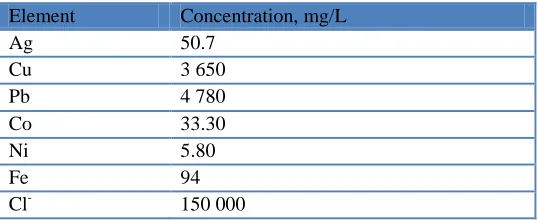
laboratory of hydrometallurgy within the frame of HYDRO project supported by Polish National Centre for Research and Development (NCBiR) [20,21]. The composition of investigated electrolyte after chloride leaching process is presented in Table 1. Figure 1 illustrates the simplified flowsheet of the hydrometallurgical process developed at Wroclaw University of Technology for alternative processing of copper flotation concentrate from Lubin Concentrator [21].
Table 1. The compositions of electrolyte after two-step chloride leaching process, according to flowsheet in Fig.1.
Element Concentration, mg/L
Ag 50.7
Cu 3 650
Pb 4 780
Co 33.30
Ni 5.80
Fe 94
Cl- 150 000
The goal of the present study is to propose and test the selective method of silver electrodeposition from complex matrix electrolyte obtained after chloride leaching. The analysis of the standard potentials indicates that the closest to silver electroreduction potential is the copper electroreduction potential [22]. It may be expected that among all the above listed metals copper may disturb electrodeposition of pure silver. The other metals should not cause problem for selective silver electrodeposition. Short discussion of silver ionic species stable in the studied solution is given below.
Scanning electron microphotographs were recorded on JOEL JSM 6490 LV (Japan) instrument equipped with EDS.
[image:4.596.165.434.213.323.2] [image:4.596.209.384.483.725.2]
3. RESULTS AND DISCUSSIONS
The solution obtained after chloride leaching contained much less silver than copper (see Table 1). Therefore one can expect that recovery of pure silver can be disturbed by electroreduction of copper ions. Additionally, it is well established that the following silver ionic and neutral species may be theoretically present in the solutions containing chloride ions [23, 24]: (AgCl)0, AgCl2-, AgCl32-,
AgCl43-. In the present study high concentration of chloride ions (approx. 4M) was used and in
according to the literature data [23] the AgCl32-, AgCl43- ions are dominant in the solutions. The
reported stability constant of these ionic species are following 1.1x10⁵, 4.4x10³, respectively. At such high concentrations of chloride ions the presence of AgCl is not expected [23] as it was reported in analogous case of CuCl precipitate in copper chloride solutions in [25]. Taking into account the complexation of silver ions by chloride anions the range of potentials where pure silver product can be obtained should be carefully selected. Figure 2 presents the voltammetric curves recorded in leached electrolyte at gold and platinum ultramicroelectrodes of diameter 10 µm. The starting potential of cyclic voltammograms commenced at +0.60 V reversed at -0.50 V and terminated at +0.60 V (scan rate 0.05 V/s). As it can be seen there was no cathodic current registered initially until potential of -0.10 V was reached. At this voltage the cathodic current starts to increase and forms two waves corresponding probably to two-step reduction of copper ions [8]. Reverse sweep into the positive direction results in three anodic peaks corresponding to electrodissolution of deposited species, probably to the two-step electrodissolution of copper and oxidation of metallic silver. According to [24] anodic dissolution of silver in solutions containing of chloride ions undergoes with participation of chemically adsorbed halide ions:
Ag + Cl-(ads) = AgCl(ads) + e (1)
followed by formation of silver complexes and their consecutive diffusion from the electrode surface to the bulk solution
AgCl(ads) + ( n-1)Cl- = Ag Cln-(n-1) (ads) (2)
Ag Cln-(n-1) (ads) = Ag Cln-(n-1) (aq) (3)
where 2 < n ≤ 4
On the other hand the electroreduction of ionic silver species to silver metal is carried out according to the following reaction:
Ag Xn-(n-1) (aq) + e = Ag + (n-1) X-(aq) (4)
where X= Cl-, Br-, CN- etc. [24, 26]
E/V
-0,6 -0,4 -0,2 0,0 0,2 0,4 0,6 0,8
j/A c m -2 -0,6 -0,4 -0,2 0,0 0,2 0,4 0,6 0,8 1,0 1,2 Au 10 Pt 10
-0,12 -0,08 -0,04 0,00 -0,12
-0,10 -0,08 -0,06 -0,04
Figure 2. The voltammetric curve recorded at room temperature on gold and platinium ultramicroelectrodes, scan rate v = 0.05 V/s. Insert: the voltammetric curves recorded at v = 0.0005V/s.
Electrodeposition of silver is expected to occur at much positive potentials than those where copper ions are reduced. Since the concentration of Ag(I) is low, its reduction current density can be masked by the capacitive current. That is why, in order to register cathodic peak or any cathodic current change corresponding to silver reduction the voltammetric curves on gold and platinum ultramicroelectrodes in limited potential range and low potential scan rate were registered (insert in Fig. 2). One can notice gentle inclination of current density line at potential range from 0.0 V to -0.08 V which can be connected with double layer charging and/or reduction process of depolarizer of lower content. The sudden drop of current density at about -0.08V indicates reduction process for depolarizer of higher content. This was confirmed by chronomperometric experiments where applying potentials more negative than -0.08 V resulted in co-deposition of copper and silver on the surface of the electrode (see Fig. 5d).
[image:6.596.124.449.102.334.2]
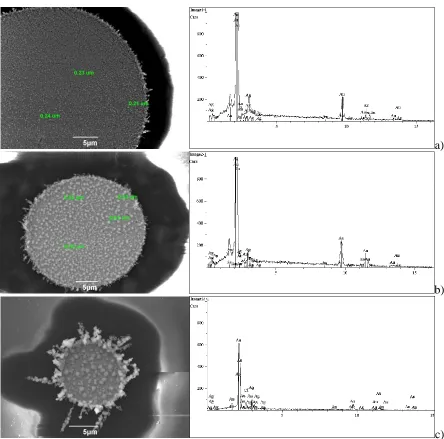
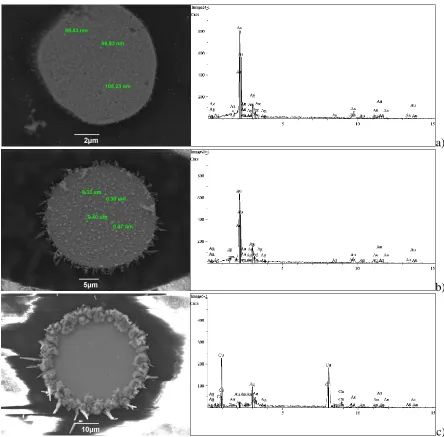
chronamperometric pulse increasing deposit potentials produces smaller nuclei (Fig. 3a and 4b). After 300s of electrolysis the co-deposition of copper takes place (Fig. 4c). At -0.08 V pure silver powders are obtained only for 60-120s of electrolysis (Fig. 5a, 5b). For longer time codeposition of copper occurs (Fig. 5c). At -0.10 V copper electroreduction takes place even for 60 s (Fig. 5d). Based upon conducted experiments one can conclude that silver recovery from electrolytes of such a complex matrix should not be conducted continuously but as pulse potential-controlled electrolysis and after certain period of time the cathode product in form of powders should be removed from the cathode.
a)
b)
c) Figure 3. SEM images and EDS analysis of silver deposition at Au ultramicroelectrodes at
[image:7.596.76.520.210.649.2]
a)
b)
c) Figure 4. SEM images and EDS analysis of silver deposition at Au ultramicroelectrodes at
E=-0.07 V for a) 60s, b) 300s, c) 600 s.
[image:8.596.75.519.66.503.2]
b)
c)
d) Figure 5. SEM images and EDS analysis of silver deposition at Au and Pt ultramicroelectrodes
a) E = -0.08 V(Ag/AgCl), 60 s, b) E = -0.08 V(Ag/AgCl), 120 s, c) E = -0.08 V(Ag/AgCl), 300 s., d) E = -0.1 V(Ag/AgCl), 60 s.
[image:9.596.76.521.66.533.2]
reversed at -0.80 V and terminated at 0.0 V (scan rate 0.05 V/s). It can be noticed that no cathodic current registered initially until potential of -0.25 V was reached. At this voltage the cathodic current start to increase and form waves corresponding probably to two-step reduction of copper ions and hydrogen ions discharge. Recording the cv curve for lower scan rate did not provide the information about potential rate where silver reduction can take place. Therefore, the electrochemical conditions where pure silver products were obtained, were determined after numerous chronoamperometric measurements for a wide range of potentials and time of electrolysis followed by SEM/EDS analysis.
E/V
-0,8 -0,6 -0,4 -0,2 0,0
j/A
c
m
-2
-0,03 -0,02 -0,01 0,00 0,01 0,02
Figure 6. The voltammetric curve recorded at room temperature on stainless steel plate, scan rate v = 0.05 V/s.
[image:10.596.85.512.219.524.2]
a)
b)
c)
d) Figure 7. SEM images and EDS analysis of silver deposition on stainless steel plates:
[image:11.596.76.520.65.649.2]
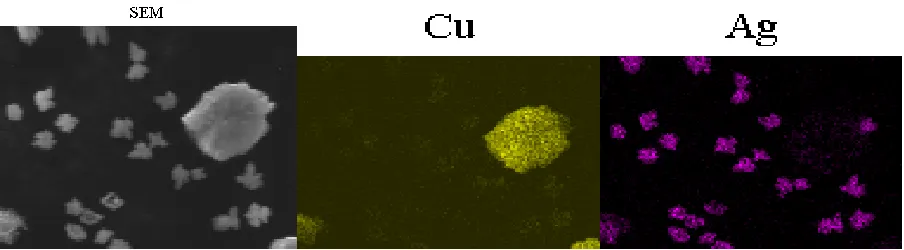
Figure 8. SEM image and map illustrating silver and copper particles distribution on stainless steel electrode. Electrolysis conditions: E = -0.25 V, t = 1800 s.
4. CONCLUSIONS
Based upon obtained results it can be concluded that selective recovery of silver from leaching solution of low concentration of Ag is feasible by using potential-controlled electrolysis (PCEl). The potential range where pure silver products can be cathodically precipitated is quite narrow but is easy to determine. Since the concentration of silver in the studied electrolyte is low the process should be performed using pulse electrolysis. The obtained product is in the form of powders which size can be controlled by the time of electrolysis. When the metal is deposited as nanopowder the high added value product is readily obtained making the technology economically viable because 1 kg of silver nanoparticles and microparticles prices range from $1000 to $2000 (http://www.advancedmaterials.us/47MR-02C.htm). The economic viability of the process might be also assured by the application of ultramicroelectrodes and ultramicroelectrodes arrays at which spherical (non-linear) diffusion occurs leading to very high cathodic current densities reaching a few ampers per cm2 as presented in the current study.
ACKNOWLEDGEMENTS
In part (non-oxidative, atmospheric and chloride leaching) this work was carried out in the frame of HYDRO project (Polish NCBiR project contract ZBP/56/66309/IT2/10). Authors acknowledges the financial support given to this project by the NCBiR (National Center for Research and Development) under the IniTech Enterprise. The work was also co-financed by statutory activity subsidy from the Polish Ministry of Science and Higher Education for the Faculty of Chemistry of Wroclaw University of Technology. The electrochemical studies were supported by the European Union funds under the European Social Fund.
References
1. U. U. Jadhav and H. Hocheng, J. Achiev. Mater. Manufac. Eng., 54 (2) (2012) 159 2. T. Chmielewski, Fizykochemiczne Problemy Mineralurgii, 30 (1996) 217
[image:12.596.74.526.83.208.2]
4. M. Schlesinger, in: M. Schlesinger, M. Paunovic, (Eds.), Modern Electroplating, fifth ed. John Wiley&Sons, Inc, Hoboken, (2010) pp.131
5. F. Z. Ren, L.T. Yin, S. S. Wang, A. A. Volinsky and B. H. Tian, Trans. Nonferrous. Met. Soc. China 23, (2013) 3822
6. V. Reyes Cruz, M.T. Oropeza, I. Gonzalez and C. Ponce-de-Leon, J. Appl. Electrochem. 32 (2002) 473
7. A. Liu, X. Ren, M. An, J. Zhang, P. Yang, B. Wang, Y. Zhu and C. Wang, Sci. Rep. 4, (2014) 3837 8. A. Lukomska, A. Plewka and P. Los P, J. Electroanal. Chem., 633 (2009) 92.
9. A. Lukomska, A. Plewka and P. Los P, J. Electroanal. Chem., 637 (2009) 50.
10.P. Los, A. Lukomska and A. Plewka, Polish Patent P-387565 (2009), PCT Patent application, No.PCT PL 2010/000022 (2010)
11.P. Los, A. Lukomska, S. Kowalska, M. Masalski and M. Kwartnik, Conference Proceedings Copper 2013 Chile V (2013) 27
12.P. Los, A. Lukomska, S. Kowalska, and M. Kwartnik, J. Electrochem. Soc., 161 (10) (2014) D593 13.A. J. Bard and L.R. Faulkner, Electrochemical Methods, Fundamentals and Applications, John
Wiley &Sons, New York, (2001)
14.E. P. Schoch and F. M. Crawford, J. Am. Chem. Soc. 38(9), (1916) 1682 15.M. Kato, Journals of Metals 47 (1995) 44
16.J. Y. Choi and D.S. Kim, J. Hazard. Mater. 99(2) (2003) 147
17.L.P Bicelli, B. Bozzini, C. Mele and L. D’Urzo, Int. J. Electrochem. Sci. 3, (2008) 356 18.A. Lukomska, A. Plewka, P. Los, Conference Proceedings GDMB – Copper 2010, Hamburg,
Germany, 1 (2010) 425
19.T. Chmielewski, K. Borowski, K. Gibas, K. Ochromowicz and B. Wozniak, Physicochemical Problems of Mineral Processing 47 (2011) 193
20.T. Chmielewski, Separation Science and Technology, 47(9), (2012)1264 21.T. Chmielewski, et al., Polish Patent P405901 (2014)
22.P.C. Hayes, S.H.Algie Process Principles in Minerals and Materials Production, Ed., Hayes Publ, (1993)
23. J. Fritz, J. Sol. Chem. 14 (1985) 865
24.H. Hassan, M. Ibrahim, S.S. Abd El Rehin, M.A. Amin, Int. J. Electrochem. Sci., 5 (2010) 278 25.H. Zhang, J. Chang, A. Boika, A. Bard, Anal. Chem. 85 (2013) 7696
26.M.Schwartz, Handbook of Deposition Technologies for Films and Coatings R.F. Bunshah, Ed., Noyes Publ. (1994)
27.R.G. Compton, Comprehensive Chemical Kinetics, Electrode Kinetics:Reactions, Ed., Elsevier (1987)
28.http://www.advancedmaterials.us/47MR-02C.htm