Int. J. Electrochem. Sci., 10 (2015) 8224 - 8235
International Journal of
ELECTROCHEMICAL
SCIENCE
www.electrochemsci.org
Poly(propylene imine) Dendrimer and Gold Nanoparticles as
Anti-passivating Electrode Modifiers in Phenol Sensing – a Case
Study of 4-Chorophenol
T Ndlovu1,2, O.A. Arotiba1,3,* 1
Department of Applied Chemistry, University of Johannesburg, PO Box 17011, Doornfontein 2028, Johannesburg, South Africa
2
University of Swaziland, Department of Chemistry, Private Bag 4, Kwaluseni, Swaziland 3
Centre for Nanomaterials Science Research, University of Johannesburg, South Africa *
E-mail: [email protected], Tel: +27 11 559 6200
Received: 13 June 2015 / Accepted: 23 July 2015 / Published: 26 August 2015
The electro-oxidation of phenols usually causes electrode passivation which results in drastic reduction of peak currents in subsequent scans. Electrode modifiers may help improve the peak current of phenolic compounds without the need to polish the electrode surface. The effect of electrode modification was therefore investigated on a fabricated exfoliated graphite (EG) electrode using different nano-materials such as poly(propylene imine) dendrimer, gold, cobalt oxide and bismuth nanoparticles. 4-Chlorophenol (a model phenolic compound) passivated the bare EG electrode such that the phenolic peak (at about 0.670 V) was 88.8% lower for the second scan compared to the first scan. The modified electrodes showed some anti-passivating properties with minimum reduction of peak current on the second and subsequent scans. Poly(propylene imine) dendrimer and gold nanoparticle modified EG electrodes exhibited the best anti-passivating properties.
Keywords: chlorophenol, exfoliated graphite, gold nanoparticles, phenols, poly(propylene imine) dendrimer, passivation
1. INTRODUCTION
affordable and readily available electrode materials with good electrochemical properties are continually sought after.
Electrochemical sensors have found wide applications in the detection organic pollutants such as phenols in water. Phenols, which include chlorophenols, are a major class of organic pollutants. Chlorophenols are environmental pollutants that are classified as Persistent Organic Pollutants (POPs) as well as Endocrine Disrupting Compounds (EDCs). They are of environmental concern because of their toxicity and widespread applications. These organic compounds are released into the environment during their production, transportation and application. Some of these chlorophenols such as 2-Chlorophenol (2-CP), 4-chlorophenol (4-CP), 2,4-dichlorophenol (2,4-DCP), 2,4,6-trichlorophenol (2,4,6-TCP) and pentachlorophenol are listed as priority pollutants in the United States of America [2]. Chlorophenols are usually measured and monitored using chromatographic techniques such as gas chromatography (GC) and high performance liquid chromatography (HPLC) [2]. These techniques provide high separation efficiency as well as good sensitivity especially when coupled with mass spectrometer (MS) or other detectors [2]. Nevertheless, these methods are time-consuming, require laborious sample preparation and costly (equipment-wise). Furthermore, they are difficult to use for in situ and on site applications [3]. For quick and cost-effective sample screening and monitoring, electrochemical sensors are considered [2,4,5]. However, phenol sensing presents the challenge of electrode passivation or fouling during electro-analysis. The loss of the electrode activity during phenol oxidation as a result of insulating surface film is well documented [6,7]. Although the passivation of electrode due to phenol oxidation has been in literature for a long while; the quest for methods of inhibiting this film formation is still actively ongoing. In order to mitigate electrode passivation, electrode modification has been proposed [8].
Peeters et al [5] investigated the oxidation of 4-chlorophenol (4-CP) on a bare Au electrode and its detection on electrodes modified with either cobalt (II) tetrasulphonatedphthalocyanine or 3,4’,4’’,4’’’-copper(II) tetrasulphonatedphthalocyanine where the results suggested that the behaviour of 4-CP depends on the molecular structure of the phthalocyanine thin film layers on the gold surface [5]. In another study, a cobalt (II) phthalocyanine-modified GCE was used for the detection of 2-CP and 4-CP, where the modified electrode was characterised by an increase in the oxidation currents and improved electrode stability [9]. Electrode modification has been proposed to minimise electrode passivation and provide significant improvement in the monitoring of phenols and chlorinated phenolic compounds [8, 10]. A myriad of materials such as polymers and other substances in the nanoscale are being utilised as electrode modifiers.
2. EXPERIMENTAL
2.1. Reagents and Instruments
Generation 2 Poly(propylene imine) dendrimer (SyMO-Chem, Netherlands); HAuCl4 and natural graphite (Sigma Aldrich) and others chemicals such as 4-chlorophenol (4-CP), K3Fe(CN)6, K4Fe(CN)6, KH2PO4, K2HPO4, HCl, KOH purchased from Merck Chemicals were used as receieved. Double distilled water was used for all aqueous preparations. A supporting electrolyte of 0.1 M phosphate buffer solutions pH 5 and pH 7 were was used for 4-CP and PPI-AuNPs solutions, respectively. Electrochemical readings with a three electrode cell configuration (fabricated exfoliated graphite (working electrode), platinum wire (auxiliary electrode) and Ag/AgCl (3M Cl-) (reference electrode)) were obtained from Autolab PGSTAT 302N. Degassing was carried out with ultra pure argon prior to all electrochemical measurements.
2.2. Electrode Modification
The EG electrode was prepared as reported in our previous work [13]. Five nanomaterials namely: poly(propylene imine) dendrimer (PPI), gold nanoparticles (AuNPs), cobalt oxide nanoparticles (CoO), silver nanoparticles (AgNP) and bismuth oxide nanoparticles (Bi)were selected as electrode modifiers.
The electrodeposition of PPI onto the EG electrode surface was accomplished from a 10 mM solution of generation 2 PPI in 0.1 M phosphate buffer solution (pH 7) by cycling the potential from -400 mV to 1100 mV for 10 cycles at a scan rate 50 mV s-1. The PPI modified EG electrode was referred to as EG-PPI. This modified procedure has been reported by Arotiba et al. [14, 15]. A similar methodology was used for the preparation AuNPs modified EG electrode (EG-AuNP). However, a 5 mM solution of HAuCl4 (without PPI) was used as the electrolyte. A nanocomposite of PPI and AuNP was electro-co-deposited onto the electrode surface using equal amounts of the PPI and HAuCl4 solutions and the resultant electrode was referred to as EG-PPI-AuNP.
For the modification of the EG electrode with cobalt oxide, cobalt oxihydroxide film was electro-deposited onto the electrode surface by scanning between 1200 mV and -1100 mV for 10 cycles in 1 mM CoCl2 pH7 phosphate buffer solution at a scan rate of 50 mVs-1 [16][17]. This electrode was referred to as EG-CoO.
The electro-deposition of bismuth film (EG-Bi) was done using a previously reported method with minor modifications[18, 19]. Briefly, bismuth oxide was electro-deposited by holding the potential at -600 mV for 300 seconds in 0.1 M HNO3 supporting electrolyte solution containing 5mM Bi2O3. The prepared electrodes were characterised with cyclic voltammetry (CV) and square wave voltammetry (SWV) in [Ru(NH3)6]2+/3+redox probe.
2.3. 4-CP passivating effects on modified EG electrodes
the phenolic group was explored using EG, EG-PPI, EG-AuNP, EG-PPI-AuNP, EG-CoO and EG-Bi. The modified EG electrodes were used to record the SWVs of 40 µM 4-CP five times without electrode renewal. The percentage of peak current reduction was monitored for all the electrodes. The electrode that gave the highest peak current response on the first scan (EG-AuNP) was used to record the SWV for different 4-CP concentrations (1 µM to 50 µM) to obtain a linear relationship which was used to calculate the detection limit of that electrode. All CV experiments were recorded at a scan rate of 50 mVs-1 while SWV experiments were acquired at 50 mV and 25 Hz amplitude and frequency respectively. The electrode surface was polished using emery paper with a fine grid of 1600 followed by polishing on a weighting paper to obtain a smooth surface. The electrode was then rinsed in deionised water before use.
3. RESULTS AND DISCUSSION 3.1. Electrode characterization
The bare and modified EG electrodes were electrochemically characterised using CV and SWV in [Ru(NH3)6]2+/3+redox probe as shown in Fig 1. Electrode modification resulted in current enhancement which was more pronounced on the square wave voltammograms in Fig 1b. The increase in peak current in all cases can be attributed to enhanced surface area induced by the nanomaterials.
a) b)
Figure 1. a) CVs (50 mV/s) and b) SWVs of all the modified electrodes in 1 mM [Ru(NH3)6]2+/3+.
The slope of peak current versus square root of the scan rate from Randles-Sevcik equation:
5 3 2 1 2 1 2
2.69 10 p
[image:4.596.85.516.435.597.2]
The estimated electroactive surface area for the bare and modified electrodes are summarised in Table 1.
Table 1. Surface area (A), peak separation (ΔE) in [Ru(NH3)6]2+/3+ for bare and modified EG electrode.
Electrode A (cm2)
ΔE (mV)
EG 0.046 106
EG-PPI 0.061 111
EG-AuNP 0.051 100
EG-PPI-AuNP 0.048 90
EG-CoO 0.046 88
EG-Bi 0.054 97
The estimated electroactive surface area for all the modified electrodes was higher than the bare EG electrode. This is in agreement with the peak currents observed for all the modified electrodes. The highest electroactive surface area was observed on the EG-PPI electrode which justifies the highest peak current observed on this electrode. The differences in peak current are better observed when using square wave voltammetry (SWV) as shown in Fig. 1b owing to better sensitivity when compared to CV. The values of ΔE can be an estimate of the kinetics of the reaction in which the lower the ΔE the closer to reversibility and hence a more facile electron transfer. The lower ΔE values on EG-AuNP, EG-PPI-AuNP, EG-CoO and EG-Bi compared to the bare EG electrode thus suggest that electron transfer are faster at the interface of the modified electrodes. This is because the kinetic and reversibility properties of electrochemical processes are dependent on electrode’s surface [20]. For a reversible one electron system, ΔE is equal to 59 mV, while for quasi-reversible processes, ΔE is larger than 59 mV. All the EG electrodes showed quasi-reversibility. However, EG-PPI electrode had the highest ΔE value which may be due to the electrostatic repulsion between the positively charged PPI and redox probe; and the non-metallic nature of the dendrimer.
3.2. Electrochemical behaviour of 4-CP
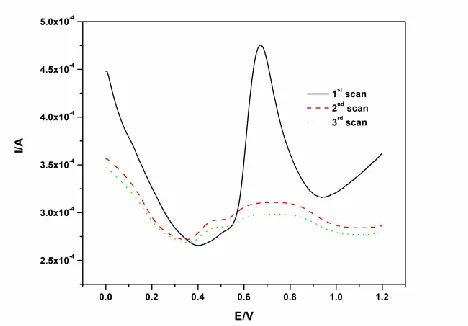
The source of the electroanalytical signal for chlorophenols originates from the phenolic group which tends to passivate electrode surfaces. Electrode modification has been proposed to reduce passivation due to the polymerisation of phenolic compounds. The electrochemical behavior of 4-CP was first investigated by using CV on the bare EG electrode as shown in Fig 2.
Figure 2. CVs of 40 µM 4-CP in 0.1 M phosphate buffer solution at 50 mVs-1 and five scans.
3.3. 4-CP passivating effects on modified EG electrodes
The passivation of the electrode surfaces due to 4-CP polymerisation was also investigated on the bare EG electrode using SWV. The results are shown in Fig. 3, where the first scan gave a sharp oxidation peak at 670 mV. The second and third scans on the same electrode surface (without polishing) resulted in voltammograms that had 11.6% and 9.2% of the peak current observed in the first scan, respectively.
Figure 3. SWVs showing the effect of passivation on the EG electrode by 40 µM 4-CP
[image:6.596.181.415.444.607.2]
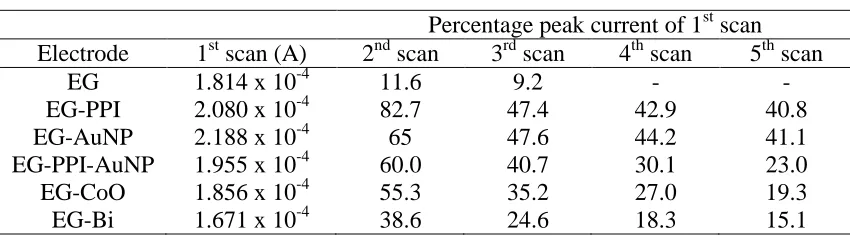
Table 2. Passivation effects of 4-CP (40µM) on bare and modified EG electrodes as illustrated by the percentage of the peak current of the second to the fifth scans in relation to the first scan in 4-CP.
Percentage peak current of 1st scan Electrode 1st scan (A) 2nd scan 3rd scan 4th scan 5th scan
EG 1.814 x 10⁻⁴ 11.6 9.2 - -
EG-PPI 2.080 x 10⁻⁴ 82.7 47.4 42.9 40.8
EG-AuNP 2.188 x 10⁻⁴ 65 47.6 44.2 41.1
EG-PPI-AuNP 1.955 x 10⁻⁴ 60.0 40.7 30.1 23.0
EG-CoO 1.856 x 10⁻⁴ 55.3 35.2 27.0 19.3
EG-Bi 1.671 x 10⁻⁴ 38.6 24.6 18.3 15.1
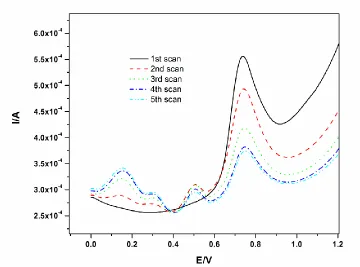
EG-PPI dendrimer resulted in peak current enhancement of about 20.2% for 4-CP compared to the bare EG. The reasons for this performance of PPI among the other modified electrodes can be as a result of i) the nanometer scale of PPI which increases the electrodes active surface area; ii) the encapsulating ability of PPI owing to its nano cavities; iii) the organic nature of PPI which may encourage π-π interaction with the organic 4-CP or favourable functional group interactions resulting in higher concentration of 4-CP per unit area. On the second scan, Ip was 82.7% of the initial current observed (Table 2). This showed a huge improvement from the bare electrode which recorded a second scan with 11.2% peak current of the first scan. The behaviour observed suggest good anti-passivating properties for the first two scans as the peak current retention is above 80%.The fifth scan still had a phenolic peak which was 40% of the Ip of the first one, much larger than on a bare EG electrode where there is no observed peak on the fifth scan.
The actual voltammograms are shown in Fig 4. It should be noted that the first scan only had the peak due to the oxidation of 4-CP and it was the highest of all the five. The subsequent scans had three additional oxidation peaks at about 150 mV, 308 mV and 507 mV while the magnitude of the peak of interest (ca 730 mV for EG-PPI) was decreasing. The decrease of the oxidation peak at 730 mV indicates electrode passivation which results from the polymerisation of the phenolic groups on the electrode surface hence a reduced amount of free electroactive sites and thus a decrease of the corresponding oxidation peak [7].
Based on previous studies, the main oxidation peak (at 730 mV on EG-PPI) can be assigned to the oxidation of the phenolic group, resulting in phenoxy radicals which are resonance stabilised. Chlorophenol oxidation has also been reported to follow the polymerisation pathway.
Figure 4. SWVs illustrating the effect of passivation on the EG-PPI electrode by 0.04 mM 4-CP
OH
Cl
O
Cl
+ H+ + e
-O
Cl O
Cl
O
Cl H
H
.
.
.
.
Step 1
O
Cl O
Cl
O
Cl H
.
.
O
Cl
Step 3
Scheme 1. Proposed reaction mechanism for electrooxidation processes of 4-CP
They proposed that the electro-oxidation of chlorophenol results in dimerisation with the possibility of the formation of a polymer. Step 1 is the formation of 4-chlorophenoxy radical, which is resonance stabilised (step 2). The final step is the head to head coupling reaction via oxygen atoms as illustrated in step 3 [25]. This mechanism has also been proposed for other phenolic compounds such as bisphenol A [25].
The other peaks that appeared in potentials different from ca 730 mV after the first scan (Fig. 4), were attributed to the reaction of the deposited coating or polymer. The electro-deposited products of phenolic compounds were reported to contain several oxidising centres which are known to contain o-quinone or p-quinone via a four electron and four-proton process [26, 27] hence more oxidation peaks are observed on subsequent scans.
EG-AuNP showed a 4-CP oxidation peak at 750 mV with a Ip 20.4% higher than the bare EG electrode. The electrocatalytic nature and electroactive surface area enhancement capabilities of AuNP are well known[25, 28]. The voltammograms from all the electrodes (of the first scan) for the oxidation of 4-CP are shown in Fig 5. The second Ip for EG-AuNP was 35% lower than the initial current while the fifth scan gave 41.1% of first scan. The current decrease was higher on the EG-AuNP electrode when compared to the EG-PPI while the Ip values were almost identical on the fifth scan. EG-PPI-AuNP gave Ip values of 7.7% higher than that of the bare EG for the first scan with the second and fifth scan peak currents being 60.0% and 23.0% of the first scan. Though the lowered currents after multiple scans is not the most ideal, the modifier still resisted passivation and thus useful for phenol detection as seen in section 3.4. For unmodified electrodes, passivation is so strong that the second scan (and subsequent scans) cannot give any meaningful phenol detection. This means that the electrode has to be polished after every scan making the detection process tedious.
Figure 5. SWVs of the bare and modified electrodes in 0.04 mM 4-CP.
The highest Ip was obtained from EG-AuNP and hence it was used to record SWVs of different concentration of 4-CP and subsequently used to calculate the detection limit.
3.4. Detection of 4-CP on EG-AuNP
The first square wave voltammogram from the EG-AuNP electrode gave the highest peak current (Table 2) hence it was used for the detection of 4-CP. The SWVs of different concentrations of 4-CP were recorded and their peak currents used to plot the calibration curve. This was accomplished by polishing the electrode after every measurement, followed by the electro-deposition of AuNPs onto the electrode surface.
a) b)
[image:10.596.86.519.564.724.2]
A linear relationship between Ip and concentration was observed in the concentration range of 1 µM – 50 µM with R = 0.991 as shown in Fig 6. The linear regression equation for this relationship
was: 3 5
4.66 10 2.794 10
y x .
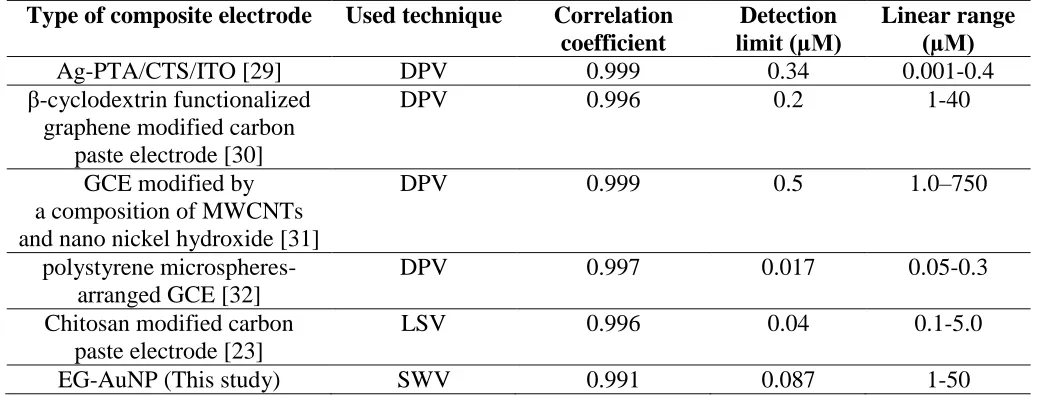
[image:11.596.39.559.279.478.2]The detection limit was calculated to be 0.087 µM when using the EG-AuNP electrode which is in the same range as other electrodes as illustrated in Table 3. These results support the possible application of the modified EG electrode for the electrochemical detection of 4-CP. The experiment was repeated five times with a good reproducibility as denoted by a RSD of 4.8%. The EG-AuNP electrode has the added advantage of resisting passivation which makes it applicable for the detection of phenolic compounds (without polishing and re-modification) with a good response to the analyte.
Table 3. Response characteristics of different electrodes for detection of chlorophenols
Type of composite electrode Used technique Correlation coefficient
Detection limit (µM)
Linear range (µM)
Ag-PTA/CTS/ITO [29] DPV 0.999 0.34 0.001-0.4
β-cyclodextrin functionalized graphene modified carbon
paste electrode [30]
DPV 0.996 0.2 1-40
GCE modified by a composition of MWCNTs and nano nickel hydroxide [31]
DPV 0.999 0.5 1.0–750
polystyrene microspheres-arranged GCE [32]
DPV 0.997 0.017 0.05-0.3
Chitosan modified carbon paste electrode [23]
LSV 0.996 0.04 0.1-5.0
EG-AuNP (This study) SWV 0.991 0.087 1-50
4. CONCLUSION
Electrode modification helps to reduce the effect of electrode passivation caused by the anodic oxidation of phenolic compounds. The peak current of the second scan can be reduced by more than 88% without modification while peak reduction can be as low as 17% on modified electrodes. These anti-passivating properties suggest that there is potential for the use of the modifiers (especially PPI dendrimer and AuNPs) reported in this work for the detection of phenols. The analysis is simple, fast and effective when using these fabricated electrodes.
ACKNOWLEDGEMENTS
References
1. C. I. Justino, A. C. Freitas, R. Pereira, A. C. Duarte and T. A. R. Santos, TrAC Trends in Analytical Chemistry, 68 (2015) 2.
2. S. Zhao and J. H. T. Luong, Analytica Chimica Acta, 327 (1996) 235. 3. A. K. M. Kafi and A. Chen, Talanta 79 (2009) 97.
4. J. Zhang, Z. Zhu, J. Zhu, K. Li and S Hua, International Journal of Electrochemical Science, 9 (2014) 1264.
5. K. Peeters, K. D. Wael, D. Bogaert and A. Adriaens, Sensors and Actuators B: Chemical, 128 (2008) 494.
6. G. Avci, B. Yazci and M. Erbil, Russian Journal of Electrochemistry, 45 (2009) 263.
7. T. Ndlovu, O. A. Arotiba, S. Sampath, R. W. Krause and B. B. Mamba, Sensors, 12 (2012) 11601.
8. T. Spătaru and N. Spătaru, Journal of hazardous materials, 180 (2010) 777. 9. T. Mafatle and T. Nyokong, Analytica Chimica Acta, 354 (1997) 307.
10.A. Hilmi, J. H. T. Luong and A. Nguyen, Journal of Chromatography, 761 (1997) 259. 11.R. Seifie-Makrani, N. Sajjadi, O. Younesi and H. Bagheri, International Journal of
Electrochemical Science, 9 (2014) 1799.
12.S. Poorahong, C. Thammakhet and P. Thavarungkul, Microchimica Acta, 176 (2012) 91. 13.T. Ndlovu, O. A. Arotiba, S. Sampath, R. W. Krause and B. B. Mamba, Journal of Applied
Electrochemistry, 41 (2011) 1389.
14.O. A. Arotiba, E. A. Songa, P. G. Baker and E. I. Iwuoha, Chemistry Today, 27 (2009) 55. 15.O. A. Arotiba, P. G. Baker and E. I. Iwuoha, International Journal of Electrochemical Science, 6
(2011) 673.
16.A. Salimi, H. Mamkhezri, R. Hallaj and S. Soltanian, Sensors and Actuators B: Chemical, 129 (2008) 246.
17.A. Salimi, R. Hallaj, S. Soltanian and H. Mamkhezri, Analytica Chimica Acta, 594 (2007) 24. 18.R. O. Kadara, N. Jenkinson and C. E. Banks, Electroanalysis, 21 (2009) 2410.
19.M. Yang and Z. Hu, Journal of Electroanalytical Chemistry, 583 (2005) 46. 20.C. A. Frysz, X. Shui and D. D. L. Chung, Carbon, 35 (1997) 893.
21.J. M. Skowroński and P. Krawczyk, Journal of Solid State Electrochemistry, 11 (2006) 223. 22.V. P. Chauke, W. Chidawanyika and T. Nyokong, Electroanalysis, 23 (2011) 487.
23.J. Xu, Y. Wang, H. Qiu and Y. Zhang, Russian Journal of Electrochemistry, 50 (2014) 531. 24.B. Agboola and T. Nyokong, Electrochimica Acta, 52 (2007) 5039.
25.S. Guo and E. Wang, Analytica Chimica Acta, 598 (2007) 181.
26.J. Zhang, Q. Li and M. Chen, Sensors and Actuators B: Chemical, 160 (2011) 784.
27.T. A. Enache, and A. M. Oliveira-Brett, Journal of Electroanalytical Chemistry, 655 (2011) 9. 28.L. Xiao, G. G. Wildgoose and R. G. Compton, Analytica Chimica Acta, 620 (2008) 44.
29.M. Wei, D. Tian and S. Liu, Sensors Actuators B: Chemical, 195 (2014) 452.
30.J. Zolgharnein, T. Shariatmanesh and A. Babaei, Sensors and Actuators B: Chemical, 186 (2013) 536.
31.S. Zhang, Z. Shi and J. Wang, Electrochimica Acta, 130 (2014) 734.
32.Y. Zhu, M. Wu and S. Liu, Journal of Applied Electrochemistry, 43 (2013) 1035.
![Figure 1. a) CVs (50 mV/s) and b) SWVs of all the modified electrodes in 1 mM [Ru(NH3)6]2+/3+](https://thumb-us.123doks.com/thumbv2/123dok_us/1891234.146758/4.596.85.516.435.597/figure-cvs-mv-swvs-modified-electrodes-ru-nh.webp)