Int. J. Electrochem. Sci., 10 (2015) 4562 – 4570
International Journal of
ELECTROCHEMICAL
SCIENCE
www.electrochemsci.org
Improved Oxygen Reduction Activity on PEDOT Via
Electroolymerisation In Ionic Liquid
Jinfu Ma1,*, Tong Xue1, Zhongli Zou1, Beiping Wang1, Min Luo2
1
School of Material Science and Engineering, Beifang University of Nationalities, Yinchuan 750021, PR China
2
College of Chemistry and Chemical Engineering, Ningxia University, Yinchuan 750021, PR China
*
E-mail: [email protected]
Received: 20 February 2015 / Accepted: 23 February 2015 / Published: 28 April 2015
It has been demonstrated that the electrolyte of electropolymerisation of Poly(3,4-ethylenedioxythiophene)(PEDOT) have a significant influence on the electro-catalytic activity for reduction of oxygen. It is notable that PEDOT-modified electrode via electropolymerisation in ionic liquid (GC/PEDOTIL) possesses remarkable electrocatalytic properties for oxygen reduction reaction (ORR) as compared with the electrode obtained from aqueous solution (GC/PEDOTaq). The exchange current densities have been achieved to be 86:1, it indicates the excellent catalytic properties of GC/PEDOTIL. Nevertheless, the number of electron transferred by per O2 molecule(n) calculated from
the slope of the Koutecky-Levich plots [J−1 vs ω−1/2] is to be 2, it means the ORR proceeds via the 2-electron pathway only in alkaline media on PEDOT decorated electrode.
Keywords: Oxygen reduction reaction (ORR), Poly(3,4-ethylenedioxythiophene) (PEDOT), Ionic liquid, Electron-transfer mechanism
1. INTRODUCTION
The air electrode, which reduces oxygen (O2), is a critical component in energy generation and
researchers’ great interest. Du et al. pointed out that “the metal - free carbon nanomaterials become more active than the metal catalysts and last longer” [13]. As compared with Pt catalyst, metal-free catalyst has no CO poisoning and fuel penetration effect, and has long-term operation stability and low price. Recently, the N, P, B, S doped carbon materials [13-29] and functional carbon materials [30] have been focused by researchers. For example, the vertically aligned nitrogen containing carbon nanotubes (VA-NCNTs) fuel cell cathodes have been demonstrated with superior oxygen-reduction activities, operational stability, crossover effects tolerance, and CO poisoning resistance [3].
An air electrode based on a porous material coated with poly(3,4-ethylenedioxythiophene) (PEDOT), which acts as an O2 reduction catalyst without material degradation or deterioration, has
been developed by Winther-Jensen et al. It could work for 1500 hours. In addition, PEDOT electrode is inert to CO[1]. In latest research [31],it has been found that the polymerization method to prepare the conducting polymer PEDOT have influenced the electro-catalytic pathway of oxygen reduction significantly .
Here, based on the previous research [32], aims to demonstrated the influence on improve oxygen reduction activity of Poly(3,4-ethylenedioxythiophene)(PEDOT) electropolymerisation media the PEDOT electropolymerised in ionic liquid and ORR catalytic mechanism has been investigated.
2. EXPERIMENTAL SECTION
All chemicals were reagent grade, used without further purification. The monomer, EDOT has been obtained from Aldrich (Purity:97%). The ionic liquid 1-ethyl-3-methylimidazolium bis((trifluoromethy)sulfonyl)imide ([EMIm][NTf2]) (Purity:99%) was from Lanzhou institute of
chemical physics, China.
The cyclic voltammograms (CV), galvanostatic line sweep voltammograms (LSV) and Tafel curves were carried out in a conventional three-electrode arrangement using a computer controlled CHI760E Electrochemical Workstation (CH Instrument, Inc. USA). The rotating disk electrodes (RDE-3A, BAS inc. Japan) glassy carbon electrode (GCE, Φ=0.4 cm) served as the working electrode. Ag/AgCl(3 M KCl) and Hg/HgO(6 M KOH) electrodes as reference electrodes used in electropolymerisation and ORR test, respectively. A Pt wire as a counter electrode. The reference electrodes were connected to the main body of the cell through a Luggin capillary, whose end was centered on the working electrode and positioned closed to the electrode surface.
Using field emission scanning electron microscope (FE-SEM, JEOL-7500F, Japan), the morphology information of the PEDOT was characterized.
3. RESULTS AND DISCUSSION
3.1 Electropolymerisation of EDOT in different media
3,4-Ethylenedioxythiophene is poorly soluble in aqueous solution, hence it has been used in relatively low concentrations to guarantee homogeneous media. After the solution of 0.01 M EDOT+0.1 M Na2SO4 stood for 24 h, the color of the mixture solution would convert to yellow. It
indicates that the oligomer has been generated.
0.8 1.0 1.2 1.4 1.6
-0.5 -1.0 -1.5 -2.0 -2.5 -3.0 -3.5
P1'
P2
Na2SO4 solution
[EMIm][NTf2]
j /
m
A.
cm
-2
E / V vs Ag/AgCl P1
Figure 1. LSV of EDOT on GC electrode in 0.1 M Na2SO4 aqueous solution (black) and in ionic
liquid [EMIm][NTf2] (red) media containing 0.01 M EDOT at 10 mV/s.
Figure.1(black curve) shows the linear sweep voltammogram of 0.01M EDOT aqueous solution containing 0.1 M Na2SO4 at sweep rate of 10 mVs–1. Two oxidation peaks, P1and P2, locate at
+1.15 and 1.31 V, respectively. The two peak potential values are in agreement with previously reported data [32, 33]. According to data analysis, the first peak (P1) is related to the oxidation of monomer, which adsorbed on or free from the electrode surface [33]. The second peak (P2) is related to the oxidation of EDOT species diffused to the electrode closely, or the overoxidation of the PEDOT film as enough amount of polymer deposited on the electrode [33]. Therefore, as shown in Fig.1, potential of +1.15 V was been selected for electropolymerisation process (GC/PEDOTaq).
EDOT can easily dissolve in [EMIm][NTf2]. Therefore, it is unnecessary to leave the solution
on standing before use. As shown in the Figure.1 (red curve), the peak potential(P1’)related to the oxidation of monomer shifts negatively to 1.1 V, and the potential of overoxidation peak shifts positively. It indicates the electropolymerisation process is easier as comparing with the one dissolved in ionic liquid, and overoxidation will be limited. The existence of ionic liquid could help to obtain high quality of conductive polymer PEDOT. As a result, 1.1 V was applied as electropolymerisation potential (GC/PEDOTIL).
The GC/PEDOTaq and GC/PEDOTIL were prepared by potentiostatic polymerization for 200 seconds, and then soaked in dichloromethane(CH2Cl2) in 24 hours to remove residual EDOT monomer
and [EMIm][ NTf2]. Before electrochemistry test, the electrodes were left to stand in 0.1 M KOH
[image:3.596.149.419.167.362.2]
3.2 Characterization of morphology
Figure 2. FE-SEM images of PEDOT from electropolymerisation in (a) aqueous solution and (b) ionic liquid ([EMIm][NTf2])
The FE-SEM micrographs of GC/PEDOTaq and GC/PEDOTIL are shown in Figure 2. From the images, the structural distribution the PEDOT synthesized in ionic liquid (Figure 2b) is even and particle size are mainly distributed in 100-200 nm. By contrast, no uniform particles were observed when the polymerization was carried out aqueous solution (Figure 2a), this confirms that the ionic liquid plays a vital role in preventing particle aggregation during synthesis.
3.3 Electrocatalytic behavior of PEDOT for ORR 3.3.1 Cyclic voltammetry(CV)
The cyclic voltammograms (CVs) of oxygen reduction in O2-or N2-saturated 0.1 M KOH
solutions at different electrodes are shown in Figure 3A. For the PEDOT-modified GCE in aqueous solutions, the ORR peaks could be observed clearly in the O2-saturated, but not N2-saturated 0.1M
KOH solution.
0.0 -0.2 -0.4 -0.6 -0.8 0.0
0.1 0.2
N2 O2
j
/
m
A,
cm
-2
E / V vs Hg/HgO
A
0.0 -0.2 -0.4 -0.6 -0.8
-1.5 -1.0 -0.5 0.0 0.5
PEDOT synthesised in Na
2SO4
PEDOT synthesised in [EMIm][NTf2
j /
m
A.
cm
-2
E / V vs Hg/HgO
[image:4.596.129.476.105.240.2]B
Figure 3. Cyclic voltammograms of ORR on various electrocatalysts in O2 or N2 saturated 0.1 M KOH
solution.(A) GC/PEDOTaq in N2(black) and O2(red) saturated solution. (B)
[image:4.596.102.479.567.692.2]
The onset potential of ORR is -0.2 V (versus Hg/HgO) with a single cathodic reduction peak of around -0.37 V (versus Hg/HgO). It indicats PEDOT has a good electrochemical catalytic effect for ORR in the alkaline solution that has been reported by Winther-Jensen’[1] and our group[32] . By contrast, the CV of ORR catalyzed by PEDOT-modified GCE in ionic liquid has apparent changes. The onset potential of ORR shifts negatively and the reduction peak shifts positively to around 0.3 V, with a concomitant increase in the peak current density (Figure 3B). It indicates the ORR electrocatalytic activity of PEDOT has a significant enhancement in ionic liquid media. As reported by Kerr et.al. [31], the polymerization method used to prepare the conducting polymer PEDOT has a significant influence on the electro-catalytic pathway for the reduction of oxygen.
Combining the FE-SEM images (Figure 2), the uniform structure distribution and smaller particle size of GCE/PEDOTIL provide greater specific surface area and catalytic active sites for ORR.
3.3.2 Tafel analysis
In order to demonstrate the improved ORR activity on PEDOT via electropolymerisation in ionic liquid further, the Tafel curves have been carried out. Exchange current densities reflect intrinsic rates of electron transfer between analyte and the electrode. The intrinsic rates provide insights into the structure of electrode materials and bonding in the electrolyte and the electrode.
An electrochemical reaction under kinetic control obeys the Butler-Volmer equation, which relates the exponential dependence of current to the deviation of voltage from the open circuit potential. Therefore, by potentiostatically measuring the dependence and plotting the logarithm of current density (I) vs. potential (V), it is possible to extract the reaction kinetic parameters, such as exchange current density[34].
0.1 0.2 0.3 0.4 0.5
-11 -10 -9 -8 -7 -6
PEDOT synthesised in Na2SO4
PEDOT synthesised in [EMIm][NTf2]
lo
g
(j
/ m
A.
cm
-2 )
E / V vs Hg/HgO
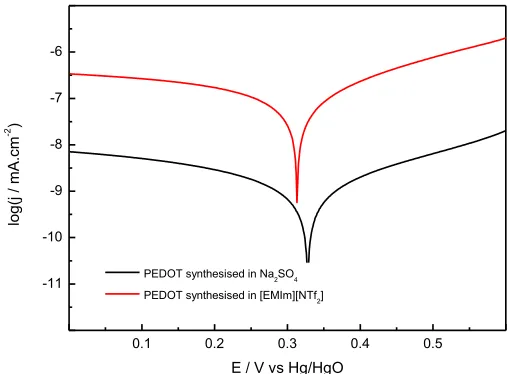
Figure 4. Tafel curves of GC/PEDOTaq(black) and GC/PEDOTIL (red) electrodes in O2-saturated 0.1
M KOH solution at 0.001 V.s-1
As shown in Figure 4, the cathodic/anodic branches were obtained in the O2 -saturated 0.1 M
[image:5.596.161.415.468.655.2]
GC/PEDOTIL electrode had 16 mV shifts to negative potential and significantly larger current compared to GC/PEDOTaq electrode. Through a linear fit by excluding larger overpotentials (larger than 200 mV), exchange current densities of 1.01 ×10⁻⁶ A.cm-2 and 8.57×10⁻⁵ A.cm-2 were obtained from the point of intersections, respectively. The ratio of 86:1 on exchange current densities indicates the excellent catalytic properties of GC/PEDOTIL.
3.3.3 Electro-transfer mechanism
RDE voltammetry measurements were also carried out to gain further insight on the ORR performance of the GC/PEDOTIL electrode.
-1.0 -0.8 -0.6 -0.4 -0.2 0.0 0.0 0.5 1.0 1.5 2.0 2.5 3.0
E / V vs Hg/HgO
J / mA cm -2 0 rpm 200 rpm 400 rpm 600 rpm 1000 rpm 1200 rpm 1600 rpm 2000 rpm 2400 rpm A
0.00 0.01 0.02 0.03 0.04 0.05 0.06 0.07
0.0 0.2 0.4 0.6 0.8 1.0 1.2 1.4 1.6 1.8 1 /J / mA -1 cm 2 -0.4V -0.6V -0.7V -1V -1/2
/ (rmin-1
)-1/2
B
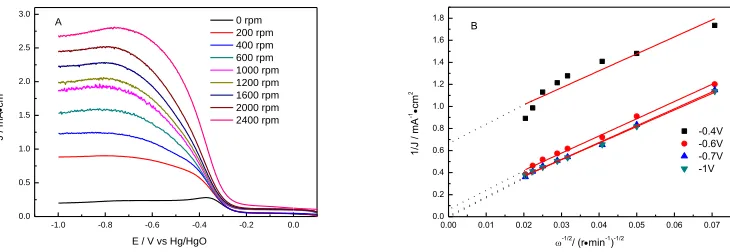
Figure 5. LSV of GC/PEDOTIL on RDE at different rotating rates (0 to 2400 rpm) in O2-saturated 0.1
M KOH solution (A) and corresponding Koutecky-Levich plots at different potentials (B).
Figure 5A shows RDE I-V curves at different rotation rates for GC/PEDOTIL electrode. It is clearly shown, the limiting current density increases with rotation rate increasing. The transferred electron number per oxygen molecule involved in the oxygen reduction was determined by the Koutechy-Levich equation given below [34,35]:
5 . 0 1 1 1 B J J k
where Jk is the kinetic current and ω is the electrode rotating rate. B is determined from the
slope of K-L plots (Figure 5B) based on Levich equation as follows [35]:
2 2 6 / 1 3 / 2 ) ( 2 .
0 nF DO CO
B
Where n is transferred electron number, DO2 is well-established values for the diffusion
coefficient (1.9×10⁻⁵ cm2 s−1), ν is kinematic viscosity (0.01 cm2 s−1), CO2is solubility limit (= 1.2 ×
10−6 mol dm−3) of gaseous oxygen in KOH (aq, 0.1 mol dm−3) at 298 K, and F is the Faraday constant (96485 C · mol−1). The constant 0.2 is adopted when the unit of rotation speed is in rpm. It was assumed that the active area of each film is equal to the geometric area (0.1256 cm2).
[image:6.596.111.476.272.398.2]
It indicates ORR at the GC/PEDOTIL electrode is only via the classical two-electron process. The presented result is in good agreement with the one that literature reported [31]. The reversely extended fitting lines at higher overpotentials (-0.7 V and -1.0 V) pass through the zero point. It indicates the electrode reaction is a fully diffusion-controlled process whereas a dynamics and diffusion mixed controlled process carries out at lower overpotentials (-0.4 V and -0.6 V).
3.3.4 Stability test
The stability and the methanol tolerance are important issues for cathode materials in low-temperature fuel cells. Pt-based catalysts could be poisoned easily during methanol oxidation procedure. The durability of GCE/PEDOTIL was evaluated by the chronoamperometric response under constant cathodic voltage of -0.4 V.
0 500 1000 1500 2000 -0.4 -0.2 0.0 0.2 0.4 0.6 0.8 1.0 1.2 1.4
-0.7-0.6-0.5-0.4-0.3-0.2-0.10.0 0.0 0.5 1.0 1.5 2.0 2.5 3.0 3.5 J / mA cm -2
E / V vs Ag/AgCl GCE/PEDOTIL Pt/C Pt/C GCE/PEDOTIL J / mA cm -2
t / s A
0 500 1000 1500 2000
0 20 40 60 80 100 120 Pt/C GCE/PEDOTIL R e la tive cu rre n t %
t / s
B
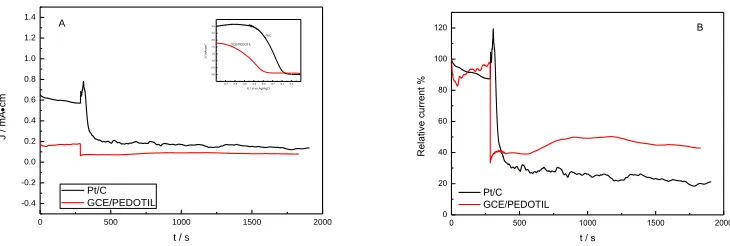
Figure 6. Chronoamperometric responses of GCE/PEDOTIL(red) and Pt/C(black)-modified GC electrodes with 3 M methanol added at around 300 s at -0.40 V in an O2-saturated 0.1 M KOH
solution. (Inset- LSVs of GCE/PEDOTIL(red) and Pt/C(black)-modified GC electrodes at 1600 rpm) in O2-saturated 0.1 M KOH solution)
As shown in Figure 6, linear scan voltametrys (LSVs) curves (inset) of GCE/PEDOTIL and Pt/C-modified GC electrodes have been tested at 1600 rpm. It has been shown that the catalytic ability for ORR of Pt/C is still better than that of GCE/PEDOTIL, remarkably. As shown in Figure 6A, the original cathodic ORR current of GCE/PEDOTIL under -0.4 V had no significant change after the scheduled addition of methanol into the electrolyte solution (the resulting methanol concentration is 3 M), while the current of Pt/C shifted from a cathodic current to a reversed anodic current in a very short time after methanol addition, it means the dominated oxygen reduction reaction converted to the methanol oxidation reaction. The relative current of GCE/PEDOTIL could be increased after ca. 150 s. After addition of methanol, the catalysts were held at -0.40 V for 1800 s in an O2-saturated 0.1 M
[image:7.596.112.477.309.432.2]
It also can be seen from Figure 5A, after addition of methanol, the cathodic current of GCE/PEDOTIL electrode increases gradually after a sudden drop, while current of Pt/C electrode continues to decline. It has been investigated that the Pt electrode has been poisoned by carbon monoxide (CO) during methanol oxidation while PEDOT electrode could not be [36]. With the methanol concentration decreasing, the cathodic current for ORR of GCE/PEDOTIL electrode increase gradually.
As the results, GCE/PEDOTIL exhibits high stability and has a good ability for avoiding CO poisoning from methanol oxidation. It has been demonstrated that GCE/PEDOTIL has potential usage in direct methanol and alkaline fuel cells.
4. CONCLUSIONS
In summary, this study has demonstrated that the electrolyte of electropolymerisation of PEDOT have a significant influence on the electro-catalytic activity for reduction of oxygen. It is notable that PEDOT-modified electrode via electropolymerisation in ionic liquid ([EMIm][NTf2])
possesses remarkable electrocatalytic properties for ORR. From the slope of the Koutecky-Levich plots,it could be found that the ORR on PEDOT prepared electrochemically proceeds via the 2-electron pathway only in alkaline media. The GCE/PEDOTIL exhibits high stability and has a good ability for avoiding CO poisoning from methanol oxidation. The SEM images show that GC/PEDOTIL provides a porous electrode with high porosity, high specific surface, high gas / liquid / solid three phase boundary reaction zone (Figure 3b), which accelerates the gas phase reaction in the liquid phase mass transfer process; significantly improve the cathodic reaction rate. The mechanism of PEDOT electropolymerisation in ionic liquid will be investigated in further research.
ACKNOWLEDGEMENTS
This work was supported by the National Natural Science Foundation of Ningxia Hui Autonomous Region, China (No. NZ14097) and the National Natural Science Foundation of China (Grant No 21361020).
References
1. B. Winther-Jensen, O. Winther-Jensen, M. Forsyth and D. R. MacFarlane, Science, 2008, 321 (2008) 671
2. R. Bashyam, P. Zelenay,.Nature, 443 (2006) 63
3. K. Gong, F. Du, Z. Xia and M. Durstock, L. Dai, Science, 323 (2009) 760 4. M. Lefèvre, E. Proietti F. Jaouen and J-P. Dodelet,Science, 324 (2009) 71
5. Y. Zheng, Y. Jiao, J. Chen J. Liu, J. Liang, A. Du. W. Zhang, Z. Zhu, S.C. Smith, M. Jaroniec. G. Q. Lu and S. Qiao, J. Am. Chem. Soc. 133 (2011) 20116
6. Z. Yang, X. Zhou, H. Nie, Z. Yao and S. Huang, ACS Applied Materials & Interfaces. 3 (2011) 2601
Chem. C., 115 (2011) 16672
9. R. Chen, H. Li, D. Chu, G. Wang and G. Richard, J. Phys. Chem. C, 113 (2009) 20689 10. S. Zhang, X. Ren and J. Read, Electrochimica Acta., 56 (2011) 4544
11. Z. Wen, S. Ci, F. Zhang, X. Feng, S. Cui, S. Mao, S. Luo, Z. He and J. Chen, Adv. Mater., 24 (2012) 1399
12. J. P. Collman, N. K. Devaraj, R. A. Decreau, Y. Yang, Y. L. Yan,W. Ebina, T. A. Eberspacher and C. E. D. Chidsey, Science, 315 (2007) 1565
13. D. Yu, E. Nagelli, F. Du and L. Dai, J. Phys. Chem. Lett., 1 (2010) 2165 14. R. Liu, D. Wu, X. Feng and K. Müllen, Angew. Chem. Int. Ed., 49 (2010) 2565 15. S. Yang, X. Feng, X. Wang and K. Müllen, Angew. Chem. Int. Ed., 50 (2011) 5339 16. D. J. Wiggins-Camacho, K. J. Stevenson, J. Phys. Chem. C, 115:( 2011) 20002
17. T. Chen , Z. Cai , Z. Yang , L. Li , X. Sun , T. Huang , A. Yu, H. G. Kia and H. Peng, Adv. Mater. 23 (2011) 4620
18. L. Zhang, Z. Xia, J. Phys. Chem. C, 115 (2011) 11170
19. Z. W. Liu, F. Peng, H. J. Wang, H. Yu, W. X. Zheng and J. Yang, Angew.Chem. Int. Ed., 50 (2011) 3257
20. L. Yang, S. Jiang, Y. Zhao, L. Zhu, S. Chen, X. Wang, Q. Wu, J. Ma, Y. Ma and Z. Hu, Angew. Chem. Int. Ed., 50 (2011) 1
21. S. Wang, E. Iyyamperumal, A. Roy, Y. Xue, D. Yu and L. Dai, Angew. Chem., 123(2011) 11960
22. Y. Zheng, Y. Jiao, J. Chen, J. Liu, J. Liang, A. Du, W. Zhang, Z. Zhu, S. C. Smith, M. Jaroniec, G. Q. (Max) Lu and S. Z. Qiao, J. Am. Chem. Soc., 133 (2011) 20116
23. S. Lyth, Y. Nabae, S. Moriya, S. Kuroki, M. Kakimoto, J. Ozaki and S. Miyata, J. Phys. Chem. C, 113 (2009) 20148
24. Y. Tang, B. Allen, D. R. Kauffman, A. Star, J. Am. Chem. Soc., 131 (2009) 13200
25. Z. Chen, D. Higgins, H. Tao, R. S. Hsu and Z. Chen, J. Phys. Chem. C, 113 (2009) 21008 26. Z. Chen, D. Higgins and Z. W. Chen, Carbon, 48 (2010) 3057
27. W. Xiong, F. Du, Y. Liu, A. Peres, M. Supp, T. S. Ramakrishnan, L. Dai and L. Jiang, J. Am. Chem. Soc., 132 (2010) 3057
28. D. Yu, Q. Zhang and L. Dai, J. Am Chem. Soc., 132 (2010) 15127
29. Z.Yang, Z. Yao, G. Li, G. Fang, H. Nie, Z. Liu, X. Zhou, X. Chen and S. Huang, ACS Nano, 6 (2012) 205
30. S. Wang, D. Yu and L. Dai, J. Am. Chem. Soc., 133 (2011) 5182
31. R. Kerr, C. Pozo-Gonzalo, M. Forsyth, and B. Winther-Jensen, ECS Electrochem. Lett., 2 (2013) F29
32. J. Ma, X. Wang and X. Jiao, Int. J. Electrochem. Sci., 7 (2012) 1556
33. L. Pigani, A. Heras, Á. Colina, R. Seeber and J. López-Palacios, Electrochem. Commun., 6 (2004) 1192
34. A. J. Bard, L. R. Faulkner, Electrochemical methods: fundamentals and applications, 2nd ed., John Wiley & Sons, Inc., Hoboken, NJ, 2001.
35. S. Wang, D. Yu and L. Dai, J. Am. Chem. Soc., 133 (2011) 5182 36. S. Patra, N. Munichandraiah, Langmuir, 25 (2009) 1732
![Figure 1. LSV of EDOT on GC electrode in 0.1 M Na2SO4 aqueous solution (black) and in ionic liquid [EMIm][NTf2] (red) media containing 0.01 M EDOT at 10 mV/s](https://thumb-us.123doks.com/thumbv2/123dok_us/1886804.146128/3.596.149.419.167.362/figure-electrode-aqueous-solution-liquid-media-containing-edot.webp)
![Figure 2. FE-SEM images of PEDOT from electropolymerisation in (a) aqueous solution and (b) ionic liquid ([EMIm][NTf2])](https://thumb-us.123doks.com/thumbv2/123dok_us/1886804.146128/4.596.102.479.567.692/figure-images-pedot-electropolymerisation-aqueous-solution-ionic-liquid.webp)