Int. J. Electrochem. Sci., 10 (2015) 10718 - 10725
International Journal of
ELECTROCHEMICAL
SCIENCE
www.electrochemsci.org
Short Communication
Synthesis and Electrochemical Performance of Li-rich Cathode
Material Li[Li
0.2Ni
0.16Mn
0.56Co
0.06Al
0.02]O
2in the Lithium-Ion
Battery
Zhang Hai-Lang*, Ye Yan-Yan
School of Chemical and Material Engineering, Jiangnan University, Wuxi 214122, China
*
E-mail: [email protected]
Received: 7 September 2015 / Accepted: 25 October 2015 / Published: 4 November 2015
The layered Li-rich cathode material Li[Li0.2Ni0.16Mn0.56Co0.06Al0.02]O2, which is a solid solution
between Li[Li1/3Mn2/3]O2 and LiNi0.4Mn0.4Co0.15Al0.05O2 has been synthesized firstly by a sol–gel
process. X-ray diffraction (XRD) identified that the material has layered ɑ-NaFeO2 structure, and images of scanning electron microscopy (SEM) showed the material particles are about 100nm. Electrochemical measurements showed that in the range of 2.0–4.8V at a rate of 0.1C, the initial discharge capacity at 20 oC is 221.8mAh/g with the irreversible capacity loss of 38.2mAh/g, andthe initial discharge capacity at 55 oC is 281.7mAh/g with the irreversible capacity loss of 21.1mAh/g. The material also exhibits good cycleability and rate capability. The cyclic voltammetry data are reflected in the charge–discharge studies.
Keywords: lithium-ion battery, Li[Li0.2Ni0.16Mn0.56Co0.06Al0.02]O2, cathode, high capacity,
electrochemical performance
1. INTRODUCTION
Lithium ion batteries (LIBs) have been widely used for electronic devices, hybrid electric vehicles, portable power tools and many other power supplies owing to their high energy and power density. The price and performance of one Li-ion battery is mainly based on its cathoe material . The layered lithium transition metal oxide LiCoO2 has been used as the cathode material for Li-ion battery
for a long time and still used. However , its high cost,toxicity and unsatisfactory thermal stability seriously limit its use[1-3]. Other cathode materials such as spinel LiMn2O4 [4] and olivine
LiFePO4[5 ]have been successfully applied in lithium ion batteries, but they typically have very low
reversible capacity following an “activation” process[6]. This family of cathode materials are also called Li-rich layered materials. Because Li-rich layered materials could deliver a very high discharge capacity of about 235mAhg-1 at room temperatue and of over 285 mAhg-1 at 55℃, they have been investigated intensively in recent years[ 7-28]. Although this kind of cathode material has many attracting advantages, it has a poor rate performance and is subject to voltage decay after long cycling. Doping one or more metal elements have been demonstrated to be one effective method to improve one cathode material[ 29-31 ]. Doping has also successfully been used for improving Li-rich layered materials[ 16,18,22 ]. Surface modification, i.e. coating , is also one useful method for improving one cathode material. In recent years,many researchers have employed this method to improving Li-rich layered material [ 11,13,15,16,6,19-21].
In the group of Li-rich layered cathode materials, Li[Li0.2Mn0.6Ni0.2]O2 and
Li[Li0.2Mn0.54Ni0.13Co0.13]O2 have been widely investigated already[ 7,12,14-18,20 , 24-27]. Between
them, Li[Li0.2Mn0.54Ni0.13Co0.13]O2 always shows better performance[7], because of that the presence
of cobalt reduces the electrode polarization significantly and improves the activation of the Li2MnO3
component[7], but it still contains 13 mol% of Co which certainly represents an issue with regard to cost, and the effect of the cobalt seems to deteriorate the high-potential cycling performances of the materials[8,28].
In the present work, we synthesized a novel Li-rich cathode material with a substantially lower Co content. The material has a general formula of Li[Li0.2Mn0.56Ni0.16Co0.06Al0.02]O2,which can also be
indicated as Li[Li1/3Mn2/3]O2·0.4LiNi0.4Mn0.4Co0.15Al0.05O2. The Al element is much more cheaper and
also environment friendly. And also the Al element has been demonstrated to improve Li-ion cathode materials[31]. So the Al element has been selected to replace the Co element a little. This The structure, electrochemical properties are reported in this paper. The as-synthesized sample exhibits both high capacity and cycling stability.
2. EXPERIMENTAL
2.1. Preparation of materials
Li[Li0.2Mn0.56Ni0.16Co0.06Al0.02]O2 powder was synthesized by a sol–gel process in which citric
acid was used as a chelating agent as the synthesis method in our labarotory[ 29-31]. Stoichiometric amounts of LiNO3, Mn(CH3COO)2·4H2O, Ni(NO3)2·6H2O, Al(NO3)3·9H2O and Co(NO3)2·4H2O were
used as starting chemicals and dissolved in distilled water, and added to a continuously stirred aqueous solution of citric acid. The molar ratio of citric acid to total metal ions was unity. The pH of the solution was adjusted in the range 7–8 by adding aqueous ammonium hydroxide. The resultant solution was evaporated at 80oC until a transparent sol-gel was obtained. The gel was dried at 120 oC for 15 h. The resulting gel precursor was decomposed at 500 oC for 5 h in air to eliminate the organic substances. The decomposed powders were pressed into pellets, heated at 750 oC for 6 h, and then 950
o
2.2. Measurements
The crystal structure of the as-prepared Li[Li0.2Mn0.56Ni0.16Co0.06Al0.02]O2 powder was
characterized by XRD with a D8 ADVANCE diffractometer using Cu Kα radiation. The diffraction angle was scanned from 2θ =10° to 80° at the scanning speed of 3°/min. The size and morphology of the sample was visualized using SEM performed on S4800 microscope with 3 kV.
Electrochemical experiments were performed using two-electrode coin cells[29-31]. The composite cathodes were made by dispersing active material (80 wt.%), acetylene black (12 wt.%), and PVDF (8 wt.%) to form a slurry, The slurry was pasted onto Al foil ,then pressed at 10MPa and dried at 120°C for 10h in a vacuum oven. The CR2032 coin cells were assembled in an argon-filled glove box using lithium metal as the counter electrode, Celgard 2325 as the separator, and 1 M LiPF6 in 1:1 EC:DEC solution as the electrolyte. Charge–discharge performance of the cells was evaluated within different cut-off voltages and at different discharge rates at 20 oC and 55 oC using LAND BT1210 electrochemical test instrument( Made in China).
3. RESULTS AND DISCUSSION
20 40 60 80
-50 0 50 100 150 200 250 300 350 400
Intensity
/a.u.
2/degree
003
104
101
102 006
110 108
[image:3.596.118.464.401.581.2]113
Figure 1. XRD patterns of Li[Li0.2Mn0.56Ni0.16Co0.06Al0.02]O2
The XRD pattern of Li[Li0.2Mn0.56Ni0.16Co0.06Al0.02]O2 is shown in Fig. 1.The XRD patterns are
indexed in α-NaFeO2 type structure, space group R¯3m. It exhibits a well defined diffractogram that
contains sharp and highly intense peaks. The weak reflections at 2θ =21°–25° are known to originate from the monoclinic Li2MnO3-like (C2/m) super lattice, which correspond to the ordering of the Li+
[image:4.596.98.500.131.303.2]
layered characteristics[9,33]. The integrated intensity ratio ‘R’ of the (003) to (104) line was found to be 1.52, which is an indication that the compound has good cation ordering[34].
Figure 2. SEM images of Li[Li0.2Mn0.56Ni0.16Co0.06Al0.02]O2
The morphological features of Li[Li0.2Mn0.56Ni0.16Co0.06Al0.02]O2 were characterized by
scanning electron microscopy and the results are shown in Fig. 2. It can be seen that the as-prepared particles have a nearly spherical morphology with an average diameter of approximately 100nm, almost a nano-material. Since small particles present shorter diffusion path for Li ions[7], the insertion and de-insertion of the Li+ in this material are expected to be faster, thus enhancing the electrochemical performance of this material[35].
0 50 100 150 200 250 300 350
1.8 2.0 2.2 2.4 2.6 2.8 3.0 3.2 3.4 3.6 3.8 4.0 4.2 4.4 4.6 4.8 5.0
Voltage/
(V vs Li
+ /Li
)
[image:4.596.138.449.488.650.2]Specific capacity/(mAh/g) 55℃ 20℃
Figure 3. Discharge curves of Li[Li0.2Ni0.16Mn0.56Co0.06Al0.02]O2 at a rate of 0.1C
Fig. 3 shows the first charge–discharge profiles of Li[Li0.2Ni0.16Mn0.56Co0.06Al0.02]O2 in the
range of 2.0–4.8V at a rate of 0.1C at room temperature and high temperature, recpectively.. Li[Li0.2Ni0.16Mn0.56Co0.06Al0.02]O2 exhibits charge and discharge capacity values of260mAh/g and
discharge capacity at 55 oC increases to 281.7mAh/g and the irreversible capacity loss decreases to 21.1mAh/g. It is important to notice that the first columbic efficient delivered by our material is larger than that of the Al2O3 coated Li[Li0.2Ni0.17Mn0.56Co0.07]O2 which is reported to have a larger
irreversible capacity loss of 58mAh/g[36]. This may predict that doping is more effective than coating.
0 10 20 30 40 50 60
100 150 200 250
55℃ 20℃
Specific capacity/(mAh/g)
Cycle number 4.8V
4.5V
[image:5.596.94.483.171.377.2]4.6V 4.7V 4.8V
Figure 4. Cycling performance of Li[Li0.2Ni0.16Mn0.56Co0.06Al0.02]O2 within different cut-off voltages
Fig. 4 shows the Cycling performance of Li[Li0.2Ni0.16Mn0.56Co0.06Al0.02]O2 electrodes
subjected to continuous cycling within different cut-off voltages at a rate of 0.2C. It can be seen from the figure that the discharge capacity of the cell Li[Li2/10Ni1/10Co2/10Mn5/10]O2/Li increases with the
increase of cycle number initially then slightly decreases afterwards and finally becomes stable up to 60 cycles both at 20 oC and 55 oC, respectively.The Li[Li0.2Ni0.16Mn0.56Co0.06Al0.02]O2 electrode
delivers 245.8mAh/g at the beginning and its discharge capacity reaches the maximum of 251.6mAh/g at the 6th cycle which means that the electrochemical properties have been fully activated, and then its discharge capacity decreases to 240.1mAh/g at the 60th cycle when the upper cut-off voltage is 4.8V at 55 oC. The excellent cycling characteristics of Li[Li0.2Ni0.16Mn0.56Co0.06Al0.02]O2 electrode can be
attributed to the enhanced structural stability reflected by high degree of crystallinity shown in Fig. 1 and the small crystallite size shown in Fig. 2 [37].
As can be seen in the Fig. 4, the discharge capacities of Li[Li2/10Ni1/10Co2/10Mn5/10]O2 at 20oC
are 183mAh/g in 4.5–2.0 V, 192.2mAh/g in 4.6–2.0 V and 197.6mAh/g in 4.7–2.0 V, respectively. The discharge capacities of Li[Li2/10Ni1/10Co2/10Mn5/10]O2 at 55 oC are 211mAh/g in 4.5–2.0 V,
0 10 20 30 40 50
[image:6.596.183.405.91.227.2]80 100 120 140 160 180 200 220 240 260 280 300 55℃ 20℃ Specific capacity/( mAh/g ) Cycle number 0.1C 0.2C 0.5C 0.75C 1C
Figure 5. Cycling and rate performances of Li[Li0.2Ni0.16Mn0.56Co0.06Al0.02]O2
Fig. 5 shows the discharge curves and cycling performance of Li[Li0.2Ni0.16Mn0.56Co0.06Al0.02]O2 in the range of 2.0–4.8V at various rates from 0.1 C to 1C. As can
be seen, the electrodes are able to deliver capacities of 223.1mAh/g and 282.1mAh/g at 0.1C after 10 cycles at 20 oC and 55 oC, respectively. Very interestingly, at 1C rate, the electrodes are still able to deliver 148.5mAh/g and 188.6mAh/g after 50 cycles at 20 oC and 55 oC, respectively, which correspond to 66.6% and 66.9% of the 0.1C delivered capacity. This comparison clearly indicates the excellent cycling characteristics and promising good rate capability of the material, especially at 50 oC. But compared to other materials from the same family, the Li[Li0.2Mn0.56Ni0.16Co0.08]O2 material
reported by Klopsch still has the better rate capability at high rate at 20 oC[35]. Therefore, a further study is necessary to improve its rate capability at low temperature.
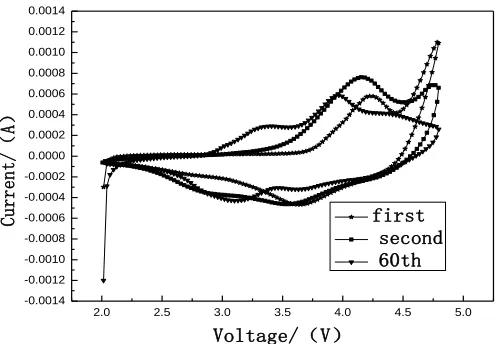
2.0 2.5 3.0 3.5 4.0 4.5 5.0 -0.0014 -0.0012 -0.0010 -0.0008 -0.0006 -0.0004 -0.0002 0.0000 0.0002 0.0004 0.0006 0.0008 0.0010 0.0012 0.0014 first second 60th Current/( A) Voltage/(V)
Figure 6. Cyclic voltammograms of Li[Li0.2Ni0.16Mn0.56Co0.06Al0.02]O2
In order to further understand the electrochemical properties of Li[Li0.2Ni0.16Mn0.56Co0.06Al0.02]O2, cyclic voltammetry was carried out in the range 2.0–4.8V with a
[image:6.596.169.417.481.653.2]
which is above 4.5 V is the irreversible reaction in which the lithium is extracted from the removed from Li[Li1/3Mn2/3]O2 component with the simultaneous release of oxygen[8]. In the first charge curve,
there are no peaks below 3.5 V that corresponds to Mn3+/Mn4+ redox-reaction in CV. The absence of the Mn3+/Mn4+ peaks indicates that Mn4+ ions are electrochemically inactive, so it is presumed that Mn in our sample synthesized is in the valence of Mn4+ [10,38]. In the second charge curve, the Mn3+/Mn4+ peaks around 3.0V appear, which proves that part of Mn4+ has been reduced to Mn3+. As the cycling progresses, the Mn3+/Mn4+ peaks become more evident which results in the increase of the capacities at the beginning as shown in Fig. 4.
4. CONCLUSION
In this paper, Li[Li0.2Ni0.16Mn0.56Co0.06Al0.02]O2 has been succeedly synthesized by a sol–gel
method. The material shows the single phase layered with the super lattice structure originating from the monoclinic Li2MnO3, and the as-prepared particles have a nearly spherical morphology with an
average diameter of approximately 100nm. The electrochemical properties were analyzed by charge– discharge and CV studies. The highlights of this material are its high first columbic efficient, excellent cycling characteristics and good rate capability. Electrochemical measurements show that the irreversible capacity loss of the compound is 38.2mAh/g and 21.1mAh/g at 20 oC and 55 oC, respectively, in the range of 2.0–4.8V at a rate of 0.1C. The electrodes are still able to deliver 148.5mAh/g and 188.6mAh/g after 50 cycles at 1C rate at 20 oC and 55 oC, respectively. All those demonstrate that Li[Li0.2Ni0.16Mn0.56Co0.06Al0.02]O2 is a promising cathode material for next-generation
Li-ion battery. The Al element is an ideal element to replace the expensive and toxic element Co in this kind of cathode material.
References
1. Z.S. Peng, C.R. Wan and C.Y. Jiang, J. Power Sources, 72 (1998) 215 2. S. Bruno, Electrochim. Acta, 45 (2000) 2461
3. E. Antolini, Solid State Ionics, 170 (2004) 159
4. Y. S. Lee, Y. K. Sun and K. S. Nahm, Solid State Ioincs,109 (1998) 285 5. Y.S. Hu and Y.G. Guo, J. Maier, Adv. Mater., 19 (2007) 1963
6. L. Brian Ellis, Kyu Tae Lee and F. Linda , Chem. Mater., 22(2010),691
7. J. Li, R. Klopsch, M.C. Stan, S. Nowak, M. Kunze, M. Winter and S. Passerini, J. Power Sources, 196(2011)4821
8. L. Y. Yu, W.H. Qiu and F. Lian, Mater. Letters, 62( 2008),3010
9. Ch. H. Song, A. Manuel Stephan and Y. S. Lee, Mater. Chem. and Phys., 101(2007)63 10. Ch.L. Gan, X. H. Hu and H. Zhan, Solid State Ionics, 176( 2005) 687
11. S.-W. Cho, G.-O. Kim and K.-S. Ryu, Solid State Ionics,206(2012)84 12. J.M. Zheng, X.B. Wu and Y. Yang, Electrochim. Acta, 59(2011)3071
13. B. Liu, Q. Zhang, Sh.C. H, Y. Satob, J. W. Zheng and D.Ch. Li, Electrochim. Acta, 59(2011)6748 14. J.M. Zheng, X.B. Wu and Y. Yang, Electrochim. Acta, 105(2013)200
16. P. K.Nayak, J. Grinblat, M. Levi and D. Aurbach, Electrochim. Acta, 137(2014)546
17. Zh. He, Zh.X. Wang, Z.M. Huang, H. Chen, X.H. Li and H.J. Guo, J. Mater. Chem., 3(2015)16817 18. D. Wang, Y. Huang, Zh.Q. Huo and L. Chen, Electrochim. Acta,107(2013)461
19. Shi, S.J., J.P. Tu, Y.J. Zhang, Y.D. Zhang, X.Y. Zhao,X.L. Wang, and C.D. Gu,Electrochim. Acta, 108(2013)44
1
20. X.Y. Liu, J.L. Liu, T. Huang and A.Sh. Yu, Electrochim. Acta,109(2013)52 21. En.Sh. Han, Y.P Li, L.Zh. Zhu and L. Zhao, Solid State Ionics,255(2014)113 22. S. Yamamoto , H. Noguchi and W.W Zhao, J. Power Sources, 278(2015)76
23. A. Vu, L. K. Walker, J. Bareno, A. K. Burrell and I. Bloom, J. Power Sources, 280(2015)155 24. B.-J. Hwang, C.-J. Wang and C.-H. Chen, J. Power Sources, 146(2005),658
25. S. Christopher Johnson, N. Ch. Li, and L. Christina, Chem. Mater., 20(2008),6095 26. Y. Naoaki, Y. Kazuhiro and M. Seung-Taek, J. Am. Chem. Soc ., 133(2011)4404 27. W. Jeffrey,W. Fergus, J. Power Sources, 195(2010)939
28. M.M. Thackeray, S.H. Kang and C.S. Johnson, Electrochem. Commun., 8(2006)1531 29. J. F. Wang, H.L. Zhang, Funct. Mater. Letters,3(2010)65
30.H. L. Zhang, L. Zhang and L. Ye, Int. J. Electrochem. Sci., 9(2014)4635
31.H. L. Zhang, L. Zhang and Sh.W. Yang, Int. J. Electrochem. Sci., 9(2014)8182 32. Y.Wu, A. Manthiram, J. Power Sources, 183( 2008)749
33. L. F. Jiao, M. Zhang, H. T. Yuan, J. Power Sources, 167(2007)178 34. P. Periasamy and N. Kalaiselvi, J. Power Sources, 159( 2006)1360
35. J. Li, R. Klopsch, M.C. Stan and S. Nowak, J. Power Sources,196(2011)4821 36. Y. Wu, A. Manthiram.,Solid State Ionics, 180( 2009)50
37. D.-K. Lee, S.-H. Park, and K. Amine, J. Power Sources, 162( 2006)1346 38. S.H. Kim, S.J. Kim and K.S. Nahm, J. Alloys and Comp., 449(2008)339
![Figure 1. XRD patterns of Li[Li0.2Mn0.56Ni0.16Co0.06Al0.02]O2](https://thumb-us.123doks.com/thumbv2/123dok_us/1895056.147269/3.596.118.464.401.581/figure-xrd-patterns-li-li-mn-ni-co.webp)
![Figure 3. Discharge curves of Li[Li0.2Ni0.16Mn0.56Co0.06Al0.02]O2 at a rate of 0.1C](https://thumb-us.123doks.com/thumbv2/123dok_us/1895056.147269/4.596.138.449.488.650/figure-discharge-curves-li-li-ni-mn-rate.webp)
![Figure 4. Cycling performance of Li[Li0.2Ni0.16Mn0.56Co0.06Al0.02]O2 within different cut-off voltages](https://thumb-us.123doks.com/thumbv2/123dok_us/1895056.147269/5.596.94.483.171.377/figure-cycling-performance-li-li-ni-different-voltages.webp)