Int. J. Electrochem. Sci., 8 (2013) 3902 - 3911
International Journal of
ELECTROCHEMICAL
SCIENCE
www.electrochemsci.org
Significant Capacitance Performance of Vertically Aligned
Single-Walled Carbon Nanotube Supercapacitor by Varying
Potassium Hydroxide Concentration
Mohd Asyadi Azam1, 2, *, Akihiko Fujiwara3 ,and Tatsuya Shimoda2
1
Engineering Materials Department, Faculty of Manufacturing Engineering, Universiti Teknikal Malaysia Melaka (UTeM), 76100 Durian Tunggal, Melaka, Malaysia.
2
School of Materials Science, Japan Advanced Institute of Science and Technology (JAIST), 1-1 Asahidai, Nomi, 923-1292 Ishikawa, Japan.
3
Research and Utilization Division, Japan Synchrotron Radiation Research Institute (JASRI), 1-1-1, Kouto, Sayo-cho, Sayo, 679-5198 Hyogo, Japan.
*
E-mail: [email protected]
Received: 25 October 2012 / Accepted: 4 January 2013 / Published: 1 March 2013
In this manuscript, the effect of potassium hydroxide (KOH) electrolyte concentrations (0.1 M, 1.0 M, and 6.0 M) to the specific gravimetric capacitance of vertically aligned single-walled carbon nanotube (VA-SWCNT) based supercapacitor will be reported. VA-SWCNT electrode was prepared using direct growth technique of alcohol catalytic chemical vapor deposition. It was found that specific gravimetric capacitance of the VA-SWCNT supercapacitors increased with increasing KOH electrolyte concentration. Besides, lower concentration (or viscosity) of the KOH electrolyte may give better stability in charge storage performance; suggesting difference of ion movement inside the VA-SWCNT double-layer system. The capacitance slope (as a function of cyclic voltammetry scan rate) can be improved by lower concentration of the electrolyte.
Keywords: Vertically aligned single-walled CNTs; supercapacitor; alcohol catalytic CVD direct growth technique; KOH electrolyte; specific gravimetric capacitance; electrolyte molar concentration.
1. INTRODUCTION
with random and/or entangled form of CNTs. One of the popular methods to grow vertically-aligned CNTs (VA-CNTs) is the alcohol catalytic chemical vapor deposition (ACCVD) [4, 5], which is well-known for its economical merit, wide selectivity of substrates, and for yielding higher volume of CNTs. In optimizing performance of ECs (or supercapacitors), it is desirable to directly grow the aligned CNTs onto conducting substrates to prepare the electrodes. For example, metal alloy substrate/foil can act as a current collector in a capacitor; this simplifies the conventional electrode assembly process [6]. The direct growth technique can reduce the number of process steps in device fabrication, and also might avoid binder material incorporation which could increase the internal resistance of the device, thus negatively affecting charge storage performance [7].
ECs are structurally different from conventional capacitors. The EC electrode materials should be designed with an appropriate physical structure to have larger surface area for electrolyte wetting and ion accessibilities. In the case of carbon material electrode, although the pore size is good enough for electrolyte wetting and rapid ionic motion [8], consideration on other factors is also extremely critical. Another important factor in obtaining better electrochemical performance is the electrolyte or solvent [9 – 11]. The dynamic of electrolyte ions may affect the charge storage capacitance. For example, CNTs and exfoliated carbon fibers (ExCFs) were found to give higher capacitance in concentrated sulfuric acid (H2SO4) [12, 13]. In previous work, ionic liquid which is known for their
high concentration and high viscosity was used as electrolyte and resulting a remarkably high capacitance performance. However, the specific capacitance rate of VA-SWCNT electrode was found drastically decreased as the CV scan rates increased [14]. A more stable capacitance rate performance is required in approaching practical application.
In this article, ACCVD technique was used to directly grow vertically aligned single-walled CNT (VA-SWCNT) forests on metal alloy, SUS 310S for EC electrode fabrication. Cyclic voltammetric (CV) measurement was performed to study the capacitance performance of the SWCNT electrode in aqueous solution, the potassium hydroxide (KOH). By using similar VA-SWCNT electrode, different KOH electrolyte concentrations were employed in order to investigate the capacitance rate stability based on calculated specific gravimetric capacitances (Csp).
2. EXPERIMENTAL
2.1. Preparation of VA-SWCNT electrode
The electron beam (EB-) deposited Al films (20 nm) were thermally-oxidized (400 o C, 10 min, static air), and Co (0.5 nm) used as the catalyst [5, 15]. For the formation of Al-O, deposited Al was first naturally-oxidized at room temperature for 2 hours. The substrate was subsequently transferred to an ultra-high-vacuum CVD furnace (MILA-3000), and baked at 400 oC in static air for 10 min just before the CVD. Ethanol (99.99 %) was used as carbon feedstock during ACCVD [5, 16]. The furnace was then evacuated to around 0.1 Pa. Ar/H2 (3% H2) as the pretreatment gas was injected at a pressure
parameter was fixed at 700 o C, ethanol flow rates of 100 - 130 sccm, 3 kPa pressure, and 10 min processing time.
For conducting substrate to be used as current collector, SUS 310S foil with 0.2 mm thickness were cut into 15 mm diameter round substrates. The weight of one SUS 310S foil was approximately 0.285 g. After the CVD, the average weight increase of a foil with as-grown CNTs was 0.25 mg. We used Mettler Toledo balance with 0.01 mg accuracy to weigh the samples. Through similar heat-treatment without ethanol (CVD without ethanol), the foil`s weight increased 0.05 mg. Therefore, the net mass loading of CNT (0.20 mg) was obtained by subtraction of the weight increase of the foil with Co/Al-O films only, from that with CNTs.
2.2. Electrochemical measurements
Without electrode drying process, ECs were fabricated from Takumi Giken two-electrode cells using 25-m polypropylene (PP; Celgard) as separator, and potassium hydroxide (KOH) aqueous solution as electrolyte. KOH electrolyte was diluted from 8 M KOH into 3 different concentrations; 0.1, 1.0, and 6.0 M. Cyclic voltammetry (CV) measurements were conducted by potentiostat that attached to (a part of) the electrochemical quartz crystal microbalances (model 420A; ALS/CH Instruments). Based on the KOH solution applied potential window, CV measurements were conducted from 0.0 to 0.7 V.
3. RESULTS AND DISCUSSION
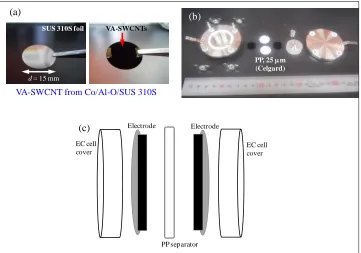
First, Fig. 1 shows VA-SWCNT forests were directly-grown on SUS 310S foils. From various analytical testing, CNTs on SUS 310S indicated the presence of single-walled type CNTs [5, 7], and the existence was confirmed by the radial breathing mode (RBM) region in Raman analysis (reported elsewhere) [17, 18]. In this article, the advantages of direct growth technique using ACCVD will be introduced. Various techniques including ACCVD have been developed for VA-SWCNT growth, in order to have ideal morphology for the effective use of the CNT surface. ACCVD technique has become one of the most popular methods used for low-cost, high-purity SWCNT production due to lack of amorphous carbon was attributed to the OH- radical present in ethanol, which preferentially reacts with carbon molecules that have dangling bonds [4, 18]. This effectively etches away those carbon atoms that are most likely to produce amorphous carbon. Growth condition and potential of SWCNTs for device application have also been reported elsewhere [14, 18].
simplified, and avoided the incorporation of binder material. Importantly, the limitations such as the cost to purchase pure SWCNTs and the electrode fabrication complexities have been minimized.
PP, 25 m (Celgard)
PP separator
Electrode Electrode
EC cell cover
EC cell cover SUS 310S foil VA-SWCNTs
d= 15 mm
VA-SWCNT from Co/Al-O/SUS 310S
(a) (b)
[image:4.596.119.480.131.384.2](c)
Figure 1. VA-SWCNT electrode preparation and electrochemical capacitor fabrication. (a) Images of blank SUS 310S foil and with VA-SWCNTs, (b) Digital image of EC fabrication using two-electrode cell, polypropylene separator, VA-SWCNT two-electrodes, and KOH electrolyte. (c) Cross-sectional schematic model of fabricated EC. All ECs were assembled in ambient environment.
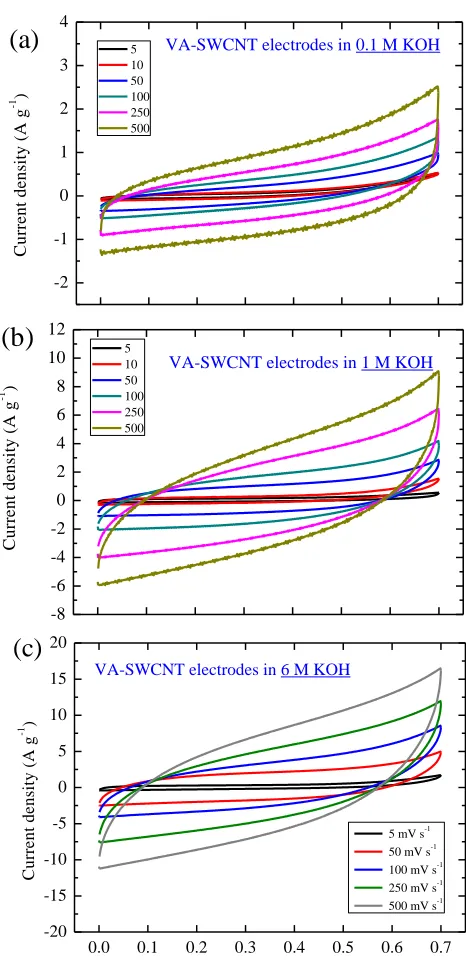
Electrochemical performance of VA-SWCNT electrode in KOH electrolyte is shown in Fig. 2. Csps in this work were calculated accurately based on the linear dependence of capacitance on cell
potential [21]. To quantitatively evaluate the charge storage capacity, capacitance of the ECs is determined by the voltammetric charges, cell potential window, and SWCNT loading [14, 21, 22]. Considering that the shape of CV curves is not ideal mirror-symmetry, integral area of CV curve divided by CV scan rate was used to represent the sum of anodic voltammetric charges (qa) and
cathodic voltammetric charges (qc). Sensitivity of CV measurement was 0.001 V per point. The Csp
was calculated accurately on the basis of the following equation:
𝐶sp = ( 𝑖 𝐸 𝑑𝐸
𝐸2
𝐸1
) ÷ 2 𝐸2− 𝐸1 𝑚𝑣
(1) where E1, E2 are the cutoff potentials in CV. i(E) is the current.
𝑖 𝐸 𝑑𝐸
𝐸2
𝐸1 is the total
voltammetric charges obtained by integration of positive (charge) and negative (discharge) sweeps in CV. (E2 – E1) is the cell potential window width. m is the SWCNT mass per electrode (0.20 mg for this
Fig. 2 shows the result of CV measurements for ECs made of VA-SWCNT grown on the SUS 310S. The electrodes were measured from 5 to 500 mV s-1 scan rates within the potential range from 0.0 to 0.7 V. Regardless of the scan rates, the CV curves confirmed the double-layer capacitance behavior of VA-SWCNTs when used as electrode material in the EC. All electrolyte concentrations results in similar CV profile. This significant result proved that the VA-SWCNTs had good electrical contact with the substrates. This can be mainly attributed to the fact that the CNTs are well-anchored to the substrates, and also indicates that the (insulating) Al-O support layer did not influence the contact between the CNTs and the substrate [23]. On the other hand, storing energy on and/or inside the SWCNT enables the device to have high rate capability, of up to 500 mV s-1.
0.0 0.1 0.2 0.3 0.4 0.5 0.6 0.7
-2 -1 0 1 2 3 4 C u rr e n t d e n si ty ( A g -1 )
VA-SWCNT electrodes in 0.1 M KOH
Potential (V) 5 10 50 100 250 500
(a)
0.0 0.1 0.2 0.3 0.4 0.5 0.6 0.7
-8 -6 -4 -2 0 2 4 6 8 10 12 C u rr e n t d e n si ty ( A g -1 )
VA-SWCNT electrodes in 1 M KOH
Potential (V) 5 10 50 100 250 500
(b)
0.0 0.1 0.2 0.3 0.4 0.5 0.6 0.7
-20 -15 -10 -5 0 5 10 15 20 C u rr e n t d e n si ty ( A g -1 ) Potential (V)
5 mV s-1 50 mV s-1
100 mV s-1 250 mV s-1
500 mV s-1 VA-SWCNT electrodes in 6 M KOH
[image:5.596.178.411.239.722.2](c)
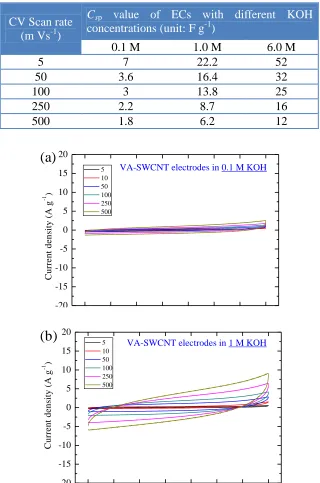
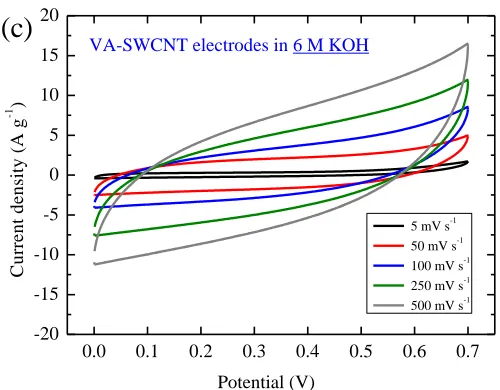
Furthermore, for easier understanding, Fig. 3 shows the CV curves with normalized current density values. In all CVs, current density adjusted from -20 to 20 A g-1 to show the CV shape size difference which directly correlated to the difference in capacitance performance. The Csp values are
summarized in Table 1. It shows that the higher the electrolyte solution concentration the higher the ion concentration, resulting in enhanced ion accessibilities onto the double-layer surfaces. Therefore, greater charge is stored on the electrode. Complete results of the specific capacitance for the electrolyte concentrations are summarized in Table 1.
Table 1. Specific gravimetric capacitance (Csp) of VA-SWCNT supercapacitor at different KOH
electrolyte concentrations.
CV Scan rate (m Vs-1)
Csp value of ECs with different KOH
concentrations (unit: F g-1)
0.1 M 1.0 M 6.0 M
5 7 22.2 52
50 3.6 16.4 32
100 3 13.8 25
250 2.2 8.7 16
500 1.8 6.2 12
0.0 0.1 0.2 0.3 0.4 0.5 0.6 0.7
-20 -15 -10 -5 0 5 10 15 20 C u rr e n t d e n si ty ( A g -1 )
VA-SWCNT electrodes in 0.1 M KOH
Potential (V) 5 10 50 100 250 500
(a)
0.0 0.1 0.2 0.3 0.4 0.5 0.6 0.7
-20 -15 -10 -5 0 5 10 15 20 C u rr e n t d e n si ty ( A g -1 )
VA-SWCNT electrodes in 1 M KOH
[image:6.596.139.459.249.732.2]
0.0 0.1 0.2 0.3 0.4 0.5 0.6 0.7
-20 -15 -10 -5 0 5 10 15 20
C
u
rr
e
n
t
d
e
n
si
ty
(
A
g
-1 )
Potential (V)
5 mV s-1
50 mV s-1
100 mV s-1
250 mV s-1
500 mV s-1
VA-SWCNT electrodes in 6 M KOH
[image:7.596.175.425.73.268.2](c)
Figure 3. Normalized current density of CV curves of VA-SWCNT based electrochemical capacitor at the range of 5 ~ 500 mV s-1 scan rates in (a) 0.1 M, (b) 1 M, and (c) 6 M KOH electrolyte. Current density was normalized in the range of -20 to 20 A g-1to show the pattern size difference.
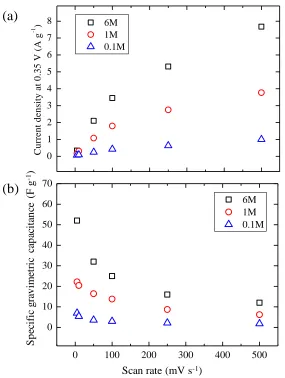
The maximum Csps were 7, 22, and 52 F g-1 with KOH electrolyte concentrations of 0.1, 1.0,
and 6.0 M, respectively (at 5 mV s-1 scan rate). The capacitance of the VA-SWCNTs employed in 0.1 M KOH was estimated approximately one-seventh the value of the one cycled in 6.0 M KOH. The higher KOH electrolyte concentration, the higher specific capacitance was obtained. This indicates the enhanced charge-storage mechanism in more concentrated electrolytes [13].
Further, Fig. 4 (a) depicts the plots of current density as a function of CV scan rates for all capacitors. The current density at ~ 0.35 V cell potential was found to increase linearly with the CV scan rates; a linear dependence of the current density to the CV scan rates for all KOH electrolytes. This again indicates good double-layer capacitance behavior between KOH electrolyte ions and VA-SWCNTs. Consistent with calculated Csps, VA-SWCNT electrode assembled with 6.0 M KOH showed
remarkably higher current density values than the others.
The stability of different KOH concentrations is discussed in Fig. 4 (b); the plot of Csp as a
function of CV scan rate. The difference of the capacitance rate performance was summarized in Table 2, showing the difference at slowest (5 mV s-1) and fastest (500 mV s-1) CV scan rates. At all KOH concentrations (0.1, 1.0, and 6.0 M), it was found that the capacitances decreased to about 71 %, 73 %, and 77 %, respectively. It is interesting that although VA-SWCNTs in 6 M KOH has the highest Csp,
0 100 200 300 400 500
0 1 2 3 4 5 6 7 8
Scan rate (mV s-1) 6M 1M 0.1M C u rr e n t d e n si ty a t 0 .3 5 V ( A g -1 )
(a)
0 100 200 300 400 500 0 10 20 30 40 50 60 70 6M 1M 0.1M sp e c if ic c a p a c it a n c e ( F /g )
scan rate (mV/s)
S p ec ifi c g ra v im et ri c ca p ac it an ce (F g -1)
Scan rate (mV s-1)
(b)
[image:8.596.157.442.75.453.2]
Figure 3. (a) The linear dependence of the current density (at 0.35 V) to the CV scan rates for all KOH electrolytes. (b) The plot of specific gravimetric capacitance, Csp as a function of CV scan rate
for all KOH electrolytes.
Table 2. Specific gravimetric capacitance decreasing rate at different KOH electrolyte concentration.
KOH electrolyte concentration
Csp value at different scan rate
(unit: F g-1)
Csp
decreasing rate
5 mV s-1 500 mV s-1
0.1 M 7 2 71 %
1.0 M 22 6 73 %
6.0 M 52 12 77 %
[image:8.596.141.454.567.665.2]
movement inside a double-layer system. The capacitance slope (as a function of cyclic voltammetry scan rate) can be improved by lower concentration of the electrolyte.
4. CONCLUSIONS
Successful fabrication of supercapacitors using vertically aligned single-walled carbon nanotube (VA-SWCNT) electrodes and KOH aqueous solution with different concentration as electrolyte was demonstrated. Based on the CV analyses, a fair performance of double-layer capacitance was obtained in 0.1, 1.0 and 6.0 M KOH. VA-SWCNT electrode fabricated using ACCVD direct growth technique results in specific gravimetric capacitance of up to 52 F g-1 and high rate capability of up to 500 mV s-1. Specific gravimetric capacitance of the VA-SWCNT capacitors increased with increasing KOH electrolyte concentration. This indicates the enhanced charge-storage mechanism in more concentrated electrolytes. The capacitance rate stability of capacitor with different KOH electrolytes was also investigated. The lower concentration of KOH electrolyte gives better stability in charge storage performance. It is suggested that the difference was caused by ion movement inside the double-layer system. This research work may provide another scientific finding on enhancing the total performance of nanostructured carbon material based energy storage devices.
ACKNOWLEDGEMENT
Major part of this work was supported by Grant-in-Aid for Japan Society of Promotion Science (JSPS) Research Fellows. The authors are also grateful to Ministry of Science, Technology and Innovation (MOSTI), Malaysia for financial support under eScienceFund research grant scheme.
References
1. P. Simon, Y. Gogotsi, Nature Mater. 7, (2008) 845.
2. M. A. Azam, K. Isomura, A. Fujiwara, T. Shimoda, Global Engineers and Technologists Review, Vol.1, No.2 (2011) pp. 1 – 8.
3. T. Hiraoka, A. I-Najafabadi, T. Yamada, D. N. Futaba, S. Yasuda, O. Tanaike, H. Hatori, M. Yumura, S. Iijima, K. Hata, Adv. Func. Mater. 20 (2010) 422.
4. S. Maruyama, R. Kojima, Y. Miyauchi, S. Chiashi, M. Kohno, Chem. Phys. Lett. 360 (2002) 229. 5. M. A. Azam, A. Fujiwara, T. Shimoda, Appl. Surf. Sci. 258 (2011) 873 – 882.
6. S. Talapatra, S. Kar, S. K. Pal, R. Vajtai, L. Ci, P. Victor, M. M. Shaijumon, S. Kaur, O. Nalamasu, P. M. Ajayan, Nature Nanotech. 1, 112 (2006).
7. M. A. Azam, A. Fujiwara, T. Shimoda, J. New Mat. Electrochem. Systems 14 (2011) 173-178. 8. M. Inagaki, H. Konno, O. Tanaike, J. Power Sources 195 (2010) 7880.
9. H. Wada, S. Nohara, N. Furukawa, H. Inoue, N. Sugoh, H. Iwasaki, et al., Electrochim. Acta 49 (2004) 4871.
10. B. Xu, F. Wu, R. Chen, G. Cao, S. Chen, G. Wang, et al., J Power Sources 158 (2006) 773. 11. Y. Soneda, M. Toyoda, K. Hashiya, J. Yamashita, M. Kodama, H. Hatori, M. Inagaki, Carbon 41
(2003) 2680–2682.
12. V.Srinivasan, J. W. Weidner, J. Electrochem. Soc. 147 (2000) 880-885. 13. T-W. Weng, W. Huang, and K-Y. Lee, Vacuum 83 (2009) 629–632.
doi: 10.1002/pssa.201228438.
15. M. A. Azam, M. W. Abd Rashid, K. Isomura, A. Fujiwara, T. Shimoda, Adv. Mat. Res. 620 (2013) 213 – 218.
16. M. A. Mohamed, M. A. Azam, E. Shikoh, A. Fujiwara, Jpn. J. Appl. Phys. 49 (2010) 02BD08. 17. M. S. Dresselhaus, G. Dresselhaus, R. Saito, A. Jorio, Phys. Rep. 409 (2005) 47.
18. M. A. Azam, M. A. Mohamed, E. Shikoh, A. Fujiwara, Jpn. J. Appl. Phys. 49 (2010) 02BA04. 19. T. Hiraoka, T. Yamada, K. Hata, D. N. Futaba, H. Kurachi, S. Uemura, M. Yumura, S. Iijima, J.
Am. Chem. Soc. 128 (2006) 13338.
20. M. W. A. Rashid, M. Gakim, Z. M. Rosli, M. A. Azam, “Formation of Cr23C6 during the
Sensitization of AISI 304 Stainless Steel and its Effect to Pitting Corrosion”, Int. J. Electrochem. Sci. 7 (2012) 9465 – 9477.
21. P. Kurzweil, M. Chwistek, R. Gallay, Proc. 2nd European Symposium on Super Capacitors & Applications (ESSCAP) (2006).
22. B. E. Conway, Electrochemical Supercapacitors: Scientific Fundamentals and Technological Applications (Kluwer, New York, 1999).
23. H. Zhang, G. Cao, Z. Wang, Y. Yang, Z. Gu, Carbon 46 (2008) 822.