March/2000
The « I
EUHOΕΥΡΩ
REPORT
EDITED BY THE INSTITUTE FOR PROSPECTIVE T E C H N O L O G I C A L STUDIES (IPTS)A N D ISSUED I N C O O P E R A T I O N W I T H THE EUROPEAN S&T OBSERVATORY NETWORK
:ϊ****'-«£ί
»Stòtó
as.--.*
·**",
røJJCLESTO ESTO ESTi
: ËSÏQ ESTO ESI
WtÉ&ÍO
ESTO ESTO E
¿ S T O - E S T O
E S T O E S T O
E S T O
Ö E S T O E S T O E S T O E S T O ES
J ESTO ESTO ESTO ESTO ESTO
ESTO ESTO ESTO ESTO ESTO ES
ESTO ESTO ESTO ESTO ESTO ESTO
FESTO ESTO
ESTO ESTO E S T O « * ) E
S T O E S T O E S T O Ü Ü Ê O
FMO
E S T T T E S
J
E S T O E S T O
VÆ
J S T O = E S T O
E S T O
E S T O E S T O Esrm
n > ESTO ESTO '
[•O ESTO
E S T O . E S I
» Τ Ο ES^O/EflL
ESTO ESTO «ËffiCfi
fclSTO-tfeSTO
1O ESTO ESTÍ
Wr$3F"
E£TO E S r
^ ESTO ESTO
S P E C I A L
I S S U E :
T E C H N O L O G Y
&
P O L I C Y
F R A M E W O R K S
F O R
E - C O M M E R C E
2
Technology & Policy Frameworks for E-commerce
Bernard Clements & bannis Maghiros
5
Technologies and Regulatory Frameworks
for Network Access: A Delicate Balancing Act
Eric Van Heesvelde
I
f) New Rules to Deal with Old Problems in
j j Internet Commerce
Morten Falch & Anders Henten
Frameworks for Privacy in the On-Line
Environment
Jos Dumortier & Caroline Goemans
Δ J st
commerce and the Encryption Debate
Stuart J. D. Schwartzstein
2 1 Alternative Paradigms for European
jX
E-commerce
Andrew McMeekin, Ian Miles & Jason Rutter
4% Q The Need for an International
Infra-~)Q structure for Low-value Payment Systems
Michael Rader, Knud Böhle & Ulrich Riehm
EUROPEAN COMMISSION
Joint Research Centre
T h e I P T S R e p o r t
A B O U T T H E I P T S R E P O R T
r
he IPTS Report is produced on a monthly basis - ten issues a year to be precise, since there
are no issues in January and August - by the Institute for Prospective Technological Studies
(IPTS) of the Joint Research Centre (JRC) of the European Commission. The IPTS formally
collaborates in the production of the IPTS Report with a group of prestigious European institutions,
forming with IPTS the European Science and Technology Observatory (ESTO). It also benefits from
contributions from other colleagues in the JRC.
The Report is produced simultaneously in four languages (English, French, German and
Spanish) by the IPTS. The fact that it is not only avaitoble in several languages, but also largely
prepared and produced on the Internet's World Wide Web, makes it quite an uncommon
undertaking.
The Report publishes articles in numerous areas, maintaining a rough balance between them,
and exploiting interdisciplinarity asfar as possible. Articles are deemed prospectively relevant if
they attempt to explore issues not yet on the policymaker's agenda (butprojected to be there sooner
or later), or underappreciated aspects of issues already on the policymaker's agenda. The
multi-stage drafting and redrafting process, based on a series of interactive consultations with outside
experts guarantees quality control.
The first, and possibly most significant indicator, of success is that the Report is being read. The
issue 00 (December 1995) had a print run of 2000 copies, in what seemed an optimistic
projection at the time. Since then, readership of the paper and electronic versions has far exceeded
the 10,000 mark. Feedback, requests for subscriptions, as well as contributions, have come from
policymaking (but also academic and private sector) circles not only from various parts of
Europe but abo from the US, Japan, Australia, Latin America, N. Africa, etc.
We shall continue to endeavour to find the best way of fulfilling the expectations of our quite
diverse readership, avoiding oversimplification, as well as encyclopaedic reviews and the
inaccessibility of academic journals. The key is to remind ourselves, as well as the readers, that
we cannot be all things to all people, that it is important to carve our niche and continue
optimally exploring and exploiting it, hoping to illuminate topics under a new, revealing light for
the benefit of the readers, in order to prepare them for managing the challenges ahead.
T h e I P T S R e p o r t
T H E P T S R E P O R T
N
N
M A R C H 2 0 0 0
EDITED BY THE INSTITUTE FOR PROSPECTIVE TECHNOLOGICAL STUDIES (IPTS) And Issued in Cooperation with the European S&T Observatory Network
PUBLISHED BY THE EUROPEAN COMMISSION Joint Research Centre
ISSN: 10259384 Catalogue Number GKAAOO002ENC
DEPOT LEGAL: SE193795
DIRECTOR JeanMarie Cadiou EXECUTIVE EDITOR
Dimitris Kyriakou
EDITORIAL BOARD C. Fahrenkrog, P. Fleissner, J. Gavigan, M. Gonzalez, H. Hernández, D. Kyriakou. I. Maghiros
(Production Manager), P. Sørup, A. Sorla, C. Tahir.
PRODUCTION
CINDOCCSIC/L&H Spain
Craesal
TRANSLATION
CINDOCCSIC/L&H Spain
COPYRIGHT
The views expressed in this publication do not necessarily reflect those of the European Commission
O ECSCEECEAEC BrusselsLuxembourg, 1997 Reproduction is authorised, except for commercial
purposes, provided the source is acknowledged. The EC may not be held responsible for the use
made of the information.
THE IPTS REPORT
is published in the first week of every month, except for the months of January and August. It is edited
in English and is currently available at a price of 50 EURO per year, in four languages: English,
French, German and Spanish.
2 Editorial. Technology & Policy Frameworks for E-commerce
5 Technologies and Regulatory Frameworks for Network Access: A Delicate Balancing Act
The success of ecommerce will depend on affordable, highquality network access
being made available to residential and smallbusiness users. With a variety of technologies and players overlapping in the market, regulators need to balance long and
shortterm interests carefully.
12 New Rules to Deal with Old Problems in internet Commerce
Although the need to protect consumers against unscrupulous sellers is not new, national
approaches differ and the crossborder nature of ecommerce makes it necessary to find new ways of providing unsatisfied customers with redress.
18 Frameworks for Privacy in the On-Line Environment
The use of personal information is an intrinsic part of successful ebusiness. Thus ways
need to be found to balance the needs of ebusinesses with concerns about privacy. The
relationbuilding aspect of the standardization approach could help create the right
privacyprotection environment.
25 E-commerce and the Encryption Debate
Encryption is finding increasing use as a means of protecting sensitive data passed over
the alltoopublic Internet. Arrangements intended to ensure governments continue to
exercise their traditional control over this technology face a number of problems.
31 Alternative Paradigms for European E-commerce
It is generally assumed that the Internet will be the dominant paradigm for ecommerce
in Europe, as it is in the US. However, mobile telephony, digital TV and EDI offer other
alternatives, which may have interesting ramifications.
SUBSCRIPTIONS
For a subscription to The IPTS Report, or to amend an existing subscription, please
write with full details to: The IPTS Report Secretariat
IPTS, JRC Sevilla World Trade Center
Isla de la Cartuja E41092 Sevilla, Spain Tel: +3495448 82 97 Fax: +3495448 82 93 Email: ¡pts_secrejrc.es
Web address: www.jrc.es/iptsreport/subscrlbe.html
38 The Need for an International Infrastructure for Low-value Payment Systems
While credit cards can be used for online transactions above a certain value, there is as yet no widely accepted system for smallvalue payments. Such a system could give a
boost to ecommerce, all the more so in view of the projected path towards the digital
economy.
T h e I P T S R e p o r t
E D I T O R I A L
Technology & Policy Frameworks
for E-commerce
B e r n a r d C l e m e n t s & l o a n n i s M a g h i r o s , IPTS
O
ver the last year or so electronic com-merce (e-comcom-merce) has shown itself to be a strategy for success for some and animplementation minefield for others. Not all those adopting this new distribution channel
have found it financially rewarding, yet it has
allowed newcomers in certain sectors to raise their stature to the point where they threaten incumbent
giants. Predictions about the volume of e-commerce and its rate of growth vary widely (and
are frequently distorted by economic interests). But
in reality so far it has remained small, accounting for less than 1 % of retail trade. Although the figures
suggest Europe is lagging behind the United States, many believe it will close the gap and expect
growth rates to be as high as 100% a year over the
next three years (assuming that PC penetration increases and that telephone tariffs decrease
further - Forester Research 27/12/99).
Whatever Its current usage, which is strongly
influenced by the overall active number of Internet users, e-commerce will bring with it a
range of transformations. It is a source of new wealth, new business organization paradigms,
new methods of work, and could bring a shift in
social patterns. It offers convenience of use and time and cost savings to the end-user, in addition
to stressing the differences that exist at many social and economic levels. The main reason for
its growth is attributed to its enhancing both the
supply and the demand chains (e.g. impact on inventories, sales, distribution) which are quickly
translated into cost reductions, although not
necessarily immediately into price reductions.
A very much "hands-off" regulatory approach
has been crucial to the growth of e-commerce so
far. Fundamental to ensuring that this growth continues are issues of (a) developing a
sufficiently large infrastructure and ensuring affordable access to it; (b) enhancing trust and
confidence of both citizens and businesses alike;
(c) coping with the lightning pace of technological evolution; as well as (d) identifying where, what
and how rules should be applied. In addition, the impact of e-commerce on international trade,
taxation and operation of global financial markets
is only now starting to be assessed. Moreover, the ability to measure precisely the composition and
growth of e-commerce (especially the widely diffused business-to-business segment), as well as
the ability to educate and train the necessary
human resources required for its long-term operation (probably the first step towards a digital
economy), will become essential properties of the expected growth.
Against this backdrop Governments and
businesses everywhere seem to agree that a
predictable, stable legal environment, even if not globally uniform, is a necessary condition for
continuous growth, provided interoperability is ensured. Current thinking takes the line that
enhanced competition and consumer choice
should be the main driving force, while the
T h e I P T S R e p o r t
privacy and security issues raised should be dealt with under sectoral self-regulatory regimes that
provide a safe environment without establishing extra barriers. Yet, technological evolution, which
is both solving problems and creating new ones,
can only mean that a new approach to developing a policy framework needs to be considered. One
that defines globally accepted principles, allows market forces to develop their own tools and
procedures to address any emerging problems
and concurrently develops the means to validate market-led instruments and educates users so that
they themselves may handle any negative consequences.
framework that encourages rather than stifles
growth, and at the same time on setting commonly
accepted standards and rules reflecting techno-logical evolution. The following are the main
aspects presented in the 6 articles of this issue:
The first of the articles presents the role of
the national regulatory authorities in ensuring affordable universal access, the circumstances
under which unbundling the local access network
might prove to be advantageous, how to deal with the interconnection problem, and finally how to
tackle the risk of oligopolies in provision of backbone capacity.
3
The IPTS has been analysing the
socio-economic implications of e-commerce since
1998. In order to achieve this it has conducted studies and organized a series of workshops1
which have sought to establish comparative perspectives on regulations, so as to inform
European policy-makers on current developments
in other regions and provide an open forum for debate. As a further step in this ongoing process,
the IPTS is co-financing, with Directorate General for Enterprise, the development of a European
Observatory on electronic payment systems (see:
http://www.jrc.es/pages/projects/e-business.html).
This special issue of the IPTS Report aims to present just some of the aspects raised in defining
the required technology and policy frameworks. The main questions are centred on identifying the
best process needed to achieving a policy
The second article analyses some of the existing regulatory problems in the area of
consumer protection in the light of the fresh challenges created by the emergence of
e-commerce. It then goes on to describe the
international/regional and public/private initia-tives being developed for their solution, the
optimal solution probably being a mix of state and self-regulation.
In our third article, the authors deal with some
of the issues regarding the protection of privacy.
They explore the differing environment for data protection in the U.S. and the EU and how the
public/private sector is dealing with this. They go on to propose general guidelines for the
establishment of a "standards-approach" process
that would aim to balance the needs of the business world and those of the individual consumer.
Note
1. A workshop in June 1999 to explore the limits and opportunities of self-regulation from primarily a European perspective; and one in October 1999 to discuss the relationship between policy objectives, self-regulation and the role of standardisation in the area of privacy policy; and one in January 2000 to examine responsive regulatory frameworks and processes that may be applied to Internet commerce on a global basis. This last workshop also addressed the theme of taxation in an electronic world, (web address http://www.jrc.es/pages/projects/e-business.html)
T h e IPTS R e p o r t
4
In the fourth of the articles, encryption is
discussed as a means of protecting the
confi-dentiality of transmitted data over a public Internet. The potential misuse of encryption raises
a series of issues that governments, industry and the public will have to solve if e-commerce is to
flourish. In addition when addressing these issues
it may well be worth considering that not all disparate needs may be met at the same time and
especially the aim to regulate encrypted content.
The authors of the fifth article suggest that,
considering Europe's economic and cultural
identity, it is unlikely that the pattern of technological uptake will be identical to that of the
U.S. with the only difference being that of a time
lag. In this case it would be worthwhile to prepare
for the possibility of alternative technological platforms becoming a significant paradigm for
business to consumer e-commerce in Europe. It is
suggested that their ramifications should be studied
and appropriate scenarios developed.
The last article deals with a relatively modest
issue with far-reaching implications. The authors
present the need for developing a widely accepted system for small-value payments and
the boost this could bring to trade in intangible
goods and services as well as the completion of
monetary Union. For this to happen, a set of technological issues, as well as various political
and cultural issues, will have to be addressed.
Contacts
Bernard Clements, Head of Unit
Life Sciences & Information and Communication Technologies, IPTS
Tel.: +34 95 448 84 49, fax: +34 95 448 82 08, e-mail: [email protected]
loannis Maghiros, IPTS
Tel.: +34 95 448 82 81, fax: +34 95 448 83 39, e-mail: [email protected]
T h e I P T S R e p o r t
Technologies and Regulatory
Frameworks for Network Access:
A Delicate Balancing Act
Eric Van H e e s v e l d e , BIPT
Issue: The cost of access to data and multimedia services ¡s a key factor for the diffusion of electronic commerce in Europe. Greater competition In the context of "convergence"
Is likely to push down prices and weed out Inefficient network solutions.
Relevance: As well as the need to ensure that market rules keep pace with changes in
technology, regulatory bodies are faced with three fundamental problems that need to be solved in the short term; universal access at affordable tariffs (related to the question of competition In the local loop), Interconnection and the risk of oligopoly formation ¡n the backbone market.
Universal access
is there enough choice in the local loop?
espite the liberalization of the telecom-munications market, users have yet to
enjoy the full benefits due to the lack of
competition in the local loop (i.e. the connection from the user's home or premises and
the network). It emerged early on that the level of investment alternative operators needed to reach
all end users via adequate infrastructure was
much too high to permit full competition in this segment. In response many European Member
States have either started to introduce local loop unbundling (LLU) or have at least begun a
consultation process to discuss the options for
bringing competition into the local loop. The fact that xDSL services (x Digital Subscriber Line,
where the "x" stands for one of a number of
access methods) can also make use of the local subscriber telephone link means it is not just
would-be télécoms operators who have a stake in unbundling. Nevertheless, the process is a
complex one and EU Member States may take
different approaches depending on national circumstances and preferences.
When defining their approaches National
Regulatory Authorities (NRAs) need to take into account the phenomenon of convergence. This
convergence not only concerns the blurring of the
limits between fixed and mobile telephony but also the phenomenon of integration all along the value
chain, bringing together access providers, network operators, service providers and content producers.
The second essential consideration is that, in most
European countries, although effective competition has reached the mobile telephony market, and there
%
5
ft ·*
\ \
Liberalization of
telecommunica tions
markets in Europe
has yet to bring
effective competition
to small-business and
residential users.
Local-loop unbundling
(LLU) is one solution
being put forward
T h e I P T S R e p o r t
6
ve' c Sf
h
/ / /
is growing competition in the business market
(where corporate users usually have a choice of
alternative operators or leased lines), there is clearly
still insufficient competition in the residential and
small-business market. Thus it is here that the
question of unbundling is most relevant.
These phenomena imply a new role for NRAs:
not only to stimulate competition, but also to
facilitate change by fostering innovation and
thereby creating added value for industry and
consumers. From the regulatory perspective,
solutions have been put in place to help overcome
many of the obstacles, such as interconnection,
Significant Market Power (except perhaps for
mobile-fixed relations and mobile-mobile relations),
frequencies, number portability, etc. Nevertheless,
the issue of customer access has still to be resolved.
At present the access market offers a variety of
possible technical options:
• Copper (the incumbent's Public Switched
Telecom Network) with :
- upgrading (e.g. xDSL)
- Carrier Select and Carrier Preselect
- Value Added Services for competitors
(in collecting or terminating model)
• cable
• leased lines
• wireless local loop
• satellite
• powerline (although not yet fully proven)
• convergence (fixed & mobile) :
- GSM 2nd generation-upgrading
- UMTS : network + services + content
• unbundling of the local loop
The table below, which indicates the potential
capacities, the timing for market introduction and
the cost of investment (and so ultimately the cost
to the end user) clearly shows that diversity on the
supply side does not necessarily mean that there
is optimal competition in the market.
is unbundling of the local loop a viable alternative?
NRAs' decisions regarding unbundling should
be based on the criteria of timing, demand for
bandwidth and the cost of the alternatives.
Moreover, they should take into account supply
and demand for new services in both the short
and medium term. Unbundling is possible in the
very short term, whereas competition in UMTS
(Universal mobile telecommunications service) is
to be situated in the longer term. Weighing up
several technologies and analysing whether a
decision does not, in one sense or another,
Table 1. Access technologies
COPPER X DSL
ADSL HDSL
CABLE
WLL GSM:HSCSD
GPRS EDGE UMTS
BITS/SEC
± 1 Mbps several Mbps VARIABLE, from Kbps to several Mbps 64 kbps-155 Mbps 57,6 kbps 115 kbps 384 kbps 2 Mbps
TIMING
NOW
VERY NEAR FUTURE VARIABLE
NOW NOW VERY NEAR VERY NEAR FUTURE (NEAR) FUTURE
COST OF INVESTMENT/ COST PER SUBSCRIBER
± CHEAP ± EXPENSIVE
± VARIABLE / EXPENSIVE
± EXPENSIVE ± CHEAP ± CHEAP ± CHEAP ± EXPENSIVE
T h e I P T S R e p o r t
undermine the future possibilities of a new
technology, is obviously hazardous in the
télécoms market given the pace of change.
Nevertheless, it could be argued that unbundling
might limit the future potential of UMTS given that
users may be reluctant to buy new terminal
equipment after having invested in Asymmetric
Digital Subscriber Line (ADSL), for instance. Will
operators be inclined to make risky investments in
UMTS when they find that upgrades of GSM (i.e.
GPRS) and unbundling of the local loop can
provide an adequate (if not optimal) service? On
the other hand, past experience seems to suggest
that when a new technology is sufficiently
attractive users will tend to adopt it.
More difficult, however, is the question of the
extent to which unbundling might have a
negative impact on cable investments. This is
definitely an essential part of the question in
countries where cable penetration is very high
and where these operators have made and are
still planning huge investments (e.g. Telenet and
UPC in Belgium). Generally speaking, LLU
should be carried out in a way that avoids
undermining incentives to invest in broadband
networks. Moreover the N RA is obliged to take
account of the need for consistency and
transparency in the regulatory framework.
Technological and commercial factors already
bring more than enough uncertainty to the sector,
and legislation should avoid adding to it.
In view of this, the policy of certain NRAs to
introduce sunset clauses (i.e. clauses which set in
advance the date at which the regulatory
instrument is to become ineffective) may be an
option in some cases. This offers the advantage of
responding smoothly to specific market
developments. For instance, this could be used to
introduce unbundling in specific regions for a
certain period, for example if the incumbent fails
to introduce new technologies, does so badly or at
too high a price. Or, alternatively, when the cable
operator, as a duopolistic player in the customer
access market fails to introduce enough real
competition in the market.
There may also be other options, however, such
as partial baseband leased circuit technology,
bitstream access, permanent virtual circuit access,
indirect access. One option that could be
considered, for instance, would be to force the
incumbent to offer service plans via leased lines for
ADSL access to alternative service providers and
operators. This would certainly have a positive
impact on the supply of higher bit rates to companies
and users with sufficient demand for them.
With all these considerations one should not
lose sight of certain key issues upon which the
ultimate success of both unbundling and other
mediumterm developments rests:
• The correct definition of costs. It is a highly
complicated matter to determine the right
compensation for the incumbent; it is also
fraught with dangers given its close links with a
number of fundamental economic problems on
the boundary between the short and longer
term. Getting the tariff balance right is a decisive
factor in stimulating effective market entry. In
some cases (especially in remote regions) it can
bring to the fore the question of the local access
deficit and consequently the need for
rebalancing the tariffs. Finally, the introduction
of LLU must not erode the incumbent's
incentive to build or upgrade infrastructure;
• A number of technical problems have yet to be
solved. These include uncertainty about the
length of individual lines that can be served.
The suitability of lines has to be studied case
by case, which means there is sometimes the
need for efficient spectrum management. This
in turn influences overall capacity possible
while avoiding mutual interference.
β »ι
Local loop unbundling
could be implemented
quickly, but may
undermine the
prospects for other
solutions that will
only become available
in the longer term
One option would be
for local loop
unbundling to be used
to encourage
competition in
specific areas and
for specific periods
T h e IPTS
R e p o r t
8
o
fff
¿iß
One way of stimulating
ecommerce might be to
introduce different
pricing structures for
data than for voice
traffic, although from
the operator's point of
view the cost is
basically the same
Many Internet services
providers are able to
offer free connection
thanks to the way
collecting costs are
calculated. Lowering
retail tariffs
could jeopardize
this business
• The problem of collocation and other logistic
issues have also to be solved.
In the meantime regulators need to be aware
of the danger of network operators re
establishing a monopolistic position in the
absence of LLU, e.g. with xDSL. The incumbent
could sign an exclusive contract with certain
suppliers, thereby denying other suppliers access
to that terminal equipment market. This
situation's arising could be sufficient reason for
unbundling.
The interconnection issue
is the existing interconnection model suitable
for lower tariffs?
It is not enough to provide universal access to
all users; they should also be able to enjoy
Internet access under sufficiently advantageous
conditions so that electronic commerce can
develop in the businesstocustomer segment.
Therefore regulators will have to answer the
question whether it is justified for retail tariffs for
data communications to be lower than retail tariffs
for telephony. Unless infrastructures have been
specifically adapted for data communications
right down to low levels of the network, this
option may not be easy to implement.
Nevertheless, it is safe to say that from a strategic
point of view it is not unjustified to differentiate
between voice and data, considering the need to
stimulate electronic commerce and internet
access and the specific user profile of this kind of
communications, which on average have a much
longer duration.
The question is, however, how to make these
retail tariffs substantially lower than the other
tariffs, when one assumes that the cost price
elements for the use of the network, at least as far
as access to the last mile are concerned, are
basically still the same.
In general the financial flow is as follows:
Retail = Collecting + Terminating + the costs of
the internet service provider (ISP) for peering (i.e.
direct interconnection agreements between ISPs)
and/or transit. As the incumbents' interconnection
conditions have been determined by the NRA and
are costoriented, this simple formula clearly
shows that the margins for lowering the retail
tariffs are not very big. The problem is more
complicated still, in fact, because the terminating
revenues paid by the incumbent to the other
licensed operators (as part of the specific
interconnection terms) are used by these
operators to pay opportunity costs to the internet
service providers, thereby enabling the ISPs to
offer their customers free access. Lowering the
terminating tariffs could therefore put this under
pressure, so that lower retail tariffs could lead to
the disappearance of free internet access paid for
in this way. Thus, in the existing terminating
context, the margins are fairly tight.
This model also holds two additional risks that
put a heavy burden on optimal economic
efficiency. First of all there is no pressure
whatsoever either on the incumbent, who sets the
retail tariffs, nor on the other operators or the
Internet service providers, to intervene either in
the collecting costs, or in the terminating price.
Everyone is comfortable with the situation, since
the retail tariffs in a monopoly for the incumbent
are the same for everyone anyway. A second risk
is that by changing the terminating aspect the
door is left open for the incumbent to squeeze
retail pricing, thus making it harder for other
operators to compete.
Efforts to lower the retail tariffs drastically in
the short term could therefore upset certain
financial balances and the short term advantages
could strengthen the incumbent's hold over the
data market and remove any incentives to make
further investments in that market.
T h e I P T S R e p o r t
Box 1. Glossary: Telecommunication terminology
CPS
Collecting
CS
EDGE
Extra access area
GPRS
HSCSD
Intra access area
LLU
NRA
Powerline
Terminating
UMTS
xDSL
ADSL
HDSL WLL
Carrier Pre Select
CSC-based conveyance of calls generated by end users of a network operator to a point where another operator is interconnected with this
network Carrier Select
Enhanced Data rates for GSM Evolution
Evolution of the GSM standard using a new high-level modulation process
on the radio interface of a GSM network = 384 kbit/s
Collecting or terminating service requested by interconnected operator
crosses the boundaries of the access area where the call was handed over to, respectively by the interconnected operator
General Packet Radio Services
Evolution of the GSM standard transforming a GSM network into a packet
switched data network =115 kbit/s, or even 170 kbit/s
High Speed Circuit Switched Data
Evolution of the GSM standard allowing to combine several time slots on the radio interface in order to achieve a higher bit rate = 57,6 kbit/s
collecting or terminating service requested by interconnected operator
remains within access area where the call was handed over to,
respectively by the interconnected operator
Local Loop Unbundling, i.e. allowing competitors direct access to the
local loop by forcing the incumbent to sell or lease the links to homes or
business premises to competing télécoms operators. National Regulatory Authority
line that is part of a network used to convey electrical energy
conveyance of calls by a network operator handed over by an
interconnected operator to destinations on the network of the network operator (e.g. identified by geographic numbers)
Universal Mobile Telecommunications Systems
Third generation of radio systems for mobile communication. UMTS will
be the European variant of a family of standards named IMT-2000
("International Mobile Telecommunications") recognized by the
International Telecommunication Union (up to 2 Mbit/s), with an intelligent architecture achieving fixed-mobile convergence.
A method of transmitting digital data at high bit rates using advanced
modulation and signal processing techniques over the existing installed
twisted pairs of the access network
Asymmetric Digital Subscriber Line, xDSL family member
High bit rate Digital Subscriber Line, xDSL family member Wireless Local Loop (also known as Fixed-Wireless Access, FWA)
\
9
T h e I P T S R e p o r t
10
fff
¿iß
Introducing a specific
series of numbers
for Internet access
might lead to tariff
innovations, as well
as making the cost
of access more trans
parent for users
is there an alternative?
Supposing that internet access were
considered as a wholesale market, the internet
service provider having a hold both on the tariffs
per unit time and on the access subscription
conditions, it might be possible to work out some
alternatives. This would first of all mean that
specific series of numbers for Internet access are
introduced. In general this would also make the
costs of connecting to the Internet more
transparent for users because the service is
provided as a whole by the Internet service
provider. Furthermore, it would make room for
tariff innovations. Finally, and most importantly,
any gain in efficiency would be passed on to the
end user. This is basically the same as the
collecting model described above, but although
the formula Retail = C + Τ + ISP costs remains
unchanged, competitive pressure would be
introduced at each level of costs, causing tension
between competitors for retail prices too. In such
a situation one can no longer talk about a
collecting fee for the incumbent, but about a
withholding. In this context it is essential to fix this
withholding correctly, in relation to the collecting
costs the incumbent has to bear.
However, a number of problems will persist,
such as the distinction between the intra access
area (IAA) and the extra access area
interconnection conditions, since at this moment
there is sometimes not enough competition on the
level of the backbone segment. ISPs are then
faced with a difficult choice, either face high
charges for leased lines or the high cost of
IAA access investments. So, intervention of the
NRAs is also needed here. A second problem is
that care has to be taken that the various models
(collecting and terminating and the use of
geographical and nongeographical numbering)
coexist for some time, in order to allow all
market players to go from one system to the other
in a fair way.
These considerations although only briefly
stated make it amply clear that it definitely
would be advisable to proceed with caution
where interconnection is concerned so as to avoid
short term interests standing in the way of the
balanced development of the sector over the
longer term. Moreover, miraculous reductions in
retail tariffs cannot be expected. The need for the
necessary investments to make data transmission
more efficient over the "last mile" to the end user,
should not be overlooked.
The Risk of Oligopolies
The third problem in the electronic commerce
market is also very complicated and the solutions
may well be even less apparent. Internet service
providers are forced, both nationally and
internationally, to reach agreements for the
extension of ways of terminating traffic. On the
domestic market they have to appeal to other
operators, which makes them subject to the general
price level of leased lines, internationally they have
to conclude peering agreements or transit
agreements with ISPs or operators that may or may
not apply accounting rates themselves. In general,
there is a lack of transparency in the international
market and this may also favour oligopoly
formation. At the same time some experts point to
a risk of overinvesting, leading to overcapacity. In
any case entry in this market is not easy. Also, not
unsurprisingly given the cost of infrastructure,
many internet service providers have a privileged
link with certain network operators.
This gives rise to a number of risks, in
particular the disappearance of smaller ISPs who
are pushed out of the market because they lack
that privileged link. Also it can force integration in
the value chain of operators, service providers,
backbone operators (and for reasons having to do
with convergence, also content providers), to the
extent of severely limiting competition in this
segment. Another possible repercussion is that in
countries with small markets and consequently
smaller access players, these small players are
likely to be absorbed in this worldwide battle.
The problem of the cost price of national
leased lines may still seem solvable for the
Member States, supported by the European
Commission and its analysis of costorientation
for this market, but on the international level the
problem is much harder to solve. This is largely
due to the fact that this market is highly opaque,
but also because it is not clear which bodies are
to regulate these problems and on what legal and
strategic basis they should do so.
Conclusion
The first two problems (universal access, i.e.
competition in the local loop and interconnection)
have made it clear that the NRAs have to make
tough decisions about the short and the long term,
while bearing in mind the need not to undermine
the incentives to make investments and to
guarantee fair compensation of all market players
Keywords
involved. At the same time, the regulatory system
must apply sufficient competitive pressure to
ensure the market evolves in a way beneficial to
consumers. Whereas the problem of competition in
the local loop may seem solvable in the short term
by means of LLU possibly including sunset clauses
or specific rules where there is already some
competition in the local loop the interconnection
debate is still some way from being concluded. The
key here is to rethink the interconnection problem,
but with due caution in order to avoid the short
term advantages of lower internet tariffs harming
competition in the longer term.
As for the backbone problem and especially the
risk of oligopoly formation, the solution seems to
lie in the general rules of fair competition rather
than in sector specific rules. Apart from that, it is all
too clear that the major part of the problem will
have to be handled at the international level. The
European Union would benefit from a common
position in order to lay down enforceable and fair
rules in the competent international bodies such as
the ITU (International Telecommunication Unit) or
WTO (World Trade Organization). ^
local loop unbundling, interconnection, oligopoly formation
Contact
Prof. Eric Van Heesvelde, General Administrator
Telecommunications)
Tel.: +32 2 226 87 63, fax: + 32 2 223 24 78, emai
BIPT (Belgian Institute for Postal Services and
rñi IPTQ Mr, A? _
T h e I P T S R e p o r t
<&
i i
The opaqueness of the market and the big differences in size between players create a risk of oligopoly formation
About the author
Eric Van Heesvelde is a lawyer by training and is currently General Administrator of BIPT and
a guest professor at the University of Ghent. Other past and present responsibilities include working as a legal advisor for a private firm, membership of the Belgian Planning Office responsible for the communications and transport sector, the post of head the Cabinet of the Minister of Science Policy, and the post of deputy head of the Cabinet of the Minister of Cooperation Development.
T h e I P T S R e p o r t
12
h
fff
Wf
Although the Internet
has developed f airly
successfully so far
without much
regulatory intervention,
there is a general
recognition that some
sort of regulation is
necessary where
consumer protection is
concerned; this could
take the form of
self-regulation or self-regulation
by some national or
international authority
New Rules to Deal with Old Problems
in Internet Commerce
M o r t e n Falch & A n d e r s H e n t e n , CDI/DTU
issue: The emergence of an electronic market has created a range of new regulatory problems relating to authenticity, quality and security, cancellation and consumer redress, contractual issues, payments, marketing practices and privacy. These issues apply In particular to cross-border transactions. Common minimum rules need to be established to increase trust and confidence levels, since suppliers do not always live up to desirable standards.
Relevance: Lack of transparent legislation protecting consumer rights could prevent the electronic market place from reaching its full potential as consumers may be reluctant to engage in transactions on the internet if they are unsure of their rights and obligations. This applies in particular to European countries with a long tradition of legislation on consumer issues. Regulation may be rule-based or market driven, but needs to be transparent to consumers and sufficiently flexible and dynamic to meet the demands of an ever-changing environment.
Regulatory frameworks
S
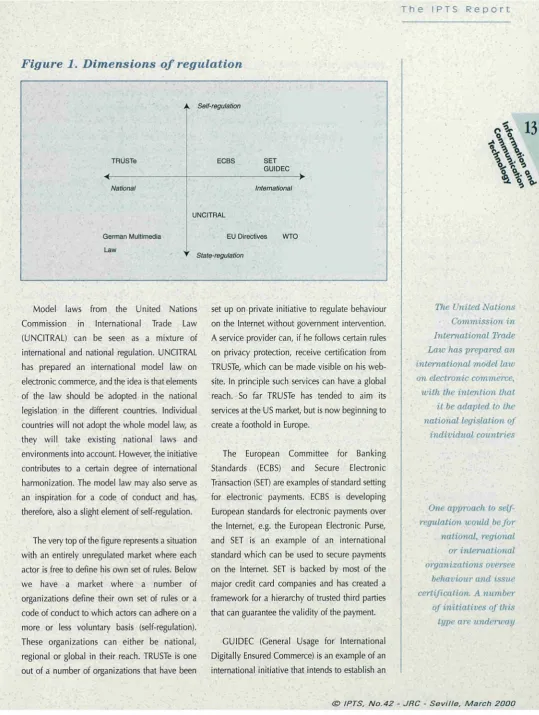
o far the Internet has developed very successfully in a basically unregulated environment. There are, however, a number of issues related to consumer protection where some type of regulation may be desirable. This is recognized both by national governments and international bodies such as the Organization for Economic Cooperation and Development (OECD) and the World Trade Organization (WTO). The question is how regulation of international transactions on the Internet can be enforced in a world where regulation is defined and enforced within national borders.A number of regulatory models have been proposed to solve this issue. These models can be characterized by their location on a two dimensional continuum defined by two different parameters: The degree of international orien tation and the degree of government intervention (Figure 1).
In the bottom left-hand corner we have national legislation, which is the dominant form of
regulation in the physical world. One example is the German Law on Multimedia, which also addresses electronic commerce. In the bottom right-hand corner we have international agreements such as WTO treaties. In between we have EU Directives, e.g. the directive on electronic commerce.
T h e I P T S R e p o r t
Figure 1. Dimensions
of
regulation
A Sell-regulation
TRUSTe ECBS SET GUIDEC
National International
UNCITRAL
German Multimedia EU Directives WTO Law L,
▼ State-regulation
Model laws from the United Nations
Commission in International Trade Law
(UNCITRAL) can be seen as a mixture of
international and national regulation. UNCITRAL
has prepared an international model law on
electronic commerce, and the idea is that elements
of the law should be adopted in the national
legislation in the different countries. Individual
countries will not adopt the whole model law, as
they will take existing national laws and
environments into account. However, the initiative
contributes to a certain degree of international
harmonization. The model law may also serve as
an inspiration for a code of conduct and has,
therefore, also a slight element of selfregulation.
The very top of the figure represents a situation
with an entirely unregulated market where each
actor is free to define his own set of rules. Below
we have a market where a number of
organizations define their own set of rules or a
code of conduct to which actors can adhere on a
more or less voluntary basis (selfregulation).
These organizations can either be national,
regional or global in their reach. TRUSTe is one
out of a number of organizations that have been
set up on private initiative to regulate behaviour
on the Internet without government intervention.
A service provider can, if he follows certain rules
on privacy protection, receive certification from
TRUSTe, which can be made visible on his web
site. In principle such services can have a global
reach. So far TRUSTe has tended to aim its
services at the US market, but is now beginning to
create a foothold in Europe.
The European Committee for Banking
Standards (ECBS) and Secure Electronic
Transaction (SET) are examples of standard setting
for electronic payments. ECBS is developing
European standards for electronic payments over
the Internet, e.g. the European Electronic Purse,
and SET is an example of an international
standard which can be used to secure payments
on the Internet. SET is backed by most of the
major credit card companies and has created a
framework for a hierarchy of trusted third parties
that can guarantee the validity of the payment.
GUIDEC (General Usage for International
Digitally Ensured Commerce) is an example of an
international initiative that intends to establish an
Λ
Λ
13
Cr ί <ìrW o
The United Nations
Commission in
International Trade
Law has prepared an
international model law
on electronic commerce,
with the intention that
it be adapted to the
national legislation of
individual countries
One approach to
self-regulation would, befor
national, regional
or international
organizations oversee
behaviour and issue
certification. A number
of initiatives of this
type are underway
[image:15.595.25.565.62.778.2]T h e IPTS R e p o r t
14
if J à
Ì if
n? i f f
Tìie argument most
frequently levelled
against state regtdation
is that it stifles
innovation. On the
other hand, some
form, of regulation
may be necessary
to inspire confidence
in consumers
The problems associated
with self-regulation
should not imply state
regulation is the only
option, the optimal
solutionis probably a
mix of state regulation
and self-regulation
international code of conduct for electronic commerce. GUIDEC is an initiative of the
International Chamber of Commerce (ICC) providing a set of common definitions and
business-generated best practices for certifying
electronic commerce.
Self-regulation vs. state-regulation
The issue of consumer protection is often
discussed in terms of consumer trust and confidence. The fact that some suppliers may not
live up to desirable standards makes rules necessary
to secure the trust and confidence of users. It is frequently argued that self-regulation ensures
adequate control as suppliers have an interest in delivering good quality at acceptable prices as
otherwise they will not survive in the market. However, it is clearly not always the case that
enlightened self-interest alone is enough, as it leaves
the door open for the unscrupulous players, uninterested in long-term survival in the market, to
make a quick profit through cheating, fraud or other kinds of malpractice. Clearly some form of
regulatory framework is required, not least in order
to create the necessary trust and confidence for the market to develop. If consumers are to use it, the
system not only needs to be trustworthy it needs to be seen to be trustworthy.
The primary argument against state regulation
-apart from it ostensibly being impossible in an international Internet environment - is that it tends
to stifle development and innovation. This is a well
known argument against almost any state intervention in markets, but it is here reinforced
with arguments concerning the inherently international, distributed and unregulated "nature"
of the Internet. The counter-argument is also well
known, namely that there has to be a stable regulatory framework for markets to grow and
develop. Debates of this type have frequently been rehearsed in the standardization field, for instance.
In the area of e-commerce, the argument is that
lack of information and security for consumers
constitute market failures that require governmental (or inter-governmental) intervention.
Nevertheless, self-regulation also has its
difficulties. One problem lies in the definition of the group or groups that are to be regulated
(which may be different in the case of business-to-business e-commerce and business-to-business-to-consumer
e-commerce) and the players who are to have a
say in the process.
Even if there is no state governance of a
market, there will still be some kind of governance structure. The governing parties will
then not be the state but generally business representatives, and probably representatives of
the larger corporations. Even if some consumers
may favour this approach, it can represent a problem in terms of public democratic procedures
in governance structures.
Self-regulation does not provide the same basis
as state regulations in terms of accountability. It is
true - as argued, for instance, by the Secretary General of ICC, Maria Livanos Cattaui - that rules
that are freely incorporated into contracts also are enforceable in court. However, most consumer
"contracts" with sellers are not based on large
voluntary bodies of provisions. Furthermore, very few consumer cases are taken to court. The costs
both economically and otherwise may be too high.
But these arguments in favour of state
regulation do not exclude self-regulation.
Probably the best solution is a mixture of self and state regulation. Therefore, the question is not
whether there should be self-regulation but where its limits should be set. It would be foolish to
reject positive self-regulatory measures. A
situation with an industry that reluctantly abides by the minimum rules laid down by the state is in
T h e I P T S R e p o r t
no way desirable. As, for instance, in the field of
social insurance (life insurance, pensions and
health insurance, etc.) where there is presently much interest in the social responsibility of
industry, positive initiatives should not be rejected. The two types of regulation are by no
means mutually exclusive.
National vs. international Regulation
In the EU the European Commission has
proposed a new directive on electronic
com-merce in order to ensure harmonized rules within the EU on authenticity, contractual issues
and marketing practices such as spamming. According to this directive, the official place
of e-business will be where the operator is
registered for tax or company law purposes irrespective of where web-sites, mail boxes or
servers are situated. Furthermore operators will be obliged to disclose basic information such as
name, address, trade register number, etc. In
order to avoid spamming, commercial communication by e-mails must be made clearly
identifiable so they easily can be deleted. A political agreement on this directive was
reached in December 1999 and will contribute
to a more transparent consumer protection regime within the EU.
In the EU and EFTA (European Free Trade
Agreement) countries, the Lugano/Brussels
Con-vention allows consumers to raise cases either on the basis of their home country laws or on the
basis of the appropriate laws in the home country of the seller. This rule has obvious advantages
for consumers and is generally recommended
by consumer organizations. However, such a solution raises a number of problems in terms of
technical trade barriers and extra-territorialism including enforceability of decisions. It is,
therefore, unlikely that this convention can be
extended beyond European borders.
However, one should be cautious about the
mixture of arguments dealing with desirability and feasibility at the same time. International
regulation is not an entirely new thing.
International regulation is already practised in other areas through binding agreements, e.g.
through the WTO. While international business representatives and the US government have
opposed any mandatory international public rules
in the areas of consumer protection and privacy, they have been strongly in favour of establishing
an international regime for the protection of intellectual property rights.
This in itself should not be criticized, but it
shows that it is not primarily a question of the
difficulty of establishing an international legal regime. The intellectual property rights field is
perhaps one of the more difficult areas in which to, enforce international rules. The reason that
international business representatives, in spite of
these difficulties, still want to install an inter-national legal regime is that they have crucial
interests at stake here. This illustrates that it is not only a question of difficulties but also a question
of desirability and political will. Often arguments
consist of a mixture of feasibility and desirability.
There is no easy solution to the problem of establishing international rules in the e-commerce
area. The initiatives of ICC with regard to
international guidelines and model contracts, etc. are highly commendable. Very important is also
the UNCITRAL model law on electronic commerce. Initiatives in the OECD will,
furthermore, have a large impact. The OECD is
not an organization, where binding agreements can be taken. Nevertheless, it is often used as a
forum in which member states can develop common political positions. A Global Action Plan
for Electronic Commerce prepared by business
with recommendations for governments was presented at the Ottawa meeting in October
9-
°-à\
15
•ί» * · t
A proposed EU directive
on e-commerce aims to
clarify issues such as
the place of business of
electronic commerce
firms, and proposes
harmonized rules
on authenticity,
spamming, etc.
Agreements are now
in place to allow
consumers to take up
cases either on the
basis of the laws in
their own country or
those of the seller,
although there are
doubts about the
applicability of
this in practice
T h e IPTS R e p o r t
16
Hi
iff
iff
1998. A revised version of this plan was issued in October 1999. The plan is very much focussed on
regulation, and includes a survey of self-regulating initiatives taken on the electronic
market place.
However, none of these organizations have the
competence to establish legally enforceable rules. The WTO could be such an organization,
although its recent travails would need to be kept in mind before charging it with more tasks. It
should be possible, as in connection with the
basic telecommunications deal, to have a regulatory model attached to an agreement on
electronic commerce setting out the basic minimum requirements for (among other things)
consumer protection.
Conclusion
The regulatory problems created by the Internet are not entirely new. International
transactions, of course, already took place before
the Internet was born. However, in the physical market, it is always easy to distinguish between
domestic and cross-border transactions. Moreover, cross-border transactions are mainly
to-business transactions, while business-to-consumer transactions are far less frequent. The
international electronic financial market is a good
example of this. Electronic transactions have played a role in the development of more
liberalized currency markets, but the actors dealing in the market are all professionals and
consumer protection is not an important issue.
While professional dealers can be expected to have knowledge about different types of national
regulations, it will be difficult to demand the same knowledge from private consumers.
National borders are related to control over
physical space. Lawmaking requires some
mechanism for law enforcement, which depends on the ability to impose coercive sanctions on
law-breakers. International institutions do not exercise the same physical control and international law
making can only be done with the consent of
national states. This makes international lawmaking a very complicated and slow process,
in sharp contrast to the dynamic Internet market. Even at the national level, national legislation may
find it difficult to keep pace with technical
developments, making control at international levels yet more elusive, j f
i n e i F i b K e p o r t
Keywords
electronic commerce, electronic market, consumer protection, national and international regulation, self-regulation
References
• Cattaui, M.L., (99): Ler commerce shape the future of the Net. CommunicationsWeek International, No.1, February 1999.
• CEC, A European Initiative in Electronic Commerce, COM(97) 157, 1997.
• CEC, Commission proposal for European Parliament and Council Directives on the taking up, the pursuit and the prudential supervision of the business of electronic money institutions, 1988. • CEC, Proposal for a European Parliament and Council Directive on certain legal aspects of electronic
commerce in the internal market, COM (1998) 586 final, Brussels, 1998.
• Danish Ministry of Business and Industry, The Legal Protection of Consumer Rights in Relation to Transnational Digital Network. Copenhagen, 1997.
• Falch, M., Henten, Α., and Skouby, Κ.E., Consumer related Legal Aspects of the Information Society, the Case of Denmark. In Human Choice and Computers, IFIP-TC9 5th World Conference. Geneva, 25-28 August 1998.
• OECD, Business-to-Consumer Electronic Commerce, Survey of Status and Issues. OCDE/GD(97)219. Paris, 1997.
• OECD, Gateways to the Global Market - Consumers and Electronic Commerce. OECD, Paris, 1998. • OECD, Electronic Commerce: Prices and Consumer Issues for Three Products: Books, Compact
Discs, and Software. DSTI/ICCP/IE(98)4/Final, Paris, 1998.
• OECD, A Global Action Plan for Electronic Commerce Prepared by Business with Recommendations for Governments. Ministerial Conference, Ottawa, Canada, 7-9 October 1998 (2nd edition, October 1999). • OECD, A Borderless World: Realising the Potential of Global Electronic Commerce. Ministerial
Conference Ottawa, Canada, 7-9 October 1998.
Contacts
Morten Falch, CTI/ DTU
Tel.: +45 45 25 51 77, fax: +45 45 96 31 71, e-mail: [email protected] Anders Henten, CTI/ DTU
Tel.: +45 45 25 51 76, fax: +45 45 96 31 71, e-mail: [email protected]
About the authors
Morten Falch has aMaster degree in economics and a bachelor in Mathematics. He holds a Ph.D. and is an Associate Professor at the Center for Tele-Information (CTI) at the Technical University of Denmark. His main areas of research are: Telecommunication regulation and policy, telecommunication economics, inter-nationalisation of telecommunications, socio-economic implications of Information
and communication technologies and trade in services.
Anders Henten has a Master degree in communications and international development studies. He holds a Ph.D.
and is an Assistant Professor at the Center for Tele-Information (CTI) at the Technical University of Denmark. His main areas of research are: Regulation, internationalisation and standardisation of telecommunications, socio
economic implications of information and communication techno logies, trade in services, and development policy.