City, University of London Institutional Repository
Citation
: Demers, C. and Gond, J-P. ORCID: 0000-0002-9331-6957 (2019). The moral
microfoundations of institutional complexity: Sustainability implementation as compromise-making at an oil sands company. Organization Studies, doi: 10.1177/0170840619867721This is the accepted version of the paper.
This version of the publication may differ from the final published
version.
Permanent repository link:
http://openaccess.city.ac.uk/id/eprint/22414/Link to published version
: http://dx.doi.org/10.1177/0170840619867721
Copyright and reuse:
City Research Online aims to make research
outputs of City, University of London available to a wider audience.
Copyright and Moral Rights remain with the author(s) and/or copyright
holders. URLs from City Research Online may be freely distributed and
linked to.
The moral microfoundations of institutional complexity: Sustainability implementation
as compromise-making at an oil sands company
Christiane Demers Department of Management
HEC Montréal (QC, CAD) Édifice Côte-Sainte-Catherine 3000, chemin de la Côte-Sainte-Catherine
Montréal (Québec), Canada H3T 2A7
T.: +1 514 340-6345 F.: +1 514 340-5635
Jean-Pascal Gond Cass Business School City, University of London 106 Bunhill Row, EC1Y 8TZ
London, United Kingdom T: +44(0)20 7040 0980 F: +44 (0)20 7040 8328 [email protected]
The moral microfoundations of institutional complexity: Sustainability implementation
as compromise-making at an oil sands company
Abstract
Research on institutional complexity has overlooked the fact that moral judgements are likely
involved when individuals face a plurality of logics within organizations. To analyze the
moral microfoundations of institutional complexity, we build on Boltanski and Thévenot’s
(2006 [1991]) economies of worth (EW) framework and explore how individuals produce
moral judgement in response to the institutional complexity triggered by a major shift in the
sustainability strategy within an oil sands company. Fifty-two interviews with employees,
managers and executives reveal how actors rely on four types of justification that combine
different moral principles and related objects with the aim of either forming (sheltering and
solidifying work) or challenging (fragilizing and deconstructing work) a new compromise
with regard to sustainability within the organization. Our results show how the EW
framework can enrich institutional complexity theory by bringing morality back into the
analysis as a core dimension of inhabited institutions while advancing the microanalysis of
compromise-making around sustainability in organization studies.
Key-words
compromise, institutional complexity, justification work, morality, sociological micro-CSR,
…It’s very hard to say, ‘I’m going to develop oil sands, and I’m going to put capitaland human resources into oil sands’… and have a credible environmental message as well… It’s
hard for me to argue that an oil sands project is good for the environment.
(Manager 29)
The institutional complexity research has identified some of the challenges inherent in the
management of multiple contradictory ‘institutional logics’ (Friedland & Alford, 1991;
Thornton, Ocasio, & Lounsbury, 2012). The prior studies show that situations of institutional
complexity shape how individuals perform their jobs (Currie & Spyridonidis, 2016; Marti et
al., 2017) and how professionals navigate among multiple ‘conflicting-yet-complementary’
logics (McPherson & Sauder, 2013; Smets, Jarzabkowski, Burke, & Spee, 2015).
However, because this prior research has neglected the moral foundations of institutional
logics (Cloutier & Langley, 2013; Friedland & Arjaliès, 2017), it has remained silent on the
moral implications inherent in the coexistence of multiple logics. Nevertheless, situations of
institutional complexity are likely to require individuals’ moral judgement for two reasons.
First, institutional logics often reflect contradictory moral principles (Lamont, 2012) or
societal logics (Silber, 2016, p. 163), and their presence within organizations introduces
tensions between contradictory moral principles or values. Managers implementing
strategies that seek to reconcile ecological sustainability and the search for profit, for
instance, face such tensions (Hengst, Jarzabkowski, Hopegl, & Muethel, 2019). Second, the
prior research on institutional complexity suggests that such situations create freedom for
individuals to exercise judgments as they can chose which logics they can use or combine
(Gümüsai, Smets & Morris, 2019; McPherson & Sauder, 2013); individuals confronted with
situations of institutional complexity thus have ‘discretion’ in exercising moral judgements.
To conceptualize the moral microfoundations of institutional complexity, we rely on the
economies of worth (EW) framework developed by Boltanski and Thévenot (2006 [1991]),
2017a) and can reveal how actors manage moral contradictions (Nyberg & Wright, 2013;
Oldenhof et al., 2014; Reinecke, van Bommel & Spicer, 2017). EW notions can help extend
and ‘moralize’ concepts such as toolkits (McPherson & Sauder, 2013) or hybridity (Battilana
& Dorado, 2010) that are key to institutional complexity scholarship.
As part of their theory of justification, Boltanski and Thévenot provide a ‘grammar’ for
describing competing normative approaches to the common good, which they conceptualize
as specific ‘worlds’ or ‘orders of worth’ rather than logics. The EW framework provides a
vocabulary to capture the processes whereby, through their ‘justification work’ (Jagd, 2011;
Taupin, 2012), individuals build on these ‘worlds’ to establish or challenge the forming of
‘compromises’ (Thévenot, 2001) in contexts of dispute or tension between worlds (Cloutier,
Gond & Leca, 2017; Gond, Leca & Cloutier, 2015b). Within organizations, as in social life,
these ‘worlds’ provide individuals with a ‘repertoire of cultural-cognitive and normative
resources’ to address moral tensions (Cloutier & Langley, 2013, p. 371; Silber, 2016).
We empirically study how actors of different positions and status at an oil sands
corporation respond to a new sustainability strategy that redefines the relationship between
the economic, social and environmental goals of the firm. Through an analysis of company
and industry documents and 52 interviews with corporate members, we show how the shift in
sustainability strategy creates a move from one form of compromise – compensation between
goals – to another – reconciliation between goals. Then, we explore how this strategic shift
triggered four distinct types of ‘justification work’ that combine different worlds and related
objects with the aim to either form (sheltering and solidifying work) or challenge (fragilizing
and deconstruction work) the emerging reconciliation compromise.
Our study offers a twofold contribution to organization theory. First, our analysis shows
how the EW framework can enrich institutional theory (Bessy & Favereau, 2003; Orléans,
individuals use their moral ‘toolkit’ when faced with institutional complexity (McPherson &
Sauder, 2013). In bringing the moral dimension back to the study of institutional complexity
(Friedland, 2018; Selznick, 1957), we contribute to a richer account of institutional life as
inhabited ‘on the ground’ by individuals who have singular interactions (Hallet & Ventresca,
2006), emotions (Voronov & Vince, 2012) but also a sense of fairness (Boltanski, 2012).
Second, by showing how types of justification work are involved in compromise making,
our results also extend the organizational study of the EW (Cloutier et al., 2017; Dionne,
Mailhot, & Langley, 2019) and the discussions of how multiple ‘worlds’ are involved in the
management of sustainability issues (Gond, Barin Cruz, Raufflet, & Charron, 2016; Patriotta,
Gond, & Schultz, 2011). In contrast with studies suggesting that the ‘market world’
subjugates other worlds through the corporate commodification of sustainability (Nyberg &
Wright, 2013), our analysis shows that multiple worlds are involved in compromise making
around sustainability issues (Finch, Geiger, & Harkness, 2017) but that some actors can
challenge market dominance ‘from the inside’ through their justification work, in a form of
moral resistance.
Inhabiting institutionally complex organizations: In search of morality
Over the last 20 years, the institutional logics approach has recognized that organizations
must operate ‘within multiple institutional spheres’ (Kraatz & Block 2008, p. 243) and are
hence subject to the pressures of potentially contradictory ‘institutional logics’ from their
environment that are mediated by internal organizational constituents (Besharov & Smith,
2014). According to Greenwood et al. (2011, p. 317), ‘organizationsface institutional
complexity whenever they confront incompatible prescriptions from multiple institutional
logics’. In line with the calls to analyze the micro-foundations of institutions (Barley, 2008;
Powell & Colyvas, 2008), students of institutional complexity have begun ‘zooming in’ on
Currie & Spyridonis, 2016; Smets et al., 2015). In doing so, this stream of studies has
focused on institutionally ‘inhabited’ organizations (Hallett & Ventresca, 2006) where actors
who have been given agency interact while relying on institutional logics to shape the
meaning of their work.
Ethnographic studies considering logics ‘from the ground’ suggest that the co-existence
of contradictory institutional logics is not necessarily dysfunctional but may generate benefits
given that logics can be ‘conflicting-yet-complementary’ (Smets et al., 2015, p. 962). Such
studies portray logics as ‘enablers’, and not only as constraints, for actors. McPherson and
Sauder (2013) suggest that logics can operate as a ‘cultural toolkit’ (Swidler, 1986; Weber,
2005) to provide actors with resources in situations of institutional complexity. Currie and
Spyridonidis’ (2016) analysis of competing logics in a healthcare setting, McPherson and
Sauder’s (2013) study of negotiations in a drug court, and Smets et al.’s (2015) study of
reinsurance trading at Lloyd’s, all depict actors as skillful agents who are able to shift from
one logic to another in their daily practices and enact the relevant logic in a given situation.
By providing a higher level of agency and discretionary judgement to individuals within
organizations, institutional complexity allows for the further integration of individuals’ moral
judgements within institutional theory. Arguably, several of the empirical situations studied
by the individually focused research on institutional complexity can best be described as
‘morally’ problematic as actors face tensions among a set of multiple moral orientations and
must exercise their judgement. For instance, in McPherson and Sauder’s (2013) study of
drug court, what is at stake is actually the evaluation of the moral ‘worth’ of an individual
who can be released from jail or not. If professionals search for which ‘logic to apply’
among four possible logics, and possibly hijacking other actors’ logics, this could be because
they seek to find the most appropriate ‘professional’ backing for the moral choice they have
complexity scholars could be best described after Reinecke et al. (2017) as involving ‘moral
multiplexity’.
However, although these recent developments in the study of institutional complexity
provide a unique opportunity to reintegrate moral dimensions within the scope of institutional
analysis, in line with the original project of Friedland and Alford (1991) and with earlier
insights from so-called ‘old’ institutionalism (Selznick, 1957), several voices have noted that
these moral foundations remain to a large extent lost in recent studies and have called for a
refocusing on important issues such as inequality or morality (Moore & Grandy, 2017;
Willmott, 2015). To date, institutional scholars have mainly focused on how identity is
involved when individuals are confronted with contradictory and morally loaded institutional
prescriptions. The prior research shows that actors engage in the work of identity
(re)construction (Creed, DeJordy & Lok, 2010), sometimes by adopting forms of ‘tempered
radicalism’ (Meyerson & Scully, 1995). For instance, Wright, Nyberg and Grant (2012)
show how sustainability managers struggle through their daily managerial practice to
overcome the contradictions between environmental and economic goals.
We seek to extend these insights by considering individuals’ moral responses to
institutional complexity through the unpacking of the moral foundations of logics and their
link to approaches to the common good (Cloutier et al., 2017) by recognizing that situations
of institutional complexity offer more room for moral agency, and thus moral judgement,
than usually assumed in prior institutional studies (Friedland & Arjaliès, 2017) and by
considering individual responses to institutional complexity not only through the
consideration of identity work (Wright et al., 2012) but also through individuals’ capacity to
form moral compromises among distinct notions of the common good within specific
question: How do organizational actors mobilize their moral judgement in situations of
institutional complexity?
An ‘economies of worth’ take on institutional complexity
When confronted with situations associating environmental issues and market demands, as in
the contexts of sustainability controversies (Gond et al., 2016) or corporate sustainability
strategy deployment (Hengst et al., 2019; Nyberg & Wright, 2013), individuals cannot rely
on stable and fixed logics. They must face the ‘normative considerations about what is
desirable for the common good’ (Doganova & Laurent, 2016, p. 6) and ‘confront the issue of
worth as a matter of course’ (Finche et al., 2017, p. 74). Institutional complexity concepts
such as ‘toolkit’ and ‘hybridity’ become insufficient to analyze the moral underpinning of
situations because they do not account for the role played by contradictory or multiple visions
of the common good (Gond et al., 2017a).
We therefore turn to the EW framework proposed by Boltanski and Thévenot (2006),
which recognizes the profoundly moral nature of organizational life (Gond et al., 2017a) as
the theory does not separate pragmatic from moral legitimacy (Suchman, 1995) or business
from ethical/normative approaches to decision making (Swanson, 1999). For EW scholars,
the market and industrial contexts are regarded as ‘moral orders’ of their own, and deciding
to align with market pressures or adopt a logic of efficiency is already a ‘moral’ choice.
Bridging the EW framework with institutional complexity concepts can therefore advance the
project of re-humanizing institutional theory by considering the moral agency of actors and
recognizing their capacity to manage multiple approaches to the common good.
Moral agency in situations of institutional complexity: Justification work
Recent developments of institutional complexity that conceive of logics as shared ‘toolkits’
between actors after Swidler (1986) and Weber (2005) ‘portray actors as having a repertoire
advocate arises’ (McPherson & Sauder, 2013, p. 168). This approach allows for the full
consideration of the activities of actors’ justification while it also recognizes actors’ agency.
However, institutional logics ‘have largely eclipsed moral aspects underscoring beliefs’
(Cloutier & Langley, 2013, p. 373), and to conceptualize actors’ moral agency, it should be
recognized that logics have moral foundations that actors can acknowledge and mobilize.
Although some institutional logics scholars suggest that some logics are driven by underlying
moral principles (Friedland & Arjaliès, 2017; Lamont, 2012) and that, by definition, ‘societal
logics’ are usually grounded in normative principles (Moore & Grandy, 2017; Silber, 2016),
little has been done to analyze how actors manage contradictory logics in relation to different
moral systems or distinct approaches to the common good.
The EW framework usefully extends institutional insights as it recognizes individuals’
agency in a moral domain (Boxenbaum, 2014) by assuming that all individuals are able to
react to unfair situations (the assumption of ‘common humanity’, Boltanski, 2012 [1990]) and
postulating the availability of a shared moral ‘cultural repertoire’ (Swidler, 2016; Friedland,
2013). In particular, EW scholars have already used a notion of ‘justification work’ (Jagd,
2011, p. 340) that consists of purposively using discursive and material resources to justify
the moral worthiness of their claims in relation to specific situations, objects or persons.
Examples of this approach include the following. Patriotta et al. (2011) illustrate such
justification work in the case of a corporation seeking to renegotiate the ‘moral legitimacy’ of
nuclear energy in Germany after an incident at one of its power plants. Taupin (2012)
uncovers the circularity of the justification work engaged in by financial rating agencies to
reconstruct their worthiness after the 2008 crisis. Oldenhof et al. (2014) advance the
theorization of justification work to analyze how Dutch healthcare managers juggle
This stream of studies builds on Boltanski and Thévenot’s (2006) conceptualization of
the ‘moral repertoire’ that actors can mobilize to evaluate or justify the ‘worthiness’ of things
and beings in contexts of disputes or controversies. This repertoire is composed of a number
of ‘orders of worth’, that is, higher-order normative principles. Each order of worth is an
organizing principle that regulates one of the social ‘common worlds’ (also referred to as
‘cities’ or ‘polities’ in reference to the French word cité). ‘Worlds’ are morally grounded:
they refer to a definition of the ‘common good’. To identify ‘worlds’, Boltanski and
Thévenot (2006) draw on the empirical data from a wide range of fieldwork focused on
disputes (Boltanski, 2012 [1990]; Boltanski & Thévenot, 1989) and from a set of classical
texts in political science (e.g. Jean-Jacques Rousseau, Thomas Hobbes, Adam Smith) that
offer an analytical method for systematically capturing distinct approaches to the common
good. Indeed, political philosophies ‘must, in order to be convincing, demonstrate that the
common good on which they are based is well founded’ (Boltanski, 1999, p. 366).
In its foundational formulation, the EW framework encompasses six common worlds: the
inspired world, which favors passion and grace; the world of fame, which values renown and
public opinion; the domestic world, which is based on tradition and trustworthiness; the civic
world, in which collective welfare, defined in terms of rights and responsibilities, is key; the
industrial world, which is rooted in performance and technical efficiency; and the market
world, in which rivalry and value (in terms of cost and profit) are the highest principles
(Boltanski & Thévenot, 2006). Over time, the model has been extended to encompass the
green world (Lafaye & Thévenot, 1993), in which the natural environment and its protection
are the highest common good.i As Friedland (2013) and Thornton et al. (2012) observe, these
‘worlds’ are embedded in situations rather than in institutions, and, therefore, they provide
more ‘moral agency’ to actors who can mobilize them ‘across’ specific institutional or
how individuals find a compromise in situations of disputes. Building on this conceptual
resource, the justification work of individual actors can be related to the dynamics of
‘compromise-making’.
Moralizing institutional hybridity: Compromise-making
Beyond providing actors with moral agency and the capacity to manage moral multiplexity,
the EW framework can also address the lack of consideration for morality in the analysis of
organizational hybridity (Battilana & Dorado, 2010; Gümüsai et al., 2019; Pache & Santos,
2013). In their study of microfinance organizations, Battilana and Dorado (2010) show how
one of the two commercial microfinance institutions they studied reconciled the differences
between banking and development logics through the construction of a common identity.
Although such an approach shares deep similarities with the EW framework (Cloutier &
Langley, 2013), it does not recognize that the complexity inherent in the coexistence of both
logics could also rely on their belonging to two distinct worlds that reflect distinct views of
the common good. Managerial difficulties in reconciling distinct logics may reflect the
deeper moral tensions inherent in their co-presence or co-existence within organizations
(Gond et al., 2017a), and situations of institutional hybridity may thus correspond to distinct
configurations of worlds more or less complex to reconcile. For instance, Hengst et al.
(2019) found that the moral values of managers explain their difficulty recognizing the
legitimacy of a corporate sustainability strategy that contradicts their beliefs.
The EW framework can help reintegrate the moral underpinnings of institutional
hybridity through its conceptualization of how disputes over worthiness can be resolved
through ‘tests of worth’ during which worth is evaluated by mobilizing criteria that
correspond to one world. Tests of ‘state of worth’ remove uncertainty by clarifying the worth
of things and beings (Dansou & Langley, 2012); they rely on actors’ use of material devices:
the dispute does not have the material means of resolution by testing. (Boltanski & Thévenot, 2006, p. 131)
For instance, in the market world, this principle is monetary value in a competitive
setting. In a case in which actors mobilize the same world, agreement can be reached by
referring to the principle that structures this world and the related ‘test of state of worth’,
although debates may persist about whether the test has been adequately conducted.
Although ‘tests of state of worth’ can help clarify worthiness once actors have agreed on ‘the
world from which worth should be evaluated’ and ‘which test to apply’ (Dansou & Langley,
2012), actors can also disagree on which world is appropriate and engage in tests of ‘order of
worth’. In this case, actors end up ‘questioning the appropriateness of principles being
applied in a particular situation’ (Dansou & Langley, 2012, p. 551).
In the presence of multiple worlds, finding an agreement is a possible but much more
complex process that may involve the search for a ‘compromise’ between worlds (Cloutier &
Langley, 2013). The modalities of agreements ‘between worlds’ can consist of a ‘temporary’
or ‘local’ arrangement that reflects the more lasting search for a compromise.
In the compromise, people agree to come to terms, that is, to suspend a clash—a dispute involving more than one world—without settling it through recourse to a test in just one of the worlds. The situation remains composite, but a clash is averted. Beings that matter in different worlds are maintained in presence, but their identification does not provoke a dispute. (Boltanski & Thévenot, 2006, p. 277)
Using the example of ‘creativity techniques’ as a compromise between the industrial and
the inspired worlds, Boltanski and Thévenot (2006) further add the following:
[A] compromise suggests the possibility of a principle, that can take judgments based on objects stemming from different worlds and make them compatible. It aims at a
common good that transcends the two different forms of worth in presence but including both of them… (p. 278)
Although, Boltanski and Thévenot (2006) insist on the ‘fragility’ of any attempt at
tests of order and of state of worth, they point to the role of ‘composite objects’ in the
construction of a compromise (see also: Boltanski, 1999). ‘Composite objects’ are defined as
…objects composed of elements stemming from different worlds at the service of the common good and endow them with their own identity in such a way that their form will no longer be recognizable if one of the disparate elements of which they are formed is removed. (Boltanski & Thévenot, 2006, p. 278)
Despite showing promise for understanding how actors manage the moral dimension of
institutional complexity, the EW concept of compromise has remained relatively
under-studied in organizational analysis (Jagd, 2011; Oldenhof et al., 2014; Reinecke et al., 2017),
although organizations have been described by EW scholars as ‘compromising devices’
(Thévenot, 2001, p. 405). Nevertheless, the EW framework offers a promising way to
manage organizational situations of moral multiplexity as suggested by Nyberg & Wright
(2013) in their study of sustainability managers’ reactions to moral tensions. Below, we
mobilize the concepts of justification work and compromise-making to address our research
question and, in doing so, explore the moral microfoundations of institutional complexity.
Methods
Research Design
We conducted a single qualitative case study at OilsandsCo, a large integrated oil company
located in Canada. This case presents some features of an ‘ideal case’ (Yin, 2009) to analyze
the moral foundations of institutional complexity given that OilsandsCo specializes in oil
sands extraction, a practice that has been subject in recent years to numerous pressures from
non-governmental organizations (NGOs) (Klein, 2014) and is a ‘particularly divisive and
controversial’ topic in this industry in Canada (Lefsrud & Meyer, 2012, p. 1482).
Given that OilsandsCo is publicly held, it must accommodate multiple stakeholder
pressures from its financial, environmental and social environments and arguably operates in
sustainability policy and how organizational actors justify this policy can help us uncover the
‘moral work’ involved in the management of institutional complexity.
Data collection
We conducted a series of 52 semi-structured interviews to understand how actors from
OilsandsCo appreciate and perceive ‘from the ground’ its sustainability strategy. To account
for the diversity of individual responses, we purposively sampled actors with different
positions – ranging from top managers and middle managers to employees (referred to in our
citations, respectively, as ‘Exec.’, ‘Man.’ and ‘Emp.’) – based at distinct organizational sites
– including the corporate headquarters, an extraction site and a refinery (referred to,
respectively as ‘HQ’, ‘EXT’ and ‘REF’) – and representing distinct functions such as
production, sales, sustainability, and other diverse support functions such as human resource
management or health and safety (Appendix A provides more details about our interviewees).
During our interviews, we asked the actors open-ended questions about OilsandsCo’s
sustainability strategy, what it meant for the organization and their work and how it had
evolved over time. The interviews, which lasted approximately one hour, were all recorded,
typed and fully transcribed. Although two respondents at one of the sites were concerned
about issues of confidentiality and refused to be recorded, a trusting relationship was
established with most of the respondents, and they seemed comfortable during the interviews.
Interviews are not only a means of capturing knowledge about organizations but also
‘organizational sites’ for observing in-situ power plays, identity tensions, emotional work in
relation to specific topics and, ultimately, actors’ performance in interviews (Alvesson,
2003). Our emotional experiences of these interviews make clear that sustainability
implementation was a ‘sensitive’ topic, which confirms the prior insights according to which
addressing sustainability issues in ecologically sensitive industries involves a form of
sign that ‘something more’ than professional norms was at stake here and that discussing
sustainability was also calling for the interviewees’ individual moral judgement.
To complement our data, we also interviewed an expert on the oil industry based at our
university. This individual had insider knowledge of the board’s perspective on
sustainability. We also collected relevant company and industry documents such as
sustainability reports and annual reports in addition to secondary data from third-party
sources (e.g. external rating agencies or financial and accounting databases) tracking the
company’s performance in the financial and extra-financial domains over the last ten years
(see: Appendix A). With this information, we could evaluate the company’s claims
concerning its ranking and status in relation to sustainability within the industry.
Data analysis
Given that our theoretical analysis was continuously refined throughout the four-stage
process of data analysis, our analytical strategy can be best described as ‘abductive’ (Ketokivi
& Mantere, 2010). First, we inductively investigated our organizational data and a subset of
interviews to build an account of OilsandsCo’s sustainability strategy. Relying on a temporal
bracketing strategy (Langley, 1999), we isolated the crucial role of a recent shift in the
sustainability strategy.
At the second stage of inductive analysis, one of the authors immersed herself in the data,
systematically identifying in all of the interviews the recurrent topics and themes in relation
to the sustainability strategy. Through discussions with the other author, who conducted
many of the interviews, it appeared that numerous interviewees spontaneously adopted
discourses that could qualify as forms of justification in the sense of Boltanski and Thévenot
(2006). Without being prompted, the interviewees engaged in discussions about whether
was actually put into practiceat their organization. Hence, the relevancy of the justification
framework emerged inductively from the analysis.
At the third stage of analysis, we shifted to a more deductive mode (Miles & Huberman,
1994). In line with the prior studies that have operationalized the EW framework (e.g., Gond
et al., 2016; Patriotta et al., 2011), we used the description of the seven orders of worth
provided by Boltanski and Thévenot (2006) (for an overview, see Patriotta et al., 2011) to
investigate how the different worlds were mobilized in the actors’ discourses. In the
interviews, we systematically coded all of the references to sustainability and its
implementation in relation to the vocabulary that Boltanski and Thévenot (2006) associated
with each ‘world’. Although such an exercise was straightforward for most of the worlds, we
realized that the ‘domestic world’ took a specific meaning and form in the context of a large
corporation, which was related to notions of ‘responsibility’ or ‘stewardship’ used by the
actors in a paternalistic manner. This vocabulary is aligned with the domestic world, defined
by Thévenot et al. (2000) as being related to ‘traditions that honor interpersonal ties and
respect for family values’ (p. 678), that is, ‘a world which stresses tradition, trustworthiness,
local attachment and personal ties’ (p. 678). Such an interpretation of the meaning of the
domestic world is consistent with the meaning of this order of worth in the prior studies
focused on sustainability issues (Gond et al., 2016; Richards et al., 2017). We analyzed each
citation related to sustainability to observe whether reference was made to one or several of
the seven worlds. When several worlds were evoked, we investigated how they were related
(i.e. positively, negatively, the nature of the links). In doing so, we could map the set of
justifications (and critiques) of the sustainability strategy used by individuals and anchored in
distinct worlds.
At the fourth stage of analysis, we shifted back to an inductive mode of analysis, aiming
stage one by analyzing whether and how the individual responses related to the new
‘compromise’. We grouped the responses across individuals, focusing on whether they
challenged or helped form the new compromise. Through this analysis, we could identify
four groups of responses that reflected distinct types of ‘justification work’ (Jagd, 2011;
Oldenhof et al., 2014), and that we present in detail after having contextualized the strategic
shift in sustainability through an EW lens.
Contextualizing two compromises: A journey towards sustainability
In an industry facing major environmental controversy, OilsandsCo had been, for many
years, defining its mission as ‘operating our business in a way that enhances social and
economic benefits to society while minimizing the environmental impacts of resource
development’ (OilsandsCo sustainability report). Conceiving economic prosperity as
compatible with social well-being, its focus was on reducing the negative impacts of its
operations on the environment. Concretely, that meant that the company focused on major
projects related to its oil sands extraction operations that were celebrated for considerably
reducing its environmental footprint. Interviewees at the three sites were proud of the
company’s past environmental accomplishments, particularly with regard to the financial
commitment they implied (‘What we developed for the tailings pond… It’s a lot of money,
and we are not afraid to invest’, Exec. Ref. 15).
However, a few years after his arrival, a new CEO decided to refocus the corporate
strategy on sustainability, starting with a new mission: ‘Creating energy for a better world’.
Sustainability is now to be conceived more broadly and ambitiously. While the emphasis
was previously on costly environmental projects in remote areas of Western Canada, the new
sustainability strategy is meant to involve every unit in its everyday operations. It is viewed
by top management as a major cultural change and a systems change:
[S]o now we’re putting together a plan to embed sustainability more into the
processes and the tools, and the second is the cultural piece, trying to engage employees. (Exec. HQ. 39)
While none of our interviewees questions the importance of sustainable development for a
company in their industry, they differ in the way in which they respond to the new
sustainability strategy being implemented. They are well-aware of the diverging demands
facing oil sands operations, and comments such as the following are frequent.
…we’ve been demonized by the NGOs. There’s no question we have issues related to greenhouse gas, emissions, water, land use, and biodiversity. We also have First Nations issues… and, then, we have issues around cost. (Exec. HQ. 39)
However, the way in which they evaluate this new strategy tends to differ according to
their local context. This diversity of reactions reflects a change in the existing compromise
between different moral worlds involved in the shift of sustainability strategy.
Organizational search for a new compromise: From compensation to reconciliation
Whereas the old compromise relied on a logic of compensation to transform the worth of the
market world into green and civic forms of worth, the new compromise challenges this view
and aims at avoiding direct clashes between the market, green and civic worlds by operating
their reconciliation through the domestic or industrial worlds.
Before this shift, the company’s mission presented OilsandsCo, firstly, as ‘operating a
business’ (market world), and its commercial successes (market world) allowed for
compensating the environmental costs of pollution (green world) and for creating social
benefits (civic world). The ‘challenges’ involved in such compensation among worlds were
acknowledged by the prior CEO:
…how to produce the energy required to fuel our economy in a way that is socially beneficial and preserves a healthy environment. At OilsandsCo, we’ve been thinking about this dilemma for a long time.
According to this justification, although it competes with the green world and the civic
world in the short term, the market world ultimately serves the ‘common good’ by
‘beneficial’, which make sense in both worlds, help build a bridge between the market world
and the civicworld; ‘preserves’ does the same between the market world and the green
world. This compromise was stabilized through its materialization in high visibility and
costly projects (e.g. tailing ponds reclamation technology) that acted as composite objects
‘concretely’ reconciling the three potentially conflicting worlds.
The new CEO offered a distinct compromise, as shown by the revised vision statement:
We strive to be trusted stewards of valuable natural resources. Guided by our values, we will lead the way to deliver economic prosperity, improved social well-being and a healthy environment for today and tomorrow. (OilsandsCo sustainability report)
Although sustainability is still defined as referring to the three previous moral
foundations, namely, the market world (‘economic prosperity’), the civic world (‘social
well-being’) and the green world (‘healthy environment’), the manner in which these worlds are
combined has changed. Reconciliation is now achieved through the domestic world. Instead
of portraying OilsandsCo as a business (market world), the corporation is humanized, and its
managers are defined as ‘trusted stewards’ who will act as benevolent guardians of the
common good, ‘valuable natural resources’. Here it is trustworthiness, the moral foundation
of the domestic world, that is put at the forefront. The use of the word ‘steward’ (originally, a
person who has duties in a household), as opposed to the term ‘manager’, also positions it in
the domestic world. In addition, the reference to ‘valuable natural resources’ mixes the
market and green worlds and, by leaving open the question ‘valuable for whom?’, can be
interpreted as encompassing the civic world. It is interesting to note that this formulation,
anchored in the domestic world, which values those in authority (i.e. top managers as ‘trusted
stewards’) does not specify how they will achieve this reconciliation except to say that it will
be ‘guided by our values,’ which are part of the company’s heritage (domestic world).
In this form of compromise, the domestic world acts as a mediator among the three
second component of the new strategy (‘the systems’), it is to be operationalized through the
operational excellence management system (OEMS). As stated by the CEO, ‘Operating
reliably and efficiently is not just about achieving increased production and profitability – it’s
also about how we become a more sustainable energy company.’ Thus, the industrial world
(‘operating reliably and efficiently’) becomes another mediator between the market, civic and
green worlds, creating another version of the new compromise where the OEMS is the new
composite object. In both versions of the new compromise, the market world does not take
center stage, it is regarded as one among three worlds. In contrast with the ‘compensation
compromise’, however, this ‘reconciliation compromise’ seems difficult to stabilize.
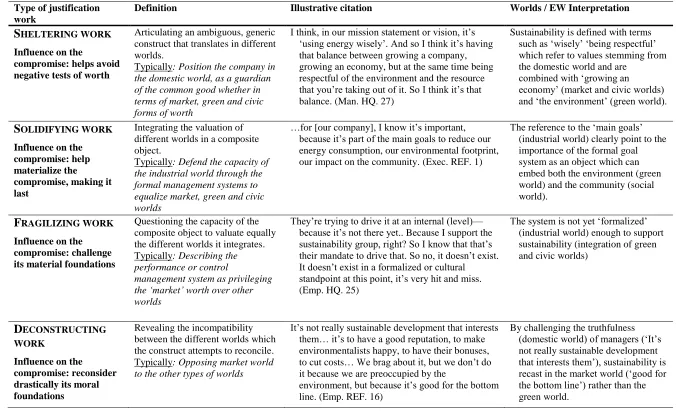
Individuals’ responses to the compromise shift: Four types of justification work
Our analysis reveals four types of individuals’ responses to the new strategy that reflect
different types of justification work. Two types of justification work aim at ‘forming’ the
new compromise, either by sheltering it in a manner that avoids tests of order of worth or by
solidifying it through positive tests of state of worth. By contrast, the other two types of
justification work we identified aim at ‘challenging’ the new compromise, either by
fragilizing it through a negative test of state of worth or, more radically, by deconstructing it
by showing it is failing tests of order of worth. Table 1 supplements our description with a
broader range of data extracts. We present each type of justification work in turn and discuss
how they influence the organizational compromise.
--- INSERT TABLE 1 ABOUT HERE ---
Sheltering work: Defusing the moral underpinnings of the compromise by avoiding tests
At headquarters, most of the people we interviewed were well-aware of the new sustainability
strategy. Although these interviewees viewed sustainability as an ambiguous concept, they
defusing its moral underpinnings. In line with the domestic world, which mainly values
trustworthiness as well as tradition, duty (responsibility) and local ties, they present the
company’s adherence to the values of responsibility and trustworthiness as self-evident and
sufficient to mediate as an impartial arbiter among the market, civic and green worlds. One
of the employees in charge of sustainability deployment throughout the entire organization
exemplified this sheltering justification work.
It’s a bit of an ambiguous concept… So, (we’re) really trying to clarify, specifically for employees, what we mean by being a sustainable energy company… We’ve used the triple bottom line definition of sustainability: environment, social, economic; and a kind of sustainability that is the sweet spot where all of those things intersect… So, being a sustainable company means being a responsible company; it means doing things the right way. And I think, personally, that resonates more with me in terms of seeing how the company operates. I mean, making the right choices and doing the right things and being an ethical company seems very intuitive and easy to understand. (Emp. HQ. 30)
It is interesting to note how this employee’s justification avoids giving priority to one of
the three normative foundations (green, civic and market), approaching sustainability as ‘the
sweet spot where all those things intersect’. In addition, the employee emphasizes her
personal ties to the company, which is presented as having a tradition of being trustworthy
(‘personally, that resonates with me in terms of seeing how the company operates’).
Sustainability is redefined as ‘being responsible’ and ‘doing the right things the right way,’ a
formulation that here is anchored in the domestic world but that can equally apply to the
green, civic and market worlds.
Another telling illustration of sheltering work is given by an executive in charge of
sustainability who, in a paternalistic tone (‘you just have no idea…’), reaffirms the definition
of sustainability as ‘responsible development’:
You just have no idea how challenging and complex all those things really are… […] The term I use is responsible development. (Exec. HQ. 34)
In the domestic world, where hierarchy is important, those in authority have the
be loyal. Despite – and maybe because of – sustainability’s ambiguity, the vast majority of
the respondents at headquarters adhere to it and refer to sustainability as a core ‘shared
value’, emphasizing it as a part of their common heritage (domestic world). Relying on the
definition provided by top management, individuals discursively construct sustainability as a
‘compromise’ that equalizes the market, civic and green worlds (e.g. the dimensions of the
TBL) under principles derived from the domestic world (e.g. trustworthiness, heritage). The
domestic world acts in their work of justification as an ‘umbrella’ notion, a mediator, under
which the other worlds can coexist, and domestic moral principles help in forming the new
compromise by referring to what are viewed as traditional ways of doing things within the
organization (e.g. ‘being responsible’), which can be ‘translated’ across the different worlds
touched by sustainability (e.g. social reputation, reduced ecological impact). We observe that
the vocabulary used by the interviewees engaged in such sheltering work denotes the search
for words that support a consensual view of the new sustainability strategy: they were in
search of a term that ‘feels intuitive’, ‘resonates’ with the local context or is ‘adequate’; they
avoid subjecting the new compromise to a ‘test of worth’, thereby defusing its moral
underpinnings. In the domestic world, a reputation that warrants trustworthiness is the proof
required for a test of order of worth to be conclusive. Here, employees’ moral optimism rests
on OilsandsCo’s past actions. However, such a proof of engagement resting on tradition is
difficult to establish with a new compromise, thereby leading to sheltering work.
In contrast to this sheltering work, which was noted in the context of the headquarters at
all levels of the hierarchy, we find a different form of justification work in the responses of
the majority of individuals based at the refinery.
Solidifying work: Materializing the compromise’s moral foundations with composite
Sustainability at the refinery seems exempt from the definitional struggle experienced at
headquarters. The new approach to sustainability is viewed as trustworthy (‘It’s serious, not
only words’, Emp. Ref. 20) and not as a major change but rather as continuous improvement,
both from an environmental perspective (e.g. ‘we were pioneers… There were few refineries
which were certified ISO 14001 in 2003, 2004’, Emp. Ref. 5) and from a social perspective
(e.g. ‘we always had a close relationship with the local community’, Exec. Ref. 10), in line
with both the domestic and industrial worlds.
In this old refining installation located in a populated urban area, sustainability is mostly
defined in operational terms related to the formal goals and presented as a ‘win-win’
situation. Interestingly, here, the industrial world through its value of standardization acts as
the neutral mediator among the market, green and civic worlds. In this work context,
operational reliability and safety are presented as environmentally, socially and economically
profitable: ‘everything is linked to safety’ (Man. Ref. 9). As explained by a production
manager, sustainability is strongly embedded in their goals and their formal work contracts:
Sustainability, for us, is as simple as optimizing our furnaces… If, with a sustainable development project, we can avoid citizen complaints or reduce nuisance to the
community… We’ll do it… It’s something that we have in our programs, to have ideas for improvement. It’s in our work contracts, on that side [environmental], as well as on the economic side. (Man. Ref. 9)
Another production manager adds that the focus on sustainability is becoming even
stronger with the new OEMS program:
With the new system [OEMS], you have elements for operations and elements only for the environment… It standardizes everything… (Man. Ref. 2)
In the refinery, the industrial world (‘the new system… It standardizes everything’),
more than the domestic world,is the mediator that reconciles the market world (‘cost
reductions’) with the green world (‘avoid environmental problems’) and the civic world
(‘reduce nuisance to the community’). The compromise, which is viewed as already existing
originating in the industrial world, this formal management system also includes elements of
the green, civic and market worlds through their materialization in formal goals (e.g.
environmental and social goals). This system allows the different worlds to coexist
peacefully without specifying a priori the goals that dominate – i.e. for which the system is
optimized. When asked about the new sustainability strategy, actors point to a tangible
composite object as a positive test of state of worth. This solidifying work of justification
stabilizes the compromise and creates moral approval at the local level; it eliminates the need
for sheltering work by materializing the new strategy the latter work seeks to articulate.
However, these two versions of the compromise, domestic and industrial based, are not
always reinforcing. Although a majority of interviewees positively justify top management’s
new sustainability strategy, we also found voices that challenge the new compromise on
moral grounds.
Fragilizing work: Destabilizing the moral foundations of the compromise by reconsidering
composite objects
In contrast to the situation at the refinery, a number of individuals based at headquarters
describe the effort that is still needed to embed sustainability in the OEMS. Here, as is the
case at the refinery, sustainability is also equated with optimization: ‘For me, it is about
optimizing the value of the oil sands deposit… and giving value to something other than the
cost per barrel’ (Exec. HQ. 34). However, in this context, they question whether the
composite object stemming from the industrial world, the OEMS, actually optimizes the
market, green and civic worlds. A manager involved in integrating sustainability across the
organization explains as follows:
This feeling is echoed by a support manager who wonders about its applicability in a
downtown office:
Yeah, so, some people will include things like ‘print less’ or ‘recycle’ in comparison to somebody in the business who is going to cut water based on their project, right? And then, when you’re truly working towards goals and you’re calculating percentages, I’m, like, really, what percentage would you use? (Man. HQ. 38)
The lack of equal footing for various aspects of sustainability in the formal system is also
expressed by those involved in major construction projects, either in sustainability (‘there’s a
lot of social sustainability that we don’t focus on yet’, Exec. HQ. 34) or in operations:
In some cases, and again, despite what I say regarding the best intentions… people do value sustainability… Of the value-drivers, at times, it does feel like the poorer cousin, sometimes even an afterthought… (Exec. HQ. 23)
This fragilizing work of justification reveals the difficulties involved in the development
of new artifacts that combine multiple ‘worlds’ – the building of a new ‘composite object’.
The metrics behind the OEMS that are used to create equivalence between worlds in the
system are not necessarily ‘commensurable,’ and, even if they are, they may not weigh in the
same manner on actors’ practices throughout the organization leading to the questioning of
whether the new sustainability strategy can actually be deployed.
Interestingly, fragilizing work does not challenge the ‘value’ given to sustainability at
OilsandsCo, and many also speak of sustainability in terms of ‘doing the right thing’ or a
‘feel-good concept’. Although their fragilizing work weakens the new compromise, it is not
an attempt to deconstruct it through a test of order of worth. Instead, it tests the
compromise’s state of worth with regard to the value of optimization (principles of the
industrial word). It operates within the compromise and challenges its actual strength and its
capacity to indeed reconcile the principles from the different worlds in a seamless manner.
Individuals who express this view exercise moral caution, believing that the compromise
None of the individual responses presented thus far actually delegitimizes the moral
foundations on which the new compromise is based whether domestic or industrial. In
contrast to this situation, at the extraction site, some interviewees go further in their critique.
Deconstructing work: Showing the moral compromise’s failure at tests of order of worth
At the remote Western site, most people acknowledged and valued the pioneering work of
OilsandsCo in its industry with regard to sustainable development, largely due to its
initiatives to diminish the environmental impact of oil sand extraction. However, some now
wonder whether the new sustainability strategy can be morally justified. They engage in
deconstructing work through tests of order of worth where the moral foundations underlying
the new compromise are debated. This employee’s comment is representative of this type of
justification work:
We have a vision and a mission and, you know, principles and all of those things that have all of this included, but at my level, it always comes down to dollars… I’m not saying that it’s ‘go out there and wreck things’, but it’s kind of that. (Emp. Ext. 41)
One of his colleagues, a manager involved in major construction projects, expresses a
similar view: ‘It’s always a battle between the regulations, money and the environment. And
the environment comes last, the regulations come second, and money comes first’ (Man. Ext
40). This justification work deconstructs the compromise by submitting it to a ‘test of order
of worth’ whereby the green world is opposed to the market world and the moral principles
of the latter world are viewed as necessarily dominating (e.g. ‘it always comes down to
dollars’, ‘money comes first’). Tellingly, when they compare the new and the old
sustainability strategies, these interviewees judge the latter as less worthy, and some of them
even refer to the current ‘sustainability report’ as a form of manipulation:
In this citation, for instance, the prior strategy is justified by mobilizing investments in
‘sustainable projects’ that were the composite objects in the old compromise as concrete
proofs that the market world actually created a bridge to the green world, that the market
world was not the only criterion of value (‘we would do things without an eye so much on the
bottom line’). Furthermore, this justification work also deconstructs the new compromise
through a complex argument whereby the domestic world (in which trustworthiness is the
fundamental value) is dissociated, through a test of order of worth, from the world of renown
and the market world, which are deemed to be unworthy (i.e. not trustworthy) and opposed to
the green world ( ‘greenwash’). This deconstructing work leverages the domestic world by
criticizing the new strategy as undoing the company’s heritage (‘we had a good sustainable
culture… that kind of thing never happens anymore…’), thus directly attacking the basis of
the new compromise in the message of top management. This justification work expressing
moral outrage radically challenges the new compromise, through tests of order of worth,
involving either purification in the market world or dissociation from the domestic world.
Although less frequent, deconstructing work helps to clarify the different configurations
of compromise and, particularly, their links to the market world.
Moralizing institutional complexity
Our analysis of the interaction of the types of justification work within and across the various
organizational units offers insights into how justification work constructs different local
moralities in situations of institutional complexity and suggests reconsideration of how the
market world helps to build compromise in for-profit organizations.
Moral agency: How a shift in compromise produced distinct types of justification work
Our prior findings show that justification work in the case of a new compromise gives rise to
a variety of local responses that are morally distinct. It is interesting to note how the shift
that individuals managed through their justification work relying on the various moral
foundations that are locally relevant (Gond et al., 2017a). For instance, two types of
justification work, sheltering and fragilizing, reveal ‘moral fluidity’ as actors withhold their
final judgment, basing their evaluation of the new compromise on both past (domestic world)
or present (industrial world) actions and future intentions (reconciliation compromise). In
sheltering work, there is a type of moral optimism: the new compromise is viewed as a
morally legitimate ‘project-in-the-making’. Fragilizing work, for its part, reflects moral
caution or skepticism: the new compromise is viewed as morally failing now but possibly
succeeding in the future. Deconstructing work reflects moral outrage: the new compromise is
presented as morally illegitimate, as both a betrayal and a form of moral manipulation. Only
solidifying work seems exempt of moral tension. The new compromise is viewed as morally
legitimate because it is made tangible through a composite object which passes the different
tests of state of worth. As a whole, these four types of justification work paint a rich ‘moral
landscape’ where individuals engage in complex justification work whose evolution will
influence the future stabilization of the new compromise.
Moral hybrids: The resilience of the ‘compensation’ compromise
Our findings also advance the understanding of institutional and organizational hybridity by
specifying how moral agency plays through compromise-making among different ‘worlds’.
Specifically, we identified two forms of compromise related to sustainability that highlight
different types of relationships among moral worlds, compensation and reconciliation, which
influence the place given to the market world. When conceiving organizations as
‘compromising devices’ (Thévenot, 2001), both can be viewed as hybrid forms that attempt
to reconcile potentially conflicting moral foundations. However, while the ‘compensation
compromise’ seeks to hybridize by directly translating the market world from an opponent to
form that hybridizes through the implication of a mediating world making the market world
less central. This compromise takes away the market world’s responsibility in achieving
sustainability, an approach that can be regarded as a surprising stance for a for-profit
organization.
However, the stabilization of such a compromise seems to be difficult, as we saw in the
previous section. While the test of the market world (investment in major projects) was
accepted by all as legitimate, the tests of the domestic and the industrial worlds gave rise to
more or less radical moral challenges, as observed in three out of four types of justification
work. Thus, the justification work that accompanies the reconciliation compromise reveals
its vulnerability to changing local circumstances. Accordingly, our findings suggest that
institutional or organizational hybrid forms among multiple logics are more or less robust and
thus likely to last, depending on how they combine and materialize the distinct moral worlds
they embed.
Discussion and implications
In this study, we theorize the moral foundations of institutional complexity by revealing how
moral judgement is involved in individual responses to a shift in their organization’s
sustainability strategy and by analyzing how these individual responses influence the
formation of a compromise after this shift. Our results led to the conceptualization of four
types of justification work – refining, solidifying, fragilizing and deconstructing – that reflect
how moral principles are engaged by individuals. We show how justification work shapes the
shift from a compromise about sustainability based on a logic of compensation among
distinct worlds to a compromise seeking their reconciliation in the domestic or industrial
worlds. Our study resulted in a number of insights into the moral dimensions of institutional
complexity and the process of compromise-making for corporate sustainability. We discuss
Humanizing institutional complexity: Recovering individuals’ moral judgement
Although institutional analysis has moved towards a richer description of people who
‘inhabit’ organizations and institutions by recognizing their singularity (Kraatz & Block,
2008) and reintegrated within the scope of analysis facets of humankind such as emotions
(Voronov & Vince, 2012) or the capacity to manage paradoxes embedded in contrasting
logics (Gümüsai et al., 2019; Hengts et al., 2019), it has strangely overlooked morality
(Moore & Grandy, 2017). Nevertheless, findings from recent institutional complexity studies
suggest that actors use their moral judgement when faced with conflicting logics (Gümüsai et
al., 2019; McPherson & Sauder, 2013).
Making explicit morality within the analysis of institutional complexity is not a trivial
matter. Longstanding traditions in history, philosophy, and psychology show how
individuals’ moral sense is altered by dominant institutions (Neitzel & Welzer, 2012,
Zimbardo, 2006). During his trial, Eichmann argued that he was acting professionally,
following the rule of law (Arendt, 1963). We could say that he was following a dominant
institutional logic without considering the moral grounding of this logic nor relying on his
own moral sense. Reintegrating actors’ moral agency and capacity to manage multiple
approaches to the common good is essential to ‘humanize’ institutional complexity studies.
Specifically, our results show how the notion of worlds specifies how moral orders form
actors’ cultural ‘toolkits’ (Swidler, 2006; Weber, 2005). We show how individuals combine
such moral orders through their justification work, a process that can explain why
professional logics aligned with moral principles are specifically mobilized in situations of
institutional complexity by actors to make their case. Our analysis suggests that the ‘world’
underlying logics explain why actors ‘hijack’ logics from other professions (McPherson &
invite investigations in future research into how (societal) moral orders captured by worlds
interact with (field) professional logics in actors’ daily practices.
Considering the moral dimension through an EW lens can also further clarify the notion
of institutional hybridity beyond the current focus on identity (Battilana & Dorado, 2010;
Pache & Santos, 2013). By explaining how ‘tests of order of worth’ and ‘tests of state of
worth’ (Dansou & Langley, 2012) as well as material artefacts are involved in fragilizing and
solidifying work, our analysis makes explicit the role played by objects to reconcile
contradictory moral worlds and build compromises. Accordingly, our results shed a different
light on recent studies in the domains of strategy as practice (e.g. Hengst et al., 2019) or
logics and paradoxes (e.g. Gümüsai et al., 2019). First, an EW approach suggests that more
moral ‘worlds’ could be at play than the key pairs of tensions on which these studies focus,
and our results invite consideration of the possibility that some worlds could themselves have
been used to organize the reconciliation of goals, values or logics. Second, an EW puts more
emphasis on the role played by objects in the forming of compromise among distinct worlds,
and this suggests that specifying how materiality is involved in the management of normative
tensions (Gond et al., 2017a) could be central to appreciating what makes organizational
hybrids ‘elastic’ (Gümüsai et al., 2019) or ‘structurally flexible’ (Smith & Besharov, 2019).
Unpacking the complexity of compromise-making on corporate sustainability
Our study also contributes to the EW theory and the growing stream of studies investigating
how individuals engage with corporate sustainability strategy within organizations. Our
results extend and refine the prior EW studies that have highlighted how corporate
sustainability can be approached has a compromise between the green and the market worlds
that may ultimately comfort the domination of the market world and thus consolidate the
hegemony of the market (Nyberg & Wright, 2013). We found in our case that compromises
elicit distinct responses from employees and managers and that compromise-making around
sustainability may involve more substantially a plurality of worlds beyond the green and
market worlds (Finch et al., 2018). In particular, the industrial and domestic worlds and the
related objects played central roles in either consolidating the new reconciliation compromise
within a higher order common principle or in challenging the robustness of the new
compromise. Actors’ work of justification interacted within the process of
compromise-making around a new sustainability strategy in ways that shape the forming of this
compromise. Our results thus suggest that through their moral agency and capacity to
combine multiple worlds, actors can engage in forms of ‘moral resistance’ – through
fragilizing or deconstructing work – that may challenge the market hegemony from within
the corporation. Such forms of moral resistance could explain why the ‘green world’ can in
some contexts avoid being absorbed into the market world (Nyberg & Wright, 2013).
As a whole, our results show the value of using the EW to closely scrutinize the make-up
of compromises in corporate sustainability in a variety of informal situations within
organizations. The moral underpinnings of such interactions may play a key role in the
deployment of sustainability strategies within organizations and thus explain their capacity to
become successfully deployed (Hengst et al., 2019) or embedded in a lasting manner within
organizational structures (Brès et al., 2019; Soderstrom & Weber, 2019). By investigating
individuals’ moral engagement with sustainability within organizations, the concepts of
justification work and compromise-making, therefore, contribute by extending the moral
microfoundations of sustainability and CSR (Gond, El Akremi, Swaen, & Babut, 2017b;
Gond & Moser, 2019) and respond to calls for qualitative investigations of how individuals
make sense and interpret the moral and human issues surrounding these notions (Glavas,