Atom-only descriptions of the driven-dissipative Dicke model
François Damanet,1,*Andrew J. Daley,1and Jonathan Keeling2
1Department of Physics and SUPA, University of Strathclyde, Glasgow G4 0NG, United Kingdom 2SUPA, School of Physics and Astronomy, University of St Andrews, St Andrews KY16 9SS, United Kingdom
(Received 10 January 2019; published 25 March 2019)
We investigate how to describe the dissipative spin dynamics of the driven-dissipative Dicke model, describing
Ntwo-level atoms coupled to a cavity mode, after adiabatic elimination of the cavity mode. To this end, we derive a Redfield master equation which goes beyond the standard secular approximation and large detuning limits. We show that the secular (or rotating wave) approximation and the large detuning approximation both lead to inadequate master equations, that fail to predict the Dicke transition or the damping rates of the atomic dynamics. In contrast, the full Redfield theory correctly predicts the phase transition and the effective atomic damping rates. Our work provides a reliable framework to study the full quantum dynamics of atoms in a multimode cavity, where a quantum description of the full model becomes intractable.
DOI:10.1103/PhysRevA.99.033845
I. INTRODUCTION
Placing ultracold atoms in a high finesse optical cavity provides an ideal platform to study quantum many-body physics out of equilibrium. As a many-body open quantum system, it also provides a severe test for theoretical modeling, as the problem size scales as the square of the Hilbert space dimension, and the Hilbert space dimension grows exponentially with the number of atoms and cavity modes involved. For this reason, much theoretical work has been restricted to modeling single-mode cavities [1–3], and cases where all atoms behave identically, so that mean-field descriptions can be applied, or permutation symmetry can be exploited. However, to fully explore many-body physics one must move beyond mean-field descriptions, and consider multimode optical cavities [4–14]. Modeling such systems beyond a semiclassical approximation is a major challenge. However, a separation of energy scales naturally exists, with fast cavity degrees of freedom coupled to slower atomic motion. This suggests adiabatic elimination could be used to significantly shrink the Hilbert space. In this paper we show this is indeed possible, but to capture the resulting dissipative dynamics of atoms requires Redfield theory.
Ultracold atoms in optical cavities provide a versatile platform to study a wide variety of questions about engineer-ing and controllengineer-ing many-body nonequilibrium systems. In particular, one can produce controllable coherent atom-cavity interactions by using a Raman driving scheme, where atoms in the cavity scatter light between an external pump laser and the cavity modes [1]. This controllable interaction can be combined with multimode optical cavities, which support degenerate or near-degenerate families of transverse modes. This allows tuning the spatial structure of the interactions. Indeed, experiments have realized this using a tunable-length cavity [8], which can be used both in the nondegenerate [9] and nearly degenerate confocal [11,13,14] regime. This has enabled the creation of tunable-range [11] sign-changing
*Corresponding author: [email protected]
[13,14] interactions between atoms. A wide variety of ap-plications of such multimode cavity experiments have been considered. These include realization of quantum liquid crys-talline states [4,5], simulating dynamical gauge fields and the Meissner effect [15], realization of spin-glass phases [6], and creating of associative memories [7]. Related to this last concept there have also been a number of proposals of infor-mation processing using such systems, including proposing alternate routes to realize Hopfield associative memory [10], and to solve specific NP hard problems such as theN-queens problem [12]. Other quantum generalizations of the Hopfield associative memory [16] have also been studied.
Much of the work listed above on multimode cavities has made use of semiclassical equations, describing the amplitude of the cavity modes and the classical spin state of the atoms. Modeling the full quantum dynamics of the multimode system is a significant challenge, as the multimode structures require keeping track of the quantum state of each atom and each mode of light. Moreover, since the system is driven and dissipative, a full quantum description generally requires a density matrix approach, or an equivalent stochastic approach. Since the dynamics of the cavity modes are generally faster than those of the atoms, it would be highly advantageous to eliminate the cavity modes and consider a master equation for the atomic dynamics only.
To explore the properties of different approximations in deriving an atom-only description, we consider a model for which the correct behavior is well known, namely the open Dicke model [1]. This model describes N two-level atoms coupled to a single cavity mode; it has been extensively studied because this model has a ground-state transition to a superradiant1 state [21–23]. While the existence of this ground-state phase transition has historically been questioned [24], more recent works [25–30] suggest such a transition is
1Note the use of the term “superradiant” in this paper refers to
indeed possible, but with subtleties regarding gauge choice. No such issues however occur when considering the driven-dissipative realization of the Dicke model [3], and indeed the phase transition has been seen experimentally [2]. As a single-mode problem, the behavior of this model is well understood both through mean-field approaches [1,31,32], as well as through exact approaches based on permutation symmetry [33–35].
To derive an atom-only master equation, we consider both the cavity mode and the extracavity light as forming a structured bath, with a frequency-dependent density of states. Despite this structure, it is nonetheless possible to produce a time-local (i.e., Markovian) equation of motion for the system density matrix, as long as the effective damping rate due to coupling to the bath is smaller than the energy scale over which the bath density of states varies. This holds in the limit of weak enough matter-light coupling, where the Born-Markov approximation holds [36]. A time-local description means memory effects are neglected, allowing for an efficient computation of the atomic dynamics, while capturing the leading order effects of the cavity loss.
Directly integrating out the bath and using the Born-Markov equation leads to an equation known as the Redfield master equation [37,38]. Such an equation is not necessarily of Lindblad form [39], and so does not always preserve the positivity of the reduced density matrix for all time [40–42], yielding in some situations negative and/or diverging popula-tions. The equation is of Lindblad form if the system-bath cou-pling terms all sample the bath at the same frequency, or if the bath has no structure. However, in most cases (including the problem we consider), this is not true. In order to overcome this potential positivity violation, it is a common practice to use in addition the secular approximation, introduced by Wangsness and Bloch [43]. This approximation amounts to neglecting the nonresonant transitions induced by the system-bath dynamics, i.e., it removes the coupling between popula-tions and coherences related to states of different energies.
In many cases in quantum optics, the secular approxima-tion holds very well—the energy (or frequency) differences are very large compared with the dynamical frequency scales for evolution of the system, and so the neglected terms have very high frequencies in the interaction picture. Indeed, in the quantum optics literature the rotating wave approximation is used, neglecting all counter-rotating terms in the system-bath coupling, and this has an effect identical to the sec-ular approximation. The master equation can then be put into the standard form [44] which, following Lindblad [39], guarantees the positivity of the density matrix for all times. However, neglecting the couplings between populations and coherences can have a dramatic effect and completely remove important physical processes. Indeed it is known that, com-pared to exactly solvable problems, secular master equations can lead to wrong results where nonsecular Redfield theory gives qualitatively correct behavior [45–48]. In this paper, we show that the secular approximation is also inadequate to
and Haroche [18]. It is also distinct from the steady-state superradiant laser [19,20]. See Kirtonet al.[3] for further discussion.
describe the dissipative dynamics of the Dicke model in the thermodynamic limit.
In this paper we present a variety of atom-only descriptions for the open Dicke model, in the form of effective master equations. These different forms correspond to making or not making the secular approximation, or making an approx-imation based on the small ratio of atomic energy vs cavity linewidth (i.e., the large bandwidth limit). We will see that these various approximations significantly modify the attrac-tors of the dynamics, and that only the full Redfield theory correctly captures the known behavior of the driven Dicke model. Moreover, we will show how semiclassical equations derived from the full model capture dissipative processes which are lost if one first writes semiclassical equations of the Dicke model, and then adiabatically eliminates photons. By comparison to known results we demonstrate that we can derive a master equation for the atom-only system which captures all the required dissipative dynamics. This provides a firm foundation for future work to model the atom-only dynamics in multimode cavities, making use of advanced numerical methods [49–53].
The remainder of the article is arranged as follows. In Sec. IIwe introduce the open Dicke model, and review the well known behavior of this model, both in terms of its steady states and the dissipative approach to those states in the limit where atomic energies are much smaller than the cavity linewidth. SectionIIIthen presents the atom-only equations of motion, and discusses the form that these take with and without various approximations. The results of each of these different approximations are given in Sec.IV, giving the exact solution in some cases, and numerical and analytic approximations for the full (unsecularized) model. Finally, in Sec.Vwe summarize our results, and discuss some potential future applications enabled by this work.
II. MODEL AND BACKGROUND
A. Raman-driven realization of Dicke model
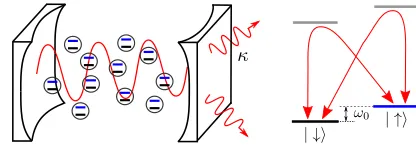
We consider the Dicke model [21–23], describingN iden-tical two-level atoms collectively coupled to a single-mode lossy cavity [3]. As described in Ref. [1], such a model can be realized as an effective low-energy description of atoms with Raman driving. That is, transitions between two low-lying atomic states are driven by scattering a pump photon into a cavity mode, or vice versa (see Fig.1).
[image:2.608.327.535.631.704.2]In this context, working in the rotating frame of the pump, one realizes the Dicke Hamiltonian, combined with optical losses from the cavity mode [1,32]. The problem is thus
described by the master equation
∂tρ= −i[HDicke, ρ]+κL[a], (1) where L[X]=2XρX†− {X†X, ρ} describes the photon losses with a rateκand the Dicke Hamiltonian is given by
HDicke=ω0Sz+ωa†a+2g(a+a†)Sx. (2)
The first term describes the level splittingω0 of the two low-lying atomic states, whereSα=(1/2)Ni=1σiα (α=x,y,z) are collective spin operators written in terms of the standard single-spin Pauli operators σiα (i=1, . . . ,N). The second term describes the cost of scattering photons into the cavity, where a is the annihilation operator of a cavity photon and ωthe detuning of the cavity mode from the pump frequency. The final term results from the Raman process, leading to an effective interaction between the atoms and the cavity field, whereg=g0/ ain terms of the bare couplingg0, the Rabi frequencyof the transverse pump, and the atomic detuning a. These definitions are chosen to match the Hamiltonian in Ref. [32], for ease of comparison to the semiclassical results presented there.
B. Review of dynamics of the dissipative Dicke model
For completeness, in this section we briefly summarize the well-known properties of the model described by Eq. (1) and Eq. (2). In the thermodynamic limit (i.e., largeS), the behavior of the model is well described by the semiclassical equations of motion [32]:
∂tS− = −iω0S− +2ig(a + a†)Sz, ∂tSz =2g(a + a†)Sy,
∂ta = −(κ+iω)a −2igSx. (3) Following these equations, one may see this model shows a phase transition between two classes of steady-state attractor: normal states, where Sx = a+a† =0, and an ordered state where these expectations are nonzero. This ordered state spontaneously breaks the Z2 symmetry of the model under the transformation Sx→ −Sx,a→ −a. By analogy to the ground-state phase transition in the Dicke model [21–23], this ordered state is known as a superradiant state. For the open system [1,32] the transition occurs wheng>gc, where 4g2
cN =ω0(ω2+κ2)/ω.
The dynamics in both states is dissipative, i.e., there is damped relaxation towards the given steady state. As dis-cussed in detail in Bhaseenet al. [32], this can be charac-terized by considering the semiclassical equations of motion, and then linearizing around a given steady state. In general this procedure leads to a quartic equation for the eigenvalues, but this equation can be solved in the limit whereω0ω, κ. In the normal state, the eigenvalues of this linearized analysis take the form
λ= −4κω0ωg2N (ω2+κ2)2 ±iω0
1−
g gc
2
(4)
[see Eq. (18) of Ref. [32]]. Thus, forg<gc, the normal state is absolutely stable, but with a decay rate that can be much smaller than the bare cavity loss rate, particularly in the exper-imentally relevant regimeω0κ. When the system becomes
superradiant, one must linearize around the new superradiant solution. This [using Eqs. (19) and (20) of Ref. [32]] gives instead the eigenvalues
λ= − κω20
ω2+κ2 ±iω0
g gc
4
−1, (5)
which corresponds to damped oscillations around the steady state.
The results above come from an analysis of the linearized semiclassical equations of the full model, i.e., both atomic and photon degrees of freedom, as given in Eq. (3). If one performs adiabatic elimination of the photon mode on these semiclassical equations, i.e., usinga = −2igSx/(κ+iω), one may note that the other equations depend only on the combinationa + a† = −4gSxω/(ω2+κ2). Inserting this into the other two equations yields purely conservative dynamics of the collective spin expectation S. Indeed, as noted in [31], this semiclassical spin dynamics corresponds to that from a Lipkin-Meshkov-Glick [54–56] Hamiltonian
H=ω0Sz− 4g2ω ω2+κ2(S
x
)2. (6)
This Hamiltonian does reproduce the existence of a phase transition at the correct gc, but since the dynamics is purely conservative, this atom-only semiclassical theory cannot de-scribe the correct damped decay toward the steady-state at-tractors. In the following we will see that a correct atom-only semiclassical theory can however be derived by eliminating cavity photons first, and then taking a semiclassical limit.
III. ATOM-ONLY REDFIELD MASTER EQUATION
A. Derivation of the Redfield equation
In this section, we treat the matter-light coupling as a weak system-reservoir coupling and derive a Redfield master equation for the atom-only dynamics. That is, we derive a description purely in terms of atomic operators, which nonetheless captures the effects of the dissipative cavity mode. In order to formally derive the atom-only equations, it is useful to note that the starting model described in Eq. (1) can also be written as a purely Hamiltonian problem. That is, one could alternatively describe the same system by enlarging the Hilbert space to describe coupling between the cavity mode and a flat bath of extracavity radiation modes,Htotal= HDicke+
kgk(a†Ak+H.c.)+μkA†kAk, where the bath spec-tral density satisfieskg2
kπδ(νk−ν)=κ(ν)≡κ. In such a description, adiabatic elimination of the cavity modes means regarding both the cavity and extracavity modes as forming the bath. By diagonalizing these coupled harmonic oscillators, one finds the density of states for this effective bath, and can use this to write the open-system description of the atom-only problem.
Using such an approach, we perform the standard deriva-tion of the Redfield equaderiva-tion, first dividingHDicke=H0+H1 and then working in the interaction picture with respect to H0. In this interaction picture, the interaction HamiltonianH1 takes the form
where X(t)=a(t)+a†(t) andS±(t)=S±e±iω0t withS±=
Sx±iSy. The master equation then becomes
˙ ρ= −
t
0
dt TrB([H1(t),[H1(t ), ρ]]). (8)
To evaluate this, we need to find the correlation function of the cavity photons; thus one needs the time dependence of a(t). This can be found either from the Green’s function resulting from diagonalizing the cavity and extracavity modes, or alternatively by using Heisenberg-Langevin equations [36] for the cavity modes. Using the assumed flat spectral density of the extracavity modes finds the cavity photon correlation function:
TrB(X(τ)X(0)ρB)=e−iωτ−κ|τ|. (9)
Performing the integrals over time after extending the limit of integration to infinity, we can then write the Redfield equation for the density matrix. It is convenient to introduce the quantities
Q±= g
2 κ+i(ω±ω0)
, (10)
in terms of which the Redfield equation in the Schrödinger picture takes the form
˙
ρ = −i[ω0Sz, ρ]− {Q+(S+S+ρ−S+ρS+)
+Q−(S+S−ρ−S−ρS+)+Q+(S−S+ρ−S+ρS−)
+Q−(S−S−ρ−S−ρS−)+Q∗−(ρS+S+−S+ρS+)
+Q∗−(ρS+S−−S−ρS+)+Q∗+(ρS−S+−S+ρS−)
+Q∗+(ρS−S−−S−ρS−)}. (11)
In writing Eq. (11), we have not made the secular approx-imation. To make this additional approximation we would neglect those terms which are time-dependent in the inter-action picture. In the above equation, it is the terms with two operators S− or two operators S+ which oscillate at a frequency±2ω0, respectively. In the following, we will com-pare a number of different approximations with and without secularization. To enable this we will introduce a prefactor ξ in front of those terms which are time dependent in the interaction picture, so that ξ =0 corresponds to the secular approximation andξ =1 to making no approximation.
B. Master equation in operator form
The master equation given in Eq. (11) can be written in a more compact and convenient form:
˙
ρ = −i[Heff, ρ]+
i j
Li j(2CjρCi†− {C
†
iCj, ρ}), (12)
Heff=ω0Sz+
i j
Hi jCi†Cj. (13)
Here the two-component vectorChas componentsC1,2 =S±. To write the Hamiltonian and Lindblad-Kossakowski matri-ces H,L it is convenient to first define Q0 and Q1 through
Q±=Q0±Q1. We then find
H=Q 0
1 ξ
ξ 1
+
Q 1 iξQ1
−iξQ1 −Q 1 , (14)
L=Q0
1 ξ
ξ 1
+
Q1 iξQ 1
−iξQ 1 −Q1 , (15)
where Qi,Q i refers to real and imaginary parts of these quantities.
The quantities Q0 and Q1 can be thought of as corre-sponding to the mean and difference of the quantities arising from the co- and counter-rotating terms in the matter-light coupling. In the following, we will compare this full master equation with the results making a number of commonly used approximations. Specifically, we will consider the limit Q1=0, which is relevant when ω0ω, κ (i.e., the large detuning limit), and the limit ξ =0 corresponding to secu-larization. We next briefly summarize the simplifications that occur to the effective master equation in these various limiting cases.
1. Secularized master equation
In the case ξ =0, the Hamiltonian and Lindblad-Kossakowski matrix both become diagonal. As expected from secularization, this latter has positive entries Q±=Q0± Q1=g2κ/[κ2+(ω±ω
0)2] guaranteeing complete positiv-ity. We find the effective Hamiltonian takes the form of a Lipkin-Meshkov-Glick [54–56] model withXY symmetry
Heff =(ω0−2Q1 )S
z+
2Q 0[(Sx)2+(Sy)2], (16)
accompanied by simple spin raising and lowering rates: ∂tρ= −i[Heff, ρ]+Q+L[S+]+Q−L[S−]. (17) Because the effective Hamiltonian hasXY symmetry, it con-serves the number of excited spins. This conservation is an expected consequence of secularization, as the interaction picture with respect toH0=ω0Szwill give time dependence to any term that is not diagonal in theSz basis. As we will show below, this means the steady-state density matrix is diagonal in theSzbasis, and we find particularly simple steady states arising from the competition of the spin raising and lowering processes.
If we combine this secular limit with the large detuning limit whereQ1may be neglected, the equation simplifies fur-ther, giving equal ratesQ±=Q0for spin raising and lowering processes.
2. Large detuning limit
If we consider the limit whereQ1 may be neglected, but avoiding secularization (soξ =1), we also find a simple form of the master equation. In this case
Heff=ω0Sz+4Q 0(S
x
)2, (18)
surprising, as dropping Q1 corresponds to neglecting the energy differences ±ω0, so that all operators sample the bath at the same frequency. As also discussed further below, this equation also has a simple steady state—since the jump operator is Hermitian, the steady state is a fully mixed density matrix.
3. Full model
While the two limiting cases mentioned above lead to com-pletely positive master equations, this is not true for the full model. We may see this directly by considering the eigenval-ues of the Lindblad-Kossakowski matrixL. Specifically, the eigenvalues of this matrix are Q0±(Q0)2+ |Q
1|2, which indeed involves a negative eigenvalue for any nonzero Q1. However, as we will show below, despite this nonpositivity, this full master equation is capable of describing the known behavior of the open Dicke model. This is in contrast to both the limiting cases which cannot reproduce the known behavior at the superradiance transition.
C. Master equation in the Dicke basis
Since the master equation is written only in terms of collective spin operators, it is convenient to write the master equation in the Dicke basis spanned by the Dicke states|SM withS=N/2 andM= −S, . . . ,S, which satisfy
Sz|SM =M|SM, S±|SM = f±M|SM±1, (20)
where fM
± =√(S∓M)(S±M+1).In this Dicke basis, the density matrix can be decomposed as
ρ(t)= S
M=−S
ρM,M(t)|SMSM|, (21)
with (N+1)2 matrix elements given by ρM,M(t)=
SM|ρ(t)|SM. Noting that fM
− = f+M−1 we use only f+M and suppress the subscript + from hereon. The master equation (11) for these matrix elements reads
˙ ρM,M
= −iω0(M−M )ρM,M
− {ξQ+(fM−1fM−2ρM−2,M −fM−1fMρM−1,M+1)
+Q−(fM−1fM−1ρM,M − fMfMρM+1,M+1)
+Q+(fMfMρM,M −fM−1fM−1ρM−1,M−1)
+ξQ−(fMfM+1ρM+2,M −fMfM−1ρM+1,M−1)
+ξQ∗−(fM+1fMρM,M+2−fM−1fMρM−1,M+1)
+Q∗−(fM−1fM−1ρM,M −fMfMρM+1,M+1)
+Q∗+(fM fMρM,M −fM−1fM−1ρM−1,M−1)
+ξQ∗+(fM−2fM−1ρM,M−2− fMfM−1ρM+1,M−1)}. (22)
D. Atom-only semiclassical dynamics
In the following sections, to understand the behavior in the thermodynamic limit, it is useful to write semiclassical equations of motion, found by writing equations forSαand
then replacing SαSβ → SαSβ. It is generally easier to extract the equation of motion directly from Eq. (11), but introducing the factors of ξ. Considering a general operator Awe find
∂tA = −iω0[A,Sz] − Q+[A, ξS++S−]S+
+Q−[A,S++ξS−]S−+Q∗−S+[ξS++S−,A]
+Q+∗S−[S++ξS−,A]. (23) We need only consider equations forSzandS−, sinceS+ follows by complex conjugation. We thus find
∂tSz = −Q+(ξS+−S−)S++Q−(S+−ξS−)S−
+Q−∗S+(−ξS++S−)+Q∗+S−(−S++ξS−) (24) and
∂tS− = −iω0S− +2Q+ξSzS++Q−SzS−
−Q∗−S+ξSz−Q∗+S−Sz. (25) Further simplification of these equations depends on whether ξ =0 orξ =1.
IV. SPIN DYNAMICS OF ATOM-ONLY MODEL
Having introduced the general model in the previous sec-tion, in this secsec-tion, we analyze the dissipative spin dynamics of this model and each of its limiting cases. In several of these cases, we can exactly solve the model in closed form.
A. Secularized master equation
For the secularized case, ξ =0, the populationsρM,M(t) are decoupled from the coherencesρM,M=M(t), as can be seen from Eq. (22). Physically, this corresponds to the fact that the Hamiltonian is diagonal in the Sz basis, and the dissipative terms only create or destroy excitations. The equations for the populations (i.e., diagonal elements,PM=ρM,M) read
˙
PM =2Q−[(S+M+1)(S−M)PM+1
−(S+M)(S−M+1)PM]
+2Q+[(S+M)(S−M+1)PM−1
−(S+M+1)(S−M)PM]. (26) One may solve this explicitly for the steady state using a detailed balance condition, where gain and loss terms must be equilibrated [57]. The only consistent way of doing this consists in equating the first and fourth terms. This implies the second and third must then also match and, moreover, one may see that the second and third terms relate to the first and fourth by replacingM→M−1. Thus the only required condition isPM+1/PM=Q+/Q−. This condition is identical to that for a thermal equilibrium magnet of momentμ in a Zeeman magnetic fieldB, for whichPM ∝exp(MβμB), but with the replacementβμB→ln(Q+/Q−). We can thus use the standard results of such a model and obtainSz =SB
S(x), wherex=S ln (Q+/Q−) andBS(x) is the Brillouin function [58]:
BS(x)= 2S+1
2S coth
2S+1 2S x
− 1
2Scoth
1 2Sx
In the limit S→ ∞ the existence of the factor of S in the argument of the Brillouin function means there is a sharp dependence of the result on the ratioQ+/Q−. Namely,Sz =
±S depending on whetherQ+>Q−or vice versa. Interme-diate values of S only occur when |Q+/Q−−1|1/S, a vanishing region at largeS.
We thus see that, in this approach, we never describe a superradiant state, but instead have a state purely determined by the ratio of spin flip rates. This is consistent with our observation from the effective Hamiltonian: the Hamiltonian conserved number of excitations, so could not modify the effects of gain or loss. It is notable that if one considered the effective Hamiltonian on its own, the ground state of this Lipkin-Meshkov-Glick model does have a ground-state phase transition when Q 0 is negative. That is, for 2|Q 0|N> ω0− 2Q1, there is a transition to a state with a finite component of spin in the xy plane. The effects of dissipation however destroy this transition, and leave only a transition between states aligned along+zand−zaxes.
One may also verify that, in this limit, the semiclassical equations (24) and (25) support this result. The equation for
S−becomes
∂tS− =iω0S− +2Q−SzS−−Q∗+S−Sz, (28) which we may rewrite by symmetrizing expressions in the second term as
∂tS− = −(iω0+Q−−Q∗+)S− +2(Q−−Q∗+)SzS−. (29)
Regardless of Sz, we always find the steady state obeys
S− =0. The equation forSzsimilarly becomes ∂tSz =2(Q+−Q−)(S2− (Sz)2)−2(Q++Q−)Sz.
(30)
In the largeSlimit, the second term can be neglected, and we find the only steady state is Sz = ±S, corresponding to the sharp switch noted above.
If we combine the secular limit with the large detuning limit, where Q±=Q0, we immediately find all probabilities must be equal and so normalization impliesPM =1/(N+1), i.e., a fully mixed state. Thus, in this case,Sz =0 indepen-dent of all parameters.
B. Large detuning unsecularized master equation
In the large detuning limitQ±=Q0,Q1=0 (but without secularization), the decoupling of populations and coherences no longer occurs, i.e., the terms in Eq. (22) with M =M couple to other terms withM =M. However, the form of the master equation in Eq. (19) suggests the solution nonetheless remains straightforward. Namely, since the jump operator in the master equation is Hermitian, a general result [36] states that, for Hermitian jump operators, ρ∝1is a steady state.2
2The proof follows from the fact that the identity always commutes
with the Hamiltonian, [H,1]=0, and the identity can make the Lindblad form vanish, i.e., 2X1X†− {X†X,1} =0 ifX†=X.
In such a state we find all expectations ofSα vanish, and there is no transition as a function of parameters, as obtained in [59].
C. Full model
If we consider the full model with ξ =1 and Q1=0, no simple solution exists. Nevertheless, the total number of connected density matrix elements containing the populations is (n+1)2/2 [since Eq. (22) connects matrix elements according to a checkerboard pattern], i.e., grows only quadrat-ically with the number of spins, which makes it possible to solve the equations numerically for moderateN. In the largeN limit, we may also use the semiclassical equations of motion to obtain an analytic expression of the expectation value of the collective spin. In this thermodynamic limit, we find, in contrast to the previous two cases, that there is a superradiant transition.
In the case ξ =1 the semiclassical equations simplify considerably, since we may in general write
∂tA = −iω0[A,Sz] −2[A,Sx](Q+S++Q−S−)
−2(Q+S++Q−S−)†[Sx,A]. (31) In this case it is clearest to write equations for Sα=x,y,z explicitly, rather than forS±. If we symmetrize all products of operators before taking expectations (i.e., writingAB =
1
2{A,B} +[A,B] = AB + 1
2[A,B]), we then find the following equations:
∂tSx = −ω0Sy, (32)
∂tSy =ω0Sx −4Q0S
y −
8Q0 SzSx
−4Q 1Sx −8Q1SzSy, (33)
∂tSz = −4Q0S
z +
8Q 0SxSy +8Q1Sy2. (34)
We may note that not all these terms are extensive in the thermodynamic limit, where we assumeg2N is finite sog2∝ 1/N. Specifically, those terms involving Qi multiplying a single spin operator (the terms arising from commutators) scale as g2 and so vanish in the limit N→ ∞. In contrast, those terms multiplying two spin operators scale asg2Nand so remain finite in this limit. Neglecting such terms is therefore consistent with considering the semiclassical (i.e., mean-field) limit, where fluctuations are suppressed by 1/N. Since real experiments involve finite numbers of atoms and finite cavity volumes, the practical distinction is that some of the terms in this equation areN-fold smaller and, for a typicalN105, that difference is significant. Neglecting these smaller terms then gives a simplified equation of motion:
∂tSx = −ω0Sy, ∂tSy =ω0Sx −8Q 0S
z
Sx −8Q1SzSy, ∂tSz =8Q 0SxSy +8Q1Sy2. (35) In the limit whereω0 ω, κ, but where it remains finite, we may approximate that the two combinations ofQi appearing here are
Q 0 − g 2ω
ω2+κ2, Q1 −
2g2κωω 0
0.7 0.6 0.5 0.4 0.3 0.2 0.1 0 0
−0.2
−0.4
−0.6
−0.8
−1 N→ ∞
N= 150 N= 125 NN= 100= 50 N= 30 N= 20 NN= 10= 1
g√N
S
z/
(
N/
2)
gc√N
0.7 0.6 0.5 0.4 0.3 0.2 0.1 0 0
−0.2
−0.4
−0.6
−0.8
[image:7.608.68.274.69.221.2]−1
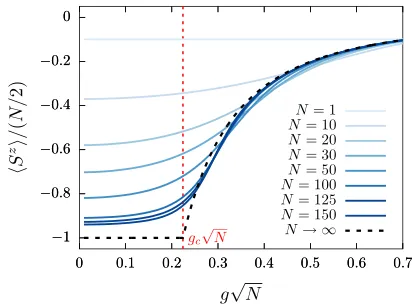
FIG. 2. Evolution of the steady-state value ofSzwith matter-light couplingg√Nforω0=0.1, andκ=1 (in units chosen so that
ω=1). Curves are rescaled byN/2 so as to produce a finite limit asN→ ∞. The blue curves show the exact numerical simulations [based on the resolution of the master equation (22)] for various values of N as indicated in the legend. The dashed black curve shows the semiclassical solution (valid asN→ ∞). The position of
gc √
N, which marks the transition between the normal state and the superradiant state, is indicated by a red vertical dashed line.
It is notable that this procedure (eliminating photon modes from the quantum theory, and then deriving the semiclassical equations) does not match the result derived in [31] and reviewed at the end of Sec.II B. Namely, if one first makes a semiclassical approximation for the full model, and then elim-inates the photon mode, the resulting equations do not match Eq. (35); such equations are missing the term proportional to Q1 which describes damping. Thus the approach described here of eliminating photons first and making a semiclassical approximation second appears to restore the missing damping. We discuss the consequences of this in the remainder of this section.
1. Steady state
To first check the semiclassical theory, we consider the steady state and its comparison to exact solution of the full atom-only model. The steady state of Eq. (35) is satisfied bySy =0 along withSx(ω
0−8Q0 Sz)=0. This indeed describes two distinct states: a normal state withSx =0 or a superradiant state that becomes possible once 4N|Q 0|> ω0, allowing a solution withSz>−N/2. Using the above result forQ 0 we indeed see this expression matches the location of the superradiance transition in the full Dicke model. Using this definition of threshold 4g2
cN =ω0(ω2+κ2)/ω we see that above threshold the solution is
Sx = ±N 2
1−g 4
c
g4, S
z = −N 2
g2
c
g2. (37)
Figure 2 shows the semiclassical solution for Sz in comparison to results of the exact numerics for finite-size calculations. We see that these match well in the large N limit and that, in that limit, a sharp cusp develops in the exact solution. We focus onSz, as the finite-size calculation never shows symmetry breaking; however, as discussed elsewhere [60], signatures of the transition nonetheless survive.
2. Linear stability analysis
To understand the role of the damping termQ1 appearing in the equations of motion, we consider linear stability of the normal and superradiant states.
a. Normal state. For the normal state, Sx = Sy = 0,Sz = −N/2, we can easily see that fluctuations of Sz decouple from those ofSx,y, Denoting fluctuations ofSx,y byx,y, we find these obey the coupled equations:
∂t x y =
0 −ω0
ω0+4Q 0N 4Q1N
x y
. (38)
The eigenvalues of this matrix are
λ=2Q1N±i
ω0(ω0+4Q 0N)−(2Q1N)2. (39)
We can use this to recover the behavior below and at thresh-old. When gis small, the square root is real, corresponding to oscillating modes, with damping caused byQ1. Instability of the normal state occurs when an eigenvalue crosses zero. This requiresω0+4Q 0N =0. Inserting the expression forQ0 we see this again matches the expected threshold,g>gc, for superradiance of the Dicke model. Using this definition of gc we find that, away from this transition, we can write the eigenvalues as
λ −4g2Nκωω0 (ω2+κ2)2 ±iω0
1− g gc 2 , (40)
which matches precisely the linear stability analysis of the full model as presented in Sec. II B. For g<gc, the eigenvalues have a small negative real part (given by the first term) and an imaginary part (given by the square root). Hence the solution is stable. Forg>gc, one of the eigenvalues becomes positive. The solutionSz = −N/2 is thus unstable.
b. Superradiant state. One may similarly perform a linear stability analysis around the ordered states. In this case we consider, e.g., Sx = Sx
ss+x, where Sxss is the steady-state value. A similar replacement holds forSz, whileSy =
yas we may note thatSy
ss=0. This then gives ∂tx= −ω0y,
∂ty=ω0x−8Q 0(Szssx+ Sxssz)−8Q1Szssy, ∂tz=8Q 0Sxssy. (41) The second equation can be simplified by noting that the steady-state condition implies thatω0=8Q 0S
z
ss. After this, one finds the equations fory,zno longer depend onx, allow-ing one to directly read out the eigenvalues:
λ= −4Q1Szss±
(4Q1Sz
ss)2−(8Q 0Sxss)2. (42)
We may note that, sinceQ1Q0 , the first term in the square root can be neglected. Inserting the expressions for the steady-state values (37) we then find
λ − κω02
ω2+κ2 ±iω0
g4 g4
c
−1. (43)
V. CONCLUSION
In summary, we have shown that it is possible to produce an atom-only description of the dissipative Dicke model which correctly describes the dissipation rates and the steady states of the system. To recover such a theory it is necessary to use an unsecularized Redfield master equation, accounting for the variation of effective bath density of states at system frequencies ±ω0. Such a theory is not of Lindblad form. Attempts to put it in Lindblad form, either by neglecting the small detuning ω0 or by secularization, lead to a master equation that is qualitatively incorrect, i.e., it fails to produce the phase transition expected. As a result, constructing a time-local equation of motion that captures the dissipative physics of the open Dicke model in an atom-only description appears to require such a non-Lindblad form. Although non-Lindblad master equations may lead to positivity violation, this viola-tion of positivity is restricted to specific initial condiviola-tions, and does not typically occur for the steady state of the system. Indeed, in other contexts [47] it can be shown that violation of positivity of the density matrix only occurs as a transient behavior at early time starting from certain initial states; this transient nonpositivity does not cause problems for the later time evolution.
The ability to describe the dissipative dynamics with an atom-only theory is a crucial step to understand the quan-tum dynamics in more complicated situations. Specifically, for multimode cavities [4–14], it enables one to adiabati-cally eliminate the bosonic cavity modes (which massively
increases the size of the Hilbert space), and provides a de-scription of the key slow dynamics with only atomic variables. Such a description can then form a basis for numerical meth-ods, such as matrix-product-density-operator [49–51], corner-space-renormalization [52], or cluster expansions [53], to be applied, allowing a full quantum description of the problem. Moreover, as described above, the above quantum theory has a semiclassical limit that correctly captures the effects of dissipation. In addition, the methods described here may be particularly useful when considering fermionic atoms in optical cavities [61–63] and the possibility of cavity mediated superconductivity [64], as fermions do not admit the same semiclassical approaches as used for bosonic atoms. Future work will make use of the methods above applied to multi-mode problems to explore the evolution of entanglement and quantum correlations in this complex open quantum system.
All data underpinning this publication are openly available from the University of Strathclyde KnowledgeBase [65].
ACKNOWLEDGMENTS
J.K. acknowledges useful discussions with Monika Schleier-Smith and Benjamin Lev, and in particular acknowl-edges Monika Schleier-Smith for asking the question that prompted this work. F.D. and A.D. acknowledge support from the EPSRC Programme Grant DesOEQ (No. EP/P009565/1), and by the EOARD via AFOSR Grant No. FA9550-18-1-0064. J.K. acknowledges support from SU2P.
[1] F. Dimer, B. Estienne, A. S. Parkins, and H. J. Carmichael, Proposed realization of the Dicke-model quantum phase transi-tion in an optical cavity QED system,Phys. Rev. A75,013804 (2007).
[2] K. Baumann, C. Guerlin, F. Brennecke, and T. Esslinger, Dicke quantum phase transition with a superfluid gas in an optical cavity,Nature (London)464,1301(2010).
[3] P. Kirton, M. M. Roses, J. Keeling, and E. G. D. Torre, Introduc-tion to the Dicke model: From equilibrium to nonequilibrium, and vice versa,Adv. Quantum Technol.2,1800043(2019). [4] S. Gopalakrishnan, B. L. Lev, and P. M. Goldbart, Emergent
crystallinity and frustration with Bose-Einstein condensates in multimode cavities,Nat. Phys.5,845(2009).
[5] S. Gopalakrishnan, B. L. Lev, and P. M. Goldbart, Atom-light crystallization of Bose-Einstein condensates in multimode cav-ities: Nonequilibrium classical and quantum phase transitions, emergent lattices, supersolidity, and frustration,Phys. Rev. A
82,043612(2010).
[6] S. Gopalakrishnan, B. L. Lev, and P. M. Goldbart, Frustration and Glassiness in Spin Models with Cavity-Mediated Interac-tions,Phys. Rev. Lett.107,277201(2011).
[7] S. Gopalakrishnan, B. L. Lev, and P. M. Goldbart, Exploring models of associative memory via cavity quantum electrody-namics,Philos. Mag.92,353(2012).
[8] A. J. Kollár, A. T. Papageorge, K. Baumann, M. A. Armen, and B. L. Lev, An adjustable-length cavity and Bose-Einstein condensate apparatus for multimode cavity QED,New J. Phys.
17,043012(2015).
[9] A. J. Kollár, A. T. Papageorge, V. D. Vaidya, Y. Guo, J. Keeling, and B. L. Lev, Supermode-density-wave-polariton condensa-tion,Nat. Commun.8,14386(2017).
[10] V. Torggler, S. Krämer, and H. Ritsch, Quantum annealing with ultracold atoms in a multimode optical resonator,Phys. Rev. A
95,032310(2017).
[11] V. D. Vaidya, Y. Guo, R. M. Kroeze, K. E. Ballantine, A. J. Kollár, J. Keeling, and B. L. Lev, Tunable-Range, Photon-Mediated Atomic Interactions in Multimode Cavity QED,Phys. Rev. X8,011002(2018).
[12] V. Torggler, P. Aumann, H. Ritsch, and W. Lechner, A quantum N-queens solver,arXiv:1803.00735.
[13] Y. Guo, R. M. Kroeze, V. V. Vaidya, J. Keeling, and B. L. Lev, Sign-changing photon-mediated atom interactions in mul-timode cavity QED,arXiv:1810.11086.
[14] Y. Guo, V. D. Vaidya, R. M. Kroeze, R. A. Lunney, B. L. Lev, and J. Keeling, Emergent and broken symmetries of atomic self-organization arising from Gouy phase shifts in multimode cavity QED,arXiv:1810.11085.
[15] K. E. Ballantine, B. L. Lev, and J. Keeling, Meissner-Like Effect for a Synthetic Gauge Field in Multimode Cavity QED, Phys. Rev. Lett. 118, 045302 (2017).
[16] P. Rotondo, M. Marcuzzi, J. P. Garrahan, I. Lesanovsky, and M. Müller, Open quantum generalisation of Hopfield neural networks,J. Phys. A51,115301(2018).
[18] M. Gross and S. Haroche, Superradiance: An essay on the theory of collective spontaneous emission,Phys. Rep.93,301 (1982).
[19] D. Meiser, J. Ye, D. R. Carlson, and M. J. Holland, Prospects for a Millihertz-Linewidth Laser,Phys. Rev. Lett.102,163601 (2009).
[20] J. G. Bohnet, Z. Chen, J. M. Weiner, D. Meiser, M. J. Holland, and J. K. Thompson, A steady-state superradiant laser with less than one intracavity photon,Nature (London)484,78(2012). [21] K. Hepp and E. H. Lieb, On the superradiant phase transition
for molecules in a quantized radiation field: the Dicke Maser model,Ann. Phys. (NY)76,360(1973).
[22] Y. K. Wang and F. T. Hioe, Phase transition in the Dicke model of superradiance,Phys. Rev. A7,831(1973).
[23] K. Hepp and E. Lieb, Equilibrium statistical mechanics of matter interacting with the quantized radiation field,Phys. Rev. A8,2517(1973).
[24] K. Rza˙zewski, K. Wódkiewicz, and W. ˙Zakowicz, Phase Tran-sitions, Two-Level Atoms, and theA2Term,Phys. Rev. Lett.35,
432(1975).
[25] A. Vukics and P. Domokos, Adequacy of the Dicke model in cavity QED: A counter-no-go statement, Phys. Rev. A86, 053807(2012).
[26] A. Vukics, T. Grießer, and P. Domokos, Elimination of the
A-Square Problem from Cavity QED, Phys. Rev. Lett. 112, 073601(2014).
[27] A. Vukics, T. Grießer, and P. Domokos, Fundamental limitation of ultrastrong coupling between light and atoms,Phys. Rev. A
92,043835(2015).
[28] T. Grießer, A. Vukics, and P. Domokos, Depolarization shift of the superradiant phase transition,Phys. Rev. A94,033815 (2016).
[29] D. De Bernardis, T. Jaako, and P. Rabl, Cavity quantum elec-trodynamics in the nonperturbative regime, Phys. Rev. A 97, 043820(2018).
[30] D. De Bernardis, P. Pilar, T. Jaako, S. De Liberato, and P. Rabl, Breakdown of gauge invariance in ultrastrong-coupling cavity QED,Phys. Rev. A98,053819(2018).
[31] J. Keeling, M. J. Bhaseen, and B. D. Simons, Collective Dy-namics of Bose-Einstein Condensates in Optical Cavities,Phys. Rev. Lett.105,043001(2010).
[32] M. J. Bhaseen, J. Mayoh, B. D. Simons, and J. Keeling, Dynam-ics of nonequilibrium Dicke models,Phys. Rev. A85,013817 (2012).
[33] M. Xu, D. A. Tieri, and M. J. Holland, Simulating open quan-tum systems by applying SU(4) to quanquan-tum master equations, Phys. Rev. A87,062101(2013).
[34] P. Kirton and J. Keeling, Superradiant and lasing states in driven-dissipative Dicke models, New J. Phys. 20, 015009 (2018).
[35] N. Shammah, S. Ahmed, N. Lambert, S. De Liberato, and F. Nori, Open quantum systems with local and collective incoher-ent processes: Efficiincoher-ent numerical simulations using permuta-tional invariance,Phys. Rev. A98,063815(2018).
[36] H.-P. Breuer and F. Petruccione,The Theory of Open Quantum Systems(Oxford University Press, Oxford, 2002).
[37] A. G. Redfield, On the theory of relaxation processes,IBM J. Res. Dev.1,19(1957).
[38] F. Bloch, Generalized theory of relaxation,Phys. Rev.105,1206 (1957).
[39] G. Lindblad, On the generators of quantum dynamical semi-groups,Commun. Math. Phys.48,119(1976).
[40] E. B. Davies, Markovian master equations, Commun. Math. Phys.39,91(1974).
[41] R. Dümcke and H. Spohn, The proper form of the gen-erator in the weak coupling limit, Z. Phys. B 34, 419 (1979).
[42] R. S. Whitney, Staying positive: Going beyond Lindblad with perturbative master equations,J. Phys. A41,175304(2008). [43] R. Wangsness and F. Bloch, The dynamical theory of nuclear
induction,Phys. Rev.89,728(1953).
[44] V. Gorini, A. Kossakowski, and E. C. G. Sudarshan, Completely positive dynamical semigroups of N-level systems, J. Math. Phys.17,821(1976).
[45] J. Jeske, D. Ing, M. B. Plenio, S. F. Huelga, and J. H. Cole, Bloch-Redfield equations for modeling light-harvesting com-plexes,J. Chem. Phys.142,064104(2015).
[46] H. M. Cammack, P. Kirton, T. M. Stace, P. R. Eastham, J. Keeling, and B. W. Lovett, Coherence protection in coupled quantum systems,Phys. Rev. A97,022103(2018).
[47] P. R. Eastham, P. Kirton, H. M. Cammack, B. W. Lovett, and J. Keeling, Bath-induced coherence and the secular approxima-tion,Phys. Rev. A94,012110(2016).
[48] A. Dodin, T. Tscherbul, R. Alicki, A. Vutha, and P. Brumer, Secular versus nonsecular Redfield dynamics and Fano coher-ences in incoherent excitation: An experimental proposal,Phys. Rev. A97,013421(2018).
[49] A. J. Daley, C. Kollath, U. Schollwöck, and G. Vidal, Time-dependent density-matrix renormalization-group using adaptive effective Hilbert spaces,J. Stat. Mech.(2004)P04005. [50] F. Verstraete, J. J. García-Ripoll, and J. I. Cirac, Matrix
Product Density Operators: Simulation of Finite-Temperature and Dissipative Systems, Phys. Rev. Lett. 93, 207204 (2004).
[51] M. Zwolak and G. Vidal, Mixed-State Dynamics in One-Dimensional Quantum Lattice Systems: A Time-Dependent Superoperator Renormalization Algorithm,Phys. Rev. Lett.93, 207205(2004).
[52] S. Finazzi, A. Le Boité, F. Storme, A. Baksic, and C. Ciuti, Corner-Space Renormalization Method for Driven-Dissipative Two-Dimensional Correlated Systems, Phys. Rev. Lett. 115, 080604(2015).
[53] J. Jin, A. Biella, O. Viyuela, L. Mazza, J. Keeling, R. Fazio, and D. Rossini, Cluster Mean-Field Approach to the Steady-State Phase Diagram of Dissipative Spin Systems,Phys. Rev. X6, 031011(2016).
[54] H. J. Lipkin, N. Meshkov, and A. J. Glick, Validity of many-body approximation methods for a solvable model: (I) Ex-act solutions and perturbation theory, Nucl. Phys. 62, 188 (1965).
[55] N. Meshkov, A. J. Glick, and H. J. Lipkin, Validity of many-body approximation methods for a solvable model: (II) Lin-earization procedures,Nucl. Phys.62,199(1965).
[56] A. J. Glick, H. J. Lipkin, and N. Meshkov, Validity of many-body approximation methods for a solvable model: (III) Dia-gram summations,Nucl. Phys.62,211(1965).
[57] M. O. Scully and M. S. Zubairy,Quantum Optics(Cambridge University Press, Cambridge, UK, 1997).
[59] R. Imai and Y. Yamanaka, Dynamical properties of the finite-size Dicke model coupled to a thermal reservoir,J. Phys. Soc. Jpn.88,024401(2019).
[60] P. Kirton and J. Keeling, Suppressing and Restoring the Dicke Superradiance Transition by Dephasing and Decay,Phys. Rev. Lett.118,123602(2017).
[61] J. Keeling, M. J. Bhaseen, and B. D. Simons, Fermionic Super-radiance in a Transversely Pumped Optical Cavity,Phys. Rev. Lett.112,143002(2014).
[62] F. Piazza and P. Strack, Umklapp Superradiance with a Colli-sionless Quantum Degenerate Fermi Gas,Phys. Rev. Lett.112, 143003(2014).
[63] Y. Chen, Z. Yu, and H. Zhai, Superradiance of Degenerate Fermi Gases in a Cavity,Phys. Rev. Lett.112,143004(2014). [64] E. Colella, R. Citro, M. Barsanti, D. Rossini, and M.-L.
Chiofalo, Quantum phases of spinful Fermi gases in optical cavities,Phys. Rev. B97,134502(2018).