Manipulation and Gratification Through
Gamification
Xavier Bellekens1, Gayan Jayasekara1, Hanan Hindy1, Miroslav Bures1,3, David Brosset2, Christos Tachtatzis4 and Robert Atkinson4
1
Abertay University, Division of Cyber-Security, Scotland
2 Chair of Naval Cyber Defense, Ecole navale, France 3
Czech Technical University in Prague, Dpt. of Computer Science, Faculty of Electrical Engineering, Czech Republic
4
University of Strathclyde, Dpt. of Electronic & Electrical Engineering, Scotland
Abstract. With the ever growing networking capabilities and services
offered to users, attack surfaces have been increasing exponentially, ad-ditionally, the intricacy of network architectures has increased the com-plexity of cyber-defenses, to this end, the use of deception has recently been trending both in academia and industry. Deception enables to cre-ate proactive defense systems, luring attackers in order to better defend the systems at hand. Current applications of deception, only rely on static, or low interactive environments. In this paper we present a plat-form that combines human-computer-interaction, analytics, gamification and deception to lure malicious users into selected traps while piquing their interests. Furthermore we analyse the interactive deceptive aspects of the platform through the addition of a narrative, further engaging malicious users into following a predefined path and deflecting attacks from key network systems.
Keywords: Deception·Cyber-Security·Manipulation·Interactive
De-fense
1
Introduction
Over the last two decades the field of cyber-security has experienced numerous changes associated with the evolution of neighboring fields, such as network-ing, mobile communications, and recently the Internet of Things (IoT) [7] [14]. Changes in mindsets have also been witnessed, a couple of years ago the cyber-security industry blamed users for their mistakes often depicted as the num-ber one reason behind security breaches. Nowadays, companies are empowering users, modifying their perception of being the weak link, into being the center-piece of security design [9]. Users are by definition “in control” and therefore a security asset. Researchers have focused on the gamification of cyber-security elements, helping users to learn and understand the concepts of attacks
and threats, allowing them to become the first line of defense to report anoma-lies [21]. However, over the past years numerous infrastructures have suffered from malicious intent, data breaches, and crypto-ransomeware, clearly demon-strating the technical “know-how” of hackers and their ability to bypass the security measures in place [12] [13].
Researchers concentrated on the gamification, learning and teaching theory of cyber-security to end-users in numerous fields through various techniques and scenarios to raise end-user cyber-situational awareness [2][1]. While empowering the end-users, researchers overlooked hackers, and the potential of using hacker gamification to benefit cyber-security. In this paper, we argue that there is an endemic issue in the understanding of hacking practices leading to vulnerable de-vices, software and architectures. We therefore propose a gamification platform for hackers. The platform is designed with hacker user-interaction and deception in mind.
The contributions of this paper are threefold:
– Deceptive Interactive Techniques are proposed and defined. This can be transposed to other systems to increase the interactivity of deception sys-tems.
– An Interactive Deceptive Based Platform is presented. The platform is able to deploy scenarios to engage and deceive malicious users in different con-texts.
– Deceptive narrative scenarios based on gamification are presented and eval-uated. The narrative enables to engage the malicious user to further explore the deceptive scenarios and safeguards key elements of the network. The remainder of this paper is organised as follows; Section 2 discusses tech-niques to engage malicious users through Gamification, Narrative, Manipulation and Gratification. Section 3 introduces the interactive deception platform and its components, followed by Section 4 which discusses 3 different scenarios to eval-uate the interactivity and deceptiveness of the platform. Furthermore, Section 5 discusses the results obtained through the different scenarios, Section 6 highlight the related works, Section 7 discusses the key takeaways from the platform and its limitations and the paper concludes with Section 8.
2
Interactive Deception Based Defenses
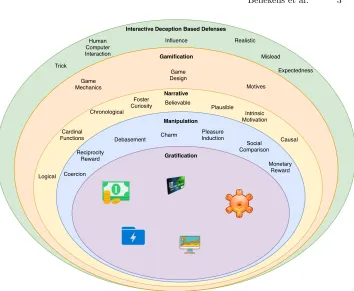
Interactive Deception Based Defenses Gamification Narrative Manipulation Gratification Coercion Reciprocity Reward Debasement Charm Pleasure Induction Social Comparison Monetary Reward Causal Logical Chronological Cardinal Functions Plausible Intrinsic Motivation Foster Curiosity Believable Human Computer Interaction Influence Realistic Mislead Trick Expectedness Game Mechanics Game Design Motives
Fig. 1.Inner Architecture of the Deception Framework
2.1 Gamification
Interactive defences, such as honeypots, are often based on real or virtualised systems logging interaction information and queries made by malicious users. While honeypots are effective at detecting and deflecting cyber-attacks or creat-ing malware zoo, their deceptive action is often seen as a secondary purpose [16]. Furthermore, while enabling interaction honeypots are not designed to coerce the user into further interacting with it. To this end, we challenged the defini-tion of high interacdefini-tion honeypots, by combining high interacdefini-tion environments with gamification techniques, coercing malicious users into participating in an unknown (to the malicious user) challenge. A generally accepted definition of gamification is provided by Deterding et al. as “The use of game design
ele-ments in non-game contexts” [8]. The gamification and design techniques used
within the interactive deception platform are derived from [5].
Game Mechanics act as building blocks, for example, the scoring systems, badges and trophies enable the user to rank himself and foster the motivation of the user to perform better. In the platform, the scoring system is enabled by providing the user with the ability to compare his achievements against planted hacker achievements [5].
Gamification and Game Mechanics must be tightly coupled with a game nar-rative in order to provide best results and ensure immersion.
2.2 Narrative
In order to foster interaction with the deception platform , the platform builds on an attack narrative, additionally to the gamification techniques used. The narra-tive enables to construct a causal, logical and chronological chain of events, nec-essary to the high interaction capabilities of the platform. Barthes [3] described events critical to the coherence of the story as “cardinal functions”. Cardinal functions play an important role within story telling as it enables branching into sub-stories, but also allows the malicious user to immerse himself within the challenge provided by the platform. In order to increase the deception aspect of the platform, the narrative follows the intrinsic motivation of a malicious user. Furthermore, the narrative must be plausible, as different network architecture may have different vulnerabilities and rewards, and hence, intrinsic motivations. Furthermore, narratives must cultivate the curiosity of the malicious user as the story unfolds, it is therefore important to align the narrative to the gamification aspect of the platform. To this end, the platform provides a believable chain of events based on potential cyber-attacks and vulnerabilities induced within the systems as scenarios. The stories provided by the platform are linear, and constructed retrospectively, in order to avoid mismatches between the vulnera-bilities, the gamification, the rewards and the narrative.
of action, he is unable to influence the outcome of the game without following the path laid out.
2.3 Manipulation
A unique approach to deceive and mislead users is through manipulation. Ma-nipulation can be defined as the action of controlling someone at your advantage. Manipulation can take different forms as explored by Buss [6]. In his study, Buss reported 12 different manipulation techniques used in close relationships and interactional context. We identified 7 techniques to work with our deception platform, each leading the malicious user to perform an action at our advantage to either follow the story or to follow another path (i.e. target).
Coercion is the practice of making someone perform a forced action by using
threat or force. Through data gathering, and behavioural analysis an operator is able to modify the narrative and gamification element relating to a specific malicious user, enabling to display coercive error message, forcing the hacker to follow any other pre-defined given path.
Reciprocity Reward are provided through a flexible narrative. As aforementioned, the platform can be used to monitor the actions of a malicious user. In order to evaluate the user’s competencies, the platform requires manual vulnerabili-ties testing, hence, the gamification engine provides reciprocal rewards to users that are not using vulnerabilities scanners. Enabling them to continue further discovering key elements within the deceptive environment.
Debasement is the practice of lowering values, to manipulate someone. While un-able to work on the emotions of the malicious user, the narrative is un-able changes by analysing the attacks performed. Vulnerabilities can be loaded in a round robin fashion, in order to keep the malicious user entertained, and therefore ex-hibit less difficulties. Debasing the platform challenges ensures the continuation of the story and thus the immersion of the malicious user within the deceptive game.
Charm focuses on complimenting someone in order to perform an action. As the
platform and the narrative require a logical and believable construct, charming the malicious user is only done through subtle clues, such as comments on the “ability” of a malicious user in code running on the client-side. Those charming “comments” help the user follow the pre-defined path, while believing to follow this path through is own free will.
Pleasure Induction is the ability of demonstrating that an unwanted action can
Social Comparison is the act of comparing the malicious user against other hackers or groups. Due to the nature of the platform, obvious comparisons such as leaderboard would annihilate the immersive element of the platform. To this end, comments on client-side and defacing pages are hidden. Website defacement is an attack that changes the appearance of a website, often accompanied by the name of the defacers or the group of defacers. This subtle clue, enables to create a social comparison between the malicious user and other groups or hackers.
Monetary Rewards are core of some scenarios to deceive the hacker. The
narra-tive builds upon potential credit cards, or valuable information available at the end of the quest, hence leading the attacker to follow the narrative to obtain a potential monetary reward.
2.4 Gratification
Luring a malicious user into deception requires to foster its curiosity, in this manuscript, we use gratification to trigger a pleasurable emotional reaction within the malicious user, in order to lure him to perform key deceptive ac-tions. By providing the malicious user, with credit card information, rewards, or key information, we lead the action of the user towards a specific path or target predefined within the platform. The gratification inherently focuses on increasing the deceptive action of the platform.
3
Platform Architecture
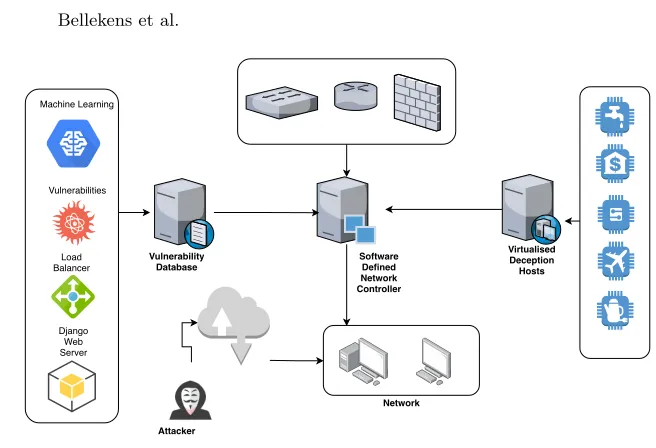
This section provides an overview of the deceptive platform architecture. We developed a fully extendable gamification architecture allowing researchers to deploy virtualised hosts on both local networks and the internet. Each virtualised hosts contains a set of specific vulnerability (i.e. web application, software, buffer overflow, etc). Each host is connected to a game engine, an interaction engine and a scoring engine.
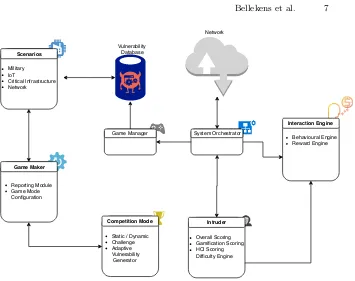
Figure 2 depicts the logical architecture of the platform. When a hacker connects to one or more virtual hosts, he is unable to differentiate it from a real-world computer (i.e. running a windows operating system), this is achieved by using port-scanning deception enabling to camouflage the signature of the operating system.
System Orchestrator Game Manager
Interaction Engine
Behavioural Engine Reward Engine
Intruder
Overall Scoring Gamification Scoring HCI Scoring Difficulty Engine
Competition Mode
Static / Dynamic Challenge Adaptive Vulnerability Generator
Scenarios
Military IoT
Critical Infrastructure Network
Game Maker
Reporting Module Game Mode Configuration
Vulnerability Database
[image:7.612.152.507.89.370.2]Network
Fig. 2.Logical Architecture of the Deception Framework
provided to the hacker. The clues are inbuilt in each scenario. The clues vary from wireshark captures, to misleading network scans and vulnerability scans. The clues enable the hacker to seamlessly continue his malicious activity on the the network by following a pre-defined path, without suspecting interacting with a virtual environment. The path leads to data being gathered on the attacks, techniques and tools used by hackers to solve each challenges thrown at him. All the gathered information are further analyzed using a circular methodology, enabling the operators to enhance the game engine and the variability of the difficulties.
Attacker
Virtualised Deception Hosts Software
Defined Network Controller
Network Machine Learning
Vulnerabilities
Load Balancer
Vulnerability Database
[image:8.612.139.467.87.311.2]Django Web Server
Fig. 3.Network the Deception Framework
4
Scenarios
4.1 Scenario 1: Shopping Website
77% of web applications have been reported to include a vulnerable JavaScript library enabling malicious users to take advantage of the website and potentially use this vulnerability to launch further attacks. The scenario was evaluated on its own, to identify the state of the narrative, the value of the kernels within the narrative, and the deception, manipulation and gamification aspects.
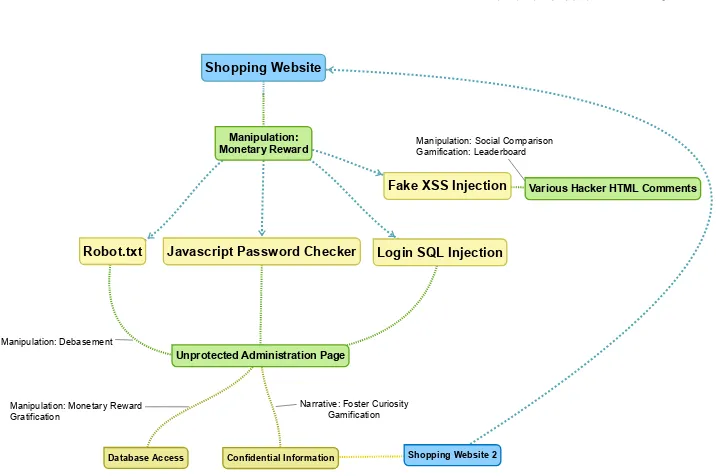
Figure 4 provides an overview of the deception narrative. The shopping web-site offers potential monetary rewards if hacked through credit cards stored in the database. To this this end, 4 apparent vulnerabilities were created. I) A “robot.txt” wile containing the path to an unprotected administration page. II) A “JavaScript password checker” library included within the “index.html” page enabling the hacker to bypass the login and password requirements. III) A “Login SQL Injection” enabling the hacker to use an SQL injection against the password field to gain access to the administration page. IV) A persistent cross-site scripting (XSS) injection vulnerability.
Manipulation: Monetary Reward Gratification
Narrative: Foster Curiosity Gamification
Manipulation: Social Comparison Gamification: Leaderboard
Manipulation: Debasement
Shopping Website
Manipulation: Monetary Reward
Javascript Password Checker
Unprotected Administration Page
Database Access Confidential Information Shopping Website 2
Robot.txt Login SQL Injection
[image:9.612.146.504.100.338.2]Fake XSS Injection Various Hacker HTML Comments
Fig. 4.Web Deception Narrative
user. Furthermore, by following the first 3 vulnerabilities, the hacker will access an unprotected administration page, which, in turn, will give him access to a “database.db” file containing fabricated credit card numbers and associated CSV numbers. Another file provides information about another shopping website, which simulate similar vulnerabilities with a different design, misleading the hacker to follow another path.
4.2 Scenario 2: Vulnerable FTP
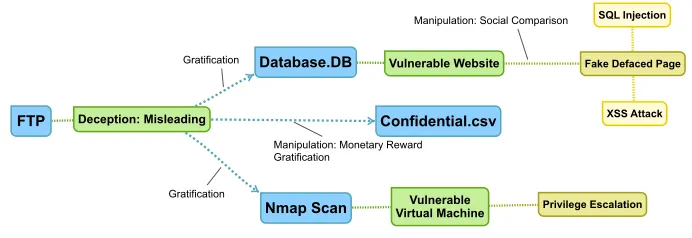
The second scenario is built around a vulnerable version of an FTP application. The FTP contains default credentials enabling a malicious user to read and upload new data on the FTP. The premise of this scenario is to reward the hacker upfront to provide direct gratification.
Manipulation: Social Comparison Gratification
Manipulation: Monetary Reward Gratification
Gratification
FTP Deception: Misleading
Database.DB Vulnerable Website Fake Defaced Page SQL Injection
XSS Attack Confidential.csv
[image:10.612.142.488.127.246.2]Nmap Scan Virtual MachineVulnerable Privilege Escalation
Fig. 5.FTP Deception Narrative
with a large Nmap scan of numerous machine. One is identified as vulnerable. Upon exploiting the vulnerability the malicious user is able to perform a privi-lege escalation through a buffer overflow attack (All buffer overflow protections are disabled).
4.3 Scenario 3: IoT Network Combination
This scenario builds upon Scenario 1 and 2, by integrating them into a vulnera-ble IoT Network running MQTT nodes. The aggregation of scenarios enavulnera-ble to construct a plausible interactive deception environment, leading the malicious user towards predefined targets and exhaust his skills against known vulnera-ble nodes allowing operators to segregate the network, essentially, exploiting the malicious user for the benefit of data gathering.
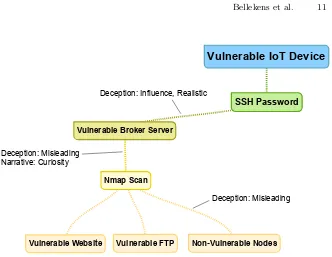
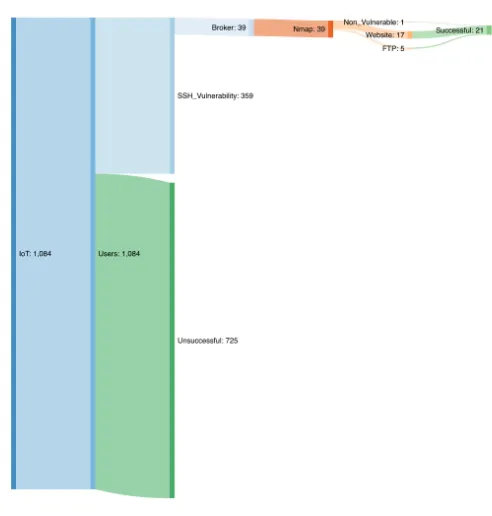
Figure 6 provides an overview of the vulnerable IoT network. One front facing vulnerable IoT device running MQTT uses weak SSH credentials. The device itself contains a file with un-encrypted SSH credentials for a vulnerable “broker server”. The root of the broker contains an NMAP Scan which has for objective to lead the malicious user towards the vulnerable devices analysed. The scan contains information about 7 nodes in total. One vulnerable webserver, one vul-nerable FTP and 5 IoT nodes with weak credentials but advertised within the NMAP scan as no port open and secured. Using Nmap as an “authority figure” to mislead the user into selecting another proposed target.
5
Evaluation
Deception: Influence, Realistic
Deception: Misleading Narrative: Curiosity
Deception: Misleading
Vulnerable IoT Device
SSH Password
Vulnerable Broker Server
Nmap Scan
[image:11.612.154.486.90.347.2]Vulnerable Website Vulnerable FTP Non-Vulnerable Nodes
Fig. 6.IoT Network Deception Narrative
All deception environments have been launched front facing the internet using four different locations (Atlanta, Lyon, London, and Tokyo) for 2 weeks. All interactions with the environment were recorded and the path of the hackers where analysed for each environment. For consistency, all environments were reset at midnight (local time). The path taken by malicious users accessing dif-ferent systems are recorded using their IP addresses. Furthermore, all malicious users following a path on a predefined scenario have been aggregated.
Fig. 7.Website Flow Narrative
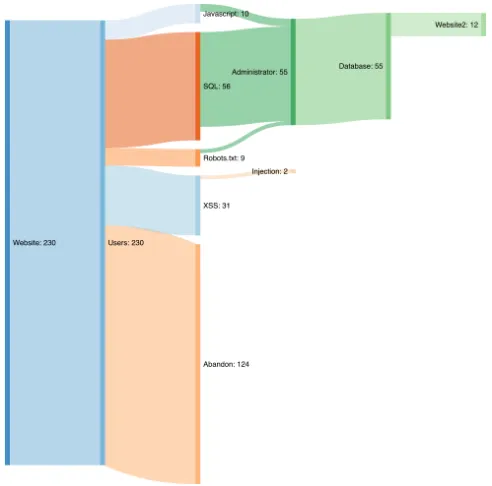
accessed the database file, however, 21% of the successful users went on to at-tacking the second deceptive website.
While the drop-out rate is high, 46% of users carried out at least one attack, with a total of 27.9% carrying out a successful attack. The average time spend by user 29.6 minutes. The flows presented in Figure 7 indicate a successful narrative, as successful users tried to proceed with an attack on a pre-defined path, the drop-outs at various stages are indicated by a lack of motivation (i.e. potential gratification) or a lack of skills.
Fig. 8.FTP Flow Narrative
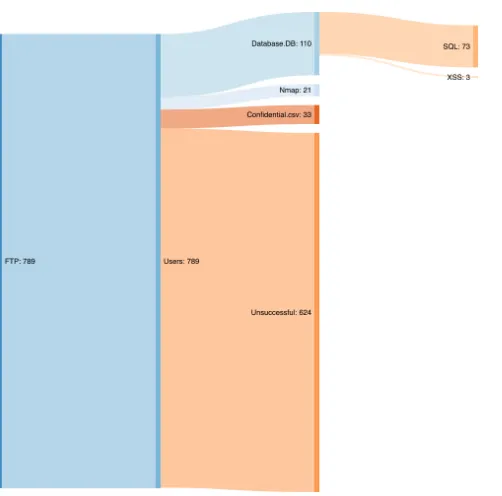
The primary assumption for the high-drop off at the first stage is due to the number of bots that scanned the FTP and abandoned. The low number reported to access the “confidential.csv” file is believed to be due to the too obvious name of the file, hence leading malicious users onto pursuing the “database.DB” file and executing SQL and XSS attacks against the website. Malicious users spend an average time of 9.36 minutes on the platform.
Fig. 9.IoT Flow Narrative
of 41.3 minutes on the deceptive scenario demonstrating a successful, believable narrative, fostering curiosity.
6
Related Works
termi-nology to describe deception and classified deception as an emerging field within cyber-security.
7
Discussion and Limitations
This section introduces the key takeaways of the interactive deception platform as well as the limitations of the platform in its current state.
7.1 Key Takeaways
– Increased Interaction: The platform enables malicious users to interact with numerous believable components and focuses on increasing the interac-tion time between the malicious user and the components.
– Chronological Events: The platform builds on the concepts of gamifica-tion and narrative, hence, unfolds in a time line fashion.
– Deflection:The use of gamification, manipulation, gratification and narra-tive have demonstrated to be successful in order to deflect attacks from key network components to secondary nodes, or towards the dedicated virtual environment.
– Platform Flexibility: The platform is modular and hence enables to fit, and build on numerous scenarios.
7.2 Limitations
– Scenario Complexity: Complex environments may require complex sce-narios, which may clutter the environments. Furthermore, building believable scenarios and a plausible narrative is time consuming.
– Distinguishing between legitimate and malicious users:In its current state the platform is unable to distinguish between users, hence limiting the interaction of the environment with legitimate users.
8
Conclusion
References
1. Almeshekah, M.H., Spafford, E.H.: Planning and integrating deception into com-puter security defenses. In: Proceedings of the 2014 New Security Paradigms Work-shop. pp. 127–138. ACM (2014)
2. Almeshekah, M.H., Spafford, E.H.: Cyber security deception. In: Cyber deception, pp. 23–50. Springer (2016)
3. Barthes, R.: Lecture in inauguration of the chair of literary semiology, coll`ege de france, january 7, 1977. Oxford Literary Review4(1), 31–44 (1979)
4. Bellekens, X.J., Tachtatzis, C., Atkinson, R.C., Renfrew, C., Kirkham, T.: Glop: Enabling massively parallel incident response through gpu log processing. In: Pro-ceedings of the 7th International Conference on Security of Information and Net-works. p. 295. ACM (2014)
5. Blohm, I., Leimeister, J.M.: Gamification. Business & Information Systems Engi-neering5(4), 275–278 (2013)
6. Buss, D.M.: Manipulation in close relationships: Five personality factors in inter-actional context. Journal of personality60(2), 477–499 (1992)
7. Desolda, G., Ardito, C., Matera, M., Piccinno, A.: Mashing-up smart things: a meta-design approach. In: Proceedings of workshop on end user development in the internet of things era–CHI15 EA. pp. 33–36 (2015)
8. Deterding, S., Dixon, D., Khaled, R., Nacke, L.: From game design elements to gamefulness: defining gamification. In: Proceedings of the 15th international aca-demic MindTrek conference: Envisioning future media environments. pp. 9–15. ACM (2011)
9. Faily, S., Faily, S.: Why designing for usability and security is hard. Designing Usable and Secure Software with IRIS and CAIRIS pp. 3–8 (2018)
10. Han, X., Kheir, N., Balzarotti, D.: Deception techniques in computer security: A research perspective. ACM Computing Surveys (CSUR)51(4), 80 (2018) 11. Heckman, K.E., Walsh, M.J., Stech, F.J., O’boyle, T.A., DiCato, S.R., Herber,
A.F.: Active cyber defense with denial and deception: A cyber-wargame experi-ment. computers & security37, 72–77 (2013)
12. Hill, G., Bellekens, X.: Cryptoknight: Generating and modelling compiled crypto-graphic primitives. Information9(9), 231 (2018)
13. Hindy, H., Brosset, D., Bayne, E., Seeam, A., Tachtatzis, C., Atkinson, R., Bellekens, X.: A taxonomy and survey of intrusion detection system design tech-niques, network threats and datasets. arxiv 2018. arXiv preprint arXiv:1806.03517 14. Hodo, E., Bellekens, X., Hamilton, A., Dubouilh, P.L., Iorkyase, E., Tachtatzis, C., Atkinson, R.: Threat analysis of iot networks using artificial neural network intru-sion detection system. In: 2016 International Symposium on Networks, Computers and Communications (ISNCC). pp. 1–6. IEEE (2016)
15. McQueen, M.A., Boyer, W.F.: Deception used for cyber defense of control systems. In: Human System Interactions, 2009. HSI’09. 2nd Conference on. pp. 624–631. IEEE (2009)
16. Merien, T., Brosset, D., Bellekens, X., Claramunt, C.: A human-centred model for network flow analysis. In: 2018 2nd Cyber Security in Networking Conference (CSNet). pp. 1–6 (Oct 2018). https://doi.org/10.1109/CSNET.2018.8602913 17. M´erien, T., Bellekens, X., Brosset, D., Claramunt, C.: A spatio-temporal
18. Nawrocki, M., W¨ahlisch, M., Schmidt, T.C., Keil, C., Sch¨onfelder, J.: A survey on honeypot software and data analysis. arXiv preprint arXiv:1608.06249 (2016) 19. Stech, F., Heckman, K.E., Hilliard, P., Ballo, J.R.: Scientometrics of deception,
counter-deception, and deception detection in cyber-space. PsychNology Journal
9(2) (2011)
20. Yuill, J.J., et al.: Defensive computer-security deception operations: processes, prin-ciples and techniques (2007)