City, University of London Institutional Repository
Citation
:
Benton, A. L. (2019). Party Leader or Party Reputation Concerns? How VerticalPartisan Alignment Reins in Subnational Fiscal Profligacy. The Journal of Politics, 81(1), pp. 201-214. doi: 10.1086/700201
This is the published version of the paper.
This version of the publication may differ from the final published
version.
Permanent repository link:
http://openaccess.city.ac.uk/id/eprint/23091/Link to published version
:
http://dx.doi.org/10.1086/700201Copyright and reuse:
City Research Online aims to make research
outputs of City, University of London available to a wider audience.
Copyright and Moral Rights remain with the author(s) and/or copyright
holders. URLs from City Research Online may be freely distributed and
linked to.
Partisan Alignment Reins in Subnational Fiscal Pro
fl
igacy
Allyson Lucinda Benton
, Centro de Investigación y Docencia Económicas
Some scholars argue that party leader considerations drive governors copartisan with presidents toward fiscal disci-pline, while others argue that party reputation concerns guide their behavior. To demonstrate how to assess whether either of these mechanisms is at work, I extend this analysis to the municipal level. If mayors aligned with both governors and presidents are more disciplined than mayors aligned with presidents only, copartisan governors affect mayoralfiscal behavior through party leader considerations. If mayors aligned with both governors and presidents are just asfiscally disciplined as those aligned with presidents only, party reputation concerns drive mayoralfiscal behavior. Cross-sectional time-series analysis of debt used tofinancefiscal excess in municipal Mexico reveals support for the party-leader-concern logic in this nation, but the party reputation logic (or both logics or neither logic) may be at work in others.
D
ecentralized political systems have often been linked to inefficient public benefits provision and oversized public sectors, elevated budget deficits and public debt loads, and high inflation,fiscal crisis, and macroeconomic in-stability (Rodden and Wibbels 2002; Treisman 2000; Wibbels 2000). Decentralization weakens intergovernmental policy co-ordination by empowering subnational officials to choose public benefits and spending with an eye toward their polit-ical careers, producing subnational policy divergence (Rodden and Wibbels 2002; Weingast 2014). While such policy diver-gence is useful for accommodating diverse subnational policy needs (Weingast 2009), the contracts regulating intergovern-mentalfiscal relations in these systems can create common-pool resource dynamics in subnational spending that under-mine nationalfiscal stability (Faguet 2014; Rodden 2002, 2003; Rodden and Wibbels 2002; Weingast 2009, 2014).When intergovernmentalfiscal contracts assign national governments responsibility for generating tax revenues and funding state governments throughfiscal transfers—creating verticalfiscal imbalances—state governors have an incentive to deliver benefits to constituents but without regard to effi -ciency. Constituents do not hold them accountable for tax-benefit distortions, forcing national governments to accept theirfiscal costs (Rodden 2002, 2003; Rodden and Wibbels 2002; Weingast 2009). Whenfiscal contracts allow states to
enjoy soft budget constraints and national governments back excess state expenditures, state officials have an incentive to raise spending. Constituents do not hold them accountable for fiscal excess, forcing national governments to accept its costs (Rodden 2002, 2003; Rodden and Wibbels 2002; Wein-gast 2009). Rebalancing intergovernmental relations is diffi -cult because state governors often enjoy influence over na-tional policy making through nana-tional legislatures, allowing them to veto changes to state policy autonomy or fiscal re-sources (Rodden 2002; Rodden and Wibbels 2002; Treisman 1999). State leaders’national policy influence can force na-tional governments to accept verticalfiscal imbalances, soft budget constraints, and common-pool resource abuses (Wein-gast 2014).
Decentralized political systems thus appear doomed to struggles with statefiscal profligacy, which raises the impor-tance offinding ways to bring statefiscal policy into line with national macroeconomic goals without requiring major changes to political institutions orfiscal contracts. In this vein, scholars have noted that vertical partisan alignment between national and state governments improves statefiscal discipline. Jones, Sanguinetti, and Tommasi (2000)find in Argentina that pro-vincial governors copartisan with national presidents tend to spend less than governors from opposition parties. They argue that presidential influence over the career paths of copartisan
Allyson Lucinda Benton ([email protected]) is a research professor in the División de Estudios Políticos at the Centro de Investigación y Docencia Económicas (CIDE), Carret, México-Toluca 3655, Col. Lomas de Santa Fé, México, CDMX 01210.
Data and supporting materials necessary to reproduce the numerical results in the article are available in theJOPDataverse (https://dataverse.harvard
.edu/dataverse/jop). An online appendix with supplementary material is available at http://dx.doi.org/10.1086/700201.
The Journal of Politics, volume 81, number 1. Published online September 26, 2018. http://dx.doi.org/10.1086/700201
governors encourages them to moderate spending to appease national presidents concerned with macroeconomic stability. Opposition governors juxtaposed against presidents do not face such top-down pressures and, instead, raise spending to survive hostile national political environments. To make their case, Jones et al. (2000) note that unified government (in the United States) raises presidents’capacity to encouragefiscal prudence among national legislators who view national re-sources in the same common-pool way that governors would (e.g., Alt and Lowry 1994; Cox and McCubbins 2001; Mc-Cubbins 1991).
Similarly, Rodden and Wibbels (2002)find that nations with greater shares of state governments copartisan with national executives enjoy greaterfiscal discipline cross-nationally. How-ever, they argue that the main political threat to state gover-nors in some nations may come from constituents whose electoral connection leads them to punish national incum-bents for macroeconomic instability. Although Rodden and Wibbels (2002) note that presidents exert leverage over co-partisan governors’careers in some systems in the way de-scribed by Jones et al. (2000), in other systems governors might moderate their tendency to overfish common-pool re-sources out of concern for their copartisan presidents’ macro-economic performance and its effect on their parties’national reputations, which can affect their own electoral fortunes. Studies showing that strong macroeconomic performance confers electoral benefits on copartisan governors in some politically decentralized systems support this link (e.g., Gélineau and Bélanger 2005; Gélineau and Remmer 2006).
Vertical partisan alignment can thus moderate the common-pool resource dynamics often plaguing decentralized political systems, although the precise mechanism through which this occurs is unclear. In this study, I explain how to distinguish between the alternative“party leader”and“party reputation” mechanisms, something that scholars have not yet been able to do (Rodden and Wibbels 2002). To this end, I theorize about how each mechanism would operate at a third, lower tier of municipal government found in most decentralized systems but that has rarely been examined for vertical par-tisan effects. Yet, municipal mayors often enjoy the same policy and budgetary autonomy, and vertical fiscal imbal-ances and soft budget constraints, as state governors, raising spending around elections for political ends (Benton and Smith 2017; Drazen and Eslava 2010; Sakurai and Menezes-Filho 2008; Veiga and Veiga 2007). If mayors can raise spend-ing for political purposes, then vertical partisan alignment should matter to their calculations as well.
I show how comparison of thefiscal behavior of (1) mu-nicipalities that share partisan allegiance with both state and national executives to (2) municipalities that share partisan
alignment with only national executives to (3) municipalities that do not share partisan allegiance with national executives can be used to distinguish whether party leader or party rep-utation logics drive vertical partisan effects. If municipalities aligned with both state and national governments are more fiscally disciplined than those aligned with only national in-cumbents, then copartisan governors affect mayoralfiscal de-cisions and party leader concerns matter for municipalfiscal behavior. If municipalities aligned with both state and na-tional officials are just asfiscally disciplined as municipalities aligned with only national copartisans, then copartisan gov-ernors play no role in mayoralfiscal decisions and party repu-tation concerns drive municipalfiscal behavior.
I demonstrate the usefulness of this approach using data from Mexico. Mexico has a decentralized (federal) political system with three tiers of government. Three main political parties compete in national, state, and municipal elections, producing a variety of vertical partisan alignments that I le-verage to discern the nature of vertical partisan effects. Sta-tistical analysis of municipal long-term debt shows that mu-nicipalities copartisan with both national presidents and state governors spend less than municipalities only aligned with national presidents.“Party leader”—rather than“party rep-utation”—concerns thus drive vertical partisan effects in this nation. Importantly, the results for Mexico apply only to this case. Other countries might enjoy vertical partisan effects driven by party reputations or by both party reputations and party leaders. They might also experience no vertical partisan effects. As I explain below, where electoral systems allow party leaders to control subnational politicians’access to political opportunities, party leader concerns will likely guide their fiscal choices. Where electoral systems raise the influence of national party reputations over subnational politicians’ po-litical careers, party reputation concerns will likely guide their fiscal behavior. Where the influence of party leaders and party reputations on subnational politicians’careers is limited, ver-tical partisan effects will likely be absent.
MECHANISMS DRIVING VERTICAL PARTISAN EFFECTS
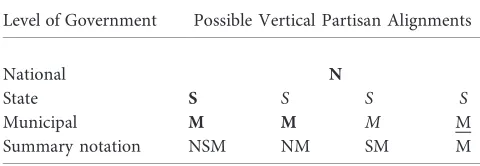
There are four possible vertical partisan alignments in three-tiered decentralized political systems, shown in table 1. Among mayors aligned with national presidents, mayors might share partisan affiliation with state governors, or they might not. Municipalities whose mayors share partisan affiliation with both state and national executives are called NSM munici-palities (Npnational, Spstate, Mpmunicipal); those that share partisan affiliation with only national presidents are called NM municipalities. Among mayors not aligned with national presidents, mayors might share partisan affiliation with state governors, or they might not. Municipalities whose mayors share partisan affiliation with only state governors are SM municipalities; those that do not share partisan affiliation with state or national executives are M municipal orphans.
Party leader concerns
I begin by considering relative NSM, NM, SM, and M mu-nicipal spending under the “party leader”mechanism. The core theoretical mechanism driving “party leader”vertical partisan effects is grounded in political ambition theory and how politicians build careers in vertically organized territorial-based decentralized political systems where party leaders con-trol access to political opportunities (e.g., Samuels 2003; Schle-singer 1966). Here, party leaders at each level of the system control access to political opportunities within their territo-rial spheres of authority, promoting politicians up (and down) the hierarchical political career ladder. In such systems, pol-iticians seek to appease their most proximate party leaders to ensure access to elected and appointed government and party posts, and party leaders look to their most proximate co-partisan subordinates tofill them (Kerevel 2015; Schlesinger 1966). Off-path promotions that bypass rungs on the hierar-chical political career ladder risk discord and are fairly rare. National party leaders are unlikely to promote municipal pol-iticians to national posts if this means usurping the role of state party leaders in overseeing municipal careers or passing over
state and national copartisans aspiring to these posts. State party leaders are unlikely to promote municipal politicians to state posts if this means passing over state copartisans seeking these positions. This jibes with research showing the hierar-chical paths of political promotion in party-leader-dominated politically decentralized systems (Kerevel 2015), in contrast to systems in which party leaders play no role in political pro-motions and politicians are free to seek off-path posts (Bor-chert 2011; Samuels 2003).
From the perspective of NSM and NM municipal mayors, this means two things. First, national party leaders leave co-partisan state party leaders to oversee their NSM and NM mayors’political careers. Second, NSM and NM mayors’ pros-pects for promotion at the hands of state party leaders deter-mine whether these mayors seek to appease them. State gov-ernors (i.e., state party leaders controlling state government) with access to both state government and state party resources are better able to promote copartisan NSM mayors because they control access to resources for winning municipal elec-tions, elected state government and appointed state bureau-cratic posts, and state party positions. NSM mayors thusfind it politically expedient to engage infiscal discipline to appease copartisan state governors (who seek to appease copartisan national presidents concerned with macroeconomic stability). In contrast, out-of-power state party leaders have little to offer their NM mayors. Without access to state government, out-of-power state party leaders cannot appoint their NM mayors to state bureaucratic posts or ensure that they retain munic-ipal power or secure election to state offices. Elected state of-fices, along with appointed state party posts, are monopolized by state copartisans awaiting the election of copartisan gov-ernors or promotion to elected or appointed national posi-tions. With limited career prospects in state government—or in national government thanks to copartisan presidents’ re-luctance to pass over state copartisans—NM mayors have little interest infiscal discipline, especially if it could spell the loss of municipal political control. Instead, NM mayorsfind it expedient to raisefiscal spending to ensure their municipal electoral survival in hostile state political environments, while working toward the election of copartisan state governors.
The logic of party leader concerns thus suggests that NSM mayors will be driven toward greaterfiscal discipline than NM mayors, who will spend similarly to SM and M mayors, if this mechanism drives vertical partisan effects. The presence of fiscally profligate opposition state governors juxtaposed against national presidents—who are thus free to use public spending to retain state power and to unseat NM mayors— encourages NM mayors to spend similarly to SM (and M) mayors to survive in municipal government. Without copar-tisan national presidents, SM mayors’ copartisan state
gov-Table 1. Municipal Vertical Partisan Alignments
Level of Government Possible Vertical Partisan Alignments
National N
State S S S S
Municipal M M M M
Summary notation NSM NM SM M
Note. Hypothetical party 1 in bold, party 2 italicized, party 3 underlined.
[image:4.654.74.314.651.734.2]ernors are unconcerned about the impact of SM municipal fiscal profligacy on their chances of promotion to national posts and may even perceive benefits from it if it helps them retain state political control. SM mayors are thus left—and may even be encouraged—by copartisan state governors to spend to ensure their municipal political survival while await-ing state positions monopolized by state copartisans workawait-ing toward the election of copartisan national presidents. Without higher-level copartisans, M mayors are unchecked and free to spend to survive hostile state and national political environ-ments. In other words (see table 2):
Party Leader Concerns: If party leader concerns drive subnationalfiscal behavior, NSM mayors will be morefiscally disciplined than NM mayors, with NM, SM, and M mayors equallyfiscally undisciplined.
Party reputation concerns
I now consider relative NSM, NM, SM, and M municipal spending under the“party reputation”mechanism. The core theoretical mechanism driving“party reputation”vertical par-tisan effects is grounded in retrospective economic voting theory (e.g., Lewis-Beck 1988) and how politicians build ca-reers in vertically organized territorial-based politically de-centralized systems in which national macroeconomic per-formance determines access to political opportunities. Here, poor national macroeconomic performance undermines voter support for national incumbents (LeDuc and Pammett 2013; Singer 2013) and their subnational copartisans (Gélineau and Bélanger 2005; Gélineau and Remmer 2006). Although elected
and appointed government and party positions exist at all lev-els, the chance that politicians will rotate through them de-pends on national macroeconomic performance and whether their parties are responsible for it. Strong macroeconomic performance strengthens national incumbent reputations and electoral support, increasing the political opportunities avail-able to subnational copartisans. Weak national macroeco-nomic performance weakens national incumbent reputations and electoral support, reducing the opportunities available to subnational copartisans.
From the perspective of NSM and NM municipal mayors, this means that national macroeconomic instability stands to undermine not only their national parties’electoral sup-port but also their individual political career prospects. As a result, and to paraphrase Rodden and Wibbels (2002, 508), NSM and NM mayors will have an incentive to makefiscal decisions that support national macroeconomic stability when their electoral and political fates are directly tied to those of copartisan national presidents and national party reputations. It is counterproductive for NSM and NM mayors to sabotage copartisan presidents’efforts to ensure macroeconomic sta-bility with municipalfiscal excess. Instead, it is more polit-ically expedient for them to makefiscal policy choices that contribute to balanced national budgets, low inflation, macro-economic stability—and thus their parties’ national reputa-tions—in the interest of their political careers.
[image:5.654.72.317.541.746.2]The logic of party reputation concerns suggests that both NSM and NM mayors will be equally driven toward greater fiscal discipline, compared to SM and M mayors facing in-centives towardfiscal excess, if this mechanism drives vertical partisan effects. Of course, copartisan state governors con-cerned with the effect of their parties’national reputations on their own electoral prospects might seek to strengthen their NSM mayors’awareness of the electoral benefits offiscal pru-dence. However, the same could be said for out-of-power state party leaders and their copartisan NM mayors. If NSM and NM mayors’future political opportunities are determined by the ability of copartisan national presidents to deliver macro-economic stability, any additional appeals by copartisan state governors or out-of-power state party leaders are unlikely to affect NSM or NM mayors’political calculations, especially if they have already benefited electorally from sound national macroeconomic performance and their ownfiscal contribu-tion to it. As such, both NSM and NM mayors will be driven to greaterfiscal discipline compared to SM and M mayors who are juxtaposed against national presidents and do not ben-efit electorally from—and are in fact electorally harmed by— national macroeconomic stability. NSM and NM mayors face national party reputation effects, whereas SM and M mayors do not. In short (see table 2):
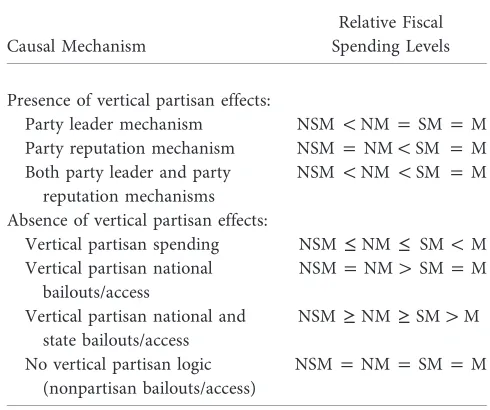
Table 2. Vertical Partisan Effects under Different Mechanisms
Causal Mechanism
Relative Fiscal Spending Levels
Presence of vertical partisan effects:
Party leader mechanism NSM !NMpSMpM Party reputation mechanism NSMpNM!SM pM Both party leader and party
reputation mechanisms
NSM !NM !SM pM
Absence of vertical partisan effects:
Vertical partisan spending NSM ≤NM ≤ SM ! M Vertical partisan national
bailouts/access
NSMpNM1 SMpM
Vertical partisan national and state bailouts/access
NSM ≥NM ≥SM1M
No vertical partisan logic (nonpartisan bailouts/access)
NSMpNMpSMpM
Party Reputation Concerns: If party reputation con-cerns drive subnationalfiscal behavior, NSM and NM mayors will be equallyfiscally disciplined, with both NSM and NM mayors morefiscally disciplined than SM and M mayors (who will be equally fiscally un-disciplined).
Party leader and party reputation concerns
It is possible that both party leader and party reputation concerns might drive NSM and NMfiscal behavior, that is, that both party leaders and national party reputations might affect subnational politician’s political career opportunities. Rodden and Wibbels (2002) suggest this but do not elabo-rate. Adding together thefiscal behavior of these two logics leads to (see table 2):
Party Leader and Party Reputation Concerns: If party leader and party reputation concerns drive sub-national fiscal behavior, NSM mayors will be more fiscally disciplined than NM mayors, with both NSM and NM mayors morefiscally disciplined than SM and M mayors (who will be equallyfiscally undisciplined).
No vertical partisan effects
It is also possible that political careers in politically decen-tralized systems might not depend on party leaders or party reputations, undermining the incentive for subnational pol-iticians to reduce spending on the basis of either of these con-cerns. Evidence that NSM, NM, SM, and M mayors all suc-cumb to common-pool resource dynamics and are similarly fiscally undisciplined would show this. This would also sug-gest the presence of vertical nonpartisan bailout expectations, where vertical partisan alignment plays no role in moderat-ing relative municipal fiscal behavior. Evidence that NSM mayors spend more than NM ones, who spend similarly to or more than SM ones, who spend more than M ones, would suggest the presence of vertical partisan national and state bailout expectations, where municipalities with higher-level copartisans expect bailouts and thus enjoy preferential access to debt forfinancingfiscal excess (see table 2).
Evidence that NSM mayors spend similarly to or less than NM ones, who spend similarly to or less than SM ones, who spend less than M ones, would show that vertical partisan spending drives municipalfiscal behavior. Here, higher-level government spending in copartisan municipalities enables NSM, NM, and SM mayors to spend less than M ones. Greater M spending compared to NSM, NM, and SM spending dis-tinguishes vertical partisan spending from vertical partisan effects. Where vertical partisan effects are present, SM and M mayors are similarlyfiscally undisciplined because they are
juxtaposed against national presidents (see table 2). Table 2 is not meant to be exhaustive but to show how other political logics would produce relative NSM, NM, SM, and Mfiscal discipline different from that under vertical partisan effects.
EMPIRICAL STRATEGY
Mexico satisfies three conditions for examining theories about vertical partisan effects: its federal system includes three tiers of government, (at least) three main parties regularly win na-tional and subnana-tional executives, and loopholes in its federal fiscal contract allow subnational governments to overspend. Mexico is divided into 31 states and a federal district (desig-nated a state in 2016), with states divided into about 2,440 mu-nicipalities (depending on the year). The Institutional Revo-lutionary Party (PRI) controlled Mexico during much of the twentieth century, losing the presidency in 2000 but regularly winning state and municipal offices. Two other national parties also regularly win state and municipal elections: the National Action Party (PAN), which won the 2000 and 2006 presidential races, and the Democratic Revolution Party (PRD). The PRI reassumed the presidency in December 2012 (term ending in December 2018).
Mexico’s federalfiscal contract dates tofiscal, public debt, and banking reforms made between 1997 and 2000 that op-erated mostly intact from 2001 to 2016, when a new public debt law was approved. The 2001–16fiscal contract purpose-fully strengthened verticalfiscal imbalances: the national gov-ernment retained most tax rights and funded states through fiscal transfers (Díaz-Cayeros 2006); states redistributed a set share of federal transfers to municipalities (Timmons and Broid 2013). States and municipalities enjoyed some tax rights, but they were insufficient for meeting policy obligations. The perversefiscal incentives of Mexico’s verticalfiscal imbalances are well known (Cabrero and Carrera 2002; Giugale, Hernández-Trillo, and Oliveira 2000).
By law, subnational governments were authorized tofi -nance“economically productive”public investment (outlined in the national constitution) with long-term debt in Mexican pesos, from authorized financial institutions, and report it to the secretary of the treasury and public credit (Secretaría de Hacienda y Crédito Público [SHCP], http://www.shcp.gob .mx). Unreported long-term debt would be risk reweighted automatically by the SHCP’s National Banking and Securi-ties Commission (Comisión Nacional Bancaria y de Valores [CNBV]), raising bank capitalization requirements (Giugale et al. 2000; Revilla 2013).
Reflecting the rules-based aspect of Mexico’s approach to managing subnational capital markets, state legislatures were responsible for setting limits to state and municipal long-term debt and for authorizing state and municipal long-term loans. The approval of municipal councils was also needed for mu-nicipal long-term debt. In practice, however, governors con-trolled state legislatures and bureaucracies, and mayors, mu-nicipal councils and bureaucracies, weakening oversight over debt decisions and allowing long-term debt obligations to ex-ceed formal limits (enacted in only about half of the states and usually unenforced; Hurtado and Zamarripa 2013). At the municipal level, electoral laws in all but six states guaranteed mayors absolute majorities in municipal councils, while mu-nicipal administrative structures guaranteed all mayors ab-solute control over their bureaucracies (Merino 2006; Meza 2015; Pérez Durán 2008). Weak oversight and strong bureau-cratic control allowed subnational governments to run up ever larger debt.
By law, subnational borrowing had to be based onfiscal solvency, with lenders holding capital reserves tied to it, re-flecting the market-based side of Mexico’s approach to man-aging its subnational capital market (Hernández-Trillo and Smith-Ramírez 2009; Revilla 2013). Subnational governments seeking loans from private lenders had to secure formal credit ratings (with one exception; see below) from authorized agen-cies to prevent their loans from automatic capital risk re-weighting (Hernández-Trillo and Smith-Ramírez 2009; Re-villa 2013). Those seeking loans from public banks faced internal bankfiscal appraisals, with these loans scrutinized by the CNBV and capital risk reweighted as needed (Giugale et al. 2000). In practice, however, subnationalfiscal accounts were nontransparent, with arrears to service providers and public employees, other contingent liabilities (like pension obligations), and (unsanctioned)fiscal deficits (and the short-term loans financing them) unreported (Hernández-Trillo and Smith-Ramírez 2009; Hurtado and Zamarripa 2013). Sub-national governments also shopped for credit ratings to guar-antee good reports and postponed bad ones, while competition
between agencies for clients inflated ratings (Rosado Buenfil 2017). Subnational credit ratings andfiscal assessments were often—if not usually—inconsistent with true subnationalfiscal positions (Hernández-Trillo and Smith-Ramírez 2009; Rosado Buenfil 2017), with states and municipalities accessing credit lines disproportionate to theirfiscal capacity to repay.
Much of this was likely widely known, but subnational governments could collateralize long-term debt with unear-marked and earunear-markedfiscal transfers and own-source rev-enues, with these resources intercepted by fiduciaries and debt payments made before reaching subnational treasuries, reducing the risk to repayment. In practice, however, debt collateralization did not prevent subnational governments from assuming debt obligations that neared the limit of or exceeded the resources available for collateralization. The re-sources collateralizing debt also declined during economic downturns, affecting repayment. There were no hard bailouts during the period under analysis, but soft bailouts occurred when subnational governments were allowed to refinance short-term loans using term debt or to restructure long-term debt to reduce payments (Fitch Ratings 2011; Hurtado and Zamarripa 2013; Revilla 2013). National and state gov-ernments often helped municipalities orchestrate access to long-term credit and interpreted the constitution’s“economic productivity”clause to include debt refinancing and restruc-turing (Fitch Ratings 2011; Hernández-Trillo and Smith-Ramírez 2009; Hurtado and Zamarripa 2013; Revilla 2013). Loopholes in Mexico’s approach to managing its subnational capital market thus created opportunities for subnationalfiscal excess (Benton and Smith 2017; Espinosa and Martell 2015; Giugale et al. 2000; Hernández-Trillo, Díaz-Cayeros, and Gamboa González 2002).
DATA AND STATISTICAL APPROACH
To distinguish between the party leader, party reputation, and joint party leader–party reputation mechanisms under-lying vertical partisan effects, I use a panel data set consisting of 1,873 municipalities in Mexico across 11 years (2005–15), with 20,603 possible observations. I exclude Oaxaca state’s 570 municipalities because a supermajority select govern-ments using nonpartisan systems on different timetables. I ex-clude the Federal District, as it operated like a state.
address nonlinearity and account for outliers. (I do not use a logarithmic transformation, as municipalities can choose zero liabilities.) Juárez, in the state of Coahuila, had per cap-ita debt obligations nearly 40 times greater than the next-indebted municipality in 2009 and 2010, when it was under municipal and state PRI control juxtaposed against national PAN rule (making it an SM municipality). I exclude this case, as it could bias the results in favor offinding vertical partisan effects. During 2005–15, 1,315 municipalities had long-term debt, including 404 with commercial bank or nonbank fi -nancial entity debt, 1,206 with development bank debt, 208 with bond debt, and 95 with“trust”debt. Trusts are managed by third-partyfinancial institutions, but thefinance ministry does not specify the type of debt managed by them. Among municipalities with commercial bank or nonbankfinancial entity loans, debt from these sources averaged 107.90 pesos per capita (SDp276.25, minp0, maxp3,554.35). Data are from the SHCP.
I examine long-term debt from commercial banks and nonbankfinancial entities rather thanfiscal deficits orfiscal spending. As noted, municipal fiscal deficits are unsanc-tioned, with municipalities not reporting deficits or spend-ing beyond revenues. As noted, municipal governments used short-term loans from commercial banks and nonbank fi -nancial entities to run unsanctionedfiscal deficits, accumu-lating these loans and refinancing them with long-term credit from these same institutions. Municipalities cannot use de-velopment bank loans or bond emissions for short-termfi -nancing, reducing their capacity to refinance such loans with these institutions. Debt from commercial banks and nonbank financial entities thus serves as a good proxy forfiscal excess, with loans from these institutions widely available to subna-tional governments in Mexico.
Commercial banks have lent to subnational governments in Mexico since the early twentieth century, and subnational governments enjoy preexisting relationships with them be-cause they handle other banking needs (Hernández-Trillo et al. 2002). The operation of non-deposit-taking nonbank financial entities (the Sofomes) was authorized in 2006 in an effort to deepen the nation’s credit market. These entities (27 regulated, 3,060 unregulated) operate alongside 48 li-censed and regulated commercial banks (Comisión Nacional de la Protección y Defensa de los Usuarios de Servicios Fi-nancieros, http://www.condusef.gob.mx). Unlike commercial banks, nonbankfinancial entities need not be licensed by the CNBV and can opt out of CNBV regulation if they share no equity links with commercial banks. Otherwise, they face the same CNBV regulation as their supervisory banking institutions (OECD 2011). Among nonbankfinancial entities, municipal
short- and long-term debt was mainly supplied by the un-regulated ones targeting municipalities underserviced by more traditional lenders. Unregulated nonbankfinancial en-tities could also operate without meeting CNBV capitalization requirements, facilitating their ability to lend to municipalities with low/no credit ratings but that could still collateralize debt withfiscal transfers or other revenues (thereby still attracting these lenders).
The main explanatory variables are the four structures of vertical partisan alignment. Dummy variables record whether municipalities were NSM, NM, SM, or M in their alignment each year. I considered any coalition between one of the main national PAN, PRI, or PRD parties and any small party as dominated by the main national party, which tended to be the case in most municipalities. Between 2005 and 2012, the PAN held the national presidency; between 2013 and 2015 (term ending 2018) the PRI held the presidency. The PAN, PRI, PRD (on their own or in coalition with small parties), and an infrequent PAN-PRD coalition won all state and most municipal elections. I consider state and municipal PAN-PRD coalitions to be juxtaposed against national PAN rule. Ex-cluding Juárez, there are 3,292 NSM, 3,293 NM, 7,055 SM, and 6,888 M municipal-year observations in the data set. The number of NSM, NM, SM, and M municipal-year observa-tions totals 20,528 (rather than 20,603) because of the crea-tion/elimination of municipalities that reduced their lives or missing electoral data. Data are from state electoral institutes. Municipalities might vary in their ability to access credit, regardless of their capacity to collateralize debt. Municipal-ities with greaterfiscal resources have greater resources for debt collateralization, while more heavily populated munici-palities with better access tofinancial institutions or larger tax bases might be better able to access loans (Benton and Smith 2017; Freire 2014; Petersen and Huertas 2004; Thau 2011). Municipalfiscal revenue (own source plus transfer revenue [square root per capita]) and its lag, as well as municipal pop-ulation (square root), capture this. I do not use municipal credit ratings. Even if they were reliable (which they were likely not), only those municipalities accessing debt from commercial banks, regulated nonbank financial entities, or bond markets needed them. The inclusion of credit ratings would lead municipal-year observations with only unregulated nonbankfinancial entity or development bank debt obliga-tions, or no debt obligaobliga-tions, to drop out of the analysis in-advertently.
overspend (measured as the ratio of transfer revenues to total revenues; Rodden 2002, 2003; Rodden and Wibbels 2002; Weingast 2009). Low municipal administrative capacity might result in poorfiscal choices (captured with population, human development, and verticalfiscal imbalances; Avellaneda 2009; Ibarra Salazar, Sandoval Musi, and Sotres Cervantes 2001; Mendoza 2004; Smith and Benton 2017). Mayors might raise debt ahead of municipal elections or state gubernatorial races, or amid weak political mandates (captured with mayoral and gubernatorial election dummies, winning municipal margins; Benton and Smith 2017; Drazen and Eslava 2010; Sakurai and Menezes-Filho 2008; Veiga and Veiga 2007), even if vertical partisan alignment affects the relative magnitude of these effects. Partisan ideological differences might influencefiscal spending (Benton and Smith 2017), or partisan organizational differences might affect the strength of vertical partisan ef-fects across parties (captured with partisan dummies). Data are from the National Institute of Geography and Statistics (http://www.inegi.gob.mx), its National Population Council (https://www.gob.mx/conapo), and state electoral institutes.
I examine the data using linear Prais-Winston cross-sectional time-series analysis with panel-corrected standard errors. Unit-root tests (assuming a common autoregressive process) show that the data are stationary, so I keep the data in level form. Wooldridge tests for serial autocorrelation in the residuals are significant (p!:01), so I correct all models for a common autoregressive error process of order 1. Mod-ified Wald tests for group-wise heteroskedasticity in the re-siduals are significant (p!:01), so I correct all models for panel-level heteroskedastic errors (assuming no contempo-raneous correlation across panels). (I could not correct for panel-specific autoregressive processes or cross-panel con-temporaneous correlation because of missing fiscal data.) I include a lagged dependent variable in all models to account for persistence, making the models dynamic (De Boef and Keele 2008; Williams and Whitten 2012).
Yearfixed effects control for intertemporal variation in (national/international) debt dynamics common to all mu-nicipalities; tests for whether year dummies were jointly zero were significant (p!:01). Statefixed effects control for state differences that might affect municipal debt dynamics, such as statefiscal policy, debt loads, debt ceilings, oversight over municipal borrowing, and electoral laws allowing propor-tional representation in municipal councils (that might raise municipal oversight). I also prefer statefixed effects to munic-ipal fixed effects on econometric grounds: two of the main explanatory variables (the NSM and NM dummies) are time invariant in most municipalities, and some of the controls are highly sluggish (Clark and Linzer 2015). In addition to the lagged dependent variable, I include all other municipal debt
types and their lags to control for any effect on commercial bank or nonbankfinancial entity debt.
STATISTICAL RESULTS
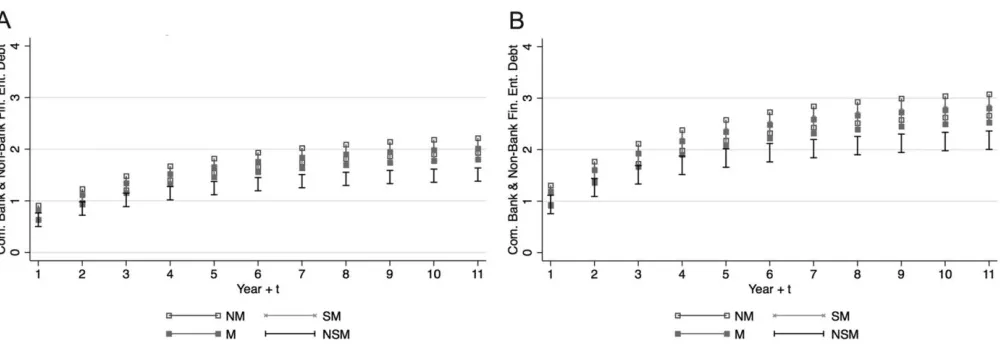
Table 3 presents the results. Model 1 examines the impact of NM, SM, and M vertical partisan alignment compared to NSM alignment (the omitted case) on the full sample of all municipalities. As shown, NM municipalities acquired greater per capita commercial bank and nonbankfinancial entity debt compared to their NSM counterparts, with the NM variable’s coefficient positive and significant (p!:01). SM and M mu-nicipalities also assumed greater commercial bank debt com-pared to NSM ones (p!:05). Overlapping confidence inter-vals (fig. 1A) around the NM, SM, and M coefficients show that they were not statistically different in their fiscal be-havior. The results are in line with a party leader logic behind vertical partisan effects.
Although I control for factors affecting municipal access to subnational capital markets, it could be that municipali-ties not accessing any type of debt are distinct from those accessing some kind of credit. I therefore rerun the analysis on the subsample of municipalities that accessed some kind of debt in at least one year during the period under analysis, excluding all municipalities that assumed no debt. The re-sults in model 2 in table 3 are the same as for the full sample: NSM municipalities assumed lower commercial bank or non-bankfinancial entity debt than NM, SM, and M municipali-ties, who behaved no differently from one another (shown by their overlapping confidence intervals infig. 1B), in line with the party leader logic.
It could also be that there is something different about municipalities accessing private sector debt compared to mu-nicipalities that rely on public development bank credit. I therefore rerun the analysis on another two subsamples. Model 3 in table 3 includes all municipalities assuming com-mercial bank or nonbankfinancial entity loans, regardless of whether they contracted public development bank debt (ex-cluding any municipalities that only assumed development bank loans). Model 4 in table 3 examines the smaller sub-sample that accessed commercial bank or nonbankfinancial entity debt as well as public development bank loans (ex-cluding any municipalities that only accessed commercial bank or nonbankfinancial entity credit). Development bank loans require technical assistance to improvefiscal reporting and debt management, with municipalities assuming these loans more transparent in their fiscal finances and use of credit. The results are the same.
counter-parts, in line with party-leader-driven vertical partisan effects in the short term. To demonstrate that this persists into the longer term, I do two things. First, I estimate simple long-term effects to show that they are in line with the short-term ones (see app. 1; apps. 1–3 available online). Second, I conduct
“dynamic simulations”of the long-term effects of NSM pared to NM, SM, and M vertical partisan alignment on com-mercial bank or nonbankfinancial entity debt, following the Williams and Whitten (2012) procedure. (I prefer the simple dynamic panel approach due to this procedure, but I report results for dynamic panel models in app. 3; the results are the same.)
Figure 1 presents the results for the dynamic simulations for the full sample and the subsample of municipalities with debt. The impact of NSM municipal partisan alignment in lowering commercial bank or nonbankfinancial entity debt compared to NM, SM, and M municipalities persists and grows over time. For example, among those municipalities with some kind of debt (fig. 1B), after justfive years NM (SM or M) municipalities each count on nearly three pesos per capita more commercial bank and nonbankfinancial entity debt compared to their NSM counterparts (all other variables at their means). For an NM (SM or M) municipality with 10,000 people, this amounts to about 30,000 pesos (or US $2,750 at 10.89 Mexican pesos per US dollar in 2005) addi-tional commercial bank or nonbank financial entity debt compared to a similar NSM municipality (beyond that already owed). This seemingly small sum can loom large in the eyes of mayors governing poor municipalities with other public spend-ing and debt repayment obligations. It can also loom large in the eyes of national presidents concerned about the macro-economic impact of debt across all municipalities over time.
ADDRESSING ALTERNATIVE EXPLANATIONS
It could be argued that NSM municipalities assume lower commercial bank or nonbankfinancial entity debt because they enjoy privileged access to other types of debt or benefit from“vertical partisan spending”(table 2). I dismiss these possibilities. All models include controls for all other debt types (and their lags), which account for any impact they might have on commercial bank or nonbankfinancial entity borrowing. All models include controls for total municipal fiscal revenues (and their lags), which account for any par-tisan favoritism in state and federal transfers. The commer-cial bank and nonbank financial entity models show that NSM mayors borrow less than NM, SM, and M mayors, with no difference between NM, SM, and M municipal borrowing. If vertical partisan spending were present but not accounted for by the controls, then NSM mayors would borrow less than NM and SM mayors, who would borrow less than M mayors deprived of higher-level copartisans (table 2). This was not the case.
[image:10.654.79.579.86.259.2]It could be argued that some factor underlying vertical partisan alignment—rather than vertical partisan alignment itself—drives the difference between NSM compared to NM, SM, and M municipalities in commercial bank or nonbank financial entity borrowing. If this is the case, then we should observe the same vertical partisan effects across other types of debt. If it is not, then we should not observe the same vertical partisan effects across other types of loans. I there-fore examine development bank and bond debt—where ver-tical partisan effects should be absent—in a placebo test. Pub-lic development bank loans rank alongside commercial bank debt as the oldest type of subnationalfinancing in Mexico. National governments likely push all or just copartisan
municipalities toward public development bank debt to meet priorities in six-year national development plans. Develop-ment bank debt thus should be devoid of vertical partisan ef-fects. Models 5 and 6 in table 3 show that the NM term was insignificant in the full sample and both the NM and SM terms insignificant in the subsample with debt (see also app. 2). Research is needed to understand development bank debt dy-namics but, at least for the purposes here, the point is clear: development bank debt is free from vertical partisan effects.
Bond emissions are much less frequent, newer (dating to 2001), and less well known. Manyfinancial institutions spe-cializing in them do not provide short-termfinancing or other banking services, so they do not enjoy the same ties to mu-nicipalities as commercial banks (or nonbankfinancial enti-ties catering to low-income individuals). However, municipal bond emissions likely benefit from higher-level copartisan gov-ernments due to their help in organizing access to this source of credit. Bond emissions should thus be devoid of vertical partisan effects. Models 7 and 8 in table 3 (and app. 2) show that NM and SM municipalities enjoyed lower bond debt than NSM ones. Research is needed to unpack municipal bond dy-namics but, for the purposes of this study, the point is clear: bond emissions are free from vertical partisan effects.
ELECTORAL SYSTEMS AND VERTICAL PARTISAN EFFECTS
That Mexico would enjoy party-leader-driven vertical par-tisan effects is not surprising. Mexico is a politically decen-tralized system where party leaders act as gatekeepers to elected and appointed government and party offices, leading politicians to appease their most proximate party leaders to ensure their political careers (Kerevel 2015; Langston 2010). The absence of immediate reelection rights for municipal mayors and councilors (and for state and national legislators) during the period under study, alongside the absence of all reelection rights for state governors, reinforced party leaders’ influence over their subordinates (Kerevel 2015; Langston 2010).
It is likely that in politically decentralized systems where party leaders control executive and legislative ballots and votes are cast for parties—such as where party leaders determine candidates for executive office and use closed party lists tofill legislative seats—subnational politicians’careers will depend on appeasing party leaders, producing party-leader-driven vertical partisan effects. Where party leaders do not control executive or legislative ballots and votes are cast for candi-dates—such as where politicians determine whether to run in party primaries for executive offices and whether to ap-pear on open party lists filling legislative seats—as long as
votes are pooled within parties, subnational politicians’ ca-reers will depend on the strength of their personal support and on the strength of their parties’national reputations, pro-ducing party-reputation-driven vertical partisan effects. Where party leaders control executive and legislative ballots but votes are cast for candidates—such as where party leaders deter-mine participation in party primaries for executive offices and in open party lists for legislative seats—as long as votes are pooled within parties, subnational politicians’careers will de-pend on party leaders and party reputations, producing joint party leader-party reputation vertical partisan effects.
The proliferation of political parties should weaken the impact of vertical partisan alignment onfiscal behavior, as politiciansfind it difficult to determine whom to appease to ensure promotion (under the party leader logic) or to take credit for national macroeconomic stability (under the party reputation logic) amid multiparty coalition governments. In politically decentralized systems where party leaders do not control executive or legislative ballots and votes are cast for candidates—such as where politicians determine whether to run in party primaries for executive offices or appear on open party lists for legislative seats—as long as votes are not pooled within parties, subnational politicians’careers will depend on the strength of their personal support and not on party leaders or party reputations, with no vertical partisan effects present.
CONCLUSION
I leverage the presence of three tiers of government in polit-ically decentralized systems to distinguish how vertical par-tisan effects moderate subnational fiscal profligacy. If mu-nicipalities aligned with state and national governments are more fiscally disciplined than those aligned with only na-tional presidents, then copartisan governors drive mayoral fiscal decisions and party leader concerns affect fiscal be-havior. If municipalities aligned with state and national executives are as fiscally disciplined as municipalities with only national copartisans, then copartisan governors play no role in mayoralfiscal decisions and national party reputation concerns affectfiscal behavior. Examination of the debt types most often used tofinance subnationalfiscal excess in Mexico shows that party leader concerns drive municipalfiscal choices there, although mayors in other nations may respond to party reputation concerns (or both or neither), depending on how electoral rules shape subnational politicians’ strategies for building political careers.
systems (Kelemen and Teo 2014; Martell and Guess 2006). Systems in which vertical partisan effects are present might benefit from a rules-based approach to preventing subna-tionalfiscal excess. If subnational leaders facing copartisan national presidents are influenced by top-down party leader concerns to engage infiscal discipline, national governments can encouragefiscal discipline using a top-down rules-based approach, like strengthening subnational budgeting rules that improve nationalfiscal behavior in some systems (e.g., Alesina and Perotti 1996; Hallerberg, Strauch, and von Hagen 2007; von Hagen and Harden 1995). This suggests that Mex-ican officials should consider the same.
If subnational leaders facing copartisan presidents are motivated by concerns about national party reputations and how they affect voters from the bottom-up, national gov-ernments can encouragefiscal discipline using a bottom-up rules-based approach, like improving subnationalfiscal trans-parency to strengthen citizens’capacity to detectfiscal excess that improves nationalfiscal behavior in other systems (Alesina and Perotti 1996; Alt and Lassen 2006). Systems facing both party leader and party reputation vertical partisan effects might consider a combination of top-down and bottom-up rules-based approaches. In contrast, systems in which vertical partisan effects are absent might benefit from a market-based approach to preventing subnational fiscal excess. Financial market and banking regulations that raise the incentive and capacity for subnational governments to disclose information about theirfiscal positions, raisefinancial institutions’ capi-talization requirements attached to subnational lending, and strengthen the link between subnationalfiscal positions, bank capitalization requirements, and the terms/conditions at-tached to loans can raise the costs offiscal excess to subna-tional borrowers and the lenders that make it possible (Freire and Petersen 2004).
ACKNOWLEDGMENTS
I would like to extend my sincerest thanks to my colleague and friend Heidi Jane M. Smith, whose support on an initial foray into this topic many years ago and subsequent col-laboration on other related research on Mexican municipal debt made this study possible. I am also extremely grateful to two reviewers whose criticisms, observations, and guidance were crucial for improving this study. Carolina Garriga, Fausto Hernández, Yann Kerevel, Joy Langston, and Felipe Nuñez provided valuable insights that improved the appli-cation of the argument to Mexico. Lorena Barberia, Andrew Philips, and Guy Whitten provided statistical advice. The study was presented at Texas A&M University in 2017, and I thank audience members for their comments and sugges-tions. All errors are my own.
REFERENCES
Alesina, Alberto, and Roberto Perotti. 1996.“Fiscal Discipline and the Budget
Process.”American Economic Review86 (2): 401–7.
Alt, James E., and David Dreyer Lassen. 2006.“Fiscal Transparency, Political
Parties, and Debt in OECD Countries.” European Economic Review
50 (6): 1403–39.
Alt, James E., and Robert C. Lowry. 1994.“Divided Government, Fiscal
Institutions, and Budget Deficits: Evidence from the States.”American
Political Science Review88 (4): 4811–28.
Avellaneda, Claudia N. 2009.“Municipal Performance: Does Mayoral Quality
Matter?”Journal of Public Administration Research and Theory19 (2):
285–312.
Benton, Allyson Lucinda, and Heidi Jane Smith. 2017.“The Impact of Parties
and Elections on Municipal Debt Policy in Mexico.”Governance30 (4):
621–39.
Borchert, Jens. 2011.“Individual Ambition and Institutional Opportunity:
A Conceptual Approach to Political Careers in Multi-Level Systems.”
Regional and Federal Studies21 (2): 117–40.
Cabrero, Enrique, and Ady Carrera. 2002.“Fiscal Decentralisation and
In-stitutional Constraints: Paradoxes of the Mexican Case.”Documento de
Trabajo no. 85, División de Administración Pública, Centro de Inves-tigación y Docencia Económicas, Mexico City.
Clark, Tom S., and Drew A. Linzer. 2015.“Should I Use Fixed or Random
Effects?”Political Science Research and Methods3 (2): 399–408.
Cox, Gary W., and Mathew D. McCubbins. 2001.“The Institutional
Deter-minants of Economic Policy Outcomes.”In Stephan Haggard and
Ma-thew D. McCubbins, eds.,Presidents, Parliaments, and Policy. Cambridge:
Cambridge University Press.
De Boef, Suzanna, and Luke Keele. 2008.“Taking Time Seriously.”
Amer-ican Journal of Political Science52 (1): 184–200.
Díaz-Cayeros, Alberto. 2006.Federalism, Fiscal Authority, and
Centraliza-tion in Latin America. Cambridge: Cambridge University Press.
Drazen, Allan, and Marcela Eslava. 2010.“Electoral Manipulation via
Voter-Friendly Spending: Theory and Evidence.”Journal of Development
Eco-nomics92 (1): 39–52.
Espinosa, Salvador, and Christine Martell. 2015.“Building Bond Repayment
Capacity in Developing Countries: A Study on Property Tax Collections
and Debt Affordability in Mexico.”International Journal of Public
Ad-ministration38 (3): 227–36.
Faguet, Jean-Paul. 2014.“Decentralization and Governance.”World
Devel-opment53 (January): 2–13.
Fitch Ratings. 2011.“Marco Institucional de los Gobiernos Subnacionales
en México.”Reporte especial, Fitch Ratings, Mexico City.
Freire, Maria Emilia. 2014.“Managing External Resources.”In Catherine
Farvacque-Vitkovic and Mihaly Kopanyi, eds.,Municipal Finances: A
Handbook for Local Governments. Washington, DC: World Bank.
Freire, Mila, and John Petersen, eds. 2004.Subnational Capital Markets in
De-veloping Countries: From Theory to Practice. Washington, DC: World Bank.
Gélineau, François, and Éric Bélanger. 2005.“Electoral Accountability in a
Federal System: National and Provincial Economic Voting in Canada.”
Publius35 (3): 407–24.
Gélineau, François, and Karen Remmer. 2006.“Political Decentralization
and Electoral Accountability: The Argentine Experience, 1983–2001.”
British Journal of Political Science36 (1): 133–57.
Giugale, Marcelo, Fausto Hernández-Trillo, and Joao de Carmo Oliveira.
2000.“Subnational Borrowing and Debt Management.”In Steven Webb
and Marcelo Giugale, eds.,Fiscal Decentralization in Mexico:
Achieve-ments and Challenges. Washington, DC: World Bank.
Hallerberg, Mark, Rolf Strauch, and Jürgen von Hagen. 2007.“The Design of
Fiscal Rules and Forms of Governance in European Union Countries.”
Hernández-Trillo, Fausto, Alberto Díaz-Cayeros, and Alberto Gamboa
González. 2002.“Determinants and Consequences of Bailing out States
in Mexico.”Eastern Economic Journal28 (3): 365–80.
Hernández-Trillo, Fausto, and Ricardo Smith-Ramírez. 2009.“Credit
Rat-ings in the Presence of Bailout: The Case of Mexican Subnational
Gov-ernment Debt.”Economía: Journal of the Latin American and Caribbean
Economic Association10 (1): 45–79.
Hurtado, Carlos, and Guillermo Zamarripa. 2013. Deuda Subnacional:
Un Análisis del Caso Mexicano. Mexico City: Fundación de Estudios Financieros.
Ibarra Salazar, Jorge, Alfredo Sandoval Musi, and Lida Sotres Cervantes. 2001. Desempeño de los Gobiernos Estatales Mexicanos. Monterrey: EGADE del ITESM.
Jones, Mark P., Pablo Sanguinetti, and Mariano Tommasi. 2000.“Politics,
Institutions, and Fiscal Performance in a Federal System: An Analysis
of the Argentine Provinces.”Journal of Development Economics61 (2):
305–33.
Kelemen, R. Daniel, and Terence K. Teo. 2014.“Law, Focal Points and Fiscal
Discipline in the United States and the European Union.”American
Political Science Review108 (2): 355–70.
Kerevel, Yann P. 2015.“(Sub)national Principals, Legislative Agents.”
Com-parative Political Studies48 (8): 1020–50.
Langston, Joy. 2010. “Governors and ‘Their’Deputies: New Legislative
Principals in Mexico.”Legislative Studies Quarterly35 (2): 235–58.
LeDuc, Lawrence, and Jon H. Pammett. 2013.“The Fate of Governing Parties
in Times of Economic Crisis.”Electoral Studies32 (3): 494–99.
Lewis-Beck, Michael. 1988.Economics and Elections: The Major Western
Democracies. Ann Arbor: University of Michigan Press.
Martell, Christine R., and George Guess. 2006. “Development of Local
Government Debt Financing Markets: Application of a Market-Based
Framework.”Public Budgeting and Finance26 (1): 88–119.
McCubbins, Mathew D. 1991.“Party Governance and US Budget Deficits:
Divided Government and Fiscal Stalemate.”In Alberto Alesina and
Geoffrey Carliner, eds.,Politics and Economics in the Eighties.
Washing-ton, DC: National Bureau of Economic Research.
Mendoza, Enrique C. 2004. “Capacidades Institucionales en Gobiernos
Subnacionales de México.”Gestión y Política Pública13 (3): 753984.
Merino, Mauricio, ed. 2006.La Gestión Profesional de Los Municipios en
Méx-ico: Diagnóstico, Oportunidades y Desafíos. Mexico City: CIDE-SEDESOL.
Meza, Oliver. 2015.“Why Does More Pluralism Reduce Expenditure? The
Case of How Mexico’s Old Institutions Affect Waves of Democratic
Reform.”Politics and Policy43 (5): 723–53.
OECD (Organization for Economic Cooperation and Development). 2011. OECD Economic Surveys: Mexico 2011. Paris: OECD.
Pérez Durán, Ixchel. 2008.“Efectos del Diseño Electoral Municipal en la
Formación y en el Ejercicio de Poder en México.”Gestión y Política
Pública17 (2): 381–423.
Petersen, John, and Marcela Huertas. 2004.“Credit Analysis and Credit
Ratings.”In Mila Freire and John Petersen, eds.,Subnational Capital
Markets in Developing Countries: From Theory to Practice.
Washing-ton, DC: World Bank, 141–54.
Revilla, Ernesto. 2013.“Subnational Debt Management in Mexico: A Tale
of Two Crises.”In Otaviano Canuto and Lili Liu, eds.,Until Debt Do
Us Part: Subnational Debt, Insolvency, and Markets. Washington, DC: World Bank.
Rodden, Jonathan. 2002.“The Dilemma of Fiscal Federalism: Grants and
Fiscal Performance around the World.”American Journal of Political
Science46 (3): 670–87.
Rodden, Jonathan. 2003.“Reviving Leviathan: Fiscal Federalism and the
Growth of Government.”International Organization57 (4): 695–729.
Rodden, Jonathan, and Erik Wibbels. 2002.“Beyond the Fiction of
Feder-alism: Macroeconomic Management in Multitiered Systems.”World
Politics54 (4): 494–531.
Rosado Buenfil, Welmar Eduardo. 2017.“Essays on the Political Economy
of Subnational Public Finances.”PhD diss., California Institute of
Tech-nology.
Sáez, Lawrence. 2016.“The Political Budget Cycle and Subnational Debt
Expenditures in Federations: Panel Data Evidence from India.”
Gov-ernance29 (1): 47–65.
Sakurai, Sergio, and Naercio Menezes-Filho. 2008.“Fiscal Policy and
Re-election in Brazilian Municipalities.”Public Choice137 (1): 301–14.
Samuels, David. 2003.Ambition, Federalism, and Legislative Politics in Brazil.
Cambridge: Cambridge University Press.
Schlesinger, Joseph. 1966.Ambition and Politics: Political Careers in the
United States. Chicago: Rand McNally.
Singer, Matthew M. 2013. “Economic Voting in an Era of (Non)Crisis:
Economic Voting in Latin America, 1982–2010.”Comparative Politics
45 (2): 169–85.
Smith, Heidi Jane M., and Allyson Lucinda Benton. 2017.“The Role of
Metropolitan Cooperation and Administrative Capacity in Subnational
Debt Dynamics: Evidence from Municipal Mexico.”Public Budgeting
and Finance37 (2): 58–82.
Thau, Annette. 2011.The Bond Book. New York: McGraw-Hill.
Timmons, Jeffrey F., and Daniel Broid. 2013.“The Political Economy of
Municipal Transfers: Evidence from Mexico.”Publius43 (4): 551–79.
Treisman, Daniel. 1999.“Political Decentralization and Economic Reform:
A Game-Theoretic Analysis.”American Journal of Political Science
43 (2): 488–517.
Treisman, Daniel. 2000.“Decentralization and Inflation: Commitment,
Col-lective Action, or Continuity?”American Political Science Review94 (4):
837–57.
Veiga, Linda Gonçalves, and Francisco José Veiga. 2007.“Political Business
Cycles at the Municipal Level.”Public Choice131 (1–2): 45–64.
von Hagen, Jürgen, and Ian J. Harden. 1995.“Budget Processes and
Com-mitment to Fiscal Discipline.”European Economic Review39 (3–4): 771–
79.
Weingast, Barry R. 2009.“Second Generation Fiscal Federalism: The
Im-plications of Fiscal Incentives.”Journal of Urban Economics65 (3): 279–93.
Weingast, Barry R. 2014.“Second Generation Fiscal Federalism: Political
Aspects of Decentralization and Economic Development.”World
De-velopment53 (January): 14–25.
Wibbels, Erik. 2000.“Federalism and the Politics of Macroeconomic Policy
and Performance.”American Political Science Review44 (4): 687–702.
Williams, Laron K., and Guy D. Whitten. 2012.“But Wait, There’s More!
Maximizing Substantive Inferences from TSCS Models.”Journal of