City, University of London Institutional Repository
Citation
:
Jarzabkowski, P. ORCID: 0000-0001-8674-6628, Le, J. and Balogun, J. (2018). The social practice of co-evolving strategy and structure to realize mandated radical change. Academy of Management Journal, doi: 10.5465/amj.2016.0689This is the accepted version of the paper.
This version of the publication may differ from the final published
version.
Permanent repository link:
http://openaccess.city.ac.uk/20107/Link to published version
:
http://dx.doi.org/10.5465/amj.2016.0689Copyright and reuse:
City Research Online aims to make research
outputs of City, University of London available to a wider audience.
Copyright and Moral Rights remain with the author(s) and/or copyright
holders. URLs from City Research Online may be freely distributed and
linked to.
The social practice of co-evolving strategy and structure to realize mandated radical change
Authors
Professor Paula Jarzabkowski [email protected]
Professor Jane Lê [email protected]
Professor Julia Balogun
Abstract
This paper draws on a longitudinal interpretive case study to develop a theoretical model of how actions by people across an organization co-evolve strategy and structure in order to realize a mandated radical change. Mandated change, imposed by a powerful external actor, extends understanding of the dynamics of radical change. While other studies examine how unintended consequences shape the way radical change is realized, under mandated change actors focus on bringing about the change in ways that will be, collectively, considered to realize the intended mandate. Our study, grounded in a practice approach to how actions bring about radical change, identifies three different action cycles (performing action cycles, reinforcing action cycles, and reflecting action cycles). Shifts in cycles are triggered by unintended consequences that escalate into breakdowns. Cumulative cycles, arising from the escalation of unintended consequences that lead to breakdowns, are necessary for bringing about a mandated change in strategy and structure. Following breakdown, actors switch to reflecting actions in which they consider the underlying intent of the mandate and how to modify the espoused strategy and structure to bring about that intent.
INTRODUCTION
Our paper shows how actions by senior, middle and frontline managers co-evolve strategy
and structure in order to realize a mandated radical change. Alignment between strategy and
structure has been considered critical since Chandler’s (1962) study showing that a divisional
structure enabled firms with a diversification strategy to dominate the competitive environment.
Radical change, a rapid and simultaneous, discontinuous shift in the firm’s strategic orientation,
such as its products, markets, and ways of competing, and in its associated organizational activities
(Tushman & Romanelli 1985), is a particularly critical point in the alignment of strategy and
structure. It is a time when the two move together rapidly and simultaneously (Mintzberg, 1990),
disrupting the existing strategy-structure alignment (e.g. Amis et al, 2004; Tushman & Romanelli,
1985), with potentially damaging implications for organizational performance (Gulati & Puranam,
2009). Yet few studies discuss how strategy and structure change together over time (Mintzberg,
1990). Rather, most studies examine the unintended consequences of radical change, such as lags
between strategic and structural change (Amburgey & Dacin, 1994; Greenwood & Hinings, 1988),
oscillations of strategy and structure (Amis et al, 2004; Greenwood & Hinings, 1993), and
structural reversals of strategic change (Mantere et al, 2012).
We argue that radical change not only presents an appropriate context through which to
explore how strategy and structure move together, but that doing so requires us to view radical
change as a dynamic process that people enact (Langley et al, 2013; Tsoukas & Chia, 2002).
Adopting a practice perspective, we conceptualize construction of change in strategy and structure
as a social ordering of organizational arrangements that shape and are shaped by people’s actions
(Bartunek, 1984; Jarzabkowski, 2008; Orlikowski, 2000; Ranson et al, 1980). This approach directs
our attention to how people act within organizations, and facilitates a theoretical understanding of
the constitutive role of such actions in constructing the social order of organizations (Feldman &
Orlikowski, 2011: 1240). Critically, practice theorizing points to the recursive nature of action and
and structure, even as those actions enact the change that is ultimately realized (Rerup & Feldman,
2011).
Our paper examines a simultaneous shift of strategy and structure during a mandated radical
change, meaning a change, often imposed by a powerful actor, with which an organization must
comply or face sanctions (Rodriguez et al, 2007). Under a mandate, espoused changes to strategy
and structure are particularly influential in shaping actions (Oakes, Townsend & Cooper, 1988;
Rodriguez, Langley, Beland & Denis, 2007; Stiem, 1981), as people consciously endeavor to enact
the specific strategy and structure set out in that mandate. In our case, a rapid and radical
simultaneous shift in strategy and structure had to be delivered to tight deadlines as part of a
mandated, legally-binding regulatory framework that had been strategically negotiated by senior
managers of an organization, Telco.
Telco is in a very unique strategic position. ... We get very heavily regulated around areas where we believe we have a bottleneck and hold the monopoly; that is, the distribution network.A key aspect of that is to set up a structure that we actually work very hard in enabling competition to occur, through the provision of our bottleneck services and significant market power services to external customers and communications providers, in an equal-handed way [via a separate division, AccessCo], so that competition flourishes in our retail space and then we get deregulated in that space. That’s our overall strategy. (Retail Divs Manager, Interview)
We study how people’s actions bring about this mandated and radical shift in strategy and
structure, tracking the process in real-time from its inception to the strategic review at 28 months
when the regulator agreed that the mandate had been met. Our findings reveal how efforts by
actors throughout the organization to perform the espoused strategy and structure (ESS) had
unintended consequences. However, unlike in other studies (e.g. Balogun & Johnson, 2004; 2005;
Balogun et al, 2015a; Rerup & Feldman, 2011; Sillince et al, 2012; Sonenshein, 2010), managers
could not allow these unintended consequences to shape the change process. Rather, knowing that
they had to deliver the mandate, they initially engaged in reinforcing cycles of action, thereby
exacerbating the unintended consequences until the change process broke down. Such
employees throughout the organization and with the regulator about how to modify the ESS whilst
continuing to conform to the mandate. This reflecting action cycle enabled modification of the
ESS as actors sought to work out what actions were consistent with the principles or ‘spirit’ of the
mandate.
We draw these findings together in a conceptual framework that highlights breakdowns as
enabling triggers in the dynamic process of co-evolving strategy and structure in order to realize a
mandated radical change. Initial performing action cycles lead to unintended consequences that are
further compounded through reinforcing action cycles. Escalation of these unintended consequences
leads to breakdowns that are critical because they enable managers to shift to reflecting action cycles in
which the ESS is recognized as imperfectly suited to the mandate and, hence, modified to align
more closely with the intent of the mandate. Drawing on our practice lens, we theorize these cycles
as different modes of action (Giddens, 1984; Seidl & Hendry, 2003; Sandberg & Tsoukas, 2011)
through which actors construct the relationships between strategy and structure in producing the
radical change (Feldman & Orlikowski, 2011; Sandberg & Tsoukas, 2011).
Our study makes four contributions. First, we extend understanding of how breakdowns
shape the processual dynamics of radical change. We argue that, in the context of mandated
change, breakdowns (Lok & de Rond, 2013; Sandberg & Tsoukas, 2011) are necessary triggers for
a shift to reflective action, in which actors are able to consider the intent behind the mandate and
how to best realize it (see Giddens, 1979: 24; 1984: 8; Hendry & Seidl, 2003; Sandberg & Tsoukas,
2011). Second, we show that the unintended consequences of action do not necessarily lead to
deviations from, or reinterpretations and failures of the change initiative (e.g. Balogun & Johnson,
2004; Mantere et al, 2012; Rerup & Feldman, 2011). Rather, they can support realizing a change
against its higher-level objectives as intended. Third, our study of managerial actions across levels
of the organization, allows us to build on existing studies of managerial strategizing roles (e.g.
Floyd & Lane, 2000; Rouleau & Balogun, 2011), in particular extending understanding about top
Fourth, we go beyond existing studies that examine how people enact strategic change (e.g.
Balogun & Johnson, 2004; Balogun et al, 2015a; 2015b; Wiedner et al, 2017) by giving equal
emphasis to how structural change and strategic change co-evolve within people’s actions (Floyd
et al, 2011; Pye & Pettigrew, 2006).
THEORETICAL FRAMING
Radical change in strategy & structure. Alignment between strategy and structure is
critical for organizational performance (e.g. Chandler, 1962; Keats & O’Neill, 2006). Strategy is
defined according to a firm’s competitive orientation and associated strategic objectives at the
corporate and business unit levels (Kaplan & Norton, 1996, 2007), while structure concerns the
divisional grouping of roles within organizations (Gulati & Puranam, 2009; March & Simon, 1958;
Nadler & Tushman, 1997) and lines of interaction between horizontal and vertical groups (Gulati
& Puranam, 2009; Mintzberg, 1993).
The relationship between strategy and structure is brought into particularly sharp relief at
times of radical change, when the two are disrupted and move simultaneously (Mintzberg, 1990),
with potentially damaging implications for performance if realignment cannot be achieved. Radical
change is defined as a rapid, simultaneous and discontinuous shift in the firm’s strategic orientation
and its associated organizational activities (Tushman & Romanelli 1985). It involves a
time-consuming shift in roles, responsibilities, skills, power relationships, control systems, lines of
authority through which organizational members interact, and managerial interpretations (Amis,
Slack & Hinings, 2004; Balogun & Johnson, 2004; Greenwood & Hinings, 1993; Gulati &
Puranam, 2009; Hall & Saias, 1980, Huff, 1982; McKinley & Scherer, 2000; Romanelli & Tushman,
1994). Such rapid and simultaneous shifts are challenging, as the new structure often lags the
intended strategic changes (Amburgey & Dacin, 1994), typically because managers remain wedded
to existing ways of interacting through known groupings and linkages (Gulati & Puranam, 2009).
Thus it is not enough to merely announce the new strategy. While some studies assume
technologies and tasks in order to enhance efficiency and effectiveness in delivering the strategy
(e.g. Chandler, 1962), people’s activities within these new structural groupings may not match their
intended strategic purposes (Amburgey & Dacin, 1994). As they enact the strategy and structure,
managers reinterpret and modify the espoused changes (Balogun & Johnson, 2004; 2005; Rerup
& Feldman, 2011; Sonenshein, 2010), or work around them (e.g. Bertels, Howard-Grenville &
Pek, 2016; Pollock, 2005; Tyre & Orlikowski, 1994), often accompanied by power struggles
(Balogun et al, 2011; Wiedner et al, 2017) and conflict (Floyd & Lane, 2000; Lê & Jarzabkowski,
2015; Wooldridge & Floyd, 1989) that generate unintended consequences. For example, Wiedner
et al (2017) show how doctors used their medical knowledge to control resources in ways that
redistributed power, ultimately altering both the health service’s strategic change initiative and the
structures put in place to enable it. Radical change in strategy and structure is thus difficult
(Amburgey & Dacin, 1994; Bartunek et al, 2011; Hoskisson & Johnson, 1992; Tushman &
Romanelli, 1985), as the espoused change is often reinterpreted, modified or even reversed in the
course of being enacted by people.
Understanding radical change as a process that people enact, rather than a shift from one
state to another, involves a particular ontological perspective. Many existing studies have viewed
strategy and structure as entities or ‘things’ that exist outside the practices and processes of those
who enact them (Feldman, 2016; Feldman & Orlikowski, 2011; Langley, Smallman, Tsoukas &
Van de Ven, 2013). Consequently, much research has sought to understand the changes in these
entities between Time 1 and Time 2, focusing on reorientation at T2 as the outcome of change
(e.g. Amburgey & Dacin, 1994; Amis et al, 2004; Romanelli & Tushman, 1994; Tushman &
Romanelli, 1985). Hence, the way people’s actions shape the actual process of reorienting are not
examined in detail. Even studies that examine the broad processual patterns that accompany such
shifts (e.g. Amis et al, 2004; Greenwood & Hinings, 1988; 1993) focus primarily on the outcome
at T2, rather than on explaining how the emerging configurations are constructed within the
non-linear, with oscillations between strategy-structure configurations during which radical change
is often not achieved (e.g. Amburgey & Dacin, 1994; Amis et al, 2004; Greenwood & Hinings,
1988). The attempted shift from one state to the next clearly involves much activity. We thus turn
to complementary studies that adopt a different ontology, going inside the black box of what people
actually do when a rapid, simultaneous disruption of strategy and structure are proposed.
A number of studies examine, implicitly, how the enactment of structure shapes strategic
change. For example, structurally assigned roles and responsibilities demarcate the types of
strategizing activities and participation in strategy-making expected from top, middle and
operational managers (Floyd & Lane, 2000; Mantere & Vaara, 2008). Such roles may come into
conflict at times of strategic change when the control systems, administrative procedures and
power relationships through which strategic actions are coordinated are in flux (Floyd & Lane,
2000; Jarzabkowski & Balogun, 2009). Moreover, the specific tasks performed by people with
different functional expertise and organizational roles shape the way strategic change unfolds
(Mantere, 2008). In the process of realizing strategy, different actors operate from different
structural positions: engineers make sense of strategy (Balogun & Johnson, 2004; 2005; Regnér,
2003), sales people narrate it (Rouleau, 2005), frontline workers embody it (Balogun, Best & Lê,
2015), and project workers temporally orient to it (Kaplan & Orlikowski, 2013). While these actors
have varying capacity to directly influence the espoused strategy (Balogun et al, 2011; Mantere &
Vaara, 2008), their actions, undertaken from their different hierarchical and functional positions
within the organization, have important consequences for its enactment. Yet these studies do not
explicitly examine how action shapes the co-evolution of strategy and structure,
up-down-and-across organizations, as different employees perform change tasks according to their specific roles
and responsibilities and, in doing so, enact the new strategy.
This emphasis on action is particularly important in the context of mandated radical
change. Much literature examines how people’s actions generate unintended consequences as they
2015a; Mantere et al, 2012; Rerup & Feldman, 2011; Sillince et al, 2012; Sonenshein, 2010), or
engage in workarounds through which they undermine or sidestep the change (Bertels et al, 2016;
Pollock, 2005; Tyre & Orlikowski, 1994). Yet in the context of a mandated change, defined as one
with which an organization must comply or face sanctions, often because it is imposed by a
powerful external actor, such as a government or regulator (Rodriguez et al, 2007), there may be
less leeway for modification, reinterpretation, or tolerance of unexpected outcomes (e.g.
Rodriguez, et al, 2007; Stiem, 1981; Tolbert & Zucker, 1983), particularly if the mandate is
legally-binding. However, while some studies examine externally-imposed change (e.g. Denis et al, 2001;
Oakes et al, 1998; Wiedner et al, 2017), little attention has been focused on how a mandated change
shapes action or how that action shapes understanding that the mandate has (or has not) been
realized. Hence mandated radical change provides an opportunity for theoretical insight into how
actors “work out” structure and strategy and deal with the unintended consequences that arise,
given that they are constrained in modifying or working around the espoused change.
A practice perspective. The practice turn in strategy and organization theory (see
Burgelman et al, 2018; Feldman & Orlikowski, 2011; Jarzabkowski et al, 2016; Orlikowski, 2000;
Seidl & Whittington, 2014; Vaara & Whittington, 2012) is informed by various social practice
theories that broadly examine interaction between action and social structure (e.g. Bourdieu, 1990;
Giddens. 1984; Schatzki, 2002). In order to avoid confusion between the organization theory terms
‘strategy’ and ‘structure’ and the practice theoretical term ‘social structure’, we conceptualize
strategy and structure as the unfolding social ordering of organizational arrangements within the
actions of organizational members (Feldman & Orlikowski, 2011; Jarzabkowski, 2004; Nicolini,
2013; Whittington, 2006). A practice-theoretical framework seeks to explain the consequentiality
of people’s actions in three ways; empirically in what they actually do, theoretically in how these
actions iteratively shape and are shaped by the social ordering of organizations, and ontologically
in the premise that what we take to be organizational ‘reality’ – such as the patterns of collective
distributed across time and space (Feldman & Orlikowski, 2011; Giddens, 1984; Schatzki, 2002).
Such an approach, while favoring action in constructing social order, rejects dualisms such as
agency and structure or cognition and action, in order to focus on their mutual constitution
(Feldman & Orlikowski, 2011: 1240-1243). Thus, actors’ actions cannot be separated from the
changing social ordering of strategy and structure produced by them. Tsoukas and Chia (2002)
refer to this as a process of “becoming,” urging scholars not to examine change as a particular
state or outcome, but to focus instead on how social order is brought about continuously within
people’s actions (see also Langley et al, 2013).
From a practice perspective, we need to move beyond the canonical definitions of strategy
and structure presented above, to examining the inseparable and mutually constitutive actions
involved in strategizing and structuring. Strategizing is defined as the flow of actions and
interactions by multiple actors and the practices that they draw upon as they enact the
organization’s strategic objectives (Floyd & Lane, 2000; Jarzabkowski, 2008; Jarzabkowski et al,
2007; Johnson et al, 2003). Structuring is defined as the ongoing flow of action in which actors
construct and reconstruct the specified grouping and linking that comprises the organizational
chart (Barley, 1986; Bartunek, 1984; Gulati & Puranam, 2009; Ranson, Greenwood & Hinings,
1980). Such definitions indicate the entanglement of the two concepts as actors enact structure in
the enacting of strategy and vice versa: “two interwoven threads, not unlike a double helix, which
twist and turn, bringing each to the foreground from time to time, as they work in tandem to bring
about change” (Pye & Pettigrew, 2006: 587). Thus, though separate actions may be associated with
strategizing and structuring, a single action may also enact strategy and structure simultaneously.
For instance, the actions of a sales manager in delivering sales targets constitutes strategizing work
as it contributes to enacting core strategic objectives associated with revenue and growth, and
simultaneously constitutes structuring work as the sales manager enacts her role within a particular
While the mutual construction of strategy and structure is a dynamic and unfolding
process, practice theorizing also points to the difficulty of change, as actions are recursively guided
by social order while also producing it (Giddens, 1984). This recursiveness predisposes stability.
Yet action is also generative (Feldman & Orlikowski, 2011; Feldman & Pentland 2003;
Jarzabkowski, 2004). That is, action is never so ‘over-socialized’ that it conforms only to the social
ordering instantiated by it (Bucher & Langley, 2016; Howard-Grenville, 2005). Rather, each action
is an ‘effortful accomplishment’ (Pentland & Rueter, 1994) that contains within it the potential for
variations that may generate change, particularly as different actors construct and reconstruct the
social order according to their own local situations (see, for example, Bucher & Langley, 2016;
Feldman & Pentland, 2003; Howard-Grenville, 2005; Kaplan & Orlikowski, 2013; Salvato &
Rerup. 2018).
Our study of mandated radical change draws on these practice-theoretical concepts that
have informed the study of organizational structures (e.g. Barley, 1986; Bartunek, 1984;
Jarzabkowski et al, 2012; Ranson et al, 1980), strategy (e.g. Jarzabkowski, 2008; Kaplan &
Orlikowski, 2013; Rouleau, 2005), and routines (e.g. Feldman & Pentland, 2003;
Howard-Grenville, 2005; Rerup & Feldman, 2011). For the purposes of this paper, we follow Rerup &
Feldman (2011), who distinguish between what is espoused at the start of a change initiative and
what is actually enacted within people’s shifting performances over time. We suggest that the
espoused strategy and structure (ESS) articulated at the outset of a mandated radical change, often as a
written plan and organizational chart (Spee & Jarzabkowski, 2017), are a guideline that shapes the
multiple actions performed by actors around the organization. Such actions in various parts of the
organization come together and collectively enact the social order that is termed the mandated
change. Hence the mandate is nothing except what people enact. And yet, when that mandate is
imposed by a powerful external actor, it is also critical in shaping actions, and in the social ordering
of organizational arrangements produced by those actions (see, for example, Oakes et al, 1998).
strategy and structure during radical change. Building from this theoretical framing, we examine:
‘How do people’s actions bring about a mandated radical change of strategy and structure?’.
METHOD
We undertook a longitudinal, real-time case study (Lee, 1999; Miles & Huberman, 1994)
of Telco, a communications provider, as it enacted a radical change that had been mandated by
the regulator and was legally binding. This is a theoretically salient case of radical change in strategy
and structure, as defined by Tushman and Romanelli (1985) and Greenwood and Hinings (1988;
1993), and has four key characteristics. First, the change was radical not just because of its sheer
extent and complexity, but also because – having never been attempted in this industry or in any
other country – there was no template for delivery. This incredibly complex change would affect
all of Telco’s key products, services, systems, and processes and have implications across all levels
of the organization. Second, the change involved a simultaneous and rapid shift in the corporate
strategy and organizational structure. Third, it was mandated; hundreds of legally binding targets
and deadlines were outlined in a formal change document that specified many elements of the new
strategy and structure. Finally, the change had to be delivered as intended, with penalties for failure
to deliver on the various targets. The overall success would be evaluated by the regulator after 28
months. Any deviations from the radical change would need to be formally negotiated by the most
senior corporate managers, thereby assigning them additional responsibility for articulating
strategic intent and setting strategic direction (e.g. Floyd & Lane, 2000). Yet the Regulator made it
clear that the terms of the change were non-negotiable and alterations would only be approved in
exceptional circumstances. We now provide an overview of the radical change in strategy and
structure at Telco.
Case Overview: Radical Change at Telco. In extended strategic negotiations with the
regulator and key industry stakeholders, Telco committed to a radical change known as the Mandate.
The new strategy and the agreed structural activities designed to support it were documented in
included specific deadlines for key deliveries. The legally-binding nature of the Mandate meant
that failure to deliver would lead to seven figure financial penalties and possible recommendation
to the Competition Commission that Telco be broken up and forced to sell its profitable
distribution assets. The Mandate was signed by top managers at Telco, who were given
responsibility for delivering the new strategy through a set of agreed structural activities.
The key purpose of the Mandate was to create an independent industry supplier of
equivalent products. This was to be met by a radical, overarching change. Telco, which was a
vertically integrated telecommunications company that used its value chain to create competitive
advantage for all of its business divisions, would separate its distribution network into a new
division (AccessCo), which would supply all of industry on equal terms, without favoring Telco’s
downstream retail divisions (RetailDivs). This agreement was quite strategic by Telco, as the new
strategy would thus enable competition throughout the retail part of the industry, including
RetailDivs. RetailDivs were to be free to compete vigorously in the retail space, while AccessCo
was not to compete but rather to be the monopoly supplier of high quality products to all industry
competitors. It was thus a radical change to the firm’s own way of competing strategically, and
also to the competitive dynamics of the entire national telecommunications industry. The specific
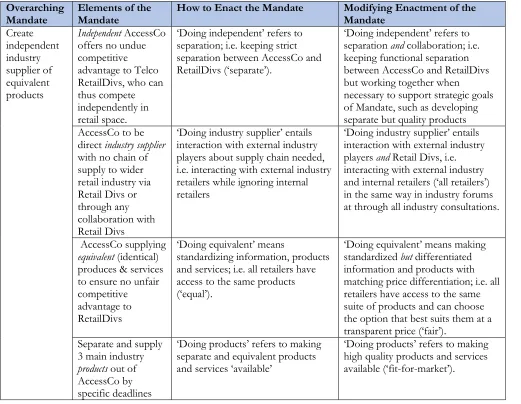
terms of the mandate contained four key entwined elements: independence, industry supplier,
equivalence, and products, each of which had specific structural and strategic implications.
Independence. Independence between Telco’s distribution network, AccessCo, and its
RetailDivs, was strategic because it let Telco retain ownership of the valuable distribution network.
Independence would be met through strict structural separation of the divisions. The strategy, to
ensure that AccessCo would not give competitive advantage nor let its decision-making be
influenced by RetailDivs, came with a radical change in structure that separated the distribution
network and assets into the new business division. This involved moving 30,000 employees, who
brand, logo, and buildings. AccessCo would remain under the corporate Telco structure but
operate separately from the RetailDivs.
Industry Supplier. The ‘industry supplier’ element of the Mandate was a new strategy, as
AccessCo would have to supply distribution products and services directly to external industry
retailers and their customers, making the competitive requirements of all industry retailers a core
part of its new strategy.. This was a radical shift for Telco, as AccessCo had previously been
integrated with and supplied to Telco. As an industry supplier. The Mandate meant converting the
structure of a vertically integrated company, in which all divisions worked strategically for the
competitive advantage of Telco as a whole, to one in which AccessCo would be virtually
disintegrated.
Equivalence. Equivalence was Telco’s new strategy to provide all of its network assets and
services (the distribution side of the industry, of which it was sole owner) on an equal basis to all
industry retailers, with no competitive advantage for its own retail businesses, RetailDivs.
Structurally this would be implemented by standardizing information and products within
AccessCo and providing them in the same way to all retailers, thus ensuring that no advantage was
afforded to Telco’s RetailDivs.
Products. Under the Mandate, there were three essential products that needed to be
supplied strategically as equivalent products and services to all of industry. Each product, which
had initially been provided as part of an integrated supply chain and not offered separately, had to
be separated completely by specific deadlines so that it could be supplied by AccessCo to any
industry retailer on equal terms. To support this change, specific sub-objectives for equivalence
and independence were set for each of these products; these concerned developing prototypes of
the product/service bundles, piloting them with different industry parties, and transferring
specified numbers of customers to the new products. They also included deadlines for full
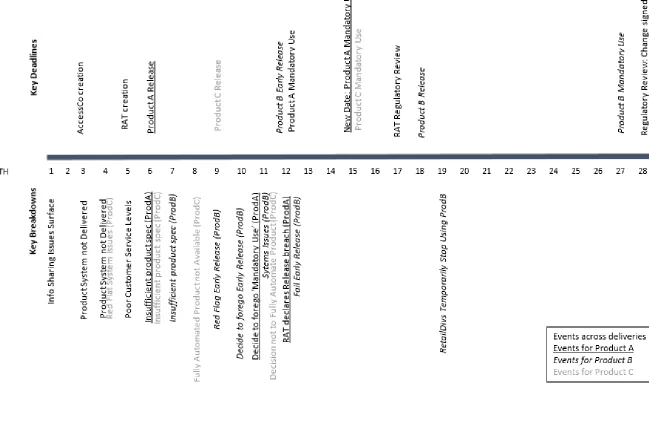
realization (see Figure 1 for a timeline of key deadlines relating to Product A, B and C).
as reporting lines, control systems, and distribution of power and responsibility between particular
roles, were all radically altered. And these changes had to be enacted as intended; any substantive
shift from the espoused strategy and structure might constitute a breach in the Mandate and attract
serious penalties. To support the radical change, the signing of the Mandate was prefaced with an
extended period of internal and external consultation and communication. Throughout the
company people referred to the “spirit” of the Mandate1 in their actions, as these illustrative data
extracts show; “There are two aspects of the Mandate, there’s the written details and there’s a
spirit, and we want to meet the spirit” (Senior manager, interview). As a divisional manager
explained during a project meeting, “I was actually quite impressed by everybody I met in terms
of their understanding of the Mandate. It’s not just how it affected their jobs, but actually how
they understood the whole spirit and everything else.” Operational employees also considered the
spirit in their tasks: “from a spirit perspective, given that these services are very much tied into the
availability of these product functionalities, shall we keep them as a package and just do the extra
work?” (Systems engineer, shadowing). Hence, while exogenously imposed, the Mandate was
rapidly absorbed into the social ordering of Telco, as people gave meaning to it in their actions.
Insert Figure 1 here
---Data Collection. Longitudinal qualitative data were collected over 28 months, tracing the
change in real-time at the Corporate Centre and across all Telco divisions. This extensive field
engagement produced a dataset consisting of 254 audio-recorded meeting observations, with
associated fieldnotes, 130 audio-taped interviews with managers, 16 days of work shadowing, and
over 1,500 documents pertaining to the delivery of the strategy and structure. In addition, the first
author, who had prior research engagement with Telco throughout the policy formation that lead
to the Mandate, underwent internal training to be awarded ‘special status’, a particular structural
1 The ‘spirit’ referred to the underlying principles that guided the Mandate. People within Telco believed that it was
group who were allowed to span divisions. The second author did the code-of-practice training
on the implications of the Mandate undertaken by most Telco staff. We complemented these data
with pre- and post-meeting observations, informal discussions, feedback sessions, and social
functions (see Miles & Huberman, 1994). Our research question and practice-based ontology
required us to track the unfolding enacting of the radical change over time; we thus built our dataset
around meeting observations. In particular, we followed all of the key weekly, fortnightly, and
monthly meetings pertaining to the change, including meetings at the Corporate Centre
(Implementation Board Meetings), in each division (Divisional Meetings), and specific product
meetings (Product Meetings). These meetings allowed us to track people’s actions over time,
gathering data on any changes to the ESS as they occurred.
We interviewed key organizational members, particularly senior and middle managers
involved in realizing the radical change, as well as some operational employees who were part of
their project teams; generally, these people were also central to the meetings we observed.
Interviews were used to enrich the storyline and flesh out details about how and why particular
adaptations took place. The documents we collected included program and project updates relating
specifically to the change, such as reports, PowerPoint slides, white papers, e-mails, and other
communiques. We used these documents to triangulate findings from other sources and ensure
that the timeline was accurate (Flick, 1992). These formal data sources were complemented with
informal observations and discussions that enabled us to form a well-rounded understanding of
the context and ask clarifying questions that facilitated our thinking. See Table 1 for a full
breakdown of data sources in each category.
Insert Table 1 here
---In line with publication etiquette, we acknowledge that some subsets of the above dataset
have been used in other publications. These papers have addressed specific topics such as the
disruption and re-coordination of a single product (Jarzabkowski, Le & Feldman, 2011), the effects
humour (Jarzabkowski & Le, 2017). The context of a Telco and hence the products and some
types of employees, such as engineers, are the same across all papers. However, the current paper
is unique, as it draws the entire dataset together for the first time in order to explain the full nature
of the radical change across the whole organization. In this process, we have oriented toward a
new literature and have developed new concepts, which have not been the subject of any other
publication with this dataset. Additionally, this different focus and wider dataset means that there
are no overlapping quotes, vignettes or data extracts in this paper and any other publication.
Coding & Analysis. Our analysis followed an iterative approach, moving between data
and theory (Locke, Golden-Biddle & Feldman, 2008; Mantere & Ketokivi, 2013), applying various
process analysis tools to progressively emerge theory from data (Jarzabkowski, Lê & Spee, 2017).
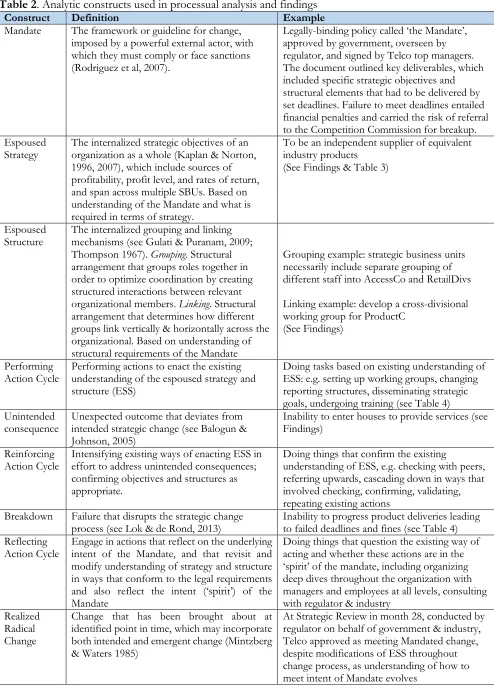
In this section we explain the analytic constructs developed, which are summarized in Table 2.
--- Insert Table 2 here ---
First, we wrote a rich chronological case story of the mandated radical change (Geertz,
1973; Langley, 1999), paying particular attention to how the espoused changes in strategy and
structure unfolded. Initially we worked with the data from the group-level Implementation Board
meetings, as these were weekly meetings that oversaw all elements of the change, allowing us to
maintain chronological order and build an overarching story of the radical change (see Figure 1),
which we then expanded to the full dataset. As we examined the data, we found that strategic and
structural elements were entwined in practice (Pye & Pettigrew, 2006) as people engaged,
iteratively, in actions that materialized their understanding of the strategy and structure that had
been espoused. Consistent with our practice approach, we labelled these iterative actions, which
began to enact the strategy and structure, performing action cycles; people’s iterative actions were
performative in bringing about their understanding of the mandated changes in strategy and
structure (Feldman & Orlikowski, 2011; Rerup & Feldman, 2011).
Second, in examining the performative actions of people at various levels of the
and serious breakdowns in the mandated change process. Iterating with the literature on
breakdowns in people’s practice (e.g. Lok & de Rond, 2013; Sandberg & Tsoukas, 2011), we
defined breakdowns in our data as an inability to continue with the radical change process; people
literally could not deliver on a critical goal or meet a deadline. Curious about the origin and role of
breakdowns in the change process, we started to build case stories around them. We moved
backwards and forwards from specific breakdowns as the starting point in order to better
understand how and why they arose and their consequences. Again, we anchored our work in the
meeting data, developing a skeletal chronology of each breakdown before fleshing it out with
additional observation, interview, and documentary data.
Third, this analysis allowed us to discern a critical theme shared across breakdown stories.
Breakdowns were associated with subtle shifts in the espoused strategy and structure (ESS). Such
shifts essentially constituted modifications in how organizational actors understood what was
being mandated through the change in strategy and structure and how this might best be achieved
in practice. As the ESS had been designed specifically to deliver the legally-binding Mandate, any
reinterpretation and modification was complex. Looking across our 28-month observation period,
we identified four ways in which the ESS shifted, with these shifts being brought about, subtly,
through the responses of actors to the breakdowns. We detail these shifts in Table 3 and explain
them in the findings, where this table provides a helpful reference guide to the story.
--- Insert Table 3 here ---
Fourth, intrigued by these breakdowns and shifts, we tried to understand how they were
being produced in people’s actions. Looking at the within-case dynamics, we noted that
breakdowns arose each time actors’ efforts to meet the ESS generated unintended consequences
– often quite micro things, such as not being able to enter houses to do repairs or not having the
necessary information to transfer customers onto a product prototype –that prevented them from
meeting some aspect of the mandated change. Seeking to explain why this occurred, we revisited
actors brought about their specific change tasks enacted the strategy and structure in a particular
way that, while aligned to what had been espoused by top managers and embraced by employees
throughout the organization as the ‘right’ way to realize the Mandate, actually obstructed it, thereby
preventing them from meeting the legally binding objectives of the Mandate.
Exploring these unintended consequences further, to understand why such micro actions
in performing specific change tasks hindered the change process, we noted an additional set of
actions. Specifically, organizational actors were aware of these unintended consequences and
signaled this by escalating the problems they were experiencing upward. However, as the ESS was
perceived to be consistent with the mandated change, the original performing actions were deemed
in line with the Mandate and reinforced at multiple levels throughout the organization all the way
to the top managers. Reinforcing action cycles thus kept actors performing the same actions and
even increasing their effort to enact strategy and structure in this way. Reinforcing actions
ultimately exacerbated the unintended consequences until breakdown occurred.
Fifth, understanding the origin of breakdowns, we then sought to better understand how
they lead to shifts in the ESS. We found that breakdowns were essential in prompting shifts, as
they helped actors realize that the ESS, as currently enacted, was not delivering the change and
had to be modified. Yet such modifications were not simple, and could not be allowed to evolve
naturally, since this was a legally-binding mandated change. Looking carefully into these moments,
we found that breakdowns prompted a reflecting action cycle. Here, people stopped trying to
perform the ESS and instead engaged in different actions, such as deep dives and consultations
with the regulator, questioning what was espoused and whether it enabled the ‘spirit’ of the
Mandate. Such actions also generated reflection on and deeper understanding of the intent of the
Mandate, from which they were able to come up with modifications to the ESS that they could
enact to better meet that intent. Specifically, organizational actors modified either the strategic
objectives or the structural arrangements or both in order to address the breakdown and continue
Drawing these analytical steps together, our findings demonstrate how the mandated
change process unfolded, leading to a radical change that was realized largely as intended, with
delivery of the high-level strategy and structure sufficient to gain approval at the 28-month
Strategic Review, conducted by the regulator on behalf of industry and government. We explain
and illustrate these processual dynamics in the findings, through a detailed case of one specific
change task. We remind the reader that, for ease of reference, the key constructs used to tell the
story are outlined in Table 2, with an overview of the key shifts in Table 3.
FINDINGS
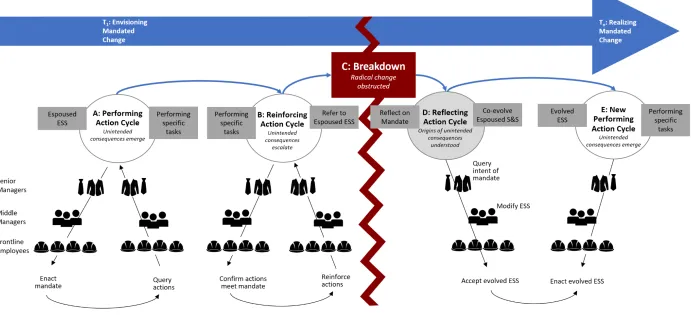
Using a rich case story, we illustrate the iterative process in which: (1) the everyday actions
taken by managers at different levels to perform the ESS have unintended consequences; (2)
managers reinforce these unintended consequences as they confirm with their peers and superiors
that existing actions are consistent with the Mandate; (3) the unintended consequences escalate
until the change process breaks down; whereupon (4) top managers reflect on the intent of the
Mandate, and engage in new actions with others that modify the ESS; and that, hence (5) triggers
managers at all levels to engage in further action cycles to perform the ESS. This iterative process
unfolds over multiple tasks throughout the organization, cumulatively enabling Telco and its
managers to ultimately realize the mandated change.
Door-in-the-Face: Illustrative Case of Processual Dynamics
We now explain these processual dynamics through a detailed explanation of a specific
change task. While we can only present a single task due to space constraints, additional change
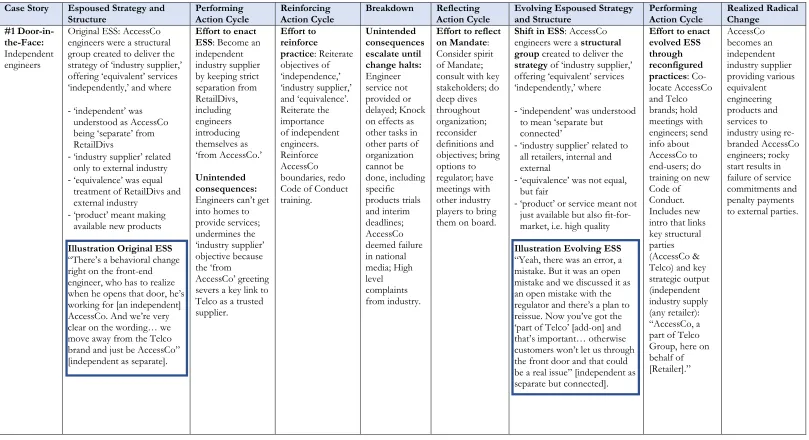
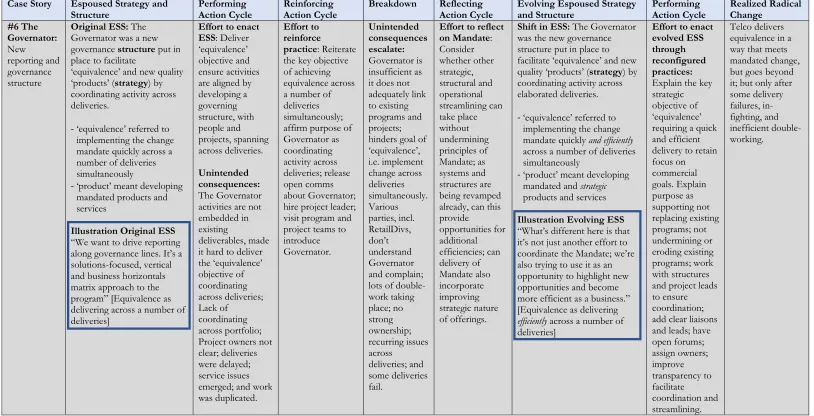
tasks are presented in Table 4. Such tasks, occurring across all parts of the organization, share the
same underlying processual dynamics. Cumulatively, these dynamics generate the ESS shifts
through which the key aspects of the Mandate are realized (see Table 3).
--- Insert Table 4 here ---
The case we present focuses on AccessCo engineers, a structural group created to deliver
new functional cluster within the separate AccessCo division, engineers were to supply
network-related services such as installations and repairs to all retailers, while operating independently from
RetailDivs. Independence was the key to becoming an equivalent industry supplier, since industry
would distrust any collaboration as disproportionally advantageous to RetailDivs. Hence,
AccessCo engineers’ separate reporting structures and information systems ensured that
RetailDivs could not gain any direct access that might compromise the engineers’ independence.
1) Performing action cycle: Enacting the initial ESS generates unintended consequences. As the ESS of separating AccessCo into an independent business division in order
to deliver the new strategy of equivalent industry supply had been explained in significant detail,
people felt ready to perform it. At the corporate level, top managers articulated independence to
internal and external stakeholders, explaining what it meant and why it was important to the
success of Telco and the entire telecommunications industry. Such actions, which included taking
the top 350 managers in the company away for a “town hall” meeting to discuss the ESS, equated
structural separation with the strategy of enabling AccessCo to supply products and services
independently to industry. Hence, the actions of top managers aimed to enact the strategic change
through structural separation.
At the divisional level, managers’ actions were producing separation within the multiple
projects they were running. For example, in project meetings, divisional managers consistently
explained that people in AccessCo were acting separately from other divisions. This meant that
they should not be asked to work across boundaries or share information, and all employees should
help perform this separation to support the new strategy of independent industry supply. At the
same time, divisional managers developed distinct reporting lines and separated information
systems and work processes, which helped to embed actions that performed structural separation.
Consequently, there was little or no communication across functional boundaries.
At the operational level actions also performed structural separation, including engineers
built upon actions at divisional and corporate levels and meant that the engineers acted separately,
not referring to Telco as they provided services. By adhering to strict separation, Engineers were
performing their part of the new strategy of independence from the competitive requirements of
RetailDivs. We now zoom in on this level to better understand the dynamics of enacting the ESS
in this way. Critically, one particular performative action emerged around how engineers
introduced themselves when they were called to end-users’ homes to supply a service for any of
their retail customers. When end-users opened the door, engineers announced that they were ‘from
AccessCo.’ Hence they enacted the ESS by representing an independent AccessCo and supplying
an industry service with no visible ties to Telco.
While consistent with the ESS, this action had unintended consequences. In particular,
end-users, who were unfamiliar with AccessCo, were reluctant to let AccessCo engineers enter
their homes: “It’s not just a name change – It impacts everything we do! All the time people ask
us ‘what is AccessCo?’ We never had these problems with Telco, because they trust Telco and just
let us in. Now with AccessCo, sometimes people won’t see us at all” (Engineer, Shadowing).
Hence, enacting the new engineering structure in this way delayed or prevented engineers from
supplying services.
2) Reinforcing Action Cycle: Unintended consequences escalate. Engineers, struggling
to get into homes, verified with their peers that what they were doing was appropriate: “I’d like to
just say that I’m from Telco, but I’d get fired for that” (Engineer, shadowing). His colleague agreed,
referring to the Mandate: “Our competitors are just waiting for us to mess up. And then they’ll
push to have Telco ripped apart.” They checked training material and decided what they were
doing was right, despite the problems: “This is meant to put Telco through as much pain as
possible” (Engineer, shadowing). Assuming it would simply take more time for people to get to
know the AccessCo brand, engineers continued to explain that they were “from AccessCo,”
specific actions. However, as they continued to have trouble accessing end-user homes, they
realized that they could not resolve the problem and passed the issue upward.
Divisional managers examined their own actions, verifying that the engineering structure was
indeed intended to be separate in order to ensure the strategy of an independent supply of
engineering services to industry. Believing that engineers simply needed more time and training to
perform the ESS effectively, divisional managers reinforced existing actions to underpin separation
and working without crossing divisional boundaries:
“I think that we’ve still got a long way to go from a spirit [of the Mandate] point of view in translating the theory into a reality that’s meaningful for people in the areas that they operate in. Because people only really tend to take notice when it directly affects them. We’ve done an awful lot of work… right down to the Field Engineers, through paper communications, electronic communications, team meetings, induction programs, etc. And everything has a theme of the Mandate and independence running through it. But even though I think the awareness is quite high now, translating that into what it means for people on a day-to-day basis hasn’t happened yet. That takes time. And we’re just about to kick off the ‘Living the Spirit’ program to address this issue” (Senior AccessCo Regulatory Manager, Interview).
For instance, the divisional managers held meetings and designed communications to
reiterate the importance of having independent engineers. They provided additional training for
engineers to underscore the structural separation of AccessCo. Supported by their divisional
managers, engineers thus continued to perform the ESS, explaining that they were ‘from
AccessCo’ and thereby escalating the unintended consequence of problematic access to end-user
premises. This dynamic recurred over several months, perpetuating service problems. There were
several rounds of engineer training, as divisional managers further reinforced their own actions
aimed at helping engineers to “get better” at doing things in the “new AccessCo world” (Division
manager, product meeting). Unable to resolve the service supply failure, which became increasingly
critical, divisional managers passed the issue up the hierarchy.
Corporate managers also ensured that the strategy of independent industry supply was enacted
through structural separation. Indeed, they felt failure to gain access was proof of AccessCo being
internal and external stakeholders that separation was important for independent supply. For
example, corporate managers explained the engineers’ access difficulties at a wider industry
meeting to demonstrate to external retailers that AccessCo was indeed acting independently: “We
explained [to industry], ‘They’re [engineers] living it’” (Corporate manager, Meeting). Satisfied that
they were performing the ESS and delivering the Mandate, they further underscored separation
throughout the organization: “We had a top-level, personalized communication, with Callan
putting his authority on it as the Chief Executive of the Group saying ‘this is absolutely the right
thing to do and this is what we are doing’, and those messages were sent to every single person in
the organization” (AccessCo senior manager, meeting). In short, their actions reinforced the
existing way of performing the ESS across organizational levels. This escalated the unintended
consequences, so that engineers struggled to supply service for some ten months.
3) Breakdown arises from enacting strategy and structure as espoused. While
delivering a strategy of independent industry supply, separation of the ‘AccessCo’ engineering
division generated a breakdown. As change tasks are connected throughout an organization, the
engineering service issues delayed the wider Telco change progress, forcing divisional managers to
forgo or fail to implement some of the elements necessary to meet the ‘early release’ deadline for
ProductB and jeopardizing the ‘mandatory use’ deadline for ProductA (see Figure 1). They were
unable to achieve these product elements of the strategy because they could not get services
installed because engineers were essentially ‘locked out’ of their sites of work. Each time an
engineer was delayed or unable to complete their work, load accrued in the service schedule, until
it became impossible for the engineers to ‘catch up’ on this workload (despite new hires). Rather
than being a supplier that industry wanted to contract with, AccessCo became known as the
“supplier of no choice,” delivering service “at the lowest common denominator,” or simply “bad
service” (Discussion, AccessCo meeting). Indeed, engineers being unable to provide services to
the customer did not solely generate ‘bad service’, but also meant that the new provisions of the
These escalating implications reverberated at the highest level with corporate managers unable
to keep the agreed terms and conditions of the Mandate. Indeed, they had to negotiate a new
mandatory use deadline for ProductA, accompanied by a hefty fine, as they realized that the
product they had could not yet be supplied. Something as simple as how engineers introduced
themselves to end-users had amplifying effects throughout the organization, as other elements in
enacting the ESS were also affected; each of which underwent their own unintended consequences
and reinforcing actions cycles that, cumulatively, created a catastrophic service breakdown. Despite
performing and reinforcing the ESS, Telco could not deliver the intent of the Mandate. As these
service effects accumulated, AccessCo was depicted as a failure in the national media and attracted
significant complaints, publicly highlighting Telco’s inability to deliver: “Have you read the papers?
When we said we wanted everyone to know AccessCo, this isn’t what we had in mind!” It was a
failure at all levels, with engineers, divisional managers and corporate managers all contributing to
the breakdown. Technically, they had performed the ESS of structural separation in an
independent way to supply equivalent service to all of industry. The service failure, however, was
certainly not intended by the Mandate.
The entire change process came to a halt while managers assessed what they could do to
address these issues. The core problem was that performing the ESS was not delivering the key
principles guiding the Mandate: “There is a tension between interpreting what’s the spirit of the
Mandate and trying to actually do the – well, the physical tasks of it” (Corporate Change Manager,
interview). This made the managers realize that the espoused structure must be changed and,
potentially, the strategy also modified: “Something has to give” (Corporate manager, meeting).
4) Reflecting Action Cycle: Modifying the ESS to reflect the intended Mandate. The
breakdown helped show corporate managers that there was a fundamental misalignment between
the ESS and the intended Mandate. A fully separate structure could not deliver the quality product
and service strategy entailed in being the industry supplier. Hence, even if they were doing exactly
action, making them consider what was actually intended by the Mandate – the ‘spirit’ – and what
actions could deliver it:
Part of what I am looking at is how people interpret the Mandate. The Mandate would just have said that you need to deliver this integrated service, but it wouldn’t have told you how in any real detail. ‘Is this your [regulator] way of putting this integrated package together and getting rid of some systems?’ If this is your way of interpreting and understanding, then how we can deliver this? Is it the intent of the Mandate or just an operational efficiency? Where are we going wrong and what do we need to do to get it right? (AccessCo Manager, Interview).
Top managers took new action, such as ‘deep dives2’, working with engineers, project
teams, and divisional managers to drill down into why problems had escalated into the breakdown.
For example, people began to realize that the way engineers introduced themselves to end-users
failed to link AccessCo to Telco or to industry retailers. Performing the espoused strategy of
independent industry supply through structural separation had severed a critical link to Telco as a
trusted supplier, leaving AccessCo on its own as a ‘new’ division that lacked a reputation with
end-users for quality products and services. Thus, engineers could not supply their services for industry
retailers, or only deliver them with significant delay, resulting in poor service overall; “These guys
are in the real world – you just can’t give them something that doesn’t work” (Division manager,
meeting). This had knock-on effects for other change tasks.
Top managers thus engaged in a series of “deeply intellectual and spiritual arguments on
what we are required to do and what not” (Corporate meeting). They accompanied such reflections
with new actions, such as internal deep dives on the intent of the Mandate and meetings with the
regulator and industry to discuss potential solutions. Here they did not simply specify problems
such as how engineers could enter end-user houses but more broadly situated this problem within
the intended Mandate; how could AccessCo remain independent within Telco, yet also supply
equivalent but high quality services to the industry, including RetailDivs? Through these reflective
2 We observed these deep dives to address specific elements of breakdowns. They were typically teleconferences on
actions they realized that the ESS would need to shift to accommodate their growing
understanding of the Mandate; no-one could change the Mandate, but they could adapt the strategy
and structure to better deliver what they understood to be the spirit of that mandate. The purpose
of independent and equivalent supply was not to produce separation at any cost. Rather, it was
meant to ensure an equal playing field, where RetailDivs garnered no unfair competitive advantage.
While separation was meant to be a structural tool to achieve this, it had unintentionally prevented
delivery of other elements of the Mandate, specifically supplying industry with high quality
products and services. “Industry and the regulator would expect Telco’s wholly-owned RetailDivs
and its wholly-owned distributor, AccessCo to act within the spirit of the Mandate for the benefit
of all our customers who want a competitive offer. And it’s getting that balance right” (Corporate
manager, interview). Engaging in these reflective actions, managers began to realize that AccessCo
and Telco would need some connection, due to their unique relationship. The question was how
to convey that relationship in a way that most effectively addressed the Mandate.
Across the organization, managers engaged in further reflective actions to develop
solutions. For example, they considered asking for specific regulatory exemptions from service
delivery, as long as the products and services were equivalent: “we’re looking at ways in which we
can add exceptions to the Mandate that help us resolve these issues” (Division manager, meeting).
Yet they felt that such exceptions would not be in the ‘spirit’ of the Mandate, as supplying quality
products and services was strategically important: “We are trying to develop an acceptable story
to present to the regulator, based around ensuring industry access to high quality products and
services, rather than getting regulator deadlines and milestones for specific systems to be changed”
(Corporate Manager, meeting). They thus put together a team to work out these issues with the
regulator, discussing the technical detail of independence and how to perform this for AccessCo,
RetailDivs, Telco, and external retailers. They also gathered ‘customer experience’ reports about
the impact of these issues on end-users. Through such actions, they reviewed multiple potential
Because of their specific roles and responsibilities in signing the Mandate and ensuring its
implementation, corporate managers specified the shift in the ESS, which now acknowledged that
AccessCo had some connection to Telco, even as it supplied both internal and external retailers.
Future performative actions would need to emphasize AccessCo “as part of Telco,” which was
known to provide high-quality engineering services. In a series of high-level meetings held as part
of their iterative reflective actions, corporate managers confirmed with the regulator and industry
members that this new ESS was faithful to the intent behind the Mandate: “Negotiations with the
regulator are going well. Bad service is in no one’s best interest” (Corporate manager, interview).
5) Performing Action Cycle: Enacting the Modified ESS. With this shift in the ESS, a
new performing action cycle was triggered. Although corporate managers initially drove the
process with a raft of managerial actions to communicate, articulate and embed modifications in
the ESS, it was brought into being through actions across the organization, as we now explain,
with specific reference to the engineers’ service delivery tasks.
Corporate managers emphasized the new structural linkages, in which connections between
groups and divisions, such as co-location of engineering and technical workers or having specific
linking people on projects, were permitted on specific tasks when necessary to achieve product
and service delivery. They explained that these linkages were strategically important in
strengthening their business proposition to supply all industry retailers with high quality products
and services out of AccessCo: “It can only be a good thing for industry retailers if AccessCo is
well respected; after all, they are basing their offering on AccessCo” (Corporate manager, Product
meeting). As part of the modified ESS, explicit changes were approved to bolster the credibility of
AccessCo engineering services and enhance their supply, including co-location of the Telco and
AccessCo brands. These new performances by corporate managers in articulating the strategic
proposition to strengthen the quality of industry supply through a separate but connected structure
Divisional managers engaged in a series of high-level cross-divisional meetings: “This is really
about setting up the big things that will tell us how to re-engineer the process to make it work”
(Division manager, Interview). This ultimately involved rebranding vans and uniforms, making
both Telco and AccessCo logos clearly visible in all customer-facing spaces, and purchasing full
page ads in newspapers to explain ‘the arrival of AccessCo, a Telco business’ and the implications
for end-users: “When you see an AccessCo van, you’re getting Telco expertise without the Telco
baggage” (Division manager, Interview). To complement these actions, divisional managers also
worked with their employees to enact the modified ESS. For example, engineers were given
scripted responses and training in how to explain the radical change to end-users. The modified
structural linkage was communicated through a series of breakfast meetings: “We reminded them
that we are ‘a part of but apart from’ Telco – Telco is in our DNA, but we are AccessCo now”
(Division manager, Implementation Board meeting). Conscious of remaining within the ‘spirit’ of
the Mandate, they also clarified that despite these modifications, AccessCo still operated at arm’s
length from Telco, supplying an independent service to all end-users, irrespective of whether they
purchased from RetailDivs or another industry retailer. Structural linkages were important in
offering strategically competitive products to all retailers, although they still had to be performed
within the guidelines of independent and equivalent industry supply.
Engineers also performed new actions. Critically, they now introduced themselves as
“[we’re] from AccessCo, a part of Telco Group, here on behalf of [Retailer].” This Retailer was
the specific contracted party, which was either an external industry retailer or RetailDivs. New
structural links from AccessCo to the familiar Telco organization were thus performed, whilst
emphasizing that strategically, engineers were working for various industry retailers. To enable
competition in the ‘spirit’ of the strategy, they could include any retailer, including RetailDivs. With
these actions, Engineers could now get into houses to deliver engineering services, thereby
achieving the intended service outcomes and reinforcing the new actions: “It’s fine. I don’t have
changes in the actions of engineers arose from important modifications to the ESS that
constructed new structural links for performing independence so that the strategy of industry
supplier could also be delivered to all competitors.
Summary: Reflective Shifts in How to Enact the Mandate. These processual dynamics
of shifting action cycles, triggered by escalating unintended consequences and breakdowns,
occurred not only in this task, but throughout the organization (see Table 4). This enabled Telco
to meet the intent of the Mandate: becoming independent and supplying products to all of industry
that were equivalent and of high quality, albeit not without modifications to the ESS. These
modifications emerged as Telco managers developed their understanding of the intent of the
Mandate and how it could be enacted. These processual dynamics, which occurred across multiple
tasks (see Table 4), enabled both these managers and their regulatory stakeholders to understand
the Mandate as something that had been realized within Telco. Indeed, at the 28-month Strategic
Review undertaken by the regulator on behalf of industry and government, Telco was confirmed
to have met the Mandate and fulfilled its legal obligations.
Reflective Shifts in Bringing about the Change
Bringing about the change involved reflective shifts in understanding the intention of the
Mandate and how to perform its elements strategically and structurally. As these shifts in the ESS
were achieved through multiple action cycles around the organization, they were not temporally
discrete episodes or ‘phases’, but rather emerged cumulatively from reflective action cycles over a
series of breakdowns. We observed subtle shifts in the ESS, morphing from an ‘independent’ to a
separate but connected ‘industry supplier’ to all retailers, internal and external. ‘Equivalence’ meant
‘fair’ rather than equal and ‘product’ high-quality, fit-for-market products rather than merely
available ones. While entwined and co-evolving, for the sake of simplicity, we now conclude our
presentation of the findings by explaining the strategic and structural shifts involved in each
Independence. Throughout the many change tasks, actors struggled with how to perform
‘independence,’ which was a key principle of the Mandate. When they enacted it as espoused,
through actions that kept AccessCo and RetailDivs strictly separate, they kept experiencing
unintended consequences that hindered their ability to deliver separate products and services to
industry. Over various breakdowns such as the one described above, managers engaged in
reflective actions that increasingly broadened their scope for performing independence. Through
these small shifts, ‘independence’ was gradually espoused as simultaneous separation and
collaboration, enabling performing action cycles that enacted functional separation between
AccessCo and RetailDivs on corporate and commercial issues but facilitated working together to
support the other elements of the mandated change. For example, specific actions enabled working
together to develop and supply quality products and services (see Tasks 2 & 3, Table 4). Thus,
although actions initially enacted separate divisions in the name of independence, they were later
modified to both separate and unite the divisions in order to perform a refined understanding of
independence in line with the principles of the Mandate (e.g. see Tasks 1, 2 & 5, Table 4).
Industry Supplier. The ‘industry supplier’ element of the Mandate was a new strategy,
delivered structurally through the creation of AccessCo to be the supplier to industry. At first, in
line with the independence element of the ESS, managers performed ‘industry supplier’ by
interacting with external industry retailers at the expense of internal retailers. This had unintended
consequences across a range of tasks, as AccessCo employees could not incorporate the expertise
of their largest and most experienced customer, RetailDivs, in developing quality products.
Ultimately, this also affected their ability to supply. Breakdowns in supply triggered reflective
action on the real purpose of independence in the context of being an industry supplier. Reflecting
that the Mandate was innately concerned with quality as well, they realized that, from a strategic
perspective, they needed to be a ‘quality industry supplier’ (see tasks, 1,3,5 & 6, Table 4). They
supported this shift in the espoused strategy with new structural actions within various change