City, University of London Institutional Repository
Citation
:
Bonato, M., Lisi, M., Pegoraro, S. & Pourtois, G. (2016). Cue-targetcontingencies modulate voluntary orienting of spatial attention: dissociable effects for speed and accuracy. Psychological Research, doi: 10.1007/s00426-016-0818-6
This is the accepted version of the paper.
This version of the publication may differ from the final published
version.
Permanent repository link:
http://openaccess.city.ac.uk/17623/Link to published version
:
http://dx.doi.org/10.1007/s00426-016-0818-6Copyright and reuse:
City Research Online aims to make research
outputs of City, University of London available to a wider audience.
Copyright and Moral Rights remain with the author(s) and/or copyright
holders. URLs from City Research Online may be freely distributed and
linked to.
Psychological Research, Accepted manuscript
Cue-target contingencies modulate voluntary orienting of spatial attention:
Dissociable effects for speed and accuracy
Mario Bonato1,2§*, Matteo Lisi3,2§, Sara Pegoraro2, Gilles Pourtois4
1
Department of Experimental Psychology, Ghent University, Belgium
2
Department of General Psychology, University of Padova, Italy
3
Laboratoire Psychologie de la Perception (CNRS UMR 8242), Universitè Paris-Descartes, Paris,
France
4
Department of Experimental Clinical and Health Psychology, Ghent University, Belgium
§
= Equal contribution
Keywords:
spatial attention; attentional orienting; cue predictivity; proportion valid; endogenous; cue-target
contingencies
Word Count: approximately 5700 (body)
Running head: Contingencies learning and spatial orienting
*Corresponding author:
Dr Mario Bonato,
Department of Experimental Psychology,
Henri Dunantlaan 2, B9000, Ghent, Belgium
2 Abstract
Voluntary orienting of spatial attention is typically investigated by visually presented directional
cues, which are called predictive when they indicate where the target is more likely to appear. In
this study we investigated the nature of the potential link between cue predictivity (the proportion of
valid trials) and the strength of the resulting, covert, orienting of attention. Participants judged the
orientation of a unilateral Gabor grating preceded by a centrally-presented, non-directional, colour
cue, arbitrarily prompting a leftwards or rightwards shift of attention. Unknown to them, cue
predictivity was manipulated across blocks, whereby the cue was only predictive for either the first
or the second half of the experiment. Our results show that the cueing effects were strongly
influenced by the change in predictivity. This influence differently emerged in response speed and
accuracy. The speed difference between valid and invalid trials was significantly larger when cues
were predictive, and the amplitude of this effect was modulated at the single trial level by the recent
trial history. Complementary to these findings, accuracy revealed a robust effect of block history
and also a different time-course compared to speed, as if it mainly mirrored voluntary processes.
These findings, obtained with a new manipulation and by using arbitrary non-directional cueing,
3
The commonsense intuition suggests the existence of specific cognitive mechanisms allowing to
voluntarily shift spatial attention in the environment towards potentially relevant stimuli. These
mechanisms have been thoroughly scrutinized in the past. The standard method to isolate the
voluntary (endogenous) component of spatial attention is the Posner’s (1980) cuing paradigm,
whereby leftward/rightward oriented arrow cues with a predictive value are centrally presented
before the appearance of a unilateral target. Cues can be either valid (target appearing at the cued
location) or invalid (target not appearing at the cued location). For a long time, the orienting of
spatial attention arising from central arrows has been conceived as a mechanism involving pure
voluntary control of attention, occurring only if the arrows were predictive, that is if they indicated
with above-than-chance frequency the spatial position of the upcoming target (e.g. Muller &
Rabbit, 1989; Posner, Walker, Friedrich, & Rafal, 1984). This approach is consistent with Jonides
(1981)’s original statement postulating that the endogenous orienting of spatial attention is
primarily sensitive to the expectations of the participants.
Some subsequent studies reported discrepant results without challenging the assumption that
predictive cues are necessary to induce endogenous shifts of spatial attention. Among them,
Tassinari, Aglioti, Chelazzi, Marzi and Berlucchi (1987) showed that attention can be voluntarily
allocated without using predictive cueing (see also Koshino, Warner, & Juola, 1992).
At the end of the 90's, the use of symbolic, directional cues (e.g. arrows) was criticized. Once more,
this occurred without focusing on the effects of cue predictivity. Several studies (Eimer, 1997;
Hommel et al., 2001; Tipples, 2002; Ristic & Kingstone, 2006) clarified that centrally-presented
arrows induce a specific orienting of spatial attention, termed “reflexive” because occurring
although participants know that there is no benefit in orienting towards the cued location. This type
of orienting shares some characteristics with the “genuine” exogenous orienting of attention that is
triggered by using peripheral and non predictive cues. Consistent with this assumption, in patients
with unilateral spatial neglect, it is plausible that involuntary components mostly contribute to the
characteristic disengage deficit for contralesional targets (Bonato, Priftis, Marenzi & Zorzi, 2009;
Olk, Hildebrandt, & Kingstone, 2010). However, as already outlined here above, past studies
primarily questioned the use of asymmetric symbolic, directional cues as arrows to induce
endogenous spatial orienting (Lambert, Roser, Wells, & Heffer, 2006) without studying the role of
cue predictivity. Nevertheless, indirect evidence suggests that predictivity might interact with
expectations. Cueing effects (performance for invalid vs valid trials) by predictive (central) arrows
have been described to greatly exceed the sum of the so-called reflexive orienting of spatial
attention (triggered by non-predictive arrows), and of the “volitional” shift of spatial attention
4
In sum, a common assumption in the literature is that voluntary shifts of spatial attention can
be induced only when the cue reliably predicts target’s position(Carrasco, 2011; Prinzmetal &
Landau, 2008), and yet not much is known about the effects of cue predictivity per se. The main
goal of our study was to explore the role of cue predictivity in spatial orienting in the absence of
confounding factors like explicit symbolic value/physical asymmetry of the cues. To this aim, we
systematically manipulated, unbeknown to participants, cue predictivity in a specifically designed
variant of the Posner task. Participants were required to orient attention towards the left or on the
right of the fixation point according to a centrally presented, color cue which, unlike arrows, did not
automatically prompt any directional shift of spatial attention. This feature is of paramount
importance because it resulted in an arbitrary association between cue identity and target position.
We decided to use a "short" vs a "long" SOA to capture the “fast” exogenous and the “slow”
endogenous attentional processes, respectively. Moreover, we analyzed the data using linear and
generalized linear mixed-effects models, and we capitalized on the possibility they offer to perform
single trial data analysis to model, for instance, effects of (immediately) preceding trials on the
current one (Kinoshita, Mozer & Forster, 2011).
Our new manipulation was designed to highlight potential modulatory effect of cue predictivity but
also to test whether, when cues are fully non-directional and do not carry any overlearned symbolic
meaning, predictivity is a necessary condition for a reliable orienting of spatial attention to occur.
Computer-based assessment is a very sensitive option (compared to paper and pencil tests) for
detecting spatial awareness deficits after brain damage (Bonato, 2015). However, the use of
predictive cues remains the most frequently adopted methodology to specifically quantify
impairments in voluntary orienting of spatial attention after brain-damage (Losier & Klein, 2001).
Similarly, it is still the gold standard approach for exploring the neural correlates of endogenous
spatial attention (Corbetta & Schulman, 2011). Does predictivity (cue-target contingencies) add
some automatic, associative/reflexive components to spatial orienting? If this would be the case,
then it could potentially challenge the dichotomy between automatic and voluntary components of
attention at least in the way it is typically assessed in neuroimaging and in clinical
5
Method
Overview
The task was based on the well-established Posner paradigm. Lateralized targets were presented
after a cue indexing where attention had to be oriented “covertly”, that is without overt eye
movements. In order to obtain a more fine-grained picture of the effects of the proportion of valid
trials, we opted for the use of a discrimination task, allowing to analyze both Reaction Times (RTs)
and accuracy data. With such a manipulation, attention orienting is thought to be slower than in
simple detection tasks (Rafal & Henik, 1994) and cueing effects are usually more reliable (Chica,
Martín-Arévalo, Botta & Lupiánez, 2014). Two specific manipulations, yet never combined
together in earlier studies, were implemented. First, non-directional cues were used (colors).
Second, predictivity (that is the proportion of valid trials, namely how often the target actually
appeared at the cued location) was varied across the experimental session but no information was
given to participants regarding the predictive value of the color cues. This way, the effect of (cue)
predictivity on subsequent target processing as such (without any confound related to cue
directionality and explicit expectations about target location) could be explored thoroughly.
Participants were simply instructed to attend either to the left or to the right side (relative to
fixation) depending on the color of the cue, but were not given any information about the
probability of target appearing in the cued location. Cueing was actually predictive for only half
(either first or second depending on the specific subject’s assignment) of the experiment (see below
and participants were not informed about this change.
Participants
Twenty-four healthy adult participants (mean age 23.6 years, range 19-29 years, 8 males), with
normal or corrected-to-normal vision freely took part in the experiment in exchange of thirteen
euros compensation.
Materials and procedure
Stimuli were presented using E-Prime2 (Schneider, Eschmann, & Zuccolotto, 2002) on a 17 inch
screen positioned at a distance of 50 cm from the participant’s head. A chin-rest was used to keep
the head still and eye movements were continuously monitored using a Tobii T120 eye-tracker.
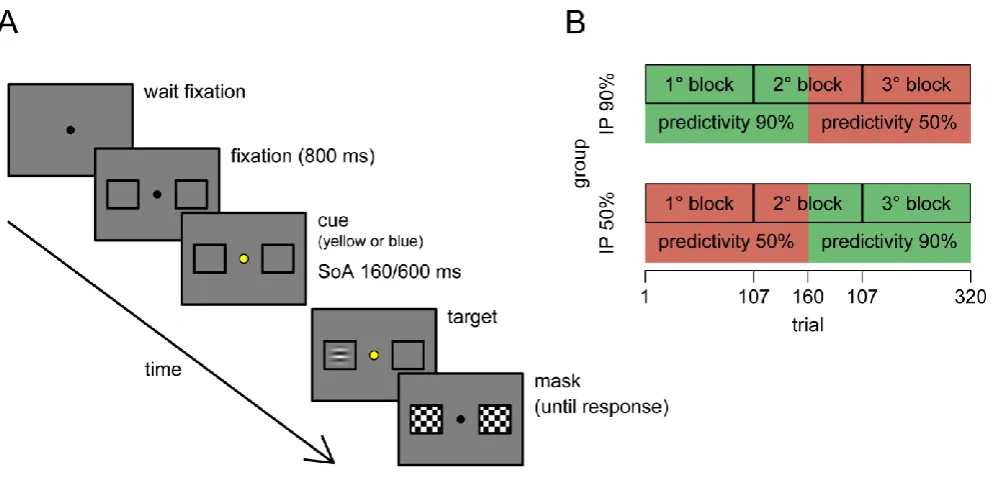
Each trial started with a black fixation point (visual angle 0.5°), presented against a gray
homogenous background (Figure 1). Trial sequence was triggered when the participant kept fixation
(tolerance: 2°) for at least 250 ms. Then, two placeholders (side 3.4°) were presented, one on the
right and one on the left relative to the fixation point (distance from the centre ≈ 10°). After a
constant 800 ms delay, the fixation point turned either yellow or blue. This colour change informed
6
color and direction was counterbalanced across participants). Either a short (160 ms) or a long SOA
(600 ms) was randomly introduced between cue and target. The target stimulus consisted of a
vertical or horizontal Gabor patch (contrast 100%; subtending ≈ 3°) appearing in one of the two
lateralized placeholders. Target duration was individually calibrated (see below). At target offset,
the fixation point turned black again and the two placeholders were filled by a mask (checkerboard)
until response or after 2.5 seconds elapsed. Half of the participants were required to press the “v”
key for “vertical” (index finger left hand) and the “n” key for “horizontal” (index finger right hand)
while the other half received the opposite stimulus-response mapping. Instructions emphasized both
speed and accuracy.
For sixteen practice trials the cued placeholder turned yellow/blue synchronously with the cue. This
was done only during the practice to facilitate the learning of the arbitrary cue-location association.
During the subsequent experimental session only the cue changed its color while the placeholder
did not. There were two lists of experimental trials, one with cue predictivity set to 50% and another
one with cue predictivity set to 90% [see Footnote 1]. List order was counterbalanced across
participants. There were two short breaks, occurring after roughly 1/3 and 2/3 of the trials and
dividing the experiment into three successive blocks of equal length/size. After 160 trials, in the
middle of the second block, there was a change (not announced and not immediately noticeable) in
the proportion of valid trials, from 50% to 90% or vice versa. Participants were not informed about
the initial proportion of valid trials, nor about its sudden change during the experiment. After
completing the experiment questionnaire adapted from Bartolomeo et al. (2006) and Risko and
Stolz (2010) was administered (see the Supplementary Materials). It assessed whether participants
had noticed a larger-than-chance association between color of the cues and target side, and/or any
change in the strength of this relationship during the experiment. It also required estimating,
separately for the two color cues (corresponding to leftward and rightward shift of attention), the
percentage of targets appearing at the cued position (predictivity estimate).
We decided to present the questionnaire at the end of the experiment, instead of probing individual
predictivity estimate online (during the experiment), in order not to bias individual awareness and to
7
Fig. 1. (A) Trial structure. Color cueing was used to induce arbitrary cue-space associations. Half of the participants were instructed to orient attention to the right of fixation following a yellow cue and to the left after a blue cue. Half of the participants received the reverse assignment. The task was to discriminate the orientation (Horizontal vs. Vertical) of a unilateral Gabor patch by means of two response keys. Target duration was adjusted individually following a pre-experiment calibration procedure. In this representative trial a left target was presented after yellow cue. For the yellow-left/blue-right group this would have been a valid trial. For the yellow-right blue-left group this would have been an invalid trial. (B) Experimental design. There were two main trial lists, one with a cue predictivity of 50% (upper right and lower left, in red) and the other one of 90% (upper left and lower right, in greed). For half of the participants (IP 50%, lower panel) initial predictivity was set to 50% before changing to 90% after half of the trials, while for the other half of participants (IP 90%, upper panel), the reverse order was used.
Calibration procedure
The aim of the calibration procedure (48 trials performed prior to experiment) was to adapt target
duration to individual performance thereby avoiding floor/ceiling effects. Trial sequence was
similar to experimental trials but there was no cue (the fixation point remained black). Initial target
duration was set to 133 ms and then adjusted online (within the range 17-266 ms) through a
weighted up-down staircase procedure (Kaernbach, 1991) with goal performance set to 75%
accuracy. Duration values for the last 12 trials were averaged and used as individual target duration
8
Results
Reaction times
Trials contaminated by eye movements (1.60%) were excluded from further analyses. In these trials
gaze position was detected (according to offline analysis) for more than 100ms consecutively
outside of a circular area of 2° of radius around the fixation point, in the interval between cue onset
and the response. The data of two participants had to be excluded from statistical analyses, one due
to excessive eye movements (52.8%), and another one due to poor performance (error rate of 32%,
[image:9.595.61.531.256.606.2]2 SD above group average). RTs above 2500 ms (0.44%) were also discarded.
9
Reaction times for correct responses were analyzed using a linear mixed-effects model
(Pinheiro & Bates, 2000), fitted with the open-source software R version 3.3.0 (R Core Team,
2015) and the lme4 library version 1.1-12 (Bates, Maechler, Bolker, & Walker, 2014). To avoid
potential issues related to the typical skewedness and non-normality of RT distributions, we
implemented a Box-Cox transformation for RTs with λ = -0.69; a value which resulted from a
maximum likelihood procedure (Box & Cox, 1964).
We started with a model that had Trial validity (at the single trial level: valid vs. invalid),
SOA (160 vs. 600ms), Proportion valid (at the block level: 50% vs. 90% of valid trials), and Block
order assignment (at the experiment level: start with 50% vs. 90% of valid trials) and all possible
interactions as fixed effects predictors; and subject as random effect predictor, or grouping factor.
The model had random intercepts, thus allowed for different marginal RTs means for each
participant, and also random slopes, for all the within-subjects factors (Trial validity, SOA and
Proportion valid). We then proceeded by adding random slopes for each interaction between the
within-subjects factors, except for the three-way interaction, because it caused a convergence failure
of the optimization algorithm (i.e. its inclusion would have resulted in a model that was too
complex to be properly supported by the data). However, none of these interaction factors improved
the fit of the model (likelihood ratio test, all ps > 0.1). Nevertheless, we included in the final model
a random slope for the interaction between Proportion valid and Trial validity, as this interaction
was the most interesting with respect to the main goal of the study. Additional analyses (not shown
here) performed with models that included one or more of the random slopes for the remaining
interaction terms resulted in a pattern of significant fixed-effects identical to that reported in Table
1.
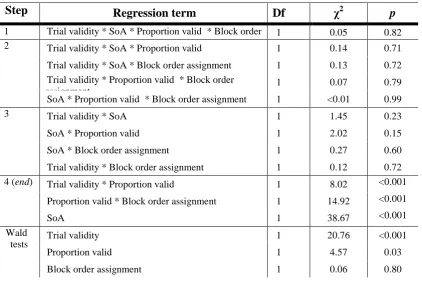
To test fixed effects predictors, we performed a backward stepwise simplification: we
iteratively removed a single term at a time, fitted the relative reduced model, and tested it against
the full model. At each step of the process we tested all possible models resulting from the
exclusion of a single term (maintaining marginality). Next we refitted the model excluding all the
terms that could be dropped without a significant worsening of the model fit (likelihood-ratio tests,
α=.05). The process was repeated until no more terms could be dropped without leading to a
significant decrease in the likelihood of the model or a violation of marginality (on the importance
of marginality in regression analysis, we refer the reader to Nelder, 1977; Venables, 1998). For each
step of the simplification process we listed the regression terms that could be dropped (Table 1),
along with the results of the corresponding likelihood ratio tests. The estimates of fixed effects and
variance/covariance components for the linear mixed-effects models used in the analysis are
10
Crucially for our purposes, the significant interaction between Trial validity (at trial level) and
Proportion valid (at block level) showed that the validity effect, here unbiased because triggered
without directional cues, was context-dependent because modulated by the proportion of valid trials
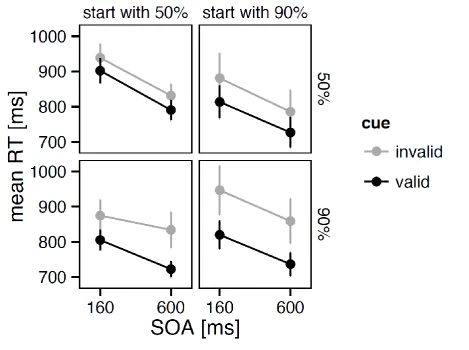
(Table 1). The model predicted faster RTs in valid as compared to invalid trials, and this was
confirmed by means of paired, two-tailed, t-tests in both blocks separately [block 50%, mean
difference 51ms, t(21) = 3.90, p = 0.0008; block 90%, mean difference 99ms, t(21)= 4.04, p =
0.0006]. The effect in the non-predictive block was still significant when the considering only the
IP50 participants, that is when the non-predictive block was performed first and any
“contamination” from the predictive block could be excluded, t(11)=2.41, p <0.05.
We also found a significant main effect of SOA, indicating faster RTs at the 600ms delay (see
Figure 2 and Table 1), and a significant interaction between Proportion valid and Block order
assignment. Presumably, this interaction indexed a learning effect, whereby participants were
slower in the first block than in the second block depending on the initial (and unknown)
cue-predictivity assignment, suggesting an impact of trial history on general response speed. Moreover,
the main effect of SOA is probably a direct consequence of the longer time period available for
preparing a manual response to the target in the 600ms compared to the 160ms SOA condition. This
effect is not uncommon (e.g. Fuchs & Ansorge, 2012; Fuchs, Ansorge, Huber-Huber, Höflich,
11 Table 1
Backward stepwise simplification of LMM model (Box-Cox transformed RTs with λ=-0.69)
Step Regression term Df χ2
p
1 Trial validity * SoA * Proportion valid * Block order .assignment
1 0.05 0.82
2 Trial validity * SoA * Proportion valid 1 0.14 0.71
Trial validity * SoA * Block order assignment 1 0.13 0.72
Trial validity * Proportion valid * Block order assignment
1 0.07 0.79
SoA * Proportion valid * Block order assignment 1 <0.01 0.99
3 Trial validity * SoA 1 1.45 0.23
SoA * Proportion valid 1 2.02 0.15
SoA * Block order assignment 1 0.27 0.60
Trial validity * Block order assignment 1 0.12 0.72
4 (end) Trial validity * Proportion valid 1 8.02 <0.001
Proportion valid * Block order assignment 1 14.92 <0.001
SoA 1 38.67 <0.001
Wald
tests Trial validity 1 20.76 <0.001
Proportion valid 1 4.57 0.03
Block order assignment 1 0.06 0.80
Table 1. Backward stepwise simplification of the linear mixed effects model used in the analysis of RTs. Note that in the final step (4th) the likelihood ratio tests were significant: these factors could not be excluded without a significant worsening of the model fit (as indexed by a significant drop in the likelihood of the model). For completeness, in the last row we report Wald type II tests for the regression terms that could not be tested, during the stepwise simplification, without violating marginality (i.e. because these terms were included in significant higher order interactions).
Next, we assessed whether the subject-specific coefficients (that is the conditional modes of
the random effects) coding for the cue validity effect (difference in RTs between valid and invalid
trials) differed according to the individual awareness of the relation between cue color and target
position. Participants were divided into two groups according to their subjective awareness of the
cue-target relationship, on the basis of the response provided to question number 3 "Have you
perceived any contingency between the colour of the central dot and the position of appearance of
the target?". Those who reported having noticed a systematic association between the cue and the
target location entered the aware group (n=11). Those who failed to notice such an association
entered the non-aware group (n=11). No significant group difference in the size of the cue validity
effect was found [t(20)=0.64, p=0.53]. We also examined whether adding subjective awareness
(aware vs non-aware) as a predictor could improve the fit of the final linear mixed-effects model
12
including interactions with all other predictors, no improvement in the goodness of fit was observed
(likelihood ratio tests, all p>0.1). Similarly, we assessed whether those participants (n=11) who
positively responded to question 5 "Do you have the feeling that cue-target relation changed during
the experiment ?" (awareness of predictivity change) had a significantly larger speed difference in
validity between the two types of block (90% and 50%) by looking at the corresponding
subject-specific coefficients coding for the interaction between Trial validity and Proportion valid.
However, no significant group difference emerged [t(20)=0.17, p=0.87]. Further, adding the
awareness of predictivity change as predictor in the mixed-effects model, including all possible
interactions, did not improve the goodness of fit of the model either (likelihood ratio tests, all
p>0.1). These findings allowed us to rule out, at least partly, the possibility that different validity
effects were mostly due to participants adjusting their efforts/strategies according to their degree of
insight/awareness of the cue-target contingencies.
[Footnote 1]
Finally, we performed a more fine-grained analysis to test whether fluctuations in the size of
validity effects across the experiment could also be predicted at a given time point according to the
immediately preceding and most recent trials. We reasoned that, in case the amplitude of the
validity effect is determined, as we contend, by cue-target contingencies, it should be possible to
account for the fluctuations in its size by taking into account the recent trial history. To this aim, we
took advantage of the fact that mixed-effects models do not require averaging of data within each
cell in the experimental design, and thus allow testing predictors that vary on a trial-by-trial basis.
For each trial, we counted the number of immediately preceding, consecutive valid trials (i.e., not
interrupted by an invalid trial), and added it as a predictor, in interaction with Trial validity, in the
final model resulting from the previous simplification procedure. In other words this predictor
consisted in the number of valid trials between the current trial and the last invalid trial, and
therefore it was set to zero for each trial that immediately followed an invalid one. The rationale of
this analysis is the following: if adding this predictor on top of the interaction between Trial validity
and proportion Valid increases significantly the goodness of fit, this indicates that there are
systematic fluctuations in the validity effect that depend on the recent trial history and which cannot
be accounted for exclusively by the block-level predictor Proportion valid. In line with this
assumption, we found that the inclusion of this predictor in the model significantly increased the
goodness of fit, χ2(1)=15.74, p<0.001. This finding is valuable because it suggests that at a given,
arbitrary timepoint, the (predicted) validity effect (difference between the expected RT in case of
invalid cue minus the expected RT in case of valid cue) was reliably modulated by the cue-location
13
Proportion valid at the block level. More specifically, this result suggests that framing the effect as
a function of previous trial history allows to track rapid fluctuations in the cueing effects that are
neglected by the global model. However, as a word of caution, it is important to point out that the
predictivity at the block level and at the single trial level could be only partly orthogonalized in our
paradigm.
[image:14.595.80.480.260.566.2]Response accuracy
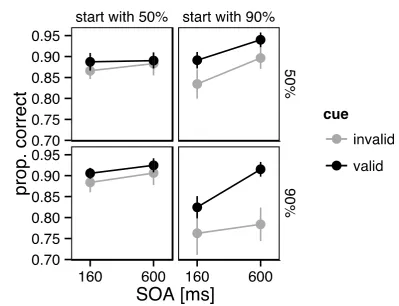
Fig. 3. Average proportion of correct responses, separately for each level of validity, cue
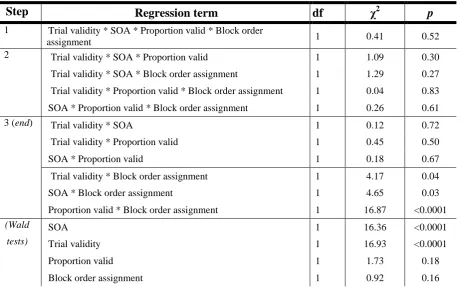
14 Table 2
Backward stepwise simplification of GLMM model
Step Regression term df χ2 p
1 Trial validity * SOA * Proportion valid * Block order
assignment 1 0.41 0.52
2 Trial validity * SOA * Proportion valid 1 1.09 0.30
Trial validity * SOA * Block order assignment 1 1.29 0.27
Trial validity * Proportion valid * Block order assignment 1 0.04 0.83
SOA * Proportion valid * Block order assignment 1 0.26 0.61
3 (end) Trial validity * SOA 1 0.12 0.72
Trial validity * Proportion valid 1 0.45 0.50
SOA * Proportion valid 1 0.18 0.67
Trial validity * Block order assignment 1 4.17 0.04
SOA * Block order assignment 1 4.65 0.03
Proportion valid * Block order assignment 1 16.87 <0.0001
(Wald SOA 1 16.36 <0.0001
tests) Trial validity 1 16.93 <0.0001
Proportion valid 1 1.73 0.18
Block order assignment 1 0.92 0.16
Table 2. Backward stepwise simplification of the generalized linear mixed effects model used in the analysis of response accuracy. In the final row, we report Wald tests for the remaining factors.
Before analyzing response accuracies, we ensured that our calibration procedure returned an
appropriate individual target duration value by computing the correlation over subjects between the
individual value of target duration and the overall proportion of correct responses. No evidence for
a significant correlation was found [r(20)=0.14, p=0.53], indicating that the task was equally
challenging for all participants included in the analysis.
Also response accuracy was analyzed with a generalized linear mixed effects model
(GLMM), now with the logit as link function (see Figure 3 for averaged data). The model had
subject as grouping factor, and included random slopes for the same terms as the model used to
analyze RTs. Adding additional random slopes did not improve the fit of the model (likelihood ratio
test, all p>0.1), nor changed the pattern of significant fixed-effects (not shown here). The estimates
of fixed effects and variance/covariance components for the linear mixed-effects models used in the
analysis are reported in Supplementary Materials Table S2.
As opposed to RTs, no modulation of validity emerged in the non-predictive block when it
15
Finally, we performed a one-way ANOVA on accuracy differences between validly and
invalidly cued trials. We were interested in investigating whether cueing effects differed among
participants according the individually-reported awareness of any systematic relation between the
color of the cue and side of appearance of the target. This analysis did not reveal any difference
[F(1,20) = 1.85, p = 0.19].
Even if we found no evidence for a systematic modulation of the proportion valid on
response accuracy by the trial context (proportion valid), we investigated whether there were some
fluctuations in the size of the validity effect that could be explained by taking into account the
recent trial history. Following the same rationale as in the analysis of the RTs above, we added as a
predictor (in interaction with Trial validity) the number of immediately preceding consecutive valid
trials, computed individually for each trial. In contrast with the analysis of RTs, the addition of this
predictor did not improve the fit of the model, χ2
(1) = 0.66, p = 0.47. In sum, we found no evidence
for a modulation of response accuracy by the recent trial history, unlike the RTs.
We also investigated whether the responses to the (post-experiment) questionnaire could
influence task performance when titrated using response accuracy, by including additional
predictors in the final GLMM model. First we added subjective awareness (aware vs. non-aware)
of the cue-target relationship, but failed to observe any variation across participants in the size of
the validity effect that could be explained by this predictor (likelihood ratio tests, all ps>0.1).
Similarly, including the awareness of predictivity change (in interaction with Proportion valid and
Trial validity) as predictor in the model, did not improve the fit of the model either (likelihood ratio
tests, all ps>0.1).
Awareness of cue predictivity and influence on cueing effect
To examine whether performance was influenced, at individual level, by the perceived proportion
of valid trials, we compared post-experiment ratings with the amplitude of the validity effect
resulting from the computer-based task. For this purpose, we calculated exploratory correlations
between the individual cueing effects (for either RTs or accuracy) and the individual cue
predictivity estimate (see Risko & Stolz, 2010a for a similar procedure). We computed these
correlations either separately for the two cue colors and SOA, as well as averaging individual
estimates and measured effects over color and SOA, respectively. These tests did not reveal any
significant correlation between the two variables: the correlation values ranged from -0.12 to 0.32,
16
needed when interpreting this non-significant result (the absence of evidence does not prove the
evidence of absence). It is also possible that the detection of a significant correlation is made less
likely due to the noisy nature of differences scores (cf. Cronbach & Furby, 1970).
Discussion
In this study, we instructed participants to orient attention according to the colour of a central
non-directional cue that, unbeknown to them, was predictive of target position (90% valid) in half of the
experiment and non-predictive (50% valid) in the other half. The use of non directional cues was a
distinctive task characteristic and allowed to avoid unwarranted orienting effects due to cue
asymmetries. Our results showed that a faster discrimination of targets occurred when their location
matched the one indexed by the colour, compared to the situation where they appeared at the invalid
location. This cueing effect was already present in the non-predictive block but was larger in the
predictive one, and its amplitude (when considering RT speed) resulted to be modulated the recent
trials history (i.e. by the number of preceding consecutive valid trials). The strength of the cueing
effect on RTs therefore appears to be strongly modulated by the learning of
cue/color-target/location contingencies. In this specific case contingencies were arbitrary and therefore not
a-priori biased as opposed, for instance, to the use of asymmetrical cues like arrow cues (Lambert et
al., 2006). Moreover, awareness of these contingencies (as indicated by post-experiment ratings) did
not modulate the strength of the spatial orienting effect. The effect of the proportion of valid trials
and its interaction with trial context were roughly constant across the two different SOAs used,
allowing to exclude the more effective engagement of a slow, voluntary, component over less
effective engagement of fast and automatic –possibly associative- processes.
Our results suggest that the proportion valid effect on RTs is the outcome of an automatic process,
which modulates attention orienting on the basis of (rapidly learned or instructed) spatial-temporal
contingencies in the environment (Zhao, Al-Aidroos, & Turk-Browne, 2013), possibly through a
mechanism similar to repetition priming (Dobbins, 2004; Logan, 1990) and can act outside
awareness and without explicit strategies.
We also found that the proportion valid effect on accuracy was modulated by the more general
context, at experiment level (block order assignment), as opposed to the single trial level in the case
of RTs. Specifically, we observed that the extent of cueing effects on response accuracy depended
only on which block (90% or 50% predictivity) was presented first. In contrast, cueing effect on
response accuracy was not modulated by changes in predictivity during the experiment. Given that
17
to assume that it should be more strongly linked to overt cognitive strategies. Therefore, we suggest
that cueing effects on response accuracy might largely depend on the task set adopted, which seems
to be fully configured during the initial part of the experiment (where specific expectations are
created based on the task instructions provided and cue predictivity initially encountered). This
interpretation implies that slightly different task sets can be determined by different level of
predictivity during the initial phase of the experiment, that can then linger regardless of changes in
predictivity encountered during the experiment.
Our interpretation of the different contingencies effects on RTs/accuracy is in line with the
influential proposal by Prinzmetal, McCool, and Park, (2005) according to which automatic
allocation of spatial attention would not affect the underlying representations and would show its
signature on RTs only. We point out however that, in the more commonly used detection tasks, this
dissociation cannot emerge due to the almost flawless performance usually exhibited (by healthy
participants).
The present results cast doubts on the almost-never-tested assumption that predictive cueing leads
to “pure” voluntary orienting of spatial attention. Rather, it seems more appropriate to conclude that
several earlier studies that attributed shifts of spatial attention to a voluntary control mechanism
could actually be, at least in part, explained by the effects of target predictability or cue predictivity
per se, in the absence of voluntary control (Prinzmetal, McCool & Park, 2005). As a matter of fact,
predictive cueing is still considered the gold standard in research on spatial orienting of attention
(Corbetta & Shulman, 2011). The use/non-use of predictive cueing is believed to distinguish
endogenous from exogenous mechanisms (Awh, Belopolsky & Theeuwes, 2012). The present
results suggest that such a dissociation may actually be conflated by differences in levels of cue
predictivity, rather than on core attentional components (see Doricchi et al., 2010, for a similar
view). While our new results clearly confirm the efficacy and sensitivity of the Posner paradigm to
disentangle the contribution of several key processes underlying visuo-spatial attention in humans,
at the same time they also show that predictive cueing does not only induce pure voluntary
orienting. In this context, our novel behavioral findings are also compatible with the assumption
that expectations and predictions are two major determinants of the efficacy of spatial orienting (for
conceptually similar findings see for instance Melloni, Schwiedrzik, Müller, Rodriguez & Singer,
2011). At the same time, however they can hardly subsume the standard dichotomy between
endogenous and exogenous attention effects, rather suggesting that these spatial orienting effects
always necessarily result from the integration of sensory signals with top-down input (Macaluso &
Doricchi, 2013). The multifaceted picture provided by RTs and accuracy unambiguously calls for a
18
Using different approaches or experimental set-ups than the one used here, some early studies in the
field already emphasized the importance of the “proportion valid” trials (or cue predictivity) to
account for spatial orienting effects (Eriksen & Yeh, 1985; Johnson & Yantis, 1995). Puzzlingly
enough, these initial hints did not lead to a systematic investigation of the possibly crucial role of
predictivity in shaping spatial orienting effects. Accordingly, a specific contribution of our study is
to show, using a novel methodology and arbitrary cue/target associations, that shifts of spatial
attention are strongly influenced by predictivity levels while robust orienting could, at the same
time, be reliably triggered by (the use of) simple instructions.
A significant validity effect for RTs was found also for the non-predictive block. An open issue is
therefore to what extent these cue-target (spatial) associations leading to changes in response speed
are involuntary or whether, alternatively, genuine voluntary mechanisms or components are also
involved. In a seminal study, Lambert, Naikar, McLachlan, and Aitken, (1999) reported an implicit
cueing effect on RTs (peripheral symbolic cues and peripheral targets) unrelated to participants'
awareness of the cue-target relationship and perceptual awareness of the cue itself, corroborating
the notion that spatial shifts of attention could be triggered by implicit cue-target associations.
However, the results of Bartolomeo et al. (2007) seem to suggest that some room for purely
voluntary components exists. They manipulated the proportion of valid trials in a cued detection
task (central arrow or peripheral cue). A larger orienting effect following central cueing was
observed for participants who, according to a questionnaire, were aware of the predictivity levels.
The link between awareness of predictivity and cueing effects led Bartolomeo and colleagues to
conclude that spatial cueing effects may be due to a voluntary component, because spatial orienting
more reliably occurred when cue predictivity level accessed awareness.
Risko and Stolz (2010a) proposed implicit learning as an alternative explanation for the proportion
valid effect. They manipulated the predictivity (e.g. 50% vs. 75%) of either a peripheral or a central
arrow cue. In both conditions cueing effects increased with increase in predictivity. A questionnaire
showed that following peripheral but not central cueing participants correctly identified the two
different levels of predictivity used. Crucially (and similarly to the present results), the estimated
levels of predictivity were unrelated to the actual cueing effects on both RTs and accuracy. Given
the robust cueing effect obtained despite the short SOA (150 ms), these authors suggested that
endogenous orienting is (considered) too slow to modulate the proportion valid effect (which was
present irrespective of participants’ awareness of cue predictivity). They concluded that the
proportion valid effect results from involuntary attentional capture and implicit learning (see also
Peterson & Gibson, 2011). Chica & Bartolomeo (2010) argued that, although implicit learning
19
excluded (see also Risko & Stolz, 2010b). Earlier findings (Risko, Blais, Stolz, & Besner, 2008a,b)
suggest a modulation of spatial orienting performance due to frequency differences, whereby the
more frequent condition would give rise to a more efficient processing than the less frequent
condition (see Cutini et al., 2008 for converging evidence in task-switching).
A potential lack of systematic association between the awareness of cue predictivity and the
observed cueing effects would suggest that spatial orienting based on predictive cues cannot be
qualified as purely “voluntary” (Peterson & Gibson 2011; Risko et al., 2008; Risko & Stolz, 2010a).
The non-significant correlations we found are subject to caution and deemed preliminary only. At
any rate, the potential absence of an association between awareness of cue predictivity and
amplitude of the cueing effects (even at long SOAs), if confirmed by future studies, would reinforce
the notion that in predictive cueing the voluntary component is not necessarily the most important
determinant of performance.
More generally, the present findings extend the notion that cue-target associations can strongly
influence performance (López-Ramón, Chica, Bartolomeo & Lupiáñez, 2011) even when cues are
devoid of directionality. This association has been recently proven so strong to counteract the effect
of hemispatial neglect (as highlighted in computer based tasks, see Bonato, 2012) in the
contralesional hemispace (Wansard, Bartolomeo, Vanderaspoilden, Geurten, & Meulemans, 2015).
Our study goes beyond this intriguing observation by showing that implicit learning-like effects
hold not only for the location where the cue is presented, as is the case with peripheral cues
(Wansard et al., 2015), but can also be evidenced at a higher level. In our task, spatial properties
were not immediately decoded or available, but the information on cue-target probability was
nonetheless timely extracted from the arbitrary color feature at fixation to subsequently enhance the
(visual) processing of a non-spatially overlapping target.
Our new findings extend the results reported in a recent series of studies by Vossel and
collaborators, which focused on RTs modulation resulting from changes in cue-target predictability.
In these studies, cues were mostly directional and participants were told to expect changes in cue
target occurrence through the task. In a first study, it was demonstrated that an explicit arrow
direction can trigger saccadic movements more efficiently when predictive of target position
(Vossel, Mathys et al., 2014), and its effect is influenced by cholinergic stimulation (Vossel, Bauer
et al., 2014). Applying the same logic to a search task revealed an increase in the cueing effect on
RTs the more the cue was abstract (Dombert, Fink & Vossel, 2016). The effects related to the
proportion of valid trials were limited when the cue was painted in the color to be looked for (e.g.
20
Noteworthy, in domains other than spatial orienting/attention, the role of contextual effects and
associative/implicit learning are becoming more and more conceived, albeit not always explicitly,
as major determinants of performance (for a recent review, see Abrahamse, Braem, Notebaert, &
Verguts, 2016; see also Braem, Hickey, Duthoo, & Notebaert, 2014; Duthoo, Abrahamse, Braem,
Boehler, & Notebaert, 2014; Schmidt, 2013; Rieth & Huber, 2013).
To conclude, the present results show that a change, unknown to the participants, in the reliability
the cue had in predicting target location (proportion of valid trials) deeply affected the spatial
orienting of attention (to the target location) rather independently from participant’s awareness of
cue predictivity. With respect to RT effects: (i) the size of spatial cueing effects is strongly
modulated by cue predictivity; (ii) immediately after cue presentation and persisting at a longer
cue-target SOA, and (iii) fluctuations in the size of the cueing effects can be predicted by considering
the recent trial history. In accuracy, these spatial cueing effects were strongly modulated by block
history, and were reliable only when the participants experienced as first a strong/clear cue target
association.
For more than 40 years and since the groundbreaking work of Michael Posner, researchers have
striven to isolate the specific contribution(s) of voluntary mechanisms responsible for the spatial
orienting of attention, using clever experimental designs. However, often, these designs entail that
spatial orienting repeats over again and again across several hundred (sometimes thousands) of
trials, and can therefore be best captured by computing mean scores. This notion seems, in any case,
a priori questionable because initial volition can rapidly turn into automatic processing. Crucially,
here we showed that, different levels of cue predictivity at the beginning of the experiment induce
different task set configurations (accuracy) and implicitly shape the size and strength of cueing
effects in the short run, as evidenced by a systematic influence of the recent trial history (RTs).
These effects seem to occur relatively independently from participants’ awareness. As such, our
new results emphasize that the underlying orienting processes activated by predictive cueing are
probably far more complex and dynamic than initially thought, and they do not correspond to a
simple instruction-based voluntary mechanism.
[Footnote 1]
Of note, the two levels of cue predictivity used here are only indicative because “real” cue
21
Compliance with Ethical Standards:
Funding: MB was funded by a FWO Pegasus/Marie Curie IEF Fellowship within the 7th framework
program (Project 625378 "SpaceLOAD").
Conflict of Interest: MB declares that he has no conflict of interest. ML declares that he has no
conflict of interest. SP declares that she has no conflict of interest. GP declares that he has no
conflict of interest.
Ethical approval: All procedures performed in studies involving human participants were in
accordance with the ethical standards of the institutional research committee and with the 1964
Helsinki declaration and its later amendments or comparable ethical standards.
Informed consent: Informed consent was obtained from all individual participants included in the
study.
References
Abrahamse, E., Braem, S., Notebaert, W., & Verguts, T. (online first, 2016). Grounding Cognitive
Control in Associative Learning. Psychological Bulletin.
Akaike, H. (1974). A new look at the statistical model identification. IEEE Transactions Automatic
Control, 19, 716-723.
Awh, E., Belopolsky, A.V., & Theeuwes, J. (2012). Top-down versus bottom-up attentional
control: a failed theoretical dichotomy. Trends in Cognitive Sciences, 16, 437-443.
Baayen, R.H. (2005). Data mining at the intersection of psychology and linguistics. In A. Cutler
(ed), Twenty-First Century Psycholinguistics: Four Cornerstones (pp. 69-83). Mahwah, NJ:
22
Box, G.E.P. & Cox, D. R. (1964) An analysis of transformations. Journal of the Royal Statisistical
Society, Series B. 26, 211-246.
Bartolomeo, P., Decaix, C., & Siéroff, E. (2007). The phenomenology of endogenous orienting.
Consciousness and Cognition, 16, 144-161.
Bates, D.M., & Sarkar, D. (2007). lme4: Linear mixed-effects models using S4 classes, R package
version 0.99875-6.
Bates, D., Maechler, M., Bolker, B., & Walker, S. (2014). lme4: Linear mixed-effects models using
Eigen and S4. R package version 1.1-7. Retrieved from http://cran.r-project.org/package=lme4
Bonato, M., Priftis, K., Marenzi, R., & Zorzi, M. (2009). Normal and impaired reflexive orienting
of attention after central nonpredictive cues. Journal of Cognitive Neuroscience, 21, 745-759.
Bonato, M. (2012). Neglect and extinction depend greatly on task demands: A review. Frontiers in
Human Neuroscience 6:195.
Bonato, M. (2015). Unveiling residual, spontaneous recovery from subtle hemispatial neglect three
years after stroke. Frontiers in Human Neuroscience 9:413.
Box, G. E. P., & Cox, R. (1964). An Analysis of Transformations. Journal of the Royal Statistical
Society. Series B (Methodological), 26(2), 211–252.
Braem, S., Hickey, C., Duthoo, W., & Notebaert, W. (2014). Reward determines the
context-sensitivity of cognitive control. Journal of Experimental Psychology: Human Perception &
Performance, 40,1769-1778. doi: 10.1037/a0037554.
Burnham, K. P., & Anderson, D. R. (2002). Model Selection and Multimodel Inference: A Practical
Information-Theoretic Approach. New York, US: Springer-Verlag.
Carrasco, M. (2011). Visual Attention: The past 25 years. Vision Research, 51, 1484-1525.
Chica, A.B., & Bartolomeo, P. (2010). Unconscious strategies? Commentary on Risko and Stolz
(2010): The proportion valid effect in covert orienting: Strategic control or implicit learning?
23
Chica, A.B., Martín-Arévalo, E., Botta, F., & Lupiáñez, J. (2014). The Spatial Orienting paradigm:
how to design and interpret spatial attention experiments. Neuroscience & Biobehavioural Reviews.
40:35-51. doi: 10.1016/j.neubiorev.2014.01.002.
Corbetta, M., & Shulman, G. L. (2011). Spatial neglect and attention networks. Annual Review of
Neuroscience, 34, 569-599.
Cronbach, L.J., & Furby, L. (1970). How we should measure "change": Or should we?
Psychological Bulletin, 74, 68-80.
Cutini, S., Scatturin, P., Menon, E., Bisiacchi, P.S., Gamberini, L., Zorzi, M., & Dell’Acqua, R.
(2008). Selective activation of the superior frontal gyrus in task-switching: an event-related
fNIRS study. NeuroImage, 42, 945-955.
Dobbins, I.G. (2004). Cortical activity reductions during repetition priming can result from rapid
response learning. Nature, 428, 316-319.
Dombert, P.L., Fink, G.R., & Vossel, S. (2016) The impact of probabilistic feature cueing depends
on the level of cue abstraction. Experimental Brain Research, 234, 685-694.
Doricchi, F., Macci, E., Silvetti, M., & Macaluso, E. (2010). Neural correlates of the spatial and
expectancy components of endogenous and stimulus-driven orienting of attention in the posner task.
Cerebral Cortex, 20, 1574-1585.
Duthoo, W., Abrahamse, E.L., Braem, S., Boehler, C.N., & Notebaert W. (2014). The
heterogeneous world of congruency sequence effects: an update. Frontiers in Psychology 5:1001.
Eimer, M. (1997). Uninformative symbolic cues may bias visual-spatial attention: behavioral and
electrophysiological evidence. Biological Psychology, 46, 67-71.
Efron, B., & Tibshirani, R. (1986). Bootstrap Methods for Standard Errors, Confidence Intervals,
and Other Measures of Statistical Accuracy. Statistical Science, 1(1), 54-75. Retrieved from
http://www.jstor.org/stable/2245500
Eriksen, C.W., & Yeh, Y.Y. (1985). Allocation of attention in the visual field. Journal of
24
Fuchs, I., & Ansorge, U., (2012). Unconscious cueing via the superior colliculi: Evidence from
searching for onset and color targets. Brain Sciences, 2, 33-60.
Fuchs, I., Ansorge, U., Huber-Huber, C., Höflich, A., & Lanzenberger, R. (2015). S-ketamine
influences strategic allocation of attention but not exogenous capture of attention. Consciousness
and Cognition, 35, 282-294
Hommel, B., Pratt, J., Colzato, L., & Godijn, R. (2001). Symbolic control of visual attention.
Psychological Science, 12, 360-365.
Johnson, D.N., & Yantis, S. (1995). Allocating visual attention: Tests of a two-process model.
Journal of Experimental Psychology: Human Perception & Performance, 21, 1376-1390.
Jonides, J. (1981). Voluntary versus automatic control over the mind's eye's movement. In J. B.
Long & A. D. Baddeley (Eds.), Attention and performance IX (pp. 187-203). Hillsdale, NJ:
Erlbaum.
Kaernbach, C. (1991). Simple adaptive testing with the weighted up-down method. Perception &
Psychophysics, 49(3), 227–229.
Kinoshita, S., Mozer, M.C., Forster, K.I. (2011). Dynamic adaptation to history of trial difficulty
explains the effect of congruency proportion on masked priming. Journal of Experimental
Psychology: General, 140(4), 622-636.
Koshino, H., Warner, C.B., & Juola, J.F. (1992). Relative effectiveness of central, peripheral, and
abrupt-onset cues in visual attention. Quarterly Journal of Experimental Psychology, 45(4),
609-631.
Lambert, A., Naikar, N., McLachlan, K., & Aitken, V. (1999). A new component of visual
orienting: Implicit effects of peripheral information and subthreshold cues on covert attention.
Journal of Experimental Psychology: Human Perception and Performance, 25, 321-340.
Lambert, A., Roser, M., Wells, I., & Heffer, C. (2006). The spatial correspondence hypothesis and
25
López-Ramón, M.F., Chica, A.B., Bartolomeo, P., & Lupiáñez, J. (2011). Attentional orienting and
awareness: Evidence from a discrimination task. Consciousness and Cognition, 20, 745-755.
Logan, G.D. (1990). Repetition priming and automaticity: Common underlying mechanisms?
Cognitive Psychology, 22, 1-35.
Losier, B.J., and Klein, R.M. (2001). A review of the evidence for a disengage deficit following
parietal lobe damage. Neuroscience Biobehavioral Reviews, 25, 1-13.
Macaluso, E., & Doricchi, F. (2013). Attention and predictions: control of spatial attention beyond
the endogenous-exogenous dichotomy. Frontiers in Human Neuroscience. 7:685. doi:
10.3389/fnhum.2013.00685.
Melloni, L., Schwiedrzik, C.M., Müller, N., Rodriguez, E., & Singer, W. (2011). Expectations
change the signatures and timing of electrophysiological correlates of perceptual awareness.
Journal of Neuroscience, 26;31(4),1386-1396.
Nelder, J.A. (1977). A Reformulation of Linear Models. Journal of the Royal Statistical Society.
Series A (General), 140, 48-77. doi:10.2307/2344517
Olk, B., Hildebrandt, H., & Kingstone, A. (2010). Involuntary but not voluntary orienting
contributes to a disengage deficit in visual neglect. Cortex, 46, 1149-1164.
Peterson, S.A., & Gibson, T.N. (2011). Implicit attentional orienting in a target detection task with
central cues. Consciousness and Cognition, 20, 1532-1547.
Pinheiro, J.C., & Bates, D.M. (2000). Mixed-Effects Models in S and S-PLUS. New York:
Springer-Verlag. doi:10.1007/b98882
Posner, M.I. (1980). Orienting of attention. Quarterly Journal of Experimental Psychology, 32,
3-25.
Prinzmetal, W., McCool, C., & Park, S. (2005). Attention: Reaction Time and Accuracy Reveal
Different Mechanisms. Journal of Experimental Psychology: General, 134, 73-92.
Prinzmetal, W., & Landau, A.N. (2008). Dissecting spatial visual attention. In V. Coltheart
26
R Development Core Team (2012). R: A language and environment for statistical computing.
Vienna, Austria: R Foundation for Statistical Computing. Retrieved from http://www.r-project.org/
Rafal, R., & Henik, A. (1994). The neurology of inhibition: Integrating controlled and automatic
processes. In D. Dagenbach, & T. H. Carr (Eds.), Inhibitory processes in attention, memory and
language (pp. 1-51). San Diego, CA: Academic Press.
Rieth, C.A., & Huber, D.E. (2013). Implicit learning of spatiotemporal contingencies in spatial
cueing. Journal of Experimental Psychology: Human Perception and Performance, 39, 1165-1180.
Risko, E.F., Blais, C., Stolz, J.A., & Besner, D. (2008a). Covert orienting: A compound-cue
account of the proportion cued effect. Psychonomic Bulletin & Review, 15, 123-127.
Risko, E.F., Blais, C., Stolz, J.A., & Besner, D. (2008b). Nonstrategic contributions to putatively
strategic effects in selective attention tasks. Journal of Experimental Psychology: Human
Perception and Performance, 34, 1044-1052.
Risko, E.F., & Stolz, J. A. (2010a). The proportion valid effect in covert orienting: Strategic control
or implicit learning? Consciousness and Cognition, 91, 432-442.
Risko, E.F., & Stolz, J. A. (2010b). On the nature of cognitive control and endogenous orienting:
A Response to Chica and Bartolomeo (2010). Consciousness and Cognition, 19, 445-446.
Ristic, J. & Kingstone, A. (2006). Attention to arrows: Pointing to a new direction. Quarterly
Journal of Experimental Psychology, 59, 1921-1930.
Schneider, W., Eschman, A., & Zuccolotto, A. (2002). E-Prime User's Guide. Pittsburgh:
Psychology Software Tools, Inc.
Schmidt, J., (2013). Questioning conflict adaptation: proportion congruent and Gratton effects
reconsidered. Psychonomic Bulletin & Review, 20, 615-630.
Tassinari, G., Aglioti, S., Chelazzi, L., Marzi, C.A., & Berlucchi, G. (1987). Distribution in the
visual field of the costs of voluntarily allocated attention and of the inhibitory after-effects of covert
27
Tipples, J. (2002). Eye gaze is not unique: Automatic orienting in response to uninformative
arrows. Psychonomic Bulletin & Review, 9, 314-318.
Venables, W.N. (1998). Exegeses on linear models. Paper presented to the S- Plus User’s
Conference. Washington DC, October 8-9, 1998.
Vossel, S., Bauer, M., Mathys, C., Adams, R.A., Dolan, R.J., Stephan, K.E., & Friston, K.J. (2014).
Cholinergic stimulation enhances Bayesian belief updating in the deployment of spatial attention.
Journal of Neuroscience, 19, 15735-15742.
Vossel, S., Mathys, C., Daunizeau, J., Bauer, M., Driver, J., Friston, K.J., & Stephan, K.E. (2014).
Spatial attention, precision, and Bayesian inference: a study of saccadic response speed. Cerebral
Cortex, 24, 1436-1450.
Wansard, M., Bartolomeo, P., Vanderaspoilden, V., Geurten, M., & Meulemans T. (2015).
Can the exploration of left space be induced implicitly in unilateral neglect?
Consciousness & Cognition 31, 115-123.
Zhao, J., Al-Aidroos, N., & Turk-Browne, N.B. (2013). Attention is spontaneously biased toward
regularities. Psychological Science, 24, 667-677.
Acknowledgements
MB was funded by a FWO Pegasus/Marie Curie IEF Fellowship within the 7th framework program
(Project 625378 "SpaceLOAD". GP is funded by the Special Research Fund from Ghent University
and by the Belgian Science Policy, Interuniversity Attraction Poles program (P7/11). The authors
are grateful to Marco Zorzi for providing access to lab facilities and to two anonymous reviewers
for constructive comments on the manuscript. MB is grateful to Carlo Umiltà for valuable