Procedia Computer Science 106 ( 2017 ) 104 – 111
1877-0509 © 2017 The Authors. Published by Elsevier B.V. This is an open access article under the CC BY-NC-ND license (http://creativecommons.org/licenses/by-nc-nd/4.0/).
Peer-review under responsibility of the Organizing Committee of CRIS2016 doi: 10.1016/j.procs.2017.03.042
ScienceDirect
13th International Conference on Current Research Information Systems, CRIS2016, 9-11 June
2016, Scotland, UK
Progress in the Implementation of
the OpenAIRE Guidelines for CRIS Managers
Pablo de Castro
a*, Jochen Schirrwagen
b, Dimitris Karaiskos
c, Jan
'YRĜiN
d, Andrea
Bollini
e, Vasilis Bonis
c, Nikon Gasparis
f, Victoria Tsoukala
c, Paolo Manghi
g, Pedro
Príncipe
haLIBER, Prins Willem-Alexanderhof 5, 2595 BE The Hague, The Netherlands bUniversity of Bielefeld, Universitätsstrasse 25, 33615 Bielefeld, Germany
cNational Hellenic Research Foundation/National Documentation Center, 48 Vassileos Constantinou Ave., 11635 Athens, Greece dCharles University in Prague, I
QVWLWXWHRI,QIRUPDWLRQ6WXGLHVDQG/LEUDULDQVKLS8.ĜtåH&=-15800 Praha 5, Czech Republic eCineca, Via dei Tizii, 6B, 00185 Roma, Italy
fNational and Kapodistrian University of Athens, Department of Informatics and Telecommunications, Panepistimiopolis, Ilisia, Athens, Greece
gIstituto di Scienza e Tecnologie dell'Informazione, Consiglio Nazionale delle Ricerche, Via Moruzzi 1, Pisa, Italy hUniversity of Minho Documentation Services, Campus de Gualtar, 4710-057 Braga, Portugal
Abstract
This contribution provides an update on the implementation of the OpenAIRE Guidelines for CRIS Managers based on CERIF-XML, which aim to allow Current Research Information Systems (CRIS) to be harvested by the OpenAIRE content aggregator. Besides describing the technical challenges posed by this step forward in system interoperability, the text provides an insight on the CRIS landscape and how different systems could gradually become OpenAIRE-compliant. The contribution is a follow-up to previous presentations on the progress with the drafting of these guidelines that were delivered at past CRIS conferences.
© 2016 The Authors. Published by Elsevier B.V.
Peer-review under responsibility of the Organizing Committee of CRIS2016.
Keywords:system interoperability, data exchange, research information management, current research information systems, open access repositories, content aggregation
* Corresponding author. Tel.: +31 (0)70 314 0730
E-mail address:[email protected]
© 2017 The Authors. Published by Elsevier B.V. This is an open access article under the CC BY-NC-ND license (http://creativecommons.org/licenses/by-nc-nd/4.0/).
1. Introduction
Open scholarly communication allows for sharing, discovery and reuse of published research results. An increasing number of funding bodies have Open Access (OA) policies in place. The European Commission (EC) mandates Open Access to publications in the Horizon2020 funding program. The Open Access Infrastructure for Research in Europe (OpenAIRE) supports and monitors the implementation of the EC’s OA policies. OpenAIRE provides access to the research output of funded projects and other Open Access content from a network of OA repositories, e-journals, research data archives and aims to include CRIS platforms as a next major step. Different typologies of data providers describing different types of research products pose a challenge with regard to interoperability. For this reason OpenAIRE has developed a suite of guidelines which take into account established metadata formats and transfer protocols used by these data providers and specific requirements supporting the objectives in OpenAIRE1. Making systems interoperable will allow all the different communities to work together for the benefit of researchers, institutions and funders2. The OpenAIRE Guidelines for CRIS Managers based on CERIF-XML, in which OpenAIRE and euroCRIS have collaborated to make it possible for CRIS systems to be harvested by the OpenAIRE aggregation infrastructure, are one further step in this direction3.
This work reports on the progress achieved so far on the implementation of the OpenAIRE Guidelines for CRIS Managers, which were first released in July 20154. A conversation has been going on since then between OpenAIRE and euroCRIS in order to jointly work on their actual implementation. This is thus an ongoing workline and given the relevance of this development, it makes sense to provide a progress report at such a key event as the CRIS2016 conference. The gradual advances in the drafting of such guidelines have been reported before at previous CRIS conferences as an example of collaboration across communities: this is then a follow-up to such contributions, which should eventually result in very significant benefits for both areas.
2. Development of the OpenAIRE Guidelines for CRIS Managers
Building up on the previous harmonisation work carried out since the release of the DRIVER-II Guidelines in 2008, OpenAIRE released its Guidelines for Literature and Data Repositories in order to encode linkage between publications, research data and project grants. While this standardization was taking place, a growing number of institutions across Europe decided to implement Current Research Information Systems (CRIS) in order to fulfill the requirements of their national research assessment exercises. The partially overlapping functionality of CRIS and repository platforms meant that while some institutions chose to run both systems in parallel, some others preferred to operate just a commercial CRIS and no institutional repository5. This implied that the research output coming from these institutions could not be included into the content aggregation unless some mechanism was defined to allow CRIS systems to become OpenAIRE-compliant.
At the same time, institutions that were running a CRIS and an Open Access repository needed to come up with mechanisms to transfer information between both platforms in order to avoid duplicate data entry. This effort resulted in the definition of mappings between the CERIF- and DublinCore-based metadata models characteristic of CRISs and repositories, but this approach would not be able to transfer the rich research information context that is expressed in CERIF in a structured way, such as publications’ relationships to projects, datasets, and research infrastructures. A CERIF-XML-based alternative was eventually devised that would allow CRIS records to be exported into a data model that would keep the information-rich format.
x the subset of CERIF entities that are supported;
x more specific scope definitions of the supported entities;
x the usage of CERIF attributes;
x more specific scope definitions of the supported attributes;
x the usage of CERIF classifications and the classification schemes used;
x the usage of CERIF linking relationships and the roles used;
x additional integrity constraints on top of general CERIF.
The description of a CRIS as an OAI-PMH data provider is accessible using the OAI-PMH Identify request. Additional details can be retrieved from the singleton cfService object in the system.
3. A broad CRIS landscape for the implementation of the guidelines
There is presently a wide range of CRIS systems that may benefit from the implementation of the OpenAIRE Guidelines for CRIS Managers. These include institutional and national regional CRISs both commercial and in-house built, each of them with specific architecture and objectives. Given the strong differences among such platforms, a strategy has been defined for the gradual implementation of the OpenAIRE guidelines for CRIS managers based on adopting standard data exchange formats (e.g. CERIF-XML) and standard systemic APIs and protocols (e.g. OAI-PMH). The objective is to allow every CRIS system to expose their OpenAIRE data subset using common language and protocol. Simultaneously, CRIS systems should be able to test their compatibility with the OpenAIRE infrastructure. For this purpose, a validator for the implementation of the guidelines will be made available along with the CRIS managers to support the work towards OpenAIRE-compliance in the same way as it’s done for repositories.
National CRIS systems like CRIStin in Norway, NARCIS in the Netherlands or their counterparts in countries like the Czech Republic (IS VaVaI), Greece (NISRT) or Slovakia (SK-CRIS) could be the most beneficial use case for this implementation work, as it would mean the opportunity to harvest the whole national research output. Especially in countries where the repository infrastructure is not too advanced, this offers a promising alternative for content delivery.
Given the case-specific and complex nature of such systems, it makes sense however to start testing the implementation of the OpenAIRE guidelines on smaller, more standard institutional systems. Widely-implemented commercial CRISs like Pure or Converis are clear goals for the sake of a wider coverage, but while the momentum builds up for this it is simpler to start with in-house built systems whose teams of developers are strongly committed to making them OpenAIRE-compliant. Such is the case for instance for the CERIF-CRIS Reference Implementation (CC-REFIM) operated by euroCRIS, cc-refim.ekt.gr. Expressions of interest have already been collected from additional in-house built institutional CRISs willing to become OpenAIRE-compliant.
The DSpace-CRIS open source platform, which integrates repository and CRIS functionalities, offers a particularly interesting use case for testing these guidelines7. In principle, such a combined platform could become OpenAIRE-compliant via OAI-PMH harvesting like any other repository, but could also use its CERIF-XML export feature to meet the guidelines for CRIS managers for a more comprehensive research information exchange.
3.1. Case Study: Integrating CC-REFIM with OpenAIRE
Thus, CC-REFIM provides an indicative implementation to the CRIS community to clearly demonstrate the CERIF concepts. It hosts a native CERIF database, populated with data publicly available for download in CERIF XML format through a REST API along with a user interface for browsing of data, cc-refim.ekt.gr. The CC-REFIM database has been populated with data that was retrieved:
a) from the European Commission CORDIS project database, which contains both FP7 and H2020 projects; b) from OpenAIRE – for publications and authors.
This data covers the basic CERIF entities and a subset of additional CERIF entities required by the OpenAIRE Guidelines for CRIS Managers.
CC-REFIM’s specific features with regard to its implementation and data coverage made it a useful case study for the integration between a CRIS system and OpenAIRE. It constitutes a particular approach to the general challenge, i.e. integrating any CRIS to OpenAIRE. Under this perspective CC-REFIM was designed and carried out using standard formats and best practice architectures and technologies. The goal of the CC-REFIM integration case study is to provide generic guidelines to CRIS technical managers wishing to implement similar integrations and furthermore to practically test these guidelines with real-life information exchange scenarios.
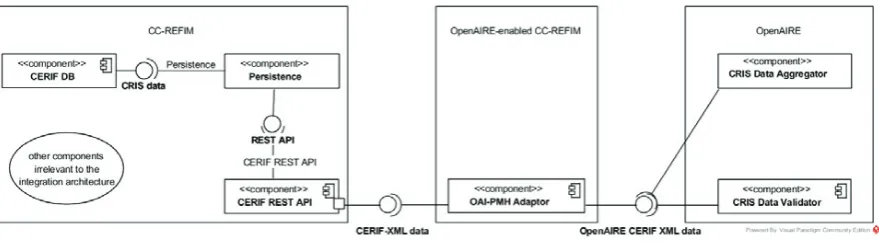
The integration between CC-REFIM and OpenAIRE (see Fig 1 below) relies on a pull strategy from the side of OpenAIRE. This means that OpenAIRE requests data from the CRIS (in this case CC-REFIM) for validation and, if appropriate, for its ingestion into OpenAIRE. The integration architecture involves an OAI-PMH server that handles the data retrieval. The OAI-PMH protocol was selected for homogeneity reasons as it is currently the main information exchange protocol adopted and used by OpenAIRE for data ingestion from other system types. Furthermore, the communication between the OAI-PMH server and the CRIS system is handled by a standard interface, the CERIF REST API9. The CERIF REST API, curated by euroCRIS, is a specification of a standard API that enables third-party software programs to access and reuse research information stored in CRIS systems. Thus, in this case the OAI-PMH server uses the standard API calls for retrieving all necessary data and embed them in an OAI-PMH message for relaying it to the OpenAIRE validator. The actual CRIS data in the OAI-PMH message is formatted to comply with the CERIF-XML schema and follow the OpenAIRE Guidelines for CRIS Managers4.
As aforementioned, CC-REFIM is based on a native CERIF database, meaning that the schema of the database is an explicit representation of the CERIF data model (currently at version CERIF 1.6.2). The CRUD functionalities of the database are operated by the Persistence software component as depicted in Figure 1. CC-REFIM also includes a service layer over the Persistence component that exposes its contents through a CERIF REST API in CERIF-XML format. The transformation of the CERIF database data to standard CERIF-XML is performed inside the CERIF REST API by a dedicated library. All these components, i.e. CERIF Model, CERIF Persistence, CERIF XML and CERIF REST API are provided as open source6. CC-REFIM is subsequently able to serve its database contents through a standard CERIF REST API in CERIF-XML format, a key feature in the integration case study with OpenAIRE.
and performs the validation process on the received data. The validation is operated through an administrator user interface, hosted at the OpenAIRE side.
Fig. 1. The CC-REFIM architecture for data exchange with OpenAIRE.
3.2. Case Study: Italian Regional Research Portal for Friuli-Venezia-Giulia
The web portal of the research of the Regione Friuli Venezia Giulia, called ResearchUnityFVG, is a web gateway for searching and spreading the research activities done by the SISSA, University of Trieste and University of Udine. The portal offers a central point of access to the open access repositories run by the single institutions allowing easy access without restrictions to the results of the research activities financed by public funds.
The beta version of the Portal was released at the end of 2015 and the final version is to be presented in June 2016 at the CRIS2016 Conference in St.Andrews, UK. The main objectives of this portal are:
x to provide a single point of access to the information about the research activities in the Region reusing the information already available at the individual institutions;
x to require zero administrative activities to keep the portal updated;
x to allow other institutions in the region to join the portal with minimal effort from both sides.
To achieve such goals the OAI-PMH protocol for the harvesting of the information available at the individual institutions was the ideal choice but a rich format was needed to allow the exchange of complex interconnected information such as the relation between publications, projects, people etc. Some institutions are running just a DSpace repository while others have adopted a proper CRIS solution such as IRIS or DSpace-CRIS and future partners could add other CRIS solutions to the landscape too. This is exactly the same scenario managed by the OpenAIRE project so when the guidelines for CRIS managers4were released, it was an evident choice to work on the implementation of such guidelines.
By choosing to adopt these public guidelines we have relieved the UnityFVG project from the effort of defining common cataloging practice and we have also made it easier for other institutions to join the initiative, as the technical requirements will hopefully be met by any future CRIS system that aims to follow international standards and be compliant with the recommendations and requirements from the EC funder. The expected OpenAIRE Validator for CRIS system will be also usable to certify the compliance of new systems to the requirements of the UnityFVG portal reducing the cost and effort necessary to manage the portal itself.
was also available. During the first half of 2016 Cineca, the technical partner for the project, have extended the OAI-PMH support available in DSpace-CRIS and DSpace to be able to manage the CERIF XML over OAI-OAI-PMH as described in the OpenAIRE guidelines for both content exposure and harvesting. The project has a mandate to release such development as open source software in order to promote its adoption by the whole community and the sharing of the maintenance cost of such features. These developments are described in more detail in another contribution11to the CRIS2016 Conference.
This case study shows two relevant successes for the OpenAIRE guidelines for CRIS managers and CERIF:
The first one is that the DSpace-CRIS software, while not being a native-CERIF solution, can be turned into a wrapped-CERIF solution using an appropriate mapping methodology, thus becoming able to successfully implement the OpenAIRE guidelines without facing major issues. Other existent open source libraries such as the EKT CERIF-Tools6and the XOAI framework are used to achieve the goals, showing how the adoption of open standards and open source components can result in cost efficiency and speed up project implementation.
The second positive result is that the implementation of a minimally sufficient CERIF format starting from poorly structured information available in a standard DSpace repository can result in immediate benefits such as the ability to expose the authors’ ORCID information where collected. The oai_dc format is indeed not able to carry such detail, but this can instead be exposed via the Federated Identifier for the cfPers entity.
4. Technical challenges for aggregating CRISs into OpenAIRE
The above-mentioned conceptual asymmetry between the graph based CERIF model and flat or hierarchical metadata schemas like DublinCore or MODS require different solutions for the aggregation into the OpenAIRE infrastructure which itself supports a graph-based data model. The OpenAIRE data model defined a subset of the CERIF entities and adopted the CERIF semantic layer approach to express entity relationships10. Whereas typical bibliographic metadata records (DublinCore) are self-contained, the OpenAIRE CERIF approach requires additional steps to extract the full information context of a publication, which includes the involved persons, projects, organizations and to map it into the entities of the data model. These extra steps can be omitted when all CERIF objects are imported into the OpenAIRE information space. However an update of the OAI-PMH import strategy for CRISs into OpenAIRE is necessary. Future discussions may lead to alternative protocol solutions to overcome the shortcomings in the way this harvesting protocol deals with the complex CERIF record information.
On validating OpenAIRE CERIF XML
The OpenAIRE CERIF XML is based on a custom-built XML Schema that is a restriction of the full CERIF XML Schema for CERIF 1.6. The former is the XML Schema that defines and constrains the structure of any OAI-PMH payload that may be produced by an OpenAIRE-compliant CRIS. Further validation rules include the following ones:
1. cfStartDate İİ cfEndDate. Whereever in the CERIF XML structure both cfStartDate and cfEndDate are specified, the cfStartDate must not be later than the cfEndDate. This is a generic CERIF integrity constraint. 2. One service descriptor.There is exactly one OpenAIRE CERIF Service instance in an OpenAIRE-enabled
CRIS. This service (a cfSrv OpenAIRE CERIF XML element) represents the CRIS itself and includes administrative meta-information such as (a link to) the organization that runs the CRIS (the “Owner”). 3. Mandatory information present. Wherever an attribute, an identifier, a classification in a specific
Example:The validator shall check that any project (a cfProj OpenAIRE CERIF XML element) does contain its title (an embedded cfTitle element).
Example: The validator shall check that any publication (a cfResPubl OpenAIRE CERIF XML element) does contain the type classification (an embedded cfResPubl_Class element with cfClassSchemeId=759af938-34ae-11e1-b86c-0800200c9a66†).
4. Maximum cardinality not exceeded. Wherever in the OpenAIRE Guidelines [4] an identifier, a classification in a specific classification scheme or a link with a specific role scheme is specified as having a bounded maximum cardinality (typically with the value of one, which means that at most one occurrence is expected), the validator must check that the identifier, classification or link is not present more times than it was specified.
Example: The validator shall check that for any product / dataset (a cfResProd OpenAIRE CERIF XML element) at most one license type is present (as an embedded cfResProd_Class element with cfClassSchemeId=704845f1-6b38-4130-be96-e65e3b9ef80d‡).
5. No information items outside the specification. The OpenAIRE Guidelines4 specify closed lists of classifications, roles, or identifier types that can occur with any OpenAIRE CERIF entity§. The validator shall check that the classifications, roles and types of actual information items belong to those lists.
Example: The validator shall check that the role in the link between a project and an organization unit (cfProj_OrgUnit which can occur within either cfProj or cfOrgUnit) is one of the admissible six roles as specified (i.e., the cfClassId has one of the values c31d3380-1cfd-11e1-8bc2-0800200c9a66, c77f9885-b80d-466a-9097-9768720c0fe1, abf21190-1cfc-11e1-8bc2-0800200c9a66, eda28bc0-34c5-11e1-b86c-0800200c9a66, 69948e23-7c53-4437-a33e-17c051b9281b, 33551370-1cfe-11e1-8bc2-0800200c9a66**). 6. Classification scheme consistency.Wherever a classification occurs, the validator shall check that it is used
in combination with a corresponding classification scheme.
Example: The validator shall check that the classification 31d222b4-11e0-434b-b5ae-088119c51189††is only used in reference to the classification scheme bccb3266-689d-4740-a039-c96594b4d916‡‡.
7. Referential integrity.All objects found at link ends shall be present and accessible through the CRIS OAI-PMH endpoint.
Example:When the cris.example.org CRIS presents a publication (represented by a cfResPubl OpenAIRE CERIF XML element) that links to a person with identifier 12345, the OAI-PMH record with identifier oai:cris.example.org:cfPers/12345 shall be present and accessible in both the openaire_cris and openaire_cris_persons OAI-PMH sets.
The structure of OpenAIRE CERIF entities presents unique challenges for both the OpenAIRE Validator and OpenAIRE Aggregator services. A sensible strategy to tackle those challenges involves a caching (staging) database that records the XML objects as they are received.
An early implementation of the OpenAIRE validator service enabling CERIF validation compatibility tests is available at https://beta.openaire.eu/validator/.
†
The UUID of the “Output Types” classification scheme ‡
The UUID of the “License Types” classification scheme §
In the case of subject classifications, the lists of admissible classifications shall be retrieved from the resource that is referenced in the CRIS’s self-description as cfService
* *
The UUIDs of the Coordinator, Partner, Contractor, Funder, In kind contributor, and Applicant classifications, respectively † †
The UUID of the “DOI” classification (the Digital Object Identifier) ‡‡
On aggregation of OpenAIRE CERIF-XML
The aggregation sub-system of the OpenAIRE infrastructure is responsible for the collection of information packages from external data providers, in our case the CERIF-XML objects, and their transformation into metadata records with uniform structure and semantics following the specification of the OpenAIRE data model. A dedicated ingestion workflow for CERIF entities is a multistage process and is similar to the Extract, Transform and Load process (ETL) in data warehousing. It consists of the following steps:
x Metadata harvesting.CERIF-XML objects are harvested from the openaire_cris OAI-set grouping all CERIF entities. All objects are stored in a single metadata store.
x Validation.In addition to the validation step at the registration of a CRIS in OpenAIRE the harvested CERIF objects will be continuously validated which includes referential integrity checks.
x Transformation.In contrast to the ingest of flat metadata formats like Dublin Core the import of CERIF objects requires a denormalization of the entities in order to add to a given entity (e.g. publication) the properties of related entities (e.g. information from the person entity). Finally the objects are transformed into a XML representation that reflects the structure of the OpenAIRE data model.
5. A roadmap for a gradual progress in CRIS harvesting
The first step in the roadmap for the implementation of these OpenAIRE guidelines for CRISs is making available a fully operational CRIS validator similar to the OpenAIRE validator for literature and data repositories (https://www.openaire.eu/validator). There is ongoing work on this at the moment, with a team at the University of Athens having already developed and early tested such a validator.
Once such testing system is made available in production, the first ‘external’ CRIS systems may start to test their compliance. As mentioned above, these will be in-house built institutional systems interested in collaborating with OpenAIRE for establishing the appropriate interface for implementing the guidelines. At the same time, conversations are being held with the commercial and open source CRIS providers in order to keep them updated on the progress of this work and in order for them to start looking into the possibility of becoming OpenAIRE-compliant when possible.
References
1. Príncipe, P., Rettberg, N., Rodrigues, E., Elbæk, M. K., Schirrwagen, J., Houssos, N., & Jörg, B. (2014). OpenAIRE Guidelines: supporting interoperability for Literature Repositories, Data Archives and CRIS. doi:10.1016/j.procs.2014.06.015
2. De Castro, P. (2014). COAR Repository Observatory. Third Edition - IR and CRIS. 7 things you should know about…Institutional Repositories, CRIS Systems, and their Interoperability, http://bit.ly/1x0eXkg
3. +RXVVRV1-|UJ%'YRĜiN-3UtQFLSH35RGULJXHV(, Manghi, P., & Elbæk, M. K. (2014). OpenAIRE guidelines for CRIS managers: supporting interoperability of open research information through established standards. Procedia Computer Science, 33, 33-38. doi:10.1016/j.procs.2014.06.006
4. Houssos, N., Joerg,%'YRĜiN-2SHQ$,5(*XLGHOLQHVIRU&5,60DQDJHUVGRL]HQRGR
5. Ribeiro, L., Mennielli, M., De Castro, P. (2016). EUNIS-euroCRIS Joint Survey on CRIS and IR (In Press) 6. EKT CERIF-Tools project: https://github.com/EKT/CERIF-Tools
7. DSpace CRIS - Documentation and Source Code: https://wiki.duraspace.org/display/DSPACECRIS
8. Brasse, V., Houssos 1 'YRĜiN - 6LFLOLD 0$ &(5,)-CRIS Reference Implementation (CC-REFIM) and CERIF compatibility testing system: Project Charter, http://hdl.handle.net/11366/487
9. Houssos, N., Karaiskos, D. (2015), CERIF REST API Specification v1.0, http://hdl.handle.net/11366/398
10. Manghi, P., Houssos, N., Mikulicic, M., & Jörg, B. (2012). The data model of the OpenAIRE scientific communication e-infrastructure. In Metadata and Semantics Research (pp. 168-180). Springer Berlin Heidelberg. doi:10.1007/978-3-642-35233-1_18, http://helios-eie.ekt.gr/EIE/bitstream/10442/13187/2/MTSR2012_60_camera_ready_final.pdf