
in High Fields
Remi Capdessus
1, Martin King
1, Dario Del Sorbo
2, Matthew Duff
1, Christopher P. Ridgers
2&
Paul McKenna
1The relativistic Doppler effect is one of the most famous implications of the principles of special
relativity and is intrinsic to moving radiation sources, relativistic optics and many astrophysical
phenomena. It occurs in the case of a plasma sail accelerated to relativistic velocities by an external driver, such as an ultra-intense laser pulse. Here we show that the relativistic Doppler effect on the high energy synchrotron photon emission (~10 MeV), strongly depends on two intrinsic properties of the plasma (charge state and ion mass) and the transverse extent of the driver. When the moving plasma
becomes relativistically transparent to the driver, we show that the γ-ray emission is Doppler-boosted
and the angular emission decreases; optimal for the highest charge-to-mass ratio ion species (i.e. a hydrogen plasma). This provides new fundamental insight into the generation of γ-rays in extreme conditions and informs related experiments using multi-petawatt laser facilities.
The relativistic Doppler effect—the change in the frequency of light due to the relative motion of the source and the observer—is a direct result of special relativity and has a number of consequences for both fundamen-tal and applied sciences. The knowledge of redshifts or blueshifts, occurring whenever a light-emitting source moves away from or toward an observer, has been applied not only to spectroscopic observations of astronomical objects, but also to develop several terrestrial technologies such as Doppler radar1. Relativistic Doppler effects
have been explored in the laboratory using ultra-intense laser radiation (~1018 W.cm−2) in order to produce XUV
radiation via the relativistic oscillating mirror2 and relativistic flying mirror schemes3.
At the even higher intensities (≥1023 Wcm−2)–expected to be achievable using multi-petawatt laser systems
such as the Extreme Light Infrastructure (ELI)– it will be possible to produce γ-ray sources as well as to enable the exploration of new fundamental processes predicted by classical and quantum electrodynamics (QED)4–6. The
intensities required for this can be parameterized as aL≡ m ceeEωLL 1, where aL is the normalized field strength, which represents the work (compared to mec2) performed by the field over λ
π
2L7, where λL, −e, me, ωL and EL are the laser wavelength, the electron charge, the electron rest mass, the laser frequency and the electric field amplitude, respectively. Such ultra-intense laser radiation will enable the laboratory production of extreme conditions in which collective effects are paramount, accessing physics similar to that encountered in astrophysical events8–10.
Due to the intense electromagnetic fields involved, quantum electrodynamics effects become important for χe≳ 0.1. The (Lorentz invariant) QED parameter χ ≡ γ
+ ×
⊥
E
E v B
e e
e
S is defined as the electric field in the electron’s rest frame in units of the Sauter-Schwinger field, Es=m c ee 3/ ~1016 Vcm−1 11, where γe is the electron Lorentz factor and E⊥ is the electric field perpendicular to the electron’s motion. This results in the production of copious amounts of synchrotron-like γ-ray emission12–16 and electron-positron pairs as χ
e tends to unity17–20. These effects
are maximized when the electrons counter-propagate with the laser pulse. They are also enhanced, due to the influence of collective plasma effects, when the plasma is relativistically underdense15,16,21; i.e. when the laser
fre-quency becomes higher than the relativistically-corrected-electron plasma frefre-quency ωp,e= n ee 2/γe e 0mε , where
ne is the electron density. Moreover, charged particle dynamics in strong fields are in particularly strongly affected by the radiation reaction (RR) force, that is, how a charged particle interacts with the radiation it emits. In particu-lar, the radiation reaction, which can be interpreted as a friction force in the semi-classical framework (recently shown to accurately describe the average energy loss of the electron population22,23), which strongly affects not only
the electron dynamics24–27 but also those of ions, through the charge-displacement-induced fields28–30.
In such ultra-intense laser-plasma interaction regimes, the plasma ions can no longer be considered as back-ground particles, since the quiver electron energy can be comparable with the ion rest mass. It has recently been
1SUPA Department of Physics, University of Strathclyde, Glasgow, G4 0NG, UK. 2York Plasma Institute, Department
of Physics, University of York, York, YO10 5DQ, UK. Correspondence and requests for materials should be addressed to R.C. (email: [email protected]) or P.M. (email: [email protected])
www.nature.com/scientificreports/
highlighted that the ion mass affects laser energy absorption and the production of high energy synchrotron-like radiation16. In particular, for a given charge state, heavier ions result in a higher yield of γ-rays, as well as an
enhancement in the radiation emitted in the backwards direction (with respect to laser propagation)16. This effect
is maximized for a thick plasma layer (i.e. the thickness is such that l~100λLls, where ls =c/ωcrit. is the skin
length) and relativistically underdense plasma layer. In the case of a thin plasma layer accelerated by a driving force (e.g. the radiation pressure of an ultra-intense laser pulse31,32), the ion inertia (due to its mass) could have an
impact on the radiation generated by the accelerated electrons through the Doppler effect, resulting from the longitudinal motion of the thin plasma layer. The role of ions in such strongly non-linear regimes remains poorly understood.
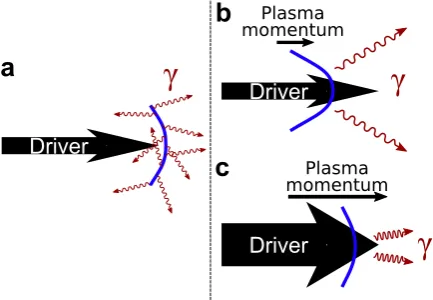
In this article, we demonstrate the influence of both the ion charge-to-mass ratio ( ) and the transverse extent of the driver (W0) on the high energy synchrotron radiation, emitted by accelerated electrons, as illustrated
sche-matically in Fig. 1. We consider an ultra-intense laser pulse as a driver, striking an overdense plasma layer at normal incidence. The plasma layer is accelerated to relativistic velocities via the laser radiation pressure. In doing so, we show that the relativistic Doppler effect can be tuned through the intrinsic properties of the plasma (charge state and ion mass) and the transverse extent of the driver (see Fig. 1), bringing a new way to control the emission of γ-rays.
Simulation Results
The laser-piston phase.
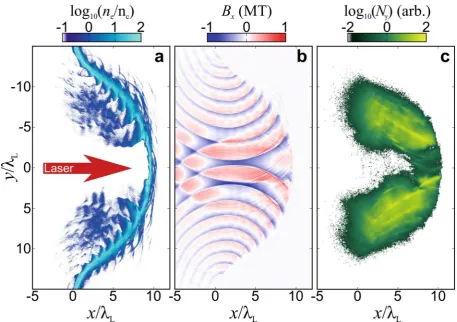
Figure 2 shows that the radiating electrons are magnetically-confined into bunches at the edges of the laser pulse, due to the transverse reflection of the surface plasma waves. They have a typical size close to the Larmor radius (rL) such as rL ~ cβe/(ωre) ~ γemec/eBx≃ 0.8λL (where ω =re pe×FL,e /pe2 is the instan-taneous electron rotation frequency, FL,e is the Lorentz force experienced by the electron, γe ~ aL= 200 and B0=meωL/e≃ 1.02 × 10⁴ T is the critical magnetic field) and are separated by one laser period (λL) as shown inFig. 2a,b. In these areas, the longitudinal magnetic field Bx as well as the longitudinal field Ex reaches roughly 40% and 60% of the maximal value of the laser magnetic field (i.e. Bx≃ 80B0≃ 0.8 MT) respectively and are the
domi-nant fields as the laser field amplitude decreases in the transverse direction due to the Gaussian shape of the laser spot. Therefore Bx induces collective dynamics that influences the synchrotron radiation (also pointed out in a different context in ref.33) such that a significant amount of radiated photons are emitted with an energy
ωγ0 44. γ ωe3 cr~10
MeV. The generation of the longitudinal magnetic field Bx is due to the reflection of plasma surface waves in the transverse direction (y), due to the transverse curvature of the plasma layer due to the finite size of the laser spot. At the centre of the plasma layer, the electrons are expelled from high intensity regions by the ponderomotive force and are accelerated forward, acquiring a strong longitudinal momentum such that
pe ~ aLmec. It has been shown that under these given conditions, the RR force (which can be seen as a friction force, proportional to the instantaneous radiated power; see Methods) can counteract the ponderomotive force and leads to the formation of a confined electron bunch propagating behind the laser pulse front26. However, for
such an effect to be efficient, the laser intensity has to be beyond ~1024 W/cm2, which is not the case here. Thus,
the ponderomotive force effect dominates the RR force effect, which prevents the formation of a confined electron bunch in the highest intensity area. Thus, most of the synchrotron radiation is produced at the edges of the trans-verse profile of the pulse and guided by Bx as shown in Fig. 2c.
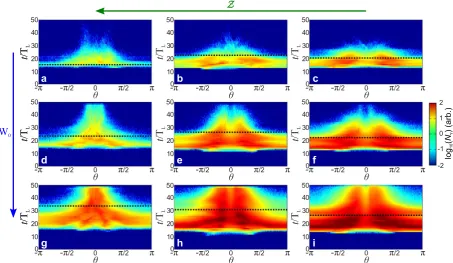
The temporal evolution of the angular distribution of 10 MeV photons shown in Fig. 3, demonstrates clear evi-dence of the effect of the laser spot size and the ion mass on the synchrotron radiation. As the plasma layer is Figure 1. Schematic illustration of a plasma sail pushed by the radiation pressure of a driver. While accelerated by the radiation pressure of a driver (a) the electrons of the plasma emit intense synchrotron radiation (from MeV to hundreds of MeV energy) which is Doppler-shifted due to the own motion of the sail. The momentum and dynamics of the sail depend on the transverse extent of the driver and the ion inertia, which has a
[image:2.595.155.372.48.198.2]moving at the average velocity 〈β〉, the angular distribution of the emitted radiation is modified through the Lorentz transform cosθ =1cos+ 〈 〉θβ′ + 〈 〉cosβθ′34. For simplicity, we assume that the transverse motion of the plasma can be
neglected compared to its longitudinal motion such that 〈β〉≈〈β〉ex and the related Lorentz factor is written
Γ≡ (1 −〈β〉2)−1/2. The primes denote variables computed in the instantaneous rest frame of the plasma layer. This
special relativity effect enhances the radiation production in the forward direction (θ ~ 0o) and tends to reduce the radiation emitted in the backward direction (|θ| ≈π). Since the moving plasma is accelerated this effect is amplified over time as shown in Fig. 3. Moreover, it is optimum for a plasma layer consisting of light ions irradiated by a large spot size as the average velocity of the plasma layer is maximized. As the plasma layer velocity increases over time, the Doppler shift on the radiation becomes more and more significant which can be identified in panels of Fig. 3 through a decrease of the angular emission. Moreover, the synchrotron radiation is Doppler-boosted via the factor
such as
β θ
β θ
≡ 〈 〉 =
Γ − 〈 〉
( , ) 1
(1 cos ) (1)
It is worth emphasizing why no high energy radiation is emitted before t*≈ 12 T
L as shown in Fig. 3. This time
can be easily recovered by assuming that the high energy synchrotron radiation generation (i.e. ωγMeV) becomes important from aL≈100= max[ ]2aL (I≃ 1022 W/cm2) implying t⁎≈trise− FWHM2 12TL where
trise≃ 18 TL is the rise time of the laser field. At the beginning of the interaction, the front of the plasma layer is
pushed by the ponderomotive force of the laser pulse which forms an electron density spike in front of the laser that reflects the laser pulse. This forms a double layer structure denoted laser-piston and implies the propagation of an electrostatic shock35. Due to this structure, the area which includes the shocked plasma without any laser
pulse, is separated from the area where there is only the laser pulse and no plasma. The radiation emitted by the electrons is therefore very weak, (i.e. the reflection coefficient in the piston frame of reference is close to unity).
After t=t* (which in our case also corresponds numerically to the time for which the laser-piston reaches the rear of the plasma layer35), a part of the electrons of the plasma layer are piled up at the rear of the target inducing
a highly dense electron bunch which reflects the electromagnetic pulse as shown in Fig. 2a. This generates a charge separation field, which accelerates the ions. This regime, known as the light sail regime, has been Figure 2. Simulation results of the interaction of an ultra-intense laser pulse with a plasma sail. The laser pulse (IL= 1023 Wcm−2) interacts at t= 0 with the plasma slab. The transverse extent of the driver (in this case equal
[image:3.595.98.556.42.364.2]www.nature.com/scientificreports/
investigated in a number of studies at moderate laser intensities, where the synchrotron radiation emission is non-existent or neglected31,32. Over time, the electrons experience higher fields and can escape the electron
turn-ing point. They are accelerated both within the risturn-ing edge of the laser pulse and due to the ion charge separation layer (Δi) ≃c〈β〉/ωp,i where ω =p i, n Zeγ εi( )m
i i 2
0 is the ion plasma frequency. Thus, the escaping electrons emit a signif-icant amount of synchrotron radiation as shown in panels of Fig. 3. Whilst the radiating electrons are guided by
Bx, the charge separation field, Ex boosts the energy of the radiating electrons, rendering their motion more cha-otic. Although, the ion mass enhances Ex16,36, the finite size of the laser spot induces an electric field normal to the plasma layer surface at the edge of the spot which leads to strong electron heating (which increases with W−
01) and thus an enhancement of the production of synchrotron radiation.
Although it could be supposed that the duration of the synchrotron radiation (τγ) depends uniquely on the
laser pulse duration (τL), we note that as the laser spot size increases, τγ increases significantly as shown in Fig. 3.
Indeed, we have τγ,[W0=15m]≈ ×3 τγ,[W0=3m]40TL140 fs, higher than τL= 30 fs. This can be explained as follows. There are two key processes competing: (i) the transverse expansion of the plasma layer, and (ii) the rela-tivistic longitudinal motion of the plasma. When the transverse expansion of the plasma is important (i.e. involv-ing small laser spot sizes, here, less than 6 μm), the electrons are swept away from the high field area before they can interact with the peak of the laser pulse. Thus, for small laser spot sizes, the transverse expansion process domi-nates compared to the relativistic longitudinal motion of the plasma. This implies that the time corresponding to the peak of the radiated intensity (tγ) is less than trise, as shown in Fig. 4a. On the contrary, for a [=1] plasma and
a large spot size, the relativistic longitudinal motion dominates, which tends to down-shift the laser frequency, thus decreasing the critical density, in the co-moving frame. This implies tγ≥trise. We stress that in the case of a
negligi-ble transverse expansion the inequality tγ≥trise is always fulfilled, which has been observed in ref.36. This
empha-sizes the influence of the collective plasma effects induced by the laser spot size on the synchrotron radiation. The time interval for which a large amount of radiation is emitted (between 70% and 90%), is strongly enhanced by the size of the spot. This can be identifiable as a strip with width roughly equal to tbreak−t*, as shown in panels of Fig. 3.
The breakout time tbreak corresponds to the time when the plasma layer becomes relativistically transparent to
the laser pulse and is plotted out in Fig. 4b and represented in black dashed lines in Fig. 3. This makes a clear link between the properties of the emitted radiation and the plasma layer evolution. We will see that when the plasma layer becomes relativistically transparent to the electromagnetic pulse, the angular emission of the synchrotron radiation decreases, with a characteristic angle.
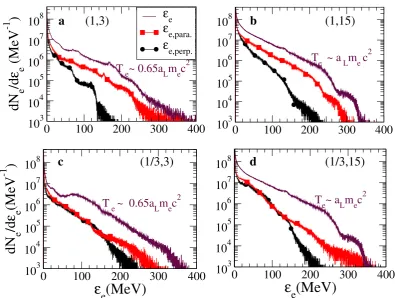
It is of interest also to consider how the ion charge-to-mass ratio and the laser spot size affect the electron temperature. Figure 5 shows the electron energy spectra at t=tγ (i.e. time corresponding to the maximum syn-chrotron radiation emission, plotted out in Fig. 4a), for [=1] and = 31 plasmas with W0= 3 μm and 15 μm. Figure 3. Two-dimensional particle-in-cell simulation results. Angular distribution of 10 MeV photons over time for several ion charge-to-mass ratio
≡ Z
m mi/ proton
. (a–c) W0= 3 μm; (d–f) W0= 6 μm; (g–i) W0= 15 μm.
[image:4.595.100.554.48.311.2]For each case, the full electron energy spectra as well as the perpendicular and the parallel components are plotted out. The hot electron temperature Te ≈aLmec2= 110 MeV (See Fig. 4) does not significantly depend on the ion
charge-to-mass ratio. In the case of W0= 3 μm the hot electron temperature is slightly reduced compared to the cases b and d, where W0= 15 μm. However, it is clear that the anisotropy ( ) of the electron distribution function defined as ≡ T⊥
Tee , ,
depends on these parameters. It tends to increase with W0−1 and mi since the longitudinal
Figure 4. Characteristic times of the simulation results. (a) Time corresponding to the peak of the radiated intensity (tγ) and (b) the relativistic transparency time (tbreak), as a function of the laser spot size (W0). Dashed blue lines, orange dashed-pointed lines and green lines represent [=1], =
1 2
and =
1
3 plasmas, respectively.
Figure 5. Electron energy spectra. The total energy electron spectra as well as parallel and perpendicular components are plotted out in maroon lines, red squares and black circles, respectively. (a) [=1] plasma and
W0= 3 μm; (b) [=1] plasma and W0= 15 μm; (c) = 13 plasma and W0= 3 μm; (d) = 13 plasma and W0= 15 μm. The spectra have been considered at the time corresponding to the maximum synchrotron
radiation emission (t=tγ), i.e., t = 17 TL, 20 TL, 16 TL and 17 TL respectively. The parallel and perpendicular
component of the temperature are defined compared with the direction of the laser wave propagation, i.e., the x
[image:5.595.159.552.46.206.2] [image:5.595.156.552.278.576.2]www.nature.com/scientificreports/
motion of the plasma layer is enhanced, which tends to increase the parallel component of the electron tempera-ture. The anisotropy turns out to be minimum for a [=1] plasma and W0= 15 μm, where it is about 0.34 and it
is maximum for a = 13 plasma such that ≈1. Indeed, for a = 13 plasma, the electron distribution func-tion is almost anisotropic for electrons with a kinetic energy (e) less than 150 MeV as shown in Fig. 5c,d. This highlights the important role of both ions and the laser spot size on the features of the electron distribution func-tion and so, on the synchrotron radiafunc-tion. The development of an analytical model highlighting the role of aniso-tropicity of the electron distribution on the synchrotron radiation is beyond the scope of this article and is left for future investigations.
Decrease of the angular emission.
As the plasma layer is expanded due to the transverse/longitudinal ponderomotive force, it becomes relativistically transparent to the laser pulse. The threshold of the transparency of the plasma layer may be estimated as37laser La t( )=ξ( )t (2)
where ≡ 〈 〉β θ − = − 〈 〉ββ + 〈 〉
( )
( , 0)
laser 1 11
1/2
is the Doppler factor on the laser photons. The shell surface
den-sity evolves in time due to the transverse expansion through ξ(t) =ξ0/Λ(t) where ξ0≡πnneλl
c L (see Methods) and
Λ(t) describes the transverse curvature of the expanded plasma layer and is inversely proportional to the laser spot size as illustrated in Fig. 1. From the relationship (2), we can see that the faster a plasma is moving, the longer it remains opaque to the laser, which is consistent with the values of the characteristic time tbreak shown
in Fig. 4b.
For a fixed laser spot size, a [=1] plasma will be transparent at later times compared to a plasma layer con-sisting of heavier ions as shown in Fig. 4b. This can be explained as follows. The lighter the ion, the higher the plasma layer velocity. Therefore, due to the Doppler down shift of the laser intensity in the instantaneous rest frame of the plasma layer (i.e. IL′=laser2 IL) the transparency process occurs later on with high . A smaller laser
spot size enhances the transverse ponderomotive force, which implies a faster transverse expansion of the plasma, resulting in transparency occurring earlier. This aspect is enhanced with increasing ion mass as the electron heat-ing is maximized. Such statements are consistent with with transparency times plotted in Fig. 4b. In the absence of transverse expansion, and immobile ions, one retrieves the well known threshold of the transparency that is
aL≃ξ31,38. When the plasma layer becomes transparent to the electromagnetic pulse (i.e. at t=tbreak), the reflection
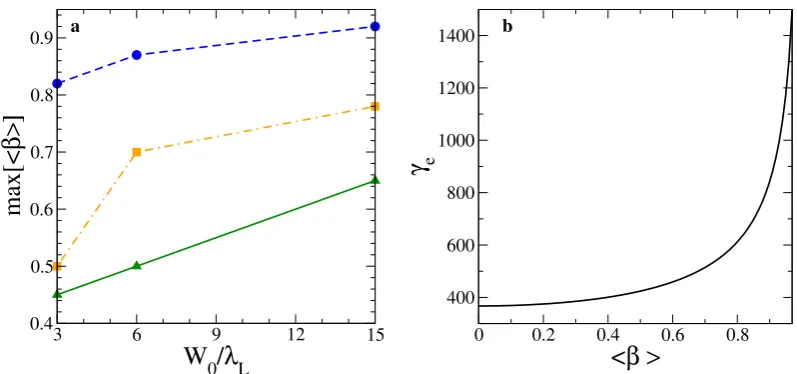
coefficient drops to zero. This implies not only a negligible radiation pressure but also the breakdown of the lon-gitudinal magnetic field structures, shown in Fig. 2b. The plasma layer is no longer accelerated and we may there-fore assume that plasma layer speed attains its maximum value (see Fig. 6a) and becomes constant (i.e.
β
∂ 〈 〉t t t≥break =0 and 〈 〉βt t=break = max[〈 〉β]) and the electromagnetic laser wave propagates now within a relativ-istically underdense plasma12,18. The radiating electrons propagate now in the direction of the laser wave
propa-gation since the longitudinal ponderomotive force dominates. Heuristically, from this stage of the interaction, the laser group velocity (vg) at t⪆tbreak is very close to the plasma speed, 〈 〉βtbreak. In the frame co-moving at 〈β〉, the electrons experience a time-varying rotating electric field18,39 and have a negligible longitudinal momentum,
p p
(i e ,. . ′x e, = ( ′⊥,e)). Here, p⊥,e refers to the component of the electron momentum perpendicular to the
direc-tion of the laser wave propagadirec-tion. Assuming a longitudinal modirec-tion (px,e ≫p⊥,e), from Lorentz transforms, we
Figure 6. Evolution of the plasma speed and the mean electron Lorentz factor. (a) Plasma speed as a function of the laser spot size
( )
Wλ0 [image:6.595.155.554.42.229.2]have p⊥,e=p′⊥,e and thus, γ′ ≈e ⊥ p m c
e e
,. Performing a Lorentz Transform to laboratory frame for the longitudinal component, px e, p m c p
1 1
x e, e e e
2 , 2 ⟨ ⟩ ⟨ ⟩ ⟨ ⟩ ⟨ ⟩
= γ β ≈
β
β β
′ + ′
− −
⊥ . This results in a decrease of the angular photon distribution, for
which the characteristic angle of emission
Θ ≡
⊥
arctan ppe x e ,
, may be written:
[image:7.595.93.556.44.193.2]β β θ Θ = − 〈 〉 〈 〉
〈| |〉γ ≥ .
arctan 1
(3)
t
t t t
2 break
break
break
This is consistent with previous work published in ref.12. In that paper, an electromagnetic pulse which
propa-gates within a semi-infinite relativistically underdense plasma is considered. The average angle of the radiation emission is expressed through the laser phase velocity such that Θ =(βφ2−1)1/2 +(βφ2−1). In their study, it is indeed easier to make reference to the phase velocity ≡ β ≈
− φ φ ω ω −
( )
v c c1 p e 2 1/2L
, rather than the plasma
veloc-ity itself, which is difficult to estimate in this interaction regime. We stress that from the relationship between the group velocity and the phase velocity, that is vgvφ=c2 and assuming vg ≈〈β〉, one recovers formula (3).
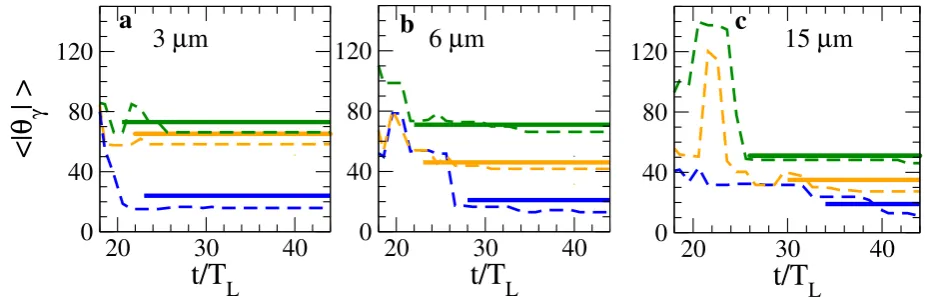
As the plasma velocity is higher for a [=1] plasma, it follows that the characteristic angle Θ is smaller for a
=
[ 1] plasma, which is consistent with the values of the mean angle of the synchrotron radiation 〈|θγ|〉 plotted
in Fig. 7. This characteristic angle is numerically defined as 〈| |〉 ≡θγ N1∑ |iN=1θγ,i|
y
y , where Nγ is the number of the emitted photons. The analytical values of Θ〈| |〉θγ t t≥break (3) (thick lines) are in very good agreement with the numerical simulation results. The best agreement is obtained in the cases of W0= 6 m and 15 μm. In the expres-sion (3) we have assumed that the plasma motion is mainly longitudinal; however, a smaller laser spot size induces a higher transverse ponderomotive force which tends to enhance the transverse speed of the moving plasma.
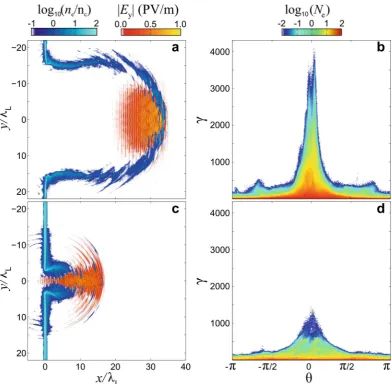
It is of interest also to examine the electron and laser field behavior during the transparency stage. Figure 8a,c show the electron density and the laser field at t=tγ+ 13 TL, for the two extreme cases, that is for which (tγ) and
β
〈 〉tbreak are maximum and minimum (see Figs 4a and 6a). For a [=1] plasma with W0= 15 μm, the electron
population behaves as a dense electron shell moving forward into forward-propagating high-amplitude electro-magnetic wave, whereas for a = 13 plasma with W0= 3 μm, the electron population is radially expelled by the
strong laser field. While the relativistic longitudinal motion of the plasma layer dominates in first case, the trans-verse expansion process tends to dominate in the second.
The electron energy-angular distributions for both cases are shown in Fig. 8b,d. In the case of an interaction involving both an ultra-strong electromagnetic field and ultra-relativistic electrons such that aL eγ2εrad−1, the electron Lorentz factor in the co-moving frame may be written γ′ ≈
+ + ε ε
( )
1e a a
1/2 1 1/2 L
L
rad rad
39. The parameter
εrad=τrω determines the strength of the radiation reaction force39 with τ = . × πε
− 6 2 10
r 6 em c 24
e 2
0 3 s being the
radiating time34. Performing a Lorentz transform from the co-moving frame to the laboratory frame we obtain an
estimate of the mean electron Lorentz factor:
Figure 7. Results of theoretical predictions and numerical simulations. Average angle of the synchrotron radiation 〈|θγ|〉 as a function of time, for different values of
( )
, Wλ0L . (a) W0= 3 μm. (b) W0= 6 μm. (c)
www.nature.com/scientificreports/
γ
ε ε β
≈
+
+
−
⟨ ⟩
t t a
a
( ) 1 1 1
1 , (4)
e L
L t
break
rad 1/2
rad 2
1/2
break
plotted out in Fig. 6b. This is in good agreement with the electron energy-angular distribution shown in Fig. 8b,d. Figure 9a shows the synchrotron radiation spectra. The influence of both and W0 on the synchrotron
radi-ation is significant. Whilst an increase in enhances the intensity of the radiation (via an increase of the self-consistent fields amplitude)16, a larger W
0 enables the emission of photons with energies higher than 100 MeV.
From numerical simulation data, we can estimate that the emitted radiation corresponds roughly to a brightness of the order of 1024 ph. s−1 mm−2 mrad−2 (0.1% bandwidth)−1 (see Methods). Once the plasma is transparent to
the electromagnetic wave, the synchrotron radiation is Doppler-boosted by the factor
β
β
≡ Θ =
Γ − Θ
. (⟨ ⟩ , ) ⟨ ⟩1
(1 cos ), (5)
t
t
[synchro rad] break
break
which is plotted out in Fig. 9b. We note further differences between the spectra for which W0= 15 μm because the plasma velocity is sufficiently high to induce a significant Doppler-boosted factor (i.e. D[synchro rad ,. . =Z 1,W0=15m]5), which makes the highest energy photons generated through a [=1] plasma and a
= 13 plasma
comparable.
Figure 8. Electron density and laser field behavior during the transparency regime. (a) The electron density and laser field. (b) The electron energy-angular distribution both for =
λ 15
W
L
0 , =1 at t =t
break+ 13 TL. (c,d) Same
but for =
λ 3
W
L
[image:8.595.159.552.43.427.2]Discussion
In the case of a thin plasma layer accelerated by a driving force, we have reported on the influence of the ion charge-to-mass ratio and the transverse extent of the driver on the relativistic Doppler-boosted synchrotron radi-ation. In the first phase of the interaction, while the radiating electrons are magnetically-confined via the longitu-dinal magnetic field, the charge separation field enhances the production of radiation. We have demonstrated for the first time that the ion charge-to-mass ratio and the transverse extent of the driver strongly affect the physics of relativistic transparency, which results in both a decrease and an ion-dependent degree of the angular emission of the synchrotron radiation produced. The angular emission is optimal for the highest charge-to-mass ratio ion species, that is, a hydrogen plasma.
The new insight gained into the generation of gamma rays through tuning the relativistic Doppler effect in this important new laser intensity regime paves the way for advancing the development of laser-plasma sources using next generation high power lasers. The experimental evidence of the ion charge-to-mass ratio dependence could be tested at the ELI laser facility with plastic targets such as C-H and C-D or cryogenic hydrogen/deuterium tar-gets. In the collisionless regime obtained with ultra-high intensity and ultra-high energy lasers interacting with low Z targets, the dynamics of the ions is dominated by the ion charge-to-mass ratio. As a first step, C-D plastic target foils can be used to produce a fully ionized C-D plasma with = 0.5, the same as a deuteron plasma. A fully ionized C-D plasma has 0 5. mZproton
proton, the same as a deuteron plasma. The angular emission of the γ-rays could be evaluated by measuring the angular distribution of the emitted radiation.
As a final remark, our simulation and theoretical results substantially advance our understanding of funda-mental ultra-relativistic plasma dynamics and could be relevant for fundafunda-mental science and applied sciences. Our results are an essential guide for experimentalists on next generation facilities, allowing them to tune the emission (i.e. duration, intensity, angular emission) of the radiation emitted from the target, by changing the ion charge-to-mass ratio and the laser spot size. Although the generated sources are comparable in brightness (~1024 ph. s−1 mm−2 mrad−2 (0.1%bandwidth)−1) with large conventional synchrotron sources, they achieve much
higher peak energies (10 MeV; i.e. one order of magnitude greater than conventional sources). In particular, they could be used to investigate the emission of the e−/e+ pair in the collision of γ-ray beams produced with high-intensity lasers40. This advances significantly the state-of-the-art of the field providing substantive
develop-ments towards ground-breaking papers where these experidevelop-ments are actually done. Moreover, the use of these plasmas as an intense source of radiation could be useful in order to improve the understanding of phenomena encountered in extreme astrophysical events41,42 (i.e. the role of and the transverse extent of the driving force:
in the dynamics of a radiative collisionless shock43, in the Doppler-boosting of the synchrotron emission in γ-ray
binaries44, in the anisotropicity on the gamma-ray burst afterglow emission45), which makes a fruitful connection
between subfields.
Methods
Underpining theory in strong electromagnetic fields.
The first covariant formulation was proposed by Dirac in the classical framework, for a charged particle experiencing an intense electromagnetic field, on the basis of energy momentum conservation46. However it is well known that the so-called Lorentz-Abraham-Dirac(LAD) equation suffers from anomalies, leading to unphysical solutions. Detailed discussions comparing models are given in references47,48. In order to account for the RR force, we consider the Landau Lifshitz equation34.
Retaining only the dominant term of the RR force proportional to γ = +e2 1 p m ce2/
e2 2, which can be seen as a
Figure 9. Results of numerical simulations. (a) Photon energy spectra above 3 MeV for several values of
( )
, λW0 L .
(b) The Doppler-boosted synchrotron factor synchro rad. .≡ Γ − 〈 〉[ (1 β cos )]Θ −1 (5) once the plasma is
[image:9.595.154.555.46.230.2]www.nature.com/scientificreports/
friction force, the vectorial form of the Landau Lifshitz equation can be recast as = − γβ p F d
dt e Le c e where, FLe =−e[E +cβe× B] is the Lorentz force, Fr ≡ −Pcγβe= −32αλfcG( )χ χe e2m ce 2βe is the dominant term of the RR force and γ is the instantaneous radiated power by one electron. To ensure a semi-classical framework, the dimensionless parameter χe defined as χ =e γe (E+cβe×EB) −(E.β)
2 e2
s , which measures the significance of quantum effects, must be less than unity. Here, Es=mec2/eƛc is the Schwinger field with ƛc the reduced Compton length. The
function ( )χe ≈[1+ .4 8(1+χe)ln(1+ .1 7 )χe + .2 44 ]χe2 2/3− 49 accounts for the quantum effects which
reduces the amplitude of the RR force.
The radiated intensity produced by an electron accelerated in strong electromagnetic fields may be written:
δΩ χ χ
=
− ϒ
ω γ γ
Ω − ( , ) dI d d p p e e e e
. The parameter χ =
γ 2m ce F F k kba cba c
e
3 4 is the associated quantum parameter for emitted photons. The function ϒ(χe, χγ) is defined as ϒ( ,χ χe γ)= +
∫
− χ χ χ χ ∞ γ γ
( )
yK y y K x dx4 2 2/3( ) 1 2 y 5/3( )
e e
, where y= 4χγ/[3χe(χe− 2χγ)] and Kn are modified Bessel functions of the second kind. In the semi-classical
limit which means χγ≪χe< 1, the function ϒ(χe, χγ) reduces to the Macdonald function33: ϒ( ,χ χe γ)→
∫
∞ ≡ ωω yc y K x dx5/3( ) Sc cr with
ω
≡ = ω ω
γ × −
yc 32 pep F 1
e cr
e3 L,e
2 . For aL≫ 1 the photon formation length becomes small. In this case the radiation is synchrotron-like, with spectrum given by the quantum synchrotron spec-trum49. It is emitted into a narrow cone within the angle 1/γ
e with respect to the electron propagation direction
and may be modeled by a Dirac function.
Numerical modeling.
To investigate the effects of the laser spot size (i.e. the transverse extent of the driver) and the ion charge-to-mass ratio on the synchrotron radiation, 2D numerical simulations have been performed with the QED-particle-in-cell code EPOCH50. Particle-In-Cell (PIC) codes provide a good description of plasmadynamics with reasonable precision and in an acceptable computing time. In particular, PIC codes are useful to study collective effects in plasma which dominate at ultra-high laser pulse intensities. In EPOCH, the interaction of the particles of the plasma (electrons, positrons and ions) with the electromagnetic fields are described by the quasi-classical model of Baier and Katkov51, meaning that the particles experience the Lorentz force and photon
emission with an emission probability7 which induces a recoil, conserving momentum. This recoil gives the
quan-tum equivalent of the RR force52.
In order to enable a plasma layer to be accelerated to relativistic velocities while allowing volumetric heating to generate radiation from the accelerated electrons, the initial shell surface density (ξ0≡πnneλl )
c L has to be such that
ξ0 aL. We thus consider a plasma layer with an initial density equal to 40 nc and with thickness l= 0.8 μm that is ξ0≃ 100, where nc=me Lω ε20/e2 is the critical density and λL= 1.0 μm. To highlight the role of the ion
charge-to-mass ratio and the laser spot size, three plasmas with differing ion charge-to-mass ratios, ≡ m m/Z
i proton
(1, 1
2 and 13) and three laser spot sizes, W0 (3 μm, 6 μm and 15 μm full-width half-maximum), have been considered. To enable the emission of intense and high energy radiation by accelerated electrons whilst enhancing the role of ions, we consider a circularly polarized laser pulse with an intensity peak of 1.1 × 10²³ W/cm2 (i.e. aL=ay =az = 200). The spatial and temporal laser profiles are chosen to be Gaussian since this corresponds to the
most common experimental profiles. The duration of the laser pulse is 8.6 TL (TL= ω2πL= 3.3 fs is the laser period)
which corresponds to the typical duration of laser pulses at next generation, multi-petawatt laser facilities, such as ELI. Due to the geometry of the interaction, the QED parameter of electrons χe is small compared to unity and
thus the production of e−/e+ pairs becomes negligible7 and thus, is not considered in this study. It becomes
impor-tant for laser intensities above 1024 W/cm2 17,18,53 (i.e. about one order in magnitude higher than in our study). The
laser pulse interacts at normal incidence with the plasma layer at t= 0 and the simulation box is defined on 200 λL× 50.6 λL using 20000 × 5060 mesh cells.
Computation of the plasma layer velocity and the transparency time.
The mean angle of emission of the high energy synchrotron-like radiation is related to the plasma layer velocity at the transparency time (tγ), when its speed is maximal. Since the analytical computation of the plasma layer velocity is not within the scope of the article, we have obtained this speed through simulation results by measuring the speed of the electron front (see Fig. 2a). To assess the transparency time (i.e., when ne =γenc), both the average electron density and the average electron Lorentz factor have been defined such as 〈 〉ne ≡W∫
− n dyW e
1 20 W
0 20 and 〈 〉γe ≡W
∫
− γdyW e
1 20 W
0 20 =W n
∫
−W
1 20
e W
0 20
∫
3f d dye e eγ p≈N∑kN=γ
(
− ≤ ≤y)
k W W
1
1 2 2
e
e 0 0 , where fe is the electron distribution function with
∫
3f de pe =ne.Estimation of the brightness of the
γ
-ray source.
From numerical simulations data, we can estimate the brightness (Bγ) as Bγ~ Nγσ Ω .TL1 10 1 % BW1 , where Nγ is the photon number, σ the characteristic surface over which the γ-ray source is generated and Ω is the solid angle. We assumed that the synchrotron radiation is mainly emit-ted within the laser spot size (i.e. σ≈π
( )
W20 2) and the solid angle of the source may be written as∫ ∫
ψ ψ θburnoff limit in magnetic reconnection: an explanation of the crab flares. Astrophys. J. 770, 147 (2013).
10. D’Angelo, M., Fedeli, L., Sgattoni, A., Pegoraro, F. & Macchi, A. Particle acceleration and radiation friction effects in the filamentation instability of pair plasmas. Mon. Not. R. Astron. Soc. 451, 3460–3467 (2015).
11. Schwinger, J. On Gauge Invariance and Vacuum Polarization. Phys. Rev. 82, 664 (1951).
12. Nakamura, T. et al. High-Power gamma-Ray Flash Generation in Ultraintense Laser-Plasma Interactions. Phys. Rev. Lett. 108, 195001 (2012).
13. Lobet, M. et al. Ultrafast Synchrotron-Enhanced Thermalization of Laser-Driven Colliding Pair Plasmas. Phys. Rev. Lett. 115, 215003 (2015).
14. Gonoskov, A. et al. Ultrabright GeV Photon Source via Controlled Electromagnetic Cascades in Laser-Dipole Waves. Phys. Rev. X
7, 041003 (2017).
15. Brady, C. S., Ridgers, C. P., Arber, T. D., Bell, A. R. & Kirk, J. G. Laser Absorption in Relativistically Underdense Plasmas by Synchrotron Radiation. Phys. Rev. Lett. 109, 245006 (2012).
16. Capdessus, R., d’Humiéres, E. & Tikhonchuk, V. T. Influence of Ion Mass on Laser-Energy Absorption and Synchrotron Radiation at Ultrahigh Laser Intensities. Phys. Rev. Lett 110, 215003 (2013).
17. Grismayer, T., Vranic, M., Martins, J. L., Fonseca, R. A. & Silva, L. O. Laser absorption via quantum electrodynamics cascades in counter propagating laser pulses. Phys. Plasmas 23, 056706 (2016).
18. Bell, A. R. & Kirk, J. G. Possibility of Prolific Pair Production with High-Power Lasers. Phys. Rev. Lett. 101, 200403 (2008). 19. Sokolov, I. V., Naumova, N. M., Nees, J. A. & Mourou, G. A. Pair Creation in QED-Strong Pulsed Laser Fields Interacting with
Electron Beams. Phys. Rev. Lett. 105, 195005 (2010).
20. Ridgers, C. P. et al. Dense Electron-Positron Plasmas and Ultraintense gamma-rays from Laser-Irradiated Solids. Phys. Rev. Lett.
108, 165006 (2012).
21. Gonzalez-Izquierdo, B. et al. Optically controlled dense current structures driven by relativistic plasma aperture-induced diffraction.
Nat. Phys. 12, 505–512 (2016).
22. Ridgers, C. P. et al. Signatures of quantum effects on radiation reaction in laser-electron-beam collisions. J. Plasma Phys. 83, 5 (2017). 23. Niel, F., Riconda, C., Amiranoff, F., Duclous, R. & Grech, M. From quantum to classical modeling of radiation reaction: A focus on
stochasticity effects. Phys. Rev. E 97, 043209 (2018).
24. Di Piazza, A., Hatsagortsyan, A. K. Z. & Keitel, C. H. Strong Signatures of Radiation Reaction below the Radiation-Dominated Regime. Phys. Rev. Lett. 102, 254802 (2009).
25. Gonoskov, A. et al. Anomalous Radiative Trapping in Laser Fields of Extreme Intensity. Phys. Rev. Lett 113, 014801 (2014). 26. Ji, L. L., Pukhov, A., Kostyukov, I., Yu., Shen, B. F. & Akli, K. Radiation-Reaction Trapping of Electrons in Extreme Laser Fields. Phys.
Rev. Lett. 112, 145003 (2014).
27. Tamburini, M. et al. Radiation reaction effects on electron nonlinear dynamics and ion acceleration in laser-solid interaction. Nucl. Inst. Meth. Phys. Res. A 653, 181–185 (2011).
28. Tamburini, M., Pegoraro, F., Di Piazza, A., Keitel, C. H. & Macchi, A. Radiation reaction effects on radiation pressure acceleration.
New. J. Phys. 12, 123005 (2010).
29. Capdessus, R. & McKenna, P. Influence of radiation reaction force on ultraintense laser-driven ion acceleration. Phys. Rev. E 91, 053105 (2015).
30. Nerush, E. N. & Kostyukov, I. Y. Laser-driven hole boring and gamma-ray emission in high-density plasmas. Plasma Phys. Control. Fusion 57, 035007 (2015).
31. Macchi, A., Veghini, S. & Pegoraro, F. “Light Sail” Acceleration Reexamined. Phys. Rev. Lett. 103, 085003 (2009).
32. Esirkepov, T. Z., Borghesi, M., Bulanov, S. V., Mourou, G. & Tajima, T. Highly Efficient Relativistic-Ion Generation in the Laser-Piston Regime. Phys. Rev. Lett. 92, 175003 (2004).
33. Stark, D. J., Toncian, T. & Arefiev, A. V. Enhanced Multi-MeV Photon Emission by a Laser-Driven Electron Beam in a Self-Generated Magnetic Field. Phys. Rev. Lett. 116, 185003 (2016).
34. Landau, L. D. & Lifschitz, E. M. The Classical Theory of Fields. 4th ed. Pergamon, New York, Vol. 2 (1994).
35. Robinson, A. P. L. et al. Relativistically correct hole-boring and ion acceleration by circularly polarized laser pulses. Plasma Phys. Control. Fusion 51, 024004 (2009).
36. Capdessus, R., Lobet, M., d’Humiéres, E. & Tikhonchuk, V. T. gamma-ray generation enhancement by the charge separation field in laser-target interaction in the radiation dominated regime. Phys. Plasmas 21, 123120 (2014).
37. Bulanov, S. V. et al. Unlimited Ion Acceleration by Radiation Pressure. Phys. Rev. Lett. 104, 135003 (2010).
38. Vshivkov, V. A., Naumova, N. M., Pegoraro, F. & Bulanov, S. V. Nonlinear electrodynamics of the interaction of ultra-intense laser pulses with a thin foil. Phys. Plasmas 5, 2727 (1998).
39. Bulanov, S. V., Esirkepov, T. Zh., Kando, M., Koga, J. K. & Bulanov, S. S. Lorentz-Abraham-Dirac versus Landau-Lifshitz radiation friction force in the ultrarelativistic electron interaction with electromagnetic wave (exact solutions). Phys. Rev. E 84, 056605 (2011). 40. Ribeyre, X. et al. Pair creation in collision of γ-ray beams produced with high-intensity lasers. Phys. Rev. E 93, 013201 (2016). 41. Bulanov, S. V., Esirkepov, T., Zh., Habs, D., Pegoraro, F. & Tajima, T. Relativistic laser-matter interaction and relativistic laboratory
astrophysics. Eur. Phys. J. D 55, 483–507 (2009).
42. Piran, T. The physics of gamma-ray bursts. Rev. Mod. Phys. 76 (2004).
43. Medvedev, M. V. & Spitkovsky, A. Radiative cooling in relativistic collisionless shocks: can simulations and experiments probe relevant gamma-ray burst physics? Astrophysics. J. 700, 2 (2009).
44. Dubus, G., Cerutti, B. & Henri, G. Relativistic Doppler-boosted emission in gamma-ray binaries. A&A 516, A18 (2010).
www.nature.com/scientificreports/
46. Dirac, P. A. M. Classical theory of radiating electrons. Proc. R. Soc. A 167, 148–169 (1938).
47. Burton, D. A. & Noble, A. Aspects of electromagnetic radiation reaction in strong fields. Contemporary Phys. 55, 110 (2014). 48. Capdessus, R., Noble, A., Mckenna, P. & Jaroszynski, D. A. Role of momentum and velocities for radiating electrons. Phys. Rev. D 93,
045034 (2016).
49. Erber, T. High-energy Electromagnetic Conversion Processes in Intense Magnetic Fields. Rev. Mod. Phys. 38, 4 (1966). 50. Arber, T. D. et al. Contemporary particle-in-cell approach to laser-plasma modelling. Plasma Phys. Control. Fusion 57, 11 (2015). 51. Baier, V. N. & Katkov, V. M. Quasiclassical theory of Bremsstrahlung by relativistic particles. Sov. Phys. JETP 26, 854 (1968). 52. Di Piazza, A., Hatsagortsyan, K. Z. & Keitel, C. H. Quantum radiation reaction effects in multiphoton Compton scattering. Phys. Rev.
Lett. 105, 220403 (2010).
53. Stark, D. J. et al. Relativistic Plasma Polarizer: Impact of Temperature Anisotropy on Relativistic Transparency. Phys. Rev. Lett. 115, 025002 (2015).
Acknowledgements
This work is supported by EPSRC (Grant Nos. EP/P007082/1, EP/M018091/1 and EP/R006202/1). EPOCH was developed under EPSRC Grant No. EP/G054940/1. Data associated with research published in this paper is accessible at https://doi.org/10.15129/aca1eeb1-80ab-485d-8307-3e2289631a9d.
Author Contributions
R.C. developed the analytical theory and analysed the simulation results. M.K. performed the numerical simulations and designed some figures of the manuscript. The manuscript was prepared by R.C. with contributions from P.M. and input from M.K., D.S., C.P.R. and M.D.
Additional Information
Competing Interests: The authors declare no competing interests.
Publisher's note: Springer Nature remains neutral with regard to jurisdictional claims in published maps and institutional affiliations.
Open Access This article is licensed under a Creative Commons Attribution 4.0 International License, which permits use, sharing, adaptation, distribution and reproduction in any medium or format, as long as you give appropriate credit to the original author(s) and the source, provide a link to the Cre-ative Commons license, and indicate if changes were made. The images or other third party material in this article are included in the article’s Creative Commons license, unless indicated otherwise in a credit line to the material. If material is not included in the article’s Creative Commons license and your intended use is not per-mitted by statutory regulation or exceeds the perper-mitted use, you will need to obtain permission directly from the copyright holder. To view a copy of this license, visit http://creativecommons.org/licenses/by/4.0/.
![Figure 9.=max〈 〉βbreakλtransparent to the electromagnetic wave (i.e. (b) The Doppler-boosted synchrotron factor t 1 (5) once the plasma is synchro rad[ (1cos)]−..≡ Γ− 〈 〉βΘ≥ tbreak), as a function of the plasma velocity 〈 〉βt(,≥Wt](https://thumb-us.123doks.com/thumbv2/123dok_us/1368791.90237/9.595.154.555.46.230/figure-bbreakl-transparent-electromagnetic-doppler-synchrotron-function-velocity.webp)