City, University of London Institutional Repository
Citation
:
Furnari, S. (2018). When does an issue trigger change in a field? A comparative approach to issue frames, field structures and types of field change. Human Relations, 71(3), pp. 321-348. doi: 10.1177/0018726717726861This is the accepted version of the paper.
This version of the publication may differ from the final published
version.
Permanent repository link:
http://openaccess.city.ac.uk/19485/Link to published version
:
http://dx.doi.org/10.1177/0018726717726861Copyright and reuse:
City Research Online aims to make research
outputs of City, University of London available to a wider audience.
Copyright and Moral Rights remain with the author(s) and/or copyright
holders. URLs from City Research Online may be freely distributed and
linked to.
City Research Online: http://openaccess.city.ac.uk/ [email protected]
When does an issue trigger change in a field? A comparative approach to issue frames,
field structures and types of field change
Santi Furnari
Abstract
Previous research has shown that institutional fields evolve around issues, but has devoted
less attention to explain why certain issues trigger substantial field-level changes while others
remain largely inconsequential. In this paper, I argue that the extent to which an issue is
likely to trigger field change and the type of field change triggered depend on the structure of
the field and the ways in which the issue is framed. I develop a model linking two types of
issue frames (adversarial vs collaborative issue frames) with two types of field structures
(centralized vs fragmented). The model explains how the likelihood of field change and type
of field change vary across four configurations of these issue frames and field structures. In
particular, I highlight four types of field change that entail different re-distribution of power
within a field (weakening vs reinforcing the field’s elite; aligning vs polarizing fragmented
actors). Overall, I contribute a much called-for comparative approach to institutional fields,
explaining how the effects of issue frames on field change vary across different fields.
Keywords
“The aviation industry will tomorrow make a dramatic pledge to slash carbon dioxide
emissions in half by 2050….The British Airways chief executive, Willie Walsh, will
unveil an agreement between airlines, airports and aircraft companies to cut
emissions to 50% below 2005 levels by 2050. Walsh warned earlier this year that
[this agreement] would add around £3bn per year to industry costs…”
(The Guardian, September 21st, 2009).
Litrico and David (2017) show how the issue of carbon emissions transformed the
field of civil aviation from a valued icon of globalization to a visible symbol of environmental
degradation in a surprisingly short time (p. 990). In fact, this issue became so prominent to
prompt key field actors, such as airlines and airports, to change the existing “rules of the
game” and reach a new “field settlement” –i.e. a common framework of action to deal with
the issue (Litrico and David, 2017: 988)- embodied by the emission cuts’ collective
agreement described above. This example highlights how some issues can catalyze enough
support to break the “iron cage” (Di Maggio and Powell, 1983) in which organizations
routinely operate within their field, inducing them to change the otherwise stable normative
and cognitive frameworks underlying existing field settlements (Scott, 1994: 207).
Yet, for every issue that succeeds in triggering substantial change in a field, there are
many other issues that remain largely inconsequential or even fail to attract enough attention
and support. For example, Carpenter (2007) documents how the issue of child abuse struggled
to attract attention and support in the transnational advocacy field, leading to “issue
non-emergence” (p. 99). O’Sullivan and O’Dwyer (2015) show how the issue of socially
accountable finance was captured and eventually absorbed into existing field settlements by
examples illustrate not only that issues may or may not lead to actual field change, but also
that the type of change triggered by issues can be substantially different.
To address this phenomenon, this paper investigates two research questions: 1) When
is an issue more likely to trigger field change? 2) What different types of field change are
more likely to be triggered by an issue? These questions have been addressed only partially
by current institutional research. Scholars have long recognized that fields “become centers of
debates in which competing interests negotiate over issue interpretation” (Hoffman, 1999:
351), highlighting that the field-level debates surrounding an issue are consequential for the
structuring of institutional fields (e.g. Meyer and Hollerer, 2010). Central to these accounts is
the idea that issues have no objective meaning attached to them (Blumer, 1971), but are
assigned meaning through “issue frames” –i.e. schemata of interpretation that field actors use
to perceive, identify and label issues “in ways that are intended to mobilize potential
adherents and constituents” (Snow and Benford, 1988: 198; cf. Goffman, 1974: 21). This
perspective emphasises the dynamic relationship between issue frames and field change,
unpacking a variety of processes by which frames can effect change, such as field-level
framing contests (e.g. Gurses and Ozcan, 2015), bottom-up processes of frame amplification
(e.g. Gray et al. 2015), frame mobilization (e.g. Granqvist and Laurila, 2011) and frame shifts
(e.g. Litrico and David, 2017).
While this research has contributed key insights, it has also featured two important
scope limitations. First, studies of field-level change have largely examined one single field at
a time, devoting less attention to theorize how the outcomes of framing processes may vary
across different fields –i.e. whether frames’ effects on field change depend on different fields’
characteristics. In fact, as Greenwood and colleagues noted, “fields are not all the same.
Perhaps surprisingly, therefore, relatively little attention has been given to comparing fields or
original). Second, extant literature conceived field change mostly as a discrete “disruption” of
the existing institutional order, paying less attention to theorize more nuanced types of
field-level change. In fact, in their comprehensive review of institutional field research, Zietsma
and colleagues recently argued that “there is a lack of theorization in studying field-level
change holistically” (Zietsma et al., 2017: 409).
To begin addressing these limitations, in this paper I develop a model explaining how
field structures and the content of issue frames jointly shape the likelihood that a given issue
triggers field change and the type of change that is likely to be triggered. Building on social
movement research and institutional theory, I identify two types of issue frames (adversarial
vs collaborative) and two types of field structures (centralized vs fragmented). I argue that
adversarial and collaborative issue frames are more or less likely to trigger field change
depending on whether the structure of the field is centralized or fragmented. This is because
the capacity of these different issue frames to mobilize the “critical mass of support” needed
for field change varies across different field structures. I also argue that, when an issue frame
triggers field change, the type of change triggered is likely to be different depending on the
content of the frame and the type of field structure. In particular, I highlight four types of field
change that entail different re-distribution of power within a field –i.e. changes that either
reinforce or weaken the field’s elite in a centralized field; and changes that either polarize or
align the uncoordinated actors populating a fragmented field.
This paper makes three contributions to the extant literature. First, I contribute to
issue-based approaches to institutional fields (e.g. Hoffman, 1999; 2001; Meyer and Hollerer,
2010; Litrico and David, 2017) by providing a model explaining when an issue is more likely
to trigger field change. While previous research has established that issue frames are
consequential for field change, this paper extends this general insight by specifying the
field change are crucially contingent on the field structure in which issue framing occurs.
Second, I contribute to studies of field change (e.g. Dacin et al., 2002; Zietsma and Lawrence,
2010) by identifying four types of field changes that entail different re-distributions of power
in a field. By doing so, I follow Zietsma and colleagues (2017)’s call to better understand the
effect of change on power relations in a field (p. 409-410). While several “change pathways”
in institutional fields have been recently identified (Zietsma et al., 2017) , these pathways
capture changes in the institutional infrastructure and logics prioritization in a field, devoting
relatively less attention to the patterned ways in which field-level power can change. In fact,
power has been highlighted as the “most neglected component” of the field’s construct
(Meyer & Greenwood, 2008: 262), despite its fundamental importance in Di Maggio and
Powell (1983)’s original conception of fields. Third, I contribute to social movement research
by developing a typology of issue frames. While social movement research has typically
defined frames inductively and empirically, this typology provides a theory-based
conceptualization of the common and salient characteristics underlying a variety
empirically-specified frames, thus responding to the call for theorizing the elements of frames that are
more abstract and generalizable across contexts and issues (e.g. Benford, 1997).
This paper is structured in three main sections. First, I discuss existing research about
fields and field change. Second, I develop the model and propositions advanced in this paper.
Third, I discuss the theoretical contributions of the paper and its implications for practice.
Perspectives on fields and field change
An institutional field is generally defined as “a community of organizations that
fatefully with one another than with actors outside of the field” (Scott, 1994: 206-207). At
least two perspectives on fields and field change can be distinguished in the literature.
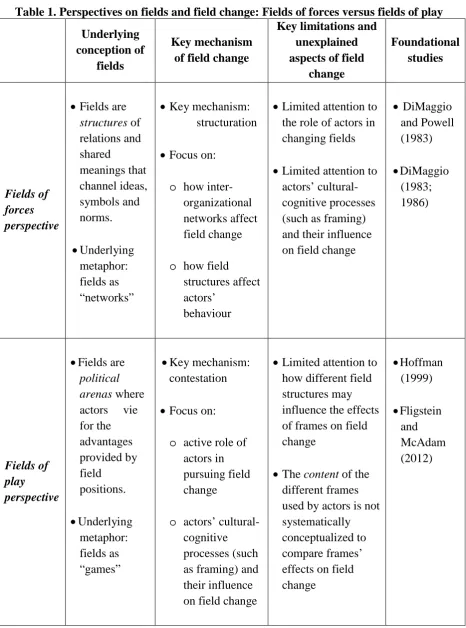
A first perspective conceives fields as durable structures of network relations and
shared meanings that channel ideas, symbols and norms (e.g. Di Maggio and Powell, 1983;
Meyer et al. 1987; Scott, 1994; Scott et al., 2000). In this structural view, fields are seen as
fields of forces (cf. Martin, 2003: 28) in that they shape and regulate actors’ behaviour by
defining “culturally legitimate models of organization and action” (Clemens & Cook, 1999:
442). Scholars in this tradition have identified field structuration as the key mechanism
through which fields form and change (e.g. DiMaggio & Powell, 1983), arguing that the
evolution of networks of inter-organizational relations is a key driver of field change (e.g. Di
Maggio, 1986; Powell et al., 2005; see Owen-Smith & Powell, 2009 for review).
Although these studies provided crucial insights, they also featured two limitations.
First, as it has been long noted (see Battilana et al. 2009 for review), they under-stated the
role of actors in changing fields, often depicting field structuration as a “top-down
deterministic process” in which free floating templates of meaning “become imposed on
actors a result of increasing consolidation and domination within a field” (Suddaby et al.
2007: 356). Second, they over-emphasized the relational-network components of fields
(Mohr, 2005), devoting less attention to the cultural-cognitive processes by which actors can
change fields, such as the framing process by which actors construct frames to mobilize
support for field-level change (e.g. Granqvist & Laurila, 2011; Gray et al., 2015).
A second perspective has instead conceived fields as fields of play (cf. Owen-Smith &
Powell, 2008: 599; Martin, 2003: 20) –i.e. structured spaces of positions or “arenas” where
actors compete for the advantages conveyed by those positions (e.g. Hoffman, 1999; Fligstein
& McAdam, 2012; Bourdieu & Wacquant 1992). This political conception has highlighted
existing social order to enhance their field positions. In this view, contestation is a key
mechanism of field change (e.g. Hoffman, 1999; Zietsma & Lawrence, 2010). Differently
from structuration studies, this political perspective has emphasized the agency of field actors
in initiating and pursuing field-level change, pointing at the active role of social movements
(e.g. Lounsbury & Schneiberg, 2008), institutional entrepreneurs (e.g. Levy & Scully, 2007)
and new or peripheral players (e.g. Sauder, 2009; Leblebici et al., 1991).
An emerging research stream within this political perspective has highlighted the key
importance of frames to explain the field-level change (Litrico and David, 2017; Gurses and
Ozcan, 2015; Gray et al. 2015; Granqvist and Laurila, 2011; Guerard et al. 2013).1 Overall,
this body of work builds on insights from social movement studies, which first broke ground
in pointing at the role of frames in mobilizing support and resources for change (e.g. Benford
& Snow, 1988; 2000; Gamson, 1992; see Cornelissen & Werner, 2014 for review). Similarly,
institutional scholars contended that framing dynamics are integral not only to social
movements but more generally to the evolution of institutional fields (see Schneiberg &
Lounsbury, 2008 for review), showing a variety of processes by which frames can amplify
consensus around issues to bring about field change (e.g. Granqvist and Laurila, 2011; Gurses
& Ozcan, 2015) and highlighting how frames change over time (Guerard et al. 2013; Litrico
& David, 2017; Gray et al. 2015).
Although these studies have provided a dynamic view of fields, they have devoted
less attention to how field structures may influence the effectiveness of different types of
frames in producing field change. In addition, scholars in this tradition have mostly focused
on frames’ changes and framing processes, devoting less attention to systematically
conceptualize the content of different frames and the different effects that such frames can
highlighted that the content of frames is crucially important to understand why certain frames
are resonant with potential supporters (see Johnston & Noakes, 2005 for review).
---
Insert Table 1 about here
---
Juxtaposing these two perspectives–summarized in Table 1- we note that each of them
has separately emphasized one important driver of field change –i.e. either
inter-organizational networks or actors’ frames- but that these drivers have been mostly analyzed
in relative isolation. However, extensive research has highlighted that field structures and
actors’ frames are inherently inter-related, so that understanding their interaction is crucial to
more fully explain field change (e.g. Scott, 2008; Battilana et al., 2009; Greenwood et al.,
2011; Grey et al. 2015). One of the reasons why extant research has not systematically
conceptualized the relationship between field structures and frames is that the vast majority
of studies of field change have relied on single case studies, thereby focusing on one type of
field structure at a time.
To overcome this limitation, we need an explicitly comparative approach explaining
how the effects of issue frames on field change vary across different types of field structures.
Indeed, a “systematic program of comparative research” is “essential if we are to develop a
better understanding of how and why we observe some [change] outcomes, but not others,
given similar contextual conditions” (Micelotta et al., 2017: 21). Comparative frameworks
are well-suited to “uncover sources of persistent heterogeneity by focusing on contextual
differences” (King et al., 2009). Yet, despite comparative approaches have been foundational
to organizational sociology at large (see, for example, Gouldner, 1954; Blau, 1955), a
systematic comparative approach to issue frames and field-level change still awaits full
of the field-level institutional change’s literature by noting that this “research has been
dominantly non-comparative” (Micelotta et al., 2017: 20; emphasis in original).
In the following section, I start outlining such a comparative approach by connecting
field structures, issue frames and field change.
Field structures, issue frames and field change
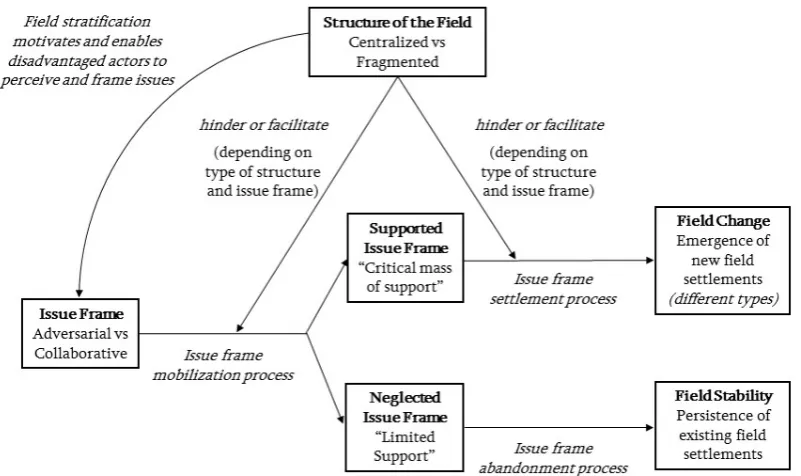
Figure 1 depicts the processes linking field structures, issue frames and field change.
Below, I will first describe these processes, explaining the overall logic that connects field
structures, issue frames and field change. I will then present a typology of issue frames and
provide the definitions of centralized and fragmented structures. Next, I will introduce the
core model advanced in this paper and illustrate propositions concerning the expected
relationships between different types of field structures, issue frames and field changes.2
---
Insert Figure 1 about here
---
Figure 1 depicts field-level change as a cyclical process underpinned by the periodic
emergence of “issues” (Hoffman, 1999), generally defined here as “unsettled matters of
importance” (Merriam-Webster Dictionary, 2016) for the interests and objectives of some
field actors. By “unsettled” I mean the fact that some actors perceive a given matter as in
need of future action and discussion. Indeed, as Dutton and Jackson (1987) famously argued,
the concept of issue features “importance” and “future-oriented” as its key attributes (p. 80).
As mentioned in the introduction, the nature of an issue is not objectively determined but
rather socially constructed by actors through framing (cf. Blumer, 1971). Thus, issues
Issues emerge when some field actors –i.e. issue proponents- start seeing and
constructing some matter as “unsettled” and “important” (i.e. as an issue). Issue proponents
emerge as the internal stratification of the field creates disadvantaged “field positions” (e.g.
Battilana, 2006; cf. Bourdieu, 1990), which make their occupants more likely to perceive and
frame some matter as an issue (e.g. Leblebici et al. 1991; Battilana et al., 2009). Because of
their disadvantaged positions, issue proponents are more likely to dis-embed themselves from
existing field structures (e.g. Seo & Creed, 2002; Battilana, 2006) and perceive, frame, and
act upon issues in order to change the field structures that disadvantage them.
In order to change existing field structures, issue proponents attempt to mobilize the
support of other field actors on their views of the issue. They do so by engaging in “issue
framing” –i.e. by crafting issue frames that make some aspects of an issue more salient to
other field actors in order to attract their support (e.g. Benford and Snow 2000). By “support”
here I indicate the commitment of material, cognitive and emotional resources (such as
attention, money, time, energy and effort) to the issue frame advocated by proponents
(Klandermans, 2004). Given that multiple issue frames typically co-exist in a field at any
given point in time and given that the support of other field actors is a scarce resource in a
field (e.g. Hillgarnter and Bosk, 1988), issue frames compete among each other to mobilize
others’ support (“issue mobilization process”). Thus, many issue frames will not succeed in
mobilizing support in the field (“neglected issue frame”), eventually decaying from
field-level debates (“issue frame abandonment process”) and ultimately resulting in the persistence
of existing field settlements (see Figure 1).
Other issue frames will instead attract a level of support high enough to put pressure
on field actors to act upon the issue and change existing field-level settlements (i.e. the
established frameworks for action in the field) in order to accommodate the issue. I indicate
critical mass as “an amount necessary and sufficient to have a significant effect”
(Merriam-Webster Dictionary, 2016) and the way in which this term is used in threshold models of
collective behaviour (Granovetter, 1978). Following this analogy, a “critical mass of support”
makes the issue “not avoidable” anymore for field actors, so that they broadly perceive they
“have to deal with it” with some form of change. In other words, when an issue frame attracts
a critical mass, even the actors that do not necessarily agree with the issue frame (e.g. the
contested elites blamed for the issue) recognize the issue as an important problem that needs
some form of change. Thus, according to this conceptualization, the issue frames that are
likely to attract a critical mass of support are as a consequence likely to trigger some form of
field-level change.
However, the specific type of field change triggered by a supported issue frame is not
only the result of the issue mobilization process. Despite field actors may agree on the need
for change, they may still disagree on what and how to changein order to address the issue –
i.e. on the type of field change. For this reason, the specific type of field change results from
what I label “the issue frame settlement process” (see Figure 1) –i.e. the process by which
field actors negotiate and agree on a field settlement around the issue. As mentioned above,
by “field settlement” here I mean a common framework of action aimed at guiding and
organizing field-level activities to address the issue. Think of the civil aviation field’s carbon
emission agreement described in the opening of this article as one instance of field-level
settlement. Previous research has shown that field settlements are important field change
outcomes because they constitute “relatively durable truces” among field actors “about which
frame is [going to be] used to organize activities” in the field (Rao & Kenney, 2008: 356;
Litrico and David, 2017; Helms & Oliver, 2015). New field settlements establish new
standards of “collective rationality” in a field (DiMaggio and Powell, 1983: 147), defining
the “defined set of legitimate options” that will subsequently constrain organizations’ choices
and behaviours (Hoffman, 1999: 351).
As illustrated in figure 1, I argue that the structure of a field (centralized vs
fragmented) hinders or facilitates the two processes described above (issue mobilization and
issue settlement) depending on the content of the issue frame (adversarial vs collaborative
issue frame). In other words, it is the interaction between field structures and types of issue
frames that influences the likelihood that a given issue frame will attract a critical mass of
support, and therefore trigger a field change, as well as the likelihood of the type of field
change emerging as a result of the issue settlement process. In fact, as I will illustrate in detail
below, fragmented and centralized structures provide different constraints and opportunities
for adversarial and collaborative frames in both the issue mobilization and settlement
processes, thereby shaping the capacity of these frames to mobilize a critical mass of support
(and therefore trigger field change) and their capacity to serve as a basis for negotiating
field-level settlements of a different type.
Adversarial and collaborative issue frames
Issue proponents create frames by engaging in in two basic framing processes. The
first process is diagnostic framing, which involves the “attribution of blame or causality”
(Snow and Benford, 1988: 200). The diagnostic component of an issue frame concerns the
identification of the causes of the issue, including attributions about “who or what is to
blame” for the issue (Benford and Snow 2000: 615). The second process is prognostic
framing, which concerns the articulation of potential solutions to the issue, identifying also
the processes, strategies and tactics to achieve those solutions. This prognostic component of
that reality” (Benford 1993: 699). Thus, a given issue frame is made by these two
components: diagnostic and prognostic.
In the social movement literature, diagnostic and prognostic components are typically
considered as two analytically distinct elements of an issue frame (e.g. Benford & Snow,
2000; Kaplan, 2008). At the same time, this literature has established that these components
are inter-related such that “more often than not there is a direct correspondence between
diagnostic and prognostic framing” (Snow & Benford, 1988: 201). Indeed, in order to ensure
the “logical consistency” of the issue frame as a whole, the solutions proposed in the
diagnostic component of a frame typically follow from the causal attributions made in the
prognostic component of the same frame (Johnston & Noakes, 2005: 11).
The social movement literature has identified a variety of frames empirically, on the
basis of the specific movement and issue analyzed (see Benford & Snow, 2000). Another way
is identifying “ideal type” frames that are theoretically defined (Gehrards, 1995). To enable a
comparative approach, I follow this approach here by developing a typology of issue frames,
identifying two basic ideal-types of issue frames -adversarial and collaborative- that vary on
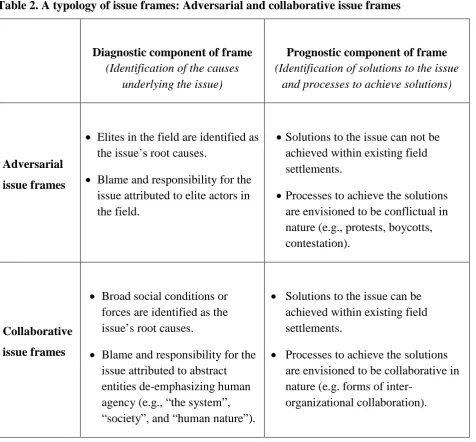
both the diagnostic and prognostic components defined above (see Table 2).
---
Insert Table 2 about here
---
In terms of diagnostic components, adversarial issue frames explicitly blame elite actors
in the field as responsible for the issue at stake. Thus, they identify field elites as the root
cause of the issue. By blaming elites, these frames focus on a concrete target for action –i.e.
some concrete human agents whose practices must be changed to effectively solve the issue-
this diagnosis, the prognostic component of adversarial issue frames emphasises that a
solution to the issue cannot be achieved within the existing field settlements which maintain
those elites in power. Therefore, these frames envision processes and strategies that are
conflictual in nature, such as boycotts (e.g. Gamson, 1992), protests (e.g. Davis, McAdam,
Scott and Zald, 2002), and other forms of contention (Rao et al. 2000).
Differently, the diagnostic component of a collaborative issue frame does not assign
blame for the issue to elite actors or other specific actors in the field, but rather identifies
broad social conditions and forces as the root causes of an issue. Instead than holding
responsible specific nameable actors, collaborative issue frames use “abstract targets that
render human agency as invisible as possible” by blaming “actorless entities such as “the
system”, “society”, “pollution” and “human nature”” (Gamson, 1992: 32) Thus, these frames
use general abstractions as targets for mobilizing action, without highlighting clear-cut
distinctions between “we” and “they” but rather emphasizing “an all-inclusive “we””
(Gamson 1992: 82). Consistently with this diagnosis, in their prognostic components
collaborative issue frames point to solutions that can be reached within existing institutional
arrangements –i.e. solutions achievable within the existing institutions shared by field actors.
Also, they emphasize processes and strategies that are collaborative in nature, such as
multi-stakeholder initiatives or other forms of inter-organizational collaboration (e.g. Hardy &
Phillips, 1998; O’Sullivan & O’Dwyer, 2015).
Adversarial and collaborative issue frames are important not only because they are used
by issue proponents to mobilize support for change, but also because they elicit responses
from the actors targeted by the frames (i.e. the field’s elites blamed or the actors whose
support is needed). The responses of such targeted actors crucially influence the ways in
which different issue frames can induce field changes and the type of field change likely to
depending on the content of the frame used (adversarial vs collaborative) and the field
structure (centralized vs fragmented) in which issue framing occurs.
Centralized and fragmented fields
A centralized field is one “characterized by a distinct dominance order in which a few
groups of actors operate at the apex while others survive on the bottom” (Rao et al. 2000:
262; Meyer et al. 1987; Fligstein and McAdam 2012). Centralized fields are characterized by
the presence of dominant actors whose authority in the field is typically formalized or widely
recognized as legitimate (Meyer et al. 1987). These dominant players may include regulatory
authorities which ensure institutional compliance via law enforcement or tax incentives (e.g.
Scott el. 2000), professional organizations (Greenwood et al. 2007) or trade associations (e.g.
Van Wijk et al., 2013) that exercise their control by constructing shared norms and systems
of evaluation. These dominant actors enjoy great advantages and power from the institutional
infrastructure of a field, typically enforcing and reproducing the dominant institutions
regulating the field.
A fragmented field is one in which field actors depend on multiple and uncoordinated
constituents (Meyer et al. 1987). In fragmented fields “elites are disorganized and possess
little influence to change the system” (Rao et al. 2000: 259). Fragmentation is usually high in
fields when multiple regulatory bodies and state agencies have overlapping jurisdictions (e.g.
Suddaby et al. 2007), professions have weak jurisdictional power (e.g. Abbott 1988) and
consumers, suppliers and producers are disorganized (e.g. Rao et al. 2000).
The distinction between centralized and fragmented fields is one out of several
important classifications of fields that have been proposed in the literature. Another common
distinction sets apart “emergent” and “mature” fields (e.g. Maguire et al. 2004; Greenwood
two reasons. First, it emphasizes the power distribution within the field as its salient
dimension and thereby “offers the possibility of a more nuanced analysis of the relationship
between field-level structures” and how actors respond to those structures (Greenwood et al.,
2011: 336-337). Second, the mature vs emergent distinction has been recently criticized for
its implicit underlying assumption that fields evolve according to a linear evolutionary
lifecycle (Zietsma et al., 2017: 409) and so it is less well-suited to conceptualize different
types of change, which is one of the central concerns of this paper.
Issues frames and types of change in centralized and fragmented fields
As discussed above, my central argument is that different types of issue frames are
more likely to trigger field change depending on the structure of the field and, when they do,
the type of field change triggered will be of a different nature in different field structures.
Figure 2 below summarizes my propositions regarding the likelihood of field change and the
type of field change under different configurations of issue frames and field structures.
Below, I illustrate the arguments underlying the propositions in each quadrant of the matrix.
---
Insert Figure 2 about here
---
Quadrant 1: Adversarial issue frames in centralized fields
Centralized field structures are characterized by “unequal access to and unequal
distribution of resources and social opportunities” (Lamont and Molnar, 2002: 168), featuring
a considerable number of peripheral actors that are dissatisfied with existing field structures,
which lock them in disadvantageous positions (e.g. Leblebici et al., 1991). The increasing
opportunities that they can successfully exploit via adversarial issue frames. Indeed,
adversarial frames are more likely to attract the attention and support of peripheral actors in a
centralized field for two main reasons. First, adversarial frames explicitly identify elites and
central actors in a field as responsible of the issue at stake, thereby drawing clear lines
between “good” and “bad” actors. By exacerbating the cognitive contrast between categories
of actors in a field, adversarial issue frames are more likely to be easily understood and to be
visible in a centralized, unequal context. Second, by identifying significant changes in
existing institutional arrangements as solutions to the issue, adversarial issue frames are more
likely to appeal to the interests of peripheral actors that are disadvantaged by those
arrangements.3 For these reasons, I argue that adversarial issue frames are likely to attract a
critical mass of support in a centralized field and are therefore likely to trigger field change.
In turn, the critical mass of support catalysed by adversarial issue frames puts
pressure on the field’s elites to act upon the issue, thereby triggering the process of issue
settlement described above –i.e. the elites will start negotiating with issue proponents and
their supporters on a new possible framework of action to deal with the issue. The results of
this process are likely to be shaped by several forces. On one side, the elites are likely to be
de-legitimated by the critical mass of support received by the adversarial issue frame blaming
them as directly responsible for the issue and, as a result of that de-legitimation, they are
likely to be weakened in their bargaining position. On the other side, issue proponents are
likely to be strengthened by the critical mass of support accumulated and are likely to display
“purity” (Douglas, 1986) and distinctiveness, distancing themselves from the de-legitimated
elites in the eyes of their supporters and interested audiences in the field (e.g., the media).
Thus, in negotiating a new field settlement with the elites, issue proponents will presumably
accommodate the issue. For these reasons, the elites are likely to be “forced” to concede a
new field settlement that weakens their position in the field.
An example of the field change activated by adversarial issue frames in a centralized
field is provided by Zietsma and Lawrence (2010)’s study of the coastal forestry field in
British Columbia (BC). This study shows how two initially powerless social groups (i.e.
environmental activists and aboriginal people) raised the issue of tree clear-cut logging in a
field dominated by one large forestry firm and a “business-friendly government” (p. 197).
These two groups engaged in a “war of the woods” by publicly vilifying dominant actors as
“eco-lepers”, accusing forestry companies of being “the real criminal” and casting the
government “as an industry “lap dog”” (p. 205). By directly attacking the central and widely
visible actors in the field, this adversarial issue frame became increasingly salient and visible
in the eyes of the actors targeted for mobilization (i.e. customers, other environmental
groups), which backed issue proponents in big numbers, supporting their cause and the
field-level changes they advocated (pp. 197-198; pp. 204-206). Eventually, this adversarial
mobilization resulted into a new field-level settlement that substantially weakened the power
of the dominant actors by creating a field-wide committee (including environmental groups,
forest companies and the government) with the power to define and ratify ecosystem-based
harvesting practices (p. 198). This committee considerably weakened the power of the field’s
elite, leading to a substantial change in field practices (e.g. clear-cutting dropped from 95% to
45%). On the basis of the arguments illustrated, I submit the following proposition:
Proposition 1: In a centralized field, adversarial issue frames are likely to attract a
critical mass of support and trigger field change; and when they do, the type of field
Quadrant 2: Collaborative issue frames in centralized fields
Collaborative issue frames are unlikely to mobilize a critical mass of support in a
centralized field for at least two reasons. First, by focusing attention on more abstract and
actor-less entities, these frames are unlikely to be salient in a centralized field because they
do not directly blame the central, visible actors dominating the field. In fact, as discussed
above, in a centralized field potential supporters can more easily relate and understand frames
which use dominant actors as key reference point (such as adversarial frames). Second, by
advocating for more incremental and collaborative changes as candidate solutions to an issue,
collaborative issue frames are less likely to resonate with the interests of the numerous
peripheral actors populating a centralized field, which are disadvantaged by existing field
structures and therefore more likely to buy into more radical change proposals. Thus, I argue
that collaborative issue frames are unlikely to attract a critical mass of support in a
centralized field and therefore unlikely to trigger field change.
Although it is not probable, the mobilization of a critical mass of support via
collaborative issue frames is still possible in a centralized field, but in less frequent cases.
This can happen when a collaborative frame taps into broader cultural beliefs deeply-held by
field actors (e.g. Maguire et al., 2004). For example, a collaborative frame defining an issue
as a “national emergency”, a “dangerous disease”, a “human rights violation” is likely to
activate entrenched “higher-order cultural accounts that provide dominant logics of action”
(Creed et al., 2002: 478), thereby becoming salient and prompting field actors to support the
frame. Indeed, social movement studies have long acknowledged that a frame can mobilize
support not only when it rings true to the everyday experience of potential adherents, but also
when “it resonates with broader cultural narrations….that are part and parcel of one’s cultural
heritage and that thus function to inform events and experiences in the immediate present”
centralized field temporarily recede in importance as compared to the higher-order beliefs
inducing actors to support the frame and collaborate to address the issue. In the words of
Snow and colleagues, when frames activate these broad cultural beliefs, “domain-specific
experiences are now given new meaning and rearranged, frequently in ways that were
previously inconceivable, in accordance with…..a new primary framework [that] gains
ascendance over others” (Snow et al. 1986: 475; see also Benford and Snow, 2000: 624).
However, there are two reasons why these cases are not likely to happen often. First,
not many issues can be credibly framed in a way to invoke higher-order cultural beliefs. This
is especially the case in a centralized field where the “experiential commensurability” of a
frame (i.e. the extent to which it resonates with the “troublesome events and situations”
directly experienced by actors (Snow and Benford, 1988: 208-209)) is likely to carry more
weight than its resonance with broader cultural beliefs. Second, social movement research has
indicated that issue proponents struggle to reproduce or integrate in their frames higher-level
cultural discourse “in any consistent or structured manner” (Cornelissen and Werner, 2014:
205), so that this higher-level resonance with cultural beliefs is typically difficult to achieve
and therefore unlikely (Fisher, 1997; Polletta, 2006; Steinberg, 1999).
When collaborative issue frames occasionally attract a critical mass of support and
trigger field change, the type of change is likely to be a new field settlement strengthening the
field’s elite. By “strengthening” here I mean a change that enriches the domain of influence
and power of the dominant actors in the field. Several factors make this settlement outcome
likely. First, differently from the case of adversarial frames discussed above, a widely
supported collaborative frame does not result into the de-legitimation of field elites, making
issue proponents and their supporters more willing to cooperate with the elites in order to
achieve a settlement. Second, as demonstrated by a long tradition of social movements’
challengers with the intent of bringing “the interests of the challenging group into alignment
with [their] own goals” (Trumpy, 2008: 480).
Normally, dominant actors in a centralized field would have no interest in changing
the existing institutional arrangements legitimating their power in the field. However, when a
critical mass of support is attracted by issue proponents, elites will be “forced” to take care of
the issue in some way, as explained above. In this scenario, elites are likely to agree on a new
field settlement with issue proponents and their supporters, but they are also likely to shape
the content of that settlement in a way that maintains their power. In fact, research has shown
that elites typically react to collaboration attempts by challengers by accommodating issues
symbolically (Bromley and Powell, 2012), by co-opting challengers’ initiatives (e.g. Trumpy,
2008; Coy & Heeden, 2005), and by pursuing incremental adjustment of existing settlements
or “elaborative changes” in order to expand their areas of influence to new domains of
activity (O’Sullivan & O’Dwyer, 2015; Currie et al., 2012).
An example of this dynamics is provided by Van Wijk and colleagues (Van Wijk et
al., 2013)’s study of how activist groups framed the issue of “sustainable tourism” as an issue
requiring the collaboration of trade associations, tour operators and sustainability movements
in the Dutch tourism field. As the authors document, sustainability activists successfully
mobilized support on this issue by embedding their collaborative frame in the “global
macro-cultural discourse on sustainable tourism that emerged in the 1970s and 1980s” (p. 369), so
that their collaborative frame activated “the broader discourse on sustainable development”
(p. 361) and its associated higher-order cultural beliefs. As this collaborative issue frame
attracted increasing support, the organizations traditionally dominating this centralized field
(i.e. the ANVUR trade association and the tour operators) started collaborating with the
activists but also co-opting their changes proposals by developing practices that “posed fewer
(p.375) allow the field’s elite to successfully co-opt the activists’ collaborative frame, diluting
the change that they had initially advocated and maintaining the dominant position of the
field’s elite. On the basis of the arguments developed in this section, I suggest the following
proposition:
Proposition 2: In a centralized field, collaborative issue frames are unlikely to attract
a critical mass of support and trigger field change; but when they do, the type of field
change triggered is likely to be a new field settlement reinforcing the field’s elite.
Quadrant 3: Adversarial issue frames in fragmented fields
Adversarial issue frames are unlikely to attract a critical mass of support in
fragmented fields for two main reasons. First, due to the absence of a clear dominant actor in
a fragmented field, adversarial frames will be less salient to mobilization targets. In fact,
because an adversarial frame focuses attention on dominant actors as the focal reference point
of the frame, this reference point becomes less clear and visible in a fragmented structure in
which there is no clearly dominant actor. Second, by focusing attention on specific actors,
adversarial frames are likely to be too narrow to appeal to the different actors constituting a
fragmented field and to allow for the development of a collective identity among them (cf.
Hunt and Benford, 2004; Polletta and Jaspers, 2001). An interesting example is Noy (2009)’s
study of how community groups mobilize support around the issue of homeless policy in San
Francisco, where authority over homeless policy issues was distributed across many
uncoordinated government, private, and non-profit agencies. As the author explains, the
adversarial frame used by community groups to advance homeless policy issues did not
resonate with the heterogeneous and uncoordinated actors in this field, who looked at the
233). Based on the arguments above, I contend that adversarial issue frames are unlikely to
attract a critical mass of support in fragmented fields and are therefore unlikely to trigger
field-level change.
Although it is not probable, the mobilization of a critical mass of support via
adversarial issue frames is still possible in a fragmented field, but in less frequent cases. This
can happen in the more rare occasions in which an adversarial frame, by repeatedly blaming
some actors, activates “oppositional identity dynamics” (Polletta and Jasper, 2001) among the
disconnected actors populating a fragmented field, increasing in turn the level of support for
the frame. In fact, although in fragmented fields there are no clearly dominant actors,
previous research has shown that under certain conditions frames can socially construct a
salient rival or “virtual enemy” with the strategic intent to create the perception of a
well-identified antagonist in the eyes of potential supporters (e.g. Hunt, Benford and Snow, 1994;
Knight and Greenberg, 2011). For example, McEvily and Ingram (2007) documented how
actors in the highly fragmented field of food cooperatives created the perception of Whole
Foods –which at the time was not considered a “player” and competitor by the cooperatives-
as a salient “dominating” rival, eventually sharpening the identity of food cooperatives and
eliciting their increasing support against a “common enemy” (which was virtually unknown
until that time). In fact, a long history of social psychological research explains how these
oppositional identity dynamics can have strong motivational effects (e.g. Sherif et al., 1961;
Tajfel and Turner, 1986; Greve, Pozner and Rao, 2006) and can therefore shape the
likelihood that field actors will contribute their support.
However, previous research has shown that the conditions facilitating these
oppositional identity dynamics are unlikely to be found in fragmented fields, making these
phenomena plausibly less frequent in these fields. In fact, several studies have highlighted
interact closely and frequently in settings that are removed from their “imagined” opponents
(Polletta and Jasper, 2001: 288; Creed et al. 2002). Different concepts have been used to
describe these settings such as “free spaces” (Evans and Boyte, 1986; Rao et al. 2014),
“havens” (Hirsch, 1990) and “sequestered social sites” (Scott, 1990). This research has
emphasized that these settings feature more commonly in centralized field structures, in
which they emerge as “institutions removed from the physical and ideological control of
those in power” (Polletta & Jasper, 2001: 288). In fact, given the disconnection and
un-coordination of fragmented fields, it is unlikely that actors in these fields will get together in
the first place to create these kinds of spaces and, even if they do, it is unlikely that they will
interact repeatedly and regularly in these settings for the prolonged time necessary to activate
an oppositional identity dynamics. Therefore, this phenomenon is possible but not likely in
fragmented fields, so that adversarial issue frames can, but are not likelyto, succeed in
mobilizing a critical mass of support in these fields.
When adversarial issue frames mobilize a critical mass of support, the type of change
emerging is likely to be shaped by several forces influencing the issue settlement process.
First, the increased salience of a “culpable agent” to blame is likely to prompt issue
proponents and their supporters to behave in ways that visibly mark their difference from the
vituperated actors. This argument is consistent with empirical evidence showing that the
perception of a salient rival prompts actors in a social group to sharpen and clarify their own
identities by contrasting and marking their difference from the perceived rival (Sherif et al.,
1961; Tajfel and Turner, 1986; Greve, Pozner and Rao, 2006; McEvily and Ingram, 2007). In
turn, the actors vituperated by issue proponents are likely to “counter-frame” (Rao et al.
2000; Guerard et al. 2013) and attack issue proponents and their supporters, activating
oppositional dynamics such as the one described above in the Co-op case. These opposition
the ones of the vituperated actors. Importantly, the salience of the issue increases in the eyes
of the vituperated actors because these actors will presumably feel the need to defend
themselves from what they perceive as “false accusations”, which nevertheless have
cumulated others’ support. Thus, despite the vituperated actors initially were not interested in
the issue per se, they are likely to become motivated to show they are taking into account the
issue –i.e. they become motivated to “settle” the issue with some form of action and change.
However, given the oppositional identities emerging in the field it is unlikely that the two
camps will reach a common framework of action. Rather, it is more likely that two
settlements will be reached, each representing the frameworks to deal with the issue
developed by one of the two camps and each probably very different from the other.
An example of this dynamic is provided by Rao et al. (2000)’s study analyzing how
the issue of “minor disputes” spurred an oppositional dynamics between two sets of actors in
the fragmented socio-legal field: on one side, legal professionals (e.g. lawyers, judges and
law professors); on the other side, social workers who advocated for alternative dispute
resolution for minor disputes and articulated adversarial critiques of conventional legal
practices, scapegoating legal professionals. Over time, these adversarial frames eventually
attracted “critical masses of supporters” (p. 253), polarizing the views of these two camps
about how to handle the minor disputes’ issue, so that each group developed their own
frameworks of action to address the issue. On the basis of the arguments illustrated in this
section, I submit the following proposition:
Proposition 3: In a fragmented field, adversarial issue frames are unlikely to attract
a critical mass of support and trigger field change; but when they do, the type of field
change triggered is likely to consist of two new field settlements polarizing the
Quadrant 4: Collaborative issue frames in fragmented fields
Issue proponents operating in fragmented fields are likely to attract supporters by
framing issues in a way to appeal to the multiple interests and values of the heterogeneous
actors composing a fragmented field (cf. Padgett and Ansell 1993). Since such diverse and
uncoordinated actors typically lack shared meanings to understand each other, issue
proponents need to find a common ground among these actors by framing the issue as a
systemic problem for the field. For these reasons, a collaborative issue frame may be
particularly well suited for mobilizing in fragmented fields. For example, Jacques Delors
framed the issue of a common EU market to appeal to the interests of the EU governments
which lacked central coordination on policy issues (Fligstein and Mara-Drita, 1996). By
emphasizing synergies among the diverse actors composing a fragmented field, collaborative
issue frames can also facilitate the development of a collective identity among field actors,
which in turn supports mobilization (e.g. Polletta and Jasper, 2001). Via collaborative frames,
issue proponents can craft broader collective identities, which can simultaneously appeal to
the multiple different stakeholders populating a fragmented field (cf. Padgett and Ansell
1993). Thus, I argue that collaborative issue frames are likely to attract a critical mass of
support in fragmented fields and are therefore likely to trigger field-level change.
In turn, the critical mass of support catalysed by collaborative issue frames triggers
the process of issue settlement among the heterogeneous and uncoordinated actors present in
a fragmented field. In that process, supported collaborative frames are likely to enhance the
coordination between previously uncoordinated actors, facilitating the exchange of their
different practices and templates in an effort to tackle what is perceived to be a common issue
(cf. Trist, 1963).In turn, these collaborative engagements are likely to produce new hybrid
practices and frameworks to tackle the issue (Hardy & Phillips, 1998; Furnari, 2014), which
socialized. Whether this hybridization is “partial” (combining previously unconnected
elements “in new but recognizable ways” [Powell & Sandholtz, 2012: 94]) or “full” (fusing
them together in un-distinguishable ways [Furnari, 2016: 564]), this process is likely to bring
the parties closer to their previously distant, uncoordinated positions, so that the field-level
settlement emerging is likely to align the fragmented actors in the field.
For example, Armstrong (2002)’s detailed history of the San Francisco’s gay
community field documents how this initially fragmented field (in the 80s) progressively
“crystallized” around a new field settlement forming around collaborative frames and
practices, such as the gay parade. In this context, what made a field settlement possible was
not the identification of a common enemy, but rather the creation of collaborative frames –
emphasizing the right to stand together to “affirm gay identity and celebrate diversity”
(Armstrong 2002: 2). These issues were not framed in oppositional or adversarial ways, but
rather in collaborative ways, emphasizing the opportunities for different organizations to
re-unite around abstract ideals such as “diversity” and “diversity pride”. By doing so, these
frames facilitated “multi-vocal coordination” (Furnari, 2014: 453) in that they could be
interpreted consistently from multiple perspectives simultaneously (Padgett and Ansell, 1993:
1263), thereby facilitating the coordination of the heterogeneous actors in the fragmented.
This example points to the power of collaborative frames in fragmented structures,
supporting the idea that, when collaborative issue frames work, the ensuing new field
settlement is more likely to align the fragmented actors in the field. Based on the arguments
illustrated in this section, I submit the following proposition:
Proposition 4: In a fragmented field, collaborative issue frames are likely to attract a
change triggered is likely to be a new field settlement aligning the fragmented actors
in the field.
Discussion and conclusion
This paper makes three main contributions to the extant literature.
First, I contribute to issue-based studies of institutional fields (e.g. Hoffman, 1999;
Meyer and Hollerer, 2010) by explaining when an issue is more likely to trigger field change.
While previous research has established the key importance of frames for explaining field
change (Granqvist and Laurila, 2011; Gray et al. 2015), by and large this literature has
under-studied the influence of field-level structures on the effects of frames. Differently, the
contingent approach developed in this paper complements these studies of micro-level
framing processes with an attention to how broader, field-level structures shape the outcomes
of these processes (e.g. Meyer and Hollerer, 2010). By doing so, this paper addresses the
criticism according to which studies of frames often “focus almost exclusively on meaning
construction but fail to connect to the structural context in which this meaning-making
occurs” (Fiss and Hirsch 2005: 30; see also McCammon et al., 2007). In addition, I contribute
to this literature by specifying the content of two salient types of issue frames and showing
how the effects of these frames on field change differ depending on the field structure in
which framing occurs. By doing so, I complement extant research which has mostly focused
on the processes of framing devoting less attention to the content of commonly recurring
frames (e.g. Gurses and Ozcan, 2015; Gray et al. 2015; Granqvist and Laurila, 2011; Litrico
and David, 2017; Guerard et al. 2013). The theoretical specification of frames’ content
suggested in this paper facilitates the systematic comparison of frames’ effects across fields,
In this respect, a promising direction for future research would be to take into account
more the temporal dimension of framing, comparing how different issue frames may change
over time in different field structures and the different speeds at which they may change.
While this paper is not focused on framing dynamics, but rather on the variation of frames’
effects across field structures, the model developed here also suggests useful pointers for
future research aiming at exploring frames’ changes. For example, when a field’s elite is
reinforced as a result of a collaborative change attempt (Quadrant 2 in Figure 2), it is
plausible to hypothesize that issue proponents are likely to perceive the change as a failure
and shift from a collaborative to an adversarial frame in order to counter-act the increased
centralization of the field. Relatedly, it is plausible to hypothesize that issue proponents will
change their framing strategies at different speeds depending on the type of change taking
place in a given field structure. For example, issue proponents might be more likely to
perceive as a clear-cut failure the reinforcement of the elite’s status-quo (Quadrant 2) rather
than a field change modifying existing settlements although in an unexpected direction
(Quadrant 3). As a result, they might be more likely to change their frames faster in the
former scenario than in the latter. Thus, an important question for future research is how long
it will take issue proponents to change their framing strategies. In sum, while the
comparative, synchronic approach outlined in this paper is valuable to understand how
frames’ effects vary across field structures, a promising direction for future research is to
further unpack how frames and field structures co-evolve diachronically.
Second, I contribute to studies of field change (e.g. Hardy and Maguire, 2010;
Zietsma and Lawrence, 2010; Van Wijk et al., 2013) by identifying four distinct types of field
change that are likely to emerge from the interaction of different issue frames and field
structures. I follow Zietsma and colleagues (Zietsma et al. 2017: 410)’s call to carefully
power structure of a field, an hitherto under-studied aspect in institutional field research
(Greenwood and Meyer, 2008: 260). By focusing on changes in field-level power, I
complement the notion of “change pathways” which captures changes in a field’s institutional
infrastructure and logic prioritization (Zietsma et al. 2017). In addition, I explain how
field-level changes are shaped by the ways in which issues are framed, thereby addressing the
recent call for more research that theorizes the relationship between issue-level processes and
field-level structural changes (Zietsma et al., 2017: 421). Finally, I further develop the notion
of “field settlement” (Litrico & David, 2017) by conceptualizing different types of field
settlements and articulating their implications for field-level power. This conceptualization
facilitates the empirical operationalization of field level changes, directing attention to the
specific moments in which actors in a field reach new collective agreements on an issue,
tackling some of the difficulties in measuring field change highlighted by previous research
(Suddaby et al., 2007: 334). In sum, the model developed in this paper usefully complements
Zietsma and colleagues (Zietsma et al. 2017)’s recent framework, contributing to advance
their research agenda “to clarify, systematize and further the study of institutional change at
the field level” (Zietsma et al. 2017: 410).
In this regard, a promising direction for future research is to study how the pace,
linearity, and scope of field change may intertwine to produce specific change configurations
or patterns (Meyer et al. 2005; cf. Hinings & Greenwood, 1988; Grandori & Furnari, 2013).
In fact, some fields are “likely to be characterized by disjunctions, oscillations, reversals of
directions” (Zietsma et al. 2017: 410). While the model advanced here is limited in this
respect because it does not consider directly these non-linear change dynamics, this paper
provides a useful platform for future research to explore how different types of settlements
might be more prone to reversals, oscillations and other feedback-loop dynamics. In fact,
enforced over time, thus becoming institutionalized and effecting long-term structural
changes in a field; rather than becoming decoupled from the actual practices of a field, thus
gradually reverting the field back to its pre-settlement stage. While previous research has
demonstrated that new field-level settlements are crucial change outcomes in their own right
(Litrico & David, 2017; Helms & Oliver, 2015; cf. Rao & Kenney, 2008), it is also important
to explain when and how they may become institutionalized into the patterns of regular
relationships and taken-for-granted meaning systems that constitute field structures
(Greenwood et al. 2011; Scott, 1994). The link between issue frames and field settlements
theorized in this paper offers an important pointer to further investigate this topic, opening up
new questions such as whether a weakly institutionalized field settlement may prompt issue
frames to re-surface and, if so, with what likely support. Thus, the model advanced here can
be used as a flexible platform to discover and investigate more complex research questions,
which so far have been laying undercurrent in institutional research due to the lack of a
baseline framework to link field structures, issue frames and field change.
Third, I contribute a theory-based typology of issue frames to social movement
research, which has typically defined frames inductively and empirically (see Benford, 1997),
devoting less attention to the conceptualization of the common characteristics underlying
empirically-specified frames. For example, Benford (1997: 415) criticizes Gamson (1992) for
inductively deriving a “plethora of specific frames” which does not facilitate the systematic
comparison of frames across issues and movements. By providing a theoretically-specified
typology of frames, I respond to the call for theorizing the analytic components of frames that
are likely to recur across contexts and issues (Gerhards, 1995), re-balancing the
“movement-centric” approach typically adopted in social movement studies (Lounsbury et al. 2013). In
addition, while social movement studies typically focus on how issue frames are used for
negotiating settlements around the issue. In doing so, this paper complements the
mobilization-focused perspective of social movement studies with a focus on the role of issue
frames in the process of settlement. This extension is important as it prompts field-level
research to integrate insights from negotiation research, which has studied frames as devices
for negotiating collective agreements (cf. Lewicki et al. 2003), but mostly at the
intra-organizational or group (rather than field) level of analysis.
An important direction for future research would be to study how adversarial and
collaborative elements can be mixed in hybrid types of frames and with what consequences.
While there is not extensive empirical evidence on these hybrid frames, some studies provide
examples of how collaboration and contestation can co-exist in certain fields. For example,
Bechky and O’Mahony (2008) describe how challengers (open source projects) and
incumbents (commercial firms) in the software field framed issues and practices to enable
collaboration while “preserving their disparate interests” (p. 424). As a result, while the
parties were able to converge “on a sub-set of interests on which they were able to
collaborate” (p. 422), conflict and contestation remained pervasive (p. 446-448). While this
example does not concern field-level change per se, it nevertheless illustrate how adversarial
and collaborative frames may be potentially combined in hybrid ways. Since few examples of
this sort have been documented in previous research, future studies should assess the
empirical relevance of these hybrid frames and investigate the mechanisms underlying the
emergence and consequences of such frames in different types of field structures. Another
useful direction for future research would be to investigate internal variation within the
ideal-types of adversarial and collaborative issue frames. For example, it would be useful to
investigate whether fine-grained variations within a type of frame (e.g. a change from a
radically adversarial to a moderately adversarial frame) are significantly consequential for
Indeed, it is important to note the limitations and bounded scope of the typology of
issue frames developed in this paper. While this typology encompasses two theoretically
salient and empirically relevant frames, capturing in a parsimonious way a variety of frames
that have been analysed in the literature (e.g. Maguire et al., 2004; Zietsma and Lawrence,
2010; Rao et al. 2000; Van Wijek et al., 2013), the two ideal-types identified do not fully
encompass all the ways in which issues can be framed in fields. At the same time, as any
effort to construct an ideal-typical categorization, my conceptualization aims to "provide an
abstract model, so that deviation from the extreme or ideal type can be noted and explained"
(Blalock, 1969: 32). A similar scope limitation concerns the number and type of field
structures considered –fragmented and centralized- which can be further extended to include
fields characterized by different levels of institutionalization –contrasting “mature” (e.g.
Greenwood and Suddaby 2006) and “emergent” (Maguire et al. 2004) fields- or fields
featuring different levels of loose-coupling (e.g. Greenwood and Hinings, 1996). Despite
these extensions would certainly enrich the model outlined here, my intent has been to
provide a baseline model that can serve as a platform to analyse the interaction between
different types of frames and field structures, so that future research can build on it, rather
than offering a one-size-fits-all framework encompassing all types of field structures and
change processes.
Despite its limitations, this paper has practical implications for issue proponents who
advocate for field changes and for policy-makers that aim to encourage or coordinate
field-level change. For issue proponents, this study highlights the importance of issue frames and
the role of the institutional context –in particular, centralized and fragmented structures- in
shaping the success of frame mobilization. Thus, the model outlined in this paper can support
the selection of issue frames depending on the field structure that an issue proponent aims to