City, University of London Institutional Repository
Citation
:
Spooner, A. J., Aitken, L. M., Corley, A. & Chaboyer, W. (2017). Developing a minimum dataset for nursing team leader handover in the intensive care unit: A focus group study. Australian Critical Care, doi: 10.1016/j.aucc.2017.01.005This is the accepted version of the paper.
This version of the publication may differ from the final published
version.
Permanent repository link: http://openaccess.city.ac.uk/16518/
Link to published version
:
http://dx.doi.org/10.1016/j.aucc.2017.01.005Copyright and reuse:
City Research Online aims to make research
outputs of City, University of London available to a wider audience.
Copyright and Moral Rights remain with the author(s) and/or copyright
holders. URLs from City Research Online may be freely distributed and
linked to.
City Research Online: http://openaccess.city.ac.uk/ [email protected]
Developing a minimum dataset for nursing team leader handover in the intensive care
unit: A focus group study
Amy J. Spooner RN, BN, Grad Dip ICU, PhD (Candidate)a,c,
Leanne M. Aitken Int Care Cert, B HSc (Nurs) Hons, Grad Cert Mgt, Grad Dip Sc Med (Clin Epi), PhD, FACN, FAANb,c,d,e
Amanda Corley, RN, BN, Grad Cert HSc (Nurs), MAdvPrac (Research)a,
Wendy Chaboyer RN, BSc (Nurs) Honours, MN, PhDb
aThe Prince Charles Hospital, Critical Care Research Group, Intensive Care Unit, The Prince
Charles Hospital, Brisbane, Australia.
bNHMRC Centre of Research Excellence in Nursing, Menzies Health Institute Queensland,
Griffith University, Gold Coast, Australia.
cSchool of Nursing and Midwifery, Griffith University, Nathan, Australia.
dIntensive Care Unit, Princess Alexandra Hospital, Woolloongabba, Australia
eSchool of Health Sciences, City University London, London, United Kingdom.
Corresponding author at: Amy Spooner
The Prince Charles Hospital Level 5 CSB, Room 6,
Rode Rd, Chermside. 4032.
Key words:
Clinical handover, intensive care unit, minimum dataset, intensive care
Author contribution:
All authors declare that this manuscript is original, has not been published before and is not
currently being considered for publication elsewhere. We confirm that the manuscript has
been read and approved by all named authors and that there are no other persons who
satisfied the criteria for authorship but are not listed. We further confirm that the order of
authors listed in the manuscript has been approved by all of us. We understand that the
Corresponding Author is the sole contact for the Editorial process. She is responsible for
communicating with the other authors about progress, submissions of revisions and final
Abstract
Background
Despite increasing demand for structured processes to guide clinical handover, nursing handover tools are limited in the intensive care unit.
Objectives
The study aim was to identify key items to include in a minimum dataset for intensive care
nursing team leader shift-to-shift handover.
Methods
This focus group study was conducted in a 21-bed medical/surgical intensive care unit in
Australia.Senior registered nurses involved in team leader handovers were recruited. Focus
groups were conducted using a nominal group technique to generate and prioritise minimum
dataset items. Nurses were presented with content from previous team leader handovers
and asked to select which content items to include in a minimum dataset. Participant
responses were summarised as frequencies and percentages.
Results
Seventeen senior nurses participated in three focus groups. Participants agreed that ISBAR
(Identify-Situation-Background-Assessment-Recommendations) was a useful tool to guide
clinical handover. Items recommended to be included in the minimum dataset (≥65%
agreement) included Identify (Name, age, days in intensive care), Situation (Diagnosis, surgical procedure), Background (Significant event(s), management of significant event(s))
and Recommendations (Patient plan for next shift, tasks to follow up for next shift). Overall,
30 of the 67 (45%) items in the Assessment category were considered important to include in
system. Other non-ISBAR items considered important to include related to the ICU
(Admissions to ICU, staffing/skill mix, theatre cases) and patients (Infectious status, site of
infection, end of life plan). Items were further categorised into those to include in all
handovers and those to discuss only when relevant to the patient.
Conclusions
The findings suggest a minimum dataset for intensive care nursing team leader shift-to-shift
handover should contain items within ISBAR along with unit and patient specific information
1. INTRODUCTION
Adverse patient incidents associated with miscommunication during clinical handover
remains a recurring problem nationally and globally in healthcare.1-4 Breakdown in
communication accounted for 20% of all reported sentinel events in Queensland (Australia)
public hospitals between 2005 and 20064 and the Joint Commission recently reported that
poor communication is the leading cause of all sentinel events and that more than one third of all patient handoffs are defective.5 Gaps in communication has been linked to delays in
diagnosis, patients receiving the wrong treatment, breakdown in continuity of care and life
threatening adverse events leading to longer hospital stays and increased healthcare
expenditure.6 In Australia, clinical handover is listed as a priority area for patient safety
improvement, and has led to the roll out of the National Safety Quality Health Service
Standard (NSQHSS) 6 - Clinical handover.7 To fulfill accreditation standards healthcare
organisations are required to have structured handover processes in place, including a
minimum dataset (MDS) to handover patient information. Growing awareness of this patient
safety issue has led to the development of a wide range of handover resourceswith an
increasing evidence base in this important area.8, 9
The introduction of standardised handover processes ensures all participants know the
process and content required to present complex patient information.9 Part of the
standardised process includes the incorporation of structured handover tools that enable
clinicians to deliver handover in a structured format. Commonly used handover tools include
SBAR (Situation-Background-Assessment-Recommendation), I-PASS (Illness
severity-Patient summary-Action list-Situation awareness-Synthesis by receiver) and SHARED
(Situation-History-Assessment-Risk-Expectation-Documentation). While the use of structured
handover tools has been linked to improved continuity of care and patient outcomes,6, 10, 11 not all handover tools can be successfully used across all clinical settings.This may be due
to the clinical context. Health care facilities vary widely and have differing functions and size
in relation to service delivery, location and workforce.7 One solution is to utilise flexible
standardisation which involves either adapting an established framework or developing a
minimum dataset (MDS) that contains content pertinent to the clinical context.6, 10,12, 13 Recent
studies indicate that standardised handover processes encourages more effective
handover10, 12, 14 and positive patient outcomes.11 In particular, there are reports of improved
handovers, with fewer technical errors,15 enhanced clinical performance and clinicians
reporting greater knowledge of patients;14, 16 higher satisfaction amongst patients;14, 16
improved patient safety and reduced costs to the healthcare system.6, 11
Despite the availability of a variety of structured handover tools, transferability to the
intensive care unit (ICU) can be challenging. The ICU is an event-driven, time-pressured
environment prone to continuous distractions. Patients are critically ill and require timely care
at a moment’s notice. 17 The complex and multidisciplinary nature of the ICU renders it
susceptible to healthcare errors. Handovers occur frequently in the ICU (e.g., change of shift,
meal breaks, admissions, transfers) amongst members of a multidisciplinary team (nurses,
doctors and allied health staff). Despite a growing body of research focusing on handovers in
adult and pediatric ICUs, relating to admissions to the ICU from the emergency department 18 or operating theatre, 15, 19-21 nursing bedside shift-to-shift handover22 and transfers from
ICU to the ward,12, 23 little is known about ICU nursing team leader shift-to-shift handover.
Unlike bedside nurses that care for one or two patients per shift and discuss detailed patient
information at handover, nursing team leaders oversee care provided by bedside nurses, are
responsible for the coordination and management of multiple critically ill patients in the ICU
and require a succinct overview of patient information. Informative handovers are critical to
maintaining patient continuity, safety and a high standard of care, however no structured process for nursing team leader shift-to-shift handover currently exists. Evidence based
handover to avoid unnecessary patient harm. Therefore, the aim of this study was to identify
the key items to include in a MDS for nursing team leader shift-to-shift handover in the ICU.
METHODS
This focus group study was conducted over two days during February 2014 in a 21-bed
(government funded) adult medical/surgical ICU, specialising in cardiothoracic surgery at a tertiary referral hospital, in Queensland, Australia. Ethical approval was obtained by the
institutional and (HREC/10/QPCH/5) and university (NRS/09/13) Human Research Ethics
Committee.
Setting
There were 180 registered nurses employed in the ICU including 63 senior registered nurses
working in team leader roles. The ICU consists of three areas (ICU 1- cardiac surgical, ICU
2/3 – general); each area containing up to nine beds coordinated by one team leader.
Handovers occur at the nurses’ station with a maximum of nine patients discussed by each
team leader. The ISBAR (Identify-Situation-Background-Assessment-Recommendation)
schema was the hospital’s approved handover tool to conduct clinical handover at the study
site. The ISBAR schema is widely used in healthcare settings24, 25 and has undergone
extensive testing.24, 26 Despite having an approved handover tool at the study site, no
standardised or evidence based handover tools were being used. Prior to commencing this
study, team leaders could choose up to five different templates that were either developed by
individual staff members or printed from an electronic computer system. Team leaders in the
two general ICUs predominantly used a template containing the body systems (e.g., Central
nervous system, respiratory system, cardiovascular system etc.), the registrars weekly patient
summary or a printed template from the hospital computer system (WardView provides a brief
summary of the patient’s demographics and medical status). Team leaders in the cardiac surgical ICU often used a paper template with a cardiac surgical focus (e.g., surgery type,
clinical events. Although the templates are vastly different they all contained patient identifiers
(name, bed number).
Participants
Senior ICU registered nurses (Grade 5, 6 and 7 registered nurses) involved in team leader
handover were purposively sampled. Grade 5 nurses have successfully completed the ICU
transition program and team leader educational package, grade 6 nurses have completed the ICU transition program, Graduate Certificate in Intensive Care and team leader educational
package, while grade 7 nurses have postgraduate qualifications and coordinate the clinical
and managerial operation of the unit. All team leaders worked across the three ICU areas.
Participant information sheets and consent forms were sent via internal mail to all nursing staff
who met the inclusion criteria (Senior ICU registered nurses involved in team leader handover).
Potential participants were told about the study at staff meetings and written consent was
obtained prior to study commencement. Consent was also confirmed verbally at the time of
data collection.
Data collection
Registered nurses involved in team leader handover were invited to attend focus groups.
Focus groups occurred over two days, were approximately 90 minutes in length and occurred
in a room with space for participants to sit comfortably in a circle to ensure the researcher
could maintain eye contact with participants throughout the session. Investigators used a
convenience sample to conduct focus groups. As senior nurses working in the ICU were
required to leave the unit for an extended period of time, the number of staff available to attend
focus groups was dependent on the busyness (patient numbers, patient acuity) and staffing
levels (sick calls, skill mix and the availability of staff to cover each other) of the ICU on the
To ensure all participants contributed during the session a nominal group technique (NGT) 27-29 was used to guide the focus groups. NGT is a structured method, recognised as an efficient
and effective methodology to generate and prioritise ideas.27, 29, 30 In NGT, data are
systematically collected from all participants to ensure divergent views are reflected in the data.
The process prevents the domination of discussion by a single person, encourages passive group members to participate, and results in a set of prioritised solutions or recommendations.
NGT assisted the researchers to determine which concepts to include in a MDS for ICU team
leader handover.
Focus groups were structured using Keatinge’s27 NGT to generate data (Figure 1). To
commence the NG meeting, an investigator (AS) (the facilitator) clarified the purpose of the
meeting, expectations of the participants, asked open ended questions and kept the
conversation moving.31 A second investigator (TB) audiotaped the discussions; observed the
group and made field notes to complement the audio recordings.32 Handouts were given to
participants containing content items from team leader handovers. Content within the ISBAR
schema, along with additional unit and patient specific content was presented to participants.
Using a round robin technique (i.e. each participant takes a turn), participants were asked to
state which items from the handout to include/remove from a MDS. Responses were
summarised and participants had a final vote on content items to include in a MDS. Participants
were asked to suggest additional content items to include in a MDS. A round robin was
conducted, responses shared and participants voted and decided which items should be
included in a MDS. A final summary of the responses was presented, participants
clarified/suggested final recommendations during a round robin and a final vote resulted in a
MDS for team leader handover.
Data analysis
Descriptive statistics were used to provide a summary of key items to include in a MDS for
Audiotapes and field notes from the meeting were used to clarify inconsistencies and further
explain data generated. Participants suggested that content could be further stratified into
items to include in all handovers and items to include if relevant to the patient e.g.,
temperature value if the patient was hypo/hyper thermic, wounds if present. Investigators set
an agreement threshold at ≥65%, as achieving 2/3 agreement within each of the focus groups was considered appropriate.
RESULTS
Seventeen senior nurses (two males and 15 females) involved in team leader handover
consented to participate in focus groups. Three focus groups were conducted containing
four, six and seven nurses in each group. Participants included one grade seven nurse,
seven grade six nurses and nine grade 5 nurses. Forty-one percent (7) of participants
worked full-time in the ICU.
ISBAR items
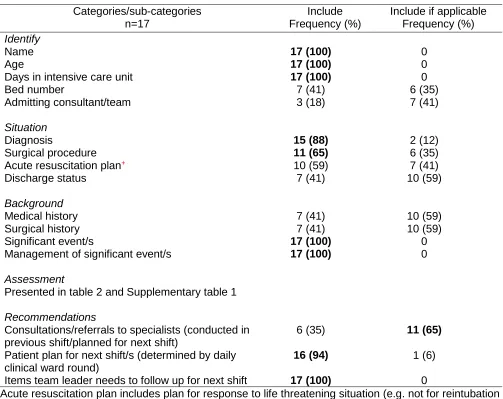
Specific items within Identify (Name, age, days in ICU), Situation (Diagnosis, surgical
procedure), Background (Significant event/s and management of significant event/s) and
Recommendations (Patient plan for the next shift, tasks team leader needs to follow up for next shift) were recommended to be included in a MDS. Patient consultations (e.g.,
Occupational therapist) and/referrals (e.g., mental health review) within the Recommendation
category were suggested only when they were relevant to the patient. All content items within
ISBR of the ISBAR schema are presented in Table 1, while the Assessment items are
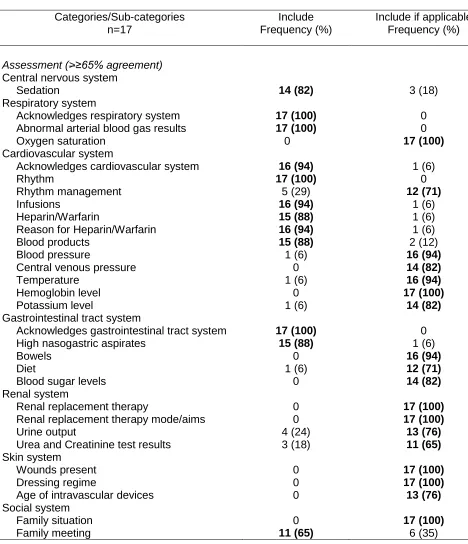
summarised in Table 2.
Within the Assessment category, participants identified specific content within each body
system (central nervous system, respiratory system, cardiovascular system, renal system,
to include in a MDS, while 18 of the 67 (27%) items were considered important to include
only when relevant to the patient e.g., oxygen saturation was important to include if the
patient was weaning from ventilation or was having difficulty maintaining optimal oxygenation
levels. Assessment items with ≥65% agreement amongst participants with ‘Include’ or
‘Include if applicable’ responses are identified in table 2. Assessment items with <65% in either the ‘include’ or ‘include if applicable’ are shown in Supplementary table 1.
Non-ISBAR items
There were other items not related to the ISBAR mnemonic that participants considered
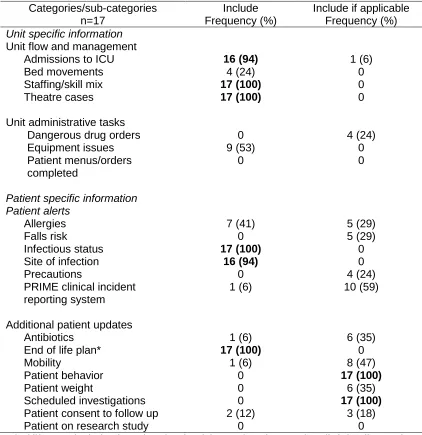
important to include in a MDS (Table 3). These included unit flow and management
(Admissions to ICU, staffing/skill mix, theatre cases), patient alerts (Infectious status, site of
infection) and additional patient updates (End of life plan), while unit administrative tasks
such as dangerous drug orders, equipment issues and patient menus/orders completed were
not considered necessary to discuss at handover. Items within the additional patient updates
category (Patient behavior, scheduled investigations) were considered important to include in
handover only if relevant to the patient.
Additional patient updates to be included in handover
Participants were asked to suggest other items that could be included in a MDS. Although
several items were discussed during focus groups, only two additional items – patient’s
surgeon (17/17, 100%) and ICU consultant in charge for the week/weekend (11/17, 65%)
achieved consensus for inclusion in the MDS.
2. DISCUSSION
This study identified content for inclusion in a MDS for nursing team leader shift-to-shift
handover. Content included items within the ISBAR schema, non-ISBAR and additional
included in all shift-to-shift handovers and content that could be included in handovers if
relevant/pertinent to the patient. Items relevant to all handovers tended to focus on the
summary of patient management (e.g., significant event(s), management of significant
event(s), current health assessment, future patient plans and organisational issues). Further
detail within patient health assessments was deemed important to include in handovers if relevant to the patient (e.g., renal replacement therapy, dressing regime for wounds).
Through engaging the nurses involved in handover the investigators were able to identify key
items to include in a MDS for nursing team leader handover. Engaging key stakeholders in
the development of interventions such as a MDS for team leader handover is crucial to
ensuring the intervention is relevant to the clinical context, meets the needs of the users and
can be successfully implemented and utilised.34 While it is important to engage the key users
when developing an intervention for practice change it is also imperative that the intervention
meets the local/national/international standards and guidelines to ensure high standards of
care and patient safety is maintained.7 Our research identified several content items within
the ISBAR schema that team leaders did not consider necessary to include in handover that
are mandatory items within the NSQHSS 6. These items include patient bed number,
admitting consultant/team (Identify); acute resuscitation plans, discharge status (Situation);
and medical, surgical history (Background).
The ISBAR schema is one of several tools recommended by the ACSQHC to help guide
clinicians with the transfer of patient information during handover and was the approved tool
to use for handover at the study site.8 To adequately Identify a patient during handover three
forms of identity (patient name, date of birth and medical identification number) are recommended to avoid misidentification and mismatching of patient management.7 A previous
study conducted in the ICU found that medical identification number was not mentioned during
team leader handovers35 and nor was it recommended for inclusion during focus groups in this
included in all handovers or included if applicable to the patient. Team leaders also considered
the inclusion of admitting medical consultant/team to be unnecessary which could compromise
patient outcomes such as causing delays in treatment if the appropriate physician is not
notified promptly of changes in patient conditions.
Within the Situation category team leaders were impartial as to whether acute resuscitation
plan and discharge status should be mentioned in all handovers or only when applicable e.g.,
some team leaders considered acute resuscitation plan necessary to mention if a specific
plan had been documented, otherwise it was not important to mention in handover. Similarly,
within the Background category of the ISBAR schema team leaders were divided as to
whether medical and surgical history should be mentioned in all handovers or only when
applicable to the patient. These results show there were varied opinions amongst team
leaders regarding the content to include in a MDS. The advantages of structured tools such
as MDSs is that they minimise individual biases as to what information is deemed
“important”.36 Standardised frameworks are objective and outline the minimum content that
must be contained and transferred during handover.9, 36 These findings also suggest a lack of
awareness or understanding amongst clinicians in relation to current standards and
guidelines for the delivery of safe clinical handovers.37, 38 While it is important to develop an
evidence-based MDS that meets the needs of the clinicians and context, it is also imperative
that clinical practice and patient safety is not compromised due to the omission of critical
patient information at handover.
Within the Assessment category team leaders identified items to include in a MDS for
handover. While Spooner et al’s35 study identified a large number of items discussed in this category, focus group participants considered less than half of these items to be relevant to
include in all handovers or when applicable to the patient. These findings indicate that team
leaders would rather obtain a concise summary of the most pertinent patient assessment
one or two patients, team leaders’ handover up to nine patients in the same allocated
timeframe. The transition from bedside nurse to team leader may prove challenging when
determining what information to discuss in this category at handover. A structured MDS may
be a beneficial way to reduce unnecessary content discussed at handover and assist clinicians
to prepare and deliver succinct and timely handovers.
Our research showed that alongside the ISBAR schema, participants considered information
specific to the unit and patient to be important. The ICU has been identified as one of the major
areas where patient flow can be problematic. Once the ICU is at capacity, unless patients are
well enough to be transferred to the wardto make a bed available for an admission, patients
are unable to be transferred to another area within the hospital and no further patients can be
admitted to the ICU. Clinical handovers that contain information regarding patient flow (e.g.,
planned/emergency admissions into and transfers out of ICU) may assist nursing team leaders
to plan and optimise patient flow within the ICU, thereby minimising delays in patients receiving
timely and efficient care.39 These findings add to the current literature and inform the
development of an evidence-based MDS incorporating a modified ISBAR schema along with
specific ICU and patient details required by team leaders to deliver informative shift-to-shift
handovers.
Recommendations for practice
The ICU is a high risk environment containing critically ill patients that can become unstable
with little warning. Clinicians rely on informative handovers to maintain continuity of care.
While there are many resources available for clinicians to assist with the handover process,
there are limited resources that can be applied in the ICU setting. It is imperative that handover tools are either modified or MDSs are developed to meet the needs of the clinical
context such as ICU to avoid incomplete, inconsistent or inaccurate information that could
compromise patient safety.9 Furthermore, clinician engagement is essential to ensure MDSs
likelihood the tool will be accepted and adopted by clinicians.40 Alongside clinician
engagement investigators need to also ensure tools comply with local guidelines and
national standards. Further work is required to evaluate whether ICU specific MDSs improve
handover communication and reduce adverse patient events in the ICU.
Limitations
This study was conducted in one ICU and the sample size was small, however it was
representative of all levels of nurses involved in team leader handover. A larger sample size
containing more full-time nurses may have provided further insight into the content required
in a MDS. Although focus groups are a valuable way to obtain a large amount of information
in a short timeframe, group dynamics and varying opinions can silence participants. To
ensure all participants contributed during focus groups a NGT was utilised to structure the
sessions, promote rich discussions and allow individuals to be heard.
3. CONCLUSION
Our research findings identified items within the ISBAR schema and additional items
necessary to include in a MDS for ICU nursing team leader shift-to-shift handover. Specific
items were proposed for inclusion in all clinical handovers, while other items were considered
only necessary to discuss if relevant to the patient. These findings will inform the
development of the first evidence-based MDS for nursing team leader handover in the ICU.
This MDS may be adaptable to other hospital ICUs that lack structured, evidence based
resources to guide the handover of critical patient information. Our MDS aims to provide a
structured, informative handover that assists team leaders to maintain continuity of care and
provide patients with a high standard of care.
The investigators would like to thank the Nursing Director, Clinical Nurse Consultant, Quality
and Safety nurse, Medical Director and nursing staff from the ICU for their support,
encouragement and participation in this project.
FUNDING
This work was supported by an Australian Centre for Health Services Innovation (AusHSI) grant and the Babe Norman PhD Scholarship awarded by the Nurses Memorial Centre which
REFERENCES
1. Johnson, J.K., Arora, V.M. Improving clinical handovers: Creating local solutions for a
global problem. Qual Saf Health Care; 2009;18 (4): 244-245.2. Thomas, M.J., Schultz, T.J., Hannaford, N., Runciman, W.B. Failures in transition:
Learning from incidents relating to clinical handover in acute care. J Healthc Qual; 2013;35(3): 49-56.
3. Australian Commission on Safety and Quality in Health Care. Clinical handover.
ACSQHC, Sydney; 2008. http://www.safetyandquality.gov.au/internet/safety/ publishing .nsf/ Content/ PriorityProgram-05 (9 October 2015)
4. World Health Organization. Communication during patient hand-overs. Patient safety
solutions; 2007;1 (3).5. Joint commission on accreditation of healthcare organizations. Joint commission center
for transforming healthcare releases targeted solutions tool for hand-off communications. Joint commission perspectives, 2012.http://www.jointcommission.org/assets/1/6/TST_HOC_Persp_08_12.pdf (31 October 2016)
6. Ahmed, J., Mehmood, S., Rehman, S., Ilyas, C., Khan, L.U. Impact of a structured
template and staff training on compliance and quality of clinical handover. Int J Surg; 2012;10
(9): 571-574.
7. Australian Commission on Safety and Quality in Healthcare. Safety and quality
improvement guide standard 6. ACSQHC, Sydney; 2012.8. Australian Commission on Safety and Quality in Health Care. Implementation toolkit for
clinical handover improvement. ACSQHC, Sydney; 2011.9. Australian Commission on Safety and Quality in Health Care. Ossie guide to clinical
handover improvement. ACSQHC, Sydney; 2010.10. Yee, K.C., Wong, M.C., Turner, P. "Hand me an isobar": A pilot study of an
evidence-based approach to improving shift-to-shift clinical handover. Med J Aust; 2009;190 (11 Suppl): S121-124.11. Agarwal, H.S., Saville, B.R., Slayton, J.M., Donahue, B.S., Daves, S., Christian, K.G., et
al. Standardized postoperative handover process improves outcomes in the intensive care unit: A model for operational sustainability and improved team performance*. Crit Care Med; 2012;40 (7): 2109-2115.12. Graan, S.M., Botti, M., Wood, B., Redley, B. Nursing handover from icu to cardiac ward:
Standardised tools to reduce safety risks. Aust Crit Care; 2016;29 (3): 165-171.13. Gardiner, T.M., Marshall, A.P., Gillespie, B.M. Clinical handover of the critically ill
postoperative patient: An integrative review. Aust Crit Care; 2015;28 (4): 226-234.14. Riesenberg, L.A., Leitzsch, J., Cunningham, J.M. Nursing handoffs: A systematic review
of the literature. Am J Nurs; 2010;110 (4): 24-34; quiz 35-26.15. Catchpole, K.R., de Leval, M.R., McEwan, A., Pigott, N., Elliott, M.J., McQuillan, A., et al.
Patient handover from surgery to intensive care: Using formula 1 pit-stop and aviationmodels to improve safety and quality. Paediatr Anaesth; 2007;17 (5): 470-478.
16. Thomas, L., Donohue-Porter, P. Blending evidence and innovation: Improving intershift
handoffs in a multihospital setting. J Nurs Care Qual; 2012;27 (2): 116-124.17. Smith, A.F., Pope, C., Goodwin, D., Mort, M. Interprofessional handover and patient
safety in anaesthesia: Observational study of handovers in the recovery room. Br J Anaesth; 2008;101 (3): 332-337.18. McFetridge, B., Gillespie, M., Goode, D., Melby, V. An exploration of the handover
process of critically ill patients between nursing staff from the emergency department and the intensive care unit. Nurs Crit Care; 2007;12 (6): 261-269.20. Segall, N., Bonifacio, A.S., Schroeder, R.A., Barbeito, A., Rogers, D., Thornlow, D.K., et
al. Can we make postoperative patient handovers safer? A systematic review of theliterature. Anesth Analg; 2012;115 (1): 102-115.
21. Kaufmnan, J., Twite, M., Barrett, C., Peyton, C., Koehler, J., Rannie, M., et al. A handoff
protocol from the cardiovascular operating room to cardiac icu is associated withimprovements in care beyond the immediate postoperative period. Jt Comm J Qual Patient Saf; 2013;39 (7): 306-311.
22. Spooner, A.J., Chaboyer, W., Corley, A., Hammond, N., Fraser, J.F. Understanding
current intensive care unit nursing handover practices. Int J Nurs Pract; 2013;19 (2): 214-220.23. van Sluisveld, N., Hesselink, G., van der Hoeven, J.G., Westert, G., Wollersheim, H.,
Zegers, M. Improving clinical handover between intensive care unit and general ward professionals at intensive care unit discharge. Intensive Care Med; 2015;41 (4): 589-604.24. Woodhall, L.J., Vertacnik, L., McLaughlin, M. Implementation of the sbar communication
technique in a tertiary center. J Emerg Nurs; 2008;34 (4): 314-317.25. Haig, K.M., Sutton, S., Whittington, J. Sbar: A shared mental model for improving
communication between clinicians. Jt Comm J Qual Patient Saf; 2006;32 (3): 167-175.26. Thompson, J.E., Collett, L.W., Langbart, M.J., Purcell, N.J., Boyd, S.M., Yuminaga, Y., et
al. Using the isbar handover tool in junior medical officer handover: A study in an australian tertiary hospital. Postgrad Med J; 2011;87 (1027): 340-344.27. Keatinge, D. Identifying service needs of children with disruptive behavior problems
using a nominal group technique. Nurs Hlth Sci; 2000;2: 179-189.28. Potter, M., Gordon, S., Hamer, P. The nominal group technique: A useful consensus
methodology in physiotherapy research. NZ Journal of Physiotherapy; 2004;32 (3).29. Harvey, N., Holmes, C.A. Nominal group technique: An effective method for obtaining
group consensus. Int J Nurs Pract; 2012;18 (2): 188-194.30. Asmus, C.L., James, K. Nominal group technique, social loafing, and group creative
project quality. Creat Res J; 2005;17 (4): 349-354.31. Gibbs, A. Focus groups. University of Surrey, Guilford; 1997.
32. Bender, D.E., Ewbank, D. The focus group as a tool for health research: Issues in design
and analysis. Health Transit Rev; 1994;4 (1): 63-80.33. Fink, A. How to conduct surveys: A step-by-step guide. Sage., Los Angeles; 2009.
34. Siriwardena, A.N. Engaging clinicians in quality improvement initiatives: Art or science?
Qual Prim Care; 2009;17 (5): 303-305.35. Spooner, A.J., Aitken, L.M., Corley, A., Fraser, J.F., Chaboyer, W. Nursing team leader
handover in the intensive care unit contains diverse and inconsistent content: Anobservational study. Int J Nurs Stud; 2016;61: 165-172.
36. Keebler, J.R., Lazzara, E.H., Patzer, B.S., Palmer, E.M., Plummer, J.P., Smith, D.C., et
al. Meta-analyses of the effects of standardized handoff protocols on patient, provider, and organizational outcomes. Hum Factors; 2016;58 (8): 1187-1205.37. Cabana, M.D., Rand, C.S., Powe, N.R., Wu, A.W., Wilson, M.H., Abboud, P.A., et al.
Why don't physicians follow clinical practice guidelines? A framework for improvement. JAMA; 1999;282 (15): 1458-1465.38. Leone, M., Ragonnet, B., Alonso, S., Allaouchiche, B., Constantin, J.M., Jaber, S., et al.
Variable compliance with clinical practice guidelines identified in a 1-day audit at 66 french adult intensive care units. Crit Care Med; 2012;40 (12): 3189-3195.39. Institute for Healthcare Improvement. Optimizing patient flow: Moving patients smoothly
through acute care settings. IHI Innovation Series white paper; 2003.Table 1 ISBR (Identify-Situation-Background-Recommendations) items
+Acute resuscitation plan includes plan for response to life threatening situation (e.g. not for reintubation and one defibrillator shock).
Categories/sub-categories n=17
Include Frequency (%)
Include if applicable Frequency (%) Identify
Name Age
Days in intensive care unit Bed number Admitting consultant/team 17 (100) 17 (100) 17 (100) 7 (41) 3 (18) 0 0 0 6 (35) 7 (41) Situation Diagnosis Surgical procedure Acute resuscitation plan+
Discharge status 15 (88) 11 (65) 10 (59) 7 (41) 2 (12) 6 (35) 7 (41) 10 (59) Background
Medical history 7 (41) 10 (59)
Surgical history 7 (41) 10 (59)
Significant event/s
Management of significant event/s
Assessment
Presented in table 2 and Supplementary table 1
17 (100) 17 (100)
0 0
Recommendations
Consultations/referrals to specialists (conducted in previous shift/planned for next shift)
Patient plan for next shift/s (determined by daily clinical ward round)
Items team leader needs to follow up for next shift
Table 2 Assessment items≥65% agreement
Categories/Sub-categories n=17
Include Frequency (%)
Include if applicable Frequency (%)
Assessment (>≥65% agreement) Central nervous system
Sedation 14 (82) 3 (18)
Respiratory system
Acknowledges respiratory system Abnormal arterial blood gas results Oxygen saturation 17 (100) 17 (100) 0 0 0 17 (100) Cardiovascular system
Acknowledges cardiovascular system Rhythm
Rhythm management Infusions
Heparin/Warfarin
Reason for Heparin/Warfarin Blood products
Blood pressure
Central venous pressure Temperature Hemoglobin level Potassium level 16 (94) 17 (100) 5 (29) 16 (94) 15 (88) 16 (94) 15 (88) 1 (6) 0 1 (6) 0 1 (6) 1 (6) 0 12 (71) 1 (6) 1 (6) 1 (6) 2 (12) 16 (94) 14 (82) 16 (94) 17 (100) 14 (82)
Gastrointestinal tract system
Acknowledges gastrointestinal tract system High nasogastric aspirates
Bowels Diet
Blood sugar levels
17 (100) 15 (88) 0 1 (6) 0 0 1 (6) 16 (94) 12 (71) 14 (82) Renal system
Renal replacement therapy
Renal replacement therapy mode/aims Urine output
Urea and Creatinine test results
0 0 4 (24) 3 (18) 17 (100) 17 (100) 13 (76) 11 (65) Skin system Wounds present Dressing regime
Age of intravascular devices
Table 3 – Non-ISBAR items
Categories/sub-categories n=17
Include Frequency (%)
Include if applicable Frequency (%) Unit specific information
Unit flow and management Admissions to ICU Bed movements
16 (94) 4 (24)
1 (6) 0
Staffing/skill mix 17 (100) 0
Theatre cases 17 (100) 0
Unit administrative tasks Dangerous drug orders Equipment issues Patient menus/orders completed 0 9 (53) 0 4 (24) 0 0
Patient specific information Patient alerts
Allergies Falls risk
Infectious status Site of infection Precautions
PRIME clinical incident reporting system 7 (41) 0 17 (100) 16 (94) 0 1 (6) 5 (29) 5 (29) 0 0 4 (24) 10 (59)
Additional patient updates Antibiotics
End of life plan*
1 (6) 17 (100) 6 (35) 0 Mobility Patient behavior 1 (6) 0 8 (47) 17 (100) Patient weight Scheduled investigations 0 0 6 (35) 17 (100)
Patient consent to follow up Patient on research study
2 (12) 0
3 (18) 0
Supplementary Table 1 Assessment items with <65% agreement (n=17 participants) ISBAR schema Categories/Sub-categories n=17 Include Frequency (%)
Include if applicable Frequency (%)
Assessment (<65% agreement) Central nervous system
Refers to Central Nervous System Glasgow Coma Scale
Pupil Reaction Limb powers Sleeping status Paralysis medication Train of Four score Bispectral Index Pain level Pain management 7 (41) 7 (41) 2 (12) 1 (6) 4 (24) 10 (59) 3 (18) 0 (0) 7 (41) 8 (47) 4 (24) 8 (47) 10 (59) 8 (47) 10 (59) 5 (29) 4 (24) 1 (6) 5 (29) 3 (18) Respiratory system Extubation status Airway grade Ventilation settings Oxygen delivery device Ventilation/parameters Respiratory rate Sputum
Normal arterial blood gas results
10 (59) 7 (41) 0 (59) 8 (47) 0 (0) 0 (0) 0 (0) 0 (0) 7 (41) 9 (53) 10 (59) 2 (12) 10 (59) 10 (59) 7 (41) 0 (0) Cardiovascular system Pacing wires Pacing mode
Blood pressure aims/management Cardiac drainage
Ventricular assist device settings Circulation
APTT/INR results Time APTT/INR due
10 (59) 10 (59) 5 (29) 7 (41) 5 (29) 9 (53) 3 (18) 4 (24) 6 (35) 7 (41) 10 (59) 10 (59) 5 (29) 8 (47) 2 (12) 2 (12) Gastrointestinal tract system
Nasogastric/orogastric tube present Management of high gastric aspirates Nausea/vomiting
Management of abnormal blood sugars
1 (6) 2 (12) 0 (0) 5 (29) 6 (35) 6 (35) 1 (6) 7 (41) Renal system
Management of urine output Refers to indwelling catheter Full blood count results
8 (48) 0 (0) 1 (6) 9 (52) 6 (35) 9 (53) Skin system
Pressure areas present Wound chart