City, University of London Institutional Repository
Citation
:
van Hooff, M. L. M., Flaxman, P. E. ORCID: 0000-0002-6417-2499, Soderberg,M., Stride, C. and Geurts, S. A. E. (2018). Basic Psychological Need Satisfaction, Recovery State, and Recovery Timing. Human Performance, 31, pp. 125-143. doi:
10.1080/08959285.2018.1466889
This is the accepted version of the paper.
This version of the publication may differ from the final published
version.
Permanent repository link:
http://openaccess.city.ac.uk/19663/Link to published version
:
http://dx.doi.org/10.1080/08959285.2018.1466889Copyright and reuse:
City Research Online aims to make research
outputs of City, University of London available to a wider audience.
Copyright and Moral Rights remain with the author(s) and/or copyright
holders. URLs from City Research Online may be freely distributed and
linked to.
Basic Psychological Need Satisfaction, Recovery State, and Recovery Timing
Madelon L. M. van Hooff
Behavioural Science Institute, Radboud University Nijmegen, The Netherlands Paul E. Flaxman
Psychology Department, City, University of London, United Kingdom Mia Söderberg
Psychology Department, City, University of London, United Kingdom Chris B. Stride,
Management School, University of Sheffield, United Kingdom Sabine A. E. Geurts
Behavioural Science Institute, Radboud University Nijmegen, The Netherlands;
(Paper accepted for publication in Human Performance, April 2018)
Author Note
Mia Söderberg is now at the Department of Occupational and Environmental Medicine, Sahlgrenska Academy and University of Gothenburg, Sweden.
Abstract
This study aimed to provide insight into recovery from work-related load effects by examining (1) whether basic psychological need satisfaction (BPN satisfaction) during non-work days facilitates recovery; (2) whether the effect of BPN satisfaction is stronger in case of an unfavorable initial recovery state; and (3) whether the association between BPN satisfaction and recovery is stronger on work weekend days compared to non-work weekdays. Data were collected across seven consecutive days from 205 employees (39% shift workers). Fatigue and depressed mood were assessed as indicators of (failed) recovery. Multilevel analyses revealed that BPN satisfaction during non-work days was related to improved recovery state. This association was stronger if employees had experienced elevated fatigue on the preceding day, and on non-work weekend days compared to non-work weekdays.
Basic Psychological Need satisfaction, recovery state, and recovery timing
It is now widely acknowledged that sufficient recovery from load effects that build up at work is crucial to protect employees’ daily well-being and long-term health. This can be understood from the perspective of Meijman and Mulder’s (1998) Effort-Recoverymodel. This model posits that effort expenditure at work activates employees’ bodily stress systems and draws upon employees’ resources. As a consequence, certain negative load reactions develop, which are manifest in, for example, higher levels of fatigue or negative affect. These negative load reactions are reversible and cause no harm if the
psychophysiological systems that were activated during the workday return to their baseline (pre-demand) levels during free time after work, a process that is usually called ‘recovery’ (Geurts & Sonnentag, 2006; Meijman & Mulder, 1998). Insufficient recovery will eventually cause employees’ psychophysiological systems to malfunction, leading to more chronic physical and mental health problems (e.g., Devereux, Rystedt, & Cropley, 2011; Feldt, Huhtala, Kinnunen, Hyvönen, Mäkikangas, & Sonnentag, 2013; Sonnentag & Geurts, 2009).
predominantly concentrated on one or more of the experiences defined by Sonnentag and Fritz (2007), namely detachment, relaxation, mastery and/or control.
Another approach to understanding employees’ off-job recovery experiences can be found in Deci and Ryan’s Self-Determination theory (Deci & Ryan, 2000; Ryan & Deci, 2000a). Self-Determination theory poses that humans have three innate basic psychological needs, namely the needs for autonomy (i.e., the need to experience self-endorsement or volition in one’s actions, and to act as the originator of one’s own
behavior; Patrick, Knee, Canevello, & Lonsbary, 2007; Ryan, Bernstein, & Brown, 2010),
competence (i.e., the feeling of being effective in one’s actions as well as having opportunities to use one’s capacities; Deci, 1975) and relatedness (i.e., the need to feel close and connected to others; Baumeister & Leary, 1995; Ryan 1995). According to Self-Determination theory, ‘basic psychological need satisfaction’ – that is, the
fulfillment of these three innate and basic psychological needs for autonomy, competence and relatedness - is an essential prerequisite for the maintenance and development of human well-being. Occupational health research informed by this theory has indeed
shown that daily satisfaction of basic psychological needs (henceforth “BPN satisfaction”) during off-job time contributes to employees’ recovery at the end of the evening (Van Hooff & Geurts, 2014) and the following day (Mojza, Sonnentag & Borenemann,2011).
The primary purpose of the present study is to enhance the understanding of the role of BPN satisfaction in employees’ off-job recovery process during full non-work days, by examining potential moderators of the association between BPN satisfaction and day-level recovery. Specifically, the aim of this study is to investigate: (1) if BPN
days off during the working week) facilitates employee recovery; (2) whether employees’ initial recovery state affects the strength of the association between BPN satisfaction and recovery (focusing particularly on whether this association varies a) according to employees’ recovery state just before the start of their non-work period and b) between the first and subsequent day(s) off); and (3) whether the timing of non-work days affects the strength of the association between BPN satisfaction and employees’ recovery state (specifically whether this association varies between non-work days during the weekend and non-work days during the working week).
To address this set of research questions we adopted a seven-day diary
methodology, and collected data from employees with different types of work schedules. We used fatigue and depressed mood as indicators of employees’ recovery state.
we examine daily levels of depressed mood on both work days and non-work days as a second indicator of impaired recovery.
BPN satisfaction during off-job days and recovery
The positive effects of BPN satisfaction on various indicators of well-being have been widely established (e.g., Nix, Ryan, Manly, & Deci, 1999; Sheldon, Ryan, & Reis, 1996; Van den Broeck, Vansteenkiste, De Witte, & Lens 2008). It has also been demonstrated that there are significant day-to-day variations in BPN satisfaction, which are associated with daily variations in well-being (e.g., Ryan, Bernstein, and Brown, 2010; Sheldon, et al., 1996). For these reasons, it is valuable to examine the degree to which the experience of BPN satisfaction influences employees’ daily recovery. We believe that there are at least three processes that may explain a positive effect of BPN satisfaction on daily recovery from work demands. First, according to Self-Determination theory, BPN satisfaction will result in energy maintenance or enhancement (Ryan & Deci, 2008), which may facilitate the recovery process; this is because recovery requires the
replenishment of employees’ (energetic) resources that have been drawn upon during the workday (Meijman & Mulder, 1998).
emotions induced by a psychosocial stressor, an assumption that has been supported in experimental studies (Fredrickson, Mancuso, Branigan, & Tugade, 2000).
Third, the Broaden-and-Build theory proposes that positive emotions broaden people’s thought-action repertoires - a process thought to enhance people’s ability to interact with their environment (Fredrickson, 2001). This enhanced interaction ability is likely to boost employees’ opportunities to increase their resources, or to regain resources that were lost due to previous effort expenditure at work. It is therefore plausible to assume that BPN satisfaction adds to the recovery process by allowing employees to gain new resources. As noted above, the few studies that have explored the role of BPN satisfaction in the daily recovery process have found that meeting basic needs is positively related to employee recovery during free evenings after work (Mojza et al., 2011; Van Hooff & Geurts, 2014). Building on these findings, and on the proposed theoretical mechanisms linking BPN satisfaction with recovery, we hypothesize:
Hypothesis 1: BPN satisfaction during off-job days will be positively related to
employees’ recovery state.
Employees’ initial recovery state as a moderator of the association between BPN
satisfaction and recovery state
reducing job demands or active coping efforts (Demerouti, 2014). For example, when employees are excessively fatigued or in a negative mood following a demanding period of work, they may lack the energetic and emotional resources required to invest in those activities (e.g., valued social interactions) that have most potential to satisfy basic psychological needs. If this is the case, depleted employees may not show immediate recovery, and may instead require additional time to replenish energy resources and experience full mood repair.
2001). The idea that BPN satisfaction will have a stronger influence on the recovery status of those employees feeling most depleted can also be viewed through the lens of Conservation of Resources theory (Hobfoll, 2001). This theory posits that resource gain is likely to be more salient after resource loss. Applied to the association between BPN satisfaction and recovery, this implies that employees will respond more positively to satisfaction of their BPNs if this satisfaction takes place soon after they have experienced an unfavorable recovery state. In support of these related assumptions from
Effort-Recovery and Conservation of Resources theory, previous research has found that recovery-rich off-job experiences (such as psychological detachment from work) have a stronger relationship with recovery at those times when employees have been expending increased levels of effort at work (Sonnentag & Bayer, 2005). On the basis of these theoretical assumptions we test the following hypothesis:
Hypothesis 2: The positive association between BPN satisfaction during off-job days and
employees’ recovery state will be stronger if employees report an unfavorable recovery
state on the day preceding the off-job day.
Building on these ideas that the recovery potential of off-job experiences may depend on employees’ initial level of load reactions, we additionally aimed to investigate if the strength of the association between BPN satisfaction and employees’ recovery state varied between employees’ first day off versus their subsequent day(s) off (where
however, it might be expected that these load effects decrease with increasing time off the job and that, consequently, employees’ recovery state becomes progressively more favorable. Thus, based on the ideas that BPN satisfaction is especially beneficial for recovery if employees are experiencing an unfavorable initial recovery state, it is possible that it would show a stronger relationship with employees’ recovery state on their first day off after a period of work compared to subsequent days off. In addition, the second or subsequent day(s) off are naturally closer to the next period of work, and recovery
experiences may therefore be adversely affected by anticipatory stress, worry, or
problem-solving cognitions about imminent work problems or demands (e.g., Flaxman et al., 2012; Querstret & Cropley, 2012). Thus, we hypothesize:
Hypothesis 3: The positive association between BPN satisfaction during off-job days and
employees’ recovery state will be stronger on their first day off compared to subsequent
day(s) off.
Timing of non-work days as a moderator of the association between BPN
satisfaction and employees’ recovery state
For employees who work standard office hours (e.g., Monday to Friday), the weekend offers one of the most important opportunities to recover from work demands and pressures; and research has shown that experiences during the weekend (e.g., positive work reflection, detachment from work) contribute to recovery (Binnewies, Sonnentag, & Mojza, 2010; Fritz & Sonnentag, 2005). For employees who work irregular hours (e.g., shift-workers), weekly rest days may vary, and they may have their major recovery opportunities on week days.
As society is still generally constructed around the idea that employees work normal office hours and are free during the weekend, there is typically a larger variety of activities employees can choose from during weekends (e.g., many organized leisure activities such as sports, concerts, and parties take place during the weekend), and there is also typically more time available on the weekend to spend with one’s significant others. Due to this greater range of off-job activities and typically increased availability of significant others, it may be easier to fulfill one’s basic psychological needs to feel autonomous, competent and related to others during a non-work weekend day than on a non-work weekday. In other words, during weekends it is conceivable that employees would generally have to invest less of their resources (e.g., time, energy, seeking social interactions) to gain new resources (e.g., satisfaction of basic psychological needs) than during non-work weekdays. Consequently, the beneficial processes associated with BPN satisfaction may be more fully activated during the weekend, and may be less impeded by ‘costs’ (i.e., resource investment) associated with obtaining BPN satisfaction. Due to the lower ‘costs’ associated with obtaining BPN satisfaction on a weekend day, we
employees’ recovery state during non-work weekend days than during non-work weekdays. Based on this line of reasoning, we test the following hypothesis:
Hypothesis 4: The positive association between BPN satisfaction during off-job
days and employees’ recovery state will be stronger on off-job weekend days compared
to off-job weekdays.
Method
Participants and Procedure
The majority of participants for this study were healthcare employees recruited from four regional hospital sites within the British National Health Service. A smaller group of participants was recruited from a local government and a central government organization also in the UK. The participating organizations employed individuals working on a range of different shift patterns. Employees were not compensated for their participation in the study.
A total of 496 healthcare employees and 181 governmental/other employees expressed interest in participating in the study and received survey booklets in the post. Each survey pack included three separate survey booklets (i.e., “Initial Survey”, “Work Day Surveys”, and “Non-Work Day Surveys”). The initial survey included measures of emotional stability (included as a control variable) and demographic questions.
survey pack). Similarly, participants were instructed to complete the non-work day surveys on any days they were not working between Thursday and the following Wednesday during the week of survey completion. Participants’ recovery state was assessed both on work days and non-work days, whereas BPN satisfaction was only reported on non-work days.
A total of 205 employees participated in our study (30% response rate). Among this sample 61% (n = 125) were classified as working a “regular” shift pattern during the data-collection period; that is, Monday to Friday working with Saturday and Sunday off. Of these, 14 participants reported that they also had the Monday off in the week of participation in the study. The remaining 39% (n = 80) were classified as shift workers who worked non-regular hours punctuated by rest days. Out of these 80 shift workers, n = 48 had days off during the week as well as Saturday and/or Sunday during the data-collection period; a further 23 participants had days off only on weekdays during the data-collection period, and worked through the weekend; 7 participants had just one day off out of seven during the data-collection period, with that non-work day off falling on the weekend; and 2 participants reported having no days off at all during the week of survey completion. Out of the 205 participants, 197 completed measures of both their recovery state and their level of BPN satisfaction during non-work days, providing data that spanned a total of 453 non-work days.
and M = 36.46, SD = 7.15 for shift workers). With regard to marital status, 66.2% of participants were married or in a relationship, and approximately half (58.6%) of study participants lived with one or more children in the household. Participants were drawn from a wide range of healthcare and other public service roles and professions, including specific and general nursing, biomedical sciences, physiotherapy, and clinical and non-clinical managers. There were no relevant significant differences between participants working in the healthcare organizations and those working in the other type of
organizations regarding shift patterns, recovery state and BPN satisfaction.
Measures Administered on Work Days and Non-Work Days
We utilized two indicators of employees’ daily recovery state: fatigue and
depressed mood. Both of these day-level markers of inadequate recovery were measured with items extracted from the affective well-being subscales originally developed by Warr and validated by Daniels and colleagues (Warr, 1990; see also Daniels, 2000; Daniels, Guppy, Peters-Bean, & Weatherstone, 1997). These brief adjective scales have demonstrated good psychometric properties among working populations, and have been used as outcome variables in previous studies of employees’ respite experiences (e.g., Daniels, 2000; Flaxman et al., 2012; Mäkikangas, Feldt, & Kinnunen, 2007; Stride, Wall & Catley, 2007). Fatigue was measured with two items: “Tired” and “Fatigued”.
Depressed mood was measured with three negative affect items validated by Mäkikangas et al. (2007): “Miserable; “Gloomy”; and “Depressed”. In the present study, the
instructions preceding these affective items on both work and non-work days asked participants to rate “how you have felt today”. The items were rated on a five-point
Cronbach’s alpha for the 3-item depressed mood subscale was .87 (.85 < α < .90) across seven days; average alpha for the 2-item fatigue subscale was .92 (.91< α <.94) across seven days. To examine if fatigue and depressed mood could be considered empirically distinct constructs, we conducted two multilevel CFA’s (using WLSMV estimation). Results showed that a two-factor solution (separate factors for depressed mood and fatigue) fit the data well (RMSEA = .058, CFI = .976), and fit better than a one factor model (one factor for depressed mood and fatigue; RMSEA = .311; CFI =.144). Furthermore, to check the measurement invariance of the two recovery indicators
between workdays and non-work days, we conducted a multigroup CFA. In a first model, two factors were specified (one for each recovery indicator), and factor loadings were constrained to be equal on workdays and nonwork days. The fit of this model was good (X2 = 47.82, df = 14, RMSEA = .058, CFI = .992). Allowing the factor loadings to vary between workdays and nonwork days did not improve model fit (Δ X2 = 1.70, Δ df = 3,
ns). Therefore, we concluded that fatigue and depressed mood represent the same constructs on both types of days.
Measures Administered on Non-Work Days
(extremely effective). Autonomy was assessed with two items: “To what extent did you feel you were pursuing your own goals today?”; and, “How much freedom and choice did you have over the things you did today?” Finally, relatedness was assessed with the following two items: “To what extent did you feel understood and appreciated by others today?”; and, “To what extent did you feel close and connected to the people you were with today?” The autonomy and relatedness items were rated on a 7-point scale ranging from 1 (not at all) to 7 (a great deal). Consistent with previous research (e.g., Van den Broeck, et al., 2008; Vansteenkiste, et al., 2007) we averaged across the items to create an overall measure of BPN satisfaction, with higher scores indicating greater fulfillment of psychological needs. This overall score was obtained by first computing the means for the autonomy and relatedness items, and then computing the average of these two means and the single item rating for competence. Average reliability of this 5-item BPN
satisfaction scale was α = .89 (α range .85 to .92 across seven days). By means of a CFA, we checked the measurement invariance of BPN satisfaction between free weekend and free weekdays. Compared to a model in which we modeled one factor to represent BPN satisfaction and in which factor loadings were constrained to be equal on nonwork weekdays and nonwork weekend days, allowing the factor loadings to vary between workdays and nonwork days did not improve model fit (Δ X2 = 3.041, Δ df = 4, ns). We therefore concluded that BPN satisfaction represent the same constructs on both types of non-work days.
Control Variables
as control variable in our analyses, implying that the dependent variable refers to a relative change in fatigue/depressed mood from the previous day to the day under study.
Analytic Strategy
As our day-level observations (level 1) are nested within subjects (level 2), we employed multilevel analysis (Hox, 2002; Snijders & Bosker, 1999) using SPSS v20 software to test this study’s various hypotheses. As we were interested in the daily associations between BPN satisfaction and employees’ recovery state per se, and not so much in within-person relationships between BPN satisfaction and recovery, our independent variables were grand-mean-centered (Ohly, Sonnentag, Niessen, & Zapf, 2010).
We tested our hypotheses by fitting a series of multilevel models for each
recovery outcome (i.e., fatigue and depressed mood), and testing for model improvement at each stage by testing the reduction in the model deviance (i.e., the improvement in model fit) using a chi-square test. Our first baseline model included only an intercept (the unconditional model), and in the following models predictors corresponding to our hypotheses were added sequentially. Specifically, in Model 1, we included the level of fatigue or depressed mood reported at the end of the previous day. BPN satisfaction was subsequently added in Model 2 (to test Hypothesis1). To examine whether the
association between BPN satisfaction and recovery depends on employees’ initial
recovery level, we added the interaction between BPN satisfaction and fatigue/depressed mood as reported in the previous evening to the analyses in Model 3 (to test Hypothesis 2). The hypothesized differential function of BPN satisfaction on the first versus
2: Model 4a additionally incorporated a dummy variable distinguishing between the first day off (1 = yes) and subsequent day(s) off. The interaction between this dummy variable and BPN satisfaction was added in Model 4b (to test Hypothesis 3). The role of non-work weekend days versus non-work weekdays in relation to recovery was examined in the final two models: Model 5a extended Model 2 by incorporating a dummy variable for ‘non-work weekend day’ (1 = yes). The interaction between BPN satisfaction and this dummy variable was then added to create Model 5b (to test Hypothesis 4).
Results
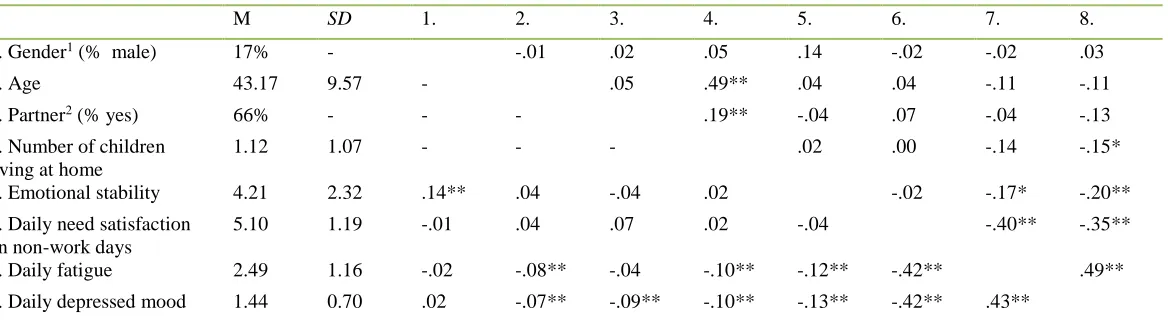
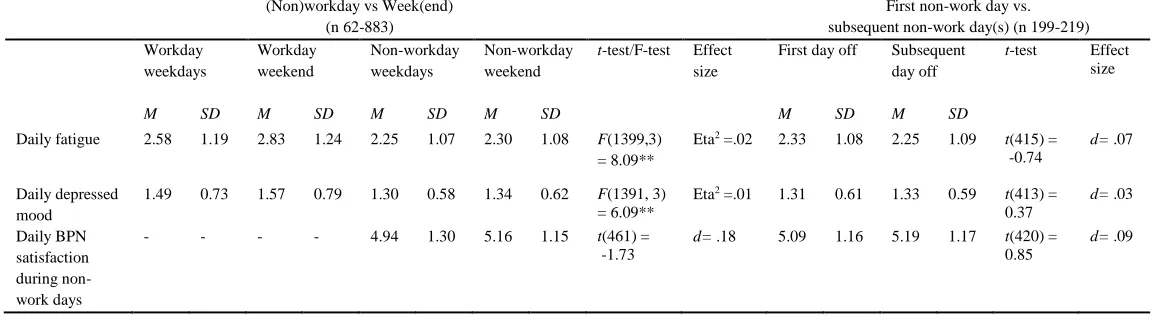
Means, standard deviations and correlations between study variables are presented in Table 1. Table 2 gives a more detailed overview of means and standard deviations of BPN satisfaction and the two recovery indicators for (non)work weekdays vs. (non)work weekend-days, and for the first days off vs. subsequent days off. With respect to the first categorization of types of days, post-hoc tests with Bonferroni correction showed that, for both fatigue and depressed mood, mean levels were significantly higher on workdays during the week compared to non-work weekdays (d = 0.29 for both fatigue and depressed mood) and non-work weekend-days (d = 0.25 for fatigue and d = 0.22 for depressed mood). The difference between work weekdays and work weekend-days was not significant (d = 0.21 for fatigue and d = 0.11 for depressed mood). Furthermore, non-work weekdays did not differ significantly from non-non-work weekend-days (d = 0.05 for fatigue and d = 0.07 for depressed mood).
Results for fatigue
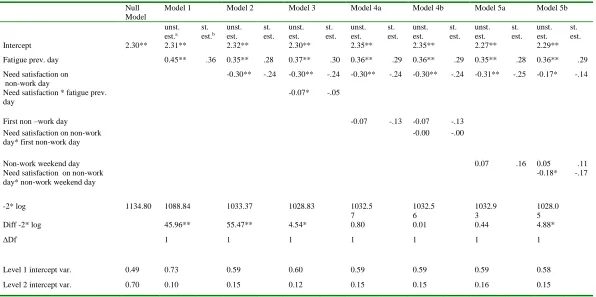
experienced during the previous day is significantly and positively related to fatigue experienced on the present day. Model 2 offered an improved fit over Model 1, and reveals, in support of Hypothesis 1, that – controlling for previous day’s fatigue - BPN satisfaction experienced during non-work days is negatively related to fatigue on those days. A post-hoc power analysis showed that the power associated with this result was very high (i.e., .99).
With respect to Hypothesis 2, results showed that adding the interaction between BPN satisfaction and fatigue experienced during the previous evening in Model 3, resulted in a better fitting model, in which this interaction was significant. A post-hoc power analysis showed that the power associated with this result was below the traditionally accepted .80 (namely .70). A further examination of this interaction
Regarding Hypothesis 4, Table 3 reveals that Model 5a (including the dummy variable indicating ‘non-work weekend day’) did not fit better than Model 2. However, Model 5b showed a better fit, and included a significant interaction between BPN satisfaction during non-work days and the weekend dummy variable. A post-hoc power calculation showed that the power associated with this finding was .72. An examination of the simple slopes (Preacher et al., 2006) revealed that, in accordance with Hypothesis 4, the association between BPN satisfaction and fatigue was stronger on non-work weekend days (multilevel estimate = -0.36, p < .01) than it was on non-work weekdays (multilevel estimate = -0.14, p < .05; see Figure 2).
Results for depressed mood
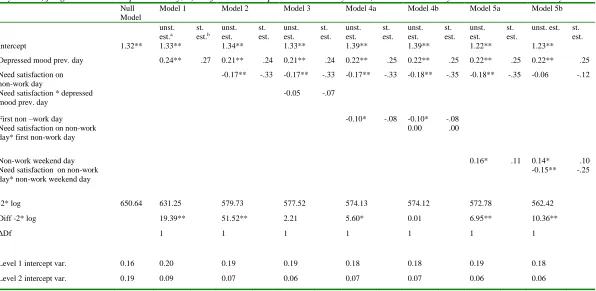
Results of similar analyses conducted for depressed mood are presented in Table 4. Model 1 showed improved fit over the Null Model, indicating that depressed mood on the previous day was positively related to depressed mood experienced on the present day. Including BPN satisfaction during non-work days in the analyses in Model 2 improved the model fit, and showed that – controlling for depressed mood on the previous day - depressed mood was lower if employees reported higher levels of BPN satisfaction on non-work days; this finding provides support for Hypothesis 1. A post-hoc power analysis showed that the power associated with this result was very high (i.e., .99).
Model 4a, which included the dummy variable distinguishing between the first and subsequent non-work days, showed a better fit than Model 2, and revealed that levels of depressed mood were generally lower on employees’ first day off. Model 4b, which incorporated the interaction between the first/subsequent non-work day dummy variable and BPN satisfaction, did not fit better than Model 3b; thus Hypothesis 3 was not supported for depressed mood. A post-hoc analysis also revealed that the power associated with this result was very low (i.e., .06).
Model 5a also provided a better fit than Model 2, and showed that levels of depressed mood were generally higher during work weekend days compared to non-work weekdays. Finally, Model 5b exhibited a better fit to our data than did Model 5a, revealing a significant interaction between the ‘weekend’ dummy variable and BPN satisfaction during non-work days. The power associated with this result turned out to be very high (.95).A further analysis of the interaction effect (Preacher, et al., 2006) revealed that the association between BPN satisfaction and depressed mood was stronger on non-work weekend days (multilevel estimate = -0.22, p < .01) compared to non-work weekdays (multilevel estimate = -0.06, p>.05; see Figure 3), thus providing support for Hypothesis 4.
Additional analyses
conclusions regarding our hypotheses as those in which these control variables were not included.
Discussion
Although previous research clearly supports the positive association between BPN satisfaction and well-being, its role in the daily recovery process has received little empirical attention. Thus, the present study sought to make a unique contribution by examining the influence of non-work day BPN satisfaction on employees’ recovery state. More importantly, we investigated whether the role of BPN satisfaction as an experience that contributes to recovery varies according to employees’ initial recovery state, and between their first and subsequent non-work days. We also examined if the beneficial effect of BPN satisfaction is dependent upon the timing of non-work days (i.e., whether non-work days occur during the weekend or during the week).
Main findings and theoretical implications
Second, this study showed that the association between BPN satisfaction and employees’ recovery state was stronger when employees reported a poor recovery state on the previous (working) day. BPN satisfaction turned out to be particularly influential in reducing fatigue among those employees who had experienced high levels of fatigue the previous day. This result is in accordance with an assumption of the Effort-Recovery model (Meijman & Mulder, 1998) and Conservation of Resources theory (Hobfoll, 2001) that the processes underlying the beneficial effects of BPN satisfaction will have more opportunities to operate in response to elevated load reactions. This finding is
encouraging, not only because it is consistent with prominent recovery theory, but also because it suggests that employees who are most in need of recovery may obtain most benefit from fulfilling core psychological needs during non-work time.
While an elevated level of fatigue the previous day seemed to enhance the
benefits of BPN satisfaction on non-work days, we did not find a similar effect in relation to depressed mood, although this effect was comparable in size to that found for fatigue. It may be that the presumed stronger effects of BPN satisfaction only start operating above a certain level of depressed mood, and that this level was not reached in our sample. Indeed, the levels of depressed mood were generally low in our sample, as indicated by the fact that only 6.8% of the daily reports entailed ‘high’ levels of depressed mood (i.e., a ‘moderate amount’ or higher).
For reasons similar to those underlying the presumed stronger association
examine if we were correct in assuming that employees start their first day off in a less favorable recovery state, we conducted a t-test for each of the two recovery indicators. Results showed that employees indeed reported higher levels of fatigue (M = 2.59; t(412) = -2.48, p <.05; d = 0.24) and depressed mood (M = 1.46; t(411) = -2.37, p <.05; d = 0.24) on the evening preceding their first non-work day compared to the evening preceding a subsequent non-work day (fatigue: M = 2.31; depressed mood: M = 1.30). These differences were not very large, though, and probably not large enough to result in different effects of BPN satisfaction between the first/subsequent non-work days. Consequently, the contention that BPN satisfaction’s relationship with employees’ recovery state would be stronger on the first non-work day because they start such days with a less favorable recovery state was not supported in the present study. It remains to be investigated if these findings are unique to this sample or instead entail a general phenomenon. A tentative conclusion is that our study’s results suggest BPN satisfaction has an equal effect on employees’ recovery on the first and subsequent days off.
Third, we found that BPN satisfaction was more strongly related to employees’ recovery state on free weekend days compared to free weekdays. This finding supports our assumption that satisfying one’s basic psychological needs requires less resource investment during the weekend, and indicates that not all free days are created equal; free weekend days seem particularly important for enhancing the recovery functions of
psychological need fulfillment.
Limitations and suggestions for future research
employees’ recovery state were measured at the same time on non-work days, at the end of each day. As a consequence, it is not possible to exclude the possibility that the causal associations proposed in the present study (also) operated in the opposite direction. Nonetheless, the direction of the associations hypothesized in the present study concurs with basic assumptions derived from the Effort-Recovery model (Meijman & Mulder, 1998) and Self-Determination theory (Deci & Ryan, 2000). Post-hoc analyses of this study’s data showed that (controlling for previous day’s BPN satisfaction) both fatigue (multilevel estimate = -0.31, p<.01) and depressed mood (multilevel estimate = -0.45, p<.01) were negatively related to BPN satisfaction. These findings are in accordance with previous research that found a negative association between employees’ recovery state at the end of their workdays, and BPN satisfaction during their subsequent free evenings (Van Hooff & Geurts, 2014). Future research could provide more insight in this respect, for example by measuring both BPN satisfaction and employees’ recovery state multiple times during the course of a free day.
research should examine this issue taking into account BPN satisfaction both during full non-work days and evenings after work.
Third, despite its pivotal role in the recovery process (Sonnentag & Geurts, 2009), we did not address sleep (quality and/or quantity) in our study. For example, sleep may mediate the association between BPN satisfaction and employees’ next day recovery; and/or the previous night’s sleep may affect the extent to which employees are able to fulfill their basic psychological needs during the day. We therefore recommend that future research provides more insight into the role of BPN satisfaction in the recovery process by also examining if and how it influences sleep (quality and/or quantity) and vice versa.
Fourth, our study focused exclusively on BPN satisfaction and did not pay attention to BPN frustration. As the latter has been shown to be related to ill-being (Vansteenkiste & Ryan, 2013), to provide more insight into the role of basic
psychological needs in the recovery process, it might be valuable for future research to examine if and how frustration of the basic psychological needs relates to employees’ recovery state, and vice versa.
studied, it would be valuable for future research to study the relation between BPN satisfaction and recovery in samples with more variation in recovery states and BPN satisfaction.
Sixth, there was substantial variation in the work patterns of the shift-workers in our sample (see Method section), with only a limited number of participants (n = 23) having days off only on weekdays. To further substantiate the current study’s findings, it is recommended that it is replicated, employing a larger sample of employees who have their weekly days off on weekdays.
Finally, to our knowledge, this is the first study to demonstrate that the functional influence of BPN satisfaction was stronger on free weekend days compared to free weekdays. We assumed this was due to the fact that satisfying one’s basic psychological needs requires less resource investment (e.g., time, energy) during the weekend. However, we did not directly investigate this potential mechanism. Future research may be able to enhance the understanding of the recovery functions of different types of off-job days by explicitly addressing the processes underlying such effects. It would also be useful to investigate whether similar differences between weekday/weekend days away from work pressures will be found for other recovery experiences (such as detachment from work and relaxation; Sonnentag & Fritz, 2007).
Practical implications
personal sense of autonomy, competence, and relatedness, and by reflecting on ways to increase the frequency of such activities/behaviors in their leisure time.
Given the stronger association between BPN satisfaction and recovery on such days, employees should particularly be encouraged to engage in need-satisfying
behaviors on off-job days during the weekend and on off-job days that are preceded by an unfavorable recovery state. Obtaining BPN satisfaction on the latter type of days might be difficult, though, as previous research showed that employees with the highest need for recovery are least able to satisfy their BPNs (Van Hooff & Geurts, 2014), presumably because they lack the (self-regulatory) resources to pursue activities that contribute to BPN satisfaction. It is therefore additionally recommended that employees aim to make a habit of engaging in need satisfying behavior, as habitual behaviors require less (self-regulatory) resources and are therefore more likely to be pursued.
Also, given the stronger association between BPN satisfaction and recovery observed during non-work weekend days, it is essential that BPN satisfaction can be achieved during this type of day. This not only has implications for workers employed in professions that are traditionally characterized by shift-work, but also for other
employees who are requested to be flexible and to adapt to the “24-hour economy”. Results of the current study highlight the importance of allowing employees to have at least some of their off-job days during the weekend. Employers can play an important role in this respect. They could for example contribute to their employees’ health and well-being by designing work schedules in such a way that free days regularly take place during weekends.
References
Baumeister, R., & Leary, M. (1995). The need to belong. Desire for interpersonal
attachments as a fundamental human motivation. Psychological Bulletin, 117, 497– 529.
Daniels, K. (2000). Measures of five aspects of affective well-being at work. Human Relations, 53, 275-294.
Daniels, K., Brough, P., Guppy, A., Peters-Bean, K. M., & Weatherstone, L. (1997). A note on a modification to Warr’s measures of affective well-being at work. Journal of Occupational and Organizational Psychology, 70, 129-138.
Deci, E. L. (1975). Intrinsic motivation. New York: Plenum.
Deci, E. L., & Ryan, R. M. (2000). The “what” and “why” of goal pursuits: Human needs and the self-determination of behavior. Psychological Inquiry, 11, 227-268.
Demerouti, E. (2014). Individual strategies to prevent burnout. In Michael P. Leiter, Arnold B. Bakker and Christina Maslach (Eds.), Burnout at work: A psychological
perspective. London: Taylor and Francis.
Demerouti, E., Bakker, A., Geurts, S., & Taris, T. (2009). Daily recovery from work- related effort during non-work time. In: S. Sonnentag, P. Perrewe, & D. Ganster (eds),
Current Perspectives on job-stress recovery (pp. 85 – 123). Bingley (UK): Emerald Group.
Devereux, J. J., Rydstedt, L. W., & Cropley, M. (2011). Psychosocial work
characteristics, need for recovery and musculoskeletal problems predict psychological distress in a sample of British workers. Ergonomics,54, 840-848.
Feldt, T., Huhtala, M., Kinnunen, U., Hyvönen, K., Mäkikangas, A., & Sonnentag, S. (2013). Long- term patterns of effort-reward imbalance and over-commitment:
Investigating occupational well-being and recovery experiences as outcomes. Work & Stress, 27, 64-87.
Flaxman, P. E., Menard, J., Bond, F. W., & Kinman, G. (2012). Academics’ experiences of a respite from work: Effects of self-critical perfectionism and perseverative cognition on post-respite well-being. Journal of Applied Psychology, 97, 854-865.
Fredrickson, B. L. (2001). The role of positive emotions in positive psychology: The broaden-and-build theory of positive emotions. American Psychologist, 83, 577-585. Fredrickson, B. L., Mancuso, R. A., Branigan, C., & Tugade, M. M. (2000). The undoing
effect of positive emotions. Motivation and Emotion, 24, 237-257.
Geurts, S. A. E., & Sonnentag, S. (2006). Recovery as an explanatory mechanism in the relation between acute stress reactions and chronic health impairment. Scandinavian Journal of Work, Environment and Health, 23, 482-492.
Hobfoll, S. E. (2001). The influence of culture, community, and the nested-self in the stress process: advancing conservation of resources theory. Applied Psychology: An International Review, 50, 337-421.
Houlfort, N., Koestner, R., Joussemet, M., Nantel-Vivier, A., & Lekes, N. (2002). The impact of performance-contingent rewards on perceived autonomy and competence.
Motivation and Emotion, 26, 279-295.
Hox, J. (2002). Multilevel analysis: Techniques and Applications. Mahwah, NJ: Lawrence Erlbaum Associates.
Mäkikangas, A., Feldt, T., & Kinnunen, U. (2007). Warr’s scale of job-related affective well-being: A longitudinal examination of its structure and relationships with work
characteristics. Work & Stress, 21, 197-219.
McEwen, B. S. (1998). Stress, adaptation, and disease: Allostasis and allostatic load. Annals of the New York Academy of Sciences, 840, 33-44.
Meijman, T. F., & Mulder, G. (1998). Psychological aspects of workload. In P. J. D. Drenth, Hk. Thierry, & C. J.De Wolff (Eds.), Handbook of Work and Organizational
Psychology (2nd ed., pp. 5-33). Hove (UK): Psychology Press/Erlbaum.
Mojza, E. J., Sonnentag, S., & Bornemann, C. (2011). Volunteer work as a valuable leisure-time activity: A day-level study on volunteer work, non-work experiences, and well-being at work. Journal of Occupational and Organizational Psychology, 84, 123-152. Muthén, L. K., & Muthén, B. O. (1998-2012). MplusUser’s Guide. Seventh Edition. Los
Angeles, CA: Muthén & Muthén.
Nix, G. A., Ryan, R. M., Manly, J. B., & Deci, E. L. (1999). Revitalization through self- regulation: The effects of autonomous and controlled motivation on happiness and vitality. Journal of Experimental Social Psychology, 35, 266-284.
Ohly, S., Sonnentag, S., Niessen, C., & Zapf, D. (2010). Diary studies in organizational research. Journal of Personnel Psychology, 9, 79-93.
Patrick, H., Knee, C. R., Canevello, A., & Lonsbary, C. (2007). The role of need
fulfillment in relationship functioning and well-being: A self determination theory perspective. Journal of Personality and Social Psychology, 92, 434-457.
Ryan, R. (1995). Psychological needs and the facilitation of integrative processes.
Journal of Personality, 63, 397–427.
Ryan, R. M., Bernstein, J. H., & Brown, K. W. (2010). Weekends, work, and well-
being: Psychological need satisfactions and day of the week effects on mood, vitality, and physical symptoms. Journal of Social and Clinical Psychology, 29, 95-122. Ryan, R. M., & Deci, E. L. (2000b). Self-determination theory and the facilitation
of intrinsic motivation, social development, and well-being. American Psychologist, 55, 68–78.
Ryan, R. M., & Deci, E. L. (2008). From ego depletion to vitality: Theory and findings concerning the facilitation of energy available to the self. Social and Personality Psychology Compass, 2, 702-717.
Sheldon, K. M., Ryan, R., & Reis, H. T. (1996). What makes for a good day?
Competence and autonomy in the day and in the person. Personality and Social Psychology Bulletin, 22, 1270-1279.
Sonnentag, S., & Bayer, U. V. (2005) Switching off mentally: Predictors and
consequences of psychological detachment from work during off-job time. Journal of Occupational Health Psychology, 10, 393-414.
Sonnentag, S., & Fritz, C. (2007). The Recovery Experience Questionnaire: Development and validation of a measure for assessing recuperation and unwinding from work.
Journal of Occupational Health Psychology, 12, 204 – 221.
Sonnentag, S., & Geurts, S. A. (2009). Methodological issues in recovery research. In: S. Sonnentag, P. Perrewe, & D. Ganster (eds), Current Perspectives on job-stress recovery (pp. 1-36). Bingley (UK): Emerald Group.
no place like home? International Journal of Stress Management,11, 366-391. Stride, C., Wall, T. D., & Catley, N. (2007). Measures of job satisfaction, organisational
commitment, mental health and job-related well-being: A benchmarking manual.
Chichester, England: Wiley.
Van Hooff, M. & Geurts, S. (2014). Need satisfaction during after work hours: Its role in daily recovery. Stress & Health, 30, 198-208.
Van den Broeck, A., Vansteenkiste, M., De Witte, H. (2008). Self-Determination Theory A theoretical and empirical overview in occupational health psychology. In Houdmont, J., Leka, S. (Eds.), Occupational Health Psychology: European Perspectives on Research, Education, and Practice.(pp.63-88).Nottingham: Nottingham University Press.
Van den Broeck, A., Vansteenkiste, M., De Witte, H., & Lens, W. (2008). Explaining the relationships between job characteristics, burnout and engagement: The role of basic psychological need satisfaction. Work & Stress, 22, 277–294.
Vansteenkiste, M., & Ryan, R. M. (2013). On psychological growth and vulnerability: Basic psychological need satisfaction and need frustration as a unifying principle. Journal of Psychotherapy Integration, 23, 263.
Table 1. Means, standard deviations and correlations of the core variables under study (6-8) and control variables (1-5).
M SD 1. 2. 3. 4. 5. 6. 7. 8.
1. Gender1 (% male) 17% - -.01 .02 .05 .14 -.02 -.02 .03
2. Age 43.17 9.57 - .05 .49** .04 .04 -.11 -.11
3. Partner2 (% yes) 66% - - - .19** -.04 .07 -.04 -.13
4. Number of children living at home
1.12 1.07 - - - .02 .00 -.14 -.15*
5. Emotional stability 4.21 2.32 .14** .04 -.04 .02 -.02 -.17* -.20**
6. Daily need satisfaction on non-work days
5.10 1.19 -.01 .04 .07 .02 -.04 -.40** -.35**
7. Daily fatigue 2.49 1.16 -.02 -.08** -.04 -.10** -.12** -.42** .49**
8. Daily depressed mood 1.44 0.70 .02 -.07** -.09** -.10** -.13** -.42** .43**
1 0 = female, 1 = male; 2 0 = no, 1 = yes Note : below diagonal: day-level correlations (n between 454 and 1428); above diagonal:
Table 2. Means and standard deviations of fatigue, depressed mood and BPN satisfaction on workdays vs. non-work days, weekday vs.
weekend days and the first non-work day vs. subsequent non-work day(s)
(Non)workday vs Week(end) (n 62-883)
First non-work day vs. subsequent non-work day(s) (n 199-219) Workday weekdays Workday weekend Non-workday weekdays Non-workday weekend
t-test/F-test Effect
size
First day off Subsequent
day off
t-test Effect
size
M SD M SD M SD M SD M SD M SD
Daily fatigue 2.58 1.19 2.83 1.24 2.25 1.07 2.30 1.08 F(1399,3)
= 8.09**
Eta2 =.02 2.33 1.08 2.25 1.09 t(415) =
-0.74
d= .07
Daily depressed mood
1.49 0.73 1.57 0.79 1.30 0.58 1.34 0.62 F(1391, 3)
= 6.09**
Eta2 =.01 1.31 0.61 1.33 0.59 t(413) =
0.37
d= .03
Daily BPN satisfaction during non-work days
- - - - 4.94 1.30 5.16 1.15 t(461) =
-1.73
d= .18 5.09 1.16 5.19 1.17 t(420) =
0.85
d= .09
Table 3. Associations between need satisfaction during non-work days and fatigue, as well as interactions between need satisfaction during non-work days and a)
fatigue levels on the previous day, b) the first vs. subsequent non-work day and c) non-work weekdays vs. non-work weekend days.
Null
Model
Model 1 Model 2 Model 3 Model 4a Model 4b Model 5a Model 5b
unst. est.a st. est.b unst. est. st. est. unst. est. st. est. unst. est. st. est. unst. est. st. est. unst. est. st. est. unst. est. st. est.
Intercept 2.30** 2.31** 2.32** 2.30** 2.35** 2.35** 2.27** 2.29**
Fatigue prev. day 0.45** .36 0.35** .28 0.37** .30 0.36** .29 0.36** .29 0.35** .28 0.36** .29
Need satisfaction on non-work day
-0.30** -.24 -0.30** -.24 -0.30** -.24 -0.30** -.24 -0.31** -.25 -0.17* -.14
Need satisfaction * fatigue prev. day
-0.07* -.05
First non –work day -0.07 -.13 -0.07 -.13
Need satisfaction on non-work day* first non-work day
-0.00 -.00
Non-work weekend day 0.07 .16 0.05 .11
Need satisfaction on non-work day* non-work weekend day
-0.18* -.17
-2* log 1134.80 1088.84 1033.37 1028.83 1032.5
7 1032.5 6 1032.9 3 1028.0 5
Diff -2* log 45.96** 55.47** 4.54* 0.80 0.01 0.44 4.88*
∆Df 1 1 1 1 1 1 1
Level 1 intercept var. 0.49 0.73 0.59 0.60 0.59 0.59 0.59 0.58
Level 2 intercept var. 0.70 0.10 0.15 0.12 0.15 0.15 0.16 0.15
Table 4. Associations between need satisfaction during non-work days and depressed mood, as well as interactions between need satisfaction during non-work days and a) fatigue levels on the previous day, b) the first vs. subsequent non-work day and c) non-work weekdays vs. non-work weekend days.
Null
Model
Model 1 Model 2 Model 3 Model 4a Model 4b Model 5a Model 5b
unst. est.a st. est.b unst. est. st. est. unst. est. st. est. unst. est. st. est. unst. est. st. est. unst. est. st. est.
unst. est. st.
est.
Intercept 1.32** 1.33** 1.34** 1.33** 1.39** 1.39** 1.22** 1.23**
Depressed mood prev. day 0.24** .27 0.21** .24 0.21** .24 0.22** .25 0.22** .25 0.22** .25 0.22** .25
Need satisfaction on non-work day
-0.17** -.33 -0.17** -.33 -0.17** -.33 -0.18** -.35 -0.18** -.35 -0.06 -.12
Need satisfaction * depressed mood prev. day
-0.05 -.07
First non –work day -0.10* -.08 -0.10* -.08
Need satisfaction on non-work day* first non-work day
0.00 .00
Non-work weekend day 0.16* .11 0.14* .10
Need satisfaction on non-work day* non-work weekend day
-0.15** -.25
-2* log 650.64 631.25 579.73 577.52 574.13 574.12 572.78 562.42
Diff -2* log 19.39** 51.52** 2.21 5.60* 0.01 6.95** 10.36**
∆Df 1 1 1 1 1 1 1
Level 1 intercept var. 0.16 0.20 0.19 0.19 0.18 0.18 0.19 0.18
Level 2 intercept var. 0.19 0.09 0.07 0.06 0.07 0.07 0.06 0.06