City, University of London Institutional Repository
Citation: Amirova, A., Cropley, M. & Theadom, A. (2017). The Effectiveness of the
Mitchell Method Relaxation Technique for the Treatment of Fibromyalgia Symptoms: A Three-Arm Randomized Controlled Trial. International Journal of Stress Management, 24(1), pp. 84-106. doi: 10.1037/str0000017This is the accepted version of the paper.
This version of the publication may differ from the final published
version.
Permanent repository link: http://openaccess.city.ac.uk/14655/
Link to published version: http://dx.doi.org/10.1037/str0000017
Copyright and reuse: City Research Online aims to make research
outputs of City, University of London available to a wider audience.
Copyright and Moral Rights remain with the author(s) and/or copyright
holders. URLs from City Research Online may be freely distributed and
linked to.
City Research Online: http://openaccess.city.ac.uk/ [email protected]
Amirova, A., Cropley. M. & Theadom, A. (in press) International Journal of Stress Management The effectiveness of the Mitchell Method Relaxation Technique for the treatment of
fibromyalgia symptoms: a three-arm randomised controlled trial.(MS 2014-0734)
The effectiveness of the Mitchell Method Relaxation Technique for the treatment of
fibromyalgia symptoms: a randomised controlled trial
Objective: To evaluate the effectiveness of the Mitchell Method Relaxation Technique (MMRT) in reducing symptoms of fibromyalgia. Design: A randomised controlled trial was used to compare the
effectiveness of self-administered MMRT (n= 67) with attention control (n = 66) and usual care (n =
56) groups. Main Outcome Measures: Primary outcomes included self-reported fatigue, pain, and
sleep. Secondary outcomes were daily functioning, quality of life, depression, and coping, anxiety
and perceived stress. Outcomes were assessed at baseline, post-intervention (four weeks) and
follow-up (eight weeks). Results: A significant combined improvement on outcomes (p<.005), specific
significant effects for sleep problems (d=0.29, p<.05), sleep inadequacy (d=0.20, p<.05), and fatigue
(d=0.47, p<.05) were present in the MMRT group. At the follow-up, fatigue did not differ to the
post-intervention score (p=.25) indicating short-term sustainability of the effect. The effects on sleep
problems and sleep inadequacy were not sustained. The pain levels decreased when the MMRT was
practiced three times a week (p<.001). Conclusion: MMRT was effective in reducing pain, sleep
problems, and fatigue. High rates of relative risk reduction for fatigue (37%) and pain (42.8%)
suggest clinical significance.
Abbreviations:
PMR=Progressive Muscle Relaxation;
MMRT=Mitchell Method Relaxation Technique;
FIQR=Fibromyalgia Impact Questionnaire (Revised);
MOS=Medical Outcome Sleep Scale;
HADS-A=Hospital Anxiety and Depression Scale (Anxiety Subscale);
HADS-D=Hospital Anxiety and Depression Scale (Depression Subscale); PSS=Perceived Stress
Scale;
VAS=Visual Analogue Scale;
Introduction
Fibromyalgia is a debilitating chronic condition, which is hallmarked by widespread pain, fatigue, sleep
disturbance, and negative affect (Wolfe, Smythe, Yunus, Bennett, Bombardier, & Goldenberg, 1995). It is thought that 2 to 3% of the population experience this condition, although the prevalence rates are believed
to be an underestimate (Bennett, Jone, Turk, Russell, & Matallana, 2007). The costs of health care for
fibromyalgia are substantial (Berger, Dukes, & Oster, 2007). Currently, symptom management is the
primary form of treatment, with pharmaceutical treatments commonly prescribed to reduce pain symptoms.
Most medications, however, have adverse effects, which lead to the discontinuation of treatment, resulting
in limited and non-sustained effect (Arnold, 2007). Multidisciplinary treatments, based on a
biopsychological framework and aimed to address multi-domain symptoms of the condition, should form
an important component of the treatment approach.
The MMRT is an auditory relaxation technique, practiced individually and in silence. MMRT focuses on
the psychoneuroimmunological link between mind and body, and incorporates guided imagery, muscular
relaxation and breathing exercises, and implies full engagement and autonomy (Mitchell, 1997). The
stress-related posture is thought to increase muscle tension and influence the nervous and endocrine
systems as well as to cause muscle stiffness and dystonic patterns (Mitchell, 1990). Mitchell (1990)
suggested that this method causes postural realignment by reversing stress-related posture. Findings from a
systematic review of mind-body treatments for fibromyalgia suggest that guided imagery and progressive
muscle relaxation (PMR) are efficient techniques for the management of the symptoms of fibromyalgia
(Baranowsky, 2009). These techniques have been associated with a moderate positive effect on quality of
life and a spectrum of fibromyalgia symptoms in two trials (Baranowsky, 2009). The MMRT has been
found to reduce the physiological stress response in healthy adults, indicated by heart rate measurements
(Bell & Saltikov, 2000). MMRT is a technique that can be taught and self-applied and therefore is very
likely to have a long-lasting sustained positive effect on outcome measures. Coherent combination of
imagery, muscular relaxation and breathing addresses the management of symptoms associated with FM. It is, therefore, expected, that the MMRT will diminish features of the condition that contribute to
Many relaxation therapies involve prolonged therapy sessions, some taking a minimum of 45 minutes,
during which patients have to be immobile. Considering that fibromyalgia patients report switching
between relaxation and movement as one of the strategies they use to cope with pain (Theadom, Cropley,
Humphrey, 2007), long immobility during these sessions may induce pain and hamper the therapeutic
effect. In contrast, MMRT sessions are short, and therefore, the technique is expected to be more effective
at symptom management and also less onerous for patients. In addition, to make the therapy acceptable for participants, we chose to deliver the study online.
We propose that the MMRT will reduce fibromyalgia symptoms through its effect on the hypothesized underlying cause of the condition whilst the online delivery, self-application, and the short duration of each
session reduce the burden on the fibromyalgia sufferers. In this RCT we examined the effectiveness of an
online Mitchell Method Relaxation programme (Mitchell, 1997) in reducing fibromyalgia symptoms. The
primary objective of this study was to evaluate the immediate effects of the MMRT on fibromyalgia
symptoms and its short-term sustainability as well as to evaluate the dose-sensitive effect of the
programme on health outcomes. The secondary objective was to identify its effects for subgroups of
patients presenting with different co-morbidities, and to explore the mechanisms of the intervention. The
third objective was to evaluate the clinical significance of the MMRT.
Method
Design
A three-arm randomised controlled trial (RCT) was used to evaluate the effectiveness of the MMRT in
comparison to active control and usual care groups. The study was conducted in accordance with the
CONSORT Statement for RCTs of Non-Pharmacologic Treatments (Boutron, Moher, Altman, Schulz, &
Ravaud, 2008) and, where applicable, with the CONSORT 2010 Statement (Schulz, Altman, & Moher,
2010). The study was conducted online in England.
Participants and Recruitment Procedure
Committee. Individuals diagnosed with fibromyalgia were approached online via regional support groups
and 201 enrolled to participate in the study. Study participants gave their consent to take part in the current
study via e-mail. To be eligible, participants had to meet the following criteria: aged between 18 to 80
years, have Internet access and to be diagnosed with fibromyalgia syndrome as outlined by American
College of Rheumatology classification criteria of widespread pain persistent for at least 3 months and
tenderness at a minimum of 11 of the 18 tender points (Wolfe et al, 1995). Additionally, participants had to satisfy the new preliminary diagnostic criteria for fibromyalgia (Wolfe, Clauw, Fitzcharles, Goldenberg,
Katz, & Mease, 2010). Internet connectivity across Great Britain is now widespread, with approximately 83% having access to the Internet, and 73% of adults reporting use of the Internet every day. Internet
connectivity is not confined to the more economically affluent groups (Office for National Statistics,
2013). Participants reporting severe psychiatric comorbidities, life-threatening conditions, substance abuse
and pregnancy as well as recipients of any non-pharmaceutical treatment were excluded from the study. To detect a medium effect size, using MANOVA with power of β=0.8 and to account for 20% dropout
rate, 67 participants were recruited for each group.
Health Outcomes and Measurements
Primary Outcome Measures
Pain Severity. To assess the severity of pain, a Visual Analogue Scale of Pain (VAS) was employed. VAS
are widely used to assess pain in patients with fibromyalgia (Salaffi, Sarzi-Puttini, Ciapetti, & Atzeni,
2009). The scale was adapted for online use and transformed from a 10 cm scale into 1-10 point scale.
Lower VAS scores indicate lower level of pain severity.
Sleep. The Medical Outcome Sleep Scale (Hays & Stewart, 1992) was employed to evaluate sleep quality.
The MOS is a patient self-report sleep scale consisting of 12 items and is used to assess sleep across six
domains: (1) sleep disturbance; (2) snoring; (3) awaking, due to shortness of breath or with a headache; (4)
sleep adequacy; (5) somnolence; and (6), sleep quantity. The Sleep Problems Index summarizes responses
using an abbreviated six-item index. This index contains questions from the sleep disturbance, sleep
scale are scored using a six-point response scale, one item uses a five-point Likert scale, and sleep quantity
is an open-ended question about the actual number of hours slept. Each subscale score and Sleep Problem
Index range from a 0–100 scale and represents the percentage of a particular sleep domain; sleep quantity
was recorded as 0–24 hours. Higher scores for the domains indicate worse sleep problems. The MOS has
good construct validity and reliability when used with fibromyalgia patients (Cappelleri, Bushmakin,
McDermott, Dukes, Sadosky, Charles, Petrie, & Martin, 2009). The Cronbach’s α for each of the subscales was higher than .70 (Cappelleri, 2009).
Fatigue. Levels of fatigue were assessed using fatigue subscale of the Short Form-36 Health Survey (Ware
& Kosinski, 2001). The subscale is a sensitive, valid and brief measure of fatigue and consists of 4 items: (1) ‘Did you feel full of life?’, (2) ‘Did you have a lot of energy?’, (3) ‘Did you feel worn out?’, & (4) ‘Did
you feel tired?’. The Likert scale for each item ranges from 1 (‘none of the time’) to 6 (‘all of the time’).
The total score represents the sum of the scores for all items and ranges from 4 to 24, with a greater score
representing higher levels of fatigue. The SF-36 fatigue scale is highly correlated with multidimensional
fatigue, as measured by Fatigue Symptom Inventory Scale, r=-0.68 to -0.77 (Brown, Kroenke, Theobald,
& Wu, 2011).
Secondary Outcome Measures
The impact of Fibromyalgia. The Revised Fibromyalgia Impact Questionnaire (FIQR; Bennett, Friend,
Jones, Ward, Han, & Ross, 2009) was administrated to assess the components of health that are affected by
fibromyalgia. The FIQR consists of 10 items constituting 3 dimensions: (1) ‘fibromyalgia symptoms’, (2) ‘function’ and (3) ‘overall impact’. The FIQR is an advanced measurement in comparison to FIQ
(Burckhardt, Clark, & Bennett, 1991), as it includes symptoms of tenderness and dyscognition and does
not have sex or race biased items. The FIQR has desirable discriminant validity (Luciano, Aguado, &
Seranno-Blanco, 2013). The Cronbach’s α value of the FIQR domains was higher than 0.80 (Bennet et al.,
Depression (Dysphoria). To assess depression (dysphoria) the Depression subscale of the Hospital Anxiety
and Depression Scale was employed (Zigmond, & Snaith, 1983). Evidence of the discriminant validity,
reliability of the measure in people with fibromyalgia has been demonstrated (Pallant, & Tennant, 2007).
Anxiety. To assess the impact of treatment on the levels of negative affect, the anxiety subscale of the
Hospital Anxiety and Depression Scale (Zigmond, & Snaith, 1983) was utilised. Greater score on
HADS-A indicates lower anxiety levels.
Health-related Quality of Life. HRQoL was measured using SF-36 Health Survey (Ware & Kosinski,
2001). SF-36 has a desirable reliability and has been validated for clinical samples.
Coping. Coping difficulty and coping efficacy were assessed with two single items: ‘how difficult was it to
cope with symptoms for the past week?’ and ‘How satisfied are you with how you coped with symptoms
during the past week?’ respectively. The items are valid measures of coping efficacy and coping difficulty
with good reliability (Lazarus, & Folkman, 1983).
Perceived Stress. The Perceived Stress Scale (PSS) was used to assess levels of perceived stress (Cohen,
Kamarck, & Mermelstein, 1983). The PSS comprises of 10 items assessing the frequency of everyday
stressful events and the perceived control of stressful event. PSS has been validated on a clinical sample of
fibromyalgia patients. PSS construct and discriminant validity was reported. The scale has very good reliability, Cronbach’s α=0.78 [Cohen, & Williamson, 1988).
To evaluate perceived effectiveness of the treatment intervention and the comparator, a Treatment
Creditability Scale was utilised (Dunmore, 2001). The credibility scale asks participants to rate the logical
approach of the treatment, the certainty that treatment will be successful and the degree of confidence with which to recommend the intervention to a friend. The items’ scale ranges from 0 (‘not at all’) to 10
(‘completely’). The measurement of the dose comprised of the single item inquiring the frequency with
which the intervention was applied. The item’s scale ranged from 1 (‘every day’) to 6 (‘less than once a
week’). To evaluate therapeutic effects of MMRT the assessment of outcome measures was performed
one-month follow-up. At the baseline assessment participants reported the comorbidities and demographic
characteristics.
Randomization
Participants were allocated to one of the three study conditions in blocks of 30 in a 1:1:1 ratio. An
algorithm implemented within the RandNum and SysRand functions, provided by the SSIWEB software,
produced the automated random allocation to one of the groups. Participants were then able to download their allocated instructions from the next page on the website. Participants in the experimental condition
were able to download instructions for the MMRT intervention, the attention control group were asked to
listen to a relaxation audio recording and usual care participants were instructed to close the questionnaire.
Treatments
The Mitchell Method Relaxation Technique (MMRT)
The intervention group received written instructions of the Mitchell Method Relaxation Technique
(Mitchell, 1997) and a short (5 minutes 20 seconds) audio recording of the guided technique. Participants
were asked to practice the MMRT by using the same audio recording every day for one month. When
prepared and engaged, the participant sat at a desk or in a chair with a high back or laid on the floor. The participant was then given definite verbal orders (e.g. ‘move and feel’, ‘stop’, ‘feel’) to engage in a series
of muscle relaxation exercises in the following sequence: arms, legs, body, head and face. Participants
were not provided with training in discriminating between levels of muscle tension. Participants practiced
muscle relaxation at their preferred level of tension to ensure autonomy – a key aspect of MMRT. After the
completion of the exercise, participants engaged in deep breathing at a comfortable rate. Lastly, the
participant performed an imagery task, recalling a pleasant occasion or concentrating on a pleasant
repetitive sequence (e.g. song, prayer) for one minute.
The Attention Control
The attention control group received an audio recording of ‘white noise’ and steady sound of resting heart
listening to the recording is deemed to initiate relaxation, increases sleep quality and reduces tension and
stress, and subsequently reduces pain levels. Participants were asked to listen to the recording on a daily
basis for one month. The length of recording was identical to the intervention. The mean total creditability
score was not significantly different between participants who received the MMRT (M=6.02, SD=2.64)
and participants who received the attention control treatment (M=5.30; SD=2.71), t (68) =1.10, p=.27),
verifying the successful control for the placebo effect. Creditability score was not associated with health outcomes. Self-reports were employed to measure adherence to both, the MMRT and attention control, at
post-intervention assessment and follow-up.
Waiting list control
Participants allocated to the waiting list group did not receive an active treatment and proceeded with usual
care. All participants were offered the MMRT audio recording upon the completion of the study.
Study Flow
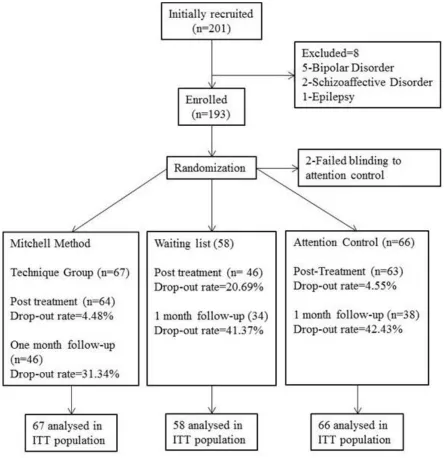
The flow chart (figure 1) presents process of the study, group allocation, excluded cases, and attrition rates.
Dropouts resulted from the disregarding of e-mails, difficulty in contacting the participants, and
withdrawals for personal reasons (i.e. holidays).
Intention-To-Treat Procedure
In accordance with the CONSORT statement for reporting randomised trials (Zwarenstein, Treweek,
Gagnier, Altman, Tunis, Haynes, Gent, Oxman, & Moher, 2008), the statistical analysis was performed on the ‘intention-to-treat’ basis to avoid overestimation of clinical effectiveness and to control for bias
introduced by participant dropout. All patients were included in the analysis, regardless of the treatment
actually received and regardless of subsequent withdrawals or deviations from the protocol and loss to
follow-up. Missing responses were imputed using multiple imputation procedure (Sterne, Carlin, Spratt,
Royston, Kenward, Wood, & Carpenter, 2009). Linear regression analysis procedures were performed to
determine the predictors of outcome variables. Co-morbidities, age, medication, and duration of the
preserve the naturally occurring trends in data the latter were stated as predictors in the linear regression
model, used for multiple imputations. Due to reciprocal relationships between the outcome variables, all
outcome measures were stated as predictors and used in the linear regression model for multiple
imputations. The Rubin Rule of averaging on 5 sets of imputed data was performed to control for the uncertainty of the variance. Insignificant results of Little’s test confirmed the assumption that data-values
were missing at completely random (MACR) [χ² (756; 58) = 84.153, p=1]. Differences between means of the observed and imputed data were insignificant based on a 95% confidence level.
Participant’s characteristics and randomization check
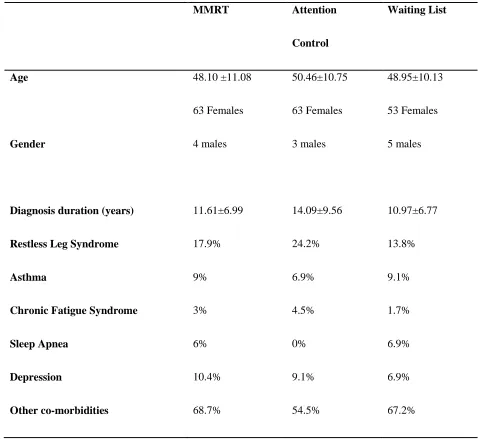
The age of participants ranged from 37 to 69 years. Participants were predominantly Caucasian (90%) and
female (93.7%). The demographic characteristics are presented in Table 1. Frequencies of co-morbidities
and gender distribution across groups are representative of the fibromyalgia population. To verify the randomisation and equal distribution of baseline characteristics between the three groups, the χ² test was
performed on the categorical variables and MANOVA on the continuous variables. The groups did not
differ in terms of distribution of males and females [χ² (2; 191) =.888, p=.642]. The frequencies of Restless Leg Syndrome [χ²(2;191)=2.26, p=.323], Asthma [χ² (2;191)=2.52, p=.882], Chronic Fatigue Syndrome
[χ²(2;191)=816, p=.665], Sleep Apnoea [χ² (2;191)=4.48, p=.107] , depression and other co-morbidities
[χ²(2;191)=3.40, p=.183] were the same across the study groups. The three groups did not differ in terms of
age [F(2; 191) =.834, p=.436] and diagnosis duration [F(1,191) = 2.76, p =.070]. Using Pillai’s trace,
MANOVA indicated, that at baseline, overall variances across all outcome measures was not significantly different across three study groups [V=.328, F (54; 326) =1.186, p=.187, β=.991]. However, follow-up
univariate between-subjects ANOVA demonstrated the significant difference in the mean VAS pain score at the baseline [F (2; 188) =3.08, p=.05]. Post hoc multiple comparisons with Tukey’s adjustment
identified that the mean value of the baseline VAS pain score of the MMRT group (M=7.43, SD=1.68)
was significantly higher than the mean value of the waiting list control group [(M=6.68; SD=1.42), p<.05].
The somnolence baseline scores significantly differed across the three groups [F (2; 188) =3.50, p<.05].
The mean baseline somnolence score of the MMRT group (M=55.19; SD=27.74) was significantly higher
than the mean score for the control group (M=46.80; SD=33.86), p<.05). The baseline mean scores of
difficulty did not differ across the groups.
Statistical Analysis
Evaluation of the immediate effects of the treatment
The researchers performed blinded analysis of the data. Two-tailed hypothesis tests were employed
throughout the analysis. Between-subject MANCOVA was employed to test the differences between
groups on the extent of change among outcome variables, after having adjusted for pre-intervention levels. MANCOVA, in contrast to several ANOVAs, accounts for multivariate relationships between pain, sleep,
fatigue, and other outcomes. Using Levine’s Test of Equality of Error Variance, the assumption of
homogeneity of variance was supported, indicating the robust multivariate analysis. The baseline measures
for all outcomes were included as covariates due to significant differences in baseline VAS score and
somnolence scores across groups and its reciprocal relationships with other primary and secondary
outcome measures. Age, medication, co-morbidities, and diagnosis duration were included as covariates, to
control for its predictive value identified at the preliminary analysis. To provide accurate estimates of the effect sizes for the population Cohen’s ds were calculated. MANCOVA was followed up with discriminant
function analysis to test the differences between study conditions and to explore the covariance between
changes in outcome variables.
Evaluation of the sustained effects of the treatment
A treatment (MMRT, Attention Comparator, Control Group), by time (baseline, post-intervention, one
month follow-up) Mixed-Subject MANOVA was conducted to evaluate the effect of the intervention
against the attention group and the waiting list control group. Due to the significant results of Mauchley’s
test and the violated assumption of sphericity for sleep inadequacy scores [χ² (2) =30.3, p<.001], sleep problems scores [χ² (2) =22.87, p<.001] and fatigue scores [χ² (2) =1.81, p<.05] the Greenhouse–Geisser
corrected values are presented. The differences between the groups are assessed by planned comparisons
Evaluation of effects for subgroups, dose-sensitive effects and mechanisms of the treatment
Bootstrapping method of simple moderation analysis was performed (Hayes, 2009; 2012; 2013) to
test for moderating effect of comorbidity (i.e. RLS) on the effectiveness of the MMRT and the
conditional effect of the MMRT at a value of dose. A presence of comorbidity was coded as 1 and its
absence was coded as 0. Multiple mediation analysis (Preacher & Hayes, 2008) to test for the indirect
effects of the intervening variables was performed. The clinical significance of the treatment
The clinical significance of the treatment is presented by taking into account: the Absolute Risk Reduction (ARR), Relative Risk Reduction (RRR), Number Needed to Treat (NNT), Cohen’s U3, and Probability of
the Superiority. The ARR is an arithmetic difference between experimental group and the control group in
percentages of participants who displayed the reduction in the outcome scores after the treatment. The
RRR is based on the relative percentage of participants who benefited in terms of each outcome in
comparison to control groups. NNT was calculated using the following formula: 1÷ Ö (Cohen’s
d−1÷(CGP))−CGP, where Ö is the cumulative distribution function of the standard normal distribution;
CGP is the control group's percentage of people displaying symptom reduction in the control group; and ä
- the population Cohen's d. U3 was calculated by multiplying cumulative distribution function (Ö) by
Cohen’s d. Probability of the Superiority was calculated using the following formula: Ö(Cohen’s d ÷√2).
Results
Immediate effects of the MMRT
MANCOVA, using Pillai’s trace, identified a significant groups and pre-post interaction across all
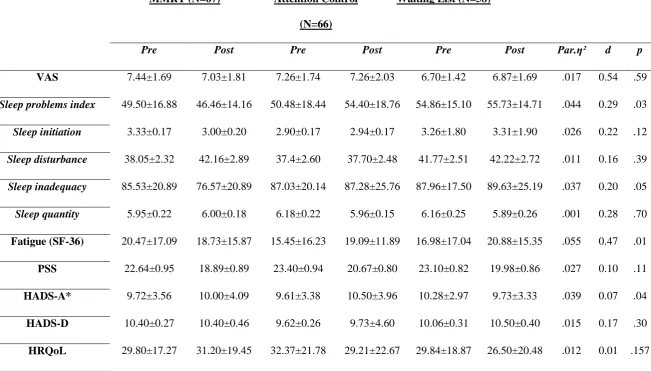
outcomes [V=.511, F (56; 266) =1.631, p<.005, η²=.256]. Summary of mean scores before and after the
intervention, together with effect sizes at 95% confidence level for all variables are presented in Table 2.
Separate univariate ANCOVAs on the outcome variables revealed significant difference across the groups in mean changes of sleep problems [F(2;159)=3.70, p<.05, ηp²=.044], sleep inadequacy [F(2;159)=3.09,
p=.048, ηp²=.037], anxiety [F(2;159)=3.22, p<.05, ηp²=.039], and fatigue [F(2;159)=4.633, p<.05,
The mean pre-post change of perceives stress score (PSS) did not significantly differ across three study
arms [F (2; 159) =2.27, p=.11, ηp²=.027]. Similarly, the treatment effects on sleep disturbance [F (2; 156) =.924, p=.39, ηp²=.011] and sleep initiation [F (1; 159) =2.15, p=.12, ηp²=.026] were insignificant. The
mean changes of the VAS score across three groups did not significantly vary [F (2; 159) =.536, p=.592, ηp²=.007]. Univariate ANCOVAs did not detect significant differences between the study groups in mean
pre-post changes of the secondary outcome variables (Table 2).
MANCOVA was followed-up with one way between-subject analysis of variance of fatigue, anxiety, sleep
problems, sleep inadequacy, controlling for baseline measurements, age, medication, duration of diagnosis
and comorbidities. Planned contrasts revealed that the average pre-post change of fatigue score in the
MMRT was significantly different from the mean change of the score in the control [t (160) =2.16, p<.05],
and attention comparator [t (160) =6.32, p<.05] groups. The attention comparator group’s pre-post change
in fatigue score was not significantly different from the mean of the control group [t (160) =-.223, p=.823].
The mean pre-post change in levels of anxiety for the attention comparator group was significantly higher
than the mean for the wait-list control group [t (160) =2.50, p<.05]. However, the anxiety levels in the
main intervention group did not significantly drop in comparison to the control group [t (160) =.885,
p=.38]. Sleep inadequacy was significantly reduced for MMRT group when comparing to waiting list
control group, [t (160) =-2.56, p=.01], but did not significantly differ from the attention comparator group
[t (160) =6.97, p=.188]. Sleep problems were reduced after the MMRT significantly more than in attention
control [t (160) =8.37, p<.01], and waiting list groups [t (160) =2.36, p<.02].
MANCOVA was additionally followed up with discriminant function analysis to explore whether the
MMRT group membership significantly predicted the pre-post intervention change across outcomes. The
first discriminant function explained 63.4% of the variance (canonical r²=.25). Change in scores on sleep
inadequacy (r=.377), sleep problems (r=.491) and fatigue (r=.456) loaded significantly high on the first
function. The first discriminant function significantly differentiated the MMRT group from the attention comparator and control groups, [Λ=.807, χ²(12)= 39.72, p<.001]. The second function explained 36.6 %
of variance (canonical r²=.277) and was correlated with pre-post change in anxiety levels (r=.30). The second function significantly differentiated control group from both active groups, [Λ=.923, χ² (5) =14.79,
problems and sleep inadequacy scores relative to the control and usual care groups. Whilst, the active control’s group mean pre-post change in anxiety was significantly different to usual care.
Effects of the MMRT at one-month follow-up
Mixed Subject MANOVA indicated the significant effect of time on all outcome measures within the entire cohort [V=.959, F (2; 137) =62.02, p<.001, η²= .059]. Overall, the outcome measures significantly
differed across the three study arms over time [V=.735, F (2; 276) =1.54, p<.005, η²=.368]. However, the
effect of attention comparator group on the anxiety levels was not sustained at the follow-up [F (4; 376)
=1.61, p=.171].
Sleep Inadequacy
Mean scores of sleep inadequacy at three time points were significantly different across the groups [F
(3.81; 376) =2.895, p<.05]. The planned contrast comparison indicated significant difference between
post-intervention mean scores and the follow-up mean scores [F (2; 376) =4.89, p<.01]. However, the mean
scores at one-month follow-up did not differ from the score assessed at the baseline [F (2; 376) =673,
p=.512]. The latter suggests that the effect of the intervention on sleep inadequacy did not sustain at the
follow-up.
Sleep Problems
Mean scores of sleep problems (MOS) significantly varied across assessment points between the groups [F (3.59; 376) =2.79, p<.05, η²= .030]. Within subject contrasts indicated significant difference between mean
scores at baseline and post-intervention [F (2; 376) =2.83, p<.05]. However, the follow-up mean score of
the MMRT group (M=51.11; SD=13.16) was significantly higher than the post-intervention mean score
(M=46.46 SD=14.16), [F (2; 376) =4.50, p<.05]. Therefore indicating, that sleep problems score regressed
to the baseline score.
Fatigue
Planned within-subject contrasts with Bonferroni adjustment showed that the follow-up MMRT fatigue
score was significantly lower than baseline scores [F (2;356)=3.182, p<.05], however, did not differ from
the fatigue levels as measured immediately after the intervention [F(2;356)=1.415, p=.246], indicating the
sustained effect of MMRT on fatigue levels.
Dose-sensitive effects of the MMRT
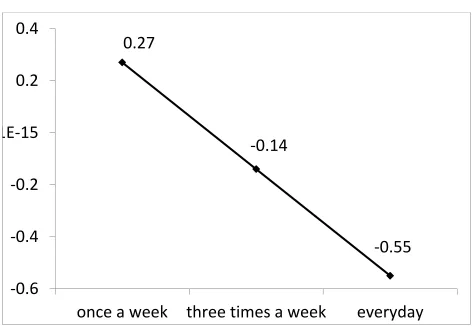
The mean value of dosage was 3.5 (SD=1.27), which corresponds to 5 sessions a week. A significant dose-conditioned effect of the intervention on the VAS score was observed [R=.24, F (3; 132) =3.44, p<.05;
interaction B=-.72, t=-2.97, p<.005]. At the value of dose = 4.77, which corresponds to 3 sessions a week,
[t (049) = 2.10, p<.05]. The VAS score was significantly reduced by .55 when the technique was practiced
at least 3 times a week. The mean pre-post changes in VAS scores at a value of dose are presented in figure
2. Dose of the intervention did not have a moderating effect on any other outcome variables. The dose was
significantly reduced by a value of 3.37 at the follow-up assessment [t(190)=36.37, p<.001; CI: 3.18;
3.55].
MMRT effects for clinical subgroups
Restless Leg Syndrome (RLS) did not have a significant moderating effect on pre-post change in sleep
inadequacy, sleep problems and fatigue as evaluated by bootstrapped moderated mediation model [R=.11,
p=.97; interaction B=6.19, t(.48)=1.29, p=.20]. The independent t-test identified significant difference [t
(65) =-2.08, p<.05] between mean pre-post changes in sleep problems score for the participants’ with
co-morbid RLS (M=7.20; SD=18.19) and those without the co-co-morbidity (M=- 6.6; SD=21.49). Similar
results were observed in coping difficulty [t (65) =2.40, p<.05]. Participants with RLS co-morbidity
experienced small increase in coping difficulty (M=.14, SD=.21), whereas participants without comorbid
RLS displayed decrease in coping difficulty (M=-.81; SD=1.39). The effects however, were not significant
when compared to the control groups. Frequencies of other comorbidities were too low to conduct the
The mechanism of the MMRT
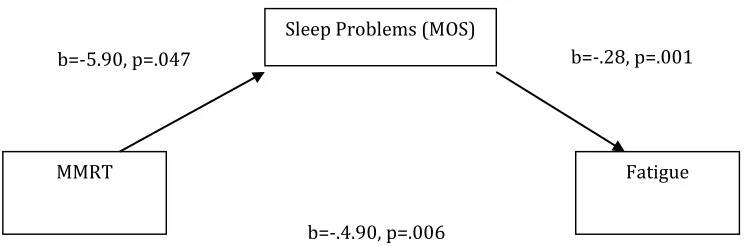
The mediating roles of sleep problems and sleep inadequacy were tested. The total effect of the MMRT
and the indirect factors explained 34.4% of the change in the variance of fatigue, and sleep inadequacy,
and sleep problems, explained 14.7% of the unique variance in fatigue change [R=.344, R²=.118,
F(3;187)=8.37, p<.001]. However, only sleep problems had a significant mediating effect on fatigue
(figure. 3). No other significant mediators were identified.
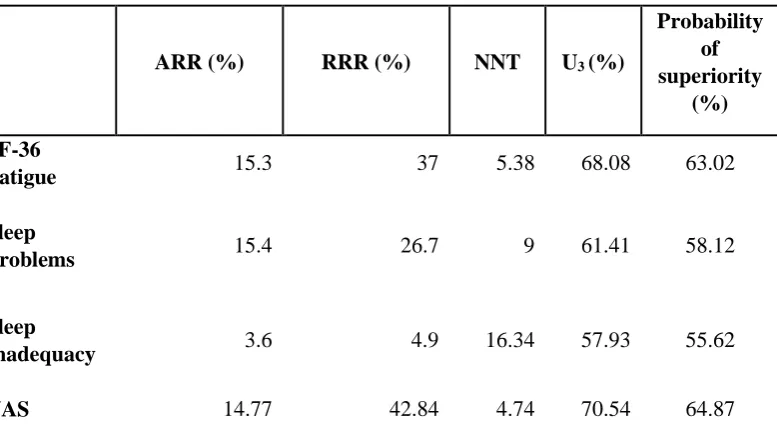
The clinical significance of the MMRT
Table 4 presents Absolute Risk Reduction (ARR), Relative Risk Reduction (RRR), and Number Needed to
Treat (NNT) for the MMRT group comparatively to the waiting list control group. As indicated by
Cohen’s U3, the 70.54% of the individuals who received MMRT had greater reduction in pain severity than
the mean reduction rate in usual care group. The percentages for sleep inadequacy; sleep problems, and
fatigue are given in Table 4. Given overall improvement in both control and treatment groups, the
probabilities of a person selected at random from the MMRT group having a larger reduction in pain
severity (64.87%) fatigue (63.02%), sleep problems (58.12%), and sleep inadequacy (55.62%) than a
person selected at random from the control group, are relatively large.
Discussion
This is the first study to evaluate the effectiveness of the Mitchell Method Relaxation Technique in reducing symptoms associated with fibromyalgia. The results showed a dose-response effect on pain
levels, moderate sustained effect on fatigue, and short-term positive effect on sleep quality. Thus, the
MMRT is effective at reducing fatigue, sleep problems, and in particular, sleep inadequacy for people with
fibromyalgia. Furthermore, the technique effectively reduces pain severity, if practiced at least 3 times a
week. However, practicing the MMRT did not improve functioning, depression (dysphoria), HRQoL or
coping with the condition.
Fatigue and poor sleep emerge as the most prominent problems of fibromyalgia experience and have been
reported by patients as being more detrimental than pain (Bennet et al., 2007) yet, treatments targeting
existing mind-body interventions decreased pain levels, improved mood and functioning in short-term did
not result in improved sleep quality or decreased fatigue levels (Theadom et al., 2015). Whilst the MMRT
significantly attenuated sleep problems and fatigue prevalent in fibromyalgia. Furthermore, the positive
effect of the MMRT on fatigue persisted a month later. Therefore, the MMRT is a favourable symptom
management aid for fibromyalgia-related fatigue and sleep problems compared to other existing
mind-body therapies.
The results revealed that improvement in sleep quality significantly accounted for the reduction in fatigue
levels induced by the MMRT. The latter is in line with the evidence supporting the moderating role of poor
sleep in fatigue (Nicassio et al., 2002). In conjunction with insignificant mediating effect of pain on fatigue
levels, this points out the primary causal role of sleep problems in fibromyalgia-related fatigue.
Identification of subgroups of patients is an important factor of the treatments’ effectiveness particularly
for patients with fibromyalgia (Adams & Sims, 2005). We used the bootstrapped method in the present
study to evaluate the moderating role of comorbid RLS on the MMRT effect. The effectiveness of the
MMRT for the subgroup of patients displaying RLS co-morbidity was however not supported. Thus, the
effects of the MMRT, as well as effects of other treatments, for different clinical subgroups of
fibromyalgia patients should be investigated in studies with a larger sample size. The presence of RLS
causes sleep difficulties (Allen, Walters, Montplaisir, Hening, Myers, Bell, & Ferini-Strambi, 2005), in addition to the normal sleep problems accompanying fibromyalgia, and thus, conflicts with the MMRT’s
effects on sleep. This suggests a need for specific symptom management for patients with comorbid
dystonic patterns.
Future studies of the effectiveness of the MMRT are urged to assess the long-term effects. The long-term
effect is not reflected in the current study, due to the reduced adherence to the intervention as assessed at
the one-month follow-up. The MMRT can be easily learned and self-applied, and therefore likely to have
long-term therapeutic effects with sustained practice. Perhaps educating patients of the benefits of
continuing with the technique would increase adherence and practice long-term. The issue of treatment
adherence should be addressed by future research in order to increase the sustainability of the MMRT’s
The intervention was self-applied and delivered online, and this may have contributed to the dropout rate,
and perhaps this could have been reduced if there was regular contact with a health professional. It is
expected that MMRT will have a greater sustained effect on health outcomes if implemented in clinical settings or under therapist’s supervision. In addition, the limitations of the study include self-reported
measures of compliance, which could be overcome by direct observations in clinical settings. On the other
hand, the online delivery, self-application and minimal intrusion throughout the study, provides evidence of the MMRT effectiveness in real world settings, thus increasing the ecological validity of the findings. In
addition, patients with fibromyalgia may prefer interventions that they can practice at home, and this
would increase their perceptions of control over their condition, and also will help to avoid the necessary
travel to the clinic, which patients could find challenging. Furthermore, the nature of the technique and the session’s short duration accommodate for the patients’ need to shift between movement and immobility.
Comparative studies are required to determine the constructive modes of delivery and duration of sessions.
Several measures were taken to obtain an objective assessment of the technique. The study included a
representative homogeneous sample of fibromyalgia patients. The selection bias was eliminated by
randomisation procedure. Furthermore, the blinding of the assessors of the outcomes was performed.
Additionally, the potential biases introduced by the high attrition rates were reduced through the
employment of intention-to-treat analysis. The significantly greater improvement of the MMRT group in
comparison to attention control group, as indicated by the discriminant function analysis, supports the
specific effect of the intervention and accounts for the unspecified placebo effect. The rigorous method of
this study helps to ascertain objective evaluation of the MMRT effectiveness.
The MMRT fulfils few of the criteria for clinical significance. Firstly, The MMRT effect on pain and
fatigue was relatively large, 42.84% and 37%, respectively. Secondly, the estimate of the Number Needed
to Treat (NNT) is 4.74 for pain and 5.38 for fatigue. The NNT of 2-5 is considered indicative of the
clinically effective treatment in pharmaceutical research (Cook & Sackett, 1998). Furthermore, none of the
study participants reported adverse effects of the treatment. Stringent control for biases as well as a relatively small NNT, large magnitude of the effects and absence of health hazards advocate the clinical
In summary, the Mitchell Method Relaxation Technique attenuates sleep inadequacy, sleep problems, and
subsequently fatigue, and pain in patients with fibromyalgia. This symptom management does not require
substantial effort and commitment. The technique, therefore, is a feasible and cost-effective management
of fibromyalgia symptoms in patients without comorbid RLS. This study highlights the role of effective
management of sleep problems in the fibromyalgia treatment approach. The absence of adverse effects,
rigorous methods of evaluation and the supported effectiveness in symptoms management, signify the MMRT as an adjuvant treatment for the individuals diagnosed with fibromyalgia.
References
Adams, N., & Sims, J. (2005). Rehabilitation Approaches in fibromyalgia. Disability and Rehabilitation,
12, 711-723.
Allen, R.P., Walters A.S., Montplaisir J., Hening W., Myers, A., Bell, T.J., Ferini-Strambi L.(2005).
Restless leg syndrome prevalence and impact: REST general population study. Archive Intern
Medicine,13(165),1286-92.
Arnold, L. (2007). Duloxetine and Other Antidepressants in the Treatment of Patients with Fibromyalgia.
Sleep Medicine 8 (s2), 63-74. DOI: 10.1111/j.1526-4637.2006.00178.x
Baranowsky, J. (2009). Qualitative systemic review of randomized controlled trials on complementary and
alternative medicine treatments in Fibromyalgia. Rheumatology International, 30, 1–21.
Bell, J., A., & Saltikov, J., B. (2000). Mitchell's Relaxation Technique: Is It Effective?Physiotherapy, 86, 473-478.
Bennett, R.M., Friend, R., Jones, K., D., Ward, R.,Han, B.K., Ross, R.L. (2009). The Revised
Fibromyalgia Impact Questionnaire (FIQR): validation and psychometric properties. Arthritis
Research & Therapy, 11, R120 doi:10.1186/ar2783.
Bennett, R.M., Jone, J., Turk, D., Russell, I., & Matallana, L. (2007). An Internet survey of 2,596 people
with fibromyalgia. BMC Musculoskeletal Disorders, 8 (27), doi:10.1186/1471-2474-8-27
Berger, A., Dukes, E., & Oster, G. (2007). Characteristics and healthcare costs of patients with
fibromyalgia syndrome. International Journal of Clinical Practice, 61, 1498-1508.
Boutron, I., Moher, D., Altman, D.G., Schulz, K., Ravaud, P. (2008). Methods and Processes of the
Annals of Internal Medicine. W60-W67. Retrived from:
http://www.consort-statement.org/extensions/interventions/non-pharmacologic-treatment-interventions/
Brown, L.F., Kroenke K., Theobald, D.E., Wu, J. (2011). Comparison of SF-36 vitality scale and Fatigue
Symptom Inventory in assessing cancer-related fatigue. Support Cancer, 19(8), 1255-9. doi:
10.1007/s00520-011-1148-2.
Burckhardt, C.S., Clark, S.R., & Bennett, R.M. (1991). The Fibromyalgia Impact Questionnaire: development and validation. Journal of Rheumatology, 18, 728-33.
Cappelleri, J., C., Bushmakin, A. G., McDermott, A. M., Dukes, E., Sadosky A., Charles D. Petrie, C., D.,
Martin, S. (2009). Measurement properties of the Medical Outcomes Study Sleep Scale in patients
with fibromyalgia. Sleep Medicine, 10 (7), 766–770.
Cohen, S., Kamarck, T., & Mermelstein, R. (1983). A global measure of perceived stress. Journal of
Health and Social Behavior, 24, 386-396.
Cook, R.J., & Sackett, D.L. (1998). The number needed to treat: a clinically useful measure of treatment
effect. British Medical Journal, 310, 452-4.
Cropley, M., & Theadom A. (2008). Sleep disturbance in fibromyalgia syndrome. Future Rheumatology,
3, 533-535.
Dunmore, 2001- C-scale in Ehlers, A., Clark, D., Hackmann, (2003). A Randomized Controlled Trial of
Cognitive Therapy, a Self-help Booklet, and Repeated Assessments as Early Interventions for
Posttraumatic Stress Disorder, Arch Gen Psychiatry, 60(10), 1024-1032.
Hayes, A. (2009). Beyond Baron and Kenny: Statistical Mediation Analysis in the New Millennium.
Communication Monographs, 76, 408‐420.
Hayes, A. (2013). Introduction to Mediation, Moderation, and Conditional Process Analysis: A
Regression-Based Approach. New York: Guildford Press.
Hayes, A. F. (2012). PROCESS: A versatile computational tool for observed variable mediation,
moderation, and conditional process modelling [White paper]. Retrieved from
http://www.afhayes.com/public/process2012.pdf
Hays, R. D., & Stewart, A. L. (1992). Sleep measures. In A. L. Stewart & J. E. Ware (eds.), Measuring
functioning and well-being: The Medical Outcomes Study approach (pp. 235-259), Durham, NC:
Lazarus, R.S., & Folkman, S. (1984). Stress, appraisal, and coping. New York: Springer.
Luciano, J., Aguado, J., & Seranno-Blanco, A. (2013). Dimensionality, reliability and validity of the
Revised Fibromyalgia Impact Questionnaire (FIQR). The American College of Rheumatology, 65,
2-26.
Mitchell, L (1977). Simple Relaxation: The Mitchell method for easing tension. Frome and London: Butler
and Tanner, 15-23, 40-112.
Moher, D., Schulz, K.F. & Altman, D.G. for the CONSORT group, 2001. The CONSORT statement:
Revised recommendations for improving the quality of reports of parallel-group randomized trials.
Annuals of Internal Medicine, 134, 657-662.
Nicassio, P.M., Moxham, E. Schumand, C. & Gevirtza, R. (2002), The contribution of pain, reported
sleep quality, and depressive symptoms to fatigue in fibromyalgia. Pain, 100, 271-279.
Office for National Statistics (2013). Internet access—Households and individuals, 2013.
http://www.ons.gov.uk/ons/rel/rdit2/internet-access---households-and-individuals/2013/stb-ia-2013.html.
Pallant, J., Tennant, A. (2007). An introduction to the Rasch measurement model: An example using the
Hospital Anxiety and Depression Scale (HADS). British Journal of Clinical Psychology, 46(1),
1-18.
Preacher, K. J., & Hayes, A. F. (2008). Asymptotic and resampling strategies for assessing and comparing
indirect effects in multiple mediator models. Behavior Research Methods, 40, 879-891.
Salaffi F, Sarzi-Puttini P, Ciapetti A, Atzeni F. (2009). Assessment instruments for patients with
fibromyalgia: Properties, applications and interpretation. Clinical Experimental Rheumatology,
27(5;S56), 92-105.
Schulz, K.F., Altman, D.G., Moher, D., CONSORT Group. (2010). CONSORT 2010 Statement: Updated
Guidelines for Reporting Parallel Group Randomised Trials. PLoS Med 7(3): e1000251.
doi:10.1371/journal.pmed.1000251
Sterne, J., Carlin, J., Spratt, M.,Royston, P., Kenward, G., Wood, A., Carpenter, J. (2009). Multiple
imputation for missing data in epidemiological and clinical research: potential and pitfalls, British
Theadom, A., Cropley, M., Humphrey, K. (2007). Exploring the role of sleep and coping in quality of life
in fibromyalgia. Journal of Psychosomatic Research, 62, 145– 151.
Theadom, A., Cropley, M., Smith, H. E., Feigin, V. L., & McPherson, K. (2015). Mind and body therapy
for fibromyalgia. The Cochrane Database of Systematic Reviews, 4, CD001980.
http://doi.org/10.1002/14651858.CD001980.pub3
Ware, J. E., & Kosinski, M. (2001). SF-36 physical & mental health summary scales: a manual for users
of version 1. Quality Metric Inc.
Wolfe F., Clauw D.J., Fitzcharles, M.A., Goldenberg, D.L., Katz, R.S., Mease, P. (2010). The American
College of Rheumatology preliminary diagnostic criteria for fibromyalgia and measurement of
symptom severity. Arthritis Care Research, 62, 600–10.
Wolfe, F., Smythe, H.A., Yunus, M.B., Bennett, R.M., Bombardier, C., & Goldenberg, D.L. (1995). The
American College of Rheumatology. Criteria for the classification of fibromyalgia. Report of the
Multicenter Criteria Committee. Arthritis Rheumatology ,33, 160–172.
Zigmond, A. S., & Snaith, R. P. (1983). The hospital anxiety and depression scale. Acta Psychiatrica
Scandinavica, 67, 361–370.
Zwarenstein, M., Treweek, S., Gagnier, J., & Altman, G. Tunis, S., Haynes, B., Gent, M., Oxman A., D.,
David Moher, D. (2008). Improving the reporting of the Pragmatic Trals: an Extension of the
CONSORT Statement. British Medical Journal, 337, 1-8. doi:
Figure 2. Dose-conditioned mean pre-post change of VAS score.
0.27
-0.14
-0.55
-0.6
-0.4
-0.2
-1E-15
0.2
0.4
Figure 3. The MMRT mechanism, being tested on the basis of the multiple mediator model (Preacher, & Hayes, 2008).
Sleep Problems (MOS)
MMRT Fatigue
b=-5.90, p=.047 b=-.28, p=.001
b=-.4.90, p=.006
Indirect effect: b=-.785, 95%
Table 1. Baseline characteristics of the three study groups
MMRT Attention
Control
Waiting List
Age 48.10 ±11.08 50.46±10.75 48.95±10.13
Gender
63 Females
4 males
63 Females
3 males
53 Females
5 males
Diagnosis duration (years) 11.61±6.99 14.09±9.56 10.97±6.77
Restless Leg Syndrome 17.9% 24.2% 13.8%
Asthma 9% 6.9% 9.1%
Chronic Fatigue Syndrome 3% 4.5% 1.7%
Sleep Apnea 6% 0% 6.9%
Depression 10.4% 9.1% 6.9%
Table 2. Means and standard deviations for all variables per group at baseline (pre) and at the end of the intervention (post).
MMRT (N=67) Attention Control
(N=66)
Waiting List (N=58)
Pre Post Pre Post Pre Post Par.ƞ² d p
VAS 7.44±1.69 7.03±1.81 7.26±1.74 7.26±2.03 6.70±1.42 6.87±1.69 .017 0.54 .59
Sleep problems index 49.50±16.88 46.46±14.16 50.48±18.44 54.40±18.76 54.86±15.10 55.73±14.71 .044 0.29 .03 Sleep initiation 3.33±0.17 3.00±0.20 2.90±0.17 2.94±0.17 3.26±1.80 3.31±1.90 .026 0.22 .12 Sleep disturbance 38.05±2.32 42.16±2.89 37.4±2.60 37.70±2.48 41.77±2.51 42.22±2.72 .011 0.16 .39 Sleep inadequacy 85.53±20.89 76.57±20.89 87.03±20.14 87.28±25.76 87.96±17.50 89.63±25.19 .037 0.20 .05 Sleep quantity 5.95±0.22 6.00±0.18 6.18±0.22 5.96±0.15 6.16±0.25 5.89±0.26 .001 0.28 .70 Fatigue (SF-36) 20.47±17.09 18.73±15.87 15.45±16.23 19.09±11.89 16.98±17.04 20.88±15.35 .055 0.47 .01
PSS 22.64±0.95 18.89±0.89 23.40±0.94 20.67±0.80 23.10±0.82 19.98±0.86 .027 0.10 .11
HADS-A* 9.72±3.56 10.00±4.09 9.61±3.38 10.50±3.96 10.28±2.97 9.73±3.33 .039 0.07 .04
HADS-D 10.40±0.27 10.40±0.46 9.62±0.26 9.73±4.60 10.06±0.31 10.50±0.40 .015 0.17 .30
Note: Greater score on HADS-A indicates lower anxiety levels. Greater scores for all other variables correspond to higher levels of the outcomes. Cohen’s d reflects
difference between mean pre-post changes of MMRT and waiting list groups divided by pooled standard deviations. P values represent between groups difference of
within-group mean pre-post change, controlling for baseline outcome measures and characteristics using MANCOVA.
FIQR 68.09±20.03 68.79±16.90 69.83±20.67 68.72±17.88 65.50±16.10 66.10±15.34 .001 0.24 .708
Coping difficulty 3.54±1.00 3.47±0.96 3.65±1.05 5.21±3.48 3.35±0.94 3.29±1.00 .013 0.56 .148
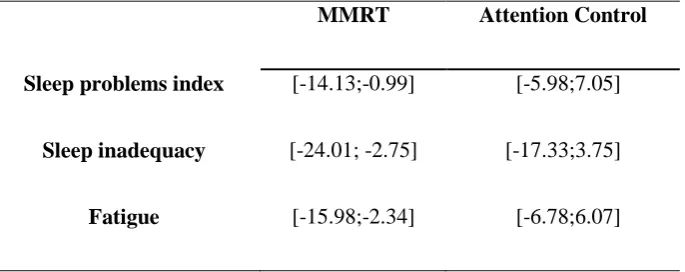
Table 3. The estimation of the mean pre-post change in the scores (95 % CI).
MMRT Attention Control
Sleep problems index [-14.13;-0.99] [-5.98;7.05]
Sleep inadequacy [-24.01; -2.75] [-17.33;3.75]
Table 4. Clinical significance of the MMRT for fatigue, sleep problems, sleep inadequacy, and pain comparing to waiting list (WL).
ARR (%) RRR (%) NNT U3 (%)
Probability of superiority
(%)
SF-36
Fatigue 15.3 37 5.38 68.08 63.02
Sleep
Problems 15.4 26.7 9 61.41 58.12
Sleep
Inadequacy 3.6 4.9 16.34 57.93 55.62