This is a repository copy of
Data from static and dynamic mechanical tests of different
isomers of amine cured multifunctional epoxy resins
.
White Rose Research Online URL for this paper:
http://eprints.whiterose.ac.uk/131672/
Version: Published Version
Article:
Foreman, J. orcid.org/0000-0002-7521-990X and Ramsdale-Capper, R. (2018) Data from
static and dynamic mechanical tests of different isomers of amine cured multifunctional
epoxy resins. Data in Brief, 19. pp. 992-996. ISSN 2352-3409
https://doi.org/10.1016/j.dib.2018.05.125
© 2018 The Authors. Published by Elsevier Inc. This is an open access article under the
CC BY license (http://creativecommons.org/licenses/by/4.0/).
[email protected]
https://eprints.whiterose.ac.uk/
Reuse
This article is distributed under the terms of the Creative Commons Attribution (CC BY) licence. This licence
allows you to distribute, remix, tweak, and build upon the work, even commercially, as long as you credit the
authors for the original work. More information and the full terms of the licence here:
https://creativecommons.org/licenses/
Takedown
If you consider content in White Rose Research Online to be in breach of UK law, please notify us by
Data Article
Data from static and dynamic mechanical tests of
different isomers of amine cured multifunctional
epoxy resins
Roderick Ramsdale-Capper, Joel P. Foreman
nDepartment of Materials Science and Engineering, Sir Robert Hadfield Building, University of Sheffield, Sheffield S1 3JD, UK
a r t i c l e
i n f o
Article history: Received 19 May 2018 Accepted 21 May 2018 Available online 25 May 2018
a b s t r a c t
Data from gas pycnometry, static compressive stress-strain and dynamic mechanical analysis are presented for a series of aromatic amine cured epoxy resins. Samples are prepared and tested which consist of para-para, para-meta, meta-para and meta-meta isomers of the epoxy and amine phenylene ring respectively. The density data consists of 25 measurements on 3 separate samples of each of the 4 sample types. The static compressive stress–strain data consists of at least 5 tests on separate samples of each of the 4 samples types. The dynamic mechanical analysis data consists of multiple frequency, loss tangent measurements of at least 6 separate samples of each of the 4 sample types. The data is interpreted in the accompanying research article, ‘Internal antiplasticisation in highly crosslinked amine cured multifunctional epoxy resins’(Ramsdale-Capper and Foreman, submitted for publication)[1].
&2018 The Authors. Published by Elsevier Inc. This is an open access article under the CC BY license (http://creativecommons.org/licenses/by/4.0/).
Contents lists available atScienceDirect
journal homepage:www.elsevier.com/locate/dib
Data in Brief
https://doi.org/10.1016/j.dib.2018.05.125
2352-3409/&2018 The Authors. Published by Elsevier Inc. This is an open access article under the CC BY license (http://creativecommons.org/licenses/by/4.0/).
DOI of original article:https://doi.org/10.1016/j.polymer.2018.05.048
n
Corresponding author.
Specifications Table
Subject area Materials Science & Engineering
More specific subject area Polymers, Thermosets, Materials Characterisation
Type of data Spreadsheets containing data and plots
How data was acquired Gas pycnometry (Micromeritics AccupycII 1340), static compressive mechanical testing (Instron 5582), dynamic mechanical analysis (Perkin Elmer DMA8000).
Data format Analysed:
1.Gas pycnometry data (volume) converted to density
2.Static compressive mechanical testing data (load, displacement) con-verted to stress-strain and a compliance correction was used
3.Dynamic mechanical analysis data (storage modulus, loss modulus) converted to loss tangent (tan
δ
)Experimental factors Samples were cured using an epoxy:amine ratio of 100:36. Amine was
dissolved in epoxy at 120°C and degassed at 100°C before casting. The cure cycle was 100°C preheat temperature, ramp to 130°C at 2°C/min, dwell at 130°C for 1 h, ramp to 200°C at 2°C/min, dwell at 200°C for 2 h andfinally ramp to 25°C at 2°C/min. Specimens prepared as described in [1].
Experimental features Samples were stored in a desiccator over phosphorous pentoxide between casting and testing. Samples were also subject to weighing and vacuum drying before testing.
Data source location Department of Materials Science, University of Sheffield, Sheffield, UK.
Data accessibility Data in article.
Value of the data
The data contained in the article provides the community with individual data for each test performed on a series of resin samples, allowing readers to perform their own statistical analyses potentially providing new insights into the material performance. In particular, density measurements over multiple cycles, compressive stress-strain data and multiple frequency storage modulus and loss tangent for each sample type. The data provides benchmarks for this type of high performance epoxy resins used in the aerospace industry and allows readers to compare their values to those presented here where performance versus weight ratios are key. The data provides measurements of samples with a variety of different isomeric components which allows readers to tailor the properties of resins accordingly.1. Data
1. Pycnometry. The spreadsheet contains the calculated densities of each sample type. The samples contain para-para, para-meta, meta-para or meta-meta substituted phenylene rings in the epoxy or amine respectively. 25 measurements are taken on 3 separate samples giving 75 measurements for each sample type and a total of 300 measurements overall.
2. Static compressive stress-strain. The spreadsheet contains the calculated applied stresses and calculated experience strains for each sample type. The samples contain para-para, para-meta, meta-para or meta-meta substituted phenylene rings in the epoxy or amine respectively. At least 5 tests are done on each sample type giving a total of at least 20 stress-strain curves. The data is plotted as a stress-strain curve for each test.
3. Dynamic mechanical analysis. The spreadsheet contains the calculated loss tangent values for each sample type. The samples contain para-para, para-meta, meta-para or meta-meta substituted phenylene rings in the epoxy or amine respectively. The tests are run between160°C and 300°C and at 4 different frequencies (1, 5, 10, 50 Hz). At least 6 tests are done on each sample type giving a total of 96 loss tangent plots. These are combined onto 24 multi-frequency plots.
4. Raw data is in the attached spreadsheets and summaries are given in the experimental design, materials and methods section of this article.
2. Experimental design, materials and methods
The epoxy resin isomers used are triglycidyl p-aminophenol (TGPAP) and triglycidylm -amino-phenol (TGMAP) (supplied as Araldite MY0510 and Araldite MY0610 respectively by Huntsman Advanced Materials). The amine isomers used are 4,4’diaminodiphenylsulphone (44DDS) (supplied
by Sigma Aldrich) and 3,30diaminodiphenylsulphone (33DDS) (supplied as Aradur 9719-1 by
Huntsman Advanced Materials). When cured, four different epoxy resin sample types are created, denoted as TGPAP/44DDS, TGPAP/33DDS, TGMAP/44DDS and TGMAP/33DDS. The four sample types represent para-para, para-meta, meta-para and meta-meta combinations of the phenylene ring structural isomers respectively.
For this study an epoxy rich epoxy:amine ratio of 100:36 is used. The uncured epoxy is initially heated to 60°C to reduce its viscosity, after which the DDS is added. The temperature of the mixture is increased to 120°C and mechanically stirred for approximately 30 minutes until the DDS has dissolved producing a clear homogeneous solution. The solution is then placed into a vacuum oven at 100°C to degas and then poured into a preheated mould prior to cure. The cure cycle was 100°C preheat temperature for the mould, ramp to 130°C at 2°C/min, dwell at 130°C for 1 h, ramp to 200°C at 2°C/min, dwell at 200°C for 2 h andfinally ramp to 25°C at 2°C/min. The samples were ground top and bottom to remove a thin layer to prevent issues with surface oxidation or remnants of the release agent affecting the resin properties. Further information regarding experimental procedure and sample preparation can be found in‘Internal Antiplasticisation in Highly Crosslinked Amine Cured Multifunctional Epoxy Resins’[1].
A Perkin Elmer DMA8000 was used in single cantilever mode to measure the dynamic response in each sample as a result of applying a sinusoidal force at 1, 5, 10 & 50 Hz. Samples were cut into
rec-tangular coupons measuring 30 mm 10 mm 1.6 mm. The samples were scanned from160°C to
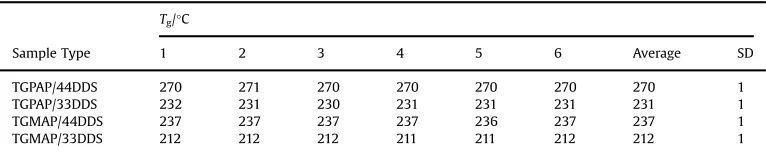
300°C at a heating rate of 3°C/min using a strain amplitude of 0.05 mm.Tables 1and2express the analysed data of the glass transition temperature (Tg) and the beta transition temperature (Tβ).
A Micromeritics AccupycII 1340 helium gas pycnometer was used to measure the volume of all samples by measuring the amount of gas displaced at 19.00 psi. Testing consisted of 25 cycles on three 10 mm diameter samples of each type at 27°C. The density is then calculated after measuring the mass on a four point balance. The data from this test is expressed withinTable 3.
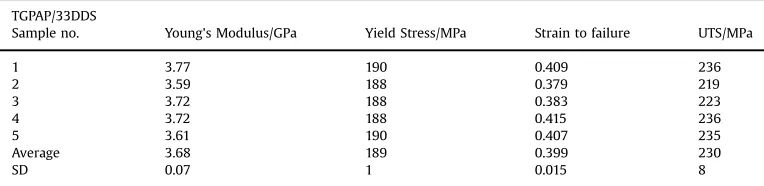
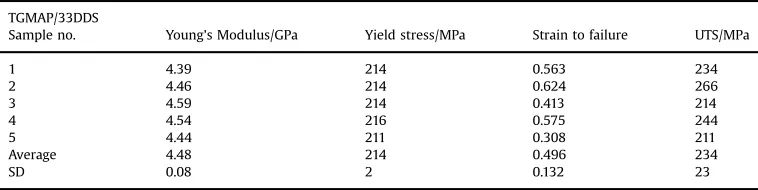
An Instron 5582 tensometer was used to measure the static compressive load-response properties of the samples. Compression samples were cut into cylinders of 10 mm diameter which were then machined to 10 mm lengths with parallel faces. Five samples of each resin variant were tested at a strain rate of 1 mm/min at 30°C. The analysed data for the four sample variants are expressed within
[image:4.468.40.423.550.627.2]Tables 4–7.
Table 1
Tgpeak values of the loss tangent curve for each of the epoxy resin variants. Numbers represent the sample number analysed.
Tg/°C
Sample Type 1 2 3 4 5 6 Average SD
TGPAP/44DDS 270 271 270 270 270 270 270 1
TGPAP/33DDS 232 231 230 231 231 231 231 1
TGMAP/44DDS 237 237 237 237 236 237 237 1
Table 2
Tβpeak values of the loss tangent curve for each of the epoxy resin variants. Numbers represent the sample number analysed.
Tβ/°C
Sample Type 1 2 3 4 5 6 Average SD
TGPAP/44DDS 38 40 37 35 36 38 37 2
TGPAP/33DDS 47 42 41 42 43 40 43 2
TGMAP/44DDS 39 40 37 37 39 39 39 1
[image:5.468.44.430.238.314.2]TGMAP/33DDS 42 44 43 41 45 43 43 1
Table 3
Analysed density data from a helium gas pycnometer of the epoxy resin variants TGPAP/44DDS, TGPAP/33DDS, TGMAP/44DDS and TGMAP/33DDS.
Density/g cm3
Sample Type Sample 1 Sample 2 Sample 3 Average
TGPAP/44DDS 1.313970.0006 1.310570.0007 1.310270.0008 1.311570.0018 TGPAP/33DDS 1.316170.0010 1.312370.0004 1.313570.0005 1.314070.0017 TGMAP/44DDS 1.324070.0010 1.326070.0006 1.323470.0006 1.324570.0014 TGMAP/33DDS 1.325670.0011 1.326670.0007 1.324170.0007 1.325470.0014
Table 4
Analysed compressive properties of TGPAP/44DDS.
TGPAP/44DDS
Sample no. Young's Modulus/GPa Yield stress/MPa Strain to failure UTS/MPa
1 3.19 / 0.402 242
2 3.34 / 0.396 238
3 3.15 / 0.343 220
4 3.51 / 0.405 245
5 3.37 / 0.412 249
Average 3.31 / 0.392 239
SD 0.14 / 0.028 11
Table 5
Analysed compressive properties of TGPAP/33DDS.
TGPAP/33DDS
Sample no. Young's Modulus/GPa Yield Stress/MPa Strain to failure UTS/MPa
1 3.77 190 0.409 236
2 3.59 188 0.379 219
3 3.72 188 0.383 223
4 3.72 188 0.415 236
5 3.61 190 0.407 235
Average 3.68 189 0.399 230
SD 0.07 1 0.015 8
[image:5.468.46.428.376.469.2] [image:5.468.46.428.518.611.2]Acknowledgements
This work was supported by the UK Engineering and Physical Sciences Research Council (EP/ M508135/1).
The authors gratefully acknowledge Huntsman Advanced Materials for supplying TGPAP (Araldite MY0510) and TGMAP (Araldite MY0610) epoxy resins and 33DDS (Aradur 9719-1) hardener used in this study.
Transparency document. Supporting information
Transparency data associated with this article can be found in the online version athttp://dx.doi. org/10.1016/j.dib.2018.05.125.
Appendix A. Supplementary material
Supplementary data associated with this article can be found in the online version athttps://doi. org/10.1016/j.dib.2018.05.125.
Reference
[image:6.468.43.420.87.182.2][1]R. Ramsdale-Capper, J.P. Foreman, Internal antiplasticisation in highly crosslinked amine cured multifunctional epoxy resins, Avian Pathol. Polymer 146 (2018) 321–330 (submitted for publication).
Table 6
Analysed compressive properties of TGMAP/44DDS.
TGMAP/44DDS
Sample no. Young's Modulus/GPa Yield stress/MPa Strain to failure UTS/MPa
1 3.92 206 0.383 206
2 4.31 208 0.516 226
3 4.14 210 0.583 250
4 4.13 208 0.452 208
5 4.20 208 0.458 214
Average 4.14 208 0.478 221
SD 0.14 1 0.075 18
Table 7
Analysed compressive properties of TGMAP/33DDS.
TGMAP/33DDS
Sample no. Young's Modulus/GPa Yield stress/MPa Strain to failure UTS/MPa
1 4.39 214 0.563 234
2 4.46 214 0.624 266
3 4.59 214 0.413 214
4 4.54 216 0.575 244
5 4.44 211 0.308 211
Average 4.48 214 0.496 234
[image:6.468.42.421.230.325.2]