COMMISSION OF THE EUROPEAN COMMUNITIES
Brussels, 09.07.1997
COM(97) 361 final
; · · , · ·
·m·e~~(~,~~~
..
~;~;6;i:~· .ll~;~:~ijfi i~~J9.7
·
'••• • ',~··..-••'•-~~-·'" " ' " ' • .}...._ -"•·••••<~- ""' ,,;~_,,,.,..,,,., ' ' !_,.,v_,._,.,,~ •.. ,.,.'.l.·~L,1'~,c '••"''
' • ' e '
. i)e.l)lographic Re'(lo·rt
t 99'7
.
~.
' ' : . .. j
Part l -
Impact of demographic
ch~ge
on the labour market ... : ... 1
. . - '
-· Part 2
-Th¢ significance oftheregional dimension, ... , .... · .... , ...
~.,..12
'
Note to the reader :
All the statistics presented in this report were supplied
by the.
.
. Statistical Office of the European Communities.
·
· lntnHitrdion,
Demography assumes increasing significance as slower population growth -and · ageing, · keeps ·
- tranforming at an accelarating rate the age-pyramid. The conclusion of the last rei>ort' was
. that, given present treQds, the next 30 years could
see .the papulation ·aged over 60 grow by 50%, while at the same time the number of young people · (0-19 years) and adultS (20~59 years) would fall by
11% and 6% respectively. ·
The etfects of this· marlced transition towards ·a much 9lder population are set to be felt through to the middle of the next _century. ·
· The fir~ effects of an ageing population - are
~ready being felt in the field of social protection, . particularly on retirement pensions, but also on · health. This will . place great strain on the futon~
fundilig of social protection which is largely dependent upOn the ·contributions of the . working population. The developing trends indicate both a fall in the population. of working age · and an increase in the number of older people. As their number grow, the role of elderly people 'in society -_is also _ going to become increasingly relevant.
Demography is. thus already becoming a crucial factor which must be . taken into account :when . modernising social protection.
Demographic change will also impact on the· characteristics of the population of working age· ' who makes up' the labour force. What will be the
demographic changes in this labour force? ~t effect will these changes have . on .. the labour market? And will this demographic change require specific action? These are the questions which part
1 of this report tr'y to explore. · ·
The situation. at the EU level wiJl also have
-conseq~ences for regional balances .in socio-economic ternis. This will be the focus of attention' in part . two of this· report. Will demographic change help to reduce regional ·differences or; alternatively,. will some regions . be faced · with growing imbalances? Locally, how will it be possible to bring the labour market into line with the pools of available _labour? Will the framework for action vary from one region to another? ·
1 See « The demographic situation in the
European Union - 1995 », European Commission,
. Directorate General V ·
Part three of the repor:t tries to identify the major demographic trends in the 12. applicant States2
.
· This analysis will aim at providing a better understanding of the significance of demography for this group of countries which are experiencing deep-seated economic change.
Whether the subject is - social protection . employment, or
structuial
policy, the·_demographic variable is destined to be an essential factor in analysing . problems and · developiJ!g appropriate policy. The development of a medium to long~term . perspective in policy-making is of vital importance · to the Union. , · -. ·The ·Commission therefore . presents the 1997 Demographic Report as- the basis for reflection and. reaCtion by policy makers throughout the
Union.-· 2
.Malta·ha~
been included- altl.lough: for the time.·; · ·
·."~· . ·:
1\\.t{:r
·r ·
·'· . ·, · ·
l
n~t·>_:ld
of
,dcni(;g;.;tphic
dtar~gc
on
~·thtdai).uu.r n1arlict
··
• > ~ ... •Demographic change and the labour market are linked in many respects, three of which deserve particular attention:
I. Demographic change modifies the internal characteristics of the · labour market. By changing the structure and the size of the pools of available labour, demography affects the baSic conditions under which the labour market operates;
2. Demographic change also influences the labour market by putting pressures on systems of social protection. Imbalances. · between the . number of . active and non-active people not only affect the funding and organisation of social protection, but also the functioning of the labour market itself;
· 3. It is not just the population's age and gender structure which affects the active population, but also the demography of families and households. The propensity to form or dissolve _ couples, have children, child care conditions and the living arrangements for young and the elderly, are all factors which can have an effect on whether or not people take up employment. On the other hand, the opportunities offered by the labour market influence the . ·lifecycle ' decisions of individuals and househol4s
The Commission highlighted these three types of relationship in its last report on the demographic situation, giving an initial quantitative estimate of · the effects of an ageing population· on social
protection. However, the possible impact of demographic change on the labour market is equally important. This chapter will seek to outline what are likely to be the principal . effects of demographic change in this area.
It must· also be remembered that these effects are
no more than a backdrop against which other
factors inevitably come Into play, such as eConomic growth and productivity. Nevertheless, within the limits of our approach, the analyses pursued here aim and providind an understanding of the impact and extent of demographic change and of the margins for manoeuvre within the various
pop~ation groups.
/
Figure comyares the rate -of change for the
· TJnirm':; ~~tal · population t0 the . rate of ::hange
'>lit;\iil the ·20.:.04 age group, with reference to three
:;.;-~nJrios of demographic-chnnge3.
T:lT:!e :;onsecutive period.-: can bt identified :
~· oveY: the past 20· years; the population of
';/UT.king age has .increaser1 at a fnster rate than
t~1e toml population: ·
" ove;- th~ · next 15 years, the population of
work:ing age will · 3tabi1ise at a · relatively
const;m( le~;e.!, while the total population will.
· 3\lh continue to g;·ow; .
,, .· xler
approximately l5 years, the population of ·v;-") ·:dng age _will start to fall significantly,_
wl:J]:;! tlle toial popaiation will slow down witi1
a !iiminishing pace. '
l::~ ;bn:::J·:, -
-'f--·---·
·
~~-:.::·~
'(\'p:r.~viL
'3.e.,pl!'l.i~tl
of growth tbe: I !JO~'ri.l.!!·U~m 1'f ·uor~.diq a~1e . ~.!lhitised in around
I
p~Y~; il'J UD>.'nd 15ytars
time itwm
start to fall.; ,I , ; ' • ,, ' I , ,
~ . '·
...._
_____ _
fR~"-;~r~-:-
· · · .
·l
1?;;
;:~
...
u
,~<·
., .,_.:-
om~..&.que
..
r·••
1
1llii_•_ ..
1r_l_l_"~_.~_:._t_·_•~:•;••-\•_~_._:_:_:_:_~_,b_·,=-~-·~~.nf_r_:.:_._:,·_
. .
_-_6tllef_:,,_.•-•.·---:t'~--:mo_:.:_
•. r,:_:_:_ •.._._.tC_.~o_L_r:
__ ._i_i_·-~
$_,if::;
:j~;!;::#~~i:.f~;~~~f/;:~ ll~aaa:_. ' 6 . . 40 1n;: u u~:~~1~.;_;~~¥~~~~~:.~~~~~:~J~1ie~~:·•~
. ''·J: -:::,;;.:-._:~·:.- :\\_:·:-.':·: -·: .. ::~:- . :.··.·.··:·:-.· .. :::::::::=::::.-::·:~:: .. .;...~-..: ~..:--c.-~-,~~~..;~;·· .... ·
,. " I
_,
. ' ~ .
·;.•,
_'_· --'-·-·
-\ ' t• ' ', I' , : ' : ,, , • , I • ' ' . : , : , ' ' " •· ' :, , ' ' '"' ~ . ,
I
I
!
I
'\/, · -' '
'Aline~. A _prc~~nis fiv;: scenariosirt'r6t?L
.
TLc
nir~~~sc.::n;iri{k~
in"qi1cst10n(Youitg:
Basclin'c " .1,;::~ld o1il~· .~~~~-5 .~ \~:~i.\1~.~r~ .s~:~~.tari;s. (~li~-~
•.
~?:~;.7:q~:~1-:_ -'·:~t.·-·:r:
Figure 1
Changes in the total population and· in the
population of working age (20-64 years).
b~ index.of 100 in 1995 for three demographlc scenarios
..•. ~.: ... .
85
110 1
Continuation of preioent trent~~>
105
t·
1 o o E S ' . . . .
95 ._ . . .
>;;./_. ... .
90 ... •·•··· ... .85 "'., ~ *" I I I 1 I 1 I
E.
J
§ ~ ~ ~-- ~ ii ii _EI
·:··
..
\I
I
~ ~
110 r.--;Mu,~~x<.;lm;;:u;:;;l;-;a;;;qe;;<in;;-;q-;---,----.,.--_;_--c:--c
' 105.
100
95
90
·.1
85~H+~-~~~~~~~--~----~--.~~~~
~ ~- ~ ~- ~ ~-~~
·=
=-- . =-- =-- Total populi.tton Poi!Uatlon af ..Ur..tng age
. -. .
Source : Eurostat. observatiOits. uniil-19 9 5. 'prJ;ections'.
after.that date. . .
. ' ' .. { ; , \ .~: ~··. '-. ., ,'
..
..
' . ., ., ·'·~;\;·~<'·:
/
},:<.::.;:);;.~:: ::,;~.;;:;
..
:~;i·}\·:~\;t}:>.·;~J~t?~f::·
.. '.,, .. • ,, .
- - · - · ' • j ....
~~~'-"o-'~'.,;:.'-'-·.· ..
<.~~~~~:.·,:
t~;t~~tr~ ~;~;tt~;;c:-;;(:-:·~::::·. ~:·:\)
?-·
... -:·::-·-:-~:-·-· .••.. ·:.:·::.::::::.::::::'·{:::: .·.::··::·:=.·:-.=--::.
Within the limits of the demograr-hic approaci1. the measurement of dependency illustrated in figure 2
can give a good idea of the tension in the sphere of
social protection-arising 'rrom demographic trends,
and its impact on the labour nta!·ket:
Tela! dependency l1as fallen ove1 the past 2.0 .
years fpr two raisuns: Fir1;\, bab:'-i~ocm ·
generatic.ms joi.ned (he active ~>or.1trlati;~J:, se~;ow5 fl!rtiiity nttes have fai:II.'.n aficr !.'75;
¢ . Total riependency will sta1t co incrr:as:. :;.gain,'
initially b.:x;;us~~ of smaHt>t :nfiov.;s of ,;;;crl:.ir;;~
age p::puh:.tion and later, a11er ).G' I 0, becam:e 01° .
the. retir~.r,Jent cf (ite bab:;· 'Joom u.nera;ion~.
El.derly. peof1k. growth w;LL be the !Jrincipd
source of mciru r.ro:ection e;.~penri!ture inr:H!<'!'e:
• t.: E.ven if t~wre is a rt!versal cf fertility trend£, :iE
e.aviE;;gect l:y the ic:\v ageing scenLio
(~·c~n,~;·:.J
·.1
<< c l:), t!ii.s wif.l aot..!JC sufiidem to prevent in
I
rb:: lc::1g tc:r;!l, fi~e relati\•(- ir.cxeas~;. in C.c
. •iq:·:ol.cir.~·.~-::·· n~tio- due to' i11e increase b ~;H~
!'lf'Jportic,;\ c.;· ddc;~. people.
r - - - · - - - · - - - · - - - _.. ___ _
i
ll!-
lu:j£1:_:_f.'iv,u·t:O i. J:UIU5.
Mea~ure of dcmogn>ph:k {.(;pcndC:ncy
Tot::! eq:endenr;' r.·~te (%) IT.a.Hc of ~·mw.g fJCU[fl.e f'a e~ffedy peor. [t:
~.c
r··---- ___ , __ , .. __ ---···--·----· ····-· _, ___ _,
. ~--, . .
,.
I . .
I . ;
i
1 --.. ·--·---·
:
-~ f•
{!,C'
__
,_,,
·--
_
_,.-
---·-I . i
I
r·-·~
I1
I '
I
- -
!
-~
--~
J.
i
(I
1!!7[ 19!:C ·, 2.01(: 201! ~011i 1575 2111G 7,111("
Scc:nal"im: : ;; =continuation or prcscnl trend. h = maximum ageing. c
=
minimum ageiagSource: /·.'un•uar. J,,,wgrapluc rn•reci"'"" /996
A cioser anaiysis allows us to· estimate the impact
of ch~ges to the · age-pyramid on . the active
population. How have changes in the size of each . age group . influenced the growth of the active . · populatiorijn the past and how will they influence
it in the future? The results are set out in figure 3-:_
On the basis
of
certain hypotheses, this analysisseeks to determine the factors .leading to a change in the . size of the working population for each ·of the three decades (see model in Annex B and explanation on data sources).
This ~hange
Call
be broken down into two factors : ·• .the "demography" factor, namely the variation in the population's ageisex structure and size . alone (thus keeping the activity rates constant); • the "behaviour" factor, namely the fact that ·
·. levels of activity per age and sex chatlge in time
(thus the difference between the « real » active
population and the one obtained . while keeping
the activity rates constant). ·
Figure 3 - EUR12
and
EURISRespective roles of the. d~mograpbic factor and· behavioural factor in producing changes in tbe. size of tlie
active population.
·-
Cl)8
t:··o
·e
6
c
·--
in4
c
0
.(I)
....
CDc.
2
Cl)
>
....
(,)
ca
0
(ij
c.
0 ;;
-2
-:a
"C
ca
1985-1995
1995-2005
2005-2015
II
Demographic effect
o
·Behavioural effect
Sources·: l:"urostat. /996 demographic projections. !Jaseline scenan·o
l:"urostat. J~ihour/•iwce Survey (HUR/21985-1995, ECR/5,after 1995)
A~ analysis of past data allows for the following conclusions :
-• in the Europe of Twelve4, 9.4 million people
joined the active population between 1985 and 1995, a 7% growth rate. During this same period; demographic change would have generated an iQcrease of 9.6 million if it had been the sole factor, thus 200,000 more than actually recorded. This latter figure indicates the extent of the participation decr~e in the labour market.
•
als~
between -1985 and 1995, the. number of jobs rose by just 8.5 million. As the number of active adults increased more than the jobs, the difference represents the absolute increase in unemployment, that · is 900,000 more ·unemployed in 1995 than in 19855.The same approach has been adopted for the development of future scenarios.
Apart from the impact on emp_loyment -unemployment, the following trends in active population are likely:
• we can expect to see the active population increase by about 6.9 million by the year 2005, representing a lower rate of growth than during the preceding period. Demographic change will contribute less to this increase, 50% of which will be due to increased partici~ation in the_ labour market;
• over- the following I 0 years - 2005 to 2015 --the active population .could fall by as 'much as 2.15 million. An expected demographic fall of 3 .4 million people will be partly offset by an extra 1.25 million people participating in the labour market. ·
Migra~ory
(l{>ws could play :.a significant rote· in _ shaping · ihc· future trends· of ~Qrking ·age ; poptW:i_til).ri''._ In tile past<accadcii\thcy haye nmtritiritcd .to sonit
·extent!O
incrcasi"ng the size. : ... -.::.:· ' .
.. .
<::~~~~~.
l ····-~·~ - - ; - - -··paia or;:
lire
;u.:ti~\~·
population of EUR 15 arc only <iv3,ilable froJU 1995Between •1985 and 1995, 'peak years for
unemployment. the total number o(um:mployed people grew from around 15 million to 16.8 million whereby about 900 000 are to be attributed to the new L:mders which in this simulation arc not taken into account. Sec Eurostat scenarios in Anncxe A.
and reducing the pace of ageing of the working age population.
In brief :
• Demographic change bas placed additional pressure on the labour market over tbe past 10 years because of a sharp increase in the labour supply. Together with the growth in female participation the result was an "'increase in tbe active population.
• Even if participation in the labour market increases, we will soon see a reduction in tensions· in tbe labour market due to the demographic fall;
• Changes . i:it the levels of participation will
play a greater role in the future growth of tbe labour
In the above, trends in the population of working
age ancl the · active population were seen to be
[image:11.562.59.529.25.615.2]closely linked. But what is the situation within this population?
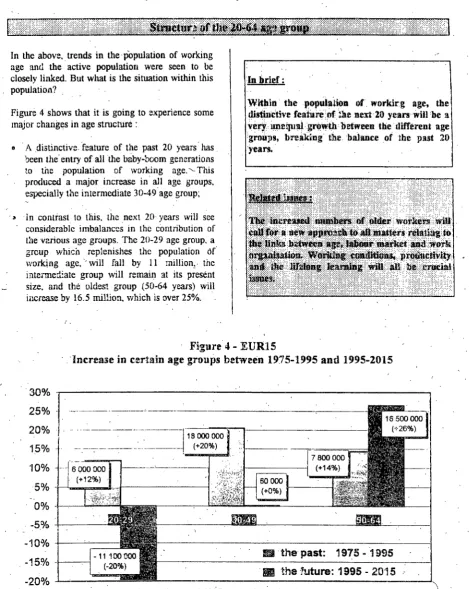
Figure 4 shows that it is going to experience some major changes in age structure :
o · A .distinctive feature of the past 20 years has
been the· entry of all the baby-boom generations to the population of working age.'- This produced a major increase in· all age groups, especially the intermediate 30-49 age group;
·" ·In contrast to this. the next 20· years will see
considerable imbalances in the contribution of the various age groups. The 20-29 age group. a grcup which replenishes the population o(
working age, ·. will fall by 11 million,. the intennetEate group will remain at its present size, and the oldest group (50-64 years) will
increase by 16.5 mimon, which is over 25%.
In brief:
Within· the
populalioa
of workirg age, thedistinctive feafure of :he next 20 years
will
be avery
~eipnd grO.wth between the different agegnnlps, breildng the balance of the :pllst 20. years.
Figure 4- EUR15
·.·Increase in
c~rtainage groups between 1975-1995 and
1995-2015
.. 30% 25%
20%
15% 10%
· . · · · · · · · · · ,
-5% -j-.!,...,...,...J, ... , . j - - - j
0%
-1---,----l--=~ ....-5°/o
-1----~-1 0"/o
_J_____:----'-'---. -15% 1
-·20%
L, _
_:==:~~•
Ill ·the past: 1975 - 1995
·a
the Juture: 1995 - 2015Source: Eurostat, obsen:ations unti/1995, projections after that date. Baseline scenan·o
A further analysis is needed as the ageing
indieatcrs highlight two rupt:me poi.nts.
Th.~ size of the expected fall ii:1 tlt<! nurnber of
peopie aged between 20 and 29 ccu.piea. v.-~tli ti1e
increase in those aged between 50 and E4 wiii
result in a marked ageing of the available pooi of
labour. ·
The change in the average age of the populaticn
agcd.betw~.oefl 20 and M, as ilLustrated in figure 5. is art initial indication of this changing trend.
o This average age scarcely changed during the
years 1975-1995, when it remained just over 40 years;
I
e Since 1995 it has been a marked tendency for the average age to increase, as a comparison of the cwves' · g:1'.dient fer the two t~eriods dearly
Ulustrates;
c· After having rer:nained. stable for lhc ('ast 20 ye;;rs, the average a.ge wiLl increase by 2.5 years
on
averr.ge by the 2015, a considerable increase.1,. ,
.. ,. •
fr Lrl iiJ:I:'TC::
I
.
i
Stt~Kh11g irn 1995, Mdi co~tlur:tdl!l:fE I!Jeyml'~ 2€H5, tire Ei.VIl!H'Il!ge age af the wm,killig &ge po!Jui~ermtwfH ~~WW ~ cm:u:rOieii"Wfe ll!ll!d' CG!!!!:fiJmt inCnCWle.
Source : Eurostat, observations until 1995, proJections after that date. Baseline sce11ario
··I
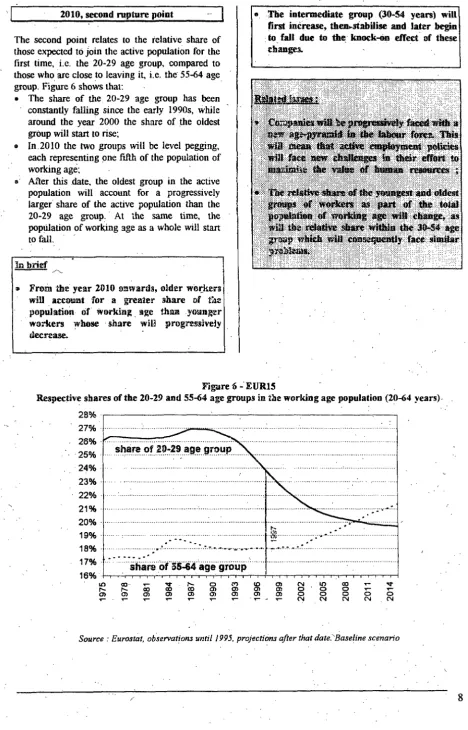
2010, second rupture pointThe second point relates to the relative share of those expected to join the active population for the first time, i.e. the 20-29 age group, compared to those who are dose to leaving it. i.e. the 55-64 age
group. Fi~e 6 shows that: ·
• The share of the. 20-29 age group has been
constantly falling since the early 1990s, while around the year 2000 the share of the oldest
group will start to rise;
o In . 20 10 the two groups will be level pegging,
each representing ~me fifth of the population of
working age;
.,. After this date. the oldest group in the active
population will account for a progressively
larger share of the active population than the
20-29 age group.· At the same time, the
poptilation of working age as a whole will start
to fall.
fu brief
a From the year 2lHO mnvards, older wot:kers
wiU . accm:~nt for a greate1· share of 1~1~
popuhttion c)f workin~. !lge thnn .ymmgu
W3:-kers ~bose · share wiU prognssive!y
decnaae.
e The intermediate group (30-54 years) will
first increase, then..stabilise and later begin
• to_ fall due to th~ knock-on effect. uf these
[image:13.571.59.527.35.765.2]cbange3.
Figure fi -· EUR15
Respective shares of the 20-29 and 55-64 age groups in the working age population (20-64 years).
28% ·,---~---~~
27% 28% ·25%
·24%.
23%. 22%.
21% 20% ....
19%.
-
..
-...
...
.
.
·-···--··· .... -3.1-
--···~·-··"'···
18% ... ! ... : .. ,_,_. ____ ., .•.• ~··· ·-···"·"···-~---... .
Source : Eurostat, observations until 1995, projections after that date.'Base/ine scenario
In the past, the renewal of the population :of
working age, i.e. i:he ability to replace generations leaving tbe labour market by those coming in to
jotn it, has served to:
o supply tbe highest growtb sector£;
c: contribute to the system's productivity by virtue
(I ~he fact tbat young peopte have lower
cost/productivity ratio :
e make a contribution of new sl.dlls and flexibility
in all sectors.
It is interesting to illustrate this renewal by means · oftwo additional indicators. The first estimates the balance between incoming and outgoing flows
(figure 7-a). Tlus gives us a good idea of the
change in the size of the population of working age. The second, more qualil:ative, ·indicator examines the ratio between numbers joining and
leaving the la~our market (figure 7-b): this is
essentially a replacement indicator.
• In terms of balances, tbe decrease which began in 1990 will result in more departures than
entries by around 2009.
• In terms of ratios. the replacement rate will fall
by 35% over 20 years: in 1995 there were 140
entries for 100 departures: by 2015 there will be
90 entries for 100 departures, and thus a net
deficit
. . . . . .
r. J)~ogre£!h'ery, tbere wilE he le&£ scope to
adjui:t
the Ia~our- marf?;et: ~y mean~ of tbzflow! of e~L~ries ·and departw.·e~ ;
i
e Demogravhic chaage win ~roooce megatn~£renew&i .
P!abm~ fOil" tbe ~opula('im:;, ofworking ~ge. The possibiKttie! of skm
reoewru d:ue solcly to the entry of you~mg
_1 people wifi be limited.
Figu>e 7 - EUIUS
7-a : Differences between incoming and outgoing
flows for the population of working age
1.500.000
1.000.000 .... . ... ··· .
500.000 ... .
-500.000 . L _ _ _ _ _ _ _ _ _ _ _ _ _ _ ,
7-b : Number! joining the population of working
· age for every 100 leaving
160
"'
Ill...
:I t::~ 120
Ill
"CI
Cl 100 Cl
...
...
80 Ill Q. Ill Ill 60~
Ill40
-
0...
Ill 20
.Q
E
:I
0
z
1975
1995
2015
Source : Eurostat, observations until 1995, projections after that date: Baseline scenario.
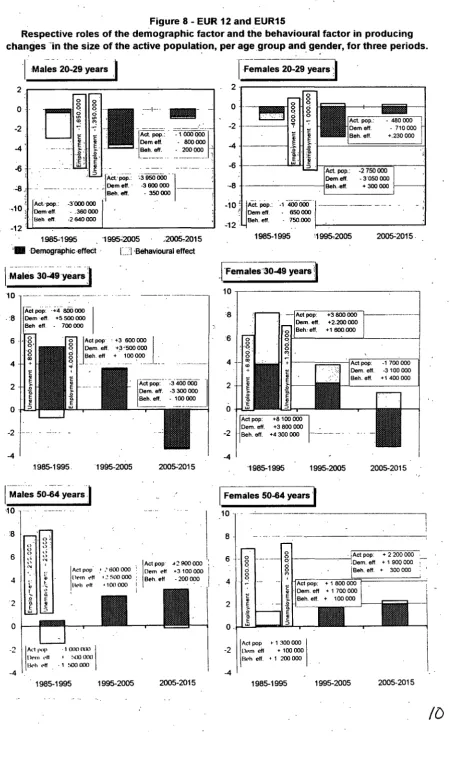
Is it possible to determine in more detail how demographic change ·is going to effect the active population? Some interesting findings are obtained by distinguishing by sex and age:: group; between the effects of demographic change and behavioural change on the size of the active population:_
'The differences between· generations, and especially between the sexes, are clearly marked:
• The increase in the total size of the active population recorded between 1985 and 1995 is unequally distributed b_etween the ~xes, while . the demographic c~ntribution. which is similar between the sexes. is not. the. same· for all age groups:
• BetWeeQ
i
985 arid 1995. entry . to the labour market fell by 200,000. This fall is principally attributed to the ·decline for men, and young .men in particUlar. Employment among all young people aged between 20 and 29. regardless of sex, fell during this period.- This could in part result from the prof!ounced demographic contribution of the . preceding generations, which may have blocked their' access to the' iabour-market, as well as from the long-term tre~d for increased participation in · education · and training · of the_ younger generations:• There has been a sharp increase· in employment :among women over 30 during this period. In the intermediate group (30-49 years). more · thim 50% of the increase active women recorded between 1985 and 1995 is due to the increased participation of women in the labour market
• Among older ·women workers~ participation . behaviour was responsible for virtually. the entire increase in activity:
• The demographic contribution among the youngest workers
has
started to fail and.- after · 2005. it will only be the oldest workers who · will bring any increase due to- demographicchange:
• In terms of behaviour, and still on the basis
of
the hypotheses for changes to the active · . population, female participation will- continue·to increase, even ·among younger generations. _By contrast, between 2005 and 2010. there will . be reduced male participation in all age groups.
In brief:
o
The
separationbetween
the behavioural .effect aucl de~nograpbic effect reveals the
change in the
size
o{ reserves in the labourstlpply procfueeil
by
d~()grapbic effects; • Among young people hi particular, it w_illcease to
be
possible to Offset the demographicfall by increaSed p~rticipation; .
• Apart from the potential:- offered by .occupational and. geographical mobility, women constitute tbe main resource for
employment . groWth, especially · young
women, who . when they· grow older, will
bring a higher participation and
Figure 8- EUR 12 and EUR15
Respective roles of the demographic factor and the behavioural factor in producing changes 'in the size of the active population, per age group and gender, for three periods.
. .
.
0
____ ,___ l!i!ll!!r
--2 ---·----··
..
Dem eli. - 800 000
!
Act. pop-:-: ·
-::-;·ooo oool
__ ._ _ _ _ Bah. ell. - 200000 _.,
..t) •..
Act-pop.: -3'000000
l
i\Ct.:;,<;;;:
_.:Demel!.·Beh. ell.
Dem·ell. - .360000 l.leh ell. -2 640 000
---..
---:
,~3:0':~
- 350000·r---198&;1995 '1995~2005
[J ·Behavioural effect
1
M;,;~-3o.i9~y~a;~]
'10 - -·-· -·· ..--.:8
po:~--+:~=~
I
ell. - 700000
6
4
!
Act pop · +3 600 000
I .
Dem ell +3·500 000 Beh ell + 100 000 .-- ---··
----2
0
-2
-4
.1985-1995 '1995-2005
,-;;.~s so.;4·y~ars'J
·10
:a o::
0
"
0 0 ,;6 0 0
"
·~,,
'
N
t:
4 .t.
..
2
0
2
I""'
Ut~m'~'P
t>ltll<•h ~~~ -4
'
\
Act pop. .' .' oOO 000 l )("lfl ~" f -~ soo 000
B~h ~~~ • 100 000
·1 ()(XlOlKl
I
I ;,()QQ(l()
- 1 ~..00 000
. 1985-1995 1995-2005
2()()5.:2015
\
Act pop· .. ~ 900 000 i . Dem ell +3 100 000 ; \ Beh. ell -200 000
2005-2015
~-Females
20-29 years
;I
2.---,
0
+ 300 000 1---,J
-10 -1 400000 - 650000 ell. - 750.000
~~---~
1985-1995 !1995-,2005 2()()5.:2015.
.re-~~les'3049 years~~
1 0 . - - - .
6 4 2 0 -2 -4
'1985-1995 1995-2005 2005-2015
~F;;~Ies
50-64 years
·J
10 . - · - - - ,
8 -- ... ---~.----
-6
4
2
0
.1-U~--L.;;;..,I--r--I
Act pop • 1 300 000
l
-2 ll••m ell + 100 000H~h eff. • 1 200 000
-4
1985-1995 1995-2005 2005-2015
[image:16.564.55.505.36.799.2]:
~Lt~ ~:
~:: =-~ /= ~\=/ ~~~ ~=~-~ == --= -==::-:·:=:·~====.: =-=·= : :_: :.: ::= =:= ~=~ ::: : ======= =-· = ·:· :: .:. : :::: ~ <: = ===} :·:·: /;_;;;_; ;.~.: = : ) ===-~-=-~ ==== ~ f:~ ~:U:~ ~ : ~ : : .:. =.:.~ ~ === -~~~ ==~ ·;: ~~~->~ :·:=: :·: ::: ===== .:-= : ~-; ~=~ ~-~ ~ :;~ ::\~.Y =·= = ; :=: : -:(;: r.~:
:::·;T :_: ...
}'J:n
.... ; ..
:·::1·:.:::::•:::
:;n:~
..
~I!~~J.'
....
1
_
.• _._
.. :
..
••···::•:¥:t~'=gt:~~~r::ii::'\ii:::
\ ···.-... :·•· •:.::: .... ···
:- :: :<=: :=:-:: :: :·· :_: ~ ~-:-~:: ~-~== ::: : :·:: :': :; ~: ~: ~-~ ~ ~-~ .. -.- ... :': :.:-: :=:·:::::: :':'. -· :': :=:=:·:: : :: :: :·: ··::::: :'; :_:-: :-:< :::::: ;:; ::: :-·-::: :·:·:·::: :-:.: ;:: :: ~/-! :.:.;.:.;... . ... -.- . ,·, . ,·, ... .
CONCLl 'SION
..
. The anaJysis of _changes in . the pojmla:tion of working age .reveals-the extent to which future economic growth Will . be dependent on quantitative and qualitative changes in the labOur force.
· The stabilisation and then faJI in the size of the population of working age could prove a favourable · factor in reducing imbaJances between labour .
supply and labOur demand. However, it will aJso be necessary to deal with a considerable increase in the pressure of .ageing on sociaJ protection, , .. especiaJiy for pay-as-you-go pension systems.
Keeping 'older workers in employment for longer . could be, in certclin sectors, a key ele!Jlent for at
least partiaJiy countering this problem.
·.
Howe\te~.
keeping older workers in employment for more years willadd
to a second concern-linked to . the demography of the labour force: • its internaJ ageing. Thu5._ :adaptability to labour demand · · chl'lnges will have to be obtained more from resourceS aJready . in . the labour: force rather thanfrom new cohorts joining the labour market. Active measures such as re-quaJification. life long · learning, measures to ensure employability will be
required in ,order to adapt skills and ensure. · economic competitiveness.
Stronger economic ·growth is becoining
a
fundainentaJ factor in supporting sociaJ protection. provided this growth translates into an increase in jobs and increased recourse to existing pools oflabour. ·For women in particular. this recourse is subject to certain constraints. An_ innovative approach will be' necessary, including· measures to promote access to · the traditiollal employment . market (reconciliation of work and family life). the absorption of . hitherto exclusively voluntary activities by the market economy (community actions, responsibility for family care through tax incentives, etc.), ana more flexible work organisation. All types of mobility will· pl~y a greater role during the years to come.
7
See, among others. «·The new role of women- Family formation in Modern Societies» edited by Hans-Peter Blossfeld .. SociaJ inequality series, Westview Press, 1994 or« Fani.illes, travail et politiques familiaJes en Europe». L. Hantrais and M-T. Letablier, Cahier du Ceri~re d'EtUdes de I'Emploi. PUF, 1996
,. . ' I
P.\RI" 2
Tht• :-;igniticann· of
t~ten·gional
dimcnsimn
The previous chapter showed that there · are
important liDks between demographic change and · the labour market. However, the aggregate approach often fails to provide the most effective
means of examining these
linkS.
Among otherthings, it is not suitable for understanding the widely differing trends at regional level.
The strongly diverging situations found among regions suggest that the impact of demographic
change could be open to different interpretations
than that provid~d by th~ agg_regate approach.
This · is confirmed by the regional analysis presented in this section.
The Union's regional diversity can be illustrated with reference to many criteria. Among the most
visible aspects is the uneven population
distribution, with a large share of rhe popuiation concentrated in a comparatively ·small part· of the · territory. Possible population change, as illustrated
on Map 1, is also of particular interest. Among
other things, it helps to highlight differences in future demographic patterns between regions.
· This is particularly interesting because, ~ shown
in chapter one, a stage characterised by a constant and balanced demographic increase in the population of working age is now giving way to one of "demographic neutrality", soon to be followed by one of negative growth.
Map I shows the growth index for each region
compared to its population in 1995' On the basis of
their stage of demographic growth, regions can be
,grouped under three headings:
• Regions which have already reached the negative growth stage, such as the former East Germany, Saarland and pan . of Westphalia. · northern Italy, Asturias and Aragon in Spain, and Lorraine in France;
• The vast majority of the regions are likely to go towards a period of demographic .neutrality
between 1995 and 2015:
• Finally, sustained growth is found in about
one-fifth of the regions, located in a . greater urban districts and in the south of Spain .. France. , Italy, Germany, the United Kingdom. Belgium
and Greece. · . .
In brief:· .
• :Most of the Union c:ountries show an
u~even
regional pattern . of future . demographic
'nnrth· g '
• . The same country can preSent a variety of
situations in· terms of .demographic
dynamism;
• Regions with similar characteristiCs tend to
• fofoi
a·Ciiister witb·neigbbouring re~ons..---.
---~---~~EUR-15
NUTS l (UK : NUTS 0)
(AU. FI.SK: NUTS 0)
Base 100::: 1995
0
<97.5~-
97.5 to 102.5. . • 102.5 to 1
ro'
.
~~
>-IJO.PopUlation growth· betWeen 1995
and
2015
;
.•
..
...
-·:Map
1..
•. •J•1 ..
:'b
... \·.
' <:;, ... ,,
,'I J ,Although there is a marked difference between the
regions in terms ~f the stage of population gro\lth
they have reached. ageing is a phenomenon common to _all of them. Since 1995, the proportion of people aged over 65 has been increasing in all areas. The results of this growth of the older
popuiation arc presented on Maps 2a and
ib
whichillustrate the proportion of people aged over 65 as part of the total population.
By 2015 the following developments are likely:
• As expected. the rate of ageing and, above alL the current· population structures vary from one region to another;
• The proportion of elderly people will be
particularly high in northern and central Italy
· where they will account for a qumter of the population;
• To a lesser degree. there will also be a
preponde~ance of elderly people in nmthem Spain and. in a more dispersed way, in northern· and eastern Germany, Greece and some central regions of France;
• The regions which will still have a relatively younger population will be more limited -in number arid more localised. The areas in
question . are southern. Spain ~d central
Portugal.,,)~Ireland, .. Apulia
<irtct
Campania in southern I@y, northern France and Flevoland.The Easr,Midlands
in
the U~ted Kingdom andAlsace ai&{more isolated pockl!ts. . ··
~ ~ · ' ~-"'"'~ -~<i' ·~ -~
. :·•-.::~- -..:~
In brie!:
e Although apparent everywhere, population
ageing will occur at varying rate!l and
degrees, affecting . ·il'opulations with very
different:initial age structures. The t'estdt in
20 yea~ time will: be;
a
Weater
diversftv Gfage structure in ilie regiaos. ·
0 A.geine . doos . not nccessruily reslllt in a:
population d~rease. In 2015 signf11{;:rnt
population increases
wm
be coupled \7itb aq11ih~: ofd pop&rlation strnc(urf.
• Tile. conili[mt!iGn of & can.~idei'all~e fail irt
flopn£8t1on and lL muc:.h o[ner· (10f1u~auarr:, ar
i'ocnd in nortben1 Italy ~n;d Sr;,aln:, rnd iu the
former East Germany,.
mggc.:st~:
signiricz.ntI
demographic decline.
• As mcniim:.~d in:. c.Iur~ter Ic (fu:. klttun;
ttrospec(s are alw poterttlafky fliflm::.rrc(,rc !'iiv
economic perf<>nnance ::md mr:;ratm.)·
flaw~
at regiorr.l!l ieve[.
-
. J.
I
I
I
I
i
i
Map2~
Proportion of
ears and over
as'
art of total opulation in 1995
r:nrrs
2 (UK : NUTS I). ( AU, Fl et SE : NUTS 8)
1995
0
<16%,~
l6to 18%IIJI•s
to 20%. • >20%
.f
'2-~·;.-=.-.~r·~::
/~--..
Eurostat, Demographic projections, 1996 -
Medium
scenario··;:,
.
...
..
,
..
If(<:,:"-;.. i1
.. •• . . . >I • ... v
t•
·~'
Map2 b
Proportion of people aged 65 years and over as part of total population in 2015
NL'TS 2 (11K: NUfS 1) · . (AU, Fl ct S! : Nt.rfS 8)
2015
0
<16%I~
I.
,.
I
16 to 18%
18 to 20%
>20%
'
'
Eurostat, Demographic projections, 1996- Medium seeoario
_ ....
It has been seen that older population will grow · substantially in most European regions over the next decades. This becomes a major concern since- _ the population which must bear-this extra cOst is simultaneously shrinking. Map 3 -gives, at regional level, the year -'when- the active population is exspected to start to fall for demographic reasons. In other words, it shows the dates when the net demographic contribution to the active population will
cease.
The methodological basis used is the same as for the global- analysis in part on~ (see Annex B).• Sev_eral geographical areas,. incluping the ~hole
of southern Germany,· France, Italy_ and the United Kingdom, will find ~at over the next 2 decades natural demographiC change
_will
de.;>ress the numbers in the labour force.-• Three major geographically compact areas will find themselves in exactly the opJ)osite situation with a substantial reduction of the potential labour supply by the end of the- century. The -regions in question are the ~hole of Italy lying ·north of Molise; all areas of northern Spain lying between Catalonia -and Gaiicia, the far· north of Germany, North~Rhine Westphalia, Saarland, Lorraine and Flanders.
• The analysis of the year in which a decrease of · the active population, for d~mographic reasons.
will-start shows two separate peaks. On the one hand, many regions will experience a reversal of trends before or shortly iller the turn of the century. On the other hand, many regions will experience this after 2010. Very few regions will see trends reverse. during the period 2000-2010.
·-lin brief:
• There is a ten-yeair difference between tbe
regitms in terms of tbe reduction. of the
pOtentiaUabour ~pply.
. ·' .·
• Several' groups. • of regions have . already
experieneed a •
decrease in
tbe demographic:contributio1r
to tbe active population. Thisincreases the risk. of a lab(ijlr shortage in
eei'taio
a~as.·
·Year in which the active age popUlation will start to fall
due to demographic _reasons
EUR-15
NUTS l (UK : NUl'S l)
(AU, l't et SE: NUl'S 0)
Year
of
occurrence
,
0
between 1995 and 1999flj
between 2000 and 2004II
between 2005 and 2009• between 2010 and l014
fH
n()t before 2015~
'
_,
·.•.
~s.
t:--~~-~ ·....,.-'.''
-~~:·
Eurostat, Demographic projections, 1996 Medium scenario
-"j r- ~-···. ··~ ... . : •••
. -~""· \,
~-'·-··
,_
...
--~·--···.--
..
. ___ ... , .
. ·· ,. -.. ·-·--.... .. :
-:-·-... ~"-:.-.,_
· .. ,
Another aspect of ageing has implications for the · laboUr market, namely the ageing of potential labour forces. In this section, estimates are based on the population aged between 15 and 64 years, as these are the only age groups for which the statistics used are available.
Map 4 shows the rate of ageing, with a growth ·index for the 50-64 age group as part of the total population of working age ranging from \I 05% to 160% between 1995 and 2015:
• . The French, Dutch, Belgi~ and Irish regions show a very high rate of ageing within the population of working age.
• Regions , with an initially elderly population (Germany, northern ·Italy) show a more moderate ageing of the active population. • Irrespective of the rate of ageing, the analysis of
.the age structure of active persons (share of over 45s within 15-64 age gioup) shows that it is in the Gennan regions that the jxlpulation of working age is likely to be the oldest in the Union in 20 years time. More than 40% of the-over 45s in the 15-64 age group will be found in these regions.
• In neirly all the other regions, the 45-64 age group will represent mote than a third of the population of working age.
• A lower proportion of.25% will.only be found in four isolated areas in 2015: southern Spain, Ireland, Brittany, Nord-Pas-de-Calais and half of the Benel"'x regions.
1m brief (
o · Combined with the falll in tbe demographic ' cOntribution, tlhe' . geweral ageing of tbe
>population of working· age amplifies the
regional:. significaiice-of this phenomenon _for
the
~abour market. · , ·• Germany and Italy generally
sh~w-
a· morr pronounced ageing of the population of working age. ·• -With the exception of certain isolated areas,
this phenomeoon also affects, with a different
timing, all Europe's regions:
·Map4
Growth in the population aged between 50 and 64
yean
between 1995 and 2015
EUR-15
NUTSl
· ( AU, Plet SE : NtrfS 0)
Base 100
=
1995.
.0<
107.5~ 107.5 to 125 .. ~-,
. I •
125 to 142:5i
.>
142.5l
I
I
Ir
I
Eurostat, Demographic projections, 1996 - Medium scenario
. .
-· --·:
...
.,.,.---:.---~ , ... ·.
·. ·-·-···
Three underlying trends relating to demographic effects have been identified :
l. The. major difference between the regional picture and national situation;
2. The polarisation of certain demogr:aphic and economic trends with implications for the convergence
·process:
3. The potential 'demographic imbalances w~ich could Wldermine the functiorung of the labour market due
to a labour shortage,
,.
While there are various uncertainties concerning any scenarios for future· demographic patterns in the regions, it seems likely that the Union will face new challenges in this regard in the .next century. National arid Union policies will have ·to ensure that labour resources are optimally used in regions where there are scarce. while seeking to ensure that new job opportunities are created where they are in surplus and w.here Wlemployment is persistently high. While some geographical mobility of labotir is inevitable in a .market economy, the main challenge for· 'the future is to ensure · the occupational mobility of the workforce in a · c<intext of rapid
technologic~ change by providing necessary skills. · -~ ·
-
PART3
-_
Demogt·aphic trends in the applicant States
_
Union enlargement is one of the major milestones on the road to European integration. Over the next years at least some of the 12 present applicant· States. could find their place within the European Union (sec ·footnote in introduction concerning Malta).
It is therefore only fitting to complete our outline of
the principal demographic challenges facing the Union with a brief review of the demographic future which awaits these countries.
The aim here is not to undertake a detailed analysis but rather to - identify points on which these countries converge or diverge, both with respect to one another and to the present EU countries,- in terms of the . challenges which their respective demographic development could generate.
What is the demographic picture of these countries in economic transition? An initial indicator. given _ in figure 9. measures the population growth index between 1995 and 2015. An almost general lack of growth is observed:
• Whereas between 1995 and 2015 the Union is
going to
see
a population increase despite the /demographic slowdown. this will hold true- for
just four· of the candidate States : Poland and
the Slovak Republic, Cyprus and Malta.
• If Cyprus and Malta, whose small population
renders the increase incomparable with the others, are excluded all the applicant countries will have demographic growth inferior to that
of the Unio~.
·. Figure 9 -Applicant States
Total population growtb between 1995 and 2015
- (base 100 in 1995) ·
- Sources·_. llnited Natiom. Worlcl Populatio11 Prospect 1996
(applic~nt
States) - Eurostat, Demographic Projections I 996,Hclsl'lillt' sn·nm'io (Fl IU /5)
What will be the implications of demographic
change for the labour market in the applicant States? As in the case of the previous analyses. the
principal conclusions can be ~rawn from two
indicators: dependency rates and the growth of the
population of working age. The results. presented in figure 10, allow for the following conclusions :
• Some of those countries set to e:-.:perience a fall in total population over the neXt 20 years will
also · experience a significant fali in the population of working age over this· same ·
.period. .
• Poland and· the Slovak Republic will see the population of working age grow at a faster rate
than the total-population. .
• Dependency ratios provide a more detailed view of the differences between countries in terms of demographic· ageing. The dependence of older
{ .
people in all the ~pplicant States is lower
th3n
in the Union. Five of them neve-rtheless have a
higher proportion of .older people than young
people,_ with relatively high dependency rates (Estonia,. Hungary, Slovenia, Bulgaria and the Czech Republjc).
• Polan~ and t,he Slovak Republic are worthy of particular note among the countries with a younger population structure.
. . Figure 10 - Applicant States
Development indicators for the population of working age (15-64 years) between 1995 and 2015
lOa- Growth index for the population of working age (base 100 in 1995) ·
1~r---~
~
·!! -~ .!!!.c
.!!! .!!!c
~ ci. c c
3'
"'
0 Gl Gl"'
"'
!J.I Ui ·> ( j l r E :::1 :::1 ·0 .s:;
ID w ii5 ·o
""
a: ..J
lOb-De~nden£Y rates.in 2015
de=dep. !l elderly (65+/15-64); ~-of young (().14115-64); dl=tolal dep. (de+dy)
50%~---~--~~----~--~
40%
30%
20%
1
1
i
.20::
(/)
In -o
"'
it: -~ c
...
"'
:J a.. :::E
w
r
·'
-I· 0,71 o;9 1,06
I- ~~~---_-_:r::.::... .. :.-:t·.:_~~ :::±:::...:..'==L~~~:-=~L=:r::=:c:::=:ic::E~:t=~~
...
Ill~ ci.
[
0 Gl
(ijlr
>-u
, Sources : C lnited.Nations World Population Prospect I 996 (applicant States) - Eurostat, Demographic Projecti~ns I 996, ·
· Baseline_.,cenario.(EUR/5) . · · ·
The observed slower demographic growth for most of the Eastern European· States is explained by the low fertility rates, the high mortality and the
important migratory o~tflows. observed over the
last years. Total fertility rates have declined . substantially over the last decade bringing some of
these States to levels lying below EU.average,
. However, the demographic ageing is not so advanced in these States because of their relatively
higher mortality patterns. ·
These patterns refer to children under one year of
age (high infant mortality rates), and the mo~
elderly members of the population.
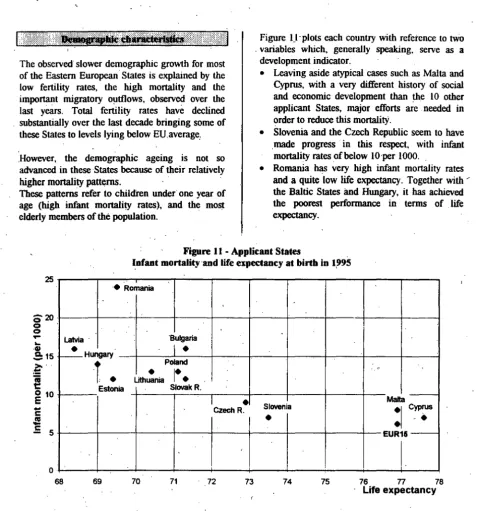
Figure 1_1-plots each country with reference to tWo
. variables which, generally speaking, serve as a development indicator.
• Leaving aside atypical cases such as Malta and Cyprus, with a very different history of social
and economic development than the I 0 other
applicant States, major efforts are . needed in order to reduce this mortalitY.
• Slovenia and the Czech Republic seem to have made progress · in this respect, with infant mortality rates of below IO·per 1000 .
• Romania has very high infant mortality rates and a quite low life expectancy. Together with_..
the Baltic States and Hungary, it has achieved
the poorest performance in tenns of . life
expectancy.
Figure 11 - Applicant States
Infant mortality·and life expectancy at birth in 1995
25
c;20
0 0....
...
.G) .9:15 -~·~
~ 10
...
c~
50
. '
·• Romania
Latvia . 'Bulgaria
•
1--Hungary
I
•
t
•
Lithuania•
Poland1· •
Estonia Slovak R.
I
•
Czech R. Slovenia
•
!
68 69 70 71 ' .72 73 74 75
Malta
:I
Cyprus-
.
EUR1&-I.
76 77 78
· Life expectancy
.. Sources: United Nations World Population Prospedt 1996 ·(applicant States) - Eurostat, Demographic Statistics,/99 7 .
. 'EURJ5) . . . . . .
~
-
Conclusion
.
.
Although it will come later and . to. a lesser degree, population ageing will also affect Eastern European countries. In half of these States demographic trends have already opened the door to increased pressure on the
social protection system which even now is experiencing difikulties. ·
These States arc also going to experien'cc a sometimes significant fall ·in· the population of working age.
heralding problems of a simil:ir n:Hure to those with which European Uriion will be faced after 20 10 .. A future
of sust:uncd growth would require the activation of the existing labour force reserves. Developments in Po,land ·and till' Slodk.- Rcpuhli0 might he somehow. ditTcrcnt. Sustained economic gro\\th and .job .creat.ion will be
ll'lJIIIIl'tl Till· gulf hl·tw,·di the ~iti~:s and !he ~ountryside may pose a special challenge in .these.States.
[image:30.567.34.514.24.535.2]ANNEXE-. AANNEXE-.
SCENARIOS FOR THE FUTURE DEVELOPMENT OF THEEU
POPULATION (1995~2015)A
verage num er o b f Cl h'ld ren per woman ·1995 '2000 2005 2010 2015
High 1.50 1.75 1.87 . ' 1.91 1.92.
Low '1.42. 1.40 1.40' 1.40 - 1.41
Baseline 1.45 1.55. ·1.60 ' 1.63 1.64
Old 1.42 1.40 1.40. 1.40 1.41
Young 1.50 . ·1.75 1~87 1.91 1.92
.-. Life expectancy at birth (Men)
1995 2000: 2005 . 2010 2015
High 74.3 75.5 . 76.9 78.1 79.2.
' Low 73.5 73.9 74.3 74.7 75.0.
.. Baseline 73.9' 74.7 75:6 76.4
-
77.2Old . 74.3 75.5 76.9 78.1 . 79.2
·Young 73.5 73.9. 74.3 74.7 75.0
LifeJexpectancy at birth (Women)
1995 2000 2005 2010 2015
High 80.7 81.7 82.7 - 83.7 84.4
-Low 80.1 80.5 80.9 81.3
81.5-Baseline - - 80.4 81.1 81.9 - 82.5 83.1
Old 80;7 . 81.7 82:7 83.7 ' ' 84:4
·voung 80.1 80.5 '• 80.9 . 81.3 81.5
_, ·• Annual migration balance (in thousands)
. .
1995-1999 2000-2004 2005-2009 . 2010-2014
High - 934· 977 840 788
.Low 527 391 388 396
-·Baseline 719 654 605 592
Old -527 39.1 388 396
Young 934 977 840 788 .,
8. METHOD OF CALCULATING THE DEMOGRAPIDC AND BEHAVIOURAL EFFECT (ACTIVITY RATE EFFECT) IN CHANGES IN THE ACTIVE POPULATION
On the basis of the population aged between 15 and 64 per year of age and per gender in 1995, and
demographic projections for the population aged between 15 and 64 per year of age and gender up to
2015, for each gender we have, ·
for
; P,
P;,,
O'i,tand·for ar;,, AP;,, AP,
-population aged between 15 and 64 in year t
population of ~ge i in year t (i ranging from 15 to 64 years)
percentage of age i complement in 15-64 age group complement' in. y~ t, the
vector (c:r1s, c:r64),defining the structure per age in year t, so that P;,1 I P,
=
c:r;,, with1:
c:r;=
l· for year tactivity rate for year of age i in year t
active popul~tion of age i in year t
total active pqpulation (15 to 64 years) in year t
the followj.ng relations:
AP;,, ar;,, x P;,, ·= ar;,, x c:r;,, x P,
APt
=
1:; (ar i.t x c:r;,, x P,)and the variation in the active population between two different dates as follows:
MP ·1:;. (ar; x c:r; x .1P)
+
1:;
(ar; x .1c:r; xP)
+
1:; (.1ar;_ x c:r; x P)+
s.demographic e~ect
..
.
· activity rate ~ffect residue· that is the sum of the two effects:
• an ·activity rate.effect, expressed by the variation ·in the active population with a
~onstant
15-64 agegroup complement and constant age structure; . this expresses the degree of participation -in· · employment of a given complement;
• a demographic effect,· expressed by the. ·variation in the active population wil4 a· constant activity rate per year of age and constant age stRJcture; this demographic effect combines an effect linked to
the complement and an effect linked to its age composition.
.
' .
As the me! hod was applied to ~ach