This is a repository copy of
The Performance Implications of Speed, Regularity, and
Duration in Alliance Portfolio Expansion
.
White Rose Research Online URL for this paper:
http://eprints.whiterose.ac.uk/87735/
Version: Accepted Version
Article:
Hashai, N, Kafouros, M orcid.org/0000-0002-6438-3990 and Buckley, PJ
orcid.org/0000-0002-0450-5589 (2018) The Performance Implications of Speed,
Regularity, and Duration in Alliance Portfolio Expansion. Journal of Management, 44 (2).
pp. 707-731. ISSN 0149-2063
https://doi.org/10.1177/0149206315592030
© The Author(s) 2015. This is an author produced version of a paper accepted for
publication Journal of Management. Uploaded in accordance with the publisher's
self-archiving policy.
[email protected] https://eprints.whiterose.ac.uk/
Reuse
Unless indicated otherwise, fulltext items are protected by copyright with all rights reserved. The copyright exception in section 29 of the Copyright, Designs and Patents Act 1988 allows the making of a single copy solely for the purpose of non-commercial research or private study within the limits of fair dealing. The publisher or other rights-holder may allow further reproduction and re-use of this version - refer to the White Rose Research Online record for this item. Where records identify the publisher as the copyright holder, users can verify any specific terms of use on the publisher’s website.
Takedown
If you consider content in White Rose Research Online to be in breach of UK law, please notify us by
The performance implications of speed, regularity and duration in
alliance portfolio expansion
Kafouros M, Hashai N, Buckley PJ
ABSTRACT
Extant research on the management of time shows that the speed of undertaking new strategic
moves has negative consequences for firm profitability. However, the literature has not
distinguishedwhether this outcome results from the effects of speed on firms' revenues or from
the effects of speed on firms' costs, or examined how firms can become more profitable by
reducing the negative consequences of speed. We address these gaps for a specific strategic move
– alliance portfolio expansion. We show that the speed at which firms expand their alliance
portfolios increases managerial costs disproportionately relative to revenues, leading to an overall
negative effect on firm profitability. However, a more regular rhythm of expansion and a longer
duration of existing alliances reduce the negative profitability consequences of expansion speed
by moderating the increase in managerial costs. These findings suggest that firms that make
strategic moves, such as alliances, may reduce the negative profitability consequences of speed
when they maintain a regular expansion rhythm and when their existing strategic engagements
require modest managerial resources.
Keywords: Alliance portfolio, expansion speed, pace, regularity, alliance duration, firm
INTRODUCTION
Alliance portfolio expansion is a major strategic move that can have a profound effect on
firm profitability. Prior research has shown that inter-firm profitability variations are driven by
attributes such as the size of alliance portfolios, partner quality, redundancy among partners, and
partner diversity (Ahuja, 2000; Baum, Calabrese, & Silverman, 2000; Goerzen & Beamish, 2005;
Lavie & Miller, 2008). However, the development of alliance portfolios is not an isolated event,
and firm profitability is driven not only by the attributes of alliance portfolios but also by the
temporal variations and patterns through which they are built (Das & Teng, 2002; Shi & Prescott,
2011). A key temporal dimension that may affect firm profitability is the speed at which firms
expand their alliance portfolios (Shi, Sun & Prescott, 2012). However, the extant research has not
investigated how the expansion speed of alliance portfolios affects firm profitability.
To enhance our understanding of the effect of expansion speed on profitability, we
investigate how speed of alliance portfolios’ expansion influences firm-level revenue generation,
"managerial costs,” and, thereby, profitability. By analyzing both the revenue-generating and
cost-escalating consequences of alliance portfolio expansion speed, we offer a finer-grained view
of the factors affecting firm profitability when expansion speed is increased. Furthermore, this
distinction allows us to investigate how two additional temporal dimensions – the rhythm of
expansion and the duration of alliances in existing portfolios – influence the ability of firms that
expand their alliance portfolios quickly to accelerate revenue generation while minimizing the
increase in managerial costs associated with rapid expansion.
Managerial costs are a particularly salient feature in alliance portfolio expansion that is
associated with the time and effort invested in creating, nurturing and managing alliances (White
& Lui, 2005). Managerial costs do not just depend on transaction costs (i.e., the costs associated
with partners behaving opportunistically, Williamson, 1985). Creating and sustaining alliance
transaction costs, alliance portfolio expansion may still increase managerial costs because of the
need to identify and interact with new partners, to maintain an effective inter-organizational
interface and to implement changes in response to partners’ actions (White & Lui, 2005).
Alliance portfolio expansion therefore requires partner firms to commit substantial managerial
time to developing partner-specific capabilities, to building trust and reputation, to identifying
synergies and to creating positions in networks of alliances (Dyer & Singh 1998; Schilke &
Goerzen, 2010).
Our analysis of 147 high-tech firms engaged in 1,043 alliances reveals that alliance
portfolio expansion speed is positively associated with both firm-level revenue generation and
managerial costs. However, managerial costs increase disproportionately more than revenues,
leading to a negative net effect on firm profitability. Subsequently, we show how firms can
expand quickly while avoiding, or at least reducing, the disadvantages of rapid expansion. This
analysis underscores the moderating role of the regularity with which firms expand their alliance
portfolio and the duration of existing alliances in the firm’s portfolio. Firms that expand their
alliance portfolio in a more regular rhythm and firms that sustain their existing alliances for
longer durations can limit the negative implications that expansion speed has on managerial costs.
In other words, a constant alliance portfolio expansion speed and lower managerial resource
demands resulting from maintaining alliances for longer durations help firms to reduce the
disproportionate increase in managerial costs, thus improving their profitability.
We extend prior research on the speed, regularity and duration of expansion and provide
insights for firms undertaking new strategic moves, in general, and those expanding their alliance
portfolio, in particular. Prior research has focused on the overall profitability consequences of
speed as it pertains to strategic moves such as entry into new countries and business sectors
(Vermeulen & Barkema, 2002; Klarner & Raisch, 2013). Engaging in strategic moves at greater
speeds has been shown to have negative profitability implications (Vermeulen & Barkema, 2002;
profitability variations are driven by differences in revenue generation or differences in the
managerial costs involved in making strategic moves. The current study highlights that the reason
for such profitability reduction is the disproportionate increase in managerial costs relative to
revenues, rather than a decrease in revenues due to firms’ limited capacity of capturing the
benefits of fast-paced strategic moves (Vermeulen & Barkema, 2002). Clearly, each type of
strategic move differs in its context and in its revenue-generating and cost-escalating patterns. Yet
we expect the direction of the hypothesized effects to remain similar.
Our analysis further identifies the circumstances in which firms that expand quickly can
succeed in reducing the negative effects of this strategy. These results show that firms that make
strategic moves at high but constant speed manage to moderate the negative consequences of
rapid expansion. Hence, whereas previous studies have focused on the direct effect of regularity
on firm performance (Klarner & Raisch, 2013; Laamanen & Keil, 2008; Shi & Prescott, 2012;
Vermeulen & Barkema, 2002), we show that a regular expansion rhythm enables firms that make
fast-paced strategic moves to reduce the acceleration of managerial costs. Furthermore, although
research on the profitability implications of expansion speed has considered the role of regularity
or rhythm, it has not sufficiently explored the duration of existing strategic engagements. Our
analysis suggests that because existing strategic engagements of longer duration place lower
managerial demands compared to "younger" strategic engagements, they increase firms' capacity
to direct managerial resources to new strategic moves thus reducing the negative effect of
expansion speed on managerial costs.
Overall, our findings suggest that two firms may end up undertaking similar strategic
moves, but experience different profitability outcomes because they have expanded at different
speeds, with different regularities and for different durations. The remainder of this study is
organized as follows: the next section presents our theoretical framework and specifies our
our results. Finally, we present the conclusions and elaborate upon the theoretical and practical
implications of the study.
THEORETICAL FRAMEWORK The performance consequences of speed
The extant research on time management and its consequences (Shi et al., 2012) suggests
that new strategic moves may accelerate organizational learning and facilitate the acquisition of
new capabilities and the adoption of new routines and processes (Vermeulen & Barkema, 2002;
Klarner & Raisch, 2013). Fast-paced strategic moves may also help firms avoid competency
traps, implement new initiatives, and pursue new opportunities by facilitating the implementation
of "change" routines that support subsequent strategic moves (Amburgey, Kelly & Barnett, 1993;
Barkema & Schijven, 2008; Beck, Brüderl & Woywode, 2008). Fast-paced strategic moves can
further help firms adapt to changing environments (Teece, 2007).
Although these benefits may assist firms in generating revenues, fast-paced strategic
moves also require managerial attention, time, and resources and may disrupt existing
organizational operations (Klarner & Raisch, 2013; Vermeulen & Barkema, 2002). Because
establishing new organizational routines takes time, firms that engage in new strategic initiatives
face substantial adaptation costs in seeking to exploit new resources and capabilities (Dierickx &
Cool, 1989; Zollo & Winter, 2002). Rapid strategic moves also require senior managers to make
many decisions within a short time, which raises the risk of information overload (Huber, 1991)
and may lead to ineffective decision making and costly mistakes (Hambrick, Finkelstein &
Mooney, 2005). Prior studies have shown that the speed of strategic moves negatively affects
firm profitability (e.g., Vermeulen & Barkema, 2002; Klarner & Raisch, 2013) and other
performance measures such as market returns (Laamanen & Keil, 2008), but this literature has not
examined whether the negative effects on firm profitability result from increases in managerial
The extant research also shows that firm profitability depends on the regularity at which
firms make strategic moves, with regular expansion having positive effects on profitability
(Klarner & Raisch, 2013; Vermeulen & Barkema, 2002). Whereas this observation has its own
merits, the literature is silent regarding the question of whether regularity also has a moderating
effect on the relationship between the speed of strategic moves and firm profitability. As a result,
it remains unclear how fast-paced strategic moves affect profitability differently depending on
whether they are made regularly or irregularly. Similarly, we know very little about how the
temporal characteristics of firms' existing strategic engagements, such as their duration (Child &
Yan, 2003;Shi, et. al, 2012), affect the profitability consequences of fast-paced strategic moves.
We confront the unresolved issues concerning the effect of speed and its interaction with
regularity and the duration of existing strategic engagements on revenue generation, managerial
costs, and firm profitability in the context of alliance portfolio expansion.
Clearly, there are variations in the revenue generating and cost increasing patterns within
and across different types of strategic moves, such as alliances, acquisitions, entry into new
foreign markets and business segments, and other types of investment. For example, managerial
costs in alliances result from monitoring and interacting with partners; managerial costs in foreign
market entries result from the need to identify new locations and analyze their characteristics; and
managerial costs in acquisitions result from the complexities of integrating firms with different
structures and cultures into a unified entity. Yet we expect the relationship between the speed of
undertaking new strategic moves and firm level revenue generation and managerial costs to be
similar, where fast-paced strategic moves are expected to increase both the benefits and costs of
firms (Pacheco de Almeida, Hawk & Yeung, 2015).
In the following subsections, we define the nature of the benefits of building a portfolio
of alliances, the effect of building such a portfolio on revenue generation, and the associated
and its interactions with the regularity of alliance portfolio expansion and the duration of existing
alliances affect revenue generation, managerial costs and, subsequently, firm profitability.
Revenue generation and managerial costs of alliance portfolios
It has long been recognized that firms do not have to fully own resources to enjoy their
benefits (Das & Teng, 2000; Kale, Dyer & Singh, 2002; Lavie, 2006; Zaheer & Bell, 2005).
Rather, they can exploit rent-generating resources residing outside the firm’s boundaries (Dyer,
1996; Gulati, 1999; Gulati, Nohria & Zaheer, 2000) that are embedded in inter-firm routines and
processes (Dyer & Singh, 1998). Hence, firm performance is directly linked to the alliances in
which firms participate, where idiosyncratic inter-firm linkages may result in economic benefits
generated through the joint contributions of alliance partners. Such benefits may take the form of
greater product differentiation and faster product development cycles (Dyer & Singh, 1998;
Vasudeva & Anand, 2011). In turn, these allow firms to improve competitive positions, expand
customer bases and increase their revenues (Belderbos, Carree & Lokshin, 2004; Singh &
Mitchell, 2005; Stuart, 2000).
Engagement in alliances, however, may also lead to increased managerial costs. These
costs are associated with the managerial time and effort required to generate and maintain new
relationships, develop partner-specific learning capabilities, monitor alliance outcomes, build
trust and reputation, and identify synergies and complementarities (Dyer & Singh 1998; Levinthal
& Fichman, 1988; Schilke & Goerzen, 2010; Zaheer, McEvily & Perrone, 1998). Managerial
costs not only result from the transaction costs associated with partners that behave
opportunistically (Williamson, 1985), but also stem from the need to collaborate with alliance
partners to achieve certain strategic objectives. Even in the absence of transaction costs,
managerial costs may be incurred. Such costs can be classified into “task-related” and "social"
dimensions (White & Lui, 2005). Task-related dimensions involve the difficulties of coordinating
knowledge transfer. Social dimensions involve the need to establish an effective
inter-organizational interface and to overcome cultural and social differences (White & Lui, 2005).
Because managers need a stream of supporting services to operate effectively, managerial
costs do not merely refer to managers' direct compensation. Managerial costs include the costs
related to the time and effort invested by existing managers, the costs related to the acquisition of
additional managerial resources, and the costs of supporting managerial resources, such as
administrative assistance, legal and financial consulting, communication, and travel.
The effects of the speed of alliance portfolio expansion
We expect the speed with which firms expand their alliance portfolios to have a
substantial impact on revenue generation, managerial costs and, subsequently, firm profitability.
Rapid alliance portfolio expansion is likely to positively affect the generation of firm revenues by
accelerating organizational learning and the adaptation of new routines and processes from
alliance partners (Dyer & Nobeoka, 2000; Hoffmann, 2007). As in the case of acquisitions
(Barkema & Schijven, 2008; Laamanen & Keil, 2008), a faster expansion rate can help firms to
more rapidly access new resources, capitalize on external knowledge, and learn from their
alliance partners how to develop more efficient structures (Kale, Singh & Perlmutter, 2000). A
faster alliance portfolio expansion also enhances firm flexibility, which is particularly important
in volatile competitive environments (Teece, 2007). In turn, these mechanisms enable firms that
expand their alliance portfolios quickly to enjoy advantages such as greater product
differentiation and faster product development cycles (Dyer & Singh, 1998). A faster alliance
portfolio expansion allows firms to widen their customer base and increase revenues (Singh &
Mitchell, 2005; Stuart, 2000) more than firms that expand their alliance portfolios slowly.
However, given that integrating partners' resources with firms' existing routines and
processes takes time and consumes substantial managerial resources (Barkema & Schijven, 2008;
existing managerial capacity to identify synergies, change organizational routines, and create
interfaces with partners (Huber, 1991;Laamanen & Keil, 2008). A rapid alliance portfolio
expansion therefore requires significant effort from existing managers, the acquisition of
additional managerial resources, and a stream of administrative support services, which in turn
significantly increase the firm’s managerial costs.
When firms rapidly expand their alliance portfolios within a short time span, they are
constrained by time-compression diseconomies (Dierickx & Cool, 1989). According to asset
accumulation theory (Dierickx & Cool, 1989), time compression diseconomies pertain to the
additional costs incurred by firms seeking to quickly reach a given level of asset stock when this
stock could be accumulated more economically over a longer duration. In the current context, this
theory implies that creating many alliances within a short time requires a larger increase in the
commitment of managerial resources (and consequently in related administrative support) than
does establishing the same number of alliances over a longer period. Rapid alliance portfolio
expansion requires substantial investments of managerial resources to avoid costly mistakes due
to information overload (Huber, 1991) and to ensure that existing processes are appropriately
adapted to those of partners. Such investments are accompanied with convex adjustment costs;
i.e., the cost of the investments increases disproportionally when the speed of expansion is
accelerated (Knott, Bryce & Posen, 2003). Time-compression diseconomies are less likely to
arise when alliance portfolios are developed gradually because the organization can handle the
associated complexities without overstretching its existing managerial resources and
administrative support services (Barkema & Schijven, 2008).
Because expansion speed increases both firm revenues and managerial costs, the net
effect of speed on firm profitability will depend on whether the effect of rapid expansion on
revenues is greater than the increase in managerial costs. We argue that although fast-paced
expansion may enhance revenue generation, the disproportionate increase in managerial costs will
diseconomies, which predicts that a higher speed of conducting a given process will lead to a
nonlinear increase in the costs of such a process (Dierickx & Cool, 1989). Overall, we expect
disproportionate increases in managerial costs when firms expand their alliance portfolios rapidly
to outweigh the positive effects of a rapid alliance portfolio expansion on revenues, which will
negatively affect profitability:
Hypotheses 1a, b and c: A higher expansion speed of the alliance portfolio a) enhances
revenue generation; b) disproportionately increases managerial costs; and therefore c)
reduces profitability.
Given the predicted effects of alliance portfolio expansion speed on firms’ revenues and
managerial costs, an important strategic question is to determine when firms can expand quickly
and at the same time reduce the negative effects of a rapid expansion. We argue that two
important factors that may make such an expansion possible are: 1) the regularity with which
firms conduct a rapid alliance portfolio expansion; and 2) the duration of firms’ existing alliances
when making a rapid alliance portfolio expansion. The regularity with which strategic moves are
made is often studied together with the speed of making such moves (e.g. Klarner & Raisch,
2013; Laamanen & Keil, 2008; Vermeulen & Barkema, 2002). However, the duration of existing
strategic engagements has been overlooked in this literature. Yet it is a key construct in studying
temporal aspects of alliance portfolios (Shi, et. al, 2012) and has implications for both managerial
costs and revenue generation. Since both the regularity of alliance portfolio expansion and the
duration of the existing alliances are closely associated with the managerial demands placed on
firms (Shi, et. al, 2012), they are both likely to play a significant role in facilitating a rapid
The moderating effect of alliance expansion regularity
Regularly paced alliance portfolio expansion is likely to enhance revenue generation
while reducing managerial costs. By contrast, time periods between the establishment of alliances
that are either too short or too long are likely to negatively affect the skills, structures and
processes a firm draws upon (Klarner & Raisch, 2013; Laamanen & Keil, 2008) when
establishing new alliances. In turn, these effects will likely lead to lower revenues and higher
managerial costs.
Regularity in alliance portfolio expansion increases predictability. As a result, firms can
interpret their experiences in establishing alliances in the past and relate these experiences to
similar organizational routines and operations (Klarner & Raisch, 2013; Laamanen & Keil, 2008;
Vermeulen & Barkema, 2002) that are required for future alliances. Predictability therefore
makes the process of alliance building more efficient (Gulati, 1995). Firms become accustomed
to a given rate of new alliance engagement. Hence, they can effectively plan, implement, and
adapt to new collaboration agreements because they are accustomed to the routines and structures
required to assign responsibilities, take the required actions, and make appropriate resources
available (Shi & Prescott, 2012). In turn, this enables firms to better leverage their alliance
portfolios to increase revenues. It further allows firms to use their managerial capacities more
effectively to reduce the managerial costs involved in meeting the requirements of the chosen
rhythm (Klarner & Raisch, 2013).
Conversely, firms that expand at a highly irregular pace face complexities in creating new
alliances—both during periods of expansion peaks and during periods of inactivity, because
organizational structures and systems are seldom sufficiently flexible to manage the resulting
complexities of abrupt and discontinuous changes (Klarner & Raisch, 2013; Laamanen & Keil,
2008; Shi & Prescott, 2012). During peaks of rapid expansion, firms will find it difficult to
alliances and increasing revenues. Such peaks represent an extreme case of time-compression
diseconomies and will therefore also increase managerial costs significantly.
Alternatively, periods of inactivity may lead firms to gradually forget the practices they
have learned in previous alliances (Darr, Argote, & Epple, 1995). This is frequently the result of
the overturn of personnel who engaged in previous alliances, marked by managers leaving the
firm or switching positions within it, leading to the loss of valuable knowledge and experience
(Laamanen & Keil, 2008), hampering future alliance formation. Such inactivity may become
detrimental to the ability of firms to reap the benefits of new alliances and increase their
revenues. It may also result in additional managerial costs, as firms will need to redevelop the
necessary skills, routines and structures to effectively re-engage in new alliances.
Hence, maintaining a regular expansion rhythm is likely to allow firms to avoid some of
the negative effects of rapid alliance expansion.1
A rapid but constant pace of alliance expansion
may help firms leverage the advantages of predictability when establishing alliances. It alsoallows them use their knowledge of similar organizational routines and operations to become
more efficient at building new alliances (Gulati, 1995; Laamanen & Keil, 2008). This efficiency
further enhances firms’ ability to leverage rapid alliance portfolio expansions to generate
revenues, while reducing time-compression diseconomies and their associated managerial costs.
By contrast, the combination of rapid alliance portfolio expansion and irregular expansion rhythm
is likely to stretch a firm’s managerial capacity even further. This combination limits firms’
ability to rely on past experiences due to the severe time constraints and the limited predictability
that the combination of high speed and irregular expansion pace imposes. This combination will
therefore further increase managerial costs and constrain firms’ ability to use previously learned
skills and processes to generate revenues.
We therefore expect firms that follow both a rapid and constant alliance portfolio
expansion to generate higher returns and incur lower managerial costs than firms that adopt a
portfolio rapidly but keep their expansion rhythm regular are likely to further increase their
revenues (over and above the revenue-generation effect of rapid alliance portfolio expansion). In
turn, these firms reduce their managerial costs and improve their profitability. By contrast, firms
that expand their alliance portfolios rapidly, but irregularly, will find it difficult to exploit their
alliance portfolio expansion to generate revenues. These firms will further face higher managerial
costs because of time-compression diseconomies. As a result of this combination, they will
achieve lower profitability. Accordingly, we propose the following:
Hypotheses 2a, b and c: A regular alliance portfolio expansion rhythm a) enhances the
positive effects of a higher expansion speed on revenue generation, b) decreases the
positive effects of a higher expansion speed on managerial costs, and therefore c)
decreases the negative effects of a higher expansion speed on profitability.
The moderating effect of alliance portfolio duration
The average duration of the alliances comprising alliance portfolios varies across firms.
We expect such variations and the associated challenges that firms face when their portfolios
consist of younger alliances (relative to more mature alliances) to have a profound impact on the
revenue, managerial costs, and profitability consequences of a fast-paced alliance portfolio
expansion. Younger alliances are characterized by limited trust, because partners are unfamiliar
with one another’s processes and systems (Dyer & Singh 1998; Kale, et al., 2002; Lavie, 2006).
A portfolio consisting of shorter-duration alliances requires firms to invest substantial managerial
time and effort in developing partner-specific learning capabilities, to monitor alliance outcomes,
to build trust and reputation and to identify synergies. These developments result in increased
managerial resource demands and, hence, higher managerial costs. Mature alliances enable firms
to become more familiar with their partners’ needs and practices (Kale, et al., 2002; Lavie, 2006).
Thus, less managerial effort is required for mature alliances than for younger alliances, both in
Because the managerial resource demands of managing mature alliances tend to be lower
than those of managing younger alliances, such firms have a higher capacity to expand their
alliance portfolios rapidly, while avoiding the pitfalls of time-compression diseconomies faced by
firms engaged in less-established alliances. Furthermore, the greater availability of managerial
resources in firms that sustain a portfolio of longer-duration alliances is likely to make them more
capable of reaping the benefits of rapidly expanding their alliance portfolios. Subsequently, this
will enable such firms to increase their revenue generation relative to firms that manage
less-established alliances. Altogether, we expect these mechanisms to allow firms that have a portfolio
of alliances of longer duration to be able to enhance the benefits of speed to increase their
revenues, reduce associated managerial costs, and thus achieve higher profitability. Accordingly:
Hypotheses 3a, b and c: A longer alliance portfolio duration a) enhances the positive
effects of a higher expansion speed on revenue generation, b) decreases the positive
effects of a higher expansion speed on managerial costs, and therefore c) decreases the
negative effects of a higher expansion speed on profitability.
METHODS Data and Sample
Our hypotheses were tested on a sample of randomly selected Israel-based, private and public
high-technology firms. High-technology firms are suitable for the current research because the
alliance literature frequently focuses on such firms (Kumar & Nti, 1998; Lavie & Miller, 2008;
Phelps, 2010; Stuart, 2000). The use of high-technology firms is particularly important for our
analysis because the dynamic and intensive alliance formation in this sector enhances the
meaningfulness, reliability, and variability of the relationships we wish to test. The sample was
derived from the full list of Israel-based high-technology firms constructed by the consulting firm
Dolev and Abramovitz Ltd. for the year 2007. The Dolev and Abramovitz dataset is recognized
high-technology firms that have reached the stage at which they sell their products. The dataset
represents the vast majority of high-tech sectors.2 We collected data both at the firm and at the
alliance level. This approach is essential for testing our framework because it allows us to link
revenues, managerial costs and profitability variations at the firm level to variations related to
firms’ alliance portfolios. It further allows controlling for both firm- and alliance portfolio-level
effects.
Firm level data—including revenues, number of employees, firm age, and investments
attracted—were collected from the Dolev and Abramovitz dataset and the Israel Venture Capital
(IVC) dataset. Dolev and Abramovitz Ltd. is a private company that collects and publishes annual
information on Israeli high-tech firms. The IVC dataset is another comprehensive source for
Israeli high-technology industries.3 We further used annual financial reports to collect firm-level
financial data. These data are readily available for public firms. We were also granted access to
key figures in the financial reports of private firms that represent 72% of the sample. Such
financial figures include the following: general and administrative (G&A) expenditures;
operational expenses; earnings before interest, taxes and depreciation (EBITDA); and fixed
assets. Finally, we also collected patent data from the United States Patent and Trademark Office
(USPTO). Because all the sampled firms had substantial sales in the USA4, it was important to
collect patent data from the USPTO.
Alliance-specific data were collected from the Lexis Nexis Academic archive and the
archives of leading Israeli financial newspapers, such as TheMarker and Globes. These archival
sources were used to identify announcements of alliance formation, to identify the governance
mode of each alliance agreement and to find announcements of alliance terminations. Lexis Nexis
Academic was further used to identify the country of origin of each alliance partner. Overall,
firm-level data were collected for 147 firms over the 2000-2007 period. Basic t-test comparisons
of the 147 participating firms and the 253 participating firms did not show evidence of
firm valuation and industrial classification. Because the sampled firms may have been engaged in
alliances established prior to 2000 and to avoid right-censoring bias, our alliance-level data also
included data on active alliances established before 2000.
The firm-year was used as the unit of analysis because our dependent variables were defined
at the firm level (Goerzen & Beamish, 2005; Lavie & Miller, 2008). Data for 1,043 alliance
announcements were transformed to alliance-year records by replicating alliance records for
active periods of alliance duration and by updating all time-variant variables. These records were
used to form 895 firm-year observations for the 147 analyzed firms by pooling the data for all
alliances in a firm’s alliance portfolio in a given year.
Measures
The variables required for the current study and their measures are detailed in Appendix
Table 1 and are further described below.
Dependent variables
To capture firm-level revenues, we used each firm's income in a given year. To capture
firm-level managerial costs, we used each firm’s General and Administrative (G&A)
expenditures.5 G&A expenditures consist primarily of senior managers' compensation and of
other administrative costs incurred at the head office for supporting the senior management (e.g.,
administrative employees, legal and accounting consulting, communication and travel costs). To
further examine the extent to which this measure indeed captures managerial costs, we
interviewed the CFOs of 10 random firms in our sample. These CFOs indicated that the costs
related to senior managers' compensation and the direct costs of administrative support for such
managers typically range between 65% and 80% of the overall G&A expenditures. Hence, the use
of G&A expenditures as a proxy for firm-level managerial costs is consistent with our earlier
observation that alliance portfolio engagement involves the time and effort of managers as well as
administrative support services for such managers. Finally, we captured each firm’s profitability
allows us to avoid potential biases that might arise from different financing strategies, tax
treatments, and depreciation rules in different industries.6
Independent variables
The expansion speed of a firm's alliance portfolio is operationalized as the number of new
alliances that the firm has established in a given year (derived from alliance announcements)
divided by the alliance portfolio size (i.e., the number of partner firms a focal firm has) in that
year. This metric has the advantages of capturing a normalized measure of alliance portfolio
establishments in a given year relative to the firm's alliance portfolio size, which has been shown
in past alliance portfolio research to affect firm performance (Wassmer, 2010).7 It is noteworthy
that firms are less consistent in reporting on alliance termination, whereas many announce
alliance creation. We used two alternative ways to overcome this problem.
For 584 alliances (out of the total of 1,043 alliance announcements), we obtained alliance
termination dates either from secondary sources or by directly approaching the relevant firms.
The average duration of this subset of alliances was two years and ten months. Regarding those
alliances for which we could not establish a precise termination date, we followed the procedure
conducted by Ahuja (2000) and Phelps (2010) to estimate alliance duration when termination
dates were missing. This procedure distinguishes between joint venture (JV) alliances and non-JV
alliances. We assumed that JVs with no termination announcements existed until the end of 2007,
the last year of our study. Non-JV alliances with no termination announcements were presumed to
exist until the end of the last year in which they were documented (in secondary sources) or until
the end of the year after the year they were founded, whichever was later (Phelps, 2010). This
procedure led to an average alliance duration of two years and eight months. Given that the t-test
of the difference in mean alliance portfolio size when using the two alternative methods of
calculating alliances’ duration found no significant difference between these alternatives, we
We followed Laamanen and Keil (2008) and used the standard deviation of alliance
engagement speed within the analyzed time frame to measure alliance portfolio expansion
regularity. More specifically, we used the inverse of the standard deviation (1/s, where s =
standard deviation) as our measure. High peaks in a firm’s alliance portfolio expansion combined
with periods of inactivity result in a relatively high standard deviation and, therefore, low values
of the engagement regularity measure. A regular pace of alliance portfolio expansion results in
low standard deviation and, therefore, high values of the expansion regularity measure. Given
that hypotheses 2a, 2b, and 2c concern the advantages of regularity for rapid alliance portfolio
expansion, this measure allows us to have a straightforward interpretation of regularity and to
estimate its direct effects.
The alliance portfolio duration is measured as the average duration (in years) of each firm's
alliance portfolio in a given year (i.e., all alliances that have not been terminated—or deemed to
have been terminated—up to the end of a given year). It is computed as the sum of the duration of
each firm's existing alliances divided by the number of alliances. The duration of each alliance is
calculated as the time elapsed (in years) between the announcement of the alliance and the end of
year t.8 The alliance portfolio duration is expected to moderate the effect of the alliance portfolio
expansion speed on profitability—as predicted in hypotheses 3a, 3b and 3c—and may also have a
positive direct effect on the dependent variables.
Control variables
Our analysis controls for an extensive number of firm-level and alliance-portfolio-level
factors that might impact our dependent variables.
Firm level controls
We control for firm size (Ahuja, Lampert & Tandon, 2008), which is operationalized as the
log of the number of employees to reduce its skewness. To control for the effects of the firm’s
tangible resources, our regression models also include a measure of fixed assets. Another factor
investments made in a firm. We therefore control for total investments (in US$ million) made in
each firm by private investors, venture capital funds, corporate venture capitalists, acquisitions,
and/or through public offerings. This measure is log-transformed to reduce it skewness.
The yearly numbers of patents for which firms applied (and that were granted at a later stage)
are used as a proxy for the possible impact of firms' technological innovations on their revenues,
managerial costs, and profitability. The number of patents reflects high-technology firms'
innovation output. The literature highlights the superiority of the number of patent citations
compared to merely the number of patents as an innovation output measure, because the former
reflects the patents’ value (Ahuja & Katila, 2001; Grilliches, 1990). However, because patent
citations are likely to lag behind the act of technological innovation, we choose the number of
patents as our main proxy for innovation output. 9 A firm's level of technological innovation is
expected to increase its revenues and profitability, but it may also increase managerial costs.
The degree of diversification may also affect firm profitability (Goerzen & Beamish, 2005).
Because the firms in our sample are mostly single-business firms, we control for intra-industry
product diversification by calculating the cumulative number of product lines that a firm has in a
given year. We also control for the geographic diversification of firms. This measure is
operationalized as an entropy measure of their sales across six foreign regions: North America,
South and Central America, the European Union, the rest of Europe, Asia, and the rest of the
world (Kim, Hwang & Burgers, 1993; Hitt, Hoskisson & Kim, 1997). This classification builds
on the observation that regional considerations play a significant role in firms' internationalization
(Rugman & Verbeke, 2004). It has the further advantage of capturing diversity between regions
in terms of geographic, institutional, and cultural distances (Delios & Henisz, 2003; Ronen and
Shenkar, 1985). A further control is firm age. This measure captures inter-firm heterogeneity in
revenues, managerial costs, and profitability that result from maturity differences. Firm age may
also account for the observation that high-technology firms reach profitability at relatively late
controlled for by year effects. Industry effects, representing 11 principal high-technology sectors,
are used to control for inter-industry variances in revenues, managerial costs and profitability.
Alliance portfolio level controls
We control for the potential effect of prior alliance portfolio experience on revenues,
managerial costs, and profitability (Anand & Delios, 2000). Following Gulati, Lavie and Singh
(2009), we use the number of alliances in which each firm was engaged up to the beginning of
each year as a proxy for prior alliance experience. In addition, alliance functiondiversity
measures the dispersion of existing alliances across R&D, production, marketing and customer
support activities (Jiang, Tao & Santoro, 2010). Alliance functiondiversity should be positively
correlated with revenues and profitability because of greater learning and resource
complementarity potential (Dyer & Singh, 1998; Gulati, 1999; Jiang, et al., 2010; Kale, et al.,
2002). This measure should also be positively correlated with managerial costs due to greater
coordination complexity (Goerzen & Beamish, 2005). Accounting for these alliance portfolio
level measures is likely to increase the reliability of our results because they allow us to test the
possible effects of alliance-portfolio-level heterogeneity on our dependent variables.
Statistical Method
To overcome potential endogeneity issues, we first take differences in our regression
models to control for unobservable model-specific effects and then estimate the model using a
general method of moments (GMM) approach, thus applying panel random-effect methods.
Arellano and Bond (1991) show that the most efficient set of instruments in the absence of serial
correlation are found using the lagged values of the dependent variable and the potentially
endogenous explanatory variables (i.e., expansion speed, expansion regularity and duration) from
t-2. Therefore, these are the instruments we adopt. Arellano and Bond’s dynamic panel model has
been shown to produce poor results when there are many independent variables and few periods.
In such cases, fewer instruments are available (i.e., because the Arellano and Bond framework
periods analyzed consequently decreases. Building on the work of Arellano and Bover (1995),
who used lagged differences as potential instruments, Blundell and Bond (1998) exploit
additional moment restrictions, which substantially improve the performance of the Arellano and
Bond GMM estimator in circumstances in which the number of time-series observations is
relatively small (e.g., in which there are relatively few years of data). Because we have a
maximum of eight periods per firm (2000-2007), we adopt the Blundell and Bond extension.
RESULTS
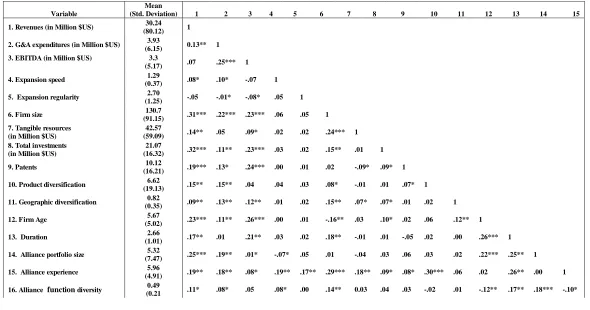
Descriptive statistics and correlations are presented in Table 1. The firms in our sample
are fairly young (less than six years old on average); they are small to medium sized in terms of
their numbers of employees (131 employees on average) and revenues (US$30 million on
average). On average, each firm has approximately 10 patents. Because Israel is a fairly small
economy, 74% of the alliances are with foreign partners, mainly with US and European firms.
Firms have engaged in approximately 1.3 new alliances per year, on average, and the average
alliance portfolio engagement regularity is approximately 2.7. The average duration of alliances is
two years and eight months (2.66). In a given year, firms have been engaged in an average of
over five alliances.
[Insert Table 1 about here]
The results of the GMM regressions are presented in Table 2, in which revenues, managerial
costs and profitability are tested against the independent and control measures. Models 1-4 test
the effects on revenues, models 5-8 test the effects on managerial costs, and models 9-12 test the
effects on profitability. Models 2-4 show that expansion speed has a significant positive effect on
revenues, supporting H1a. Models 6-8 show a significant negative effect for expansion speed on
managerial cost, thus lending support to H1b. Models 10-12 show a significant negative effect of
expansion speed on profitability, thus supporting H1c. Importantly, we also investigate whether
would lead to a reduction in profitability growth. When comparing the coefficients of expansion
speed in models 2-4 (predicting revenues) and models 6-8 (predicting managerial costs), Wald
tests show the coefficients for managerial costs are consistently significantly larger than those for
revenues (p> 2=0.001 for all models).10
Furthermore, when comparing the marginal effect of
expansion speed on revenues and managerial costs for the average firm in absolute terms, it isclear that the increase in sales in model 4 (0.04X30.24=US$1.21 million) is always smaller than
the increase in managerial costs in model 8 (0.35X3.93=US$1.37 million). Together, these results
indicate that increases in expansion speed lead to greater increases in managerial costs than
revenues. This outcome substantiates our point that it is the increase in managerial costs that
hampers profitability, despite the increase in revenues.
Next, models 3 and 4 indicate that a more regular expansion11 of alliance portfolios positively
affects revenues, but the interaction between regularity and expansion speed (model 4) is
insignificant, indicating that H2a is not supported. Models 7 and 8 show that a more regular
expansion of alliance portfolios negatively affects managerial cost, and its interaction with
expansion speed (model 8) is negative and significant, thus supporting H2b. Finally, models 11
and 12 show that a more regular expansion of alliance portfolios positively affects profitability,
and its interaction with expansion speed (model 12) is also positive and significant, thus
supporting H2c. Overall, these results show that greater regularity does not allow firms that
rapidly expand their alliance portfolios to increase their revenues more than firms that also
expand their alliance portfolio rapidly, but not in a regular way. Yet greater regularity enables
firms that expand rapidly to reduce their managerial costs more than firms that expand their
alliance portfolios rapidly but irregularly. This phenomenon, in turn, enables the former group of
firms to have higher profitability than the latter group of firms.
Finally, models 3 and 4 further indicate that longer duration of alliance portfolios positively
affects revenues, but the interaction of longer duration and expansion speed (model 4) is
managerial cost, and its interaction with expansion speed (model 8) is negative and significant,
which supports H3b. Finally, models 11 and 12 show that duration positively affects profitability,
and its interaction with expansion speed (model 12) is also positive and significant, thus
supporting H3c. As in the case of alliance expansion regularity, these results indicate that firms
with more mature alliances that expand their alliance portfolios rapidly are not able to increase
their revenues more than firms with younger alliances that rapidly expand their alliance
portfolios. Yet the former group of firms may expand rapidly and bear lower costs than the latter
group and subsequently increase their profitability.
Overall, we conclude that both alliance portfolio expansion regularity and duration can
reduce the managerial costs resulting from rapid alliance portfolio expansion. Yet they do not
contribute to an increase in revenues when alliances portfolios are rapidly expanded. A possible
explanation for the fact that hypotheses H2a and H3a are not supported may be that, unlike
managerial costs (which are under the firm’s control), revenues depend on external factors, such
as market conditions and competitors’ actions. Because it is difficult to control for the effects of a
multiplicity of external factors, they may mask the moderation effects of engagement regularity
and duration.
Models 1, 5 and 8 present the effects of firm- and alliance-level control variables on the
dependent variables. Total investments, patents, geographic diversification, and alliance function
diversity are found to be significantly associated with all the dependent variables. Firm size is
also positively associated with revenues. The models provide support for our regression
specifications in terms of their Wald statistics. The Sargan tests (Blundell and Bond, 1998)
confirm the validity of the instruments, and the null hypothesis of no serial autocorrelation of the
residuals is also retained. Wald tests further show that all models that include our independent
variables are more significant than those models that include only the control measures (models
1, 5 and 8) at the p>F=0.01 level.
Robustness Tests
To test the robustness of our results, we conduct several additional analyses, the first of
which is a more direct test of our argument that managerial costs increase more than revenues as
a result of rapid alliance portfolio expansion. Although we use profitability to capture the effects
of speed, regularity and duration on revenues deducted from costs, this measure also includes
additional cost components that make profitability cruder for this paper's purpose. We therefore
construct a measure that deducts managerial costs from revenues per firm and year and run all our
models with this measure as the dependent variable.12 The new results remain consistent with
those presented in models 9-12 in Table 2. We also use market value and Return on Sales (ROS)
13
as alternative operationalizations for firm performance (Farjoun 1998; Goerzen &Beamish,
2003, 2005). The results using these alternative performance measures remain similar to those
presented in models 9-12 in Table 2.
Second, to further test the argument that faster expansion generates revenues through the
enhanced effect of alliance portfolios on product differentiation and product-scope expansion, we
use patents and product diversification as dependent variables, rather than as controls. The
results of these models show that expansion speed is indeed positively associated with both
product diversification and patents, thus corroborating our argument. When we use expansion
regularity and duration as moderators for the effect of expansion speed on product
diversification, we find positive and significant moderating effects. These results are in line with
H2a, which was not supported when revenues was used as the dependent variable. When we use
expansion regularity and duration as moderators for the effect of expansion speed on patents, we
find no significant moderating effects, consistent with our core results.
Third, we examine the existence of curvilinear effects by squaring the key constructs
(expansion speed, expansion regularity and duration). Among other considerations, this
investigation is conducted due to the study of Shi and Prescott (2012), showing that the expansion
performance (Tobin's Q). We find insignificant effects for all squared measures. Moreover, we
examine whether some effects of expansion speed, expansion regularity and duration might be
mitigated when repeated alliances are included (Goerzen & Beamish, 2005; Goerzen, 2007). We
therefore estimate the models while excluding repeated alliances from the sample. This
re-estimation does not change the results. We also test whether the number of repeated alliances
moderates the effects of expansion speed. The rationale for this is that when firms have many
repeated alliances, their enhanced familiarity with their partners may reduce managerial costs.
The role of repeated alliances, however, is insignificant both for its main and moderating effects,
most likely because of the low number of repeated alliances in our sample (only 0.72 on average).
Tests of the moderating effect of alliance experience also yield no significant results.
Furthermore, we replace our measure of technological innovation with the number of patent
citations in each period as reported by the USPTO and with the level of R&D expenditures. These
alternative measures, once again, yield similar results. Next, we test whether the results are
affected by the governance mode of alliances (licensing, joint venture, outsourcing, distribution
agreements and OEM agreements) and specific functions of alliances (R&D, production,
marketing and customer support) by running separate regressions for such sub-groups. No
significant effects are found. We also add controls for the share of alliances in the alliance
portfolios of firms with specific governance modes and for the share of alliances pertaining to a
given function. This allows us to examine whether alliance portfolios that are biased towards a
specific governance mode or function affect our results. No significant effects are found in these
cases either.
In addition, we test whether additional alliance portfolio diversity measures—such as partner
industry, partner nationality or governance mode diversity (Jiang, et al., 2010)—affect our results.
The effects are insignificant for these measures. Additionally, given the possible effect of
uncertainty on alliance portfolio expansion moves (Koka, Madhavan and Prescott, 2006) we
sub-sample of public firms (41 firms represented by 251 firm-year observations). Here, we test
whether the addition of firm-specific uncertainty and market uncertainty might also affect our
results. The results remain consistent for this sub-sample, while the significance of the
independent variables is approximately 5%, most likely due to the smaller sample size. Finally,
we lag all independent variables and controls by one, two, and three years relative to the
dependent variables. This allows us to test for whether time lags change the effects of expansion
speed, regularity and duration. The results remain consistent with those presented in Table 2,
although the significance level decreases as the time lag increases.
DISCUSSION AND CONCLUSION Theoretical Contributions and Implications
This study advances the view that the speed at which firms make strategic moves (such as
alliances, mergers, acquisitions and new market entry) has a significant direct effect on their
profitability over and above the actual outcome of the strategic moves themselves. Although
firms’ ability to enhance their profitability should be positively related to their ability to respond
rapidly to changing environments by quickly making new strategic moves (Teece, 2007), the
emerging literature on temporal effects and time management largely suggests that fast-paced
strategic moves have negative profitability consequences (Klarner & Raisch, 2013; Vermeulen &
Barkema, 2002). The present study distinguishes between the effects of expansion speed on
revenue generation, managerial costs, and profitability. It therefore contributes to prior research
that has not explicitly considered whether decreases in profitability are driven by the effects of
speed on the firm’s ability to capture new revenue streams or by its effects on managerial costs.
This distinction allows us to examine the exact factors that determine how quickly firms
should make new strategic moves and identify how firms that undertake strategic moves quickly
can accelerate revenue generation while minimizing costs. Although a higher speed of strategic
findings reveal that the increase in managerial costs is disproportionately high relative to
contemporaneous increases in revenues, leading to an overall reduction in firm profitability.
Therefore, ignoring the distinction between the effects of fast-paced strategic moves on revenue
generation and managerial costs could be a major shortcoming in understanding what factors
allow firms to make rapid strategic moves in a manner that maximizes their profitability. This
view is consistent with recent work on temporal effects that suggests scholars should focus on
time management and its underlying performance consequences (Shi and Prescott, 2011).
We further advance the literature on the speed of strategic moves by explaining how the
profitability consequences of such speed are influenced by the moderating effects of expansion
regularity and the duration of existing strategic engagements. The extant literature (Laamanen &
Keil, 2008; Shi & Prescott, 2012; Vermeulen & Barkema, 2002) has treated rhythm separately
from speed, but has neglected the role of duration. Instead, we show that expansion speed should
be considered alongside expansion regularity and the duration of existing strategic engagements
when firms make new strategic moves. A key insight of our study is that firms that combine rapid
and regular strategic moves profit more than firms whose expansion is irregular. We argue that
firms can become more profitable by being better prepared for such moves, by reducing the
possibility of overstretching resources and capabilities in peaks of expansion, and by improving
their responsiveness and adaptation. A more regular expansion may enable firms to create a
temporal map and manage the expansion process more efficiently (Klarner & Raisch, 2013; Shi
& Prescott, 2011). More regular expansion thus allows firms that make fast-paced strategic
moves to increase revenue generation, control managerial costs, and become more profitable.
Furthermore, although the importance of time-compression diseconomies has long been
recognized in the literature (Dierickx & Cool, 1989), our study explains how regularity helps
firms to make rapid strategic moves while reducing the negative consequences of
time-compression diseconomies. This finding is consistent with recent insights into the role of
contributes to the "change-stability" debate (Beckman, et al., 2004; Klarner & Raisch, 2013) by
suggesting that an effective way to balance a firm’s need for fast-paced strategic moves and
optimal profitability is to regularly undertake such moves.
The negative profitability consequences of speed are also moderated by the duration of
the existing strategic engagements of firms. We argue that existing strategic engagements that are
mature place fewer demands on managerial resources. They therefore reduce managerial costs
and allow a higher capacity for fast-paced expansion. These results, together with the findings
regarding the role of regularity, underscore important contingencies that enable firms to expand
quickly while reducing negative profitability consequences. In both cases, the effect on
managerial costs enables a more rapid expansion (compared with the effect on revenues, which is
insignificant), further emphasizing the importance of distinguishing between the revenue
generation and managerial costs of strategic moves.
Our findings challenge the established view that fast-paced strategic moves negatively
influence profitability because firms cannot quickly absorb the benefits associated with such
moves (Vermeulen & Barkema, 2002). This view typically suggests that constraints on absorptive
capacity and cognitive scope (Cohen & Levinthal, 1990; Zahra & George, 2002) limit firms’
ability to capture the benefits of fast-paced strategic moves and identify complementarities that
will increase revenues. By contrast, our findings indicate that a higher speed of strategic moves,
such as alliance portfolio expansion, increases the benefits that firms can get out of their alliance
portfolio in terms of expanding their product differentiation and product scope14 and, in turn,
generates more revenue. Making strategic moves at a higher speed increases revenues by enabling
firms to accumulate new resources, achieve greater flexibility, and adapt to changing
environments. The overall effect of speed on firm profitability is indeed negative, but this result is
driven not by the firm’s inability to capture the revenue-generation benefits of fast-paced strategic
In that respect, another key contribution of this study is examining how temporal
constructs, such as speed, regularity, and duration, affect a fundamental problem in alliances: the
cost of managing such agreements. Even when alliance partners trust one another and are not
confronted with the opportunistic behavior of their partners (Williamson, 1985), alliances involve
significant managerial costs in terms of coordination and integration mechanisms (White & Lui,
2005). Managerial costs are therefore a salient feature of hybrid forms of governance. Although
our analysis focused on the context of alliances, managerial costs may, in fact, be a crucial
component when firms make other types of strategic moves. For instance, acquisitions require
managerial efforts in identifying and evaluating target firms, reaching acquisition agreements and
integrating acquired firms with the parent company. Entering foreign markets requires substantial
managerial effort in selecting target markets, deciding the appropriate timing and entry mode and
establishing collaborations in the target country. Likewise, diversification into new business areas
can consume significant managerial time and effort to establish new operations in an unfamiliar
industry. Our findings therefore indicate that when fast-paced strategic moves are considered, the
role of managerial costs is pivotal in determining whether such moves will enhance or reduce
firm performance.
This study also contributes to the literature on the profitability implications of alliances
(e.g., Ahuja, 2000; Baum, Calabrese, & Silverman, 2000; Goerzen & Beamish, 2005; Lavie &
Miller, 2008). A significant insight offered by this study is that the benefits and costs of alliances
depend not only on the attributes of alliance portfolios but also on differences in the alliance
portfolio expansion process. This finding suggests that two firms may end up with apparently
similar portfolios of alliances and collaborate with similar partners but experience different
profitability because they build their portfolios at different speeds, with different regularities and
for different durations. A key implication is that understanding how differences in firm-level
profitability consequences of alliances involves considering how alliance portfolios are developed
because they avoid sharp increases in the managerial costs associated with such expansion. By
contrast, a fast build-up of alliance portfolios results in time-compression diseconomies, thereby
increasing the managerial costs associated with alliance portfolio expansion. Yet, although a
higher alliance portfolio expansion speed by itself will most likely hamper firm profitability,
firms that keep a regular expansion rhythm and sustain mature alliances in their portfolio can reap
the benefits of a higher speed (in terms of revenue generation) while substantially reducing the
cost disadvantages of speed. Because the build-up speed, regularity, and duration of alliance
portfolios vary significantly across firms, empirical analyses that ignore the time-dependent
processes in which alliance portfolios are developed may be incomplete explanations of
profitability outcomes.
Managerial Implications
Our study demonstrates how and why the speed at which strategic moves are made influences
the returns of these moves. The speed of new strategic moves cannot be rushed, because new
initiatives require significant managerial attention and resources over a limited time frame. Prior
research has suggested that managers of firms that expand quickly should be concerned with their
ability to absorb and appropriate the benefits associated with such new strategic moves (Cohen &
Levinthal, 1990; Vermeulen & Barkema, 2002; Zahra & George, 2002). Instead, our findings
show that managers should shift their attention to controlling managerial costs. This shift is in
fact largely what determines the extent to which firms will profit (or not) from their new strategic
moves.
Managers should bear in mind that it is not only speed that must be monitored but also the
regularity of new strategic moves and the duration of existing ones. Greater regularity allows
firms not only to prepare successfully and adapt to new moves but also to limit the overstretching
of managerial resources. Managers can benefit from a more rapid speed in their strategic moves
attention, thus giving firms the opportunity to better pursue rapid expansion without substantially
increasing managerial costs. In so doing, they may reap the revenue-enhancing benefits of rapid
strategic moves while reducing the negative cost consequences associated with such moves.
These contingencies are particularly important for firms that compete in dynamic industries
and have little choice with respect to slowing down their rates of expansion. Institutional
pressures for rapid expansion can be strong in dynamic sectors, but managers should bear in mind
that firm profitability depends on the careful timing of their strategic moves rather than solely on
their ability to keep up with their competitors’ expansion. This timing may enable managers to
build new sources of competitive advantage that derive from the effective management of time.
As Shi and Prescott (2011) suggest, managers engaged in new strategic moves should behave as
experienced chess players who visualize the game as a series of well-timed sequential moves.
Limitations and Future Research Avenues
Our analysis has a number of limitations, some of which may lead to opportunities for future
research. First, all firms in the dataset originate from a single country. Thus, country-specific
characteristics, such as the cultural distance from foreign alliance partners and the costs implied
by such distance (Lavie & Miller, 2008), may affect the results. Likewise, specific
socio-economic factors, such as business culture and managerial backgrounds, may also affect our
findings by influencing firms’ expansion speed. In addition, the sectorial distribution of Israeli
high-technology industries is biased toward specific areas, such as capital equipment, medical
devices, telecommunications, and information technology. The revenues and managerial costs of
alliance portfolio expansion in these sectors do not necessarily represent those found in other
sectors. Moreover, the fact that our sample consists of fairly young and relatively small
high-technology firms implies that the profitability implications of these firms’ alliance portfolios
might differ from those for more established firms that can use their experience and size to