UNIVERSITI TEKNIKAL MALAYSIA MELAKA
ANALYSIS OF DOPPLER EFFECT IN LTE BY USING MATLAB
This report is submitted in accordance with the requirement of the Universiti Teknikal Malaysia Melaka (UTeM) for the Bachelor of Electronic Engineering
Technology (Telecommunication) with Honours.
by
FATIN NOOR AFIFAH AFIF BT DASUKY B071410497
950810-03-5854
I hereby, declare that this thesis entitled “The Analysis of Doppler Effect in LTE System by Using Matlab” is the result of my own research except as cited in
references.
Signature : ………
Name : FATIN NOOR AFIFAH AFIF BT DASUKY
UNIVERSITI TEKNIKAL MALAYSIA MELAKA
BORANG PENGESAHAN STATUS LAPORAN PROJEK SARJANA MUDA
TAJUK: ANALYSIS OF DOPPLER EFFECT IN LTE SYSTEM BY USING MATLAB
SESI PENGAJIAN: 2017/18 Semester 1
Saya FATIN NOOR AFIFAH AFIF BT DASUKY
mengaku membenarkan Laporan PSM ini disimpan di Perpustakaan Universiti Teknikal Malaysia Melaka (UTeM) dengan syarat-syarat kegunaan seperti berikut:
1 Laporan PSM adalah hak milik Universiti Teknikal Malaysia Melaka dan penulis. 2 Perpustakaan Universiti Teknikal Malaysia Melaka dibenarkan membuat salinan
untuk tujuan pengajian sahaja dengan izin penulis.
3 Perpustakaan dibenarkan membuat salinan laporan PSM ini sebagai bahan pertukaran antara institusi pengajian tinggi.
4 **Sila tandakan ( )
SULIT
TERHAD
TIDAK TERHAD
(Mengandungi maklumat yang berdarjah keselamatan atau kepentingan Malaysia sebagaimana yang termaktub dalam AKTA RAHSIA RASMI 1972)
(Mengandungi maklumat TERHAD yang telah ditentukan oleh organisasi/badan di mana penyelidikan dijalankan)
Alamat Tetap:
LOT 1636, JLN PONDOK KG.BANGGOL
KERIAN, 16800 PASIR PUTEH,
KELANTAN.
Tarikh: ________________________
Disahkan oleh:
Cop Rasmi:
Tarikh: _______________________
i
DECLARATION
I hereby, declare that this thesis entitled “Analysis of Doppler Effect in LTE System by Using Matlab” is the result of my own research except as cited in references.
Signature : ………
Name : FATIN NOOR AFIFAH AFIF BT DASUKY
ii
APPROVAL
This report is submitted to the Faculty of Engineering Technology of UTeM as a partial fulfilment of the requirements for the degree of Bachelor of Electronic Engineering Technology (Telecommunication) with Honours. The following are the members of supervisory committee:
iii
ABSTRAK
iv
ABSTRACT
In this report, the effect of Doppler Shift on the LTE network is investigated at different propagation channel using Matlab simulation software. The throughput analysis of wireless communication system is a key parameter for increasing the performance of wireless network. As 3GPP has evolved newly 4G LTE network for uplink and downlink channels. In the downlink channels, the throughput measurement is the most important parameter to measure the performance from base station to mobile station. This study is to analyze the simulate throughput performance in three propagation condition of EPA, EVA and ETU based on different maximum Doppler Frequency. In addition, with a MIMO system a simulation result is presented based on low and high correlation in a multipath propagation condition. From the simulation, the throughput performance are specifies based on SNR values and number of antenna been transmitted. It is shown that the graph for throughput performance have reach steady-state as number of antenna increase and low correlation used in MIMO system. Conversely, Doppler frequency increases causing a decrease in throughput performance.
v
DEDICATION
This humble effort specially dedicated to my beloved parents, family, friends and lecturers whose love can never be forgotten for their support, guidance and
encouragement upon completing this project.
Special dedicated to my family
iv
ACKNOWLEDGEMENT
I am using this opportunity to express my special appreciation and thanks to my supervisor Zahariah Bt Manap for her immense knowledge, aspiring guidance, and friendly advice in process of completing this project work. Then, I would like to thank my parents and family because they were always supporting and encouraging me with their best wishes.
v
TABLE OF CONTENT
Abstrak i
Abstract ii
Dedication iii
Acknowledgement iv
Table of Contain v
List of Tables iv
List of Figures viii
List of Abbreviations, Symbols and Nomenclatures ix
CHAPTER 1: INTRODUCTION
1.1 Introduction 1
1.2 Background 2
1.3 Problem Statement 2
1.4 Objective 3
1.5 Work Scope 4
1.6 Thesis Organization 4
CHAPTER 2: LITERATURE REVIEW 4
2.1 Introduction
2.2 Overview of LTE Network 6
2.2.1 LTE Features 7
2.2.2 OFDM 8
2.2.3 SC-FDM 8
2.2.4 MIMO 9
2.3 Overview of Wireless communication 10
2.4 Doppler Effect 10
vi
2.5 LTE Physical Layer 12
2.5.1 Air Interface 14
2.5.2 Frequency Band 15
2.5.3 Time Framing 15
2.5.4 Time-Frequency Representation 16
2.5.5 Cyclic Prefix 18
2.6 LTE Propagation Model 19
2.7 LTE Classification 20
2.7.1 LTE Downlink Transceiver 21
2.7.2 PDSCH Transmitter and Receiver Structure 22
2.7.3 LTE Uplink Transceiver 25
2.7.4 PUSCH Transmitter and Receiver Structure 25
2.8 Related Works 27
2.9 Methodology from related Journal 29
CHAPTER 3: METHADOLOGY 31
3.0 Introduction 31
3.1 Flowchart for PUSCH Throughput 32
3.2 Simulation Set Up 33
3.2.1 UE Configuration 33
3.2.2 Propagation Channel Configuration 34
3.3 Channel Estimator Configuration 36
3.3.1 SC-FDMA Waveform 36
3.3.2 Hybrid Automatic Repeat Request (HARQ) Process 37
3.3.3 SC-FDMA Demodulation 38
3.3.4 Throughput Calculation 39
3.3 Display Throughput Calculation 40
CHAPTER 4: RESULT
4.1 Introduction 41
4.2 Simulation Set Up 41
vii
4.3.1 Throughput Analysis in EPA 43
4.3.2 Throughput Analysis in EVA 45
4.2.3 Throughput Analysis in ETU 49
4.4 Analysis of Doppler Effect 53
4.5 Throughput Analysis on Same Scenario 55
CHAPTER 5: CONCLUSION AND RECOMMENDATION
5.1 Introduction 59
5.2 Conclusion 59
5.3 Achievement of project objective 60
5.4 Recommendation 60
REFERENCES 61
APPENDICES
viii
LIST OF TABLES
2.1 LTE channel model delay profile of EPA, EVA and ETU 19
2.2 Overview of the Journal Research 29
3.1 Performance Conditions for Number of Frames to Generate Waveform 34
3.2 The Scenario Structure in Delay profile 34
3.3 Parameters for Propagation condition 35
3.4 Minimum requirements for PUSCH 36
3.5 Differences between ARQ and HARQ 38
3.6 FRC Parameters for performance requirement 38
3.7 Matlab Function 39
4.1 Simulation Parameter 42
4.2 Result summarized from EPA simulation 45
4.3 Result summarized from EVA 5 simulation 47
4.4 Result summarized from EVA 70 simulation 48
4.5 Result summarized from ETU 70 simulation 50
4.6 Result summarized from ETU 300 simulation 52
4.7 Result Comparison for EPA5 and EVA5 54
4.8 Result Comparison for EVA5 and EVA70 55
ix
LIST OF FIGURES
2.1 Evolution of Wireless Standards in the last two decades. 10
2.2 Phenomenon of Doppler Effect 11
2.3 Physical Layer Specification in LTE 13
2.4 LTE Time-domain structure 16
2.5 Resources Elements, blocks and grid 17
2.6 Multipath Propagation 20
2.7 PDSCH transmitter and receiver structure 22
2.8 PUSCH transmitter and receiver structure 25
3.1 Flowchart of PUSCH Throughput Performance 32
4.1 Percentage Throughput for Extended Pedestrian A for 5Hz 44 4.2 Percentage Throughput for Extended Vehicular A for 5Hz 46 4.3 Percentage Throughput for Extended Vehicular A for 70 Hz 47 4.4 Percentage Throughput for Extended Typical A for 70 Hz 50 4.5 Percentage Throughput for Extended Typical A for 300Hz 51
4.6 Percentage Throughput for EPA5 and EVA5 53
4.7 Percentage Throughput for EVA5 and EVA70 55
x
LIST OF ABBREVATIONS, SYMBOLS AND
NOMENCLATURES
3GPP - 3 Generation Partnership Project AMC - Adaptive Modulation and Coding ARQ - Automatic Repeat Request
BER - Bit Error Rate
BPSK - Binary Phase Shift Keying CRC - Cyclic Redundancy Check DLSCH - Downlink Shared Channel ENodeB - Evolved Node B or Base Station EPA - Extended Pedestrian A
ETU - Extended Typical Urban EVA - Extended Pedestrian A FDD - Frequency Divison Duplex FRC - Fixed Reference Channel
HARQ - Hybrid Automatic Repeat Request LTE - Long Term Evolution
MAC - media Access Control
MIMO - Multiple input Multiple Output
OFDM - Orthogonal Frequency Division Multiplexing PDSCH - Physical Downlink Shared Channel
PHY - Physical
xi RLC - Radio Link Control
SC-FDMA - Single carrier Frequency Multiple Access SER - Image Blunder Rate
SNR - Signal-to-Noise-Ratio TDD - Time Division Duplex UE - User Equipment
1
CHAPTER 1
INTRODUCTION
1.1 Introduction
This chapter covers the introduction of the effect of Doppler shift for three propagation channel which are Extended Pedestrian A model (EPA), Extended Vehicular A model (EVA) and Extended Typical Urban model (ETU). In this report also included with background study, problem statement, objective and scope of work to represent multipath delay propagation.
1.2 Background
We live in the time of a versatile information insurgency. From versatile correspondence framework, cell phones, tablets, scratch pad, and smart phones clients request administrations and applications that go a long ways past minor voice and communication. A main impetus for improvement of the up and coming age of remote principles has development in information serious versatile administrations and applications, for example, Web perusing, long range interpersonal communication, music and video spilling. To give the information rates and system limit another standard had turned into an outcome to help overall conveyance of these sorts of rich mixed media application.
2 operating costs, multi-antenna support, and seamless integration with the Internet and existing mobile communication systems.
This report analyzed the LTE performance in theoretical, measurement and simulation aspect. The aim of this study is to analyze the effect of the Doppler shift on the performance of LTE system in several propagation channel. In 3GPP specification, the model that used to describe the LTE system performance which are Extended Pedestrian A Model (EPA), Extended Vehicular A Model (EVA) and the Extended Typical Urban Model (ETU). This fading profiles have been taken into consideration for the simulation in digital environment. In wireless telecommunication, phenomenon that results in radio signals reaching the receiving antenna by two or more paths are knows as multipath propagation.
In addition, this report focused on analyzing the Doppler Effect in LTE network. Doppler affect occur when data signal change in the frequency due to the movement of the sender of the receiver. The 3GPP has defined several reference channel for LTE network deployment which differ in term of access delay profile. In this simulation, the throughput analysis performance based on A3-2 reference channel are shown in running throughput for all SNR values varying number of frames. Therefore, an analysis on the Doppler affect is very important to investigate the LTE performance in all propagation scenario over a fixed reference channel.
1.3 Problem Statement
3 The Doppler Effect and its use for different profiles for the LTE have been specified in 3GPP LTE specifications. It is noticeable to say that with the Doppler increase, fading is also incremented. Therefore, an analysis on the Doppler affect is very important to investigate the LTE performance in all propagation scenario over a fixed reference channel.
1.4 Objective
The aim of this project is to analyze the Doppler Effect on the performance of LTE Physical channel in different propagation environment. The objectives are as follows:
i. To simulate the LTE Physical Channel data transmission in pedestrian, vehicular and typical urban propagation environment.
ii. To analyze the performance of the LTE Physical Channel based on the data throughput.
1.5 Work Scope
4
1.6 Thesis Organization
This project report consists of five chapter that described the flow of this research in structure. For the first chapter, it contained of the background of this project, problem statement, objectives and the scope of this project.For second chapter contained the literature review that comparing the idea and method or technique of other researcher used to do the analysis on effect of Doppler shift on throughput performance in LTE system. Besides, this chapter discussed several features on LTE system. Other than that, this chapter discussed the other researcher method by apply suitable technique to improve this project.
5
CHAPTER 2
LITERATURE REVIEW
2.1 Introduction
This chapter explains literature review based on the overview of LTE and Doppler Effect, aims and objectives, problem statement and scope research for this project and its outline are discussed.
2.2 Overview of LTE Network
A new standard specified by 3GPP for fourth generation (4G) wireless communications is called Long-Term Evolution (LTE). LTE provides various features like high peak data rates, low latency, reduced operating costs, multi-antenna support, flexible bandwidth operations, improved system capacity and coverage. It operates on technologies like Orthogonal Frequency Division Multiplexing (OFDM) and Multiple-Input and Multiple- Output (MIMO), robust channel coding, scheduling and link adaptation. In wireless telecommunication, phenomenon that results in radio signals reaching the receiving antenna by two or more paths are knows as multipath propagation.
6
2.2.1 LTE Features
As indicated by Jing Zhu, (2011) the empowering advances of the LTE and its development incorporate the OFDM, MIMO, turbo coding, and dynamic connection adjustment strategies. As examined in the last segment, these advancements follow their inceptions to settled regions of research in interchanges and together help add to the capacity of the LTE standard to meet its prerequisites. In the interim, as indicated by Ammar Osman, (2009) the fundamental reasons LTE chooses OFDM and its single-bearer partner SC-FDM are as the essential transmission plans including vigor to the multipath blurring channel, high ghastly proficiency, low-many-sided quality usage, and the capacity to give adaptable transmission data transfer capacities and bolster propelled highlights, for example, recurrence specific planning, MIMO transmission, and obstruction coordination.
2.2.2 OFDM
7
2.2.3 SC-FDM
As per M.Taha, (2012) In uplink transmission, a variation of the OFDM transmission knows as SC-FDM is chosen on the grounds that the outline of complex intensifier is testing. By joining a consistent OFDM framework with a precoding in light of Discrete Fourier Transform (DFT) so SC-FDM is executed. In the mean time, SC-FDM considerably diminishes vacillations of the transmit control.
2.2.4 MIMO
MIMO is one of the key advancements sent in the LTE measures. As indicated by (Takpor et al, 2014) MIMO systems convey to hold up under the upsides of utilizing numerous recieving wires with a specific end goal to meet the goal-oriented prerequisites of the LTE standard as far as pinnacle information rates and throughput. Besides, in portable correspondence MIMO strategy can enhance in two distinctive path which by expanding the unwavering quality of the correspondence interface and by boosting the general information rates. Moreover, in LTE standard the MIMO calculations utilized can be separated into four general classes which to transmit assorted variety, get decent variety, beamforming and spatial multiplexing.
8 arrangements of up to four transmit reception apparatuses in its downlink detail.
2.3 Overview of Wireless Standards
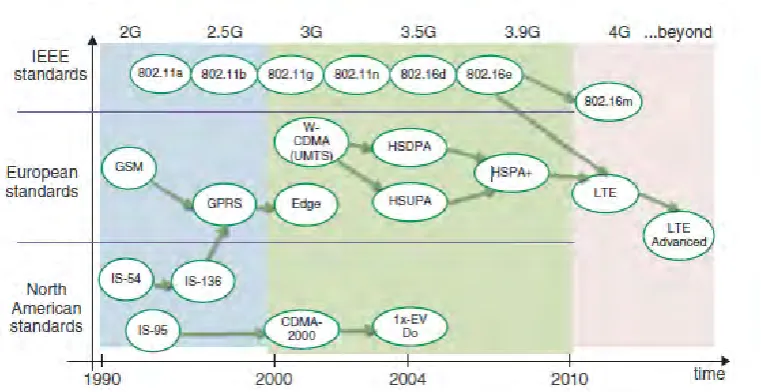
[image:23.595.130.511.406.602.2]From figure 2.1 demonstrates the pattern of different versatile standard to enhance step by step from 2G to 3G to the present 4G.The essential command of the 2G gauges was the help of portable communication and voice applications. Be that as it may, the parcel based information unrest and the help of Internet applications, for example, email, Web perusing, content informing, and other customer server administrations denoted the start of the 3G standard. Besides, the 4G standard will bolster the unstable interest for transmission capacity hungry applications, for example, versatile video-on-request benefits and will highlight all-IP parcel based systems.
9
2.4 Doppler Effect
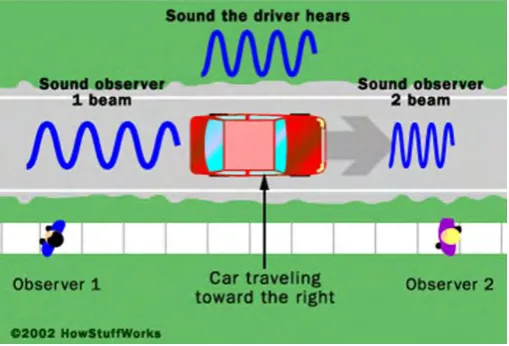
[image:24.595.192.447.354.527.2]It is easy to understand and observe the phenomenon of Doppler Effect in our daily life. An example from figure 2.2 is shows of how sound race passes by observer 1 and observer 2. When the car getting closer to observer 2 the sound has higher in pitch. Meanwhile, when the car passes and start going away from observer 1, the pitch suddenly become slower. According to Ajay Kaushik et all, (2016), the Doppler Effect is observed because the distance between the source of sound and the observer is changing. If the source and the observer are approaching, then the distance is decreasing and if the source and the observer are receding, then the distance is increasing. The source of sound always emits the same frequency.
Figure 2.2: Phenomenon of Doppler Effect
(Source: < https://science.howstuffworks.com/science-vs-myth/everyday-myths/doppler-effect2.htm.>)