This is a repository copy of
Grounding of Human Environments and Activities for
Autonomous Robots
.
White Rose Research Online URL for this paper:
http://eprints.whiterose.ac.uk/117174/
Version: Accepted Version
Proceedings Paper:
Alomari, M, Duckworth, P orcid.org/0000-0001-9052-6919, Bore, N et al. (3 more authors)
(2017) Grounding of Human Environments and Activities for Autonomous Robots. In:
IJCAI-17 Proceedings. 26th International Joint Conference on Artificial Intelligence, 19-25
Aug 2017, Melbourne, Austrailia. Lawrence Erlbaum Associates, Inc. , pp. 1395-1402.
ISBN 9780999241103
This is an author produced version of a paper accepted for publication in Proceedings of
the Twenty-sixth International Joint Conference on Artificial Intelligence. Uploaded in
accordance with the publisher's self-archiving policy.
[email protected] https://eprints.whiterose.ac.uk/
Reuse
Unless indicated otherwise, fulltext items are protected by copyright with all rights reserved. The copyright exception in section 29 of the Copyright, Designs and Patents Act 1988 allows the making of a single copy solely for the purpose of non-commercial research or private study within the limits of fair dealing. The publisher or other rights-holder may allow further reproduction and re-use of this version - refer to the White Rose Research Online record for this item. Where records identify the publisher as the copyright holder, users can verify any specific terms of use on the publisher’s website.
Takedown
If you consider content in White Rose Research Online to be in breach of UK law, please notify us by
Grounding of Human Environments and Activities for Autonomous Robots
Muhannad Alomari, Paul Duckworth, Nils Bore, Majd Hawasly, David C. Hogg, Anthony G. Cohn
{
scmara, p.duckworth, m.hawasly, a.g.cohn, d.c.hogg
}
@leeds.ac.uk, [email protected]
University of Leeds, UK. Royal Institute of Technology (KTH), Sweden
Abstract
With the recent proliferation of robotic applications in domestic and industrial scenarios, it is vital for robots to continually learn about their environments and about the humans they share their environments with. In this paper, we present a framework for autonomous, unsupervised learning from various sensory sources of useful human ‘concepts’; in-cluding colours, people names, usable objects and simple activities. This is achieved by integrating state-of-the-art object segmentation, pose estima-tion, activity analysis and language grounding into a continual learning framework. Learned concepts are grounded to natural language if commentary is available, allowing the robot to communicate in a human-understandable way. We show, using a chal-lenging, real-world dataset of human activities, that our framework is able to extract useful concepts, ground natural language descriptions to them, and, as a proof-of-concept, to generate simple sentences from templates to describe people and activities.
1
Introduction
For mobile robots to integrate in human environments, it is es-sential that they be equipped with the abilities to continuously learn about their environments, the people that inhabit these environments, and the activities that take place there. From an autonomous robot point of view, this requires incremental, unsupervised methods that can operate on the outputs of var-ious kinds of sensor modalities the robot might have, which may include RGB and depth camera outputs, voice recogni-tion, laser rangefinder measurements, etc. The desired out-come of this process is a collection of grounded concepts, such as colours, objects, people and activities that occur in the robot’s environment.
In this paper, we present a framework for autonomous learning of human environments for a mobile robot. We pre-suppose that the robot can visually analyse the environment in order to extract a multitude of features and incrementally recover useful classes of features, orconcepts. If natural lan-guage descriptions of the observations are provided, they can also be analysed, along with the other features, to ground the words describing people, objects and activities to their most
relevant perceptual concepts. Thus, the framework supports recognition of individuals, describing their physical appear-ance using natural language, and classifying and commenting on the activities they are engaged in. To do this we integrate state-of-the-art object segmentation, pose estimation, activ-ity analysis into a flexible, incremental framework for learn-ing to distlearn-inguish instances of human-level ‘concepts’ (faces, colours, objects, and activities) in real-world complex scenar-ios. Moreover, we propose a simplified language grounding framework that works across multiple modalities to learn con-cept names for human-robot interaction purposes using natu-ral language descriptions.
One possible application of such a framework can be in the field of assistive robotics where such a robot could help around the home, learning on-the-go how to describe new ob-jects or situations in a human-understandable form.
We concentrate on a small number of features and sensory data that are easily acquirable by capable mobile robots. To learn about humans in the robot’s environment, we extract facialfeatures using off-the-shelf face detectors/ descriptors, and we acquirehuman pose estimatesusing a state-of-the-art pose machine. We also collectcolourinformation from peo-ple’s clothing in order to describe their appearance. For ob-jects, we use automatic object segmentation and motion anal-ysis to identify potential objects in the environment. For hu-man activities, we use qualitative spatial-temporal representa-tions to capture the interaction through the relarepresenta-tions between people’s body poses and object positions, which feeds into a generative Bayesian model to learn activity classes in an unsupervised setting. Lastly, given textual descriptions, we use natural language grounding techniques to assign words and phrases to the learned concepts in the numerous feature spaces. Note that the chosen features are not intended to be exhaustive, but rather to demonstrate our approach.
2
Related Work
Enabling robots to share the human environment has been a goal of AI and robotics research, manifested in a vast array of active research areas including continual learning, learning by demonstration, human-robot interaction, dialogue planning, compliant robotics, humanoid robots, etc.
concepts, like object names, action labels, and spatial rela-tions, e.g. [Beetzet al., 2011; Spranger and Steels, 2015; Aksoyet al., 2017], or the semantics of natural language nav-igation and manipulation commands, e.g. [Lauriaet al., 2002; Tellexet al., 2011; Matuszeket al., 2013; Sheet al., 2014; Hemachandraet al., 2015]. In this work, we learn concepts and natural language groundings in a real-world human envi-ronment, which is more challenging in nature than the simple controlled environments that are studied in the literature.
Researches have addressed incremental learning of sim-ple elements in the robot’s environment, e.g. object fea-tures [Sinapov et al., 2014; Craye et al., 2015]. On the other hand, other work focused on learning and grounding more complex elements non-incrementally, e.g. human ac-tions from image motion features [Songet al., 2016]. In this work, we incrementally and simultaneously learn and ground multiple elements of the robot’s environment (objects, peo-ple, and human activities) in an unsupervised manner.
3
Concepts
In this section we introduce our notion ofconcepts: abstrac-tions of the feature spaces generated by the robot modalities which carry a human-level meaning. For example, concepts might include a colour represented as a cluster of values in the HSV colour space, or an object represented as a cluster of points in a 3D point cloud.
We present in the next section the sensors and feature spaces we use along with the unsupervised methods we em-ploy to generate such concepts using a Scitos A5 mobile robot [MetraLabs, 2016] running ROS Indigo. Note that our framework does not rely on any particular robot or any spe-cific sensors, rather it is flexible to what the modalities of the robot can support.
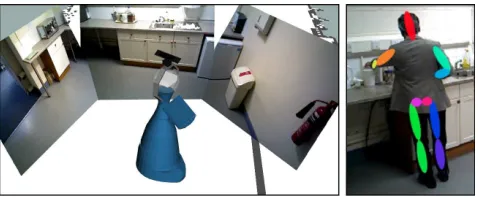
For its basic operations, the mobile robot we use is equipped with a base-mounted laser scanner that is used to model the physical environment as a 2D occupancy grid where occupied cells indicate static objects, allowing locali-sation, mapping and navigation. Also, the robot is equipped with two RGB-D sensors, one over-head and one chest-mounted, that allow collecting 640×480 RGB video streams in addition to depth point clouds. These sensors are used to generate a 3D map of the robot’s environment as shown in Figure 1 (left).
The robot detects and tracks humans as they pass within the field of view of its head-mounted RGB-D sensor. We define a human pose as the estimated 3D position of the person’s 15 body joint locations at a single timepoint, see Figure 1 (right). To estimate the human pose, we use a real-time depth-only tracker built on OpenNI [2016] along with a post-processing state-of-the-art pose estimation [Weiet al., 2016]. For each human detected by the robot, a sequence of human pose esti-mates over a time series of frames is acquired, e.g.
3.1
Extracting Concepts
Concepts are learned automatically by clustering the low-level sensory input of each of the sensor modalities of the robot after an appropriate encoding. This clustering opera-tion results in a collecopera-tion of classes that are candidate con-cepts within each feature space. Because we assume no
Figure 1: (left) Mobile A5 robot gathering data shown over-laid on its 2D map. (right) Example detected human pose.
pre-knowledge of the structure of the sensor feature spaces, we employ probabilistic modeling techniques to each feature space independently to elicit meaningful classes that are sup-ported by the observed data.
We differentiate between two kinds of concepts. Simple concepts are ones that can be detected in single observa-tions. For example, simple visual concepts like colours can be represented as Gaussian components in a Gaussian Mixture Model over the HSV space [Alomariet al., 2017]. Similarly, objects are simple concepts that can be segmented from fused 3D point clouds using geometrical and textural cues [Boreet al., 2017].
On the other hand,complex conceptsmanifest over longer sequences of observations. For instance, temporally-extended human activities are one example of complex concepts. For these, a more elaborate encoding and more sophisticated clus-tering mechanism are needed [Duckworthet al., 2017].
The robot first abstracts each observed human pose se-quence using a qualitative representation and obtains clusters using a hierarchical Bayesian model, Latent Dirichlet Allo-cation [Bleiet al., 2003]. It translates the detected pose se-quence into a relatively small number of logical spatial rela-tions that can be used to qualitatively describe the interacrela-tions taking place. The topics recovered from this process are con-sidered human activity concepts which the robot grounds to words in natural language.
In this paper, we demonstrate extracting four concepts; three simple ones: faces (to learn to distinguish people and later learn their names), colours (to describe people’s attire) and objects (to learn their function), and one complex con-cept: human activities. We briefly introduce each of the fea-ture spaces we use and show how the robot clusters observa-tions in each of them to obtain candidate concepts.
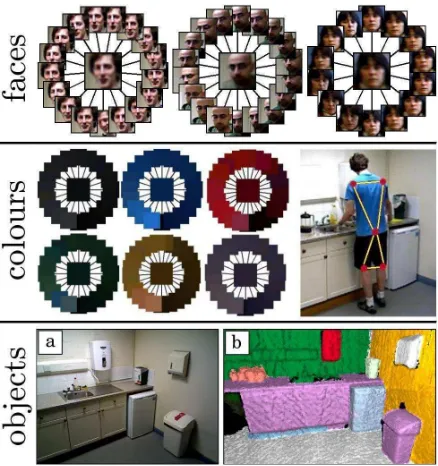
[image:3.612.318.557.52.151.2]Bayesian Information Criterion (BIC) [Posada and Buckley, 2004]. The resulting Gaussian components are used as candi-date concepts to represent people. Examples of such clusters are shown in Figure 2 (faces).
Colours: We cluster the colour values of the upper and lower garments of each person detection using a Gaussian mixture model. The number of Gaussian components is se-lected automatically using BIC. The colours of the upper and lower garments are extracted from the visual feed us-ing the human pose estimate, where the colour of the up-per garment is estimeated by the average of sampled pixel colours from the triangle of the two shoulders and the torso, and the colour of the lower garment is sampled from the triangle between the torso and the knees, as shown in Fig-ure 2 (colours). The extracted colours are projected into Hue-Saturation-Value (HSV) space to increase the robustness un-der varying lighting. Examples of six clusters extracted can be seen in Figure 2 (colours).
Objects: The robot constructs a 3D model of its environ-ment by fusing RGB-D images into surfels [Pfister et al., 2000], from which it generates clusters of “objects of inter-est”. As demonstrated in [Schoeleret al., 2015], an unsuper-vised segmentation algorithm grounded in the convexity of common human objects can achieve state-of-the-art perfor-mance in extracting semantically meaningful segments. We use a similar method to that presented in [Boreet al., 2017], which first split the scene into a collection ofsupervoxels [Pa-ponet al., 2013] over which an adjacency graph is formed. Then, weights are assigned to the edges based on local con-vexity of the point cloud and colour differences between seg-ments. Finally, to segment the point cloud, iterative graph cuts are performed to separate parts with concave boundaries and/or large colour differences. The end result is a collection of point cloud segments as illustrated in Figure 2 (objects).
To concentrate attention on the objects that are part of the observed activities, the trajectories in 3D space of people in the environment are analysed to extract the locations where people stop more frequently. The objects are scored accord-ing to their proximity to people’s hands in these locations. The highest scoring objects are considered as candidate con-cepts in the environment.
Human Activities: To learn temporally-extended human activities, the pose of humans within the environment is de-tected and tracked along with the positions of the learned objects of interest. Then, the observations are encoded into a number of qualitative spatio-temporal abstractions as in [Duckworth et al., 2017]. This condenses noisy obser-vations of arbitrary spatial positions into semantic low-level qualitative descriptors. For example, in a “making coffee” activity, the exact spatial position of a person reaching for a mug is not as useful for learning the activity as a qualitative representation of a hand approaching a mug.
We briefly introduce the Qualitative Spatio-temporal Rep-resentations (QSRs) used to encode detected poobject se-quences. A QSR is an abstraction from exact quantitative
ob-Figure 2:(faces)Examples of face clusters, with the averaged (mean) face shown in the center of each cluster. (colours) Left: Examples of different colour clusters, with the averaged (mean) colour shown in the center of each cluster. Right: defining upper and lower garments using human pose esti-mate. (objects)Processing of RGB-D feed (a) One image in a 3D sweep (b) Segmented surfel map.
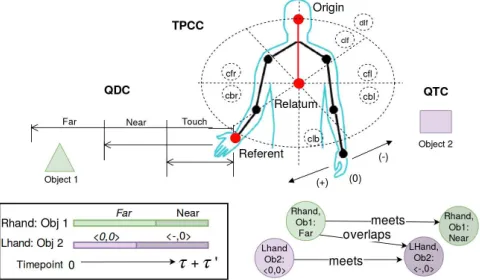
servations in a particular feature space into qualitative states that hold between the human’s pose and objects in the envi-ronment. The three representations used in this paper are: 1) Ternary Point Configuration Calculus (TPCC) [Moratz and Ragni, 2008] qualitatively describes the spatial arrangement of a point relative to two others. That is, it describes the refer-ent’s position relative to the plane created by connecting the relatumandorigin. Relations are triples ofh {front, back},
{left, right, straight},{distant, close} i.2)Qualitative Tra-jectory Calculus (QTC) [Delafontaineet al., 2011] represents the relative motion of two points with respect to the reference line connecting them, and is computed over consecutive time-points. For two objectso1, o2, it defines the following three
relations:{o1is moving towardso2(symbol−),o1is moving
away fromo2(+),o1is neither moving towards or away from
o2 (0)}. 3) Qualitative Distance Calculus (QDC)
[Clemen-tiniet al., 1997] expresses qualitative Euclidean distance be-tween two points based on defined distance thresholds. A set of QDC relations localises a person with respect to reference landmarks, while changes in the relations can help explain relative motion. An illustration of the three QSRs relative to two objects can be seen in Figure 3 (top).
[image:4.612.327.546.52.285.2]Figure 3: QSRs and Interval representations; (top left) QDC (relative distance) between right hand and object 1. (top centre) subset of the TPCC system between right hand and (relatum-origin) plane. (top right) QTC (relative motion) be-tween left hand andobject2. (bottom left) Interval represen-tation. (bottom right) Interval Graph.
relations are computed between temporally connected inter-vals to create anInterval Graphwhere nodes represent inter-vals (relations holding between a set of objects) and directed arcs link nodes with the IA relation. An example interval rep-resentation and Interval Graph can be seen in Figure 3 (bot-tom left and bot(bot-tom right, respectively).
Given a corpus of Interval Graphs, one per human detec-tion, a set of unique k-length paths are extracted from the graphs ascode wordsfor some smallk(usually≤4), where a code word represents a small set of temporally-connected spatial relations between some objects (likewise≤4). This unique set of code words is considered as a discrete vocab-ulary, and thus bag-of-words descriptors of activities (called activity feature vectors) can be computed for each detection. This bag-of-words representation is different from the tra-ditional bag-of-words used normally in document analysis in that it maintains some temporal information through the structure of the code words.
We use Latent Dirichlet Allocation (LDA) [Blei et al., 2003], a three layer hierarchical Bayesian generative model of a collection of discrete data, to discovertopicsin the activ-ity feature vectors. This model has proved successful in prob-lems with large corpora not exclusive to document analysis, e.g. [Duckworthet al., 2017]. The graphical model represen-tation can be seen in Figure 4, whereα,βare the model-level Dirichlet hyperparameters,T is the number of topic distribu-tions,M the number of videos in the corpus, andNdis the
number of code words in videod. A topic, a probability dis-tribution over the vocabulary of code words, is a conceptual model of a human activity, and thus it is considered as a can-didate concept.
4
Grounding Natural Language to Concepts
In this section we describe how the robot performs ground-ing of natural language sentences to the automatically-learned concepts, in order to enable the robot to communicate effec-tively with the humans in its environment.Figure 4: Graphical model representation of LDA using plate notation. Nodes represent random variables, links be-tween nodes are conditional dependencies, plates are repli-cated components, and shaded nodes are observations.
First, it is essential that the robot gets a natural language description of what it is learning about to perform grounding. Ideally we would like our robot to have a speech recognition modality and the capacity to ask people for particular objects, qualities or actions, but this remains an ambition for the fu-ture. At present, we collect multiple natural language descrip-tions of video snippets recorded by the robot using Amazon Mechanical Turk. The descriptions are parsed into grammar trees using NLTK [Birdet al., 2009] and an off-the-shelf En-glish grammar model [Schuster and Manning, 2016]. For example, parsing the sentence “Andy is tall and is wearing a blue shirt with black shorts” we obtain a grammar tree, and from these trees we extract all verbs, nouns, and adjectives, e.g. “Andy” is a noun, “blue” is an adjective, etc. After ap-plying a low-pass filter (remove words with low occurrences), this becomes the set of words used to ground to concepts.
For grounding, we search for the highest correlations be-tween words in a video clip description and the various con-cepts that feature in that clip, allowing multi-to-multi associ-ations to preserve the richness of natural language. Given the set ofmlearned conceptsCand the set ofnunique wordsW, theconcept-word correlationmatrixK is anm×nmatrix computed using the maximum of two frequentist measures: K(c, w) = max #(#(c,wc)),#(#(c,ww))
, where#(.)refers to the count function. This translates to computing the number of times a concept and a word are observed together, normalised by either the number of times the word is observed or the concept is observed, i.e. the strength of associating the word to the concept or the concept to the word. The maximum of these two terms concentrates on the less-observed of the word and the concept, improving the quality of the multi-to-multi associations. Defining the chosen associations as a function
AwhereA(c, w) = 1if the association(c, w)is chosen and 0 otherwise, we can formulate the problem as solving an in-teger program with the objective function:
max
A
X
C×W
A(c, w)K(c, w).
We maximise that objective function while: i) keeping sparsity of the associations by forcing the number of se-lected associations to be below some smallλ%(set between 5 and 10%) of the total number of possible associations: P
C×WA(c, w)/mn < λ% , and ii) forcing the selection
to assign at least a single word to each of the concepts, P
[image:5.612.56.296.56.196.2]re-sults in assigning a number of highly-correlated words to each concept. The error in this process gets rectified through con-tinual learning.
5
Continual Learning
In this section we describe the incremental techniques we use to update the learned visual concepts and activity topics from new observations, and the incremental natural language grounding.
For the concepts extracted from 2D visual features (i.e. faces and colours), we use an Incremental Gaussian Mixture Model (IGMM) [Song and Wang, 2005] which uses statistical tests (W-statistic and Hotelling’sT2test) to decide whether a
new measurement is part of the currently learned components or not. If they are, the component is updated. Otherwise, a new component in the feature space is created, i.e. a new concept is created.
For human activity concepts, we incrementally update our generative LDA model using Variational Bayes Inference (VB) [Hof, 2010]. For new observations the process is twofold: i) the multinomial distribution representing the ob-served activity over the current set of topics is computed, then ii) the topic distributions over the vocabulary are updated us-ing this new observation. New code words can be added to the vocabulary if they do not already exist, and the topic dis-tributions are uniformly initiated. This allows the robot to ef-ficiently update its model of activity concepts using a single pass over the data, optimising both storage and computation complexity.
For natural language, the integer programming association is performed again whenever new observations and text de-scriptions are available. This is vital as the richness of natural language and the possible noise in the data require continu-ous re-evaluation of the associations. This is achieved byi) updating the frequency measure of every observed word and concept in the correlation matrixK,ii) adding new rows and columns toK, corresponding to newly learned concepts and newly observed words, then iii) re-solving the integer pro-gram to generate the new associations. Thus, the previous data needs not be stored.
6
Empirical Evaluation
We present three experiments to evaluate the system’s per-formance in: 1) unsupervised concept extraction, 2) unsu-pervised language grounding and 3) simple sentence gener-ation to describe previously unseen video clips. We use a publicly available long-term human activity dataset collected over a one week period by a mobile robot from multiple view points (Dataset: http://doi.org/10.5518/86). The dataset con-tains 493 video clips each containing a single human per-forming a simple activity in a kitchen area of an office en-vironment, the activities include, for example, heating food, preparing hot drinks, using a multi-function printer, throwing trash and washing up. On top of the dataset, we collected nat-ural language descriptions of each video clip using Amazon Mechanical Turk, where we requested ‘turkers’ to describe the activity in the clip and the person’s appearance. A to-tal of almost 3000 descriptions were collected (6per clip in
[image:6.612.313.555.88.167.2]average)1. Example images from a video clip are shown in Figure 5 along with a subset of the descriptions obtained.
Figure 5: Example images from a video clip, with natural language descriptions.
Concept Extraction Evaluation We incrementally extract concepts in each of the feature spaces; namely faces, colours, objects, and activities over the 5 days in the dataset.
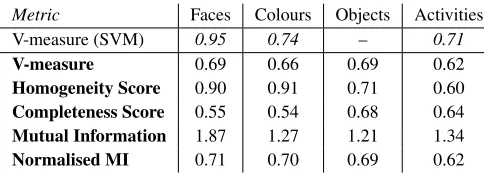
Since the learning is performed in an unsupervised set-ting, we use two popular clustering metrics to evaluate the performance: V-measure[Rosenberg and Hirschberg, 2007] and normalisedMutual Information[Vinhet al., 2009]. V-measure is a combination ofhomogeneity– whether each pre-dicted cluster contains same-class data points, and complete-ness– whether the member data points of a given class are all elements of the same predicted cluster. Normalised Mu-tual Information is a measure of how many bits are needed in order to store predicted outcomes given that the true value is known. Both metrics provide a measure of similarity of any two sets of class labels, where0 indicates no mutual infor-mation and1indicates perfect correlation. For ground truth we use the sets of9 colours,12 objects,17 names, and11 activities extracted manually from the dataset.
Metric Faces Colours Objects Activities V-measure (SVM) 0.95 0.74 – 0.71
V-measure 0.69 0.66 0.69 0.62
Homogeneity Score 0.90 0.91 0.71 0.60
Completeness Score 0.55 0.54 0.68 0.64
Mutual Information 1.87 1.27 1.21 1.34
[image:6.612.315.557.433.520.2]Normalised MI 0.71 0.70 0.69 0.62
Table 1: Experimental results of unsupervised concept ex-traction. In addition to a supervised SVM as an upper limit.
Table 1 presents results of our incremental, unsuper-vised concept extraction when compared against ground truth classes (assigned by volunteers). We use the most likely com-ponent in a mixture as a label if the prediction is multino-mial, like in the case of activity topics. The robot managed to recover35face concepts,13colour concepts,14objects of interest, and13activity classes from this real-world dataset with changing view points, lighting conditions and occlu-sions. The results show the majority of the instances observed are successfully clustered into consistent concepts. As an up-per bound, we also show the V-measure results obtained when
1
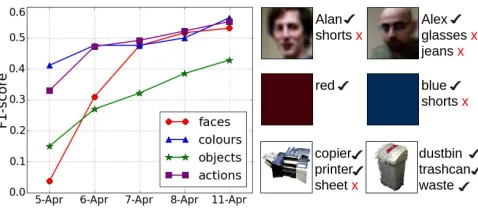
Figure 6: (left) F1-score for incremental grounding over 5 days. (right) Examples of learned concepts from the three simple feature spaces along with their grounded words. Note that in each case one or more groundings are correct.
using a supervised SVM (with4-fold cv) which has access to the ground truth labels during training; this marginally out-performs our unsupervised techniques. Note that the objects do not have SVM results as they are segmented from surfels and do not have a feature vector representation.
Given the limited size of the dataset, we seed the activ-ity model by learning topics using Collapsed Gibbs Sam-pling [Gelmanet al., 2014] on a batch of observations first (day 1), and then incrementally adding new data using Vari-ational Bayes with a regular mini-batch size of 5 videos to allow frequent updating. To pick the number of topic distri-butionsT, we start with the number of discovered objects and increase this number by one each day to allow new activities to appear over time, and remove any unused topics.
Grounding Language Evaluation We evaluate the sys-tem’s ability to acquire correct groundings for words from pairs of short video clips and their corresponding descrip-tions. We aim to learn all the possible groundings of words to their corresponding concepts. For ground truth, we man-ually annotated all correct word-concept groundings in the dataset. As a metric, we compute the F1-score [Van Rijs-bergen, 1977] of the grounding results in each feature space separately. Batches of videos recorded by day are fed to the system, effectively updating the robot’s groundings in the evening of each day. Figure 6 (left) shows the results of the incremental grounding over the 5 days in the dataset. The graph shows an improving trend in the F1-score of the word groundings in each feature space as more data is observed. We hypothesise that extended observation of the environment will allow all the concepts in these pre-defined feature spaces to be correctly grounded in an unsupervised manner. Exam-ples of learned concepts and their grounded words are shown in Figure 6 (right).
[image:7.612.56.295.51.155.2]Sentence Generation Evaluation Finally, we evaluate the soundness of both the learned concepts and word ground-ings by generating natural language sentences of previously unseen video clips. For this task, we leave 10video clips out of the training data (one at a time), and pass each of them to the robot after training on the remaining videos. The robot is provided with natural language sentence templates
Figure 7: Examples of generated sentences from previously unseen videos. (a-b) describing video1, (c,d) describing2.
that have placeholders for concept names to describe an ac-tivity or a person. The two templates we use are “name/face has acolourtop and acolourlower garment” and “The per-son isactivityusing a(n)object”. The robot extracts known concepts from the test videos and picks their most-highly as-sociated words to fill in the sentence templates. In10videos our system was able to correctly generate/fill46out of the50 available blank spaces. The correctness of the generated sen-tences were evaluated by an external volunteer. Examples of the generated sentences along with images from their video clips can be seen in Figure 7.
7
Conclusion
We present a framework for autonomous learning of human concepts for a mobile robot. The framework continually ac-quires and updates learned concepts in an unsupervised man-ner and grounds natural language words to them. The main challenge of autonomous learning using mobile robots in-clude the partial, noisy and changing viewpoints of the world using on-board sensors, in addition to limited computing power.
We learn both simple and complex concepts, where the dif-ference relates directly to the richness of the feature spaces in which the concepts are embedded. For language grounding we depend on human descriptions of the visual scenes, how-ever, perception limitations e.g. varying lighting conditions, cause errors in the grounding. On the other hand, as more data is observed, continual learning rectifies the associations. One improvement to the framework could be to remove words with a strong association to a concept from considera-tion, or words that are not consistent to concepts. This would boost scalability of the continual grounding over time. Fi-nally, during evaluation we used a collection of segmented activity videos. Extending this to use an unsegmented visual feed is possible using the same methods described in [Duck-worthet al., 2017]. However, correlating natural language annotations to the unsegmented video would be more chal-lenging.
Acknowledgments
[image:7.612.322.552.51.177.2]References
[Aksoyet al., 2017] E.E. Aksoy, E. Ovchinnikova, A. Orhan, Y. Yang, and T. Asfour. Unsupervised linking of visual features to textual descriptions in long manipulation activities.RA-L, 2017. [Allen, 1983] J. F. Allen. Maintaining knowledge about temporal
intervals. Communications of the ACM, 26(11):832–843, 1983. [Alomariet al., 2017] M. Alomari, P. Duckworth, D. C. Hogg, and
A. G. Cohn. Natural language acquisition and grounding for em-bodied robotic systems. InAAAI, 2017.
[Beetzet al., 2011] M. Beetz, U. Klank, I. Kresse, A. Maldonado, L. Mosenlechner, D. Pangercic, T. Ruhr, and M. Tenorth. Robotic roommates making pancakes. InHumanoid Robots, 2011. [Birdet al., 2009] S. Bird, E. Klein, and E. Loper. Natural
lan-guage processing with Python: analyzing text with the natural language toolkit. ”O’Reilly Media, Inc.”, 2009.
[Bleiet al., 2003] D. M. Blei, A. Y. Ng, and M. I. Jordan. Latent Dirichlet allocation.Journal of ML Research, 3, 2003.
[Boreet al., 2017] N. Bore, R. Ambrus, P. Jensfelt, and J. Folkesson. Efficient retrieval of arbitrary objects from long-term robot observations. Robotics and Autonomous Systems, 2017.
[Clementiniet al., 1997] E. Clementini, P. Di Felice, and D. Hern´andez. Qualitative representation of positional in-formation. Artificial Intelligence, 95(2):317 – 356, 1997. [Crayeet al., 2015] C. Craye, D. Filliat, and J. Goudou.
Explo-ration strategies for incremental learning of object-based visual saliency. InICDL-EpiRob, 2015.
[Delafontaineet al., 2011] M. Delafontaine, A. G. Cohn, and N. Van de Weghe. Implementing a qualitative calculus to anal-yse moving point objects. Expert Systems with Applications, 38(5):5187 – 5196, 2011.
[Duckworthet al., 2017] P. Duckworth, M. Alomari, J. Charles, D. C. Hogg, and A. G. Cohn. Latent dirichlet allocation for un-supervised activity analysis on an autonomous mobile robot. In
AAAI, 2017.
[Gelmanet al., 2014] A. Gelman, J.B. Carlin, H.S. Stern, and D.B. Rubin.Bayesian data analysis, volume 2. Chapman & Hall/CRC Boca Raton, FL, USA, 2014.
[Hemachandraet al., 2015] S. Hemachandra, F. Duvallet, T.M. Howard, N. Roy, A. Stentz, and M.R. Walter. Learning models for following natural language directions in unknown environ-ments. InICRA, 2015.
[Hof, 2010] Online learning for latent dirichlet allocation. In Ad-vances in neural information processing systems, 2010.
[Lauriaet al., 2002] S. Lauria, G. Bugmann, T. Kyriacou, and E. Klein. Mobile robot programming using natural language.
Robotics and Autonomous Systems, 38(3):171–181, 2002. [Lienhart and Maydt, 2002] R. Lienhart and J. Maydt. An extended
set of haar-like features for rapid object detection. InImage Pro-cessing, 2002.
[Matuszeket al., 2013] C. Matuszek, E. Herbst, L. Zettlemoyer, and D. Fox. Learning to parse natural language commands to a robot control system. InExperimental Robotics, 2013. [MetraLabs, 2016] MetraLabs. www.metralabs.com/en, 2016.
[Moratz and Ragni, 2008] R. Moratz and M. Ragni. Qualitative spatial reasoning about relative point position. Journal of Visual Languages & Computing, 19(1):75–98, 2008.
[OpenNI, 2016] OpenNI. www.openni.org, 2016.
[Paponet al., 2013] J. Papon, A. Abramov, M. Schoeler, and F. Worgotter. Voxel cloud connectivity segmentation-supervoxels for point clouds. InCVPR, 2013.
[Pfisteret al., 2000] H. Pfister, M. Zwicker, J. Van Baar, and M. Gross. Surfels: Surface elements as rendering primitives. In
Computer Graphics and Interactive Techniques, 2000.
[Posada and Buckley, 2004] D. Posada and T. Buckley. Model se-lection and model averaging in phylogenetics: advantages of akaike information criterion and bayesian approaches over likeli-hood ratio tests.Systematic Biology, 53(5):793–808, 2004. [Rosenberg and Hirschberg, 2007] A. Rosenberg and J. Hirschberg.
V-measure: A conditional entropy-based external cluster evalua-tion measure. InEMNLP-CoNLL, 2007.
[Schoeleret al., 2015] M. Schoeler, J. Papon, and F. Worgotter. Constrained planar cuts-object partitioning for point clouds. In
CVPR, 2015.
[Schuster and Manning, 2016] S. Schuster and C.D. Manning. En-hanced english universal dependencies: An improved representa-tion for natural language understanding tasks. InLREC, 2016. [Sheet al., 2014] L. She, S. Yang, Y. Cheng, Y. Jia, J.Y. Chai, and
N. Xi. Back to the blocks world: Learning new actions through situated human-robot dialogue. InMeeting of the Special Interest Group on Discourse and Dialogue, 2014.
[Sinapovet al., 2014] J. Sinapov, C. Schenck, and A. Stoytchev. Learning relational object categories using behavioral explo-ration and multimodal perception. InICRA, 2014.
[Song and Wang, 2005] M. Song and H. Wang. Highly efficient in-cremental estimation of Gaussian mixture models for online data stream clustering. InDefense and Security, 2005.
[Songet al., 2016] Y.C. Song, I. Naim, A. Al Mamun, K. Kulkarni, P. Singla, J. Luo, D. Gildea, and H. Kautz. Unsupervised align-ment of actions in video with text descriptions. InIJCAI, 2016. [Spranger and Steels, 2015] M. Spranger and L. Steels.
Co-Acquisition of Syntax and Semantics - An Investigation in Spatial Language. InIJCAI, pages 1909–1905. Palo Alto, US, 2015. [Tellexet al., 2011] S. Tellex, T. Kollar, S. Dickerson, M.R. Walter,
A.G. Banerjee, S. Teller, and N. Roy. Approaching the symbol grounding problem with probabilistic graphical models.AI mag-azine, 32(4):64–76, 2011.
[Turk and Pentland, 1991] M. Turk and A. Pentland. Eigenfaces for recognition.Journal of cognitive neuroscience, 3(1), 1991. [Van Rijsbergen, 1977] C. Van Rijsbergen. A theoretical basis for
the use of co-occurrence data in information retrieval.Journal of documentation, 33(2):106–119, 1977.
[Vinhet al., 2009] N. X. Vinh, J. Epps, and J. Bailey. Information theoretic measures for clusterings comparison: Is a correction for chance necessary? InICML, 2009.