epigenetics
.
White Rose Research Online URL for this paper:
http://eprints.whiterose.ac.uk/139088/
Version: Published Version
Article:
Clark, M.S., Thorne, M.A.S., King, M. et al. (3 more authors) (2018) Life in the intertidal:
Cellular responses, methylation and epigenetics. Functional Ecology, 32 (8). pp.
1982-1994. ISSN 0269-8463
https://doi.org/10.1111/1365-2435.13077
[email protected]
https://eprints.whiterose.ac.uk/
Reuse
This article is distributed under the terms of the Creative Commons Attribution (CC BY) licence. This licence
allows you to distribute, remix, tweak, and build upon the work, even commercially, as long as you credit the
authors for the original work. More information and the full terms of the licence here:
https://creativecommons.org/licenses/
Takedown
If you consider content in White Rose Research Online to be in breach of UK law, please notify us by
1982
|
wileyonlinelibrary.com/journal/fec Functional Ecology. 2018;32:1982–1994. Received September|
Accepted FebruaryDOI: 10.1111/1365-2435.13077
R E S E A R C H A R T I C L E
Life in the intertidal: Cellular responses, methylation and
epigenetics
Melody S. Clark
1|
Michae A S Thorne
1|
Miche e King
1|
He en Hipperson
2|
Joseph I Hoffman
3|
L oyd S Peck
11British Antarctic Survey Natura
Environment Research Counci Cambridge UK
2NERC Biomo ecu ar Ana ysis
Faci ity Department of Anima and P ant Sciences University of Sheffie d Sheffie d UK
3Department of Anima Behaviour
University of Bie efe d Bie efe d Germany
Correspondence
Melody S. Clark Email: [email protected]
Funding information
Natura Environment Research Counci Grant Award Number NBAF
Hand ing Editor Michae Pfrender
Abstract
Phenotypic p asticity is essentia for the persistence of organisms under changing
environmental conditions but the control of the relevant cellular mechanisms
in-c uding whiin-ch genes are invo ved and the regu ation of those genes remains un
-c ear One way to address this issue is to eva uate inks between gene expression methy ation and phenotype using transp antation and common garden experi
-ments within genetica y homogeneous popu ations
This approach was taken using the Antarctic impet Nacella concinna. In this
spe-cies two distinct phenotypes are associated with the intertida and subtida zones The in situ gene expression and methy ation profi es of intertida and subtida co -horts were directly compared before and after reciprocal transplantation as well
as after a common garden acc imation to aquarium conditions for months Expression profi es showed significant modu ation of ce u ar metabo ism to habi
-tat zone with the intertida profi e characterised by transcription modu es for an
-tioxidant production DNA repair and the cytoske eton ref ecting the need to cope with continua y f uctuating and stressfu conditions inc uding wave action
UV irradiation and desiccation.
Transp antation had an effect on gene expression The subtida anima s trans
-p anted to the intertida zone modified their gene ex-pression -patterns towards that of an intertida profi e In contrast many of the antioxidant genes were sti differentia y expressed in the intertida anima s severa weeks after transp anta
-tion into the re ative y benign subtida zone
Furthermore a core of genes invo ved in antioxidation was sti preferentia y ex
-pressed in intertida anima s at the end of the common garden experiment Thus acc imation in an aquarium tank for months did not comp ete y erase the inter
-tida gene expression profi e
Significant methy ation differences were measured between intertida and subtida anima s from the wi d and after transp antation which were reduced on common garden acc imation This suggests that epigenetic factors p ay an impor
-tant ro e in physio ogica f exibi ity associated with environmenta niche
This is an open access artic e under the terms of the Creative Commons Attribution License which permits use distribution and reproduction in any medium provided the origina work is proper y cited
|
INTRODUCTION
Species distributions and fitness traits are significant y impacted by both biotic and abiotic factors in their immediate habitat (often ca ed genotype environment interactions however our current understanding of which genes underpin these processes and their regu ation remain imited Forsman This is further com-p icated by the fact that many scom-pecies exhibit f exib e rescom-ponses whereby high y variab e phenotypes may be expressed in the ab-sence of genetic differentiation This phenomenon of phenotypic p asticity frequent y occurs in mo uscs where the morpho ogica characteristics of shell shape and thickness can vary considerably with environmenta factors These morpho ogica variants often ca ed ecotypes can be induced by a variety of abiotic and biotic factors inc uding hydrodynamic stress temperature desiccation and predation Har ey Denny Mach Mi er Examp es in -clude Littorina striata in which a nodulose form is associated with wave she tered sites and a smooth form dominating wave exposed sites; increased shell thickness in Littorina obtusata in response to the predatory green crab Carcinus maenas and the Antarctic species Nacella concinna and Laternula elliptica where she thickness var-ies with depth and the incidence of ice berg scour respective y De Wo f Backe jau Verhagen Harper et a Hoffman Peck Hi yard Zieritz C ark Trusse Nick in In these cases genetic homogeneity has been demonstrated across phenotypes but in other species heritab e components and genetic sub structuring has been shown within ecotypes and inked to mi-crohabitats The c assic examp es of such phenomena inc ude the periwinkles Littorina saxitilis and Littorina fabalis (Johannesson & Mikhai ova Johannesson Tatarenkov whi e in other species such as Mytilus there has been a clear demonstration of cryptic speciation Grant Cherry Lombard These studies emphasise the importance of understanding the genetic background of the species under study when examining phenotypic p asticity
The current understanding of the mo ecu ar basis of phenotypic p asticity is imited but such information is essentia not on y for un -derstanding how anima s function and interact with their immediate environment but a so for predicting their capacities to cope when that environment changes Somero For examp e such genomic ana -yses can he p decipher the ce u ar mechanisms under ying the com -petition advantage of c ose y re ated species Lockwood Sanders Somero dissect the subt eties of mu tip e environmenta stress -ors Chapman et a and the impact of age on the stress response
C ark et a How these expression patterns are modu ated or more important y fixed is unc ear in most cases but epigenetics is in-creasing y being revea ed as a key factor imp icated in gene regu ation in the natura environment Bossdorf Richards Pig iucci
In this study the Antarctic impet N. concinna was used to in-vestigate ce u ar mechanisms underpinning phenotypic p asticity This is one of the most abundant species in the Antarctic marine environment occurring in the intertida zone and subtida y down to m or more Powe This is not a homing impet Wa ker and unti recent y two distinct ecotypes were recognised an intertidal polaris form with a ta er thicker she and a subtida
con-cinna form with a much ighter f atter she that is often microscop -ica y sca oped due to the grazing by other impets on encrusting endo ithic a gae No an Physio ogica differences have a so been reported between the two ecotypes inc uding to erance to experimenta freezing metabo ic response to air exposure righting abi ity under different temperatures therma to erances and wet tissue mass Mor ey C ark Peck Wa er Wor and Convey Barnes Weihe Abe e Data S and S This spe -cies is a broadcast spawner with a free swimming p anktonic ve iger stage that asts months Peck Heiser C ark and recent popu ation genetic ana yses using amp ified fragment ength po y -morphisms AFLPs showed no evidence of genetic differentiation between the two ecotypes Hoffman et a Hence this spe -cies disp ays considerab e physio ogica and morpho ogica p asticity against a genetica y homogeneous background and represents a good candidate for the mo ecu ar investigation of phenotypic plasticity.
The aim of this study was to investigate not on y the gene expres -sion profi es underpinning the physio ogica f exibi ity of N. concinna to the intertida and subtida m zones but a so to use methy ation sensitive amp ified po ymorphism MSAP ana yses to identify whether epigenetic factors may be invo ved in the gene expression differences To achieve this two experiments were carried out a reciproca trans -p ant ex-periment in the Antarctic and a common garden ex-periment where collections of intertidal and subtidal animals were held in the Cambridge aquarium system for months to ensure fu acc imation to aboratory conditions It was expected that there wou d be signif -icant differences in the gene expression and methy ation profi es of intertidal and subtidal animals in the wild and that transplantation to a different shore zone wou d modify these It was a so expected that the extended acc imation in a common garden aquarium wou d reset and remove any differences in gene expression and methy ation between intertidal and subtidal cohorts.
|
MATERIALS AND METHODS
|
Experimenta design
Anima s were co ected at Rothera Research Station Ade aide Is and Antarctic Peninsu a o S o W during the austra
K E Y W O R D S
summer. Intertidal animals were hand collected and subtidal animals co ected by SCUBA divers from m The anima s produced copi -ous amounts of mucus when detached from rocks during co ection so they were he d in the f ow through aquarium at Rothera under ambient sea water conditions (c. C for days prior to samp ing to disperse the mucus To distinguish the transp anted anima s the she s were painted ye ow intertida anima s and white subtida anima s Of these were returned to their origina habi -tat and were transp anted to the a ternative regime Figure The intertida anima s were p aced at the shore end of a ong gent y s oping rocky gu y c. m ong which then dropped steep y into deep water The subtida anima s were p aced on arge f at rocks at m Figure One month ater two sets of transp anted anima s
were sampled (each of n Three sets of contro s each of n were a so samp ed from each zone intertida and subtida anima s at time point zero intertida and subtida anima s at month time seasona contro and painted anima s that had been p aced back into their origina habitat and samp ed at month manipu ation con -tro s Figure Tab e For each anima the she ength height and width were measured with vernier ca ipers mm
|
Limpet migration
During the experiment the transp anted anima s started to move back to their origina habitat hence ad hoc observations of the movement of the transp anted impets were carried out Painted
F I G U R E Representation of both the transp ant and acc imation experimenta designs
F I G U R E Intertidal and subtidal environments near Rothera a Genera view of the intertida region around Rothera base b direct view of the gu y where the impets were transp anted fi ed with brash ice c transp anted
impets in the intertida d transp anted impets in the subtida at m Photos courtesy of L oyd Peck
(a) (b)
she co our was noted and anima position ogged either by measur -ing how far they had moved from the origina site they were trans-p anted to or by ranking their trans-position in terms of distance moved
|
RNA extraction protoco and sequencing
RNA was extracted from the foot tissue n for each set of contro and transp anted anima s using TRI reagent Bio ine and purified on RNeasy mini co umns Qiagen according to manufacturers instruc -tions RNA was quantified using a NanoDrop ND LabTech Internationa The individua s from each treatment n were poo ed in equa amounts for RNA Seq to produce a sing e ibrary for each treatment An initia sequencing run using two separate libraries of pooled subtidal and intertidal control animals was per-formed on the Roche GS FLX Titanium p atform University of Cambridge Department of Biochemistry Sequencing Faci ity to confirm expression differences between the intertida and subtida cohorts before more extensive sequencing of the transp ant experi-ment Further sequencing was performed on a contro and trans -p ant treatments on an I umina GAIIx at Edinburgh Genomics
|
Transp ant experiment Generation of
backbone transcriptome and mapping
The sequences from the origina pyrosequencing run reads were assemb ed using Newb er Roche yie ding contigs with a mean ength of bp These were annotated using the GenBank nr database Benson Karsch Mizrachi Lipman Oste Whee er using a thresho d va ue for annotation of
any matches below 1e Two rep icate runs from each of the six treatments were run on the GAIIx resu ting in bp sequences of subtida contro time STC subtida contro month ST M subtida painted contro STST in-tertida contro time ITC intertida contro month
IT M intertida painted contro ITIT
intertida transp ant ITST subtida transp ant STIT These were mapped onto the reference contigs using Maq Li Ruan Durbin Three approaches were used to determine the significant y differentia y expressed contigs and two of these were app ied sequentia y to the transp ant treatments for added stringency A norma ised transcripts per mi ion tpm va ue from the mapping onto the contig was compared to the contro set by dividing the tpm va ue to the maximum of the contro set for ST STIT max STC STC M STST A twofo d cut off criteria was re -quired for se ection at this stage The use the counts was used in an-other approach in a ratio test where the mapping for a transp ant set for examp e STIT was tested against each different contro set inde-pendent y i e STIT compared to STC STIT compared to STC M and STIT compared to STST and the p- values adjusted with a selection cut- off of .01. The final results were the joint selection of these two criteria The Bayesian mode ing program BAYSEQ Hardcast e Ke y
was used using this rep icate structure to determine the popu -lation differences with an adjusted p- value cut- off of .05. Different cut offs were used according to the approach as the se ection cri -teria are independent the TPM and fo d change require stricter p- va ue cut offs whereas the Bayseq is a ready strict and the cut off va ue was chosen to retrieve the most significant resu ting genes The final selection was an intersection of these two independent
TA B L E Exp anation of the experimenta regimes and associated samp ing
Samples Experimenta va ue
Subtidal controls
Subtida anima s samp ed at time STC Contro at the start of the experiment
Subtida anima s samp ed at month ST M Contro at the end of the experiment tempora contro
Subtida anima s she s painted and rep aced at m STST Contro for experimenta manipu ation painted and a so time as samp ed at the end of the experiment tempora and manipu ation contro
Intertidal controls
Intertida anima s samp ed at time ITC Contro at the start of the experiment
Intertida anima s samp ed at month IT M Contro at the end of the experiment tempora contro Intertida anima s she s painted and rep aced into the
intertida zone ITIT
Contro for experimenta manipu ation painted and a so time as samp ed at the end of the experiment tempora and manipu ation contro
Transplanted animals
Subtida anima s transp anted to the intertida zone STIT Transplant
Intertida anima s transp anted to m ITST Transplant 9- Month acclimation
Intertida anima s acc imated in the aquarium for months ITA
Common garden acc imation in the aquarium
Subtida anima s acc imated in the aquarium for months
STA Common garden acc imation in the aquarium
approaches Those upregu ated transcripts which were putative y annotated using B ast sequence simi arity searching were manua y verified and then further ana ysed using the STRING program to
visu-a ise potentivisu-a protein protein intervisu-actions using UniProtKB humvisu-an identifiers https string db org
|
Acc imation studies
A further set of intertida and subtida anima s was co ected in the aus-tral summer of 2014. These were transported to the UK and held sepa-rate y in the Cambridge aquarium for months in a common garden experiment The aquarium is a re circu ation system he d at C sa inity at psu and a ight dark regime The anima s were he d in the same aquarium tank at simi ar densities but the subtida and intertida cohorts were kept separated They fed on a gae growing on the aquarium wa s There were no morta ities during the acc imation period The RNAs from foot tissue were extracted as described above from six simi ar sized anima s from the intertida she size mm SE mean and the subtida she size mm SE mean There was no significant difference between the she s sizes of each cohort (T p df The six RNA extractions from each of the
intertidal and subtidal animals were pooled to form two libraries of subtida and intertida RNAs TruSeqv ibraries were made from each of the two poo s and subjected to a MiSeq bp paired end read run University of Cambridge Department of Biochemistry Sequencing Faci ity Each ibrary was mapped to the origina transcriptome back -bone and ana ysed as described above se ecting significant differentia expression on fo d change and p- value adjusted ratio test.
|
Methy ation studies
DNA was extracted from the foot tissue of intertida and subtida an -imals (the controls and transplanted individuals as described above: Figure Tab e using the DNeasy B ood and Tissue kit Qiagen according to manufacturers instructions The DNA concentration and qua ity were checked by a spectrophotometer NanoDrop ND and an Agi ent TapeStation system To detect meth-y ation patterns in the different DNA samp es a modified AFLP technique using methy ation sensitive restriction enzyme MspI and HpaII digestion was carried out Data S
|
RESULTS
|
Transp antation migration and recapture of
transplanted limpets
The aim was to samp e anima s for each treatment inc uding the contro s This was possib e in a cases with the exception of the subtida anima s transp anted to the intertida zone where it was on y possib e to retrieve individua s from the intertida zone A anima s were sexu -a y m-ature -a though individu-a sexes were not noted There w-as no significant size difference between any of the intertida anima s sam -p ed in this ex-periment one way ANOVA F p The
subtida anima s samp ed showed significant differences in size one way ANOVA F p There was no difference between the three sets of subtida contro anima s Tukey but the re-trieved anima s transp anted to the intertida were significant y sma er than the contro s Tukey These transp anted anima s mean ength mm SE and a so the contro subtida anima s which were samp ed painted and put back into the subtida mm SE difference in size T = 2.84; p = 0.007; df were from the same origina samp e of painted anima s and were a ocated at random between the two ocations Given the prob ems of retrieving a fu set of subtida anima s from the intertida zone after a month the most ike y conc usion was that the arger anima s were either faster or more capab e at returning to the subtida zone hence the observed differ-ence in size of the retrieved transp anted subtida anima s
This species is not a homing impet Wa ker therefore it was surprising to see that the transp anted anima s were moving back to their origina habitats This migration was re ative y rapid as evi-denced at the fina samp ing by the inabi ity to retrieve more than subtida individua s from an origina n from the intertida gu y which inc uded samp ing in m of water at ow tide At severa time points during the experiment the movement of anima s was
cata-ogued After days ranking of anima s in the intertida gu y showed that the transp anted subtida individua s had migrated further down the shore towards deeper water than the intertidal limpets (Spearman
rank order [rho] correlation = 1; p At weeks the measure-ment of distance moved a ong the gu y showed that the subtida anima s had moved significant y c oser to the deeper water than the replaced intertidal animals (t- test: T p < .0001; df In the subtida at m after weeks most subtida anima s had not moved off the rocks they were rep aced onto but the transp anted intertida anima s had moved significant y towards more sha ow depths t- test: T = 3.08; p = .006; df In each case anima s that were rep aced in their origina habitat did not trave towards the opposite zone
|
Gene expression ana yses from the
transp ant experiment
To determine if gene expression profi es had been modified with trans -p antation the transcri-pts u-pregu ated in the trans-p anted anima s were compared with contro anima s from both their origina environments and a so the contro anima s from the zone to which they had been trans-p anted This extrans-pression trans-profi ing revea ed that intertida transtrans-p ants maintained the intertida gene profi e despite being transp anted A much bigger change was found with the transp anted subtida anima s which indicated that they were re setting their ce u ar machinery to cope with their new stressfu intertida environment Tab e These shifts in gene expression patterns are described in greater detai be ow
|
Intertida transp ants compared with intertida
contro anima s origina habitat
differentia y expressed transcripts Tab e that is the intertida transp ants maintained a very simi ar profi e to that of the origina intertidal controls.
|
Intertida transp ants compared with subtida
contro anima s transp ant habitat
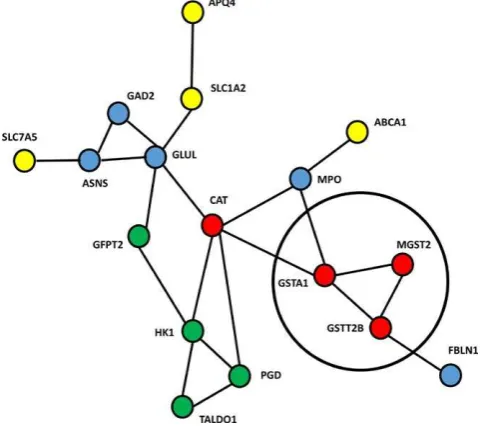
This comparison produced a higher number of upregu ated tran-scripts with annotations Tab es and S Of these se -quences were annotated via the UniProtKB Human identifiers and entered into the STRING program Resu ts showed significant
enrichment of functiona groups p = 2.29e with expected in-teractions at p = 8.88e+1 which resu ted in five main transcription
modules. These comprised transcripts involved in the respiratory chain cytochrome oxidases MT CO MT CYB protein produc -tion RPL ribosoma proteins antioxidants inc uding g utathione genes caspases and superoxide dismutases protein degradation proteasome subunit genes such as PSMB and LMP and DNA repair po ymerases and igases e g POL and LIG genes Genes in -volved in actin cytoskeleton pathways were distributed around the network Figure Data S These are a modu es which are often associated with the classical cellular stress response. The STRING
en-richments showed support for the main functiona groups identified through the manua y verified B ast sequence simi arity searching with an additiona two transcripts annotated as potentia she matrix proteins which wou d not have been identified in STRING due to the
human centric nature of the data Tab e S Thus after month at m the intertida anima s sti retained their origina intertida gene expression profi e
|
Subtida transp ants compared with subtida
contro anima s origina habitat
In this comparison transcripts were upregu ated with pu-tative annotations Tab es and S Significant enrichment was observed (p = 6.56e with expected interactions at p = 3.20e+1 using the STRING program Data S The interactions produced more
diffuse gene networks compared with the intertida ana ysis There was one main node centred on PA G pro iferation associated G kDa protein a gene invo ved in signa transduction and growth regu ation The interactions with this gene produced three branches eading to two modu es of ribosoma proteins protein trans ation and another centred on MAP kinase signa ing and the cytoske eton Data S The STRING analysis was reflected in the Blast annotations
with over 16% of the identified transcripts putatively involved in ei-ther signa ing trafficking or transport Figure In addition of annotations showed a relationship with the cytoskeleton and two transcripts putative y invo ved in the she matrix carbonic anhy -drase and chitin synthase The atter are particu ar y significant as a response to this new harsh environment where there is considerable
mechanical stress on the shells due to brash ice and wave action and thicker she s wou d be needed Figure Hence these data in -dicated cellular processes in transition with subtidal transplants re-configuring their ce u ar machinery towards coping with the more stressful intertidal environment.
|
Subtida transp ants compared with intertida
contro anima s transp ant habitat
Fewer transcripts were upregu ated in this comparison with on y unique annotations Tab e This indicated that the subtida anima s were changing their gene expression to that of the intertida ex -pression profi e Tab e
|
Common garden acc imation studies in
an aquarium
Even after months in common aquarium conditions the expres -sion differences between the intertidal and subtidal cohorts were not comp ete y erased Tab e The annotations of the acc imated subtida anima s showed no strong functiona groupings or signifi-cant protein–protein interaction networks in the STRING program
Tab e S In contrast significant enrichment was observed in the STRING program p = 4.31e with expected interactions at TA B L E The number of transcripts upregu ated in the transp anted anima s compared with contro anima s in both the intertida and subtida zones and the acc imation experiment
Transp ant Expression profi e comparison
No of transcripts
upregulated Largest expression differences
Intertidal With origina environment intertida
Intertidal With transp ant environment subtida +553
Subtidal With origina environment subtida +523
Subtidal With transp ant environment intertida
Acc imation Comparison
No of transcripts
upregulated UniProtKB annotations
Intertidal With aquarium acc imated subtida anima s 85
Subtidal With aquarium acc imated intertida anima s 59
p = 1.14e+1 for the intertida acc imated data One sma net
-work of genes was identified which centred not on y around transcripts putative y invo ved in g utathiony ation response to oxidative stress and signa ing but a so inc uded other transcripts invo ved combating reactive oxygen species ROS the pentose shunt pathway and membrane transporters representing a residue of the native intertida gene expression profi e Figure Tab es and S Thus further va idating the initia gene expression dif-ferences between intertidal and subtidal cohorts obtained from
animals sampled in the wild.
|
Methy ation studies
ms AFLP genotypes were generated for a representative subset of individua s contro s transp ants and acc imated ITC STC ITA STA ITST STIT for oci Of the oci were c assified as methy ation susceptib e MSL of these po ymorphic and as unmethy ated NML po y-morphic There was a significant difference in ms AFLP diver -sity between MSL and NML with Shannon diver-sity indices of
S = SD and S = SD respective y W =
p < There was significant epigenetic differentiation meth-y ation patterns among a groups ΦST p < but no
genetic differentiation across a non methy ated bands scored (ΦST p < Pairwise comparisons between subtida and intertida groups for three treatments contro s at the start of the transp ant experiment transp anted anima s and month ac -c imated individua s revea ed signifi-cant epigeneti-c methy ation differentiation for C (ΦST p = and T ΦST p = indicating epigenetic effects associated with
habi-tat. This difference was not observed for the acclimated
sam-ples (ΦST p = suggesting oss of habitat specific
methylation patterns over the 9- month time- scale. There was no significant genetic differentiation for any of the pairwise
com-parisons (C ΦST p =.945; T (ΦST p = M
(ΦST p = substantiating previous AFLP popu ation ana yses of this species in this area Hoffman et a
|
DISCUSSION
These data describe for the first time detailed intertidal and subtidal gene expression profi es and show that durab e programmed a -teration in gene expression p ays a significant ro e in mou ding ife to the stressfu intertida ifesty e The gene expression profi es of N. concinna from the intertida and subtida were changed on trans -p antation but the extent of this change de-pended on the habitat of origin The expression profi e of transp anted subtida impets changed showing gradua acc imation to the stressfu intertida zone In contrast after a month spent at depths be ow m the expres -sion profi e of the transp anted intertida anima s arge y remained the same A though the metabo ism of Antarctic benthic species is much s ower than temperate anima s Peck gene expression responses can be rapid with significant responses seen within an hour as measured in heat shock experiments previous y performed on this species C ark Fraser Peck Hence the ack or very s ow rate of change in gene expression profi es of the transp anted anima s was surprising and therefore other factors regu ating gene expression must be invo ved The subject of these experiments the Antarctic impet is a broadcast spawner and thus has the advantage that such evaluations are made on the basis that the ecotypes sam-p ed are from the same genetic sam-posam-pu ation Therefore the differ -ences in expression profi es between intertida and subtida cohorts represented phenotypic p asticity and were not the resu t of genetic differentiation as supported by current and previous genetic ana -yses Hoffman et a The intertida and subtida expression profi es were associated with differences in methy ation patterns which diminished in the common garden experiment over months a ong with the dominating intertida gene expression pattern These data strong y suggest that epigenetic regu ation methy ation may
p ay a significant ro e in shaping the physio ogy of these anima s to their particu ar habitat intertida or subtida
Physio ogica y N. concinna shows considerable modifications according to habitat zone and depth Mor ey et a Wa er et a Weihe Abe e In addition to the pub ished data further data are avai ab e showing that subtida anima s have almost double the wet body mass compared with intertidal ani-ma s Data S and that the therani-ma imits of intertida aniani-ma s are higher The upper etha imit of anima s warmed at C hr was C higher in intertida anima s compared with those in the subtida zone (H df p Data S Thus there is considerab e evidence that there are defined physio ogica requirements for ife in the two different zones a though there are c ear y dependency effects For examp e the righting abi ity of both forms is re ated to she shape with righting being more efficient in intertida anima s Mor ey et a The intertida anima s are a so better ab e to survive hypoxia as there is a bigger air pocket reserve in the ta er she s Weihe Abe e Therma to erance can be re ated to the different therma histories of the two zones with intertida ani-ma s regu ar y exposed to air temperatures in excess of the sha ow subtida waters C ark Geiss er et a These data on impets are va idated by physio ogica differences found between intertida and subtida popu ations of other species For examp e eva uations of c am and musse species show that intertida anima s exhibit met -abo ic rate depression higher rates of anaerobic met-abo ism abi ity
FI G U R E STRING output showing putative protein protein
interactions for 9- month acclimated intertidal animals. Transcripts represented by red circ es are putative antioxidants green circ es involved in the pentose shunt and carbohydrate metabolism; ye ow membrane transporters b ue various functions GAD
neurotransmission ASNS unfo ded protein response GLUL g utamate metabo ism MPO immune FBLN ce adhesion Transcripts invo ved in g utathiony ation are grouped in the b ack circle
Gene ID Gene name Putative function
ABCA ATP binding cassette subfami y A
member
Membrane transporter
AQP Aquaporin Membrane transporter
ASNS Asparagine synthetase Invo ved in the Unfo ded Protein
Response
CAT Catalase Antioxidant
FBLN Fibu in Cell adhesion
GAD G utamate decarboxy ase Neurotransmission GFPT G utamine fructose phosphate
transaminase 2
G ucose f ux into the hexosamine
pathway
GLUL G utamate ammonia igase G utamate metabo ism GSTA G utathione S- transferase G utathiony ation antioxidant
GSTT B G utathione S- transferase G utathiony ation antioxidant
HK1 Hexokinase G yco ysis
MGST Microsomal
g utathione S- transferase
G utathiony ation antioxidant
MPO Mye operoxidase Immune
PGD Phosphog uconate dehydrogenase Pentose shunt pathway SLC A Solute carrier family 1 member Membrane transporter
SLC A Solute carrier family 7 member Membrane transporter
TALDO Transaldolase Important for the balance of metabolites in the pentose shunt pathway
TA B L E Gene identifiers names and putative functions of transcripts involved in the major network identified in the
STRING program for month acc imated
[image:9.595.46.290.50.263.2]for air breathing and greater hypoxia to erance compared with their subtida cohorts A tieri Tag iaro o C avier Chauvaud Koken Gra There are a so differences between anima s in the two habitats with regard to she morpho ogy physio ogica ener -getics and fatty acid profi es Freites Labarta Fern ndez Reir z
Hinch Bai ey Green Labarta Fern ndez Reir z Babarro However to date there has been itt e mo ecu ar data underpinning these physio ogica f exibi ities
The data described here clearly show considerable differences in impet gene expression profi es re ated to zonation These dif -ferences can be assigned to biochemica pathways which corre ate with these different capacities and underpin the phenotypic differ-ences The transp anted intertida anima s in the subtida zone main-tained an expression profi e dominated by transcripts indicative of
ife in the intertida where there is requirement to dea with contin-ua y f uctcontin-uating and stressfu conditions such as emersion high UV and a most constant buffeting with brash ice This was evidenced by upregu ated transcripts putative y invo ved in the responses to emersion invo ving anoxia and hypoxia such as anoxia induced gr ike protein and HYOU Additiona y genes invo ved in the c assica stress response were present with genes putative y invo ved in an-tioxidation and combating ROS Figure Tab e S These inc uded transcripts with high sequence simi arity to genes encoding antiox-idants GSR GSTP MGST NXN SOD and SOD and the pen -tose shunt phosphog uconate dehydrogenase PGD The atter is an important source of reducing ce u ar NADPH to combat ROS Similar data were found in analyses of metabolic cycles in intertidal musse s where arge sca e changes in physio ogica state and metab -o ite pr-ofi es were ass-ociated with regu ar peri-ods -of hyp-oxia and the switch to anaerobic metabo ism associated with emersion Gracey Connor
The constant production of proteins that are considered pro-tective in the intertida anima s agrees with the previous identifi-cation of what has been termed “preparative defence” in Lottia an intertida gastropod Dong Mi er Sanders Somero and constitutive front oading in heat resi ient popu ations of cora s Barshis et a In the former study candidate heat shock proteins HSP were measured High constitutive expression eve s of these genes were maintained as a pre emptive defence against extreme and unpredictab e heat stress in the intertida zone Dong et a Simi ar y high eve s of constitutive expression of the inducib e forms of HSP were a so demonstrated in N. con-cinna in response to tida emersion both natura y and artificia y induced C ark Peck C ark Geiss er et a In the cora study RNA Seq ana yses revea ed that the more resi ient pop-u ations of cora expressed higher eve s of heat shock proteins and antioxidant enzymes in addition to a series of genes invo ved in a wide range of functions such as apoptosis and immune responses Barshis et a This constant production of defence genes is energetica y cost y and can resu t in ce u ar trade offs Sorensen Loeschcke In the N. concinna intertida expression profi es this increased energetic requirement may be ref ected in e evated levels of transcripts putatively involved in carbohydrate and fatty
acid metabo ism a ong with transcripts invo ved in transcription and trans ation Tab e S Data S
Additiona functiona groupings were a so identified in the upreg-u ated transcripts of the intertida transp ants Tab e S The most common of these of the tota comprised cytoske eta proteins It has ong been demonstrated that in yeast actin acts as an oxidative stress sensor Farah Amberg a though an increasing number of environmenta studies have identified a wider range of cytoske -eta proteins inc uding the tubu ins and co agen as identified here
Figure Tab e S These cytoske eton genes have been shown to be upregu ated in response to different types of stress such as tem-perature in Ciona and Mytilus and elevated PCO2 in Crassostrea gigas Fie ds Zuzow Tomanek Serafini Hann Ku tz Tomanek
Tomanek Zuzow Hitt Serafini Va enzue a The data here add to an increasing body of evidence that sing e ce ed or-ganisms through to higher vertebrates have incorporated the cyto -ske eton within numerous signa ing pathways and use the dynamic state of the cytoskeleton as an important indicator of cell health Leadsham Gour ay Transcriptiona ana yses have showed co expression of antioxidants and cytoske eta proteins indicating that the cytoske eton is a major target of ROS Leadsham Gour ay Thus upregu ation of cytoske eton transcripts can be indica -tors of increased environmenta y induced ROS activity A further modu e inc uded transcripts putative y invo ved in DNA damage and repair of tota Figure Tab e S This is another documented response to environmenta stress and ROS accumu ation which can invo ve nuc ear fragmentation and DNA degradation Farah Amberg Ga hardo Hastings Rosenberg Other tran -scripts of note in the intertidal transplants included those putatively invo ved in the she matrix such as thrombospondin and pro ine rich proteins Tab e S which is not entire y surprising as the inter-tidal animals have thicker shells compared with subinter-tidal animals.
Converse y the subtida anima s transp anted to the intertida region changed their expression profi es towards that of intertida anima s rather rapid y with an ana ysis of functiona groupings re-vea ing a simi ar profi e to the intertida anima s Overa of tran -scripts were putative y invo ved in DNA damage and repair in antioxidant activity and invo ved in the cytoske eton The atter category inc uded ge so in an actin depo ymerising protein which has been imp icated in signa ing processes Farah Amberg
moving towards that of an intertida anima indicative of an increas-ing requirement to combat ROS and produce a thicker she for de -fence against brash ice in the intertida region This a so indicates that the environmenta stresses in the intertida zone hypoxia des -iccation temperature ice etc act as strong environmenta cues on ce u ar expression patterns
These mo ecu ar findings in N. concinna which underpin the physio ogica responses to the intertida zone are seen in other spe -cies in particu ar when those spe-cies are subjected to transp an-tation experiments For examp e compensation of the heat shock response occurred in mussels moved between the intertidal and subtida zones Ha pin Menge Hofmann and the transcrip -tiona and metabo omic cyc ic response to hypoxia in intertida mus-sels was still observed when individuals of M. californianus were kept submerged for weeks These musse s continued to undergo spon-taneous bouts of anaerobiosis to mimic the conditions of emersion as they wou d experience in the intertida zone Gracey Connor Whi e the anima s in some transp ant experiments showed comp ete compensation of physio ogy after transp antation to a dif-ferent shore zone A tieri other studies recorded ags in com -pensation which it was suggested were due to either differences in eco ogica memory or adaptation de ay Freites et a Labarta et a This de ay was a most certain y due to the time sca es of the experiments as even in the temperate M. gallo-provincialis days were required for the anima s to adjust their physio ogy to that of a different habitat rocky shore vs subtida
Freites et a
This “delay” was also seen in the molecular data described here as there was a distinctive and persistent expression profi e associ-ated with ife in the intertida even when intertida anima s were transp anted to the subtida zone The most parsimonious exp ana-tions for these data are either that it took the anima s a ong time to use their physio ogica f exibi ity and acc imate to their new condi-tions as has been demonstrated for Antarctic marine invertebrates in their therma physio ogy Peck Mor ey Richard C ark or that the expression profi es associated with the intertida region had become fixed in some way The atter may potentia y act via epigenetic factors one of which is methy ation Hence a common garden experiment was performed a ongside an eva uation of ge-nome methylation patterns.
After being he d for months in identica aquarium condi-tions there were sti some significant differences in the gene expression profi es of the intertida and subtida cohorts This was surprising given the time sca e which was more than suffi -cient to enab e fu physio ogica acc imation in Antarctic species
Mor ey et a Peck et a and therefore harmonisa -tion of the transcrip-tion profi es of both cohorts might have been expected A though the STRING program showed no significant
networks in the subtida anima s there was sti a sma core of genes enriched in the intertida acc imated anima s Figure which was c ear y a remnant from the very extensive gene ex-pression differences previously identified in the transplant experiment Data S and S A critica core of an antioxidant
response remained comprising severa c assica stress re-sponse genes in particu ar severa members of the g utathione S transferase fami y which are invo ved in protecting against ROS A so present were genes within the pentose shunt path -way PGD SLC D which generate reducing equiva ents in the form of NADPH again invo ved in preventing oxidative stress Figure Hence the ce u ar pathways invo ved in combating ROS remained as the ast set of genes to have their regu ation pattern erased in these acc imated anima s thus indicating the importance of antioxidant protection systems in the intertida zone Whi e some proteins such as PGD identified in this study have been shown to be redox sensitive Wang et a our acc imation study indicates that upregu ation of these tran-scripts was not a rapid response to a potentia stress but more
ike y a durab e preventive mechanism to the intertida ifesty e simi ar to the preparative defence and constitutive front oading described ear ier Barshis et a Dong et a It may be that these remnants of intertida gene expression are the re -su t of irreversib e deve opmenta p asticity but c ear y onger common garden experiments a ong with expression profi ing of new y deve oping arvae wou d be required to detect this Thus within the context of the current experiment the question arose as to how these genes are tagged and epigenetics presented as a prime candidate for investigation
Epigenetic changes to genomes are increasing y recognised as an important factor in species modification to local environmental conditions Bossdorf et a The mechanisms behind such changes inc ude methy ated cytosine residues methy cytosine or mC the remode ing of chromatin structure through chemi-ca changes to histone proteins and regu ation by sma RNA mo -ecu es These mechanisms are not mutua y exc usive and may combine to act in a comp ex manner Bossdorf et a The best studied of these is mC A re ative y simp e test of differen-tia cytosine methy ation between different popu ations cohorts or ife history traits is the use of MSAP ana ysis Reyna Lopez Simpson RuizHerrera Sun et a Whi e methy -ated cytosines have been identified in a number of invertebrates
a so simi ar to those in other species for examp e in trout where sa t enriched diets can trigger short term genome wide methy -ation differences Moran Marco Rius Megias Cove o Soto Perez Figueroa and she fish in which methy ation is sug -gested to act as an immune regu atory factor Shang Su Wan Su Whi e in this experiment it was not possib e to assign methy ation to specific genes there was a corre ation between the extent of methy ation status and the difference in gene expression profiles associated with a particular environment. The methylation eve s decreased in the common garden experiment where there was a complete absence of the natural environmental cues further substantiating the methy ation habitat corre ations
|
CONCLUSIONS
These data using RNA Seq revea the under ying comp exity of response to maintaining ife in the intertida beyond previous can -didate gene approaches These profi es indicated that e evated expression of genes associated with antioxidant responses form a constitutive defence against the harsh intertida habitat Whi e the core of such a response is durab e asting many months after the en -vironmenta cue has been removed it may be reversib e Significant differences existed in the methy ation patterns between intertida and subtida anima s which were reduced during the common gar-den experiment indicating that epigenetic factors may inf uence the response to habitat These data demonstrating significant pheno-typic and methy ation p asticity within a genetica y homogeneous popu ation are high y re evant to g oba eva uations of species abi i-ties to respond to specific habitats and to c imate change C ear y
inking eve s of methy ation and or other epigenetic factors such as histone acety ation and microRNAs to specific genes and functions will provide critical data towards a more comprehensive mechanis-tic understanding of species ce u ar resi ience under future c imate change
ACKNOWLEDGEMENTS
This project was arge y financed by Natura Environment Research Counci NERC core funding to BAS The authors thank a members of the Rothera dive team for providing samp es and he ping with the intertida co ections and Jamie O iver BAS for creating Figures and Overa BAS diving was supported by the NERC Nationa Faci ity for Scientific Diving at Oban M S C and L S P thank both Terri Souster for the donation of her nail varnish collection and A an Hi for his f y tipping paint for the impet painting as part of the transp ant experiment AFLP ana ysis of methy ation patterns MSAP was performed at the NERC Biomo ecu ar Ana ysis Faci ity NBAF at Sheffie d financed by a NERC UK access grant NBAF awarded to M S C We thank Rache Tucker for providing abora -tory assistance and Maria E ena Mannare i for providing assistance training and guidance during the aboratory extractions and abe ing for the MSAP experiment
AUTHORS CONTRIBUTIONS
M S C L S P and J I H conceived the study M S C and L S P per -formed the fie d work and co ected samp es M S C J I H and M K processed the samp es M K and H H carried out the MSAP ana y -ses M A S T performed the bioinformatics ana y-ses M S C was responsib e for the bio ogica annotation and interpretation M S C wrote the paper with substantia input from L S P and J I H
DATA ACCESSIBILIT Y
A sequencing data were submitted to the NCBI SRA with the Accession Number SRP
ORCID
Melody S. Clark http orcid org
REFERENCES
A tieri A H Inducib e variation in hypoxia to erance across
the intertidal- subtidal distribution of the blue mussel Mytilus
edulis. Marine Ecology Progress Series 325 https doi
org meps
Barshis D J Ladner J T O iver T A Seneca F O Tray or Know es N Pa umbi S R Genomic basis for cora resi ience to c i
-mate change Proceedings of the National Academy of Sciences of the
United States of America 110 https doi org
pnas.1210224110
Benson D A Karsch Mizrachi I Lipman D J Oste J Whee er D L GenBank Nucleic Acids Research35 D D https doi
org nar gk
Bossdorf O Richards C L Pig iucci M Epigenetics for eco
-ogists Ecology Letters 11
Chapman R W Mancia A Bea M Ve oso A Rathburn C B air A Wirth E F The transcriptomic responses of the eastern oyster Crassostrea virginica to environmenta conditions Molecular
Ecology20 https doi org j X
x
C ark M S Fraser K P P Peck L S Antarctic marine mo uscs do have an HSP heat shock response Cell Stress and Chaperones
13 https doi org s
C ark M S Geiss er P Wa er C Fraser K P P Barnes D K A Peck L S Low heat shock thresho ds in wi d Antarctic inter
tidal limpets (Nacella concinna Cell Stress and Chaperones 13
https doi org s
C ark M S Husmann G Thorne M A S Burns G Truebano M Peck L S Phi ipp E E Hypoxia impacts arge adu ts first Consequences in a warming wor d Global Change Biology19
https doi org gcb
C ark M S Peck L S Triggers of the HSP stress response Environmenta responses and aboratory manipu ation in an Antarctic
marine invertebrate (Nacella concinna Cell Stress and Chaperones14
https doi org s x
De Wo f H Backe jau T Verhagen R Spatio tempora ge
-netic structure and gene f ow between two distinct she morphs of the p anktonic deve oping periwink e Littorina striata (Mollusca:
Prosobranchia Marine Ecology Progress Series163 https
doi org meps
Lottia: Interspecific variation in constitutive and inducible synthesis
corre ates with in situ exposure to heat stress Biological Bulletin215
https doi org
Farah M E Amberg D C Conserved actin cysteine residues are oxidative stress sensors that can regu ate ce death in yeast
Molecular Biology of the Cell18 https doi org
mbc.E06-08-0718
Fie ds P A Zuzow M J Tomanek L Proteomic responses of
blue mussel (Mytilus congeners to temperature acc imation Journal
of Experimental Biology 215 https doi org
jeb.062273
Forsman A Rethinking phenotypic p asticity and its conse
-quences for individua s popu ations and species Heredity115
https doi org hdy
Freites L Labarta U Fern ndez Reir z M J Evo ution of fatty
acid profiles of subtidal and rocky shore mussel seed (Mytilus
gallo-provincialis Lmk Inf uence of environmenta parameters Journal of
Experimental Marine Biology and Ecology 268 https doi
org S X
Ga hardo R S Hastings P J Rosenberg S M Mutation as a stress response and the regu ation of evo vabi ity Critical Reviews
in Biochemistry and Molecular Biology 42 https doi
org
Gracey A Y Connor K Transcriptiona and metabo omics
characterisation of spontaneous metabolic cycles in Mytilus
cali-fornianus under subtidal conditions. Marine Genomics 30
https doi org j margen
Grant W W Cherry M I Lombard A T A cryptic species of
Mytilus Mo usca Biva via on the west coast of South Africa South
African Journal of Marine Science2
Ha pin P M Menge B A Hofmann G E Experimenta
demonstration of plasticity in the heat shock response of the inter-tidal mussel Mytilus californianus. Marine Ecology Progress Series 276
https doi org meps
Hardcast e T J Ke y K A BaySeq Empirica Bayesian meth
-ods for identifying differentia expression in sequence count data
BMC Bioinformatics 11 https doi org
11-422
Har ey C D G Denny M W Mach K J Mi er L P Therma stress and morpho ogica adaptations in impets Functional Ecology
23 https doi org j x
Harper E M C ark M S Hoffman J I Phi ipp E E R Peck L S Mor ey S A Iceberg scour and she damage in the Antarctic biva ve Laternula elliptica. PLoS ONE7 e https doi
org journa pone
Hinch S G Bai ey R C Green R H Growth of Lampsilis
ra-diata Biva via Unionidae in sand and mud A reciproca transp ant
experiment Canadian Journal of Fisheries and Aquatic Science 43
https doi org f
Hoffman J I Peck L S Hi yard G Zieritz A C ark M S No evidence for genetic differentiation between Antarctic impet
Nacella concinna morphotypes. Marine Biology157 https
doi org s
Johannesson K Mikhai ova N Habitat re ated ge
-netic substructuring in a marine snai Littorina fabalis in
-vo ving a tight ink between an a ozyme and a DNA ocus
Biological Journal of the Linnean Society 81 https doi
org j x
Johannesson K Tatarenkov A A ozyme variation in a snai
(Littorina saxatilis Deconfounding the effects of microhabitat and
gene f ow Evolution51
Labarta U Fern ndez Reir z M J Babarro J M F Differences in physio ogica energetics between intertida and raft cu tivated
mussels Mytilus galloprovincialis. Marine Ecology Progress Series 152
https doi org meps
Leadsham J E Gour ay C W Cytoske eta induced apoptosis
in yeast. Biochimica & Biophysica Acta 1783 https doi
org j bbamcr
Li H Ruan J Durbin R Mapping short DNA sequencing reads and ca ing variants using mapping qua ity scores Genome Research
18 https doi org gr
Lockwood B L Sanders J G Somero G N Transcriptomic
responses to heat stress in invasive and native blue mussels
genus Mytilus Mo ecu ar corre ates of invasive success Journal
of Experimental Biology 213 https doi org
jeb.046094
Moran P Marco Rius F Megias M Cove o Soto L Perez Figueroa A Environmenta induced methy ation changes associated
with seawater adaptation in brown trout. Aquaculture 392
https doi org j aquacu ture
Mor ey S A C ark M S Peck L S Depth gradients in she morpho ogy corre ate with therma imits for activity and ice distur
-bance in Antarctic impets Journal of Experimental Marine Biology &
Ecology390 https doi org j jembe
Mor ey S A Lemmon V Obermu er B E Spicer J I C ark M S Peck L S Duration tenacity A method for assessing ac
-c imatory -capa-city of the Antar-cti-c impet Nacella concinna. Journal
of Experimental Marine Biology & Ecology 399 https doi
org j jembe
No an C P Size shape and she morpho ogy in the Antarctic
limpet Nacella concinna at Signy Is and South Orkney Is ands
Journal of Molluscan Studies 57 https doi org
mollus/57.2.225
Peck L S A co d imit to adaptation in the sea Trends in
Ecology & Evolution 31 https doi org j tree
09.014
Peck L S Heiser S C ark M S Very s ow embryonic and arva deve opment in the Antarctic impet Nacella
po-laris. Polar Biology 39 https doi org
s00300-016-1894-1
Peck L S Mor ey S A Richard J C ark M S Acc imation and therma to erance in Antarctic marine ectotherms Journal of
Experimental Biology 217 https doi org jeb
Powe A W B Antarctic and sub Antarctic mo usca Pe ecypoda and Gastropoda Discovery Reports 26
Reyna Lopez G E Simpson J RuizHerrera J Differences in DNA methy ation patterns are detectab e during the dimorphic transition of fungi by amp ification of restriction po ymorphisms
Molecular & General Genetics253
Serafini L Hann J B Ku tz D Tomanek L The proteomic response of sea squirts genus Ciona to acute heat stress A g oba perspective on the thermal stability of proteins. Comparative &
Biochemical Physiology D6
Shang X Y Su J G Wan Q Y Su J J CpA CpG methy ation of CiMDA possesses tight association with the resistance against GCRV and negative y regu ates mRNA expression in grass carp
Ctenopharyngodon idella. Developmental & Comparative Immunology
48 https doi org j dci
Somero G N The physio ogy of c imate change How potentia s for acc imatization and genetic adaptation wi determine winners
and “losers.” Journal of Experimental Biology 213 https
doi org jeb
Sorensen J G Loeschcke V Studying stress responses in the
post-genomic era: its ecological and evolutionary role. International
Symposium on Environmenta Factors Ce u ar Stress and Evo ution pp October Varanasi India
Sun Y Hou R Fu X T Sun C S Wang S Wang C Bao Z Genome wide ana ysis of DNA methy ation in five tissues of Zhikong sca op Chlamys farreri. PLoS ONE 9 e https doi
Tag iaro o M C avier J Chauvaud L Koken M Gra J
Metabolism in blue mussel: Intertidal and subtidal beds com-pared. Aquatic Biology 17 https doi org
ab00464
Tomanek L Zuzow M J Hitt L Serafini L Va enzue a J J Proteomics of hyposa ine stress in b ue musse congeners genus
Mytilus Imp ications for biogeographic range imits in response to
c imate change Journal of Experimental Biology 215
https doi org jeb
Trusse G C Nick in M O Cue sensitivity inducib e defence
and trade- offs in a marine snail. Ecology 83 https doi
org CSIDAT CO
Tweedie S Char ton J C ark V Bird A Methy ation of genomes and genes at the invertebrate vertebrate boundary
Molecular & Cellular Biology17 https doi org
MCB.17.3.1469
Wa ker A J M Introduction to the eco ogy of the Antarctic im
-pet Patinigera polaris Hombron and Jacquinot at Signy Is and South
Orkney Islands. British Antarctic Survey Bulletin28
Wa er C L Wor and M R Convey P Barnes D K A Ecophysio ogica strategies of Antarctic intertida invertebrates faced with freezing stress Polar Biology29 https doi
org s
Wang H Wang S B Lu Y Q Avarez S Hicks L M Ge X Xia Y Proteomic ana ysis of ear y responsive redox sensitive
proteins in Arabidopsis. Journal of Proteome Research 11
https doi org pr f
Weihe E Abe e D Differences in the physio ogica response of inter and subtida Antarctic impets Nacella concinna to aerial
exposure Aquatic Biology 4 https doi org ab00103
SUPPORTING INFORMATION
Additiona Supporting Information may be found on ine in the supporting information tab for this artic e
How to cite this artic e C ark MS Thorne MAS King M Hipperson H Hoffman JI Peck LS Life in the intertida Ce u ar responses methy ation and epigenetics Funct Ecol. 2018;32:1982–1994. https doi org