This is a repository copy of
Multi-scale approach for strength properties estimation in
functional materials
.
White Rose Research Online URL for this paper:
http://eprints.whiterose.ac.uk/127331/
Version: Accepted Version
Article:
Gitman, I.M. orcid.org/0000-0002-7369-6905, Klyuev, A.V., Gitman, M.B. et al. (1 more
author) (2018) Multi-scale approach for strength properties estimation in functional
materials. ZAMM - Journal of Applied Mathematics and Mechanics / Zeitschrift fur
Angewandte Mathematik und Mechanik. ISSN 0044-2267
https://doi.org/10.1002/zamm.201700265
[email protected] https://eprints.whiterose.ac.uk/
Reuse
Items deposited in White Rose Research Online are protected by copyright, with all rights reserved unless indicated otherwise. They may be downloaded and/or printed for private study, or other acts as permitted by national copyright laws. The publisher or other rights holders may allow further reproduction and re-use of the full text version. This is indicated by the licence information on the White Rose Research Online record for the item.
Takedown
If you consider content in White Rose Research Online to be in breach of UK law, please notify us by
Multi-scale Approach for Strength Properties Estimation in Functional
Materials
I.M. Gitman1,∗, A.V. Klyuev2, M.B. Gitman2, and V.Yu. Stolbov2
1University of Sheffield, Department of Mechanical Engineering, Sheffield, UK 2Perm National Research Polytechnic University, Perm, Russia
Received XXXX, revised XXXX, accepted XXXX Published online XXXX
Key words functional materials, strength properties, microstructure parameters, fuzzy sets
MSC (2010) 00-xx
A new methodology to obtain metallic functional materials with predefined sets of strength properties has been developed. It has been shown that in order to accurately estimate set of material properties at the macro-level, information from the micro-level needs to be taken into account. As a result a two-level estimation model, based on the theory of fuzzy sets, has been proposed. To demonstrate the developed methodology, a reinforcing steel has been analysed. Using microstructural information, derived from an available set of experimentally obtained digital images of material microsections under different heat treatment conditions, macroscopic strength properties of reinforcing steel have been determined.
Copyright line will be provided by the publisher
1
Introduction
In recent years, metallic functional materials [4], with predefined set of performance characteristics such as strength, elec-trical conductivity, thermal stability, etc., are attracting increasingly growing interest. These effective characteristics can be obtained by using new material manufacturing technologies and/or further mechanical treatment, leading to changes in material microstructure, and thus, desired macroscopic properties.
The main aim of this paper is to develop an effective methodology to estimate materials performance characteristics, e.g. macroscopic properties, based on cognitive analysis of its microstructural parameters through the scrutiny of materials microsections digital images. The main advantage of this methodology is that it does not require the development of complex material models or elaborate empirical relations, linking effective mechanical properties with microscopic grain-phase structure of metals.
Several different approaches to form materials (metals) with predefined mechanical properties can be distinguished in the literature. One of these is the methodology based on the multi-factors framework of designing an experiment [7]. Successfully used to define technological manufacturing processes, allowing to form materials with predefined effective characteristics [1],[15], this methodology, however, has a number of disadvantages. The necessity to perform a large number of costly experiments together with the arguments to define the rationale behind the most significant factors, influencing the forming exploitation properties of the material, are the most notable drawbacks.
Another methodology is based on the development of new constitutive relations, taking into account micro (or meso) mechanical properties of materials in order to describe elasto-plastic or thermo-elastic macroscopic materials behaviour [11],[20]. Note, among others, multi-scale models with evolution constitutive relations of different levels of observation [19]. This approach assumes analyses of different material behaviour in different loading conditions, which, again, results in the large number of experiments (and / or computational experiments).
The third approach offers the formulation of empirical relations between material mechanical properties and its mi-crostructure, e.g. Hall-Petch [16],[8] law, linking the strength of some crystal materials and the parameters of their grains. Further work, refining this law, is based on the increase of the micro parameters number to improve the accuracy of the model (see [6] where an empirical relation is developed to estimate mechanical properties of steel as a result of three-parametrical microstructural analysis). These relationships are especially useful for particular types of steels and structures, where estimation of materials macro-characteristics can be done fairly quickly and accurately. However, in our view, the proposed methodology [6] requires a serious justification when generalised to other classes of materials.
2 I.M. Gitman, A.V. Klyuev, M.B. Gitman, and V. Yu. Stolbov: Strength Properties Estimation in Functional Materials
The methodology, proposed in this paper, does not require a specific format of approximation function, (e.g. constitu-tive relation) and the methodology of approximating the results (e.g. least square method); instead it allows to estimate parameters of interest by formulating fuzzy relationships between microscopic characteristics of the metals grain-phase structure and macroscopic effective performance characteristics. Assuming that materials properties are determined by its internal microscopic structure, it will then be possible, by controlling this microstructure, to obtain materials with required combinations of properties. It is thus essential to develop tools to analyse the material microstructure based on microsec-tions images and images obtained with atomic force microscopy, scanning probe microscopy, X-ray topography or other methods [13]. This analysis is particularly relevant, since it leads to the development of novel methodologies, which can facilitate the development of manufacturing strategies and tools for predicting aforementioned performance characteristics of functional materials [4].
2
Methodology
In this Section the general formulation of the methodology to obtain predefined properties of a functional material (here metallic functional material) will be formulated. This methodology will be later split in a series of steps. This theoretical methodology will later be illustrated on a practical example.
2.1 Mathematical formulation of the general problem of manufacturing material with predefined properties
In the framework of a general mathematical methodology to guide the manufacturing process of the metallic functional material with predefined set of properties, it is required to identify particular material manufacturing technologies, initial characteristics of a primary un-treated part and its further mechanical treatments, referred here asX, resulting in pre-defined set of effective performance characteristics such as strength, ductility, heat resistance, etc., denoted here asZ. Dimensions of these setsXandZdepend on the number of technological parameters and the number of specified performance charac-teristics of functional metal or alloy. From various experimental data, it can be assumed that a unique relationship can be formed between elements of these sets
z=F(x), x∈X, z∈Z (1)
Herexandz are specific values of the functional material initial parameters and values of performance characteristics correspondingly; e.g. a particular mechanical treatment results in the unique change in performance characteristics. The operatorFcan take a form of a particular functional (vector-function, differential function etc.), depending on the form of setsXandZ.
When manufacturing a functional material, the aim is to define such initial characteristics and manufacturing technolo-gies(x∗), which would ensure the best possible match with predefined values of effective performance characteristics(z∗). Mathematically, the following optimization problem can be formulated:
define such parametersx∗∈X, that minimize kz−z∗k⇒min
subject to equality (1)
(2)
Noted that the problem (2), depending on the form of operatorF, can be attributed either to the problem of optimal control [2] or to the problem of parametric optimization [10]. The construction of the operatorF is, undebatably, the main issue in solving problem (2). Typically these operators are constructed for some particular cases, e.g. the form of the operator connecting the materials yield surface with parameters of its thermomechanical treatment is presented in [17]. However, for the case of multiple characteristics, especially considered simultaneously, this problem is particularly complex, and currently there exist no specific analytical solutions or even generic approaches to solve it. Typically every materials mechanical property on the macroscopic level is analysed separately by modeling particular thermomechanical process, this inevitably complicates the solution of the general multi-characteristics problem (2).
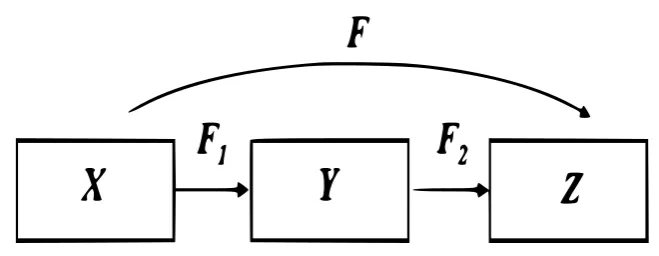
Fig. 1 Decomposition of the problem.
2.2 Problem decomposition. Two-level model
Initially, a hypothesis is introduced that the set of required mechanical characteristics of the material is uniquely determined by its microstructure. For the case of metals and alloys, considered in this paper, the microstructure is defined by the grain-phase structure of the material. Let us denote byYthe set of parameters describing the materials microstructure. Then the relation (1) takes the following form:
z=F(y(x)), x∈X, y∈Y, z∈Z (3)
whereyare specific values of parameters of the grain-phase structure of material.
Now the problem of obtaining predefined properties of functional material can be divided into two stages, shown in Figure 1.
In Figure 1, the operatorF1establishes the relations between themanufacturing processparameters andthe grain-phase
microstructuralparameters of the functional material; and the operatorF2connects themicrostructural parameters with
the resulting set ofperformance characteristics.
Now relation (1) can be transformed to the following form:
z=F(x) =F2(F1(x)) =F2(y) (4)
Herey =F1(x), and operatorF=F2F1.
Thus, the problem of obtaining the predefined properties of the functional material is reformulated as a combination of two problems:
• recovering a grain-phase microstructure of the material as a result of a manufacturing process viaF1; and
• an estimation of materials macroscopic performance properties, depending on parameters of the material microstruc-ture viaF2.
The first problem, i.e. the particular form of the operatorF1, will not be considered in this paper. The only contribution
of this first part is the identification of parameters of resulting grain-phase micro-structure. It is assumed that technologies for obtaining the required functional material are known and thus, as a result, its grain-phase structure, represented by digital images of microsections of this material under various technological processes, are given.
It is also assumed that a sufficient number of experimental data has been collected, which allows the possibility to establish relations between parameters of the material microstructure and technological processes.
Of particular interest here is the second problem, where an estimation of mechanical macroscopic properties is per-formed, based on the predefined set of parameters of the grain-phase materials microstructure. Thus the general problem reduces to the solution of the second part only:
z=F2(y) (5)
2.3 Analysis of parameters of functional materials microstructure
The analysis of microstructural properties can be further split in two stages:
• identification of all possible parameters of obtained grain-phase structure (i.e. all possible components of the vector
[image:4.595.130.460.94.222.2]4 I.M. Gitman, A.V. Klyuev, M.B. Gitman, and V. Yu. Stolbov: Strength Properties Estimation in Functional Materials
• the determination of the number of significant components of the vectory(further denoted asy˜), characterizing this microstructure from the point of the set of macro-characteristics of the material.
Below the logical sequence of these stages will be discussed, starting with the second stage.
Following the proposed hypothesis that the macroscopic properties of a material unambiguously follow from its mi-crostructure, it is necessary to determine which microstructural parameters, and their minimum number, are uniquely determined by the required set of macro-characteristics of the functional material. In other words, it is required to find such ˜
y∈Ywhere:
∃F2, such that kz˜−F2(˜y)k< ε (6)
wherez˜contains available experimental data on required set of macro characteristics, andεis the required accuracy. To ensure the completeness ofy˜, it is necessary to determine the maximum possible number of microstructural parame-ters. This can be determined by the identification of these parameters from the available set of microsections in the analysed material.
Typically, in order to analyse a microstructure, parameters of interest are related to grains structures, e.g. grain area, perimeter of boundaries, lengths (mean and deviation) of small and large grain axes, aspect ratio, elongation, compactness, etc. Automation of image segmentation procedure allows obtaining these parameters in a direct way, i.e. avoiding manual processing.
It should also be noted that thermomechanical properties of the material depend not only on parameters of the grain structure, but also on the phase composition, as well as the presence of dislocation substructures within the grain. In the case of intense plastic deformations, a stable fragmented substructure can be formed, stabilized by particles of secondary carbides [12]. Attention should also be given to the wall-effect and influence of triple junctions [16]. Note that the automation of identification of the aforementioned features from images could significantly improve the prediction of material properties.
In this paper, an automated system [18], allowing to estimate, with the user specified accuracy, parameters of grain-phase structure from a digital image of microsections, was used to determine grain-phase classification and segmentation of grains. Note that automating the microstructural parameters identification leads to significant increase in the number of these parameters, potentially impacting macro-characteristics of the material.
Having determined the parameters of the microstructurey˜, the problem of macro-properties estimation in functional material can be approached, i.e. the next step is the determination of the operatorF2in the general problem (4).
2.4 Estimation of macro-properties as a function microstructural parameters
Analysing the microstructure of metal or alloys, the main parameters of the grain-phase structure can be distinguished, including phase state parameters, e.g. volume fraction of phases, parameters of the grain structure, e.g. the mean grain size, the grain size variation coefficient, the degree of grain anisotropy, the volume fraction of grains, etc. Following the analysis of aforementioned parameters, it is thus required to estimate materials performance characteristics (here strength), i.e. define the form of the operatorF2in
˜
z=F2(˜y) (7)
At this stage, an unambiguous conformity between parameters of the grain-phase structure and parameters characterizing the performance characteristics of functional material cannot be guaranteed, thus in order to define the operatorF2, fuzzy
relationsSi[14],[21] between parameters can be built.
Assuming the number of available experiments (microsections and measurements of performance characteristics corre-sponding to each of them) isn, then
Si=Ai×Bi, i= 1..n
(8)
whereAi
is a special fuzzy set containing parameters of the grain-phase micro-structure for thei-th experiment;Bi
is a special fuzzy set containing macroscopic performance characteristics for thei-th experiment;×represents Cartesian product of fuzzy sets [21]. Thus, for eachi-th experiment, the relation ofSibetween fuzzy setsAiandBiis defined.
The mathematical objectsAi andBi introduced above are structurally represented as a multiple of couples, formed
and, as a result, different dimensions. To underline these differences between setsAi
andBi
from the conventional fuzzy sets, they are defined asspecialfussy sets. Further details will be discussed below in the worked example.
Note that (8) defines fuzzy relations that can be represented in a matrix form [21], wherel, m-th terms(l,m), defined for the element(al, bm)is determined by the rules of vector product for fuzzy sets [21]; herel = 1..dandm= 1..w, i.e. d
is the total number of couples (elements with corresponding membership functions) in the fuzzy setAi
, andwis the total number of couples in the fuzzy setBi
defined as follows:
d=k×n;w=r×n (9)
Hereris the number of parameters characterizing the required set of macroscopic performance properties of the func-tional material in each experiment,kis the total number of selected parameters of the grain-phase microstructure in each experiment, andnis the number of experiments. Note here, that although desired, it is not strictly necessary to have all microstructural parameters measured in all experiments. The methodology is still robust in the absence of some elements. The user should assume zero for the missing component. However, in order to improve accuracy as many parameters as possible should be collected.
The relation between arbitrary setsAi
(containing parameters of the grain-phase micro-structure) andBi
(containing known parameters characterizing the macroscopic performance characteristics), or, in other words, the form of the operator F2, can be determined in the following way:
F2=∪li=1Si (10)
here the operator∪l
i=1Sirefers to the standard fuzzy union of membership matrices:f2i=max(si)[14]. This leads to the
setB˜(set of unknown macroscopic parameters) be being determined as
˜
B= ˜A◦F2 (11)
whereA˜refers to the set of microscopic parameters, corresponding to the set of unknown macrostructural character-istics, and◦is the sign of maximinproduct (e.g. an ordinary product of matrices [21], whereminis substituted for the multiplication operation, andmaxis used instead of the addition operation).
It should be noted that, as a result of (11),B˜ will be obtained as a fuzzy set. If the requirement is to obtainB˜ in the form of an ordinary set (i.e. any performance characteristic must be represented as a uniquely determined scalar quantity), it will be necessary to define the ordinary representative of the fuzzy element [21] for each characteristic. For example, if an element of the fuzzy set is a discrete value, then the determination of an ordinary representative˜b∗
j of this fuzzy element
can be carried out as the determination of the mean [3] for discrete random variables.
˜b∗
j = r
X
j=1
m(˜bj)
Pr
i=1m(˜bi)
˜bj !
(12)
Here˜bjis thej-th element of a fuzzy setB˜,m(˜bj)is a membership function of thej-th element andris the number of
element couples in the fuzzy setB˜.
Following the determination of the operatorF2, the problem of identifying such microstructure that ensures a predefined
set of macroscopic materials characteristics, i.e. the solution of the optimization problem (1-2), can be approached.
3
An example of estimation of strength properties of steel subjected to heat treatment
As an illustration of the above methodology, the manufacturing of reinforcing steel with predefined strength characteristics, obtained through heat treatment (see for details the work of the Nanosteel R&D at the Magnitogorsk State Technical University [5], [9]), was considered. In order to obtain the qualitative and quantitative characteristics of the forming structure, the GLEEBLE 3500 research complex was used with Meiji Techno optical microscope using Thixomet PRO computer image analysis system and scanning electron microscope JSM 6490 LV. In analysed heat treatment modes, 3 phases are formed (see [9]): ferritic-carbide mixture (FCM), martensite (M) and bainite (B), volume fractions of which determine the strength of a material. In addition to the phase composition, the performance characteristics of analysed steel are strongly influenced by the parameters of the grain structure. The shape and size of grains can vary significantly (see [9]), which undoubtedly affects the strength of steel.
6 I.M. Gitman, A.V. Klyuev, M.B. Gitman, and V. Yu. Stolbov: Strength Properties Estimation in Functional Materials
Thus, the total number of microstructure parameters in this case isk= 7. The parameters of the grain-phase structure were calculated using the automated system [18].
The Vickers hardness (HV30) and impact strength (KC) were selected as macroscopic performance characteristics of the functional material (reinforcing steel). The measurement of Vickers hardness were taken at30kg load using the third generation Emco Test M4C075G3 universal hardness tester with high-resolution camera and automatic measurements using Brinell, Rockwell, Vickers methods. Thus, the number of performance characteristics in this case isr= 2.
[image:7.595.55.493.228.363.2]Results of the experimental study, i.e. parameters of the grain-phase structures and performance characteristics of steel for7samples (n= 7), obtained under different heat treatment modes (here cooling rates), are presented in Table 1.
Table 1 Microscopic parameters and macroscopic characteristics.
Expe- Cooling Phase Grain structure parameters Material Impact
riments rate, composition, Mean Grain size Aniso- Volume hardness strength
◦C/s %FCM/B/M grain size, variation tropy fraction HV
30 KC, J/cm2
µm coefficient degree of grains
1 10 100/0/0 0.10 0.11 0.98 0.87 400 54.3
2 20 60/10/30 0.10 0.07 1.14 0.26 412 55.7
3 25 80/10/10 0.16 0.06 1.09 0.44 436 58.5
4 30 70/20/10 0.26 0.17 1.18 0.98 469 64.0
5 40 50/30/20 0.25 0.03 1.25 0.37 554∗ 55.7∗
6 50 40/30/30 0.21 0.06 1.1 0.79 617 50.1
7 60 10/0/90 0.13 0.07 1.08 0.91 800 44.6
As it can be seen, the number of micro-structural grain-phase parameters for7experiments, following equation (9), is
d= 49, leading to the vectorAi
having dimensions49×1, and the vectorBi
having dimensions1×14(as the number of macroscopic properties after7experiments isw= 14). We will return to this full description at the end of this Section, and now for a clearer and more visual illustration of the above methodology, a much simplified example will be considered first.
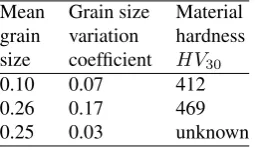
In this simplified case (see Table 2) only three experiments (cooling rates20,30and40◦C/s, i.e. experiments2, 4 and5) were analysed with only measured microscopic mean grain size and grain size variation coefficients. Also, for simplicity, only the macroscopic material hardness was chosen to represent the macroscopic characteristic. It is assumed that for the tests2and4all information is known, and for the final5thtest microstructural information was collected, but
one macrostructural characteristic is unknown and to be found.
Table 2 Microscopic parameters and macroscopic characteristics (reduced test).
Mean Grain size Material grain variation hardness size coefficient HV30
0.10 0.07 412
0.26 0.17 469
0.25 0.03 unknown
As a first step matricesAiwith microstructural parameters andBi with macroscopic characteristics were constructed.
The membership functions of an arbitrary elementcjin fuzzy setsAorBcan be found from the following relation:
m(cj) = 1− |
(cj−¯cj)
max(cj,¯cj)
| (13)
where¯cj is a value of corresponding element with the membership function equal to 1. Following equation (13),
elements of matricesAican be constructed as
A2= [1.0/0.1 0.39/0.26 0.4/0.25 1.0/0.07 0.41/0.17 0.43/0.03]
A4= [0.39/0.1 1.0/0.26 0.96/0.25 0.41/0.07 1.0/0.17 0.18/0.03]
A5= [0.4/0.1 0.96/0.26 1.0/0.25 0.43/0.07 0.18/0.17 1.0/0.03]
(14)
[image:7.595.54.182.518.593.2]value of the actual microstructural parameter itself (denoted as ”membership function/parameter value). Similarly, matrices
Bi
, corresponding to the known macrostructural characteristics, can be constructed as
B2= [1.0/412 0.88/469]
B4= [0.88/412 1.0/469] (15)
In the next step, following equations (8) and (10), an operatorF2can be built as follows:
F2=
1.0 0.88 0.88 1.0 0.88 0.96
1.0 0.88 0.88 1.0 0.43 0.43
(16)
For simplicity of the presentation, the actual formalism of the operatorF2has not been kept. Below the schematic
presen-tation is given to guide the reader through elements of this operator:
F2=
Bi →
1.0 0.88 0.88 1.0
Ai 0.88 0.96
↓ 1.0 0.88 0.88 1.0 0.43 0.43
0.88/(0.1; 412)
1.0/(0.07; 469)
0.43/(0.03; 412)
Here elements are represented as membership functions with corresponding couples of microscopic parameters and macroscopic characteristics, following equations (8) and (10). Finally, following equation (11), the unknown macroscopic characteristics, missing in Table 2, can be found:
B5=A5◦F2= [0.88/412 0.96/469] (17)
If it is required to obtainB˜in the form of an ordinary value (i.e. as a uniquely determined scalar quantity, representing fuzzy set), following equation (12), unknown macroscopic material hardness can be determined as˜b∗
3 = 441.8. Comparing the estimated number with the experimentally obtainedHVe
30= 554(see Vickers hardness with a star in table 1, corresponding to the5th
experiment) the error of the proposed methodology is
δHV =|
HVr
30−HV30e
HVe
30
| ×100% = 20% (18)
A relatively large20%error can be observed here. In order to improve the accuracy, more parameters need to be taken into consideration, as will be discussed further.
As the next test, the full set of data (presented in Table 1) has been analysed. To demonstrate the proposed methodology, now samples No. 1,2,3,4,6,7(six samples in total) are taken as the initial data, and sample No. 5as the test sample. Macroscopic characteristics of the5thtest sample are assumed unknown and are denoted with stars (∗).
Recall that in the new, complete, case the vectorAi
has dimensions49×1(as the number of micro-structural grain-phase parameters for7experiments isd= 49) and the vectorBi
has dimensions1×14(as the number of macroscopic properties after7experiments isw= 14). However as it was assumed that macroscopic material hardness and impact strength in the fifth experiment are unknown, the dimension of the vectorBi
is1×12.
As a result, see equation (8), matrixesSi(i= 1,2,3,4,6,7) and thus operatorF
2, has dimensions49×12(due to the
complexity of the presentation the full forms of the operatorF2and matricesAiandBi, withi= 1,2,3,4,6,7, are not
presented here).
8 I.M. Gitman, A.V. Klyuev, M.B. Gitman, and V. Yu. Stolbov: Strength Properties Estimation in Functional Materials
for each separate characteristic (Vickers hardness (HV30) and impact strength (KC)), following relation (12) has been obtained as
HV30r = 525KC
r
= 54.6 (19)
Note that, experimental measurements (see elements with a star in Table 1) were taken as
HVe
30= 554KCe= 55.7 (20)
Thus errors of the proposed methodology can be estimated as
δHV =|
HVr
30−HV30e
HVe
30
| ×100% = 5%;
δKC =|
KCr−KCe
KCe | ×100% = 2%
(21)
The justification of asufficient number of experiments and parameters, to obtain a required accuracy of predictive estimation of macroscopic materials properties, can be of further study. However analyzing the obtained results, it can be concluded that even with a relatively small number of experiments and parameters, the accuracy of estimation is rather high. An increase in the number of experimental data will lead to a further increase in the accuracy of the predicted results.
4
Conclusion
A new methodology has been formulated that allows, using the analysis of the grain-phase micro-structural parameters of the functional material, to estimate its macroscopic performance characteristics. A hypothesis has been formulated on the unique correspondence between macroscopic properties of the material and its microstructure. Following this hypothesis, it is sufficient to determine a certain minimum number of corresponding microstructural parameters, which will uniquely determine the required set of macro-characteristics of the functional material. A particular novelty of the proposed method-ology is the application of fuzzy sets theory while establishing relations between predefined strength characteristics and parameters of the phase state and grain structure, obtained from the image of microsections of the analysed material.
Acknowledgements The reported study was funded by the Ministry of Education and Science of the Russian Federation (the unique identifier RFMEFI58617X0055) and by the EC Horizon 2020 is MSCA-RISE-2016 FRAMED Fracture across Scales and Materials, Processes and Disciplines.
References
[1] Y. Adler, E. Markova, and Y. Granovsky, The design of experiment to find optimal conditions a programmed introduction to the design of experiments (Mir Publishers, 1975), [in Russian].
[2] V. Alekseyev, V. Tikhomirov, and S. Fomin, Optimal control (Nauka, 1979), [in Russian].
[3] V. Ashikhmin, M. Gitman, O. Naimark, V. Stolbov, P. Trusov, and P. Frick, Introduction into mathematical modeling (Logos, 2015), [in Russian].
[4] S. Banerjee and A. K. Tyagi, Functional materials: preparation, processing and applications (Elsevier, 2011).
[5] M. Baryshnikov, D. Dolgiy, K. Kuranov, and M. Zaitseva, Thermal and mechanical treatment of high-carbon steel rebar, Steel in Translation42(2), 177–179 (2012).
[6] V. Bolshakov, Y. Dubrov, and O. Kasjan, Microstructure as a predominant parameter in predicting mechanical characteristics of steel, Reports of the National Academy of Sciences of Ukraine6(2010), [in Russian].
[7] R. Fisher, The Design of Experiments (liver and Boyd, 1951).
[8] H. Gao, B. Ji, I. Jger, E. Arzt, and P. Fratzl, Materials become insensitive to flaws at nanoscale: Lessons from nature, Proceedings of the National Academy of Sciences of the United States of America100 (10), 5597–5600 (2003).
[9] M. B. Gitman, A. V. Klyuev, V. Y. Stolbov, and I. M. Gitman, Complex estimation of strength properties of functional materials on the basis of the analysis of grain-phase structure parameters, Strength of Materials49(5), 710–717 (2017).
[10] D. Himmelblau, Applied nonlinear programming (McGraw-Hill, 1972).
[11] A. Ilyushin, Plasticity, foundations of the general mathematical theory (Academy of Sciences of the USSR, 1963), [in Russian]. [12] E. Kozlov, N. Koneva, and N. Popova, Grain structure, geometrically necessary dislocations and second-phase particles in
poly-crystals of micro- and mesolevel, Physical Mesomechanics12 (5-6), 280–292 (2009).
[13] V. Malakhov, Diagnosis of functional materials, Industrial Laboratory. Material Diagnostics77(2), 310 – 318 (2011), [in Russian]. [14] K. Peeva and Y. Kyosev, Fuzzy Relational Calculus: Theory, Applications and Software (World Scientific, 2005).
[16] V. Rybin, Large plastic deformations and fracture of metals (Metallurgiya, 1986).
[17] V. M. Schastlivtsev, T. I. Tabatchikova, I. L. Yakovleva, S. Y. Klyueva, A. A. Kruglova, E. I. Khlusova, and V. V. Orlov, Microstruc-ture and properties of low-carbon weld steel after thermomechanical strengthening, The Physics of Metals and Metallography113 (5), 480–488 (2012).
[18] S. Sharybin, V. Stolbov, M. Gitman, and M. Baryshnikov, Developing of an intellectual system of complex microstructures analysis and classification on thin metal sections, Neurocomputers: development, application12, 50–56 (2014), [in Russian]. [19] P. V. Trusov and A. I. Shveykin, Multilevel crystal plasticity models of single- and polycrystals. direct models., Physical
Mesome-chanics16(2), 99–124 (2013).
[20] V.G.Bazhenov, Mathematical modeling and methods of indentifying strain and strength characteristics of materials, Physical Mesomechanics10(5-6), 302–314 (2007).