Rochester Institute of Technology
RIT Scholar Works
Theses
Thesis/Dissertation Collections
5-1-1977
Illumination
Charlotte Yale Chamberlain
Follow this and additional works at:
http://scholarworks.rit.edu/theses
This Thesis is brought to you for free and open access by the Thesis/Dissertation Collections at RIT Scholar Works. It has been accepted for inclusion
in Theses by an authorized administrator of RIT Scholar Works. For more information, please contact
Recommended Citation
ROCHESTER
INSTITUTE OF
TECHNOLOGY
ILLUMINATION
A
thesis
submittedto
thefaculty
of theCollege
ofFine
and
Applied Arts
in
partialfulfillment
ofthe
requirementsfor
thedegree
ofMaster
ofFine
Arts.
By
Charlotte
Yale Chamberlain
Rochester,
New
York
Special
thanks go toS.
D.
Chamberlain
III
ILLUSTRATIONS
Page
"Landscape"
(illuminated)
ii
"Landscape"
(not
illuminated)
iii
"Illumination
I"(illuminated)
14
"Illumination
I"(not
illuminated)
15
"Illumination
II"(illuminated)
18
"Illumination
II"(not
illuminated)
19
"Illumination
III"(illuminated)
22
"Illumination
III"(not
illuminated)
23
"Texture
I"(illuminated)
26
"Texture
I"(not illuminated)
27
"Texture
II"(illuminated)
30
"Texture
II"(not illuminated)
31
"The
Sea"(Illuminated)
34
"The
Sea""You
must collect yourselves on yourway here...
Walk
pasteverything
withoutnoticing
it,
asif
there wereonly
onething
in
the world thatis
important
andreal..."
iv
INTRODUCTION
Illumination
has
severalmeanings;
lighting
up,
enlightenment,
and thedecoration
of manuscripts.Within
the
obvious physical characteristics ofmy
work,
illumination
means
"lighting
up",
but
that
is
not meant to exclude glimmersof the more elusive
meaning
"enlightenment".
This
thesis and the work thatit
supports attempts toinvestigate
challengesbehind
theillumination
ofmy
painting.I intended
to
stick with some of the traditional materials andtechniques
whereit
suitedmy
purposesbut
alsoto
investigate
new ones as well.
The
initial
challenges ofilluminating
my
paintingsseemed awesome.
So many
new considerationshad
tobe
made.New
limitations
camehand
in hand
withthe
expansivepossibilities of the new visual expression.
What
startedas an
Intriguing
way
ofmanipulating
materials to create asuccessful
image
oncanvas,
suddenly became
anintegral
partof
my
visual expression.Illumination
allows a uniqueway
of
expressing
the relationshipsbetween
the
exterior andthe
interior;
the"what
seems to be" and"what
is";
the physicaland
the
spiritual.These
relationshipshave
intrigued
meIllumination
has become
asimportant
tomy
expressionat
this
time
as color wasto
theFauves.
This
thesisis
not an
isolated
study.I
amcontinuously
being
inspired
toinvestigate
new possibilities within this medium andintend
ILLUMINATION
The
inspiration behind
this approach to rminting became
apparent to me while
painting
atranslucent
window shade.At
that
time
several challengesintrigued
me enough to seektheir
solutions.
The
first
challenge was thedifficulty
ofmaintaining
aspontaneity
of strokein
thetranslucent
areas whileremaining
true
tomy
expression of theimagery.
I
found
thatany
insecurity
andhesitation in
stroke wasdistracting.
Going
over these areas was not
helpful.
Because
the shades wouldbe
viewed with sunlightshining
through them
from behind
in
theday
and viewed with the roomlight
on thefront
atnight,
creating
a successfulimage
in
both
situations offered a second challenge.There
arecertainly
many
possibilitiesfor
illuminating
paintings,
from
illuminating
stainedcanvas,
linen,
silk,
etc.;
illuminating
paintedplexiglass;
toilluminating
suspendedfree-form
acrylic pigment.I
hope
toeventually investigate
many
more of theseareas,
but
at thistime
my
concernlies
in
the technique ofstaining
andpainting
with acrylics onstretched canvas;
controlling
transparent,
translucent
andilluminated
and unilluminated state.I do
not wish to overdo adiscussion
ontechnique.
However,
I do
wish to share some of themany discoveries
that
came out of themany
hours
ofmanipulating
raw materials.Other
than
the challengesalready
mentioned,
numerouschallenges unfolded as
I became
moreinvolved
withilluminated
painting.
I
neededto
paintin
an environment whereI
could controlthe sources of
light.
I
setup
a studio enclosed withblack
plastic to
block
out most externallight.
I
setup
overheadand
floor
lighting,
allowing
meimmediate
accessto
changesof
light
asI
worked.I
alsofound
that the usual manner ofconstructing
large
canvas stretchers would
interfere
with the even radiation oflight
within theframe.
I
neededstrong
stretchers thatrequired no cross
bars
to support the semi-taunt canvas.I
chose 2" x 2"
pine.
Unfortunately,
these stretchers wouldcreate a 2"
dark strip
around the edge of thepainting
whenilluminated.
The
canvashad
tobe
raisedfrom
the stretchersin
one of thefollowing
methods :One
methodinvolved
a traditional means ofraising
thecanvas
from
the stretchersby
gluing
a rim of 1/2"x 1/2"
The
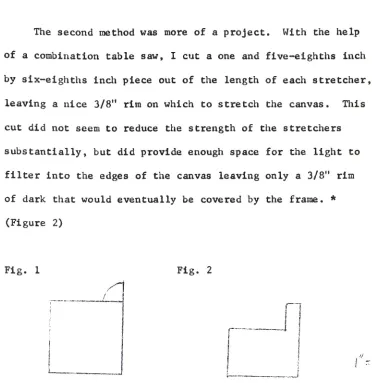
second method was more of a project.With
thehelp
of a combination table
saw,
I
cut a one andfive-eighths
inch
by
six-eighthsinch
piece out of thelength
of eachstretcher,
leaving
a nice3/8"
rim on which to stretch the canvas.
This
cut
did
not seem to reducethe
strength of the stretcherssubstantially,
but did
provide enough spacefor
thelight
to
filter
into
the
edges of the canvasleaving
only
a3/8"
rim
of
dark
that
wouldeventually be
coveredby
the
frame.
*(Figure
2)
Fig.
1
J
Fig.
2
\",2J
The
initial
treatment of the canvas afterstretching
wasto stain with acrylic pigments.
This
stain was meantprimarily
to
influence
thepainting
whileit is
illuminated,
but
notnecessarily
to show while thelight
is
off.I
first
worked*
Because
2" x2"
stretchers caused the
painting
tobe
quiteheavy,
I
eventually
used1"
x
2"
pieces.
I did
put themtogether with the 2" side
forward.
I
proceededto
usethe
method of
gluing
1/2"
[image:12.520.83.455.69.452.2]within a visual
framework
of representationalabstraction,
I
considered several subjects to
be
the most appropriatefor
illumination.
Fires,
volcaniceruptions,
andlightning
werejust
afew.
This
led
toward the use of warmstains;
oranges,
yellows and reds.
Later
asmy
imagery
departed
from
therepresentational and
drifted
toward a more abstract emotionalexpression,
the trend toward warmillumination
wasless
necessary,
introducing
a range of colors.It
wasdifficult
to get a nice clean concentratedstain with acrylic pigment without
opaquing
the material.With
muchexperimentation,
I
discovered
thatwashing
thecanvas to encourage
absorption,
orusing
alcohol and waterin
the soak or stain solution washelpful.
Alcohol
has
thetendency
to thin the polymer whilekeeping
the pigment asintense
as possible.I
alsodiscovered
aninteresting
sideeffect.
The
turbulance createdby
the combination of waterand alcohol caused the pigments to separate
in
interesting
patterns quite arbitrarily.
This
was not usefulin
the earlierpaintings as this
delicacy
waslost
with subsequent additionsof paint.
It
waskept
in
mindfor
possiblefuture
use.I
experimented with rawlinen
using
liquid bleach
to
lighten
areasbefore
staining.I
was nothappy
withthe
I
alsoinvestigated
the use of silk and other sheermaterials stretched
in
single anddouble
layers
hoping
toseparate
the
internal
stainfrom
the
external pigment moredramatically.
I
found
this
methodunsatisfactory
for my
expression.
The desire
to
separatethe
inner
stainfrom
the outerimage became
moreimportant.
In
order tokeep
the pigmentfrom
soaking
through
the canvas tothe
front
I
sized theback
with acrylic resin emulsion to maintaintransparency
while
sealing
the
canvas.To
manipulate some of the translucent areas moresuccessfully,
I
also sealed them withRhoplex
after theinitial staining
andbefore
subsequent painting.This
kept
some of the pigment on the
front
of the canvasfrom soaking
into
the canvasallowing for
greatertrans
lucency
there
aswell.
I
also usedRhoplex
mixed with the pigment to createclear transparent stains.
Rhoplex
is
an acrylic resin emulsion manufacturedby
Rohm
andHaas
Co.
It has been extremely Important for
illumination
asI
need complete and simple control oftransparent and translucent areas.
Rhoplex
is
clearer thanall
but
thehighest
grade optical glass.This
clarity
remainsand
darkening
ofthe
traditional
oil medium.Rhoplex
has
a
high
resistanceto
coagulationby
solublesalts,
allowing
it
tobe
diluted
withordinary
tap
water.Also freeze-thaw
cycles and
aging do
not affectRhoplex.
These
propertiesmade
Rhoplex
anideal
mediumfor illumination.
In
the
interest
ofeconomizing,
I
purchasedlarge
quantities andfound
its
costto
be approximately half
that
of other polymermedia.
Although Rhoplex
can nolonger be
purchaseddirectly
from Rhom
andHaas,
thecompany is helpful
in acknowledging
its
distributors.
The
mostimmediately
visible part of thepainting
is
the
front
ofthe
canvas.Up
tothis
pointI have been
describing
the
stain on the under side of the canvas whichis
not visible until the canvasis
illuminated.
The
outerimage
must work well with theinner
stain.This
outerimage
is
the mostdifficult
to control whilemaintaining
thespontaneity
of expression.Although,
thusfar,
this
technique ofpainting
seemedsomewhat
technical,
it did
leave
a greatdeal
of roomfor
thebiggest
task athand:
to come as close asI
couldto
expressing
throughmy
hands
what emanatesfrom my
soul.In
some paintings
I
used quick calligraphic strokes of thickenergy.
As I
wasinterested
in
astrong
spontaneousstatement,
I
was unableto
reworkthe
areasthat
I
felt
were unsuccessful.
This
meant thatI
was required todevelop
discipline
in
this method ofpainting before
getting
to
the
point ofactually working
on thefinal
canvas.It
also meant
that
the canvases whichdid
not measureup
tomy
expectations were nolonger
ofany
use to me asilluminations.
Other forms
of expression grewfrom
thisbasic
technique
asmy
states of consciousness changed.As my
expression matured toward a greater contrast
between
spiritual and physical
energy,
the
front
of the canvasused no
color,
merely
texturefrom
ravelledwarp
of canvasand string.
The
colorrepresenting
thephysical,
now cameonly
from
within.The
exterioronly
reflected theinternal
spiritual energy.The
final
considerationin
this problem ofilluminated
painting
wasto
provide the properviewing
experience.The
positioning
of thelights
behind
the canvas and thedepth
ofthe
frames
are of equalimportance.
I
chose 12"tubular,
40-watt
incandescent
bulbs
to
provide theillumination.
With
up
the
bulbs
sothey
fit
well and provided the proper accentsof
illumination
in
each painting.There
was concernfor
the
heat
createdby
the
bulbs
in
an enclosed area as narrow asthe
4"frame.
I found
thebulbs
did heat
the canvasbut
notenough to cause
any damage
to
the canvas or acrylic paint.Incandescent
lighting
is working
wellfor
my
purposesat
this
time,
but I do
not wish to overlook other means ofillumination.
I had originally
rejectedfluorescent
lighting
because
ofthe
weightit
would addto
thepainting
and thedemands
that
wouldbe
put on the construction of theframe.
Further investigation
revealed thatthe
heavy
transformerneed not
be
installed
directly
in
theframe but
couldbe
stored at some
distance.
This
still remains an awkwardconsideration.
Flourescent
lighting
is
cooler and wouldeliminate the
fear
of overheating.There
are enough of avariety
of coloredbulbs
to
provide the artist with anothercontrol over color.
Neon,
another means ofillumination
could provide yetanother
dimension.
Since
avariety
of shapes couldbe
madewith the neon
tubing,
they
could create adesign
element alltheir own.
Color is
anotherinteresting
variable with neon.Unfortunately
timedid
not permit meto
try
each ofthese
The
frames
had
to notonly
provide a clean edgebut
tosupport the
painting
and provide alight
sealed containerso that no
distracting
arbitrary
light
around thepainting
or on the wall would
interfere
with the effect of theilluminated
canvas.One-inch
by
four-incn
clear pine wascut to provide a 1/4"
overlap
on thefront
of the canvas.This
sealed thelight
inside
theframe
(with
thehelp
ofcardboard
sealing
theback)
and also covered the 1/8"dark
strip
around the canvas createdby
the stretchers.As
different
paintings requireddifferent
amounts ofdiffused
light,
theboard
thatbacks
eachpainting
was treated witheither a
highly
reflective material, such as tinfoil;
medium reflective
surface,
such as white paper; or a nonreflective
surface,
such asblack
paper.This
allowed me10
ENLIGHTENMENT
Throughout
thisstudy
ofillumination I
have
had
tomaintain a
delicate balance between
rational,
calculatedexperimentation and spiritual and psychic expression.
Both
areas requirediscipline.
First,
thediscipline
ofthe
mind,
andsecond,
thediscipline
of the soul.Because
I have had
no majorfinancial,
physical,
or emotionalburdens
at thistime,
I have been
able tobegin
todevelop
discipline
in both
of these areas.I hope my
work reflectsthis
discipline
and will continue to evolvemaintaining
an acute awareness of the need
for
thisdelicate balance.
As
I
have
been studying
the possibilities andlimitations
in illuminated
painting,
I have been reviewing
myself andthoughts
I have had
for
along
time.I have been
concernedfor many
years with the"nature
of things".I have been
thirsty
to understand, notonly
what makes me workbut
whatmakes the universe work as well without
eliminating
the
possibility
thatboth
"whats"
may be
one andthe
same.I have
studied,
formally
andinformally,
for
atleast
tenyears;
psychology,
sociology,
philosophy, andreligion,
in
the
hopes
of
realizing
someencouraging
truths about the"nature
of11
been
a continuous one.Only
recently, have I
realized thatit does
not matterif I
understand,
aslong
asI
canfind
away
to expressmy
spirit withhonesty
andclarity,
withinthe
framework
ofmy
spotin
time and space.It
seemsto
be
thespirit,
whether positive ornegative,
that
motivates creativity.The understanding
of theintellect
must still riseto
evaluatethe
clarity
and success ofthis
expression.I have
communed withmany
spiritsin
the past severalyears,
eitherin
person orthrough
books.
It
wouldbe
anarduous
task
to
try
to present allthat
has
influenced
meto
date,
andit surely
would not allbe
relevant tomy
work atpresent.
While
reworking in my
mind thelittle
understanding
that
I have
managed to pickup
of theWestern
consciousness,
there
has
alwaysbeen something
missing.I have had
theuncomfortable
feeling
ofgrasping
at yet another shallowgimmick
that
was tobe
the secret tohappiness,
peace ofmind,
and
fulfillment.
It
was not untilI
wasintroduced
tojust
a part of
Eastern
consciousness thatI
found
a glimmer ofself-awareness.
Investigations
of theBuddhist
philosophy
from India
to
Japan,
particularly
throughreading
Watts, Suzuki, Herrigel,
Kapleau
andHasurai
who alldealt primarily
withZen
have
been very
helpful.
Watts'discussions
concerning
the
comparison12
I
amby
no means an expert onEastern
thought,
orWestern
thought
for
that
matter.I have merely found
whatI have
graspedto
be
anincredibly
helpful ideological
springboard
from
whichmy
thoughts
and modes of expression13
I
wouldlike
to
present theillustrations
ofmy
workin
a sequenceIntermingled
with quotesthat
have had
significant
influence
on me andmy
work.I
choose not tolabor any
further
on explanationsof
my
work.I hope
thefollowing
pages reveal a reciprocalreinforcing relationship between my
work andthe
intermingled
16
"At
the
present moment wein
the
West
experience,
andin
experiencing
resent,
a consciousness offrustration.
We
have
mastered andharnessed
theforces
of naturefor
ourown
uses,
but
something,
after all ourefforts,
eludes us.We have divided life into
separatecompartments,
eachpresided over
by
a science with animposing
name;
but
thewholeness of
life
has
somehowbeen
obscured.What
we seemto
have
lost is
the art ofliving."
17
"Mindfulness
walksslowly
anddeliberately,
andits
daily
task
is
of a ratherhumdrum
nature.Yet,
whereit
places
its
feet it
cannoteasily be
dislodged,
andit
acquires and
bestows
true
mastery
of the groundit
covers."20
Spring
has hundreds
offlowers,
autumn themoon;
Summer has
cool winds, winter the snow.When nothing idle
weighsheavy
on themind,
This
then
is
man'sfavorite
season.21
"The
idea
ofthe
beautiful is
a personal and particularinsight into
the
essence of the soulin
aform
appropriate totranscendent-immanent
reality.Where
the
harmony
between
outer and
inner is
achievedin
aestheticform,
where theartist endows
the
cosmos andhis
own self with expression-there
the
immanent,
subjectiveactivity
of thepersonality
achieves
the
height
oftranscendence
objectivity.Subjectivity
immanence
and objective transcendence areinextricably
linked
in
creative art.Only
whenthe
painter standsbrush
in
hand in front
ofthe
canvasdoes
the
way
to a unique eternalidea
openbefore him.
When
a poet enters at one glanceinto
the
heart
ofnature,
theidea
translatesitself Into
speechin
the sameInstant.
Creative
arthas
a profound operationon
the
soul."24
"Outward
technique
by
itself is
not art.It is only
through
long
training
of the soulthat
the pupilis
brought
to
the
true
inward
technique.
In
artit is
notmerely
aquestion of artistic
dexterity,
but
of the artistic processwithin the artist.
Everything
that
is
formed
in
artis
united withthe
human
soul...Creation
in
artis
the psychicunfolding
ofthe
personality
whichis
rootedin
theNothing.
Artistic
skill,
therefore,
does
not mean artisticperfection:
it
remains rather acontinuing
medium orreflection of some
step
of psychicdevelopment.
The
perfectionof which
is
notto
be found in form
andshape,
but
radiatefrom
the
human
soul."25
"Intuitive
creationis
the
characteristicfeature
ofJapanese art,
whichin
thisis
quite the opposite ofWestern
art with
its
strongly
rational cast.Intuition is
thefaculty
ofcomprehending
the
object of the soulin its
interior
relation withthe
cosmictotality
lying
concealedunder the
variety
ofthe
world..."!;
28
"Love
of nature notonly
showsthe
way
to
contemplativetranscendence;
even moreit
is
a guideinto
a meditativeworld of the spirit.
Art
revealsitself in
psychicunderstanding
of
the
inner
essence ofthings,
and givesform
to the relationof man with
the
Nothing,
withthe
nature ofthe
Absolute."29
"Out
ofthe
fullness
ofthis
presence ofmind,
disturbed
by
no ulteriormotive,
the
artist whois
releasedfrom
allattachment must practice
his
art.But
if he
is
tofit
himself
self-effacingly
into
the
creativeprocess,
the
practice ofthe
art musthave
theway
smoothedfor it.
For
if,
in his
self
immersion,
he
sawhimself
faced
with a situationinto
which
he
could notleap
instinctively,
he
wouldfirst have
to
bring
it
to
consciousness.He
would then enter againinto
all the relationships
from
whichhe
had detached
himself;
he
wouldbe
like
onewakened,
who considershis
programfor
the
day,
but
notlike
aAwakened One
wholives
and worksin
the
primordial state.
It
would never appear tohim
asif
the
individual
parts of the creative process werebeing
playedinto
his hands
by
ahigher
power;
he
would never experiencehow
intoxicatingly
thevibrancy
of an eventis
communicatedto
him
who
is himself only
avibration,
andhow
everything
that
he
does
is done before he knows
it.".
;
if
t
\
\
\
i
32
"The
materialis
notthe
sign of the creativefeeling
for
life:
ofthe
warmth andsympathy
and reverence whichfoster
being;
techniques are not thesign;
"art"is
not thesign.
The
signis
the
light
that
dwells
within theact,
whatever
its
nature orits
medium."33
"The
right artis
purposeless,
aimless.The
moreobstinately
youtry
tolearn how
to shoot the arrowfor
the sake of
hitting
thegoal,
theless
you will succeedin
the one and the
further
the other will recede.What
standsin
yourway is
that
youhave
a much too willful will.You
think
that
what youdo
notdo
yourselfdoes
nothappen."
36
"The
hand
that guides thebrush
has
already
caught andexecuted what
floated
before
the
mind at the same momentthe mind
began
toform
it,
andin
the end the pupil nolonger knows
which of the two-mind or
hand
- wasresponsible
for
thework."
37
"Zen
is
strength,
concentrated,
universal,
utterly
free,
attained
by
completeemptying
of theconsciousness;
it
is
life,
inwardly
enlightened andfulfilled;
it is
absoluteinner
freedom,
perfectly dispensed
atevery instant.
All
thatZen
does
is
to awakenthe
primal consciousnesshidden
within us which alone makes possibleany
spiritualactivity."
BIBLIOGRAPHY
Barr,
A.H.,
Matisse:
His
Art
andHis
Public.
New York:
The Museum
ofModern
Art,
1951.
Binyon,
Lawrence,
The
Spirit
ofMan
in Asian Art.
Cambridge,
Mass.:
Harvard
University Press,
1935.
Chaet, Bernard,
Artists
atWork.
Cambridge,
Mass.:
Webb
Books,
Inc.,
1960.
Hasumi, Toshimltsu,
Zen in Japanese Art:
A
Way
ofSpiritual Experience.
New York:
Philosophical
Library,
Inc.,
1962-Herrigel,
Eugen,
Zen
in
the
Art
ofArchery.
New York:
Vintage
Books,
1971.
Hisamatsu,
Shinlchl,
Zen
and theFine
Arts.
Japan:
Kodansha International
Ltd.,
1971.
Jensen,
Lawrence
J.,
Synthetic
Painting
Media.
New
Jersey:
Prentice-Hall,
Inc.,
1964.
Kandinsky, Wassily,
Concerning
theSpiritual in
Art,
New
York:
G.
Wittenbom,
Inc.,
1947.
Kapleau, Philip,
The Three Pillars
ofZen,
New
York:
Harper
andRow Publishers
Inc.,
1966
Plym,
Don
andThea,
A
Macro
Philosophy for
the
Aquarian
Age,
Michigan:
Macro
Development
Center,
1971.
Thera,
Nyanaponika,
The
Power
ofMindfulness,
California:
Unity
Press,
1972.
Watts, Alan,
Psychotherapy East
andWest.
New York: