0022-538X/96/$04.0010
Copyrightq1996, American Society for Microbiology
The Rev-Responsive Element Negatively Regulates Human
Immunodeficiency Virus Type 1 env mRNA Expression in
Primate Cells
MELISSA J. CHURCHILL,† JULIA L. MOORE, MARTIN ROSENBERG,ANDDAVID W. BRIGHTY1*
Department of Gene Expression Sciences, SmithKline Beecham Pharmaceuticals, King of Prussia, Pennsylvania
Received 20 December 1995/Accepted 23 May 1996
The human immunodeficiency virus type 1 (HIV-1) Rev protein mediates the accumulation of unspliced and singly spliced viral transcripts within the cytoplasm of infected cells, late in the infection cycle, leading to the expression of the viral structural proteins, Gag, Pol, and Env. Rev binds to a complex RNA structure, the Rev-responsive element (RRE), present in all Rev-responsive viral transcripts, relieving their nuclear seques-tration. The precise mechanism by which RRE-containing transcripts are retained within the nucleus in the absence of Rev protein is not well understood. We previously demonstrated that the RRE alone plays a crucial
role in the nuclear retention of RRE-containingenvtranscripts in stably transfectedDrosophilacells. Here we
extend our previous observations and demonstrate that the RRE is a principal determinant of nuclear
retention for envelope transcripts in primate cells and, in particular, human CD41T cells.
The human immunodeficiency virus type 1 (HIV-1) encodes a number of regulatory and accessory proteins in addition to the characteristic gag, pol, and env genes common to all mem-bers of the retroviral family. Analysis of RNA from HIV-1 infected cells demonstrates that the various gene products are expressed from a set of HIV-specific mRNAs that are pro-duced by alternative splicing of a single-genome-length pri-mary viral transcript (15, 19, 27). These mRNAs fall into two subsets: the small multiply spliced mRNAs that encode the regulatory proteins, Tat, Rev, and Nef, and the singly and unspliced mRNAs that encode the structural proteins, Gag, Pol, and Env.
Kinetic studies reveal that the multiply spliced mRNA spe-cies appear in the cytoplasm of infected cells early in the infection cycle whereas the singly spliced and unspliced viral transcripts are retained within the nucleus. Subsequently, late in infection, the incompletely spliced mRNAs are also released from the nucleus, allowing for expression of the viral structural proteins (27). This transition in the pattern of the viral tran-scripts appearing in the cytoplasm is dependent on the viral regulatory factor, Rev (for reviews, see references 9, 14, 16, 30, 31, 38, and 40).
The 116-amino-acid phosphoprotein, Rev, localizes to the nucleus of expressing cells (10) and binds to a region of com-plex RNA structure, the Rev-responsive element (RRE), present in the env regions of all singly and unspliced viral transcripts (11, 12, 20, 32, 36, 42, 43). A growing body of information suggests that the Rev-RRE interaction activates these incompletely spliced transcripts for nuclear export through an active transport pathway, resulting in efficient ex-pression of the viral structural proteins (3, 17, 18, 39). How-ever, the precise mechanism by which RRE-containing tran-scripts are retained within the nucleus of infected cells, in the
absence of Rev, remains unclear. Independently proposed models suggest that recognition of splice site information by splicing components, or various repressive sequences scattered throughout the viral genome, are responsible for the observed nuclear retention of incompletely spliced viral transcripts (6, 8, 28, 29, 34, 36).
Our recent efforts have centered on the use of stably trans-fected Drosophila melanogaster S2 cells for dissection of the Rev-regulatory pathway (4, 26, 33). Using the Drosophila sys-tem, we were able to recapitulate the Rev-dependent expres-sion of the HIV-1 envelope glycoprotein that is normally
ob-served in transfected mammalian cells, including human CD41
T cells. In Drosophila cells, gp160 envelope protein is not expressed in the absence of Rev, but the block to expression can be overcome by supplying Rev in trans. Most importantly, in the absence of Rev, the RRE-containing env transcripts are retained within the nuclear compartment of transfected
Dro-sophila cells, and only when Rev is coexpressed do they locate
to and accumulate within the cytoplasm, resulting in expression of envelope (4, 26). Thus, the efficient nuclear retention of env transcripts in Rev-deficient Drosophila cells suggests the exis-tence of a common mechanism of repression that is maintained in both Drosophila and human cells.
Our analysis in the Drosophila system indicated that splice sites are not required for nuclear retention of env transcripts. Instead, we found that a single, cis-acting repressive sequence (CRS) element was both necessary and sufficient for nuclear retention and Rev responsiveness. This CRS element mapped within the RRE region (4). All constructs in which the RRE region was removed or substantially altered were no longer nuclear retained but rather were efficiently transported to the cytoplasm and expressed in the absence of Rev. The data implicated the RRE as a key element in nuclear retention as well as in Rev responsiveness of env mRNAs.
It has been argued that the Drosophila system is a special case and does not reflect the relevant mechanisms underlying the Rev response in mammalian cells. Hence, in this report we attempt to address the issues raised by our previous data and specifically examine the features that are required for nuclear retention and Rev responsiveness of env transcripts in monkey and human cell lines.
* Corresponding author. Present address: Biomedical Research Centre, Ninewells Hospital and Medical School, The University, Dundee DD1 9SY, Scotland. Phone: 44 1382 660111, ext. 3513. Fax: 44 1382 669993.
† Present address: AIDS Molecular Biology, National Center for HIV Virology, Macfarlane Burnet Centre for Medical Research, Fairfield, Victoria, Australia 3087.
5786
on November 9, 2019 by guest
http://jvi.asm.org/
We demonstrate that the RRE acts as a primary determi-nant of nuclear retention in transiently transfected heterolo-gous mammalian cell systems and, most importantly, in human
CD41T cells. Our results confirm the importance of the RRE
as a critical element in the nuclear retention of env transcripts and highlight the utility and predictive value of the Drosophila system for analysis and dissection of the Rev-regulatory path-way. Clearly, a common mechanism for nuclear retention of
env mRNAs exists in both insect and mammalian cell types. In
HIV infection, both unspliced (gag-pol) and singly spliced (env) mRNAs are subject to nuclear retention and positive regula-tion by Rev. Our results implicate a common region to all of these transcripts, the RRE, as perhaps the only CRS required for achieving nuclear retention.
MATERIALS AND METHODS
Plasmids.Vectors pMC160, pMC120, pMC160D39, and pMC160D39DRRE were derived from the previously described vectors pMt160D32, pMt120D32, pDB160DSA, and pDBDRRE, respectively (4, 26). The entire env transcription unit of each vector, spanning from 25 bp upstream of the ribosome binding site and extending through the simian virus 40 early polyadenylation sequence, was subcloned into the mammalian expression vector pCDN (1). The resulting vec-tors contain previously described derivatives of the env gene under the control of the cytomegalovirus promoter and the simian virus 40 early polyadenylation signal (1, 4). The vector pRSV-Rev (25) contains the Rev coding sequence, the Rous sarcoma virus promoter, and HIV-1 polyadenylation signals in pUC18.
Cell culture.The HeLa and Cos-1 cell lines, obtained from the American Type Culture Collection, were maintained in Dulbecco modified Eagle’s medium supplemented with 10% heat-inactivated fetal bovine serum, 2 mM glutamine, and 100 U each of penicillin and streptomycin per ml of medium. Jurkat cells were obtained from the American Type Culture Collection and maintained in RPM 1640 supplemented with 10% heat-inactivated fetal bovine serum, 2 mM glutamine, and 100 U each of penicillin and streptomycin per ml of medium.
Transfections.Cos and HeLa cells were transfected using Lipofectamine (Gibco, BRL) according to the manufacturer’s instructions. Jurkat cells were electroporated by using a Bio-Rad Gene Pulser according to the manufacturer’s instructions. Transfection mixtures were incubated for 48 h and 72 h, at which time samples were harvested for protein and RNA analyses, respectively.
RNA isolation and analysis.Total and cytoplasmic poly(A)1RNA samples were isolated by using an oligo(dT) magnetic bead procedure as directed by the manufacturer [Dynabeads Oligo(dT)25; Dynal]). Total and cytoplasmic poly(A)1
RNA samples equivalent to 2.03106cells were resolved on 1% agarose gels
containing formaldehyde and transferred to nitrocellulose membranes (4). To detect env mRNA, blots were blocked and probed with a32P-labeled
random-primed StuI-HindIII env fragment (4). Blots were washed and exposed to X-ray film. To ensure equivalent loading, blots were stripped by boiling for 15 min in 0.1% sodium dodecyl sulfate (SDS)–0.1 mM EDTA and reprobed with a labeled fragment derived from the human glucose-6-phosphate dehydrogenase gene.
Protein analysis and Western blotting (immunoblotting).Proteins were re-solved on SDS-polyacrylamide (10 or 12%) gels and electrophoretically trans-ferred to nitrocellulose (Schleicher & Schuell) as described previously (4, 5). Blots were probed by using 1:3,000 or 1:6,000 dilutions of primary antisera, and proteins were detected by enhanced chemiluminescence as directed by the man-ufacturer (Amersham). Envelope glycoprotein expression from Jurkat cells was monitored by immunoprecipitation of gp120 from culture supernatants, using the anti-gp120 monoclonal antibody 178.1 (41), followed by Western blotting of the precipitated material.
RESULTS
Splice site-independent Rev responsiveness of envelope
gly-coprotein expression in Cos-1 cells.Previously, we had
devel-oped a number of envelope expression vector constructs which when stably transfected into Drosophila cells demonstrated that both nuclear retention and subsequent Rev-dependent expression of envelope were dependent on the integrity of the RRE and did not require any splice site information. In an effort to examine whether these results were specific to the
Drosophila system used or, alternatively, reflected the general
intrinsic mechanism of Rev regulation, we carried out a set of analogous experiments using mammalian cells. Each of the previously described env transcription units (4, 26) was excised from the Drosophila expression vectors and incorporated into the mammalian expression vector pCDN (1), placing the env
region under the control of the cytomegalovirus promoter. The various transcription units are otherwise identical to those used in the Drosophila experiments, including sequences span-ning from 25 bp upstream of the ribosome binding site and extending through the entire env coding region and the simian virus 40 early polyadenylation site. The envelope constructs are
slightly chimeric at the 59end. All upstream sequences,
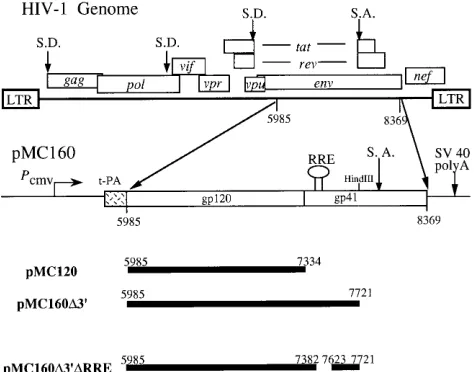
includ-ing the envelope leader and signal sequence and the splice donor for the tat and rev RNAs, have been removed and replaced by the signal sequence of the tissue plasminogen activator gene. The remainder of env, and in particular the RRE, was maintained in order to avoid disruption of the com-plex RNA structure which we suspect plays a role in the reg-ulation. The various env expression constructs generated are shown in Fig. 1.
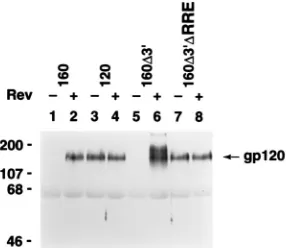
To test the Rev dependence of these env constructs in mam-malian cells, each expression vector was transiently transfected into Cos-1 primate cells in the presence or absence of the Rev expression vector, pRSV-Rev (25). Western blot analysis of cell-free conditioned medium from these transfected cell lines was used to monitor the expression of envelope proteins from the various constructs (Fig. 2).
We found that the parental vector, pMC160, encoding the full-length gp160 glycoprotein, expressed envelope protein in a highly Rev-dependent manner, as indicated by the appearance of the mature gp120 glycoprotein in the culture supernatant only in the presence of Rev (Fig. 2, lane 2). The envelope
transcription unit in pMC160 lacks the natural 59 Tat/Rev
splice donor site (which has been deleted in all of our
con-structs) but retains the 39Tat/Rev splice acceptor site, thereby
indicating that the 59 splice donor is not required for Rev
regulation in primate cells (37).
In an analogous experiment, a derivative construct,
pMC160D39, which lacked both the Tat/Rev splice donor and
[image:2.612.318.555.70.256.2]acceptor sites as well as the distal coding region of gp41, was found also to be fully Rev dependent. No envelope protein was expressed in the absence of Rev, but the block to expression was relieved by supplying Rev in trans (Fig. 2, lanes 5 and 6). Thus, neither splice site is required for Rev dependence in this
FIG. 1. The HIV-1 genome and plasmid constructs. The major genes and splice donor (S.D.) and splice acceptor (S.A.) sites are depicted. LTR, long terminal repeat; Pcmv, cytomegalovirus promoter; t-PA, signal sequence from the
tissue plasminogen activator; SV 40 polyA, simian virus 40 early polyadenylation signal; open rectangles, env sequences; thin line, vector sequences. The solid black bars indicate the regions of env present in each construct, with nucleotide coordinates shown (according to reference 35).
on November 9, 2019 by guest
http://jvi.asm.org/
primate cell line. Furthermore, the sequences deleted in this vector from the terminal coding region of gp41 are also not involved in Rev regulation.
In dramatic contrast to the Rev-dependent expression ob-served with the constructs described above, two other vectors,
pMC120 and pMC160D39DRRE, which lack additional
se-quences within the gp41 coding region of env, expressed enve-lope protein independently of Rev (Fig. 2, lanes 3 and 7, respectively). Significantly, both of these env expression con-structs retain all of the gp120 coding sequence but contain deletions within the gp41 coding region that remove the RRE. pMC120 is missing the entire gp41 coding region, whereas
pMC160D39DRRE contains a precise 240-nucleotide in-frame
deletion of RRE sequences but is otherwise identical to the
Rev-dependent construct pMC160D39. Thus, deletion of the
RRE region appears to be directly responsible for the Rev-independent expression of envelope in Cos cells. Furthermore, these data indicate that no other inhibitory sequences (i.e., CRS elements) exist within the gp120 coding region of env that are recognized by this primate cell line. In this respect, it is
important to note that both pMC120 and pMC160D39retain
the minor tev splice site (2, 22) present within the gp120 coding region of our env constructs. Nevertheless, this site is unable to prevent Rev-independent envelope expression. Thus, cryptic splice sites present within the transcription unit are not rele-vant to Rev regulation of envelope expression.
Recognition of the CRS element within the RRE is
con-served across mammalian cell types.The data presented above
indicate that the Tat/Rev splice sites are not required for Rev regulation of env transcripts in the monkey kidney cell line Cos-1. Instead, a single inhibitory sequence responsible for the observed Rev dependence occurs within the gp41 coding re-gion, within or overlapping the RRE. In an effort to examine whether the pattern of Rev regulation observed in the Cos cell line was applicable more generally in human cells, we carried out a series of transient transfections in the human HeLa cell line, using the same vector constructs.
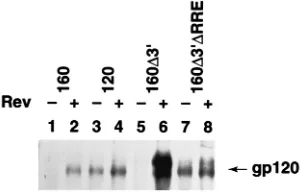
Western blot analysis of culture supernatants from tran-siently transfected HeLa cells (Fig. 3A) indicated that the pattern of Rev dependence observed for envelope glycoprotein expression was essentially identical to that observed in Cos cells. In HeLa cells, the env construct pMC160 (Fig. 3A), encoding the full-length gp160, expressed gp120 envelope gly-coprotein in a Rev-dependent manner (lanes 1 and 2).
Like-wise, construct pMC160D39, which lacks both of the major
Tat/Rev splice sites, was also Rev dependent, indicating yet again that these splice sites are not required for the repressive effects observed in HeLa cells (lanes 5 and 6).
Analogous to the results obtained in Cos cells, we found that expression in HeLa cells from constructs lacking RRE se-quences did not require Rev. Both pMC120, which lacks all
gp41 coding sequences, and pMC160D39DRRE, which lacks
the RRE region but is otherwise identical to pMC160D39,
expressed envelope protein in both the presence and absence of Rev (Fig. 3A, lanes 3, 4, 7, and 8). Again, deletions that specifically remove RRE sequences from env overcome the block to envelope expression and relieve the requirement for Rev. Thus, the results obtained from the human HeLa cell line demonstrate a consistent pattern of Rev responsiveness from insect to human cells.
The RRE is responsible for the nuclear retention of env
mRNAs in human cells. By analogy to results previously
[image:3.612.353.516.67.379.2]ob-tained from the Drosophila system, we suspected that the block to env expression in primate and human cells was due to the RRE-mediated nuclear retention of env transcripts. To test this view, we examined the subcellular distribution of env mRNAs in the transfected HeLa cells. Northern blot analysis
[image:3.612.107.250.70.194.2]FIG. 2. Rev responsiveness of envelope glycoprotein expression is indepen-dent of splice sites in Cos-1 cells. Cos-1 cells transfected with pMC160, pMC120, pMC160D39, or pMC160D39DRRE in the absence (2) or presence (1) of pRSV-Rev were assayed for envelope protein expression (gp120) by Western analysis of culture supernatants, using anti-gp120 polyclonal antisera. gp120 is indicated by the arrow; the upper band produced from pMC160D39and pMC160D39DRRE corresponds to unprocessed gp160 which occurs as a result of the deletions in the gp41 region of env (4). Sizes are indicated in kilodaltons.
FIG. 3. The RRE is responsible for nuclear retention of env mRNAs from human cells. (A) HeLa cells transfected with pMC160, pMC120, pMC160D39, or pMC160D39DRRE in the absence (2) or presence (1) of pRSV-Rev were assayed for envelope protein expression (gp120) by Western analysis of culture supernatants, using anti-gp120 polyclonal antisera; gp120 is indicated by the arrow. Sizes are indicated in kilodaltons. (B) Northern blot of total and cyto-plasmic RNA fractions from HeLa cells transfected as described above. Ex-pected env transcript sizes are as follows: pMC160, 3 kb; pMC160D39, 2.4 kb; and pMC160D39DRRE, 2.2 kb. The blot was reprobed with a fragment of the human glucose-6-phosphate dehydrogenase (G6PDH) gene as a control for equal loading.
on November 9, 2019 by guest
http://jvi.asm.org/
demonstrated that transcripts from the RRE-containing env
constructs pMC160 and pMC160D39 accumulated within the
cytoplasm of transfected cells only in the presence of Rev (Fig. 3B, lanes 8 and 10, respectively). In Rev-deficient cells, these RRE-containing transcripts were retained within the nucleus and failed to accumulate within the cytoplasmic compartment (Fig. 3B, lanes 7 and 9, respectively).
A different pattern of envelope mRNA expression was ob-served with constructs that lacked RRE sequences. We found
that mRNA from the pMC160D39DRRE construct
accumu-lated efficiently within the cytoplasm of transfected cells in the absence and presence of Rev protein (Fig. 3B, lanes 11 and 12). Identical results were obtained with pMC120 (data not shown). Thus, deletion of 240 bp of sequence overlapping the RRE reverses the nuclear sequestration of env transcripts in
human cells (compare pMC160D39and pMC160D39DRRE in
Fig. 3B, lanes 9 and 11). It is also important to note that these transcripts undergo no detectable splicing (Fig. 3B).
Withinenv, the RRE is the primary inhibitory element
rec-ognized by CD41T cells.All of the data which we have
pre-sented to date were obtained from a variety of cell types that are not normally infected by HIV-1. However, it is likely that
the RRE plays an identical role in CD41human T cells, one of
the normal cell targets of HIV-1 infection. To test this, we
carried out a series of transient transfections into the CD41
Jurkat T-cell line, using the same set of env expression vectors as described above.
Because of the low transient transfection efficiencies ob-tained with Jurkat cells, envelope expression was monitored by direct immunoprecipitation of gp120 from culture superna-tants followed by Western blotting of the precipitated materi-als. The results (Fig. 4) demonstrate the same overall pattern of Rev responsiveness as observed with the other cell types.
Both pMC160 and pMC160D39, which contain an intact RRE,
were strongly Rev dependent for envelope glycoprotein ex-pression (Fig. 4, lanes 1, 2, 5, and 6). In contrast, cells
trans-fected with the RRE-deficient construct pMC160D39DRRE or
pMC120 constitutively expressed envelope glycoproteins in ei-ther the presence or absence of Rev (Fig. 4, lanes 3, 4, 7, and
8). Thus, in human CD41T cells, deletion of RRE sequences
appears to be all that is required to allow Rev-independent expression of Env protein.
DISCUSSION
We have demonstrated that the RRE plays a critical role in the nuclear retention as well as the Rev responsiveness of RRE-containing env transcripts in various primate cells,
in-cluding human T cells. Combined with our earlier observations in Drosophila cells, these results suggest that the intrinsic mechanism of action of Rev regulation may be common to both insect and mammalian cells. Specifically, in the context described herein, we have shown (i) that Rev regulation of envelope glycoprotein expression occurs on transcription units that retain an intact RRE sequence but lack the major Tat/Rev splice donor and acceptor sites and that undergo no detectable splicing; (ii) that the presence of at least one minor splice site (tev) is unable to repress env expression from constructs that lack RRE sequences; (iii) that sequences within the RRE are directly responsible for the repression of envelope expression; and (iv) that the inhibition of envelope expression is due di-rectly to the RRE-mediated nuclear retention of env tran-scripts. Thus, the results presented here establish the impor-tance of a single CRS located within the RRE as a principal determinant of nuclear retention and Rev responsiveness for
env transcripts in both insect and mammalian cell systems.
Importantly, this negative element is recognized and is fully
functional in human CD41T cells.
Chang and Sharp (6) have suggested that HIV-1 splice sites are responsible for the nuclear entrapment of RRE-containing mRNAs. Our data do not support that conclusion; the negative regulation by nuclear retention required to support Rev re-sponsiveness can be achieved readily in multiple cell types on the env transcripts described herein which lack all major HIV-1 splice sites. Furthermore, the presence of cryptic splice sites (e.g., tev sites) does not contribute to nuclear retention of mRNAs that lack functional RRE sequences; these mRNAs readily accumulate within the cytoplasm of transfected cells in the absence of Rev.
Other reports have also questioned the requirement for splice site information (14, 16, 18, 30, 34, 36). Using Xenopus
laevis oocytes, Fischer et al. (18) demonstrated that an
RRE-containing mRNA molecule that lacked intron sequences was retained within and exported from the nucleus in a Rev-de-pendent manner. Furthermore, an RRE-containing intron ex-cised as a closed lariat structure also was retained within the nucleus and transported to the cytoplasm in a Rev-dependent fashion. In addition, Nasioulas et al. (34), using a mammalian cell system, demonstrated that following removal of all known splicing information, env mRNA remained Rev responsive when it contained a functional RRE. Those results are consis-tent with those presented here. However, Nasioulas et al. also found a repressive element within the gp120 coding region. In contrast, we find no evidence for alternative repressive se-quence elements, and we suggest that the RRE may be all that is required to support both the negative and positive aspects of the Rev response.
[image:4.612.102.253.71.167.2]Our results have significant implications regarding the in-trinsic mechanism of Rev function. The data presented, orig-inally from the Drosophila system and now from human and monkey cells, indicate that Rev protein, in binding to the RRE, binds at or close to a negative regulatory signal that it sup-presses. It is well known that the structure of the RRE plays an important role in the positive aspects of the Rev response through its capacity to bind the Rev trans activator (7, 13, 23, 24). We suggest that the complex RRE structure also is im-portant for those negative aspects of the Rev response that are associated with the nuclear retention of RRE-containing tran-scripts (33). In fact, several investigators have noted that cer-tain RRE-concer-taining transcription units fail to be negatively regulated (i.e., retained in the nucleus) (6, 20–22). They have interpreted their results as suggesting that the RRE plays no role in negative regulation. One possibility uniformly over-looked by these investigators is that in the specific context of
FIG. 4. Within env, the RRE is the primary inhibitory element recognized in CD41T cells. Jurkat cells transfected with pMC160, pMC120, pMC160D39, or pMC160D39DRRE in the absence (2) or presence (1) of pRSV-Rev were assayed for envelope protein expression (gp120). gp120 was immunoprecipitated with monoclonal antibody 178.1 (41) from culture supernatants, and the precip-itated material was analyzed by Western blotting as described in the text.
on November 9, 2019 by guest
http://jvi.asm.org/
their chimeric constructs, the structural integrity of the RRE required for its negative effects has been disrupted. Recent evidence from our own laboratory (33) indicates that the struc-tural integrity of the RRE is essential for its negative regula-tory role in Rev regulation of envelope transcripts. Thus, the RRE structure may be all that is required for achieving the inhibitory events associated with nuclear retention. If cellular factors are also involved, they will have to be evolutionarily highly conserved proteins.
ACKNOWLEDGMENTS
We thank Tristram Parslow for pRSV-Rev.
This work was supported by National Institutes of Health grant 5U01-AI24845-07. Melissa Churchill was supported by a postdoctoral fellowship from the Australian Commonwealth AIDS Grants Committee.
REFERENCES
1. Aiyer, N., B. Elayne, H.-L. Wu, P. Nambi, R. M. Edwards, J. J. Trill, C. Ellis, and D. J. Bergsma. 1994. Human AT1 receptor is a single copy gene:
characterization in a stable cell line. Mol. Cell. Biochem. 131:75–86. 2. Benko, D. M., S. Schwartz, G. N. Pavlakis, and B. K. Felber. 1990. A novel
human immunodeficiency virus type 1 protein, Tev, shares sequences with Tat, Env, and Rev proteins. J. Virol. 64:2505–2518.
3. Bogerd, H. P., R. A. Fridell, S. Madore, and B. R. Cullen. 1995. Identification of a novel cellular cofactor for the Rev/Rex class of retroviral regulatory proteins. Cell 82:485–494.
4. Brighty, D. W., and M. Rosenberg. 1994. A cis-acting repressive sequence that overlaps the Rev-responsive element of human immunodeficiency virus type 1 regulates nuclear retention of env mRNAs independently of known splice signals. Proc. Natl. Acad. Sci. USA 91:8314–8318.
5. Brighty, D. W., M. Rosenberg, I. S. Y. Chen, and M. Ivey-Hoyle. 1991. Envelope proteins from clinical isolates of human immunodeficiency virus type 1 that are refractory to neutralization by soluble CD4 possess high affinity for the CD4 receptor. Proc. Natl. Acad. Sci. USA 88:7802–7805. 6. Chang, D. D., and P. A. Sharp. 1989. Regulation by HIV Rev depends upon
recognition of splice sites. Cell 59:789–795.
7. Cochrane, A. W., C. H. Chen, and C. A. Rosen. 1990. Specific interaction of the human immunodeficiency virus Rev protein with a structured region in the env mRNA. Proc. Natl. Acad. Sci. USA 87:1198–1202.
8. Cochrane, A. W., K. S. Jones, S. Beidas, P. J. Dillon, A. M. Skalka, and C. A. Rosen. 1991. Identification and characterization of intragenic sequences which repress human immunodeficiency virus structural gene expression. J. Virol. 65:5305–5313.
9. Cullen, B. R. 1993. Regulation of HIV gene expression. AIDS 9(Suppl.): S19–S32.
10. Cullen, B. R., J. Hauber, K. Campbell, J. G. Sodroski, W. A. Haseltine, and C. A. Rosen.1988. Subcellular localization of the human immunodeficiency virus trans-acting art gene product. J. Virol. 62:2498–2501.
11. Daly, T. J., K. S. Cook, G. S. Gray, T. E. Maione, and J. R. Rusche. 1989. Specific binding of HIV-1 recombinant Rev protein to the Rev-responsive element in vitro. Nature (London) 342:816–819.
12. Dayton, A. I., E. F. Terwillinger, J. Potz, M. Kowalski, J. G. Sodroski, and W. A. Haseltine. 1988. Cis-acting sequences responsive to the rev gene product of the human immunodeficiency virus. J. Acquired Immune Defic. Syndr. 1:441–452.
13. Dayton, E. T., D. M. Powell, and A. I. Dayton. 1989. Functional analysis of CAR, the target sequence for the Rev protein of HIV-1. Science 246:1625– 1632.
14. Emerman, M., R. Vazeux, and K. Peden. 1989. The rev gene product of the human immunodeficiency virus affects envelope-specific RNA localization. Cell 57:1155–1165.
15. Feinberg, M. B., R. F. Jarrett, A. Aldovini, R. C. Gallo, and F. Wong-Staal. 1986. HTLV-III expression and production involve complex regulation at the levels of splicing and translation of viral RNA. Cell 46:807–817.
16. Felber, B. K., M. Hadzopoulou-Cladaras, C. Cladaras, T. Copeland, and G. N. Pavlakis.1989. Rev protein of human immunodeficiency virus type 1 affects the stability and transport of the viral mRNA. Proc. Natl. Acad. Sci. USA 86:1495–1499.
17. Fischer, U., J. Huber, W. C. Boelens, I. W. Mattaj, and R. Luhrmann. 1995. The HIV-1 Rev activation domain is a nuclear export signal that accesses an export pathway used by specific cellular RNAs. Cell 82:475–483. 18. Fischer, U., S. Meyer, M. Tenfel, C. Heckel, R. Luhrmann, and G.
Raut-mann.1994. Evidence that HIV-1 Rev directly promotes the nuclear export of unspliced RNA. EMBO J. 13:4105–4112.
19. Guatelli, J. C., T. R. Gingeras, and D. D. Richman. 1990. Alternative splice acceptor utilization during human immunodeficiency virus type 1 infection of cultured cells. J. Virol. 64:4093–4098.
20. Hadzopoulou-Cladaras, M., B. K. Felber, C. Cladaras, A. Athanassopoulos, A. Tse, and G. N. Pavlakis.1989. The rev (trs/art) protein of human immu-nodeficiency virus type 1 affects viral mRNA and protein expression via a cis-acting sequence in the env region. J. Virol. 63:1265–1274.
21. Hammarskjold, M. L., J. Heimer, B. Hammarskjold, I. Sangwan, L. Albert, and D. Rekosh.1989. Regulation of human immunodeficiency virus env expression by the rev gene product. J. Virol. 63:1959–1966.
22. Hammarskjold, M. L., H. Li, X. Lu, and S. Prasad. 1991. Rev regulation of HIV env RNA is dependent on the position of splice sites, p. 345–353. In W. A. Haseltine and F. Wong-Staal (ed.), Genetic structure and regulation of HIV. Raven Press, New York.
23. Heaphy, S., C. Dingwall, I. Ernberg, M. J. Gait, S. M. Green, J. Karn, A. D. Lowe, M. Singh, and M. A. Skinner.1990. HIV-1 regulator of virion expres-sion (Rev) protein binds to an RNA stem-loop structure located within the Rev response element region. Cell 60:685–693.
24. Holland, S. M., N. Ahmad, R. K. Maitra, P. Wingfield, and S. Venkatesan. 1990. Human immunodeficiency virus Rev protein recognizes a target se-quence in Rev-responsive element RNA within the context of RNA second-ary structure. J. Virol. 64:5966–5975.
25. Hope, T. J., X. Huang, D. McDonald, and T. G. Parslow. 1990. Steroid-receptor fusion of the human immunodeficiency virus type 1 Rev transacti-vator: mapping cryptic functions of the arginine-rich motif. Proc. Natl. Acad. Sci. USA 87:7787–7791.
26. Ivey-Hoyle, M., and M. Rosenberg. 1990. Rev-dependent expression of hu-man immunodeficiency virus type 1 gp160 in Drosophila melanogaster cells. Mol. Cell. Biol. 12:6152–6159.
27. Kim, S., R. Byrn, J. Groopman, and D. Baltimore. 1989. Temporal aspects of DNA and RNA synthesis during human immunodeficiency virus Infection: evidence for differential gene expression. J. Virol. 63:3708–3713. 28. Lu, X., J. Heimer, D. Rekosh, and M. L. Hammarskjold. 1990. U1 small
nuclear RNA plays a direct role in the formation of a rev-regulated human immunodeficiency virus env mRNA that remains unspliced. Proc. Natl. Acad. Sci. USA 87:7598–7602.
29. Maldarelli, F., M. Martin, and K. Strebel. 1991. Identification of posttran-scriptionally active inhibitory sequences in human immunodeficiency virus type 1 RNA: novel level of gene regulation. J. Virol. 65:5732–5743. 30. Malim, M. H., J. Hauber, R. Fenrick, and B. R. Cullen. 1988.
Immunode-ficiency virus rev trans-activator modulates the expression of the viral regu-latory genes. Nature (London) 335:181–183.
31. Malim, M. H., J. Hauber, S. Y. Le, J. V. Maizel, and B. R. Cullen. 1989. The HIV-1 rev trans-activator acts through a structured target sequence to acti-vate nuclear export of unspliced viral mRNA. Nature (London) 338:254–257. 32. Malim, M. H., L. S. Tiley, D. F. McCarn, J. R. Rusche, J. Hauber, and B. R. Cullen.1990. HIV-1 structural gene expression requires binding of the Rev trans-activator to Its RNA target sequence. Cell 60:675–683.
33. Moore, J. L., D. W. Brighty, M. J. Churchill, and M. Rosenberg. Submitted for publication.
34. Nasioulas, G., A. S. Zolotukhin, C. Tabernero, L. Solomin, C. P. Cunning-ham, G. N. Pavlakis, and B. K. Felber.1994. Elements distinct from human immunodeficiency virus type 1 splice sites are responsible for the Rev de-pendence of env mRNA. J. Virol. 68:2986–2993.
35. Ratner, L., W. Haseltine, R. Patarca, K. J. Livak, B. Starcich, S. F. Josephs, E. R. Doran, J. A. Rafalski, E. A. Whitehorn, K. Baumeister, L. Ivanoff, S. R. Petteway, M. L. Pearson, J. A. Lautenberger, T. S. Papas, J. Ghrayeb, N. T. Chang, R. C. Gallo, and F. Wong-Staal.1985. Complete nucleotide sequence of the AIDS virus, HTLV-III. Nature (London) 313:277–282.
36. Rosen, C. A., E. Terwilliger, A. Dayton, J. G. Sodroski, and W. A. Haseltine. 1988. Intragenic cis-acting art gene-responsive sequences of the human im-munodeficiency virus. Proc. Natl. Acad. Sci. USA 85:2071–2075. 37. Sadaie, M. R., J. Rappaport, T. Benter, S. F. Josephs, R. Willis, and F.
Wong-Staal.1988. Missense mutations in an infectious human immunode-ficiency viral genome: functional mapping of tat and identification of the rev splice acceptor. Proc. Natl. Acad. Sci. USA 85:9224–9228.
38. Sodroski, J., W. C. Goh, C. Rosen, A. Dayton, E. Terwilliger, and W. Hasel-tine.1986. A second post-transcriptional trans-activator gene required for HTLV-III replication. Nature (London) 321:412–417.
39. Stutz, F., M. Neville, and M. Rosbash. 1995. Identification of a novel nuclear pore-associated protein as a functional target of the HIV-1 Rev protein in yeast. Cell 82:495–506.
40. Terwilliger, E., R. Burghoff, R. Sia, J. Sodroski, W. Haseltine, and C. Rosen. 1988. The art gene product of human immunodeficiency virus is required for replication. J. Virol. 62:655–658.
41. Thiriart, C., M. Francotte, J. Cohen, C. Collignon, A. Delers, S. Kummert, C. Molitor, D. Gilles, P. Roelants, F. Van Wijnendaele, M. De Wilde, and C. Bruck.1989. Several antigenic determinants exposed on the gp120 moiety of HIV-1 gp160 are hidden on the mature gp120. J. Immunol. 143:1832–1836. 42. Tiley, L. S., M. H. Malim, H. K. Tewary, P. G. Stockley, and B. R. Cullen. 1992. Identification of a high-affinity RNA-binding site for the human im-munodeficiency virus type 1 Rev protein. Proc. Natl. Acad. Sci. USA 89: 758–762.
43. Zapp, M. L., and M. R. Green. 1989. Sequence-specific RNA binding by the Rev protein. Nature (London) 342:816–819.