Thesis by
Qifan Yang
In Partial Fulfillment of the Requirements for the Degree of
Doctor of Philosophy
CALIFORNIA INSTITUTE OF TECHNOLOGY
Pasadena, California
2019
© 2019
Qifan Yang
ORCID: 0000-0002-7036-1712
ACKNOWLEDGEMENTS
First and foremost, I am deeply grateful to my advisor, Prof. Kerry Vahala, for his
support and guidance over the years. More than an distinguished scientist, Prof.
Vahala is no doubt the best mentor that I can ever imagine. He has given me complete
freedom to exploit my research interest with valuable instructions. His devotion in science has motivated me to always stay hungry and stay foolish. Prof. Vahala is
the perfect example as a scientist and mentor that I wish to follow throughout my
career. It is a pride and a privilege to have ever been his student.
I would like to express my gratitude to Prof. Oskar Painter, Prof. Paul Bellan, and
Prof. Andrei Faraon for their service as my graduation committee and insightful
input to my thesis. I would also like to thank Dr. Scott Diddams, Prof. Tobias
Kippenberg, Prof. Lan Yang, Prof. John Bowers, Prof. Amnon Yariv, and Prof. Qiang Lin for their support of my research and academic career.
My heartfelt appreciation goes to my colleagues. I would like to offer my special
thanks to Dr. Xu Yi, Dr. Ki Youl Yang and Dr. Myoung-Gyun Suh for their
helpful advice as well as productive collaborations. I gratefully acknowledge Dr.
Seunghoon Lee, Dr. Dongyoon Oh, Dr Hansuek Lee, Dr. Yu-Hung Lai, Dr. Xinbai
Li and Dr. Chengying Bao for their support. I also want to thank Boqiang Shen,
Heming Wang, Xueyue Zhang, Lue Wu, and Zhiquan Yuan for their fidelity in
research. I likewise thank Zhewei Zhang, Yonghwi Kim, Wen Hui Cheng, and Wei-Siang Lin in Caltech, Junqiu Liu from EPFL, and Dr. Minh Tran and Dr. Nicolas
Volet from UCSB, as well as Yang He from Rochester for the exciting collaborations.
Special thanks also to my former advisor, Prof. Yun-Feng Xiao, for his
hand-by-hand training and continuous support. I was fortunate to start my research under his
guidance.
Finally, I owe my deepest gratitude to my family for their continuous and unparalleled love, help, and support. They sparked my curiosity for the world in my childhood,
without which I would have never been a scientist by now. I am also deeply thankful
to my wife, Yi Xin, for the resonance between us which has infinite Q factor. The
journey we have survived has been an invaluable and unforgettable experience. With
ABSTRACT
Like rulers of light, optical frequency combs consist of hundreds to millions of
coherent laser lines, which are capable of measuring time and frequency with the
highest degree of accuracy. Used to rely on table-top mode-locked lasers, optical
frequency combs have been recently realized in a miniaturized form, namely the microcomb, using monolithic microresonators. Besides a reduction of footprint,
microcombs could also achieve parity with traditional frequency combs in
perfor-mance by mode-locking through the formation of “light bullets” called dissipative
Kerr solitons. These soliton microcombs not only serve as a unique platform to
study nonlinear physics, but also offer scalable and cost-effective solutions to many
groundbreaking applications, spanning spectroscopy to time standards. In this thesis
I will trace the physical origin of soliton microcombs, followed by their experimental
realization in high-Q silica microresonators. The impact of several nonlinear
pro-cess on solitons will be discussed, which leads to novel soliton systems, e.g., Stokes solitons and counter-propagating solitons. Utilizing these nonlinear properties, we
show that soliton microcombs can be adapted for high-precision spectroscopic
appli-cations. In the end, a real-time method for monitoring transient behavior of solitons
PUBLISHED CONTENT AND CONTRIBUTIONS
[1] Yang He*, Qi-Fan Yang*, Jingwei Ling, Rui Luo, Hanxiao Liang, Mingxiao Li, Boqiang Shen, Heming Wang, Kerry Vahala, and Qiang Lin. A self-starting bi-chromatic LiNbO3 soliton microcomb. arXiv preprint arXiv:1812.09610, 2018. URL: https://arxiv.org/abs/1812.09610
Q.-F.Y conducted the experiment, prepared the data, and participated in the writing of the manuscript.
[2] Seung Hoon Lee*, Dong Yoon Oh*, Qi-Fan Yang*, Boqiang Shen*, Heming Wang*, Ki Youl Yang, Yu-Hung Lai, Xu Yi, Xinbai Li, and Kerry Vahala. Towards visible soliton microcomb generation.Nat. Commun., 8(1295), 2017. DOI: 10.1038/s41467-017-01473-9
Q.-F.Y participated in the conception of the project, conducted the experiment, prepared the data, and participated in the writing of the manuscript.
[3] Xinbai Li*, Boqiang Shen*, Heming Wang*, Ki Youl Yang*, Xu Yi, Qi-Fan Yang, Zhiping Zhou, and Kerry Vahala. Universal isocontours for dissipative kerr solitons. Opt. Lett., 43(11):2567–2570, 2018. DOI: 10.1364/OL.43.002567
Q.-F.Y participated in the experiment.
[4] Myoung-Gyun Suh*, Qi-Fan Yang*, and Kerry J Vahala. Phonon-limited-linewidth of brillouin lasers at cryogenic temperatures. Phys. Rev. Lett., 119(14):143901, 2017. DOI: 10.1103/PhysRevLett.119.143901
Q.-F.Y participated in the conception of the project, conducted the experiment, prepared the data, and participated in the writing of the manuscript.
[5] Myoung-Gyun Suh*, Qi-Fan Yang*, Ki Youl Yang, Xu Yi, and Kerry J Vahala. Microresonator soliton dual-comb spectroscopy.Science, 354(6312):600–603, 2016. DOI: 10.1126/science.aah651
Q.-F.Y participated in the conception of the project, conducted the experiment, prepared the data, and participated in the writing of the manuscript.
[6] Nicolas Volet, Xu Yi, Qi-Fan Yang, Eric J Stanton, Paul A Morton, Ki Youl Yang, Kerry J Vahala, and John E Bowers. Micro-resonator soliton generated directly with a diode laser. Laser Photonics Rev., 12(5):1700307, 2018. DOI: 10.1002/lpor.201700307
Q.-F.Y participated in the experiment.
Q.-F.Y participated in the experiment, prepared the data, and participated in the writing of the manuscript.
[8] Qi-Fan Yang*, Boqiang Shen*, Heming Wang*, Minh Tran, Zhewei Zhang, Ki Youl Yang, Lue Wu, Chengying Bao, John Bowers, Amnon Yariv, et al. Vernier spectrometer using counterpropagating soliton microcombs. Science, 363(6430):965–968, 2019. DOI: 10.1126/science.aaw2317
Q.-F.Y conceived the project, conducted the experiment, prepared the data, and participated in the writing of the manuscript.
[9] Qi-Fan Yang*, Xu Yi*, Ki Youl Yang, and Kerry Vahala. Spatial-mode-interaction-induced dispersive waves and their active tuning in microres-onators. Optica, 3(10):1132–1135, 2016. DOI: 10.1364/OPTICA.3.001132 Q.-F.Y participated in the conception of the project, conducted the experiment, prepared the data, and participated in the writing of the manuscript.
[10] Qi-Fan Yang*, Xu Yi*, Ki Youl Yang, and Kerry Vahala. Stokes solitons in optical microcavities.Nat. Phys., 13(1):53–57, 2017. DOI: 10.1038/nphys3875 Q.-F.Y participated in the conception of the project, conducted the experiment, prepared the data, and participated in the writing of the manuscript.
[11] Qi-Fan Yang*, Xu Yi*, Kiyoul Yang, and Kerry Vahala. Counter-propagating solitons in microresonators. Nat. Photon., 11(9):560–564, 2017. DOI: 10.1038/nphoton.2017.117
Q.-F.Y participated in the conception of the project, conducted the experiment, prepared the data, and participated in the writing of the manuscript.
[12] Xu Yi*, Qi-Fan Yang*, Ki Youl Yang*, Myoung-Gyun Suh, and Kerry Vahala. Soliton frequency comb at microwave rates in a high-Q silica microresonator. Optica, 2(12):1078–1085, 2015. DOI: 10.1364/OPTICA.2.001078
Q.-F.Y participated in the conception of the project, conducted the experiment, prepared the data, and participated in the writing of the manuscript.
[13] Xu Yi*, Qi-Fan Yang*, Ki Youl Yang, and Kerry Vahala. Active capture and stabilization of temporal solitons in microresonators. Opt. Lett., 41(9):2037– 2040, 2016. DOI: 10.1364/OL.41.002037
Q.-F.Y participated in the conception of the project, conducted the experiment, prepared the data, and participated in the writing of the manuscript.
[14] Xu Yi*, Qi-Fan Yang*, Ki Youl Yang, and Kerry Vahala. Theory and measure-ment of the soliton self-frequency shift and efficiency in optical microcavities. Opt. Lett., 41(15):3419–3422, 2016. DOI: 10.1364/OL.41.00341
Q.-F.Y participated in the conception of the project, conducted the experiment, prepared the data, and participated in the writing of the manuscript.
Q.-F.Y participated in the conception of the project, conducted the experiment, prepared the data, and participated in the writing of the manuscript.
[16] Xu Yi*, Qi-Fan Yang*, Xueyue Zhang*, Ki Youl Yang, Xinbai Li, and Kerry Vahala. Single-mode dispersive waves and soliton microcomb dynamics.Nat. Commun., 8:14869, 2017. DOI: 10.1038/ncomms14869
Q.-F.Y participated in the conception of the project, conducted the experiment, prepared the data, and participated in the writing of the manuscript.
TABLE OF CONTENTS
Acknowledgements . . . iii
Abstract . . . iv
Published Content and Contributions . . . v
Bibliography . . . v
Table of Contents . . . viii
List of Illustrations . . . x
Chapter I: Introduction . . . 1
1.1 A brief history of time standards . . . 1
1.2 Microcombs and soliton mode-locking . . . 4
1.3 Thesis outline . . . 10
Chapter II: Theory of dissipative Kerr solitons . . . 12
2.1 Pulse propagation and optical solitons . . . 13
2.2 Lugiato-Levefer equation . . . 16
2.3 Modulational instability . . . 19
2.4 Lagrangian formalism and moment analysis . . . 21
2.5 Numerical method: split-step Fourier transform . . . 24
2.6 Conclusion . . . 26
Chapter III: Soliton microcombs in high-Q silica microresonators . . . 27
3.1 Silica wedge resonators . . . 27
3.2 Dispersion engineering of silica resonators . . . 28
3.3 Active capturing and stabilization of soliton microcombs . . . 31
3.4 Soliton microcombs at 1550 nm . . . 35
3.5 Soliton microcombs at 1064 nm . . . 39
3.6 Measurement of soliton properties . . . 40
3.7 Conclusion . . . 44
Chapter IV: Raman self-frequency shift in soliton microcombs . . . 45
4.1 Lugiato-Lefever equation augmented by Raman terms . . . 46
4.2 Theory of Raman self frequency shift . . . 48
4.3 Measurement of Raman self frequency shift . . . 51
4.4 Conclusion . . . 54
Chapter V: Stokes solitons . . . 55
5.1 Principle of Stokes solitons . . . 55
5.2 Theory of Stokes solitons . . . 57
5.3 Observation of Stokes solitons . . . 63
5.4 Characterization of Stokes solitons . . . 66
5.5 Threshold behavior . . . 68
5.6 Conclusion . . . 69
6.1 Observation of spatial-mode-interaction induced dispersive waves . . 70
6.2 Active tuning of dispersive waves . . . 73
6.3 Conclusion . . . 76
Chapter VII: Single-mode dispersive waves and soliton microcomb dynamics 78 7.1 Observation of single mode dispersive waves . . . 78
7.2 Hysteretic behavior . . . 81
7.3 Theory of single mode dispersive waves . . . 82
7.4 Numerical simulation . . . 89
7.5 Soliton repetition rate quiet point . . . 90
7.6 Conclusion . . . 97
Chapter VIII: Microresonator soliton dual-comb spectroscopy . . . 98
8.1 Concept of microresonator soliton dual comb spectroscopy . . . 99
8.2 Experimental setup and soliton generation . . . 100
8.3 Electrical interferogram and spectra . . . 102
8.4 Trace gas spectroscopy . . . 104
8.5 Conclusion . . . 105
Chapter IX: Counter-propagating solitons . . . 107
9.1 Generation of counter-propagating solitons . . . 107
9.2 Tuning and locking of soliton repetition rates . . . 109
9.3 Phase-locking of counter-propagating solitons . . . 115
9.4 Conclusion . . . 121
Chapter X: Vernier spectrometer using counterpropagating soliton microcombs123 10.1 Concept of Vernier spectrometer and measurement of static lasers . . 124
10.2 Measurement of dynamic lasers and high-resolution spectroscopy . . 126
10.3 Measurement of multi-line spectra . . . 128
10.4 Signal processing . . . 129
10.5 Conclusion . . . 133
Chapter XI: Imaging soliton dynamics in microresonators . . . 135
11.1 Coherent sampling of soliton motion . . . 136
11.2 Observation of transient soliton dynamics . . . 139
11.3 Tracking relative soliton motion and soliton decay . . . 141
11.4 Numerical simulation . . . 143
11.5 Experimental details . . . 144
11.6 Conclusion . . . 145
Chapter XII: Summary . . . 147
LIST OF ILLUSTRATIONS
Number Page
1.1 Time and frequency domain representation of an optical frequency
comb. (a) A periodic pulse train with periodT (repetition rate fr).
The carrier wave (red) and envelope (grey) are propagating at phase
velocity and group velocity, respectively, which causes an increasing
carrier-envelope phase offset (∆φo) between consecutive pulses. (b)
The optical spectrum of an OFC. The comb teeth (red) are separated
by fr, while the offset frequency is related to the carrier-envelope phase offset by fo = fr∆φo/2π. The frequency of the comb tooth of orderncan be expressed as fn= fo+n fr. A common method to
deter-mine the offset frequency is called frequency comb self referencing.
Specifically, the low-frequency portion of the OFC is
frequency-doubled and mixed with its high-frequency portion, which gives the
offset frequency fo. (c) The optical spectrum of a fiber mode-locked
laser. The repetition rate is 250 MHz, and the comb teeth are not
resolved by the optical spectral analyzer. The inset shows a fiber
mode-locked laser. . . 3 1.2 Multiple types of microresonators. (a) A Fabry-P´erot-type
microres-onator. (b) A whispegallery-mode microresmicrores-onator. (c) A
ring-shaped microresonator. (d) A silica whispering-galley-mode
mi-croresonator on a chip. The photo is provided in courtesy of Lue
Wu. . . 6
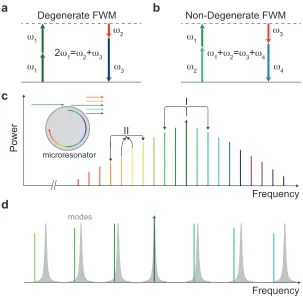
1.3 Principle of microcomb generation. (a)-(b) Level diagrams showing
degenerate and non-degenerate FWM process. (c) The optical
spec-trum of a microcomb, where the central arrow represents the pump.
Process I (II) corresponds to the degenerate (non-degenerate) FWM process. (d) Schematic representation of comb teeth and resonant
modes. When moving away from the pump, the increasing offset
between the comb tooth and the modes is induced by group velocity
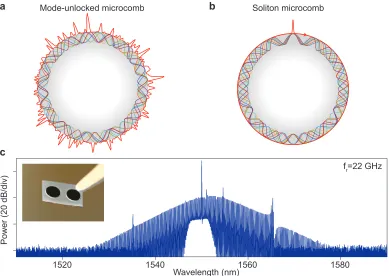
1.4 Soliton microcombs. (a)-(b) Schematic illustrations showing a
mode-unlocked comb and a soliton comb. The oscillations in the resonator represent spectral components of the comb, while the exterior red
lines indicate the intracavity power. (c) A typical spectrum of a
soliton microcomb. The repetition rate is 22 GHz. Inset: silica
microresonators. . . 8
2.1 Schematic illustration of a continuously-driven microresonator. (a)
Coordinates of lab frame. (b) Coordinates of rotational frame. . . 17
2.2 Numerical simulation of LLE. (a) Total intracavity power versus
de-tuning while the pump is tuned across a resonance with increasing
detuning. Parameters used in simulation: f = 50;D2/κ= 0.01. 512 modes are involved. (b) Intracavity intensity versus polar angle at
dif-ferent detunings as marked in (a). I: Turing pattern; II: modulational
instability comb; III: solitons. . . 26
3.1 Silica wedge resonator. (a) Top view of a silica wedge resonator
taken by scanning electron microscope (SEM). The scale bar is 1
mm. Image is from Lue Wu. (b) SEM image showing cross section
of a wedge resonator. The scale bar is 5 µm. Image is from Dr.
Seung Hoon Lee. (c) Finite element method (FEM) simulation of
TM1 mode profile. (d) Typical transmission spectrum while tuning a laser across a high-Q mode in a wedge resonator with 3 mm in
diameter and 8 µm in thickness. The Lorentzian fitting (red) reveals
intrinsic Q factor over 300 million. . . 28
3.2 Dispersion engineering via resonator thickness control. (a) A
ren-dering of a silica resonator with the calculated mode profile of the
TM1 mode superimposed. (b) Cross-sectional SEM images of the
fabricated resonators with different thickness. White scale bar is 5
µm. (c) Simulated regions of normal and anomalous dispersion are shown versus silica resonator thickness (t) and pump wavelength. The zero dispersion wavelength (λZ DW) for the TM1 mode appears
as a blue curve. Plot is made for a 3.2-mm-diameter silica resonator.
Three different device types, I, II, and III, which correspond to top,
mid, and bottom panels in (b), are indicated for soliton generation at
1550 nm, 1064 nm, and 778 nm. The simulation is performed by Dr.
3.3 Measured frequency dispersion (blue points) belonging to the
soliton-forming mode families are plotted versus relative mode number, µ. To construct this plot, mode frequency relative to a µ = 0 mode
(mode to be pumped) is measured using a calibrated Mach-Zehnder
interferometer (fiber optic based). To second order in the mode
number, the mode frequency is given by the Taylor expansionωµ = ω0+ µD1+ 12µ2D2 and the dashed red curves are parabolic fittings with fitted parameters on the top of each panel. In the plot, the mode
frequencies are offset by the linear term in the Taylor expansion to
make clear the second-order group dispersion. The measured modes
span wavelengths from 1520 nm to 1580 nm and µ= 0 corresponds to a wavelength close to 1550 nm. . . 30
3.4 Pump power transmission versus tuning across a resonance used to
generate the solitons. The data show the formation of steps as the
pump tunes red relative to the resonance. Both blue-detuned and
red-detuned operation of the pump relative to the resonance are inferred
from generation of an error signal using a Pound-Drever-Hall system
operated open loop. . . 32
3.5 (a) Simulated intracavity power in which the pump laser scans over
the resonance from the blue side to the red side. The steps on the red-detuned side indicate soliton formation. (b) Schematic of
experimental setup. (c) Four phases of feedback-controlled soliton
excitation: (I) pump laser scans into cavity resonance from
blue-detuned side; (II) laser scan stops and pump power is reduced (∼
10 µs) to trigger solitons, and then increased (∼ 100 µs) to extend soliton existence range; (III) servo-control is engaged to actively lock
the soliton power by feedback control of laser frequency; (IV) lock
sustains and solitons are fully stabilized. The cavity-pump detuning
3.6 Demonstration of capture and locking of a soliton state. (a)
Soli-ton excitation with "power kicking" but no active locking is shown. The soliton state destabilizes around 22ms due to thermal transients.
Soliton power is shown in red and a Mach Zehnder (MZI) reference
is in blue. (b) Soliton excitation with active locking is shown with
conditions similar to panel (a). (c) Zoom-in view of panel (b). The
four phases are indicated using the same background color scheme
as in Figure 3.5. . . 35
3.7 Continuous soliton measurement over 19 hours. Soliton power are
plotted versus time in hours. The soliton power experiences a slow
drift to lower values which is attributed to a slow variation in either the power set point of the electronic control or in the detected power
(perhaps due to temperature drift). . . 36
3.8 Experiment setup, soliton mode-family dispersion, optical spectrum
and autocorrelation. (a) Experimental setup. EDFA:
erbium-doped-fiber-amplifier; AOM: acousto-optic modulator; PD: photodetector;
ESA: electrical spectral analyzer; OSA: optical spectral analyzer;
FROG: frequency resolved optical gatings. (b) Measured mode
fam-ily dispersion (blue points) belonging to the soliton-forming mode
family is plotted versus relative mode number, µ. The presence of non-soliton forming mode families can be seen through the
appear-ance of avoided mode crossings (spur-like features) that perturb the
parabolic shape. Simulations of the non soliton mode families
be-lieved to be responsible for these spurs are provided (see mode 1
and mode 2 dashed curves). In addition, the normalized transverse
intensity profiles for the soliton and non-soliton spatial modes are
provided at the top of the panel (red indicates higher mode intensity).
The simulation used the Sellmeier equation for the refractive index of
silica. Oxide thickness, wedge angle, and radius were fine-adjusted to produce the indicated fits. (c) Optical spectrum of single soliton state
is shown with a sech2 envelope (red dashed line) superimposed for
comparison. The pump laser is suppressed by 20 dB with an optical
Bragg filter. (d) FROG (upper) and autocorrelation trace (lower) of
the soliton state inc. The optical pulse period is 46 ps and the fitted
3.9 Detected phase noise and electrical spectra for three devices with
cor-responding mode dispersion and soliton data. Phase noise spectral density function plotted versus offset frequency from the detected
soliton repetition frequency of three different devices. A Rohde
Schwarz phase noise analyzer was used in the measurement.
In-set shows the electrical spectrum of the soliton repetition frequency
(21.92 GHz) for one device. The other devices had similar
spec-tra with repetition frequencies of 22.01 and 21.92 GHz. The phase
noise of the fiber pump laser is shown in green and was generated
by mixing 2 nominally identical pump lasers to create a 2.7 GHz
electrical beatnote. Several features in the pump laser phase noise are reproduced in the soliton phase noise (see features near and above
20 kHz). The black line connecting square dots is the measurement
floor of the phase noise analyzer. . . 38
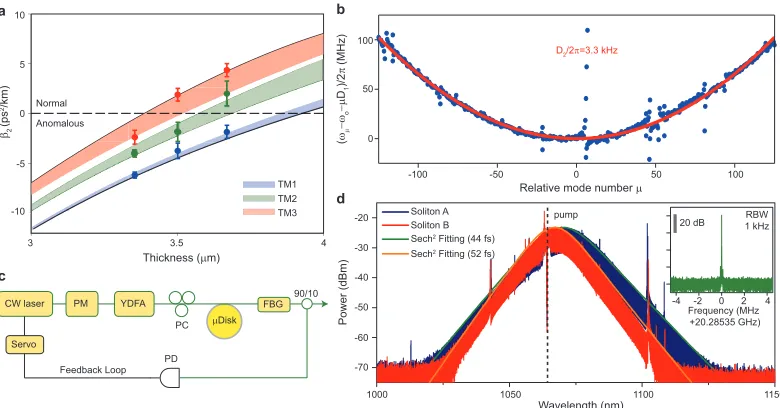
3.10 Microresonator dispersion engineering and soliton generation at 1064
nm. (a) Simulated dispersion (GVD) of TM mode families versus
resonator thickness. The angle of the wedge ranges from 30◦ to
40◦ in the colored regions. Measured data points are indicated and
agree well with the simulation. (b) Measured relative mode
frequen-cies (blue points) plotted versus relative mode number of a soliton-forming TM1 mode family in a 3.4 µm thick resonator. The red
curve is a parabolic fit yielding D2/2π=3.3 kHz. (c) Experimental
setup for soliton generation. A continuous-wave (CW) fiber laser is
modulated by an electro-optic phase modulator (PM) before coupling
to a ytterbium-doped-fiber-amplifier (YDFA). The pump light is then
coupled to the resonator using a tapered fiber. Part of the comb power
is used to servo-lock the pump laser frequency. FBG: fiber Bragg
grating. PD: photodetector. PC: polarization controller. (d) Optical
spectra of solitons at 1064 nm generated from the mode family shown in b. The two soliton spectra correspond to different power levels
with the blue spectrum being a higher power and wider bandwidth
soliton. The dashed vertical line shows the location of the pump
frequency. The solid curves are sech2fittings. Inset: typical detected
electrical beatnote showing soliton repetition rate. RBW: resolution
3.11 Control of soliton properties. (a) Measured soliton comb output
power is plotted versus measured soliton pulse width (red points) with comparison to Eq. (3.1) (dashed red line). The measured
power per central comb tooth is plotted versus pulse width (blue
points) with comparison to Eq. (3.4) (dashed blue line). (b) The
observed soliton spectra at the limits of the measurement in Figure
3.8(a) is shown (see arrows A and B in Figure 3.8(a)). Solid orange
and green curves are simulations using the Lugiato Lefever equation
including Raman terms. The indicated wavelength shifts between
the pump and the center of the soliton spectrum result from Raman
interactions with the soliton. The location of the pump line for both spectra is indicated by the dashed black line and has been suppressed
by filtering. The inset shows a magnified view near the central
region of the blue spectrum. The green (purple) envelope provides
the Lugiato Lefever simulation with (without) Raman terms. The
green spike is the location of the pump. (c) Measured minimum
pump power for soliton existence is plotted versus measured soliton
pulse width (red points) with comparison to Eq. (3.5) (dashed red
line). Measured efficiency is plotted versus measured soliton pulse
width (blue points) with comparison to Eq. (3.6) (dashed blue line). Simulation using Lugiato-Lefever equation including Raman terms
improves agreement with data (small dashed red and blue lines). . . . 42
4.1 (a) Optical spectra measured for a dissipative Kerr cavity soliton at
two operating points. The pump power is suppressed using a fiber
grating filter. A sech2 fit is shown as the orange curves and pulse
widths inferred from the fitting are shown in the legend. The location
of the pump line is indicated as the black line. The centers of the
spectra are indicated by the green lines. (b) The measured Raman
4.2 The measured efficiency versus soliton pulse width is plotted (blue
points) for two devices and compared with theory. Theory compar-ison with Raman (solid blue lines) and without Raman (dash blue
lines) is presented. There are no free parameters in the
compari-son. The small deviations between the measurement and the theory
could result from the presence of weak avoided mode crossings in
the dispersion spectrum. . . 53
5.1 Principle of Stokes soliton generation. The Stokes soliton (red)
max-imizes Raman gain by overlapping in time and space with the primary
soliton (blue). It is also trapped by the Kerr-induced effective optical
well created by the primary soliton. . . 56 5.2 Stokes soliton formation in a microresonator. (a) Simulated
intracav-ity comb power during a laser scan over the primary soliton pumping
resonance from the blue (left) to the red (right) of the resonance. The
detuning is normalized to the resonance linewidth. The initial step
corresponds to the primary soliton formation, and the subsequent
decrease in power corresponds to the onset of the Stokes soliton. The
Stokes soliton power is shown in red. (b) Zoomed-in view of the
indi-cated region from panel a. (c) Experimentally measured primary and
Stokes soliton power during a laser scan showing the features simu-lated in panels a and b. (d) Simulation of the intracavity field in the
moving frame of the solitons plotted versus the pump laser detuning.
The detuning axis is scaled identically to Figure panel a. The Figure
shows the primary soliton step region (below threshold) as well as the
onset of the Stokes soliton (above threshold). (e) Temporal overlap of
the primary and Stokes solitons is numerically confirmed in the plot
of normalized power versus location angle within the resonator. The
overlap confirms trapping and co-propagation. (f) Intracavity optical
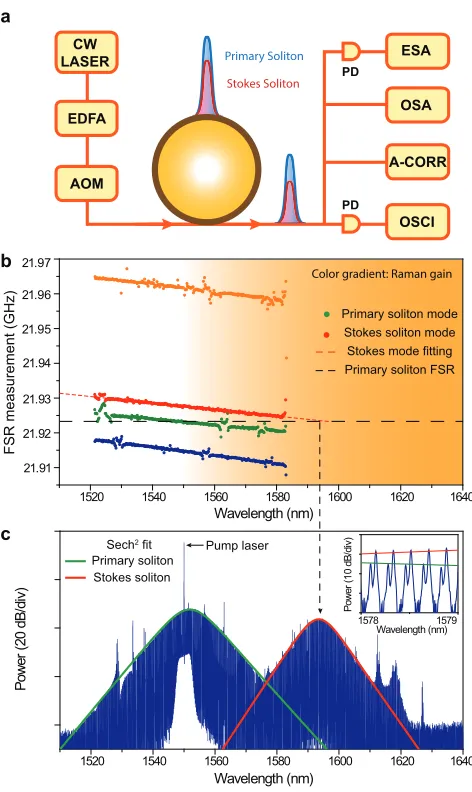
5.3 Experimental setup and observation of Stokes soliton. (a)
Experi-mental setup. (b) Free spectral range (FSR) versus wavelength mea-sured for four mode families in a 3mm disk resonator. The mode
families for the primary and Stokes soliton are shown in green and
red, respectively. The FSR at the spectral center of the primary
soli-ton is shown as a dashed horizontal line. Extrapolation of the Stokes
soliton data (red) to longer wavelengths gives the FSR matching
wave-length where the Stokes soliton forms. The background coloration
gives the approximate wavelength range of the Raman gain spectrum.
(c) Measured primary and Stokes soliton spectra. The Stokes soliton
spectral center closely matches the prediction in (c). Sech2envelopes are shown on each spectrum. The primary soliton spectrum features
a small Raman self-frequency shift. . . 64
5.4 Observation of Stokes solitons in multiple devices. (a) Dispersion
spectra (see Figure 5.3(c)) for the Stokes soliton forming mode
fam-ily measured in three devices (the upper spectrum is the device from
Figure 5.3). Other mode families have been omitted in the plots for
clarity. The horizontal dashed lines give the repetition frequency
of the primary soliton in each device. Extrapolation of the
disper-sion data attained by simulation is provided to graphically locate the predicted Stokes soliton wavelength. (b) The measured primary
and Stokes soliton spectra corresponding to the devices in (a). The
spectral locations of the Stokes solitons agree well with the graphical
predictions. . . 65
5.5 Soliton pulse and frequency measurements. (a)
Frequency-resolved-optical-gating (FROG) traces of the primary and Stokes solitons. The
primary soliton is amplified to 500 mW by an EDFA before coupling
into the FROG setup, while the Stokes soliton is amplified to 10 mW
by two cascaded semiconductor optical amplifiers with gain centered around 1620 nm. The period of the primary and Stokes solitons
are 46 ps, the cavity round trip time. (b) Electrical spectra of the
detected primary soliton pulse stream (blue) and the Stokes pulse
stream (red). (c) Beatnote between neighboring comb teeth of the
primary and Stokes solitons for a device like that in Figure 5.3. The
5.6 Stokes soliton spectra, power and threshold measurements. (a)
Soli-ton spectra are plotted below and above threshold. The upper in-sets show the spatial mode families associated with the primary and
Stokes solitons. (b) Measurement of Stokes soliton power and
pri-mary soliton peak power versus total soliton power. The pripri-mary
soliton peak power (blue) versus total power experiences threshold
clamping at the onset of Stokes soliton oscillation. The theoretical
threshold peak power from Eq. (5.13) is also shown for comparison
as the horizontal blue dashed line. . . 68
6.1 Dispersive wave generation by spatial mode interaction. (a)
Mea-sured relative-mode-frequencies (blue points) of the soliton-forming mode family and the interaction mode family. Mode number µ = 0
corresponds to the pump laser frequency of 193.45 THz (1549.7
nm). Hybrid mode frequencies calculated from Eq. (6.1) are shown
in green and the unperturbed mode families are shown in orange.
The dashed, horizontal black line determines phase matching for
ωr = D1A. (b) Measured soliton optical spectrum with dispersive wave feature is shown. For comparison, a Sech2 fitting is provided
in red. The pump frequency (black) and soliton center frequency
(green) indicate a Raman-induced soliton self-frequency shift (also see Figure 6.2(c)). A microwave beatnote of the photo-detected
soli-ton and dispersive wave is shown in the inset (frequency scale is offset
6.2 Dispersive wave phase matching condition and Raman-induced
fre-quency shift. (a) Soliton and interaction mode family dispersion curves are shown (see Figure 6.1(a)) with phase matching dashed
lines (see Eq. (6.4)). The black line is the case whereωr = D1Aand
the green line includes a Raman-induced change inωr. The
intersec-tion of the soliton branch with these lines is the dispersive wave phase
matching point (arrows). (b) Soliton optical spectra corresponding
to small (red) and large (blue) cavity-laser detuning (δω). Sech2
fitting of the spectral envelope is shown as the orange curves. (c)
Left: soliton self-frequency-shift,Ω, versus 1/τs4(τsis pulse width). The theoretical line is calculated with Q = 166 million (measured) and Raman shock time 2.7 fs. Right: dispersive wave spectra with
cavity-laser detuning (soliton power and bandwidth) increasing from
lower to upper trace. (d) Measured dispersive-wave peak frequencies
(red points) and soliton repetition rate (blue points) are plotted versus
soliton self-frequency shift. The dashed blue line is a plot of Eq.
(6.3). The dashed red line uses Eq. (6.4) to determine the dispersive
wave frequency (≈ µDWD1A+ω0) as described in the text. The offset for the repetition rate vertical scale is D1A =21.9733 GHz. . . 75
7.1 observation of single mode dispersive wave. (a) Measured relative mode frequencies are shown as blue points. The green and yellow
dashed lines represent the fitted relative mode frequencies (∆ωµA
and ∆ωµB) of the unperturbed soliton-forming mode family A and crossing mode family B, respectively. Relative mode frequencies for
upper and lower branch hybrid-modes are∆ωµ+ and∆ωµ−. The red line illustrates the frequencies of a hypothetical soliton frequency
comb. A non-zero slope on this line arises from the repetition rate
change relative to the FSR at mode µ = 0. (b) Measured optical
spectra at soliton operating points I and II, corresponding to closely matched cavity-pump detuning frequencies, δω. A strong
single-mode dispersive wave at µ = 72 is observed for operating point II
and causes a soliton recoil frequency shift. This frequency shift adds
7.2 Soliton hysteretic behavior induced by mode interaction. (a-b)
Dispersive-wave power and soliton spectral center frequency shift versus cavity-pump detuning. Inset in (a): Measured (blue dots) and theoretical
(red line) recoil frequency versus the dispersive wave power. . . 81
7.3 Numerical simulation and analytical model of single-mode dispersive
wave generation and recoil. (a) Numerical (blue dots) and analytical
(red solid line) soliton total frequency shift versus cavity-pump
de-tuning. Points i, ii, iii, and iv correspond to specific soliton operating
points noted in other Figure panels. (b) Numerical (blue dots) and
analytical (red solid line) dispersive wave power (normalized to total
soliton power) versus cavity-pump detuning. Inset: recoil frequency versus the dispersive wave power. (c) Comb spectra contributions
from the two mode families (blue: soliton forming mode family A;
red: crossing mode family B). (d) Time domain intracavity power.
TRis the cavity round trip time. . . 90
7.4 Soliton repetition frequency and phase noise measurement. (a)
Mea-sured (blue dots) and theoretical (red) soliton repetition frequency
versus pump-cavity detuning. The offset frequency is 22.0167 GHz.
The distinct soliton operating points I, II and III refer to phase noise
measurements in panel b. Point III is near the quiet operation point. (b) Phase noise spectra of detected soliton pulse stream at three
oper-ating points shown in panel a. The black line connecting the square
dots is the measurement floor of the phase noise analyzer. (c) Phase
noise of soliton repetition rates at 25 kHz offset frequency plotted
versus the cavity-pump detuning. The blue and red dots (lines)
de-note the experimental (theoretical) phase noise of the upper (blue)
7.5 Experimental setup and details on detuning-noise measurement. (a)
The experimental setup includes both the soliton generation and char-acterization setup and a Pound-Drever-Hall (PDH) system operated
open loop. The PDH is added to make possible the pump-cavity
detuning noise measurement. Components included in the set up are
an EOM: electro-optic modulator; EDFA: Erbium-doped fiber
am-plifier; AOM: acousto-optic modulator; PC: polarization controller;
FBG: fiber Bragg grating; PD: photodetector; OSA: optical spectral
analyzer; PNA: phase noise analyzer; LO: local oscillator. The OSA
and and PNA are shown for completeness. They are used to measure
the soliton spectrum and repetition rate phase noise. They are not involved in measuring the detuning frequency noise. (b)
Measure-ments that illustrate the pump-cavity detuning measurement. The
green trace is the measured power transmission when scanning the
pump laser frequency across a cavity resonance. The pump laser is
phase modulated, the transmitted signal is detected and the resulting
photocurrent is then mixed with the PDH local oscillator signal to
gen-erate the PDH error signal. Upon laser scan the PDH error signal (as
measured on the oscilloscope) is generated as shown in the red trace.
The pump laser is filtered using the fiber Bragg grating. The monitor-ing point for the detunmonitor-ing frequency measurement is indicated by the
black dot. In order to convert scanning time into laser frequency, a
calibrated Mach-Zehnder interferometer (MZI) records power
trans-mission (blue trace) on an oscilloscope. The free-spectral-range of
the MZI is 40 MHz. . . 93
7.6 Existence study for the quiet point. The maximum ratios of|∂ΩRecoil/∂δω|
to |∂ΩRaman/∂δω|at varying normalized modal coupling rateGand normalized crossing-mode damping rate κB (dashed curve is unity
ratio). The quiet point exists when this ratio is greater than unity (red region). Parameters correspond to a silica resonator. . . 96
7.7 Contour plot of detuning range. Color plot of detuning range of
bistability versus spatial-mode coupling strength,G, and dissipation
rate of crossing mode, κB. All quantities are normalized to the
8.1 Microresonator-based dual-comb spectroscopy. Two soliton pulse
trains with slightly different repetition rates are generated by contin-uous optical pumping of two microresonators. The pulse trains are
combined in a fiber bidirectional coupler to produce a signal output
path that passes through a test sample as well as a reference output
path. The output of each path is detected to generate an electrical
interferogram of the two soliton pulse trains. The interferogram is
Fourier transformed to produce comb-like electrical spectra having
spectral lines spaced by the repetition rate difference of the soliton
pulse trains. The absorption features of the test sample can be
ex-tracted from this spectrum by normalizing the signal spectrum by the reference spectrum. Also shown is the image of two, silica wedge
disk resonators. The disks have a 3 mm diameter and are fabricated
on a silicon chip. . . 99
8.2 Detailed experimental setup and soliton comb characterization. (A)
Continuous-wave (CW) fiber lasers are amplified by erbium-doped
fiber amplifiers (EDFA) and coupled into high-Q silica wedge
mi-croresonators via tapered fiber couplers. An acousto-optic modulator
(AOM) is used to control pump power to trigger soliton generation
in the microresonators. Polarization controllers (PC) are used to optimize resonator coupling. A fiber Bragg grating (FBG) removes
the transmitted pump power in the soliton microcomb. The pump
laser frequency is servo controlled to maintain a fixed detuning from
the microresonator resonance by holding the soliton average power
to a fixed setpoint. An optical spectrum analyzer (OSA) monitors
the spectral output from the microresonators. The two soliton pulse
streams are combined in a bidirectional coupler and sent to a gas cell
(or a WaveShaper) and a reference path. The interferograms of the
combined soliton pulse streams are generated by photodetection (PD) and recorded on an oscilloscope. The repetition rates of the soliton
pulse streams are also monitored by an electrical spectrum analyzer
(ESA). The temperature of one resonator is controlled by a
thermo-electric cooler (TEC) to tune the optical frequency difference of the
two solitons. (B)-(C) Optical spectra of the microresonator soliton
pulse streams. (D)-(E) Electrical spectra showing the repetition rates
8.3 Measured electrical interferogram and spectra. (A) The detected
in-terferogram of the reference soliton pulse train. (B) Typical electrical spectrum obtained by Fourier transform of the temporal interferogram
in A. To obtain the displayed spectra, ten spectra each are recorded
over a time of 20 µs and averaged. (C) Resolved (multiple and
in-dividual) comb teeth of the spectrum in panel b are equidistantly
separated by 2.6 MHz, the difference in the soliton repetitation rate
of the two microresonators. The linewidth of each comb tooth is <
50 kHz and set by the mutual coherence of the pumping lasers.
(D)-(E) Fourier-transform (black) of the signal interferogram produced by
coupling the dual-soliton pulse trains through the WaveShaper (see Fig. 8.2(A)) with programmed absorption functions (spectrally flat
and sine-wave). The obtained dual-comb absorption spectra (red) are
compared with the programmed functions (blue curves) from 1545
nm to 1565 nm. . . 103
8.4 Measured molecular absorption spectra. (A) Absorption spectrum
of 2ν1 band of H13CN measured by direct power transmission using
a wavelength-calibrated scanning laser (see Methods section) and
comparison to the microresonator-based dual-comb spectrum. The
residual difference between the two spectra is shown in green. (B) Overlay of the directly measured optical spectrum and the dual-comb
spectrum showing line-by-line matching. The vertical positions of
the two spectra are adjusted to compensate insertion loss. . . 105
9.1 Observation of counter-propagating solitons. (a) Rendering showing
counter-propagating solitons within a high-Q wedge resonator. (b)
Experimental setup. A continuous-wave fiber laser is amplified by
an erbium-doped-fiber-amplifier (EDFA) and sent into two
acousto-optic modulators (AOMs). The outputs from the AOMs are
counter-coupled into the microresonator and generate counter-propagating solitons. The optical power of solitons in one direction is used to
servo lock the pump laser to a certain frequency detuning relative to
the cavity mode. FBG: fiber-Bragg grating; PD: photodetector. (c)
Optical spectra of counter-propagating solitons. The location of the
pump line is indicated by a dashed line. Measured autocorrelation
9.2 Counter-propagating solitons with independently tuned repetition
rates. (a) Electrical spectrum of photo-detected CW and CCW soli-ton pulse streams with pump frequency difference ∆ν = 3.9 MHz.
Strong central peaks give the repetition rate of each soliton. The
weaker spectral lines occurring over a broader spectral range are
inter-soliton beat frequencies. Beat frequencies produced by the
pump line of one soliton beating with higher and lower frequency
comb teeth that neighbor the pump line of the other soliton are
in-dicated by arrows. These spectral lines are shifted by ∆ν = ±3.9 MHz relative to the two, strong repetition-rate lines. (b) Upper trace
is gray-banded region from (a). The pair of strong central peaks give the CW and CCW soliton repetition rates. Lower trace is the same
electrical spectrum when the soliton repetition rates have locked to
the same frequency (pump frequencies differ by ∆ν = 77 kHz). (c)
Temporal interferogram of the baseband inter-soliton beat signal
un-der unlocked condition in (a). (d) Plot of the difference in CW and
CCW repetition rates versus difference in pump frequencies. The red
line is a fit using the model in the Methods section. The inset shows
that the two soliton repetition rates are locked over approximately
150 kHz pump difference frequency range. . . 110 9.3 Mechanism of CP soliton synchronization. (a) Rate locking occurs
when the repetition rates of Ap and Bp are injection-locked by the
backscattering of Bb and Ab, respectively. The upper panel shows
four-wave-mixing sidebands (dashed blue lines) on the comb teeth
of the CCW soliton (solid blue lines). These are created by taper
backscattering of the CW pump. These sidebands are subsequently
backscattered within the resonator into the CW direction (middle
panel), where they (and their CW counter-parts) induce injection
locking of the CW and CCW solitons (lower panel). (b) Simulation of CP soliton repetition rate locking. φAc and φBc are the peak
position of solitons in CW and CCW rotation frames, respectively.
9.4 Counter-propagating soliton phase locking at different repetition rates.
(a) Schematic view of the counter-propagating soliton comb teeth. ∆ν
and∆f denote the pump frequency and repetition rate differences,
re-spectively, and µis mode number relative to the pump mode (µ= 0).
(b) Illustration of inter-soliton radio-frequency (RF) beatnotes
pro-duced under locked and unlocked conditions. (c) Measured RF
beat-notes of unlocked CP solitons (∆ν = 1.5 MHz). (d) Measured RF
beatnotes of locked CP solitons (∆ν =1.5 MHz,∆f = 25 kHz). (e)
Measured beat-note frequency spacing for locked and unlocked
con-ditions plotted versus beatnote number. (f) High-resolution, zoom-in
spectrum of RF beatnotes in (c). The corresponding beat note fre-quency is provided in the legend (25kHz is the fundamental beat note
frequency). (g) Phase noise of the beatnotes at 1 Hz and 10 Hz
off-set frequencies in the phase noise spectrum plotted versus beatnote
frequency. The fitting lines have an f2dependence. . . 116
9.5 Zoom-in of RF spectra showing dual soliton beatnotes. The blue
trace denotes the CP solitons with integration time 50 ms. The red
trace represents the results from solitons generated in two distinct
10.1 Spectrometer concept, experimental setup and static measurement.
(A) Counter propagating soliton frequency combs (red and blue) fea-ture repetition rates that differ by ∆fr, phase-locking at the comb
tooth with indexµ=0 and effective locking atµ= Nthereby setting
up the Vernier spectrometer. Tunable laser and chemical absorption
lines (grey) can be measured with high precision. (B)
Experimen-tal setup. AOM: acousto-optic modulator; CIRC: circulator; PD:
photodetector. Small red circles are polarization controllers. Inset:
scanning electron microscope image of a silica resonator. (C) Optical
spectra of counter-propagating solitons. Pumps are filtered and
de-noted by dashed lines. (D) Typical measured spectrum ofV1V2used to determine ordern. For this spectrum: ∆fn1−∆fn2= 2.8052 MHz and∆fr = 52 kHz giving n= 54. (E) The spectrograph of the dual
soliton interferogram (pseudo color). Line spacing gives ∆fr = 52
kHz. White squares correspond to the index n = 54 in panel C. (F)
Measured wavelength of an external cavity diode laser operated in
steady state. (G) Residual deviations between ECDL laser frequency
measurement as given by the MSS and a wavemeter. Error bars give
the systematic uncertainty as limited by the reference laser in panel B. 125
10.2 Laser tuning and spectroscopy measurements. (A) Measurement of a rapidly tuning laser showing index n (upper), instantaneous
fre-quency (middle), and higher resolution plot of wavelength relative
to average linear rate (lower), all plotted versus time. (B)
Measure-ment of a broadband step-tuned laser as for laser in panel A. Lower
panel is a zoom-in to illustrate resolution of the measurement. (C)
Spectroscopy of H12C14N gas. A vibronic level of H12C14N gas at
5 Torr is resolved using the laser in panel A. (D) Energy level
dia-gram showing transitions between ground state and 2ν1levels. The
10.3 Measurement of a fiber mode-locked laser. (A) Pulse trains generated
from a fiber mode-locked laser (FMLL) are sent into an optical spec-tral analyzer (OSA) and the MSS. (B) Optical spectrum of the FMLL
measured by the OSA. (C) Optical spectrum of the FMLL measured
using the MSS over a 60-GHz frequency range (indicated by dashed
line). (D) Measured (blue) and fitted (red) FMLL mode frequencies
versus index. The slope of the fitted line is set to 249.7 MHz, the
mea-sured FMLL repetition rate. (E) Residual MSS deviation between
measurement and fitted value. . . 129
10.4 Multi-frequency measurements. (A) A section of ˜V1,2. Pairs of beatnotes coming from the same laser are highlighted and the derived
nvalue is marked next to each pair of beatnotes. (B) Zoom-in on the highlighted region near 858 MHz in (A). Two beatnotes are separated
by 1.0272 MHz. (C) Cross-correlation of ˜V1and ˜V2is calculated for
11.1 Coherent sampling of dissipative Kerr soliton dynamics. (a)
Concep-tual schematic showing microresonator signal (red) combined with the probe sampling pulse train (blue) using a bidirectional coupler.
The probe pulse train repetition rate is offset slightly from the
mi-croresonator signal. It temporally samples the signal upon photo
detection to produce an interferogram signal shown in the lower
panel. The measured interferogram shows several frame periods
during which two solitons appear with one of the solitons
experienc-ing decay. (b) Left panel is the optical spectrum and right panel is
the FROG trace of the probe EO comb (pulse repetition period is
shown as 46 ps). An intensity autocorrelation in the inset shows a full-width-half-maximum pulse width of 800 fs. (c) Microresonator
pump power transmission when the pump laser frequency scans from
higher to lower frequency. Multiple ‘steps’ indicate the formation of
solitons. (d) Imaging of soliton formation corresponding to the scan
in panel (c). The x-axis is time and the y-axis is time in a frame that
rotates with the solitons (full scale is one round-trip time). The right
vertical axis is scaled in radians around the microresonator. Four
soliton trajectories are labeled and fold-back into the cavity
coordi-nate system. The color bar gives their signal intensity. (e) Soliton intensity patterns measured at four moments in time are projected
onto the microresonator coordinate frame. The patterns correspond
to initial parametric oscillation in the modulation instability (MI)
regime, non-periodic behavior (MI regime), four soliton and single
soliton states. . . 137
11.2 Measurements of non-repetitive soliton events. (a) Two solitons
collide and annihilate. A wave splash appears in the collision. (b)
Two solitons survive a collision, but collide again and one soliton is
annihilated. (c) Two solitons collide and merge into a single soliton. (d) A soliton hops in location when another soliton is annihilated.
The measurement frame rate is 50 MHz in all panels. Inset panels
show similar collision events from numerical simulation, including
11.3 Temporal and spectral measurements of breather solitons. (a) Motion
of a single soliton state showing peak power breathing along its tra-jectory. Panel (c) presents the zoom-in view of the white rectangular
region. (b) Spectral dynamics corresponding to panel (a). The y-axis
is the relative longitudinal mode number corresponding to specific
spectral lines of the soliton. Mode zero is the pumped microresonator
mode. The soliton spectral width breaths as the soliton peak power
modulates. The spectrum is widest when peak power is maximum.
(c) Zoom-in view of the white rectangular region in panel (a). (d)
Soliton amplitude and pulse width breathing corresponding to panel
(c). The frame rate is 50 MHz for all panels. . . 141 11.4 Measurement of relative soliton positions and soliton decay. (a) Plot
of the relative positions of four solitons while the pumping laser
frequency is scanned (high to low). The reference soliton, used to
establish zero angular position, is indicated and all solitons have stable
relative positions after only several µs of motion. (b) The relative
positions of five solitons is measured versus time as the pump laser
frequency is scanned. The soliton relative positions stabilize and
then destabilize at 22 µs. The frame rates for panels (a) and (b) are
10 and 50 MHz, respectively. (c) Interferogram envelope showing a single soliton experiencing decay. An exponential fitting is given as
the dashed black line. (d) The measured pulse width (blue) is plotted
versus time and its resolution limit (dashed blue line) is set by the EO
comb pulse width. The product of soliton amplitude and pulse width
is plotted in red. . . 142
11.5 Simulation of microresonator soliton formation. (a) Simulated
intra-cavity power plotted versus time as the pumping laser is tuned across a
cavity resonance from higher to lower frequencies. The step features
correspond to the formation of solitons. (b) Simulation results corre-sponding to panel (a) and showing the formation of multiple solitons.
In the simulation, the Raman effect and avoided mode crossing are
11.6 Experimental setup. Schematic showing the three functional
sec-tions in the experiment. CW laser: continuous-wave laser; EDFA: erbium-doped-fiber-amplifier; AOM: acousto-optic modulator; BPF:
bandpass filter; PC: polarization controller; PM: phase modulator;
IM: intensity modulator; PS: phase shifter; ATT: attenuator; Amp:
RF amplifier; DC: DC voltage source; WS: optical waveshaper; FBG:
C h a p t e r 1
INTRODUCTION
1.1 A brief history of time standards
Recorded human history started with time measurement. The seasonal floods, the
migration of animals, and the moon phases, are all natural events that announce the passage of time. Ancient Egyptians used sundials, whose shadows tracks the
movement of the sun, to measure the length of the day, later followed by water
clocks which rely on steady water flows. However, these “clocks” did not represent
a universal time standard, as the solar time varies by seasons and latitudes, and water
flows depend on different instruments. Until the Renaissance, Christiaan Huygens
fist introduced general physical quantities - at that time the gravitational acceleration
- into time measurement by connecting a pendulum to a mechanical clock. The error
of a pendulum clock, which was 1 minute per day at its invention, was reduced to
less than 1 seconds per day in later refinements.
The standardized measure of time, which no longer relied on celestial bodies, has
revolutionized astronomy, navigation, and geography. To unify such time standards
for scientific, political, and commercial purposes, the International Meridian
Con-ference held in 1884 agreed that global time should be synchronized to the best
pendulum clock in Greenwich Observatory via telegraphs. Other time standards
were later adopted for higher precision, e.g., the Shortt–Synchronome clocks which
deliver the pendulum cycles to the mechanical clocks using electrical pulses [1], and
quartz oscillators which serve as tuning forks to produce radio frequency signals
[2]. These clocks are capable of measuring a day with error below 1 ms, but their stability is still subject to size and temperature, which requires further calibration.
The atomic clocks and cesium standard
The search for more precise, stable, and universal time standards continued [3]. The
idea of using atoms as natural standard of time was conceived by Load Kelvin as early
as 1879, and the first atomic clock was experimentally demonstrated by Harold Lyons
with ammonia gas cells [4], whose performance is comparable to quartz oscillators.
The foundation of modern atomic standards was established by Isidor Rabi, whose
study unveiled the dynamics of molecular beams in oscillatory magnetic fields [5].
known as the Rabi cycle. The number of atoms that are in excitation level reaches
its maximum when the frequency of the driving field matches the energy difference between the two levels. Using such approach, microwave signals can be locked
to atomic transitions and harness their stability. Rabi’s student, Norman Ramsey,
improved this method by introducing successive oscillatory fields [6], which was
later found exceptionally useful. The first cesium clock was built in 1955, whose
error was below 1 second in 300 years, surpassing all existing means of time
measurement [7]. Therefore, in 1967, the SI unit of time was defined by hyperfine
structure of a cesium atom, which marked that cesium standard came of age.
The stability of an atomic clock can be described by the its fractional instability
defined asδν/ν, whereδνandνdenote the linewidth and frequency of the transition used, respectively. The random thermal motion of atoms would broaden its spectral
linewidth via Doppler shift, which can be suppressed using laser cooling technique
[8–10]. By shining laser beams whose frequencies are slightly lower than certain
atomic transitions, the chance of an atom absorbing photons that are propagating
oppositely is promoted, which in turn slows the atom. If this process is repeated
multiple times, an atomic ensemble can be cooled to a limit very close to absolute
zero, leading to significant narrowing of their spectral linewidths. Such
Doppler-cooling method paves the way to new concepts like atomic fountain clocks [11] and optical lattices [12].
Optical frequency combs: counting light cycles
Another approach to reduce the instability is by increasing the frequency ν, i.e.,
counting more ticks within a second (a periodic signal ticks once every cycle). The
state-of-the-art microwave oscillators can work up to 100 GHz, which is an order
of magnitude higher than the frequency of a cesium clock, 9.2 GHz. For better
precision, microwave oscillators could be superseded by light, which counts time by
femtosecond. The development of ultrastable lasers locked to atoms and molecules
enables the possibility of time standards at optical frequencies.
However, counting optical cycles is never easy, since no electronics are functional
at optical frequencies. The optical signal has to be divided down to radio
fre-quency/microwave region for detection. To solve this issue and measure the speed
of light more accurately, Researchers in NIST constructed a frequency-synthesis
chain, where a series of lasers/oscillators are locked by heterodyne method so that
of its complexity, the frequency chain indeed conveyed the fundamental principles
of optical frequency combs (OFCs): rulers of optical frequencies which consist multiple coherent lasers.
Frequency
Po
w
e
r
fo fr
fo+nfr fo+2nfr
X2 2fo+2nfr fo
a
b
Time
El
e
ct
ri
ca
l
fi
e
ld
T=1/fr
Dfo
c
Po
w
e
r
(2
0
d
B/
d
iv)
Wavelength (nm)
1480 1500 1520 1540 1560 1580 1600
[image:33.612.110.493.139.496.2]fr=250 MHz
The development of OFCs has been thoroughly covered in the Nobel lectures by
John Hall and Theodor Hansch [14, 15]. The first rudiments of OFCs date back to ’60s, when mode-locked lasers were invented [16–19]. They produced periodic
pulse trains, which give equally spaced, comb-like fringes in spectral domain, as
shown in Figure 1.1. However, there still exists substantial discrepancy between
those early mode-locked lasers and modern OFCs. In order to turn a mode-locked
laser into an OFC, the parameters that define a comb, namely the offset frequency
fo and the repetition rate fr, need to be measured and controlled. The repetition
rate frcan be easily derived from the beatnotes between adjacent comb teeth, while
the determination of the offset frequency remained a challenge. Until late ’90s,
the development of photonic crystal fibers for supercontinuum generation [20] gave rise to octave-spanning OFCs [21, 22], which allowed the detection of the offset
frequency via a method called self-referencing, as depicted in Figure 1.1(b).
Optical-rate signals derived from lasers and atomic transitions can now be
accu-rately measured by referencing them to specific comb teeth. Soon OFC-based
optical clocks were developed, showing unparalleled performance which, of course,
surpassed cesium standard [23–28]. To date, the best optical clock, which uses
Strontium atoms trapped in optical lattices, is able to reach 10−19 level in relative
accuracy, which is akin to a second versus the entire age of the universe (13.8 billion years) [29].
Besides next generation time standard, OFCs also have a broad impact in science and
technology, including but not limited to, optical frequency synthesis [30–33],
spec-troscopy [34–37], ranging [38], astronomical calibration [39–41], and attosecond
physics [42]. It is noted that, for many applications, resolving the offset frequencies
is not mandatory, while the stability of repetition rates and the equidistance of comb
teeth is crucial. Therefore, in this thesis, we take the loose definition of optical frequency combs: a series of phase-locked, coherent lasers featuring equally spaced
frequencies.
1.2 Microcombs and soliton mode-locking
The great success of optical frequency combs is primarily built on mode-locked
lasers [43]. The first mode-locking was achieved by acousto-optic modulating a
piece of fused quartz in a laser cavity [16]. If the modulation period matched
cavity round trip time, pulsed output was observed from the cavity. Later saturable
mode-locked pulses [17, 18], and their implementation in continuously-driven laser cavities
was theoretically studied [44] and demonstrated [19]. More approaches such as addictive pulse mode-locking and Kerr mode-locking were developed, which have
been reviewed in detail by Haus [45].
Nowadays, Ti-sapphire mode-locked lasers [46] and fiber mode-locked lasers [47]
have become the most conventional platforms for OFCs, since they are able to
gener-ate ultrashort pulses. Besides mode-locking, electro-optic modulating a continuous-wave laser has provided an alternative route to produce a frequency comb [48–50].
These instruments are generally power-consuming, and require delicate laboratory
environment to operate. Integrating these systems on a photonic chip would
revolu-tionize instrumentation, and enable applications in more cluttered environment, e.g.,
space, a miniaturized form of the OFC is desired. Recent advance in
microphoton-ics has led to a miniaturized form of optical frequency combs, namely microcombs
[51, 52]. They are generated in monolithic optical microresonators with a dramatic
reduction in footprint and power consumption. Some of them are compatible with
integrated photonic systems, and could be massively produced using conventional
complementary metal–oxide–semiconductor (CMOS) technology [52].
Optical microresonators
Optical microresonators are able to trap light at discrete resonant frequencies in a
tiny space [53]. Two figures of merit are often used to compare microresonators:
quality (Q) factor and effective mode volume. The quality factor is a dimensionless
parameter defined as the ratio between the resonant frequency, ωo, and the photon
damping rate,κ, which is given by
Q = ωo
κ . (1.1)
Therefore, a higher Q means slower dissipation of intracavity photons, i.e., a longer
photon lifetime. The effective mode volume determines the field confinement of the
resonator, and a smaller effective mode volume would lead to a denser light field.
Microresonators can be classified according to their trapping mechanism. As shown
in Figure 1.2, a Fabry-P´erot-type microresonator traps photons using a pair of
high-reflectivity mirrors, while whispering-gallery-mode (WGM) microresonators and
microrings confine light via total internal reflection [53]. To date, over 10 billion
Q has been reported in a crystalline WGM microresonator [54], and Q factors
close to a billion have been realized on chip-based platforms [55]. In these
d
a b c
Figure 1.2: Multiple types of microresonators. (a) A Fabry-P´erot-type onator. (b) A whispering-gallery-mode microresonator. (c) A ring-shaped microres-onator. (d) A silica whispering-galley-mode microresonator on a chip. The photo is provided in courtesy of Lue Wu.
magnitude, which is sufficient to trigger many nonlinear process, e.g., thermo-optic
effect [56, 57], Raman lasing [58], harmonic generation [59], cavity-optomechanics
[60] and Brillouin scattering [55].
Microcombs
The process that gives rise to the formation of microcombs is four wave mixing (FWM), which is associated with optical Kerr effect [61]. There are two types
of FWM, (i) the degenerate case where two photons of identical frequencies are
converted to two frequency-shifted photons, and (ii) the non-degenerate case where
all four photons feature different frequencies, as depicted in Figure 1.3(a)-(b).
FWM occurs in a series of longitudinal modes in the microresonator with proper
group velocity dispersion (usually anomalous dispersion). Pumped by a
monochro-matic laser, the first few optical sidebands were generated spontaneously via
degen-erate FWM process, which can be further cascaded via FWM process to create an OFC, as shown in Figure 1.3(c) [51, 52, 62]. It is noted that the pump also serves
as a comb tooth. In a fully-developed microcomb where each longitudinal mode is
filled by a comb tooth, the repetition rate is defined by the free-spectral-range (FSR)
of the microresonator.
The microcomb can be mode-locked if the initial pair of sidebands are generated
a b
c ω1
ω1
ω2
ω3
2ω
1=ω2+ω3
ω1
ω2
ω3
ω4 ω
1+ω2=ω3+ω4
Degenerate FWM Non-Degenerate FWM
Frequency
Po
w
e
r
I
II
microresonator
d
[image:37.612.153.456.72.369.2]Frequency modes
Figure 1.3: Principle of microcomb generation. (a)-(b) Level diagrams showing degenerate and non-degenerate FWM process. (c) The optical spectrum of a micro-comb, where the central arrow represents the pump. Process I (II) corresponds to the degenerate (non-degenerate) FWM process. (d) Schematic representation of comb teeth and resonant modes. When moving away from the pump, the increasing offset between the comb tooth and the modes is induced by group velocity dispersion of the resonator.
the cascaded FWM process [51, 52]. However, it requires a strong anomalous group velocity dispersion, which limits the spectral bandwidth of the comb due to the
frequency walking-off between the modes and the comb tooth, as shown in Figure
1.3(d). Moreover, it is found that, if such requirement is not satisfied, noise would
build up during the formation of the comb, which results in non-equidistance of the
comb spacing [62]. Indication of mode-locking was observed [63–65], but for a
long time, reliably mode-locking a microcomb has remained a challenge.
Soliton microcombs
The recent development of soliton mode-locking technique has provided a route to
stably mode lock microcombs [66–68]. Once soliton mode-locking occurs,
along the microresonators indefinitely. The phases of the comb teeth are
synchro-nized, distinct from the mode-unlocked case, as depicted in Figure 1.4(a)-(b). A typical spectrum of a soliton microcomb is shown in Figure 1.4(c), which features
a smooth, reproducible spectral envelope in addition to equidistant comb teeth.
Soliton mode-locking was first demonstrated in a fiber-ring resonator upon pulsed
seeding [69], while in microresonators soliton pulses can form spontaneously on
continuous-wave background [70]. To date, soliton microcombs have been
demon-strated on a wide range of material platforms, including magnesium fluoride [66, 71],
silica [67, 72–75], silicon nitride [68, 76–78], silicon [79], lithium niobate [80] and aluminum nitride [81]. Their performance has reached parity with their table-top
counterparts in both spectral bandwidth [82, 83] and coherence [71, 84]. The boost
of Q factors in integrated devices has dramatically reduced the power consumption
of soliton microcombs [73, 85], which paves the way towards fully-integrated soliton
microcomb sources [86].
a b
c
Po
w
e
r
(2
0
d
B/
d
iv)
Wavelength (nm)
1520 1540 1560 1580
fr=22 GHz
[image:38.612.112.501.343.619.2]Mode-unlocked microcomb Soliton microcomb